LABOR ANALGESIA
Moderator: Dr. Rejin K. Udaya
Presenter: Dr. Kundan Kishor Ghimire
Objectives
• Pain pathways during different stages of labor
• Various methods of labor analgesia
• Technique for the Epidural analgesia for painless delivery
• Indication, contraindication benefits and complication of epidural
analgesia.
Introduction
Labor
• defined as spontaneous painful uterine contractions associated with the
effacement and dilatation of the cervix and the descending of the
presenting part.
• most painful experience many women encounter.
• pain is due to cervical and lower uterine segment dilatation, uterine
contraction and distension of the structures surrounding the vagina and
pelvic outlet.
As noted by the ASA and the ACOG
• There is no other circumstance where it is considered acceptable for a
person to experience severe pain, amenable to safe intervention.
• Maternal request is a sufficient medical indication for pain relief during
labor.
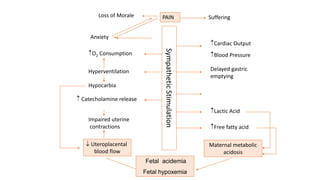
Sympathetic
Stimulation
PAIN Suffering
Loss of Morale
Anxiety
O2 Consumption
Hyperventilation
Hypocarbia
 Catecholamine release
Impaired uterine
contractions
 Uteroplacental
blood flow
Cardiac Output
Blood Pressure
Delayed gastric
emptying
Lactic Acid
Free fatty acid
Maternal metabolic
acidosis
Fetal acidemia
Fetal hypoxemia
Stages of labor
First stage of labor:
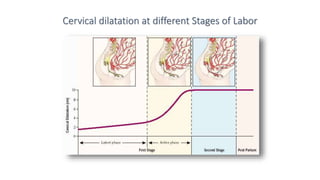
• True uterine contraction to fully dilation of cervix 10cm.
• Latent phase:-cervix dilation slowly reach to 4 cm.
• Active phase:- rapid dilation of cervix to reach 10cm
• Primi:8 -12 hrs
• Multi:- 6-8 hrs
Second stage:
• complete cervical dilation to birth of fetus.
• Primi- 1 hrs
• Multi ½ hrs
3rd stage:
• expulsion of placenta and membranes.
• 30 min.
Cervical dilatation at different Stages of Labor
Physiology of Pain in Labor
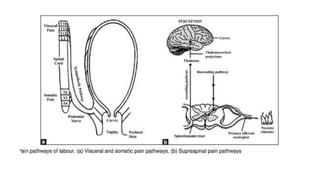
1st stage of labor –
• mostly visceral, Dull aching and poorly localized
◦ Dilation of the cervix and distention of the lower uterine segment
◦ Pain impulses are transmitted by afferent, slow conducting, A-delta
and C fibres accompanying sympathetic nerves enters spinal cord at
T10 to L1 level.
2nd stage of labor
• mostly somatic
◦ Distention of the pelvic floor, vagina and perineum
◦ Sharp, severe and well localized
◦ Stimuli enter spinal cord at S2 to S4 through pudendal nerve.
Ideal labor analgesics
• Provides good analgesics
• Be safe for the mother and baby
• Be predictable and constant in its effects
• Be easy to administer
• No loss of maternal consciousness
• Should not interfere with uterine contractions or progress of labor
• Should not interfere with mobility.
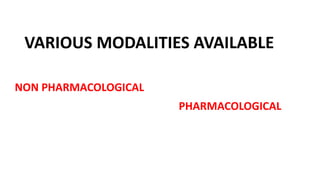
VARIOUS MODALITIES AVAILABLE
NON PHARMACOLOGICAL
PHARMACOLOGICAL
APPLICATION OF NON PHARMACOLOGICAL
METHODS OF LABOR ANALGESIA
• Useful in primary set ups
• Regional block facility not available
• Safe
• No side effects
• Primarily 1st stage analgesia
• However unsatisfactory in large no of patients
Non pharmacological methods
Acts by:
• Psycho-prophylaxis: altering the pain perception
• Activating peripheral pain perception
Psychoprophylaxis: patterned breathing and
relaxation techniques
• Physiologically by improving oxygenation and reducing muscle
tension,
• Cognitively by focusing on breathing and relaxation instead of pain
• Psychologically by reducing fear, anxiety and improving the sense of
personal control
Psycho-prophylaxis
• Lamaze technique
• Leboyer’s method
• Hypnosis
• Continuous labor support
• Yoga
• Relaxation and breathing
• Music and audioanalgesia
Technique that activate peripheral sensory
perception
• Application of heat and cold
• Transcutaneous electrical nerve stimulation
• Acupunture and Acupressure
• Intradermal water blocks
• Water baths in labor
• Touch and massage
Superficial applications of heat or cold
• Easy to use, inexpensive
• Minimal negative side effects when used properly
• Heat application: back, lower abdomen, groin and perineum
• Heat sources: hot water bottle, heated rice-filled shock, warm compress
(wash clothes soaked in warm water), electric heating pad, warm
blanket and warm bath or shower
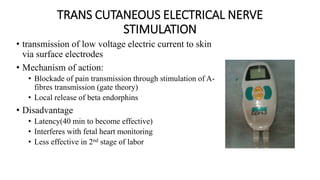
TRANS CUTANEOUS ELECTRICAL NERVE
STIMULATION
• transmission of low voltage electric current to skin
via surface electrodes
• Mechanism of action:
• Blockade of pain transmission through stimulation of A-
fibres transmission (gate theory)
• Local release of beta endorphins
• Disadvantage
• Latency(40 min to become effective)
• Interferes with fetal heart monitoring
• Less effective in 2nd stage of labor
Contd..
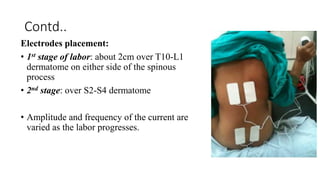
Electrodes placement:
• 1st stage of labor: about 2cm over T10-L1
dermatome on either side of the spinous
process
• 2nd stage: over S2-S4 dermatome
• Amplitude and frequency of the current are
varied as the labor progresses.
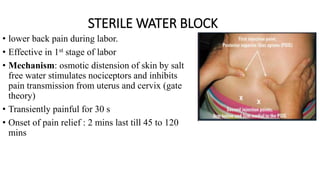
STERILE WATER BLOCK
• lower back pain during labor.
• Effective in 1st stage of labor
• Mechanism: osmotic distension of skin by salt
free water stimulates nociceptors and inhibits
pain transmission from uterus and cervix (gate
theory)
• Transiently painful for 30 s
• Onset of pain relief : 2 mins last till 45 to 120
mins
Pharmacological techniques
for labor analgesia
Pharmacological methods
• Systemic analgesia:
• Opioids
• Inhalational
• Recently, paracetamol
• Regional analgesia:
• Central neuraxial blockade
• Paracervical and pudendal nerve block
• Lumbar sympathetic block
Inhalational Analgesia
• Sub anesthetic concentrations of inhaled anesthetics
• Mother remain awake with protective laryngeal reflexes
• Either alone or as a supplement to regional anesthesia
• Easy and rapid (decrease FRC, increase MV in pregnancy)
• No effect on progress of labor
• Make uterine contraction tolerable
Disadvantages:
• Incomplete pain relief and unpleasant smell
• Specialized vaporizers
• Risk of over dose and sedation
• Environmental pollution hazards
• Need maternal monitoring and scavenging
• Post hyperventilation hypoxia
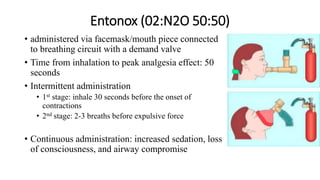
Entonox (02:N2O 50:50)
• administered via facemask/mouth piece connected
to breathing circuit with a demand valve
• Time from inhalation to peak analgesia effect: 50
seconds
• Intermittent administration
• 1st stage: inhale 30 seconds before the onset of
contractions
• 2nd stage: 2-3 breaths before expulsive force
• Continuous administration: increased sedation, loss
of consciousness, and airway compromise
Sevoflurane/Sevox
• 0.8% sevoflurane with oxygen in oxford miniature vaporizer
• Good analgesia with minimal sedation
• Pleasant odor, non irritant to the respiratory tract
• Useful pain relief during the first stage of labor
• Greater analgesia than Entonox
• More sedation with sevoflurane
Systemic Analgesia
Indications:
• Regional contraindicated or technically difficult or not available
Disadvantages:
• Poor efficacy
• Maternal/neonatal effects of opioids
• Maternal side effects: sedation, respiratory depression, orthostatic hypotension,
nausea and vomiting, gastric motility and delays emptying
• Fetal effects: FHR variability, resp depression, APGAR score, neurobehaviour
changes
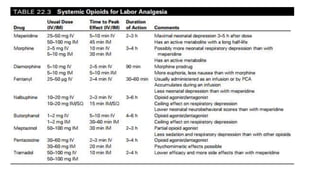
Meperidine
• most commonly used parenteral opioid
• analgesic effect lasts up to 2-3 hours
• cause sedation, respiratory depression in the neonate
• neonatal effects most likely if delivery occurs between 1 and 4 hr. after
administration
• Babies sleepier, less attentive, less able to establish breast feeding despite normal
Apgar score.
Tramadol
• Synthetic opioid
• IM: 100mg/10-30min (onset)/ 3-4 hrs(duration)
• Moderate analgesia (effective in 1st stage)
• Mild respiratory depression
• Side effects: nausea, vomiting, sedation, dry mouth, sweating
• High placental permeability
Fentanyl
• Synthetic opioid
• Highly lipid soluble, protein bound
• Provides reasonable levels of analgesia with minimal neonatal
depression.
• 25 to 50 µg intravenously
• peak effect occurs within 3 to 5 minutes and has a duration of 30 to 60
minutes
KETAMINE
• Dose: 0.25mg/kg, onset <30sec, duration: 3-5min
• Infusion: 0.25mg/kg followed by 0.25mg/kg/hr
• Minimal maternal and fetal complications at lower doses
• Indications:
• Imminent vaginal delivery in parturient without regional anesthesia
• Adjunctive agent in parturient with unsatisfactory regional
anesthesia
BARBITURATES
• Early stage labor managed with either IM or oral barbiturates.
phenobarbitol 100 to 200 mg
• Effect 1hr after oral,30 min after IM.
BENZODIAZEPINES
• not used in labor.
Regional Analgesia
• Epidural analgesia
• Combined spinal epidural analgesia
• Spinal analgesia
• Continuous spinal analgesia
• Dural puncture epidural (DPE)
• Paracervical block
• Pudendal nerve block
Epidural Labor Analgesia
• Gold standard for pain relief in labor
• Excellent pain relief and maternal satisfaction
• Minimal fetal side effects and maternal adverse effects
• Easily converts to surgical anesthetic, even in emergent/urgent
situation
PRE-REQUISITES
• Pre anesthetic check up
• Consent
• IV access and monitor
• Facility of resuscitation equipment and drugs, oxygen, suction,
intubation equipment, IPPV
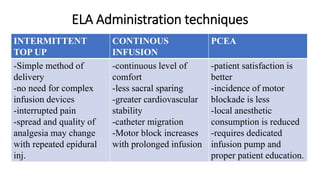
Epidural analgesia: mode of administration
• Intermittent top ups
• Continuous infusion
• Patient controlled epidural analgesia:
• With basal infusion
• Without basal infusion
• Computer integrated PCEA
ELA Administration techniques
INTERMITTENT
TOP UP
CONTINOUS
INFUSION
PCEA
-Simple method of
delivery
-no need for complex
infusion devices
-interrupted pain
-spread and quality of
analgesia may change
with repeated epidural
inj.
-continuous level of
comfort
-less sacral sparing
-greater cardiovascular
stability
-catheter migration
-Motor block increases
with prolonged infusion
-patient satisfaction is
better
-incidence of motor
blockade is less
-local anesthetic
consumption is reduced
-requires dedicated
infusion pump and
proper patient education.
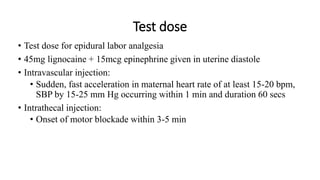
Test dose
• Test dose for epidural labor analgesia
• 45mg lignocaine + 15mcg epinephrine given in uterine diastole
• Intravascular injection:
• Sudden, fast acceleration in maternal heart rate of at least 15-20 bpm,
SBP by 15-25 mm Hg occurring within 1 min and duration 60 secs
• Intrathecal injection:
• Onset of motor blockade within 3-5 min
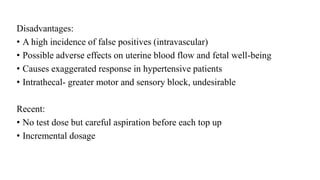
Disadvantages:
• A high incidence of false positives (intravascular)
• Possible adverse effects on uterine blood flow and fetal well-being
• Causes exaggerated response in hypertensive patients
• Intrathecal- greater motor and sensory block, undesirable
Recent:
• No test dose but careful aspiration before each top up
• Incremental dosage
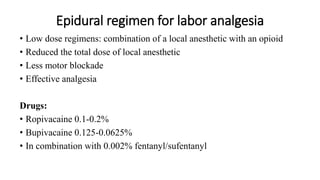
Epidural regimen for labor analgesia
• Low dose regimens: combination of a local anesthetic with an opioid
• Reduced the total dose of local anesthetic
• Less motor blockade
• Effective analgesia
Drugs:
• Ropivacaine 0.1-0.2%
• Bupivacaine 0.125-0.0625%
• In combination with 0.002% fentanyl/sufentanyl
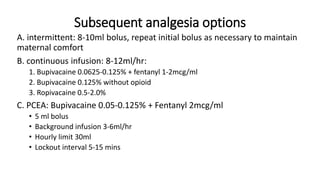
Subsequent analgesia options
A. intermittent: 8-10ml bolus, repeat initial bolus as necessary to maintain
maternal comfort
B. continuous infusion: 8-12ml/hr:
1. Bupivacaine 0.0625-0.125% + fentanyl 1-2mcg/ml
2. Bupivacaine 0.125% without opioid
3. Ropivacaine 0.5-2.0%
C. PCEA: Bupivacaine 0.05-0.125% + Fentanyl 2mcg/ml
• 5 ml bolus
• Background infusion 3-6ml/hr
• Hourly limit 30ml
• Lockout interval 5-15 mins
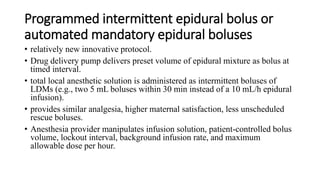
Programmed intermittent epidural bolus or
automated mandatory epidural boluses
• relatively new innovative protocol.
• Drug delivery pump delivers preset volume of epidural mixture as bolus at
timed interval.
• total local anesthetic solution is administered as intermittent boluses of
LDMs (e.g., two 5 mL boluses within 30 min instead of a 10 mL/h epidural
infusion).
• provides similar analgesia, higher maternal satisfaction, less unscheduled
rescue boluses.
• Anesthesia provider manipulates infusion solution, patient-controlled bolus
volume, lockout interval, background infusion rate, and maximum
allowable dose per hour.
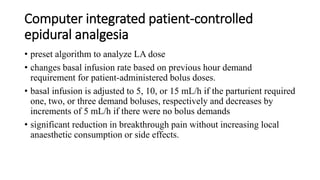
Computer integrated patient-controlled
epidural analgesia
• preset algorithm to analyze LA dose
• changes basal infusion rate based on previous hour demand
requirement for patient-administered bolus doses.
• basal infusion is adjusted to 5, 10, or 15 mL/h if the parturient required
one, two, or three demand boluses, respectively and decreases by
increments of 5 mL/h if there were no bolus demands
• significant reduction in breakthrough pain without increasing local
anaesthetic consumption or side effects.
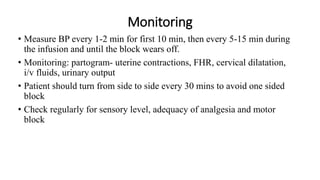
Monitoring
• Measure BP every 1-2 min for first 10 min, then every 5-15 min during
the infusion and until the block wears off.
• Monitoring: partogram- uterine contractions, FHR, cervical dilatation,
i/v fluids, urinary output
• Patient should turn from side to side every 30 mins to avoid one sided
block
• Check regularly for sensory level, adequacy of analgesia and motor
block
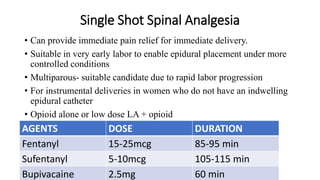
Single Shot Spinal Analgesia
• Can provide immediate pain relief for immediate delivery.
• Suitable in very early labor to enable epidural placement under more
controlled conditions
• Multiparous- suitable candidate due to rapid labor progression
• For instrumental deliveries in women who do not have an indwelling
epidural catheter
• Opioid alone or low dose LA + opioid
AGENTS DOSE DURATION
Fentanyl 15-25mcg 85-95 min
Sufentanyl 5-10mcg 105-115 min
Bupivacaine 2.5mg 60 min
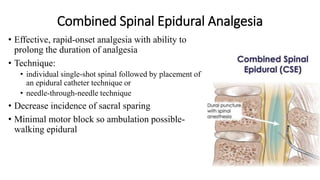
Combined Spinal Epidural Analgesia
• Effective, rapid-onset analgesia with ability to
prolong the duration of analgesia
• Technique:
• individual single-shot spinal followed by placement of
an epidural catheter technique or
• needle-through-needle technique
• Decrease incidence of sacral sparing
• Minimal motor block so ambulation possible-
walking epidural
Advantages of CSEA
Compared with epidural anesthesia
• Lower maternal, fetal, and neonatal plasma concentrations of
anesthetic agents
• More rapid onset of analgesia and anesthesia
• Denser sensory blockade
• Complete early labor analgesia with opioid alone (no local anesthetic
necessary)
• Lower failure rate
Compared With Spinal Anesthesia
• Technically easier in obese individuals.
• Ability to titrate anesthetic dose,
• Results in less hypotension
• Ability to extend the extent of neuroblockade.
• Continuous technique: ability to extend duration of anesthesia
Walking Epidural
• Also called ambulatory epidural.
• Also called minimal motor block epidural
• Low dose CSE opioid analgesia because motor function maintained
and the ability to walk not impaired.
• Any neuroaxial analgesia technique allowing safe ambulation
• Methods:
• CSE: Queen Charlotte regimen
• Intrathecal-12.5 to 25mcg of fentanyl + 2.5 mg of 0.5% bupivacaine
• Epidural- 0.0625% bupivacaine + 2mcg/ml fentanyl {10ml}
• Advantages:
• Adopting upright position may increase the pelvic diameter.
• Decreased aorto caval compression
• Improves uterine contractions
• May encourage correct positioning of fetal head.
Criteria for Ambulation during labor with
Neuroaxial Analgesia
• Reassuring fetal status
• Engagement of fetal presenting part
• Stable orthostatic vital signs(asymptomatic and within 10% of
baseline)
• Ability to perform bilateral straight-leg raises in bed against resistance
• Ability to step on step stool with either leg without assistance
• Satisfactory trial of walking accompanied by a nurse
• Patient must be accompanied by a companion at all times.
• Intermittent fetal heart rate monitoring: every 15 mins
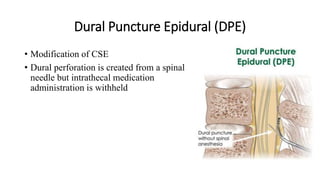
Dural Puncture Epidural (DPE)
• Modification of CSE
• Dural perforation is created from a spinal
needle but intrathecal medication
administration is withheld
Compared with epidural(EPL) and CSE
technique
• DPE technique has the advantages of:
• Earlier onset
• Increased likelihood of functional epidural catheter due to
confirmation of midline on placement.
• Lesser top ups
• Improves caudal spread of analgesia
• Less side effects like pruritus, hypotension etc.
Side effects of Neuroaxial Analgesia
• Hypotension
• Pruritus
• Nausea and vomiting
• Fever
• Shivering
• Urinary retension
• Recrudescence of HSV
• Delayed gastric emptying
Complications of Neuraxial Analgesia
• Inadequate analgesia
• Unintentional dural puncture
• Respiratory depression
• Intravascular injection of LA
• High and total spinal anesthesia
• Extensive motor blockade
• Prolonged blockade
• Sensory changes
• Back pain
• Pelvic floor injury.
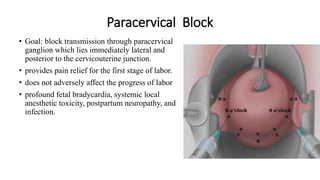
Paracervical Block
• Goal: block transmission through paracervical
ganglion which lies immediately lateral and
posterior to the cervicouterine junction.
• provides pain relief for the first stage of labor.
• does not adversely affect the progress of labor
• profound fetal bradycardia, systemic local
anesthetic toxicity, postpartum neuropathy, and
infection.
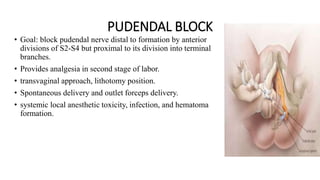
PUDENDAL BLOCK
• Goal: block pudendal nerve distal to formation by anterior
divisions of S2-S4 but proximal to its division into terminal
branches.
• Provides analgesia in second stage of labor.
• transvaginal approach, lithotomy position.
• Spontaneous delivery and outlet forceps delivery.
• systemic local anesthetic toxicity, infection, and hematoma
formation.
THANK-YOU

Labor analgesia

  • 1.
    LABOR ANALGESIA Moderator: Dr.Rejin K. Udaya Presenter: Dr. Kundan Kishor Ghimire
  • 2.
    Objectives • Pain pathwaysduring different stages of labor • Various methods of labor analgesia • Technique for the Epidural analgesia for painless delivery • Indication, contraindication benefits and complication of epidural analgesia.
  • 3.
    Introduction Labor • defined asspontaneous painful uterine contractions associated with the effacement and dilatation of the cervix and the descending of the presenting part. • most painful experience many women encounter. • pain is due to cervical and lower uterine segment dilatation, uterine contraction and distension of the structures surrounding the vagina and pelvic outlet.
  • 4.
    As noted bythe ASA and the ACOG • There is no other circumstance where it is considered acceptable for a person to experience severe pain, amenable to safe intervention. • Maternal request is a sufficient medical indication for pain relief during labor.
  • 5.
    Sympathetic Stimulation PAIN Suffering Loss ofMorale Anxiety O2 Consumption Hyperventilation Hypocarbia  Catecholamine release Impaired uterine contractions  Uteroplacental blood flow Cardiac Output Blood Pressure Delayed gastric emptying Lactic Acid Free fatty acid Maternal metabolic acidosis Fetal acidemia Fetal hypoxemia
  • 6.
    Stages of labor Firststage of labor: • True uterine contraction to fully dilation of cervix 10cm. • Latent phase:-cervix dilation slowly reach to 4 cm. • Active phase:- rapid dilation of cervix to reach 10cm • Primi:8 -12 hrs • Multi:- 6-8 hrs
  • 7.
    Second stage: • completecervical dilation to birth of fetus. • Primi- 1 hrs • Multi ½ hrs 3rd stage: • expulsion of placenta and membranes. • 30 min.
  • 8.
    Cervical dilatation atdifferent Stages of Labor
  • 9.
    Physiology of Painin Labor 1st stage of labor – • mostly visceral, Dull aching and poorly localized ◦ Dilation of the cervix and distention of the lower uterine segment ◦ Pain impulses are transmitted by afferent, slow conducting, A-delta and C fibres accompanying sympathetic nerves enters spinal cord at T10 to L1 level.
  • 10.
    2nd stage oflabor • mostly somatic ◦ Distention of the pelvic floor, vagina and perineum ◦ Sharp, severe and well localized ◦ Stimuli enter spinal cord at S2 to S4 through pudendal nerve.
  • 12.
    Ideal labor analgesics •Provides good analgesics • Be safe for the mother and baby • Be predictable and constant in its effects • Be easy to administer • No loss of maternal consciousness • Should not interfere with uterine contractions or progress of labor • Should not interfere with mobility.
  • 13.
    VARIOUS MODALITIES AVAILABLE NONPHARMACOLOGICAL PHARMACOLOGICAL
  • 14.
    APPLICATION OF NONPHARMACOLOGICAL METHODS OF LABOR ANALGESIA • Useful in primary set ups • Regional block facility not available • Safe • No side effects • Primarily 1st stage analgesia • However unsatisfactory in large no of patients
  • 15.
    Non pharmacological methods Actsby: • Psycho-prophylaxis: altering the pain perception • Activating peripheral pain perception
  • 16.
    Psychoprophylaxis: patterned breathingand relaxation techniques • Physiologically by improving oxygenation and reducing muscle tension, • Cognitively by focusing on breathing and relaxation instead of pain • Psychologically by reducing fear, anxiety and improving the sense of personal control
  • 17.
    Psycho-prophylaxis • Lamaze technique •Leboyer’s method • Hypnosis • Continuous labor support • Yoga • Relaxation and breathing • Music and audioanalgesia
  • 18.
    Technique that activateperipheral sensory perception • Application of heat and cold • Transcutaneous electrical nerve stimulation • Acupunture and Acupressure • Intradermal water blocks • Water baths in labor • Touch and massage
  • 19.
    Superficial applications ofheat or cold • Easy to use, inexpensive • Minimal negative side effects when used properly • Heat application: back, lower abdomen, groin and perineum • Heat sources: hot water bottle, heated rice-filled shock, warm compress (wash clothes soaked in warm water), electric heating pad, warm blanket and warm bath or shower
  • 20.
    TRANS CUTANEOUS ELECTRICALNERVE STIMULATION • transmission of low voltage electric current to skin via surface electrodes • Mechanism of action: • Blockade of pain transmission through stimulation of A- fibres transmission (gate theory) • Local release of beta endorphins • Disadvantage • Latency(40 min to become effective) • Interferes with fetal heart monitoring • Less effective in 2nd stage of labor
  • 21.
    Contd.. Electrodes placement: • 1ststage of labor: about 2cm over T10-L1 dermatome on either side of the spinous process • 2nd stage: over S2-S4 dermatome • Amplitude and frequency of the current are varied as the labor progresses.
  • 22.
    STERILE WATER BLOCK •lower back pain during labor. • Effective in 1st stage of labor • Mechanism: osmotic distension of skin by salt free water stimulates nociceptors and inhibits pain transmission from uterus and cervix (gate theory) • Transiently painful for 30 s • Onset of pain relief : 2 mins last till 45 to 120 mins
  • 23.
  • 24.
    Pharmacological methods • Systemicanalgesia: • Opioids • Inhalational • Recently, paracetamol • Regional analgesia: • Central neuraxial blockade • Paracervical and pudendal nerve block • Lumbar sympathetic block
  • 25.
    Inhalational Analgesia • Subanesthetic concentrations of inhaled anesthetics • Mother remain awake with protective laryngeal reflexes • Either alone or as a supplement to regional anesthesia • Easy and rapid (decrease FRC, increase MV in pregnancy) • No effect on progress of labor • Make uterine contraction tolerable
  • 26.
    Disadvantages: • Incomplete painrelief and unpleasant smell • Specialized vaporizers • Risk of over dose and sedation • Environmental pollution hazards • Need maternal monitoring and scavenging • Post hyperventilation hypoxia
  • 27.
    Entonox (02:N2O 50:50) •administered via facemask/mouth piece connected to breathing circuit with a demand valve • Time from inhalation to peak analgesia effect: 50 seconds • Intermittent administration • 1st stage: inhale 30 seconds before the onset of contractions • 2nd stage: 2-3 breaths before expulsive force • Continuous administration: increased sedation, loss of consciousness, and airway compromise
  • 28.
    Sevoflurane/Sevox • 0.8% sevofluranewith oxygen in oxford miniature vaporizer • Good analgesia with minimal sedation • Pleasant odor, non irritant to the respiratory tract • Useful pain relief during the first stage of labor • Greater analgesia than Entonox • More sedation with sevoflurane
  • 29.
    Systemic Analgesia Indications: • Regionalcontraindicated or technically difficult or not available Disadvantages: • Poor efficacy • Maternal/neonatal effects of opioids • Maternal side effects: sedation, respiratory depression, orthostatic hypotension, nausea and vomiting, gastric motility and delays emptying • Fetal effects: FHR variability, resp depression, APGAR score, neurobehaviour changes
  • 31.
    Meperidine • most commonlyused parenteral opioid • analgesic effect lasts up to 2-3 hours • cause sedation, respiratory depression in the neonate • neonatal effects most likely if delivery occurs between 1 and 4 hr. after administration • Babies sleepier, less attentive, less able to establish breast feeding despite normal Apgar score.
  • 32.
    Tramadol • Synthetic opioid •IM: 100mg/10-30min (onset)/ 3-4 hrs(duration) • Moderate analgesia (effective in 1st stage) • Mild respiratory depression • Side effects: nausea, vomiting, sedation, dry mouth, sweating • High placental permeability
  • 33.
    Fentanyl • Synthetic opioid •Highly lipid soluble, protein bound • Provides reasonable levels of analgesia with minimal neonatal depression. • 25 to 50 µg intravenously • peak effect occurs within 3 to 5 minutes and has a duration of 30 to 60 minutes
  • 34.
    KETAMINE • Dose: 0.25mg/kg,onset <30sec, duration: 3-5min • Infusion: 0.25mg/kg followed by 0.25mg/kg/hr • Minimal maternal and fetal complications at lower doses • Indications: • Imminent vaginal delivery in parturient without regional anesthesia • Adjunctive agent in parturient with unsatisfactory regional anesthesia
  • 35.
    BARBITURATES • Early stagelabor managed with either IM or oral barbiturates. phenobarbitol 100 to 200 mg • Effect 1hr after oral,30 min after IM. BENZODIAZEPINES • not used in labor.
  • 36.
    Regional Analgesia • Epiduralanalgesia • Combined spinal epidural analgesia • Spinal analgesia • Continuous spinal analgesia • Dural puncture epidural (DPE) • Paracervical block • Pudendal nerve block
  • 37.
    Epidural Labor Analgesia •Gold standard for pain relief in labor • Excellent pain relief and maternal satisfaction • Minimal fetal side effects and maternal adverse effects • Easily converts to surgical anesthetic, even in emergent/urgent situation
  • 38.
    PRE-REQUISITES • Pre anestheticcheck up • Consent • IV access and monitor • Facility of resuscitation equipment and drugs, oxygen, suction, intubation equipment, IPPV
  • 39.
    Epidural analgesia: modeof administration • Intermittent top ups • Continuous infusion • Patient controlled epidural analgesia: • With basal infusion • Without basal infusion • Computer integrated PCEA
  • 40.
    ELA Administration techniques INTERMITTENT TOPUP CONTINOUS INFUSION PCEA -Simple method of delivery -no need for complex infusion devices -interrupted pain -spread and quality of analgesia may change with repeated epidural inj. -continuous level of comfort -less sacral sparing -greater cardiovascular stability -catheter migration -Motor block increases with prolonged infusion -patient satisfaction is better -incidence of motor blockade is less -local anesthetic consumption is reduced -requires dedicated infusion pump and proper patient education.
  • 41.
    Test dose • Testdose for epidural labor analgesia • 45mg lignocaine + 15mcg epinephrine given in uterine diastole • Intravascular injection: • Sudden, fast acceleration in maternal heart rate of at least 15-20 bpm, SBP by 15-25 mm Hg occurring within 1 min and duration 60 secs • Intrathecal injection: • Onset of motor blockade within 3-5 min
  • 42.
    Disadvantages: • A highincidence of false positives (intravascular) • Possible adverse effects on uterine blood flow and fetal well-being • Causes exaggerated response in hypertensive patients • Intrathecal- greater motor and sensory block, undesirable Recent: • No test dose but careful aspiration before each top up • Incremental dosage
  • 43.
    Epidural regimen forlabor analgesia • Low dose regimens: combination of a local anesthetic with an opioid • Reduced the total dose of local anesthetic • Less motor blockade • Effective analgesia Drugs: • Ropivacaine 0.1-0.2% • Bupivacaine 0.125-0.0625% • In combination with 0.002% fentanyl/sufentanyl
  • 44.
    Subsequent analgesia options A.intermittent: 8-10ml bolus, repeat initial bolus as necessary to maintain maternal comfort B. continuous infusion: 8-12ml/hr: 1. Bupivacaine 0.0625-0.125% + fentanyl 1-2mcg/ml 2. Bupivacaine 0.125% without opioid 3. Ropivacaine 0.5-2.0% C. PCEA: Bupivacaine 0.05-0.125% + Fentanyl 2mcg/ml • 5 ml bolus • Background infusion 3-6ml/hr • Hourly limit 30ml • Lockout interval 5-15 mins
  • 45.
    Programmed intermittent epiduralbolus or automated mandatory epidural boluses • relatively new innovative protocol. • Drug delivery pump delivers preset volume of epidural mixture as bolus at timed interval. • total local anesthetic solution is administered as intermittent boluses of LDMs (e.g., two 5 mL boluses within 30 min instead of a 10 mL/h epidural infusion). • provides similar analgesia, higher maternal satisfaction, less unscheduled rescue boluses. • Anesthesia provider manipulates infusion solution, patient-controlled bolus volume, lockout interval, background infusion rate, and maximum allowable dose per hour.
  • 46.
    Computer integrated patient-controlled epiduralanalgesia • preset algorithm to analyze LA dose • changes basal infusion rate based on previous hour demand requirement for patient-administered bolus doses. • basal infusion is adjusted to 5, 10, or 15 mL/h if the parturient required one, two, or three demand boluses, respectively and decreases by increments of 5 mL/h if there were no bolus demands • significant reduction in breakthrough pain without increasing local anaesthetic consumption or side effects.
  • 47.
    Monitoring • Measure BPevery 1-2 min for first 10 min, then every 5-15 min during the infusion and until the block wears off. • Monitoring: partogram- uterine contractions, FHR, cervical dilatation, i/v fluids, urinary output • Patient should turn from side to side every 30 mins to avoid one sided block • Check regularly for sensory level, adequacy of analgesia and motor block
  • 48.
    Single Shot SpinalAnalgesia • Can provide immediate pain relief for immediate delivery. • Suitable in very early labor to enable epidural placement under more controlled conditions • Multiparous- suitable candidate due to rapid labor progression • For instrumental deliveries in women who do not have an indwelling epidural catheter • Opioid alone or low dose LA + opioid AGENTS DOSE DURATION Fentanyl 15-25mcg 85-95 min Sufentanyl 5-10mcg 105-115 min Bupivacaine 2.5mg 60 min
  • 49.
    Combined Spinal EpiduralAnalgesia • Effective, rapid-onset analgesia with ability to prolong the duration of analgesia • Technique: • individual single-shot spinal followed by placement of an epidural catheter technique or • needle-through-needle technique • Decrease incidence of sacral sparing • Minimal motor block so ambulation possible- walking epidural
  • 50.
    Advantages of CSEA Comparedwith epidural anesthesia • Lower maternal, fetal, and neonatal plasma concentrations of anesthetic agents • More rapid onset of analgesia and anesthesia • Denser sensory blockade • Complete early labor analgesia with opioid alone (no local anesthetic necessary) • Lower failure rate
  • 51.
    Compared With SpinalAnesthesia • Technically easier in obese individuals. • Ability to titrate anesthetic dose, • Results in less hypotension • Ability to extend the extent of neuroblockade. • Continuous technique: ability to extend duration of anesthesia
  • 52.
    Walking Epidural • Alsocalled ambulatory epidural. • Also called minimal motor block epidural • Low dose CSE opioid analgesia because motor function maintained and the ability to walk not impaired. • Any neuroaxial analgesia technique allowing safe ambulation • Methods: • CSE: Queen Charlotte regimen • Intrathecal-12.5 to 25mcg of fentanyl + 2.5 mg of 0.5% bupivacaine • Epidural- 0.0625% bupivacaine + 2mcg/ml fentanyl {10ml}
  • 53.
    • Advantages: • Adoptingupright position may increase the pelvic diameter. • Decreased aorto caval compression • Improves uterine contractions • May encourage correct positioning of fetal head.
  • 54.
    Criteria for Ambulationduring labor with Neuroaxial Analgesia • Reassuring fetal status • Engagement of fetal presenting part • Stable orthostatic vital signs(asymptomatic and within 10% of baseline) • Ability to perform bilateral straight-leg raises in bed against resistance • Ability to step on step stool with either leg without assistance • Satisfactory trial of walking accompanied by a nurse • Patient must be accompanied by a companion at all times. • Intermittent fetal heart rate monitoring: every 15 mins
  • 55.
    Dural Puncture Epidural(DPE) • Modification of CSE • Dural perforation is created from a spinal needle but intrathecal medication administration is withheld
  • 56.
    Compared with epidural(EPL)and CSE technique • DPE technique has the advantages of: • Earlier onset • Increased likelihood of functional epidural catheter due to confirmation of midline on placement. • Lesser top ups • Improves caudal spread of analgesia • Less side effects like pruritus, hypotension etc.
  • 57.
    Side effects ofNeuroaxial Analgesia • Hypotension • Pruritus • Nausea and vomiting • Fever • Shivering • Urinary retension • Recrudescence of HSV • Delayed gastric emptying
  • 58.
    Complications of NeuraxialAnalgesia • Inadequate analgesia • Unintentional dural puncture • Respiratory depression • Intravascular injection of LA • High and total spinal anesthesia • Extensive motor blockade • Prolonged blockade • Sensory changes • Back pain • Pelvic floor injury.
  • 59.
    Paracervical Block • Goal:block transmission through paracervical ganglion which lies immediately lateral and posterior to the cervicouterine junction. • provides pain relief for the first stage of labor. • does not adversely affect the progress of labor • profound fetal bradycardia, systemic local anesthetic toxicity, postpartum neuropathy, and infection.
  • 60.
    PUDENDAL BLOCK • Goal:block pudendal nerve distal to formation by anterior divisions of S2-S4 but proximal to its division into terminal branches. • Provides analgesia in second stage of labor. • transvaginal approach, lithotomy position. • Spontaneous delivery and outlet forceps delivery. • systemic local anesthetic toxicity, infection, and hematoma formation.
  • 61.

Editor's Notes

  • #2 Walking epidural
  • #4 60% primi describe pain of uterine contraction as unbearable, intolrerable, extremely severe or excruciating. Pain does not adds any benefit to the laboring woman or baby
  • #6 Maternal and fetal consequences of unrelieved pain in labor Fear, apprehension, anxiety can further enhance pain perception. Severe pain may also produce significant post partum emotional reactions.
  • #11 Visceral Pain occurs during uterine contraction resulting in myometrial ischemia Afferent fibres-> Paracervical nerve plexus-> inferior,middle,superior hypogastric plexus->aorticorenal plexus->coeliac plexus->lumbar sympathetic chain-> T10-L1
  • #12 As labor progresses, the descent of fetal head and subsequent pressure on pelvic floor, vagina and perinum Rapidly conducting A-delta fibres, enter spinal cord at S2 to S4
  • #13 Supraspinal pain pathways start with the ascending pathways projecting to pons and medulla, thereby activating centers of cardiorespiratory control and descending pathways, thalamus, which in turn sends projections to the anterior cingulate, motor, somatosensory, and limbic regions with projections to the cortex, resulting in the sensory–emotional experience of pain.
  • #14 ACOG and ASA “in the absence of a medical contraindication, maternal request is sufficient medical indication for pain relief during labor”
  • #17 Psychoprophylaxis- method focuses on teaching conditioned reflexes to overcome pain and fear of child birth. It uses an education program, human support during labor, breathing techniques, relaxation techniques of voluntary muscles, strong focus of attention and specific activities to concentrate on during contraction to block pain
  • #18 Most effective as a pain management strategy when learned and practiced in advance of the labor experience
  • #19 Lamaze technique- take deep breath at the beginning of each contraction followed by rapid, shallow breathing for the duration of the contraction. Leboyer’s-> concept of childbirth without violence. Delivery is conducted in near silence, in a semidark room with care taken to avoid stimulation of newborn
  • #20 Touch and massage- effleurage, counter pressure to alleviate back discomfort, light stroking and merely a reassuring pat. Water bath- reduce anxiety and pain and greater contraction efficiency
  • #21 Caution: protect mother from potential skin damage and burns
  • #24 Lower back pain during labor without side effects on mother and fetus 0.05-0.10 ml of dist water is injected with insulin syringe over PSIS and 3cm inferior and 1cm medial to PSIS
  • #26 Other- perineal infiltration
  • #27 Desflurane(0.2%),enflurane(0.25%-1.25%) isoflurane(0.2-0.25%) ,halothane.
  • #28 Decreased uterine contractility except N20
  • #29 Entonox- no reported organ toxicity, does not depress uterine activity or prolong labor or no any detrimental effect on neonatal outcome. N20- enhance the release of endogenous opioid peptides in the midbrain and modulate descending spinal pain pathway.
  • #31 Poor efficacy- does not provide complete analgesia
  • #32 Small doses of opioids may not always be effective for the fluctuating intensity of labor pain
  • #33 Reversing neonatal effects of maternal opioid administration Naloxone: 0.1mg/kg iv, best to administer naloxone to new born
  • #34 Maternal half life-3 hrs. neonatal half life-18-23hrs Risk of neonatal respi depression is least with maternal admistration within 1hr of delivery and greatest when administered 3-5 hrs. before delivery. Pethidine: PCA dose: 10-15mg lock out interval 8-20min, bolus dose: IM: 50-100mg. IV: 25-50mg
  • #35 Umbilical vein to maternal vein ratio is 0.94 Analgesic potency is equal to meperidine and 1/5th-1/10th of morphine. At equianalgesic dose less respi depression than morphine.
  • #36 Average umbilical vein/maternal vein ratio remains low due to significant degree of protein binding and drug redistribution Selective for meu opioid receptor. Analgesic potency 100 times that of morphine and 800 times that of meperidine.
  • #39 Morphine: Fetal-to-maternal blood concentration ratio of 0.96 is observed at 5 min. longer elimination half life in neonates
  • #40 Dose>2mg/kg- pschomimetic effects and increased uterine tone, low apgar scores and abnormal neonatal muscle tone Repeated dosing compromise airway, delirium
  • #41 Barbiturates- only sedation, no analgesia, neonatal depression BDZ- neonatal hypotonia, prolonged neonatal respiratory depression Amnestic properties make them undesirable agent because parturient usually want to remember the experience of delivery.
  • #42 ACOG and ASA states that :- maternal request is a sufficient medical indication for pain relief during labour
  • #43 Timing of epidural placement has no effect on cesarean rate, fetal malposition or instrumental vaginal delivery. Best time to admister ELA: linked to parturient demand not cervical dilatation.
  • #44 Work up: early involvement of anesthesiologist in the antenatal period itself. Antenatal conselling and evaluation. Oral intake of moderate amounts of clear liquid may be allowed for uncomplicated patients.
  • #45 Lumbar epidural analgesia aims to produce a selective sensory block T10-L1 sparing the motor supply to the lower limbs L2-L5 and is called mobile epidural or walking epidural Decreasing the concn of LA by addition of opioids, most commonly fentanyl 2mcg/ml with epidural bupivacaine 0.025%-0.125% resulting in sparing of motor fibres.
  • #46 Intermittent- intermittent admistration of bolus dose of LA when analgesia begins to wane, before introduction of infusion pumps. On recurrence of pain, bolus of 8-12ml LA given. CONTINOUS INFUSION- larger doses of LA which may impair the ability to bear down during second stage of labor, resulting in increased rate of instrumental deliveries. PCEA- parturient control LA doses a/c to pain severity, decreased clinician intervention
  • #47 Test dose: 3 ml of either 1.5% lignocaine with epinephrine 1:200,000 Role of test dose is controversial.. Test drug: lignocaine
  • #48 Some use no test dose technique considering the concn of LA has been decreased to maintain labor epidural analgesia has decresed to 0.0625%-0.125%, in which every dose is test dose and sign and symptoms of intravascular injection are south every time a bolus of LA is administered
  • #49 Titrated to maintain T10 level Bupivacaine 0.125%-0.0625% + fentanyl 2mcg/ml
  • #50 Titrated to maintained T10 level
  • #52 superior mode to conventional continuous epidural infusion (CEI).
  • #53 Advanced and novel epidural analgesia delivery system CIPCEA is more responsive to the parturients’ needs.
  • #55 Continous spinal analgesia with a microcatheter may be considered in cases of accidental dural puncture.
  • #56 Can be chosen in more advanced labor because spinal component provides rapid pain relief. Vs epidural- no difference in unintentional dural puncture, incidence of PDPH, rescue analgesia requirements, maternal satisfaction scores and modes of delivery Disadv- risk of transient hypotension and fetal bradycardia requiring intervention with labour epidural
  • #58 Epidural needle(rigid needle) acts as an introducer for the spinal needle Ability to extend…….– spinal anesthesia for forceps delivery may be extended to epidural anesthesia for CS after failed forceps delivery.
  • #62 Drug reaching SAS- depends on size of dural puncture, distance between puncture location and epidural drug admistration and the pressure gradient between 2 compartments. Intrathecal transfer of the injectate from the epidural space via the dural hole allowing for more rapid onset and symmetrical analgesia
  • #63 Reduced hemodynamic instability compared with spinal/CSE Disadv: large dural puncture may increase risk for PDPH
  • #66 5-10 ml LA injected through a needle introduced into left or right lateral vaginal fornix, near the cervix, at 4 o’clock and 8 o’ clock position
  • #67 Needle introduced through vaginal mucosa and sacrospnous ligament, just medial and posterior to ischial spine.