+
Antenatal Corticosteroid in Preterm Labor
Muhammad Ilham Aldika Akbar
Dept/SMF OBGYN RSUA – RSUD Dr. Soetomo
Fakultas Kedokteran Universitas Airlangga
Surabaya
+
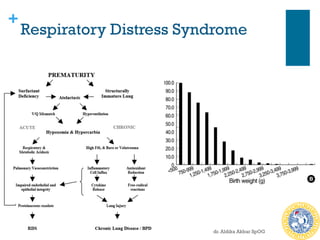
Respiratory Distress Syndrome
dr. Aldika Akbar SpOG
+History of Steroid Used in Preterm Birth
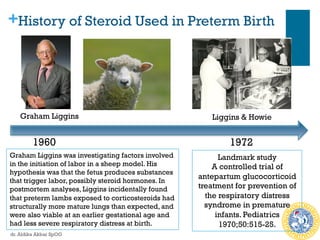
Graham Liggins
1960 1972
Liggins & Howie
Landmark study
A controlled trial of
antepartum glucocorticoid
treatment for prevention of
the respiratory distress
syndrome in premature
infants. Pediatrics
1970;50:515-25.
Graham Liggins was investigating factors involved
in the initiation of labor in a sheep model. His
hypothesis was that the fetus produces substances
that trigger labor, possibly steroid hormones. In
postmortem analyses, Liggins incidentally found
that preterm lambs exposed to corticosteroids had
structurally more mature lungs than expected, and
were also viable at an earlier gestational age and
had less severe respiratory distress at birth.
dr. Aldika Akbar SpOG
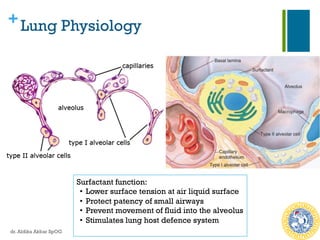
+Lung Physiology
Surfactant function:
•  Lower surface tension at air liquid surface
•  Protect patency of small airways
•  Prevent movement of fluid into the alveolus
•  Stimulates lung host defence system
dr. Aldika Akbar SpOG
+
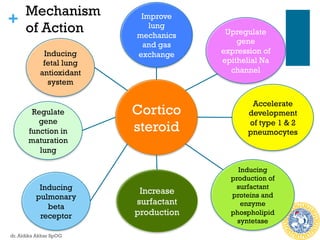
Cortico
steroid
Upregulate
gene
expression of
epithelial Na
channel
Improve
lung
mechanics
and gas
exchange
Increase
surfactant
production
Inducing
production of
surfactant
proteins and
enzyme
phospholipid
syntetase
Inducing
pulmonary
beta
receptor
Inducing
fetal lung
antioxidant
system
Accelerate
development
of type 1 & 2
pneumocytes
Mechanism
of Action
Regulate
gene
function in
maturation
lung
dr. Aldika Akbar SpOG
+
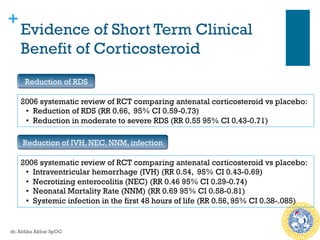
Evidence of Short Term Clinical
Benefit of Corticosteroid
Reduction of RDS
2006 systematic review of RCT comparing antenatal corticosteroid vs placebo:
•  Reduction of RDS (RR 0.66, 95% CI 0.59-0.73)
•  Reduction in moderate to severe RDS (RR 0.55 95% CI 0.43-0.71)
Reduction of IVH, NEC, NNM, infection
2006 systematic review of RCT comparing antenatal corticosteroid vs placebo:
•  Intraventricular hemorrhage (IVH) (RR 0.54, 95% CI 0.43-0.69)
•  Necrotizing enterocolitis (NEC) (RR 0.46 95% CI 0.29-0.74)
•  Neonatal Mortality Rate (NNM) (RR 0.69 95% CI 0.58-0.81)
•  Systemic infection in the first 48 hours of life (RR 0.56, 95% CI 0.38-.085)
dr. Aldika Akbar SpOG
+
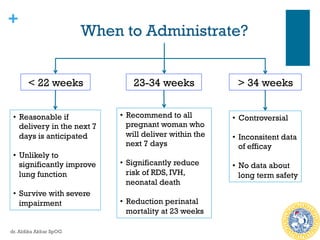
When to Administrate?
< 22 weeks 23-34 weeks > 34 weeks
•  Reasonable if
delivery in the next 7
days is anticipated
•  Unlikely to
significantly improve
lung function
•  Survive with severe
impairment
•  Recommend to all
pregnant woman who
will deliver within the
next 7 days
•  Significantly reduce
risk of RDS, IVH,
neonatal death
•  Reduction perinatal
mortality at 23 weeks
•  Controversial
•  Inconsitent data
of efficay
•  No data about
long term safety
dr. Aldika Akbar SpOG
+
Corticosteroid Use At 37-39 Weeks
n  Empiric use of steroid has been recommended prior to CS at 37-39
weeks
n  The ASTECS trial, 1000 women, betamethasone vs placebo, 48 hours
before planned CS:
n  Reduction in overall incidence of repiratory problems (Transient
tachypnea of the newborn and RDS) [RR 0.46]
n  Similar trial, dexamethasone vs placebo, 48 hours before, 38 weeks
planned CS:
n  Reduction in NICU admission for repiratory morbidity
n  Reduction in transient tachypnea of the newborn (RR 0.38)
n  No difference in RDS, need for mechanical ventilation
dr. Aldika Akbar SpOG
+
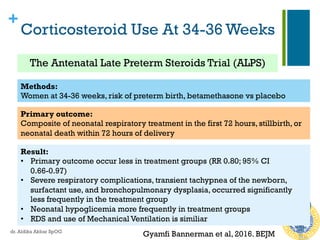
The Antenatal Late Preterm Steroids Trial (ALPS)
Corticosteroid Use At 34-36 Weeks
Methods:
Women at 34-36 weeks, risk of preterm birth, betamethasone vs placebo
Primary outcome:
Composite of neonatal respiratory treatment in the first 72 hours, stillbirth, or
neonatal death within 72 hours of delivery
dr. Aldika Akbar SpOG
Result:
•  Primary outcome occur less in treatment groups (RR 0.80; 95% CI
0.66-0.97)
•  Severe respiratory complications, transient tachypnea of the newborn,
surfactant use, and bronchopulmonary dysplasia, occurred significantly
less frequently in the treatment group
•  Neonatal hypoglicemia more frequently in treatment groups
•  RDS and use of Mechanical Ventilation is similiar
Gyamfi Bannerman et al, 2016. BEJM
+
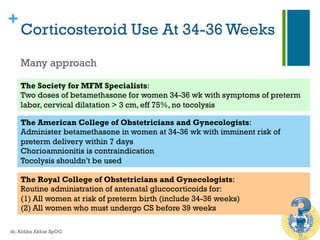
Many approach
Corticosteroid Use At 34-36 Weeks
The Society for MFM Specialists:
Two doses of betamethasone for women 34-36 wk with symptoms of preterm
labor, cervical dilatation > 3 cm, eff 75%, no tocolysis
The American College of Obstetricians and Gynecologists:
Administer betamethasone in women at 34-36 wk with imminent risk of
preterm delivery within 7 days
Chorioamnionitis is contraindication
Tocolysis shouldn’t be used
The Royal College of Obstetricians and Gynecologists:
Routine administration of antenatal glucocorticoids for:
(1) All women at risk of preterm birth (include 34-36 weeks)
(2) All women who must undergo CS before 39 weeks
dr. Aldika Akbar SpOG
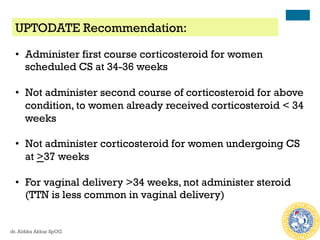
UPTODATE Recommendation:
•  Administer first course corticosteroid for women
scheduled CS at 34-36 weeks
•  Not administer second course of corticosteroid for above
condition, to women already received corticosteroid < 34
weeks
•  Not administer corticosteroid for women undergoing CS
at >37 weeks
•  For vaginal delivery >34 weeks, not administer steroid
(TTN is less common in vaginal delivery)
dr. Aldika Akbar SpOG
+
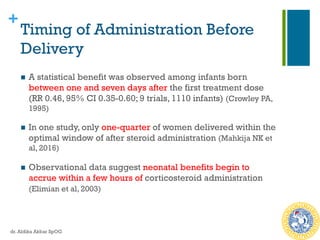
Timing of Administration Before
Delivery
n  A statistical benefit was observed among infants born
between one and seven days after the first treatment dose
(RR 0.46, 95% CI 0.35-0.60; 9 trials, 1110 infants) (Crowley PA,
1995)
n  In one study, only one-quarter of women delivered within the
optimal window of after steroid administration (Mahkija NK et
al, 2016)
n  Observational data suggest neonatal benefits begin to
accrue within a few hours of corticosteroid administration
(Elimian et al, 2003)
dr. Aldika Akbar SpOG
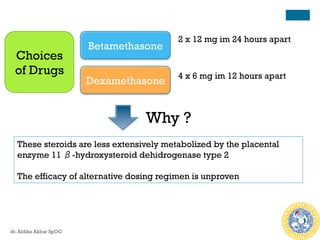
Choices
of Drugs
Betamethasone
Dexamethasone
2 x 12 mg im 24 hours apart
4 x 6 mg im 12 hours apart
Why ?
These steroids are less extensively metabolized by the placental
enzyme 11 β-hydroxysteroid dehidrogenase type 2
The efficacy of alternative dosing regimen is unproven
dr. Aldika Akbar SpOG
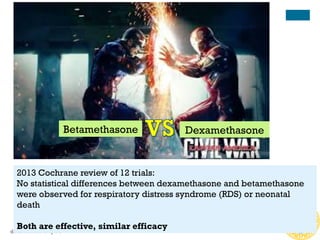
Betamethasone Dexamethasone
2013 Cochrane review of 12 trials:
No statistical differences between dexamethasone and betamethasone
were observed for respiratory distress syndrome (RDS) or neonatal
death
Both are effective, similar efficacy
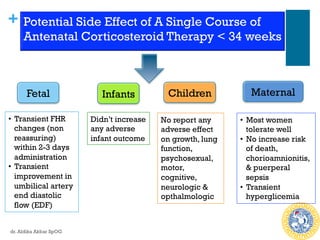
+ Potential Side Effect of A Single Course of
Antenatal Corticosteroid Therapy < 34 weeks
Fetal Infants Children Maternal
•  Transient FHR
changes (non
reassuring)
within 2-3 days
administration
•  Transient
improvement in
umbilical artery
end diastolic
flow (EDF)
Didn’t increase
any adverse
infant outcome
No report any
adverse effect
on growth, lung
function,
psychosexual,
motor,
cognitive,
neurologic &
opthalmologic
•  Most women
tolerate well
•  No increase risk
of death,
chorioamnionitis,
& puerperal
sepsis
•  Transient
hyperglicemia
dr. Aldika Akbar SpOG
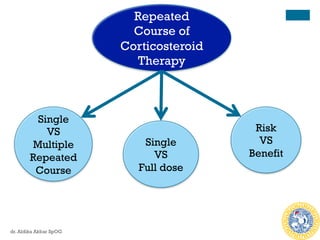
Repeated
Course of
Corticosteroid
Therapy
Single
VS
Multiple
Repeated
Course
Single
VS
Full dose
Risk
VS
Benefit
dr. Aldika Akbar SpOG
+
Efficacy of Repeated Course of
Steroid Therapy
n 2015 systematic review RCT, repeated doses
betamethasone vs placebo
n RESULT
n  For the neonate:
n  Reduced risk of RDS (RR: 0.83)
n  Reduced risk composite serious infant outcome [RR 0.84]
(perinatal death, bronchopulmonary dysplasia, IVH, NEC,
sepsis, periventricular leucomalacia, & ROP)
n  For the mothers: no difference in chorioamnionitis & puerpural
sepsis
n  For the young child: no significant benefit & harm
dr. Aldika Akbar SpOG
+
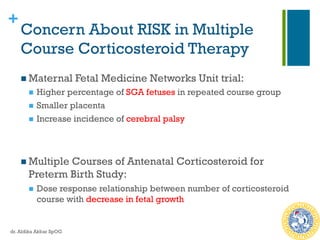
Concern About RISK in Multiple
Course Corticosteroid Therapy
n Maternal Fetal Medicine Networks Unit trial:
n  Higher percentage of SGA fetuses in repeated course group
n  Smaller placenta
n  Increase incidence of cerebral palsy
n Multiple Courses of Antenatal Corticosteroid for
Preterm Birth Study:
n  Dose response relationship between number of corticosteroid
course with decrease in fetal growth
dr. Aldika Akbar SpOG
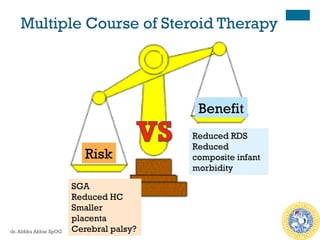
Multiple Course of Steroid Therapy
Risk
Benefit
SGA
Reduced HC
Smaller
placenta
Cerebral palsy?
Reduced RDS
Reduced
composite infant
morbidity
+
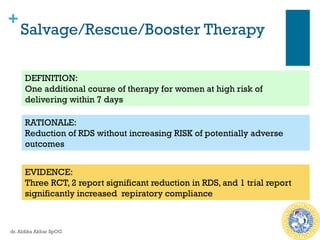
Salvage/Rescue/Booster Therapy
DEFINITION:
One additional course of therapy for women at high risk of
delivering within 7 days
RATIONALE:
Reduction of RDS without increasing RISK of potentially adverse
outcomes
EVIDENCE:
Three RCT, 2 report significant reduction in RDS, and 1 trial report
significantly increased repiratory compliance
dr. Aldika Akbar SpOG
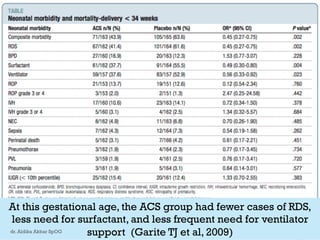
At this gestational age, the ACS group had fewer cases of RDS,
less need for surfactant, and less frequent need for ventilator
support (Garite TJ et al, 2009)dr. Aldika Akbar SpOG
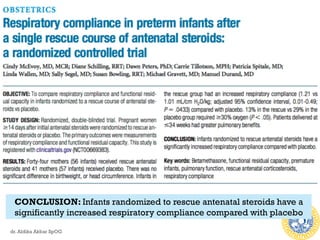
CONCLUSION: Infants randomized to rescue antenatal steroids have a
significantly increased respiratory compliance compared with placebo
dr. Aldika Akbar SpOG
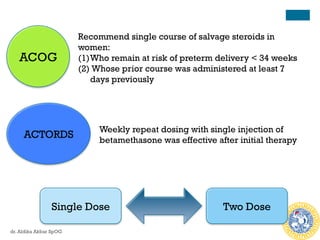
ACOG
Recommend single course of salvage steroids in
women:
(1) Who remain at risk of preterm delivery < 34 weeks
(2) Whose prior course was administered at least 7
days previously
ACTORDS
Weekly repeat dosing with single injection of
betamethasone was effective after initial therapy
Single Dose Two Dose
dr. Aldika Akbar SpOG
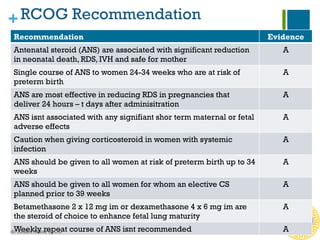
+RCOG Recommendation
Recommendation Evidence
Antenatal steroid (ANS) are associated with significant reduction
in neonatal death, RDS, IVH and safe for mother
A
Single course of ANS to women 24-34 weeks who are at risk of
preterm birth
A
ANS are most effective in reducing RDS in pregnancies that
deliver 24 hours – t days after adminisitration
A
ANS isnt associated with any signifiant shor term maternal or fetal
adverse effects
A
Caution when giving corticosteroid in women with systemic
infection
A
ANS should be given to all women at risk of preterm birth up to 34
weeks
A
ANS should be given to all women for whom an elective CS
planned prior to 39 weeks
A
Betamethasone 2 x 12 mg im or dexamethasone 4 x 6 mg im are
the steroid of choice to enhance fetal lung maturity
A
Weekly repeat course of ANS isnt recommended Adr. Aldika Akbar SpOG
+
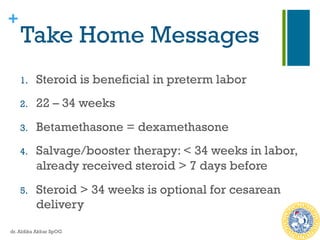
Take Home Messages
1.  Steroid is beneficial in preterm labor
2.  22 – 34 weeks
3.  Betamethasone = dexamethasone
4.  Salvage/booster therapy: < 34 weeks in labor,
already received steroid > 7 days before
5.  Steroid > 34 weeks is optional for cesarean
delivery
dr. Aldika Akbar SpOG
+Refference
n  Baud O, Sola A. 2007. Corticosteroid in perinatal medicine: how to improve
outcomes without affecting the developing brain?. Seminar in Fetal & Neonatal
Medicine (2007) 12, 273-279.
n  Bonanno C,Wapner RJ. 2009. Antenatal corticosteroid treatment: what happened
since Drs Liggins and Howie?. American Journal of Obstetrics and Gynecology.
April 2009.
n  Garite TJ, Kurtzman J, Maurel K, Clark R. 2009. Impact of a “rescue course” of
antenatal corticosteroids: a multicenter randomized placebo-controlled trial. Am J
Obstet Gynecol 2009;200:248.e1-248.e9
n  Lee MJ, Guinn D. Antenatal corticosteroid therapy for reduction of neonatal
morbidity and mortality from preterm delivery. UpToDate. Apr 08, 2016.
n  McEvoy C, Schilling D, Peters D,Tillotson C, Spitale P,Wallen L, Segel S, Bowling S,
Gravett M, Durand M. 2010. Respiratory compliance in preterm infants after a
single rescue course of antenatal steroids: a randomized controlled trial. Am J
Obstet Gynecol 2010;202:544.e1-9.
n  RCOG, 2010. Antenata; Corticosteroids to reduce neonatal morbidity and
mortality. Green top Guideline no 7, Oct 2010.
dr. Aldika Akbar SpOG

Antenatal Steroid for Preterm Birth

  • 1.
    + Antenatal Corticosteroid inPreterm Labor Muhammad Ilham Aldika Akbar Dept/SMF OBGYN RSUA – RSUD Dr. Soetomo Fakultas Kedokteran Universitas Airlangga Surabaya
  • 2.
  • 3.
    +History of SteroidUsed in Preterm Birth Graham Liggins 1960 1972 Liggins & Howie Landmark study A controlled trial of antepartum glucocorticoid treatment for prevention of the respiratory distress syndrome in premature infants. Pediatrics 1970;50:515-25. Graham Liggins was investigating factors involved in the initiation of labor in a sheep model. His hypothesis was that the fetus produces substances that trigger labor, possibly steroid hormones. In postmortem analyses, Liggins incidentally found that preterm lambs exposed to corticosteroids had structurally more mature lungs than expected, and were also viable at an earlier gestational age and had less severe respiratory distress at birth. dr. Aldika Akbar SpOG
  • 4.
    +Lung Physiology Surfactant function: • Lower surface tension at air liquid surface •  Protect patency of small airways •  Prevent movement of fluid into the alveolus •  Stimulates lung host defence system dr. Aldika Akbar SpOG
  • 5.
    + Cortico steroid Upregulate gene expression of epithelial Na channel Improve lung mechanics andgas exchange Increase surfactant production Inducing production of surfactant proteins and enzyme phospholipid syntetase Inducing pulmonary beta receptor Inducing fetal lung antioxidant system Accelerate development of type 1 & 2 pneumocytes Mechanism of Action Regulate gene function in maturation lung dr. Aldika Akbar SpOG
  • 6.
    + Evidence of ShortTerm Clinical Benefit of Corticosteroid Reduction of RDS 2006 systematic review of RCT comparing antenatal corticosteroid vs placebo: •  Reduction of RDS (RR 0.66, 95% CI 0.59-0.73) •  Reduction in moderate to severe RDS (RR 0.55 95% CI 0.43-0.71) Reduction of IVH, NEC, NNM, infection 2006 systematic review of RCT comparing antenatal corticosteroid vs placebo: •  Intraventricular hemorrhage (IVH) (RR 0.54, 95% CI 0.43-0.69) •  Necrotizing enterocolitis (NEC) (RR 0.46 95% CI 0.29-0.74) •  Neonatal Mortality Rate (NNM) (RR 0.69 95% CI 0.58-0.81) •  Systemic infection in the first 48 hours of life (RR 0.56, 95% CI 0.38-.085) dr. Aldika Akbar SpOG
  • 7.
    + When to Administrate? <22 weeks 23-34 weeks > 34 weeks •  Reasonable if delivery in the next 7 days is anticipated •  Unlikely to significantly improve lung function •  Survive with severe impairment •  Recommend to all pregnant woman who will deliver within the next 7 days •  Significantly reduce risk of RDS, IVH, neonatal death •  Reduction perinatal mortality at 23 weeks •  Controversial •  Inconsitent data of efficay •  No data about long term safety dr. Aldika Akbar SpOG
  • 8.
    + Corticosteroid Use At37-39 Weeks n  Empiric use of steroid has been recommended prior to CS at 37-39 weeks n  The ASTECS trial, 1000 women, betamethasone vs placebo, 48 hours before planned CS: n  Reduction in overall incidence of repiratory problems (Transient tachypnea of the newborn and RDS) [RR 0.46] n  Similar trial, dexamethasone vs placebo, 48 hours before, 38 weeks planned CS: n  Reduction in NICU admission for repiratory morbidity n  Reduction in transient tachypnea of the newborn (RR 0.38) n  No difference in RDS, need for mechanical ventilation dr. Aldika Akbar SpOG
  • 9.
    + The Antenatal LatePreterm Steroids Trial (ALPS) Corticosteroid Use At 34-36 Weeks Methods: Women at 34-36 weeks, risk of preterm birth, betamethasone vs placebo Primary outcome: Composite of neonatal respiratory treatment in the first 72 hours, stillbirth, or neonatal death within 72 hours of delivery dr. Aldika Akbar SpOG Result: •  Primary outcome occur less in treatment groups (RR 0.80; 95% CI 0.66-0.97) •  Severe respiratory complications, transient tachypnea of the newborn, surfactant use, and bronchopulmonary dysplasia, occurred significantly less frequently in the treatment group •  Neonatal hypoglicemia more frequently in treatment groups •  RDS and use of Mechanical Ventilation is similiar Gyamfi Bannerman et al, 2016. BEJM
  • 10.
    + Many approach Corticosteroid UseAt 34-36 Weeks The Society for MFM Specialists: Two doses of betamethasone for women 34-36 wk with symptoms of preterm labor, cervical dilatation > 3 cm, eff 75%, no tocolysis The American College of Obstetricians and Gynecologists: Administer betamethasone in women at 34-36 wk with imminent risk of preterm delivery within 7 days Chorioamnionitis is contraindication Tocolysis shouldn’t be used The Royal College of Obstetricians and Gynecologists: Routine administration of antenatal glucocorticoids for: (1) All women at risk of preterm birth (include 34-36 weeks) (2) All women who must undergo CS before 39 weeks dr. Aldika Akbar SpOG
  • 11.
    UPTODATE Recommendation: •  Administerfirst course corticosteroid for women scheduled CS at 34-36 weeks •  Not administer second course of corticosteroid for above condition, to women already received corticosteroid < 34 weeks •  Not administer corticosteroid for women undergoing CS at >37 weeks •  For vaginal delivery >34 weeks, not administer steroid (TTN is less common in vaginal delivery) dr. Aldika Akbar SpOG
  • 12.
    + Timing of AdministrationBefore Delivery n  A statistical benefit was observed among infants born between one and seven days after the first treatment dose (RR 0.46, 95% CI 0.35-0.60; 9 trials, 1110 infants) (Crowley PA, 1995) n  In one study, only one-quarter of women delivered within the optimal window of after steroid administration (Mahkija NK et al, 2016) n  Observational data suggest neonatal benefits begin to accrue within a few hours of corticosteroid administration (Elimian et al, 2003) dr. Aldika Akbar SpOG
  • 13.
    Choices of Drugs Betamethasone Dexamethasone 2 x12 mg im 24 hours apart 4 x 6 mg im 12 hours apart Why ? These steroids are less extensively metabolized by the placental enzyme 11 β-hydroxysteroid dehidrogenase type 2 The efficacy of alternative dosing regimen is unproven dr. Aldika Akbar SpOG
  • 14.
    dr. Aldika AkbarSpOG Betamethasone Dexamethasone 2013 Cochrane review of 12 trials: No statistical differences between dexamethasone and betamethasone were observed for respiratory distress syndrome (RDS) or neonatal death Both are effective, similar efficacy
  • 15.
    + Potential SideEffect of A Single Course of Antenatal Corticosteroid Therapy < 34 weeks Fetal Infants Children Maternal •  Transient FHR changes (non reassuring) within 2-3 days administration •  Transient improvement in umbilical artery end diastolic flow (EDF) Didn’t increase any adverse infant outcome No report any adverse effect on growth, lung function, psychosexual, motor, cognitive, neurologic & opthalmologic •  Most women tolerate well •  No increase risk of death, chorioamnionitis, & puerperal sepsis •  Transient hyperglicemia dr. Aldika Akbar SpOG
  • 16.
  • 17.
    + Efficacy of RepeatedCourse of Steroid Therapy n 2015 systematic review RCT, repeated doses betamethasone vs placebo n RESULT n  For the neonate: n  Reduced risk of RDS (RR: 0.83) n  Reduced risk composite serious infant outcome [RR 0.84] (perinatal death, bronchopulmonary dysplasia, IVH, NEC, sepsis, periventricular leucomalacia, & ROP) n  For the mothers: no difference in chorioamnionitis & puerpural sepsis n  For the young child: no significant benefit & harm dr. Aldika Akbar SpOG
  • 18.
    + Concern About RISKin Multiple Course Corticosteroid Therapy n Maternal Fetal Medicine Networks Unit trial: n  Higher percentage of SGA fetuses in repeated course group n  Smaller placenta n  Increase incidence of cerebral palsy n Multiple Courses of Antenatal Corticosteroid for Preterm Birth Study: n  Dose response relationship between number of corticosteroid course with decrease in fetal growth dr. Aldika Akbar SpOG
  • 19.
    dr. Aldika AkbarSpOG Multiple Course of Steroid Therapy Risk Benefit SGA Reduced HC Smaller placenta Cerebral palsy? Reduced RDS Reduced composite infant morbidity
  • 20.
    + Salvage/Rescue/Booster Therapy DEFINITION: One additionalcourse of therapy for women at high risk of delivering within 7 days RATIONALE: Reduction of RDS without increasing RISK of potentially adverse outcomes EVIDENCE: Three RCT, 2 report significant reduction in RDS, and 1 trial report significantly increased repiratory compliance dr. Aldika Akbar SpOG
  • 21.
    At this gestationalage, the ACS group had fewer cases of RDS, less need for surfactant, and less frequent need for ventilator support (Garite TJ et al, 2009)dr. Aldika Akbar SpOG
  • 22.
    CONCLUSION: Infants randomizedto rescue antenatal steroids have a significantly increased respiratory compliance compared with placebo dr. Aldika Akbar SpOG
  • 23.
    ACOG Recommend single courseof salvage steroids in women: (1) Who remain at risk of preterm delivery < 34 weeks (2) Whose prior course was administered at least 7 days previously ACTORDS Weekly repeat dosing with single injection of betamethasone was effective after initial therapy Single Dose Two Dose dr. Aldika Akbar SpOG
  • 24.
    +RCOG Recommendation Recommendation Evidence Antenatalsteroid (ANS) are associated with significant reduction in neonatal death, RDS, IVH and safe for mother A Single course of ANS to women 24-34 weeks who are at risk of preterm birth A ANS are most effective in reducing RDS in pregnancies that deliver 24 hours – t days after adminisitration A ANS isnt associated with any signifiant shor term maternal or fetal adverse effects A Caution when giving corticosteroid in women with systemic infection A ANS should be given to all women at risk of preterm birth up to 34 weeks A ANS should be given to all women for whom an elective CS planned prior to 39 weeks A Betamethasone 2 x 12 mg im or dexamethasone 4 x 6 mg im are the steroid of choice to enhance fetal lung maturity A Weekly repeat course of ANS isnt recommended Adr. Aldika Akbar SpOG
  • 25.
    + Take Home Messages 1. Steroid is beneficial in preterm labor 2.  22 – 34 weeks 3.  Betamethasone = dexamethasone 4.  Salvage/booster therapy: < 34 weeks in labor, already received steroid > 7 days before 5.  Steroid > 34 weeks is optional for cesarean delivery dr. Aldika Akbar SpOG
  • 26.
    +Refference n  Baud O,Sola A. 2007. Corticosteroid in perinatal medicine: how to improve outcomes without affecting the developing brain?. Seminar in Fetal & Neonatal Medicine (2007) 12, 273-279. n  Bonanno C,Wapner RJ. 2009. Antenatal corticosteroid treatment: what happened since Drs Liggins and Howie?. American Journal of Obstetrics and Gynecology. April 2009. n  Garite TJ, Kurtzman J, Maurel K, Clark R. 2009. Impact of a “rescue course” of antenatal corticosteroids: a multicenter randomized placebo-controlled trial. Am J Obstet Gynecol 2009;200:248.e1-248.e9 n  Lee MJ, Guinn D. Antenatal corticosteroid therapy for reduction of neonatal morbidity and mortality from preterm delivery. UpToDate. Apr 08, 2016. n  McEvoy C, Schilling D, Peters D,Tillotson C, Spitale P,Wallen L, Segel S, Bowling S, Gravett M, Durand M. 2010. Respiratory compliance in preterm infants after a single rescue course of antenatal steroids: a randomized controlled trial. Am J Obstet Gynecol 2010;202:544.e1-9. n  RCOG, 2010. Antenata; Corticosteroids to reduce neonatal morbidity and mortality. Green top Guideline no 7, Oct 2010. dr. Aldika Akbar SpOG