Definition –
 Epidemiology has been defined
by john M. Last in 1998 as “
The study of the distribution and
determinations of health related
states or events in specified
population, and the application
of this study to the control of
health problems”.
 Epidemiology the branch of medical science
which treats of epidemics ( Parkin, 1873)
 Epidemiology is the science of mass
phenomena of infectious diseases ( Frost,
1927).
Epidemiological approach:
 a) Asking Questions.
 b) Making comparisons.
Asking questions Related to
Health Events are:-
 a)What is the event ?
 b)What is its magnitude ?
 c)Where did it happen ?
 d)When did it happen ?
 e)Who are affected ?
 f)Why did it happen ?
 Related to Health Action are-
 a) what can be done to reduce this problem and its
consequences ?
 b) How can it be prevented in the future ?
 c) What action should be taken by the community ? By
the health Services ? By other Sectors ? Where and for
Whom these activities be carried out ?
 d) What resources are required ? How are the activities
to be Organized ?
 e) What difficulties may arise , and how might they be
overcome ?
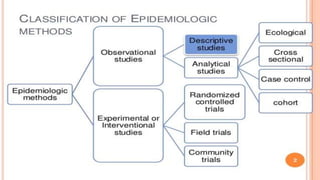
Epidemiologic methods:-
Classification of epidemiological method
Such studies basically ask the questions.
 a)when is the disease occurring ?
 -time distribution
 b)Where is it occurring ?
 -place distribution.
 c) Who is getting the disease ?
 - Person distribution.
The six steps include in Descriptive
Studies are :-
 1)Defining the populations to be studied.
 2)Defining the disease under study.
 3)Describing the disease by- Time, Place,
Person
 4)Measurement of disease
 5)Comparing with the known indices.
 6)Formulation of an etiological
hypothesis.
 1)Defining the population to be studied:-
 The “defined population” can be the whole
population in a geographic area, or more
often a representative sample taken from
it, The defined population can also be a
specially selected group such as age & sex
groups, occupational groups, hospital
patient’s , school children, etc. The defined
population needs to be large enough so
that age, sex of other specific rates are
meaningful.
2.Defining the disease under study:-
Once the population to be studied is
defined or specified, One must then
define the disease or condition being
investigated. Here the needs of the
clinician of epidemiologist may diverge.
The clinician may not need a precise
definition of disease. (eg. Migraine) for
immediate patient care.
 If the diagnosis is wrong ,he can revise it
subsequently. But the epidemiologist,
whose main concern is to obtain an
accurate estimate of disease, needs
precise & valid definition to enable it. So,
the epidemiologist looks for operational
definition, i.e. the definition which can be
identified & measured in defined
population with a degree of accuracy.
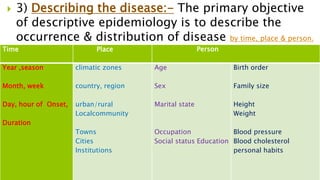
 3) Describing the disease:- The primary objective
of descriptive epidemiology is to describe the
occurrence & distribution of disease by time, place & person.
Time Place Person
Year ,season
Month, week
Day, hour of Onset,
Duration
climatic zones
country, region
urban/rural
Localcommunity
Towns
Cities
Institutions
Age
Sex
Marital state
Occupation
Social status Education
Birth order
Family size
Height
Weight
Blood pressure
Blood cholesterol
personal habits
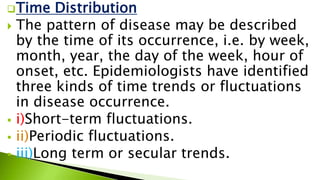
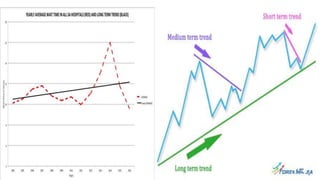
Time Distribution
 The pattern of disease may be described
by the time of its occurrence, i.e. by week,
month, year, the day of the week, hour of
onset, etc. Epidemiologists have identified
three kinds of time trends or fluctuations
in disease occurrence.
 i)Short-term fluctuations.
 ii)Periodic fluctuations.
 iii)Long term or secular trends.
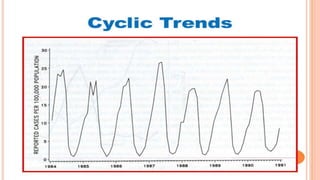
 Periodic Fluctions-
Place Distribution:
 Studies of geography of disease are one of
the important dimensions of descriptive
epidemiology. By studying the distribution
of disease in different population, we gain
perspective on the fascinating differences
in diseases pattern not only between
countries but also within countries.
 Geographic patterns provide an
important source of clues about the
cases of the disease. These variations
may be classified as:-
 a)International variations.
b)National variations.
 c)Rural-urban differences.
d)Local distributions
Person’s Distribution:
 In descriptive studies, the disease is
further characterized by defining the
person who develops the disease by age,
sex, occupation, marital status, habits,
social class & other host factors. These
factors do not necessarily represent
etiological factors, but they contribute to
good deal to our understanding of
natural history of the disease.
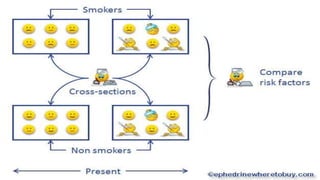
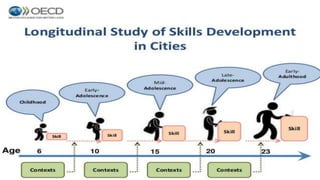
4)Measurement of disease:-
 It is mandatory to have a clear picture of
the amount of disease in the population.
This information should be available in
terms of mortality, morbidity, disability &
soon. Morbidity has two aspects
incidence & prevalence. Incidence can be
obtained from “Longitudinal” studies, &
prevalence from “cross-sectional.”
Studies.
5. Comparing with known indices:-
 The essence of epidemiology is to
make comparisons & ask question. By
making comparisons between
different populations & sub groups of
the same population, it is possible to
arrive at clues to disease etiology.
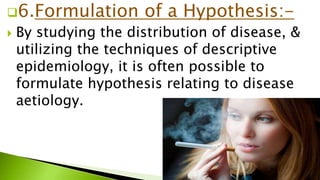
6.Formulation of a Hypothesis:-
 By studying the distribution of disease, &
utilizing the techniques of descriptive
epidemiology, it is often possible to
formulate hypothesis relating to disease
aetiology.
ANALYTICAL EPIDEMIOLOGY:- Analytical
studies are second major type of
epidemiological studies. The subject of
interest in analytical studies in an
individual within the population. The
object is not to formulate but to test
hypothesis. It comprises some distinct
types of observational studies:
 a) case-control study.
 b) cohort study
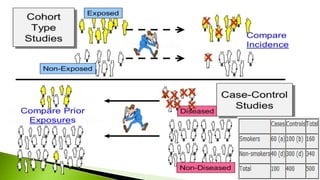
 CASE CONTROL STUDY:-Case control studies,
often called ”retrospective studies” are a
common first approach to test causal
hypothesis.
 The case control method has three distinct
features:
a) Both exposure & outcome (disease) have
occurred before the start of the study.
b) The study proceeds backward from effect
to cause.
c) It uses a control or comparisons group to
support or refute an inference.
Basic steps:- There are 4 “basic steps in
conducting a case control study:-
 1)Selection of cases & controls.
 2)Matching.
 3)Measurement of exposure, &
 4)Analysis & interpretation.
Advantages of case control studies:-
 1)Relatively easy to carry out.
 2) Rapid & inexpensive.
 3)Required comparatively few
subjects.
 4)No risk to subjects.
 5)Risk factors can be identified.
 6)Ethical problems minimal.
Disadvantages-
 1)Selection of an appropriate control
group may be difficult.
 2)We cannot measure incidence, & can
only estimate the relative risk.
 3)Do not distinguish between causes
associated factors.
 4)Another major concern is the
representativeness of cases & controls.
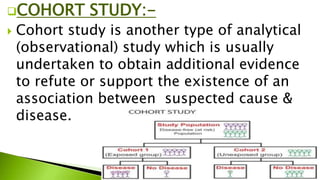
COHORT STUDY:-
 Cohort study is another type of analytical
(observational) study which is usually
undertaken to obtain additional evidence
to refute or support the existence of an
association between suspected cause &
disease.
 The distinguishing features of cohort
studies are:-
 a) The cohorts are identified prior to the
appearance of the disease under
investigation.
 b) The study groups, so defined are
observed over a period of time to
determine the frequency of disease
among them.
 c) The study proceeds forward from cause
& effect.
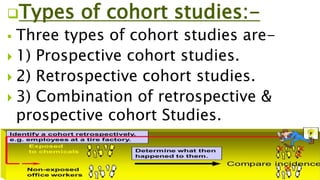
Types of cohort studies:-
 Three types of cohort studies are-
 1) Prospective cohort studies.
 2) Retrospective cohort studies.
 3) Combination of retrospective &
prospective cohort Studies.
Experimental
Epidemiology:-
Experimental studies are similar in
approach to cohort studies excepting
that the conditions in which study is
carried out are under direct control of
an investigator.
 Thus,experimental studies involve some
action, intervention or manipulation, such
as deliberate application or withdrawal of
suspected cause or changing one variable
in causative chain in experimental group
while making no change in control group
& observing & comparing the outcome of
experiments in both the groups.
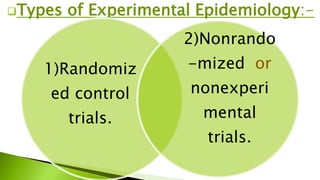
Types of Experimental Epidemiology:-
1)Randomiz
ed control
trials.
2)Nonrando
-mized or
nonexperi
mental
trials.
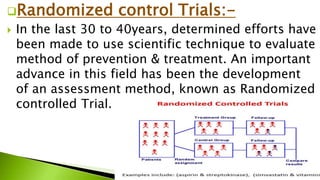
Randomized control Trials:-
 In the last 30 to 40years, determined efforts have
been made to use scientific technique to evaluate
method of prevention & treatment. An important
advance in this field has been the development
of an assessment method, known as Randomized
controlled Trial.
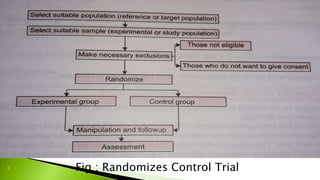
 Fig : Randomizes Control Trial
Types of R. Controlled Trials:-
 Clinical Trials:- For the most part,
“clinical trials” have been concerned
with evaluating therapeutic agents,
mainly drugs. Some of the recent
examples include- evaluation of beta
blockers in reducing the cardiovascular
mortality in patient’s surviving in acute
phase of MI, efficacy of tonsillectomy
in recurrent throat infections, etc.
Preventive Trials:- In general,
prevention is a synonym with primary
prevention & the term preventive trials
implies trial of primary preventive
measures. These trials are purposed
to prevent or eliminate disease on
experiment basis. The most frequently
occurring preventive trials are trials of
vaccines & chemoprophylactic drugs.
Risk Factor Trials:- A type of
preventive trial is the trial of risk
factor in which the investigator to
interrupt the usual sequence in the
development of the disease in those
individuals Who have the risk factors
for developing the disease. Often this
involves the risk factor modification.
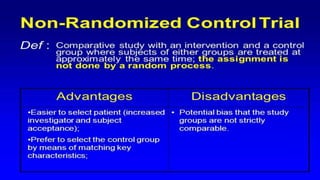
NON RANDOMIZED TRIALS:-
The experiment method is
almost always to be preferred,
It is not always possible for
ethical, administrative & other
reasons to resort to a
randomized controlled trial in
human beings.
Epidemiology

Epidemiology

  • 2.
    Definition –  Epidemiologyhas been defined by john M. Last in 1998 as “ The study of the distribution and determinations of health related states or events in specified population, and the application of this study to the control of health problems”.
  • 3.
     Epidemiology thebranch of medical science which treats of epidemics ( Parkin, 1873)  Epidemiology is the science of mass phenomena of infectious diseases ( Frost, 1927).
  • 4.
    Epidemiological approach:  a)Asking Questions.  b) Making comparisons.
  • 5.
    Asking questions Relatedto Health Events are:-  a)What is the event ?  b)What is its magnitude ?  c)Where did it happen ?  d)When did it happen ?  e)Who are affected ?  f)Why did it happen ?
  • 6.
     Related toHealth Action are-  a) what can be done to reduce this problem and its consequences ?  b) How can it be prevented in the future ?  c) What action should be taken by the community ? By the health Services ? By other Sectors ? Where and for Whom these activities be carried out ?  d) What resources are required ? How are the activities to be Organized ?  e) What difficulties may arise , and how might they be overcome ?
  • 7.
  • 8.
  • 9.
    Such studies basicallyask the questions.  a)when is the disease occurring ?  -time distribution  b)Where is it occurring ?  -place distribution.  c) Who is getting the disease ?  - Person distribution.
  • 10.
    The six stepsinclude in Descriptive Studies are :-  1)Defining the populations to be studied.  2)Defining the disease under study.  3)Describing the disease by- Time, Place, Person  4)Measurement of disease  5)Comparing with the known indices.  6)Formulation of an etiological hypothesis.
  • 11.
     1)Defining thepopulation to be studied:-  The “defined population” can be the whole population in a geographic area, or more often a representative sample taken from it, The defined population can also be a specially selected group such as age & sex groups, occupational groups, hospital patient’s , school children, etc. The defined population needs to be large enough so that age, sex of other specific rates are meaningful.
  • 12.
    2.Defining the diseaseunder study:- Once the population to be studied is defined or specified, One must then define the disease or condition being investigated. Here the needs of the clinician of epidemiologist may diverge. The clinician may not need a precise definition of disease. (eg. Migraine) for immediate patient care.
  • 13.
     If thediagnosis is wrong ,he can revise it subsequently. But the epidemiologist, whose main concern is to obtain an accurate estimate of disease, needs precise & valid definition to enable it. So, the epidemiologist looks for operational definition, i.e. the definition which can be identified & measured in defined population with a degree of accuracy.
  • 14.
     3) Describingthe disease:- The primary objective of descriptive epidemiology is to describe the occurrence & distribution of disease by time, place & person. Time Place Person Year ,season Month, week Day, hour of Onset, Duration climatic zones country, region urban/rural Localcommunity Towns Cities Institutions Age Sex Marital state Occupation Social status Education Birth order Family size Height Weight Blood pressure Blood cholesterol personal habits
  • 15.
    Time Distribution  Thepattern of disease may be described by the time of its occurrence, i.e. by week, month, year, the day of the week, hour of onset, etc. Epidemiologists have identified three kinds of time trends or fluctuations in disease occurrence.  i)Short-term fluctuations.  ii)Periodic fluctuations.  iii)Long term or secular trends.
  • 16.
  • 19.
    Place Distribution:  Studiesof geography of disease are one of the important dimensions of descriptive epidemiology. By studying the distribution of disease in different population, we gain perspective on the fascinating differences in diseases pattern not only between countries but also within countries.
  • 20.
     Geographic patternsprovide an important source of clues about the cases of the disease. These variations may be classified as:-  a)International variations. b)National variations.  c)Rural-urban differences. d)Local distributions
  • 21.
    Person’s Distribution:  Indescriptive studies, the disease is further characterized by defining the person who develops the disease by age, sex, occupation, marital status, habits, social class & other host factors. These factors do not necessarily represent etiological factors, but they contribute to good deal to our understanding of natural history of the disease.
  • 22.
    4)Measurement of disease:- It is mandatory to have a clear picture of the amount of disease in the population. This information should be available in terms of mortality, morbidity, disability & soon. Morbidity has two aspects incidence & prevalence. Incidence can be obtained from “Longitudinal” studies, & prevalence from “cross-sectional.” Studies.
  • 25.
    5. Comparing withknown indices:-  The essence of epidemiology is to make comparisons & ask question. By making comparisons between different populations & sub groups of the same population, it is possible to arrive at clues to disease etiology.
  • 26.
    6.Formulation of aHypothesis:-  By studying the distribution of disease, & utilizing the techniques of descriptive epidemiology, it is often possible to formulate hypothesis relating to disease aetiology.
  • 27.
    ANALYTICAL EPIDEMIOLOGY:- Analytical studiesare second major type of epidemiological studies. The subject of interest in analytical studies in an individual within the population. The object is not to formulate but to test hypothesis. It comprises some distinct types of observational studies:  a) case-control study.  b) cohort study
  • 28.
     CASE CONTROLSTUDY:-Case control studies, often called ”retrospective studies” are a common first approach to test causal hypothesis.  The case control method has three distinct features: a) Both exposure & outcome (disease) have occurred before the start of the study. b) The study proceeds backward from effect to cause. c) It uses a control or comparisons group to support or refute an inference.
  • 30.
    Basic steps:- Thereare 4 “basic steps in conducting a case control study:-  1)Selection of cases & controls.  2)Matching.  3)Measurement of exposure, &  4)Analysis & interpretation.
  • 31.
    Advantages of casecontrol studies:-  1)Relatively easy to carry out.  2) Rapid & inexpensive.  3)Required comparatively few subjects.  4)No risk to subjects.  5)Risk factors can be identified.  6)Ethical problems minimal.
  • 32.
    Disadvantages-  1)Selection ofan appropriate control group may be difficult.  2)We cannot measure incidence, & can only estimate the relative risk.  3)Do not distinguish between causes associated factors.  4)Another major concern is the representativeness of cases & controls.
  • 33.
    COHORT STUDY:-  Cohortstudy is another type of analytical (observational) study which is usually undertaken to obtain additional evidence to refute or support the existence of an association between suspected cause & disease.
  • 34.
     The distinguishingfeatures of cohort studies are:-  a) The cohorts are identified prior to the appearance of the disease under investigation.  b) The study groups, so defined are observed over a period of time to determine the frequency of disease among them.  c) The study proceeds forward from cause & effect.
  • 35.
    Types of cohortstudies:-  Three types of cohort studies are-  1) Prospective cohort studies.  2) Retrospective cohort studies.  3) Combination of retrospective & prospective cohort Studies.
  • 36.
    Experimental Epidemiology:- Experimental studies aresimilar in approach to cohort studies excepting that the conditions in which study is carried out are under direct control of an investigator.
  • 37.
     Thus,experimental studiesinvolve some action, intervention or manipulation, such as deliberate application or withdrawal of suspected cause or changing one variable in causative chain in experimental group while making no change in control group & observing & comparing the outcome of experiments in both the groups.
  • 38.
    Types of ExperimentalEpidemiology:- 1)Randomiz ed control trials. 2)Nonrando -mized or nonexperi mental trials.
  • 39.
    Randomized control Trials:- In the last 30 to 40years, determined efforts have been made to use scientific technique to evaluate method of prevention & treatment. An important advance in this field has been the development of an assessment method, known as Randomized controlled Trial.
  • 40.
     Fig :Randomizes Control Trial
  • 41.
    Types of R.Controlled Trials:-  Clinical Trials:- For the most part, “clinical trials” have been concerned with evaluating therapeutic agents, mainly drugs. Some of the recent examples include- evaluation of beta blockers in reducing the cardiovascular mortality in patient’s surviving in acute phase of MI, efficacy of tonsillectomy in recurrent throat infections, etc.
  • 42.
    Preventive Trials:- Ingeneral, prevention is a synonym with primary prevention & the term preventive trials implies trial of primary preventive measures. These trials are purposed to prevent or eliminate disease on experiment basis. The most frequently occurring preventive trials are trials of vaccines & chemoprophylactic drugs.
  • 43.
    Risk Factor Trials:-A type of preventive trial is the trial of risk factor in which the investigator to interrupt the usual sequence in the development of the disease in those individuals Who have the risk factors for developing the disease. Often this involves the risk factor modification.
  • 44.
    NON RANDOMIZED TRIALS:- Theexperiment method is almost always to be preferred, It is not always possible for ethical, administrative & other reasons to resort to a randomized controlled trial in human beings.