MEASURING HEALTH
Abdur Razzaque Sarker
MHE (Health Economics), MSS (Economics)
Health Economics and Financing Research, icddrb
and
PhD Fellow in Strathclyde University, UK
Email: razzaque.sarker@gmail.com
Why measuring health?
 For estimating health status of
individual and population
 For assessing the impact of any health
intervention
 For assessing equity in health across
socioeconomic groups (based on
income, education etc.), across
countries etc.
2
Who should put “value” in health
 The individual?
 The society?
3
Kind of measurements
 Natural measurement:
Healthy days, blood pressure level,
healthy years, days without illness
 Quality adjusted measurement:
Quality-adjusted life years (QALYs)
and Disability-adjusted life years (DALYs)
4
Concept and measurement of QALYs
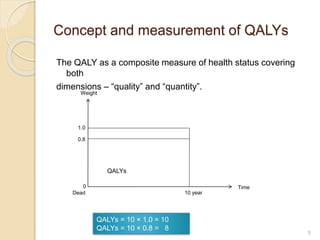
The QALY as a composite measure of health status covering
both
dimensions – “quality” and “quantity”.
QALYs
1.0
Time
Weight
0
Dead 10 year
0.8
QALYs = 10 × 1.0 = 10
QALYs = 10 × 0.8 = 8
5
QALYs without treatment: 0.5 year at 0.9 + 1 year at 0.7 = 1.15
QALYs with treatment: 0.25 year at 0.8 + 1 year at 0.9 + 0.5 year at 0.7 =
1.45
QALYs gained: 1.45-1.15=0.3
Application of QALYs
6
Some methods for estimating weight
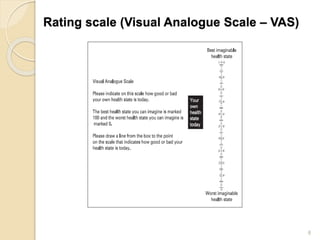
 Rating scale
 Time trade-off
 Standard Gambling
7
Rating scale (Visual Analogue Scale – VAS)
8
Respondent is presented with a choice between living the rest of their
life (t) in a given health state i (for example, on dialysis) or a shorter
period of time (x) living in perfect health. Time x is varied until the
respondent is indifferent between the two alternatives, at which point
the required preference score for state i is x/t.
Time-trade off (TTO)
1.0
Time
Weight
State i
x
Time (years)
t
If x = 6 years and t = 10 years
Score for state i = 6/10=0.6
Dead
9
Respondent is given with two alternatives to choose
Between.
Alternative 1: Living at a health status (i), which is less than full
health for t years
Alternative 2: Having an intervention which can give the
respondent full health with a certain probability
or
death.
The probability where the respondent is indifferent
between alternatives is the value of his or her health.
Standard gambling
10
Full health
Death
Health i, years t
Example:
Selim is currently living (alternative 2) with disability and expected to have
this
condition 10 years before his death. He can have a surgical intervention
(alternative 1) with a probability (p) of 75% that he will be fully cured and
live rest of his life (10 years) at full health. At the same time there is a
probability of (1-p) 25% that he can die during surgery.
If Selim is indifferent in his choice between the two alternative, then his
value of health is 0.75.
11
Instrument for measuring quality
adjusted health
 EQ-5D
 SF-36/ SF-12
 Health Utility Index
 Quality of well-being
12
EQ-5D Instrument (EuroQol group)
Total number of health states “245” (35 = 243 plus “unconscious” and “dead”)
13
Co-efficient for TTO tariffs
Dimension Coefficient
Constant 0.081
Mobility
Level 2 0.069
Level 3 0.314
Self-care
Level 2 0.104
Level 3 0.214
Usual activity
Level 2 0.036
Level 3 0.094
Pain/discomfort
Level 2 0.123
Level 3 0.386
Anxiety/depression
Level 2 0.071
Level 3 0.236
N3 0.269 14
Example: Elma responded to his health as “11223”
Mobility = No problem [1]
Self-care = No problem [1]
Usual activities = Some problems [2]
Pain/discomfort = Moderate pain [2]
Anxiety/depression = Extreme [3]
EQ-5D weights
Health Weight
Full health 1.000
Constant - 0.081
Mobility - 0.000
Self-care - 0.000
Usual activities - 0.036
Pain/discomfort - 0.123
Anxiety/depression - 0.236
Constant (level 3/ N3) - 0.269
QALY-weight 0.255
15
THANKS
16
Email:
razzaque.sarker@gmail.com

Measuring health

  • 1.
    MEASURING HEALTH Abdur RazzaqueSarker MHE (Health Economics), MSS (Economics) Health Economics and Financing Research, icddrb and PhD Fellow in Strathclyde University, UK Email: razzaque.sarker@gmail.com
  • 2.
    Why measuring health? For estimating health status of individual and population  For assessing the impact of any health intervention  For assessing equity in health across socioeconomic groups (based on income, education etc.), across countries etc. 2
  • 3.
    Who should put“value” in health  The individual?  The society? 3
  • 4.
    Kind of measurements Natural measurement: Healthy days, blood pressure level, healthy years, days without illness  Quality adjusted measurement: Quality-adjusted life years (QALYs) and Disability-adjusted life years (DALYs) 4
  • 5.
    Concept and measurementof QALYs The QALY as a composite measure of health status covering both dimensions – “quality” and “quantity”. QALYs 1.0 Time Weight 0 Dead 10 year 0.8 QALYs = 10 × 1.0 = 10 QALYs = 10 × 0.8 = 8 5
  • 6.
    QALYs without treatment:0.5 year at 0.9 + 1 year at 0.7 = 1.15 QALYs with treatment: 0.25 year at 0.8 + 1 year at 0.9 + 0.5 year at 0.7 = 1.45 QALYs gained: 1.45-1.15=0.3 Application of QALYs 6
  • 7.
    Some methods forestimating weight  Rating scale  Time trade-off  Standard Gambling 7
  • 8.
    Rating scale (VisualAnalogue Scale – VAS) 8
  • 9.
    Respondent is presentedwith a choice between living the rest of their life (t) in a given health state i (for example, on dialysis) or a shorter period of time (x) living in perfect health. Time x is varied until the respondent is indifferent between the two alternatives, at which point the required preference score for state i is x/t. Time-trade off (TTO) 1.0 Time Weight State i x Time (years) t If x = 6 years and t = 10 years Score for state i = 6/10=0.6 Dead 9
  • 10.
    Respondent is givenwith two alternatives to choose Between. Alternative 1: Living at a health status (i), which is less than full health for t years Alternative 2: Having an intervention which can give the respondent full health with a certain probability or death. The probability where the respondent is indifferent between alternatives is the value of his or her health. Standard gambling 10
  • 11.
    Full health Death Health i,years t Example: Selim is currently living (alternative 2) with disability and expected to have this condition 10 years before his death. He can have a surgical intervention (alternative 1) with a probability (p) of 75% that he will be fully cured and live rest of his life (10 years) at full health. At the same time there is a probability of (1-p) 25% that he can die during surgery. If Selim is indifferent in his choice between the two alternative, then his value of health is 0.75. 11
  • 12.
    Instrument for measuringquality adjusted health  EQ-5D  SF-36/ SF-12  Health Utility Index  Quality of well-being 12
  • 13.
    EQ-5D Instrument (EuroQolgroup) Total number of health states “245” (35 = 243 plus “unconscious” and “dead”) 13
  • 14.
    Co-efficient for TTOtariffs Dimension Coefficient Constant 0.081 Mobility Level 2 0.069 Level 3 0.314 Self-care Level 2 0.104 Level 3 0.214 Usual activity Level 2 0.036 Level 3 0.094 Pain/discomfort Level 2 0.123 Level 3 0.386 Anxiety/depression Level 2 0.071 Level 3 0.236 N3 0.269 14
  • 15.
    Example: Elma respondedto his health as “11223” Mobility = No problem [1] Self-care = No problem [1] Usual activities = Some problems [2] Pain/discomfort = Moderate pain [2] Anxiety/depression = Extreme [3] EQ-5D weights Health Weight Full health 1.000 Constant - 0.081 Mobility - 0.000 Self-care - 0.000 Usual activities - 0.036 Pain/discomfort - 0.123 Anxiety/depression - 0.236 Constant (level 3/ N3) - 0.269 QALY-weight 0.255 15
  • 16.