MSci, PhD Researcher Sanna Brauer
Oulu University of Applied Sciences
School of Professional Teacher Education
Theoretical Framework of
Digital Open Badge-Driven Learning –
Practical
Applications to Support
Emerging Ecosystems
”
”
One of largest northerly cities in the world -
home of the Air Guitar World Championships
https://
www.discoveringfinland.com/
west-coast/oulu/Photo: Aleksi Ollila
Photo: Estormiz
No Reindeers….
BUT!
Theoretical Framework of Digital Open Badge-Driven Learning –
Practical Applications to Support Emerging Ecosystems
CONTENTS
1. Standardisation of Competence Development Continuum
2. Conceptualising Digital Open Badge-Driven Learning
3. Competence-based Approach to Motivation, Gamification and
Triggers of Digital Open Badge-Driven Learning
4. Profiling Badge Earners
5. Digital Badges in Emerging Ecosystems of Learning
Brauer, S. (in proceedings). Digital Open Badge-Driven Learning –
Competence-based Professional Development for Vocational Teachers
(doctoral dissertation).
Brauer, S. 2018
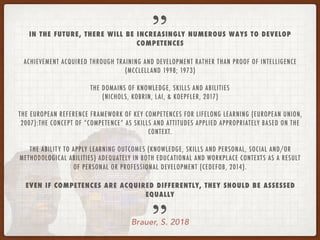
IN THE FUTURE, THERE WILL BE INCREASINGLY NUMEROUS WAYS TO DEVELOP
COMPETENCES
ACHIEVEMENT ACQUIRED THROUGH TRAINING AND DEVELOPMENT RATHER THAN PROOF OF INTELLIGENCE
(MCCLELLAND 1998; 1973)
THE DOMAINS OF KNOWLEDGE, SKILLS AND ABILITIES
(NICHOLS, KOBRIN, LAI, & KOEPFLER, 2017)
THE EUROPEAN REFERENCE FRAMEWORK OF KEY COMPETENCES FOR LIFELONG LEARNING (EUROPEAN UNION,
2007):THE CONCEPT OF “COMPETENCE” AS SKILLS AND ATTITUDES APPLIED APPROPRIATELY BASED ON THE
CONTEXT.
THE ABILITY TO APPLY LEARNING OUTCOMES (KNOWLEDGE, SKILLS AND PERSONAL, SOCIAL AND/OR
METHODOLOGICAL ABILITIES) ADEQUATELY IN BOTH EDUCATIONAL AND WORKPLACE CONTEXTS AS A RESULT
OF PERSONAL OR PROFESSIONAL DEVELOPMENT (CEDEFOB, 2014).
EVEN IF COMPETENCES ARE ACQUIRED DIFFERENTLY, THEY SHOULD BE ASSESSED
EQUALLY
”
”
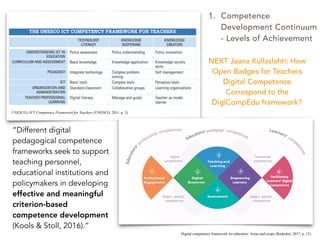
Digital competence framework for educators: Areas and scope (Redecker, 2017, p. 15).
UNESCO’s ICT Competency Framework for Teachers (UNESCO, 2011, p. 3)
1. Competence
Development Continuum
- Levels of Achievement
“Different digital
pedagogical competence
frameworks seek to support
teaching personnel,
educational institutions and
policymakers in developing
effective and meaningful
criterion-based
competence development
(Kools & Stoll, 2016).”
NEXT Jaana Kullaslahti: How
Open Badges for Teachers
Digital Competence
Correspond to the
DigiCompEdu framework?
RESEARCH QUESTIONS
How digital open badges structure the gamified competence-based learning process?
1) What motivates students in the digital open badge-driven
learning process?
2) How do students experience scaffolding in badge-driven
learning?
3) What triggers learning in the badge-driven process?
4) How do learners experience the competence-based approach
in the badge-driven learning process of professional
development?
Structure and components of a digital open badge-driven learning
process: competence-based assessment and badge management
related to guidance
Brauer & Siklander, 2017!
2. Conceptualising Digital Open Badge-Driven Learning
A competence-based learning process grounded on the badge
constellation of competences.
The process includes identifying and recognising different
competences using digital open badges.
The entity of digital open badge-driven learning involves
learning materials, badge criterion, instructional badging,
scaffolding and peer support.
2. Conceptualising Digital Open Badge-Driven Learning
Brauer, 2018
2. Stages of the badge-driven learning process
Brauer, 2018; cf. Salmon, 2018
3. Competence-based Approach to Motivation, Gamification
and Triggers of Digital Open Badge-Driven Learning
Achievement Goals
Triggers of
Online Learning
Intrinsic and
Extrinsic motivation
optional study paths (17)
progressive challenges and
the extent of required performance (91)
enthusiasm for
badge-driven learning (67)
study progress (58)
inspiring gamification (55) option to study regardless
of time and place (28)
Total
122
Total
119
Total
75 Brauer, Siklander & Ruhalahti, 2017
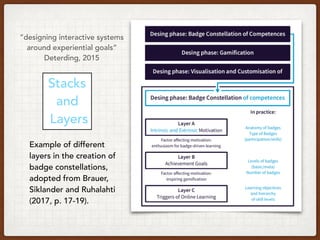
“designing interactive systems
around experiential goals”
Deterding, 2015
Example of different
layers in the creation of
badge constellations,
adopted from Brauer,
Siklander and Ruhalahti
(2017, p. 17-19).
Stacks
and
Layers
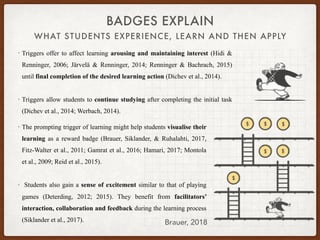
WHAT STUDENTS EXPERIENCE, LEARN AND THEN APPLY
BADGES EXPLAIN
• Triggers offer to affect learning arousing and maintaining interest (Hidi &
Renninger, 2006; Järvelä & Renninger, 2014; Renninger & Bachrach, 2015)
until final completion of the desired learning action (Dichev et al., 2014).
• Triggers allow students to continue studying after completing the initial task
(Dichev et al., 2014; Werbach, 2014).
Brauer, 2018
• The prompting trigger of learning might help students visualise their
learning as a reward badge (Brauer, Siklander, & Ruhalahti, 2017,
Fitz-Walter et al., 2011; Gamrat et al., 2016; Hamari, 2017; Montola
et al., 2009; Reid et al., 2015).
• Students also gain a sense of excitement similar to that of playing
games (Deterding, 2012; 2015). They benefit from facilitators’
interaction, collaboration and feedback during the learning process
(Siklander et al., 2017).
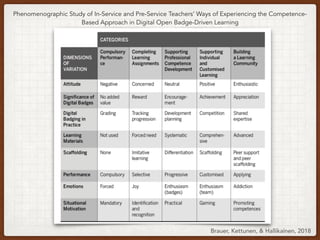
Brauer, Kettunen, & Hallikainen, 2018
Phenomenographic Study of In-Service and Pre-Service Teachers’ Ways of Experiencing the Competence-
Based Approach in Digital Open Badge-Driven Learning
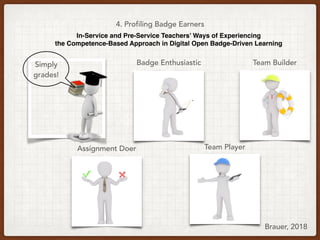
In-Service and Pre-Service Teachers’ Ways of Experiencing
the Competence-Based Approach in Digital Open Badge-Driven Learning
Team PlayerAssignment Doer
Badge Enthusiastic Team BuilderSimply
grades!
4. Profiling Badge Earners
Brauer, 2018
“The competition between teams was nice, but the most important
thing was playing. I used to play Mafia Wars for four hours a day
until my husband banned it. This is how I satisfy the craving when
going to bed but not feeling sleepy yet. One more. I got one more
badge. It seemed to me the best quality (of education), the most
addictive and interesting learning experience of my life, although not
an easy achievement.”
In-service teacher on skills set developer-level III
Share the Attitude!
Educational Reform and Emerging Ecosystems
Expert
I was going to talk about the change of paradigm - 10 years ago we enthusiastic over social
media, open environments and teacher’s skills.
Novice
We still have are early adopters
X
What has changed 20000 badges later?
See for @RubenVerborgh
Student
Self-education and learning by doing should be considered the
predominant ways to acquire expertise in the digital age.
Competence Mapping and Self-
Evaluation Services
Digital Learning Resources
Application Services
Career and Study Guidance services
Service
Person
Special
Education
Teacher
Assessment
Services
Career
Counselor
Workplace
Instructor
Coach
Teacher
Early
Childhood
Educator
Study
Counselor
Digital	Learning	and	Competence	Development	Services	and	
Actors	-	Learner`s	Perspec9ve			
Work
Community
Principal
Family/
Guardian
Planning Services for Competence Development
Continuum and Learning
Versatile Digital Learning
Environments and Platforms
Identification and Recognition of
Competences
Feedback Services
Special Education Services
Recognition of Prior Learning
Services
Learning and Competence
Development Services and
Applications
Building a National & Global Ecosystem of Learning in Finland
AuroraAI CompLeapOpen Badges
IT-architecture Metadata ESCO-classification….
Finnish National Agency for Education (EDUFI), 2018
Networking !
!
sanna.brauer@oamk.fi
h/ps://www.linkedin.com/in/sannabrauer	
h/ps://www.researchgate.net/profile/Sanna_Brauer
REFERENCES
AuroraAI https://vm.fi/artikkeli/-/asset_publisher/viranomaispalvelut-tekoalyaikaan-esiselvitys-kansallisesta-tekoalyohjelma-aurorasta?_101_INSTANCE_AOvUVthvfE4u_languageId=en_US
Brauer, S. (in proceedings). Digital Open Badge-Driven Learning –Competence-based Professional Development for Vocational Teachers (doctoral dissertation). University of Lapland
Brauer, S., Kettunen, J. & Hallikainen, V. (2018). “Learning Online” for vocational teachers - Visualisation of competence-based-approach in digital open badge-driven learning. The Journal of Professional and
Vocational Education: Vocational education and training in the Nordic countries, 2, 13-29.
Brauer, S., Ruhalahti, S., & Hallikainen, V. (2018). Digital professional learning triggers: in an online badge driven process. Education in the North, 25(1-2), 64-86. https://www.abdn.ac.uk/eitn/journal/545/
Brauer, S. & Siklander, P. (2017). Competence-based assessment and digital badging as guidance in vocational teacher education. In H. Partridge, K. Davis, & J. Thomas (Eds.), Me, Us, IT! Proceedings ASCILITE2017:
34th International Conference on Innovation, Practice and Research in the Use of Educational Technologies in Tertiary Education. 191-196.
Brauer, S., Siklander, P. & Ruhalahti, S. (2017). Motivation in digital open badge-driven learning in vocational teacher education. Ammattikasvatuksen Aikakauskirja, 19(3), 7–23.
CompLeap bit.ly/2Rhe489
Deterding, S. (2012). Gamification: designing for motivation. interactions, 19(4), 14–17.
Deterding, S. (2015). The lens of intrinsic skill atoms: A method for gameful design. Human - Computer Interaction, 30(3-4), 294–335. http://doi.org/10.1080/07370024.2014.993471
Dichev, C., Dicheva, D., Angelova, G. & Agre, G. (2014). From gamification to gameful design and gameful experience in learning. Cybernetics and Information Technologies, 14(4), pp.80-100.
Fitz-Walter, Z., Tjondronegoro, D., & Wyeth, P. (2011). Orientation passport: Using gamification to engage university students. Proceedings from the 23rd Australian computer-human interaction conference. 122-125.
ACM.
Gamrat, C., Bixler, B., & Raish, V. (2016). Instructional design considerations for digital badges. Digital Badges in Education: Trends, Issues, and Cases, 71–81.
Hamari, J. (2017). Do badges increase user activity? A field experiment on the effects of gamification. Computers in Human Behavior, 71, 469-478. https://doi.org/10.1016/j.chb.2015.03.036.
Hidi, S. & Renniger, K.A. (2006). The Four-Phase Model of Interest Development. Educational Psychologist, 41,(2), pp.111–127.
Järvelä, S. and Renniger, K.A. (2014). Designing for learning: Interest, motivation, and engagement. In (R.K. Sawyer, Ed.) Cambridge handbook of the learning sciences, pp. 668–685. Cambridge, UK: Cambridge
University Press.
Kools, M., & Stoll, L. (2016). What Makes a School a Learning Organisation?. OECD Education Working Papers, 137. Paris: OECD Publishing. https://doi.org/10.1787/5jlwm62b3bvh-en
Montola, M., Nummenmaa, T., Lucerano, A., Boberg, M., & Korhonen, H. (2009). Applying game achievement systems to enhance user experience in a photo sharing service. Proceedings from the 13th
international Academic Mindtrek conference: Everyday life in the Ubiquitous Era. Tampere, Finland. 94-97.
Redecker, C. (2017). European Framework for the Digital Competence of Educators: DigCompEdu. Punie, Y. (Ed.). EUR 28775 EN. Publications Office of the European Union, Luxembourg. https://doi.org/
10.2760/159770
Renniger, K. A. and Bachrach, J. E. (2015). Studying triggers for interest and engagement using observational methods. Educational Psychologist, 50,(1), pp.58–69.
Reid, A. J., Paster, D., & Abramovich, S. (2015). Digital badges in undergraduate composition courses: effects on intrinsic motivation. Journal of Computers in Education, 2(4), 377–398.
Salmon, G. (2018). Five-stage model. Saatavilla https://www.gillysalmon.com/five-stage-model.html

ePIC theoretical Theoretical Framework of Digital Open Badge-Driven Learning

  • 1.
    MSci, PhD ResearcherSanna Brauer Oulu University of Applied Sciences School of Professional Teacher Education Theoretical Framework of Digital Open Badge-Driven Learning – Practical Applications to Support Emerging Ecosystems ” ”
  • 2.
    One of largestnortherly cities in the world - home of the Air Guitar World Championships https:// www.discoveringfinland.com/ west-coast/oulu/Photo: Aleksi Ollila Photo: Estormiz
  • 3.
  • 4.
    Theoretical Framework ofDigital Open Badge-Driven Learning – Practical Applications to Support Emerging Ecosystems CONTENTS 1. Standardisation of Competence Development Continuum 2. Conceptualising Digital Open Badge-Driven Learning 3. Competence-based Approach to Motivation, Gamification and Triggers of Digital Open Badge-Driven Learning 4. Profiling Badge Earners 5. Digital Badges in Emerging Ecosystems of Learning Brauer, S. (in proceedings). Digital Open Badge-Driven Learning – Competence-based Professional Development for Vocational Teachers (doctoral dissertation).
  • 5.
    Brauer, S. 2018 INTHE FUTURE, THERE WILL BE INCREASINGLY NUMEROUS WAYS TO DEVELOP COMPETENCES ACHIEVEMENT ACQUIRED THROUGH TRAINING AND DEVELOPMENT RATHER THAN PROOF OF INTELLIGENCE (MCCLELLAND 1998; 1973) THE DOMAINS OF KNOWLEDGE, SKILLS AND ABILITIES (NICHOLS, KOBRIN, LAI, & KOEPFLER, 2017) THE EUROPEAN REFERENCE FRAMEWORK OF KEY COMPETENCES FOR LIFELONG LEARNING (EUROPEAN UNION, 2007):THE CONCEPT OF “COMPETENCE” AS SKILLS AND ATTITUDES APPLIED APPROPRIATELY BASED ON THE CONTEXT. THE ABILITY TO APPLY LEARNING OUTCOMES (KNOWLEDGE, SKILLS AND PERSONAL, SOCIAL AND/OR METHODOLOGICAL ABILITIES) ADEQUATELY IN BOTH EDUCATIONAL AND WORKPLACE CONTEXTS AS A RESULT OF PERSONAL OR PROFESSIONAL DEVELOPMENT (CEDEFOB, 2014). EVEN IF COMPETENCES ARE ACQUIRED DIFFERENTLY, THEY SHOULD BE ASSESSED EQUALLY ” ”
  • 6.
    Digital competence frameworkfor educators: Areas and scope (Redecker, 2017, p. 15). UNESCO’s ICT Competency Framework for Teachers (UNESCO, 2011, p. 3) 1. Competence Development Continuum - Levels of Achievement “Different digital pedagogical competence frameworks seek to support teaching personnel, educational institutions and policymakers in developing effective and meaningful criterion-based competence development (Kools & Stoll, 2016).” NEXT Jaana Kullaslahti: How Open Badges for Teachers Digital Competence Correspond to the DigiCompEdu framework?
  • 8.
    RESEARCH QUESTIONS How digitalopen badges structure the gamified competence-based learning process? 1) What motivates students in the digital open badge-driven learning process? 2) How do students experience scaffolding in badge-driven learning? 3) What triggers learning in the badge-driven process? 4) How do learners experience the competence-based approach in the badge-driven learning process of professional development?
  • 9.
    Structure and componentsof a digital open badge-driven learning process: competence-based assessment and badge management related to guidance Brauer & Siklander, 2017! 2. Conceptualising Digital Open Badge-Driven Learning
  • 10.
    A competence-based learningprocess grounded on the badge constellation of competences. The process includes identifying and recognising different competences using digital open badges. The entity of digital open badge-driven learning involves learning materials, badge criterion, instructional badging, scaffolding and peer support. 2. Conceptualising Digital Open Badge-Driven Learning Brauer, 2018
  • 11.
    2. Stages ofthe badge-driven learning process Brauer, 2018; cf. Salmon, 2018
  • 12.
    3. Competence-based Approachto Motivation, Gamification and Triggers of Digital Open Badge-Driven Learning Achievement Goals Triggers of Online Learning Intrinsic and Extrinsic motivation optional study paths (17) progressive challenges and the extent of required performance (91) enthusiasm for badge-driven learning (67) study progress (58) inspiring gamification (55) option to study regardless of time and place (28) Total 122 Total 119 Total 75 Brauer, Siklander & Ruhalahti, 2017
  • 13.
    “designing interactive systems aroundexperiential goals” Deterding, 2015 Example of different layers in the creation of badge constellations, adopted from Brauer, Siklander and Ruhalahti (2017, p. 17-19). Stacks and Layers
  • 14.
    WHAT STUDENTS EXPERIENCE,LEARN AND THEN APPLY BADGES EXPLAIN • Triggers offer to affect learning arousing and maintaining interest (Hidi & Renninger, 2006; Järvelä & Renninger, 2014; Renninger & Bachrach, 2015) until final completion of the desired learning action (Dichev et al., 2014). • Triggers allow students to continue studying after completing the initial task (Dichev et al., 2014; Werbach, 2014). Brauer, 2018 • The prompting trigger of learning might help students visualise their learning as a reward badge (Brauer, Siklander, & Ruhalahti, 2017, Fitz-Walter et al., 2011; Gamrat et al., 2016; Hamari, 2017; Montola et al., 2009; Reid et al., 2015). • Students also gain a sense of excitement similar to that of playing games (Deterding, 2012; 2015). They benefit from facilitators’ interaction, collaboration and feedback during the learning process (Siklander et al., 2017).
  • 15.
    Brauer, Kettunen, &Hallikainen, 2018 Phenomenographic Study of In-Service and Pre-Service Teachers’ Ways of Experiencing the Competence- Based Approach in Digital Open Badge-Driven Learning
  • 16.
    In-Service and Pre-ServiceTeachers’ Ways of Experiencing the Competence-Based Approach in Digital Open Badge-Driven Learning Team PlayerAssignment Doer Badge Enthusiastic Team BuilderSimply grades! 4. Profiling Badge Earners Brauer, 2018
  • 17.
    “The competition betweenteams was nice, but the most important thing was playing. I used to play Mafia Wars for four hours a day until my husband banned it. This is how I satisfy the craving when going to bed but not feeling sleepy yet. One more. I got one more badge. It seemed to me the best quality (of education), the most addictive and interesting learning experience of my life, although not an easy achievement.” In-service teacher on skills set developer-level III Share the Attitude!
  • 18.
    Educational Reform andEmerging Ecosystems Expert I was going to talk about the change of paradigm - 10 years ago we enthusiastic over social media, open environments and teacher’s skills. Novice We still have are early adopters X What has changed 20000 badges later? See for @RubenVerborgh
  • 19.
    Student Self-education and learningby doing should be considered the predominant ways to acquire expertise in the digital age.
  • 20.
    Competence Mapping andSelf- Evaluation Services Digital Learning Resources Application Services Career and Study Guidance services Service Person Special Education Teacher Assessment Services Career Counselor Workplace Instructor Coach Teacher Early Childhood Educator Study Counselor Digital Learning and Competence Development Services and Actors - Learner`s Perspec9ve Work Community Principal Family/ Guardian Planning Services for Competence Development Continuum and Learning Versatile Digital Learning Environments and Platforms Identification and Recognition of Competences Feedback Services Special Education Services Recognition of Prior Learning Services Learning and Competence Development Services and Applications Building a National & Global Ecosystem of Learning in Finland AuroraAI CompLeapOpen Badges IT-architecture Metadata ESCO-classification…. Finnish National Agency for Education (EDUFI), 2018
  • 21.
  • 22.
    REFERENCES AuroraAI https://vm.fi/artikkeli/-/asset_publisher/viranomaispalvelut-tekoalyaikaan-esiselvitys-kansallisesta-tekoalyohjelma-aurorasta?_101_INSTANCE_AOvUVthvfE4u_languageId=en_US Brauer, S.(in proceedings). Digital Open Badge-Driven Learning –Competence-based Professional Development for Vocational Teachers (doctoral dissertation). University of Lapland Brauer, S., Kettunen, J. & Hallikainen, V. (2018). “Learning Online” for vocational teachers - Visualisation of competence-based-approach in digital open badge-driven learning. The Journal of Professional and Vocational Education: Vocational education and training in the Nordic countries, 2, 13-29. Brauer, S., Ruhalahti, S., & Hallikainen, V. (2018). Digital professional learning triggers: in an online badge driven process. Education in the North, 25(1-2), 64-86. https://www.abdn.ac.uk/eitn/journal/545/ Brauer, S. & Siklander, P. (2017). Competence-based assessment and digital badging as guidance in vocational teacher education. In H. Partridge, K. Davis, & J. Thomas (Eds.), Me, Us, IT! Proceedings ASCILITE2017: 34th International Conference on Innovation, Practice and Research in the Use of Educational Technologies in Tertiary Education. 191-196. Brauer, S., Siklander, P. & Ruhalahti, S. (2017). Motivation in digital open badge-driven learning in vocational teacher education. Ammattikasvatuksen Aikakauskirja, 19(3), 7–23. CompLeap bit.ly/2Rhe489 Deterding, S. (2012). Gamification: designing for motivation. interactions, 19(4), 14–17. Deterding, S. (2015). The lens of intrinsic skill atoms: A method for gameful design. Human - Computer Interaction, 30(3-4), 294–335. http://doi.org/10.1080/07370024.2014.993471 Dichev, C., Dicheva, D., Angelova, G. & Agre, G. (2014). From gamification to gameful design and gameful experience in learning. Cybernetics and Information Technologies, 14(4), pp.80-100. Fitz-Walter, Z., Tjondronegoro, D., & Wyeth, P. (2011). Orientation passport: Using gamification to engage university students. Proceedings from the 23rd Australian computer-human interaction conference. 122-125. ACM. Gamrat, C., Bixler, B., & Raish, V. (2016). Instructional design considerations for digital badges. Digital Badges in Education: Trends, Issues, and Cases, 71–81. Hamari, J. (2017). Do badges increase user activity? A field experiment on the effects of gamification. Computers in Human Behavior, 71, 469-478. https://doi.org/10.1016/j.chb.2015.03.036. Hidi, S. & Renniger, K.A. (2006). The Four-Phase Model of Interest Development. Educational Psychologist, 41,(2), pp.111–127. Järvelä, S. and Renniger, K.A. (2014). Designing for learning: Interest, motivation, and engagement. In (R.K. Sawyer, Ed.) Cambridge handbook of the learning sciences, pp. 668–685. Cambridge, UK: Cambridge University Press. Kools, M., & Stoll, L. (2016). What Makes a School a Learning Organisation?. OECD Education Working Papers, 137. Paris: OECD Publishing. https://doi.org/10.1787/5jlwm62b3bvh-en Montola, M., Nummenmaa, T., Lucerano, A., Boberg, M., & Korhonen, H. (2009). Applying game achievement systems to enhance user experience in a photo sharing service. Proceedings from the 13th international Academic Mindtrek conference: Everyday life in the Ubiquitous Era. Tampere, Finland. 94-97. Redecker, C. (2017). European Framework for the Digital Competence of Educators: DigCompEdu. Punie, Y. (Ed.). EUR 28775 EN. Publications Office of the European Union, Luxembourg. https://doi.org/ 10.2760/159770 Renniger, K. A. and Bachrach, J. E. (2015). Studying triggers for interest and engagement using observational methods. Educational Psychologist, 50,(1), pp.58–69. Reid, A. J., Paster, D., & Abramovich, S. (2015). Digital badges in undergraduate composition courses: effects on intrinsic motivation. Journal of Computers in Education, 2(4), 377–398. Salmon, G. (2018). Five-stage model. Saatavilla https://www.gillysalmon.com/five-stage-model.html