+

GUIDED INQUIRY
An Instructional Framework for Designing Effective
Inquiry Units

LYN HAY

Head of Professional Learning, Syba Academy &
Adjunct Lecturer, Charles Sturt University
+

Educating for the now & next
n  How

to we educate our students to meet the high levels of
literacy in the technological workplace?

n  How

do we prepare our students to navigate and make sense
of the global information environment?

n  How

do we enable our students to draw on the knowledge
and wisdom of the past while using the technology of the
present to advance new discoveries for the future?

n  How

do we prepare our students to think for themselves,
make good decisions, develop expertise, and learn through
life?

Many teachers are turning to inquiry learning in subjects
across the curriculum to meet the challenge of educating
their students for lifelong learning
+

Seven Survival Skills
as defined by business leaders in their own words
CRITICAL THINKING AND PROBLEM SOLVING
“The idea that a company’s senior leaders have all the answers and can solve problems by
themselves has gone completely by the wayside…The person who’s close to the work has to have
strong analytic skills. You have to be rigorous: test your assumptions, don’t take things at face value,
don’t go in with preconceived ideas that you’re trying to prove.”
—Ellen Kumata, consultant to Fortune 200 companies

COLLABORATION ACROSS NETWORKS AND LEADING BY INFLUENCE
“The biggest problem we have in the company as a whole is finding people capable of exerting
leadership across the board…Our mantra is that you lead by influence, rather than authority.”
—Mark Chandler, Senior Vice President and General Counsel at Cisco

AGILITY AND ADAPTABILITY
“I’ve been here four years, and we’ve done fundamental reorganization every year because of
changes in the business…I can guarantee the job I hire someone to do will change or may not exist
in the future, so this is why adaptability and learning skills are more important than technical skills.”
—Clay Parker, President of Chemical Management Division of BOC Edwards
http://www.tonywagner.com/7-survival-skills
+

Seven Survival Skills
as defined by business leaders in their own words
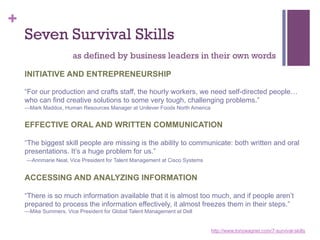
INITIATIVE AND ENTREPRENEURSHIP
“For our production and crafts staff, the hourly workers, we need self-directed people…
who can find creative solutions to some very tough, challenging problems.”
—Mark Maddox, Human Resources Manager at Unilever Foods North America

EFFECTIVE ORAL AND WRITTEN COMMUNICATION
“The biggest skill people are missing is the ability to communicate: both written and oral
presentations. It’s a huge problem for us.”
—Annmarie Neal, Vice President for Talent Management at Cisco Systems

ACCESSING AND ANALYZING INFORMATION
“There is so much information available that it is almost too much, and if people aren’t
prepared to process the information effectively, it almost freezes them in their steps.”
—Mike Summers, Vice President for Global Talent Management at Dell

http://www.tonywagner.com/7-survival-skills
+

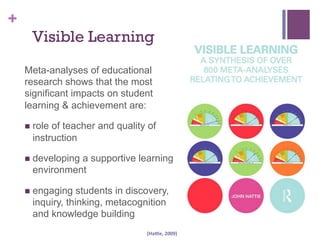
Visible Learning
Meta-analyses of educational
research shows that the most
significant impacts on student
learning & achievement are:
n  role

of teacher and quality of
instruction

n  developing

a supportive learning
environment

n  engaging

students in discovery,
inquiry, thinking, metacognition
and knowledge building	


(Ha%e,	
  2009)	


+

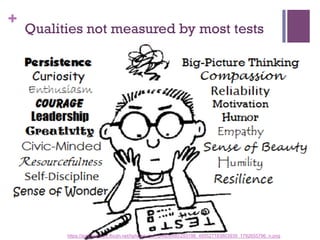
Qualities not measured by most tests

https://sphotos-b.xx.fbcdn.net/hphotos-prn1/p480x480/293198_495527183803939_1792655796_n.png
+
Inquiry underpins 21C learning
n  Critical

thinking & problem solving
expert thinking

n  Communication

& collaboration
complex communicating

n  Creativity

& innovation
applied imagination & invention
+
Digital literacy
n  Information literacy
access information efficiently/effectively, evaluate information
critically/competently, use information accurately/creatively

n  Media literacy
analyse media, ethically/legally access & use media, create media
products by effectively using media tools
n  ICT literacy
use technology as a tool to research, organise, evaluate,
communicate, social networking, ethically/legally use technologies
www.21stcenturyskills.org
+

Life & career skills
n  Flexibility & adaptability
adapt to varied roles/job responsibilities/schedules/ contexts,
understand, negotiate, balance diverse views/beliefs, find workable
solutions

n  Initiative & self-direction
manage goals/time, work independently, be self-directed learners,
go beyond basic mastery, reflect critically on past experiences to
inform future progress
n 

Social & cross-cultural interaction

know when to listen/when to speak, be respectful interacting with others,
work effectively in diverse teams, be open-minded to different ideas/values,
leverage social/cultural difference to create new ideas, innovate& improve
quality of own/groups’ work
www.21stcenturyskills.org
+
Life & career skills
n Productivity & accountability
manage projects, set/meet goals, deal with obstacles/pressures,
prioritise/plan/manage to achieve intended result, produce results
through multitasking, managing time effectively, respect/appreciate
team diversity
n Leadership & responsibility
project-based, studio model of work more prevalent now, guide &
lead others, use interpersonal/problem-solving skills to influence/
guide others towards a goal, inspire other to accomplish, lead by
example, selflessness, acting responsibly with interests of larger
community in mind
www.21stcenturyskills.org
+

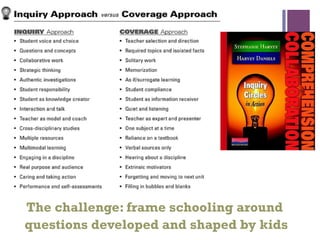
The challenge: frame schooling around
questions developed and shaped by kids
+

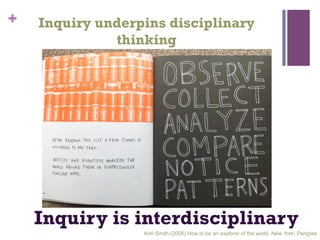
Inquiry underpins disciplinary
thinking

Inquiry is interdisciplinary
Keri Smith (2008) How to be an explorer of the world. New York: Perigree
+

Inquiry moves beyond
fact finding
+

Inquiry moves beyond
just fact finding tasks
Raises	
  standard	
  of	
  research	
  assignments	
  to	
  
higher	
  level	
  by:	
  
§ 
§ 
§ 
§ 
§ 
§ 

Drawing on life experiences
Learning from a wide range of sources
Forming deep understanding
Gaining sense of accomplishment
Developing competence and expertise
Helps student consolidate learning across subject
areas
+

Inquiry learning

§  Is an approach to learning whereby students find and use a
variety of sources of information and ideas to increase their
understanding of a problem, topic or issue
§  It requires more than simply answering questions or getting a right
answer
§  It espouses investigation, exploration, search, quest, research,
pursuit and study
§  Inquiry does not stand alone; it engages, interests and challenges
students to connect their world within the curriculum
§  It is often an individual pursuit
§  Can be enhanced by being part of a community of learning
§  Without some guidance, inquiry learning can be daunting
§  Inquiry is not an add-on to the curriculum, it is a way of learning
content, skills and values within the curriculum through inquiry
+

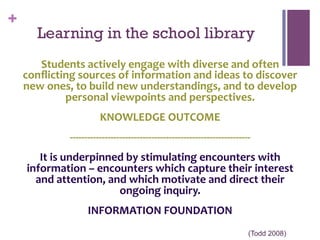
Learning in the school library
Students	
  actively	
  engage	
  with	
  diverse	
  and	
  often	
  
conflicting	
  sources	
  of	
  information	
  and	
  ideas	
  to	
  discover	
  
new	
  ones,	
  to	
  build	
  new	
  understandings,	
  and	
  to	
  develop	
  
personal	
  viewpoints	
  and	
  perspectives.	
  
KNOWLEDGE	
  OUTCOME	
  
-­‐-­‐-­‐-­‐-­‐-­‐-­‐-­‐-­‐-­‐-­‐-­‐-­‐-­‐-­‐-­‐-­‐-­‐-­‐-­‐-­‐-­‐-­‐-­‐-­‐-­‐-­‐-­‐-­‐-­‐-­‐-­‐-­‐-­‐-­‐-­‐-­‐-­‐-­‐-­‐-­‐-­‐-­‐-­‐-­‐-­‐-­‐-­‐-­‐-­‐-­‐-­‐-­‐-­‐-­‐-­‐-­‐-­‐-­‐-­‐-­‐-­‐	
  
It	
  is	
  underpinned	
  by	
  stimulating	
  encounters	
  with	
  
information	
  –	
  encounters	
  which	
  capture	
  their	
  interest	
  
and	
  attention,	
  and	
  which	
  motivate	
  and	
  direct	
  their	
  
ongoing	
  inquiry.


INFORMATION	
  FOUNDATION	
  
(Todd 2008)
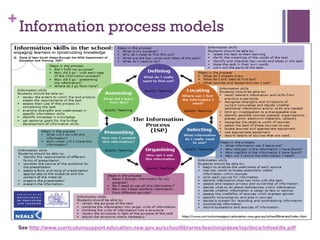
+ Information process models

See http://www.curriculumsupport.education.nsw.gov.au/schoollibraries/teachingideas/isp/docs/infoskills.pdf
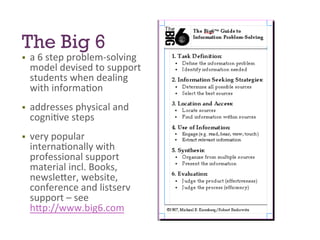
The Big 6
§ 

a	
  6	
  step	
  problem-­‐solving	
  
model	
  devised	
  to	
  support	
  
students	
  when	
  dealing	
  
with	
  informa7on	
  

§ 

addresses	
  physical	
  and	
  
cogni7ve	
  steps	


§ 

very	
  popular	
  
interna7onally	
  with	
  
professional	
  support	
  
material	
  incl.	
  Books,	
  
newsle>er,	
  website,	
  
conference	
  and	
  listserv	
  
support	
  –	
  see	
  
h>p://www.big6.com	
  	
  
+
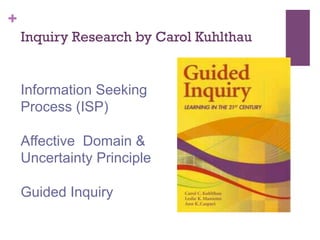
Inquiry Research by Carol Kuhlthau

Information Seeking
Process (ISP)
Affective Domain &
Uncertainty Principle
Guided Inquiry
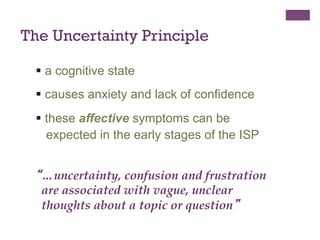
The Uncertainty Principle
§  a cognitive state
§  causes anxiety and lack of confidence
§  these affective symptoms can be
expected in the early stages of the ISP

“…uncertainty, confusion and frustration
are associated with vague, unclear
thoughts about a topic or question”
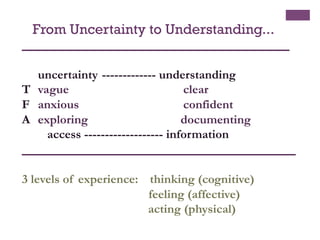
From Uncertainty to Understanding...
___________________________________________
uncertainty ------------- understanding
T vague
clear
F anxious
confident
A exploring
documenting
access ------------------- information
____________________________________________
3 levels of experience: thinking (cognitive)
feeling (affective)
acting (physical)
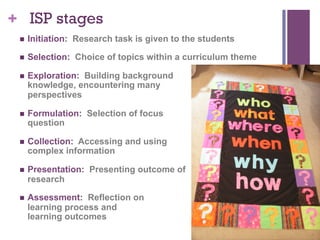
+ ISP stages
n 

Initiation: Research task is given to the students

n 

Selection: Choice of topics within a curriculum theme

n 

Exploration: Building background
knowledge, encountering many
perspectives

n 

Formulation: Selection of focus
question

n 

Collection: Accessing and using
complex information

n 

Presentation: Presenting outcome of
research

n 

Assessment: Reflection on
learning process and
learning outcomes
 

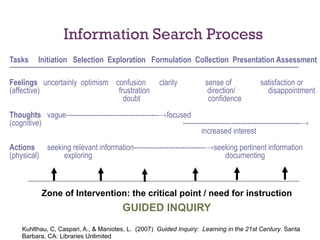
Information Search Process
Tasks


Initiation Selection Exploration Formulation Collection Presentation Assessment

---------------------------------------------------------------------------------------------------------------------------------------------------------------

Feelings uncertainly optimism confusion
(affective)
frustration
doubt

clarity

sense of
direction/
confidence

satisfaction or
disappointment

Thoughts vague----------------------------------------→focused
(cognitive)
---------------------------------------------------→
increased interest
Actions seeking relevant information-------------------------------→seeking pertinent information
(physical)
exploring
documenting

Zone of Intervention: the critical point / need for instruction

GUIDED INQUIRY
Kuhlthau, C, Caspari, A., & Maniotes, L. (2007) Guided Inquiry: Learning in the 21st Century. Santa
Barbara, CA: Libraries Unlimited
+ Inquiry-centred pedagogy & ISP
Students develop capacity to:
§  think beyond the immediate situation to consider the ‘big
picture’ before focusing on the detail (Exploration)
§  suspend judgment about a situation to consider
alternative pathways (Exploration)
§  pose insightful and purposeful questions (Formulation)
§  apply strategies to uncover meaning and make reasoned
judgments (Collection)
§  reflect on thinking, actions and processes (all stages,
Assessment)
(Todd, 2011)
+ Inquiry-centred pedagogy & ISP
Students develop capacity to:
§  generate and develop ideas and possibilities (Collection)
§  analyse information logically and make reasoned
judgements (Collection)
§  evaluate ideas and create solutions and draw conclusions
(Collection)
§  assess the feasibility, possible risks and benefits in the
implementation of their ideas (Collection, Assessment)
§  create meaningful representations of their deep
knowledge (Presentation)


(Todd, 2011)
+ The emotional rollercoaster
§  Very	
  dis7nc7ve	
  ebb	
  and	
  flow	
  of	
  emo7ons	
  
following	
  the	
  demands	
  of	
  the	
  research	
  
process	
  
§  Construc7vist	
  approach	
  to	
  learning:	
  	
  staged,	
  
guided	
  
§  Students	
  are	
  not	
  ‘abandoned’	
  in	
  the	
  
research	
  process	
  
§  Focus	
  on	
  deep	
  learning,	
  competence,	
  
mastery,	
  and	
  self	
  empowerment	


Implications of Kuhlthau's ISP
n 

Learning is an individual process, even
though the same information process model
is used

n 

Knowledge is constructed based on past
experience

n 

TLs & teachers must develop expertise in
dealing with individual student's affective
concerns when completing information tasks
What we now know....
n 

No matter how many times we use an
information process, a certain level of
uncertainty will always affect student's
completion of information tasks when
encountering new or 'unique' information

n 

TLs & teachers must employ a range of
strategies during learning process to assist
students to cope with the uncertainty
principle
+

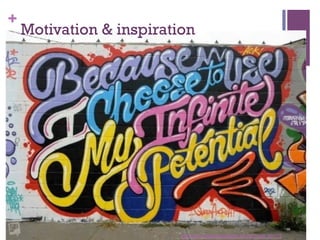
Motivation & inspiration

http://www.inspirationstation.co.za/?page_id=112
Introducing Guided Inquiry....
“The	
  information	
  age	
  calls	
  for	
  transforming	
  
schools	
  to	
  meet	
  new	
  challenges”	


n  Guided inquiry is a new learning and instructional
model
n  Occurs in a collaborative learning environment led
by an instructional team
n  Learning from a variety of sources
n  Inquiry process for deep understanding 'unique'
information
+

Guided Inquiry...
“... is carefully planned, closely supervised
targeted intervention(s )of an instructional
team of school librarians and teachers to guide
students through curriculum based inquiry
units that build deep knowledge and deep
understanding of a curriculum topic, and
gradually lead towards independent learning.”
CISSL, Guided Inquiry (2009)
http://cissl.scils.rutgers.edu/guided_inquiry.html
+

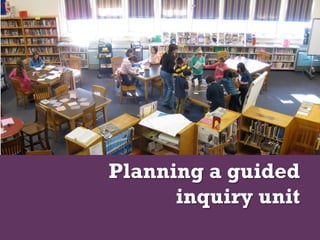
Planning a guided
inquiry unit
+

GI stages of reflection &
intervention
Set	
  of	
  3	
  templates	
  for	
  monitoring	
  progress	
  in	
  the	
  Guided	
  Inquiry	
  
process	
  can	
  be	
  downloaded	
  from	
  
h>p://studentslearn.files.wordpress.com/2012/05/gi-­‐reflec7on-­‐
sheet-­‐templates.docx	


+

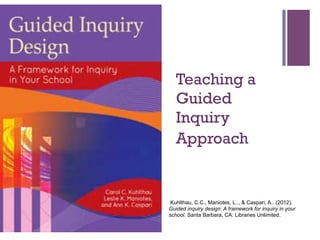
Teaching a
Guided
Inquiry
Approach

Kuhlthau, C.C., Maniotes, L.., & Caspari, A.. (2012).
Guided inquiry design: A framework for inquiry in your
school. Santa Barbara, CA: Libraries Unlimited.
 

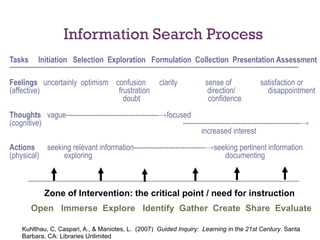
Information Search Process
Tasks


Initiation Selection Exploration Formulation Collection Presentation Assessment

---------------------------------------------------------------------------------------------------------------------------------------------------------------

Feelings uncertainly optimism confusion
(affective)
frustration
doubt

clarity

sense of
direction/
confidence

satisfaction or
disappointment

Thoughts vague----------------------------------------→focused
(cognitive)
---------------------------------------------------→
increased interest
Actions seeking relevant information-------------------------------→seeking pertinent information
(physical)
exploring
documenting

Zone of Intervention: the critical point / need for instruction
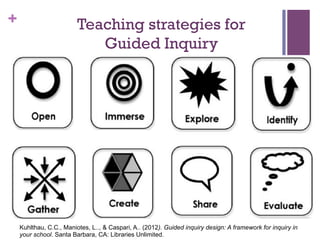
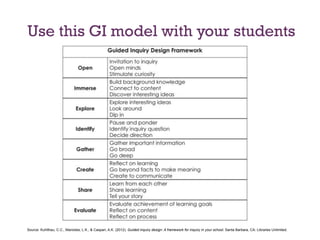
Open Immerse Explore Identify Gather Create Share Evaluate
Kuhlthau, C, Caspari, A., & Maniotes, L. (2007) Guided Inquiry: Learning in the 21st Century. Santa
Barbara, CA: Libraries Unlimited
+

Teaching strategies for
Guided Inquiry

Kuhlthau, C.C., Maniotes, L.., & Caspari, A.. (2012). Guided inquiry design: A framework for inquiry in
your school. Santa Barbara, CA: Libraries Unlimited.
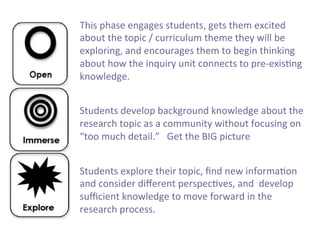
This	
  phase	
  engages	
  students,	
  gets	
  them	
  excited	
  
about	
  the	
  topic	
  /	
  curriculum	
  theme	
  they	
  will	
  be	
  
exploring,	
  and	
  encourages	
  them	
  to	
  begin	
  thinking	
  
about	
  how	
  the	
  inquiry	
  unit	
  connects	
  to	
  pre-­‐exis7ng	
  
knowledge.	


Students	
  develop	
  background	
  knowledge	
  about	
  the	
  
research	
  topic	
  as	
  a	
  community	
  without	
  focusing	
  on	
  
“too	
  much	
  detail.”	
  	
  	
  Get	
  the	
  BIG	
  picture	


Students	
  explore	
  their	
  topic,	
  find	
  new	
  informa7on	
  
and	
  consider	
  different	
  perspec7ves,	
  and	
  	
  develop	
  
sufficient	
  knowledge	
  to	
  move	
  forward	
  in	
  the	
  
research	
  process.	


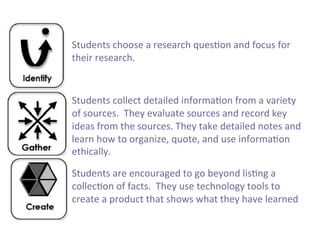
Students	
  choose	
  a	
  research	
  ques7on	
  and	
  focus	
  for	
  
their	
  research.	


Students	
  collect	
  detailed	
  informa7on	
  from	
  a	
  variety	
  
of	
  sources.	
  	
  They	
  evaluate	
  sources	
  and	
  record	
  key	
  
ideas	
  from	
  the	
  sources.	
  They	
  take	
  detailed	
  notes	
  and	
  
learn	
  how	
  to	
  organize,	
  quote,	
  and	
  use	
  informa7on	
  
ethically.	
  
Students	
  are	
  encouraged	
  to	
  go	
  beyond	
  lis7ng	
  a	
  
collec7on	
  of	
  facts.	
  	
  They	
  use	
  technology	
  tools	
  to	
  
create	
  a	
  product	
  that	
  shows	
  what	
  they	
  have	
  learned	
  
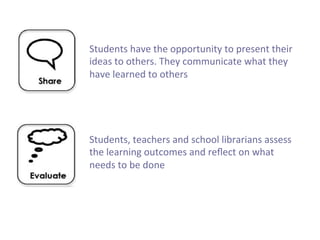
Students	
  have	
  the	
  opportunity	
  to	
  present	
  their	
  
ideas	
  to	
  others.	
  They	
  communicate	
  what	
  they	
  
have	
  learned	
  to	
  others	


Students,	
  teachers	
  and	
  school	
  librarians	
  assess	
  
the	
  learning	
  outcomes	
  and	
  reflect	
  on	
  what	
  
needs	
  to	
  be	
  done	
  
Use this GI model with your students

Source: Kuhlthau, C.C., Maniotes, L.K., & Caspari, A.K. (2012). Guided inquiry design: A framework for inquiry in your school. Santa Barbara, CA: Libraries Unlimited.
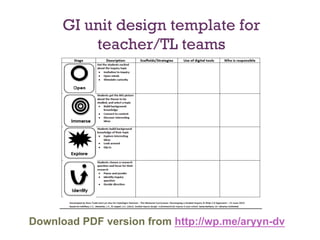
GI unit design template for
teacher/TL teams

Download PDF version from http://wp.me/aryyn-dv
+

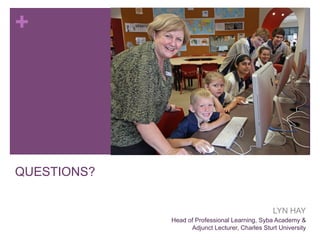
QUESTIONS?
LYN HAY
Head of Professional Learning, Syba Academy &
Adjunct Lecturer, Charles Sturt University

Guided Inquiry : An Instructional Framework for Designing Effective Inquiry Units

  • 1.
    + GUIDED INQUIRY An InstructionalFramework for Designing Effective Inquiry Units LYN HAY Head of Professional Learning, Syba Academy & Adjunct Lecturer, Charles Sturt University
  • 2.
    + Educating for thenow & next n  How to we educate our students to meet the high levels of literacy in the technological workplace? n  How do we prepare our students to navigate and make sense of the global information environment? n  How do we enable our students to draw on the knowledge and wisdom of the past while using the technology of the present to advance new discoveries for the future? n  How do we prepare our students to think for themselves, make good decisions, develop expertise, and learn through life? Many teachers are turning to inquiry learning in subjects across the curriculum to meet the challenge of educating their students for lifelong learning
  • 3.
    + Seven Survival Skills asdefined by business leaders in their own words CRITICAL THINKING AND PROBLEM SOLVING “The idea that a company’s senior leaders have all the answers and can solve problems by themselves has gone completely by the wayside…The person who’s close to the work has to have strong analytic skills. You have to be rigorous: test your assumptions, don’t take things at face value, don’t go in with preconceived ideas that you’re trying to prove.” —Ellen Kumata, consultant to Fortune 200 companies COLLABORATION ACROSS NETWORKS AND LEADING BY INFLUENCE “The biggest problem we have in the company as a whole is finding people capable of exerting leadership across the board…Our mantra is that you lead by influence, rather than authority.” —Mark Chandler, Senior Vice President and General Counsel at Cisco AGILITY AND ADAPTABILITY “I’ve been here four years, and we’ve done fundamental reorganization every year because of changes in the business…I can guarantee the job I hire someone to do will change or may not exist in the future, so this is why adaptability and learning skills are more important than technical skills.” —Clay Parker, President of Chemical Management Division of BOC Edwards http://www.tonywagner.com/7-survival-skills
  • 4.
    + Seven Survival Skills asdefined by business leaders in their own words INITIATIVE AND ENTREPRENEURSHIP “For our production and crafts staff, the hourly workers, we need self-directed people… who can find creative solutions to some very tough, challenging problems.” —Mark Maddox, Human Resources Manager at Unilever Foods North America EFFECTIVE ORAL AND WRITTEN COMMUNICATION “The biggest skill people are missing is the ability to communicate: both written and oral presentations. It’s a huge problem for us.” —Annmarie Neal, Vice President for Talent Management at Cisco Systems ACCESSING AND ANALYZING INFORMATION “There is so much information available that it is almost too much, and if people aren’t prepared to process the information effectively, it almost freezes them in their steps.” —Mike Summers, Vice President for Global Talent Management at Dell http://www.tonywagner.com/7-survival-skills
  • 5.
    + Visible Learning Meta-analyses ofeducational research shows that the most significant impacts on student learning & achievement are: n  role of teacher and quality of instruction n  developing a supportive learning environment n  engaging students in discovery, inquiry, thinking, metacognition and knowledge building     (Ha%e,  2009)        
  • 6.
    + Qualities not measuredby most tests https://sphotos-b.xx.fbcdn.net/hphotos-prn1/p480x480/293198_495527183803939_1792655796_n.png
  • 7.
    + Inquiry underpins 21Clearning n  Critical thinking & problem solving expert thinking n  Communication & collaboration complex communicating n  Creativity & innovation applied imagination & invention
  • 8.
    + Digital literacy n  Informationliteracy access information efficiently/effectively, evaluate information critically/competently, use information accurately/creatively n  Media literacy analyse media, ethically/legally access & use media, create media products by effectively using media tools n  ICT literacy use technology as a tool to research, organise, evaluate, communicate, social networking, ethically/legally use technologies www.21stcenturyskills.org
  • 9.
    + Life & careerskills n  Flexibility & adaptability adapt to varied roles/job responsibilities/schedules/ contexts, understand, negotiate, balance diverse views/beliefs, find workable solutions n  Initiative & self-direction manage goals/time, work independently, be self-directed learners, go beyond basic mastery, reflect critically on past experiences to inform future progress n  Social & cross-cultural interaction know when to listen/when to speak, be respectful interacting with others, work effectively in diverse teams, be open-minded to different ideas/values, leverage social/cultural difference to create new ideas, innovate& improve quality of own/groups’ work www.21stcenturyskills.org
  • 10.
    + Life & careerskills n Productivity & accountability manage projects, set/meet goals, deal with obstacles/pressures, prioritise/plan/manage to achieve intended result, produce results through multitasking, managing time effectively, respect/appreciate team diversity n Leadership & responsibility project-based, studio model of work more prevalent now, guide & lead others, use interpersonal/problem-solving skills to influence/ guide others towards a goal, inspire other to accomplish, lead by example, selflessness, acting responsibly with interests of larger community in mind www.21stcenturyskills.org
  • 11.
    + The challenge: frameschooling around questions developed and shaped by kids
  • 12.
    + Inquiry underpins disciplinary thinking Inquiryis interdisciplinary Keri Smith (2008) How to be an explorer of the world. New York: Perigree
  • 13.
  • 14.
    + Inquiry moves beyond justfact finding tasks Raises  standard  of  research  assignments  to   higher  level  by:   §  §  §  §  §  §  Drawing on life experiences Learning from a wide range of sources Forming deep understanding Gaining sense of accomplishment Developing competence and expertise Helps student consolidate learning across subject areas
  • 15.
    + Inquiry learning §  Isan approach to learning whereby students find and use a variety of sources of information and ideas to increase their understanding of a problem, topic or issue §  It requires more than simply answering questions or getting a right answer §  It espouses investigation, exploration, search, quest, research, pursuit and study §  Inquiry does not stand alone; it engages, interests and challenges students to connect their world within the curriculum §  It is often an individual pursuit §  Can be enhanced by being part of a community of learning §  Without some guidance, inquiry learning can be daunting §  Inquiry is not an add-on to the curriculum, it is a way of learning content, skills and values within the curriculum through inquiry
  • 16.
    + Learning in theschool library Students  actively  engage  with  diverse  and  often   conflicting  sources  of  information  and  ideas  to  discover   new  ones,  to  build  new  understandings,  and  to  develop   personal  viewpoints  and  perspectives.   KNOWLEDGE  OUTCOME   -­‐-­‐-­‐-­‐-­‐-­‐-­‐-­‐-­‐-­‐-­‐-­‐-­‐-­‐-­‐-­‐-­‐-­‐-­‐-­‐-­‐-­‐-­‐-­‐-­‐-­‐-­‐-­‐-­‐-­‐-­‐-­‐-­‐-­‐-­‐-­‐-­‐-­‐-­‐-­‐-­‐-­‐-­‐-­‐-­‐-­‐-­‐-­‐-­‐-­‐-­‐-­‐-­‐-­‐-­‐-­‐-­‐-­‐-­‐-­‐-­‐-­‐   It  is  underpinned  by  stimulating  encounters  with   information  –  encounters  which  capture  their  interest   and  attention,  and  which  motivate  and  direct  their   ongoing  inquiry.   INFORMATION  FOUNDATION   (Todd 2008)
  • 17.
    + Information processmodels See http://www.curriculumsupport.education.nsw.gov.au/schoollibraries/teachingideas/isp/docs/infoskills.pdf
  • 18.
    The Big 6 §  a  6  step  problem-­‐solving   model  devised  to  support   students  when  dealing   with  informa7on   §  addresses  physical  and   cogni7ve  steps     §  very  popular   interna7onally  with   professional  support   material  incl.  Books,   newsle>er,  website,   conference  and  listserv   support  –  see   h>p://www.big6.com    
  • 19.
    + Inquiry Research byCarol Kuhlthau Information Seeking Process (ISP) Affective Domain & Uncertainty Principle Guided Inquiry
  • 20.
    The Uncertainty Principle § a cognitive state §  causes anxiety and lack of confidence §  these affective symptoms can be expected in the early stages of the ISP “…uncertainty, confusion and frustration are associated with vague, unclear thoughts about a topic or question”
  • 21.
    From Uncertainty toUnderstanding... ___________________________________________ uncertainty ------------- understanding T vague clear F anxious confident A exploring documenting access ------------------- information ____________________________________________ 3 levels of experience: thinking (cognitive) feeling (affective) acting (physical)
  • 22.
    + ISP stages n  Initiation:Research task is given to the students n  Selection: Choice of topics within a curriculum theme n  Exploration: Building background knowledge, encountering many perspectives n  Formulation: Selection of focus question n  Collection: Accessing and using complex information n  Presentation: Presenting outcome of research n  Assessment: Reflection on learning process and learning outcomes
  • 23.
      Information Search Process Tasks   InitiationSelection Exploration Formulation Collection Presentation Assessment --------------------------------------------------------------------------------------------------------------------------------------------------------------- Feelings uncertainly optimism confusion (affective) frustration doubt clarity sense of direction/ confidence satisfaction or disappointment Thoughts vague----------------------------------------→focused (cognitive) ---------------------------------------------------→ increased interest Actions seeking relevant information-------------------------------→seeking pertinent information (physical) exploring documenting Zone of Intervention: the critical point / need for instruction GUIDED INQUIRY Kuhlthau, C, Caspari, A., & Maniotes, L. (2007) Guided Inquiry: Learning in the 21st Century. Santa Barbara, CA: Libraries Unlimited
  • 24.
    + Inquiry-centred pedagogy& ISP Students develop capacity to: §  think beyond the immediate situation to consider the ‘big picture’ before focusing on the detail (Exploration) §  suspend judgment about a situation to consider alternative pathways (Exploration) §  pose insightful and purposeful questions (Formulation) §  apply strategies to uncover meaning and make reasoned judgments (Collection) §  reflect on thinking, actions and processes (all stages, Assessment) (Todd, 2011)
  • 25.
    + Inquiry-centred pedagogy& ISP Students develop capacity to: §  generate and develop ideas and possibilities (Collection) §  analyse information logically and make reasoned judgements (Collection) §  evaluate ideas and create solutions and draw conclusions (Collection) §  assess the feasibility, possible risks and benefits in the implementation of their ideas (Collection, Assessment) §  create meaningful representations of their deep knowledge (Presentation)   (Todd, 2011)
  • 26.
    + The emotionalrollercoaster §  Very  dis7nc7ve  ebb  and  flow  of  emo7ons   following  the  demands  of  the  research   process   §  Construc7vist  approach  to  learning:    staged,   guided   §  Students  are  not  ‘abandoned’  in  the   research  process   §  Focus  on  deep  learning,  competence,   mastery,  and  self  empowerment      
  • 27.
    Implications of Kuhlthau'sISP n  Learning is an individual process, even though the same information process model is used n  Knowledge is constructed based on past experience n  TLs & teachers must develop expertise in dealing with individual student's affective concerns when completing information tasks
  • 28.
    What we nowknow.... n  No matter how many times we use an information process, a certain level of uncertainty will always affect student's completion of information tasks when encountering new or 'unique' information n  TLs & teachers must employ a range of strategies during learning process to assist students to cope with the uncertainty principle
  • 29.
  • 30.
    Introducing Guided Inquiry.... “The  information  age  calls  for  transforming   schools  to  meet  new  challenges”     n  Guided inquiry is a new learning and instructional model n  Occurs in a collaborative learning environment led by an instructional team n  Learning from a variety of sources n  Inquiry process for deep understanding 'unique' information
  • 31.
    + Guided Inquiry... “... iscarefully planned, closely supervised targeted intervention(s )of an instructional team of school librarians and teachers to guide students through curriculum based inquiry units that build deep knowledge and deep understanding of a curriculum topic, and gradually lead towards independent learning.” CISSL, Guided Inquiry (2009) http://cissl.scils.rutgers.edu/guided_inquiry.html
  • 32.
  • 33.
    + GI stages ofreflection & intervention Set  of  3  templates  for  monitoring  progress  in  the  Guided  Inquiry   process  can  be  downloaded  from   h>p://studentslearn.files.wordpress.com/2012/05/gi-­‐reflec7on-­‐ sheet-­‐templates.docx    
  • 34.
    + Teaching a Guided Inquiry Approach Kuhlthau, C.C.,Maniotes, L.., & Caspari, A.. (2012). Guided inquiry design: A framework for inquiry in your school. Santa Barbara, CA: Libraries Unlimited.
  • 35.
      Information Search Process Tasks   InitiationSelection Exploration Formulation Collection Presentation Assessment --------------------------------------------------------------------------------------------------------------------------------------------------------------- Feelings uncertainly optimism confusion (affective) frustration doubt clarity sense of direction/ confidence satisfaction or disappointment Thoughts vague----------------------------------------→focused (cognitive) ---------------------------------------------------→ increased interest Actions seeking relevant information-------------------------------→seeking pertinent information (physical) exploring documenting Zone of Intervention: the critical point / need for instruction Open Immerse Explore Identify Gather Create Share Evaluate Kuhlthau, C, Caspari, A., & Maniotes, L. (2007) Guided Inquiry: Learning in the 21st Century. Santa Barbara, CA: Libraries Unlimited
  • 36.
    + Teaching strategies for GuidedInquiry Kuhlthau, C.C., Maniotes, L.., & Caspari, A.. (2012). Guided inquiry design: A framework for inquiry in your school. Santa Barbara, CA: Libraries Unlimited.
  • 37.
    This  phase  engages  students,  gets  them  excited   about  the  topic  /  curriculum  theme  they  will  be   exploring,  and  encourages  them  to  begin  thinking   about  how  the  inquiry  unit  connects  to  pre-­‐exis7ng   knowledge.     Students  develop  background  knowledge  about  the   research  topic  as  a  community  without  focusing  on   “too  much  detail.”      Get  the  BIG  picture     Students  explore  their  topic,  find  new  informa7on   and  consider  different  perspec7ves,  and    develop   sufficient  knowledge  to  move  forward  in  the   research  process.    
  • 38.
      Students  choose  a  research  ques7on  and  focus  for   their  research.                                 Students  collect  detailed  informa7on  from  a  variety   of  sources.    They  evaluate  sources  and  record  key   ideas  from  the  sources.  They  take  detailed  notes  and   learn  how  to  organize,  quote,  and  use  informa7on   ethically.   Students  are  encouraged  to  go  beyond  lis7ng  a   collec7on  of  facts.    They  use  technology  tools  to   create  a  product  that  shows  what  they  have  learned  
  • 39.
    Students  have  the  opportunity  to  present  their   ideas  to  others.  They  communicate  what  they   have  learned  to  others       Students,  teachers  and  school  librarians  assess   the  learning  outcomes  and  reflect  on  what   needs  to  be  done  
  • 40.
    Use this GImodel with your students Source: Kuhlthau, C.C., Maniotes, L.K., & Caspari, A.K. (2012). Guided inquiry design: A framework for inquiry in your school. Santa Barbara, CA: Libraries Unlimited.
  • 41.
    GI unit designtemplate for teacher/TL teams Download PDF version from http://wp.me/aryyn-dv
  • 42.
    + QUESTIONS? LYN HAY Head ofProfessional Learning, Syba Academy & Adjunct Lecturer, Charles Sturt University