Adapted from
The Ontario Open Badge Forum
March 1, 2019
@donpresant
“Open Badges 101”
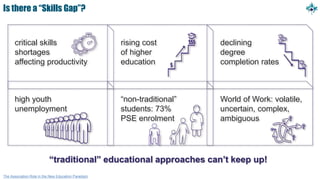
Is there a “Skills Gap”?
The Association Role in the New Education Paradigm
critical skills
shortages
affecting productivity
“traditional” educational approaches can’t keep up!
rising cost
of higher
education
declining
degree
completion rates
high youth
unemployment
“non-traditional”
students: 73%
PSE enrolment
World of Work: volatile,
uncertain, complex,
ambiguous
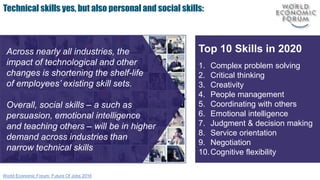
Technical skills yes, but also personal and social skills:
World Economic Forum: Future Of Jobs 2016
Across nearly all industries, the
impact of technological and other
changes is shortening the shelf-life
of employees’ existing skill sets.
Overall, social skills – a such as
persuasion, emotional intelligence
and teaching others – will be in higher
demand across industries than
narrow technical skills
Top 10 Skills in 2020
1. Complex problem solving
2. Critical thinking
3. Creativity
4. People management
5. Coordinating with others
6. Emotional intelligence
7. Judgment & decision making
8. Service orientation
9. Negotiation
10.Cognitive flexibility
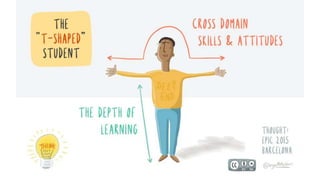
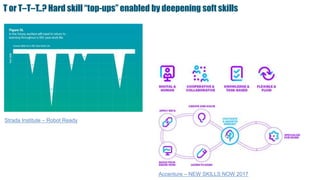
T or T–T–T..? Hard skill “top-ups” enabled by deepening soft skills
Accenture – NEW SKILLS NOW 2017
Strada Institute – Robot Ready
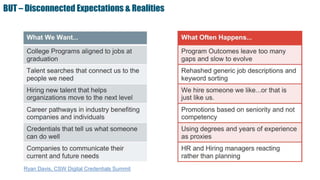
BUT – Disconnected Expectations & Realities
Ryan Davis, CSW Digital Credentials Summit
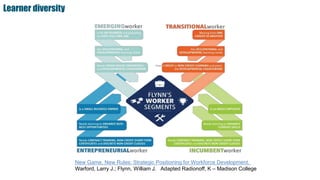
Learner diversity
New Game, New Rules: Strategic Positioning for Workforce Development.
Warford, Larry J.; Flynn, William J. Adapted Radionoff, K – Madison College
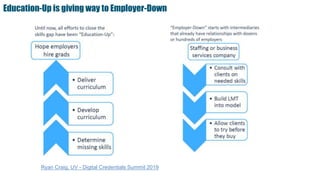
Education-Up is giving way to Employer-Down
Ryan Craig, UV - Digital Credentials Summit 2019
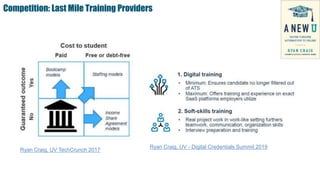
Competition: Last Mile Training Providers
Ryan Craig, UV TechCrunch 2017
Ryan Craig, UV - Digital Credentials Summit 2019
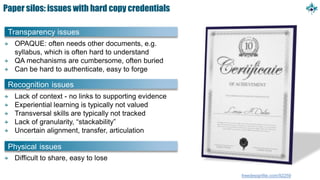
Paper silos: issues with hard copy credentials
freedesignfile.com/92259
Transparency issues
OPAQUE: often needs other documents, e.g.
syllabus, which is often hard to understand
QA mechanisms are cumbersome, often buried
Can be hard to authenticate, easy to forge
Physical issues
Difficult to share, easy to lose
Recognition issues
Lack of context - no links to supporting evidence
Experiential learning is typically not valued
Transversal skills are typically not tracked
Lack of granularity, “stackability”
Uncertain alignment, transfer, articulation
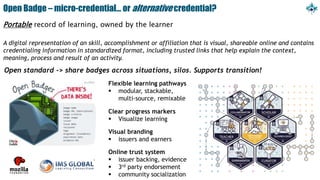
Flexible learning pathways
 modular, stackable,
multi-source, remixable
Clear progress markers
 Visualize learning
Visual branding
 issuers and earners
Online trust system
 issuer backing, evidence
 3rd party endorsement
 community socialization
A digital representation of an skill, accomplishment or affiliation that is visual, shareable online and contains
credentialing information in standardized format, including trusted links that help explain the context,
meaning, process and result of an activity.
Open standard -> share badges across situations, silos. Supports transition!
Open Badge – micro-credential… or alternative credential?
Portable record of learning, owned by the learner
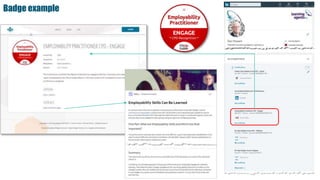
Badge example
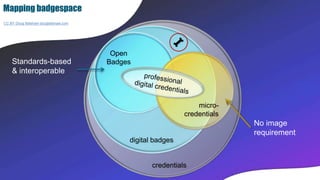
Mapping badgespace
credentials
digital badges
Open
Badges
micro-
credentials
CC BY Doug Belshaw dougbelshaw.com
Standards-based
& interoperable
No image
requirement
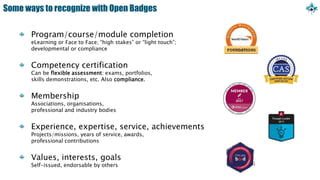
Some ways to recognize with Open Badges
Program/course/module completion
eLearning or Face to Face; “high stakes” or “light touch”;
developmental or compliance
Competency certification
Can be flexible assessment: exams, portfolios,
skills demonstrations, etc. Also compliance.
Membership
Associations, organisations,
professional and industry bodies
Experience, expertise, service, achievements
Projects/missions, years of service, awards,
professional contributions
Values, interests, goals
Self-issued, endorsable by others
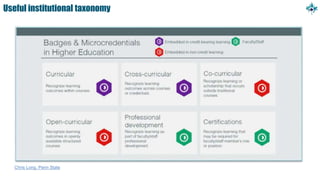
Useful institutional taxonomy
Chris Long, Penn State
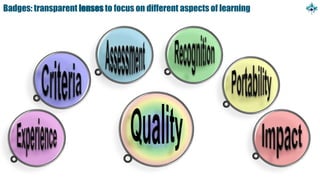
Badges: transparent lenses to focus on different aspects of learning
QUICK EXAMPLES
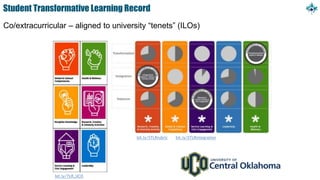
Student Transformative Learning Record
bit.ly/TLR_UCO
bit.ly/STLRrubric bit.ly/STLRintegration
Co/extracurricular – aligned to university “tenets” (ILOs)
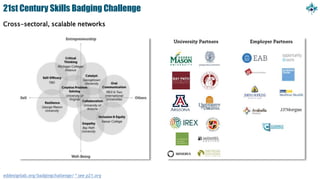
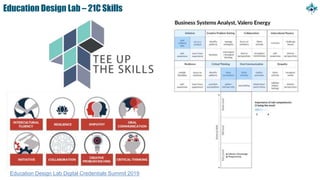
21st Century Skills Badging Challenge
Cross-sectoral, scalable networks
eddesignlab.org/badgingchallenge/ * see p21.org
Education Design Lab – 21C Skills
Education Design Lab Digital Credentials Summit 2019
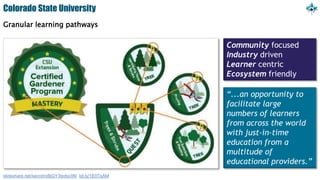
Colorado State University
Granular learning pathways
Community focused
Industry driven
Learner centric
Ecosystem friendly
slideshare.net/secret/xBjQY3Ipdsc06l bit.ly/1E0TqAM
“...an opportunity to
facilitate large
numbers of learners
from across the world
with just-in-time
education from a
multitude of
educational providers.”
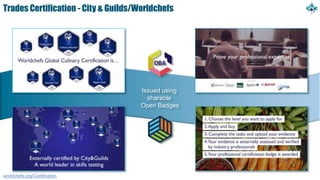
Trades Certification - City & Guilds/Worldchefs
worldchefs.org/Certification
Issued using
sharable
Open Badges
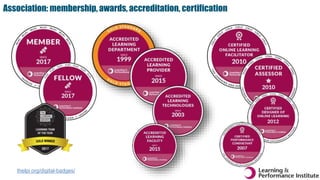
Association: membership, awards, accreditation, certification
thelpi.org/digital-badges/
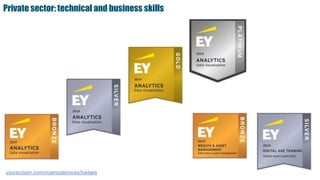
Private sector: technical and business skills
youracclaim.com/organizations/ey/badges
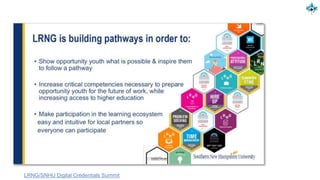
LRNG/SNHU Digital Credentials Summit
@donpresant
don@learningagents.ca

Open Badges 101

  • 1.
    Adapted from The OntarioOpen Badge Forum March 1, 2019 @donpresant “Open Badges 101”
  • 2.
    Is there a“Skills Gap”? The Association Role in the New Education Paradigm critical skills shortages affecting productivity “traditional” educational approaches can’t keep up! rising cost of higher education declining degree completion rates high youth unemployment “non-traditional” students: 73% PSE enrolment World of Work: volatile, uncertain, complex, ambiguous
  • 3.
    Technical skills yes,but also personal and social skills: World Economic Forum: Future Of Jobs 2016 Across nearly all industries, the impact of technological and other changes is shortening the shelf-life of employees’ existing skill sets. Overall, social skills – a such as persuasion, emotional intelligence and teaching others – will be in higher demand across industries than narrow technical skills Top 10 Skills in 2020 1. Complex problem solving 2. Critical thinking 3. Creativity 4. People management 5. Coordinating with others 6. Emotional intelligence 7. Judgment & decision making 8. Service orientation 9. Negotiation 10.Cognitive flexibility
  • 5.
    T or T–T–T..?Hard skill “top-ups” enabled by deepening soft skills Accenture – NEW SKILLS NOW 2017 Strada Institute – Robot Ready
  • 6.
    BUT – DisconnectedExpectations & Realities Ryan Davis, CSW Digital Credentials Summit
  • 7.
    Learner diversity New Game,New Rules: Strategic Positioning for Workforce Development. Warford, Larry J.; Flynn, William J. Adapted Radionoff, K – Madison College
  • 8.
    Education-Up is givingway to Employer-Down Ryan Craig, UV - Digital Credentials Summit 2019
  • 9.
    Competition: Last MileTraining Providers Ryan Craig, UV TechCrunch 2017 Ryan Craig, UV - Digital Credentials Summit 2019
  • 10.
    Paper silos: issueswith hard copy credentials freedesignfile.com/92259 Transparency issues OPAQUE: often needs other documents, e.g. syllabus, which is often hard to understand QA mechanisms are cumbersome, often buried Can be hard to authenticate, easy to forge Physical issues Difficult to share, easy to lose Recognition issues Lack of context - no links to supporting evidence Experiential learning is typically not valued Transversal skills are typically not tracked Lack of granularity, “stackability” Uncertain alignment, transfer, articulation
  • 11.
    Flexible learning pathways modular, stackable, multi-source, remixable Clear progress markers  Visualize learning Visual branding  issuers and earners Online trust system  issuer backing, evidence  3rd party endorsement  community socialization A digital representation of an skill, accomplishment or affiliation that is visual, shareable online and contains credentialing information in standardized format, including trusted links that help explain the context, meaning, process and result of an activity. Open standard -> share badges across situations, silos. Supports transition! Open Badge – micro-credential… or alternative credential? Portable record of learning, owned by the learner
  • 12.
  • 13.
    Mapping badgespace credentials digital badges Open Badges micro- credentials CCBY Doug Belshaw dougbelshaw.com Standards-based & interoperable No image requirement
  • 14.
    Some ways torecognize with Open Badges Program/course/module completion eLearning or Face to Face; “high stakes” or “light touch”; developmental or compliance Competency certification Can be flexible assessment: exams, portfolios, skills demonstrations, etc. Also compliance. Membership Associations, organisations, professional and industry bodies Experience, expertise, service, achievements Projects/missions, years of service, awards, professional contributions Values, interests, goals Self-issued, endorsable by others
  • 15.
  • 16.
    Badges: transparent lensesto focus on different aspects of learning
  • 17.
  • 19.
    Student Transformative LearningRecord bit.ly/TLR_UCO bit.ly/STLRrubric bit.ly/STLRintegration Co/extracurricular – aligned to university “tenets” (ILOs)
  • 20.
    21st Century SkillsBadging Challenge Cross-sectoral, scalable networks eddesignlab.org/badgingchallenge/ * see p21.org
  • 21.
    Education Design Lab– 21C Skills Education Design Lab Digital Credentials Summit 2019
  • 22.
    Colorado State University Granularlearning pathways Community focused Industry driven Learner centric Ecosystem friendly slideshare.net/secret/xBjQY3Ipdsc06l bit.ly/1E0TqAM “...an opportunity to facilitate large numbers of learners from across the world with just-in-time education from a multitude of educational providers.”
  • 23.
    Trades Certification -City & Guilds/Worldchefs worldchefs.org/Certification Issued using sharable Open Badges
  • 24.
    Association: membership, awards,accreditation, certification thelpi.org/digital-badges/
  • 25.
    Private sector: technicaland business skills youracclaim.com/organizations/ey/badges
  • 26.
  • 27.
  • 28.