
EPI for HSSO

Dr. Kyaw Kan Kaung
Project Manager/Assistant Director
Department of Health
Ministry of Health

Training on HSSO

Naypyitaw 6-7 Feb 2013
Goal and Objectives
National Immunization Program -Myanmar
The vision
reduction of under 5 morbidity and mortality caused by
vaccine preventable diseases in reaching MDG 4.
The overall objective
to reach the routine immunization coverage of 90% nationally
in children under one with 8 antigens and with TT in pregnant
women, and at least 80% coverage in all townships
The specific objectives
1.

To achieve immunization coverage of 90% nationally with at
least 80% coverage in every township for all 8 antigens in under
five and for TT in pregnant women

2.

To maintain the elimination status of Maternal and neonatal
tetanus (incidence to less than 1/1000 live-births at the national
level as well as township level)

3.

To sustain the interruption of indigenous transmission of wild
and vaccine-derived polio virus and to achieve eradication
status in 2014 Feb.
4.

To achieve measles elimination in 2015

5.

To ensure injection safety through universal use of AD
Syringes and appropriate waste management practices.

6.

To reduce vertical transmission of hepatitis B through
increased delivery of timely Hepatitis B birth dose.

7.

To enable evidence based decision making for introduction
of new vaccine –Rotavirus, Pneumococcal, JE, through
acquiring the needed information on disease burden,
costing, cost effectiveness and global funding environment
8. To increase coverage of other primary health care
interventions through improved linkages with
immunization – Vitamin A, B1, de-worming, and ITN
distribution & use.
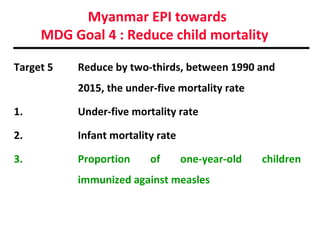
Myanmar EPI towards
MDG Goal 4 : Reduce child mortality
Target 5

Reduce by two-thirds, between 1990 and
2015, the under-five mortality rate

1.

Under-five mortality rate

2.

Infant mortality rate

3.

Proportion

of

one-year-old

immunized against measles

children
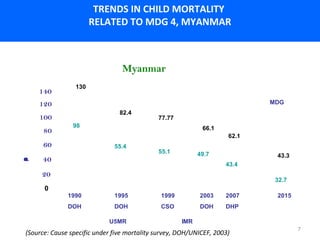
TRENDS IN CHILD MORTALITY
Trends in Child Mortality
RELATED TO MDG 4, MYANMAR
Relative to MDG-4 in Myanmar

Myanmar
140

130
MDG

120
82.4

100
80

98

66.1
62.1

60
B
L
0
,
1
r
p
s
h
t
a
e
D

77.77

55.4

55.1

49.7

40

43.3
43.4

20

32.7

0
1990

1995

1999

2003

2007

DOH

DOH

CSO

DOH

DHP

U5MR

2015

IMR

(Source: Cause specific under five mortality survey, DOH/UNICEF, 2003)

7
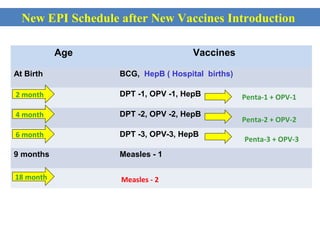
EPINew EPI Schedule after New Vaccines Introduction
Schedule in Myanmar before New Vaccine Introduction
Age

Vaccines

At Birth

BCG, HepB ( Hospital births)

6 weeks
2 month

DPT -1, OPV -1, HepB

10month
4 weeks

DPT -2, OPV -2, HepB

14month
6 weeks

DPT -3, OPV-3, HepB

9 months

Measles - 1

18 month

Measles - 2

Penta-1 + OPV-1
Penta-2 + OPV-2
Penta-3 + OPV-3
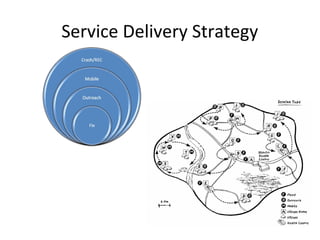
Service Delivery Strategy
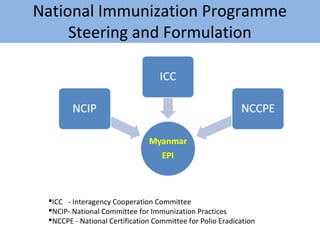
National Immunization Programme
Steering and Formulation

ICC - Interagency Cooperation Committee
NCIP- National Committee for Immunization Practices
NCCPE - National Certification Committee for Polio Eradication
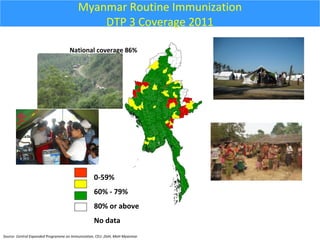
Myanmar Routine Immunization
DTP 3 Coverage 2011
National coverage 86%

0-59%
60% - 79%
80% or above
No data
Source- Central Expanded Programme on Immunization, CEU ,DoH, MoH Myanmar
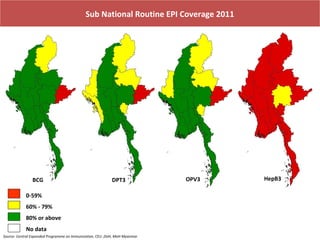
Sub National Routine EPI Coverage 2011

BCG

DPT3

0-59%
60% - 79%
80% or above
No data
Source- Central Expanded Programme on Immunization, CEU ,DoH, MoH Myanmar

OPV3

HepB3
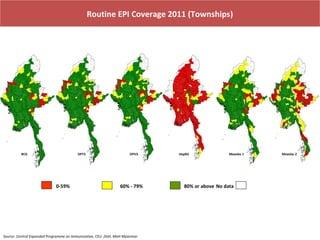
Routine EPI Coverage 2011 (Townships)

BCG

DPT3

0-59%

OPV3

60% - 79%

Source- Central Expanded Programme on Immunization, CEU ,DoH, MoH Myanmar

HepB3

Measles 1

80% or above No data

Measles 2
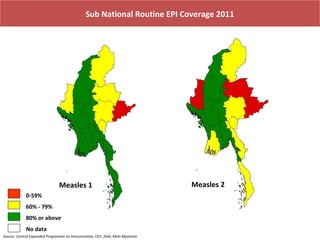
Sub National Routine EPI Coverage 2011

Measles 1
0-59%
60% - 79%
80% or above
No data
Source- Central Expanded Programme on Immunization, CEU ,DoH, MoH Myanmar

Measles 2
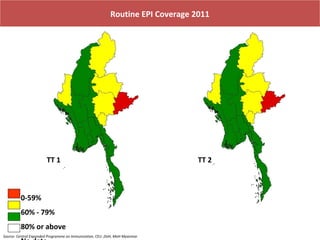
Routine EPI Coverage 2011

TT 1

0-59%
60% - 79%
80% or above
Source- Central Expanded Programme on Immunization, CEU ,DoH, MoH Myanmar

TT 2
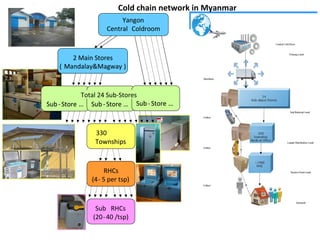
Cold chain network in Myanmar
Yangon
Central Coldroom

Level

Power
conditions

Equipment used

Central +
2 Main
Sores

~24 hrs

Walk-in cold room
Back-up generator

Sub-Stores
(State or
Division
level)

at least 8 hrs
per day

Freezer & Fridge
Back-up generator

Township

at least 3 hrs
per day

Freezer & Fridge

2 Main Stores
( Mandalay&Magway )

Total 24 Sub-Stores
Sub - Store … Sub - Store … Sub - Store …

330
Townships

Solar unit for selected
locations

Sub RHCs
(20- 40 /tsp)

mostly not
available

Sub RHC

RHCs
(4- 5 per tsp)

Rural Health
Center
(RHC)

not available

Cooler box with ice
packs (last 5 days)
Solar unit for selected
locations
Vaccine Carrier for
midwife (last only
48hrs)
Immunization Safety
Components of Immunization Safety
Vaccine Safety
Injection Safety
Safety of Waste Disposal
Vaccine safety and quality
Safe cold-chain practices
Vaccines are sensitive to heat and freezing
kept at the correct temperature from manufactured to used
in order to preserve their quality
The cold chain consists of a series of storage and transport
links
Due to unsafe cold-chain practices :
• has reduced effectiveness in
protecting against disease
• can result in higher rates of local
reactions
Safe use of diluents
• Kept correct diluent and distributed with each vaccine type
and batch.
• Vaccines and diluents must be clearly labelled and identified.
• Diluents must be cooled to between +2°C and +8°C before
reconstitution.
• Draw up the correct number of doses per vial
• Discard reconstituted vaccines after six hours of
reconstitution.
• Diluents must not be frozen.
• Sterile water for injection must NOT be used as a vaccine
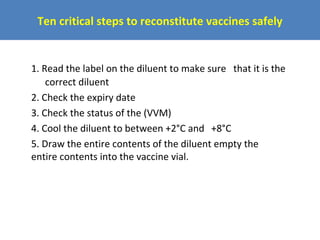
Ten critical steps to reconstitute vaccines safely

1. Read the label on the diluent to make sure that it is the
correct diluent
2. Check the expiry date
3. Check the status of the (VVM)
4. Cool the diluent to between +2°C and +8°C
5. Draw the entire contents of the diluent empty the
entire contents into the vaccine vial.
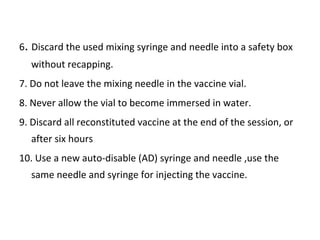
6. Discard the used mixing syringe and needle into a safety box
without recapping.
7. Do not leave the mixing needle in the vaccine vial.
8. Never allow the vial to become immersed in water.
9. Discard all reconstituted vaccine at the end of the session, or
after six hours
10. Use a new auto-disable (AD) syringe and needle ,use the
same needle and syringe for injecting the vaccine.
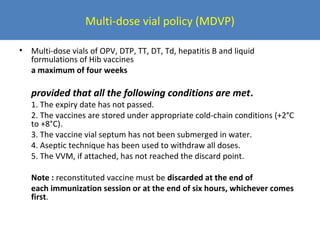
Multi-dose vial policy (MDVP)
•

Multi-dose vials of OPV, DTP, TT, DT, Td, hepatitis B and liquid
formulations of Hib vaccines
a maximum of four weeks

provided that all the following conditions are met.

1. The expiry date has not passed.
2. The vaccines are stored under appropriate cold-chain conditions (+2°C
to +8°C).
3. The vaccine vial septum has not been submerged in water.
4. Aseptic technique has been used to withdraw all doses.
5. The VVM, if attached, has not reached the discard point.
Note : reconstituted vaccine must be discarded at the end of
each immunization session or at the end of six hours, whichever comes
first.
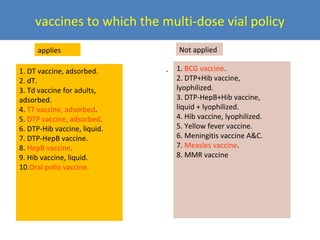
vaccines to which the multi-dose vial policy
applies
1. DT vaccine, adsorbed.
2. dT.
3. Td vaccine for adults,
adsorbed.
4. TT vaccine, adsorbed.
5. DTP vaccine, adsorbed.
6. DTP-Hib vaccine, liquid.
7. DTP-HepB vaccine.
8. HepB vaccine.
9. Hib vaccine, liquid.
10.Oral polio vaccine.

Not applied

. 1. BCG vaccine.

2. DTP+Hib vaccine,
lyophilized.
3. DTP-HepB+Hib vaccine,
liquid + lyophilized.
4. Hib vaccine, lyophilized.
5. Yellow fever vaccine.
6. Meningitis vaccine A&C.
7. Measles vaccine.
8. MMR vaccine
AEFI
Adverse Events Following Immunization
(AEFI) surveillance
Definition of AEFI surveillance

An adverse event following immunization (AEFI) is
defined as a medical event or incident that takes place after
an immunization, but is not necessarily caused by
immunization.

AEFI surveillance includes :

1. detecting, monitoring and responding to adverse
events following immunization(AEFI) ;
2. implementing appropriate and immediate action to
correct any unsafe practices detected through the
AEFI
surveillance system, in order to lessen the
negative
impact on the health of individuals and the
reputation of the immunization programme.
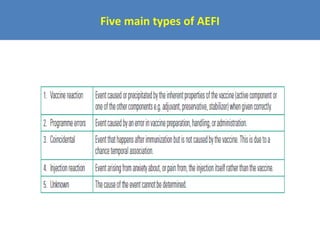
Five main types of AEFI
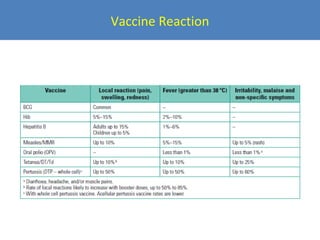
Vaccine Reaction
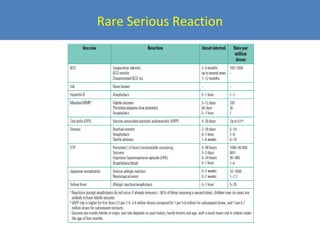
Rare Serious Reaction
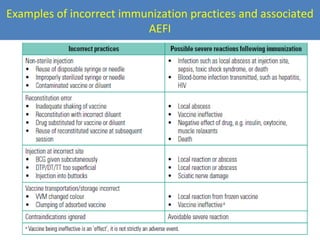
Examples of incorrect immunization practices and associated
AEFI
Programme errors and AEFI
•

The view that vaccines are the most common cause of
AEFI is incorrect.

•

On the contrary, incorrect immunization practices that
can be prevented are more often the cause.

•

Careful epidemiological investigation of an AEFI is
needed

to pinpoint the cause and to correct these

malpractices.
Estimating Vaccine and Injection Equipments
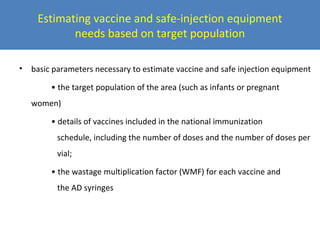
Estimating vaccine and safe-injection equipment
needs based on target population
•

basic parameters necessary to estimate vaccine and safe injection equipment
• the target population of the area (such as infants or pregnant
women)
• details of vaccines included in the national immunization
schedule, including the number of doses and the number of doses per
vial;
• the wastage multiplication factor (WMF) for each vaccine and
the AD syringes
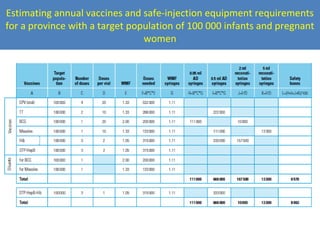
Estimating annual vaccines and safe-injection equipment requirements
for a province with a target population of 100 000 infants and pregnant
women
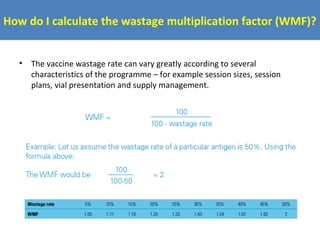
How do I calculate the wastage multiplication factor (WMF)?
•

The vaccine wastage rate can vary greatly according to several
characteristics of the programme – for example session sizes, session
plans, vial presentation and supply management.
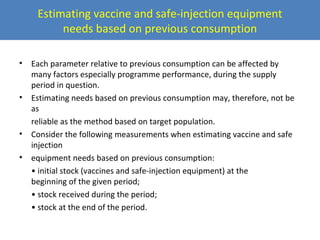
Estimating vaccine and safe-injection equipment
needs based on previous consumption
•

•

•
•

Each parameter relative to previous consumption can be affected by
many factors especially programme performance, during the supply
period in question.
Estimating needs based on previous consumption may, therefore, not be
as
reliable as the method based on target population.
Consider the following measurements when estimating vaccine and safe
injection
equipment needs based on previous consumption:
• initial stock (vaccines and safe-injection equipment) at the
beginning of the given period;
• stock received during the period;
• stock at the end of the period.
Storage of vaccines and safe injection equipment

• Storing vaccines
• Vaccine storage conditions
• Temperature sensitivity of vaccines
• Loss of potency due to heat
• Loss of potency due to Freezing
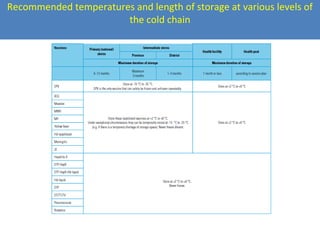
Recommended temperatures and length of storage at various levels of
the cold chain
Diluent
• if diluent is supplied separately, it can be stored outside the
cold chain
• but must be cooled before use, preferably for a day or for a
period of time
• sufficient to ensure that the vaccine and diluent are both at
temperatures between +2 °C and +8 °C when they are
reconstituted.
• Never freeze diluent.
Photosensitivity
• Some vaccines are very sensitive to light and their exposure
to ultraviolet light causes loss of potency.
• BCG, measles, MR, MMR and rubella vaccines are equally
light-sensitive and must always be protected from sunlight
and fluorescent (neon) light.
• manufacturers provide these vaccines in vials made of a
darker glass.
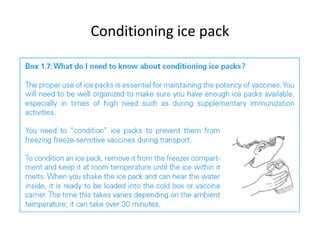
Conditioning ice pack
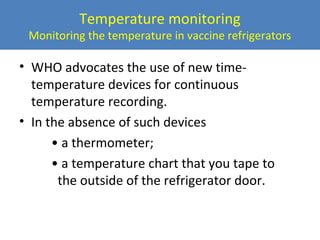
Temperature monitoring

Monitoring the temperature in vaccine refrigerators

• WHO advocates the use of new timetemperature devices for continuous
temperature recording.
• In the absence of such devices
• a thermometer;
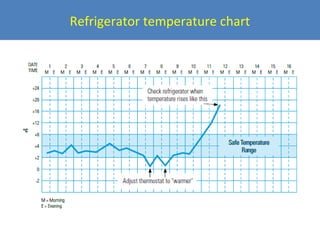
• a temperature chart that you tape to
the outside of the refrigerator door.
Refrigerator temperature chart
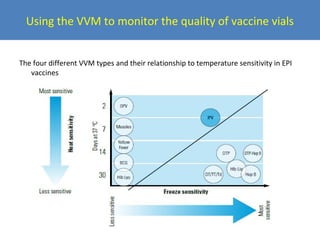
Using the VVM to monitor the quality of vaccine vials
The four different VVM types and their relationship to temperature sensitivity in EPI
vaccines
Reducing vaccine wastage
•

•

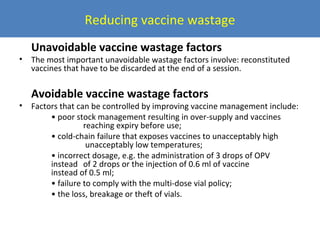
Unavoidable vaccine wastage factors

The most important unavoidable wastage factors involve: reconstituted
vaccines that have to be discarded at the end of a session.

Avoidable vaccine wastage factors

Factors that can be controlled by improving vaccine management include:
• poor stock management resulting in over-supply and vaccines
reaching expiry before use;
• cold-chain failure that exposes vaccines to unacceptably high
unacceptably low temperatures;
• incorrect dosage, e.g. the administration of 3 drops of OPV
instead of 2 drops or the injection of 0.6 ml of vaccine
instead of 0.5 ml;
• failure to comply with the multi-dose vial policy;
• the loss, breakage or theft of vials.
What is RED Strategy?
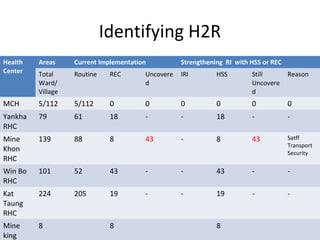
Identifying H2R
Health
Center

Areas

Current Implementation

Strengthening RI with HSS or REC

Total
Ward/
Village

Routine

REC

Uncovere
d

IRI

HSS

Still
Uncovere
d

Reason

MCH

5/112

5/112

0

0

0

0

0

0

Yankha
RHC

79

61

18

-

-

18

-

-

Mine
Khon
RHC

139

88

8

43

-

8

43

Satff
Transport
Security

Win Bo
RHC

101

52

43

-

-

43

-

-

Kat
Taung
RHC

224

205

19

-

-

19

-

-

Mine
king

8

8

8
Background
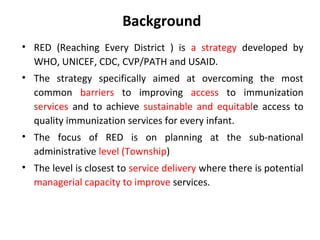
• RED (Reaching Every District ) is a strategy developed by
WHO, UNICEF, CDC, CVP/PATH and USAID.
• The strategy specifically aimed at overcoming the most
common barriers to improving access to immunization
services and to achieve sustainable and equitable access to
quality immunization services for every infant.
• The focus of RED is on planning at the sub-national
administrative level (Township)
• The level is closest to service delivery where there is potential
managerial capacity to improve services.
The

RED

strategy

has

the

following

operational components
1. Re-establishment of outreach services
2. Supportive supervision
3. Community link with service delivery
4. Monitoring and use of data for action
5. Planning and management of resources

five
The five RED operational components
1. Re-establishing outreach vaccination
services
 A large proportion of the population only have
access to immunization through outreach
 Outreach sessions, by mobile immunization teams
also present opportunities to provide other
interventions such as administering vitamin A and
deworming tablets with immunization
 Include other interventions during crash programme in
hard to reach areas where feasible
The five RED operational components
2. Supportive supervision
 providing regular on-site or on- the- job training and
assistance by supervisors to health workers in
Township during supervisory visits or at regular
monthly meetings
 offers the opportunity to integrate supervision of
other health interventions, for example Integrated
Management of Childhood Illness (IMCI).
The five RED operational components
2. Supportive supervision
 Update and use standardized supervisory checklist
 Training of supervisors(TMO,THO.HA1,THN at SD
level
 Support mobility of supervisors atl all level
 Provision feedback at all opportunities
 Prioritize areas to be supervised based on
coverage/drop-out.
The five RED operational components
3. Linking services with communities
 Immunization services need to integrated better into

community structures.
 This can be achieved by involving the community in the
planning and delivery of health services,
 Including immunization,
 such as identifying community volunteers and designating
responsibilities
 identifying newborns and
 performing regular follow-up on mothers whose children are
not fully immunized
The five RED operational components
3. Linking services with communities
 Promotion of benefit of immunization at all
opportunities.
 Explore the possibilities of increasing use of mass
media for promoting routine immunization
 Increase training for health workers and volunteers
to communicate effectively with mothers ideally in
local languages
The five RED operational components
4. Monitoring and use of data for action
 Monitoring of immunization activities and using the

data for action is critical in strengthening the
immunization system
 Simple monitoring tools such as wall charts of
vaccination coverage can be used to track monthly
progress
 Information on logistics, vaccine supply and surveillance
which is collected every month should be analyzed
together with the coverage data to improve the
immunization system.
The five RED operational components
5. Planning and management of resources
• A township/RHC micro plan is the key to the RED
strategy.
• At each level, micro plans should contain details of
the financial and human resources required to reach
every district in a sustainable manner.
Please contact kyawkankaungmo@gmail.com
09-8702267

Epi for hsso

  • 1.
    EPI for HSSO Dr.Kyaw Kan Kaung Project Manager/Assistant Director Department of Health Ministry of Health Training on HSSO Naypyitaw 6-7 Feb 2013
  • 2.
    Goal and Objectives NationalImmunization Program -Myanmar The vision reduction of under 5 morbidity and mortality caused by vaccine preventable diseases in reaching MDG 4. The overall objective to reach the routine immunization coverage of 90% nationally in children under one with 8 antigens and with TT in pregnant women, and at least 80% coverage in all townships
  • 3.
    The specific objectives 1. Toachieve immunization coverage of 90% nationally with at least 80% coverage in every township for all 8 antigens in under five and for TT in pregnant women 2. To maintain the elimination status of Maternal and neonatal tetanus (incidence to less than 1/1000 live-births at the national level as well as township level) 3. To sustain the interruption of indigenous transmission of wild and vaccine-derived polio virus and to achieve eradication status in 2014 Feb.
  • 4.
    4. To achieve measleselimination in 2015 5. To ensure injection safety through universal use of AD Syringes and appropriate waste management practices. 6. To reduce vertical transmission of hepatitis B through increased delivery of timely Hepatitis B birth dose. 7. To enable evidence based decision making for introduction of new vaccine –Rotavirus, Pneumococcal, JE, through acquiring the needed information on disease burden, costing, cost effectiveness and global funding environment
  • 5.
    8. To increasecoverage of other primary health care interventions through improved linkages with immunization – Vitamin A, B1, de-worming, and ITN distribution & use.
  • 6.
    Myanmar EPI towards MDGGoal 4 : Reduce child mortality Target 5 Reduce by two-thirds, between 1990 and 2015, the under-five mortality rate 1. Under-five mortality rate 2. Infant mortality rate 3. Proportion of one-year-old immunized against measles children
  • 7.
    TRENDS IN CHILDMORTALITY Trends in Child Mortality RELATED TO MDG 4, MYANMAR Relative to MDG-4 in Myanmar Myanmar 140 130 MDG 120 82.4 100 80 98 66.1 62.1 60 B L 0 , 1 r p s h t a e D 77.77 55.4 55.1 49.7 40 43.3 43.4 20 32.7 0 1990 1995 1999 2003 2007 DOH DOH CSO DOH DHP U5MR 2015 IMR (Source: Cause specific under five mortality survey, DOH/UNICEF, 2003) 7
  • 8.
    EPINew EPI Scheduleafter New Vaccines Introduction Schedule in Myanmar before New Vaccine Introduction Age Vaccines At Birth BCG, HepB ( Hospital births) 6 weeks 2 month DPT -1, OPV -1, HepB 10month 4 weeks DPT -2, OPV -2, HepB 14month 6 weeks DPT -3, OPV-3, HepB 9 months Measles - 1 18 month Measles - 2 Penta-1 + OPV-1 Penta-2 + OPV-2 Penta-3 + OPV-3
  • 9.
  • 10.
    National Immunization Programme Steeringand Formulation ICC - Interagency Cooperation Committee NCIP- National Committee for Immunization Practices NCCPE - National Certification Committee for Polio Eradication
  • 11.
    Myanmar Routine Immunization DTP3 Coverage 2011 National coverage 86% 0-59% 60% - 79% 80% or above No data Source- Central Expanded Programme on Immunization, CEU ,DoH, MoH Myanmar
  • 12.
    Sub National RoutineEPI Coverage 2011 BCG DPT3 0-59% 60% - 79% 80% or above No data Source- Central Expanded Programme on Immunization, CEU ,DoH, MoH Myanmar OPV3 HepB3
  • 13.
    Routine EPI Coverage2011 (Townships) BCG DPT3 0-59% OPV3 60% - 79% Source- Central Expanded Programme on Immunization, CEU ,DoH, MoH Myanmar HepB3 Measles 1 80% or above No data Measles 2
  • 14.
    Sub National RoutineEPI Coverage 2011 Measles 1 0-59% 60% - 79% 80% or above No data Source- Central Expanded Programme on Immunization, CEU ,DoH, MoH Myanmar Measles 2
  • 15.
    Routine EPI Coverage2011 TT 1 0-59% 60% - 79% 80% or above Source- Central Expanded Programme on Immunization, CEU ,DoH, MoH Myanmar TT 2
  • 16.
    Cold chain networkin Myanmar Yangon Central Coldroom Level Power conditions Equipment used Central + 2 Main Sores ~24 hrs Walk-in cold room Back-up generator Sub-Stores (State or Division level) at least 8 hrs per day Freezer & Fridge Back-up generator Township at least 3 hrs per day Freezer & Fridge 2 Main Stores ( Mandalay&Magway ) Total 24 Sub-Stores Sub - Store … Sub - Store … Sub - Store … 330 Townships Solar unit for selected locations Sub RHCs (20- 40 /tsp) mostly not available Sub RHC RHCs (4- 5 per tsp) Rural Health Center (RHC) not available Cooler box with ice packs (last 5 days) Solar unit for selected locations Vaccine Carrier for midwife (last only 48hrs)
  • 17.
    Immunization Safety Components ofImmunization Safety Vaccine Safety Injection Safety Safety of Waste Disposal
  • 18.
    Vaccine safety andquality Safe cold-chain practices Vaccines are sensitive to heat and freezing kept at the correct temperature from manufactured to used in order to preserve their quality The cold chain consists of a series of storage and transport links
  • 19.
    Due to unsafecold-chain practices : • has reduced effectiveness in protecting against disease • can result in higher rates of local reactions
  • 20.
    Safe use ofdiluents • Kept correct diluent and distributed with each vaccine type and batch. • Vaccines and diluents must be clearly labelled and identified. • Diluents must be cooled to between +2°C and +8°C before reconstitution. • Draw up the correct number of doses per vial • Discard reconstituted vaccines after six hours of reconstitution. • Diluents must not be frozen. • Sterile water for injection must NOT be used as a vaccine
  • 21.
    Ten critical stepsto reconstitute vaccines safely 1. Read the label on the diluent to make sure that it is the correct diluent 2. Check the expiry date 3. Check the status of the (VVM) 4. Cool the diluent to between +2°C and +8°C 5. Draw the entire contents of the diluent empty the entire contents into the vaccine vial.
  • 22.
    6. Discard theused mixing syringe and needle into a safety box without recapping. 7. Do not leave the mixing needle in the vaccine vial. 8. Never allow the vial to become immersed in water. 9. Discard all reconstituted vaccine at the end of the session, or after six hours 10. Use a new auto-disable (AD) syringe and needle ,use the same needle and syringe for injecting the vaccine.
  • 23.
    Multi-dose vial policy(MDVP) • Multi-dose vials of OPV, DTP, TT, DT, Td, hepatitis B and liquid formulations of Hib vaccines a maximum of four weeks provided that all the following conditions are met. 1. The expiry date has not passed. 2. The vaccines are stored under appropriate cold-chain conditions (+2°C to +8°C). 3. The vaccine vial septum has not been submerged in water. 4. Aseptic technique has been used to withdraw all doses. 5. The VVM, if attached, has not reached the discard point. Note : reconstituted vaccine must be discarded at the end of each immunization session or at the end of six hours, whichever comes first.
  • 24.
    vaccines to whichthe multi-dose vial policy applies 1. DT vaccine, adsorbed. 2. dT. 3. Td vaccine for adults, adsorbed. 4. TT vaccine, adsorbed. 5. DTP vaccine, adsorbed. 6. DTP-Hib vaccine, liquid. 7. DTP-HepB vaccine. 8. HepB vaccine. 9. Hib vaccine, liquid. 10.Oral polio vaccine. Not applied . 1. BCG vaccine. 2. DTP+Hib vaccine, lyophilized. 3. DTP-HepB+Hib vaccine, liquid + lyophilized. 4. Hib vaccine, lyophilized. 5. Yellow fever vaccine. 6. Meningitis vaccine A&C. 7. Measles vaccine. 8. MMR vaccine
  • 25.
  • 26.
    Adverse Events FollowingImmunization (AEFI) surveillance Definition of AEFI surveillance An adverse event following immunization (AEFI) is defined as a medical event or incident that takes place after an immunization, but is not necessarily caused by immunization. AEFI surveillance includes : 1. detecting, monitoring and responding to adverse events following immunization(AEFI) ; 2. implementing appropriate and immediate action to correct any unsafe practices detected through the AEFI surveillance system, in order to lessen the negative impact on the health of individuals and the reputation of the immunization programme.
  • 27.
  • 28.
  • 29.
  • 30.
    Examples of incorrectimmunization practices and associated AEFI
  • 31.
    Programme errors andAEFI • The view that vaccines are the most common cause of AEFI is incorrect. • On the contrary, incorrect immunization practices that can be prevented are more often the cause. • Careful epidemiological investigation of an AEFI is needed to pinpoint the cause and to correct these malpractices.
  • 32.
    Estimating Vaccine andInjection Equipments
  • 33.
    Estimating vaccine andsafe-injection equipment needs based on target population • basic parameters necessary to estimate vaccine and safe injection equipment • the target population of the area (such as infants or pregnant women) • details of vaccines included in the national immunization schedule, including the number of doses and the number of doses per vial; • the wastage multiplication factor (WMF) for each vaccine and the AD syringes
  • 34.
    Estimating annual vaccinesand safe-injection equipment requirements for a province with a target population of 100 000 infants and pregnant women
  • 35.
    How do Icalculate the wastage multiplication factor (WMF)? • The vaccine wastage rate can vary greatly according to several characteristics of the programme – for example session sizes, session plans, vial presentation and supply management.
  • 36.
    Estimating vaccine andsafe-injection equipment needs based on previous consumption • • • • Each parameter relative to previous consumption can be affected by many factors especially programme performance, during the supply period in question. Estimating needs based on previous consumption may, therefore, not be as reliable as the method based on target population. Consider the following measurements when estimating vaccine and safe injection equipment needs based on previous consumption: • initial stock (vaccines and safe-injection equipment) at the beginning of the given period; • stock received during the period; • stock at the end of the period.
  • 37.
    Storage of vaccinesand safe injection equipment • Storing vaccines • Vaccine storage conditions • Temperature sensitivity of vaccines • Loss of potency due to heat • Loss of potency due to Freezing
  • 38.
    Recommended temperatures andlength of storage at various levels of the cold chain
  • 39.
    Diluent • if diluentis supplied separately, it can be stored outside the cold chain • but must be cooled before use, preferably for a day or for a period of time • sufficient to ensure that the vaccine and diluent are both at temperatures between +2 °C and +8 °C when they are reconstituted. • Never freeze diluent.
  • 40.
    Photosensitivity • Some vaccinesare very sensitive to light and their exposure to ultraviolet light causes loss of potency. • BCG, measles, MR, MMR and rubella vaccines are equally light-sensitive and must always be protected from sunlight and fluorescent (neon) light. • manufacturers provide these vaccines in vials made of a darker glass.
  • 41.
  • 42.
    Temperature monitoring Monitoring thetemperature in vaccine refrigerators • WHO advocates the use of new timetemperature devices for continuous temperature recording. • In the absence of such devices • a thermometer; • a temperature chart that you tape to the outside of the refrigerator door.
  • 43.
  • 44.
    Using the VVMto monitor the quality of vaccine vials The four different VVM types and their relationship to temperature sensitivity in EPI vaccines
  • 45.
    Reducing vaccine wastage • • Unavoidablevaccine wastage factors The most important unavoidable wastage factors involve: reconstituted vaccines that have to be discarded at the end of a session. Avoidable vaccine wastage factors Factors that can be controlled by improving vaccine management include: • poor stock management resulting in over-supply and vaccines reaching expiry before use; • cold-chain failure that exposes vaccines to unacceptably high unacceptably low temperatures; • incorrect dosage, e.g. the administration of 3 drops of OPV instead of 2 drops or the injection of 0.6 ml of vaccine instead of 0.5 ml; • failure to comply with the multi-dose vial policy; • the loss, breakage or theft of vials.
  • 46.
    What is REDStrategy?
  • 47.
    Identifying H2R Health Center Areas Current Implementation StrengtheningRI with HSS or REC Total Ward/ Village Routine REC Uncovere d IRI HSS Still Uncovere d Reason MCH 5/112 5/112 0 0 0 0 0 0 Yankha RHC 79 61 18 - - 18 - - Mine Khon RHC 139 88 8 43 - 8 43 Satff Transport Security Win Bo RHC 101 52 43 - - 43 - - Kat Taung RHC 224 205 19 - - 19 - - Mine king 8 8 8
  • 48.
    Background • RED (ReachingEvery District ) is a strategy developed by WHO, UNICEF, CDC, CVP/PATH and USAID. • The strategy specifically aimed at overcoming the most common barriers to improving access to immunization services and to achieve sustainable and equitable access to quality immunization services for every infant. • The focus of RED is on planning at the sub-national administrative level (Township) • The level is closest to service delivery where there is potential managerial capacity to improve services.
  • 49.
    The RED strategy has the following operational components 1. Re-establishmentof outreach services 2. Supportive supervision 3. Community link with service delivery 4. Monitoring and use of data for action 5. Planning and management of resources five
  • 50.
    The five REDoperational components 1. Re-establishing outreach vaccination services  A large proportion of the population only have access to immunization through outreach  Outreach sessions, by mobile immunization teams also present opportunities to provide other interventions such as administering vitamin A and deworming tablets with immunization  Include other interventions during crash programme in hard to reach areas where feasible
  • 51.
    The five REDoperational components 2. Supportive supervision  providing regular on-site or on- the- job training and assistance by supervisors to health workers in Township during supervisory visits or at regular monthly meetings  offers the opportunity to integrate supervision of other health interventions, for example Integrated Management of Childhood Illness (IMCI).
  • 52.
    The five REDoperational components 2. Supportive supervision  Update and use standardized supervisory checklist  Training of supervisors(TMO,THO.HA1,THN at SD level  Support mobility of supervisors atl all level  Provision feedback at all opportunities  Prioritize areas to be supervised based on coverage/drop-out.
  • 53.
    The five REDoperational components 3. Linking services with communities  Immunization services need to integrated better into community structures.  This can be achieved by involving the community in the planning and delivery of health services,  Including immunization,  such as identifying community volunteers and designating responsibilities  identifying newborns and  performing regular follow-up on mothers whose children are not fully immunized
  • 54.
    The five REDoperational components 3. Linking services with communities  Promotion of benefit of immunization at all opportunities.  Explore the possibilities of increasing use of mass media for promoting routine immunization  Increase training for health workers and volunteers to communicate effectively with mothers ideally in local languages
  • 55.
    The five REDoperational components 4. Monitoring and use of data for action  Monitoring of immunization activities and using the data for action is critical in strengthening the immunization system  Simple monitoring tools such as wall charts of vaccination coverage can be used to track monthly progress  Information on logistics, vaccine supply and surveillance which is collected every month should be analyzed together with the coverage data to improve the immunization system.
  • 56.
    The five REDoperational components 5. Planning and management of resources • A township/RHC micro plan is the key to the RED strategy. • At each level, micro plans should contain details of the financial and human resources required to reach every district in a sustainable manner.
  • 58.

Editor's Notes

  • #17 Township collects needed vaccine from Subdepots. BHS then carry vaccine in vaccine carrier and vaccinate targeted children and pregnant women.