

Human Resources for
Health
Dr. Nilar Tin
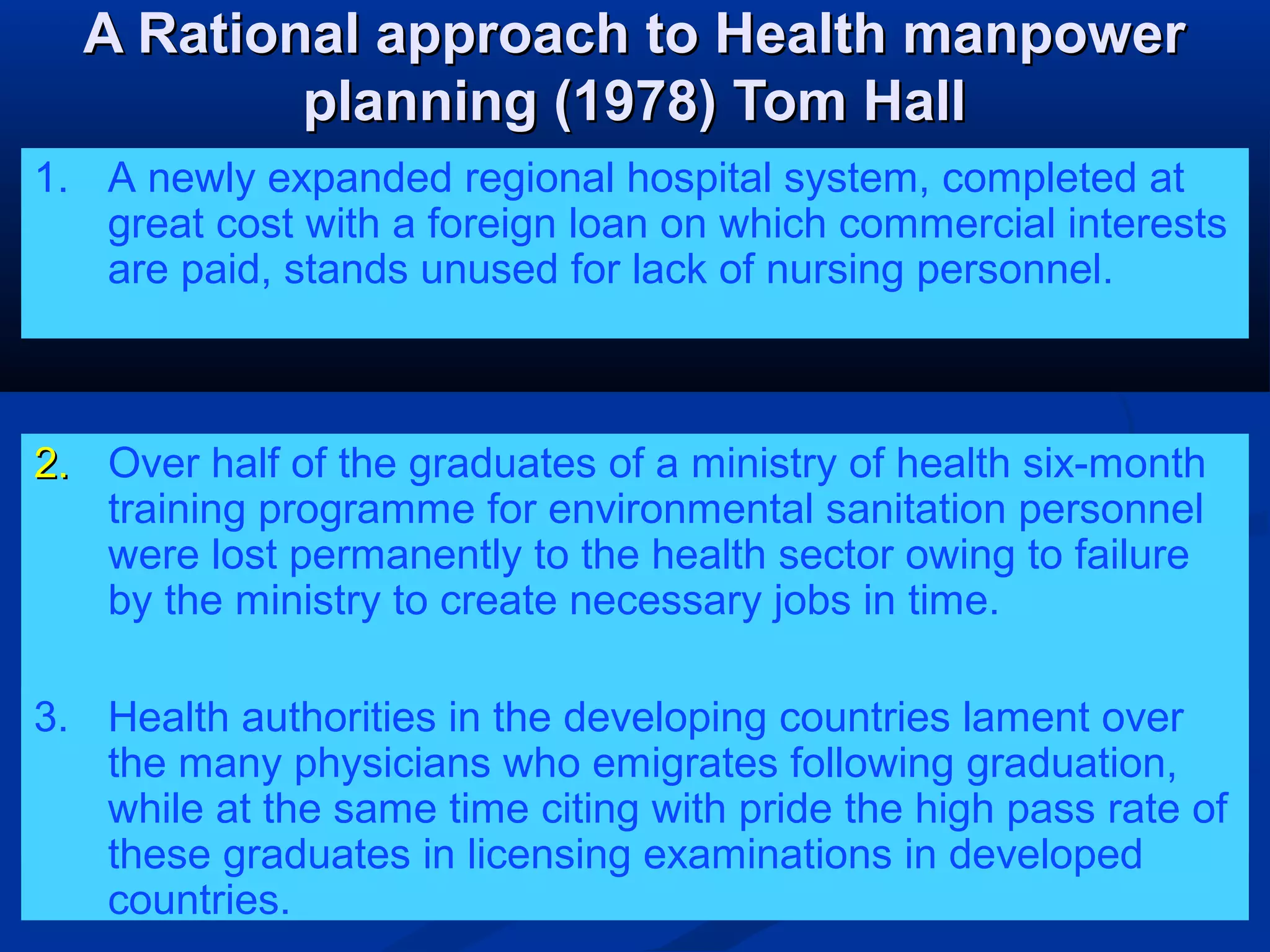
A Rational approach to Health manpower
planning (1978) Tom Hall
1. A newly expanded regional hospital system, completed at
great cost with a foreign loan on which commercial interests
are paid, stands unused for lack of nursing personnel.

2. Over half of the graduates of a ministry of health six-month
training programme for environmental sanitation personnel
were lost permanently to the health sector owing to failure
by the ministry to create necessary jobs in time.
3. Health authorities in the developing countries lament over
the many physicians who emigrates following graduation,
while at the same time citing with pride the high pass rate of
these graduates in licensing examinations in developed
countries.
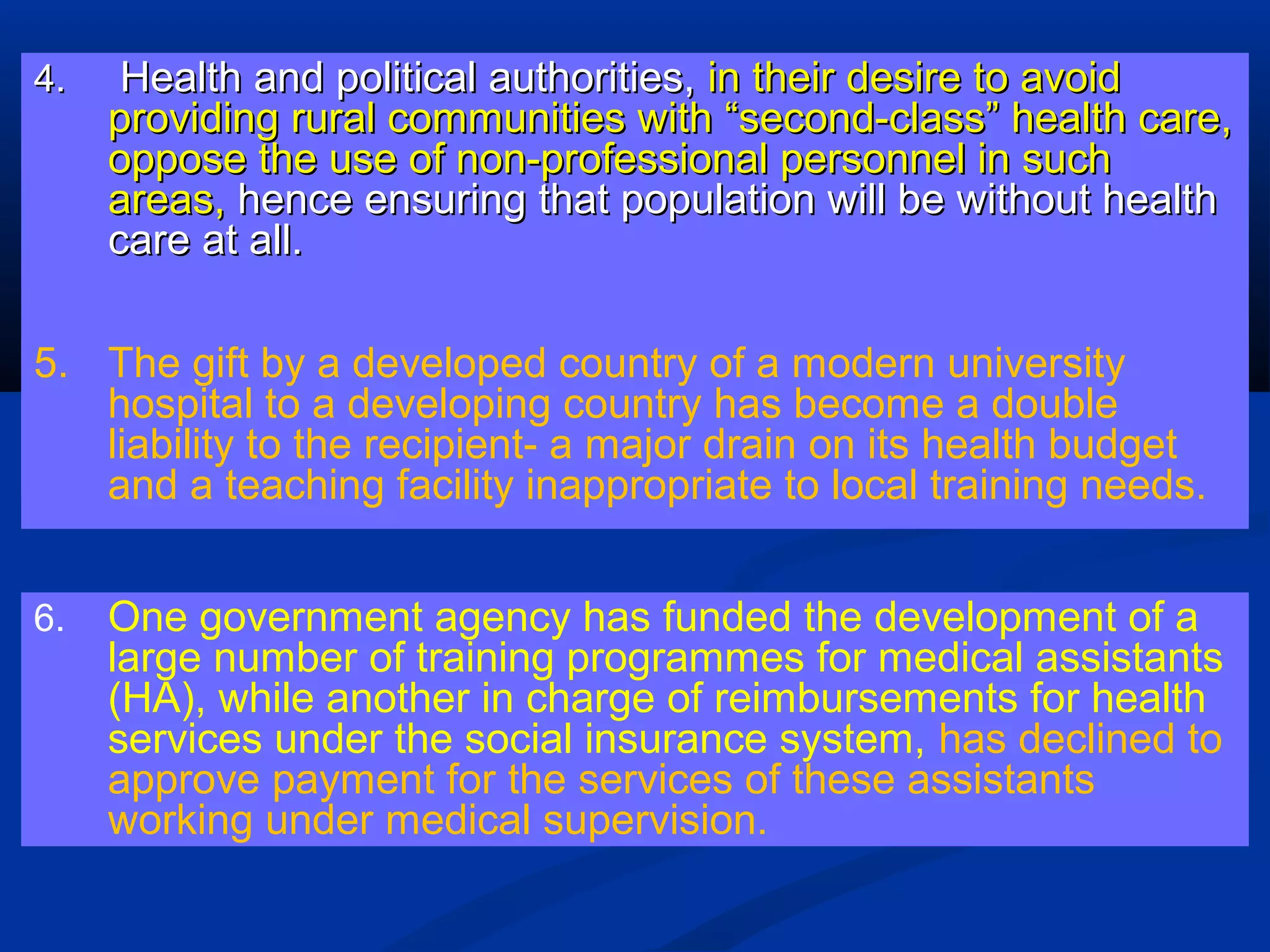
4.

Health and political authorities, in their desire to avoid
providing rural communities with “second-class” health care,
oppose the use of non-professional personnel in such
areas, hence ensuring that population will be without health
care at all.

5. The gift by a developed country of a modern university
hospital to a developing country has become a double
liability to the recipient- a major drain on its health budget
and a teaching facility inappropriate to local training needs.
6.

One government agency has funded the development of a
large number of training programmes for medical assistants
(HA), while another in charge of reimbursements for health
services under the social insurance system, has declined to
approve payment for the services of these assistants
working under medical supervision.
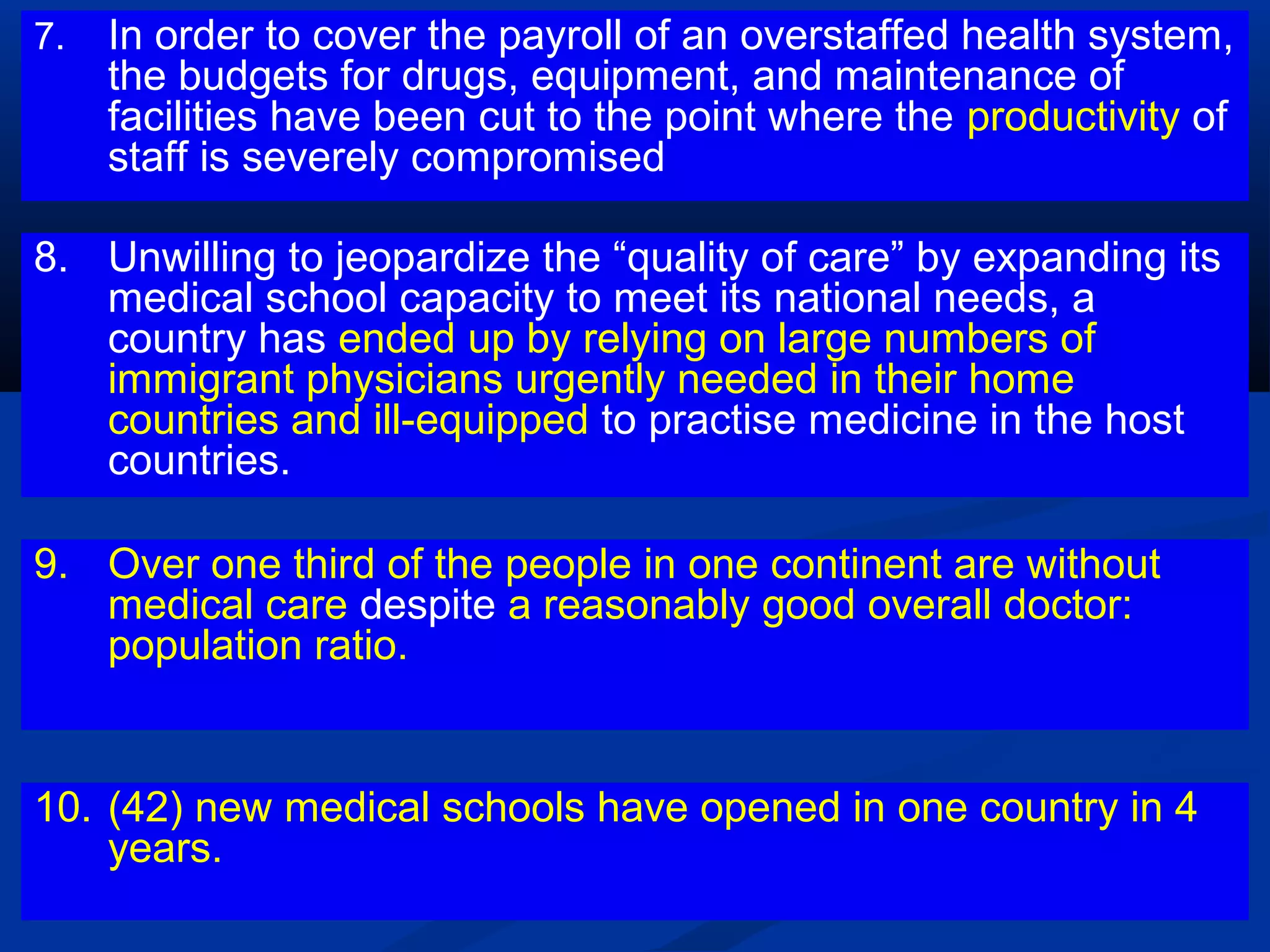
7.

In order to cover the payroll of an overstaffed health system,
the budgets for drugs, equipment, and maintenance of
facilities have been cut to the point where the productivity of
staff is severely compromised

8. Unwilling to jeopardize the “quality of care” by expanding its
medical school capacity to meet its national needs, a
country has ended up by relying on large numbers of
immigrant physicians urgently needed in their home
countries and ill-equipped to practise medicine in the host
countries.
9. Over one third of the people in one continent are without
medical care despite a reasonably good overall doctor:
population ratio.

10. (42) new medical schools have opened in one country in 4
years.
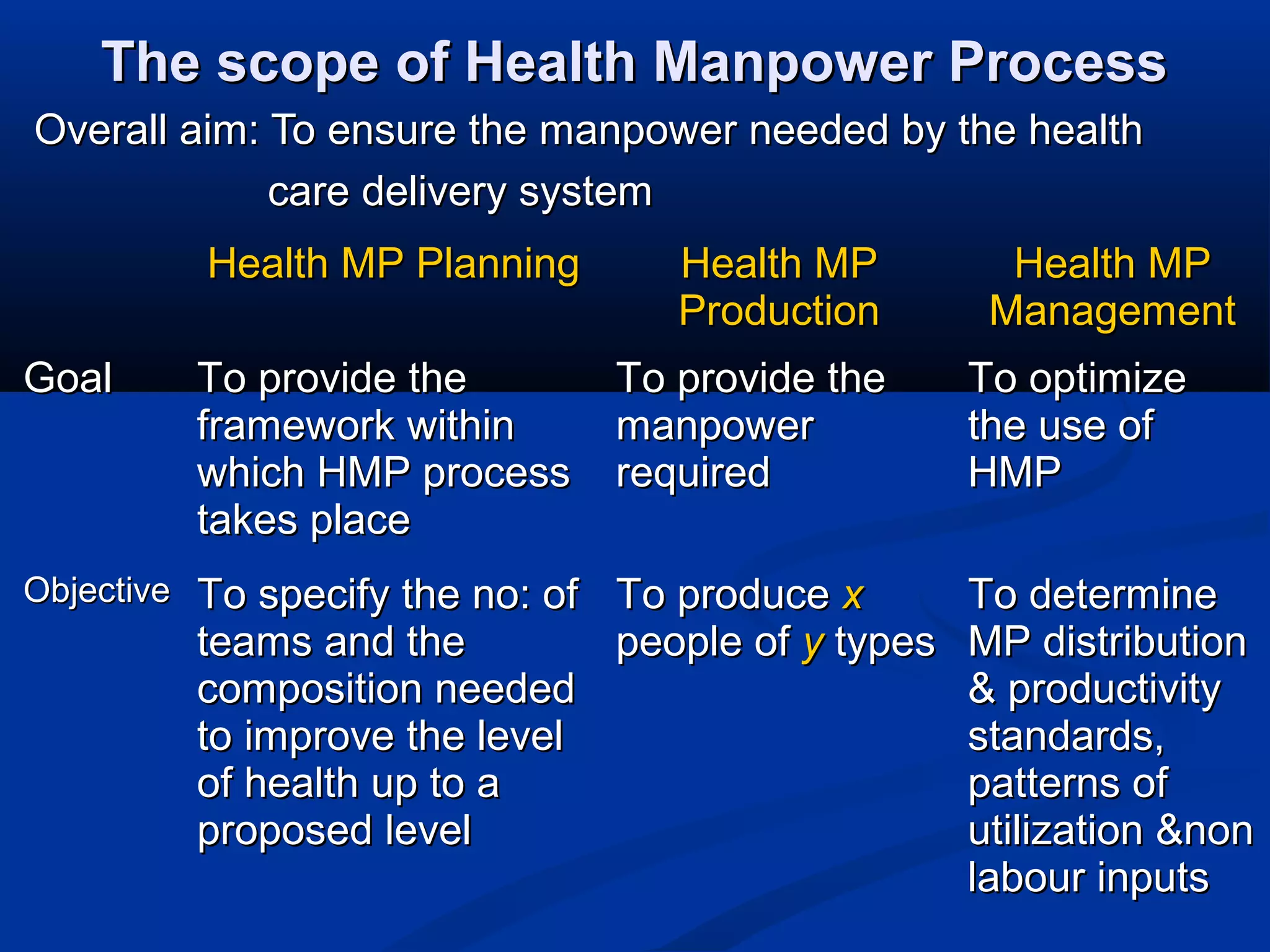
The scope of Health Manpower Process
Overall aim: To ensure the manpower needed by the health
care delivery system
Health MP Planning

Health MP
Production

Goal

To provide the
framework within
which HMP process
takes place

To provide the
manpower
required

Objective

To specify the no: of To produce x
teams and the
people of y types
composition needed
to improve the level
of health up to a
proposed level

Health MP
Management
To optimize
the use of
HMP
To determine
MP distribution
& productivity
standards,
patterns of
utilization &non
labour inputs
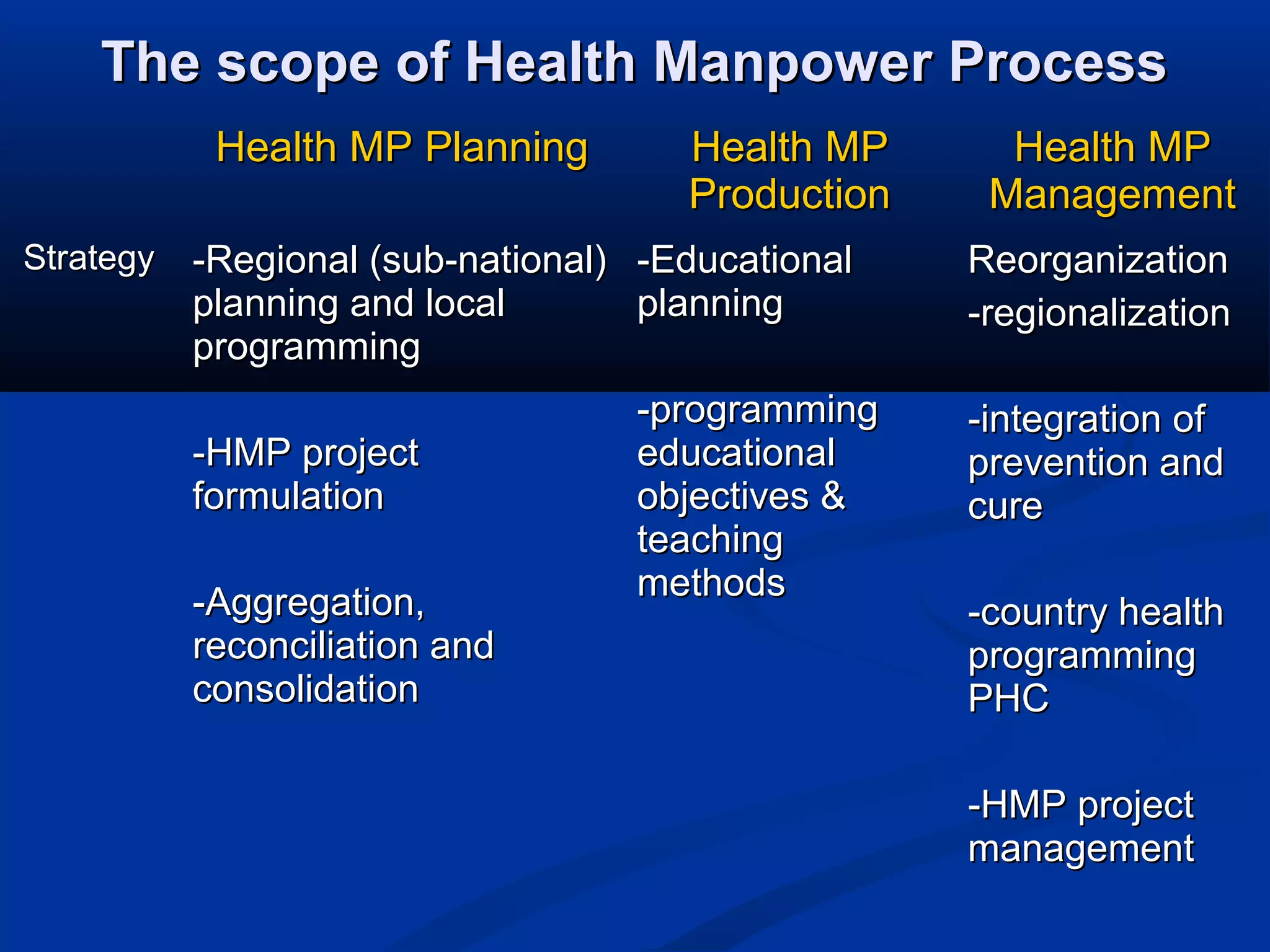
The scope of Health Manpower Process
Health MP Planning
Strategy

Health MP
Production

-Regional (sub-national) -Educational
planning and local
planning
programming
-HMP project
formulation
-Aggregation,
reconciliation and
consolidation

-programming
educational
objectives &
teaching
methods

Health MP
Management
Reorganization
-regionalization
-integration of
prevention and
cure
-country health
programming
PHC
-HMP project
management
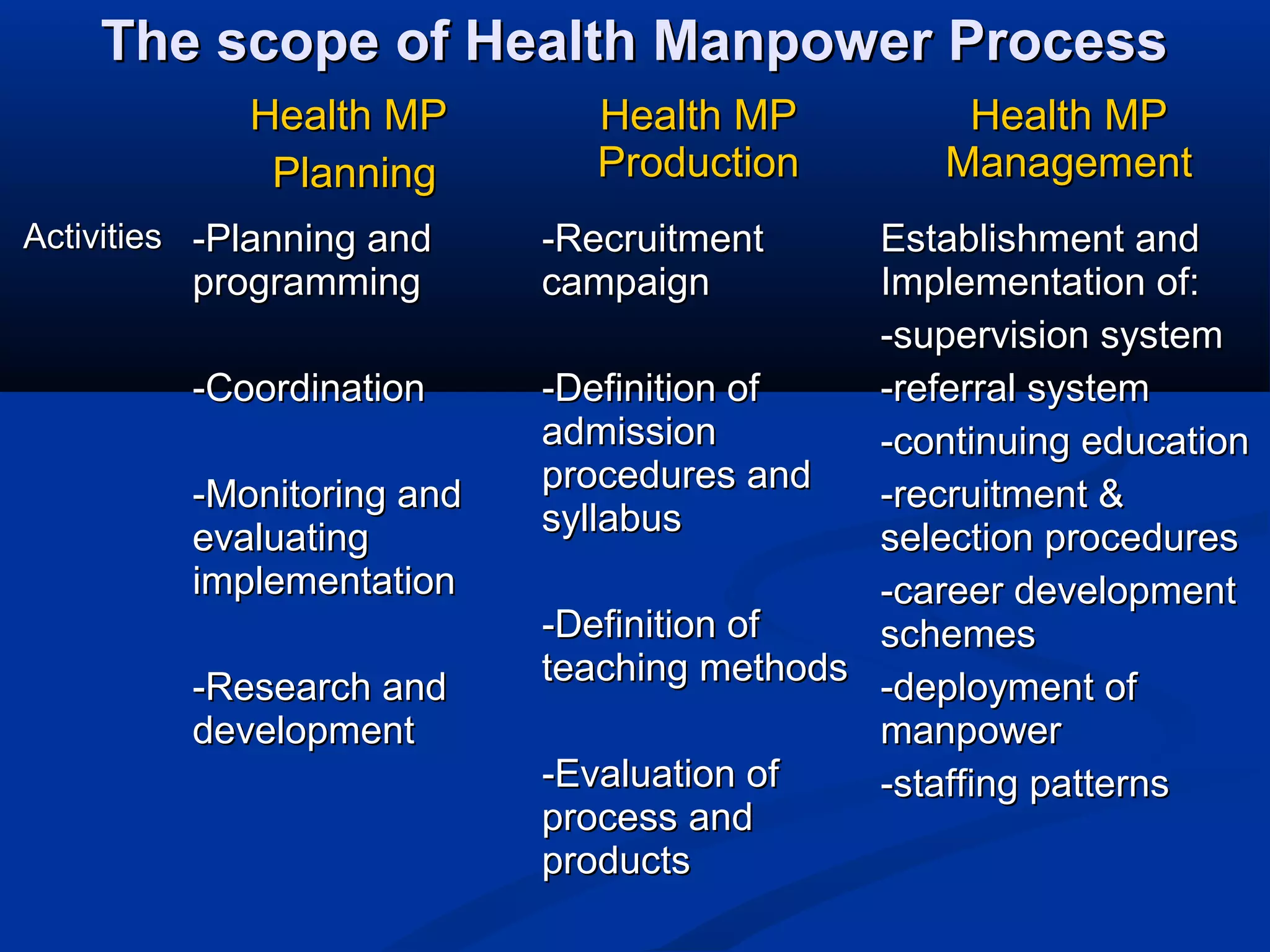
The scope of Health Manpower Process
Health MP
Planning
Activities -Planning and

programming

-Coordination
-Monitoring and
evaluating
implementation
-Research and
development

Health MP
Production
-Recruitment
campaign

Health MP
Management

Establishment and
Implementation of:
-supervision system
-Definition of
-referral system
admission
-continuing education
procedures and
-recruitment &
syllabus
selection procedures
-career development
-Definition of
schemes
teaching methods -deployment of
manpower
-Evaluation of
-staffing patterns
process and
products
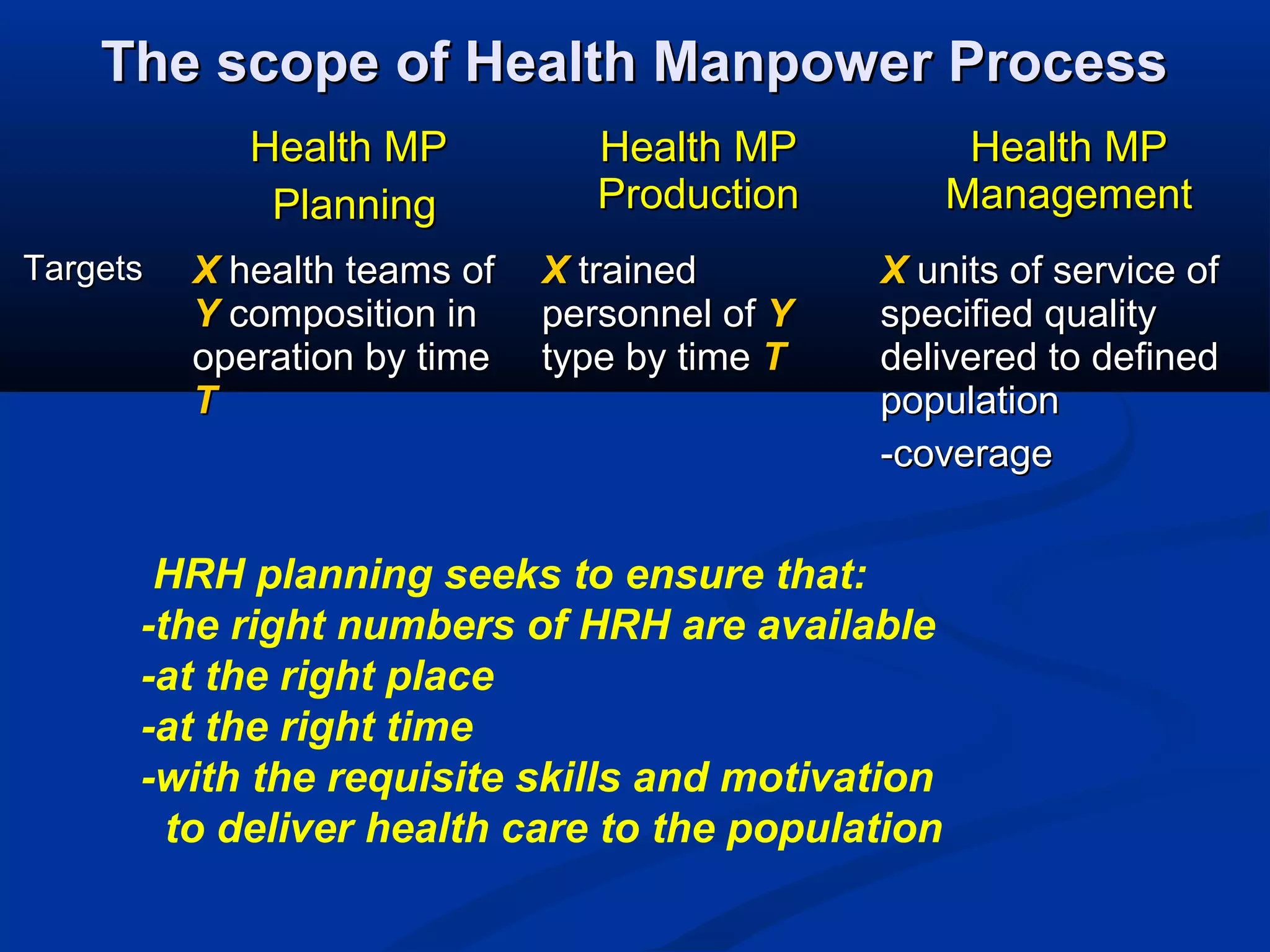
The scope of Health Manpower Process
Health MP
Planning
Targets

X health teams of
Y composition in
operation by time
T

Health MP
Production
X trained
personnel of Y
type by time T

Health MP
Management
X units of service of
specified quality
delivered to defined
population
-coverage

HRH planning seeks to ensure that:
-the right numbers of HRH are available
-at the right place
-at the right time
-with the requisite skills and motivation
to deliver health care to the population
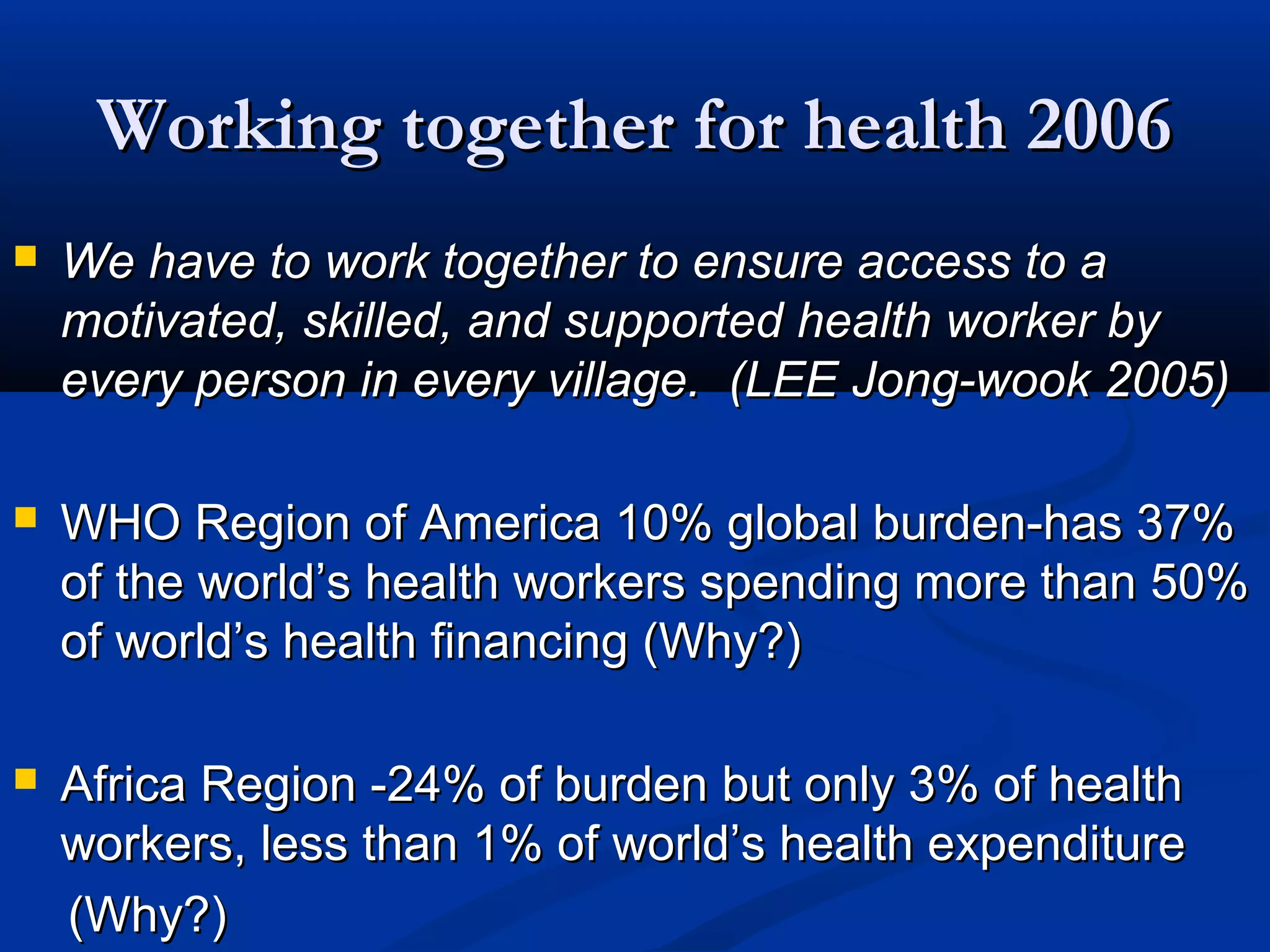
Working together for health 2006


We have to work together to ensure access to a
motivated, skilled, and supported health worker by
every person in every village. (LEE Jong-wook 2005)



WHO Region of America 10% global burden-has 37%
of the world’s health workers spending more than 50%
of world’s health financing (Why?)



Africa Region -24% of burden but only 3% of health
workers, less than 1% of world’s health expenditure
(Why?)
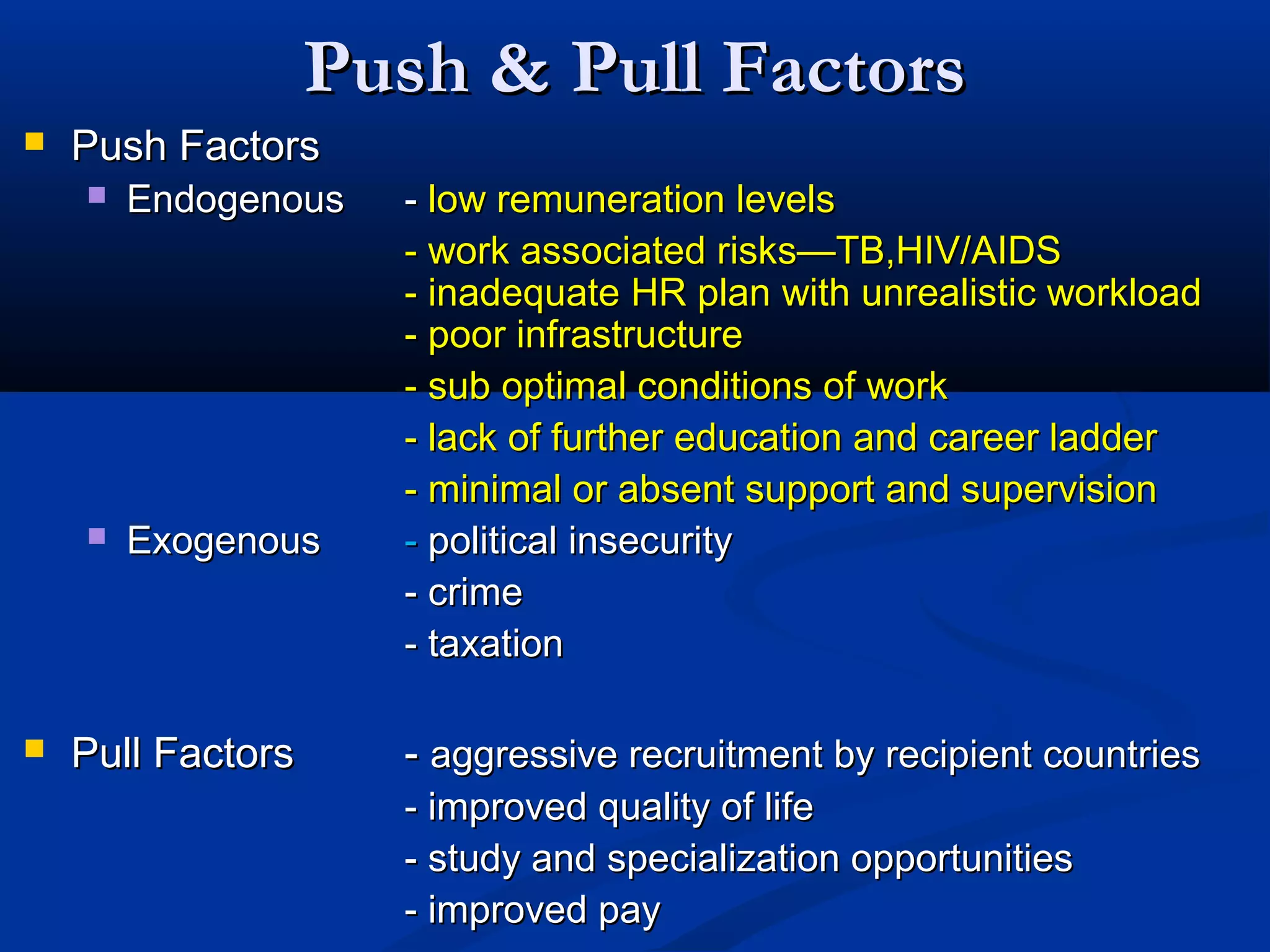
Push & Pull Factors


Push Factors






Endogenous

Exogenous

Pull Factors

- low remuneration levels
- work associated risks—TB,HIV/AIDS
- inadequate HR plan with unrealistic workload
- poor infrastructure
- sub optimal conditions of work
- lack of further education and career ladder
- minimal or absent support and supervision
- political insecurity
- crime
- taxation

- aggressive recruitment by recipient countries
- improved quality of life
- study and specialization opportunities
- improved pay
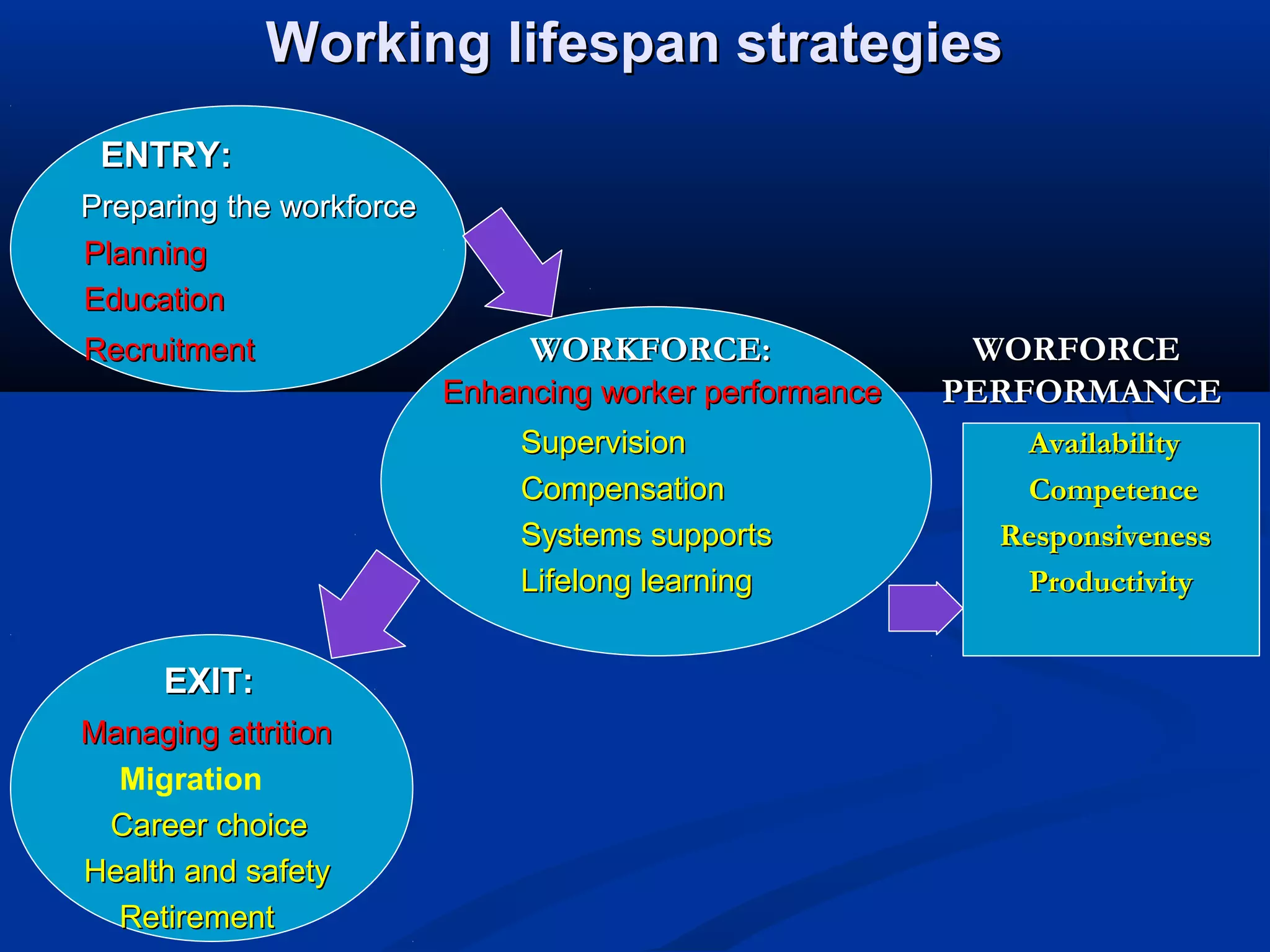
Working lifespan strategies
ENTRY:
Preparing the workforce
Planning
Education
Recruitment

WORKFORCE:
Enhancing worker performance
Supervision
Compensation
Systems supports
Lifelong learning

EXIT:
Managing attrition
Migration
Career choice
Health and safety
Retirement

WORFORCE
PERFORMANCE
Availability
Competence
Responsiveness
Productivity
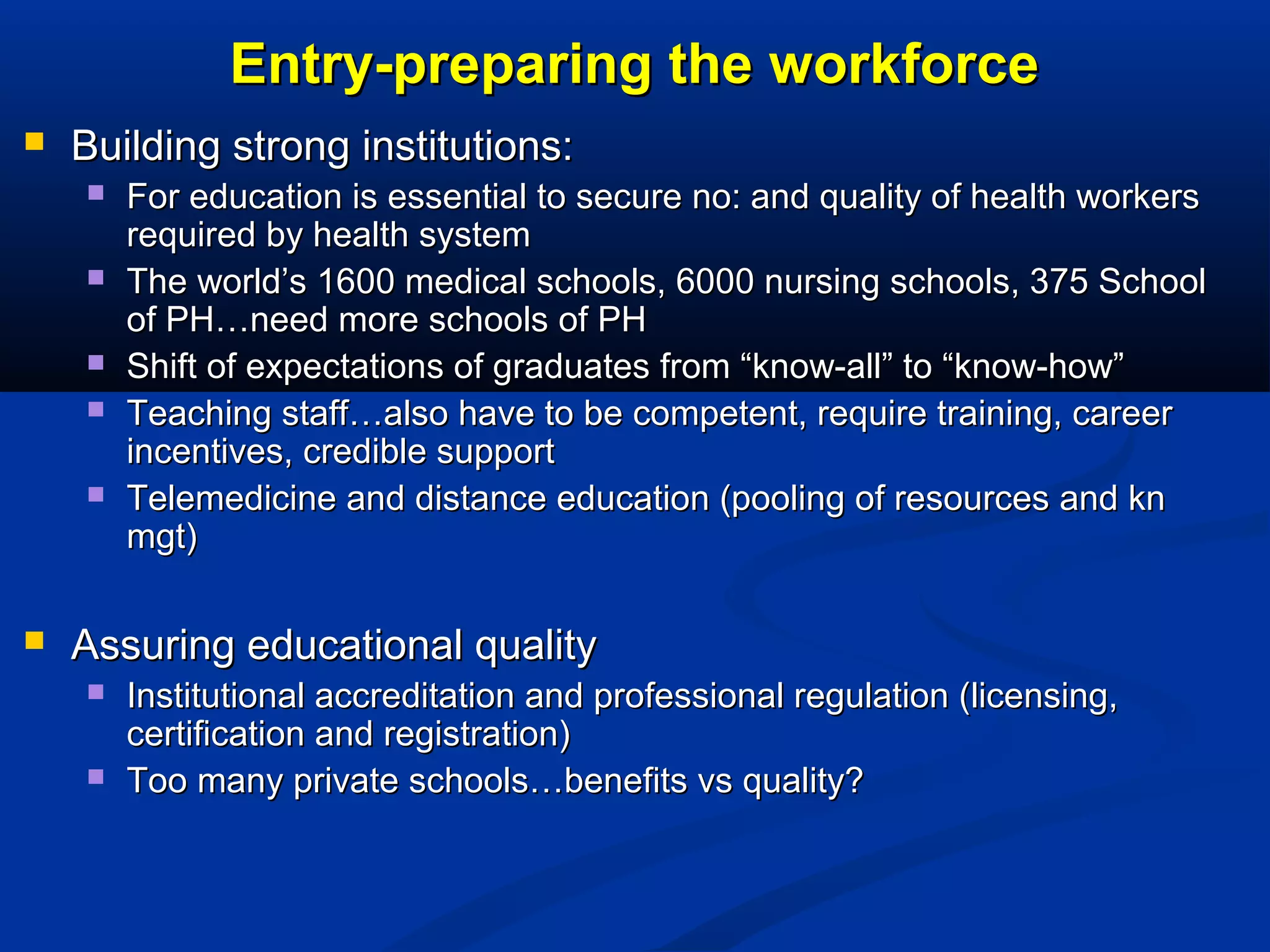
Entry-preparing the workforce


Building strong institutions:








For education is essential to secure no: and quality of health workers
required by health system
The world’s 1600 medical schools, 6000 nursing schools, 375 School
of PH…need more schools of PH
Shift of expectations of graduates from “know-all” to “know-how”
Teaching staff…also have to be competent, require training, career
incentives, credible support
Telemedicine and distance education (pooling of resources and kn
mgt)

Assuring educational quality



Institutional accreditation and professional regulation (licensing,
certification and registration)
Too many private schools…benefits vs quality?
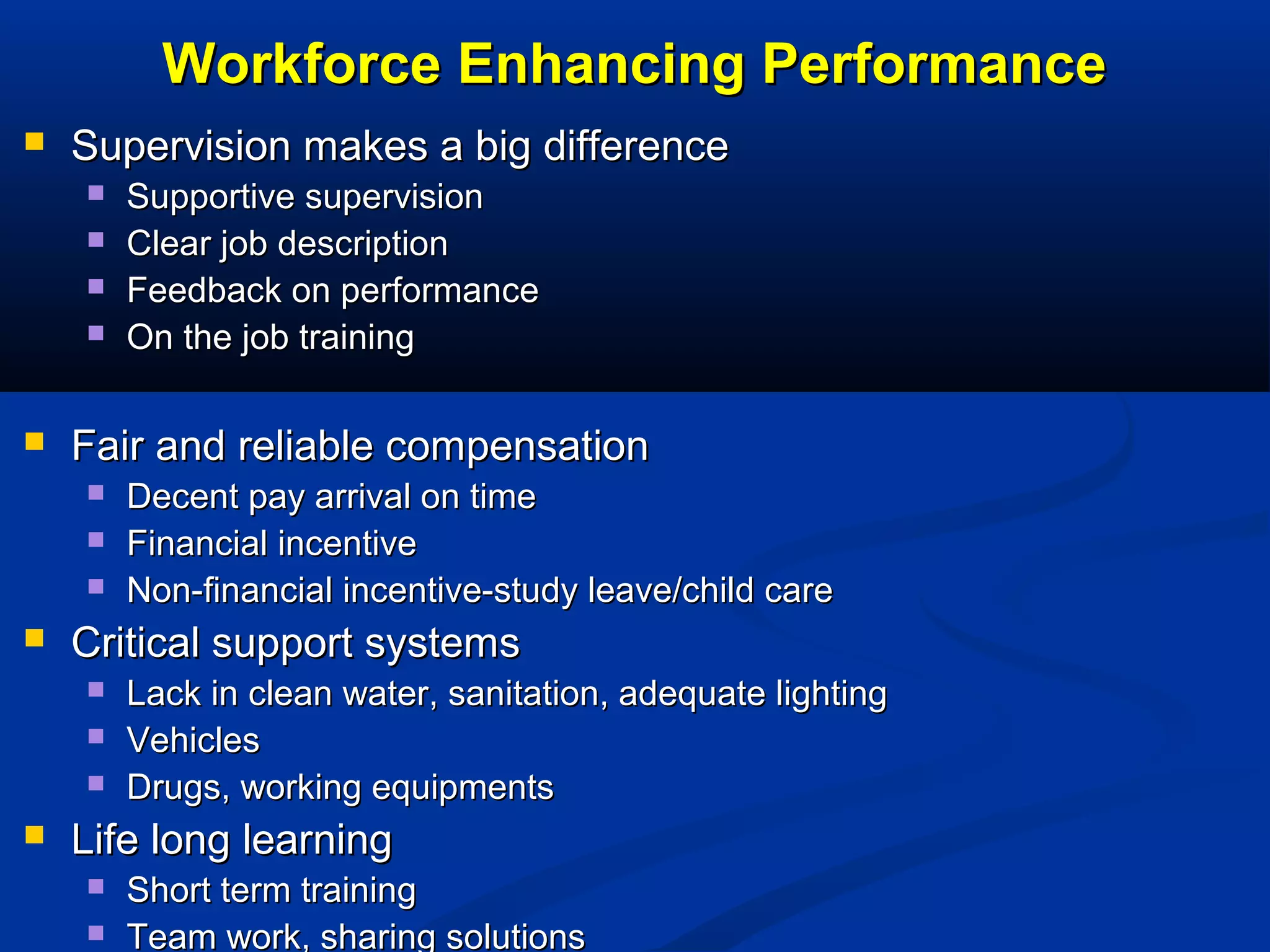
Workforce Enhancing Performance


Supervision makes a big difference







Fair and reliable compensation






Decent pay arrival on time
Financial incentive
Non-financial incentive-study leave/child care

Critical support systems






Supportive supervision
Clear job description
Feedback on performance
On the job training

Lack in clean water, sanitation, adequate lighting
Vehicles
Drugs, working equipments

Life long learning



Short term training
Team work, sharing solutions
Exit: Managing migration and attrition


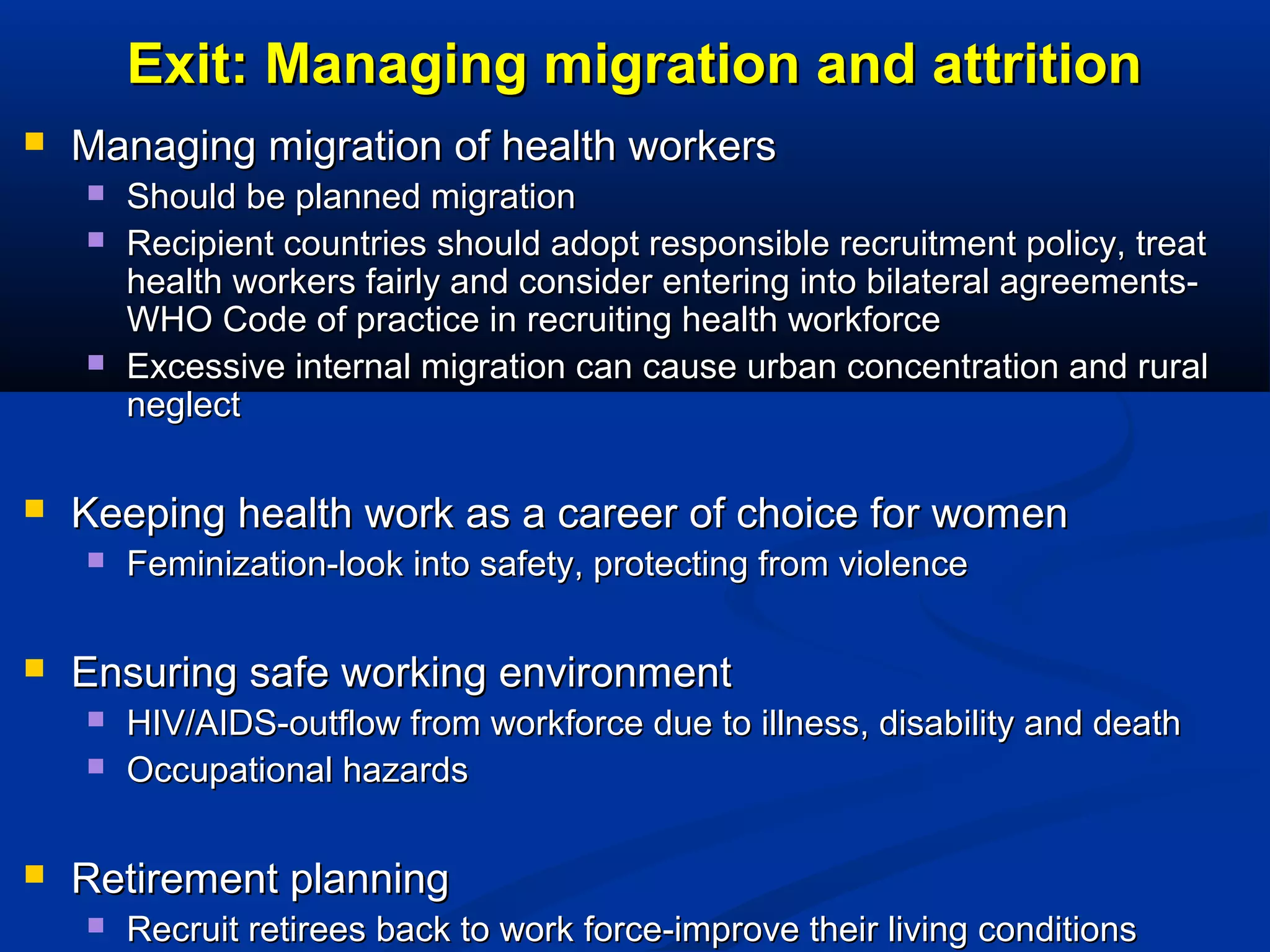
Managing migration of health workers







Keeping health work as a career of choice for women




Feminization-look into safety, protecting from violence

Ensuring safe working environment





Should be planned migration
Recipient countries should adopt responsible recruitment policy, treat
health workers fairly and consider entering into bilateral agreementsWHO Code of practice in recruiting health workforce
Excessive internal migration can cause urban concentration and rural
neglect

HIV/AIDS-outflow from workforce due to illness, disability and death
Occupational hazards

Retirement planning


Recruit retirees back to work force-improve their living conditions
Priority Countries
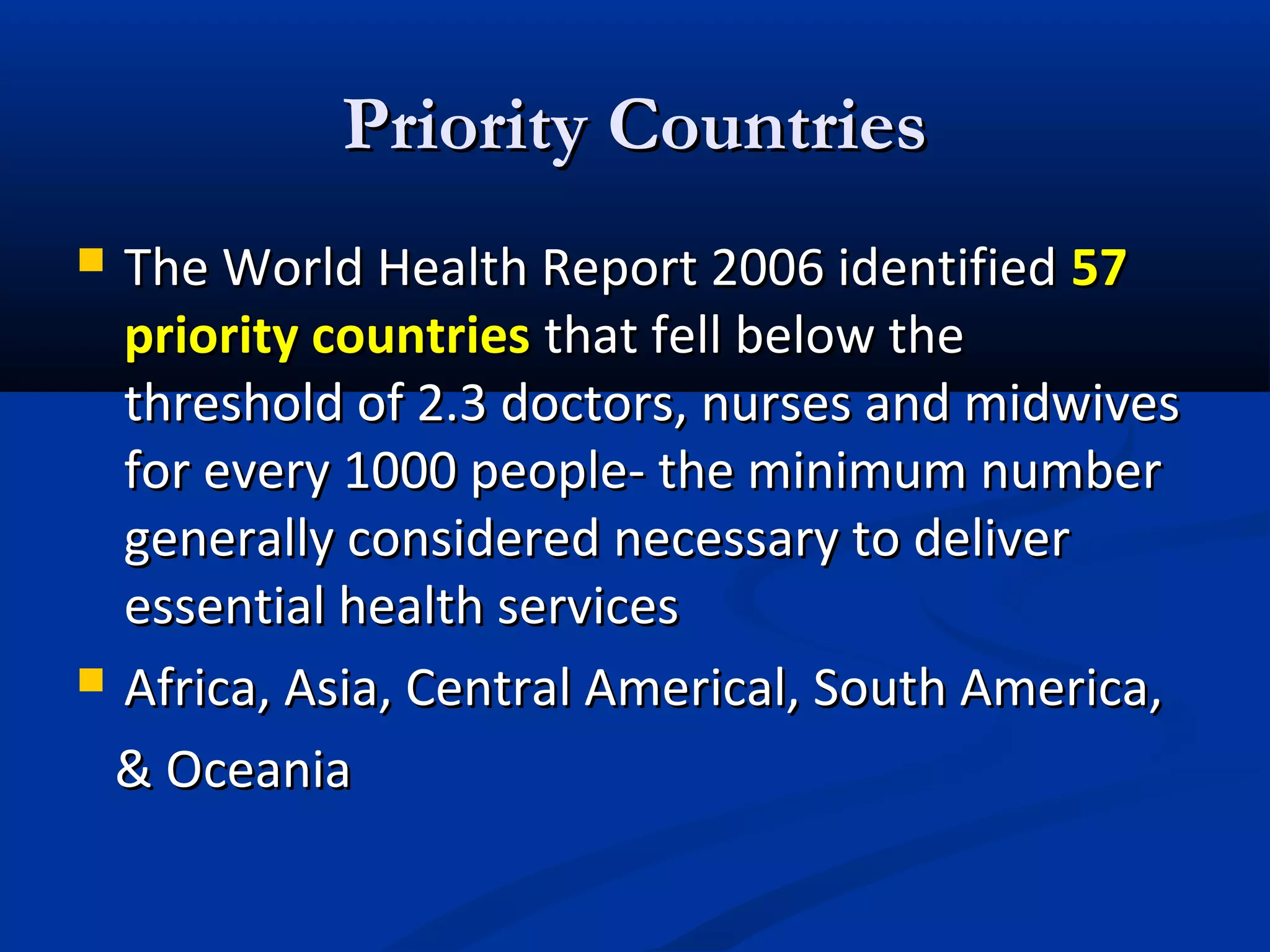
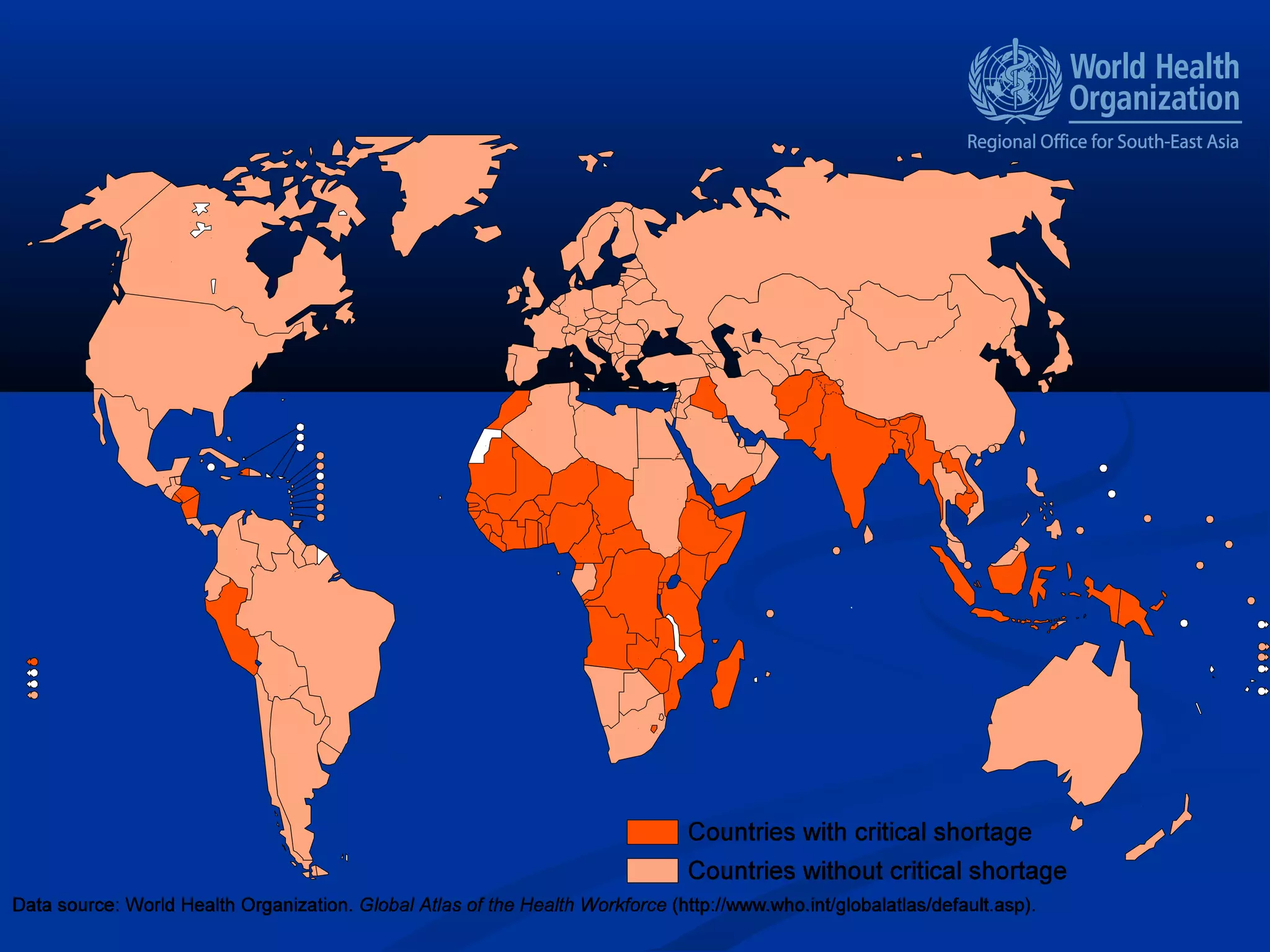
The World Health Report 2006 identified 57
priority countries that fell below the
threshold of 2.3 doctors, nurses and midwives
for every 1000 people- the minimum number
generally considered necessary to deliver
essential health services
 Africa, Asia, Central Americal, South America,
& Oceania

Health Workforce 2008


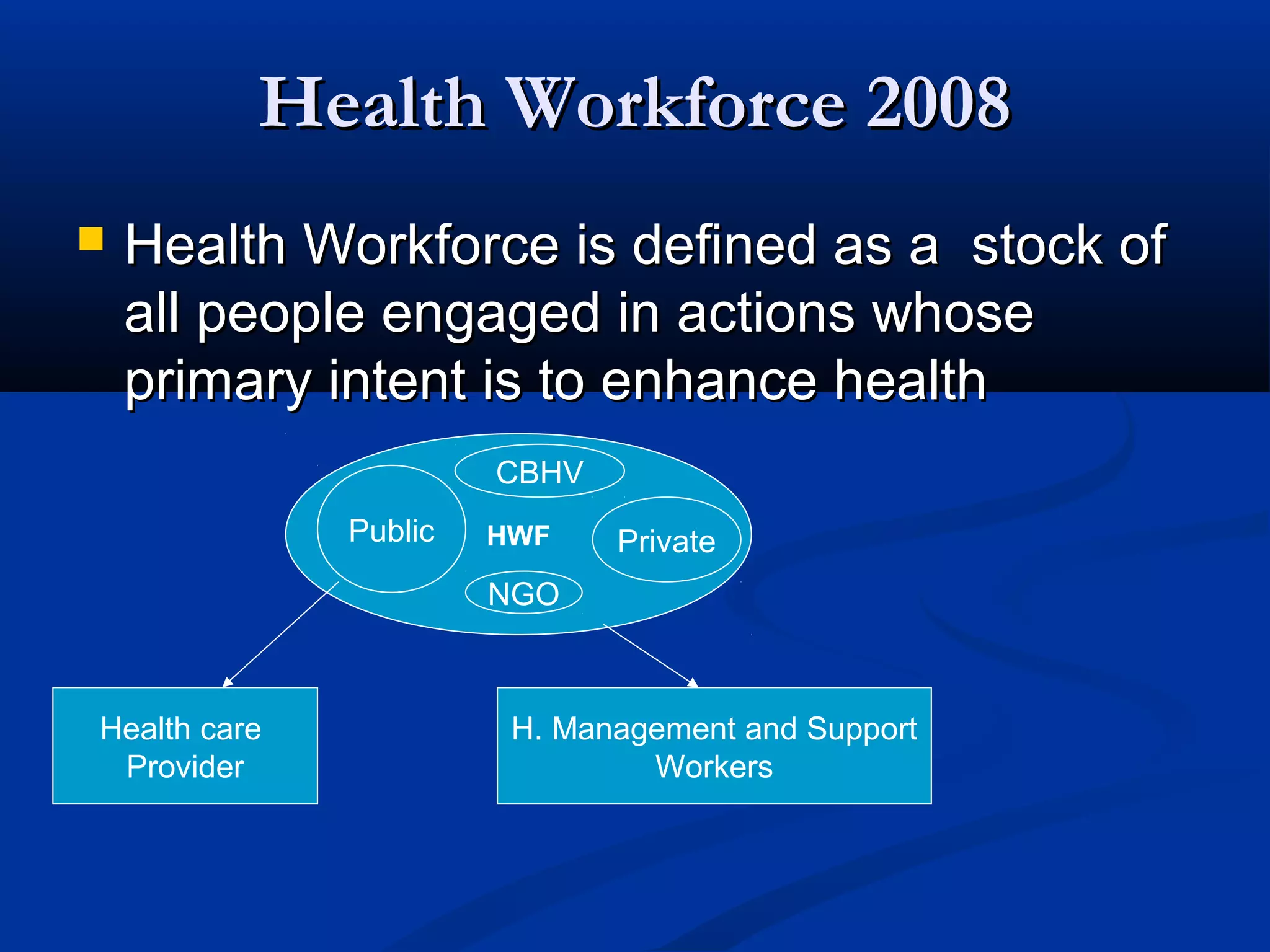
Health Workforce is defined as a stock of
all people engaged in actions whose
primary intent is to enhance health
CBHV
Public

HWF

Private

NGO

Health care
Provider

H. Management and Support
Workers
Health Challenges for SEAR











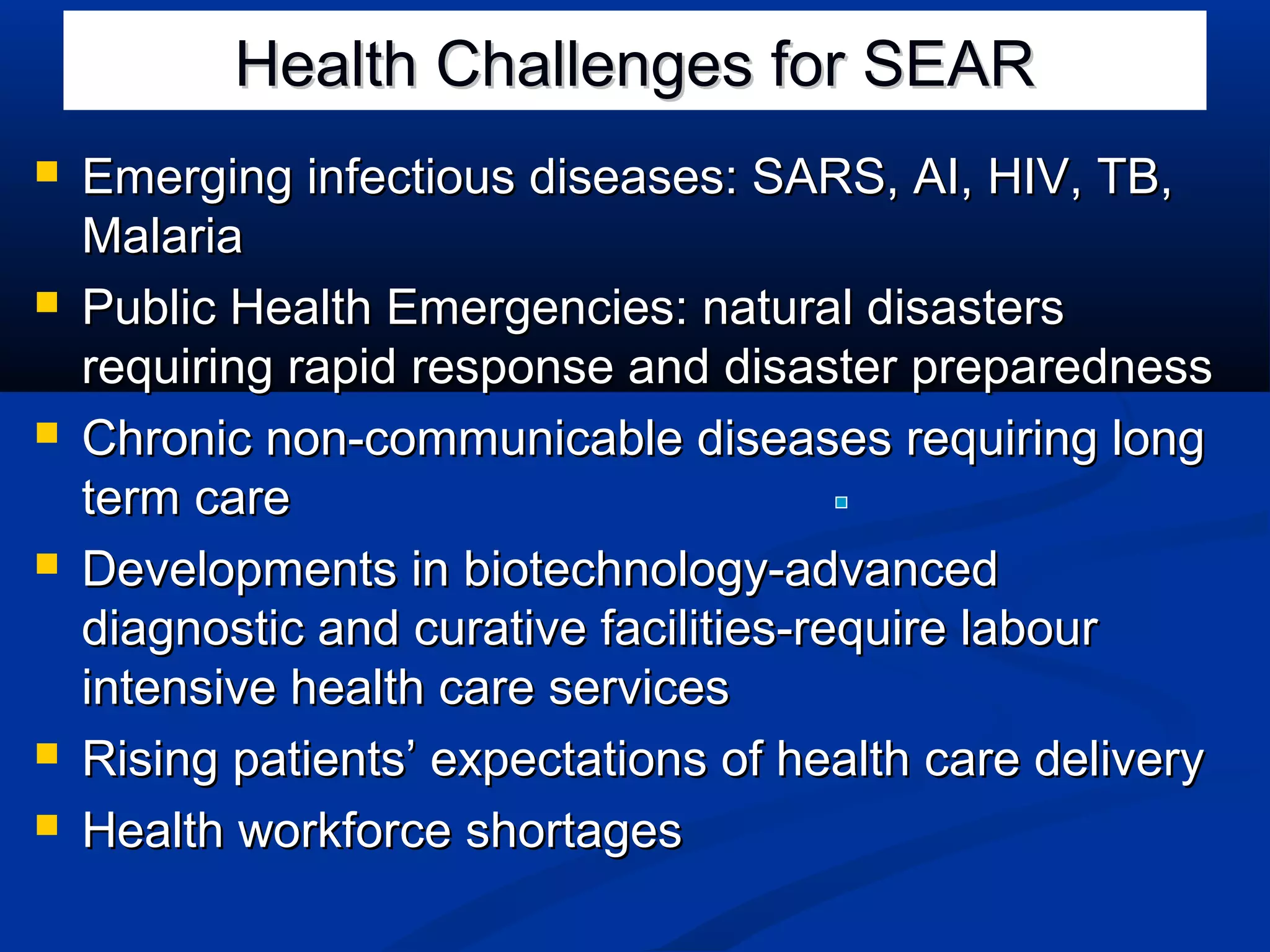
Emerging infectious diseases: SARS, AI, HIV, TB,
Malaria
Public Health Emergencies: natural disasters
requiring rapid response and disaster preparedness
Chronic non-communicable diseases requiring long
term care
Developments in biotechnology-advanced
diagnostic and curative facilities-require labour
intensive health care services
Rising patients’ expectations of health care delivery
Health workforce shortages
Health Workforce (HWF) Challenges


Need for evidence based strategic HWF planning



Comprehensive data regarding HWF distribution, public,
private, community, NGOs, partners



Imbalances in skills, geographic distribution, gender, optimal
skill-mix



Relevance of training: pre-service, in-service training
directed to country health needs.



HWF recruitment, management, working environment,
financing, retention, exit/migration of HWF



International and internal migration of health workforce
WHO’s Response to HWF Problems


59th session of the Regional Committee: Dhaka
Declaration: Strengthening Health Workforce
in countries of the SEA Region, 2007



Regional Strategic Plan for HWF development in
the SEA Region



WHO HQ-Regional-Country HWF data base
harmonized with the country data base



Regional guidelines for HWF Strategic Plan



WHO Code of Practice on international
recruitment of HWF (2010 63rd WHA)
Global Response to HWF Problems


Global Health workforce Alliance GWHA



2008 The Kampala Declaration and Agenda for
Global Action (1st Global Health Forum in
Uganda)



To strengthen HWF at all levels
To track progress in implementing the strategies
adopted
To have access for all to skilled, motivated and
supported health workers



Rationale for Health Workforce Strategic
Planning
1. HWF Shortages
2. Lack of reliable, harmonized data on
HWF
3. Resource Constraints
4. Partnership development
5. Requirements are diverse categories
HWF
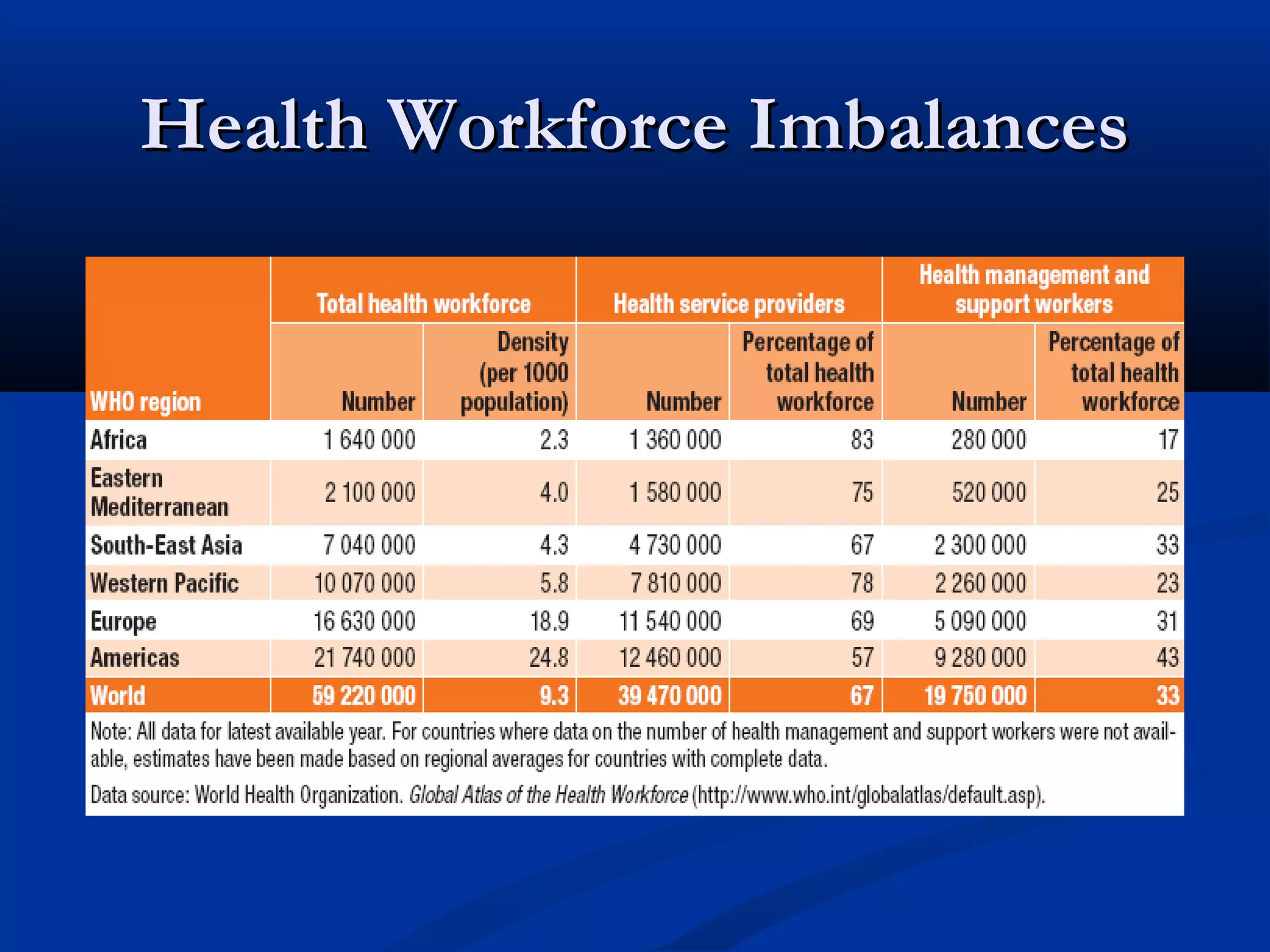
Health Workforce Imbalances
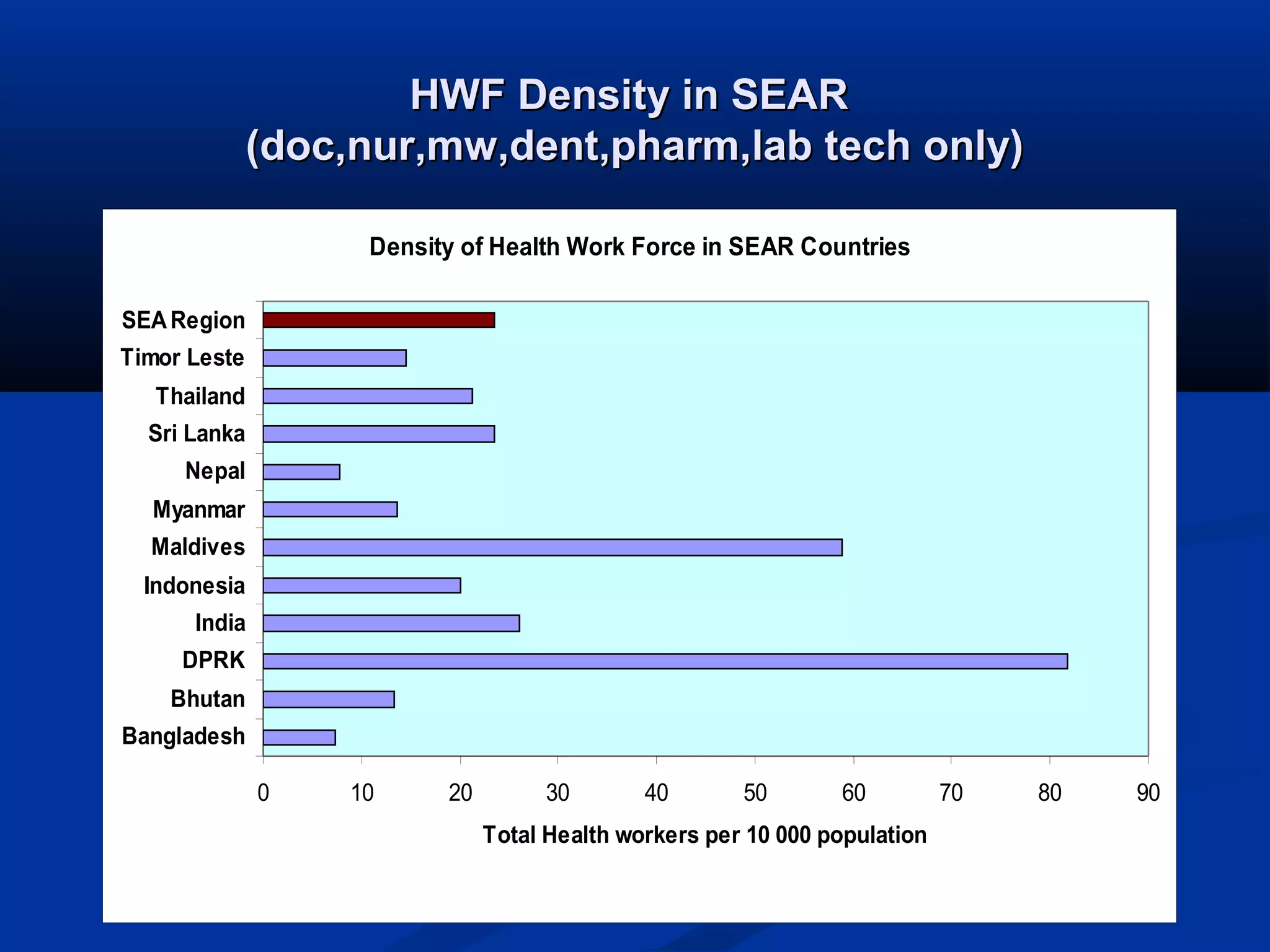
HWF Density in SEAR
(doc,nur,mw,dent,pharm,lab tech only)
Density of Health Work Force in SEAR Countries
SEA Region
Timor Leste
Thailand
Sri Lanka
Nepal
Myanmar
Maldives
Indonesia
India
DPRK
Bhutan
Bangladesh
0

10

20

30

40

50

60

Total Health workers per 10 000 population

70

80

90
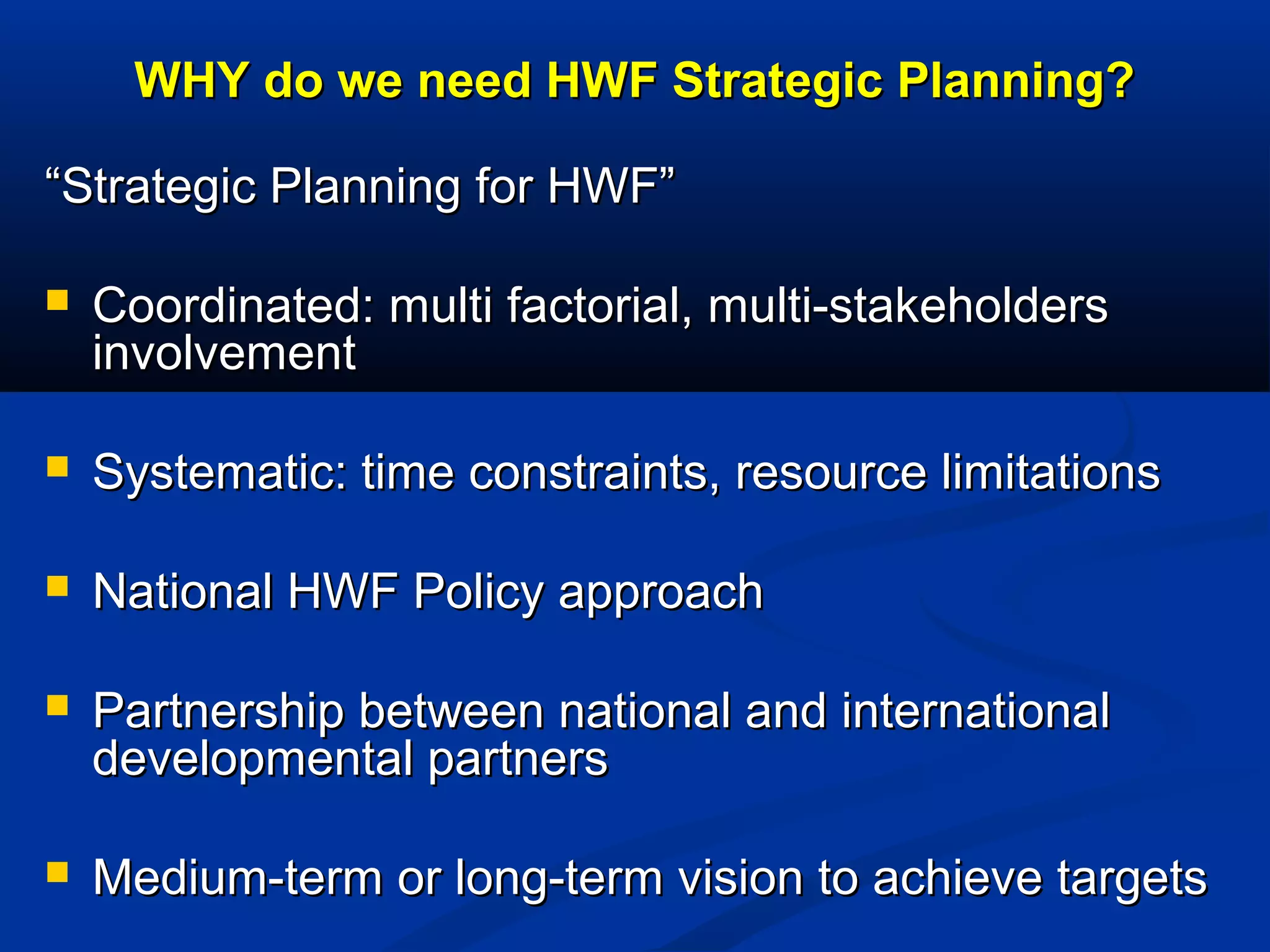
WHY do we need HWF Strategic Planning?
“Strategic Planning for HWF”


Coordinated: multi factorial, multi-stakeholders
involvement



Systematic: time constraints, resource limitations



National HWF Policy approach



Partnership between national and international
developmental partners



Medium-term or long-term vision to achieve targets
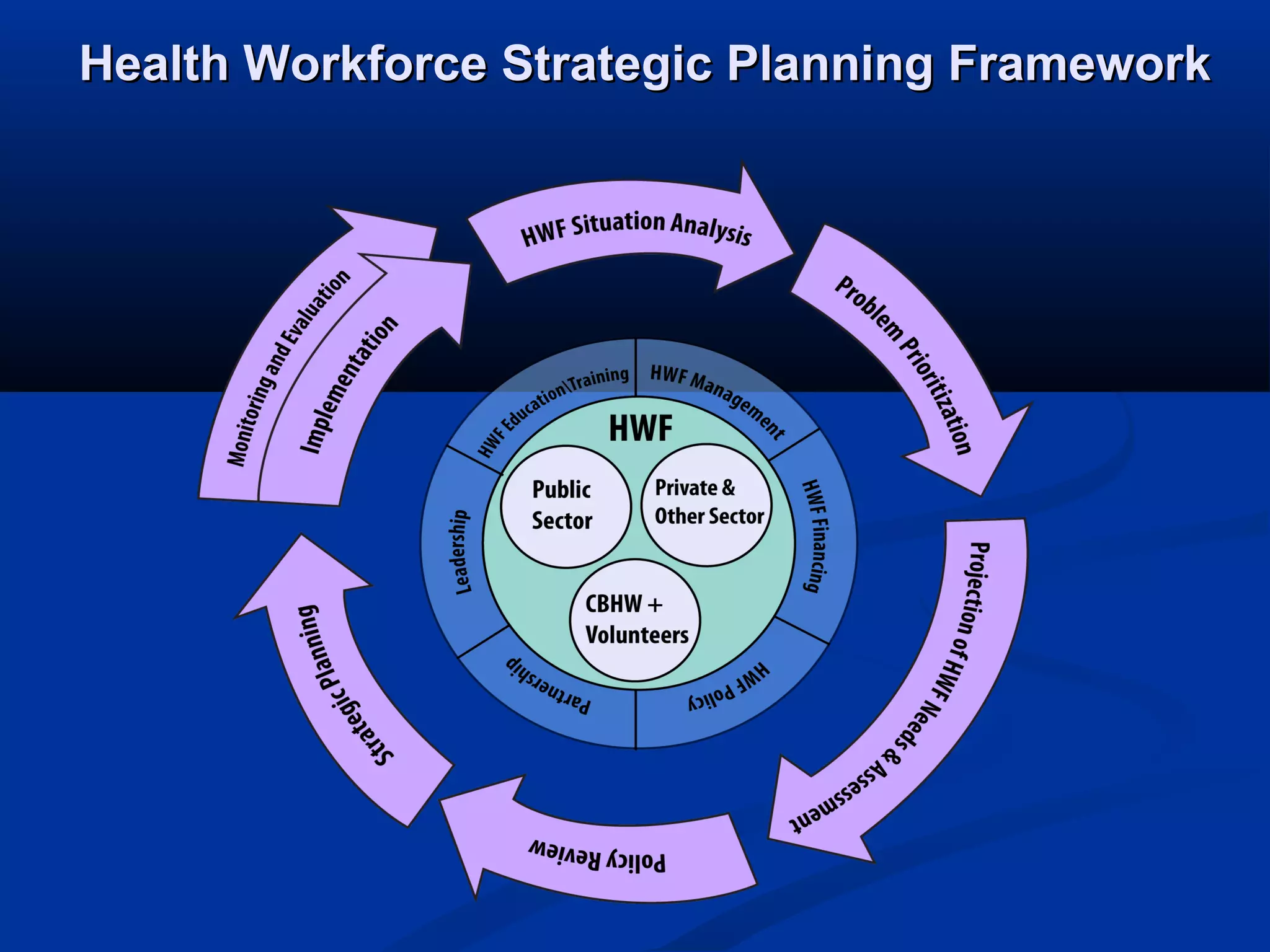
The Strategic planning framework
The strategic framework consists of six steps which are:

Health Workforce Situational analysis



Problem Identification & Prioritization



Projection of HWF Needs and Demands



HWF Policy Review and Identification of Strategic Areas



Formulating the Strategic Plan



Monitoring and Evaluation
Health Workforce Strategic Planning Framework
Six major factors influencing the entry,
sustainability and exit from HWF IN HS







Education and training
HWF Management
HWF Financing
HWF Policy
Partnerships
Leadership
1.Education/Training of HWF


Pre-service education/training; institutional capacity



In-service education and training and capacity building.



Relevance of curricula to address country’s health need



Inclusion of soft skills



Faculty development.



Accreditation system for internal and internal &external
quality assurance mechanism.



Medical and Health professional education research for
innovations in education to address current HWF problems.
2.HWF management capacity


Density and distribution of HWF, with regard to
equitable coverage, gender equity and relevance,
appropriate skill mix



HWF information system, regular updating of HWF
data including private sector and NGOs, health
workforce in numbers, competencies and
distribution



Financing of HWF which consists of salary profile
of different categories of HWF, for different
geographic areas, different sectors, and



Incentive system for manning remote health
centers.
2.HWF management capacity


HWF support for housing, healthcare,
transportation and children’s education and
welfare, working environment supportive for
maximum performance; facilities and equipments,
drugs, supplies and support staff.



Opportunities for promotion, personal and
professional development for HWF.



Data, information and causes for attrition, brain
drain, migration pattern and presence of “ghost
health workers” or absenteeism.
3.HWF policy and regulations


Is there HWF policy reflected in the National Health
Policy of the country?



Work load indicators and staffing needs



Deployment policies, recruitment policies, transfer,
promotion, grievances, incentives including
performance-based incentives, and career
advancement policies.



HWF exit policy: pension and gratuity entitlements have
to be taken into account.



Regulations on ethical conduct, liability and quality
assurance mechanisms for the HWF, both in public and
private sector.
3.HWF policy and regulations


Relationship between HWF and Public Health
standard at different level of health facilities.



Coordination with other related sector/departments.



International code of conduct for recruitment of
health professionals
4. HWF Financing
Macroeconomic profiles:







national health accounts and
national health spending in relation to GDP,
national budget for HRH development,
other sources of funding /spending for HRH



Salary rates of different levels of HRH and other
entitlements



Salary rates compared to bench marks in the
other sectors
4. HWF Financing


Ratio of public to private out of pocket spending
for health



Health spending on non-salary finances



Multiple job holdings may result due to low
salaries.



Moon-lighting in the private sector is one strategy
for HWF in the public sector to survive, however it
can lower the efficiency in the public sector.



Supportive working environment with essential
logistics
5.HWF partnerships


Partnerships with international developmental
partners



Existences of co ordination mechanisms for
international funds to align with national health
priorities and effective scaling up of health workers
training and education.



Partnerships with academic professional bodies for
quality assurance and accreditation such as the
World Federation for Medical Education.



Partnerships with the Global Health Workforce
Alliance and the Asia-Pacific Action Alliance of
Human Resources for Health
5.HWF partnerships
HWF issues relating to international migration
requires policy dialogue with international
organizations like -----






International Labour Organization (ILO),
International Organization on Migration (IOM),
Organization for Economic Co operation and
Development (OECD),
Government to Government negotiations in ethical
recruitment practices, and partnership building
becomes important.
Private-public partnerships not only for scale-up of
disease-specific programs and community-based
health workforce training and education to improve
coverage, but also for training and multi-skilling of
HWF
6. HWF leadership






Leadership development for HWF
planning and management.
Focal point for HWF, National Committee
for HWF development,
Multi-stake holder mechanism is in place
or not.
Future Plan for working together


Assist member countries to develop and
implement CSP- HWF



Scaling up of training and education of all
categories of HWF inclusive of CBHW, CBHV.



Innovative educational interventions:
 need based,
 team-based,
 field-based curricula review,
 better co ordination between training and need



Financial support to employ and deploy the
trained workforce
Future Plan for working together


HWF management capacity:
 for HWF recruitment and equitable
deployment,
 working conditions conducive for optimal HWF
performance,
 supportive supervision,
 incentive system for retention.



Pooling of Financial resources:
 for long term investment on HWF
development,
 harmonization and alignment of donors to
national priorities.
Health System Strengthening by
PHC


HWF is vital for health system
strengthening



CBHW & CBHV are vital to delivery of
health care



HWF development to strengthen
Township health system
Projection of HWF Needs and Demands
Supply Forecasting


What numbers of HWF by category are available currently?



What is the geographic distribution of different categories of
HWF?



What is the attrition rate?



Exit from HWF rate and pattern?



Rate of internal and external migration?



Recruitments from other sources? Government –to –
government MOU for recruitment of HWF?



What categories need to be scaled-up training?
Projection of HWF Needs and Demands


Supply Forecasting
Is there institutional capacity for scaling up training without
compromising the quality of output?



What are the logistic support required and faculty needed
for scaling up training?



How long will it take to build institutional capacity to meet
the needs?



How much financial support will we need to meet the
supply costs?



How do will fill the supply gap?



Does the current HWF production policy support the
proposed action to meet the supply needs?
Projection of HWF Needs and Demands




Demand Forecasting
There are two types of demand, one from the supplier of
health care side (public and private sector) and the other from
patients or clients.
When carrying out a demand analyses there are many other
non-health factors that need consideration.






Economic growth of the country,
growth of the private health sector,
patients’ changing expectations are few factors that will shape up the
countries health service demands.

For example in a country with rapidly expanding economic
growth leading to rapid expansion of the private health sector,



health trade and tourism,
demands for health workers for the private sector
has to be taken into account, so that the public sector will be able to
attract and retain sufficient health personnel.
Projection of HWF Needs and Demands
Demand Forecasting


What types of HWF do we need most for the
functioning of the health system according to
findings of situation analysis?



What tools will we use to project the need?



What is the ideal (bench mark) and what is the
current situation?
Projection of HWF Needs and Demands
Demand Forecasting


What are the gaps for optimal function of the
health system?



How do we fill the gaps? Scale-up
production/training or scale-up recruitment?



How much financial support will we need to fill
the gap?



Does the current NHP support the proposed
action to meet the demand of the health
system?
Projection of HWF Needs and Demands
Methods of HWF demand projection
 There are many methods that have been developed
over time for health workforce demand projection of
which some are basic and some requiring computer
software applications.


The basic methods that have been continuously used
for demand projection by many countries are:
 HWF requirements based on the population ratios
 HWF requirements based on service demands
 HWF requirements based on health system needs
 Work load indicators and staffing needs (WISN)
 “Soft PODD which is a Software Tool for Online
Policy Diagnosis and Dialogue”.
Human resources for health2010 25th june mph

Human resources for health2010 25th june mph

  • 1.
  • 2.
    A Rational approachto Health manpower planning (1978) Tom Hall 1. A newly expanded regional hospital system, completed at great cost with a foreign loan on which commercial interests are paid, stands unused for lack of nursing personnel. 2. Over half of the graduates of a ministry of health six-month training programme for environmental sanitation personnel were lost permanently to the health sector owing to failure by the ministry to create necessary jobs in time. 3. Health authorities in the developing countries lament over the many physicians who emigrates following graduation, while at the same time citing with pride the high pass rate of these graduates in licensing examinations in developed countries.
  • 3.
    4. Health and politicalauthorities, in their desire to avoid providing rural communities with “second-class” health care, oppose the use of non-professional personnel in such areas, hence ensuring that population will be without health care at all. 5. The gift by a developed country of a modern university hospital to a developing country has become a double liability to the recipient- a major drain on its health budget and a teaching facility inappropriate to local training needs. 6. One government agency has funded the development of a large number of training programmes for medical assistants (HA), while another in charge of reimbursements for health services under the social insurance system, has declined to approve payment for the services of these assistants working under medical supervision.
  • 4.
    7. In order tocover the payroll of an overstaffed health system, the budgets for drugs, equipment, and maintenance of facilities have been cut to the point where the productivity of staff is severely compromised 8. Unwilling to jeopardize the “quality of care” by expanding its medical school capacity to meet its national needs, a country has ended up by relying on large numbers of immigrant physicians urgently needed in their home countries and ill-equipped to practise medicine in the host countries. 9. Over one third of the people in one continent are without medical care despite a reasonably good overall doctor: population ratio. 10. (42) new medical schools have opened in one country in 4 years.
  • 5.
    The scope ofHealth Manpower Process Overall aim: To ensure the manpower needed by the health care delivery system Health MP Planning Health MP Production Goal To provide the framework within which HMP process takes place To provide the manpower required Objective To specify the no: of To produce x teams and the people of y types composition needed to improve the level of health up to a proposed level Health MP Management To optimize the use of HMP To determine MP distribution & productivity standards, patterns of utilization &non labour inputs
  • 6.
    The scope ofHealth Manpower Process Health MP Planning Strategy Health MP Production -Regional (sub-national) -Educational planning and local planning programming -HMP project formulation -Aggregation, reconciliation and consolidation -programming educational objectives & teaching methods Health MP Management Reorganization -regionalization -integration of prevention and cure -country health programming PHC -HMP project management
  • 7.
    The scope ofHealth Manpower Process Health MP Planning Activities -Planning and programming -Coordination -Monitoring and evaluating implementation -Research and development Health MP Production -Recruitment campaign Health MP Management Establishment and Implementation of: -supervision system -Definition of -referral system admission -continuing education procedures and -recruitment & syllabus selection procedures -career development -Definition of schemes teaching methods -deployment of manpower -Evaluation of -staffing patterns process and products
  • 8.
    The scope ofHealth Manpower Process Health MP Planning Targets X health teams of Y composition in operation by time T Health MP Production X trained personnel of Y type by time T Health MP Management X units of service of specified quality delivered to defined population -coverage HRH planning seeks to ensure that: -the right numbers of HRH are available -at the right place -at the right time -with the requisite skills and motivation to deliver health care to the population
  • 9.
    Working together forhealth 2006  We have to work together to ensure access to a motivated, skilled, and supported health worker by every person in every village. (LEE Jong-wook 2005)  WHO Region of America 10% global burden-has 37% of the world’s health workers spending more than 50% of world’s health financing (Why?)  Africa Region -24% of burden but only 3% of health workers, less than 1% of world’s health expenditure (Why?)
  • 10.
    Push & PullFactors  Push Factors    Endogenous Exogenous Pull Factors - low remuneration levels - work associated risks—TB,HIV/AIDS - inadequate HR plan with unrealistic workload - poor infrastructure - sub optimal conditions of work - lack of further education and career ladder - minimal or absent support and supervision - political insecurity - crime - taxation - aggressive recruitment by recipient countries - improved quality of life - study and specialization opportunities - improved pay
  • 11.
    Working lifespan strategies ENTRY: Preparingthe workforce Planning Education Recruitment WORKFORCE: Enhancing worker performance Supervision Compensation Systems supports Lifelong learning EXIT: Managing attrition Migration Career choice Health and safety Retirement WORFORCE PERFORMANCE Availability Competence Responsiveness Productivity
  • 12.
    Entry-preparing the workforce  Buildingstrong institutions:       For education is essential to secure no: and quality of health workers required by health system The world’s 1600 medical schools, 6000 nursing schools, 375 School of PH…need more schools of PH Shift of expectations of graduates from “know-all” to “know-how” Teaching staff…also have to be competent, require training, career incentives, credible support Telemedicine and distance education (pooling of resources and kn mgt) Assuring educational quality   Institutional accreditation and professional regulation (licensing, certification and registration) Too many private schools…benefits vs quality?
  • 13.
    Workforce Enhancing Performance  Supervisionmakes a big difference      Fair and reliable compensation     Decent pay arrival on time Financial incentive Non-financial incentive-study leave/child care Critical support systems     Supportive supervision Clear job description Feedback on performance On the job training Lack in clean water, sanitation, adequate lighting Vehicles Drugs, working equipments Life long learning   Short term training Team work, sharing solutions
  • 14.
    Exit: Managing migrationand attrition  Managing migration of health workers     Keeping health work as a career of choice for women   Feminization-look into safety, protecting from violence Ensuring safe working environment    Should be planned migration Recipient countries should adopt responsible recruitment policy, treat health workers fairly and consider entering into bilateral agreementsWHO Code of practice in recruiting health workforce Excessive internal migration can cause urban concentration and rural neglect HIV/AIDS-outflow from workforce due to illness, disability and death Occupational hazards Retirement planning  Recruit retirees back to work force-improve their living conditions
  • 15.
    Priority Countries The WorldHealth Report 2006 identified 57 priority countries that fell below the threshold of 2.3 doctors, nurses and midwives for every 1000 people- the minimum number generally considered necessary to deliver essential health services  Africa, Asia, Central Americal, South America, & Oceania 
  • 16.
    Health Workforce 2008  HealthWorkforce is defined as a stock of all people engaged in actions whose primary intent is to enhance health CBHV Public HWF Private NGO Health care Provider H. Management and Support Workers
  • 17.
    Health Challenges forSEAR       Emerging infectious diseases: SARS, AI, HIV, TB, Malaria Public Health Emergencies: natural disasters requiring rapid response and disaster preparedness Chronic non-communicable diseases requiring long term care Developments in biotechnology-advanced diagnostic and curative facilities-require labour intensive health care services Rising patients’ expectations of health care delivery Health workforce shortages
  • 18.
    Health Workforce (HWF)Challenges  Need for evidence based strategic HWF planning  Comprehensive data regarding HWF distribution, public, private, community, NGOs, partners  Imbalances in skills, geographic distribution, gender, optimal skill-mix  Relevance of training: pre-service, in-service training directed to country health needs.  HWF recruitment, management, working environment, financing, retention, exit/migration of HWF  International and internal migration of health workforce
  • 19.
    WHO’s Response toHWF Problems  59th session of the Regional Committee: Dhaka Declaration: Strengthening Health Workforce in countries of the SEA Region, 2007  Regional Strategic Plan for HWF development in the SEA Region  WHO HQ-Regional-Country HWF data base harmonized with the country data base  Regional guidelines for HWF Strategic Plan  WHO Code of Practice on international recruitment of HWF (2010 63rd WHA)
  • 20.
    Global Response toHWF Problems  Global Health workforce Alliance GWHA  2008 The Kampala Declaration and Agenda for Global Action (1st Global Health Forum in Uganda)  To strengthen HWF at all levels To track progress in implementing the strategies adopted To have access for all to skilled, motivated and supported health workers  
  • 21.
    Rationale for HealthWorkforce Strategic Planning 1. HWF Shortages 2. Lack of reliable, harmonized data on HWF 3. Resource Constraints 4. Partnership development 5. Requirements are diverse categories HWF
  • 23.
  • 24.
    HWF Density inSEAR (doc,nur,mw,dent,pharm,lab tech only) Density of Health Work Force in SEAR Countries SEA Region Timor Leste Thailand Sri Lanka Nepal Myanmar Maldives Indonesia India DPRK Bhutan Bangladesh 0 10 20 30 40 50 60 Total Health workers per 10 000 population 70 80 90
  • 25.
    WHY do weneed HWF Strategic Planning? “Strategic Planning for HWF”  Coordinated: multi factorial, multi-stakeholders involvement  Systematic: time constraints, resource limitations  National HWF Policy approach  Partnership between national and international developmental partners  Medium-term or long-term vision to achieve targets
  • 26.
    The Strategic planningframework The strategic framework consists of six steps which are: Health Workforce Situational analysis  Problem Identification & Prioritization  Projection of HWF Needs and Demands  HWF Policy Review and Identification of Strategic Areas  Formulating the Strategic Plan  Monitoring and Evaluation
  • 27.
    Health Workforce StrategicPlanning Framework
  • 28.
    Six major factorsinfluencing the entry, sustainability and exit from HWF IN HS       Education and training HWF Management HWF Financing HWF Policy Partnerships Leadership
  • 29.
    1.Education/Training of HWF  Pre-serviceeducation/training; institutional capacity  In-service education and training and capacity building.  Relevance of curricula to address country’s health need  Inclusion of soft skills  Faculty development.  Accreditation system for internal and internal &external quality assurance mechanism.  Medical and Health professional education research for innovations in education to address current HWF problems.
  • 30.
    2.HWF management capacity  Densityand distribution of HWF, with regard to equitable coverage, gender equity and relevance, appropriate skill mix  HWF information system, regular updating of HWF data including private sector and NGOs, health workforce in numbers, competencies and distribution  Financing of HWF which consists of salary profile of different categories of HWF, for different geographic areas, different sectors, and  Incentive system for manning remote health centers.
  • 31.
    2.HWF management capacity  HWFsupport for housing, healthcare, transportation and children’s education and welfare, working environment supportive for maximum performance; facilities and equipments, drugs, supplies and support staff.  Opportunities for promotion, personal and professional development for HWF.  Data, information and causes for attrition, brain drain, migration pattern and presence of “ghost health workers” or absenteeism.
  • 32.
    3.HWF policy andregulations  Is there HWF policy reflected in the National Health Policy of the country?  Work load indicators and staffing needs  Deployment policies, recruitment policies, transfer, promotion, grievances, incentives including performance-based incentives, and career advancement policies.  HWF exit policy: pension and gratuity entitlements have to be taken into account.  Regulations on ethical conduct, liability and quality assurance mechanisms for the HWF, both in public and private sector.
  • 33.
    3.HWF policy andregulations  Relationship between HWF and Public Health standard at different level of health facilities.  Coordination with other related sector/departments.  International code of conduct for recruitment of health professionals
  • 34.
    4. HWF Financing Macroeconomicprofiles:      national health accounts and national health spending in relation to GDP, national budget for HRH development, other sources of funding /spending for HRH  Salary rates of different levels of HRH and other entitlements  Salary rates compared to bench marks in the other sectors
  • 35.
    4. HWF Financing  Ratioof public to private out of pocket spending for health  Health spending on non-salary finances  Multiple job holdings may result due to low salaries.  Moon-lighting in the private sector is one strategy for HWF in the public sector to survive, however it can lower the efficiency in the public sector.  Supportive working environment with essential logistics
  • 36.
    5.HWF partnerships  Partnerships withinternational developmental partners  Existences of co ordination mechanisms for international funds to align with national health priorities and effective scaling up of health workers training and education.  Partnerships with academic professional bodies for quality assurance and accreditation such as the World Federation for Medical Education.  Partnerships with the Global Health Workforce Alliance and the Asia-Pacific Action Alliance of Human Resources for Health
  • 37.
    5.HWF partnerships HWF issuesrelating to international migration requires policy dialogue with international organizations like -----     International Labour Organization (ILO), International Organization on Migration (IOM), Organization for Economic Co operation and Development (OECD), Government to Government negotiations in ethical recruitment practices, and partnership building becomes important. Private-public partnerships not only for scale-up of disease-specific programs and community-based health workforce training and education to improve coverage, but also for training and multi-skilling of HWF
  • 38.
    6. HWF leadership    Leadershipdevelopment for HWF planning and management. Focal point for HWF, National Committee for HWF development, Multi-stake holder mechanism is in place or not.
  • 39.
    Future Plan forworking together  Assist member countries to develop and implement CSP- HWF  Scaling up of training and education of all categories of HWF inclusive of CBHW, CBHV.  Innovative educational interventions:  need based,  team-based,  field-based curricula review,  better co ordination between training and need  Financial support to employ and deploy the trained workforce
  • 40.
    Future Plan forworking together  HWF management capacity:  for HWF recruitment and equitable deployment,  working conditions conducive for optimal HWF performance,  supportive supervision,  incentive system for retention.  Pooling of Financial resources:  for long term investment on HWF development,  harmonization and alignment of donors to national priorities.
  • 41.
    Health System Strengtheningby PHC  HWF is vital for health system strengthening  CBHW & CBHV are vital to delivery of health care  HWF development to strengthen Township health system
  • 42.
    Projection of HWFNeeds and Demands Supply Forecasting  What numbers of HWF by category are available currently?  What is the geographic distribution of different categories of HWF?  What is the attrition rate?  Exit from HWF rate and pattern?  Rate of internal and external migration?  Recruitments from other sources? Government –to – government MOU for recruitment of HWF?  What categories need to be scaled-up training?
  • 43.
    Projection of HWFNeeds and Demands  Supply Forecasting Is there institutional capacity for scaling up training without compromising the quality of output?  What are the logistic support required and faculty needed for scaling up training?  How long will it take to build institutional capacity to meet the needs?  How much financial support will we need to meet the supply costs?  How do will fill the supply gap?  Does the current HWF production policy support the proposed action to meet the supply needs?
  • 44.
    Projection of HWFNeeds and Demands   Demand Forecasting There are two types of demand, one from the supplier of health care side (public and private sector) and the other from patients or clients. When carrying out a demand analyses there are many other non-health factors that need consideration.     Economic growth of the country, growth of the private health sector, patients’ changing expectations are few factors that will shape up the countries health service demands. For example in a country with rapidly expanding economic growth leading to rapid expansion of the private health sector,   health trade and tourism, demands for health workers for the private sector has to be taken into account, so that the public sector will be able to attract and retain sufficient health personnel.
  • 45.
    Projection of HWFNeeds and Demands Demand Forecasting  What types of HWF do we need most for the functioning of the health system according to findings of situation analysis?  What tools will we use to project the need?  What is the ideal (bench mark) and what is the current situation?
  • 46.
    Projection of HWFNeeds and Demands Demand Forecasting  What are the gaps for optimal function of the health system?  How do we fill the gaps? Scale-up production/training or scale-up recruitment?  How much financial support will we need to fill the gap?  Does the current NHP support the proposed action to meet the demand of the health system?
  • 47.
    Projection of HWFNeeds and Demands Methods of HWF demand projection  There are many methods that have been developed over time for health workforce demand projection of which some are basic and some requiring computer software applications.  The basic methods that have been continuously used for demand projection by many countries are:  HWF requirements based on the population ratios  HWF requirements based on service demands  HWF requirements based on health system needs  Work load indicators and staffing needs (WISN)  “Soft PODD which is a Software Tool for Online Policy Diagnosis and Dialogue”.

Editor's Notes

  • #30 HWF education data: relating to existing training institutions, application rate to health professional institutions, student intake, output of health professionals by category by year (4). Identification of personnel and tasks is important for in-service education and training and capacity building. Existing health professional education: relevance of curricula to address country’s health needs, coordination between HWF production and utilization, frequency of curriculum review, update and revision. Inclusion of leadership, ethical conduct, altruism, commitment, personal and professional development programs, team work, partnership building and adoption of life long learning practices and existing system for continuing medical education in the curriculum. Existing facilities for personal and professional development of faculty. Existence of accreditation system for internal and external quality assurance. Medical and allied Health professional education research for innovations in education to address current HWF problems.
  • #31 Density and distribution of HWF assessed against national bench marks and those mentioned in World health Report 2006. System to be put in place for regular updating of HWF data HWF distribution with regard to equitable coverage, gender equity and relevance, appropriate skill mix. Data regarding HWF in other sectors such as the private sector and NGOs, health workforce in numbers, competencies and distribution Financing of HWF which consists of salary profile of different categories of HWF, for different geographic areas, different sectors, and incentives for manning remote health centers. HWF support for housing, healthcare, transportation and children’s education and welfare, working environment supportive for maximum performance; facilities and equipments, drugs, supplies and support staff. HWF support for housing, family health care, transportation and children’s education. Opportunities for promotion, personal and professional development for HWF. Data, information and causes for attrition, brain drain, migration pattern and presence of “ghost health workers” or absenteeism.
  • #32 Density and distribution of HWF assessed against national bench marks and those mentioned in World health Report 2006. System to be put in place for regular updating of HWF data HWF distribution with regard to equitable coverage, gender equity and relevance, appropriate skill mix. Data regarding HWF in other sectors such as the private sector and NGOs, health workforce in numbers, competencies and distribution Financing of HWF which consists of salary profile of different categories of HWF, for different geographic areas, different sectors, and incentives for manning remote health centers. HWF support for housing, healthcare, transportation and children’s education and welfare, working environment supportive for maximum performance; facilities and equipments, drugs, supplies and support staff. HWF support for housing, family health care, transportation and children’s education. Opportunities for promotion, personal and professional development for HWF. Data, information and causes for attrition, brain drain, migration pattern and presence of “ghost health workers” or absenteeism.
  • #33 Is there HWF policy reflected in the National Health Policy of the country? Work load indicators and staffing needs for optimal allocation and deployment of staff according to population and patient loads, geographic area, functionally health services provided, at different levels (township /sub-district or village) according to facilities and financial support available (5). The existence of deployment policies, recruitment policies, transfer, promotion, grievances, incentives including performance-based incentives, and career advancement policies. HWF exit policy: pension and gratuity entitlements have to be taken into account. Regulations on ethical conduct, liability and quality assurance mechanisms for the HWF, both in public and private sector. Relationship between HWF and Public Health standard at different level of health facilities. Coordination with other related sector/departments.
  • #34 Is there HWF policy reflected in the National Health Policy of the country? Work load indicators and staffing needs for optimal allocation and deployment of staff according to population and patient loads, geographic area, functionally health services provided, at different levels (township /sub-district or village) according to facilities and financial support available (5). The existence of deployment policies, recruitment policies, transfer, promotion, grievances, incentives including performance-based incentives, and career advancement policies. HWF exit policy: pension and gratuity entitlements have to be taken into account. Regulations on ethical conduct, liability and quality assurance mechanisms for the HWF, both in public and private sector. Relationship between HWF and Public Health standard at different level of health facilities. Coordination with other related sector/departments.
  • #35 Macroeconomic profiles, national health accounts and national health spending in relation to GDP, national budget for HRH development, other sources of funding /spending for HRH (4). Salary rates of different levels of HRH and other entitlements Salary rates compared to bench marks in the other sectors Ratio of public to private out of pocket spending for health Health spending on non-salary finances: support children’ education, accommodation, transportation, etc Multiple job holdings may result due to low salaries. Moon-lighting in the private sector is one strategy for HWF in the public sector to survive, however it can lower the efficiency in the public sector. 29. Supportive working environment with essential logistics
  • #36 Macroeconomic profiles, national health accounts and national health spending in relation to GDP, national budget for HRH development, other sources of funding /spending for HRH (4). Salary rates of different levels of HRH and other entitlements Salary rates compared to bench marks in the other sectors Ratio of public to private out of pocket spending for health Health spending on non-salary finances: support children’ education, accommodation, transportation, etc Multiple job holdings may result due to low salaries. Moon-lighting in the private sector is one strategy for HWF in the public sector to survive, however it can lower the efficiency in the public sector. 29. Supportive working environment with essential logistics
  • #37 Partnerships with international developmental partners for sustainable long term investment in education and training of HWF. Existences of co ordination mechanisms for international funds to align with national health priorities and effective scaling up of health workers training and education. Partnerships with academic professional bodies for quality assurance and accreditation such as the World Federation for Medical Education. Partnerships with the Global Health Workforce Alliance and the Asia-Pacific Action Alliance of Human Resources for Health form a platform for technical co-operation and sharing of expertise in HRH development. HWF observatories are good ways to share information and case studies with regard to HWF development. HWF issues relating to international migration requires policy dialogue with international organizations like International Labour Organization (ILO), International Organization on Migration (IOM), Organization for Economic Co operation and Development (OECD), Government to Government negotiations in ethical recruitment practices, and partnership building becomes important. Private-public partnerships not only for scale-up of disease-specific programs and community-based health workforce training and education to improve coverage, but also for training and multi-skilling of HWF.
  • #38 Partnerships with international developmental partners for sustainable long term investment in education and training of HWF. Existences of co ordination mechanisms for international funds to align with national health priorities and effective scaling up of health workers training and education. Partnerships with academic professional bodies for quality assurance and accreditation such as the World Federation for Medical Education. Partnerships with the Global Health Workforce Alliance and the Asia-Pacific Action Alliance of Human Resources for Health form a platform for technical co-operation and sharing of expertise in HRH development. HWF observatories are good ways to share information and case studies with regard to HWF development. HWF issues relating to international migration requires policy dialogue with international organizations like International Labour Organization (ILO), International Organization on Migration (IOM), Organization for Economic Co operation and Development (OECD), Government to Government negotiations in ethical recruitment practices, and partnership building becomes important. Private-public partnerships not only for scale-up of disease-specific programs and community-based health workforce training and education to improve coverage, but also for training and multi-skilling of HWF.