Structure And Function Of Ecosystem
Introduction to Ecosystems
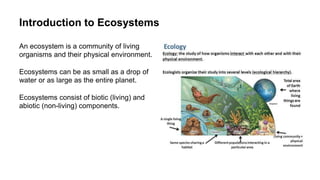
An ecosystem is a community of living
organisms and their physical environment.
Ecosystems can be as small as a drop of
water or as large as the entire planet.
Ecosystems consist of biotic (living) and
abiotic (non-living) components.
Biotic Components of an Ecosystem
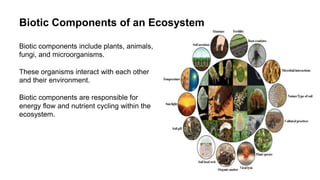
Biotic components include plants, animals,
fungi, and microorganisms.
These organisms interact with each other
and their environment.
Biotic components are responsible for
energy flow and nutrient cycling within the
ecosystem.
Abiotic Components of an Ecosystem
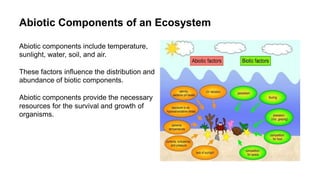
Abiotic components include temperature,
sunlight, water, soil, and air.
These factors influence the distribution and
abundance of biotic components.
Abiotic components provide the necessary
resources for the survival and growth of
organisms.
Producers in an Ecosystem
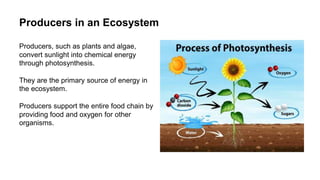
Producers, such as plants and algae,
convert sunlight into chemical energy
through photosynthesis.
They are the primary source of energy in
the ecosystem.
Producers support the entire food chain by
providing food and oxygen for other
organisms.
Consumers in an Ecosystem
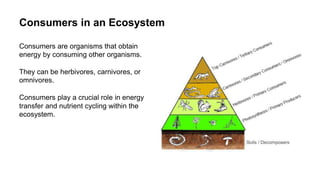
Consumers are organisms that obtain
energy by consuming other organisms.
They can be herbivores, carnivores, or
omnivores.
Consumers play a crucial role in energy
transfer and nutrient cycling within the
ecosystem.
Decomposers in an Ecosystem
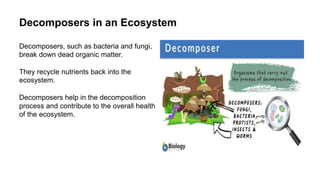
Decomposers, such as bacteria and fungi,
break down dead organic matter.
They recycle nutrients back into the
ecosystem.
Decomposers help in the decomposition
process and contribute to the overall health
of the ecosystem.
Food Chains and Food Webs
A food chain is a linear sequence of
organisms where each organism is a
source of food for the next.
A food web is a complex network of
interconnected food chains.
Food chains and food webs illustrate the
flow of energy and matter through an
ecosystem.
Trophic Levels
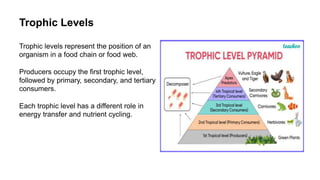
Trophic levels represent the position of an
organism in a food chain or food web.
Producers occupy the first trophic level,
followed by primary, secondary, and tertiary
consumers.
Each trophic level has a different role in
energy transfer and nutrient cycling.
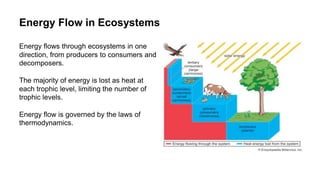
Energy Flow in Ecosystems
Energy flows through ecosystems in one
direction, from producers to consumers and
decomposers.
The majority of energy is lost as heat at
each trophic level, limiting the number of
trophic levels.
Energy flow is governed by the laws of
thermodynamics.
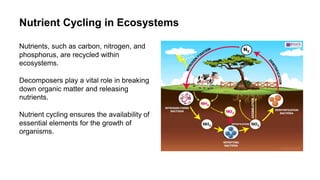
Nutrient Cycling in Ecosystems
Nutrients, such as carbon, nitrogen, and
phosphorus, are recycled within
ecosystems.
Decomposers play a vital role in breaking
down organic matter and releasing
nutrients.
Nutrient cycling ensures the availability of
essential elements for the growth of
organisms.
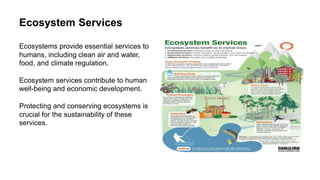
Ecosystem Services
Ecosystems provide essential services to
humans, including clean air and water,
food, and climate regulation.
Ecosystem services contribute to human
well-being and economic development.
Protecting and conserving ecosystems is
crucial for the sustainability of these
services.
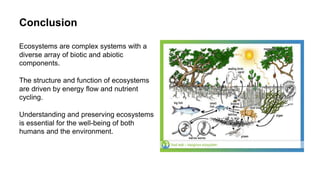
Conclusion
Ecosystems are complex systems with a
diverse array of biotic and abiotic
components.
The structure and function of ecosystems
are driven by energy flow and nutrient
cycling.
Understanding and preserving ecosystems
is essential for the well-being of both
humans and the environment.

Structure And Function Of Ecosystem.pptx

  • 1.
  • 2.
    Introduction to Ecosystems Anecosystem is a community of living organisms and their physical environment. Ecosystems can be as small as a drop of water or as large as the entire planet. Ecosystems consist of biotic (living) and abiotic (non-living) components.
  • 3.
    Biotic Components ofan Ecosystem Biotic components include plants, animals, fungi, and microorganisms. These organisms interact with each other and their environment. Biotic components are responsible for energy flow and nutrient cycling within the ecosystem.
  • 4.
    Abiotic Components ofan Ecosystem Abiotic components include temperature, sunlight, water, soil, and air. These factors influence the distribution and abundance of biotic components. Abiotic components provide the necessary resources for the survival and growth of organisms.
  • 5.
    Producers in anEcosystem Producers, such as plants and algae, convert sunlight into chemical energy through photosynthesis. They are the primary source of energy in the ecosystem. Producers support the entire food chain by providing food and oxygen for other organisms.
  • 6.
    Consumers in anEcosystem Consumers are organisms that obtain energy by consuming other organisms. They can be herbivores, carnivores, or omnivores. Consumers play a crucial role in energy transfer and nutrient cycling within the ecosystem.
  • 7.
    Decomposers in anEcosystem Decomposers, such as bacteria and fungi, break down dead organic matter. They recycle nutrients back into the ecosystem. Decomposers help in the decomposition process and contribute to the overall health of the ecosystem.
  • 8.
    Food Chains andFood Webs A food chain is a linear sequence of organisms where each organism is a source of food for the next. A food web is a complex network of interconnected food chains. Food chains and food webs illustrate the flow of energy and matter through an ecosystem.
  • 9.
    Trophic Levels Trophic levelsrepresent the position of an organism in a food chain or food web. Producers occupy the first trophic level, followed by primary, secondary, and tertiary consumers. Each trophic level has a different role in energy transfer and nutrient cycling.
  • 10.
    Energy Flow inEcosystems Energy flows through ecosystems in one direction, from producers to consumers and decomposers. The majority of energy is lost as heat at each trophic level, limiting the number of trophic levels. Energy flow is governed by the laws of thermodynamics.
  • 11.
    Nutrient Cycling inEcosystems Nutrients, such as carbon, nitrogen, and phosphorus, are recycled within ecosystems. Decomposers play a vital role in breaking down organic matter and releasing nutrients. Nutrient cycling ensures the availability of essential elements for the growth of organisms.
  • 12.
    Ecosystem Services Ecosystems provideessential services to humans, including clean air and water, food, and climate regulation. Ecosystem services contribute to human well-being and economic development. Protecting and conserving ecosystems is crucial for the sustainability of these services.
  • 13.
    Conclusion Ecosystems are complexsystems with a diverse array of biotic and abiotic components. The structure and function of ecosystems are driven by energy flow and nutrient cycling. Understanding and preserving ecosystems is essential for the well-being of both humans and the environment.

Editor's Notes

  • #3 Image source: https://www.pinterest.com.mx/pin/322288917085552700/
  • #4 Image source: https://www.jlcatj.gob.mx/cid-11/what-does-biotic-mean-6-18-40-931382190.html
  • #5 Image source: https://www.researchgate.net/figure/The-biotic-and-abiotic-factors-governing-the-marine-ecosystem_fig1_255729021
  • #6 Image source: https://www.worldatlas.com/feature/photosynthesis-explained.html
  • #7 Image source: https://www.pinterest.com/pin/372532200424805737/
  • #8 Image source: https://www.biologyonline.com/dictionary/decomposer
  • #9 Image source: https://www.teachoo.com/11169/3197/Food-Chains-and-Food-Webs/category/Concepts/
  • #10 Image source: https://cynthia-kspencer.blogspot.com/2022/04/hich-best-describes-relationship.html
  • #11 Image source: https://www.britannica.com/science/trophic-pyramid
  • #12 Image source: https://byjus.com/cbse-notes/cbse-class-9-science-notes-chapter-14-natural-resources/
  • #13 Image source: http://www.carolina.com/teacher-resources/Interactive/infographic-ecosystem-services/tr37701.tr
  • #14 Image source: https://www.pinterest.ph/pin/landscape--291045194677451081/