• Concepts of an Ecosystem
• Structure and Function of an Ecosystem
• Producers, Consumers and Decomposers
• Energy Flow in the Ecosystem
• Ecological Succession
• Food Chains, Food Webs and Ecological Pyramids
• Introduction, Types, Characteristic Features, Structure and
Function of the (A) Forest Ecosystem (B) Grassland Ecosystem
(C) Desert Ecosystem (D) Aquatic Ecosystems (Ponds, Streams,
Lakes, Rivers, Oceans, Estuaries)
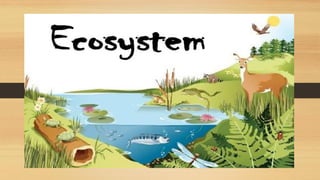
2.1 ECOSYSTEMS
2.1.1INTRODUCTION: ECOLOGY
• The term was first coined by Hons Reiter and Haekel in 1869.
• The term ecology (Okekologie) is originated from two Greek words
Oikos (eco) – means “house” (or) place of living and
“ology” means “the science of (or) the study Hence, ecology is the
branch of science that deals with the study of the pattern of relations
between the organism and their environment.
ECO SYSTEM:
• In 1935, the British ecologist A.G.Tansley coined the term “eco
system”.
• The term “eco system” is made up of two Greek words. “Eco”
means ecological sphere (or) house (or) place of living (or)
surroundings (or) Environment, where living organism does exist
while “system” means “group of organisms joined in regular and
interdependent manner.
2.1.2 FUNDAMENTAL
CHARACTERISTICS OF ECOLOGY
• STRUCTURE:
• Living /Biotic
• Non-Living /Abiotitic
• PROCESS:
• Energy flow
• Cycling of matter
CHANGE:
• Dynamic (Not static)
• Succession etc.
FUNCTION:
• Food chain
• Food web
• Ecological pyramids
• Energy Flow
• Cycling of matter
2.1.3 CHARACTERISTICS OF ECOSYSTEM
• Eco system is the basic functional unit of ecology.
• It contains both biotic and abiotic components.
• The function of ecosystem is related to the cycling of matter (materials) and
flow of energy.
• The amount of energy needed to maintain an ecosystem depends on its
structure.
• Ecosystem passes from a less complex state to more complex state, which is
called as “ecological succession
2.1.4 CLASSIFICATION OF ECOSYSTEM:
• The ecosystem can be generally classified into two types:
1. Natural Ecosystem
2. Artificial Eco system
1. NATURAL ECOSYSTEM:
two types of natural ecosystem based on their habitat.
1. Terrestrial Ecosystem.
2. Aquatic Ecosystem.
1) Terrestrial Ecosystem:
• This ecosystem is related to land.
• Examples: Grassland ecosystem. Forest ecosystem, and Desert ecosystem etc.
2) Aquatic Ecosystem:
• This ecosystem is related to water, it is further sub divided into two types based on
salt content.
i. Fresh Water Ecosystem:
Running Water Ecosystems Examples: Rivers, streams (small narrow rivers)
Standing Water Ecosystems Examples: Pond, lake & well, etc
ii. Marine Ecosystem: Examples: seas and sea shores
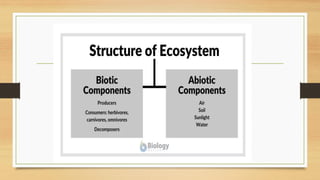
2.1.5 STRUCTURE (OR) COMPONENTS
OF AN ECOSYSTEM:
• The term structure refers to various components. So, the
structure of an ecosystem explains the relationship between the
abiotic (non-living) and the biotic (living) components.
• Each and every ecosystem has two major components are:
1. Biotic (living) components.
2. Abiotic (Non-living) components.
1. Biotic Components: The living component of an ecosystem is called
“Biotic component”
Examples: Plants (Producers)
Animals (Consumers) and
Micro Organisms (Decomposers)
• The biotic components of an ecosystem are classified into three types based
on how they get their food.
• A. Producers (Autotrophs) : Plants
• B. Consumers (Heterotrophs) : Animals
• C. Decomposers (Saprotrophs) : Micro organisms.
2. Abiotic Components:
• The non-living component of an ecosystem is called “abiotic
component”
• These non-living components enter the body of living organism,
take part in metabolic activities and then return to the
environment. The abiotic component of the ecosystems divided
into three portions.
1. Climate factors : Solar radiation, temperature, wind, water
current, rainfall, etc.
2. Physical factors : light, fire, soil, air, etc.
3. Chemical factors : Organic and Inorganic substances.
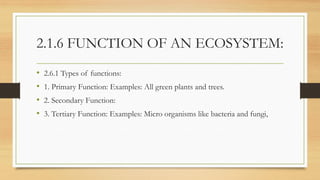
2.1.6 FUNCTION OF AN ECOSYSTEM:
• 2.6.1 Types of functions:
• 1. Primary Function: Examples: All green plants and trees.
• 2. Secondary Function:
• 3. Tertiary Function: Examples: Micro organisms like bacteria and fungi,
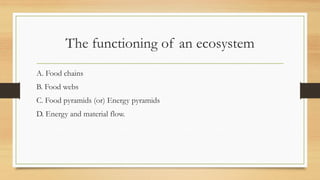
The functioning of an ecosystem
A. Food chains
B. Food webs
C. Food pyramids (or) Energy pyramids
D. Energy and material flow.
A. Food chains
• The process of transfer of food (energy) from one organism to a
series of organisms is called as “food chain”.
• A food chain always starts with a plant life and end with animal life.
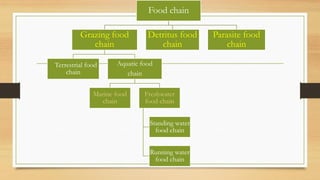
• Types of food chain
1. Grazing food chains.
2. Detritus food chains.
3. Parasitic food chains
Sun Producers Herbivores Carnivores Omnivores
Decompos
er
Food chain
Grazing food
chain
Terrestrial food
chain
Aquatic food
chain
Marine food
chain
Freshwater
food chain
Standing water
food chain
Running water
food chain
Detritus food
chain
Parasite food
chain
1. Grazing food chains:
• Grazing food chain starts with green plants (producers) and goes to
decomposer food chain (or) detritus food chain through herbivores
and carnivores.
• It has two types :
a. Terrestrial food chain and
b. Aquatic food chain
a. Terrestrial food chain: Food chain on land is called terrestrial
food chain.
Example: Grassland food chain
Grasses ……Grasshoppers ……..Frog ………Snake …….Eagles
Forest land food chain
Green plants ……Deer Tiger ………(or) lion
b. Aquatic food chain : This food chain is slightly different from
terrestrial food chain. It is seen in aquatic (water) eco system. Food
chain in water is called “Aquatic food chain”.
Example: Marine food chain…… Ocean
Example: Fresh water food chain ….. Pond, lake, streams, etc.
2. Detritus’ food chain: Detritus food chain starts with dead organic matter (plants
and animals) and goes to decomposer through consumers. Detritus food chains,
independent of solar energy, but they depend on influx of dead organic matter.
Example:
Dead Plants …..Soil mitts ……Algae ……Crabs …….Small fish ……Large fish
3. Parasitic food chain: Parasitic food chain operates in many ecosystems. In this
food chain either consumer (or) producer is parasitized and the food passes to
smaller organisms. A parasitic food chain involves host parasite hyper parasites’ links.
Example:
Trees….. Fruit eating birds…… Lice & Bugs……. Bacteria …..Fungi
B. Food Web
In a food web many food chains are inter connected, where different types of
organisms are connected at different tropic levels, so that there are a number of
options of eating and being eaten at each tropic level. Thus, there is a inter
connecting of various food chains are called food webs
Insect
Bird
Fish
Grass
Grassh
opper
Frog
Snake
These linear food chains are inter connected with other food chains
operating in the eco system to form a food web.
C. Ecological Pyramids:
• The concept of ecological pyramids was first developed by British ecologist
Charles Elton in 1927.
• Ecological pyramids are the diagrammatic representation of tropic structures
in which the tropic levels (i.e., tiers) are depicted in successive stages.
On the basis of the number of organisms, the biomass of organisms and
energy flow in organist population. Three types of ecological pyramids are:
1. Pyramid of numbers.
1. Upright pyramid of numbers.
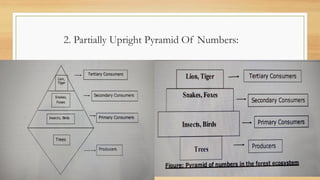
2. Partly upright pyramid of numbers.
3. Inverted pyramid of numbers.
2. Pyramid of biomass
1. Upright pyramid of biomass. ii.
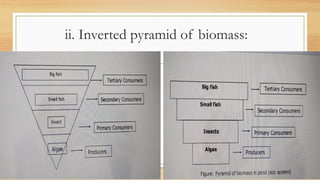
2. Inverted pyramid of biomass
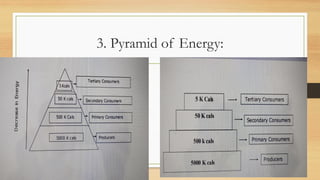
3. Pyramid of energy.
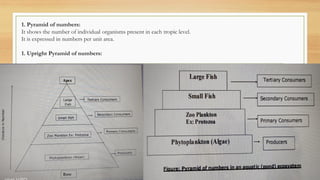
1. Pyramid of numbers:
It shows the number of individual organisms present in each tropic level.
It is expressed in numbers per unit area.
1. Upright Pyramid of numbers:
2. Partially Upright Pyramid Of Numbers:
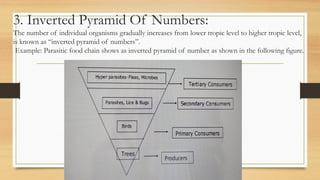
3. Inverted Pyramid Of Numbers:
The number of individual organisms gradually increases from lower tropic level to higher tropic level,
is known as “inverted pyramid of numbers”.
Example: Parasitic food chain shows as inverted pyramid of number as shown in the following figure.
2. Pyramid of Biomass:
It represents the total amount of biomass (mass (or) weight of biological material (or) organism) present
in each tropic level.
It is expressed in gram per unit area.
i. Upright Pyramid Of Biomass:
ii. Inverted pyramid of biomass:
3. Pyramid of Energy:
2.1.7 MAJOR TYPES OF ECOSYSTEMS 2.1.7.1 FOREST ECOSYSTEM
• Definition: It is a natural ecosystem consisting of dense growth of trees and wild animals
• Types:
1. Tropical – deciduous, evergreen, wet green
2. Littoral and swamps
3. Sub tropical
• Characteristics:
• Abiotic: soil, sun light, temperature etc
• Biotic : forest trees, shrubs and animals
• Structure:
• Producer : Trees and shrubs
• Consumer : Primary – elephants, deer etc. Secondary – snakes, birds, lizards etc Tertiary –
lions, tigers etc
• Decomposers : fungi, bacteria
2.1.7.2 AQUATIC ECOSYSTEM
• Definition: Deals with water bodies and biotic communities present in them-
Classified as fresh water and marine ecosystems. Fresh water systems are
classified as lentic and lotic ecosystems.
• Types:
• A. Pond ecosystem
• B. Lake ecosystem:
Top layer – shallow, warm, prone to anthropogenic activities – Littoral zone
Second layer – enough sunlight, high primary productivity – Limnetic zone
Third layer – very poor or no sunlight – Profundal zone
Eg. Dal lake in Srinagar, Naini lake in Nainital
• Types of lakes : Many types
• 1. Oligotrophic lakes – with less nutrient content
• 2. Eutrophic lakes – with very high nutrient content due to fertilizer contamination
• 3. Desert salt lakes – that contains high saline water due to over evaporation
• 4. Volcanic lakes – formed by water emitted from magma due to volcanic eruptions
• 5. Dystrophic lakes – that contains highly acidic water (low pH)
• 6. Endemic lakes – lakes that contain many endemic species, etc.
• C. Streams:
• D. River ecosystem:
• Three phases:
• 1. Mountain highlands – rushing down water fall of water – large quantity of
dissolved oxygen – plants attached to rocks and fishes that require more oxygen
are found.
• 2. Second phase – gentle slopes of hills – warmer – supports the growth of
plants and fishes that require less oxygen are seen.
• 3. Third phase: river shapes the land – lots of silts, nutrients are brought –
deposited in plains and delta – very rich in biodiversity.
• E. Oceans
• Two zones:
• 1. coastal zone – warm, nutrient rich, shallow – high sunlight – high primary
productivity.
• 2. Open sea – away from continental shelf – vertically divided in to 3 zones.
Euphotic zone – abundant sunlight
Bathyal zone – dim sunlight
Abyssal zone – dark zone – world’s largest ecological unit.
• F. Estuary: coastal area where river meet ocean – strongly affected by
tidal actions – very rich in nutrients – very rich in biodiversity also –
organisms are highly tolerant – many species are endemic – high food
productivity – however to be protected from pollution.
• Characteristics:
Structural Components:
Abiotic: pH, nutrients, D.O, temp, climatic conditions, etc.
Biotic: Phytoplankton, fishes, snails insects, birds, etc.
2.1.7.3 GRASSLAND ECOSYSTEM:
• Three types – depending on the climate
• a. Tropical grass lands – found near the boarders of tropical rain forests. Eg.
Savannas in Africa. Animals – Zebra, giraffes etc. – fires are common in dry seasons
– termite mounds produce methane – leads to fire – high in photosynthesis –
deliberate burning leads to release of high CO2 – global warming.
• b. Temperate grasslands – flat and gentle slopes of hills. Very cold winter and
very hot summer - dry summer fires do not allow shrubs and trees to grow – soil is
quite fertile – cleaned for agriculture.
• c. Polar grasslands – found in arctic polar region – organism – arctic wolf, fox, etc.
– A thick layer of ice remains frozen under the soil surface throughout the year –
known as permafrost – summer insects and birds appear. Components: Structural
• Components:
• Abiotic: soil pH, nutrients, soil moisture, temp, climatic conditions, etc.
• Biotic: grass, caterpillar, butterfly, worms, insects, birds, etc.

Ecosystems

  • 2.
    • Concepts ofan Ecosystem • Structure and Function of an Ecosystem • Producers, Consumers and Decomposers • Energy Flow in the Ecosystem • Ecological Succession • Food Chains, Food Webs and Ecological Pyramids • Introduction, Types, Characteristic Features, Structure and Function of the (A) Forest Ecosystem (B) Grassland Ecosystem (C) Desert Ecosystem (D) Aquatic Ecosystems (Ponds, Streams, Lakes, Rivers, Oceans, Estuaries)
  • 3.
    2.1 ECOSYSTEMS 2.1.1INTRODUCTION: ECOLOGY •The term was first coined by Hons Reiter and Haekel in 1869. • The term ecology (Okekologie) is originated from two Greek words Oikos (eco) – means “house” (or) place of living and “ology” means “the science of (or) the study Hence, ecology is the branch of science that deals with the study of the pattern of relations between the organism and their environment.
  • 4.
    ECO SYSTEM: • In1935, the British ecologist A.G.Tansley coined the term “eco system”. • The term “eco system” is made up of two Greek words. “Eco” means ecological sphere (or) house (or) place of living (or) surroundings (or) Environment, where living organism does exist while “system” means “group of organisms joined in regular and interdependent manner.
  • 5.
    2.1.2 FUNDAMENTAL CHARACTERISTICS OFECOLOGY • STRUCTURE: • Living /Biotic • Non-Living /Abiotitic • PROCESS: • Energy flow • Cycling of matter CHANGE: • Dynamic (Not static) • Succession etc. FUNCTION: • Food chain • Food web • Ecological pyramids • Energy Flow • Cycling of matter
  • 6.
    2.1.3 CHARACTERISTICS OFECOSYSTEM • Eco system is the basic functional unit of ecology. • It contains both biotic and abiotic components. • The function of ecosystem is related to the cycling of matter (materials) and flow of energy. • The amount of energy needed to maintain an ecosystem depends on its structure. • Ecosystem passes from a less complex state to more complex state, which is called as “ecological succession
  • 7.
    2.1.4 CLASSIFICATION OFECOSYSTEM: • The ecosystem can be generally classified into two types: 1. Natural Ecosystem 2. Artificial Eco system
  • 8.
    1. NATURAL ECOSYSTEM: twotypes of natural ecosystem based on their habitat. 1. Terrestrial Ecosystem. 2. Aquatic Ecosystem. 1) Terrestrial Ecosystem: • This ecosystem is related to land. • Examples: Grassland ecosystem. Forest ecosystem, and Desert ecosystem etc. 2) Aquatic Ecosystem: • This ecosystem is related to water, it is further sub divided into two types based on salt content. i. Fresh Water Ecosystem: Running Water Ecosystems Examples: Rivers, streams (small narrow rivers) Standing Water Ecosystems Examples: Pond, lake & well, etc ii. Marine Ecosystem: Examples: seas and sea shores
  • 9.
    2.1.5 STRUCTURE (OR)COMPONENTS OF AN ECOSYSTEM: • The term structure refers to various components. So, the structure of an ecosystem explains the relationship between the abiotic (non-living) and the biotic (living) components. • Each and every ecosystem has two major components are: 1. Biotic (living) components. 2. Abiotic (Non-living) components.
  • 11.
    1. Biotic Components:The living component of an ecosystem is called “Biotic component” Examples: Plants (Producers) Animals (Consumers) and Micro Organisms (Decomposers) • The biotic components of an ecosystem are classified into three types based on how they get their food. • A. Producers (Autotrophs) : Plants • B. Consumers (Heterotrophs) : Animals • C. Decomposers (Saprotrophs) : Micro organisms.
  • 12.
    2. Abiotic Components: •The non-living component of an ecosystem is called “abiotic component” • These non-living components enter the body of living organism, take part in metabolic activities and then return to the environment. The abiotic component of the ecosystems divided into three portions. 1. Climate factors : Solar radiation, temperature, wind, water current, rainfall, etc. 2. Physical factors : light, fire, soil, air, etc. 3. Chemical factors : Organic and Inorganic substances.
  • 13.
    2.1.6 FUNCTION OFAN ECOSYSTEM: • 2.6.1 Types of functions: • 1. Primary Function: Examples: All green plants and trees. • 2. Secondary Function: • 3. Tertiary Function: Examples: Micro organisms like bacteria and fungi,
  • 14.
    The functioning ofan ecosystem A. Food chains B. Food webs C. Food pyramids (or) Energy pyramids D. Energy and material flow.
  • 15.
    A. Food chains •The process of transfer of food (energy) from one organism to a series of organisms is called as “food chain”. • A food chain always starts with a plant life and end with animal life. • Types of food chain 1. Grazing food chains. 2. Detritus food chains. 3. Parasitic food chains Sun Producers Herbivores Carnivores Omnivores Decompos er
  • 16.
    Food chain Grazing food chain Terrestrialfood chain Aquatic food chain Marine food chain Freshwater food chain Standing water food chain Running water food chain Detritus food chain Parasite food chain
  • 17.
    1. Grazing foodchains: • Grazing food chain starts with green plants (producers) and goes to decomposer food chain (or) detritus food chain through herbivores and carnivores. • It has two types : a. Terrestrial food chain and b. Aquatic food chain a. Terrestrial food chain: Food chain on land is called terrestrial food chain.
  • 18.
    Example: Grassland foodchain Grasses ……Grasshoppers ……..Frog ………Snake …….Eagles Forest land food chain Green plants ……Deer Tiger ………(or) lion b. Aquatic food chain : This food chain is slightly different from terrestrial food chain. It is seen in aquatic (water) eco system. Food chain in water is called “Aquatic food chain”. Example: Marine food chain…… Ocean Example: Fresh water food chain ….. Pond, lake, streams, etc.
  • 19.
    2. Detritus’ foodchain: Detritus food chain starts with dead organic matter (plants and animals) and goes to decomposer through consumers. Detritus food chains, independent of solar energy, but they depend on influx of dead organic matter. Example: Dead Plants …..Soil mitts ……Algae ……Crabs …….Small fish ……Large fish 3. Parasitic food chain: Parasitic food chain operates in many ecosystems. In this food chain either consumer (or) producer is parasitized and the food passes to smaller organisms. A parasitic food chain involves host parasite hyper parasites’ links. Example: Trees….. Fruit eating birds…… Lice & Bugs……. Bacteria …..Fungi
  • 20.
    B. Food Web Ina food web many food chains are inter connected, where different types of organisms are connected at different tropic levels, so that there are a number of options of eating and being eaten at each tropic level. Thus, there is a inter connecting of various food chains are called food webs Insect Bird Fish Grass Grassh opper Frog Snake
  • 21.
    These linear foodchains are inter connected with other food chains operating in the eco system to form a food web.
  • 22.
    C. Ecological Pyramids: •The concept of ecological pyramids was first developed by British ecologist Charles Elton in 1927. • Ecological pyramids are the diagrammatic representation of tropic structures in which the tropic levels (i.e., tiers) are depicted in successive stages.
  • 24.
    On the basisof the number of organisms, the biomass of organisms and energy flow in organist population. Three types of ecological pyramids are: 1. Pyramid of numbers. 1. Upright pyramid of numbers. 2. Partly upright pyramid of numbers. 3. Inverted pyramid of numbers. 2. Pyramid of biomass 1. Upright pyramid of biomass. ii. 2. Inverted pyramid of biomass 3. Pyramid of energy.
  • 25.
    1. Pyramid ofnumbers: It shows the number of individual organisms present in each tropic level. It is expressed in numbers per unit area. 1. Upright Pyramid of numbers:
  • 26.
    2. Partially UprightPyramid Of Numbers:
  • 27.
    3. Inverted PyramidOf Numbers: The number of individual organisms gradually increases from lower tropic level to higher tropic level, is known as “inverted pyramid of numbers”. Example: Parasitic food chain shows as inverted pyramid of number as shown in the following figure.
  • 28.
    2. Pyramid ofBiomass: It represents the total amount of biomass (mass (or) weight of biological material (or) organism) present in each tropic level. It is expressed in gram per unit area. i. Upright Pyramid Of Biomass:
  • 29.
  • 30.
  • 31.
    2.1.7 MAJOR TYPESOF ECOSYSTEMS 2.1.7.1 FOREST ECOSYSTEM • Definition: It is a natural ecosystem consisting of dense growth of trees and wild animals • Types: 1. Tropical – deciduous, evergreen, wet green 2. Littoral and swamps 3. Sub tropical • Characteristics: • Abiotic: soil, sun light, temperature etc • Biotic : forest trees, shrubs and animals • Structure: • Producer : Trees and shrubs • Consumer : Primary – elephants, deer etc. Secondary – snakes, birds, lizards etc Tertiary – lions, tigers etc • Decomposers : fungi, bacteria
  • 32.
    2.1.7.2 AQUATIC ECOSYSTEM •Definition: Deals with water bodies and biotic communities present in them- Classified as fresh water and marine ecosystems. Fresh water systems are classified as lentic and lotic ecosystems. • Types: • A. Pond ecosystem • B. Lake ecosystem: Top layer – shallow, warm, prone to anthropogenic activities – Littoral zone Second layer – enough sunlight, high primary productivity – Limnetic zone Third layer – very poor or no sunlight – Profundal zone Eg. Dal lake in Srinagar, Naini lake in Nainital
  • 33.
    • Types oflakes : Many types • 1. Oligotrophic lakes – with less nutrient content • 2. Eutrophic lakes – with very high nutrient content due to fertilizer contamination • 3. Desert salt lakes – that contains high saline water due to over evaporation • 4. Volcanic lakes – formed by water emitted from magma due to volcanic eruptions • 5. Dystrophic lakes – that contains highly acidic water (low pH) • 6. Endemic lakes – lakes that contain many endemic species, etc.
  • 34.
    • C. Streams: •D. River ecosystem: • Three phases: • 1. Mountain highlands – rushing down water fall of water – large quantity of dissolved oxygen – plants attached to rocks and fishes that require more oxygen are found. • 2. Second phase – gentle slopes of hills – warmer – supports the growth of plants and fishes that require less oxygen are seen. • 3. Third phase: river shapes the land – lots of silts, nutrients are brought – deposited in plains and delta – very rich in biodiversity.
  • 35.
    • E. Oceans •Two zones: • 1. coastal zone – warm, nutrient rich, shallow – high sunlight – high primary productivity. • 2. Open sea – away from continental shelf – vertically divided in to 3 zones. Euphotic zone – abundant sunlight Bathyal zone – dim sunlight Abyssal zone – dark zone – world’s largest ecological unit.
  • 36.
    • F. Estuary:coastal area where river meet ocean – strongly affected by tidal actions – very rich in nutrients – very rich in biodiversity also – organisms are highly tolerant – many species are endemic – high food productivity – however to be protected from pollution. • Characteristics: Structural Components: Abiotic: pH, nutrients, D.O, temp, climatic conditions, etc. Biotic: Phytoplankton, fishes, snails insects, birds, etc.
  • 37.
    2.1.7.3 GRASSLAND ECOSYSTEM: •Three types – depending on the climate • a. Tropical grass lands – found near the boarders of tropical rain forests. Eg. Savannas in Africa. Animals – Zebra, giraffes etc. – fires are common in dry seasons – termite mounds produce methane – leads to fire – high in photosynthesis – deliberate burning leads to release of high CO2 – global warming. • b. Temperate grasslands – flat and gentle slopes of hills. Very cold winter and very hot summer - dry summer fires do not allow shrubs and trees to grow – soil is quite fertile – cleaned for agriculture. • c. Polar grasslands – found in arctic polar region – organism – arctic wolf, fox, etc. – A thick layer of ice remains frozen under the soil surface throughout the year – known as permafrost – summer insects and birds appear. Components: Structural • Components: • Abiotic: soil pH, nutrients, soil moisture, temp, climatic conditions, etc. • Biotic: grass, caterpillar, butterfly, worms, insects, birds, etc.