Material downloaded from http://myCBSEguide.com and http://onlineteachers.co.in
Portal for CBSE Notes, Test Papers, Sample Papers, Tips and Tricks
CHAPTER- 16
ENVIROMENTAL ISSUES
With increase in human population, demands for food, shelter, water, electricity, roads, and
automobiles are increasing rapidly and pausing pressure on environment and altering the
natural health of ecosystem. The main problems caused include- pollution, greenhouse
effect, ozone deletion, deforestation etc.
Pollution is undesirable change in physical, chemical or biological properties of air, land,
water or soil. The substances that cause undesirable change are called pollutants.
Air Pollution and its Control
Air is essential for respiration of all living organisms. Pollutants reduce growth and
production of crops as well as premature death of plants. The harmful effect of pollution on
human beings depends upon-
• Concentration of pollutants.
• Duration of exposure.
• Organisms involved.
Thermal power plants, smelters and other industries release particulate and gaseous air
pollutants along with harmless gases such as nitrogen, oxygen etc. These pollutants should
be filtered out before releasing the harmless gases into the atmosphere. There are many
methods of removing particulate matter; the most widely used is the electrostatic
precipitator.
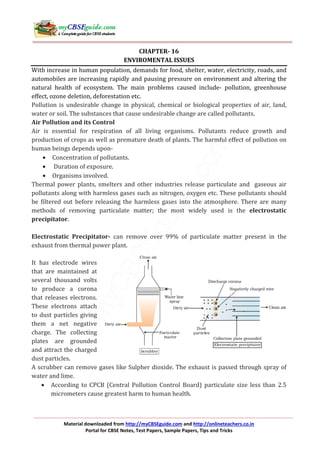
Electrostatic Precipitator- can remove over 99% of particulate matter present in the
exhaust from thermal power plant.
It has electrode wires
that are maintained at
several thousand volts
to produce a corona
that releases electrons.
These electrons attach
to dust particles giving
them a net negative
charge. The collecting
plates are grounded
and attract the charged
dust particles.
A scrubber can remove gases like Sulpher dioxide. The exhaust is passed through spray of
water and lime.
• According to CPCB (Central Pollution Control Board) particulate size less than 2.5
micrometers cause greatest harm to human health.
Material downloaded from http://myCBSEguide.com and http://onlineteachers.co.in
Portal for CBSE Notes, Test Papers, Sample Papers, Tips and Tricks
• Automobiles are main cause of atmospheric pollution in metro cities. Proper
maintenance of automobiles.
• The fine particles can be inhaled deep into the lungs and can cause breathing and
respiratory symptoms, irritation, inflammations and damage to lungs and premature
death.
Catalytic converters contain platinum-palladium and rhodium as the catalyst, are fitted into
automobiles for reducing emission of poisonous gases. As the exhaust passes through the
catalytic converter, unburnt hydrocarbons are converted into carbon dioxide and water. The
vehicles fitted with catalytic converter should use unleaded petrol because lead in the petrol
inactivates the catalyst.
In Delhi, entire fleet of public transport was converted to CNG mode to reduce the fast
increasing pollution level of metro. CNG is better than diesel because it is cheaper than
petrol and diesel, burn completely with leaving any residue and cannot be adulterated
like petrol and diesel.
In India, the Air (Prevention and Control of Pollution) Act came into force in 1981 and
was amended in 1987 to include noise as an air pollutant. High sound level greater than
150 dB or more generated by takeoff or a jet plane or rocket may damage ear drums
thus permanently impairing hearing ability.
Reduction of noise in industries can be affected by use of sound absorbent materials or
by muffling noise.
Water Pollution and it Control
Water bodies are lifeline of human beings as well as other animals. Due to disposal of all
kinds of waste ponds, lakes stream, river, estuaries and oceans are becoming polluted in
several parts of world. The Government of India has passed the water (Prevention and
Control of Pollution) Act, 1974 to protect the water resources.
Domestic Sewage and Industrial Effluents-
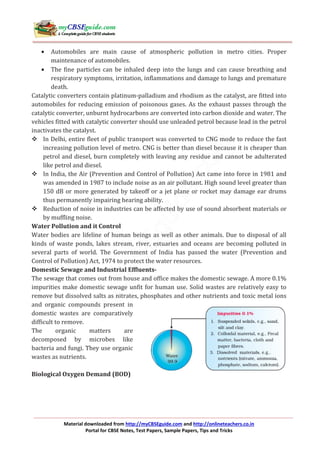
The sewage that comes out from house and office makes the domestic sewage. A more 0.1%
impurities make domestic sewage unfit for human use. Solid wastes are relatively easy to
remove but dissolved salts as nitrates, phosphates and other nutrients and toxic metal ions
and organic compounds present in
domestic wastes are comparatively
difficult to remove.
The organic matters are
decomposed by microbes like
bacteria and fungi. They use organic
wastes as nutrients.
Biological Oxygen Demand (BOD)
Material downloaded from http://myCBSEguide.com and http://onlineteachers.co.in
Portal for CBSE Notes, Test Papers, Sample Papers, Tips and Tricks
The microbes that decompose organic
wastes in water bodies consume a lot of
oxygen that result into sharp decline in
dissolved oxygen downstream from the
point of sewage discharge. This decrease in
dissolved oxygen in water bodies is called
BOD. The main effects include mortality of
fish and other aquatic creatures.
Algal Bloom
Presence of large amount of organic
nutrients in water causes excessive growth
of planktonic or free floating algae called
algal bloom. Due to this colour of water
bodies get changed. This may cause deterioration of the water quality and fish mortality.
Water hyacinth (Eichhornia crassipes) is the world’s most problematic aquatic weed.
They are introduced into India for their beautiful mauve-coloured flowers that have caused
havoc by their excessive growth by causing blocks in our water bodies. This weed is called
as ‘Terror of Bengal’.
Biomagnification or Biological Magnification
Toxic wastes present in industrial wastes and water from farmhouse containing pesticides
and weedicides enters the food chain of aquatic organisms. The increase in concentration of
toxicant at each successive trophic levels is called biological magnification. The most
common toxicant that get accumulated at successive trophic levels includes DDT and
Mercury.
Eutrophication
It is the natural aging of a lake by biological enrichment of its
water. Due to addition of nutrients such as nitrogen and
phosphorus that encourage the growth of aquatic organism the
accumulation of organic remains in course of time leads to shall
lowing of lake. Over the centuries the silt and organic debris piles
up at the bottom of lake and encourage the growth of marsh plants
in the shallow and begin to fill in the original lake basin.
Eventually large masses of floating plants grows and finally
converting into land.
The pollutants from man’s activities such as effluents from the
industries and homes radically accelerate the aging of lake. This
phenomenon is called Cultural or Accelerated Eutrophication.
Main contaminants include nitrates, phosphates that act as plant
nutrients.
Solid Wastes
Material downloaded from http://myCBSEguide.com and http://onlineteachers.co.in
Portal for CBSE Notes, Test Papers, Sample Papers, Tips and Tricks
Municipal solid wastes are wastes from home, offices, stores, schools, hospitals etc. that are
collected and disposed by the municipality. It consists of paper, food wastes, plastics, glass,
metals, rubber, leather, textile etc. Sanitary landfills were used as substitute for open
burning dumps where wastes are dumped in a depression or trench after compaction and
covered with dirt every day. There is a danger of seepage of chemicals from these landfills
polluting the underground water resources.
• The biodegradable materials can be put into deep pits in the ground and be left for
natural breakdown.
• Kabadiwallahs and rag-pickers do a great job of separation of materials for recycling
of different kinds of wastes.
• Hospitals generate hazardous wastes that contain disinfectants and other chemicals
and alos pathogenic micro-organisms. Such wastes need careful treatment and
disposal. Incinators are used for disposal of hospital wastes.
Agro-chemicals and other effects
Use of inorganic fertilizers and pesticides has been increased many fold due to green
revolution for enhancing crop production. The pesticides and insecticides are toxic to non-
target organisms that are important components of the soil ecosystem. They are
biomagnified in the terrestrial ecosystem.
Organic Farming
Integrated organic farming is a cyclic, zero-waste procedure in which waste products from
one process are cycled in as nutrients for other processes to allow the maximum utilization
of resource and increase the efficiency of production. It includes bee-keeping, dairy
management, water harvesting, composting and agriculture in a chain of processes which
support each other and allow an extremely economical and sustainable venture. No chemical
fertilizer is used in this process.
Radioactive Wastes
Nuclear energy has two very serious problems-
• Accidental leakage
• Safe disposal of radioactive wastes
The radiation released from nuclear wastes is extremely damaging to biological organisms
as it causes mutations to occur at very high rate. It has been recommended that storage of
nuclear wastes after sufficient pre-treatment should be done in suitably shielded containers
and buried within the rock about 500m deep below the earth surface.
Green House Effect and Global Warming
Municipal
wastes
Bio-degradable
wastes
Recyclable wastes
Non-biodegradable
waste
Material downloaded from http://myCBSEguide.com and http://onlineteachers.co.in
Portal for CBSE Notes, Test Papers, Sample Papers, Tips and Tricks
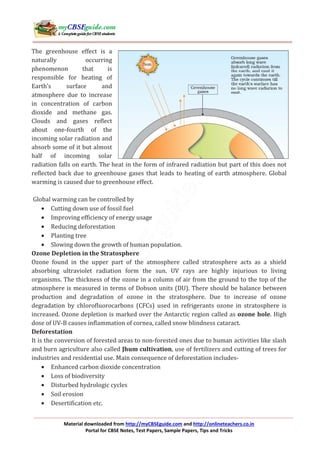
The greenhouse effect is a
naturally occurring
phenomenon that is
responsible for heating of
Earth’s surface and
atmosphere due to increase
in concentration of carbon
dioxide and methane gas.
Clouds and gases reflect
about one-fourth of the
incoming solar radiation and
absorb some of it but almost
half of incoming solar
radiation falls on earth. The heat in the form of infrared radiation but part of this does not
reflected back due to greenhouse gases that leads to heating of earth atmosphere. Global
warming is caused due to greenhouse effect.
Global warming can be controlled by
• Cutting down use of fossil fuel
• Improving efficiency of energy usage
• Reducing deforestation
• Planting tree
• Slowing down the growth of human population.
Ozone Depletion in the Stratosphere
Ozone found in the upper part of the atmosphere called stratosphere acts as a shield
absorbing ultraviolet radiation form the sun. UV rays are highly injurious to living
organisms. The thickness of the ozone in a column of air from the ground to the top of the
atmosphere is measured in terms of Dobson units (DU). There should be balance between
production and degradation of ozone in the stratosphere. Due to increase of ozone
degradation by chlorofluorocarbons (CFCs) used in refrigerants ozone in stratosphere is
increased. Ozone depletion is marked over the Antarctic region called as ozone hole. High
dose of UV-B causes inflammation of cornea, called snow blindness cataract.
Deforestation
It is the conversion of forested areas to non-forested ones due to human activities like slash
and burn agriculture also called Jhum cultivation, use of fertilizers and cutting of trees for
industries and residential use. Main consequence of deforestation includes-
• Enhanced carbon dioxide concentration
• Loss of biodiversity
• Disturbed hydrologic cycles
• Soil erosion
• Desertification etc.

12 biology notes_ch16_environmental_issues

  • 1.
    Material downloaded fromhttp://myCBSEguide.com and http://onlineteachers.co.in Portal for CBSE Notes, Test Papers, Sample Papers, Tips and Tricks CHAPTER- 16 ENVIROMENTAL ISSUES With increase in human population, demands for food, shelter, water, electricity, roads, and automobiles are increasing rapidly and pausing pressure on environment and altering the natural health of ecosystem. The main problems caused include- pollution, greenhouse effect, ozone deletion, deforestation etc. Pollution is undesirable change in physical, chemical or biological properties of air, land, water or soil. The substances that cause undesirable change are called pollutants. Air Pollution and its Control Air is essential for respiration of all living organisms. Pollutants reduce growth and production of crops as well as premature death of plants. The harmful effect of pollution on human beings depends upon- • Concentration of pollutants. • Duration of exposure. • Organisms involved. Thermal power plants, smelters and other industries release particulate and gaseous air pollutants along with harmless gases such as nitrogen, oxygen etc. These pollutants should be filtered out before releasing the harmless gases into the atmosphere. There are many methods of removing particulate matter; the most widely used is the electrostatic precipitator. Electrostatic Precipitator- can remove over 99% of particulate matter present in the exhaust from thermal power plant. It has electrode wires that are maintained at several thousand volts to produce a corona that releases electrons. These electrons attach to dust particles giving them a net negative charge. The collecting plates are grounded and attract the charged dust particles. A scrubber can remove gases like Sulpher dioxide. The exhaust is passed through spray of water and lime. • According to CPCB (Central Pollution Control Board) particulate size less than 2.5 micrometers cause greatest harm to human health.
  • 2.
    Material downloaded fromhttp://myCBSEguide.com and http://onlineteachers.co.in Portal for CBSE Notes, Test Papers, Sample Papers, Tips and Tricks • Automobiles are main cause of atmospheric pollution in metro cities. Proper maintenance of automobiles. • The fine particles can be inhaled deep into the lungs and can cause breathing and respiratory symptoms, irritation, inflammations and damage to lungs and premature death. Catalytic converters contain platinum-palladium and rhodium as the catalyst, are fitted into automobiles for reducing emission of poisonous gases. As the exhaust passes through the catalytic converter, unburnt hydrocarbons are converted into carbon dioxide and water. The vehicles fitted with catalytic converter should use unleaded petrol because lead in the petrol inactivates the catalyst. In Delhi, entire fleet of public transport was converted to CNG mode to reduce the fast increasing pollution level of metro. CNG is better than diesel because it is cheaper than petrol and diesel, burn completely with leaving any residue and cannot be adulterated like petrol and diesel. In India, the Air (Prevention and Control of Pollution) Act came into force in 1981 and was amended in 1987 to include noise as an air pollutant. High sound level greater than 150 dB or more generated by takeoff or a jet plane or rocket may damage ear drums thus permanently impairing hearing ability. Reduction of noise in industries can be affected by use of sound absorbent materials or by muffling noise. Water Pollution and it Control Water bodies are lifeline of human beings as well as other animals. Due to disposal of all kinds of waste ponds, lakes stream, river, estuaries and oceans are becoming polluted in several parts of world. The Government of India has passed the water (Prevention and Control of Pollution) Act, 1974 to protect the water resources. Domestic Sewage and Industrial Effluents- The sewage that comes out from house and office makes the domestic sewage. A more 0.1% impurities make domestic sewage unfit for human use. Solid wastes are relatively easy to remove but dissolved salts as nitrates, phosphates and other nutrients and toxic metal ions and organic compounds present in domestic wastes are comparatively difficult to remove. The organic matters are decomposed by microbes like bacteria and fungi. They use organic wastes as nutrients. Biological Oxygen Demand (BOD)
  • 3.
    Material downloaded fromhttp://myCBSEguide.com and http://onlineteachers.co.in Portal for CBSE Notes, Test Papers, Sample Papers, Tips and Tricks The microbes that decompose organic wastes in water bodies consume a lot of oxygen that result into sharp decline in dissolved oxygen downstream from the point of sewage discharge. This decrease in dissolved oxygen in water bodies is called BOD. The main effects include mortality of fish and other aquatic creatures. Algal Bloom Presence of large amount of organic nutrients in water causes excessive growth of planktonic or free floating algae called algal bloom. Due to this colour of water bodies get changed. This may cause deterioration of the water quality and fish mortality. Water hyacinth (Eichhornia crassipes) is the world’s most problematic aquatic weed. They are introduced into India for their beautiful mauve-coloured flowers that have caused havoc by their excessive growth by causing blocks in our water bodies. This weed is called as ‘Terror of Bengal’. Biomagnification or Biological Magnification Toxic wastes present in industrial wastes and water from farmhouse containing pesticides and weedicides enters the food chain of aquatic organisms. The increase in concentration of toxicant at each successive trophic levels is called biological magnification. The most common toxicant that get accumulated at successive trophic levels includes DDT and Mercury. Eutrophication It is the natural aging of a lake by biological enrichment of its water. Due to addition of nutrients such as nitrogen and phosphorus that encourage the growth of aquatic organism the accumulation of organic remains in course of time leads to shall lowing of lake. Over the centuries the silt and organic debris piles up at the bottom of lake and encourage the growth of marsh plants in the shallow and begin to fill in the original lake basin. Eventually large masses of floating plants grows and finally converting into land. The pollutants from man’s activities such as effluents from the industries and homes radically accelerate the aging of lake. This phenomenon is called Cultural or Accelerated Eutrophication. Main contaminants include nitrates, phosphates that act as plant nutrients. Solid Wastes
  • 4.
    Material downloaded fromhttp://myCBSEguide.com and http://onlineteachers.co.in Portal for CBSE Notes, Test Papers, Sample Papers, Tips and Tricks Municipal solid wastes are wastes from home, offices, stores, schools, hospitals etc. that are collected and disposed by the municipality. It consists of paper, food wastes, plastics, glass, metals, rubber, leather, textile etc. Sanitary landfills were used as substitute for open burning dumps where wastes are dumped in a depression or trench after compaction and covered with dirt every day. There is a danger of seepage of chemicals from these landfills polluting the underground water resources. • The biodegradable materials can be put into deep pits in the ground and be left for natural breakdown. • Kabadiwallahs and rag-pickers do a great job of separation of materials for recycling of different kinds of wastes. • Hospitals generate hazardous wastes that contain disinfectants and other chemicals and alos pathogenic micro-organisms. Such wastes need careful treatment and disposal. Incinators are used for disposal of hospital wastes. Agro-chemicals and other effects Use of inorganic fertilizers and pesticides has been increased many fold due to green revolution for enhancing crop production. The pesticides and insecticides are toxic to non- target organisms that are important components of the soil ecosystem. They are biomagnified in the terrestrial ecosystem. Organic Farming Integrated organic farming is a cyclic, zero-waste procedure in which waste products from one process are cycled in as nutrients for other processes to allow the maximum utilization of resource and increase the efficiency of production. It includes bee-keeping, dairy management, water harvesting, composting and agriculture in a chain of processes which support each other and allow an extremely economical and sustainable venture. No chemical fertilizer is used in this process. Radioactive Wastes Nuclear energy has two very serious problems- • Accidental leakage • Safe disposal of radioactive wastes The radiation released from nuclear wastes is extremely damaging to biological organisms as it causes mutations to occur at very high rate. It has been recommended that storage of nuclear wastes after sufficient pre-treatment should be done in suitably shielded containers and buried within the rock about 500m deep below the earth surface. Green House Effect and Global Warming Municipal wastes Bio-degradable wastes Recyclable wastes Non-biodegradable waste
  • 5.
    Material downloaded fromhttp://myCBSEguide.com and http://onlineteachers.co.in Portal for CBSE Notes, Test Papers, Sample Papers, Tips and Tricks The greenhouse effect is a naturally occurring phenomenon that is responsible for heating of Earth’s surface and atmosphere due to increase in concentration of carbon dioxide and methane gas. Clouds and gases reflect about one-fourth of the incoming solar radiation and absorb some of it but almost half of incoming solar radiation falls on earth. The heat in the form of infrared radiation but part of this does not reflected back due to greenhouse gases that leads to heating of earth atmosphere. Global warming is caused due to greenhouse effect. Global warming can be controlled by • Cutting down use of fossil fuel • Improving efficiency of energy usage • Reducing deforestation • Planting tree • Slowing down the growth of human population. Ozone Depletion in the Stratosphere Ozone found in the upper part of the atmosphere called stratosphere acts as a shield absorbing ultraviolet radiation form the sun. UV rays are highly injurious to living organisms. The thickness of the ozone in a column of air from the ground to the top of the atmosphere is measured in terms of Dobson units (DU). There should be balance between production and degradation of ozone in the stratosphere. Due to increase of ozone degradation by chlorofluorocarbons (CFCs) used in refrigerants ozone in stratosphere is increased. Ozone depletion is marked over the Antarctic region called as ozone hole. High dose of UV-B causes inflammation of cornea, called snow blindness cataract. Deforestation It is the conversion of forested areas to non-forested ones due to human activities like slash and burn agriculture also called Jhum cultivation, use of fertilizers and cutting of trees for industries and residential use. Main consequence of deforestation includes- • Enhanced carbon dioxide concentration • Loss of biodiversity • Disturbed hydrologic cycles • Soil erosion • Desertification etc.