Unit 1
AP Environmental Science Test Review
Ecological Footprints
What is an Ecological Footprint?
An ecological footprint allows us to calculate human
pressure on the planet, which measures how much land
and water area a human population requires to produce
the resource it consumes and to absorb it’s carbon
dioxide missions.
Did you know it takes the earth 1 year and 6 months
to replace what we use in one year?
The Average American uses 5 earths to keep up with
their lifestyle
Effects of Deforestation
Deforestation effects the water cycle and
the soil resources
  Water Cycle: dries up freshwater
  resources, decreases humidity and no
  more lumber is produced
  Soil: The soil cannot hold as much
  water
Notes in a Nutshell
A Country’s economic growth is measured by GDP
Changes in economic growth is measured by per Capita GDP
Sustainable yield is when you take just what you need
Global Warming is the degradation of renewable natural resources
and services
The Tragedy of the Commons is a book written to warn of the
overexploiting of shared renewable resources and its solutions are
the following:
    Limits
    Laws
    Make Common or Open Access Resources Private
Notes in a Nutshell (contd.)

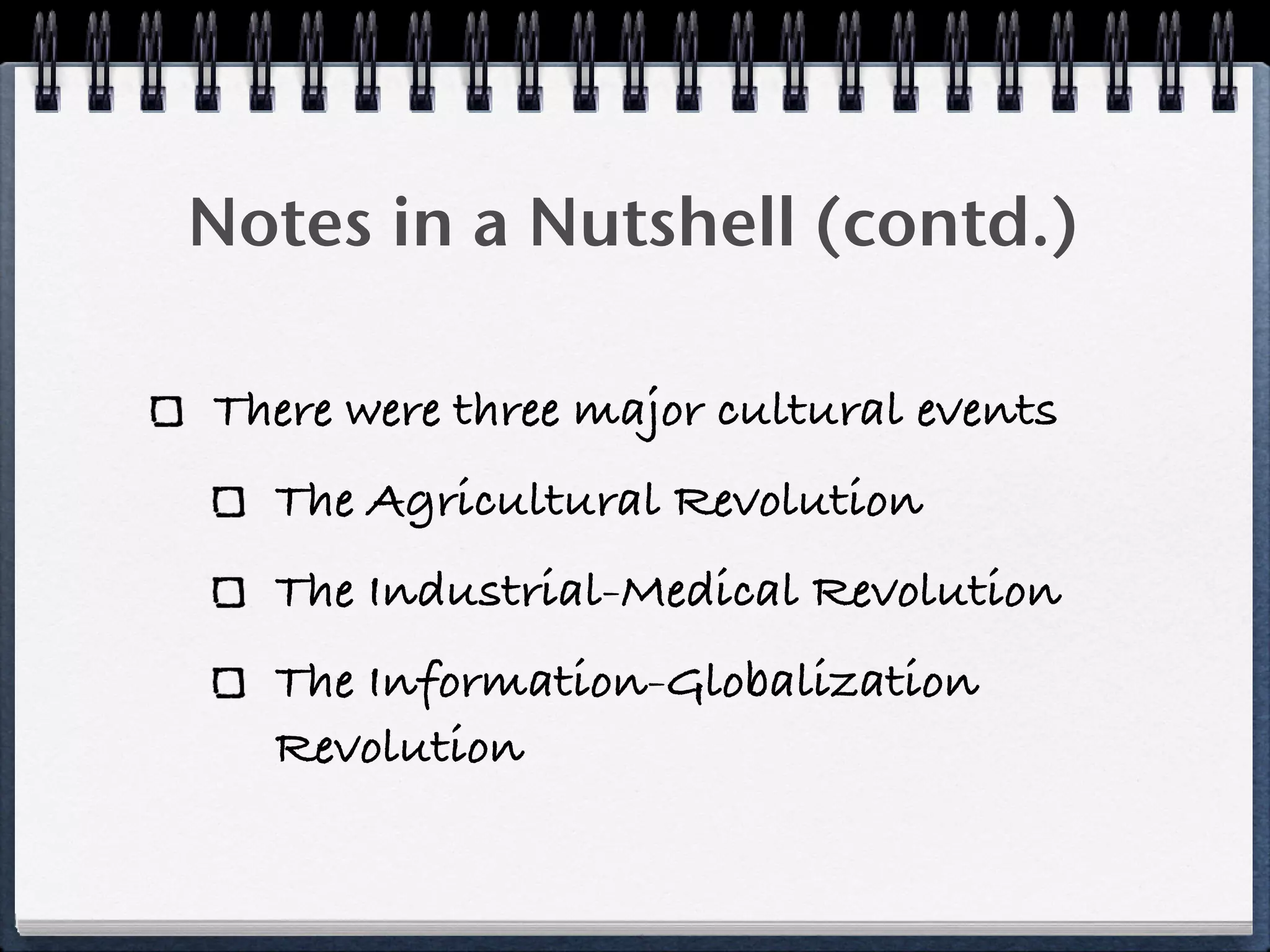
There were three major cultural events
  The Agricultural Revolution
  The Industrial-Medical Revolution
  The Information-Globalization
  Revolution
Notes in a Nutshell (contd.)
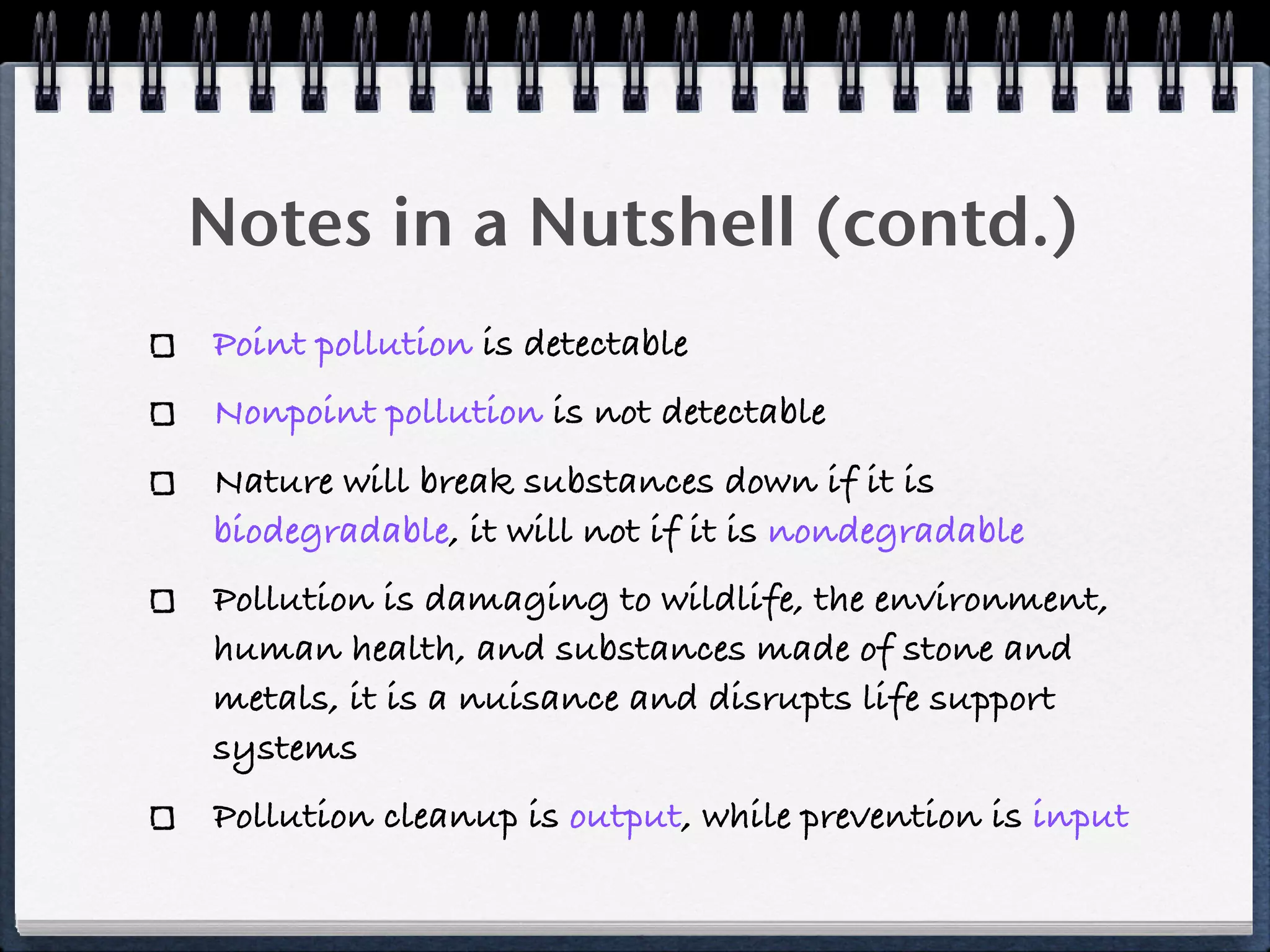
Point pollution is detectable
Nonpoint pollution is not detectable
Nature will break substances down if it is
biodegradable, it will not if it is nondegradable
Pollution is damaging to wildlife, the environment,
human health, and substances made of stone and
metals, it is a nuisance and disrupts life support
systems
Pollution cleanup is output, while prevention is input
Notes in a Nutshell (contd.)
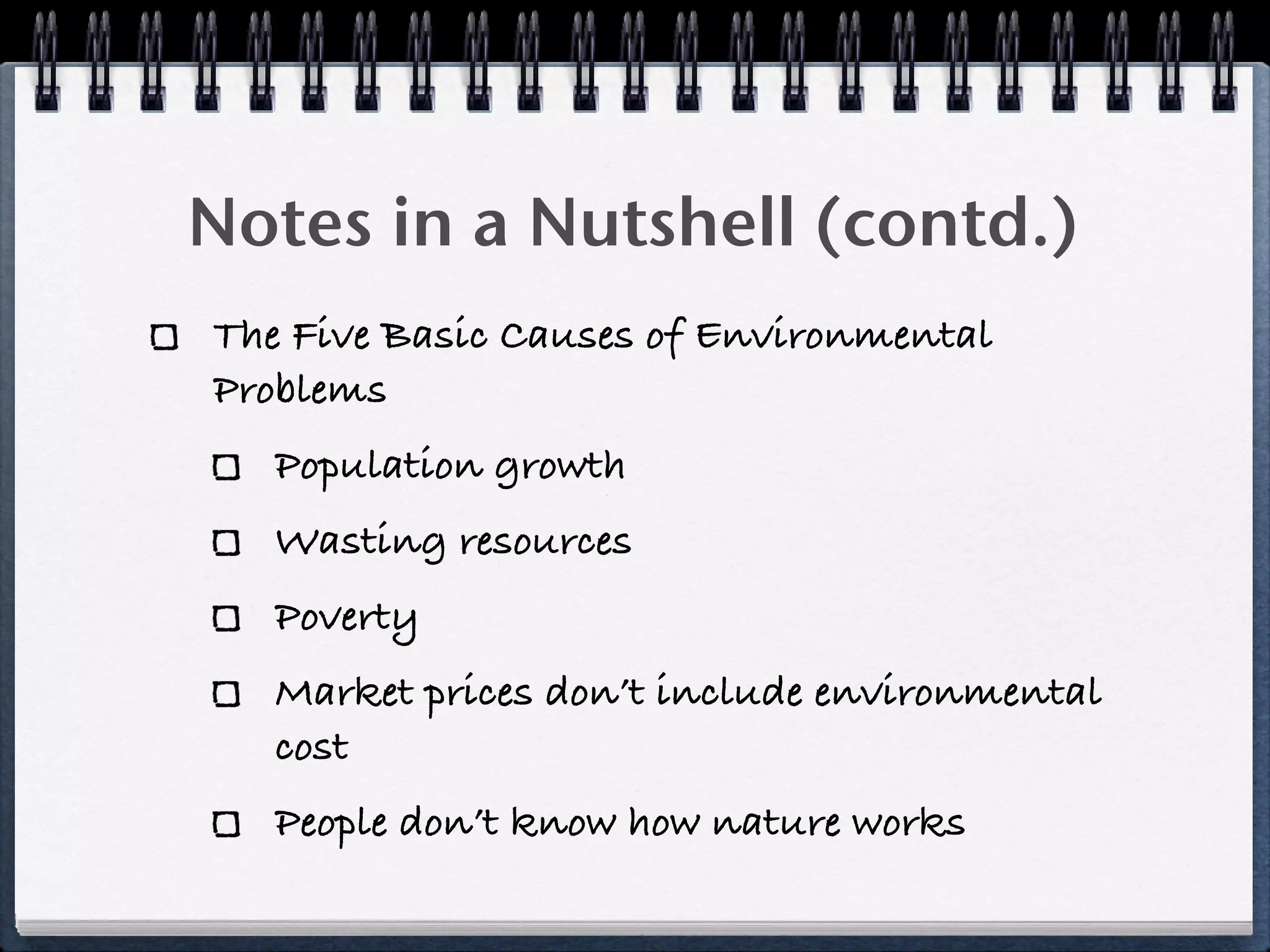
The Five Basic Causes of Environmental
Problems
   Population growth
   Wasting resources
   Poverty
   Market prices don’t include environmental
   cost
   People don’t know how nature works
Notes in a Nutshell (contd.)
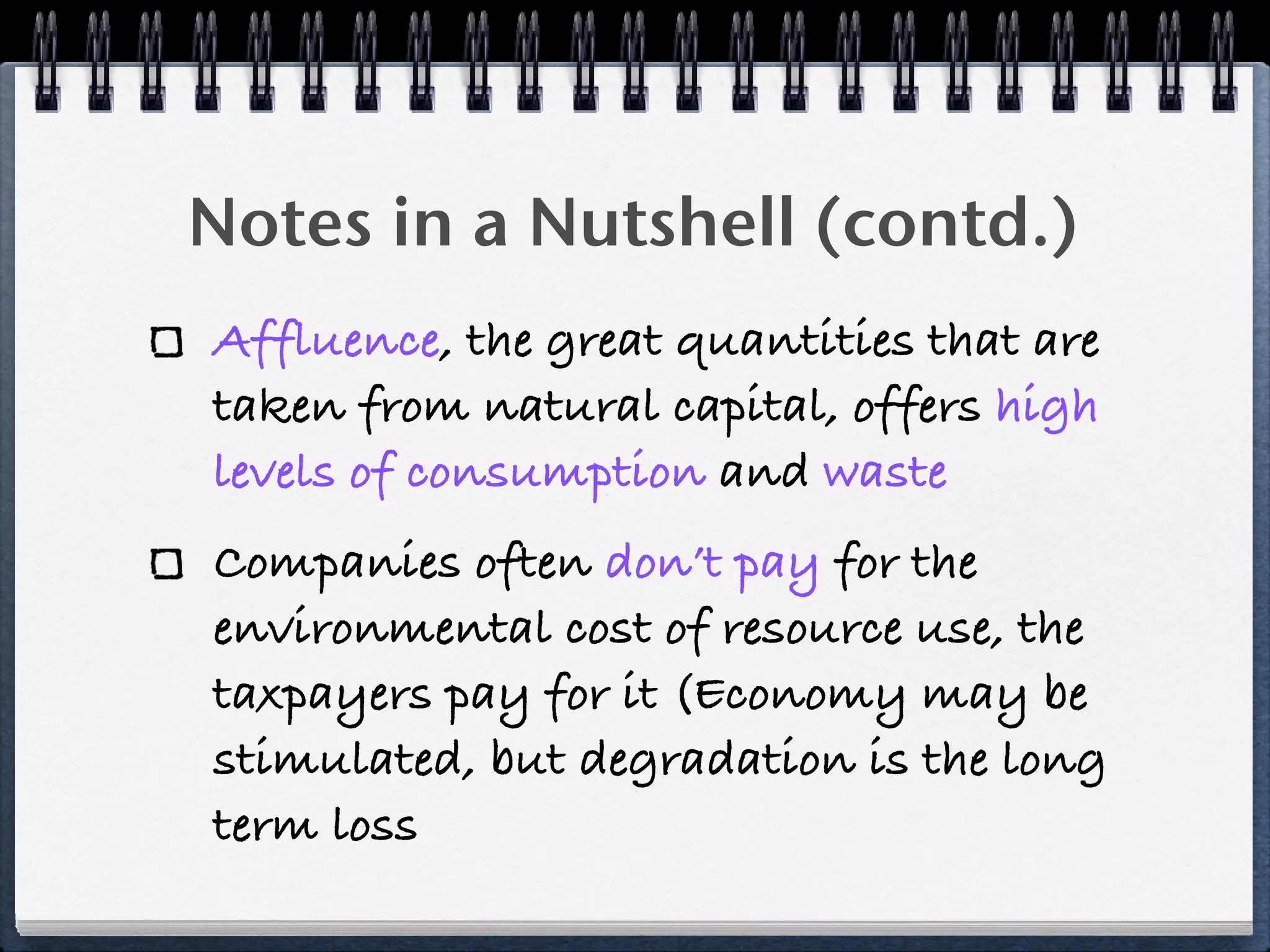
Affluence, the great quantities that are
taken from natural capital, offers high
levels of consumption and waste
Companies often don’t pay for the
environmental cost of resource use, the
taxpayers pay for it (Economy may be
stimulated, but degradation is the long
term loss
Notes in a Nutshell (contd.)
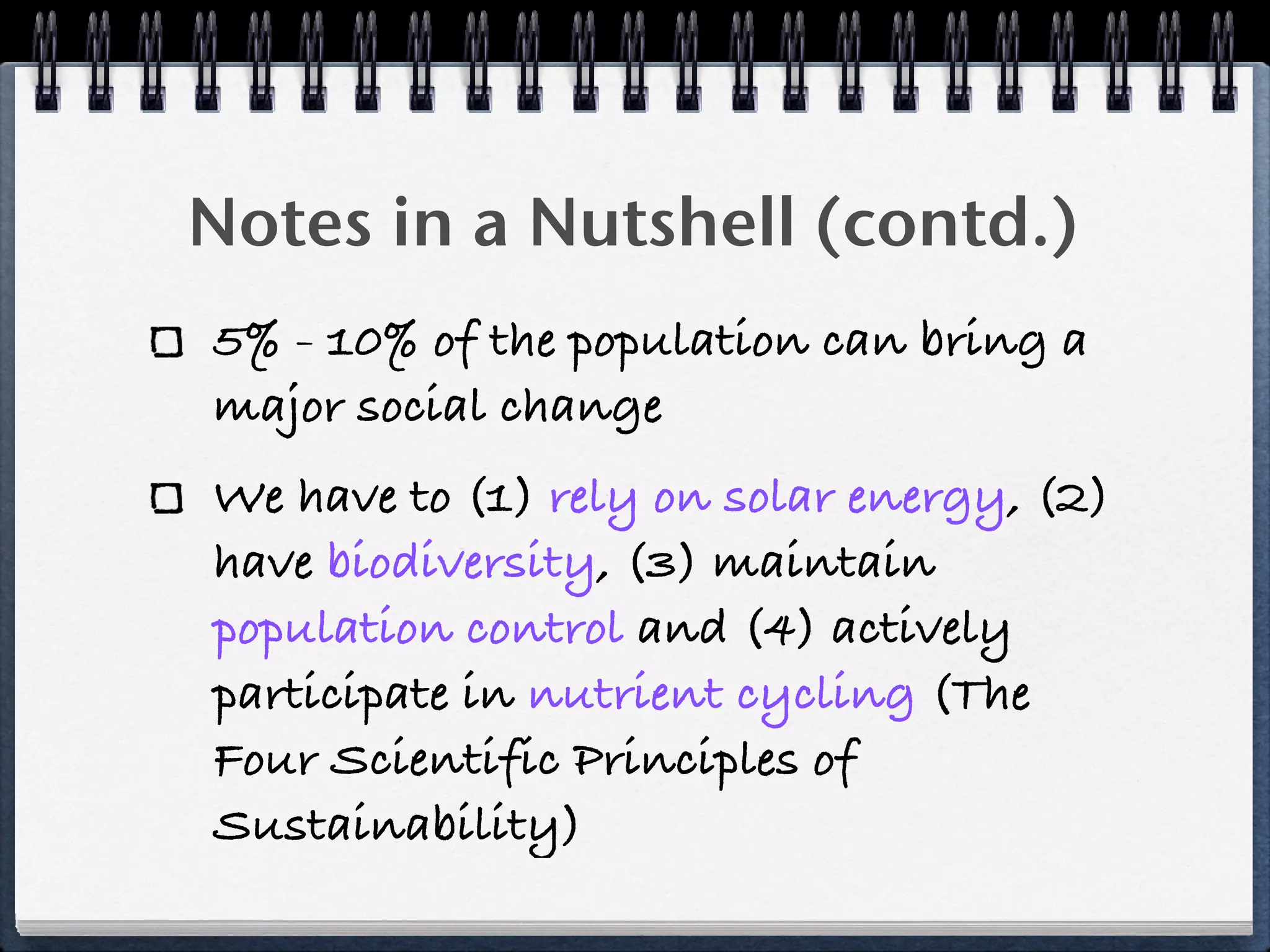
5% - 10% of the population can bring a
major social change
We have to (1) rely on solar energy, (2)
have biodiversity, (3) maintain
population control and (4) actively
participate in nutrient cycling (The
Four Scientific Principles of
Sustainability)
Notes in a Nutshell (contd.)


Atmosphere: The Air
Hydrosphere: The Water
Lithosphere: The Land/Rock
Biosphere: Life
Notes in a Nutshell (contd.)
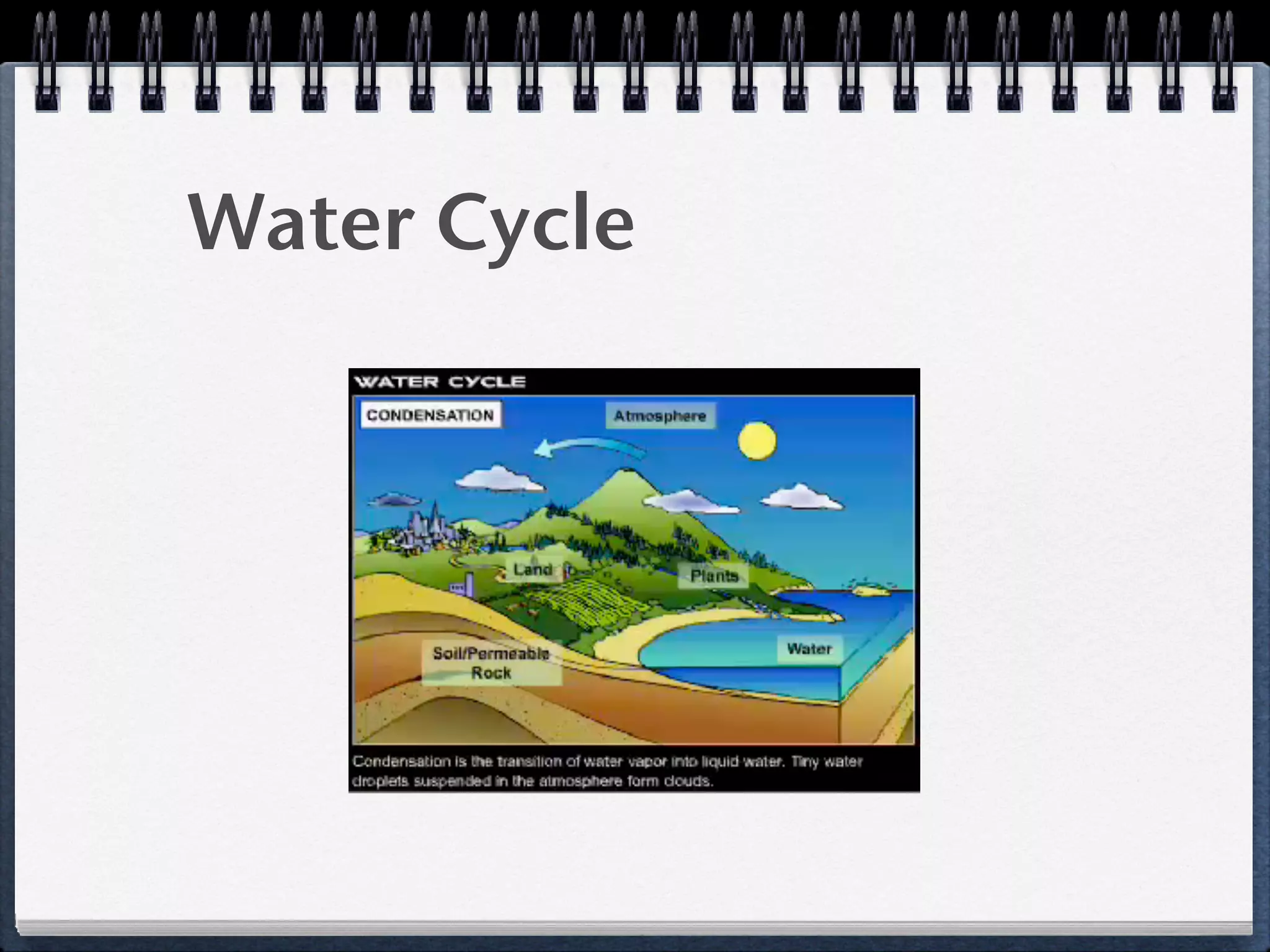
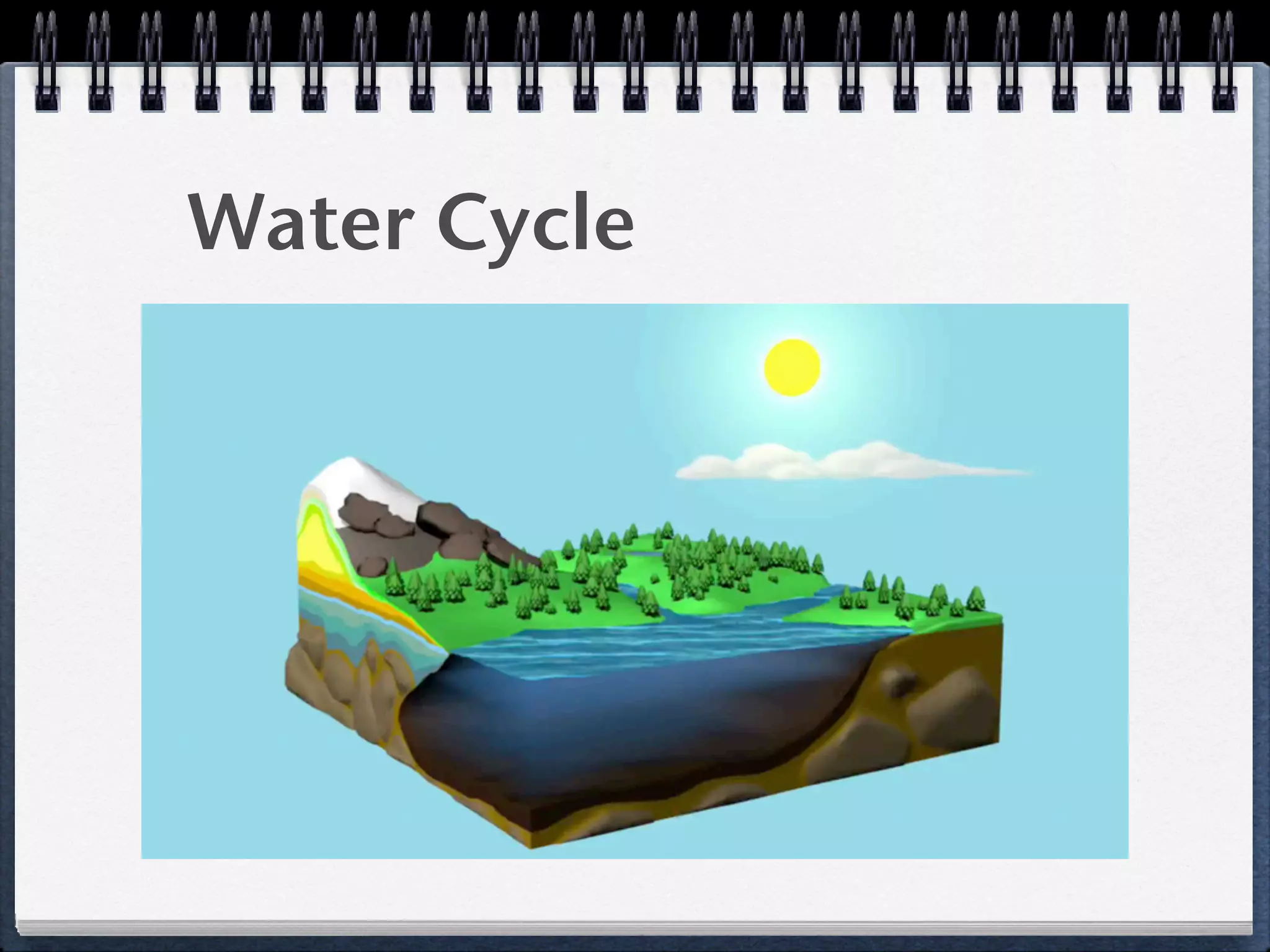
Water Cycle, Evaporation, precipitation and
transpiration
The atmosphere from bottom to top, troposphere
(weather), stratosphere (ozone), mesosphere
(meteor burning), Thermosphere or Ionosphere
(aurora borealis)
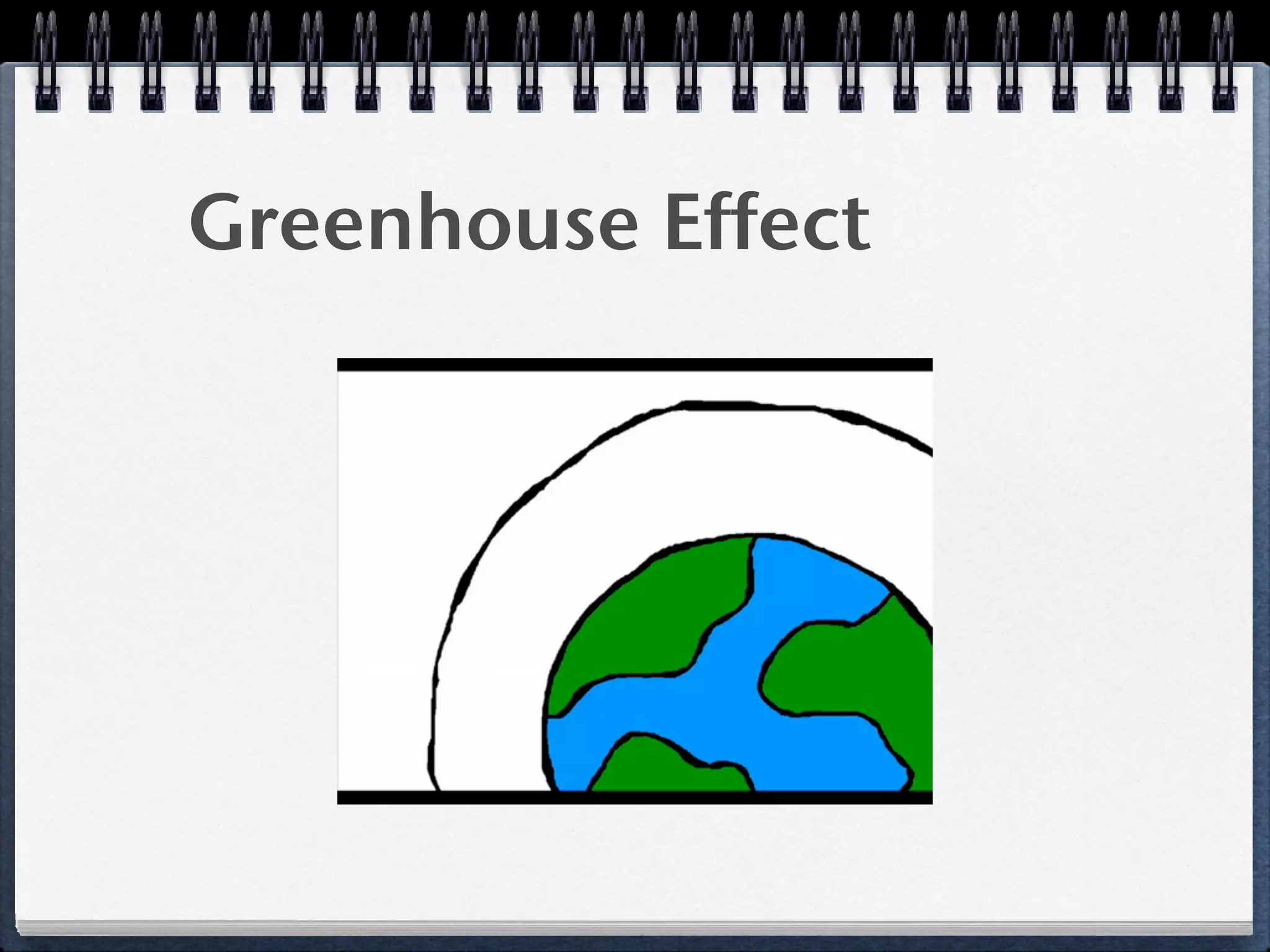
Greenhouse Gases, which heat up the lower
atmosphere, H20, CO2, CH4, N2O
Nitrogen and Oxygen are not Greenhouse gases
Notes in a Nutshell (contd.)
Weather is short term conditions, but
climate is long term conditions (trends
of hundreds of years)[most important for
climate: temperature and precipitation]
The seasons are caused by the tilt of the
earth’s axis and the intensity of the sun’s
rays at a particular angle at a particular
side of the earth
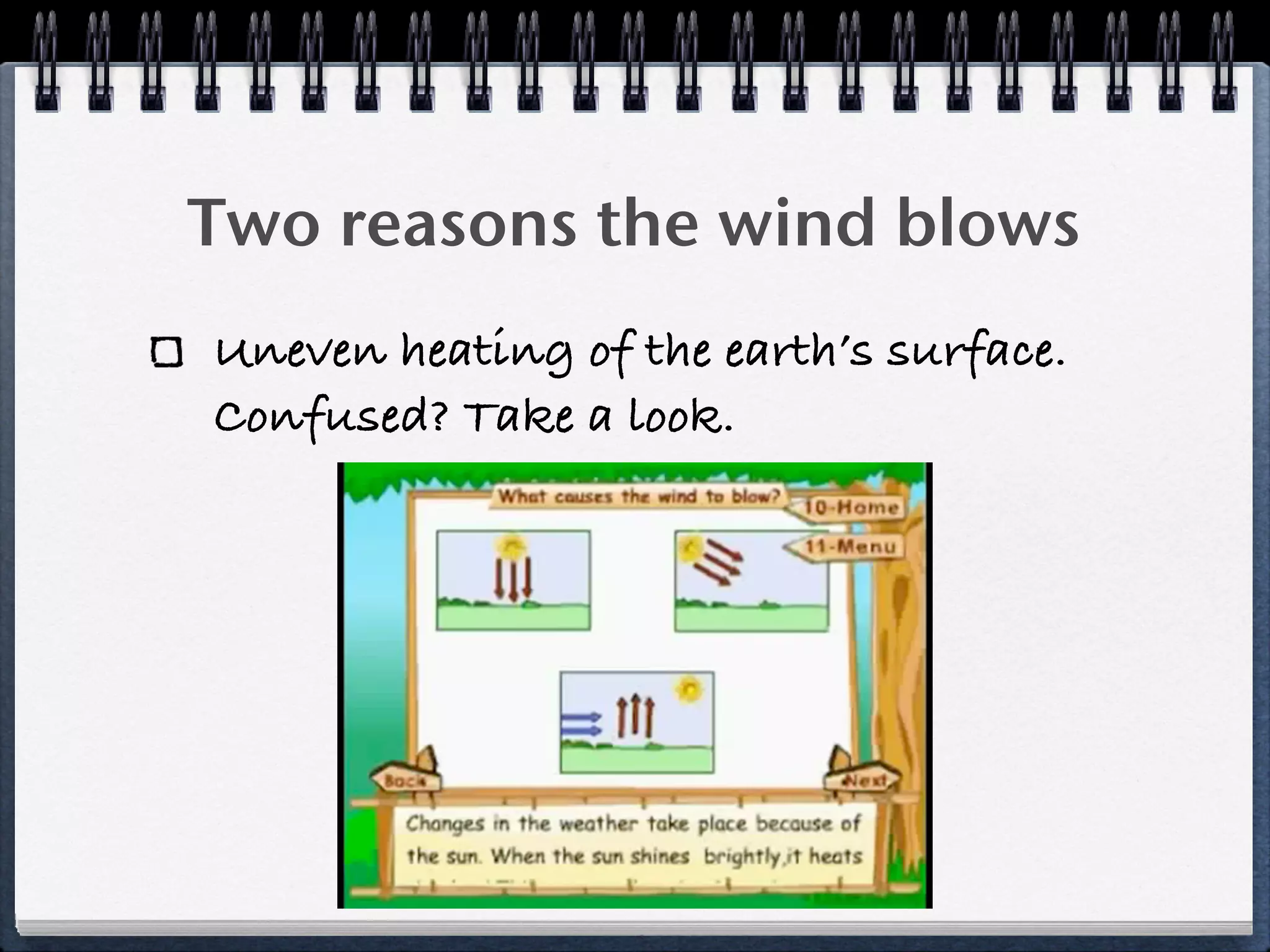
Two reasons the wind blows
Uneven heating of the earth’s surface.
Confused? Take a look.
Two reasons the wind blows
Rotation of the earth on its axis. Huh?
See video below. Coriolis effect
Water Cycle
Water Cycle
Greenhouse Effect
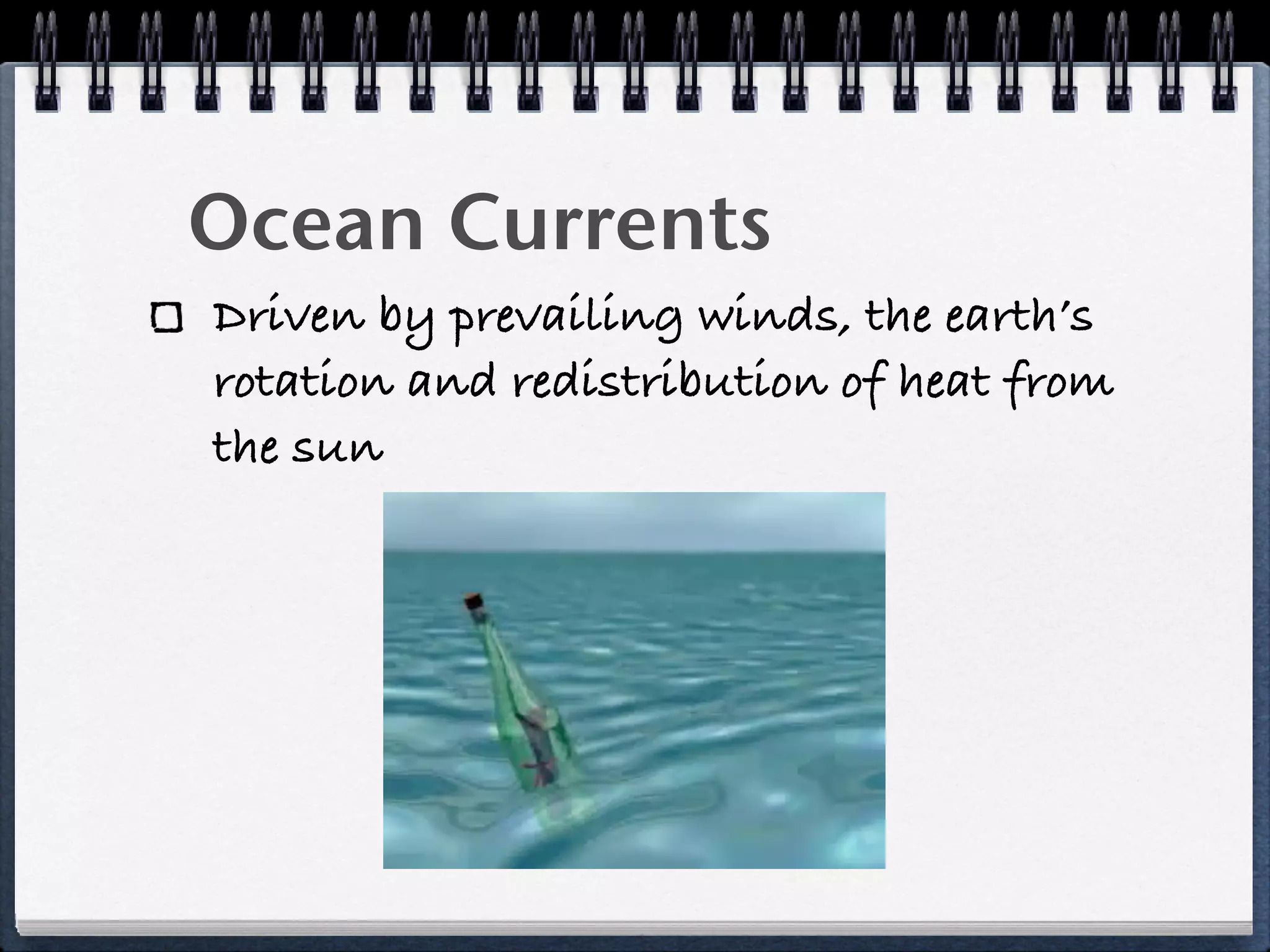
Ocean Currents
Driven by prevailing winds, the earth’s
rotation and redistribution of heat from
the sun
Air


The windward side of a mountain is
rainy
The leeward side of a mountain is dry
El Nino
El Nino are unusually warm ocean
temperatures in the Equatorial Pacific.
Storms, diseases and halted upwelling
result
Earth Systems
Core: A dense mass largely made of nickel and some iron
Mantle: Contains molten rock of magma that slowly
circulates in convection cells
Asthenosphere: Is located in the outer part of the mantle,
is composed of semi-molten, ductile rock
Lithosphere: A brittle outmost layer of the planet that is
approximately 100 km thick (60 mi) which includes
solid upper mantle and the crust. They are made of plates,
which over tile convection cells and there is soil at the top
Earth Systems
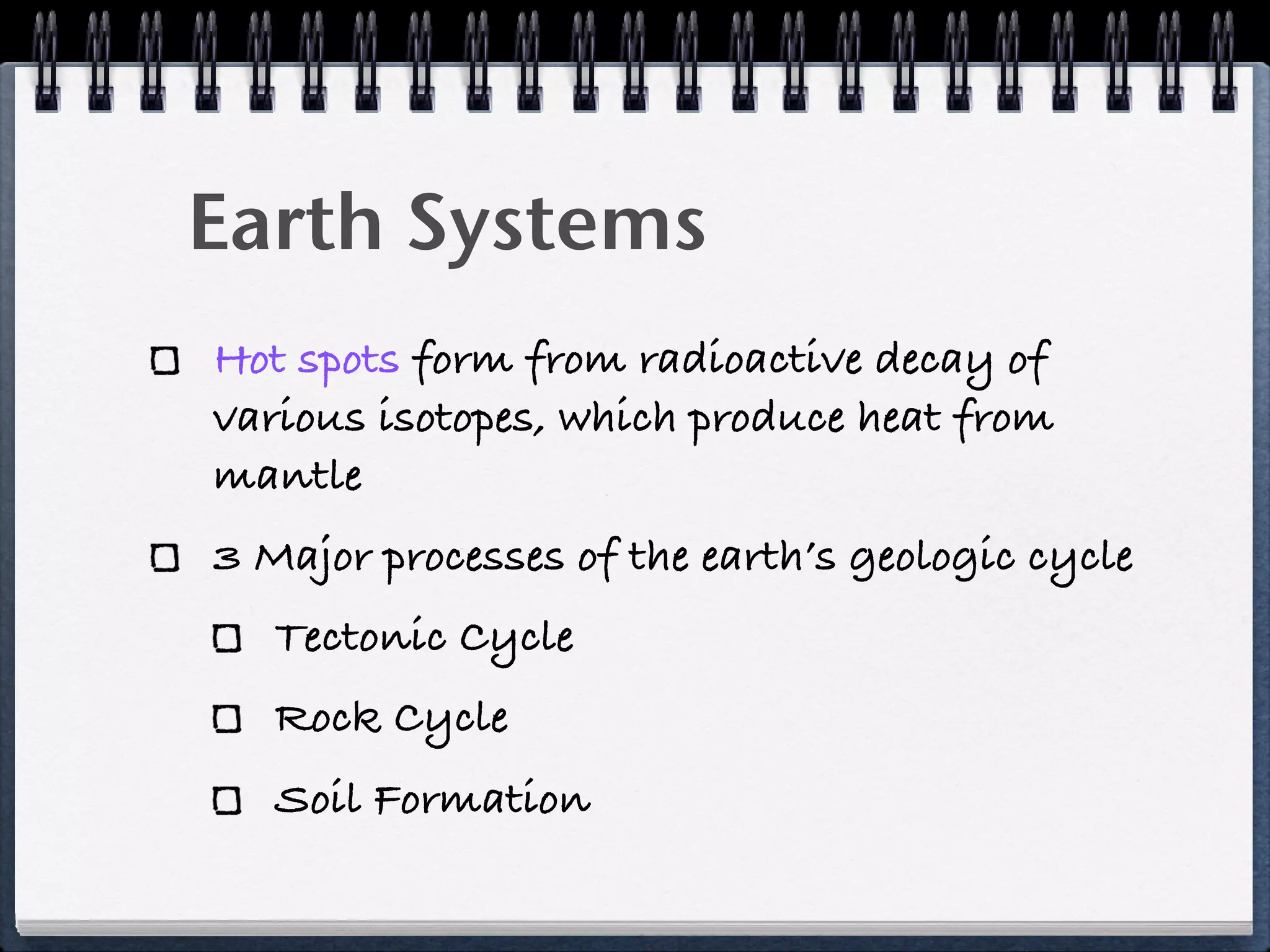
Hot spots form from radioactive decay of
various isotopes, which produce heat from
mantle
3 Major processes of the earth’s geologic cycle
   Tectonic Cycle
   Rock Cycle
   Soil Formation
Earth Systems
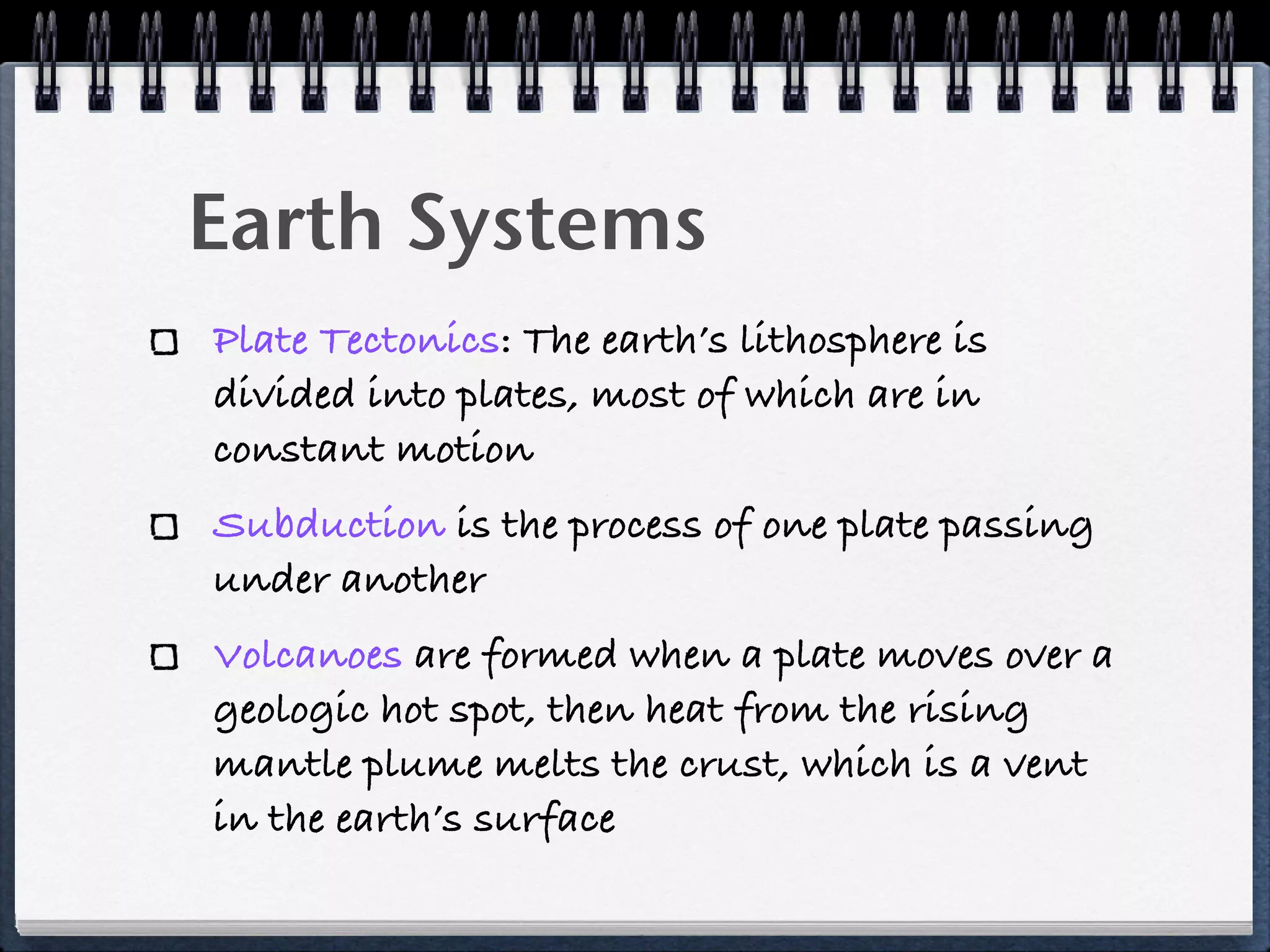
Plate Tectonics: The earth’s lithosphere is
divided into plates, most of which are in
constant motion
Subduction is the process of one plate passing
under another
Volcanoes are formed when a plate moves over a
geologic hot spot, then heat from the rising
mantle plume melts the crust, which is a vent
in the earth’s surface
Plate Boundaries
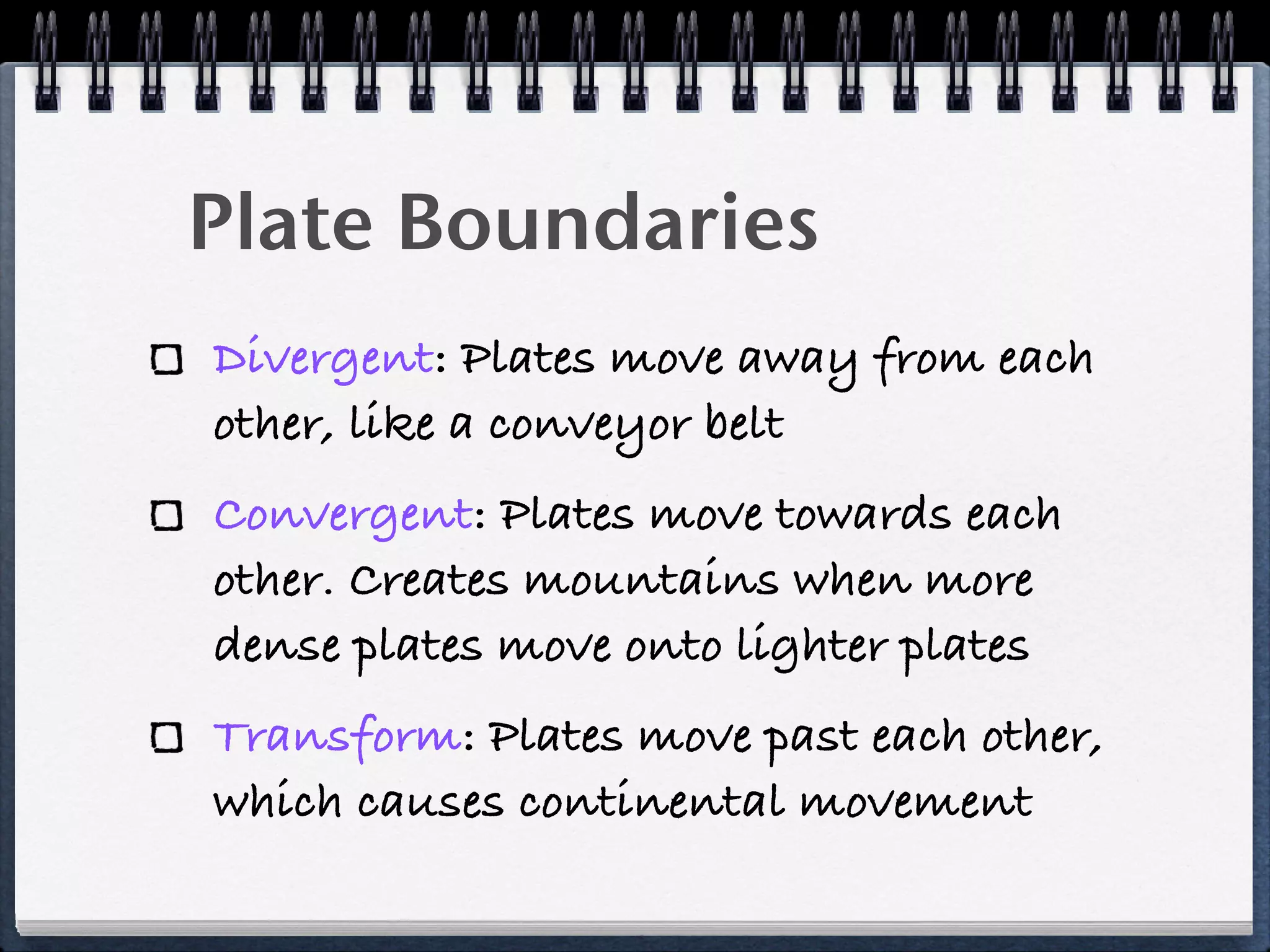
Divergent: Plates move away from each
other, like a conveyor belt
Convergent: Plates move towards each
other. Creates mountains when more
dense plates move onto lighter plates
Transform: Plates move past each other,
which causes continental movement
Earth Systems
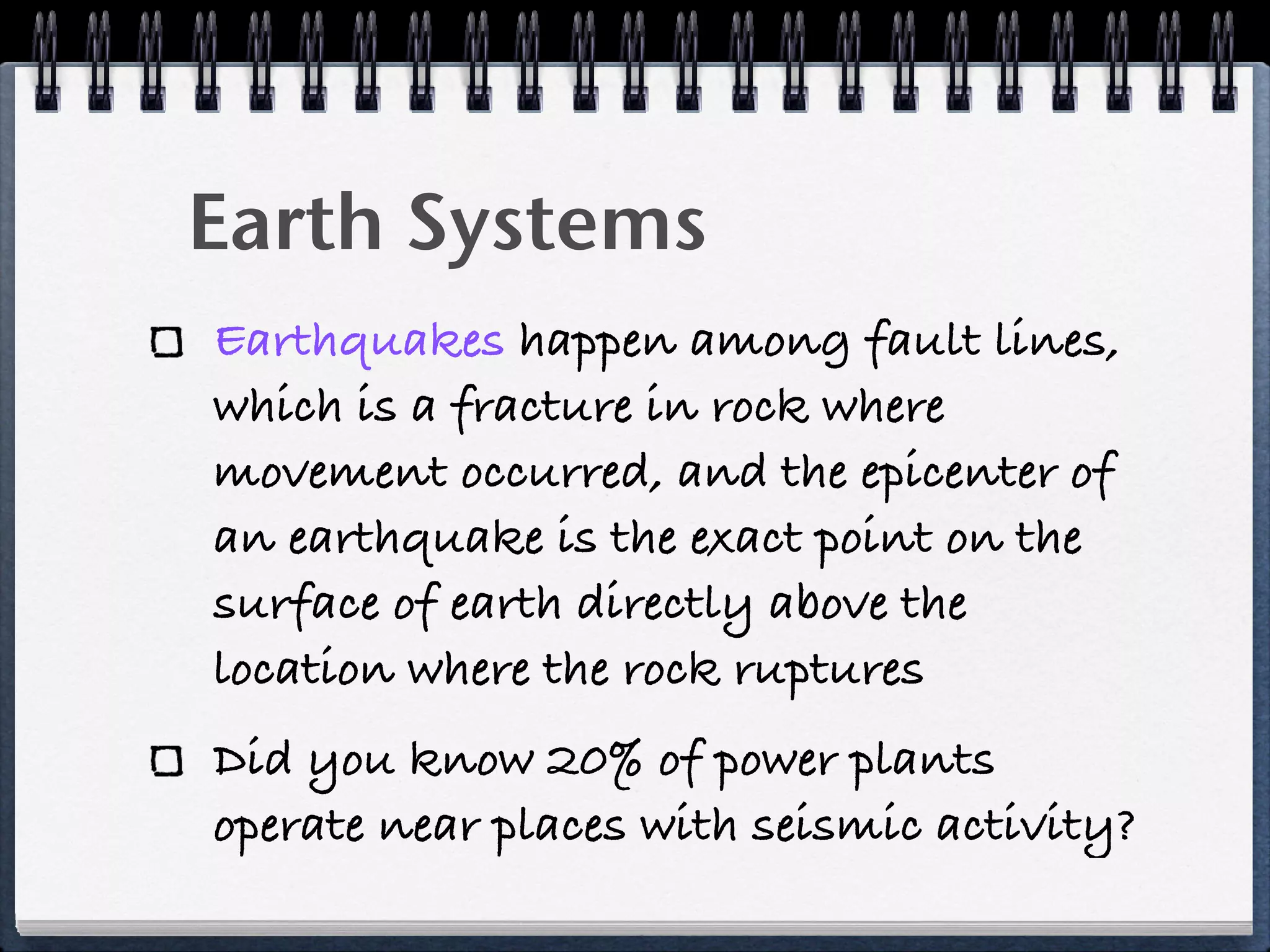
Earthquakes happen among fault lines,
which is a fracture in rock where
movement occurred, and the epicenter of
an earthquake is the exact point on the
surface of earth directly above the
location where the rock ruptures
Did you know 20% of power plants
operate near places with seismic activity?
Earth Systems
Rock Cycle: Constant formation and
destruction of rock
Rocks Rock!
Igneous: Rocks that form directly from magma
Sedimentary: They form when sediments such
as muds, sands, or gravels are compressed by
overlying sediments
Metamorphic They form when sedimentary
rocks, igneous rocks, or other metamorphic
rocks dare subjected to high temperatures and
pressures
Rocks Rock!
See video on rock types
Erosion

Erosion is the physical removal of rock
fragments. Wind, water and ice causes
it as well as living organisms. Humans
contribute by deforestation,
overgrazing, unmanaged construction
activity and road building
GEOCYCLE

Topsoil provides support, water, air and
nutrients
Three types of weathering, both
chemical ,physical/mechanical and the
organic processes
Soil
Soil type is determined by climate, vegetation, drainage, time
and parent material
Soil is made up of 25% air, 25% water, 45% mineral matter,
and 5% organic matter
Organic matter is also called humus
A layer is rich and dark while the B layer is white and lighter
in color
The main physical properties are texture, porosity, permeability
and humus
The main chemical properties are pH, nitrogen, phosphorus, and
potassium
Soil Conservation
Terracing: cutting steps into the side of a hill
Contour planting: planting perpendicular to the
slope
Strip cropping: use two types of crops
Agroforestry (alley cropping): strips of trees around
strips of crop
Windbreaks: a fence of trees around the crops
Conservation tillage: Some of the remains of the
cultivation for the last year is left on the ground

AP Environmental Science: Unit 1 Test Review

  • 1.
    Unit 1 AP EnvironmentalScience Test Review
  • 2.
    Ecological Footprints What isan Ecological Footprint? An ecological footprint allows us to calculate human pressure on the planet, which measures how much land and water area a human population requires to produce the resource it consumes and to absorb it’s carbon dioxide missions. Did you know it takes the earth 1 year and 6 months to replace what we use in one year? The Average American uses 5 earths to keep up with their lifestyle
  • 3.
    Effects of Deforestation Deforestationeffects the water cycle and the soil resources Water Cycle: dries up freshwater resources, decreases humidity and no more lumber is produced Soil: The soil cannot hold as much water
  • 4.
    Notes in aNutshell A Country’s economic growth is measured by GDP Changes in economic growth is measured by per Capita GDP Sustainable yield is when you take just what you need Global Warming is the degradation of renewable natural resources and services The Tragedy of the Commons is a book written to warn of the overexploiting of shared renewable resources and its solutions are the following: Limits Laws Make Common or Open Access Resources Private
  • 5.
    Notes in aNutshell (contd.) There were three major cultural events The Agricultural Revolution The Industrial-Medical Revolution The Information-Globalization Revolution
  • 6.
    Notes in aNutshell (contd.) Point pollution is detectable Nonpoint pollution is not detectable Nature will break substances down if it is biodegradable, it will not if it is nondegradable Pollution is damaging to wildlife, the environment, human health, and substances made of stone and metals, it is a nuisance and disrupts life support systems Pollution cleanup is output, while prevention is input
  • 7.
    Notes in aNutshell (contd.) The Five Basic Causes of Environmental Problems Population growth Wasting resources Poverty Market prices don’t include environmental cost People don’t know how nature works
  • 8.
    Notes in aNutshell (contd.) Affluence, the great quantities that are taken from natural capital, offers high levels of consumption and waste Companies often don’t pay for the environmental cost of resource use, the taxpayers pay for it (Economy may be stimulated, but degradation is the long term loss
  • 9.
    Notes in aNutshell (contd.) 5% - 10% of the population can bring a major social change We have to (1) rely on solar energy, (2) have biodiversity, (3) maintain population control and (4) actively participate in nutrient cycling (The Four Scientific Principles of Sustainability)
  • 10.
    Notes in aNutshell (contd.) Atmosphere: The Air Hydrosphere: The Water Lithosphere: The Land/Rock Biosphere: Life
  • 11.
    Notes in aNutshell (contd.) Water Cycle, Evaporation, precipitation and transpiration The atmosphere from bottom to top, troposphere (weather), stratosphere (ozone), mesosphere (meteor burning), Thermosphere or Ionosphere (aurora borealis) Greenhouse Gases, which heat up the lower atmosphere, H20, CO2, CH4, N2O Nitrogen and Oxygen are not Greenhouse gases
  • 12.
    Notes in aNutshell (contd.) Weather is short term conditions, but climate is long term conditions (trends of hundreds of years)[most important for climate: temperature and precipitation] The seasons are caused by the tilt of the earth’s axis and the intensity of the sun’s rays at a particular angle at a particular side of the earth
  • 14.
    Two reasons thewind blows Uneven heating of the earth’s surface. Confused? Take a look.
  • 15.
    Two reasons thewind blows Rotation of the earth on its axis. Huh? See video below. Coriolis effect
  • 16.
  • 17.
  • 18.
  • 19.
    Ocean Currents Driven byprevailing winds, the earth’s rotation and redistribution of heat from the sun
  • 20.
    Air The windward sideof a mountain is rainy The leeward side of a mountain is dry
  • 21.
    El Nino El Ninoare unusually warm ocean temperatures in the Equatorial Pacific. Storms, diseases and halted upwelling result
  • 22.
    Earth Systems Core: Adense mass largely made of nickel and some iron Mantle: Contains molten rock of magma that slowly circulates in convection cells Asthenosphere: Is located in the outer part of the mantle, is composed of semi-molten, ductile rock Lithosphere: A brittle outmost layer of the planet that is approximately 100 km thick (60 mi) which includes solid upper mantle and the crust. They are made of plates, which over tile convection cells and there is soil at the top
  • 23.
    Earth Systems Hot spotsform from radioactive decay of various isotopes, which produce heat from mantle 3 Major processes of the earth’s geologic cycle Tectonic Cycle Rock Cycle Soil Formation
  • 24.
    Earth Systems Plate Tectonics:The earth’s lithosphere is divided into plates, most of which are in constant motion Subduction is the process of one plate passing under another Volcanoes are formed when a plate moves over a geologic hot spot, then heat from the rising mantle plume melts the crust, which is a vent in the earth’s surface
  • 25.
    Plate Boundaries Divergent: Platesmove away from each other, like a conveyor belt Convergent: Plates move towards each other. Creates mountains when more dense plates move onto lighter plates Transform: Plates move past each other, which causes continental movement
  • 26.
    Earth Systems Earthquakes happenamong fault lines, which is a fracture in rock where movement occurred, and the epicenter of an earthquake is the exact point on the surface of earth directly above the location where the rock ruptures Did you know 20% of power plants operate near places with seismic activity?
  • 27.
    Earth Systems Rock Cycle:Constant formation and destruction of rock
  • 28.
    Rocks Rock! Igneous: Rocksthat form directly from magma Sedimentary: They form when sediments such as muds, sands, or gravels are compressed by overlying sediments Metamorphic They form when sedimentary rocks, igneous rocks, or other metamorphic rocks dare subjected to high temperatures and pressures
  • 29.
    Rocks Rock! See videoon rock types
  • 30.
    Erosion Erosion is thephysical removal of rock fragments. Wind, water and ice causes it as well as living organisms. Humans contribute by deforestation, overgrazing, unmanaged construction activity and road building
  • 31.
    GEOCYCLE Topsoil provides support,water, air and nutrients Three types of weathering, both chemical ,physical/mechanical and the organic processes
  • 32.
    Soil Soil type isdetermined by climate, vegetation, drainage, time and parent material Soil is made up of 25% air, 25% water, 45% mineral matter, and 5% organic matter Organic matter is also called humus A layer is rich and dark while the B layer is white and lighter in color The main physical properties are texture, porosity, permeability and humus The main chemical properties are pH, nitrogen, phosphorus, and potassium
  • 33.
    Soil Conservation Terracing: cuttingsteps into the side of a hill Contour planting: planting perpendicular to the slope Strip cropping: use two types of crops Agroforestry (alley cropping): strips of trees around strips of crop Windbreaks: a fence of trees around the crops Conservation tillage: Some of the remains of the cultivation for the last year is left on the ground