Office of Research and Development
National Center for Environmental Assessment
Introduction to Risk Assessment and EPA’s
Office of Research and Development
RISK ASSESSMENT TRAINING AND EXPERIENCE
Basics of Risk Assessment
University of Iowa Superfund Research Program,
Iowa City, Iowa
October 2, 2017
2
Iowa City, IA October 2, 2017
• Introduction
• Risk Assessment – Paradigm and Definitions
• How Risk Assessment Informs Risk Management
• EPA’s Office of Research and Development (ORD)
 Mission
 Risk Assessment at ORD
 Examples
• Additional Information
Introduction to Risk Assessment and EPA’s
Office of Research and Development
Disclaimer: The views in this presentation are those of the authors and do not
necessarily reflect the views or policies of the EPA.
RISK ASSESSMENT
PARADIGM
4
Iowa City, IA October 2, 2017
Class Activity
How would you define risk?
How would you define risk assessment?
5
Iowa City, IA October 2, 2017
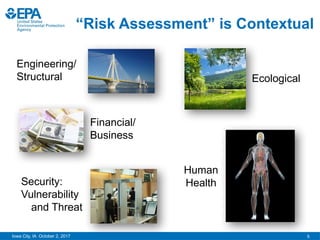
Engineering/
Structural
“Risk Assessment” is Contextual
Financial/
Business
Security:
Vulnerability
and Threat
Ecological
Human
Health
6
Iowa City, IA October 2, 2017
EPA Definition of Risk
Assessment
Risk assessment:
Qualitative and quantitative evaluation
of the risk posed to human health
and/or the environment by the actual
or potential presence and/or use of
specific pollutants
From EPA’s “Terms of Environment” Glossary
http://infohouse.p2ric.org/ref/01/00402.htm
7
Iowa City, IA October 2, 2017
EPA Definition of Risk
Risk:
A measure of the probability that
damage to life, health, property, and/or
the environment will occur as a result
of a given hazard
From EPA’s “Terms of Environment” Glossary
8
Iowa City, IA October 2, 2017
• 1970: EPA established
• 1975: First EPA chemical assessment (vinyl chloride)
 Quantitative Risk Assessment for Community Exposure to Vinyl Chloride
• 1976: Interim Procedures and Guidelines for Health Risk and
Economic Impact Assessments of Suspected Carcinogens
Brief History of Human Health
Risk Assessment at EPA
9
Iowa City, IA October 2, 2017
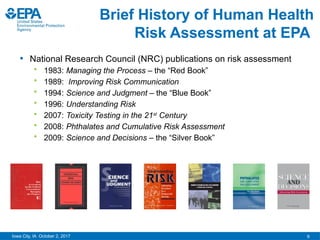
• National Research Council (NRC) publications on risk assessment
 1983: Managing the Process – the “Red Book”
 1989: Improving Risk Communication
 1994: Science and Judgment – the “Blue Book”
 1996: Understanding Risk
 2007: Toxicity Testing in the 21st
Century
 2008: Phthalates and Cumulative Risk Assessment
 2009: Science and Decisions – the “Silver Book”
Brief History of Human Health
Risk Assessment at EPA
10
Iowa City, IA October 2, 2017
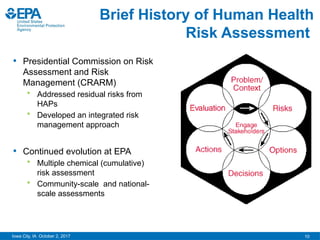
• Presidential Commission on Risk
Assessment and Risk
Management (CRARM)
 Addressed residual risks from
HAPs
 Developed an integrated risk
management approach
• Continued evolution at EPA
 Multiple chemical (cumulative)
risk assessment
 Community-scale and national-
scale assessments
Brief History of Human Health
Risk Assessment
11
Iowa City, IA October 2, 2017
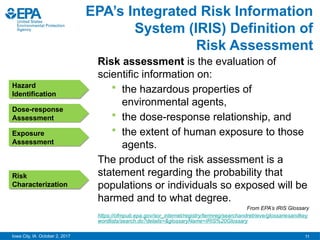
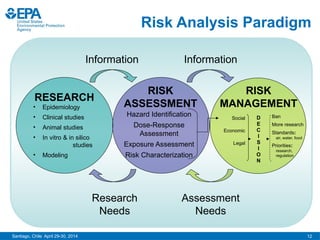
Risk assessment is the evaluation of
scientific information on:
 the hazardous properties of
environmental agents,
 the dose-response relationship, and
 the extent of human exposure to those
agents.
The product of the risk assessment is a
statement regarding the probability that
populations or individuals so exposed will be
harmed and to what degree.
From EPA’s IRIS Glossary
https://ofmpub.epa.gov/sor_internet/registry/termreg/searchandretrieve/glossariesandkey
wordlists/search.do?details=&glossaryName=IRIS%20Glossary
EPA’s Integrated Risk Information
System (IRIS) Definition of
Risk Assessment
Hazard
Identification
Dose-response
Assessment
Exposure
Assessment
Risk
Characterization
Santiago, Chile April 29-30, 2014
Information
RISK
MANAGEMENT
D
E
C
I
S
I
O
N
Ban
More research
Standards:
air, water, food
Priorities:
research,
regulation
Social
Economic
Legal
• Epidemiology
• Clinical studies
• Animal studies
• In vitro & in silico
studies
• Modeling
RESEARCH
RISK
ASSESSMENT
Hazard Identification
Dose-Response
Assessment
Exposure Assessment
Risk Characterization
Information
Research
Needs
Assessment
Needs
Risk Analysis Paradigm
12
Santiago, Chile April 29-30, 2014
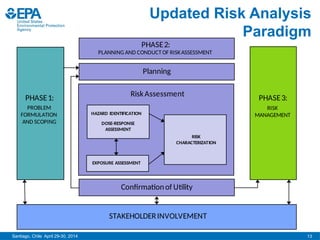
Updated Risk Analysis
Paradigm
13
RiskAssessment
Confirmationof Utility
Planning
STAKEHOLDERINVOLVEMENT
HAZARD IDENTIFICATION
DOSE-RESPONSE
ASSESSMENT
EXPOSURE ASSESSMENT
RISK
CHARACTERIZATION
PHASE2:
PLANNING AND CONDUCTOF RISKASSESSMENT
PHASE1:
PROBLEM
FORMULATION
AND SCOPING
PHASE3:
RISK
MANAGEMENT
14
Iowa City, IA October 2, 2017
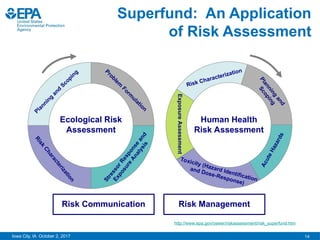
Superfund: An Application
of Risk Assessment
http://www.epa.gov/oswer/riskassessment/risk_superfund.htm
P
r
o
b
l
e
m
F
o
r
m
u
l
a
t
i
o
n
S
t
r
e
s
s
o
r
R
e
s
p
o
n
s
e
a
n
d
E
x
p
o
s
u
r
e
A
n
a
l
y
s
i
s
R
i
s
k
C
h
a
r
a
c
t
e
r
i
z
a
t
i
o
n
P
l
a
n
n
i
n
g
a
n
d
S
c
o
p
i
n
g
Ecological Risk
Assessment
Risk Characterization
P
l
a
n
n
i
n
g
a
n
d
S
c
o
p
i
n
g
Exposure
Assessment
Toxicity (Hazard Identification
and Dose-Response)
A
c
u
t
e
H
a
z
a
r
d
s
Human Health
Risk Assessment
Risk Management
Risk Communication
RISK ASSESSMENT
TERMINOLOGY
16
Iowa City, IA October 2, 2017
Important Risk Assessment Definitions:
Hazard
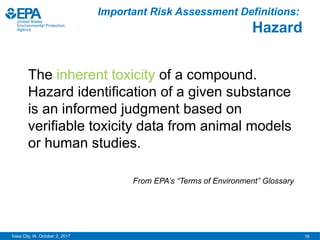
The inherent toxicity of a compound.
Hazard identification of a given substance
is an informed judgment based on
verifiable toxicity data from animal models
or human studies.
From EPA’s “Terms of Environment” Glossary
17
Iowa City, IA October 2, 2017
Important Risk Assessment Definitions:
Exposure
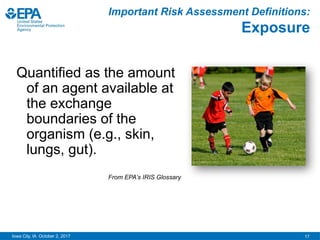
Quantified as the amount
of an agent available at
the exchange
boundaries of the
organism (e.g., skin,
lungs, gut).
From EPA’s IRIS Glossary
18
Iowa City, IA October 2, 2017
Important Risk Assessment Definitions:
Exposure Assessment
• Identifying the pathways by which toxicants may
reach individuals, estimating how much of a chemical
an individual is likely to be exposed to, and estimating
the number likely to be exposed
From EPA’s “Terms of Environment” Glossary
• The determination or estimation (qualitative or
quantitative) of the magnitude, frequency, or
duration, and route of exposure
From EPA’s Exposure Factors Handbook
https://cfpub.epa.gov/ncea/risk/recordisplay.cfm?deid=236252
19
Iowa City, IA October 2, 2017
Important Risk Assessment Definitions:
Dose
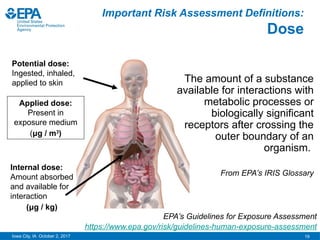
Potential dose:
Ingested, inhaled,
applied to skin
Applied dose:
Present in
exposure medium
(μg / m3
)
Internal dose:
Amount absorbed
and available for
interaction
(μg / kg)
The amount of a substance
available for interactions with
metabolic processes or
biologically significant
receptors after crossing the
outer boundary of an
organism.
From EPA’s IRIS Glossary
EPA’s Guidelines for Exposure Assessment
https://www.epa.gov/risk/guidelines-human-exposure-assessment
20
Iowa City, IA October 2, 2017
Important Risk Assessment Definitions:
Dose-Response Assessment
• Evaluating the quantitative relationship between dose and
toxicological responses.
From EPA’s “Terms of Environment” Glossary
• A determination of the relationship between the magnitude of an
administered, applied, or internal dose and a specific biological
response.
Response can be expressed as:
• Measured or observed incidence or change in level of
response
• Percent response in a group of subjects (or populations)
• Probability of occurrence or change in level of response
within a population.
From EPA’s IRIS Glossary
21
Iowa City, IA October 2, 2017
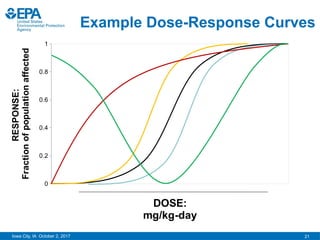
0
0.2
0.4
0.6
0.8
1
DOSE:
mg/kg-day
RESPONSE:
Fraction
of
population
affected Example Dose-Response Curves
22
Iowa City, IA October 2, 2017
Important Risk Assessment Definitions:
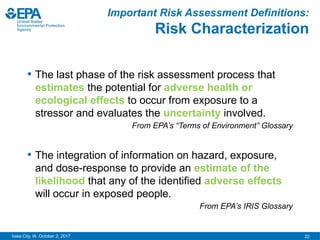
Risk Characterization
• The last phase of the risk assessment process that
estimates the potential for adverse health or
ecological effects to occur from exposure to a
stressor and evaluates the uncertainty involved.
From EPA’s “Terms of Environment” Glossary
• The integration of information on hazard, exposure,
and dose-response to provide an estimate of the
likelihood that any of the identified adverse effects
will occur in exposed people.
From EPA’s IRIS Glossary
23
Iowa City, IA October 2, 2017
Risk Assessment and
Risk Management Are Interrelated
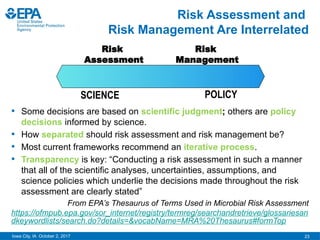
• Some decisions are based on scientific judgment; others are policy
decisions informed by science.
• How separated should risk assessment and risk management be?
• Most current frameworks recommend an iterative process.
• Transparency is key: “Conducting a risk assessment in such a manner
that all of the scientific analyses, uncertainties, assumptions, and
science policies which underlie the decisions made throughout the risk
assessment are clearly stated”
From EPA’s Thesaurus of Terms Used in Microbial Risk Assessment
https://ofmpub.epa.gov/sor_internet/registry/termreg/searchandretrieve/glossariesan
dkeywordlists/search.do?details=&vocabName=MRA%20Thesaurus#formTop
Risk
Assessment
Risk
Management
SCIENCE POLICY
24
Iowa City, IA October 2, 2017
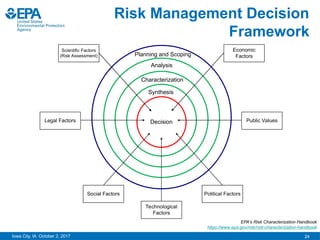
Decision
Synthesis
Characterization
Analysis
Planning and Scoping
Scientific Factors
(Risk Assessment)
Economic
Factors
Public Values
Political Factors
Technological
Factors
Social Factors
Legal Factors
Risk Management Decision
Framework
EPA’s Risk Characterization Handbook
https://www.epa.gov/risk/risk-characterization-handbook
Risk Assessment to Support Risk Management at EPA,
the ORD Role
Santiago, Chile April 29-30, 2014
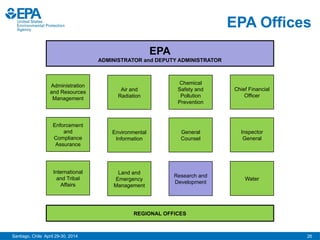
EPA Offices
26
EPA
ADMINISTRATOR and DEPUTY ADMINISTRATOR
Administration
and Resources
Management
Air and
Radiation
Chemical
Safety and
Pollution
Prevention
Chief Financial
Officer
Enforcement
and
Compliance
Assurance
Environmental
Information
General
Counsel
Inspector
General
International
and Tribal
Affairs
Land and
Emergency
Management
Research and
Development
Water
REGIONAL OFFICES
27
Iowa City, IA October 2, 2017
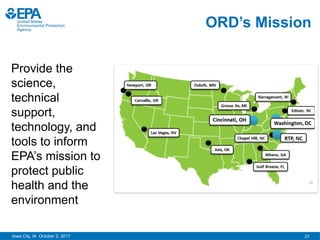
ORD’s Mission
Provide the
science,
technical
support,
technology, and
tools to inform
EPA’s mission to
protect public
health and the
environment
28
Iowa City, IA October 2, 2017
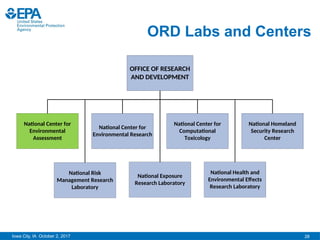
ORD Labs and Centers
OFFICE OF RESEARCH
AND DEVELOPMENT
National Center for
Environmental
Assessment
National Center for
Computational
Toxicology
National Risk
Management Research
Laboratory
National Center for
Environmental Research
National Exposure
Research Laboratory
National Health and
Environmental Effects
Research Laboratory
National Homeland
Security Research
Center
29
Iowa City, IA October 2, 2017
National Center for
Environmental Assessment
Resource center for human health
and ecological risk assessment
NCEA:
• Develops guidelines, methodologies, and training
• Creates tools and databases
• Integrates and applies ORD- and extramural-generated research
• Performs risk assessments
• Consults with EPA programs, regions, and decision makers
EXAMPLES OF NCEA
PRODUCTS USED IN
RISK ASSESSMENT
31
Iowa City, IA October 2, 2017
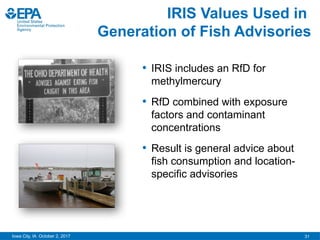
IRIS Values Used in
Generation of Fish Advisories
• IRIS includes an RfD for
methylmercury
• RfD combined with exposure
factors and contaminant
concentrations
• Result is general advice about
fish consumption and location-
specific advisories
32
Iowa City, IA October 2, 2017
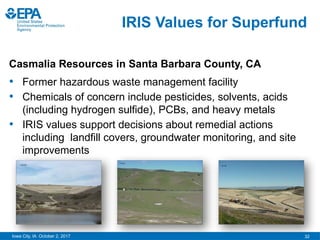
IRIS Values for Superfund
Casmalia Resources in Santa Barbara County, CA
• Former hazardous waste management facility
• Chemicals of concern include pesticides, solvents, acids
(including hydrogen sulfide), PCBs, and heavy metals
• IRIS values support decisions about remedial actions
including landfill covers, groundwater monitoring, and site
improvements
33
Iowa City, IA October 2, 2017
Integrated Science
Assessments
ISA for Carbon Monoxide – January 2010
ISA states “that a causal relationship is
likely to exist between relevant short-
term CO exposures and cardiovascular
morbidity.”
The ISA accurately reflects “the latest scientific knowledge useful
in indicating the kind and extent of identifiable effects on public
health which may be expected from the presence of [a] pollutant
in ambient air.” (Clean Air Act, Section 108, 2003)
34
Iowa City, IA October 2, 2017
• EPA has been a leader in the environmental risk
assessment field since the 1970s
• A basic paradigm (with associated terminology and
concepts) guides the application of risk assessment
principles
 Terms can vary by context
 Processes continue to evolve
• ORD products and guidance are crucial for EPA risk
assessments
Wrap Up
35
Iowa City, IA October 2, 2017
Contact Information
Xabier Arzuaga, PhD
arzuaga.xabier@epa.gov
1-703-347-8634
Geniece Lehmann, PhD
lehmann.geniece@epa.gov
1-919-541-2289

Environmental Risk Assessment in the EIA.pptx

  • 1.
    Office of Researchand Development National Center for Environmental Assessment Introduction to Risk Assessment and EPA’s Office of Research and Development RISK ASSESSMENT TRAINING AND EXPERIENCE Basics of Risk Assessment University of Iowa Superfund Research Program, Iowa City, Iowa October 2, 2017
  • 2.
    2 Iowa City, IAOctober 2, 2017 • Introduction • Risk Assessment – Paradigm and Definitions • How Risk Assessment Informs Risk Management • EPA’s Office of Research and Development (ORD)  Mission  Risk Assessment at ORD  Examples • Additional Information Introduction to Risk Assessment and EPA’s Office of Research and Development Disclaimer: The views in this presentation are those of the authors and do not necessarily reflect the views or policies of the EPA.
  • 3.
  • 4.
    4 Iowa City, IAOctober 2, 2017 Class Activity How would you define risk? How would you define risk assessment?
  • 5.
    5 Iowa City, IAOctober 2, 2017 Engineering/ Structural “Risk Assessment” is Contextual Financial/ Business Security: Vulnerability and Threat Ecological Human Health
  • 6.
    6 Iowa City, IAOctober 2, 2017 EPA Definition of Risk Assessment Risk assessment: Qualitative and quantitative evaluation of the risk posed to human health and/or the environment by the actual or potential presence and/or use of specific pollutants From EPA’s “Terms of Environment” Glossary http://infohouse.p2ric.org/ref/01/00402.htm
  • 7.
    7 Iowa City, IAOctober 2, 2017 EPA Definition of Risk Risk: A measure of the probability that damage to life, health, property, and/or the environment will occur as a result of a given hazard From EPA’s “Terms of Environment” Glossary
  • 8.
    8 Iowa City, IAOctober 2, 2017 • 1970: EPA established • 1975: First EPA chemical assessment (vinyl chloride)  Quantitative Risk Assessment for Community Exposure to Vinyl Chloride • 1976: Interim Procedures and Guidelines for Health Risk and Economic Impact Assessments of Suspected Carcinogens Brief History of Human Health Risk Assessment at EPA
  • 9.
    9 Iowa City, IAOctober 2, 2017 • National Research Council (NRC) publications on risk assessment  1983: Managing the Process – the “Red Book”  1989: Improving Risk Communication  1994: Science and Judgment – the “Blue Book”  1996: Understanding Risk  2007: Toxicity Testing in the 21st Century  2008: Phthalates and Cumulative Risk Assessment  2009: Science and Decisions – the “Silver Book” Brief History of Human Health Risk Assessment at EPA
  • 10.
    10 Iowa City, IAOctober 2, 2017 • Presidential Commission on Risk Assessment and Risk Management (CRARM)  Addressed residual risks from HAPs  Developed an integrated risk management approach • Continued evolution at EPA  Multiple chemical (cumulative) risk assessment  Community-scale and national- scale assessments Brief History of Human Health Risk Assessment
  • 11.
    11 Iowa City, IAOctober 2, 2017 Risk assessment is the evaluation of scientific information on:  the hazardous properties of environmental agents,  the dose-response relationship, and  the extent of human exposure to those agents. The product of the risk assessment is a statement regarding the probability that populations or individuals so exposed will be harmed and to what degree. From EPA’s IRIS Glossary https://ofmpub.epa.gov/sor_internet/registry/termreg/searchandretrieve/glossariesandkey wordlists/search.do?details=&glossaryName=IRIS%20Glossary EPA’s Integrated Risk Information System (IRIS) Definition of Risk Assessment Hazard Identification Dose-response Assessment Exposure Assessment Risk Characterization
  • 12.
    Santiago, Chile April29-30, 2014 Information RISK MANAGEMENT D E C I S I O N Ban More research Standards: air, water, food Priorities: research, regulation Social Economic Legal • Epidemiology • Clinical studies • Animal studies • In vitro & in silico studies • Modeling RESEARCH RISK ASSESSMENT Hazard Identification Dose-Response Assessment Exposure Assessment Risk Characterization Information Research Needs Assessment Needs Risk Analysis Paradigm 12
  • 13.
    Santiago, Chile April29-30, 2014 Updated Risk Analysis Paradigm 13 RiskAssessment Confirmationof Utility Planning STAKEHOLDERINVOLVEMENT HAZARD IDENTIFICATION DOSE-RESPONSE ASSESSMENT EXPOSURE ASSESSMENT RISK CHARACTERIZATION PHASE2: PLANNING AND CONDUCTOF RISKASSESSMENT PHASE1: PROBLEM FORMULATION AND SCOPING PHASE3: RISK MANAGEMENT
  • 14.
    14 Iowa City, IAOctober 2, 2017 Superfund: An Application of Risk Assessment http://www.epa.gov/oswer/riskassessment/risk_superfund.htm P r o b l e m F o r m u l a t i o n S t r e s s o r R e s p o n s e a n d E x p o s u r e A n a l y s i s R i s k C h a r a c t e r i z a t i o n P l a n n i n g a n d S c o p i n g Ecological Risk Assessment Risk Characterization P l a n n i n g a n d S c o p i n g Exposure Assessment Toxicity (Hazard Identification and Dose-Response) A c u t e H a z a r d s Human Health Risk Assessment Risk Management Risk Communication
  • 15.
  • 16.
    16 Iowa City, IAOctober 2, 2017 Important Risk Assessment Definitions: Hazard The inherent toxicity of a compound. Hazard identification of a given substance is an informed judgment based on verifiable toxicity data from animal models or human studies. From EPA’s “Terms of Environment” Glossary
  • 17.
    17 Iowa City, IAOctober 2, 2017 Important Risk Assessment Definitions: Exposure Quantified as the amount of an agent available at the exchange boundaries of the organism (e.g., skin, lungs, gut). From EPA’s IRIS Glossary
  • 18.
    18 Iowa City, IAOctober 2, 2017 Important Risk Assessment Definitions: Exposure Assessment • Identifying the pathways by which toxicants may reach individuals, estimating how much of a chemical an individual is likely to be exposed to, and estimating the number likely to be exposed From EPA’s “Terms of Environment” Glossary • The determination or estimation (qualitative or quantitative) of the magnitude, frequency, or duration, and route of exposure From EPA’s Exposure Factors Handbook https://cfpub.epa.gov/ncea/risk/recordisplay.cfm?deid=236252
  • 19.
    19 Iowa City, IAOctober 2, 2017 Important Risk Assessment Definitions: Dose Potential dose: Ingested, inhaled, applied to skin Applied dose: Present in exposure medium (μg / m3 ) Internal dose: Amount absorbed and available for interaction (μg / kg) The amount of a substance available for interactions with metabolic processes or biologically significant receptors after crossing the outer boundary of an organism. From EPA’s IRIS Glossary EPA’s Guidelines for Exposure Assessment https://www.epa.gov/risk/guidelines-human-exposure-assessment
  • 20.
    20 Iowa City, IAOctober 2, 2017 Important Risk Assessment Definitions: Dose-Response Assessment • Evaluating the quantitative relationship between dose and toxicological responses. From EPA’s “Terms of Environment” Glossary • A determination of the relationship between the magnitude of an administered, applied, or internal dose and a specific biological response. Response can be expressed as: • Measured or observed incidence or change in level of response • Percent response in a group of subjects (or populations) • Probability of occurrence or change in level of response within a population. From EPA’s IRIS Glossary
  • 21.
    21 Iowa City, IAOctober 2, 2017 0 0.2 0.4 0.6 0.8 1 DOSE: mg/kg-day RESPONSE: Fraction of population affected Example Dose-Response Curves
  • 22.
    22 Iowa City, IAOctober 2, 2017 Important Risk Assessment Definitions: Risk Characterization • The last phase of the risk assessment process that estimates the potential for adverse health or ecological effects to occur from exposure to a stressor and evaluates the uncertainty involved. From EPA’s “Terms of Environment” Glossary • The integration of information on hazard, exposure, and dose-response to provide an estimate of the likelihood that any of the identified adverse effects will occur in exposed people. From EPA’s IRIS Glossary
  • 23.
    23 Iowa City, IAOctober 2, 2017 Risk Assessment and Risk Management Are Interrelated • Some decisions are based on scientific judgment; others are policy decisions informed by science. • How separated should risk assessment and risk management be? • Most current frameworks recommend an iterative process. • Transparency is key: “Conducting a risk assessment in such a manner that all of the scientific analyses, uncertainties, assumptions, and science policies which underlie the decisions made throughout the risk assessment are clearly stated” From EPA’s Thesaurus of Terms Used in Microbial Risk Assessment https://ofmpub.epa.gov/sor_internet/registry/termreg/searchandretrieve/glossariesan dkeywordlists/search.do?details=&vocabName=MRA%20Thesaurus#formTop Risk Assessment Risk Management SCIENCE POLICY
  • 24.
    24 Iowa City, IAOctober 2, 2017 Decision Synthesis Characterization Analysis Planning and Scoping Scientific Factors (Risk Assessment) Economic Factors Public Values Political Factors Technological Factors Social Factors Legal Factors Risk Management Decision Framework EPA’s Risk Characterization Handbook https://www.epa.gov/risk/risk-characterization-handbook
  • 25.
    Risk Assessment toSupport Risk Management at EPA, the ORD Role
  • 26.
    Santiago, Chile April29-30, 2014 EPA Offices 26 EPA ADMINISTRATOR and DEPUTY ADMINISTRATOR Administration and Resources Management Air and Radiation Chemical Safety and Pollution Prevention Chief Financial Officer Enforcement and Compliance Assurance Environmental Information General Counsel Inspector General International and Tribal Affairs Land and Emergency Management Research and Development Water REGIONAL OFFICES
  • 27.
    27 Iowa City, IAOctober 2, 2017 ORD’s Mission Provide the science, technical support, technology, and tools to inform EPA’s mission to protect public health and the environment
  • 28.
    28 Iowa City, IAOctober 2, 2017 ORD Labs and Centers OFFICE OF RESEARCH AND DEVELOPMENT National Center for Environmental Assessment National Center for Computational Toxicology National Risk Management Research Laboratory National Center for Environmental Research National Exposure Research Laboratory National Health and Environmental Effects Research Laboratory National Homeland Security Research Center
  • 29.
    29 Iowa City, IAOctober 2, 2017 National Center for Environmental Assessment Resource center for human health and ecological risk assessment NCEA: • Develops guidelines, methodologies, and training • Creates tools and databases • Integrates and applies ORD- and extramural-generated research • Performs risk assessments • Consults with EPA programs, regions, and decision makers
  • 30.
    EXAMPLES OF NCEA PRODUCTSUSED IN RISK ASSESSMENT
  • 31.
    31 Iowa City, IAOctober 2, 2017 IRIS Values Used in Generation of Fish Advisories • IRIS includes an RfD for methylmercury • RfD combined with exposure factors and contaminant concentrations • Result is general advice about fish consumption and location- specific advisories
  • 32.
    32 Iowa City, IAOctober 2, 2017 IRIS Values for Superfund Casmalia Resources in Santa Barbara County, CA • Former hazardous waste management facility • Chemicals of concern include pesticides, solvents, acids (including hydrogen sulfide), PCBs, and heavy metals • IRIS values support decisions about remedial actions including landfill covers, groundwater monitoring, and site improvements
  • 33.
    33 Iowa City, IAOctober 2, 2017 Integrated Science Assessments ISA for Carbon Monoxide – January 2010 ISA states “that a causal relationship is likely to exist between relevant short- term CO exposures and cardiovascular morbidity.” The ISA accurately reflects “the latest scientific knowledge useful in indicating the kind and extent of identifiable effects on public health which may be expected from the presence of [a] pollutant in ambient air.” (Clean Air Act, Section 108, 2003)
  • 34.
    34 Iowa City, IAOctober 2, 2017 • EPA has been a leader in the environmental risk assessment field since the 1970s • A basic paradigm (with associated terminology and concepts) guides the application of risk assessment principles  Terms can vary by context  Processes continue to evolve • ORD products and guidance are crucial for EPA risk assessments Wrap Up
  • 35.
    35 Iowa City, IAOctober 2, 2017 Contact Information Xabier Arzuaga, PhD arzuaga.xabier@epa.gov 1-703-347-8634 Geniece Lehmann, PhD lehmann.geniece@epa.gov 1-919-541-2289

Editor's Notes

  • #1 Classroom Preparation Setup: Classroom style with tables and chairs. All chairs facing projector screen. Materials: Projector and screen, white board or flip chart, markers, slide handouts for students, reading packets for students  Welcome and Introductions Introductions: Introduce instructor(s). Go around classroom and have students share their name and affiliation. Facility: Tell class locations of break room and restrooms. Provide guidance on food and beverages in the classroom. Arrange classroom into tables of four. Announce Class Schedule: [Insert agenda for day here.] Class Guidelines: Cell Phones & pagers should be silenced. Laptops should be closed. Introduce Materials: Explain the packet of materials they have and let them know the reading materials are for them to keep.
  • #2 This first course in our series is called “Introduction to Risk Assessment and EPA’s Office of Research and Development.” In the next 30 minutes, we will cover: Some basic fundamental concepts and terminology associated with risk assessment, including how the federal government applies the risk assessment paradigm How the risk assessment process is related to and informs risk management And the mission and organizational structure of ORD. We’ll talk about: How ORD identifies current and future environmental problems and performs research to understand them. How environmental research informs EPA’s risk assessment goals. And we’ll discuss some examples of ORD products that are used in EPA risk assessment related activities.
  • #3 This module is an introduction to the terminology that you will need to understand the other courses we’ll go through today. Reviewing these terms will help to ensure that we are all using the same words in the same way. Let’s begin with a brainstorming activity.
  • #4 Divide the class into groups of 4 or 5. Give each team 5 minutes to work together to come up with definitions of risk and risk assessment. Ask each team to write their definitions on the white board or flip charts, or alternately, have each team read their definition out loud. Listen for commonalities and discuss. Did these common themes come up? Qualitative or quantitative Hazard, stressor, agent, chemical Estimate, probability Uncertainty, variability Adverse effect, outcome, health endpoint Scientifically based Context influences the definition of risk assessment.
  • #5 Risk assessment can cover almost any aspect of life. The term risk assessment is used in multiple contexts: Engineering/structural Financial/business Security – vulnerability and threat assessment Ecological Human health Physical injury Radiation Microbial Chemical The definition of risk assessment can also vary by context. The context of this course is human health risk assessment, primarily focused on chemical risk assessment, and so the definitions that we’ll discuss are presented from this perspective.
  • #6 This is a general definition from EPA’s “Terms of Environment” glossary: It says, “Risk assessment is a qualitative and quantitative evaluation of the risk posed to human health and/or the environment by the actual or potential presence and/or use of specific pollutants.”
  • #7 An important concept to understand is that “risk” typically refers to the probability, or likelihood, that something might happen in the future. From the Terms of the Environment glossary, risk is “a measure of the probability that damage to life, health, property, and/or the environment will occur as a result of a given hazard.” An evaluation of the current rate of disease within a population is not risk assessment; this is better described as epidemiology. It is also important to know that the term risk assessment can be used to apply to an activity or process and also to a document that results from doing a risk assessment. In this course, we will typically use the term to refer to the process of risk assessment. For instructor reference: This is a periodically-updated glossary of common terms; it can be found at http://infohouse.p2ric.org/ref/01/00402.htm. Terms of Environment" defines in non-technical language the more commonly used environmental terms appearing in EPA publications, news releases, and other Agency documents available to the general public, students, the media, and Agency employees. The definitions do not constitute the Agency's official use of terms and phrases for regulatory purposes, and nothing in this document should be construed to alter or supplant any other federal document. Official terminology may be found in the laws and related regulations as published in such sources as the Congressional Record, Federal Register, and elsewhere.
  • #8 Brief History of Human Health Risk Assessment This is not a comprehensive history but rather an overview of some key events in the timeline of chemical, human health risk assessment as it relates to EPA. The EPA was established in 1970. The Agency completed its first risk assessment document in December 1975. In the early 1970s, there were media reports of cases of liver cancer (many resulting in death) in workers at vinyl chloride facilities. Also, some cases of angiosarcoma were reported in people who lived in the vicinity of facilities producing vinyl chloride. So, while OSHA lowered permissible levels protecting workers, EPA assessed the need to limit emissions of vinyl chloride into the air from these facilities. EPA published the “Quantitative Risk Assessment for Community Exposure to Vinyl Chloride.” In 1976, the EPA Administrator published “Interim Procedures and Guidelines for Health Risk and Economic Impact Assessments of Suspected Carcinogens” (neither of these were formal guidelines or policy, but were the beginnings of such guidelines) *As a scientific field, risk assessment continued to evolve – for example, the Society for Risk Analysis (SRA) published the first issue of Risk Analysis in 1981.
  • #9 Then, between 1983 and 2009, the National Research Council (a part of the National Academy of Sciences) published several documents that are key to risk assessment. The first book, published in 1983 was titled Risk Assessment in the Federal Government: Managing the Process. You may hear it referred to as the “Red Book” because of the color of its cover. NRC was commissioned by Congress to prepare this set of recommendations Book contains definitions and fundamental processes still in use today This book introduced the risk assessment paradigm with its four traditional components, which we’ll discuss in a few minutes 1994 - Science and Judgment in Risk Assessment, aka the “Blue Book” Also commissioned by Congress (via Clean Air Act) In part, a follow-up to the Red Book, but with specific emphasis on EPA’s scientific methods 2009 - Science and Decisions: Advancing Risk Assessment, aka the “Silver Book” Discusses the planning and scoping principles of risk assessment along with stakeholder involvement, with EPA in mind Other NRC publications on risk assessment include: 1989: Improving Risk Communication 1996: Understanding Risk 2007: Toxicity Testing in the 21st Century 2008: Phthalates and Cumulative Risk Assessment
  • #10 The 1990 Clean Air Act Amendments called for the formation of the Presidential Commission on Risk Assessment and Risk Management (CRARM). The purpose of the Commission was to provide guidance on how to deal with residual emissions from hazardous air pollutants (HAPs) after technology-based controls have been installed on stationary sources of air pollutants. But in examining this problem, the Commission also developed a risk management framework that fosters an integrated approach to addressing complex, real-world issues that affect multiple environmental media and involve exposures to mixtures of chemicals.  This hexagon shows the Commission’s “Framework for Environmental Health Risk Management” (as published in Volume 1 of their 1997 report). The framework suggests an iterative approach to risk assessment and the engagement of stakeholders in each step. Risk assessment at EPA continues to evolve, and although single chemical risk assessment is still very important, EPA has recognized that cumulative risk assessments of multiple chemicals as well as various geographic scales such community-scale and national-scale risk assessments are also important. EPA continues to develop guidance on these types of risk assessments.
  • #11 A second, expanded definition of risk assessment can be found in EPA’s IRIS Glossary. IRIS is EPA’s Integrated Risk Information System; it is an important database of toxicity information developed and maintained by EPA’s National Center for Environmental Assessment (NCEA). This definition of risk assessment is based on the 4 components of the risk assessment paradigm developed by the National Research Council or NRC. Risk assessment, in terms of human health, is the evaluation of scientific information on: the hazardous properties of environmental agents (This is hazard identification, and IRIS assessments include hazard identification.), the dose-response relationship (This is dose-response assessment and is also included in IRIS assessments.), and the extent of human exposure to those agents (This is exposure assessment.). The product of the risk assessment is a statement regarding the probability that populations or individuals so exposed will be harmed and to what degree (This is the risk characterization component of the NRC’s paradigm). Risk characterization synthesizes the information collected and evaluated in the other three steps. An analogous and similar (but not identical) definition exists for ecological risk assessment. There is variation among federal agencies regarding how risk assessments are conducted, but the overarching frameworks that agencies use are based on the NRC paradigm. Details can differ based on statutory requirements and history of practice within each agency.
  • #12 Risk assessment can be viewed as part of a broader “risk analysis” paradigm. The other two components are: Research, which includes epidemiology research, clinical studies, animal studies, and in vitro, in silico and modeling studies. Risk management which covers regulatory (or other) decision-making. Some people also include risk communication which covers effectively communicating the results of risk assessment and the policy implications of risk management decisions. This course is focused on risk assessment, which is primarily concerned with scientific evaluation Within the risk assessment circle, the four basic components of risk assessment are Hazard Identification Dose-response Assessment Exposure Assessment Risk Characterization Although the 3 circles may apply, to some extent, to more than just human health risk assessment, the 4 components of risk assessment are specific to human health RA. Ecological RA has a slightly different outline that groups dose-response and exposure assessment into an “Analysis Phase.”
  • #13 The risk assessment paradigm from the NRC’s Red Book included four components. When NRC published the Silver Book in 2009, it updated the risk assessment paradigm. What are some of the differences you notice? Stakeholder involvement – emphasis on stakeholder involvement through all phases of risk assessment. This includes internal and external stakeholders. Problem formulation and scoping – emphasizes thinking through the possible risk management options before beginning the risk assessment. This is a necessary step in order to decide what information should be collected during the actual risk assessment. Planning – includes thinking about uncertainty and variability ahead of time. Confirmation of utility – risk assessors should evaluate if they have met their goals set out in the problem formulation and scoping phase. Also includes peer review.
  • #14 This diagram represents the components of ecological and human health risk assessments conducted as part of EPA’s Superfund program. The Superfund program is typically concerned with risk assessment of residual chemical contaminants at a specific location (i.e., site-specific risk assessment). Risk assessments can occasionally proceed in a straightforward, linear fashion; more frequently, though, risk assessments are conducted iteratively. That is, stages are often repeated on the basis of new information obtained during the process (such as sampling and analytical results) and based on decisions made by risk assessors and risk managers. So, the components of a risk assessment are shown in a circular fashion, rather than a strictly linear fashion. For instructor reference: “Superfund” refers to a set of environmental regulations and guidelines that were created as means of cleaning up hazardous waste sites throughout the nation and will be covered in more detail later.
  • #15 The next several slides cover definitions and terminology related to the four primary components of the human health risk assessment paradigm.
  • #16 There are multiple definitions for hazard, but in general, hazard addresses the question, “what kind of harm are you dealing with?” Hazard identification determines the nature of effects produced by an agent. Does the agent or chemical cause cancer or reproductive changes, for example? Your reading packet has many definitions for hazard from a variety of sources.
  • #17 Exposure answers the question “how much of a substance is an individual (or population) exposed to?” Contact is required for exposure, and without exposure, there is no dose. Contact is made between the chemical, physical, or biological agent and the outer boundary of the organism, which exists at the skin, lungs, and gut. A concentration in the environment doesn’t become a dose until exposure occurs.
  • #18 Exposure assessment is the process of estimating the magnitude, frequency or duration of human (or animal) exposure to a substance. Exposure assessment considers the: Exposure source - An entity or action that releases a chemical into the environment. Exposure pathway - The physical course that a chemical takes from its emission from its source to the exposed individual and is related to the type of release (how the chemical enters the environment). For example, what type(s) of exposure media is the chemical released into? Exposure medium - Material (e.g., air, water, soil, food, consumer products) containing an agent. Exposure route - The way a chemical enters an organism after contact (e.g., by ingestion, inhalation, dermal absorption) The size and often the characteristics (e.g., age, pre-existing disease) of the exposed population are also considered.
  • #19 Definitions of the word dose are included in many different EPA documents. The definition from the IRIS glossary is shown here: The amount of a substance available for interactions with metabolic processes or biologically significant receptors after crossing the outer boundary of an organism. Dose answers the question: How much chemical has the individual been exposed to, and it is a function of the concentration of the chemical in the exposure medium and the duration of exposure. The concept of dose becomes somewhat easier to define if specific modifiers are added. For example, the following terms are defined in EPA’s Guidelines for Exposure Assessment: Applied dose is the amount of chemical present at an absorption barrier (like the skin, lungs, GI tract). This dose has not necessarily crossed the outer boundary of the organism, but it is the amount present in the exposure medium making contact with the organism. For example, in this figure, it’s shown as a concentration in air, which would be measured in μg/m3. Potential dose is the amount of chemical ingested, inhaled, or applied to the skin. It’s the potential amount of the chemical that could be absorbed if it were 100% bioavailable. This amount is analogous to the administered dose in a dose-response experiment. Internal dose is the amount of a chemical that has been absorbed and is available for interaction with biologically significant receptors.
  • #20 Dose-response assessment, also known as Toxicity Assessment, evaluates the relationship between the dose of a chemical and the corresponding effects. A dose-response assessment attempts to answer the question, “how much or a chemical can an individual be exposed to without seeing effects” or in other words “what is a generally safe dose?” A key concept in dose-response is that there is a relationship between the dose and the effect seen or expected to occur in animals or humans. Note that the term response can be viewed in a number of different ways: We can measure or observe a change in the number of animals experiencing a response or in the level of a response experienced across a group of animals. We might be interested in evaluating changes in the severity or type of response. We can express response at the level of a population, as a percent of the population responding. Or, we can express response as the probability of a response occurring within a population.
  • #21 Dose-response assessment is quantitative. Here is an example dose-response curve showing the fraction of people who are likely to exhibit a given effect at varying doses. Note that, as you would expect: at doses close to zero, very few people will be affected at very high doses, most of the population will exhibit an effect *For a chemical that is less toxic than the one represented by the black line, the dose-response curve would be shifted over to the right. *And for a chemical more toxic, the dose-response curve would be shifted to the left--indicating that more responses are observed at lower doses. The slope and shape of the curve may vary greatly depending on the specific chemical and effect being analyzed. Not all dose-response curves are sigmoidal (or s-shaped). For example, *some dose-response curves are u-shaped. Can you think of a type of chemical that may exhibit a dose-response relationship with this shape? Substances that are required for normal physiologic function and survival (e.g., vitamins and essential trace elements such as zinc, iron, selenium, etc.). At a very low dose, there may be a high level of adverse effect, which decreases with an increasing dose. As the dose is increased to a point where deficiency no longer exists, no adverse response is detected; however, if the dose increased beyond this level, an adverse response may occur. *This red curve is a typical dose-response curve that may be observed for carcinogenic effects. So, remember that the shape of the dose-response curve will vary depending on the chemical to which population is exposed, as well as the responses (or effects) being measured.
  • #22 Finally, risk characterization integrates the hazard identification, exposure assessment, and dose-response assessment components to estimate the potential for adverse health effects resulting from exposure. Uncertainty analysis is also incorporated in the risk characterization component of the risk assessment paradigm. Uncertainty depends on the data used in the previous four components of the process. For example, if we used a very high quality analytical method to support our exposure assessment, our uncertainty will be lower than if our only exposure information comes from a less reliable measure. Uncertainty might be expressed and applied as a number, for example, an uncertainty factor, but it may also be described qualitatively.
  • #23 Risk assessment and risk management are two components of the risk analysis paradigm introduced earlier. Recall that the circles for each of these overlap. In conducting a risk assessment and using the results to make a risk-based decision, there is typically a continuum of decision types ranging from those that are clearly based on scientific judgment to those that are clearly policy decisions. But then there are some decisions that are made during risk assessment that fall in the grey zone. In these cases it may be uncomfortable for either risk managers or risk assessors to take responsibility for the decision. Early on, risk assessment and risk management were so interwoven the process lacked transparency. There was a push to separate RM from RA so that these 2 types of decisions would not be confused. And, as a result, the separation of RM and RA became very deliberate and as complete as possible. The current trend, however, is to recognize that the process is iterative, so risk managers and risk assessors should be able to communicate and to work together, but there also should be transparency regarding which decisions result from risk management and which aspects of those decisions are based on risk assessment. Achieving this balance involves a dialog between risk assessors and risk managers. Some examples that we’ll present at the end of this course illustrate how risk assessment informs risk management.
  • #24 This figure is adapted from one presented in EPA’s Risk Characterization Handbook. It illustrates how risk assessment is just one of the factors that go into risk management decisions. At least seven factors (represented by the arrows) affect and inform risk management decisions: Scientific factors (including risk assessment) Economic factors Public values Political factors Technological factors Social factors Legal factors Each factor passes through four analytical steps to integrate the information for a risk management decision: Planning and scoping Analysis Synthesis Decision Each agency goes about risk based decision making in their own way which is appropriate for their mission. But whether these factors are specifically acknowledged or not, they probably come into play.
  • #25 Now that we all have a common vocabulary to use to talk about risk assessment, we’ll talk about how EPA’s Office of Research and Development, and specifically, the National Center for Environmental Assessment, contributes to risk assessment and risk management at EPA.
  • #26 First, we need to understand where the Office of Research and Development fits within the overall EPA. EPA is divided into 12 offices that develop programs and 10 regional offices that help to implement EPA’s programs in the states. ORD is highlighted in blue in this organizational chart. The Office of Air and Radiation implements the Clean Air Act and performs risk assessments with ORD’s help to set the National Ambient Air Quality Standards for criteria air pollutants. The Office of Chemical Safety and Pollution Prevention implements the Federal Insecticide, Fungicide, and Rodenticide Act as well as the Toxic Substances Control Act, each of which requires that EPA weighs the risks of pesticides and other chemicals against their benefits. The Office of Land and Emergency Management develops guidelines for the disposal of hazardous waste and underground storage tanks based on risk assessments. The Office of Water implements the Clean Water Act, the Safe Drinking Water Act, and the Marine Protection, Research, and Sanctuaries Act (Ocean Dumping Act) and conducts risk assessments of chemicals in order to set or recommend safe levels for people and fish, plants, and wildlife. The 10 regional offices are responsible for implementing clean water regulations, responding to hazardous waste emergencies, handling enforcement and compliance, and in general implementing EPA programs in the states. They conduct site-specific risk assessments under the Superfund program.
  • #27 ORD’s mission is to provide the science, technical support, technology, and tools to inform EPA’s mission to protect public health and the environment.
  • #28 ORD is, itself, made up of several smaller organizations. Four of them are labs doing primary research: National Risk Management Research Laboratory (NRMRL) National Exposure Research Laboratory (NERL) National Health and Environmental Effects Research Laboratory (NHEERL), and National Homeland Security Research Center (NHSRC) The National Center for Computational Toxicology (NCCT) integrates advances in biology, biotechnology, chemistry, and computer science to identify important biological processes that may be disrupted by chemicals. The National Center for Environmental Research supports funding for extramural research in exposure, effects, risk assessment and risk management. The research conducted as a result of the work of all of these labs supports risk assessment. But the National Center for Environmental Assessment (NCEA) is different. For instructor reference: National Center for Environmental Research (NCER) supports environmental research in the academic community that complements ORD's in-house research. National Center for Computational Toxicology (NCCT) applies mathematical tools to help the Agency with data priorities, reporting requirements, and interpretation. National Risk Management Research Laboratory (NRMRL) investigates ways to prevent/reduce health and environmental risks from pollution. National Exposure Research Laboratory (NERL) provides information to improve the accuracy of EPA's exposure and risk assessments of environmental stressors. National Health and Environmental Effects Research Laboratory (NHEERL) focuses on research into the adverse effects of contaminants and environmental stressors. National Homeland Security Research Center focuses on efforts to improve the nation’s capability to protect from and respond to terrorist attacks on our water and wastewater infrastructure AND on efforts to improve the nation’s capability to respond to terrorist attacks affecting buildings and the outdoor environment.
  • #29 NCEA is a leader in the science of human health and ecological risk assessment. The Center conducts cutting-edge research to develop innovative risk assessment methods and tools. NCEA addresses the needs of stakeholders through evaluation, synthesis and analysis of the most up-to-date scientific information. Its products, including assessments, serve as a major component of the scientific foundation supporting EPA's activities. The Center champions the development and use of health and ecological assessments by interacting with other agencies, the scientific community, industry, policy-makers, and the public. NCEA occupies a critical position in ORD as the interface between researchers who are generating new findings and data and the regulators and decision-makers in EPA’s program and regional offices who must make decisions to protect public health and the environment.
  • #30 The following are some examples of NCEA products used in risk assessment.
  • #31 EPA uses the IRIS Reference Dose (RfD) for Methylmercury, a common contaminant found in fish, to develop fish consumption advisories. EPA used the RfD from IRIS along with exposure factors such as fish meal size and consumer body weight in conjunction with measured contaminant concentrations in fish tissue to calculate monthly fish consumption limits for non-cancer endpoints. The advisories range from general advice about what kinds of fish to avoid and about how much fish is safe to consume to location-specific advisories for lakes and other waterbodies across the country. Resulting recommendations include to avoid high-mercury fish (like shark and swordfish) and to limit meals of low-mercury fish (e.g. shrimp, salmon) to about two per week, fewer if mercury content unknown. The RfD is used in a similar way to set local advisories about the safety of fish caught in local lakes, rivers, and coastal areas. For instructor reference: RfD is the daily ingested dose someone can be exposed to over a lifetime without deleterious effects. Reference Dose (RfD): An estimate (with uncertainty spanning perhaps an order of magnitude) of a daily oral exposure to the human population (including sensitive subgroups) that is likely to be without an appreciable risk of deleterious effects during a lifetime. It can be derived from a NOAEL, LOAEL, or benchmark dose, with uncertainty factors generally applied to reflect limitations of the data used. Generally used in EPA's noncancer health assessments. [Durations include acute, short-term, subchronic, and chronic and are defined individually in the IRIS glossary].
  • #32 IRIS values are used at Superfund sites along with other factors (such as Best Available Control Technology or BACT) to help determine what levels of clean up should be achieved. For example, if expected levels of exposure to contaminants at a site are higher than IRIS values, then additional clean up may be required. The Casmalia Resources Superfund Site From 1973 until 1989, the Casmalia Resources facility took in 5.6 billion pounds of waste, including sludges, pesticides, solvents, acids, metals, caustics, cyanide, and nonliquid polychlorinated biphenyls (PCBs). Contaminant levels in air, soil, surface water, and ground water in the nearby town and at the site were compared to existing IRIS reference values. Hydrogen sulfide and acrolein were among the chemicals that needed to be cleaned up. Based on these comparisons, remedial actions were selected, and those actions help to ensure that the hazardous wastes disposed of at the site are stable and contained without entering the ground water, air, or soil near the site. For instructor reference: Pictures left to right: Landfill containing metals was capped in 2001. A view of Casmalia Creek from the site. After landfills are capped, they are hydroseeded to grow vegetation.
  • #33 The Clean Air Act requires EPA to set standards for six criteria air pollutants that are known to be harmful to people and the environment. These are the National Ambient Air Quality Standards (or NAAQS). What are the six criteria air pollutants? The NAAQS are reviewed every five years, and at the beginning of each review, NCEA develops an Integrated Science Assessment or ISA. The ISA is a review and an evaluation of the most policy-relevant science for the criteria air pollutant. ISAs are then used to support development of the risk and exposure assessment and the policy assessment that are developed by the Office of Air and Radiation. ISAs potentially contain a collection of all the information needed to do the risk assessment. They have information on: Sources of the pollutant; Ambient concentrations and exposure; Dosimetry, pharmacokinetics, and mode of action; Potential health effects; Susceptible populations; and Concentration- and dose-response relationships. As an example, in January of 2010, NCEA finalized the ISA for carbon monoxide. The ISA states that there is likely to be a causal relationship between short term exposure and cardiovascular morbidity. The results of the ISA informed EPA’s decision in 2011 to retain the existing NAAQS for CO on the basis that the current standards provide the required level of public health protection, including protection for people with heart disease, who are especially susceptible to health problems associated with CO exposures. For instructor reference: Existing CO standard: 8-hr average = 9 ppm, 1-hr average = 35 ppm There are 6 "criteria" pollutants regulated by NAAQS: Carbon Monoxide Lead Nitrogen Dioxide Ozone Particulate Matter Sulfur Dioxide
  • #34 EPA has been a leader in the environmental risk assessment field since it was established in 1970. A basic paradigm (with associated terminology and concepts) guides the application of risk assessment principles, but Terms can vary by context. Processes continue to evolve, ORD products and guidance are crucial for EPA risk assessments.