PREDICTION AND ASSESSMENT
OF IMPACTS ON THE SURFACE
WATER ENVIRONMENT
Dr. K. Pavan Kumar
Associate Professor
SCALE, VIT University
Projects Which Create Impact Concerns for the Surface-Water
Environment
I. Industrial power plants withdrawing surface water for cooling
2. Power plants discharging heated waste water from cooling cycles
3. Industries discharging process waste waters from either routine
operations or as a result of accidents and spills.
4. Municipal waste water treatment plants discharging primary,
secondary or treated waste waters.
5. Dredging projects in rivers, harbours, estuaries and or coastal area
(increased turbidity and release of sediment contaminants may
occur)
6. Projects involving "fill" or creation of "fast lands" along rivers, lakes,
estuaries and coastal area.
7. Surface mining projects with resultant changes in surface water
hydrology and non­point pollution.
8. Construction of dams for purposes of water supply. flood control or
hydropower production.
9. River canalization projects for flow improvements
10. Deforestation and agricultural development resulting in non-point
source pollution associated with nutrients and pesticides and irrigation
projects, leading to turn flows laden with nutrients and pesticides.
11. Commercial hazardous waste disposal sites and/or sanitary
landfills, with resultant run-off water and non-point-source pollution;
and
12. Tourism projects adjacent to estuaries or coastal area with
concerns related to bacterial pollution
Conceptual Approach For Addressing Surface
Water Environmental Impacts
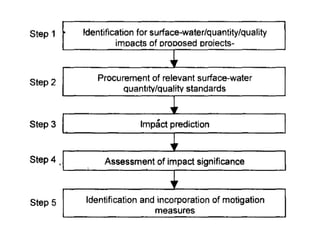
Step 1: Identification of Surface Water Quantity or Quality Impacts
Step 2: Description of Existing Surface Water Resource Conditions
Step 3: Procurement of Relevant Surface Water Quantity-Quality
Standards
Step 4: Impact Predictions
Step 5: Assessment of Impact Significance
Step 6: Identification and Incorporation of Mitigation Measures
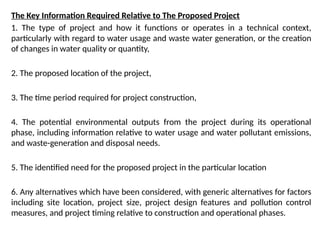
The Key Information Required Relative to The Proposed Project
1. The type of project and how it functions or operates in a technical context,
particularly with regard to water usage and waste water generation, or the creation
of changes in water quality or quantity,
2. The proposed location of the project,
3. The time period required for project construction,
4. The potential environmental outputs from the project during its operational
phase, including information relative to water usage and water pollutant emissions,
and waste-generation and disposal needs.
5. The identified need for the proposed project in the particular location
6. Any alternatives which have been considered, with generic alternatives for factors
including site location, project size, project design features and pollution control
measures, and project timing relative to construction and operational phases.
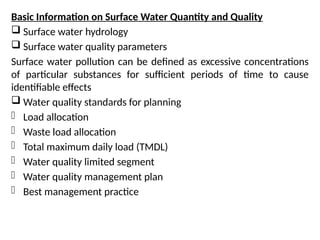
Basic Information on Surface Water Quantity and Quality
 Surface water hydrology
 Surface water quality parameters
Surface water pollution can be defined as excessive concentrations
of particular substances for sufficient periods of time to cause
identifiable effects
 Water quality standards for planning
- Load allocation
- Waste load allocation
- Total maximum daily load (TMDL)
- Water quality limited segment
- Water quality management plan
- Best management practice
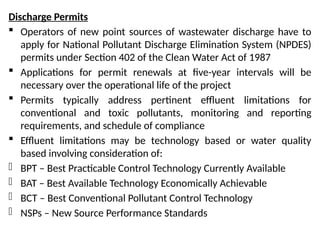
Discharge Permits
 Operators of new point sources of wastewater discharge have to
apply for National Pollutant Discharge Elimination System (NPDES)
permits under Section 402 of the Clean Water Act of 1987
 Applications for permit renewals at five-year intervals will be
necessary over the operational life of the project
 Permits typically address pertinent effluent limitations for
conventional and toxic pollutants, monitoring and reporting
requirements, and schedule of compliance
 Effluent limitations may be technology based or water quality
based involving consideration of:
- BPT – Best Practicable Control Technology Currently Available
- BAT – Best Available Technology Economically Achievable
- BCT – Best Conventional Pollutant Control Technology
- NSPs – New Source Performance Standards
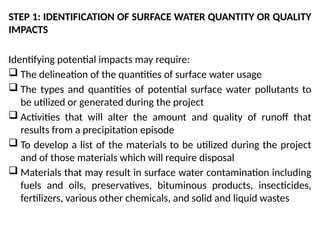
STEP 1: IDENTIFICATION OF SURFACE WATER QUANTITY OR QUALITY
IMPACTS
Identifying potential impacts may require:
 The delineation of the quantities of surface water usage
 The types and quantities of potential surface water pollutants to
be utilized or generated during the project
 Activities that will alter the amount and quality of runoff that
results from a precipitation episode
 To develop a list of the materials to be utilized during the project
and of those materials which will require disposal
 Materials that may result in surface water contamination including
fuels and oils, preservatives, bituminous products, insecticides,
fertilizers, various other chemicals, and solid and liquid wastes
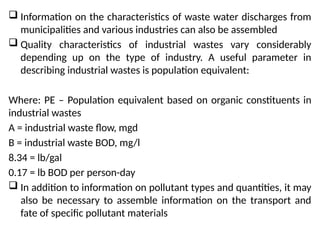
 Information on the characteristics of waste water discharges from
municipalities and various industries can also be assembled
 Quality characteristics of industrial wastes vary considerably
depending up on the type of industry. A useful parameter in
describing industrial wastes is population equivalent:
Where: PE – Population equivalent based on organic constituents in
industrial wastes
A = industrial waste flow, mgd
B = industrial waste BOD, mg/l
8.34 = lb/gal
0.17 = lb BOD per person-day
 In addition to information on pollutant types and quantities, it may
also be necessary to assemble information on the transport and
fate of specific pollutant materials
 Contaminant partitioning will be illustrated in the context of surface
water reservoir projects since such undertakings are often evaluated
in terms of the potential build up of contaminants in sediments
 It may also be necessary to consider joint toxicity effects when
several chemicals are present in the surface water environment
 If the proposed project is to involve usage of a surface water
resource (such as a river or a lake) as a water supply, information
should be gathered on the quantities of water to be used and the
distribution of this water demand over time
 If the project involves irrigation, a water balance should be
developed to determine the percentage of the applied water that
will recharge groundwater or appear in runoff to the surface water
resource
STEP 2: DESCRIPTION OF EXISTING SURFACE WATER RESOURCE
CONDITIONS
 This involves describing existing (background) conditions of the
surface water resources potentially impacted by the project
 Compilation of water quantity-quality information
 Identification of unique pollution problems
 Highlighting of key climatological information
 Baseline monitoring – can detect impacts caused by:
- Pollutants that are difficult to identify chemically or characterize
toxicologically
- Complex or unanticipated exposure from spills
- Habitat degradation due to channelization, sedimentation or
historical contamination
 Summary of pollution sources and water uses
STEP 3: PROCUREMENT OF RELEVANT SURFACE WATER QUANTITY-
QUALITY STANDARDS
STEP 5: ASSESSMENT OF IMPACT SIGNIFICANCE
- Assessment refers to the interpretation of the significance of
anticipated changes related to the proposed project
- Impact interpretation can be based upon the systematic
application of a definition of significance
STEP 6: IDENTIFICATION AND INCORPORATION OF MITIGATION
MEASURES
Some examples of mitigation measures are as follows:
 Decrease surface water usage and wastewater generation
 Minimize erosion during the construction and operational phase
of the project
 In projects involving agricultural chemicals, better plan the rate of
chemical application, timing of application and extent of such
application
 Manage non-point source pollution through the application of
BMP
 Develop a non-point pollution control program for coastal waters
 Use constructed wetlands to control non-point source pollution
involving nutrients, pesticides and sediments
 Consider alternative wastewater treatment schemes to achieve
treatment goals in a cost-effective manner
 Use discharge credit trading within watersheds
 Consider project operational modes that would minimize
detrimental impacts
 Use techniques such as sediment removal, and weed harvesting
for restoring lakes and reservoirs from water quality deterioration
and eutrophication
STEP 4: IMPACT PREDICTION
 Impact prediction refers to the quantification, where possible, of
the anticipated impacts of the proposed project on various
surface water environment factors
 Mass balance approaches
 Mathematical modelling approaches

Baseline data collection for water envronment.pptx

  • 1.
    PREDICTION AND ASSESSMENT OFIMPACTS ON THE SURFACE WATER ENVIRONMENT Dr. K. Pavan Kumar Associate Professor SCALE, VIT University
  • 2.
    Projects Which CreateImpact Concerns for the Surface-Water Environment I. Industrial power plants withdrawing surface water for cooling 2. Power plants discharging heated waste water from cooling cycles 3. Industries discharging process waste waters from either routine operations or as a result of accidents and spills. 4. Municipal waste water treatment plants discharging primary, secondary or treated waste waters. 5. Dredging projects in rivers, harbours, estuaries and or coastal area (increased turbidity and release of sediment contaminants may occur) 6. Projects involving "fill" or creation of "fast lands" along rivers, lakes, estuaries and coastal area. 7. Surface mining projects with resultant changes in surface water hydrology and non­point pollution.
  • 3.
    8. Construction ofdams for purposes of water supply. flood control or hydropower production. 9. River canalization projects for flow improvements 10. Deforestation and agricultural development resulting in non-point source pollution associated with nutrients and pesticides and irrigation projects, leading to turn flows laden with nutrients and pesticides. 11. Commercial hazardous waste disposal sites and/or sanitary landfills, with resultant run-off water and non-point-source pollution; and 12. Tourism projects adjacent to estuaries or coastal area with concerns related to bacterial pollution
  • 4.
    Conceptual Approach ForAddressing Surface Water Environmental Impacts Step 1: Identification of Surface Water Quantity or Quality Impacts Step 2: Description of Existing Surface Water Resource Conditions Step 3: Procurement of Relevant Surface Water Quantity-Quality Standards Step 4: Impact Predictions Step 5: Assessment of Impact Significance Step 6: Identification and Incorporation of Mitigation Measures
  • 6.
    The Key InformationRequired Relative to The Proposed Project 1. The type of project and how it functions or operates in a technical context, particularly with regard to water usage and waste water generation, or the creation of changes in water quality or quantity, 2. The proposed location of the project, 3. The time period required for project construction, 4. The potential environmental outputs from the project during its operational phase, including information relative to water usage and water pollutant emissions, and waste-generation and disposal needs. 5. The identified need for the proposed project in the particular location 6. Any alternatives which have been considered, with generic alternatives for factors including site location, project size, project design features and pollution control measures, and project timing relative to construction and operational phases.
  • 8.
    Basic Information onSurface Water Quantity and Quality  Surface water hydrology  Surface water quality parameters Surface water pollution can be defined as excessive concentrations of particular substances for sufficient periods of time to cause identifiable effects  Water quality standards for planning - Load allocation - Waste load allocation - Total maximum daily load (TMDL) - Water quality limited segment - Water quality management plan - Best management practice
  • 11.
    Discharge Permits  Operatorsof new point sources of wastewater discharge have to apply for National Pollutant Discharge Elimination System (NPDES) permits under Section 402 of the Clean Water Act of 1987  Applications for permit renewals at five-year intervals will be necessary over the operational life of the project  Permits typically address pertinent effluent limitations for conventional and toxic pollutants, monitoring and reporting requirements, and schedule of compliance  Effluent limitations may be technology based or water quality based involving consideration of: - BPT – Best Practicable Control Technology Currently Available - BAT – Best Available Technology Economically Achievable - BCT – Best Conventional Pollutant Control Technology - NSPs – New Source Performance Standards
  • 12.
    STEP 1: IDENTIFICATIONOF SURFACE WATER QUANTITY OR QUALITY IMPACTS Identifying potential impacts may require:  The delineation of the quantities of surface water usage  The types and quantities of potential surface water pollutants to be utilized or generated during the project  Activities that will alter the amount and quality of runoff that results from a precipitation episode  To develop a list of the materials to be utilized during the project and of those materials which will require disposal  Materials that may result in surface water contamination including fuels and oils, preservatives, bituminous products, insecticides, fertilizers, various other chemicals, and solid and liquid wastes
  • 13.
     Information onthe characteristics of waste water discharges from municipalities and various industries can also be assembled  Quality characteristics of industrial wastes vary considerably depending up on the type of industry. A useful parameter in describing industrial wastes is population equivalent: Where: PE – Population equivalent based on organic constituents in industrial wastes A = industrial waste flow, mgd B = industrial waste BOD, mg/l 8.34 = lb/gal 0.17 = lb BOD per person-day  In addition to information on pollutant types and quantities, it may also be necessary to assemble information on the transport and fate of specific pollutant materials
  • 14.
     Contaminant partitioningwill be illustrated in the context of surface water reservoir projects since such undertakings are often evaluated in terms of the potential build up of contaminants in sediments  It may also be necessary to consider joint toxicity effects when several chemicals are present in the surface water environment  If the proposed project is to involve usage of a surface water resource (such as a river or a lake) as a water supply, information should be gathered on the quantities of water to be used and the distribution of this water demand over time  If the project involves irrigation, a water balance should be developed to determine the percentage of the applied water that will recharge groundwater or appear in runoff to the surface water resource
  • 15.
    STEP 2: DESCRIPTIONOF EXISTING SURFACE WATER RESOURCE CONDITIONS  This involves describing existing (background) conditions of the surface water resources potentially impacted by the project  Compilation of water quantity-quality information  Identification of unique pollution problems  Highlighting of key climatological information  Baseline monitoring – can detect impacts caused by: - Pollutants that are difficult to identify chemically or characterize toxicologically - Complex or unanticipated exposure from spills - Habitat degradation due to channelization, sedimentation or historical contamination  Summary of pollution sources and water uses
  • 16.
    STEP 3: PROCUREMENTOF RELEVANT SURFACE WATER QUANTITY- QUALITY STANDARDS STEP 5: ASSESSMENT OF IMPACT SIGNIFICANCE - Assessment refers to the interpretation of the significance of anticipated changes related to the proposed project - Impact interpretation can be based upon the systematic application of a definition of significance
  • 17.
    STEP 6: IDENTIFICATIONAND INCORPORATION OF MITIGATION MEASURES Some examples of mitigation measures are as follows:  Decrease surface water usage and wastewater generation  Minimize erosion during the construction and operational phase of the project  In projects involving agricultural chemicals, better plan the rate of chemical application, timing of application and extent of such application  Manage non-point source pollution through the application of BMP  Develop a non-point pollution control program for coastal waters  Use constructed wetlands to control non-point source pollution involving nutrients, pesticides and sediments
  • 18.
     Consider alternativewastewater treatment schemes to achieve treatment goals in a cost-effective manner  Use discharge credit trading within watersheds  Consider project operational modes that would minimize detrimental impacts  Use techniques such as sediment removal, and weed harvesting for restoring lakes and reservoirs from water quality deterioration and eutrophication
  • 19.
    STEP 4: IMPACTPREDICTION  Impact prediction refers to the quantification, where possible, of the anticipated impacts of the proposed project on various surface water environment factors  Mass balance approaches  Mathematical modelling approaches