Basic Process Of EIA
Dr. K. Pavan Kumar
Associate Professor
SCALE, VIT University
What is EIA?
 EIA can be described as a process for identifying the likely
consequences for the bio-geophysical environment and for man’s
health and welfare of implementing particular activities and for
conveying this information, at a stage when it can materially
affect their decision, to those responsible for sanctioning the
proposals (Munn, 1979).
 EIA is an exercise to be carried out before any project or major
activity is undertaken to ensure that it will not in any away harm
the environment on a short-term or long-term basis.
 An impact can be defined as any change in the physical, chemical,
biological, cultural or socio-economic environmental system as a
result of activities relating to a project.
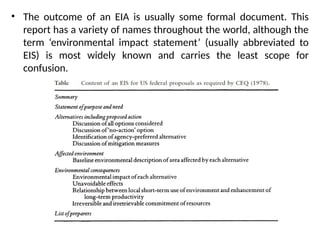
• The outcome of an EIA is usually some formal document. This
report has a variety of names throughout the world, although the
term ‘environmental impact statement’ (usually abbreviated to
EIS) is most widely known and carries the least scope for
confusion.
Environmental Impact
 The terms ‘impact’ and ‘effect’ are frequently used synonymously
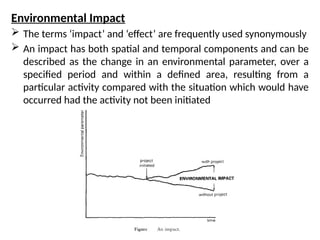
 An impact has both spatial and temporal components and can be
described as the change in an environmental parameter, over a
specified period and within a defined area, resulting from a
particular activity compared with the situation which would have
occurred had the activity not been initiated
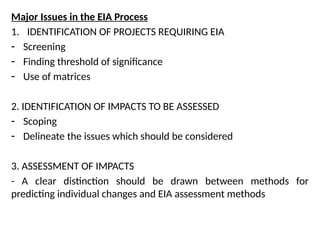
Major Issues in the EIA Process
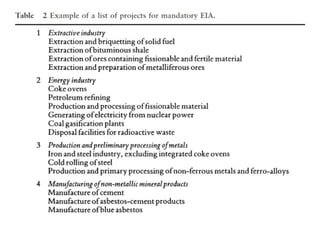
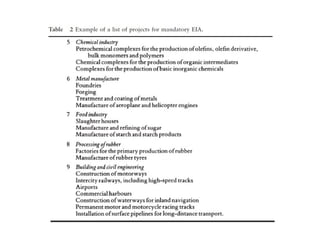
1. IDENTIFICATION OF PROJECTS REQUIRING EIA
- Screening
- Finding threshold of significance
- Use of matrices
2. IDENTIFICATION OF IMPACTS TO BE ASSESSED
- Scoping
- Delineate the issues which should be considered
3. ASSESSMENT OF IMPACTS
- A clear distinction should be drawn between methods for
predicting individual changes and EIA assessment methods
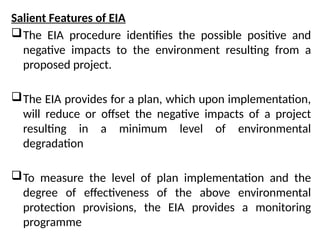
Salient Features of EIA
The EIA procedure identifies the possible positive and
negative impacts to the environment resulting from a
proposed project.
The EIA provides for a plan, which upon implementation,
will reduce or offset the negative impacts of a project
resulting in a minimum level of environmental
degradation
To measure the level of plan implementation and the
degree of effectiveness of the above environmental
protection provisions, the EIA provides a monitoring
programme
Criticism Levelled Against EIA
 Tokenism
 Unrealistic time constraints
 Failure to accommodate uncertainty
 Poor coordination and poorly stated objectives
 Inadequate research
 Limited use of protective techniques and limited study of indirect
and cumulative consequences
 Being too descriptive and voluminous
General Steps in an EIA Process
 Project screening
 Scoping
 Consideration of alternatives
 The description of the project/development action
 The description of the environmental baseline
 The identification of the main impacts
 The prediction of impacts
 The evaluation and assessment of the significance
 Mitigation
 Public consultation and participation
 EIS presentation
 Review
 Decision making
 Post decision monitoring
 Auditing
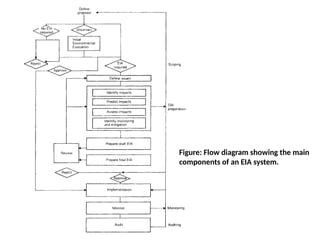
Figure: Flow diagram showing the main
components of an EIA system.
EIA Methodologies
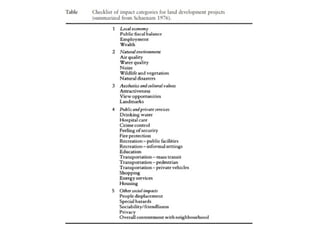
1. Checklists
- Checklists of potential impacts
- They may be exhaustive if no serious impact is to be overlooked
- Can be unwieldy and may stifle initiative during assessment
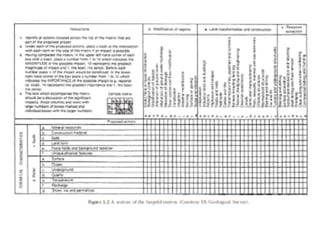
2. Leopold’s Matrix
- Developed by Leopold et al., in 1971
- Suggested use of matrix method for EIA
- Matrices are particularly useful for EIA as they reflect the fact that
impacts result from the interaction of development activities and
the environment
- The matrix format is ideally suited for impact identification,
although the ability of the Leopold matrix to identify indirect
impacts has been questioned
- Also used to present results of an appraisal
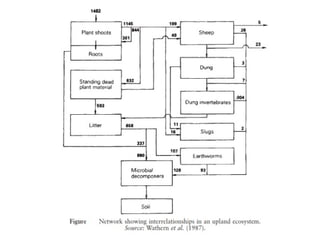
3. Network Method
- A hybrid approach developed by Sorensen (1971)
- Networks are relatively effective at revealing indirect impacts as
the ramifications of a change can be followed through chains of
intermediaries
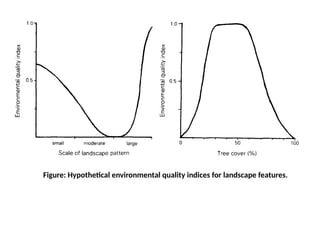
4. Aggregation Methods
- Combining numerical values indicative of individual impacts into a
surrogate reflecting overall impact
- These methods have two elements, scaling and weighting
- Many subjective elements are subsumed within both the
weighting scheme and the value functions
- In effect the basis for a decision is created by the method
- The preferred option logically can be taken as the one with
highest environmental quality score
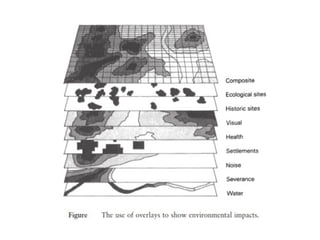
5. Overlay Techniques
- Have a long history of use in environmental planning being ideally
suited for the consideration of spatial aspects
- Their use in impact analysis predates NEPA
- Transparencies are produced showing the spatial distribution and
intensity of individual impacts
- They can be overlain to show total impact
- Only a small number of impacts can be overlain successfully,
about a dozen, although photographic and hierarchical clustering
approaches overcome this practical constraint
Figure: Hypothetical environmental quality indices for landscape features.
The EIA Process
 The structure of an EIA process is dictated primarily by
the need to accommodate each of the key issues
 From a technical point of view, EIA can be thought of as
a data management process. It has three components.
• First, the appropriate information necessary for a
particular decision to be taken must be identified and,
possibly, collected
• Secondly, changes in environmental parameters
resulting from implementation must be determined and
compared with the situation likely to accrue without the
proposal
• Finally, actual change must be recorded and analysed
EIA In The Decision Making Process
The objective of EIA is not to force decision makers to
adopt the least environmentally damaging alternative
Environmental impact is but one of the issues addressed
by decision makers as they seek to balance the often
competing demands of development and environmental
protection
CBA (Cost Benefit Analysis) was the basis for project
appraisal prior to the advent of EIA and it is still
routinely used
Risk Assessment
 Risk assessment (RA) is of particular interest as, in many respects, it
parallels EIA
 RA is frequently used to assess the probability and likely
consequences of a particular catastrophic event, such as an
explosion, associated with a hazardous installation
 Risk assessments tend to be highly numeric appraisals; they are
essentially statistical analyses of likely events based upon certain
probabilities of occurrence.
 However, risk analysis suffers from the following weakness:
- Difficult to quantify non-quantifiable effects
- Robustness may not be determined
- Subjectivity of impact assessment
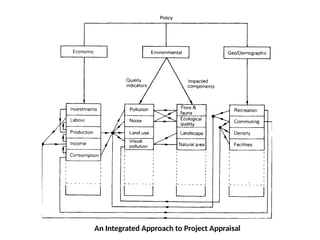
An Integrated Approach to Project Appraisal
Screening and Scoping

Basic Process of Environmental Impact Assessment.pptx

  • 1.
    Basic Process OfEIA Dr. K. Pavan Kumar Associate Professor SCALE, VIT University
  • 2.
    What is EIA? EIA can be described as a process for identifying the likely consequences for the bio-geophysical environment and for man’s health and welfare of implementing particular activities and for conveying this information, at a stage when it can materially affect their decision, to those responsible for sanctioning the proposals (Munn, 1979).  EIA is an exercise to be carried out before any project or major activity is undertaken to ensure that it will not in any away harm the environment on a short-term or long-term basis.  An impact can be defined as any change in the physical, chemical, biological, cultural or socio-economic environmental system as a result of activities relating to a project.
  • 3.
    • The outcomeof an EIA is usually some formal document. This report has a variety of names throughout the world, although the term ‘environmental impact statement’ (usually abbreviated to EIS) is most widely known and carries the least scope for confusion.
  • 4.
    Environmental Impact  Theterms ‘impact’ and ‘effect’ are frequently used synonymously  An impact has both spatial and temporal components and can be described as the change in an environmental parameter, over a specified period and within a defined area, resulting from a particular activity compared with the situation which would have occurred had the activity not been initiated
  • 5.
    Major Issues inthe EIA Process 1. IDENTIFICATION OF PROJECTS REQUIRING EIA - Screening - Finding threshold of significance - Use of matrices 2. IDENTIFICATION OF IMPACTS TO BE ASSESSED - Scoping - Delineate the issues which should be considered 3. ASSESSMENT OF IMPACTS - A clear distinction should be drawn between methods for predicting individual changes and EIA assessment methods
  • 8.
    Salient Features ofEIA The EIA procedure identifies the possible positive and negative impacts to the environment resulting from a proposed project. The EIA provides for a plan, which upon implementation, will reduce or offset the negative impacts of a project resulting in a minimum level of environmental degradation To measure the level of plan implementation and the degree of effectiveness of the above environmental protection provisions, the EIA provides a monitoring programme
  • 9.
    Criticism Levelled AgainstEIA  Tokenism  Unrealistic time constraints  Failure to accommodate uncertainty  Poor coordination and poorly stated objectives  Inadequate research  Limited use of protective techniques and limited study of indirect and cumulative consequences  Being too descriptive and voluminous
  • 10.
    General Steps inan EIA Process  Project screening  Scoping  Consideration of alternatives  The description of the project/development action  The description of the environmental baseline  The identification of the main impacts  The prediction of impacts  The evaluation and assessment of the significance  Mitigation  Public consultation and participation  EIS presentation  Review  Decision making  Post decision monitoring  Auditing
  • 11.
    Figure: Flow diagramshowing the main components of an EIA system.
  • 12.
    EIA Methodologies 1. Checklists -Checklists of potential impacts - They may be exhaustive if no serious impact is to be overlooked - Can be unwieldy and may stifle initiative during assessment 2. Leopold’s Matrix - Developed by Leopold et al., in 1971 - Suggested use of matrix method for EIA - Matrices are particularly useful for EIA as they reflect the fact that impacts result from the interaction of development activities and the environment - The matrix format is ideally suited for impact identification, although the ability of the Leopold matrix to identify indirect impacts has been questioned - Also used to present results of an appraisal
  • 13.
    3. Network Method -A hybrid approach developed by Sorensen (1971) - Networks are relatively effective at revealing indirect impacts as the ramifications of a change can be followed through chains of intermediaries 4. Aggregation Methods - Combining numerical values indicative of individual impacts into a surrogate reflecting overall impact - These methods have two elements, scaling and weighting - Many subjective elements are subsumed within both the weighting scheme and the value functions - In effect the basis for a decision is created by the method - The preferred option logically can be taken as the one with highest environmental quality score
  • 14.
    5. Overlay Techniques -Have a long history of use in environmental planning being ideally suited for the consideration of spatial aspects - Their use in impact analysis predates NEPA - Transparencies are produced showing the spatial distribution and intensity of individual impacts - They can be overlain to show total impact - Only a small number of impacts can be overlain successfully, about a dozen, although photographic and hierarchical clustering approaches overcome this practical constraint
  • 18.
    Figure: Hypothetical environmentalquality indices for landscape features.
  • 20.
    The EIA Process The structure of an EIA process is dictated primarily by the need to accommodate each of the key issues  From a technical point of view, EIA can be thought of as a data management process. It has three components. • First, the appropriate information necessary for a particular decision to be taken must be identified and, possibly, collected • Secondly, changes in environmental parameters resulting from implementation must be determined and compared with the situation likely to accrue without the proposal • Finally, actual change must be recorded and analysed
  • 21.
    EIA In TheDecision Making Process The objective of EIA is not to force decision makers to adopt the least environmentally damaging alternative Environmental impact is but one of the issues addressed by decision makers as they seek to balance the often competing demands of development and environmental protection CBA (Cost Benefit Analysis) was the basis for project appraisal prior to the advent of EIA and it is still routinely used
  • 22.
    Risk Assessment  Riskassessment (RA) is of particular interest as, in many respects, it parallels EIA  RA is frequently used to assess the probability and likely consequences of a particular catastrophic event, such as an explosion, associated with a hazardous installation  Risk assessments tend to be highly numeric appraisals; they are essentially statistical analyses of likely events based upon certain probabilities of occurrence.  However, risk analysis suffers from the following weakness: - Difficult to quantify non-quantifiable effects - Robustness may not be determined - Subjectivity of impact assessment
  • 23.
    An Integrated Approachto Project Appraisal
  • 24.