An Introduction to
Environmental Management
for incoming graduates
Simon Bell
Senior HS&E Adviser – South and West Region
Environment and Sustainability
• Why environmental management and sustainability is important
• How we do it
• Key areas of concern and potential pitfalls
Question:
Why do you think Environmental Management is important to a
business like ours?
Environmental Management – WHY
Direct and Indirect Drivers/Benefits
• LEGAL
• Regulatory framework and enforcement
• MORAL
• Protect and enhancing economic value
• Human health and wellbeing
• FINANCIAL
• Reduce unnecessary use of resources
• Ensure programme progression
P
e
r
c
e
p
t
i
o
n
LEGAL
EUROPEAN Directives – Binding on member states – generally require
adoption into a country’s legislation
e.g.
• EIA Directive
• Freedom of access to information directive
• Integrated Pollution Prevention and Control Directive
• Habitats Directive
• Water Framework Directive
• Waste Framework Directive
• Landfill Directive
• Waste Electrical and Electronic Equipment Directive
LEGAL Continued
UK Legislation
Wildlife and Countryside Act 1981
Environmental Protection Act 1990
Town and County Planning Act 1990
Water Resources Act 1991
Regulatory Enforcement and Sanctions Act 2008
Ancient Monuments and Archaeological Areas Act 1979
Planning (Listed Buildings and Conservation Area) Act 1990
The Conservation of Habitats and Species Regulations 2010
The Environmental Permitting (England and Wales) Regulations 2010
The Environmental Protection (Duty of Care) Regulations 1991
The Control of Pollution (Oil Storage) (England) Regulations 2001
LEGAL
Enforcement and Advisory Services
Local Authorities
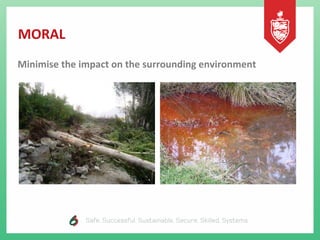
MORAL
Minimise the impact on the surrounding environment
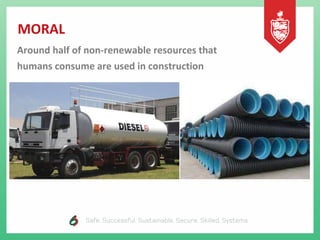
MORAL
Around half of non-renewable resources that
humans consume are used in construction
MORAL
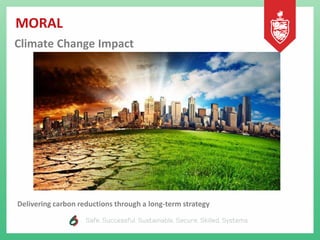
Climate Change Impact
Delivering carbon reductions through a long-term strategy
MORAL
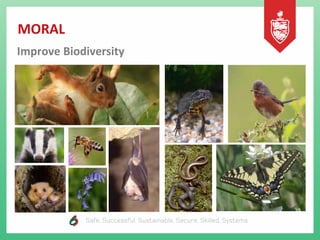
Improve Biodiversity
MORAL
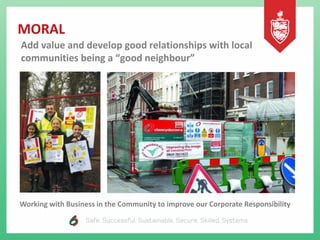
Add value and develop good relationships with local
communities being a “good neighbour”
Working with Business in the Community to improve our Corporate Responsibility
MORAL
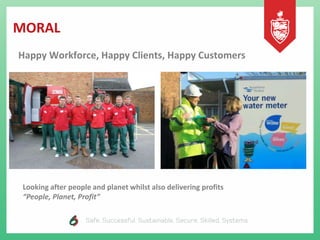
Happy Workforce, Happy Clients, Happy Customers
Looking after people and planet whilst also delivering profits
“People, Planet, Profit”
Financial
• Programme progression
• Many Environmental aspects require significant work during the
planning stage of a project. If these are not completed in a timely
fashion then construction work is likely to be delayed. This can be very
costly
For Example: Watercourse Crossings on a recently delivered major
strategic water main project. (CONTENT REMOVED FROM PRESENTATION
FOR SECURITY)
Financial
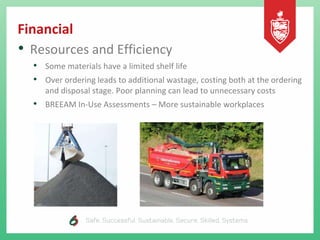
• Resources and Efficiency
• Some materials have a limited shelf life
• Over ordering leads to additional wastage, costing both at the ordering
and disposal stage. Poor planning can lead to unnecessary costs
• BREEAM In-Use Assessments – More sustainable workplaces
Financial
• Opportunities
• A company with a good environmental track record is more attractive
to potential Clients.
• New materials, technologies, and working practices are likely to be
more efficient and therefore offer a cost saving.
• Direct Financial Implications
• Fines
• Remediation
Other General Drivers
• Client Relations
• Public Relations
• Positive Press
All relating to the company brand and how we
are viewed in both the business sector and the
communities that we work.
ENVIRONMENTAL MANAGEMENT AT OUR
COMPANY
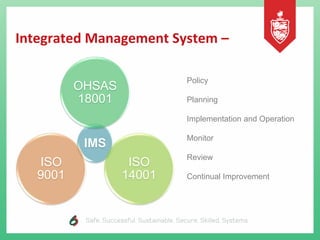
IMS
OHSAS
18001
ISO
14001
ISO
9001
Integrated Management System –
Policy
Planning
Implementation and Operation
Monitor
Review
Continual Improvement
Environmental Support
Central Team:
Function: Governance, Direction, Sustainability
Contract Support:
Environmental Advisers working in the regional HS+E teams under the r
egional directors.
Function: Advise, Monitor, Investigate, Enforce
Key Areas – a flavour of issues on site
• Archaeology
• Trees and Vegetation
• Ecology
• Protected Sites
• Water Management
• Fuel
• Waste
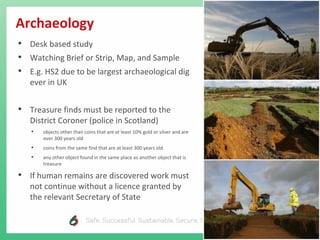
Archaeology
• Desk based study
• Watching Brief or Strip, Map, and Sample
• E.g. HS2 due to be largest archaeological dig
ever in UK
• Treasure finds must be reported to the
District Coroner (police in Scotland)
• objects other than coins that are at least 10% gold or silver and are
over 300 years old
• coins from the same find that are at least 300 years old
• any other object found in the same place as another object that is
treasure
• If human remains are discovered work must
not continue without a licence granted by
the relevant Secretary of State
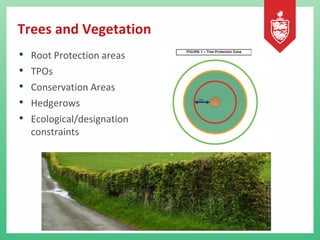
Trees and Vegetation
• Root Protection areas
• TPOs
• Conservation Areas
• Hedgerows
• Ecological/designation
constraints
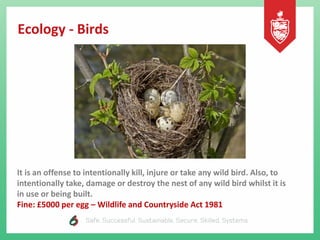
Ecology - Birds
It is an offense to intentionally kill, injure or take any wild bird. Also, to
intentionally take, damage or destroy the nest of any wild bird whilst it is
in use or being built.
Fine: £5000 per egg – Wildlife and Countryside Act 1981
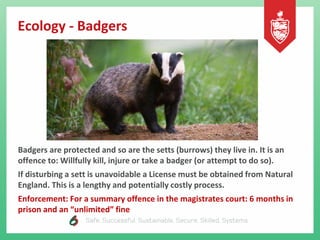
Ecology - Badgers
Badgers are protected and so are the setts (burrows) they live in. It is an
offence to: Willfully kill, injure or take a badger (or attempt to do so).
If disturbing a sett is unavoidable a License must be obtained from Natural
England. This is a lengthy and potentially costly process.
Enforcement: For a summary offence in the magistrates court: 6 months in
prison and an “unlimited” fine
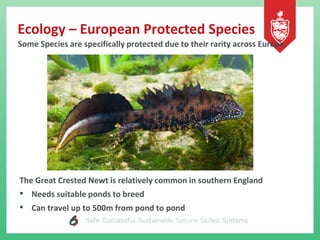
Ecology – European Protected Species
Some Species are specifically protected due to their rarity across Europe.
The Great Crested Newt is relatively common in southern England
• Needs suitable ponds to breed
• Can travel up to 500m from pond to pond
Ecology – European Protected Species
So if pond within 500m of project:
1. Habitat suitability study – Index style output indicating likelihood of
presence
2. If high likelihood – Surveying (torch, pitfall, bottle traps, netting etc…).
Minimum of 6 visits, some night time. Must be carried out by an ecologist
licenced to work with Great Crested Newts.
3. Surveys can only be carried out during active season March-July (ish).
4. Put together method statement and submit application with survey data
to Natural England.
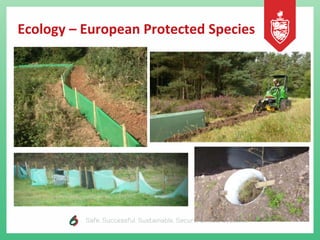
5. Common method – “Sterilise” works area by erecting exclusion fencing
and then trapping out the works area. Usually 60 day trapping period.
6. Maintain and inspect fencing throughout works.
Ecology – European Protected Species
Protected Sites
• Sites of Special Scientific Interest (SSSI)
• National Parks
• Special Areas of Conservation (European level designation)
• Local Nature Reserves
• Area’s of Outstanding Natural Beauty (AONB)
• Special Protection Areas
May require special permissions to work in these areas.
Time implications – Submit method statements with applications
Regulator: Usually Natural England
• Crown Estate
• MoD
• Conservation Areas
Protected Sites
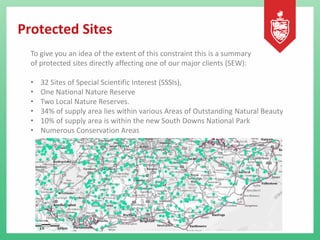
To give you an idea of the extent of this constraint this is a summary
of protected sites directly affecting one of our major clients (SEW):
• 32 Sites of Special Scientific Interest (SSSIs),
• One National Nature Reserve
• Two Local Nature Reserves.
• 34% of supply area lies within various Areas of Outstanding Natural Beauty
• 10% of supply area is within the new South Downs National Park
• Numerous Conservation Areas
Water Management
RIVERS AND STREAMS
Works within 8m of a main river fall under the Environmental Permitting
Regulations.
• Works may qualify for a notifiable exemption
• Or they may require a bespoke permit – up to 12 weeks application time.
Applications must be made well in advance of construction to the Environment
Agency or to Local Authority.
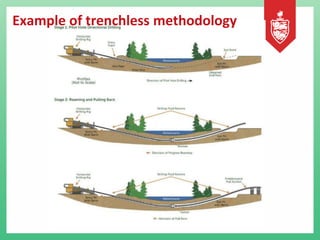
Crossings might be open cut or trenchless e.g.
(CONTENT REMOVED FROM PRESENTATION)
Example of trenchless methodology
Water Management
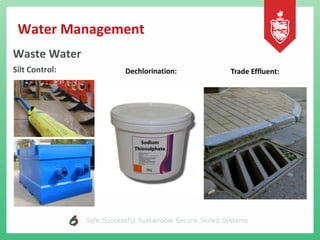
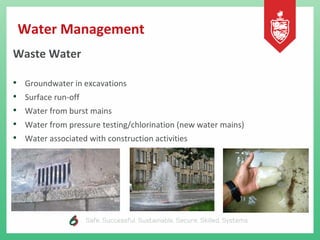
Waste Water
• Groundwater in excavations
• Surface run-off
• Water from burst mains
• Water from pressure testing/chlorination (new water mains)
• Water associated with construction activities
Water Management
Relevant Legislation: Water Resources Act Section 163
http://www.legislation.gov.uk/ukpga/1991/57/section/163
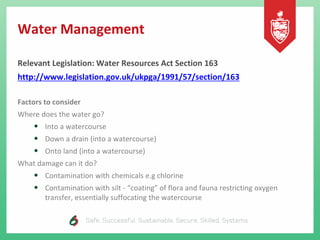
Factors to consider
Where does the water go?
• Into a watercourse
• Down a drain (into a watercourse)
• Onto land (into a watercourse)
What damage can it do?
• Contamination with chemicals e.g chlorine
• Contamination with silt - “coating” of flora and fauna restricting oxygen
transfer, essentially suffocating the watercourse
Water Management
Waste Water
Silt Control: Dechlorination: Trade Effluent:
Fuel
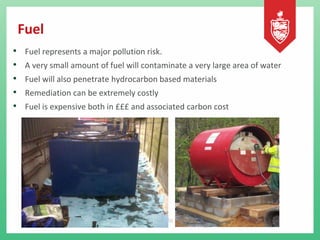
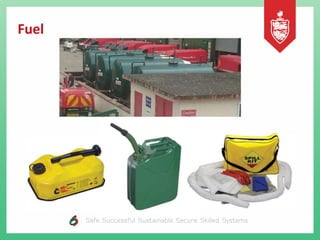
• Fuel represents a major pollution risk.
• A very small amount of fuel will contaminate a very large area of water
• Fuel will also penetrate hydrocarbon based materials
• Remediation can be extremely costly
• Fuel is expensive both in £££ and associated carbon cost
Fuel
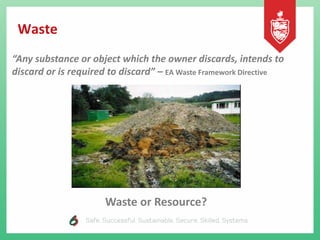
“Any substance or object which the owner discards, intends to
discard or is required to discard” – EA Waste Framework Directive
Waste or Resource?
Waste
Waste
Waste
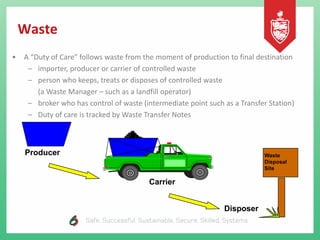
• A “Duty of Care” follows waste from the moment of production to final destination
– importer, producer or carrier of controlled waste
– person who keeps, treats or disposes of controlled waste
(a Waste Manager – such as a landfill operator)
– broker who has control of waste (intermediate point such as a Transfer Station)
– Duty of care is tracked by Waste Transfer Notes
Producer
Carrier
Disposer
Waste
Disposal
Site
Waste
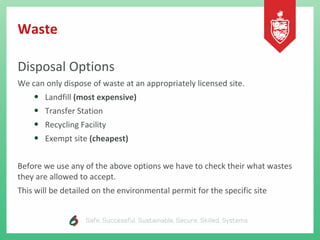
Disposal Options
We can only dispose of waste at an appropriately licensed site.
• Landfill (most expensive)
• Transfer Station
• Recycling Facility
• Exempt site (cheapest)
Before we use any of the above options we have to check their what wastes
they are allowed to accept.
This will be detailed on the environmental permit for the specific site
Waste
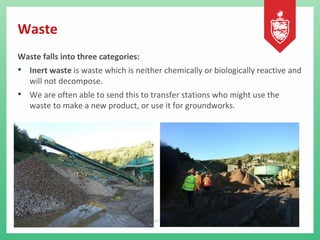
Waste falls into three categories:
• Inert waste is waste which is neither chemically or biologically reactive and
will not decompose.
• We are often able to send this to transfer stations who might use the
waste to make a new product, or use it for groundworks.
Waste
Non-Hazardous Waste contains some material that is reactive or may break
down over time.
Inert processing centres/landfill sites like the one discussed on the previous
slide cannot accept these waste streams therefore disposal options are more
limited and more costly.
Examples:
Wood, Glass, Plastic, bituminous materials not containing coal tar.
The above are ALL recyclable. Segregation is well worthwhile.
Waste
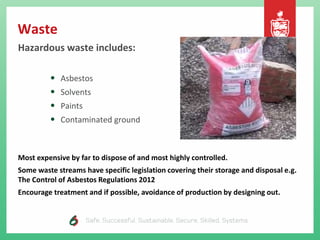
Hazardous waste includes:
• Asbestos
• Solvents
• Paints
• Contaminated ground
Most expensive by far to dispose of and most highly controlled.
Some waste streams have specific legislation covering their storage and disposal e.g.
The Control of Asbestos Regulations 2012
Encourage treatment and if possible, avoidance of production by designing out.
Waste
Requires forward planning of waste
• How can we best maximise segregation?
• Can we plan for on site re-use/ recycling?
• Can we make use of off-site recycling facilities and transfer stations (tax
exempt)
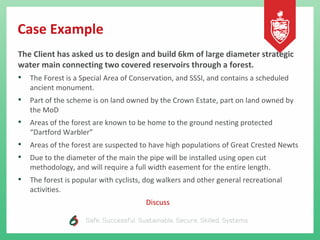
Case Example
The Client has asked us to design and build 6km of large diameter strategic
water main connecting two covered reservoirs through a forest.
• The Forest is a Special Area of Conservation, and SSSI, and contains a scheduled
ancient monument.
• Part of the scheme is on land owned by the Crown Estate, part on land owned by
the MoD
• Areas of the forest are known to be home to the ground nesting protected
“Dartford Warbler”
• Areas of the forest are suspected to have high populations of Great Crested Newts
• Due to the diameter of the main the pipe will be installed using open cut
methodology, and will require a full width easement for the entire length.
• The forest is popular with cyclists, dog walkers and other general recreational
activities.
Discuss
Summary
Environmental Management affects all areas of our business:
• Project concept and scope
• Environmental constraints could be prohibitive to a project going ahead at all
• Project Design
• Route selection, construction methodology, material selection
• Construction phase
• Pollution prevention, client relations, energy, regulator involvement, waste
management
• Operational Phase
• Design and operating parameters
• End of Life
• Disposal

Environmental Management Presentation for Graduate Induction

  • 1.
    An Introduction to EnvironmentalManagement for incoming graduates Simon Bell Senior HS&E Adviser – South and West Region
  • 2.
    Environment and Sustainability •Why environmental management and sustainability is important • How we do it • Key areas of concern and potential pitfalls Question: Why do you think Environmental Management is important to a business like ours?
  • 3.
    Environmental Management –WHY Direct and Indirect Drivers/Benefits • LEGAL • Regulatory framework and enforcement • MORAL • Protect and enhancing economic value • Human health and wellbeing • FINANCIAL • Reduce unnecessary use of resources • Ensure programme progression P e r c e p t i o n
  • 4.
    LEGAL EUROPEAN Directives –Binding on member states – generally require adoption into a country’s legislation e.g. • EIA Directive • Freedom of access to information directive • Integrated Pollution Prevention and Control Directive • Habitats Directive • Water Framework Directive • Waste Framework Directive • Landfill Directive • Waste Electrical and Electronic Equipment Directive
  • 5.
    LEGAL Continued UK Legislation Wildlifeand Countryside Act 1981 Environmental Protection Act 1990 Town and County Planning Act 1990 Water Resources Act 1991 Regulatory Enforcement and Sanctions Act 2008 Ancient Monuments and Archaeological Areas Act 1979 Planning (Listed Buildings and Conservation Area) Act 1990 The Conservation of Habitats and Species Regulations 2010 The Environmental Permitting (England and Wales) Regulations 2010 The Environmental Protection (Duty of Care) Regulations 1991 The Control of Pollution (Oil Storage) (England) Regulations 2001
  • 6.
    LEGAL Enforcement and AdvisoryServices Local Authorities
  • 7.
    MORAL Minimise the impacton the surrounding environment
  • 8.
    MORAL Around half ofnon-renewable resources that humans consume are used in construction
  • 9.
    MORAL Climate Change Impact Deliveringcarbon reductions through a long-term strategy
  • 10.
  • 11.
    MORAL Add value anddevelop good relationships with local communities being a “good neighbour” Working with Business in the Community to improve our Corporate Responsibility
  • 12.
    MORAL Happy Workforce, HappyClients, Happy Customers Looking after people and planet whilst also delivering profits “People, Planet, Profit”
  • 13.
    Financial • Programme progression •Many Environmental aspects require significant work during the planning stage of a project. If these are not completed in a timely fashion then construction work is likely to be delayed. This can be very costly For Example: Watercourse Crossings on a recently delivered major strategic water main project. (CONTENT REMOVED FROM PRESENTATION FOR SECURITY)
  • 14.
    Financial • Resources andEfficiency • Some materials have a limited shelf life • Over ordering leads to additional wastage, costing both at the ordering and disposal stage. Poor planning can lead to unnecessary costs • BREEAM In-Use Assessments – More sustainable workplaces
  • 15.
    Financial • Opportunities • Acompany with a good environmental track record is more attractive to potential Clients. • New materials, technologies, and working practices are likely to be more efficient and therefore offer a cost saving. • Direct Financial Implications • Fines • Remediation
  • 16.
    Other General Drivers •Client Relations • Public Relations • Positive Press All relating to the company brand and how we are viewed in both the business sector and the communities that we work.
  • 17.
  • 18.
    IMS OHSAS 18001 ISO 14001 ISO 9001 Integrated Management System– Policy Planning Implementation and Operation Monitor Review Continual Improvement
  • 19.
    Environmental Support Central Team: Function:Governance, Direction, Sustainability Contract Support: Environmental Advisers working in the regional HS+E teams under the r egional directors. Function: Advise, Monitor, Investigate, Enforce
  • 20.
    Key Areas –a flavour of issues on site • Archaeology • Trees and Vegetation • Ecology • Protected Sites • Water Management • Fuel • Waste
  • 21.
    Archaeology • Desk basedstudy • Watching Brief or Strip, Map, and Sample • E.g. HS2 due to be largest archaeological dig ever in UK • Treasure finds must be reported to the District Coroner (police in Scotland) • objects other than coins that are at least 10% gold or silver and are over 300 years old • coins from the same find that are at least 300 years old • any other object found in the same place as another object that is treasure • If human remains are discovered work must not continue without a licence granted by the relevant Secretary of State
  • 22.
    Trees and Vegetation •Root Protection areas • TPOs • Conservation Areas • Hedgerows • Ecological/designation constraints
  • 23.
    Ecology - Birds Itis an offense to intentionally kill, injure or take any wild bird. Also, to intentionally take, damage or destroy the nest of any wild bird whilst it is in use or being built. Fine: £5000 per egg – Wildlife and Countryside Act 1981
  • 24.
    Ecology - Badgers Badgersare protected and so are the setts (burrows) they live in. It is an offence to: Willfully kill, injure or take a badger (or attempt to do so). If disturbing a sett is unavoidable a License must be obtained from Natural England. This is a lengthy and potentially costly process. Enforcement: For a summary offence in the magistrates court: 6 months in prison and an “unlimited” fine
  • 25.
    Ecology – EuropeanProtected Species Some Species are specifically protected due to their rarity across Europe. The Great Crested Newt is relatively common in southern England • Needs suitable ponds to breed • Can travel up to 500m from pond to pond
  • 26.
    Ecology – EuropeanProtected Species So if pond within 500m of project: 1. Habitat suitability study – Index style output indicating likelihood of presence 2. If high likelihood – Surveying (torch, pitfall, bottle traps, netting etc…). Minimum of 6 visits, some night time. Must be carried out by an ecologist licenced to work with Great Crested Newts. 3. Surveys can only be carried out during active season March-July (ish). 4. Put together method statement and submit application with survey data to Natural England. 5. Common method – “Sterilise” works area by erecting exclusion fencing and then trapping out the works area. Usually 60 day trapping period. 6. Maintain and inspect fencing throughout works.
  • 27.
    Ecology – EuropeanProtected Species
  • 28.
    Ecology – EuropeanProtected Species
  • 29.
    Ecology – EuropeanProtected Species
  • 30.
    Protected Sites • Sitesof Special Scientific Interest (SSSI) • National Parks • Special Areas of Conservation (European level designation) • Local Nature Reserves • Area’s of Outstanding Natural Beauty (AONB) • Special Protection Areas May require special permissions to work in these areas. Time implications – Submit method statements with applications Regulator: Usually Natural England • Crown Estate • MoD • Conservation Areas
  • 31.
    Protected Sites To giveyou an idea of the extent of this constraint this is a summary of protected sites directly affecting one of our major clients (SEW): • 32 Sites of Special Scientific Interest (SSSIs), • One National Nature Reserve • Two Local Nature Reserves. • 34% of supply area lies within various Areas of Outstanding Natural Beauty • 10% of supply area is within the new South Downs National Park • Numerous Conservation Areas
  • 32.
    Water Management RIVERS ANDSTREAMS Works within 8m of a main river fall under the Environmental Permitting Regulations. • Works may qualify for a notifiable exemption • Or they may require a bespoke permit – up to 12 weeks application time. Applications must be made well in advance of construction to the Environment Agency or to Local Authority. Crossings might be open cut or trenchless e.g. (CONTENT REMOVED FROM PRESENTATION)
  • 33.
  • 34.
    Water Management Waste Water •Groundwater in excavations • Surface run-off • Water from burst mains • Water from pressure testing/chlorination (new water mains) • Water associated with construction activities
  • 35.
    Water Management Relevant Legislation:Water Resources Act Section 163 http://www.legislation.gov.uk/ukpga/1991/57/section/163 Factors to consider Where does the water go? • Into a watercourse • Down a drain (into a watercourse) • Onto land (into a watercourse) What damage can it do? • Contamination with chemicals e.g chlorine • Contamination with silt - “coating” of flora and fauna restricting oxygen transfer, essentially suffocating the watercourse
  • 36.
    Water Management Waste Water SiltControl: Dechlorination: Trade Effluent:
  • 37.
    Fuel • Fuel representsa major pollution risk. • A very small amount of fuel will contaminate a very large area of water • Fuel will also penetrate hydrocarbon based materials • Remediation can be extremely costly • Fuel is expensive both in £££ and associated carbon cost
  • 38.
  • 39.
    “Any substance orobject which the owner discards, intends to discard or is required to discard” – EA Waste Framework Directive Waste or Resource? Waste
  • 40.
  • 41.
    Waste • A “Dutyof Care” follows waste from the moment of production to final destination – importer, producer or carrier of controlled waste – person who keeps, treats or disposes of controlled waste (a Waste Manager – such as a landfill operator) – broker who has control of waste (intermediate point such as a Transfer Station) – Duty of care is tracked by Waste Transfer Notes Producer Carrier Disposer Waste Disposal Site
  • 42.
    Waste Disposal Options We canonly dispose of waste at an appropriately licensed site. • Landfill (most expensive) • Transfer Station • Recycling Facility • Exempt site (cheapest) Before we use any of the above options we have to check their what wastes they are allowed to accept. This will be detailed on the environmental permit for the specific site
  • 43.
    Waste Waste falls intothree categories: • Inert waste is waste which is neither chemically or biologically reactive and will not decompose. • We are often able to send this to transfer stations who might use the waste to make a new product, or use it for groundworks.
  • 44.
    Waste Non-Hazardous Waste containssome material that is reactive or may break down over time. Inert processing centres/landfill sites like the one discussed on the previous slide cannot accept these waste streams therefore disposal options are more limited and more costly. Examples: Wood, Glass, Plastic, bituminous materials not containing coal tar. The above are ALL recyclable. Segregation is well worthwhile.
  • 45.
    Waste Hazardous waste includes: •Asbestos • Solvents • Paints • Contaminated ground Most expensive by far to dispose of and most highly controlled. Some waste streams have specific legislation covering their storage and disposal e.g. The Control of Asbestos Regulations 2012 Encourage treatment and if possible, avoidance of production by designing out.
  • 46.
    Waste Requires forward planningof waste • How can we best maximise segregation? • Can we plan for on site re-use/ recycling? • Can we make use of off-site recycling facilities and transfer stations (tax exempt)
  • 47.
    Case Example The Clienthas asked us to design and build 6km of large diameter strategic water main connecting two covered reservoirs through a forest. • The Forest is a Special Area of Conservation, and SSSI, and contains a scheduled ancient monument. • Part of the scheme is on land owned by the Crown Estate, part on land owned by the MoD • Areas of the forest are known to be home to the ground nesting protected “Dartford Warbler” • Areas of the forest are suspected to have high populations of Great Crested Newts • Due to the diameter of the main the pipe will be installed using open cut methodology, and will require a full width easement for the entire length. • The forest is popular with cyclists, dog walkers and other general recreational activities. Discuss
  • 48.
    Summary Environmental Management affectsall areas of our business: • Project concept and scope • Environmental constraints could be prohibitive to a project going ahead at all • Project Design • Route selection, construction methodology, material selection • Construction phase • Pollution prevention, client relations, energy, regulator involvement, waste management • Operational Phase • Design and operating parameters • End of Life • Disposal