
Corporate Environment Management
Strategies

Unit-II
Syllabus
• Concept
of
strategic
environmental
management with examples, sustainable
industrial development, triple bottom line
concept, cleaner technologies, life cycle
analysis, green marketing.
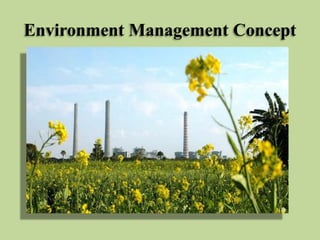
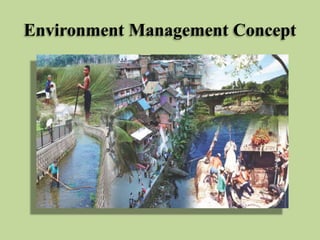
Environment Management Concept
• In this new millennium organizations are
rapidly changing their structures, systems,
work processes and activities. This changing
environment calls for enterprising managers
to manage and respond to the changes in an
appropriate manner. It is therefore, necessary
for them to develop a clear focus and
direction to facilitate decision making
process.
Environment Management Concept
• The emerging trends that characterize this
millennium are:
• An era of information revolution, which has
influenced the new economy.
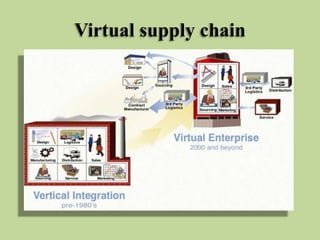
• The traditional supply chain are fast disappearing
paving way to new virtual supply chain. This
change calls for an entire revamping of the
internal process.
• The relationship among organizations, their
customers, suppliers and manufacturers is also
undergoing a drastic change.
Era of Information Revolution
Virtual supply chain
Environment Management Concept
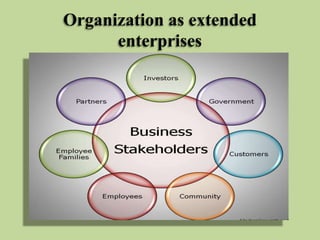
• Organization are becoming extended enterprises.
The idea of extended enterprise with the focus on
supply chain management will become the standard
for assessing performance in future.
• There is an increasing concern about the environment
performance and reporting practices. There is also a
move to towards looking at the environment
performance as competitive advantage. There is an
increase in demand from the stalk holders for
environmentally responsible behavior across the
globe.
Organization as extended
enterprises
Environment Management Concept
Environmental Problems and growing concern about
them.
It is no longer possible to ignore the needs of the society
and quite appropriately management education must
address new areas of interest.
In light of this, issues concerning protection, conservation
and management of the physical environment are to be
addressed with a view to impart knowledge, increasing
awareness and developing the required skills to solve
environmental problems. This area of action affects almost
all sectors and therefore, calls for action from people all
over the world.
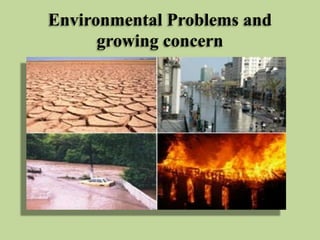
Environmental Problems and
growing concern
Environment Management Concept
• Every activity generates unavoidable
environmental impact of some kind or the
other, but the ability of people and societies to
adapt themselves to and cope with the change
is varied.
Environment Management Concept
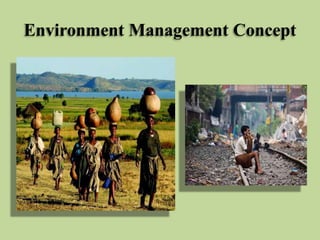
• People in developing countries particularly
in the less developed countries, have less
capacity to adapt to change and are more
vulnerable to environmental threats and the
global change. Therefore they need to bear a
disproportionate burden of the impact of
disasters, conflicts, drought, desertification
and pollution.
Environment Management Concept
• Deterioration of environmental conditions is
a major contributing factor to poor health and a
reduced quality of life.
Environment Management Concept
• The importance of prevention of the environment
and respect for nature from underlying
principles of various developing countries.
• While environmental conservation may have
been a part of cultural and religious heritage of
many developing societies, consideration has
generally been of most recent origin, certainly
not more than two decades.
Environment Management Concept
• The essence of man’s attitude to nature in India
is characterized by harmony. Lack of
awareness of the laws and forces of nature
that keep the ecological balance leads to
improper behavioral patters which result in
environmental problems.
Environment Management Concept
• The element of sustainability implies
enjoying the boundaries of nature without
prevailing over it. As exploitation starts, we
cease to utilize nature for our good, and for
the benefit and the welfare of our fellow
human being.
Environment Management Concept
• There are two basic reasons for our concern with
environmental pollution
• (i) Human health and welfare
• (ii)Sustenance and survival of mankind,
Environmental contamination and the impact on
human life is already well known.
• Only the coping mechanism have undergone
changes due to increase in awareness and the
tremendous pressure of population increase on the
environmental resources.
Environment Management Concept
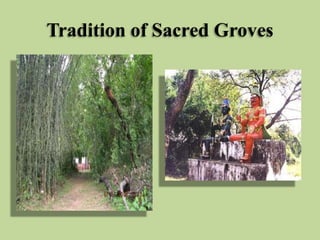
• The ancient civilizations had imposed self
restrictions to avoid different forms of
pollution, by religious and other spiritual
bondages, and not necessarily through legal
measures.
Spiritual Bondages
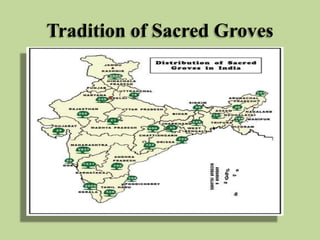
Tradition of Sacred Groves
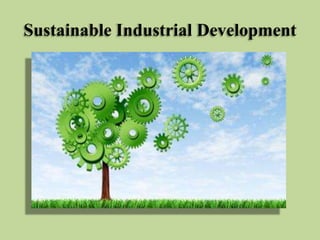
Sustainable Industrial Development
• The concept of sustainable development broadly
means that the development initiatives be initiated in
such a way that the future generations can enjoy the
benefits of nature without any compromise.
• The importance elements in the attempts to achieve
sustainability have been on
• Regulation
• Consumer awareness
• Companies solution of end of pipe problems
• Companies green product development.
Sustainable Industrial Development
• The concept of sustainable development
facilitates good and sound economic growth,
that can be maintained with minimum
environmental impact. It provides a
continuous monitoring emphasis as the
approach itself calls for overall sustainable
orientation.
Sustainable Industrial Development
• The factors that can promote sustainable
development are as follows
• Population stabilization and health care
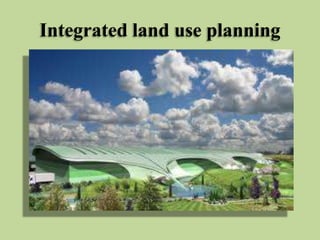
• Integrated land use planning and watershed
management, ensuring availability of adequate
area for use as cropland, woodland, and
grassland, for fuel, timber, and fodder.
Integrated land use planning
Sustainable Industrial Development
• Revegitation marginal land and greening the
uncultivated area.
• Water pollution control in rivers
• Air pollution control in industrial pockets
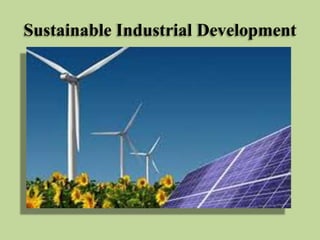
• Use of non-polluting renewable energies.
• Waste recycling and reuse.
• Conservation of biological diversity
• Human settlement without congestion
• Slum improvement
• Environmental education awareness.
Sustainable Industrial Development
• To develop more sustainable societies, Industry, need
to better understand how to respond to
environmental, social and economic challenges
and transform industrial behaviour.
• Improving environmental performance without
changing current products and processes,
• Developing and introducing new technologies, and
Changing the industrial system.
Triple bottom line Concept
• In traditional business accounting, the
"bottom line" refers to the sum of revenue
minus expenses, which is either "loss" if
negative, or "profit" if positive.
• The term originated because profit is always
shown as the very "bottom line" on a
statement of revenue and expenses.
Triple bottom line Concept
• Over the last 50 years, environmentalists and
social justice advocates have struggled to bring
a broader definition of "bottom line" into
public consciousness, by introducing full cost
accounting.
• For example, if a corporation shows a monetary
profit, but their asbestos mine causes
thousands of deaths from asbestosis, and their
copper mine pollutes a river, and the
government ends up spending taxpayer money
on health care and river clean-up, how do we
perform a full societal cost benefit analysis?
Triple bottom line Concept
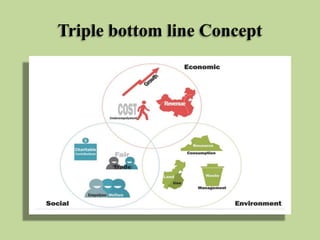
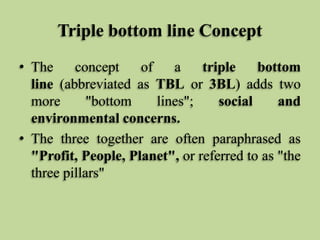
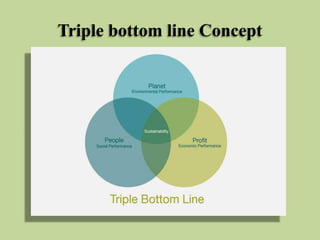
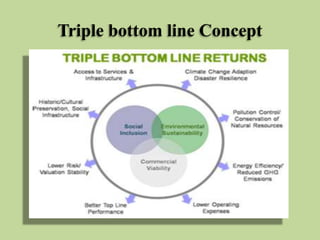
• The
concept
of
a
triple
bottom
line (abbreviated as TBL or 3BL) adds two
more
"bottom
lines";
social
and
environmental concerns.
• The three together are often paraphrased as
"Profit, People, Planet", or referred to as "the
three pillars"
Triple bottom line Concept
• With the ratification of the United
Nations, TBL standard for urban and
community
accounting
became
the
dominant approach to public sector full cost
accounting.
Triple bottom line Concept
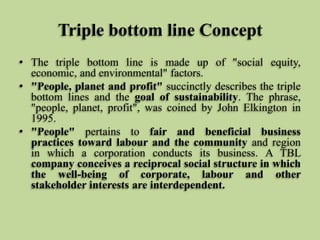
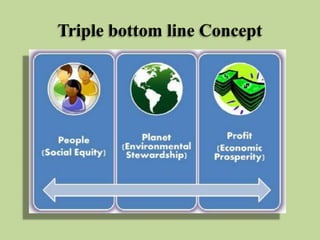
• The triple bottom line is made up of "social equity,
economic, and environmental" factors.
• "People, planet and profit" succinctly describes the triple
bottom lines and the goal of sustainability. The phrase,
"people, planet, profit", was coined by John Elkington in
1995.
• "People" pertains to fair and beneficial business
practices toward labour and the community and region
in which a corporation conducts its business. A TBL
company conceives a reciprocal social structure in which
the well-being of corporate, labour and other
stakeholder interests are interdependent.
Triple bottom line Concept
• A triple bottom line enterprise seeks to benefit
many constituencies, not exploit or endanger
any group of them. The "upstreaming" of a
portion of profit from the marketing of
finished goods back to the original producer of
raw materials, for example, a farmer in fair
trade agricultural practice, is a common
feature.
Triple bottom line Concept
• In concrete terms, a TBL business would not
use child labour and monitor all contracted
companies for child labour exploitation,
would pay fair salaries to its workers, would
maintain a safe work environment and
tolerable working hours, and would not
otherwise exploit a community or its labour
force.
Triple bottom line Concept
• A TBL business also typically seeks to "give
back" by contributing to the strength and
growth of its community with such things as
health care and education. Quantifying this
bottom line is relatively new, problematic and
often subjective.
Triple bottom line Concept
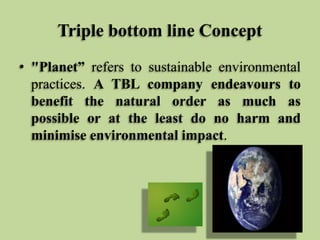
• "Planet” refers to sustainable environmental
practices. A TBL company endeavours to
benefit the natural order as much as
possible or at the least do no harm and
minimise environmental impact.
Triple bottom line Concept
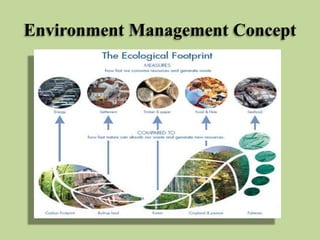
• A TBL endeavour reduces its ecological
footprint by, among other things, carefully
managing its consumption of energy and
non-renewables
and
reducing
manufacturing waste as well as rendering
waste less toxic before disposing of it in a
safe and legal manner.
Triple bottom line Concept
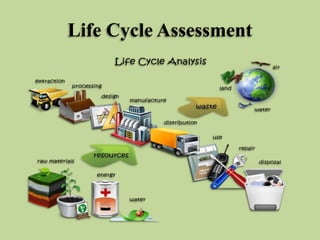
• "Cradle to Grave" is uppermost in the thoughts of
TBL manufacturing businesses, which typically
conduct a life cycle assessment of products to
determine what the true environmental cost is from
the growth and harvesting of raw materials to
manufacture to distribution to eventual disposal by
the end user.
• A triple bottom line company does not produce
harmful or destructive products such as weapons,
toxic chemicals or batteries containing dangerous
heavy metals, for example.
Life Cycle Assessment
Triple bottom line Concept
• Currently, the cost of disposing of nondegradable or toxic products is borne
financially
by
governments
and
environmentally by the residents near the
disposal site and elsewhere. In TBL thinking, an
enterprise which produces and markets a product
which will create a waste problem should not be
given a free ride by society. It would be more
equitable for the business which manufactures
and sells a problematic product to bear part of
the cost of its ultimate disposal.
Triple bottom line Concept
• Ecologically destructive practices, such as overfishing
or other endangering depletions of resources are
avoided by TBL companies.
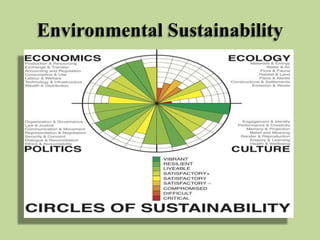
• Often environmental sustainability is the more
profitable course for a business in the long run.
Arguments that it costs more to be environmentally
sound are often specious when the course of the
business is analyzed over a period of time.
• Generally, sustainability reporting metrics are better
quantified and standardized for environmental
issues than for social ones.
Environmental Sustainability
Triple bottom line Concept
• "Profit" is the economic value created by the
organization after deducting the cost of all
inputs, including the cost of the capital tied
up. It therefore differs from traditional
accounting definitions of profit.
• In the original concept, within a sustainability
framework, the "profit" aspect needs to be
seen as the real economic benefit enjoyed by
the host society.
Triple bottom line Concept
• It is the real economic impact the organization has
on its economic environment. This is often
confused to be limited to the internal profit
made by a company or organization (which
nevertheless remains an essential starting point
for the computation). Therefore, an original
TBL approach cannot be interpreted as simply
traditional
corporate
accounting
profit plus social and environmental impacts
unless the "profits" of other entities are
included as a social benefit.
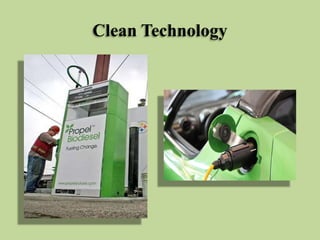
Clean Technology
Clean Technology
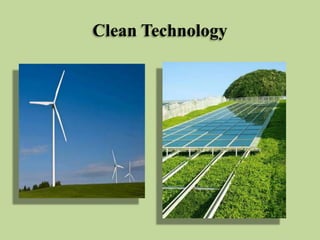
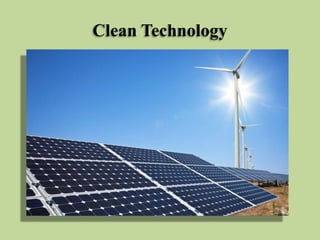
• Includes recycling, renewable energy
(wind
power, solar power, biomass, hydropower, bio-fuels
),
• Information
technology,
green
transportation,
electric
motors,
green
chemistry, lighting, Grey-water, and many other
appliances that are now more energy efficient.
Clean Technology
Clean Technology
• It is a means to create electricity and fuels,
with a smaller environmental footprint and
minimise pollution.
• Environmental finance is a method by which
new clean technology projects that has
proven that they are "additional" or
"beyond business as usual" can obtain
financing through the generation of carbon
credits.
Clean Technology
• While there is no standard definition of
“Clean Technology" it has been described
by Clean Edge, a clean technology research
firm, as "a diverse range of products,
services, and processes that harness
renewable materials and energy sources,
dramatically reduce the use of natural
resources, and cut or eliminate emissions
and wastes."
Clean Technology
Clean Technology
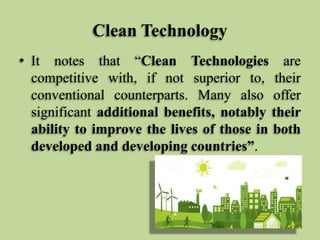
• It notes that “Clean Technologies are
competitive with, if not superior to, their
conventional counterparts. Many also offer
significant additional benefits, notably their
ability to improve the lives of those in both
developed and developing countries”.
Clean Technology
Clean Technology
• Investments in clean technology have grown
considerably since coming into the spotlight
around 2000.
• Overall, investment in clean-energy and
energy-efficiency industries rose 60 percent
from 2006 to 2007. By 2018 it is forecast that
the three main clean technology sectors,
solar photo-voltaics, wind power, and biofuels, will have revenues of $325.1bn
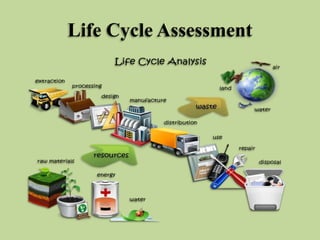
Life-Cycle Assessment
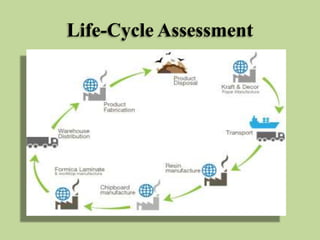
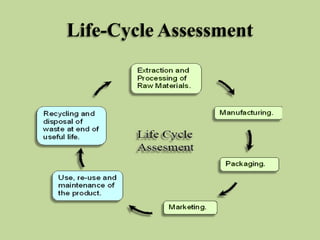
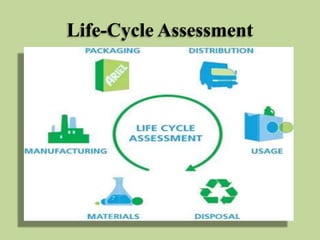
• Life-Cycle Assessment (LCA, also known
as
life-cycle
analysis,
eco-balance,
and cradle-to-grave analysis) is a technique
to assess environmental impacts associated
with all the stages of a product's life fromcradle-to-grave (i.e. from raw material
extraction through materials processing,
manufacture, distribution, use, repair and
maintenance, and disposal or recycling).
Life Cycle Assessment
Life-Cycle Assessment
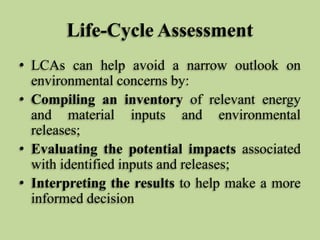
• LCAs can help avoid a narrow outlook on
environmental concerns by:
• Compiling an inventory of relevant energy
and material inputs and environmental
releases;
• Evaluating the potential impacts associated
with identified inputs and releases;
• Interpreting the results to help make a more
informed decision
Life-Cycle Assessment
• The goal of LCA is to compare the full
range of environmental effects assignable to
products and services in order to improve
processes, support policy and provide a sound
basis for informed decisions.
Life-Cycle Assessment
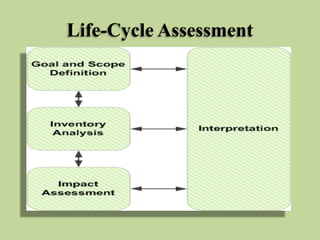
• Life Cycle Assessment is carried out in four
distinct phases. The phases are often
interdependent in that the results of one phase
will inform how other phases are completed.
Life-Cycle Assessment
Goal and Scope
• An LCA starts with an explicit statement of the
goal and scope of the study, which sets out the
context of the study and explains how and to
whom the results are to be communicated.
• the functional unit, which defines what precisely
is being studied and quantifies the service
delivered by the product system, providing a
reference to which the inputs and outputs can be
related.
Life Cycle Inventory
• Life Cycle Inventory (LCI) analysis involves
creating an inventory of flows from and to
nature for a product system. Inventory flows
include inputs of water, energy, and raw
materials, and releases to air, land, and water.
Life Cycle Impact Assessment
• Inventory analysis is followed by impact
assessment. This phase of LCA is aimed at
evaluating the significance of potential
environmental impacts based on the LCI
flow results.
Life Cycle Impact Assessment
Interpretation
• The results from the inventory analysis and
impact assessment are summarized during
the interpretation phase. The outcome of the
interpretation phase is a set of conclusions and
recommendations for the study.
Life-Cycle Assessment
Green Marketing
• Green marketing is the marketing of products
that are presumed to be environmentally
safe. Thus green marketing incorporates a
broad range of activities, including product
modification, changes to the production
process, packaging changes, as well as
modifying advertising.
Green Marketing
Green Marketing
• Green, Environmental and eco-marketing are
part of the new marketing approaches which
do not just refocus, adjust or enhance
existing marketing thinking and practice,
but seek to challenge those approaches and
provide a substantially different perspective.
Green Marketing
Green Marketing
• A model green marketing mix contains four
"P's":
• Product: A producer should offer ecological
products which not only must not contaminate
the environment but should protect it and even
liquidate existing environmental damages.
• Price: Prices for such products may be a little
higher than conventional alternatives. But
target groups are willing to pay extra for green
products.
Green Marketing
• Place: A distribution logistics is of crucial
importance; main focus is on ecological
packaging. Marketing local and seasonal
products e.g. vegetables from regional farms
is more easy to be marketed “green” than
products imported.
Green Marketing
• Promotion: A communication with the market should
put stress on environmental aspects, for example that
the company possesses or is a ISO 14000 certified.
This may be publicized to improve a firm’s image.
• Furthermore, the fact that a company spends
expenditures on environmental protection should be
advertised.
References
Environmental Management
Bala Krishnamoorthy- PHI publication
Wikipedia- The online free Encyclopedia
Thanks …

Corporate Environment Management Strategies

  • 1.
  • 2.
    Syllabus • Concept of strategic environmental management withexamples, sustainable industrial development, triple bottom line concept, cleaner technologies, life cycle analysis, green marketing.
  • 3.
    Environment Management Concept •In this new millennium organizations are rapidly changing their structures, systems, work processes and activities. This changing environment calls for enterprising managers to manage and respond to the changes in an appropriate manner. It is therefore, necessary for them to develop a clear focus and direction to facilitate decision making process.
  • 4.
  • 5.
    Environment Management Concept •The emerging trends that characterize this millennium are: • An era of information revolution, which has influenced the new economy. • The traditional supply chain are fast disappearing paving way to new virtual supply chain. This change calls for an entire revamping of the internal process. • The relationship among organizations, their customers, suppliers and manufacturers is also undergoing a drastic change.
  • 6.
  • 7.
  • 8.
    Environment Management Concept •Organization are becoming extended enterprises. The idea of extended enterprise with the focus on supply chain management will become the standard for assessing performance in future. • There is an increasing concern about the environment performance and reporting practices. There is also a move to towards looking at the environment performance as competitive advantage. There is an increase in demand from the stalk holders for environmentally responsible behavior across the globe.
  • 9.
  • 10.
    Environment Management Concept EnvironmentalProblems and growing concern about them. It is no longer possible to ignore the needs of the society and quite appropriately management education must address new areas of interest. In light of this, issues concerning protection, conservation and management of the physical environment are to be addressed with a view to impart knowledge, increasing awareness and developing the required skills to solve environmental problems. This area of action affects almost all sectors and therefore, calls for action from people all over the world.
  • 11.
  • 12.
    Environment Management Concept •Every activity generates unavoidable environmental impact of some kind or the other, but the ability of people and societies to adapt themselves to and cope with the change is varied.
  • 13.
    Environment Management Concept •People in developing countries particularly in the less developed countries, have less capacity to adapt to change and are more vulnerable to environmental threats and the global change. Therefore they need to bear a disproportionate burden of the impact of disasters, conflicts, drought, desertification and pollution.
  • 14.
  • 15.
    Environment Management Concept •Deterioration of environmental conditions is a major contributing factor to poor health and a reduced quality of life.
  • 16.
    Environment Management Concept •The importance of prevention of the environment and respect for nature from underlying principles of various developing countries. • While environmental conservation may have been a part of cultural and religious heritage of many developing societies, consideration has generally been of most recent origin, certainly not more than two decades.
  • 17.
  • 18.
    Environment Management Concept •The essence of man’s attitude to nature in India is characterized by harmony. Lack of awareness of the laws and forces of nature that keep the ecological balance leads to improper behavioral patters which result in environmental problems.
  • 19.
    Environment Management Concept •The element of sustainability implies enjoying the boundaries of nature without prevailing over it. As exploitation starts, we cease to utilize nature for our good, and for the benefit and the welfare of our fellow human being.
  • 20.
  • 21.
    Environment Management Concept •There are two basic reasons for our concern with environmental pollution • (i) Human health and welfare • (ii)Sustenance and survival of mankind, Environmental contamination and the impact on human life is already well known. • Only the coping mechanism have undergone changes due to increase in awareness and the tremendous pressure of population increase on the environmental resources.
  • 22.
    Environment Management Concept •The ancient civilizations had imposed self restrictions to avoid different forms of pollution, by religious and other spiritual bondages, and not necessarily through legal measures.
  • 23.
  • 24.
  • 25.
  • 26.
    Sustainable Industrial Development •The concept of sustainable development broadly means that the development initiatives be initiated in such a way that the future generations can enjoy the benefits of nature without any compromise. • The importance elements in the attempts to achieve sustainability have been on • Regulation • Consumer awareness • Companies solution of end of pipe problems • Companies green product development.
  • 27.
  • 28.
    Sustainable Industrial Development •The concept of sustainable development facilitates good and sound economic growth, that can be maintained with minimum environmental impact. It provides a continuous monitoring emphasis as the approach itself calls for overall sustainable orientation.
  • 29.
    Sustainable Industrial Development •The factors that can promote sustainable development are as follows • Population stabilization and health care • Integrated land use planning and watershed management, ensuring availability of adequate area for use as cropland, woodland, and grassland, for fuel, timber, and fodder.
  • 30.
  • 31.
    Sustainable Industrial Development •Revegitation marginal land and greening the uncultivated area. • Water pollution control in rivers • Air pollution control in industrial pockets • Use of non-polluting renewable energies. • Waste recycling and reuse. • Conservation of biological diversity • Human settlement without congestion • Slum improvement • Environmental education awareness.
  • 32.
  • 33.
    Sustainable Industrial Development •To develop more sustainable societies, Industry, need to better understand how to respond to environmental, social and economic challenges and transform industrial behaviour. • Improving environmental performance without changing current products and processes, • Developing and introducing new technologies, and Changing the industrial system.
  • 34.
    Triple bottom lineConcept • In traditional business accounting, the "bottom line" refers to the sum of revenue minus expenses, which is either "loss" if negative, or "profit" if positive. • The term originated because profit is always shown as the very "bottom line" on a statement of revenue and expenses.
  • 35.
  • 36.
    Triple bottom lineConcept • Over the last 50 years, environmentalists and social justice advocates have struggled to bring a broader definition of "bottom line" into public consciousness, by introducing full cost accounting. • For example, if a corporation shows a monetary profit, but their asbestos mine causes thousands of deaths from asbestosis, and their copper mine pollutes a river, and the government ends up spending taxpayer money on health care and river clean-up, how do we perform a full societal cost benefit analysis?
  • 37.
    Triple bottom lineConcept • The concept of a triple bottom line (abbreviated as TBL or 3BL) adds two more "bottom lines"; social and environmental concerns. • The three together are often paraphrased as "Profit, People, Planet", or referred to as "the three pillars"
  • 38.
  • 39.
    Triple bottom lineConcept • With the ratification of the United Nations, TBL standard for urban and community accounting became the dominant approach to public sector full cost accounting.
  • 40.
    Triple bottom lineConcept • The triple bottom line is made up of "social equity, economic, and environmental" factors. • "People, planet and profit" succinctly describes the triple bottom lines and the goal of sustainability. The phrase, "people, planet, profit", was coined by John Elkington in 1995. • "People" pertains to fair and beneficial business practices toward labour and the community and region in which a corporation conducts its business. A TBL company conceives a reciprocal social structure in which the well-being of corporate, labour and other stakeholder interests are interdependent.
  • 41.
  • 42.
    Triple bottom lineConcept • A triple bottom line enterprise seeks to benefit many constituencies, not exploit or endanger any group of them. The "upstreaming" of a portion of profit from the marketing of finished goods back to the original producer of raw materials, for example, a farmer in fair trade agricultural practice, is a common feature.
  • 43.
  • 44.
    Triple bottom lineConcept • In concrete terms, a TBL business would not use child labour and monitor all contracted companies for child labour exploitation, would pay fair salaries to its workers, would maintain a safe work environment and tolerable working hours, and would not otherwise exploit a community or its labour force.
  • 45.
    Triple bottom lineConcept • A TBL business also typically seeks to "give back" by contributing to the strength and growth of its community with such things as health care and education. Quantifying this bottom line is relatively new, problematic and often subjective.
  • 46.
    Triple bottom lineConcept • "Planet” refers to sustainable environmental practices. A TBL company endeavours to benefit the natural order as much as possible or at the least do no harm and minimise environmental impact.
  • 47.
    Triple bottom lineConcept • A TBL endeavour reduces its ecological footprint by, among other things, carefully managing its consumption of energy and non-renewables and reducing manufacturing waste as well as rendering waste less toxic before disposing of it in a safe and legal manner.
  • 48.
    Triple bottom lineConcept • "Cradle to Grave" is uppermost in the thoughts of TBL manufacturing businesses, which typically conduct a life cycle assessment of products to determine what the true environmental cost is from the growth and harvesting of raw materials to manufacture to distribution to eventual disposal by the end user. • A triple bottom line company does not produce harmful or destructive products such as weapons, toxic chemicals or batteries containing dangerous heavy metals, for example.
  • 49.
  • 50.
    Triple bottom lineConcept • Currently, the cost of disposing of nondegradable or toxic products is borne financially by governments and environmentally by the residents near the disposal site and elsewhere. In TBL thinking, an enterprise which produces and markets a product which will create a waste problem should not be given a free ride by society. It would be more equitable for the business which manufactures and sells a problematic product to bear part of the cost of its ultimate disposal.
  • 51.
    Triple bottom lineConcept • Ecologically destructive practices, such as overfishing or other endangering depletions of resources are avoided by TBL companies. • Often environmental sustainability is the more profitable course for a business in the long run. Arguments that it costs more to be environmentally sound are often specious when the course of the business is analyzed over a period of time. • Generally, sustainability reporting metrics are better quantified and standardized for environmental issues than for social ones.
  • 52.
  • 53.
    Triple bottom lineConcept • "Profit" is the economic value created by the organization after deducting the cost of all inputs, including the cost of the capital tied up. It therefore differs from traditional accounting definitions of profit. • In the original concept, within a sustainability framework, the "profit" aspect needs to be seen as the real economic benefit enjoyed by the host society.
  • 54.
    Triple bottom lineConcept • It is the real economic impact the organization has on its economic environment. This is often confused to be limited to the internal profit made by a company or organization (which nevertheless remains an essential starting point for the computation). Therefore, an original TBL approach cannot be interpreted as simply traditional corporate accounting profit plus social and environmental impacts unless the "profits" of other entities are included as a social benefit.
  • 55.
    Clean Technology Clean Technology •Includes recycling, renewable energy (wind power, solar power, biomass, hydropower, bio-fuels ), • Information technology, green transportation, electric motors, green chemistry, lighting, Grey-water, and many other appliances that are now more energy efficient.
  • 56.
  • 57.
    Clean Technology • Itis a means to create electricity and fuels, with a smaller environmental footprint and minimise pollution. • Environmental finance is a method by which new clean technology projects that has proven that they are "additional" or "beyond business as usual" can obtain financing through the generation of carbon credits.
  • 58.
    Clean Technology • Whilethere is no standard definition of “Clean Technology" it has been described by Clean Edge, a clean technology research firm, as "a diverse range of products, services, and processes that harness renewable materials and energy sources, dramatically reduce the use of natural resources, and cut or eliminate emissions and wastes."
  • 59.
  • 60.
    Clean Technology • Itnotes that “Clean Technologies are competitive with, if not superior to, their conventional counterparts. Many also offer significant additional benefits, notably their ability to improve the lives of those in both developed and developing countries”.
  • 61.
  • 62.
    Clean Technology • Investmentsin clean technology have grown considerably since coming into the spotlight around 2000. • Overall, investment in clean-energy and energy-efficiency industries rose 60 percent from 2006 to 2007. By 2018 it is forecast that the three main clean technology sectors, solar photo-voltaics, wind power, and biofuels, will have revenues of $325.1bn
  • 63.
    Life-Cycle Assessment • Life-CycleAssessment (LCA, also known as life-cycle analysis, eco-balance, and cradle-to-grave analysis) is a technique to assess environmental impacts associated with all the stages of a product's life fromcradle-to-grave (i.e. from raw material extraction through materials processing, manufacture, distribution, use, repair and maintenance, and disposal or recycling).
  • 64.
  • 65.
    Life-Cycle Assessment • LCAscan help avoid a narrow outlook on environmental concerns by: • Compiling an inventory of relevant energy and material inputs and environmental releases; • Evaluating the potential impacts associated with identified inputs and releases; • Interpreting the results to help make a more informed decision
  • 66.
  • 67.
    Life-Cycle Assessment • Thegoal of LCA is to compare the full range of environmental effects assignable to products and services in order to improve processes, support policy and provide a sound basis for informed decisions.
  • 68.
  • 69.
    Life-Cycle Assessment • LifeCycle Assessment is carried out in four distinct phases. The phases are often interdependent in that the results of one phase will inform how other phases are completed.
  • 70.
  • 71.
    Goal and Scope •An LCA starts with an explicit statement of the goal and scope of the study, which sets out the context of the study and explains how and to whom the results are to be communicated. • the functional unit, which defines what precisely is being studied and quantifies the service delivered by the product system, providing a reference to which the inputs and outputs can be related.
  • 72.
    Life Cycle Inventory •Life Cycle Inventory (LCI) analysis involves creating an inventory of flows from and to nature for a product system. Inventory flows include inputs of water, energy, and raw materials, and releases to air, land, and water.
  • 73.
    Life Cycle ImpactAssessment • Inventory analysis is followed by impact assessment. This phase of LCA is aimed at evaluating the significance of potential environmental impacts based on the LCI flow results.
  • 74.
    Life Cycle ImpactAssessment Interpretation • The results from the inventory analysis and impact assessment are summarized during the interpretation phase. The outcome of the interpretation phase is a set of conclusions and recommendations for the study.
  • 75.
  • 76.
    Green Marketing • Greenmarketing is the marketing of products that are presumed to be environmentally safe. Thus green marketing incorporates a broad range of activities, including product modification, changes to the production process, packaging changes, as well as modifying advertising.
  • 77.
  • 78.
    Green Marketing • Green,Environmental and eco-marketing are part of the new marketing approaches which do not just refocus, adjust or enhance existing marketing thinking and practice, but seek to challenge those approaches and provide a substantially different perspective.
  • 79.
  • 80.
    Green Marketing • Amodel green marketing mix contains four "P's": • Product: A producer should offer ecological products which not only must not contaminate the environment but should protect it and even liquidate existing environmental damages. • Price: Prices for such products may be a little higher than conventional alternatives. But target groups are willing to pay extra for green products.
  • 81.
    Green Marketing • Place:A distribution logistics is of crucial importance; main focus is on ecological packaging. Marketing local and seasonal products e.g. vegetables from regional farms is more easy to be marketed “green” than products imported.
  • 82.
    Green Marketing • Promotion:A communication with the market should put stress on environmental aspects, for example that the company possesses or is a ISO 14000 certified. This may be publicized to improve a firm’s image. • Furthermore, the fact that a company spends expenditures on environmental protection should be advertised.
  • 83.
    References Environmental Management Bala Krishnamoorthy-PHI publication Wikipedia- The online free Encyclopedia
  • 84.