SEMINAR
ON
ENTROPY
CONTENTS
• INTRODUCTION
• VARIOUS TYPE OF DISORDER
• EXAMPLES OF DISORDER
• DEFINITION AND EXPRESSION OF ENTROPY
• IMPORTANCE OF ENTROPY IN GEOCHEMICAL
THERMODYNAMICS
• APPLICATION OF ENTROPY
• CONCUSION
• REFERENCE
INTRODUCTION
What is entropy?
 The word entropy is sometimes confused with energy.
Although they are related quantities, they are distinct.
 or energy measures the capability of an object or system
to do work.
 on the other hand, is a measure of the "disorder" of a
system. What "disorder refers to is really the number of
different microscopic states a system can be in, given that the
system has a particular fixed composition, volume, energy,
pressure, and temperature. By "microscopic states", we mean
the exact states of all the molecules making up the system.
Entropy = (Boltzmann's constant k) x logarithm of number of
possible states
= k log(N).
Entropy - thermodynamic property-- a
quantitative measure of disorder
Entropy traces out its origin –molecular
movement interpretation-Rudolf Clausias in
1850
The concept of entropy -thermodynamic
laws(i.e. the 2nd law of thermodynamics)
It can be visualised due to the process of
expansion, heating, mixing and reaction.
Entropy is associated with heat and
temperature.
Entropy-reflects the degree of disorderness.
Diorderness can be pointed out in three different
types. They are:
Positional disorder
whether the atoms are free to move or not
Vibrational disorder(thermal disorder)
whether the atoms vibrate about an
average position
Configurational disorder
this refers to the distribution of different
atoms or sites in lattice.
Various types of disorder
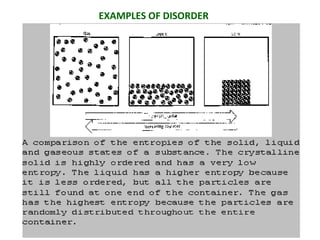
EXAMPLES OF DISORDER
 This is one
example of
entropy
 Box 1-less
entropy
 Box 2-more
entropy
Box-1
Box-2
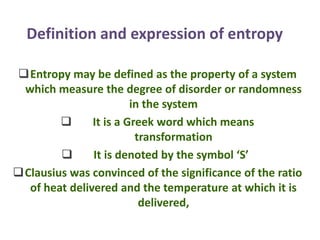
Definition and expression of entropy
Entropy may be defined as the property of a system
which measure the degree of disorder or randomness
in the system
 It is a Greek word which means
transformation
 It is denoted by the symbol ‘S’
Clausius was convinced of the significance of the ratio
of heat delivered and the temperature at which it is
delivered,
Entropy is the sum total of entropy due to
positional disorder, vibrational disorder and
configurational disorder. i.e randomness due to
change of state
S=sp+st+sc
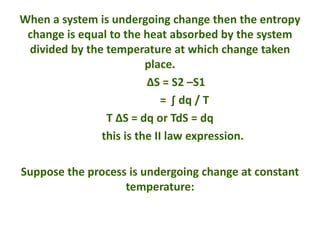
When a system is undergoing change then the entropy
change is equal to the heat absorbed by the system
divided by the temperature at which change taken
place.
ΔS = S2 –S1
= ∫ dq / T
T ΔS = dq or TdS = dq
this is the II law expression.
Suppose the process is undergoing change at constant
temperature:
From I Law we know that
ΔE = q – w or dE = dq – dw or dE = dq – PdV
At constant temperature ΔE = 0, therefore dq =
PdV.
From II law we know that dq = TdS ,
Substituting this in the above we get,
Tds = Pdv
ΔS = PdV / T,
Suppose the process is undergoing change at constant pressure
condition then:
T ΔS = (q)p -
but we know that (q)p = CpdT
T ΔS = Cp dT,
Or TdS = Cp dT
By integration,
1∫2dS = 1∫2 Cp dT /T
S2 – S1 = Δ Cp ln (T2 / T1)
This is the entropy change of the system at constant pressure condition
from room temperature to the reaction temperature.
Importance of entropy in
geochemical thermodynamics
The aim of the thermodynamics in geochemical
term is to generate a set of properties, which helps
us to predict the direction of chemical processes.
The 2nd law starts with simplest term is that there is
an increase in entropy in every natural processes.
The degree of order or disorder in a system may be
described in terms of the probability or
improbability of the observed state,
 With the statistical conception of entropy, the possible
application to geochemical systems become recognisable,
 For e.g.- the distribution of energy in geomorphic system is
one way of expressing the relative elevation of particle of
water and sediments etc. in the evolution of landscape.
 It is noted that all natural processes are spontaneous,
unidirectional –where there is increase in randomness.
 Thus this disorderness in the geochemical processes can be
determined by the concept of entropy
Applications of entropy
Thermobarometric models
Experimental work in the mineralogy,
petrology etc.
Thermobarometric models are various
thermodynamic formulas or equation by
which pressure temperature are determined,
The model is calibrated through
experimental techniques
Thus entropy is applied in the model to
measure the disorderness of the system
through temperature , pressure of the
rock.
Thermobarometry is thus an excellent
case study when the application of
the thermodynamic parameters are
involved
Conclusion
Entropy is the thermodynamic property which is
the measure of disorder in a system.
It can be expresses by ‘S’=q/t
The term is coined by Rudolf Clausius.
Entropy is mainly associated with heat and
temperature.
Disorder can be of 3 types- Positional, Vibrational
and Configurational
Thermobarometric models is an excellent case
study when the application of thermodynamic
parameters are involved.
It can also be concluded that-
(a) when heat is transferred at a high temperature,
entropy change is small whereas when heat is
transferred at low temperature, entropy change
is greater.
(b) When heat is supplied-entropy increases and
when heat is removed- entropy decreases
Entropy is not perceptible to our sense and there is
no such instrument to measure its effect. Only
changes in entropy can be determined by
computations.
It is usually determined from some specified
arbitrary datum of temperature only.
References
 Alok K.Gupta and Sisir K. Sen, a short course on elementary
thermodynamics for earth scientist,96
 Guirlo Ottonello, principles of geochemistry, Columbia University press,
New York, 1893, 151
 Roger Powell, equilibrium thermodynamics in petrology,Hasper and
row publishers, pp 231-232
 W.M White, geochemistry, 2007, pp 44-54
 www.google.com
 www.wikepedia.org
entropy-170828073801.pdf

entropy-170828073801.pdf

  • 1.
  • 2.
    CONTENTS • INTRODUCTION • VARIOUSTYPE OF DISORDER • EXAMPLES OF DISORDER • DEFINITION AND EXPRESSION OF ENTROPY • IMPORTANCE OF ENTROPY IN GEOCHEMICAL THERMODYNAMICS • APPLICATION OF ENTROPY • CONCUSION • REFERENCE
  • 3.
    INTRODUCTION What is entropy? The word entropy is sometimes confused with energy. Although they are related quantities, they are distinct.  or energy measures the capability of an object or system to do work.  on the other hand, is a measure of the "disorder" of a system. What "disorder refers to is really the number of different microscopic states a system can be in, given that the system has a particular fixed composition, volume, energy, pressure, and temperature. By "microscopic states", we mean the exact states of all the molecules making up the system. Entropy = (Boltzmann's constant k) x logarithm of number of possible states = k log(N).
  • 4.
    Entropy - thermodynamicproperty-- a quantitative measure of disorder Entropy traces out its origin –molecular movement interpretation-Rudolf Clausias in 1850 The concept of entropy -thermodynamic laws(i.e. the 2nd law of thermodynamics) It can be visualised due to the process of expansion, heating, mixing and reaction. Entropy is associated with heat and temperature.
  • 5.
    Entropy-reflects the degreeof disorderness. Diorderness can be pointed out in three different types. They are: Positional disorder whether the atoms are free to move or not Vibrational disorder(thermal disorder) whether the atoms vibrate about an average position Configurational disorder this refers to the distribution of different atoms or sites in lattice. Various types of disorder
  • 6.
  • 7.
     This isone example of entropy  Box 1-less entropy  Box 2-more entropy Box-1 Box-2
  • 8.
    Definition and expressionof entropy Entropy may be defined as the property of a system which measure the degree of disorder or randomness in the system  It is a Greek word which means transformation  It is denoted by the symbol ‘S’ Clausius was convinced of the significance of the ratio of heat delivered and the temperature at which it is delivered,
  • 9.
    Entropy is thesum total of entropy due to positional disorder, vibrational disorder and configurational disorder. i.e randomness due to change of state S=sp+st+sc
  • 10.
    When a systemis undergoing change then the entropy change is equal to the heat absorbed by the system divided by the temperature at which change taken place. ΔS = S2 –S1 = ∫ dq / T T ΔS = dq or TdS = dq this is the II law expression. Suppose the process is undergoing change at constant temperature:
  • 11.
    From I Lawwe know that ΔE = q – w or dE = dq – dw or dE = dq – PdV At constant temperature ΔE = 0, therefore dq = PdV. From II law we know that dq = TdS , Substituting this in the above we get, Tds = Pdv ΔS = PdV / T,
  • 12.
    Suppose the processis undergoing change at constant pressure condition then: T ΔS = (q)p - but we know that (q)p = CpdT T ΔS = Cp dT, Or TdS = Cp dT By integration, 1∫2dS = 1∫2 Cp dT /T S2 – S1 = Δ Cp ln (T2 / T1) This is the entropy change of the system at constant pressure condition from room temperature to the reaction temperature.
  • 13.
    Importance of entropyin geochemical thermodynamics The aim of the thermodynamics in geochemical term is to generate a set of properties, which helps us to predict the direction of chemical processes. The 2nd law starts with simplest term is that there is an increase in entropy in every natural processes. The degree of order or disorder in a system may be described in terms of the probability or improbability of the observed state,
  • 14.
     With thestatistical conception of entropy, the possible application to geochemical systems become recognisable,  For e.g.- the distribution of energy in geomorphic system is one way of expressing the relative elevation of particle of water and sediments etc. in the evolution of landscape.  It is noted that all natural processes are spontaneous, unidirectional –where there is increase in randomness.  Thus this disorderness in the geochemical processes can be determined by the concept of entropy
  • 15.
    Applications of entropy Thermobarometricmodels Experimental work in the mineralogy, petrology etc. Thermobarometric models are various thermodynamic formulas or equation by which pressure temperature are determined, The model is calibrated through experimental techniques
  • 16.
    Thus entropy isapplied in the model to measure the disorderness of the system through temperature , pressure of the rock. Thermobarometry is thus an excellent case study when the application of the thermodynamic parameters are involved
  • 17.
    Conclusion Entropy is thethermodynamic property which is the measure of disorder in a system. It can be expresses by ‘S’=q/t The term is coined by Rudolf Clausius. Entropy is mainly associated with heat and temperature. Disorder can be of 3 types- Positional, Vibrational and Configurational Thermobarometric models is an excellent case study when the application of thermodynamic parameters are involved.
  • 18.
    It can alsobe concluded that- (a) when heat is transferred at a high temperature, entropy change is small whereas when heat is transferred at low temperature, entropy change is greater. (b) When heat is supplied-entropy increases and when heat is removed- entropy decreases Entropy is not perceptible to our sense and there is no such instrument to measure its effect. Only changes in entropy can be determined by computations. It is usually determined from some specified arbitrary datum of temperature only.
  • 19.
    References  Alok K.Guptaand Sisir K. Sen, a short course on elementary thermodynamics for earth scientist,96  Guirlo Ottonello, principles of geochemistry, Columbia University press, New York, 1893, 151  Roger Powell, equilibrium thermodynamics in petrology,Hasper and row publishers, pp 231-232  W.M White, geochemistry, 2007, pp 44-54  www.google.com  www.wikepedia.org