CHAPTER ONE
THE NATURE OF ENTREPRENEURSHIP
1.1. Entrepreneurship: Historical overview
 let us took the historical development so as to
grasp the meaning of the word
entrepreneurship.
1. The ancient period
 entrepreneur was used to refer to a person managing
large commercial projects through the resources
provided to him.
2. In the 17th
Century
 a person who has signed a contractual agreement with
the government to provide stipulated products or to
perform service was considered as entrepreneur.
3. In the 18th
Century
 the first theory of entrepreneur has been developed by Richard
Cantillon. He said that an entrepreneur is a risk taker.
 the differentiation of the entrepreneurial role from
capital providing role was established. The later role is
the base for today’s venture capitalist.
 Entrepreneur was distinguished from capital provider.
4. In the late 19th
and early 20th
Century
 an entrepreneur was viewed from an economic
perspective. The entrepreneur organizes and
operates an enterprise for personal gain.
5 . In the middle of the 20th
Century
 The notion of an entrepreneur as an inventor.
 A person who innovates something new
 “The function of the entrepreneur is to reform or
revolutionize the pattern of production by exploiting an
invention or more generally untried technological
possibility for producing new commodities or producing an
old one in a new way or opening a new outlet for products
by reorganizing a new industry.”
 The concept of innovation and newness are at the heart
of the above definition
 word entrepreneur was evolved from managing
commercial project to the application of innovation
(creativity) in the business idea.
1.2. Definitions of Entrepreneurship and Entrepreneur
 The term “entrepreneur” is defined in a variety of ways.
 The word entrepreneur is derived from a French verb
entrerprendre. It means “to undertake”.
Definition of Entrepreneurship
1. Entrepreneurship is the process of identifying opportunities
in the market place, arranging the resources required to
pursue these opportunities and investing the resources to
exploit the opportunities for long term gains. It involves
creating incremental wealth by bringing together resources
in new ways to start and operate an enterprise.
2. Entrepreneurship can also be defined as the process of
creating something different and better with value by
devoting the necessary time and effort by assuming the
accompanying financial, psychic and social risks and
receiving the resulting monetary reward and personal
satisfaction.
3. Entrepreneurship is the art of identifying viable business
opportunities and mobilizing resources to convert those
opportunities into a successful enterprise through creativity,
innovation, risk taking and progressive imagination.
 In general, the process of entrepreneurship includes five
critical elements.
 These are:
1) The ability to perceive an opportunity.
2) The ability to commercialize the perceived opportunity i.e. innovation
3) The ability to pursue it on a sustainable basis.
4) The ability to pursue it through systematic means.
5) The acceptance of risk or failure.
Definition of Entrepreneur
1)An entrepreneur is any person who creates and develops a business idea and takes
the risk of setting up an enterprise to produce a product or service which satisfies
customer needs.
2)An entrepreneur can also be defined as a professional who discovers a business
opportunity to produce improved or new goods and services and identifies a way in
which resources required can be mobilized.
3)An entrepreneur is an individual who has the ability to identify and pursue a
business opportunity; undertakes a business venture; raises the capital to finance
it; gathers the necessary physical, financial and human resources needed to operate
the business venture; sets goals for him/herself and others; initiates appropriate action
to ensure success; and assumes all or a major portion of the risk!
4)An entrepreneur is a person who: create the job not a job-seeker; has a dream, has a
vision; willing to take the risk and makes something out of nothing
 Entrepreneur (Oxford Dictionary)
 Person who undertakes an enterprise with chances
of profit or loss.
 Entrepreneur: An individual who bears the risk of
operating business in the face of uncertainty about
the future conditions (New Encyclopedia Britannica).
1.4 Types of Entrepreneurs
Entrepreneurship can take three different forms. They are:
1. The individual entrepreneur: An individual entrepreneur is
someone who started; acquired or franchised his/her own
independent organization. The major portion of this module is also
devoted to describe the basic features and activities of the individual
entrepreneur.
2. Intrapreneur: An Intrapreneur is a person who does
entrepreneurial work within large organization. The process by
which an intrapreneur affects change is called Intrapreneurship.
3. The Entrepreneurial Organization: The entrepreneurial function
need not be embodied in a physical person. Every social environment
has its own way of filling the entrepreneurial function.
 Individuals working in organizations have the potential for
being, as do those working independently to start their own
business.
 An organization can create an environment in which all of its
members can contribute in some function to the entrepreneurial
function.
1.5 Role of Entrepreneurs in Economic Development
 The entrepreneurs serve as a key to the creation of new
enterprises, thereby rejuvenating economy and sustaining the
process of economic development in the following ways:
1) Improvement in per capita Income/Wealth Generation:
2) Generation of Employment Opportunities
3) Inspire others Towards Entrepreneurship
4) Balanced Regional Development
5) Enhance the Number of Enterprise
6) Provide Diversity in Firms
7) Economic Independence
8) Combine Economic factors
9) Provide Market efficiency
10) Accepting Risk
11) Maximize Investor’s Return
1.6 Entrepreneurial Competence and Environment
1.6.1. Entrepreneurial Mindset
Who Becomes an Entrepreneur?
Anyone with the following characteristics can be an entrepreneur.
1) The Young Professional:
2) The Inventor
3) The Excluded
Qualities of an Entrepreneur
 In order to be successful, an entrepreneur should have the
following qualities
1.Opportunity-seeking
2.Persevering:
 An entrepreneur always makes concerted efforts towards the successful
completion of a goal.
 An entrepreneur perseveres and is undeterred by uncertainties, risks,
obstacles, or difficulties which could challenge the achievement of the
ultimate goal.
3. Risk Taking:
 The best entrepreneurs tend to:-
 Set their own objectives where there is moderate risk of failure and take
calculated risks
 Gain satisfaction from completing a job well
 Not be afraid of public opinion, skepticism
 Take responsibility for their own actions
 Importance of Risk-taking
Build self confidence
Create a feeling of leadership
Create strong motivation to complete a job well
4. Demanding for Efficiency and Quality
 Efficiency: Being efficient means producing results with little wasted
effort.
 Quality refers to:
1. The ongoing process of constant improvement of goods/services to meet the
customer’s need in a way that exceeds the customer’s expectations;
2. A characteristic of the product or service that makes it fit to use. It makes a
product, process, or service desirable.
3. The ability of a product or service to meet a customer’s expectations for that
product or service.
 Quality plays an important role in assuring the following
benefits
 Reduction of waste
 Cost-effectiveness
 An increase in market share
 Better profitability
 Social responsibility
 Reputation
5. Information-seeking
6. Goal Setting
 A Goal - is a general direction, or long-term aim that you want to
accomplish.
 Objectives - are specific and measurable. They are concise and specific.
 An entrepreneur must have a goal and an objective which is specific, measurable,
attainable, relevant, and time bound (SMART).
 Attainable: Dream big and aim for the stars but keep one foot firmly based in reality.
7. Planning:
 Planning is making a decision about the future in terms of what to do, when to do, where to do,
how to do, by whom to do and using what resources.
8. Persuasion and Networking
 Persuasion is a way of convincing someone to get something or make a
decision in your favor.
 Networking is an extended group of people with similar interests or concerns
who interact and remain in informal contact for mutual assistance or support.
Factors that Affect Persuasion and Networking
 Socio-cultural background and perceptions
 Communication skills (both verbal and non-verbal).
 Negotiation skills
9. Building Self-confidence
Self-confidence is having confidence in oneself when considering a capability.
Characteristics of a Self-confident Person
 A person with self-confidence may exhibit some of the
following characteristics:
 Risk-taking
 Independent:
 Perseverance: Ability to endure and survive setbacks and continue
 Able to learn to live with failure
 Ability to find happiness and contentment in work.
 Doing what you believe to be right, even if others mock or
criticize you for it.
 Admitting mistakes and learning from them
10. Listening to Others
11. Demonstrating Leadership
Entrepreneurial Skills
1. General Management Skills
 These are skills required to organize the physical and financial
resources needed to run the venture.
 Strategy Skills – An ability to consider the business as a whole,
 Planning Skills
 Marketing Skills
 Financial Skills
 Project Management Skills
 Time Management Skills
2. People Management Skills:
 Communication Skills
 Leadership Skills
 Motivation Skills
 Delegation Skills
 Negotiation Skills
The Entrepreneurial Tasks
 Owning Organizations
 Founding New Organizations
 Bringing Innovations to Market
 Identification of Market Opportunity
 Application of Expertise
 Provision of leadership
 The entrepreneur as manager
Who Benefits from the entrepreneur’s Wealth?
 Employees
 Investors
 Supplier
 Customers
 The local community
 Government
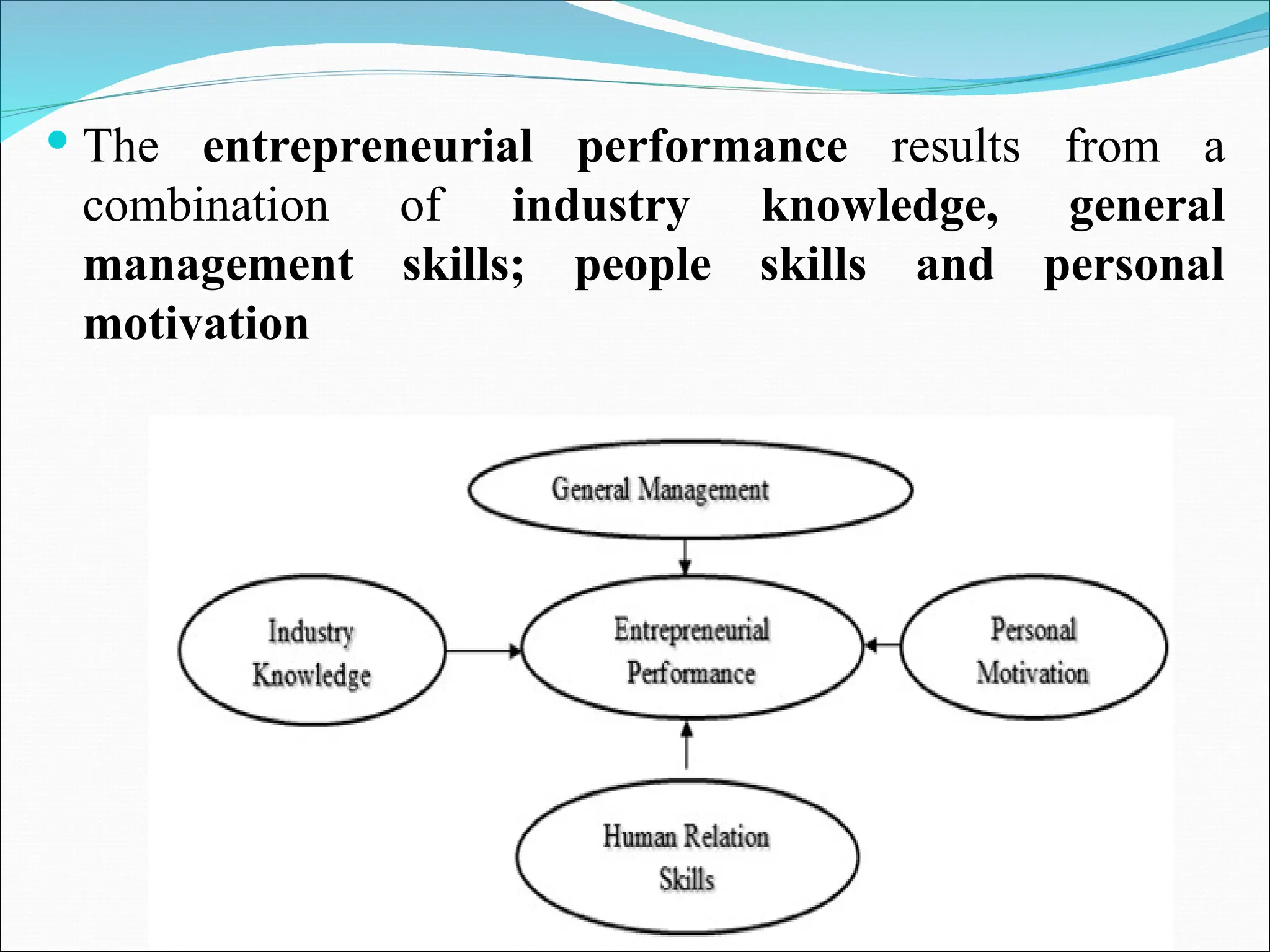
 The entrepreneurial performance results from a
combination of industry knowledge, general
management skills; people skills and personal
motivation
Entrepreneurship and Environment
 Business environment refers to the factors
external/internal to a business enterprise which
influence its operations and determine its
effectiveness.
 External Environment
 Internal Environment
Environmental Factors Affecting Entrepreneurship
 Some of the environmental factors which hinder entrepreneurial growth are given
below:
 Sudden changes in Government policy.
 Sudden political upsurge.
 Outbreak of war or regional conflicts.
 Political instability or hostile Government attitude towards industry.
 Excessive red-tapism and corruption among Government agencies.
 Ideological and social conflicts.
 Unreliable supply of power, materials, finance, labor and other inputs.
 Rise in the cost of inputs.
 Unfavorable market fluctuations.
 Non-cooperative attitude of banks and financial institutions.
Entrepreneurship is environmentally determined.
The most important essential for entrepreneurial growth is the presence of a favorable
business environment
1.7 Creativity, Innovation and Entrepreneurship
1 Creativity
 Is the tendency to generate or recognize ideas, alternatives, or possibilities
that may be useful in solving problems, communicating with others, and
entertaining ourselves and others.
 Creativity is the ability to come up with new idea and to identify new and
different ways of looking at a problem and opportunities.
 It is a process of assembling ideas by recombining elements
already known but wrongly assumed to be unrelated to each
other
Steps in the Creative Process
 Step1: Opportunity or problem Recognition:
 Step2: Immersion
 the individual concentrates on the problem and becomes
immersed in it.
 Step 3: Incubation
 the person keeps the assembled information in mind for a
while
 Step 4: Insight
 the problem-conquering solution flashes into the person’s
mind at an unexpected time, such as on the verge of sleep,
during a shower, or while running.
 Step 5: Verification and Application
 the individual sets out to prove that the creative solution
has merit.
 Barriers to Creativity
 Be aware that there are numerous barriers to creativity, including:
1. searching for the one ‘right’ answer
2. focusing on being logical
3. blindly following the rules
4. constantly being practical
5. viewing play as frivolous
6. becoming overly specialized
7. avoiding ambiguity
8. fearing looking foolish
9. fearing mistakes and failure
10. believing that ‘I’m not creative
2. Innovation
 It is the implementation of new idea at the individual, group or
organizational level.
 The Innovation Process
1. Analytical planning
 carefully identifying the product or service features, design as well as the
resources that will be needed.
2. Resources organization
 obtaining the required resources, materials, technology,
human or capital resources
3. Implementation
 applying the resources in order to accomplish the plans
4. Commercial application
 the provision of values to customers, reward employees and
satisfy the stakeholders.
Areas of Innovation
 New product:
 New Services
 New Production Techniques
 New Way of Delivering the Product or Service to the Customer
 New Operating Practices
 New Means of Informing the Customer about the Product
 New Means of Managing Relationship within the Organization
 New Ways of Managing Relationships between Organizations
 Creativity is the ability to develop new ideas and to discover new ways
of looking at problems and opportunities.
 Innovation is the ability to apply creative solution to those problems
and opportunities in order to enhance people’s lives or to enrich society.
 Entrepreneurship = creativity + innovation.
CHapter one( 1) interprn uer  new (1).ppt

CHapter one( 1) interprn uer new (1).ppt

  • 1.
    CHAPTER ONE THE NATUREOF ENTREPRENEURSHIP 1.1. Entrepreneurship: Historical overview  let us took the historical development so as to grasp the meaning of the word entrepreneurship.
  • 2.
    1. The ancientperiod  entrepreneur was used to refer to a person managing large commercial projects through the resources provided to him. 2. In the 17th Century  a person who has signed a contractual agreement with the government to provide stipulated products or to perform service was considered as entrepreneur. 3. In the 18th Century  the first theory of entrepreneur has been developed by Richard Cantillon. He said that an entrepreneur is a risk taker.  the differentiation of the entrepreneurial role from capital providing role was established. The later role is the base for today’s venture capitalist.  Entrepreneur was distinguished from capital provider.
  • 3.
    4. In thelate 19th and early 20th Century  an entrepreneur was viewed from an economic perspective. The entrepreneur organizes and operates an enterprise for personal gain. 5 . In the middle of the 20th Century  The notion of an entrepreneur as an inventor.  A person who innovates something new  “The function of the entrepreneur is to reform or revolutionize the pattern of production by exploiting an invention or more generally untried technological possibility for producing new commodities or producing an old one in a new way or opening a new outlet for products by reorganizing a new industry.”
  • 4.
     The conceptof innovation and newness are at the heart of the above definition  word entrepreneur was evolved from managing commercial project to the application of innovation (creativity) in the business idea. 1.2. Definitions of Entrepreneurship and Entrepreneur  The term “entrepreneur” is defined in a variety of ways.  The word entrepreneur is derived from a French verb entrerprendre. It means “to undertake”.
  • 5.
    Definition of Entrepreneurship 1.Entrepreneurship is the process of identifying opportunities in the market place, arranging the resources required to pursue these opportunities and investing the resources to exploit the opportunities for long term gains. It involves creating incremental wealth by bringing together resources in new ways to start and operate an enterprise. 2. Entrepreneurship can also be defined as the process of creating something different and better with value by devoting the necessary time and effort by assuming the accompanying financial, psychic and social risks and receiving the resulting monetary reward and personal satisfaction.
  • 6.
    3. Entrepreneurship isthe art of identifying viable business opportunities and mobilizing resources to convert those opportunities into a successful enterprise through creativity, innovation, risk taking and progressive imagination.  In general, the process of entrepreneurship includes five critical elements.  These are: 1) The ability to perceive an opportunity. 2) The ability to commercialize the perceived opportunity i.e. innovation 3) The ability to pursue it on a sustainable basis. 4) The ability to pursue it through systematic means. 5) The acceptance of risk or failure.
  • 7.
    Definition of Entrepreneur 1)Anentrepreneur is any person who creates and develops a business idea and takes the risk of setting up an enterprise to produce a product or service which satisfies customer needs. 2)An entrepreneur can also be defined as a professional who discovers a business opportunity to produce improved or new goods and services and identifies a way in which resources required can be mobilized. 3)An entrepreneur is an individual who has the ability to identify and pursue a business opportunity; undertakes a business venture; raises the capital to finance it; gathers the necessary physical, financial and human resources needed to operate the business venture; sets goals for him/herself and others; initiates appropriate action to ensure success; and assumes all or a major portion of the risk! 4)An entrepreneur is a person who: create the job not a job-seeker; has a dream, has a vision; willing to take the risk and makes something out of nothing
  • 8.
     Entrepreneur (OxfordDictionary)  Person who undertakes an enterprise with chances of profit or loss.  Entrepreneur: An individual who bears the risk of operating business in the face of uncertainty about the future conditions (New Encyclopedia Britannica).
  • 9.
    1.4 Types ofEntrepreneurs Entrepreneurship can take three different forms. They are: 1. The individual entrepreneur: An individual entrepreneur is someone who started; acquired or franchised his/her own independent organization. The major portion of this module is also devoted to describe the basic features and activities of the individual entrepreneur. 2. Intrapreneur: An Intrapreneur is a person who does entrepreneurial work within large organization. The process by which an intrapreneur affects change is called Intrapreneurship.
  • 10.
    3. The EntrepreneurialOrganization: The entrepreneurial function need not be embodied in a physical person. Every social environment has its own way of filling the entrepreneurial function.  Individuals working in organizations have the potential for being, as do those working independently to start their own business.  An organization can create an environment in which all of its members can contribute in some function to the entrepreneurial function.
  • 11.
    1.5 Role ofEntrepreneurs in Economic Development  The entrepreneurs serve as a key to the creation of new enterprises, thereby rejuvenating economy and sustaining the process of economic development in the following ways: 1) Improvement in per capita Income/Wealth Generation: 2) Generation of Employment Opportunities 3) Inspire others Towards Entrepreneurship 4) Balanced Regional Development 5) Enhance the Number of Enterprise 6) Provide Diversity in Firms 7) Economic Independence 8) Combine Economic factors 9) Provide Market efficiency 10) Accepting Risk 11) Maximize Investor’s Return
  • 12.
    1.6 Entrepreneurial Competenceand Environment 1.6.1. Entrepreneurial Mindset Who Becomes an Entrepreneur? Anyone with the following characteristics can be an entrepreneur. 1) The Young Professional: 2) The Inventor 3) The Excluded
  • 13.
    Qualities of anEntrepreneur  In order to be successful, an entrepreneur should have the following qualities 1.Opportunity-seeking 2.Persevering:  An entrepreneur always makes concerted efforts towards the successful completion of a goal.  An entrepreneur perseveres and is undeterred by uncertainties, risks, obstacles, or difficulties which could challenge the achievement of the ultimate goal. 3. Risk Taking:  The best entrepreneurs tend to:-  Set their own objectives where there is moderate risk of failure and take calculated risks  Gain satisfaction from completing a job well  Not be afraid of public opinion, skepticism  Take responsibility for their own actions
  • 14.
     Importance ofRisk-taking Build self confidence Create a feeling of leadership Create strong motivation to complete a job well 4. Demanding for Efficiency and Quality  Efficiency: Being efficient means producing results with little wasted effort.  Quality refers to: 1. The ongoing process of constant improvement of goods/services to meet the customer’s need in a way that exceeds the customer’s expectations; 2. A characteristic of the product or service that makes it fit to use. It makes a product, process, or service desirable. 3. The ability of a product or service to meet a customer’s expectations for that product or service.
  • 15.
     Quality playsan important role in assuring the following benefits  Reduction of waste  Cost-effectiveness  An increase in market share  Better profitability  Social responsibility  Reputation 5. Information-seeking
  • 16.
    6. Goal Setting A Goal - is a general direction, or long-term aim that you want to accomplish.  Objectives - are specific and measurable. They are concise and specific.  An entrepreneur must have a goal and an objective which is specific, measurable, attainable, relevant, and time bound (SMART).  Attainable: Dream big and aim for the stars but keep one foot firmly based in reality. 7. Planning:  Planning is making a decision about the future in terms of what to do, when to do, where to do, how to do, by whom to do and using what resources. 8. Persuasion and Networking  Persuasion is a way of convincing someone to get something or make a decision in your favor.  Networking is an extended group of people with similar interests or concerns who interact and remain in informal contact for mutual assistance or support. Factors that Affect Persuasion and Networking  Socio-cultural background and perceptions  Communication skills (both verbal and non-verbal).  Negotiation skills
  • 17.
    9. Building Self-confidence Self-confidenceis having confidence in oneself when considering a capability. Characteristics of a Self-confident Person  A person with self-confidence may exhibit some of the following characteristics:  Risk-taking  Independent:  Perseverance: Ability to endure and survive setbacks and continue  Able to learn to live with failure  Ability to find happiness and contentment in work.  Doing what you believe to be right, even if others mock or criticize you for it.  Admitting mistakes and learning from them 10. Listening to Others 11. Demonstrating Leadership
  • 18.
    Entrepreneurial Skills 1. GeneralManagement Skills  These are skills required to organize the physical and financial resources needed to run the venture.  Strategy Skills – An ability to consider the business as a whole,  Planning Skills  Marketing Skills  Financial Skills  Project Management Skills  Time Management Skills 2. People Management Skills:  Communication Skills  Leadership Skills  Motivation Skills  Delegation Skills  Negotiation Skills
  • 19.
    The Entrepreneurial Tasks Owning Organizations  Founding New Organizations  Bringing Innovations to Market  Identification of Market Opportunity  Application of Expertise  Provision of leadership  The entrepreneur as manager Who Benefits from the entrepreneur’s Wealth?  Employees  Investors  Supplier  Customers  The local community  Government
  • 20.
     The entrepreneurialperformance results from a combination of industry knowledge, general management skills; people skills and personal motivation
  • 21.
    Entrepreneurship and Environment Business environment refers to the factors external/internal to a business enterprise which influence its operations and determine its effectiveness.  External Environment  Internal Environment
  • 22.
    Environmental Factors AffectingEntrepreneurship  Some of the environmental factors which hinder entrepreneurial growth are given below:  Sudden changes in Government policy.  Sudden political upsurge.  Outbreak of war or regional conflicts.  Political instability or hostile Government attitude towards industry.  Excessive red-tapism and corruption among Government agencies.  Ideological and social conflicts.  Unreliable supply of power, materials, finance, labor and other inputs.  Rise in the cost of inputs.  Unfavorable market fluctuations.  Non-cooperative attitude of banks and financial institutions. Entrepreneurship is environmentally determined. The most important essential for entrepreneurial growth is the presence of a favorable business environment
  • 23.
    1.7 Creativity, Innovationand Entrepreneurship 1 Creativity  Is the tendency to generate or recognize ideas, alternatives, or possibilities that may be useful in solving problems, communicating with others, and entertaining ourselves and others.  Creativity is the ability to come up with new idea and to identify new and different ways of looking at a problem and opportunities.  It is a process of assembling ideas by recombining elements already known but wrongly assumed to be unrelated to each other
  • 24.
    Steps in theCreative Process  Step1: Opportunity or problem Recognition:  Step2: Immersion  the individual concentrates on the problem and becomes immersed in it.  Step 3: Incubation  the person keeps the assembled information in mind for a while  Step 4: Insight  the problem-conquering solution flashes into the person’s mind at an unexpected time, such as on the verge of sleep, during a shower, or while running.  Step 5: Verification and Application  the individual sets out to prove that the creative solution has merit.
  • 25.
     Barriers toCreativity  Be aware that there are numerous barriers to creativity, including: 1. searching for the one ‘right’ answer 2. focusing on being logical 3. blindly following the rules 4. constantly being practical 5. viewing play as frivolous 6. becoming overly specialized 7. avoiding ambiguity 8. fearing looking foolish 9. fearing mistakes and failure 10. believing that ‘I’m not creative
  • 26.
    2. Innovation  Itis the implementation of new idea at the individual, group or organizational level.  The Innovation Process 1. Analytical planning  carefully identifying the product or service features, design as well as the resources that will be needed. 2. Resources organization  obtaining the required resources, materials, technology, human or capital resources 3. Implementation  applying the resources in order to accomplish the plans 4. Commercial application  the provision of values to customers, reward employees and satisfy the stakeholders.
  • 27.
    Areas of Innovation New product:  New Services  New Production Techniques  New Way of Delivering the Product or Service to the Customer  New Operating Practices  New Means of Informing the Customer about the Product  New Means of Managing Relationship within the Organization  New Ways of Managing Relationships between Organizations  Creativity is the ability to develop new ideas and to discover new ways of looking at problems and opportunities.  Innovation is the ability to apply creative solution to those problems and opportunities in order to enhance people’s lives or to enrich society.  Entrepreneurship = creativity + innovation.