1
2
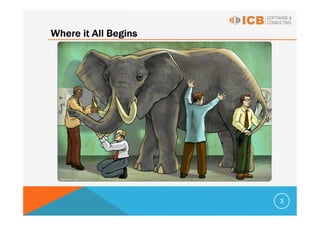
Where it All Begins


                      3
The Problem
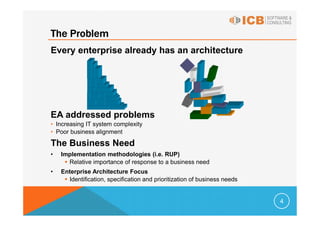
Every enterprise already has an architecture


EA addressed problems
• Increasing IT system complexity
• Poor business alignment

The Business Need
•   Implementation methodologies (i.e. RUP)
      Relative importance of response to a business need
•   Enterprise Architecture Focus
      Identification, specification and prioritization of business needs


                                                                           4
What is Enterprise Architecture ?
IBM Systems Journal, article "A Framework for Information Systems
   Architecture”, John Zachman, 1987. originally described as an
   information systems architectural framework, soon renamed to
   enterprise-architecture framework.
Definition: Formal description of the structure and operation of an
   organization. The motivation behind EA is to determine how the whole
   organization can effectively achieve its current/future objectives.


                                  “The cost involved and the success of
                                  the business that depends increasingly
                                  on its information systems require a
                                  disciplined approach to the
                                  management of those systems.”
                                                           J.A. Zachman


                                                                           5
It’s a Metaphor
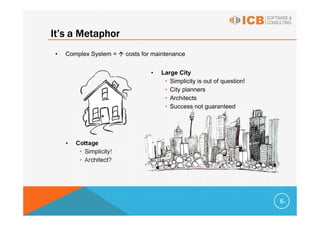
•   Complex System =     costs for maintenance


                                 •   Large City
                                      • Simplicity is out of question!
                                      • City planners
                                      • Architects
                                      • Success not guaranteed


    •   Cottage
         • Simplicity!
         • Architect?


                                                                         6
What is Architecture Framework?
An architecture framework is methodology and tool that:
 Guides the development or organization specific architecture
 Embodies best practices and common wisdom
 Assists the evaluation of architectures
 Ensures that every domain is adequately
 reviewed and documented
 Provides generic categorization
 of architecture artifacts.
 Presents a set of standards,
 design concepts, models, services


                                                                7
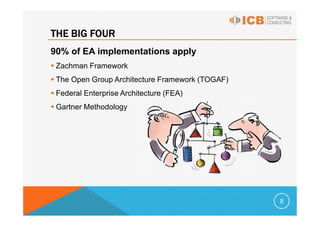
THE BIG FOUR
90% of EA implementations apply
 Zachman Framework
 The Open Group Architecture Framework (TOGAF)
 Federal Enterprise Architecture (FEA)
 Gartner Methodology


                                                 8
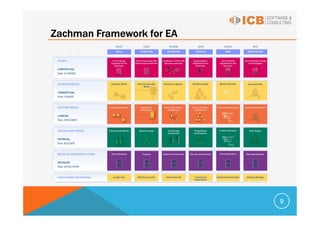
Zachman Framework for EA


                           9
v.9
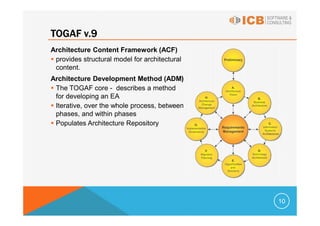
TOGAF v.9
Architecture Content Framework (ACF)
 provides structural model for architectural
 content.
Architecture Development Method (ADM)
 The TOGAF core - describes a method
 for developing an EA
 Iterative, over the whole process, between
 phases, and within phases
 Populates Architecture Repository


                                               10
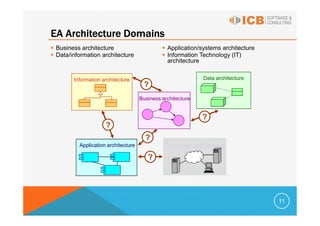
EA Architecture Domains
 Business architecture                         Application/systems architecture
 Data/information architecture                 Information Technology (IT)
                                               architecture


       Information architecture                             Data architecture
                                     ?
                                    Business architecture


                                                            ?
                    ?
                                      ?
         Application architecture             Technical architecture

                                       ?


                                                                                  11
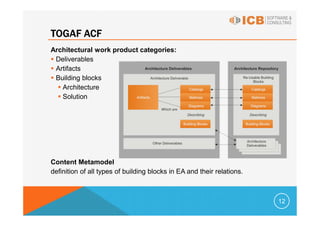
TOGAF ACF
Architectural work product categories:
 Deliverables
 Artifacts
 Building blocks
   Architecture
   Solution


Content Metamodel
definition of all types of building blocks in EA and their relations.


                                                                        12
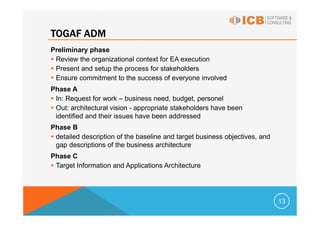
TOGAF ADM
Preliminary phase
 Review the organizational context for EA execution
 Present and setup the process for stakeholders
 Ensure commitment to the success of everyone involved
Phase A
 In: Request for work – business need, budget, personel
 Out: architectural vision - appropriate stakeholders have been
 identified and their issues have been addressed
Phase B
 detailed description of the baseline and target business objectives, and
 gap descriptions of the business architecture
Phase C
 Target Information and Applications Architecture


                                                                            13
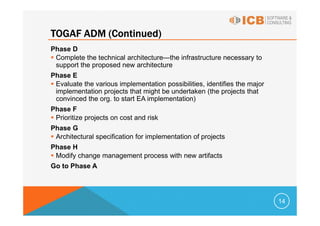
TOGAF ADM (Continued)
Phase D
 Complete the technical architecture—the infrastructure necessary to
 support the proposed new architecture
Phase E
 Evaluate the various implementation possibilities, identifies the major
 implementation projects that might be undertaken (the projects that
 convinced the org. to start EA implementation)
Phase F
 Prioritize projects on cost and risk
Phase G
 Architectural specification for implementation of projects
Phase H
 Modify change management process with new artifacts
Go to Phase A


                                                                           14
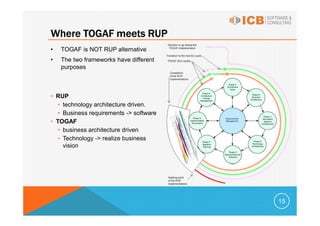
Where TOGAF meets RUP
•   TOGAF is NOT RUP alternative
•   The two frameworks have different
    purposes


• RUP
   • technology architecture driven.
   • Business requirements -> software
• TOGAF
   • business architecture driven
   • Technology -> realize business
     vision


                                         15
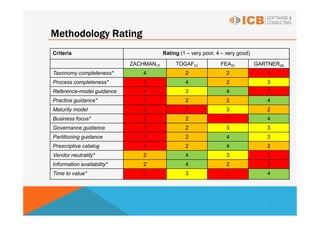
Methodology Rating
Criteria                                Rating (1 – very poor, 4 – very good)

                            ZACHMAN17        TOGAF31            FEA31           GARTNER29
Taxonomy completeness*          4                2                 2                1
Process completeness*           1                4                 2                3
Reference-model guidance        1                3                 4                1
Practice guidance*              1                2                 2                4
Maturity model                  1                1                 3                2
Business focus*                 1                2                 1                4
Governance guidance             1                2                 3                3
Partitioning guidance           1                2                 4                3
Prescriptive catalog            1                2                 4                2
Vendor neutrality*              2                4                 3                1
Information availability*       2                4                 2                1
Time to value*                  1                3                 1                4
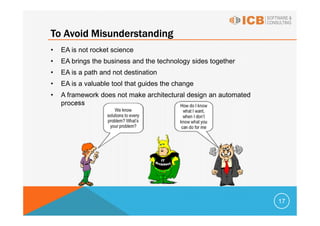
To Avoid Misunderstanding
•   EA is not rocket science
•   EA brings the business and the technology sides together
•   EA is a path and not destination
•   EA is a valuable tool that guides the change
•   A framework does not make architectural design an automated
    process


                                                                  17
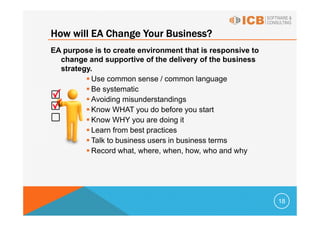
How will EA Change Your Business?
EA purpose is to create environment that is responsive to
  change and supportive of the delivery of the business
  strategy.
           Use common sense / common language
           Be systematic
           Avoiding misunderstandings
           Know WHAT you do before you start
           Know WHY you are doing it
           Learn from best practices
           Talk to business users in business terms
           Record what, where, when, how, who and why


                                                            18
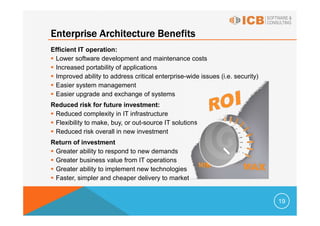
Enterprise Architecture Benefits
Efficient IT operation:
 Lower software development and maintenance costs
 Increased portability of applications
 Improved ability to address critical enterprise-wide issues (i.e. security)
 Easier system management
 Easier upgrade and exchange of systems
Reduced risk for future investment:
 Reduced complexity in IT infrastructure
 Flexibility to make, buy, or out-source IT solutions
 Reduced risk overall in new investment
Return of investment
 Greater ability to respond to new demands
 Greater business value from IT operations
 Greater ability to implement new technologies
 Faster, simpler and cheaper delivery to market


                                                                               19
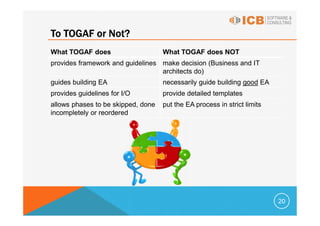
To TOGAF or Not?
What TOGAF does                     What TOGAF does NOT
provides framework and guidelines make decision (Business and IT
                                  architects do)
guides building EA                  necessarily guide building good EA
provides guidelines for I/O         provide detailed templates
allows phases to be skipped, done   put the EA process in strict limits
incompletely or reordered


                                                                          20
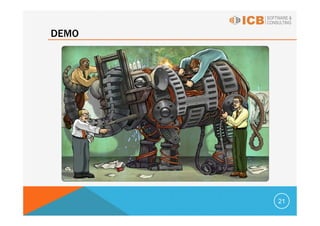
DEMO


       21
22
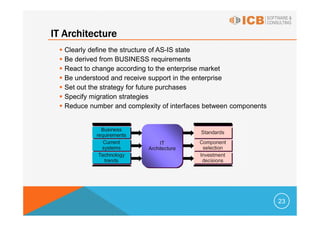
IT Architecture
   Clearly define the structure of AS-IS state
   Be derived from BUSINESS requirements
   React to change according to the enterprise market
   Be understood and receive support in the enterprise
   Set out the strategy for future purchases
   Specify migration strategies
   Reduce number and complexity of interfaces between components


                                                                   23

To TOGAFor not to TOGAF

  • 1.
  • 2.
  • 3.
    Where it AllBegins 3
  • 4.
    The Problem Every enterprisealready has an architecture EA addressed problems • Increasing IT system complexity • Poor business alignment The Business Need • Implementation methodologies (i.e. RUP) Relative importance of response to a business need • Enterprise Architecture Focus Identification, specification and prioritization of business needs 4
  • 5.
    What is EnterpriseArchitecture ? IBM Systems Journal, article "A Framework for Information Systems Architecture”, John Zachman, 1987. originally described as an information systems architectural framework, soon renamed to enterprise-architecture framework. Definition: Formal description of the structure and operation of an organization. The motivation behind EA is to determine how the whole organization can effectively achieve its current/future objectives. “The cost involved and the success of the business that depends increasingly on its information systems require a disciplined approach to the management of those systems.” J.A. Zachman 5
  • 6.
    It’s a Metaphor • Complex System = costs for maintenance • Large City • Simplicity is out of question! • City planners • Architects • Success not guaranteed • Cottage • Simplicity! • Architect? 6
  • 7.
    What is ArchitectureFramework? An architecture framework is methodology and tool that: Guides the development or organization specific architecture Embodies best practices and common wisdom Assists the evaluation of architectures Ensures that every domain is adequately reviewed and documented Provides generic categorization of architecture artifacts. Presents a set of standards, design concepts, models, services 7
  • 8.
    THE BIG FOUR 90%of EA implementations apply Zachman Framework The Open Group Architecture Framework (TOGAF) Federal Enterprise Architecture (FEA) Gartner Methodology 8
  • 9.
  • 10.
    v.9 TOGAF v.9 Architecture ContentFramework (ACF) provides structural model for architectural content. Architecture Development Method (ADM) The TOGAF core - describes a method for developing an EA Iterative, over the whole process, between phases, and within phases Populates Architecture Repository 10
  • 11.
    EA Architecture Domains Business architecture Application/systems architecture Data/information architecture Information Technology (IT) architecture Information architecture Data architecture ? Business architecture ? ? ? Application architecture Technical architecture ? 11
  • 12.
    TOGAF ACF Architectural workproduct categories: Deliverables Artifacts Building blocks Architecture Solution Content Metamodel definition of all types of building blocks in EA and their relations. 12
  • 13.
    TOGAF ADM Preliminary phase Review the organizational context for EA execution Present and setup the process for stakeholders Ensure commitment to the success of everyone involved Phase A In: Request for work – business need, budget, personel Out: architectural vision - appropriate stakeholders have been identified and their issues have been addressed Phase B detailed description of the baseline and target business objectives, and gap descriptions of the business architecture Phase C Target Information and Applications Architecture 13
  • 14.
    TOGAF ADM (Continued) PhaseD Complete the technical architecture—the infrastructure necessary to support the proposed new architecture Phase E Evaluate the various implementation possibilities, identifies the major implementation projects that might be undertaken (the projects that convinced the org. to start EA implementation) Phase F Prioritize projects on cost and risk Phase G Architectural specification for implementation of projects Phase H Modify change management process with new artifacts Go to Phase A 14
  • 15.
    Where TOGAF meetsRUP • TOGAF is NOT RUP alternative • The two frameworks have different purposes • RUP • technology architecture driven. • Business requirements -> software • TOGAF • business architecture driven • Technology -> realize business vision 15
  • 16.
    Methodology Rating Criteria Rating (1 – very poor, 4 – very good) ZACHMAN17 TOGAF31 FEA31 GARTNER29 Taxonomy completeness* 4 2 2 1 Process completeness* 1 4 2 3 Reference-model guidance 1 3 4 1 Practice guidance* 1 2 2 4 Maturity model 1 1 3 2 Business focus* 1 2 1 4 Governance guidance 1 2 3 3 Partitioning guidance 1 2 4 3 Prescriptive catalog 1 2 4 2 Vendor neutrality* 2 4 3 1 Information availability* 2 4 2 1 Time to value* 1 3 1 4
  • 17.
    To Avoid Misunderstanding • EA is not rocket science • EA brings the business and the technology sides together • EA is a path and not destination • EA is a valuable tool that guides the change • A framework does not make architectural design an automated process 17
  • 18.
    How will EAChange Your Business? EA purpose is to create environment that is responsive to change and supportive of the delivery of the business strategy. Use common sense / common language Be systematic Avoiding misunderstandings Know WHAT you do before you start Know WHY you are doing it Learn from best practices Talk to business users in business terms Record what, where, when, how, who and why 18
  • 19.
    Enterprise Architecture Benefits EfficientIT operation: Lower software development and maintenance costs Increased portability of applications Improved ability to address critical enterprise-wide issues (i.e. security) Easier system management Easier upgrade and exchange of systems Reduced risk for future investment: Reduced complexity in IT infrastructure Flexibility to make, buy, or out-source IT solutions Reduced risk overall in new investment Return of investment Greater ability to respond to new demands Greater business value from IT operations Greater ability to implement new technologies Faster, simpler and cheaper delivery to market 19
  • 20.
    To TOGAF orNot? What TOGAF does What TOGAF does NOT provides framework and guidelines make decision (Business and IT architects do) guides building EA necessarily guide building good EA provides guidelines for I/O provide detailed templates allows phases to be skipped, done put the EA process in strict limits incompletely or reordered 20
  • 21.
  • 22.
  • 23.
    IT Architecture Clearly define the structure of AS-IS state Be derived from BUSINESS requirements React to change according to the enterprise market Be understood and receive support in the enterprise Set out the strategy for future purchases Specify migration strategies Reduce number and complexity of interfaces between components 23