Information Architecture: An emerging 21 st  century profession By : Dr. A.K. Ramani Prof. & Head SCSIT, DAVV, Indore(M.P.), India [email_address]
AGENDA Information Notion of Design Business and IT evolution Information Architecture IA vs. Design Theses of IA Website Architecture Architecture team Approaches of IA Introduction to TOGAF Wrap Up
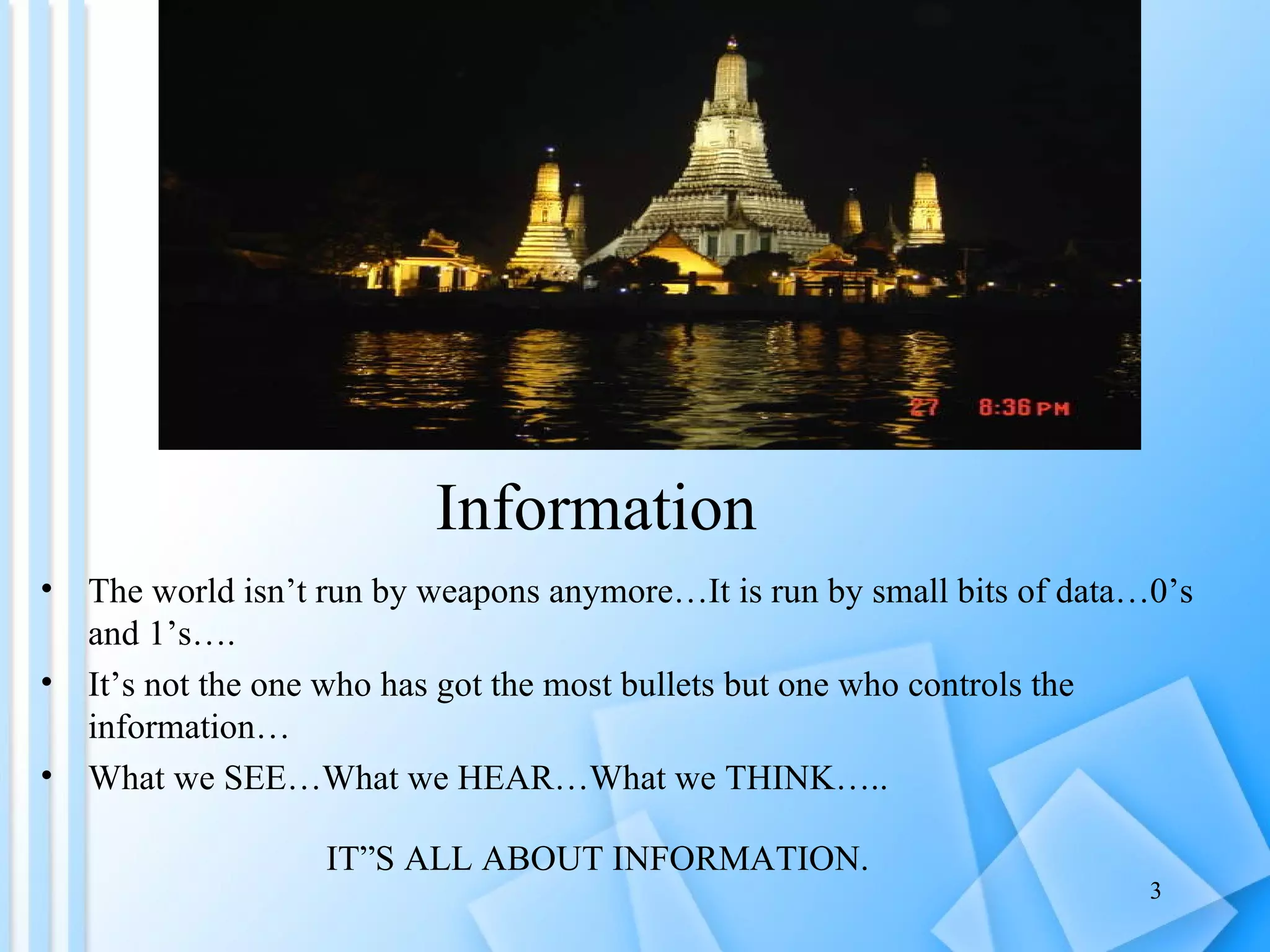
Information  The world isn’t run by weapons anymore…It is run by small bits of data…0’s and 1’s…. It’s not the one who has got the most bullets but one who controls the information… What we SEE…What we HEAR…What we THINK….. IT”S ALL ABOUT INFORMATION.
Information  More and more work depends upon effective use of Information Novel ways of accessing information are seen in offices, home, society, etc. More specialized, complex, more perplexing … Thus, design and efficient communication are more challenging than ever, requiring great deal of time, practice and knowledge
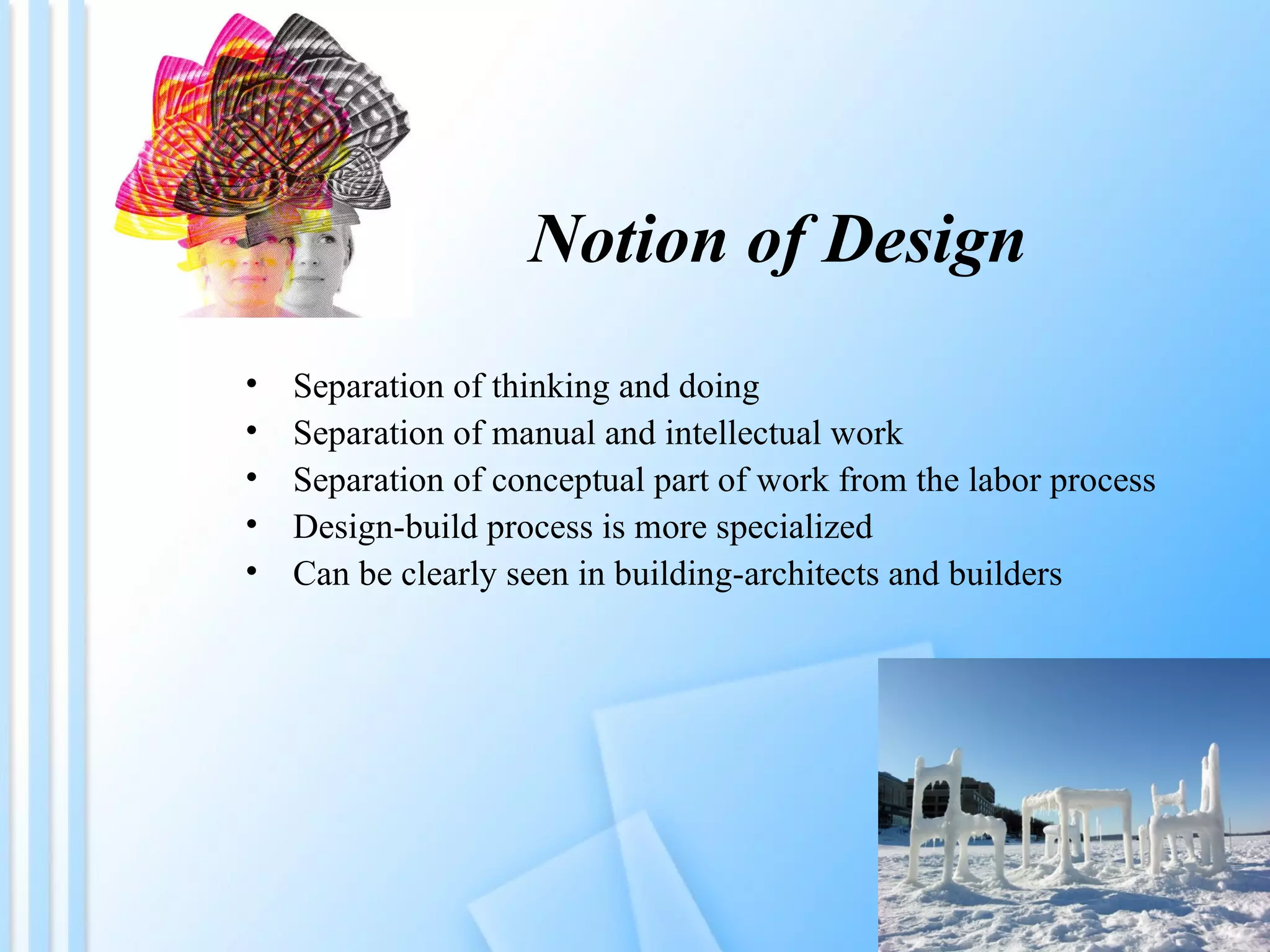
Notion of Design Separation of thinking and doing Separation of manual and intellectual work Separation of conceptual part of work from the labor process Design-build process is more specialized Can be clearly seen in building-architects and builders
Key Challenge: Towards  a New Discipline “ Storage, retrieval and transmission of information has been a challenge since the evolution of human being”.
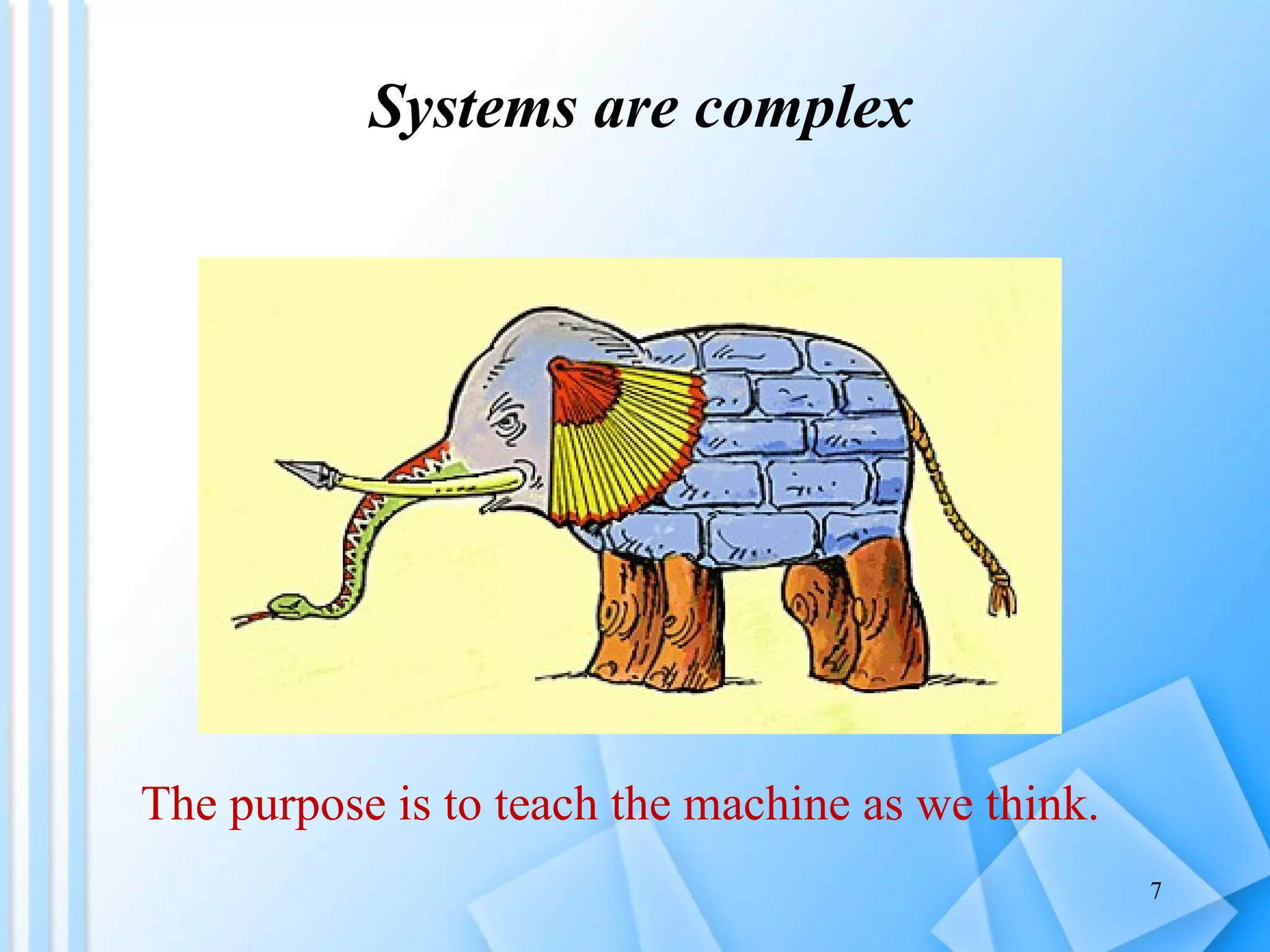
Systems are complex The purpose is to teach the machine as we think.
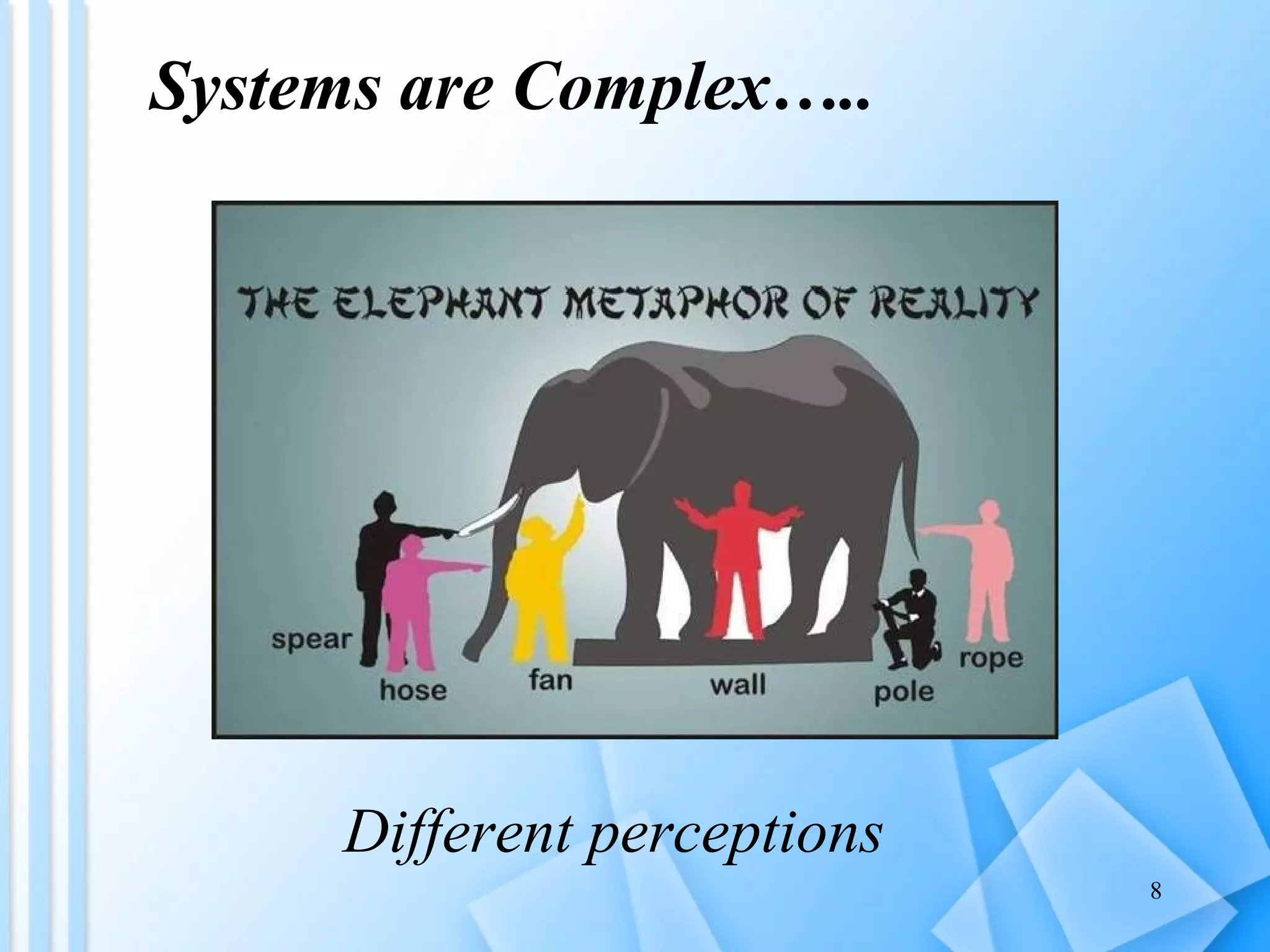
Different perceptions Systems are Complex…..
Systems are Complex….. Technology has progressed. It can do practically whatever people want it to do.  So why doesn’t everyone using a computer  system have a large smile on their face?
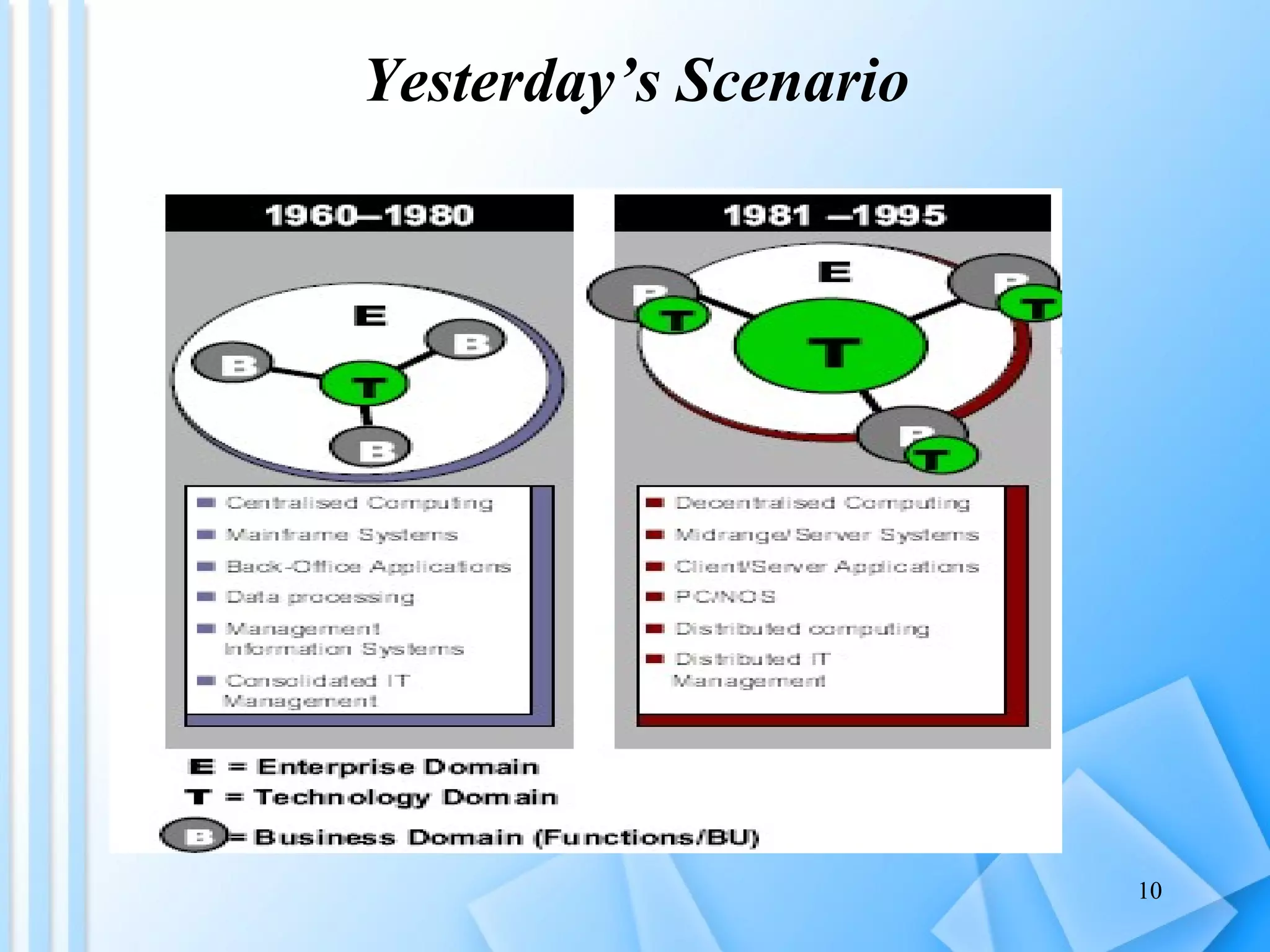
Yesterday’s Scenario
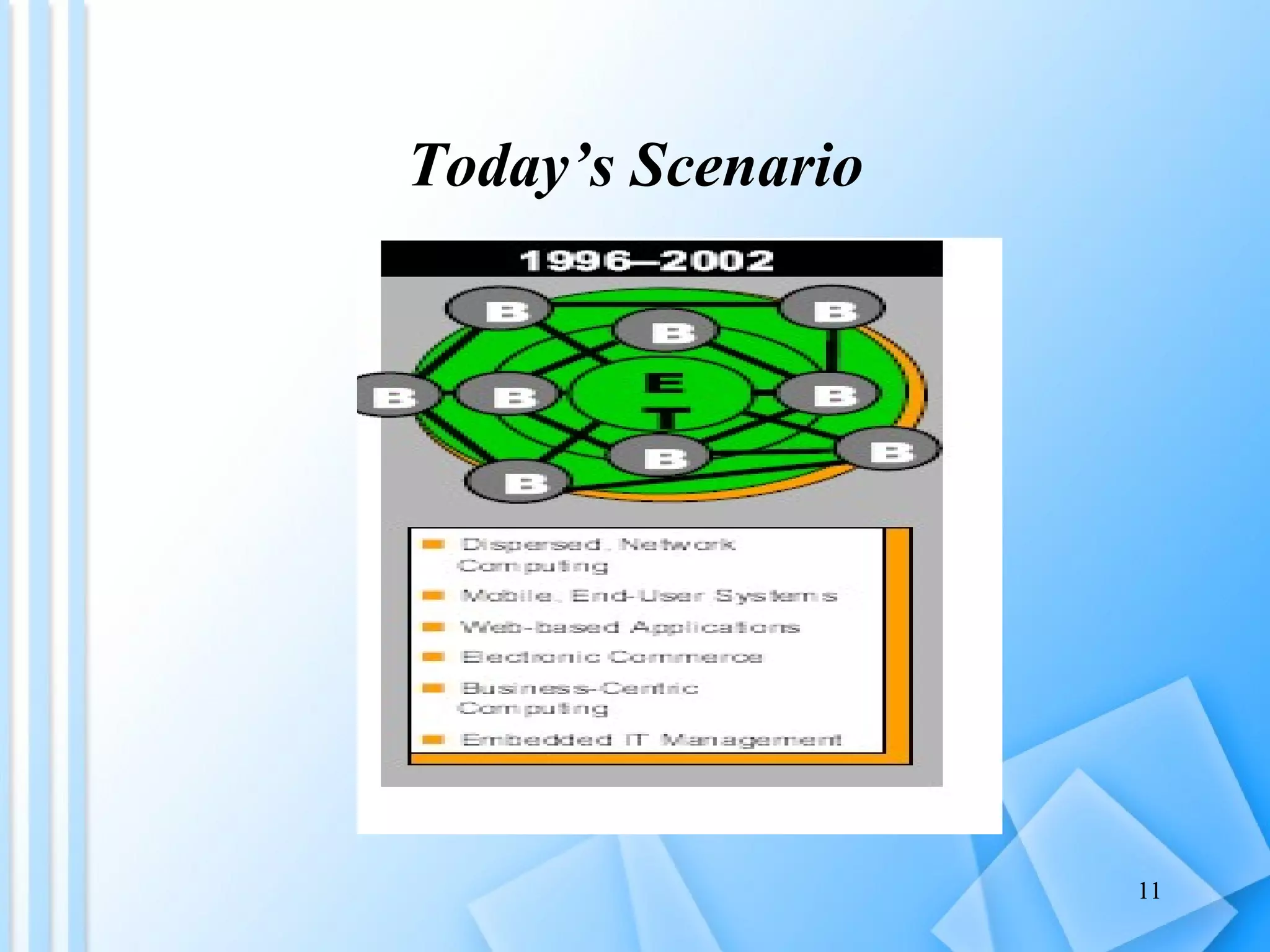
Today’s Scenario
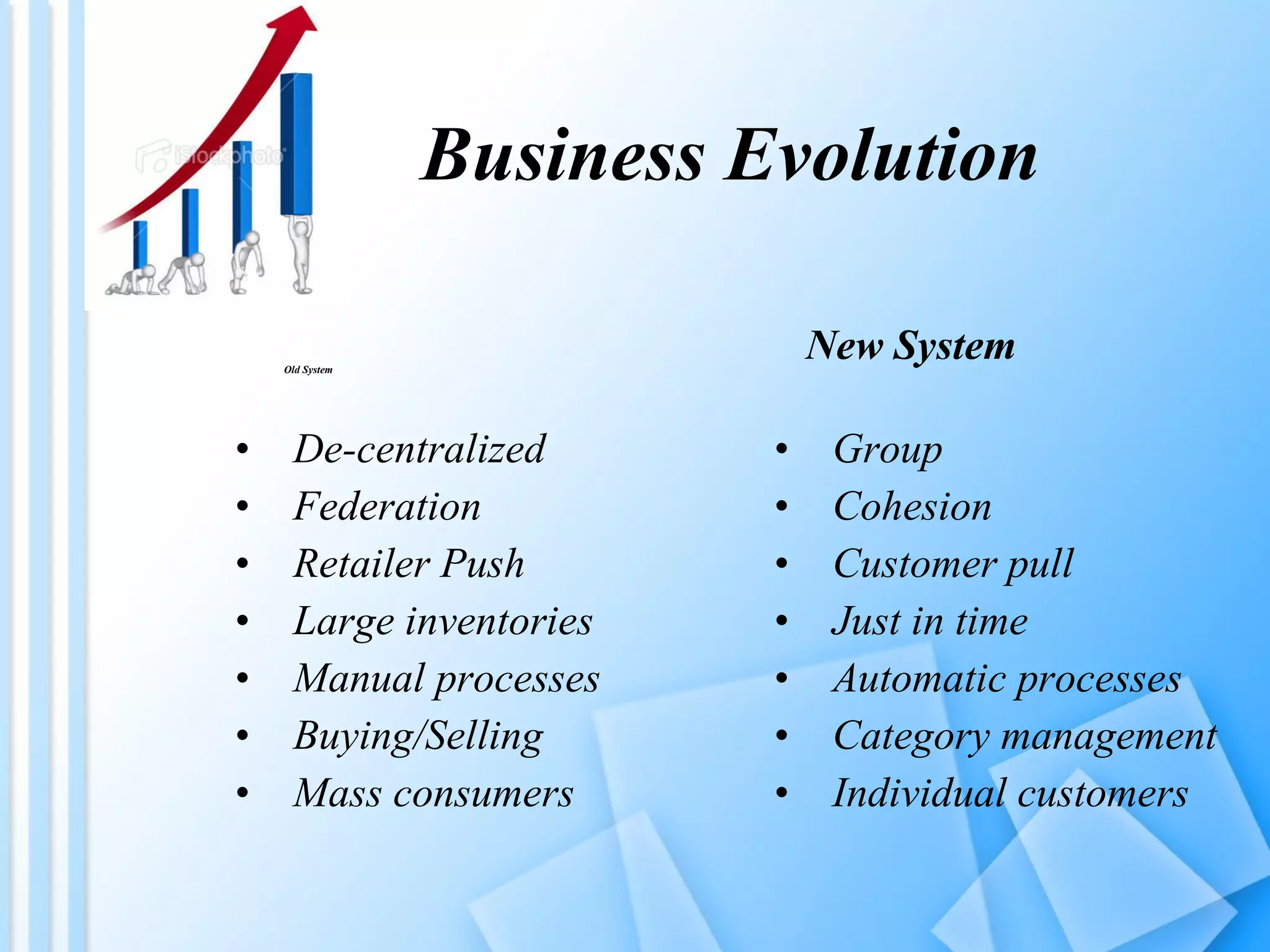
Business Evolution Old System De-centralized Federation  Retailer Push Large inventories Manual processes Buying/Selling Mass consumers New System Group Cohesion Customer pull Just in time Automatic processes Category management Individual customers
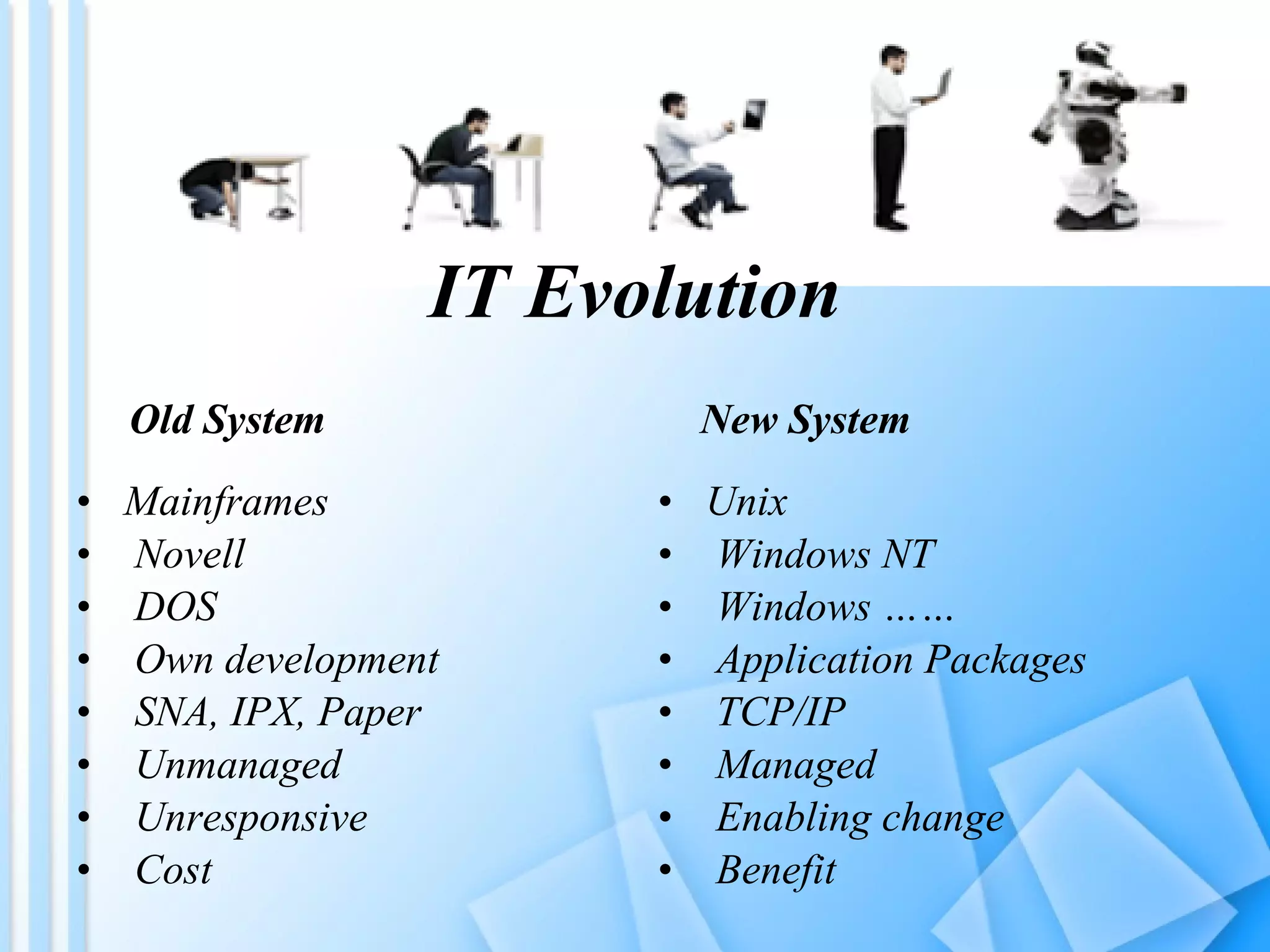
IT Evolution Old System Mainframes Novell DOS Own development SNA, IPX, Paper Unmanaged Unresponsive Cost New System Unix Windows NT Windows …… Application Packages TCP/IP Managed Enabling change Benefit
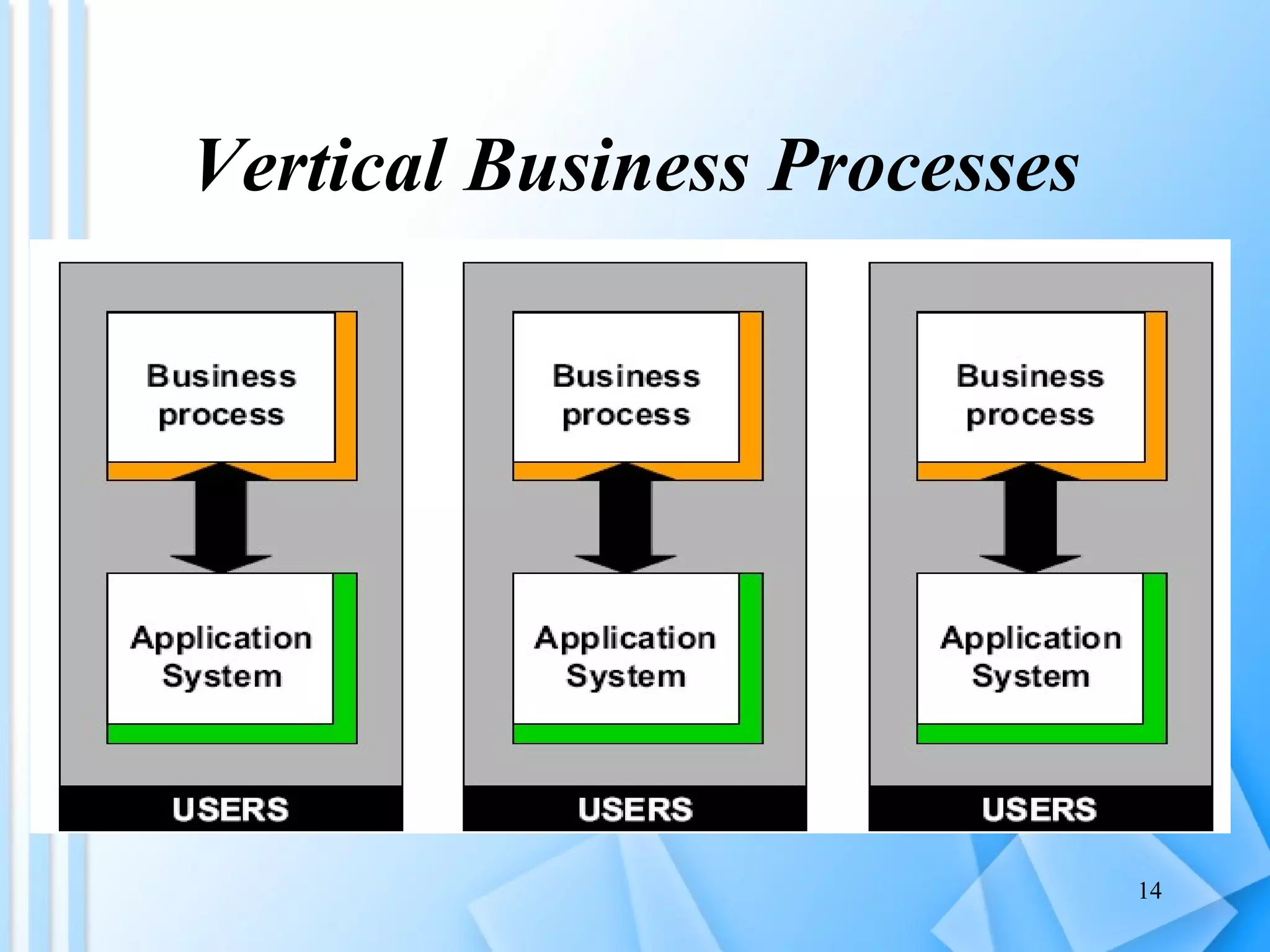
Vertical   Business Processes
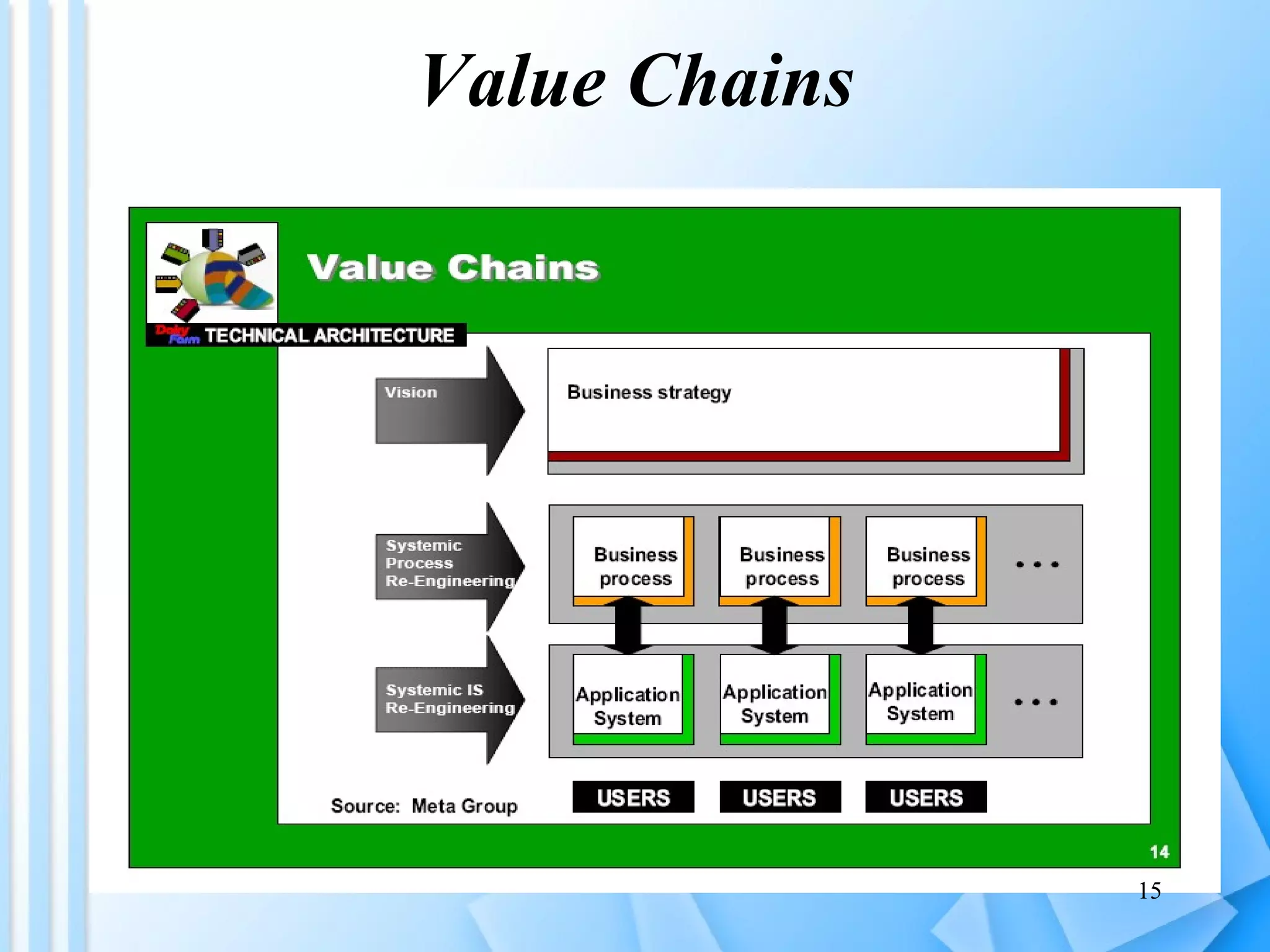
Value Chains
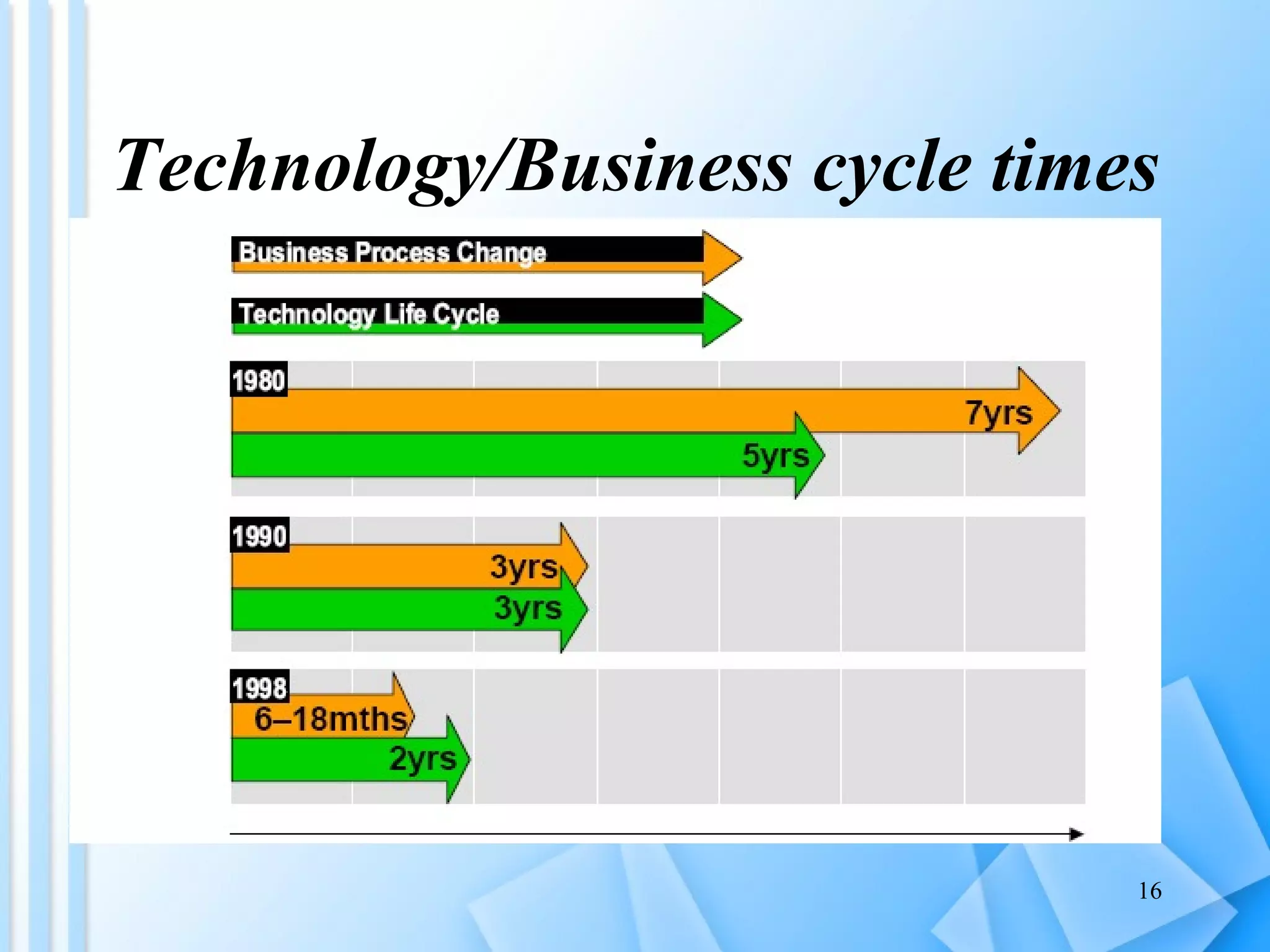
Technology/Business cycle times
Why innovative system? A rapidly changing technology and business landscape demands innovation and agility. Innovation and agility provides value to the system.
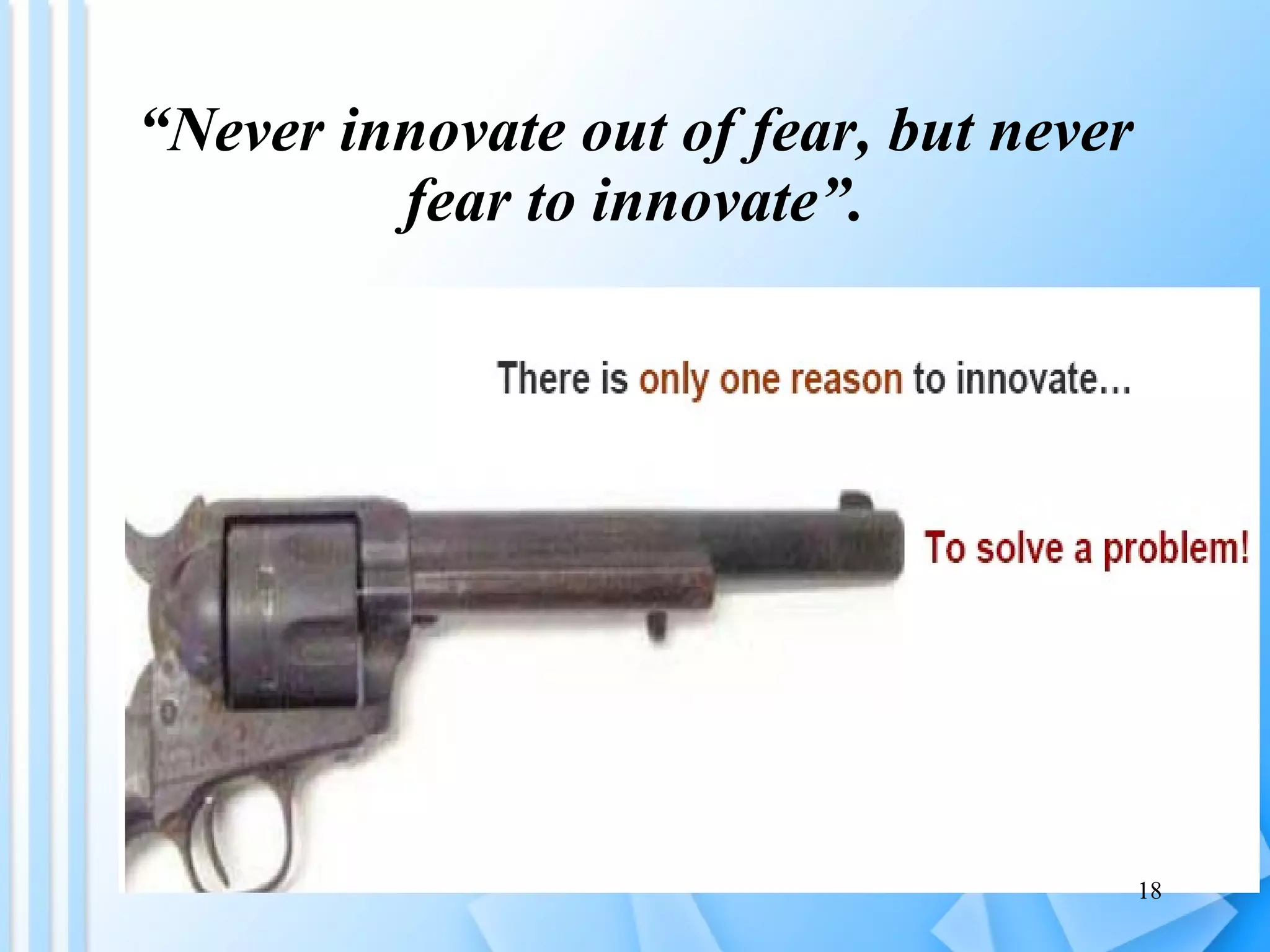
“ Never innovate out of fear, but never fear to innovate”.
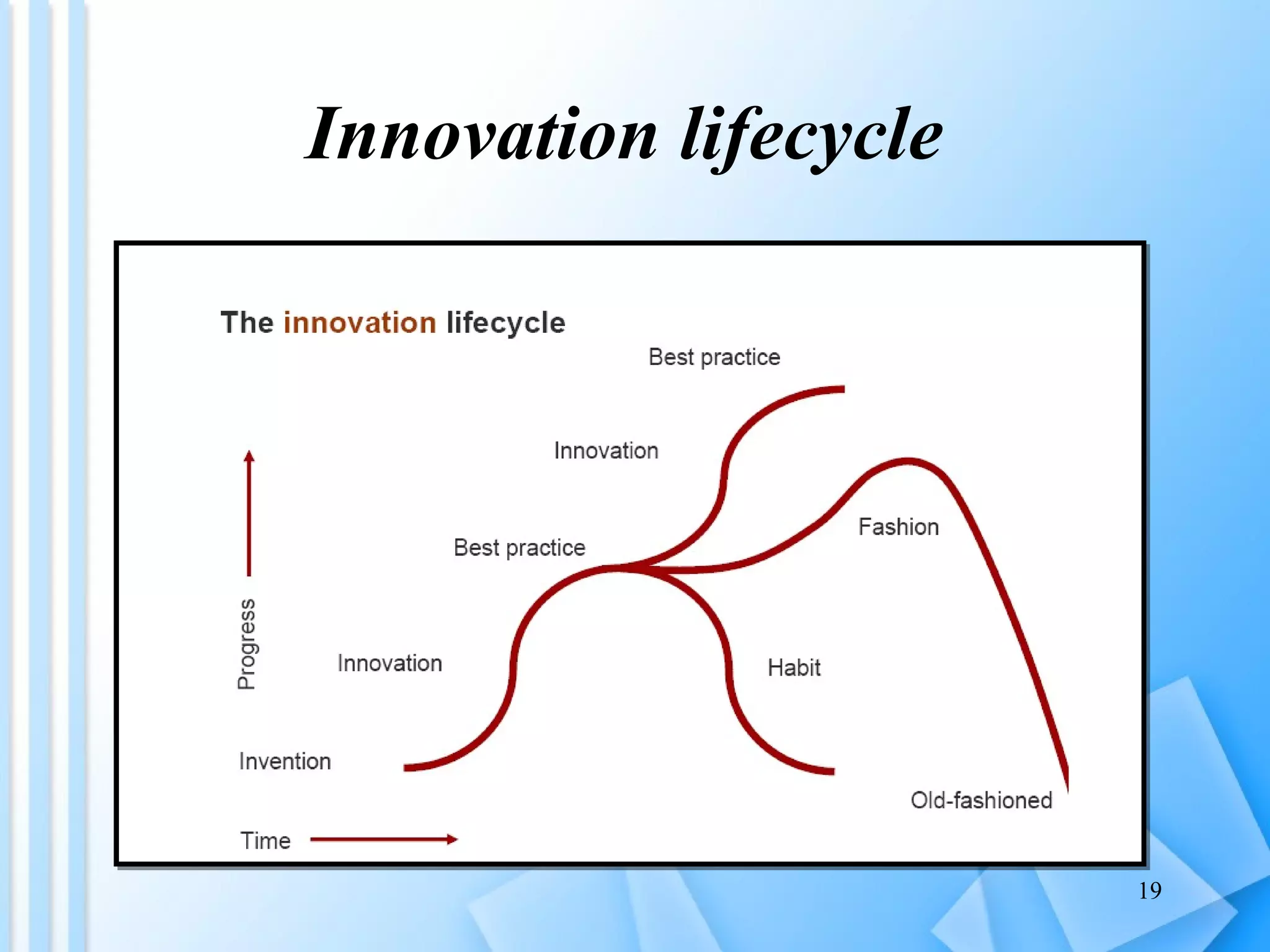
Innovation lifecycle
How to evolve new  innovative system from old system?? Big Question????
Solution is….. i.e. Architecture
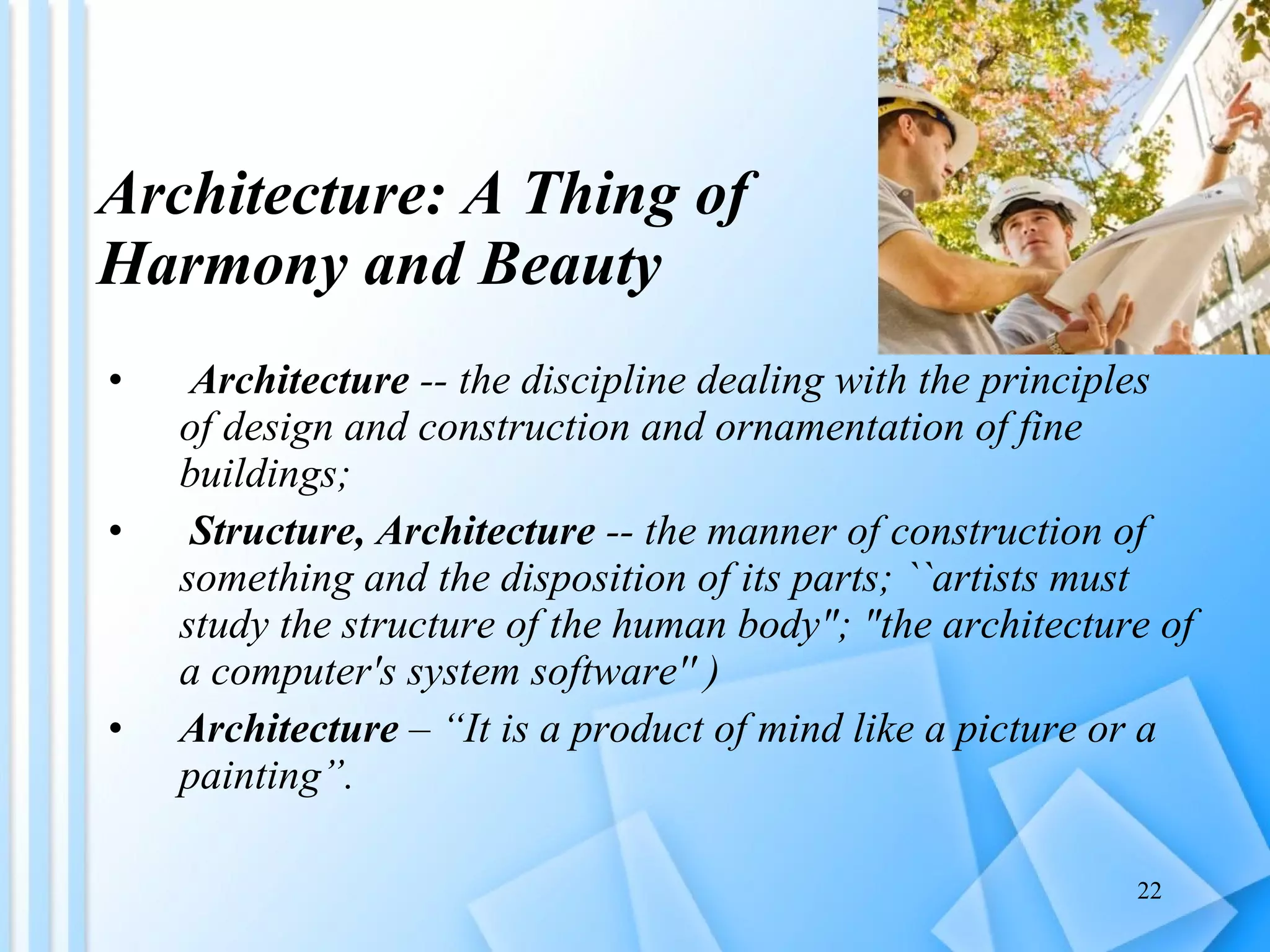
Architecture: A Thing of  Harmony and Beauty Architecture  -- the discipline dealing with the principles of design and construction and ornamentation of fine buildings; Structure, Architecture  -- the manner of construction of something and the disposition of its parts; ``artists must study the structure of the human body"; "the architecture of a computer's system software'' )  Architecture  – “It is a product of mind like a picture or a painting”.
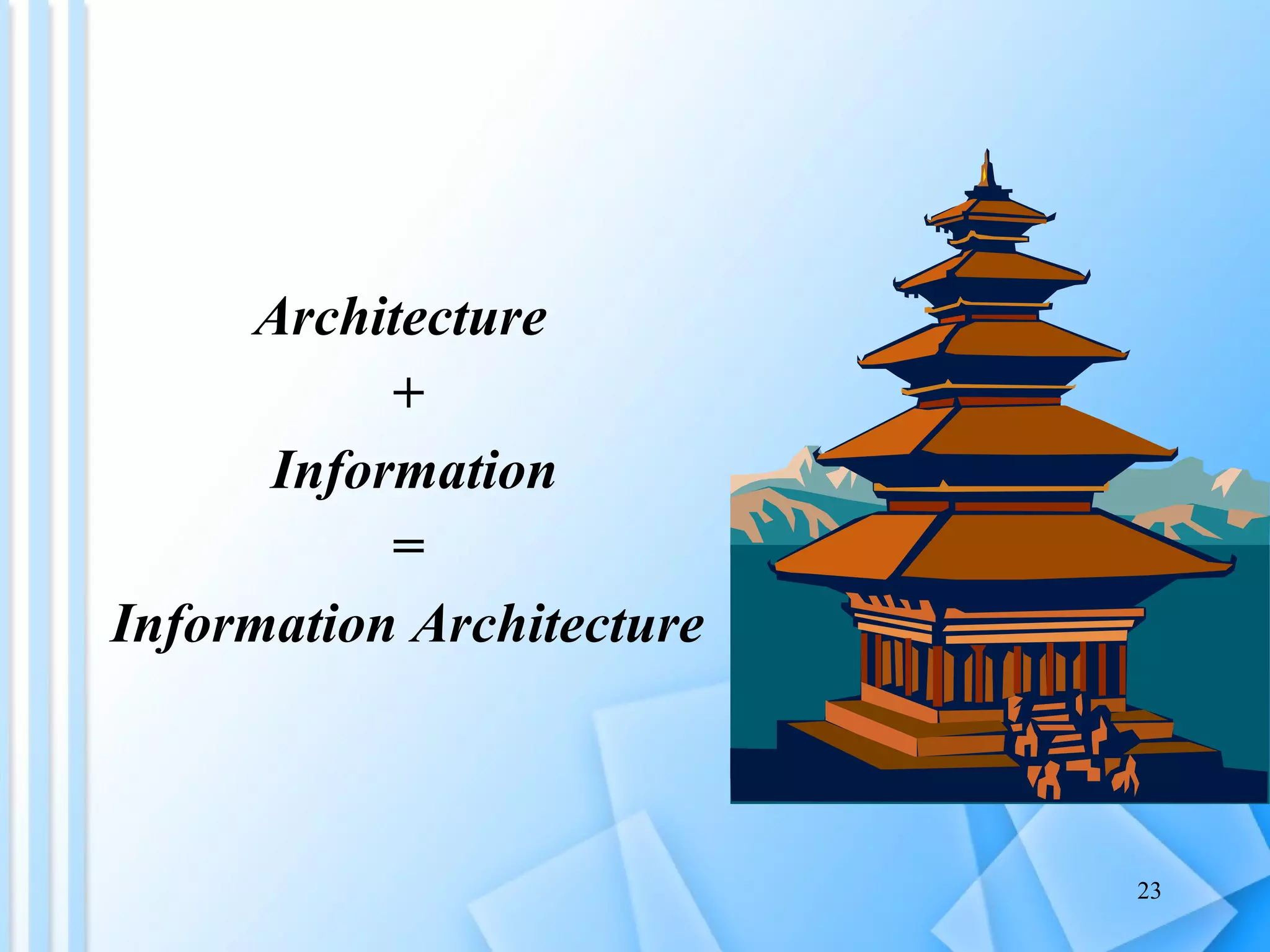
Architecture  + Information =  Information Architecture
Theses of Information Architecture People need information. More importantly, people need the right information at the right time.
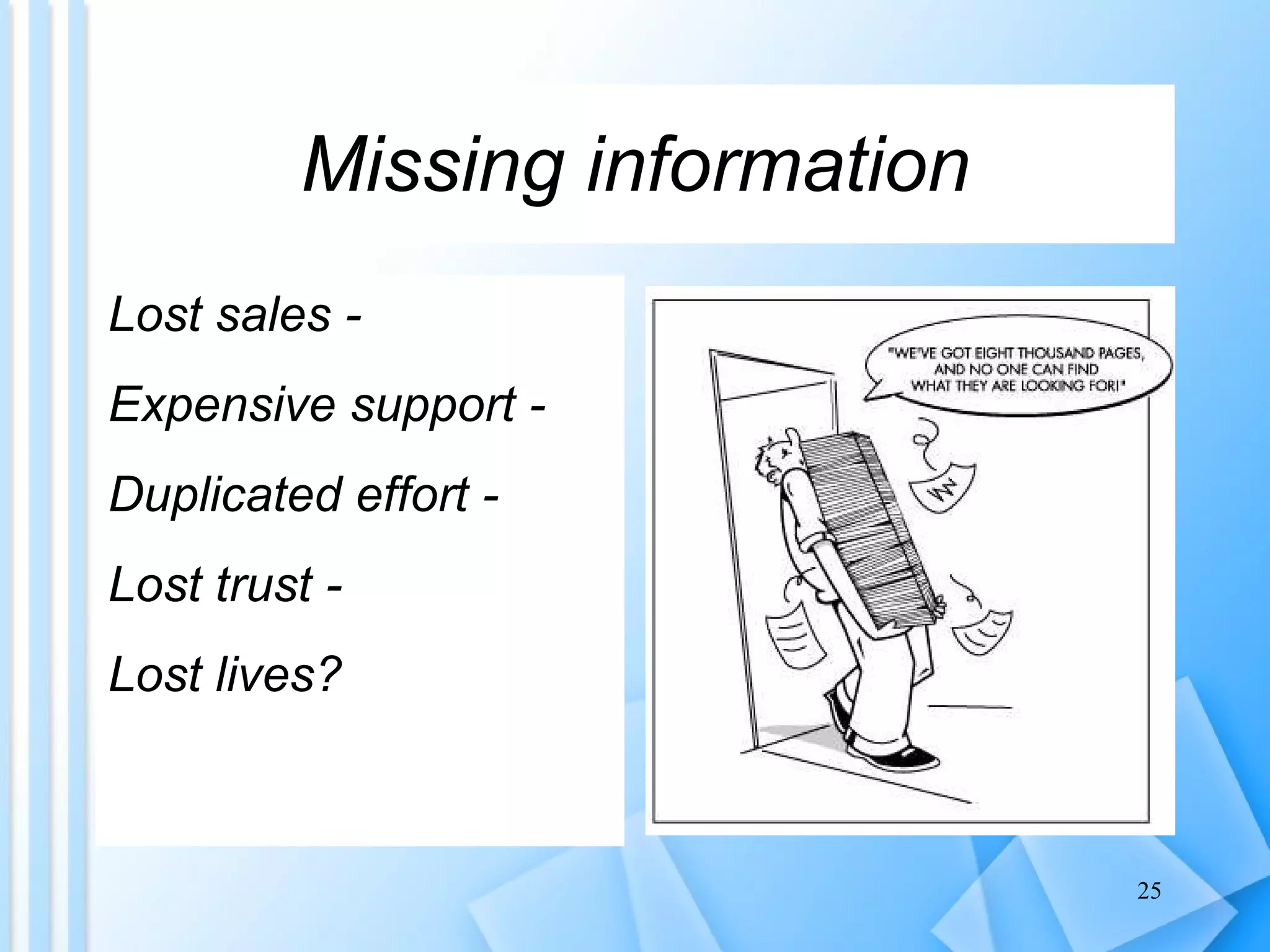
Missing information Lost sales - Expensive support - Duplicated effort - Lost trust - Lost lives?
Why Information Architecture Information Architecture helps make sure that business needs and user needs are met, leaving every one happy.
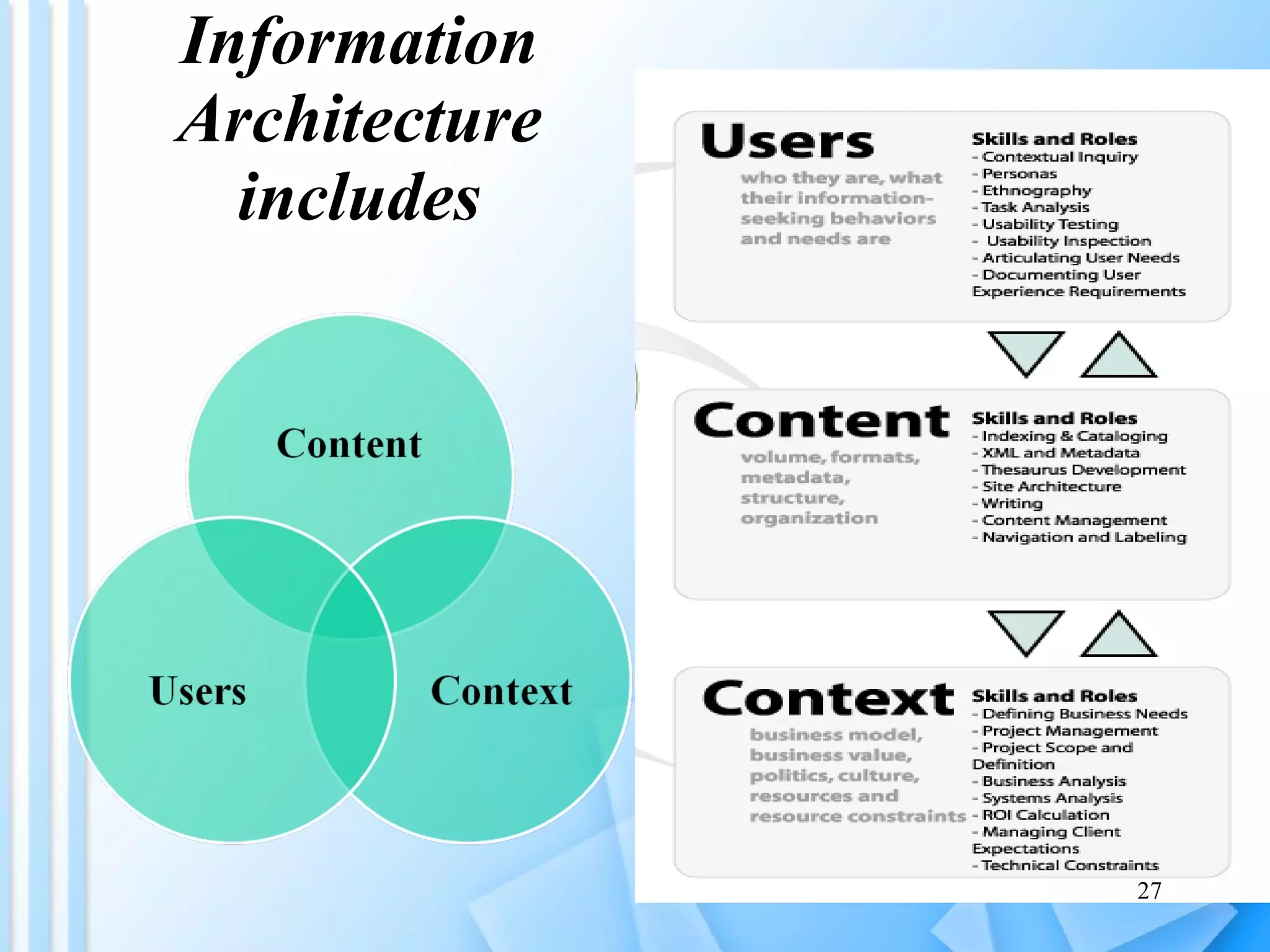
Information Architecture includes
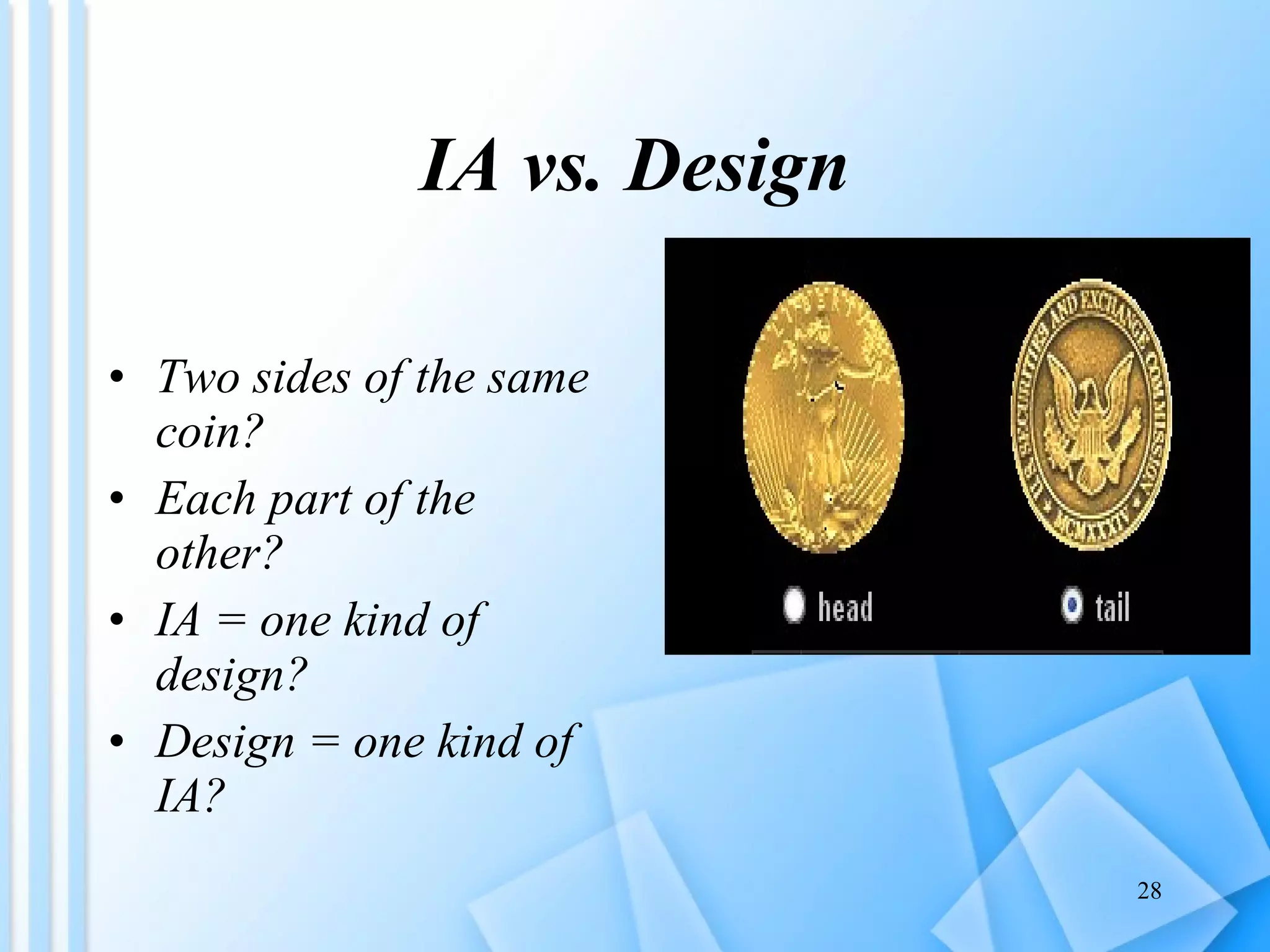
IA vs. Design Two sides of the same coin? Each part of the other? IA = one kind of design? Design = one kind of IA?
Is IA omnipresent?? Yes, it is..
An enigma history of information architecture Information architecture is as old as human communication. Where there’s information, there’s architecture.
What Does An Information Architecture Contain? The  information architecture  contains information about a number of things of interest to the business. In its early stages of development, it contains information about:   the current or planned organization structure,   
What Does An Information Architecture Contain? the goals of the organization,   the business functions that must be carried on to achieve the goals, and   the major categories of things (subjects) the organization needs information about in order to perform the functions.
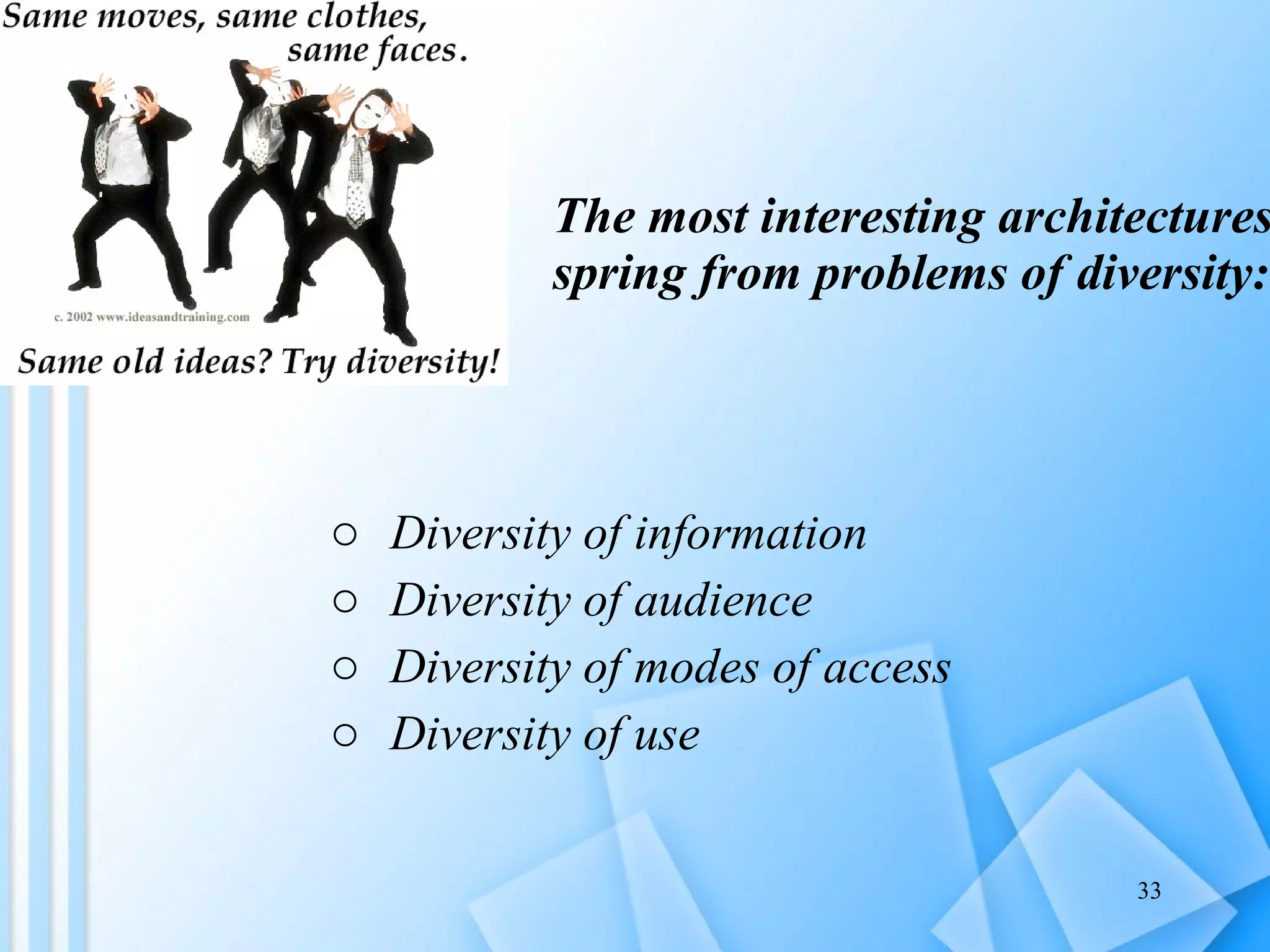
The most interesting architectures spring from problems of diversity: Diversity of information Diversity of audience Diversity of modes of access Diversity of use
Internet and IA The Internet has changed how we live with information.  It has made ubiquitous the once rare entity: the shared information environment
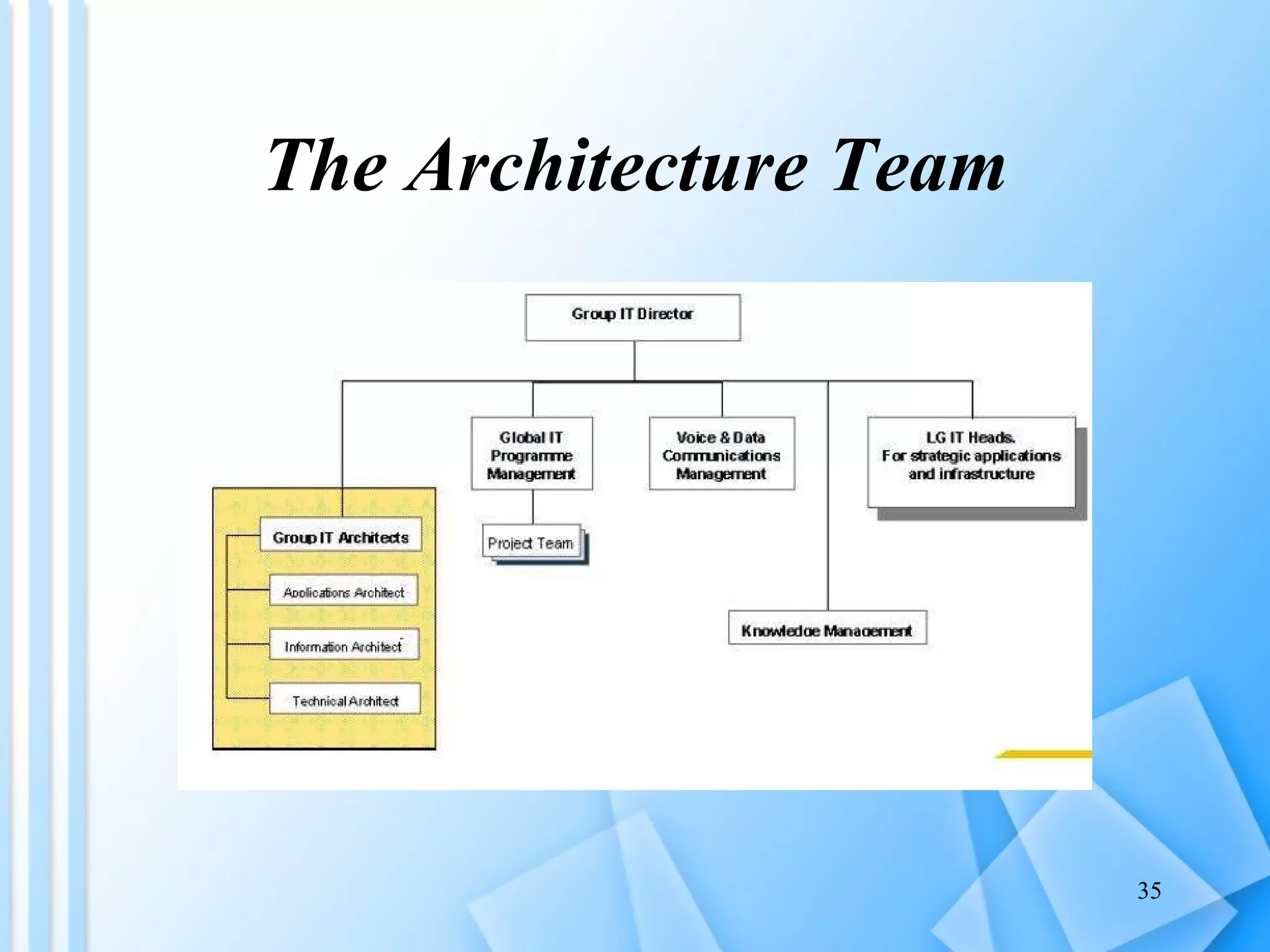
The Architecture Team
Information Architects do: Research & understand user requirements Find the patterns inherent in data, making the complex clear An information architect manages IA process with appropriate tools. Apply Experience
Information Architect :  Skills and experience needed Strong customer focus Product knowledge Knowledge of information design principles Three to five years of technical writing  agement and delivery Good interpersonal skills Knowledge of user needs and usability assessment techniques Demonstrated ability to work in a team environment Ability to perform needs analysis
Approaches of IA Top Down  Bottom Up
“ Top-down” IA It involves developing a broad understanding of the business strategies and user needs, before defining the high level structure ,  Finally the detailed relationships among contents.
“ Bottom-up” IA It involves understanding the detailed relationships among contents,  Create walkthroughs (or storyboards) to show how the system could support specific user requirements and  Then consider the higher level structure that will be required to support these requirements.
Top-Down OR Bottom-Up Not mutually exclusive—every project includes both.
What does an architecture process give us? Sufficient reality in architectural design  Common services Quality of service Vendor co-operation Centralisation of services vs. flexibility in choice of services
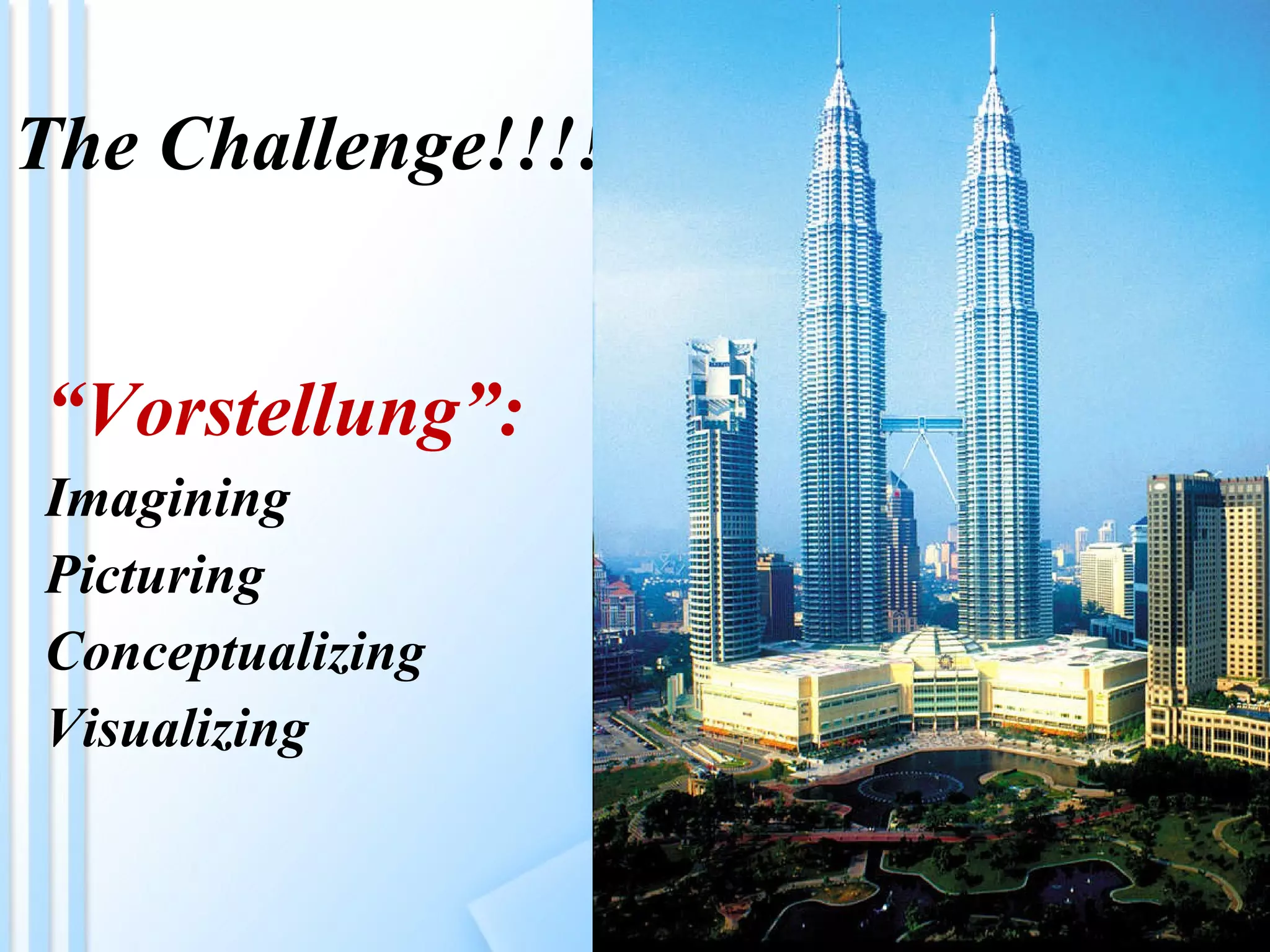
“ Vorstellung”: Imagining Picturing Conceptualizing Visualizing The Challenge!!!!!!!
Developing system architecture is a tough way. Don’t do it unless there is a need. It is expensive. It is a very difficult thing. In fact, it is the most difficult of all. - Szabolcs Michael De Gyurky
Visualization Visualization of product and its architecture. Visualization of organization required to build it. Visualization of the tools and techniques to achieve end objective.
TOGAF will help
TOGAF   provides an  EASY  and  EFFICIENT  approach towards defining an  INFORMATION ARCHITECTURE
Architecture Framework TOGAF is an architecture framework -  The Open Group Architecture Framework.   It enables you to design, evaluate, and build the right architecture for your organization.
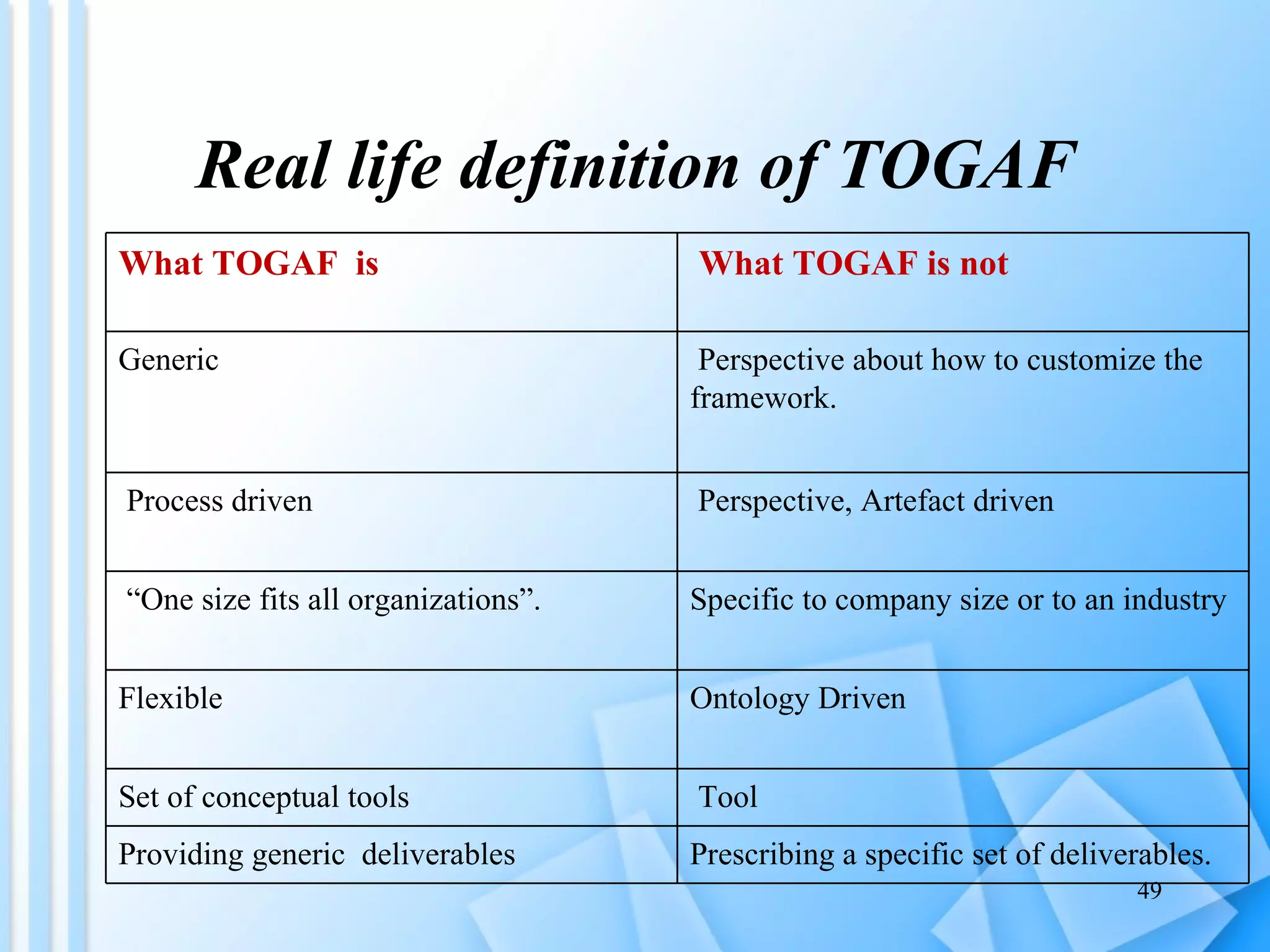
Real life definition of TOGAF What TOGAF  is What TOGAF is not Generic Perspective about how to customize the  framework. Process driven Perspective, Artefact driven “ One size fits all organizations”. Specific to company size or to an industry Flexible Ontology Driven Set of conceptual tools Tool Providing generic  deliverables Prescribing a specific set of deliverables.
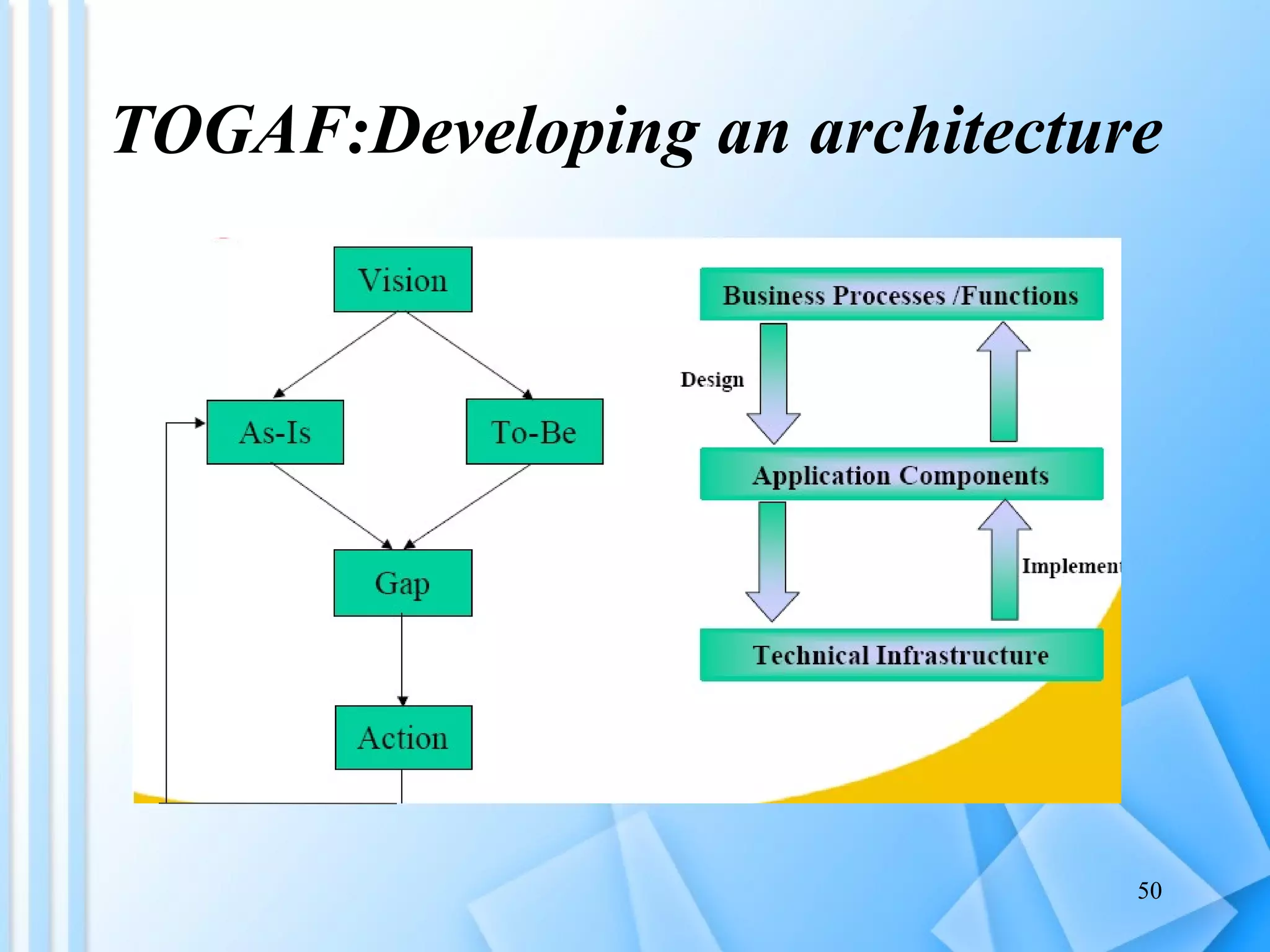
TOGAF:Developing an architecture
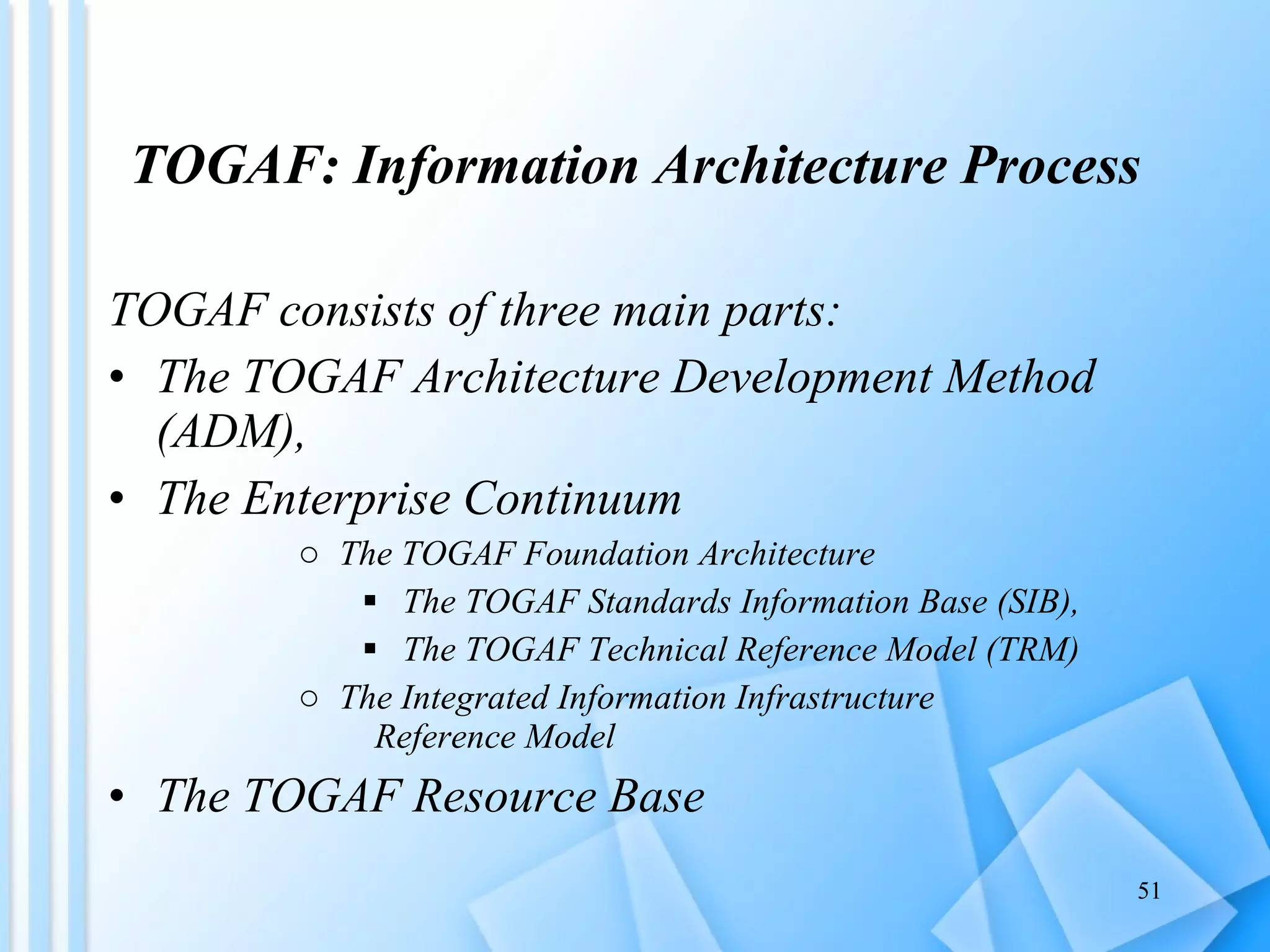
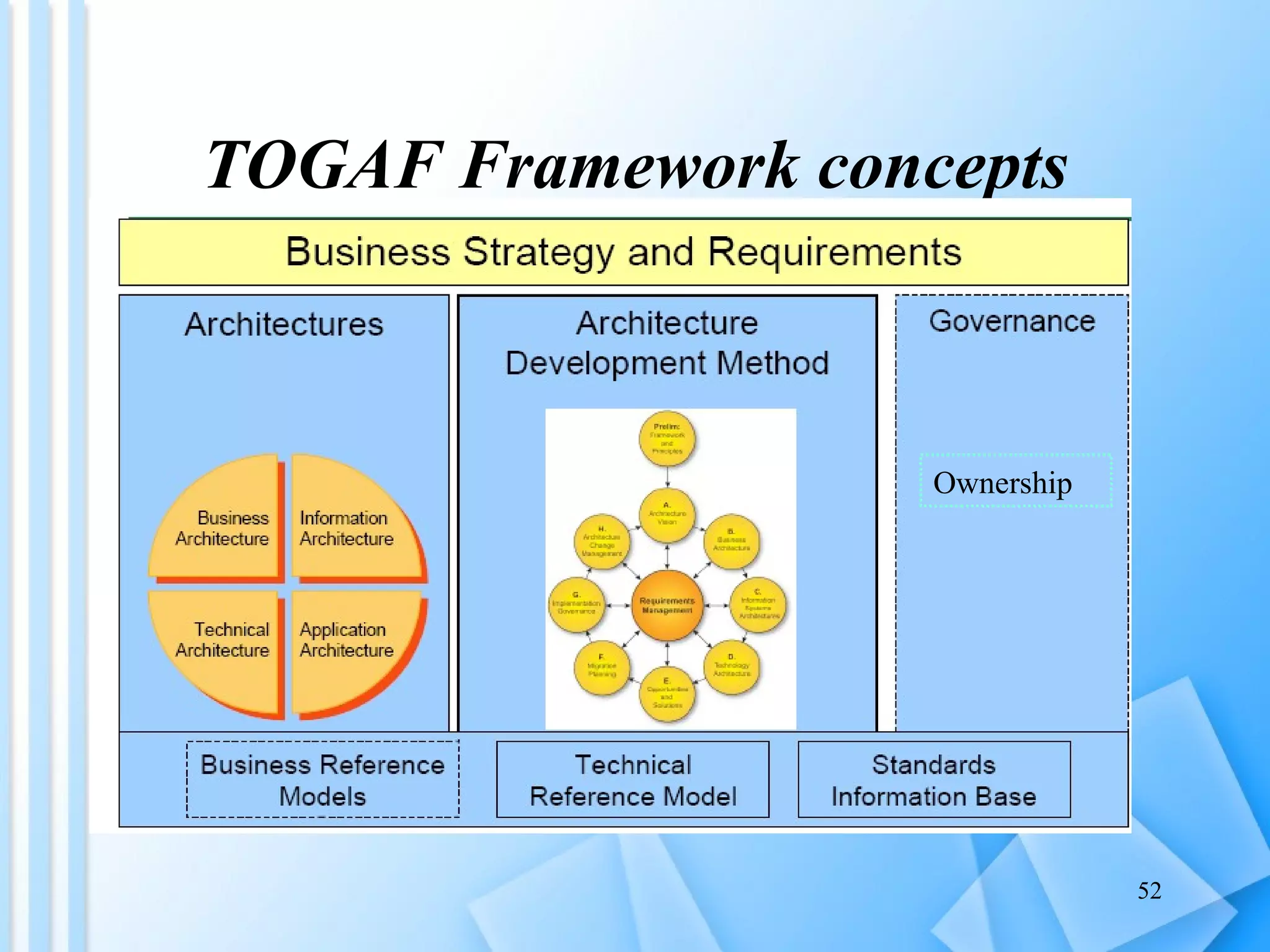
TOGAF: Information Architecture Process TOGAF consists of three main parts: The TOGAF Architecture Development Method (ADM), The Enterprise Continuum The TOGAF Foundation Architecture  The TOGAF Standards Information Base (SIB),  The TOGAF Technical Reference Model (TRM)  The Integrated Information Infrastructure  Reference Model The TOGAF Resource Base
TOGAF Framework concepts Ownership
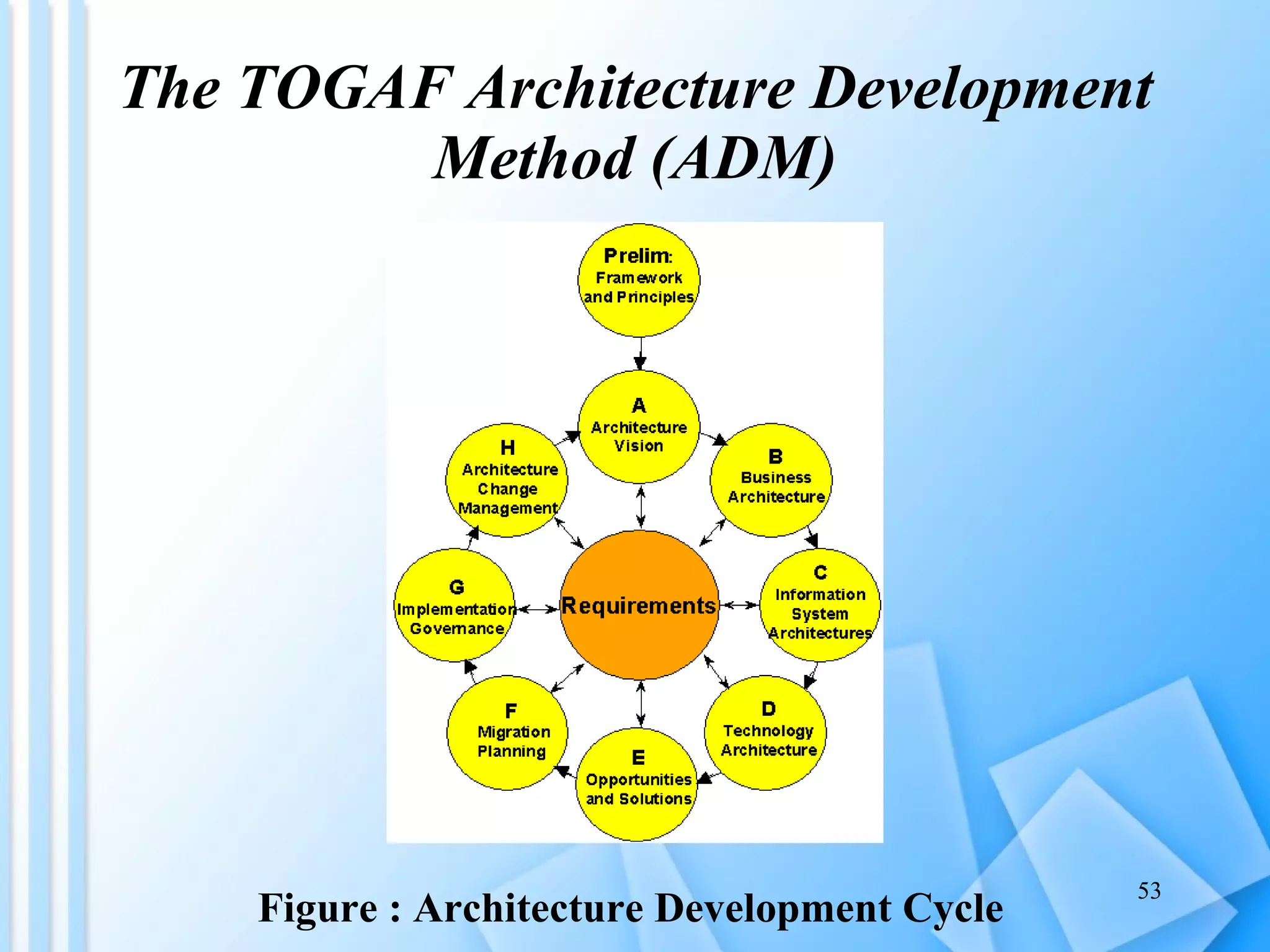
The TOGAF Architecture Development Method (ADM) Figure : Architecture Development Cycle
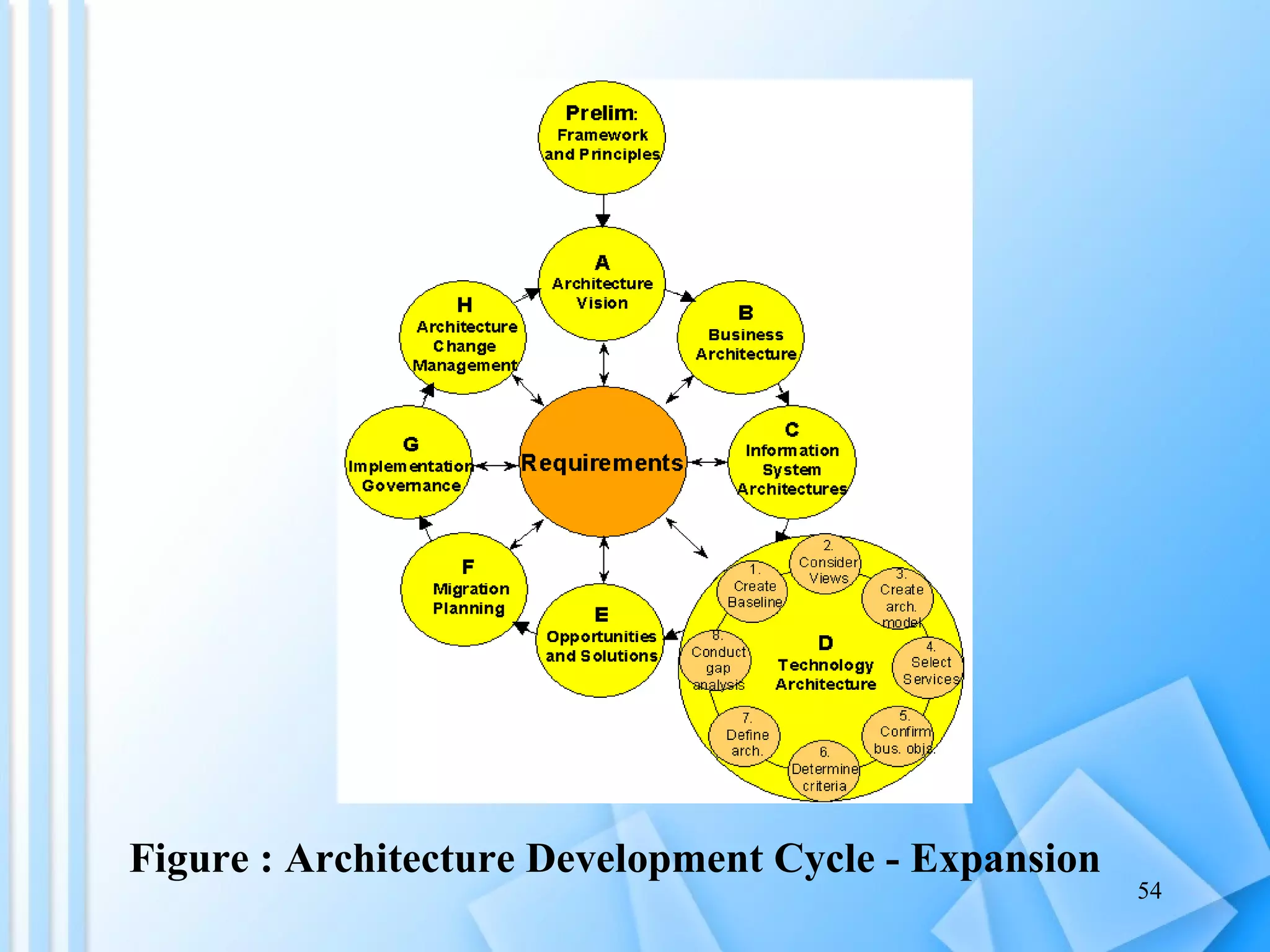
Figure : Architecture Development Cycle - Expansion
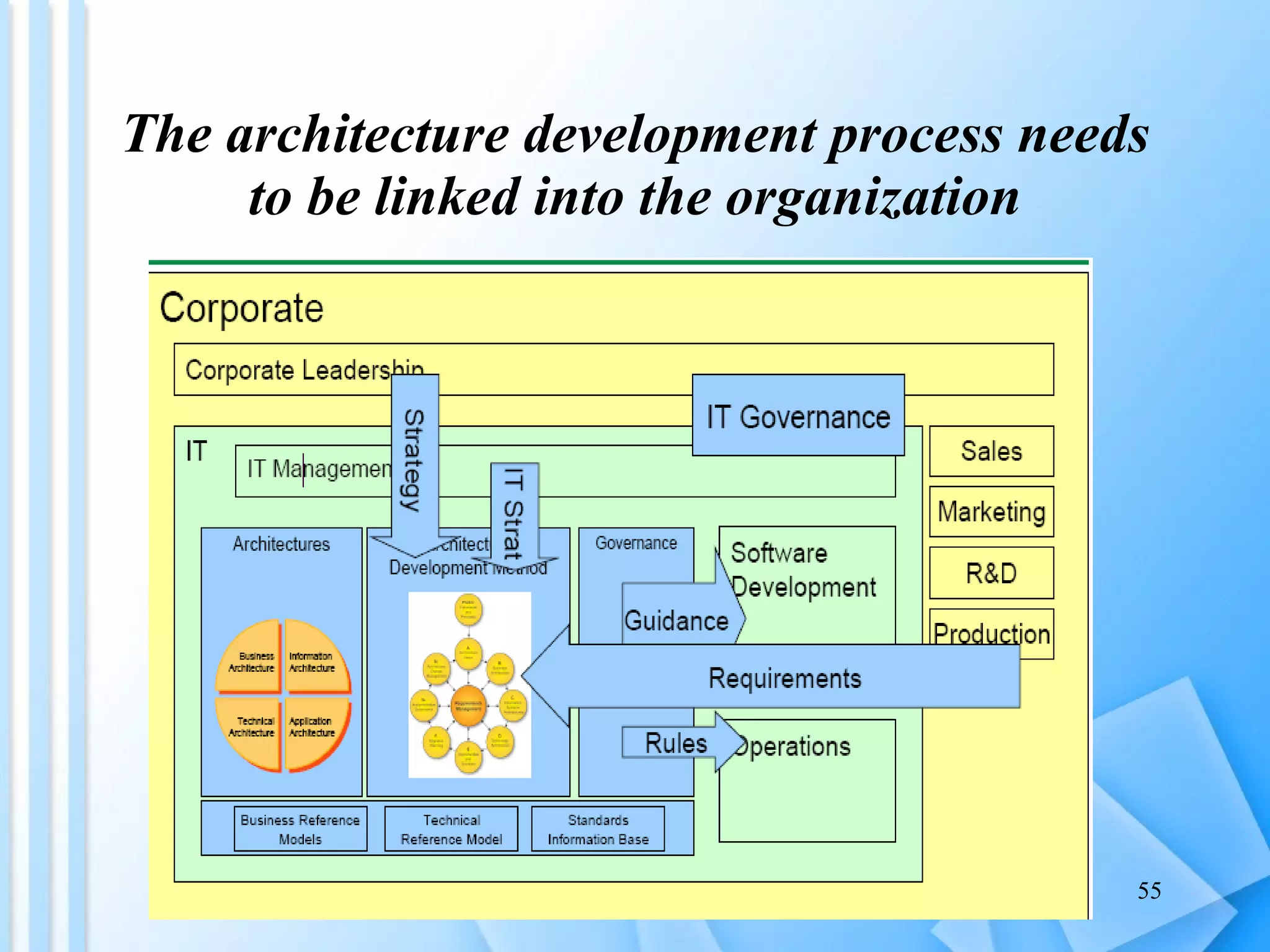
The architecture development process needs to be linked into the organization
Why Architecture in  Enterprise? Be it a standalone site or an enterprise, the users need information, and they need it fast It has to be secured and reliable A typical enterprise has at least a few ERP systems and hundreds of other supporting systems Information is duplicated, stale and retrieval is slow Every extra minute spent on information gathering results in operational overhead
Information is mostly tied with Technology it resides on Every enterprise has some master data which is core to its business Sanctity and reliability of master data may determine success or failure for an organization Master Data Management (MDM) is key Why Architecture in Enterprise?.........
Global Presence Financial Centers at geographically dispersed locations (50+ countries) Country/Local laws and regulations 30,000+ employees Complex business processes Customer Financial Transactions Banking Transactions Corporate Processes International Transactions A Financial Enterprise:
A Financial Enterprise … Master Data Customer Data Vendor/Supplier Data Banking Data Dozens of ERP systems Hundreds of Master data systems (duplication of  information – result of build as you go) Thousands of applications and information systems (integration is a nightmare!)
Driven by changing business (Bank holding company)  Overall Enterprise Architecture is being worked on by CTO organization An architecture roadmap and reference architecture (RA) is being developed (TOGAF is being evaluated) Individual technology teams are developing their own roadmaps (Remember it is a BIG organization) Roadmaps are then used to prepare Information strategies (Disbursement, Financial strategy, Sub-ledger strategy etc.) Consolidation of Master Data - development of “Source of Truth” data storages SOA (Service Oriented Architecture) based integration architecture A long-term strategy A Financial Enterprise – Solution:
A mid-size company 5000+ employees Multiple locations within US Children companies (in supporting businesses) Medium complexity business processes (it is all relative   ) International shipments, laws, regulations Integration with Rail-roads, Inter-modal (Trucking, other carriers) Online tracking - Ship & shipment locations Backend financial processes Disburse Master Data (duplication) – result of build as you go An Ocean Transportation Company:
Re-architecting of what is important for the enterprise (From legacy to multi-tier architecture) Data-warehouse and Data-mart based architecture for information Master data management – ETL based integration Business Intelligence solution for easy retrieval Services based integration at the business processes level A work in progress An Ocean Transportation Company –  Solution:
One of the top Insurance companies Multiple locations Millions of clients Complex business processes Privacy and Security is the key Separation of data and access to it drives the architecture Health industry regulations based processes Master Data Clients, Doctors, Hospitals Out of Network Doctors/Hospitals,  Health regulations But… still duplication of information (as a result of…?) Complex business Rules and their application on data A Health Insurance Organization:
Revamping of Business and Technology organizations (as a result of some business setbacks)  Work in progress on a Reference Architecture (RA) and an Enterprise Architecture Master Data Management Consolidation of master data,  Security based access Mapping of Business processes to application services Integration of Health industry standards and regulations into new Business processes rather than as an add-on A Health Insurance Organization –  Solution:
Key Points To Remember: In an Enterprise, architecture is driven by business (users, processes, adaptation to changes etc.) Information Architecture is not a stand-alone entity, it is a part of Enterprise Architecture Even in case of individual web-sites, it is driven by business architecture and user experience Architecting is a continuous process (more of a circular process) Technology and business innovations are taking place periodically – resulting in new strategies for Information Architecture
Information architecture’s impact on  business 1. Customers consistently request: Better retrievability  Solution-oriented information A seamless information experience  across products
Information architecture’s impact on the business 2. Good information architecture can fulfill those requests and:  Reduce total cost of ownership Reduce customer support calls Reduce number of non-defect  customer support issues (NDOPs) Increase customer satisfaction
Information architecture’s impact on the business 3. All information developers can work toward these goals in their information deliverables and contribute to the overall information architecture.
Conclusions IA is a rapidly emerging field concerned with the art and science of applying many approaches to the design of IS Several disciplines have to merge to architect the right systems Inf. Architect to develop Information structures usable at multiple levels of interaction among humans, machine and environment
Conclusions Information architecture is first an act, then a practice, then a discipline.  Sharing the practice grows the discipline, and makes it stronger.  A 21 st  Century Profession; Information Architect
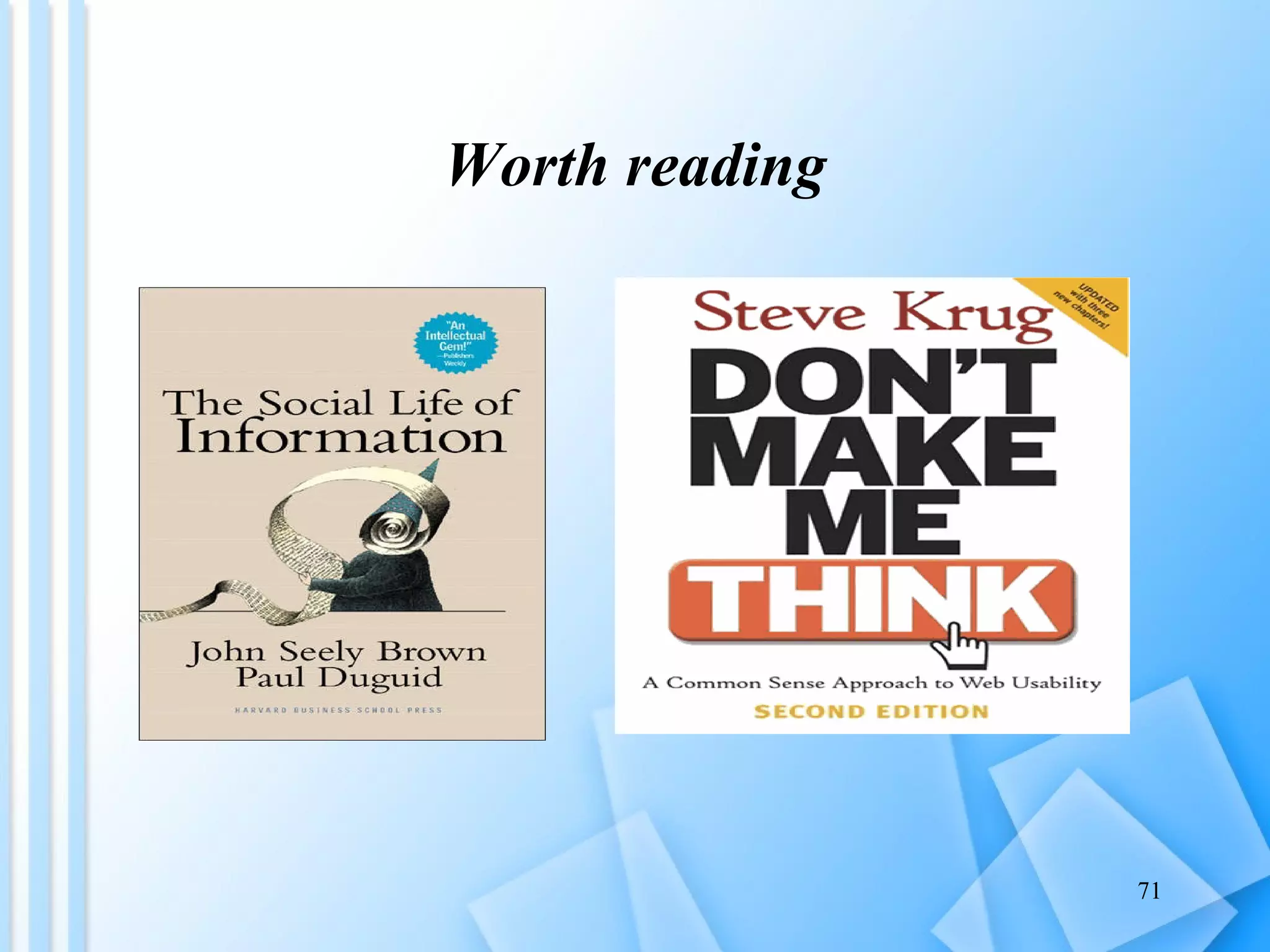
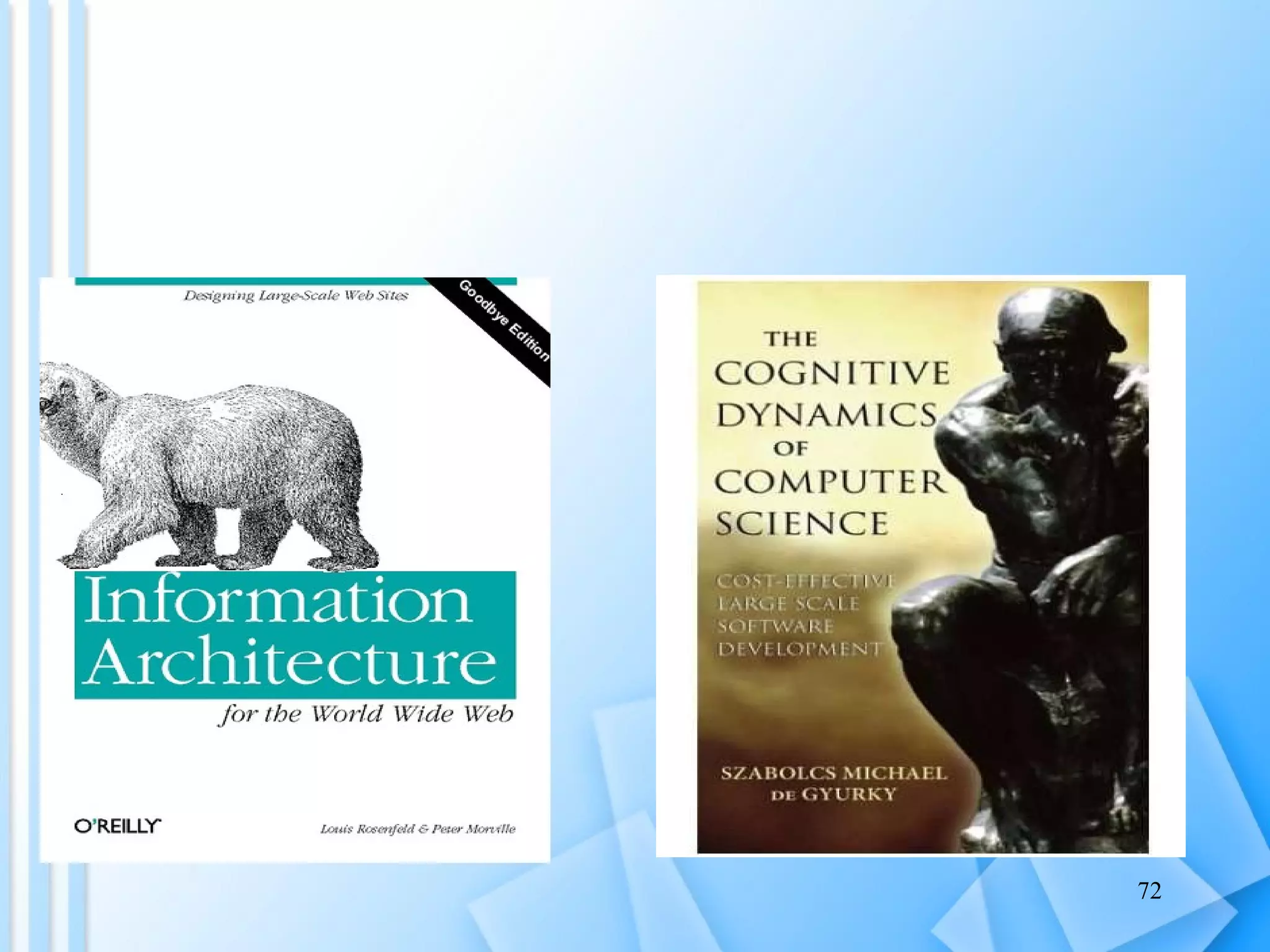
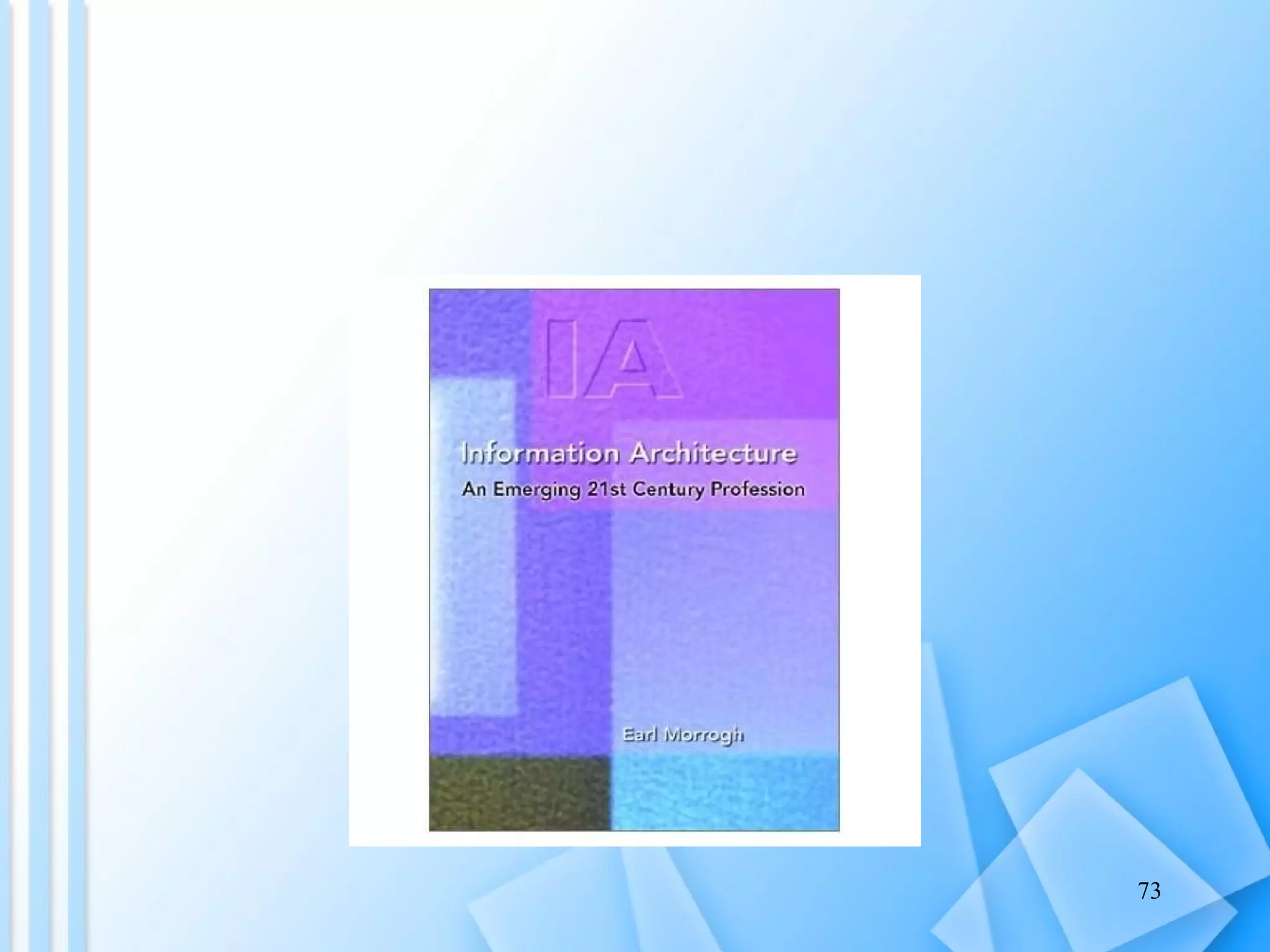
Worth reading
Questions ???
Wrap Up Contact information: Dr. A.K Ramani Prof. & Head SCSIT,DAVV(Indore) email:  [email_address] Thank you and Good Luck….

Information Architecture Profession

  • 1.
    Information Architecture: Anemerging 21 st century profession By : Dr. A.K. Ramani Prof. & Head SCSIT, DAVV, Indore(M.P.), India [email_address]
  • 2.
    AGENDA Information Notionof Design Business and IT evolution Information Architecture IA vs. Design Theses of IA Website Architecture Architecture team Approaches of IA Introduction to TOGAF Wrap Up
  • 3.
    Information Theworld isn’t run by weapons anymore…It is run by small bits of data…0’s and 1’s…. It’s not the one who has got the most bullets but one who controls the information… What we SEE…What we HEAR…What we THINK….. IT”S ALL ABOUT INFORMATION.
  • 4.
    Information Moreand more work depends upon effective use of Information Novel ways of accessing information are seen in offices, home, society, etc. More specialized, complex, more perplexing … Thus, design and efficient communication are more challenging than ever, requiring great deal of time, practice and knowledge
  • 5.
    Notion of DesignSeparation of thinking and doing Separation of manual and intellectual work Separation of conceptual part of work from the labor process Design-build process is more specialized Can be clearly seen in building-architects and builders
  • 6.
    Key Challenge: Towards a New Discipline “ Storage, retrieval and transmission of information has been a challenge since the evolution of human being”.
  • 7.
    Systems are complexThe purpose is to teach the machine as we think.
  • 8.
  • 9.
    Systems are Complex…..Technology has progressed. It can do practically whatever people want it to do. So why doesn’t everyone using a computer system have a large smile on their face?
  • 10.
  • 11.
  • 12.
    Business Evolution OldSystem De-centralized Federation Retailer Push Large inventories Manual processes Buying/Selling Mass consumers New System Group Cohesion Customer pull Just in time Automatic processes Category management Individual customers
  • 13.
    IT Evolution OldSystem Mainframes Novell DOS Own development SNA, IPX, Paper Unmanaged Unresponsive Cost New System Unix Windows NT Windows …… Application Packages TCP/IP Managed Enabling change Benefit
  • 14.
    Vertical Business Processes
  • 15.
  • 16.
  • 17.
    Why innovative system?A rapidly changing technology and business landscape demands innovation and agility. Innovation and agility provides value to the system.
  • 18.
    “ Never innovateout of fear, but never fear to innovate”.
  • 19.
  • 20.
    How to evolvenew innovative system from old system?? Big Question????
  • 21.
  • 22.
    Architecture: A Thingof Harmony and Beauty Architecture -- the discipline dealing with the principles of design and construction and ornamentation of fine buildings; Structure, Architecture -- the manner of construction of something and the disposition of its parts; ``artists must study the structure of the human body"; "the architecture of a computer's system software'' ) Architecture – “It is a product of mind like a picture or a painting”.
  • 23.
    Architecture +Information = Information Architecture
  • 24.
    Theses of InformationArchitecture People need information. More importantly, people need the right information at the right time.
  • 25.
    Missing information Lostsales - Expensive support - Duplicated effort - Lost trust - Lost lives?
  • 26.
    Why Information ArchitectureInformation Architecture helps make sure that business needs and user needs are met, leaving every one happy.
  • 27.
  • 28.
    IA vs. DesignTwo sides of the same coin? Each part of the other? IA = one kind of design? Design = one kind of IA?
  • 29.
    Is IA omnipresent??Yes, it is..
  • 30.
    An enigma historyof information architecture Information architecture is as old as human communication. Where there’s information, there’s architecture.
  • 31.
    What Does AnInformation Architecture Contain? The information architecture contains information about a number of things of interest to the business. In its early stages of development, it contains information about:  the current or planned organization structure,   
  • 32.
    What Does AnInformation Architecture Contain? the goals of the organization,  the business functions that must be carried on to achieve the goals, and  the major categories of things (subjects) the organization needs information about in order to perform the functions.
  • 33.
    The most interestingarchitectures spring from problems of diversity: Diversity of information Diversity of audience Diversity of modes of access Diversity of use
  • 34.
    Internet and IAThe Internet has changed how we live with information. It has made ubiquitous the once rare entity: the shared information environment
  • 35.
  • 36.
    Information Architects do:Research & understand user requirements Find the patterns inherent in data, making the complex clear An information architect manages IA process with appropriate tools. Apply Experience
  • 37.
    Information Architect : Skills and experience needed Strong customer focus Product knowledge Knowledge of information design principles Three to five years of technical writing agement and delivery Good interpersonal skills Knowledge of user needs and usability assessment techniques Demonstrated ability to work in a team environment Ability to perform needs analysis
  • 38.
    Approaches of IATop Down Bottom Up
  • 39.
    “ Top-down” IAIt involves developing a broad understanding of the business strategies and user needs, before defining the high level structure , Finally the detailed relationships among contents.
  • 40.
    “ Bottom-up” IAIt involves understanding the detailed relationships among contents, Create walkthroughs (or storyboards) to show how the system could support specific user requirements and Then consider the higher level structure that will be required to support these requirements.
  • 41.
    Top-Down OR Bottom-UpNot mutually exclusive—every project includes both.
  • 42.
    What does anarchitecture process give us? Sufficient reality in architectural design Common services Quality of service Vendor co-operation Centralisation of services vs. flexibility in choice of services
  • 43.
    “ Vorstellung”: ImaginingPicturing Conceptualizing Visualizing The Challenge!!!!!!!
  • 44.
    Developing system architectureis a tough way. Don’t do it unless there is a need. It is expensive. It is a very difficult thing. In fact, it is the most difficult of all. - Szabolcs Michael De Gyurky
  • 45.
    Visualization Visualization ofproduct and its architecture. Visualization of organization required to build it. Visualization of the tools and techniques to achieve end objective.
  • 46.
  • 47.
    TOGAF provides an EASY and EFFICIENT approach towards defining an INFORMATION ARCHITECTURE
  • 48.
    Architecture Framework TOGAFis an architecture framework - The Open Group Architecture Framework. It enables you to design, evaluate, and build the right architecture for your organization.
  • 49.
    Real life definitionof TOGAF What TOGAF is What TOGAF is not Generic Perspective about how to customize the framework. Process driven Perspective, Artefact driven “ One size fits all organizations”. Specific to company size or to an industry Flexible Ontology Driven Set of conceptual tools Tool Providing generic deliverables Prescribing a specific set of deliverables.
  • 50.
  • 51.
    TOGAF: Information ArchitectureProcess TOGAF consists of three main parts: The TOGAF Architecture Development Method (ADM), The Enterprise Continuum The TOGAF Foundation Architecture The TOGAF Standards Information Base (SIB), The TOGAF Technical Reference Model (TRM) The Integrated Information Infrastructure Reference Model The TOGAF Resource Base
  • 52.
  • 53.
    The TOGAF ArchitectureDevelopment Method (ADM) Figure : Architecture Development Cycle
  • 54.
    Figure : ArchitectureDevelopment Cycle - Expansion
  • 55.
    The architecture developmentprocess needs to be linked into the organization
  • 56.
    Why Architecture in Enterprise? Be it a standalone site or an enterprise, the users need information, and they need it fast It has to be secured and reliable A typical enterprise has at least a few ERP systems and hundreds of other supporting systems Information is duplicated, stale and retrieval is slow Every extra minute spent on information gathering results in operational overhead
  • 57.
    Information is mostlytied with Technology it resides on Every enterprise has some master data which is core to its business Sanctity and reliability of master data may determine success or failure for an organization Master Data Management (MDM) is key Why Architecture in Enterprise?.........
  • 58.
    Global Presence FinancialCenters at geographically dispersed locations (50+ countries) Country/Local laws and regulations 30,000+ employees Complex business processes Customer Financial Transactions Banking Transactions Corporate Processes International Transactions A Financial Enterprise:
  • 59.
    A Financial Enterprise… Master Data Customer Data Vendor/Supplier Data Banking Data Dozens of ERP systems Hundreds of Master data systems (duplication of information – result of build as you go) Thousands of applications and information systems (integration is a nightmare!)
  • 60.
    Driven by changingbusiness (Bank holding company) Overall Enterprise Architecture is being worked on by CTO organization An architecture roadmap and reference architecture (RA) is being developed (TOGAF is being evaluated) Individual technology teams are developing their own roadmaps (Remember it is a BIG organization) Roadmaps are then used to prepare Information strategies (Disbursement, Financial strategy, Sub-ledger strategy etc.) Consolidation of Master Data - development of “Source of Truth” data storages SOA (Service Oriented Architecture) based integration architecture A long-term strategy A Financial Enterprise – Solution:
  • 61.
    A mid-size company5000+ employees Multiple locations within US Children companies (in supporting businesses) Medium complexity business processes (it is all relative  ) International shipments, laws, regulations Integration with Rail-roads, Inter-modal (Trucking, other carriers) Online tracking - Ship & shipment locations Backend financial processes Disburse Master Data (duplication) – result of build as you go An Ocean Transportation Company:
  • 62.
    Re-architecting of whatis important for the enterprise (From legacy to multi-tier architecture) Data-warehouse and Data-mart based architecture for information Master data management – ETL based integration Business Intelligence solution for easy retrieval Services based integration at the business processes level A work in progress An Ocean Transportation Company – Solution:
  • 63.
    One of thetop Insurance companies Multiple locations Millions of clients Complex business processes Privacy and Security is the key Separation of data and access to it drives the architecture Health industry regulations based processes Master Data Clients, Doctors, Hospitals Out of Network Doctors/Hospitals, Health regulations But… still duplication of information (as a result of…?) Complex business Rules and their application on data A Health Insurance Organization:
  • 64.
    Revamping of Businessand Technology organizations (as a result of some business setbacks) Work in progress on a Reference Architecture (RA) and an Enterprise Architecture Master Data Management Consolidation of master data, Security based access Mapping of Business processes to application services Integration of Health industry standards and regulations into new Business processes rather than as an add-on A Health Insurance Organization – Solution:
  • 65.
    Key Points ToRemember: In an Enterprise, architecture is driven by business (users, processes, adaptation to changes etc.) Information Architecture is not a stand-alone entity, it is a part of Enterprise Architecture Even in case of individual web-sites, it is driven by business architecture and user experience Architecting is a continuous process (more of a circular process) Technology and business innovations are taking place periodically – resulting in new strategies for Information Architecture
  • 66.
    Information architecture’s impacton business 1. Customers consistently request: Better retrievability Solution-oriented information A seamless information experience across products
  • 67.
    Information architecture’s impacton the business 2. Good information architecture can fulfill those requests and: Reduce total cost of ownership Reduce customer support calls Reduce number of non-defect customer support issues (NDOPs) Increase customer satisfaction
  • 68.
    Information architecture’s impacton the business 3. All information developers can work toward these goals in their information deliverables and contribute to the overall information architecture.
  • 69.
    Conclusions IA isa rapidly emerging field concerned with the art and science of applying many approaches to the design of IS Several disciplines have to merge to architect the right systems Inf. Architect to develop Information structures usable at multiple levels of interaction among humans, machine and environment
  • 70.
    Conclusions Information architectureis first an act, then a practice, then a discipline. Sharing the practice grows the discipline, and makes it stronger. A 21 st Century Profession; Information Architect
  • 71.
  • 74.
  • 75.
    Wrap Up Contactinformation: Dr. A.K Ramani Prof. & Head SCSIT,DAVV(Indore) email: [email_address] Thank you and Good Luck….