Women’s Empowerment as Pathway to Food
Security and Productivity
Dr. Pranati Mohanraj
MEL Advisor, CARE USA
GENDER - JUST FOOD AND NUTRITION SECURITY IN
INDIA
AUGUST 29, 2016
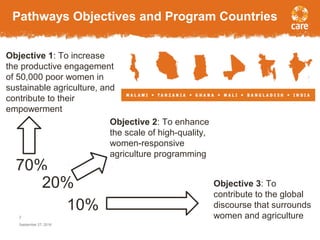
Pathways Objectives and Program Countries
September 27, 2016
2
Objective 1: To increase
the productive engagement
of 50,000 poor women in
sustainable agriculture, and
contribute to their
empowerment
Objective 2: To enhance
the scale of high-quality,
women-responsive
agriculture programming
Objective 3: To
contribute to the global
discourse that surrounds
women and agriculture
70%
20%
10%
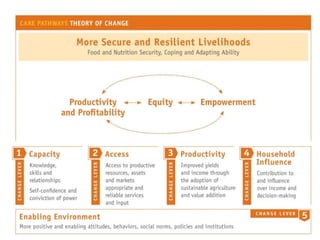
Program Objectives and Theory of Change
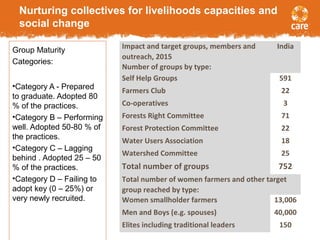
Nurturing collectives for livelihoods capacities and
social change
Group Maturity
Categories:
•Category A - Prepared
to graduate. Adopted 80
% of the practices.
•Category B – Performing
well. Adopted 50-80 % of
the practices.
•Category C – Lagging
behind . Adopted 25 – 50
% of the practices.
•Category D – Failing to
adopt key (0 – 25%) or
very newly recruited.
Impact and target groups, members and
outreach, 2015
India
Number of groups by type:
Self Help Groups 591
Farmers Club 22
Co-operatives 3
Forests Right Committee 71
Forest Protection Committee 22
Water Users Association 18
Watershed Committee 25
Total number of groups 752
Total number of women farmers and other target
group reached by type:
Women smallholder farmers 13,006
Men and Boys (e.g. spouses) 40,000
Elites including traditional leaders 150
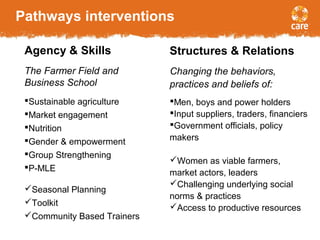
Pathways interventions
The Farmer Field and
Business School
Sustainable agriculture
Market engagement
Nutrition
Gender & empowerment
Group Strengthening
P-MLE
Seasonal Planning
Toolkit
Community Based Trainers
Agency & Skills
Changing the behaviors,
practices and beliefs of:
Men, boys and power holders
Input suppliers, traders, financiers
Government officials, policy
makers
Women as viable farmers,
market actors, leaders
Challenging underlying social
norms & practices
Access to productive resources
Structures & Relations
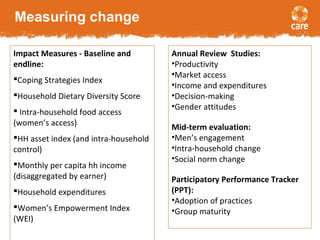
Measuring change
Impact Measures - Baseline and
endline:
Coping Strategies Index
Household Dietary Diversity Score
 Intra-household food access
(women’s access)
HH asset index (and intra-household
control)
Monthly per capita hh income
(disaggregated by earner)
Household expenditures
Women’s Empowerment Index
(WEI)
Annual Review Studies:
•Productivity
•Market access
•Income and expenditures
•Decision-making
•Gender attitudes
Mid-term evaluation:
•Men’s engagement
•Intra-household change
•Social norm change
Participatory Performance Tracker
(PPT):
•Adoption of practices
•Group maturity
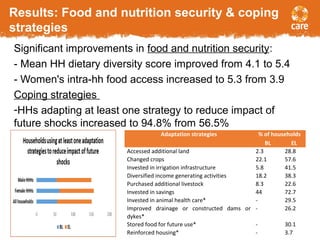
Results: Food and nutrition security & coping
strategies
Significant improvements in food and nutrition security:
- Mean HH dietary diversity score improved from 4.1 to 5.4
- Women's intra-hh food access increased to 5.3 from 3.9
Coping strategies
-HHs adapting at least one strategy to reduce impact of
future shocks increased to 94.8% from 56.5%
Adaptation strategies % of households
BL EL
Accessed additional land 2.3 28.8
Changed crops 22.1 57.6
Invested in irrigation infrastructure 5.8 41.5
Diversified income generating activities 18.2 38.3
Purchased additional livestock 8.3 22.6
Invested in savings 44 72.7
Invested in animal health care* - 29.5
Improved drainage or constructed dams or
dykes*
- 26.2
Stored food for future use* - 30.1
Reinforced housing* - 3.7
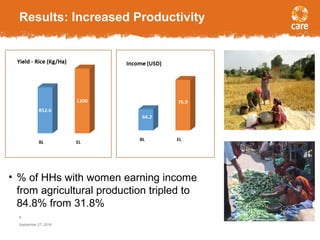
• % of HHs with women earning income
from agricultural production tripled to
84.8% from 31.8%
Results: Increased Productivity
September 27, 2016
8
Results: Access to Productive Resources
9
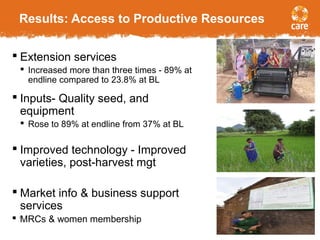
 Extension services
 Increased more than three times - 89% at
endline compared to 23.8% at BL
 Inputs- Quality seed, and
equipment
 Rose to 89% at endline from 37% at BL
 Improved technology - Improved
varieties, post-harvest mgt
 Market info & business support
services
 MRCs & women membership
Results: Women’s Empowerment
September 27, 2016
10
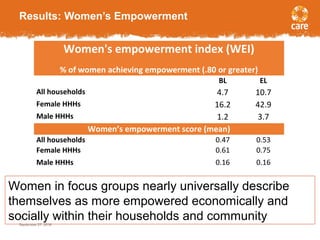
Women's empowerment index (WEI)
% of women achieving empowerment (.80 or greater)
 
BL EL
All households 4.7 10.7
Female HHHs 16.2 42.9
Male HHHs 1.2 3.7
Women’s empowerment score (mean)
All households 0.47 0.53
Female HHHs 0.61 0.75
Male HHHs 0.16 0.16
Women in focus groups nearly universally describe
themselves as more empowered economically and
socially within their households and community
Results: Women’s Empowerment
September 27, 2016
11
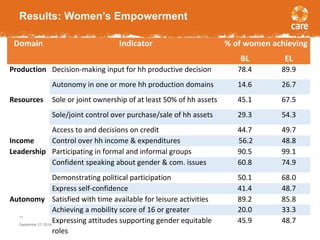
Domain Indicator % of women achieving
BL EL
Production Decision-making input for hh productive decision  78.4 89.9
Autonomy in one or more hh production domains 14.6 26.7
Resources Sole or joint ownership of at least 50% of hh assets 45.1 67.5
Sole/joint control over purchase/sale of hh assets 29.3 54.3
Access to and decisions on credit 44.7 49.7
Income  Control over hh income & expenditures   56.2 48.8
Leadership Participating in formal and informal groups 90.5 99.1
Confident speaking about gender & com. issues  60.8 74.9
Demonstrating political participation 50.1 68.0
Express self-confidence 41.4 48.7
Autonomy Satisfied with time available for leisure activities 89.2 85.8
Achieving a mobility score of 16 or greater 20.0 33.3
Expressing attitudes supporting gender equitable 
roles 
45.9 48.7
September 27, 2016
12
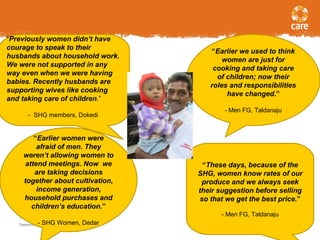
“Earlier we used to think
women are just for
cooking and taking care
of children; now their
roles and responsibilities
have changed.”
- Men FG, Taldanaju
“These days, because of the
SHG, women know rates of our
produce and we always seek
their suggestion before selling
so that we get the best price.”
- Men FG, Taldanaju
“Previously women didn’t have
courage to speak to their
husbands about household work.
We were not supported in any
way even when we were having
babies. Recently husbands are
supporting wives like cooking
and taking care of children.”
- SHG members, Dokedi
“Earlier women were
afraid of men. They
weren’t allowing women to
attend meetings. Now we
are taking decisions
together about cultivation,
income generation,
household purchases and
children’s education.”
- SHG Women, Dedar
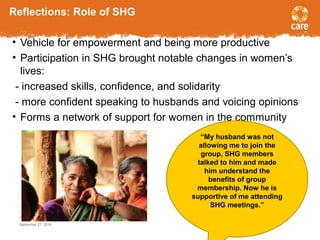
Reflections: Role of SHG
• Vehicle for empowerment and being more productive
• Participation in SHG brought notable changes in women’s
lives:
- increased skills, confidence, and solidarity
- more confident speaking to husbands and voicing opinions
• Forms a network of support for women in the community
September 27, 2016
13
“My husband was not
allowing me to join the
group, SHG members
talked to him and made
him understand the
benefits of group
membership. Now he is
supportive of me attending
SHG meetings.”
Reflections
 Group participation and income generation is
key to enable positive changes
 SHG participation enables women to gain self-
confidence and take collective action on
social issues
 Sequencing & interconnectedness of
interventions
 Participatory Monitoring, Learning and Evaluation
 Quantitative & Qualitative Approaches
September 27, 2016
14
“Because we formed
a group, we feel
confident and
courageous to face
and overcome the
challenges .”
Research implications
• HH income appeared to be notoriously unreliable
indicator for measuring income
• Coping Strategy Index needs to be augmented to
incorporate recent improvements in resilience
measurement
• Difficult to attribute empowerment impacts to the
program directly in the absence of counterfactuals
• Concept of ‘jointness’ in decision making could be
misleading (discrepancy between quantitative and
qualitative findings)September 27, 2016
15
Thank you!
September 27, 2016
16
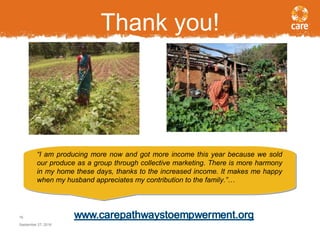
“I am producing more now and got more income this year because we sold
our produce as a group through collective marketing. There is more harmony
in my home these days, thanks to the increased income. It makes me happy
when my husband appreciates my contribution to the family.”…
“I am producing more now and got more income this year because we sold
our produce as a group through collective marketing. There is more harmony
in my home these days, thanks to the increased income. It makes me happy
when my husband appreciates my contribution to the family.”…

IFPRI-CARE USA Pathways- Pranati Mohanraj

  • 1.
    Women’s Empowerment asPathway to Food Security and Productivity Dr. Pranati Mohanraj MEL Advisor, CARE USA GENDER - JUST FOOD AND NUTRITION SECURITY IN INDIA AUGUST 29, 2016
  • 2.
    Pathways Objectives andProgram Countries September 27, 2016 2 Objective 1: To increase the productive engagement of 50,000 poor women in sustainable agriculture, and contribute to their empowerment Objective 2: To enhance the scale of high-quality, women-responsive agriculture programming Objective 3: To contribute to the global discourse that surrounds women and agriculture 70% 20% 10%
  • 3.
    Program Objectives andTheory of Change
  • 4.
    Nurturing collectives forlivelihoods capacities and social change Group Maturity Categories: •Category A - Prepared to graduate. Adopted 80 % of the practices. •Category B – Performing well. Adopted 50-80 % of the practices. •Category C – Lagging behind . Adopted 25 – 50 % of the practices. •Category D – Failing to adopt key (0 – 25%) or very newly recruited. Impact and target groups, members and outreach, 2015 India Number of groups by type: Self Help Groups 591 Farmers Club 22 Co-operatives 3 Forests Right Committee 71 Forest Protection Committee 22 Water Users Association 18 Watershed Committee 25 Total number of groups 752 Total number of women farmers and other target group reached by type: Women smallholder farmers 13,006 Men and Boys (e.g. spouses) 40,000 Elites including traditional leaders 150
  • 5.
    Pathways interventions The FarmerField and Business School Sustainable agriculture Market engagement Nutrition Gender & empowerment Group Strengthening P-MLE Seasonal Planning Toolkit Community Based Trainers Agency & Skills Changing the behaviors, practices and beliefs of: Men, boys and power holders Input suppliers, traders, financiers Government officials, policy makers Women as viable farmers, market actors, leaders Challenging underlying social norms & practices Access to productive resources Structures & Relations
  • 6.
    Measuring change Impact Measures- Baseline and endline: Coping Strategies Index Household Dietary Diversity Score  Intra-household food access (women’s access) HH asset index (and intra-household control) Monthly per capita hh income (disaggregated by earner) Household expenditures Women’s Empowerment Index (WEI) Annual Review Studies: •Productivity •Market access •Income and expenditures •Decision-making •Gender attitudes Mid-term evaluation: •Men’s engagement •Intra-household change •Social norm change Participatory Performance Tracker (PPT): •Adoption of practices •Group maturity
  • 7.
    Results: Food andnutrition security & coping strategies Significant improvements in food and nutrition security: - Mean HH dietary diversity score improved from 4.1 to 5.4 - Women's intra-hh food access increased to 5.3 from 3.9 Coping strategies -HHs adapting at least one strategy to reduce impact of future shocks increased to 94.8% from 56.5% Adaptation strategies % of households BL EL Accessed additional land 2.3 28.8 Changed crops 22.1 57.6 Invested in irrigation infrastructure 5.8 41.5 Diversified income generating activities 18.2 38.3 Purchased additional livestock 8.3 22.6 Invested in savings 44 72.7 Invested in animal health care* - 29.5 Improved drainage or constructed dams or dykes* - 26.2 Stored food for future use* - 30.1 Reinforced housing* - 3.7
  • 8.
    • % ofHHs with women earning income from agricultural production tripled to 84.8% from 31.8% Results: Increased Productivity September 27, 2016 8
  • 9.
    Results: Access toProductive Resources 9  Extension services  Increased more than three times - 89% at endline compared to 23.8% at BL  Inputs- Quality seed, and equipment  Rose to 89% at endline from 37% at BL  Improved technology - Improved varieties, post-harvest mgt  Market info & business support services  MRCs & women membership
  • 10.
    Results: Women’s Empowerment September27, 2016 10 Women's empowerment index (WEI) % of women achieving empowerment (.80 or greater)   BL EL All households 4.7 10.7 Female HHHs 16.2 42.9 Male HHHs 1.2 3.7 Women’s empowerment score (mean) All households 0.47 0.53 Female HHHs 0.61 0.75 Male HHHs 0.16 0.16 Women in focus groups nearly universally describe themselves as more empowered economically and socially within their households and community
  • 11.
    Results: Women’s Empowerment September27, 2016 11 Domain Indicator % of women achieving BL EL Production Decision-making input for hh productive decision  78.4 89.9 Autonomy in one or more hh production domains 14.6 26.7 Resources Sole or joint ownership of at least 50% of hh assets 45.1 67.5 Sole/joint control over purchase/sale of hh assets 29.3 54.3 Access to and decisions on credit 44.7 49.7 Income  Control over hh income & expenditures   56.2 48.8 Leadership Participating in formal and informal groups 90.5 99.1 Confident speaking about gender & com. issues  60.8 74.9 Demonstrating political participation 50.1 68.0 Express self-confidence 41.4 48.7 Autonomy Satisfied with time available for leisure activities 89.2 85.8 Achieving a mobility score of 16 or greater 20.0 33.3 Expressing attitudes supporting gender equitable  roles  45.9 48.7
  • 12.
    September 27, 2016 12 “Earlierwe used to think women are just for cooking and taking care of children; now their roles and responsibilities have changed.” - Men FG, Taldanaju “These days, because of the SHG, women know rates of our produce and we always seek their suggestion before selling so that we get the best price.” - Men FG, Taldanaju “Previously women didn’t have courage to speak to their husbands about household work. We were not supported in any way even when we were having babies. Recently husbands are supporting wives like cooking and taking care of children.” - SHG members, Dokedi “Earlier women were afraid of men. They weren’t allowing women to attend meetings. Now we are taking decisions together about cultivation, income generation, household purchases and children’s education.” - SHG Women, Dedar
  • 13.
    Reflections: Role ofSHG • Vehicle for empowerment and being more productive • Participation in SHG brought notable changes in women’s lives: - increased skills, confidence, and solidarity - more confident speaking to husbands and voicing opinions • Forms a network of support for women in the community September 27, 2016 13 “My husband was not allowing me to join the group, SHG members talked to him and made him understand the benefits of group membership. Now he is supportive of me attending SHG meetings.”
  • 14.
    Reflections  Group participationand income generation is key to enable positive changes  SHG participation enables women to gain self- confidence and take collective action on social issues  Sequencing & interconnectedness of interventions  Participatory Monitoring, Learning and Evaluation  Quantitative & Qualitative Approaches September 27, 2016 14 “Because we formed a group, we feel confident and courageous to face and overcome the challenges .”
  • 15.
    Research implications • HHincome appeared to be notoriously unreliable indicator for measuring income • Coping Strategy Index needs to be augmented to incorporate recent improvements in resilience measurement • Difficult to attribute empowerment impacts to the program directly in the absence of counterfactuals • Concept of ‘jointness’ in decision making could be misleading (discrepancy between quantitative and qualitative findings)September 27, 2016 15
  • 16.
    Thank you! September 27,2016 16 “I am producing more now and got more income this year because we sold our produce as a group through collective marketing. There is more harmony in my home these days, thanks to the increased income. It makes me happy when my husband appreciates my contribution to the family.”… “I am producing more now and got more income this year because we sold our produce as a group through collective marketing. There is more harmony in my home these days, thanks to the increased income. It makes me happy when my husband appreciates my contribution to the family.”…

Editor's Notes

  • #3 CARE’s Pathways to Empowerment program targets poor women smallholder farmers to increase productivity and empowerment in more equitable agricultural systems. Funded by the Bill and Melinda Gates Foundation, the program is being implemented in Bangladesh, Ghana, India, Malawi, Mali, and Tanzania and targets 50,297 resource-poor smallholder women farmers and 336,765 members of their households over 4.5 years. The Program is in its second year of implementation and is organized into 3 objectives:- --Objective 1 focuses on direct programming, implementation on the ground and takes up the larger share of our efforts and resources --This is a learning grant both for the Gates foundation and for CARE as well For CARE, objective 2 focuses how to use Pathways to enhance learning and scale the application of the approaches to women responsive agricultural programing—not only with CARE USA but also with country programs and other CARE CI members --Objective 3—how we use the results for policy and advocacy to contribute to the global discourse on women agriculture
  • #4 The Program is guided by a unifying Theory of Change that addresses the underlying causes of poverty and women’s exclusion from agriculture. It is focused on five change levers: increased capacity and skills; expanded access to services, assets, and inputs; increased productivity; greater influence over household decisions; and a more enabling environment for gender equity, both within communities and in extension and market systems. The TOC contents that changes in all 5 levers are essential in order to realize sustainable and systemic change for women farmers, and meet what we see as indivisible goals of productivity/equity/empowerment.
  • #5 One of the strategic approached being used by Pathways is nurturing collectives and community groups, this includes selecting a broad range of collectives, such as self-help groups to facilitate women’s capacity building, access to and control over resources and inclusion in financial and agricultural markets while also tackling barriers to empowerment. Livelihoods platform: We deliberately chose to work with existing groups rather than form new ones to build on existing social networks and help ensure sustainability. The majority were formed either by CARE or other NGOs, especially for access to micro-loans and savings Working with existing groups gives a base of trust and social capital; also gives them some initial small capital that they can generally access on their own and use for production purposes, although it is small. The majority of poor women are participating in agriculture, either subsistence or commercial. Using these existing groups as a platform to deliver an integrated agriculture intervention is a logical entry point for building livelihoods and helps us reach the target group (poor smallholders). The information (agriculture, marketing) is directly relevant to their lives and can be a building block for other entrepreneurial activities, and for contributing to better food security, nutrition, health outcomes Working with groups for increases in income builds on the concept of collective agency or “power with” – smallholders produce too little and have too little purchasing power on their own to access markets or be attractive to service providers. Pooling produce and purchasing bulk inputs together gives bargaining power and helps secure larger buyers. Pathways plays a key role in establishing these linkages, building market skills (through committees) and building up networks among producer groups. Some groups (Mali) engage in enterprises together, such as purchase and resale of grain or petty trading Social platform: The concept of “power with” also applies to the social transformation and individual empowerment potential that Pathways strives for. Working with existing groups that have already established trust allows women the safe space to discuss norms and challenges and to identify potential solutions. Using the Participatory Performance Tracker within the groups uses the power of the group for motivation as well as accountability. Groups assess their individual practices in front of their group, enabling their group members to support and inspire one another. The PPT also includes some intra-household-level practices, such as getting workload support from spouses or having a discussion about the budget. The dialogues used in the groups are participatory and Freirian, encouraging members to come up with their own solutions. Group dialogues are taken beyond the group to the community level, where the conversation reaches a wider audience and especially groups of spouses, men, community leaders. Women have already had a chance to reflect on the topics among themselves, so can have greater confidence and voice in public dialogues. India’s Reflect Circle brings together members from a range of collectives. With support from Pathways, Groups have applied their collective voice to advocate for livelihoods needs –in particular, access to land, control over land, and equal wages in the day-labor sector. Collectives Readiness Tool – To select and evaluate the baseline capacity of collectives, each country mapped out the existing types of collectives (self-help groups, producer groups, etc.), and then ranked them according to a collectives readiness tool (CRT), to assess their ability to take advantage of Pathways participation and access market opportunities. Each initial report identified particular areas where collectives needed strengthening (record-keeping, women’s quotas, etc.) and incorporated those criteria into their workplan strategies. This to the effect that as more competent groups graduate to a level of self-sufficiency, the program can turn its attention to collectives that need further strengthening. Baseline market and ag engagement: At baseline, non-farm income vastly exceeded farm income, ranging from two and a half times higher in Mali to 7.5 times higher in India. These findings imply that the primary use of crop production is for household consumption rather than for sale. All female-headed households, except Mali and India, reported less mean income. Mean monthly per capita income was lowest in Bangladesh and Mali ($12 USD) and highest in Malawi and Tanzania ($20 USD). Access to services and markets varied widely; most women (being VSLA or SHG members) had loan access, but access to extension services, input and output markets was low across the countries. Record-keeping was almost non-existent among groups at baseline, and very few tracked their volume of production, expenses, or profitability. Learning – CARE-wide, have an interest in furthering our understanding of the linkages between women’s group participation and social change, and household change. Each CO has incorporated some dimensions of a “collectives learning agenda” in its M&E program, reflecting on what types of groups, what type of intervention lend themselves to social change and market capability, etc. Value-chains: Selected through gendered value-chain assessment, identifying those VCs which were considered ‘women’s crops’, where women already had control but also crops that had market potential.
  • #6 Pathways has developed the Farmer Field and Business Schools (FFBS), a learning-by-doing approach integrated within the course of the seasonal crop cycle through which group members participate in a series of hands-on, participatory trainings around sustainable agriculture practices, dialogues around market engagement, gender and intra-household issues, and nutrition. They also receive capacity-building trainings as needed on group-strengthening topics, including financial management, record-keeping, and trust-building. Spouses are invited early, to secure support for the activities and to introduce them to the goals of the program. For Pathways, “Pull” activities refer not only to the support to market engagement, but also the changes in underlying social norms and practices around gender – including the perceptions that women are viable farmers, market actors, community leaders. An important part of this is about engaging men, to encourage more equitable attitudes and practices at household level.
  • #7 One of the most important lessons that CARE has learned from utilizing the push-pull approach with the Pathways program is to ensure that the push and pull strategies being implemented are operationalized and measureable in order to track changes over time, a rigorous Monitoring, Learning and Evaluation plan that allows for triangulation of data is crucial. At baseline, we captured extensive household-level data (disaggregated by hh member, to assess the gender gaps within the household) to assess poverty and vulnerability levels, as well as the empowerment status of individual women. The box on the left shows our baseline-endline impact measures (which include a CARE-specific version of the women’s empowerment index). But we also have three other critical tools for monitoring progress as we go along— ARS- annual cohort study, with shortened version of the baseline and a few other questions we found relevant Mid-term evaluation- Responding to field requests for better understanding of how to know what’s changing at the houeshold level: qualitative, focused on intra-household and social norm changes And PPT – adopted from other Push-Pull CARE programs and crucial tool not just for monitoring “push-side” progress but also for promoting good practices, through it’s participatory nature.
  • #8 Overall, there has been significant change in women commercializing their crops – selling rather than consuming—compared to baseline, where most of women’s production was used for home consumption.