Indonesian Journal of Electrical Engineering and Informatics (IJEEI)
Vol. 3, No. 4, December 2015, pp. 209~215
DOI: 10.11591/ijeei.v3i4.175  209
Received July 23, 2015; Revised October 5, 2015; Accepted October 27, 2015
Enriched Firefly Algorithm for Solving Reactive
Power Problem
K. Lenin1
, B. Ravindhranath Reddy2
, M. Surya Kalavathi3
1
Research Scholar, JNTU, Hyderabad 500 085 India
2
Deputy Executive Engineer, JNTU, Hyderabad 500 085 India
3
Department of Electrical and Electronics Engineering, JNTU, Hyderabad 500 085, India
email: gklenin@gmail.com
Abstract
In this paper, Enriched Firefly Algorithm (EFA) is planned to solve optimal reactive power dispatch
problem. This algorithm is a kind of swarm intelligence algorithm based on the response of a firefly to the
light of other fireflies. In this paper, we plan an augmentation on the original firefly algorithm. The proposed
algorithm extends the single population FA to the interacting multi-swarms by cooperative Models. The
proposed EFA has been tested on standard IEEE 30 bus test system and simulation results show clearly
the better performance of the proposed algorithm in reducing the real power loss.
Keyword: firefly algorithm, optimal reactive power, transmission loss
1. Introduction
Various algorithms utilized to solve the reactive power problem. Various numerical
methods like the gradient method [1]-[2], Newton method [3] and linear programming [4]-[7]
have been utilized to solve the optimal reactive power dispatch problem. The problem of voltage
stability and collapse play a key role in power system planning and operation [8].Evolutionary
algorithms such as genetic algorithm have been already utilized to solve the reactive power flow
problem [9]-[11]. In [12], Hybrid differential evolution algorithm is utilized to improve the voltage
stability index. In [13] Biogeography Based algorithm have been used to solve the reactive
power dispatch problem. In [14], a fuzzy based methodology is used to solve the optimal
reactive power scheduling method. In [15], an improved evolutionary programming is used to
solve the optimal reactive power dispatch problem. In [16], the optimal reactive power flow
problem is solved by integrating a genetic algorithm with a nonlinear interior point method. In
[17], a pattern algorithm is used to solve ac-dc optimal reactive power flow model with the
generator capability limits. In [18], F. Capitanescu proposes a two-step approach to evaluate
Reactive power reserves with respect to operating constraints and voltage stability. In [19], a
programming based approach is used to solve the optimal reactive power dispatch problem. In
[20], A. Kargarian et al present a probabilistic algorithm for optimal reactive power provision in
hybrid electricity markets with uncertain loads.This paper proposes Enriched Firefly Algorithm
(EFA) to solve reactive power dispatch problem. Our proposed EFA approach is good in
exploration and exploitation for searching the global near optimal solution, when compared to
other literature surveyed algorithms. A firefly algorithm (FA) is a population-based algorithm
enthused by the social behaviour of fireflies [21],[22]. Fireflies converse by flashing their light.
Dimmer fireflies are attracted to brighter ones and move towards them to mate [23]. FA is
extensively used to solve reliability and redundancy problems. A class of firefly called Lampyride
also used pheromone to attract their mate [24]. The proposed Enriched Firefly Algorithm (EFA)
extends the single population FA to the interacting multi-swarms by cooperative Models [25].
The proposed EFA algorithm has been evaluated on standard IEEE 30 bus test system. The
simulation results show that our proposed approach outperforms all the entitled reported
algorithms in minimization of real power loss.
2. Objective function
The Optimal Power Flow problem is considered as a common minimization problem
with constraints, and can be written in the following form:
 ISSN: 2089-3272
IJEEI Vol. 3, No. 4, December 2015 : 209 – 215
210
Minimize f(x, u) (1)
Subject to g(x,u)=0 (2)
And
h x, u 0 (3)
Where f(x,u) is the objective function. g(x.u) and h(x,u) are respectively the set of equality and
inequality constraints. x is the vector of state variables, and u is the vector of control variables.
The state variables are the load buses (PQ buses) voltages, angles, the generator
reactive powers and the slack active generator power:
x P , θ , . . , θ , V , . , V , Q , . . , Q (4)
The control variables are the generator bus voltages, the shunt capacitors and the transformers
tap-settings:
u V , T, Q (5)
or
u V , … , V , T , . . , T , Q , . . , Q (6)
Where Ng, Nt and Nc are the number of generators, number of tap transformers and the number
of shunt compensators respectively.
2.1. Active power loss
The objective of the reactive power dispatch is to minimize the active power loss in the
transmission network, which can be mathematically described as follows:
∑ ∈ 2 (7)
Or
∑ ∑∈ (8)
Where gk: is the conductance of branch between nodes i and j, Nbr: is the total number of
transmission lines in power systems. Pd: is the total active power demand, Pgi: is the generator
active power of unit i, and Pgsalck: is the generator active power of slack bus.
2.2. Voltage profile improvement
For minimizing the voltage deviation in PQ buses, the objective function becomes:
	 (9)
Where ωv: is a weighting factor of voltage deviation.
VD is the voltage deviation given by:
∑ | 1| (10)
IJEEI ISSN: 2089-3272 
Enriched Firefly Algorithm for Solving Reactive Power Problem (K. Lenin)
211
2.3. Equality Constraint
The equality constraint g(x,u) of the ORPD problem is represented by the power
balance equation, where the total power generation must cover the total power demand and the
power losses:
(11)
2.4. Inequality Constraints
The inequality constraints h(x,u) imitate the limits on components in the power system
as well as the limits created to ensure system security. Upper and lower bounds on the active
power of slack bus, and reactive power of generators:
(12)
	, ∈ (13)
Upper and lower bounds on the bus voltage magnitudes:
	, ∈ (14)
Upper and lower bounds on the transformers tap ratios:
	, ∈ (15)
Upper and lower bounds on the compensators reactive powers:
	, ∈ (16)
Where N is the total number of buses, NT is the total number of Transformers; Nc is the total
number of shunt reactive compensators.
3. Proposed Enriched Firefly Algorithm
There are three ideal rules amalgamated into the unique Firefly algorithm (FA), i) all
fireflies are unisex so that a firefly is attracted to all other fireflies ii) a firefly’s attractiveness is
proportionate to its brightness seen by other fireflies. For any two fireflies, the dimmer firefly is
attracted by the brighter one and moves towards it, but if there are no brighter fireflies nearby
means then firefly moves arbitrarily iii) the brightness of a firefly is proportional to the value of
its objective function. According to the above three rules, the degree of attractiveness of a firefly
is planned by the following equation:
(17)
where β is the degree of attractiveness of a firefly at a distance r, β0 is the degree of
attractiveness of the firefly at r= 0, r is the distance between any two fireflies, and γ is a light
absorption coefficient.
The distance r between firefly i and firefly j located at xi and xj respectively is calculated
as a Euclidean distance:
∑ (18)
The movement of the dimmer firefly i towards the brighter firefly j in terms of the dimmer
one’s updated location is determined by the following equation:
 ISSN: 2089-3272
IJEEI Vol. 3, No. 4, December 2015 : 209 – 215
212
(19)
The third term in (19) is included for the case where there is no brighter firefly than the
one being considered and rand is a random number in the range of [0, 1].
3.1. Basic Firefly Algorithm
[Step 1] 	fireflies are arbitrarily placed within the exploration range, supreme
attractiveness is	 , the light absorption is γ, randomization parameter is	 , maximum number of
iterations is T; the position of fireflies is arbitrary distributed.
[Step 2] Compute the fluorescence brightness of fireflies. Compute the objective
function values of Firefly Algorithm that use the enriched Firefly Algorithm as the largest
individual fluorescence brightness value .
[Step 3] Modernize the position of firefly. When the firefly is no only attracted by a
brighter firefly but also prejudiced by the historical best position of group, the position formula
is updating as function (20).The brightest fireflies will modernize their position as the following
function:
1 	 1 2⁄ (20)
Where 1 is the global optimal position at generation t.
[Step 4] Recalculate the fluorescence brightness value	 by using the distance measure
function after updating the location and penetrating the local area for the toughest
fluorescence brightness individual, modernizing the optimal solution when the target value is
enriched, or else unchanged.
[Step 5] When reach the maximum iteration number T , record the optimal solution,
otherwise repeat step (3), (4), (5) and start the next search. The optimal solution is also the
global optimum value and the global optimum image threshold is the corresponding
threshold value , at the position	 	 .
3.2. Enriched Firefly Algorithm
In order to overcome the early convergence of classical FA, Cooperative optimization
model is amalgamated into FA to construct an Enriched FA in this paper. In order to progress
the balance between the exploration and exploitation in EFA we suggest a modification of Eq.
(21) used in traditional FA. The goal of the modification is to reinstate balance between
exploration and exploitation affording increased possibility of escaping basin of attraction of
local optima. In the suggested EFA ,the firefly find a brighter firefly when iterative search use
Firefly Algorithm ,then move towards	 with a certain step, but the direction of movement will
bounce under the influence of the historical best position of group. The direction that towards	
blend with the direction that towards the historical best position of group	 is the deflect
direction, in this way each search is affected by better solutions thereby improving the
convergence rate. The principle of Firefly Algorithm with the influence of the historical best
position of group .Suppose any firefly	 in the probing range is attracted by a brighter firefly	 and
influenced by the historical best position of group, then the original direction of movement will
change and move towards the optimal direction, thus speeding up the convergence rate.
1 1 2⁄ (21)
In the proposed EFA, Eq. (20) of old-style FA based on constants values of 	and is
modified by Eq. (21) Using new variables, and	 . In this case, the fireflies are adjusted by:
Schematic procedure of Firefly Algorithm with the influence of the historical best position of
group. The movement of a firefly is attracted to another more brighter firefly with the influence of
the historical best position of group is determined by where is the updating position of
firefly,	 is the initial position of firefly which play an important role in balancing the global
IJEEI ISSN: 2089-3272 
Enriched Firefly Algorithm for Solving Reactive Power Problem (K. Lenin)
213
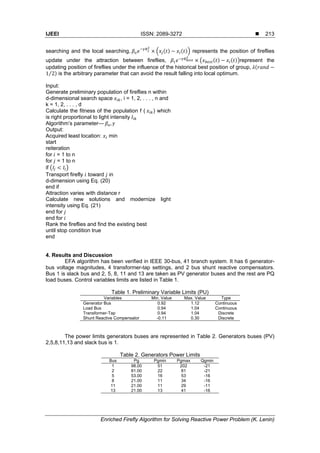
searching and the local searching,	 represents the position of fireflies
update under the attraction between fireflies, represent the
updating position of fireflies under the influence of the historical best position of group,	
1 2⁄ is the arbitrary parameter that can avoid the result falling into local optimum.
Input:
Generate preliminary population of fireflies n within
d-dimensional search space	 , i = 1, 2, . . . , n and
k = 1, 2, . . . , d
Calculate the fitness of the population f (	 ) which
is right proportional to light intensity	
Algorithm’s parameter—	 ,
Output:
Acquired least location: min
start
reiteration
for = 1 to n
for = 1 to n
if
Transport firefly toward in
d-dimension using Eq. (20)
end if
Attraction varies with distance r
Calculate new solutions and modernize light
intensity using Eq. (21)
end for
end for
Rank the fireflies and find the existing best
until stop condition true
end
4. Results and Discussion
EFA algorithm has been verified in IEEE 30-bus, 41 branch system. It has 6 generator-
bus voltage magnitudes, 4 transformer-tap settings, and 2 bus shunt reactive compensators.
Bus 1 is slack bus and 2, 5, 8, 11 and 13 are taken as PV generator buses and the rest are PQ
load buses. Control variables limits are listed in Table 1.
Table 1. Preliminary Variable Limits (PU)
Variables Min. Value Max. Value Type
Generator Bus 0.92 1.12 Continuous
Load Bus 0.94 1.04 Continuous
Transformer-Tap 0.94 1.04 Discrete
Shunt Reactive Compensator -0.11 0.30 Discrete
The power limits generators buses are represented in Table 2. Generators buses (PV)
2,5,8,11,13 and slack bus is 1.
Table 2. Generators Power Limits
Bus Pg Pgmin Pgmax Qgmin
1 98.00 51 202 -21
2 81.00 22 81 -21
5 53.00 16 53 -16
8 21.00 11 34 -16
11 21.00 11 29 -11
13 21.00 13 41 -16
 ISSN: 2089-3272
IJEEI Vol. 3, No. 4, December 2015 : 209 – 215
214
Table 3. Values of Control Variables After Optimization
Control Variables EFA
V1 1.0621
V2 1.0522
V5 1.0317
V8 1.0422
V11 1.0821
V13 1.0641
T4,12 0.00
T6,9 0.02
T6,10 0.90
T28,27 0.91
Q10 0.11
Q24 0.11
Real power loss 4.3001
Voltage deviation 0.9070
Table 3 shows the proposed approach succeeds in keeping the control variables within
limits. Table 4 summarizes the results of the optimal solution obtained by various methods.
Table 4. Comparison Results
Methods Real power loss (MW)
SGA (26) 4.98
PSO (27) 4.9262
LP (28) 5.988
EP (28) 4.963
CGA (28) 4.980
AGA (28) 4.926
CLPSO (28) 4.7208
HSA (29) 4.7624
BB-BC (30) 4.690
EFA 4.3001
5. Conclusion
In this paper, the EFA has been effectively implemented to solve Optimal Reactive
Power Dispatch problem. The proposed algorithm has been tested on the standard IEEE 30 bus
system. Simulation results show the robustness of proposed EFA method for providing better
optimal solution in decreasing the real power loss. The control variables obtained after the
optimization by EFA is within the limits.
References
[1] O. Alsac, B. Scott. Optimal load flow with steady state security. IEEE Transaction. 1973; PAS: 745-
751.
[2] Lee KY, Paru YM, Oritz JL. A united approach to optimal real and reactive power dispatch. IEEE
Transactions on power Apparatus and systems. 1985; PAS-104: 1147-1153.
[3] A. Monticelli, MVF. Pereira, S. Granville. Security constrained optimal power flow with post
contingency corrective rescheduling. IEEE Transactions on Power Systems. 1987; PWRS-2(1): 175-
182.
[4] Deeb N, Shahidehpur SM. Linear reactive power optimization in a large power network using the
decomposition approach. IEEE Transactions on power system. 1990; 5(2): 428-435.
[5] E. Hobson. Network consrained reactive power control using linear programming. IEEE Transactions
on power systems. 1980; PAS -99(4): 868-877.
[6] KY. Lee, YM. Park, JL. Oritz. Fuel –cost optimization for both real and reactive power dispatches. IEE
Proc. 131C(3): 85-93.
[7] MK. Mangoli, KY. Lee. Optimal real and reactive power control using linear programming.
Electr.Power Syst.Res. 1993; 26: 1-10.
[8] CA. Canizares, ACZ. de Souza, VH. Quintana. Comparison of performance indices for detection of
proximity to voltage collapse. 1996; 11(3): 1441-1450.
[9] SR. Paranjothi, K. Anburaja. Optimal power flow using refined genetic algorithm. Electr.Power
Compon.Syst. 2002; 30: 1055-1063.
[10] D. Devaraj, B. Yeganarayana. Genetic algorithm based optimal power flow for security enhancement.
IEE proc-Generation.Transmission and. Distribution. 6 November 2005: 152.
IJEEI ISSN: 2089-3272 
Enriched Firefly Algorithm for Solving Reactive Power Problem (K. Lenin)
215
[11] A. Berizzi, C. Bovo, M. Merlo, M. Delfanti. A ga approach to compare orpf objective functions
including secondary voltage regulation. Electric Power Systems Research. 2012; 84(1): 187–194.
[12] CF. Yang, GG. Lai, CH. Lee, CT. Su, GW. Chang. Optimal setting of reactive compensation devices
with an improved voltage stability index for voltage stability enhancement. International Journal of
Electrical Power and Energy Systems. 2012; 37(1): 50–57.
[13] P. Roy, S. Ghoshal, S. Thakur. Optimal var control for improvements in voltage profiles and for real
power loss minimization using biogeography based optimization. International Journal of Electrical
Power and Energy Systems. 2012; 43(1): 830–838.
[14] B. Venkatesh, G. Sadasivam, M. Khan. A new optimal reactive power scheduling method for loss
minimization and voltage stability margin maximization using successive multi-objective fuzzy lp
technique. IEEE Transactions on Power Systems. 2000; 15(2): 844–851.
[15] W. Yan, S. Lu, D. Yu. A novel optimal reactive power dispatch method based on an improved hybrid
evolutionary programming technique. IEEE Transactions on Power Systems. 2004; 19(2): 913–918.
[16] W. Yan, F. Liu, C. Chung, K. Wong. A hybrid genetic algorithminterior point method for optimal
reactive power flow. IEEE Transactions on Power Systems. 2006; 21(3): 1163–1169.
[17] J. Yu, W. Yan, W. Li, C. Chung, K. Wong. An unfixed piecewiseoptimal reactive power-flow model and
its algorithm for ac-dc systems. IEEE Transactions on Power Systems. 2008; 23(1): 170–176.
[18] F. Capitanescu. Assessing reactive power reserves with respect to operating constraints and voltage
stability. IEEE Transactions on Power Systems. 2011; 26(4): 2224–2234.
[19] Z. Hu, X. Wang, G. Taylor. Stochastic optimal reactive power dispatch: Formulation and solution
method. International Journal of Electrical Power and Energy Systems. 2010; 32(6): 615–621.
[20] A. Kargarian, M. Raoofat, M. Mohammadi. Probabilistic reactive power procurement in hybrid
electricity markets with uncertain loads. Electric Power Systems Research. 2012; 82(1): 68–80.
[21] B. Bhushan, SS. Pillai. Particle swarm optimization and firefly algorithm: performance analysis.
Proceedings of the 3rd IEEE International Advance Computing Conference (IACC). 2013: 746–751.
[22] PR. Srivatsava, B. Mallikarjun, XS. Yang. Optimal test sequence generation using firefly algorithm.
Swarm and Evolutionary Computation. 2013; 8: 44-53.
[23] AH. Gandomi, XS. Yang, S. Talatahari, AH. Alavi. Firefly algorithm with chaos. Communications in
Nonlinear Science and Numerical Simulation. 2013; 18(1): 89-98.
[24] R. De Cock, E. Matthysen. Sexual communication by pheromones in a firefly, Phosphaenus
hemipterus (Coleoptera: Lampyridae). Animal Behaviour. 2005; 70(4): 807-818.
[25] B. Liu, YQ. Zhou. A Hybrid Clustering Algorithm Based on Firefly Algorithm. Journal of Computer
Engineering and Applications. 2008; 44(18).

Enriched Firefly Algorithm for Solving Reactive Power Problem

  • 1.
    Indonesian Journal ofElectrical Engineering and Informatics (IJEEI) Vol. 3, No. 4, December 2015, pp. 209~215 DOI: 10.11591/ijeei.v3i4.175  209 Received July 23, 2015; Revised October 5, 2015; Accepted October 27, 2015 Enriched Firefly Algorithm for Solving Reactive Power Problem K. Lenin1 , B. Ravindhranath Reddy2 , M. Surya Kalavathi3 1 Research Scholar, JNTU, Hyderabad 500 085 India 2 Deputy Executive Engineer, JNTU, Hyderabad 500 085 India 3 Department of Electrical and Electronics Engineering, JNTU, Hyderabad 500 085, India email: gklenin@gmail.com Abstract In this paper, Enriched Firefly Algorithm (EFA) is planned to solve optimal reactive power dispatch problem. This algorithm is a kind of swarm intelligence algorithm based on the response of a firefly to the light of other fireflies. In this paper, we plan an augmentation on the original firefly algorithm. The proposed algorithm extends the single population FA to the interacting multi-swarms by cooperative Models. The proposed EFA has been tested on standard IEEE 30 bus test system and simulation results show clearly the better performance of the proposed algorithm in reducing the real power loss. Keyword: firefly algorithm, optimal reactive power, transmission loss 1. Introduction Various algorithms utilized to solve the reactive power problem. Various numerical methods like the gradient method [1]-[2], Newton method [3] and linear programming [4]-[7] have been utilized to solve the optimal reactive power dispatch problem. The problem of voltage stability and collapse play a key role in power system planning and operation [8].Evolutionary algorithms such as genetic algorithm have been already utilized to solve the reactive power flow problem [9]-[11]. In [12], Hybrid differential evolution algorithm is utilized to improve the voltage stability index. In [13] Biogeography Based algorithm have been used to solve the reactive power dispatch problem. In [14], a fuzzy based methodology is used to solve the optimal reactive power scheduling method. In [15], an improved evolutionary programming is used to solve the optimal reactive power dispatch problem. In [16], the optimal reactive power flow problem is solved by integrating a genetic algorithm with a nonlinear interior point method. In [17], a pattern algorithm is used to solve ac-dc optimal reactive power flow model with the generator capability limits. In [18], F. Capitanescu proposes a two-step approach to evaluate Reactive power reserves with respect to operating constraints and voltage stability. In [19], a programming based approach is used to solve the optimal reactive power dispatch problem. In [20], A. Kargarian et al present a probabilistic algorithm for optimal reactive power provision in hybrid electricity markets with uncertain loads.This paper proposes Enriched Firefly Algorithm (EFA) to solve reactive power dispatch problem. Our proposed EFA approach is good in exploration and exploitation for searching the global near optimal solution, when compared to other literature surveyed algorithms. A firefly algorithm (FA) is a population-based algorithm enthused by the social behaviour of fireflies [21],[22]. Fireflies converse by flashing their light. Dimmer fireflies are attracted to brighter ones and move towards them to mate [23]. FA is extensively used to solve reliability and redundancy problems. A class of firefly called Lampyride also used pheromone to attract their mate [24]. The proposed Enriched Firefly Algorithm (EFA) extends the single population FA to the interacting multi-swarms by cooperative Models [25]. The proposed EFA algorithm has been evaluated on standard IEEE 30 bus test system. The simulation results show that our proposed approach outperforms all the entitled reported algorithms in minimization of real power loss. 2. Objective function The Optimal Power Flow problem is considered as a common minimization problem with constraints, and can be written in the following form:
  • 2.
     ISSN: 2089-3272 IJEEIVol. 3, No. 4, December 2015 : 209 – 215 210 Minimize f(x, u) (1) Subject to g(x,u)=0 (2) And h x, u 0 (3) Where f(x,u) is the objective function. g(x.u) and h(x,u) are respectively the set of equality and inequality constraints. x is the vector of state variables, and u is the vector of control variables. The state variables are the load buses (PQ buses) voltages, angles, the generator reactive powers and the slack active generator power: x P , θ , . . , θ , V , . , V , Q , . . , Q (4) The control variables are the generator bus voltages, the shunt capacitors and the transformers tap-settings: u V , T, Q (5) or u V , … , V , T , . . , T , Q , . . , Q (6) Where Ng, Nt and Nc are the number of generators, number of tap transformers and the number of shunt compensators respectively. 2.1. Active power loss The objective of the reactive power dispatch is to minimize the active power loss in the transmission network, which can be mathematically described as follows: ∑ ∈ 2 (7) Or ∑ ∑∈ (8) Where gk: is the conductance of branch between nodes i and j, Nbr: is the total number of transmission lines in power systems. Pd: is the total active power demand, Pgi: is the generator active power of unit i, and Pgsalck: is the generator active power of slack bus. 2.2. Voltage profile improvement For minimizing the voltage deviation in PQ buses, the objective function becomes: (9) Where ωv: is a weighting factor of voltage deviation. VD is the voltage deviation given by: ∑ | 1| (10)
  • 3.
    IJEEI ISSN: 2089-3272 Enriched Firefly Algorithm for Solving Reactive Power Problem (K. Lenin) 211 2.3. Equality Constraint The equality constraint g(x,u) of the ORPD problem is represented by the power balance equation, where the total power generation must cover the total power demand and the power losses: (11) 2.4. Inequality Constraints The inequality constraints h(x,u) imitate the limits on components in the power system as well as the limits created to ensure system security. Upper and lower bounds on the active power of slack bus, and reactive power of generators: (12) , ∈ (13) Upper and lower bounds on the bus voltage magnitudes: , ∈ (14) Upper and lower bounds on the transformers tap ratios: , ∈ (15) Upper and lower bounds on the compensators reactive powers: , ∈ (16) Where N is the total number of buses, NT is the total number of Transformers; Nc is the total number of shunt reactive compensators. 3. Proposed Enriched Firefly Algorithm There are three ideal rules amalgamated into the unique Firefly algorithm (FA), i) all fireflies are unisex so that a firefly is attracted to all other fireflies ii) a firefly’s attractiveness is proportionate to its brightness seen by other fireflies. For any two fireflies, the dimmer firefly is attracted by the brighter one and moves towards it, but if there are no brighter fireflies nearby means then firefly moves arbitrarily iii) the brightness of a firefly is proportional to the value of its objective function. According to the above three rules, the degree of attractiveness of a firefly is planned by the following equation: (17) where β is the degree of attractiveness of a firefly at a distance r, β0 is the degree of attractiveness of the firefly at r= 0, r is the distance between any two fireflies, and γ is a light absorption coefficient. The distance r between firefly i and firefly j located at xi and xj respectively is calculated as a Euclidean distance: ∑ (18) The movement of the dimmer firefly i towards the brighter firefly j in terms of the dimmer one’s updated location is determined by the following equation:
  • 4.
     ISSN: 2089-3272 IJEEIVol. 3, No. 4, December 2015 : 209 – 215 212 (19) The third term in (19) is included for the case where there is no brighter firefly than the one being considered and rand is a random number in the range of [0, 1]. 3.1. Basic Firefly Algorithm [Step 1] fireflies are arbitrarily placed within the exploration range, supreme attractiveness is , the light absorption is γ, randomization parameter is , maximum number of iterations is T; the position of fireflies is arbitrary distributed. [Step 2] Compute the fluorescence brightness of fireflies. Compute the objective function values of Firefly Algorithm that use the enriched Firefly Algorithm as the largest individual fluorescence brightness value . [Step 3] Modernize the position of firefly. When the firefly is no only attracted by a brighter firefly but also prejudiced by the historical best position of group, the position formula is updating as function (20).The brightest fireflies will modernize their position as the following function: 1 1 2⁄ (20) Where 1 is the global optimal position at generation t. [Step 4] Recalculate the fluorescence brightness value by using the distance measure function after updating the location and penetrating the local area for the toughest fluorescence brightness individual, modernizing the optimal solution when the target value is enriched, or else unchanged. [Step 5] When reach the maximum iteration number T , record the optimal solution, otherwise repeat step (3), (4), (5) and start the next search. The optimal solution is also the global optimum value and the global optimum image threshold is the corresponding threshold value , at the position . 3.2. Enriched Firefly Algorithm In order to overcome the early convergence of classical FA, Cooperative optimization model is amalgamated into FA to construct an Enriched FA in this paper. In order to progress the balance between the exploration and exploitation in EFA we suggest a modification of Eq. (21) used in traditional FA. The goal of the modification is to reinstate balance between exploration and exploitation affording increased possibility of escaping basin of attraction of local optima. In the suggested EFA ,the firefly find a brighter firefly when iterative search use Firefly Algorithm ,then move towards with a certain step, but the direction of movement will bounce under the influence of the historical best position of group. The direction that towards blend with the direction that towards the historical best position of group is the deflect direction, in this way each search is affected by better solutions thereby improving the convergence rate. The principle of Firefly Algorithm with the influence of the historical best position of group .Suppose any firefly in the probing range is attracted by a brighter firefly and influenced by the historical best position of group, then the original direction of movement will change and move towards the optimal direction, thus speeding up the convergence rate. 1 1 2⁄ (21) In the proposed EFA, Eq. (20) of old-style FA based on constants values of and is modified by Eq. (21) Using new variables, and . In this case, the fireflies are adjusted by: Schematic procedure of Firefly Algorithm with the influence of the historical best position of group. The movement of a firefly is attracted to another more brighter firefly with the influence of the historical best position of group is determined by where is the updating position of firefly, is the initial position of firefly which play an important role in balancing the global
  • 5.
    IJEEI ISSN: 2089-3272 Enriched Firefly Algorithm for Solving Reactive Power Problem (K. Lenin) 213 searching and the local searching, represents the position of fireflies update under the attraction between fireflies, represent the updating position of fireflies under the influence of the historical best position of group, 1 2⁄ is the arbitrary parameter that can avoid the result falling into local optimum. Input: Generate preliminary population of fireflies n within d-dimensional search space , i = 1, 2, . . . , n and k = 1, 2, . . . , d Calculate the fitness of the population f ( ) which is right proportional to light intensity Algorithm’s parameter— , Output: Acquired least location: min start reiteration for = 1 to n for = 1 to n if Transport firefly toward in d-dimension using Eq. (20) end if Attraction varies with distance r Calculate new solutions and modernize light intensity using Eq. (21) end for end for Rank the fireflies and find the existing best until stop condition true end 4. Results and Discussion EFA algorithm has been verified in IEEE 30-bus, 41 branch system. It has 6 generator- bus voltage magnitudes, 4 transformer-tap settings, and 2 bus shunt reactive compensators. Bus 1 is slack bus and 2, 5, 8, 11 and 13 are taken as PV generator buses and the rest are PQ load buses. Control variables limits are listed in Table 1. Table 1. Preliminary Variable Limits (PU) Variables Min. Value Max. Value Type Generator Bus 0.92 1.12 Continuous Load Bus 0.94 1.04 Continuous Transformer-Tap 0.94 1.04 Discrete Shunt Reactive Compensator -0.11 0.30 Discrete The power limits generators buses are represented in Table 2. Generators buses (PV) 2,5,8,11,13 and slack bus is 1. Table 2. Generators Power Limits Bus Pg Pgmin Pgmax Qgmin 1 98.00 51 202 -21 2 81.00 22 81 -21 5 53.00 16 53 -16 8 21.00 11 34 -16 11 21.00 11 29 -11 13 21.00 13 41 -16
  • 6.
     ISSN: 2089-3272 IJEEIVol. 3, No. 4, December 2015 : 209 – 215 214 Table 3. Values of Control Variables After Optimization Control Variables EFA V1 1.0621 V2 1.0522 V5 1.0317 V8 1.0422 V11 1.0821 V13 1.0641 T4,12 0.00 T6,9 0.02 T6,10 0.90 T28,27 0.91 Q10 0.11 Q24 0.11 Real power loss 4.3001 Voltage deviation 0.9070 Table 3 shows the proposed approach succeeds in keeping the control variables within limits. Table 4 summarizes the results of the optimal solution obtained by various methods. Table 4. Comparison Results Methods Real power loss (MW) SGA (26) 4.98 PSO (27) 4.9262 LP (28) 5.988 EP (28) 4.963 CGA (28) 4.980 AGA (28) 4.926 CLPSO (28) 4.7208 HSA (29) 4.7624 BB-BC (30) 4.690 EFA 4.3001 5. Conclusion In this paper, the EFA has been effectively implemented to solve Optimal Reactive Power Dispatch problem. The proposed algorithm has been tested on the standard IEEE 30 bus system. Simulation results show the robustness of proposed EFA method for providing better optimal solution in decreasing the real power loss. The control variables obtained after the optimization by EFA is within the limits. References [1] O. Alsac, B. Scott. Optimal load flow with steady state security. IEEE Transaction. 1973; PAS: 745- 751. [2] Lee KY, Paru YM, Oritz JL. A united approach to optimal real and reactive power dispatch. IEEE Transactions on power Apparatus and systems. 1985; PAS-104: 1147-1153. [3] A. Monticelli, MVF. Pereira, S. Granville. Security constrained optimal power flow with post contingency corrective rescheduling. IEEE Transactions on Power Systems. 1987; PWRS-2(1): 175- 182. [4] Deeb N, Shahidehpur SM. Linear reactive power optimization in a large power network using the decomposition approach. IEEE Transactions on power system. 1990; 5(2): 428-435. [5] E. Hobson. Network consrained reactive power control using linear programming. IEEE Transactions on power systems. 1980; PAS -99(4): 868-877. [6] KY. Lee, YM. Park, JL. Oritz. Fuel –cost optimization for both real and reactive power dispatches. IEE Proc. 131C(3): 85-93. [7] MK. Mangoli, KY. Lee. Optimal real and reactive power control using linear programming. Electr.Power Syst.Res. 1993; 26: 1-10. [8] CA. Canizares, ACZ. de Souza, VH. Quintana. Comparison of performance indices for detection of proximity to voltage collapse. 1996; 11(3): 1441-1450. [9] SR. Paranjothi, K. Anburaja. Optimal power flow using refined genetic algorithm. Electr.Power Compon.Syst. 2002; 30: 1055-1063. [10] D. Devaraj, B. Yeganarayana. Genetic algorithm based optimal power flow for security enhancement. IEE proc-Generation.Transmission and. Distribution. 6 November 2005: 152.
  • 7.
    IJEEI ISSN: 2089-3272 Enriched Firefly Algorithm for Solving Reactive Power Problem (K. Lenin) 215 [11] A. Berizzi, C. Bovo, M. Merlo, M. Delfanti. A ga approach to compare orpf objective functions including secondary voltage regulation. Electric Power Systems Research. 2012; 84(1): 187–194. [12] CF. Yang, GG. Lai, CH. Lee, CT. Su, GW. Chang. Optimal setting of reactive compensation devices with an improved voltage stability index for voltage stability enhancement. International Journal of Electrical Power and Energy Systems. 2012; 37(1): 50–57. [13] P. Roy, S. Ghoshal, S. Thakur. Optimal var control for improvements in voltage profiles and for real power loss minimization using biogeography based optimization. International Journal of Electrical Power and Energy Systems. 2012; 43(1): 830–838. [14] B. Venkatesh, G. Sadasivam, M. Khan. A new optimal reactive power scheduling method for loss minimization and voltage stability margin maximization using successive multi-objective fuzzy lp technique. IEEE Transactions on Power Systems. 2000; 15(2): 844–851. [15] W. Yan, S. Lu, D. Yu. A novel optimal reactive power dispatch method based on an improved hybrid evolutionary programming technique. IEEE Transactions on Power Systems. 2004; 19(2): 913–918. [16] W. Yan, F. Liu, C. Chung, K. Wong. A hybrid genetic algorithminterior point method for optimal reactive power flow. IEEE Transactions on Power Systems. 2006; 21(3): 1163–1169. [17] J. Yu, W. Yan, W. Li, C. Chung, K. Wong. An unfixed piecewiseoptimal reactive power-flow model and its algorithm for ac-dc systems. IEEE Transactions on Power Systems. 2008; 23(1): 170–176. [18] F. Capitanescu. Assessing reactive power reserves with respect to operating constraints and voltage stability. IEEE Transactions on Power Systems. 2011; 26(4): 2224–2234. [19] Z. Hu, X. Wang, G. Taylor. Stochastic optimal reactive power dispatch: Formulation and solution method. International Journal of Electrical Power and Energy Systems. 2010; 32(6): 615–621. [20] A. Kargarian, M. Raoofat, M. Mohammadi. Probabilistic reactive power procurement in hybrid electricity markets with uncertain loads. Electric Power Systems Research. 2012; 82(1): 68–80. [21] B. Bhushan, SS. Pillai. Particle swarm optimization and firefly algorithm: performance analysis. Proceedings of the 3rd IEEE International Advance Computing Conference (IACC). 2013: 746–751. [22] PR. Srivatsava, B. Mallikarjun, XS. Yang. Optimal test sequence generation using firefly algorithm. Swarm and Evolutionary Computation. 2013; 8: 44-53. [23] AH. Gandomi, XS. Yang, S. Talatahari, AH. Alavi. Firefly algorithm with chaos. Communications in Nonlinear Science and Numerical Simulation. 2013; 18(1): 89-98. [24] R. De Cock, E. Matthysen. Sexual communication by pheromones in a firefly, Phosphaenus hemipterus (Coleoptera: Lampyridae). Animal Behaviour. 2005; 70(4): 807-818. [25] B. Liu, YQ. Zhou. A Hybrid Clustering Algorithm Based on Firefly Algorithm. Journal of Computer Engineering and Applications. 2008; 44(18).