1
 Meaning of ded
 Why ded is necessary ?
 Process of ded
 Ded formulation
 Types of technique to solve ded problem
 Invasive technique
 Invasive flow chart
 Pso technique
 Pso flow chart
 Genetic algorithm technique
 Simulated annealing technique
 Failure of classical method
 Limitation of ded
 Conclusion
 Refrences
2
 Power system economic load dispatch is
the process of allocating generation among
available generating units subject to load and
other operational constraints, such that, the
cost of operation is minimum.
3
 The rate of increase of power demand is more then the rate of
increase of generation.
 If the plant is located far from the load center transmission
losses will be considerably higher and the plant may be
uneconomical.
4
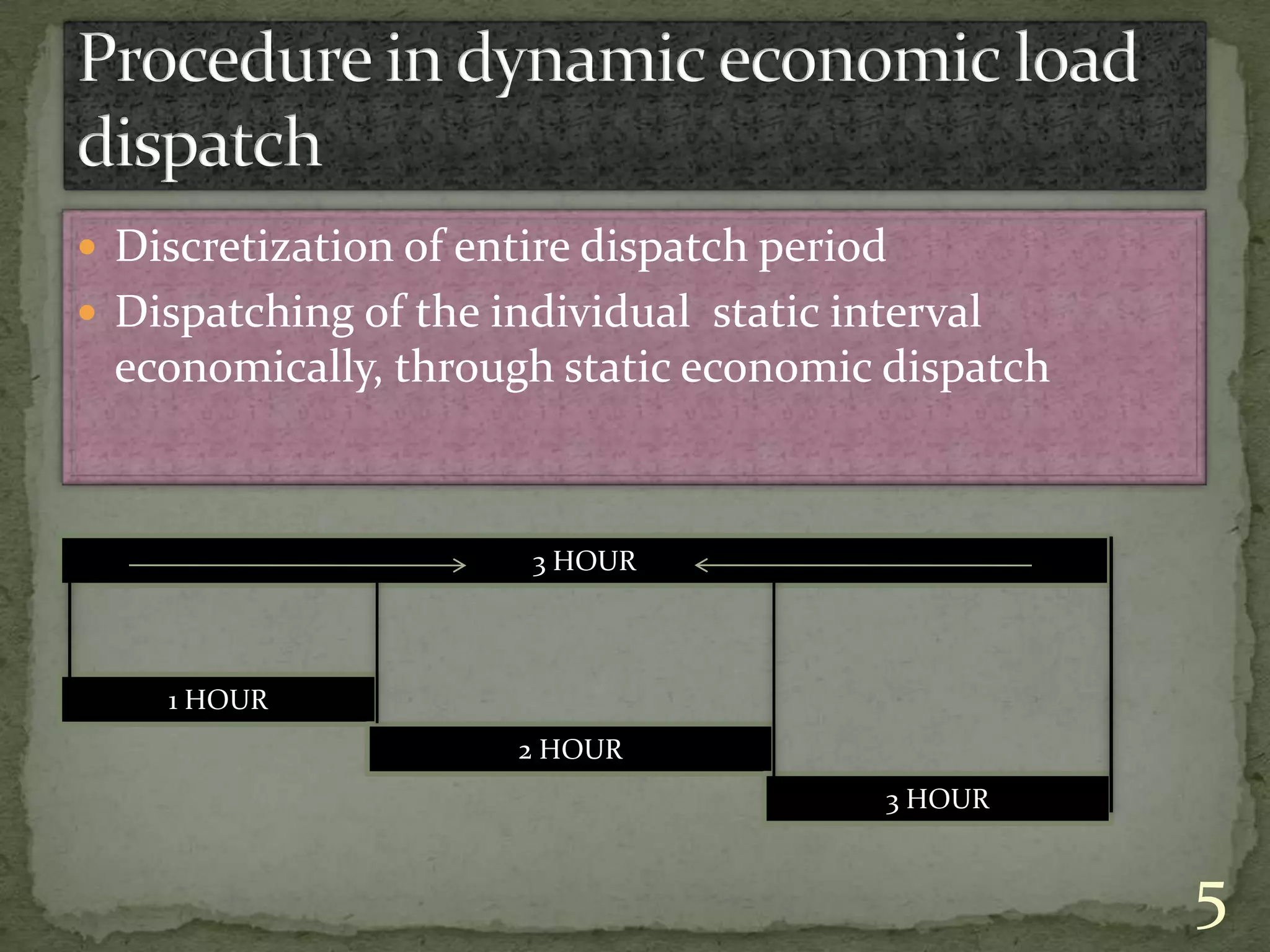
 Discretization of entire dispatch period
 Dispatching of the individual static interval
economically, through static economic dispatch
3 HOUR
1 HOUR
2 HOUR
3 HOUR
5
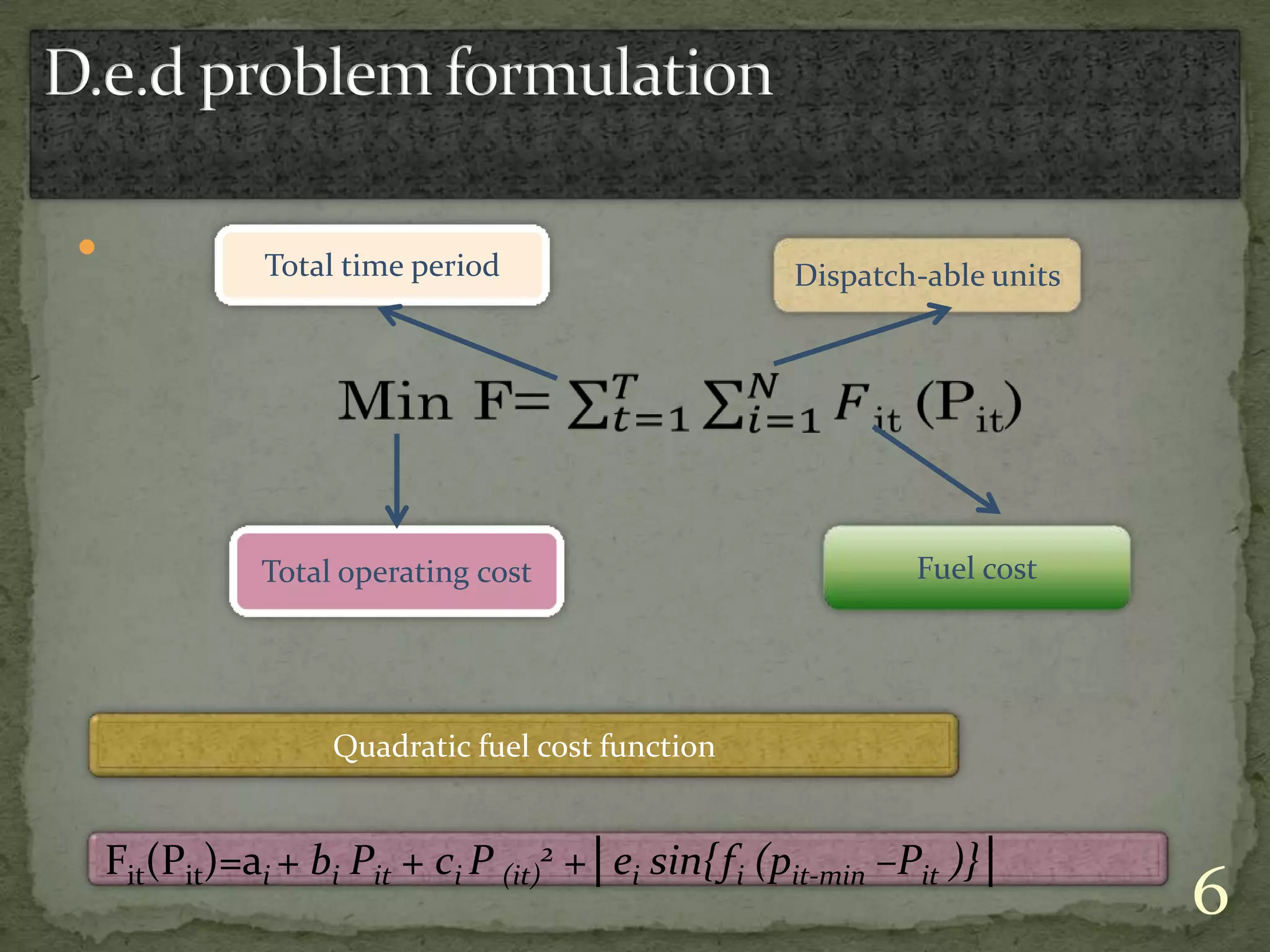
 Total time period Dispatch-able units
Total operating cost Fuel cost
Quadratic fuel cost function
Fit(Pit)=ai + bi Pit + ci P (it)
2 +│ei sin{fi (pit-min –Pit )}│
6
 Invasive weed optimization technique(IWO)
 Particle swarm optimization technique(PSO)
 Genetic algorithm technique(GA)
 Simulated annealing technique(SA)
7
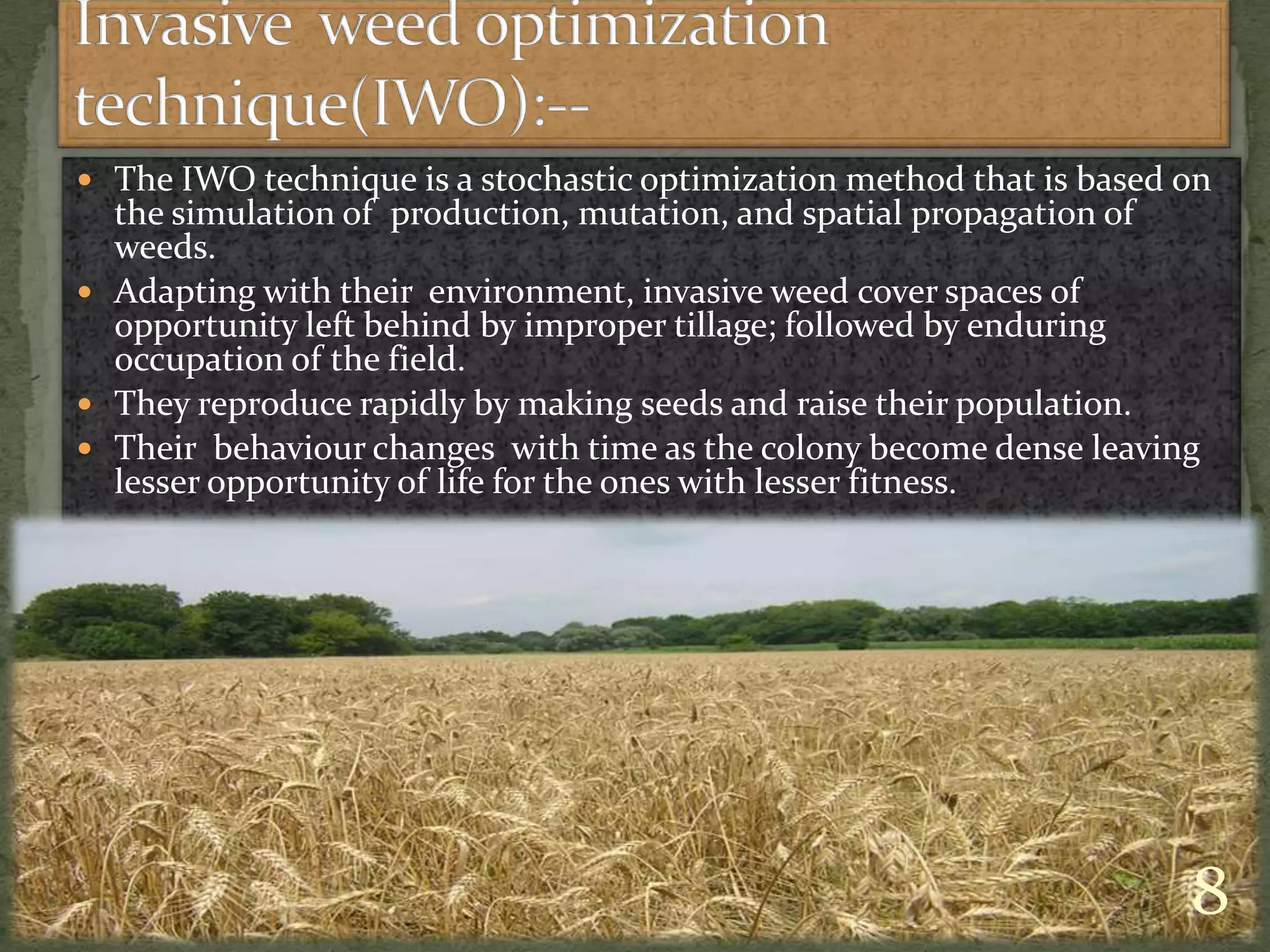
 The IWO technique is a stochastic optimization method that is based on
the simulation of production, mutation, and spatial propagation of
weeds.
 Adapting with their environment, invasive weed cover spaces of
opportunity left behind by improper tillage; followed by enduring
occupation of the field.
 They reproduce rapidly by making seeds and raise their population.
 Their behaviour changes with time as the colony become dense leaving
lesser opportunity of life for the ones with lesser fitness.
8
NO
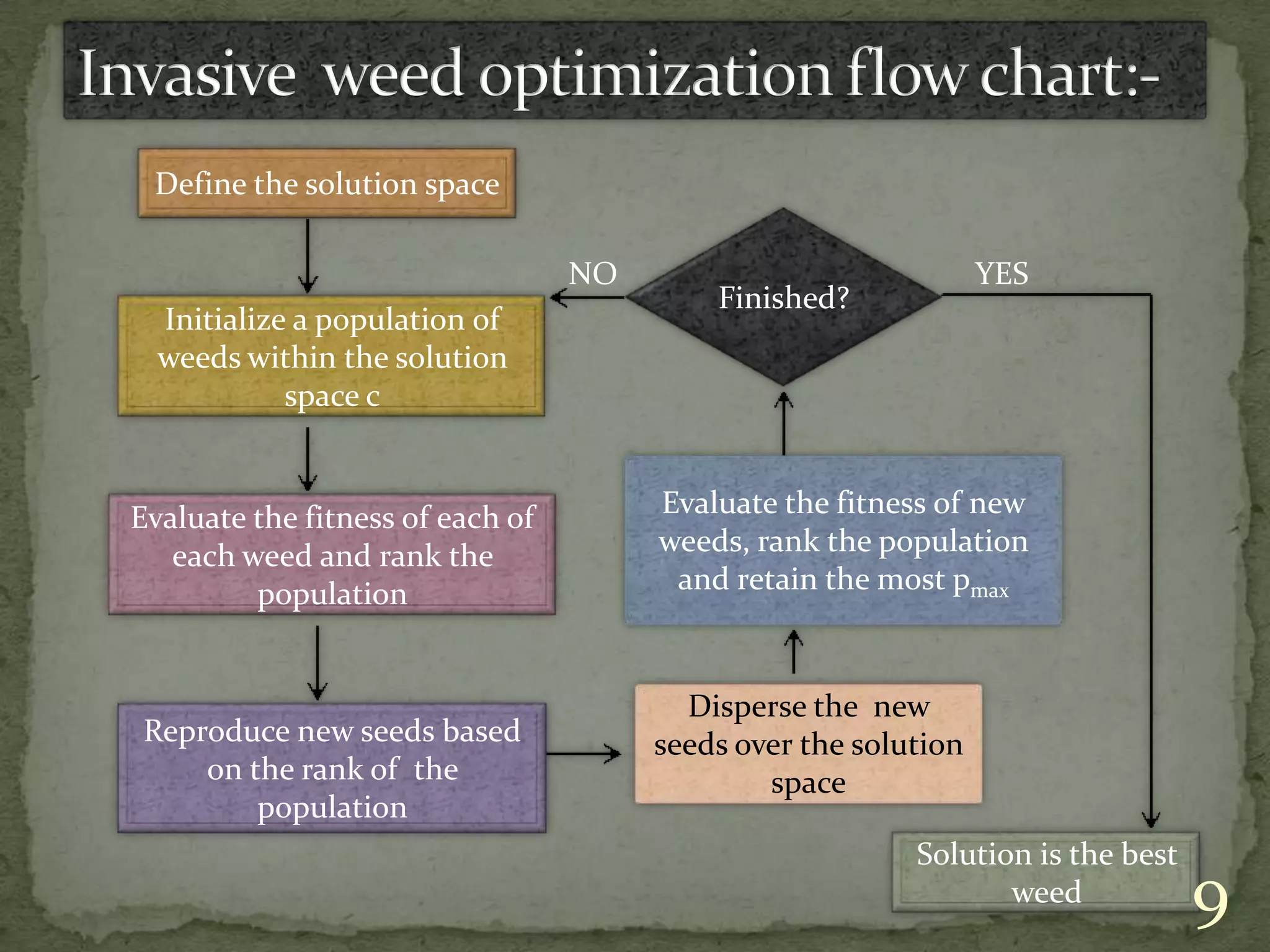
Define the solution space
Initialize a population of
weeds within the solution
space c
Evaluate the fitness of each of
each weed and rank the
population
Reproduce new seeds based
on the rank of the
population
Disperse the new
seeds over the solution
space
Solution is the best
weed
Evaluate the fitness of new
weeds, rank the population
and retain the most pmax
Finished?
YES
9
1. Xi G=[X1,i,G,X2,i,G,X3,i,G…………….XD,i,G]
2. SiG
= [{Fmax
, G-F(XiG )}{Smax - Smin }]/[{Fmax , G – Fmin ,G}]
3. =[{(Gmax -G)÷Gmin}n * ( max - min )+ min ]
4. = G(S, Xi )/ G(Si , x )
10
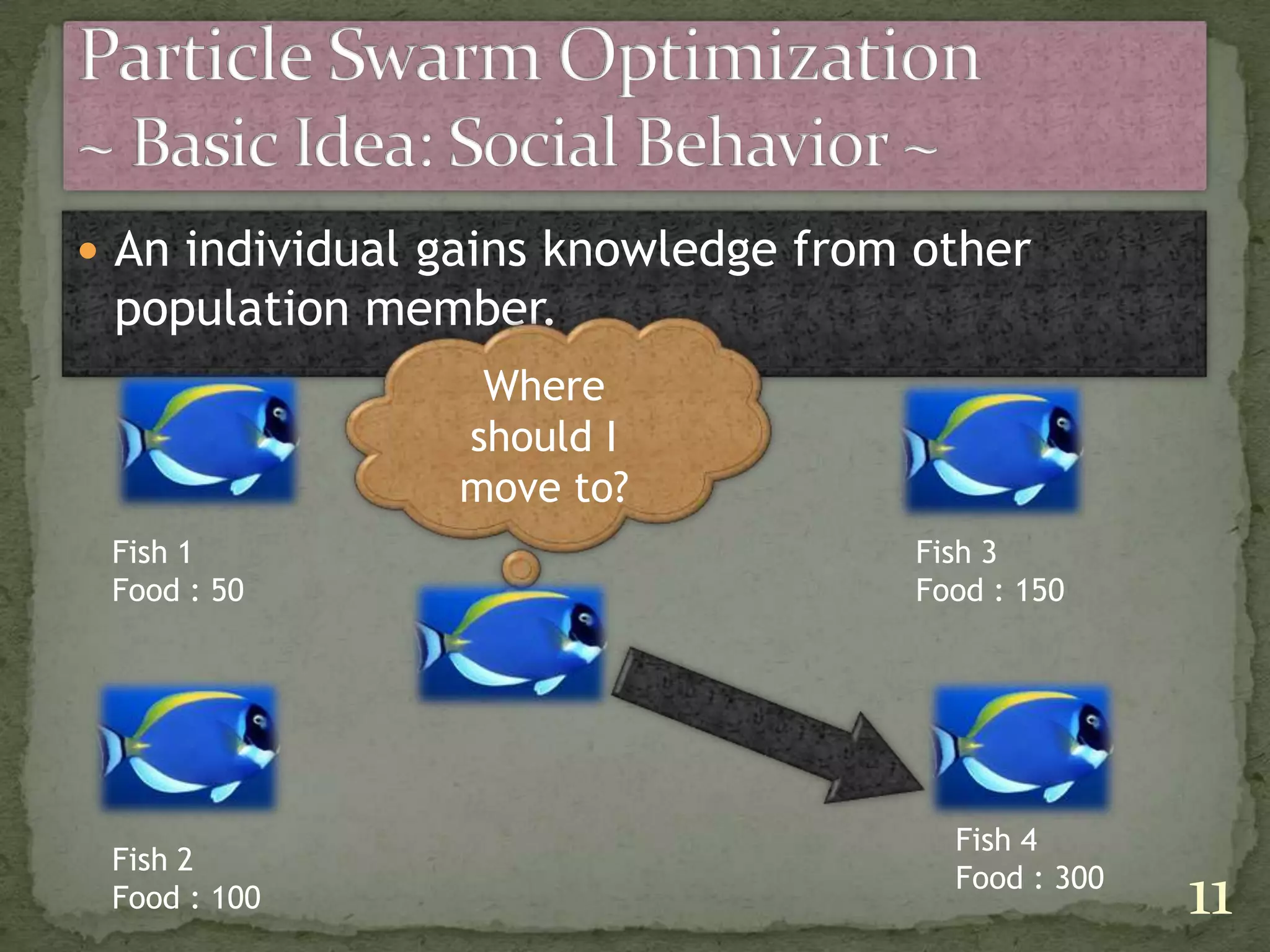
 An individual gains knowledge from other
population member.
Fish 1
Food : 50
Fish 3
Food : 150
Fish 2
Food : 100
Fish 4
Food : 300
Where
should I
move to?
11
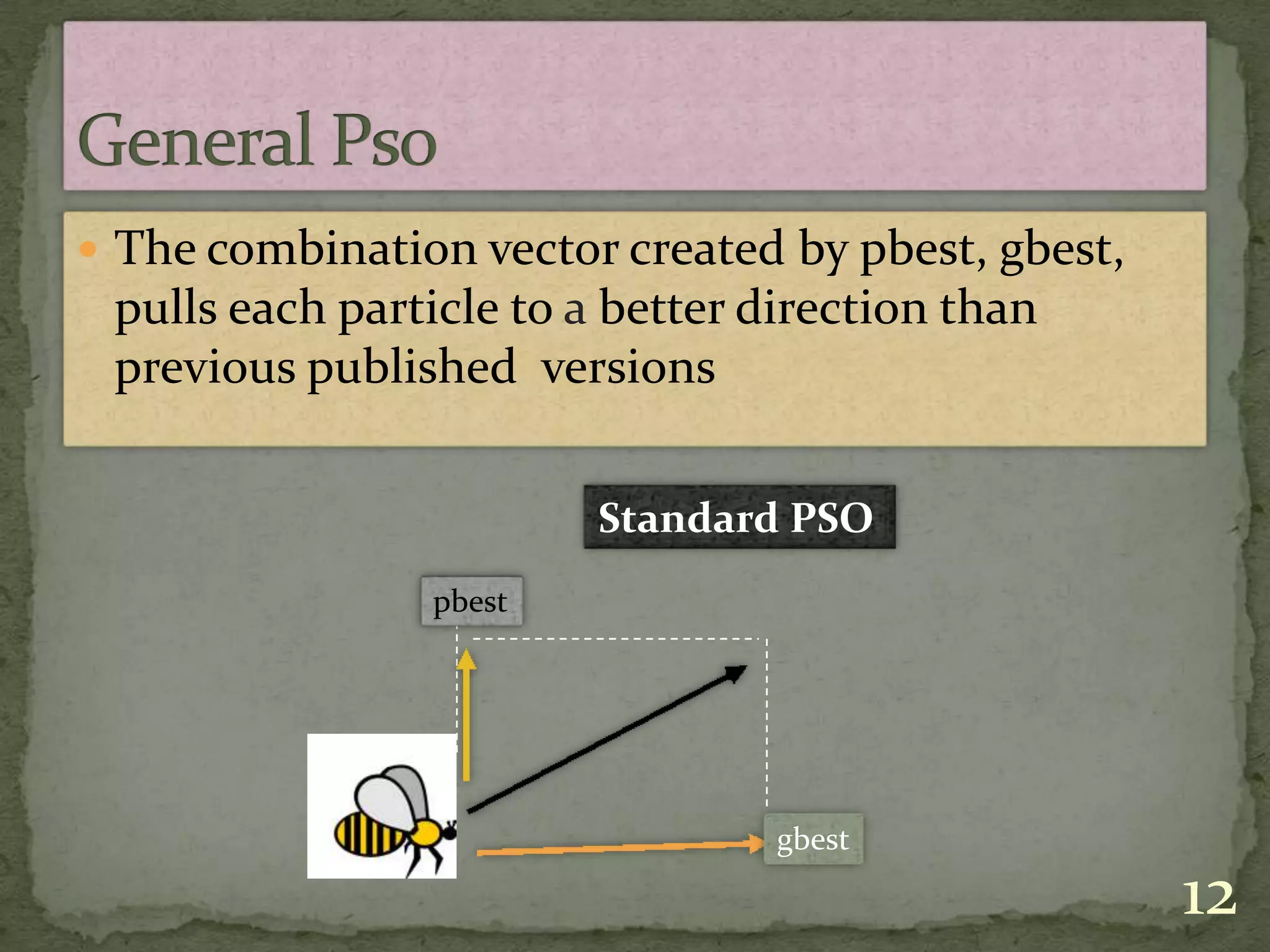
 The combination vector created by pbest, gbest,
pulls each particle to a better direction than
previous published versions
pbest
gbest
Standard PSO
12
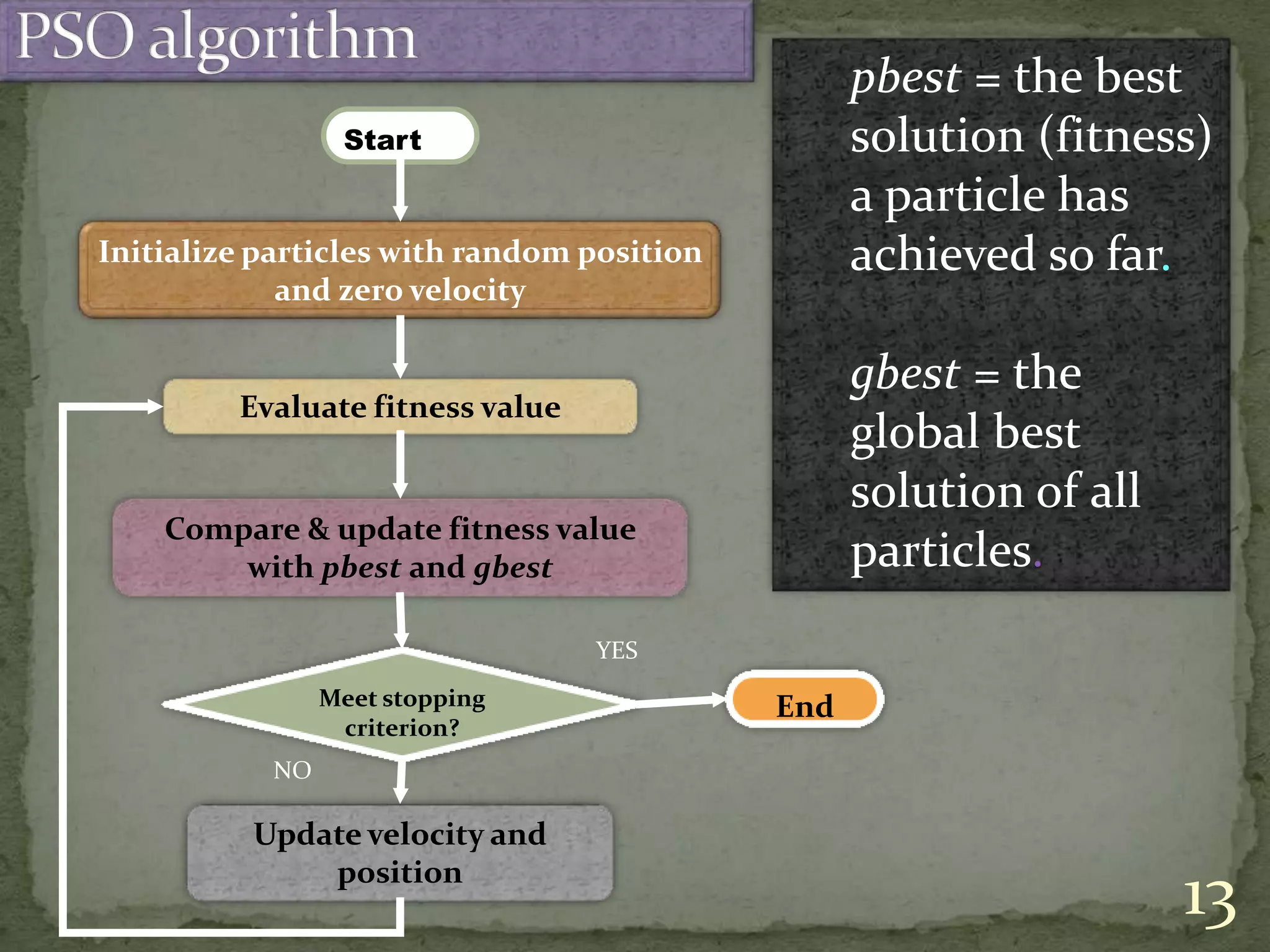
Initialize particles with random position
and zero velocity
Evaluate fitness value
Compare & update fitness value
with pbest and gbest
Meet stopping
criterion?
Update velocity and
position
Start
End
YES
NO
pbest = the best
solution (fitness)
a particle has
achieved so far.
gbest = the
global best
solution of all
particles.
13
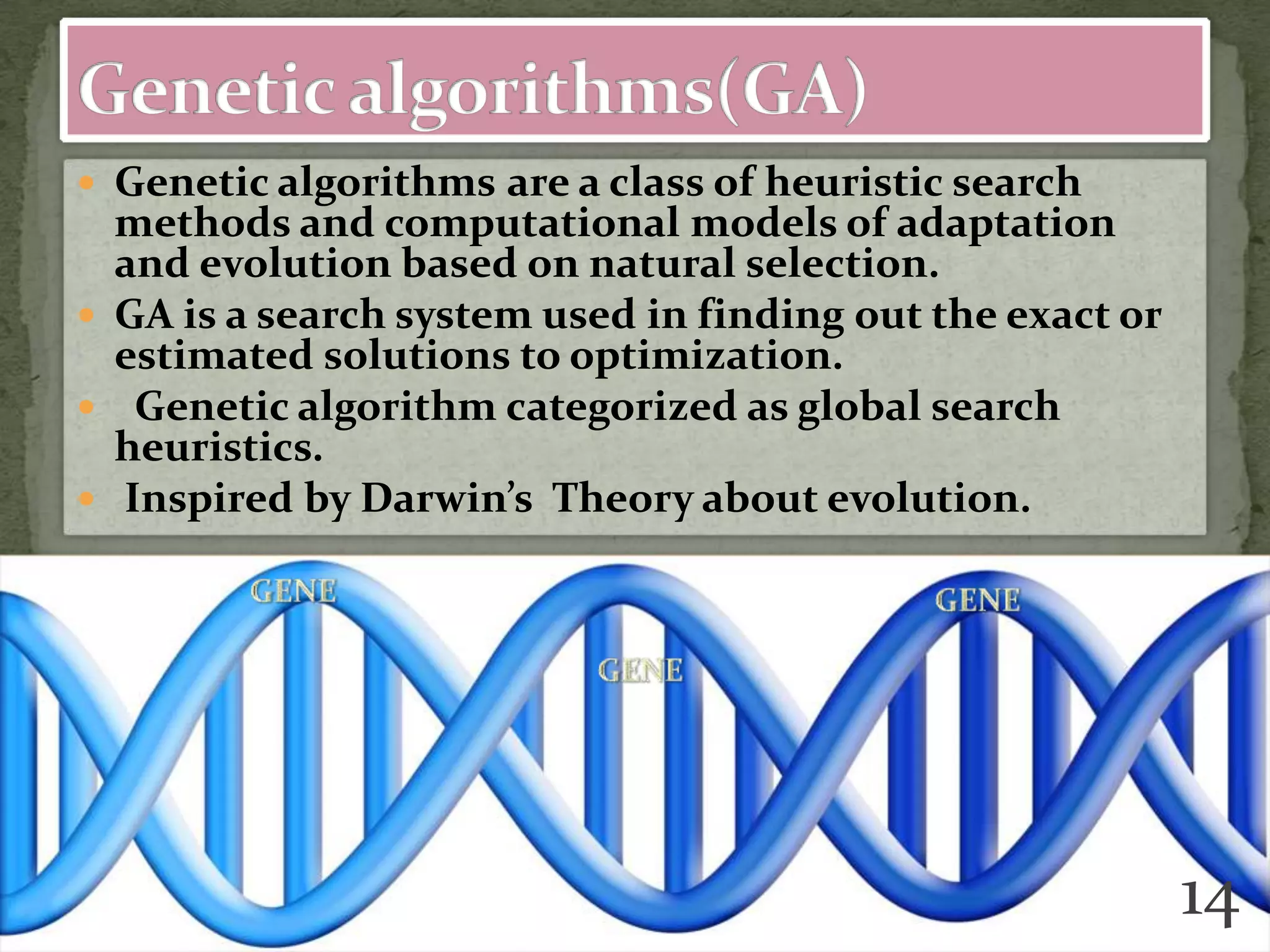
 Genetic algorithms are a class of heuristic search
methods and computational models of adaptation
and evolution based on natural selection.
 GA is a search system used in finding out the exact or
estimated solutions to optimization.
 Genetic algorithm categorized as global search
heuristics.
 Inspired by Darwin’s Theory about evolution.
14
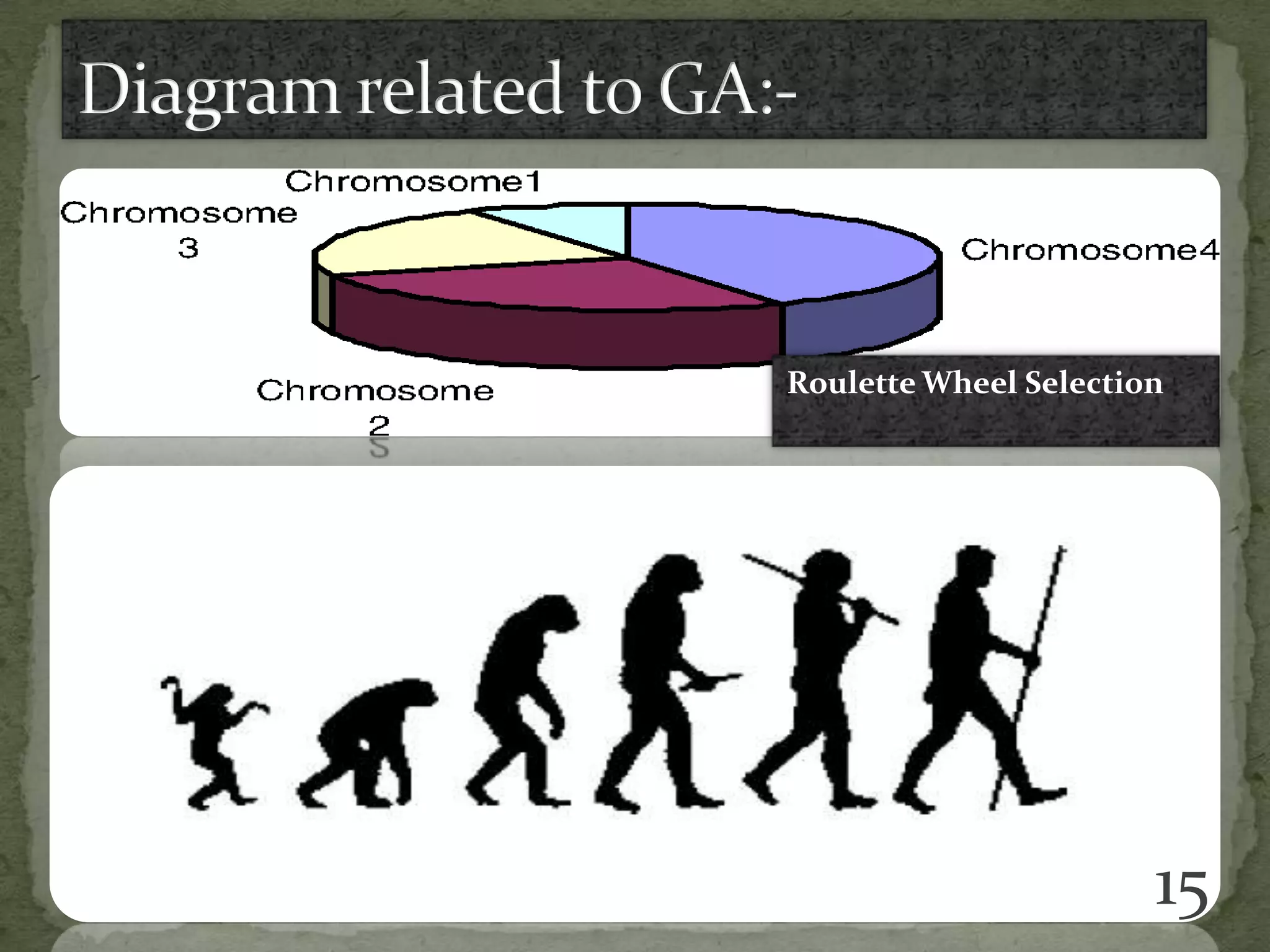
Roulette Wheel Selection
15
16
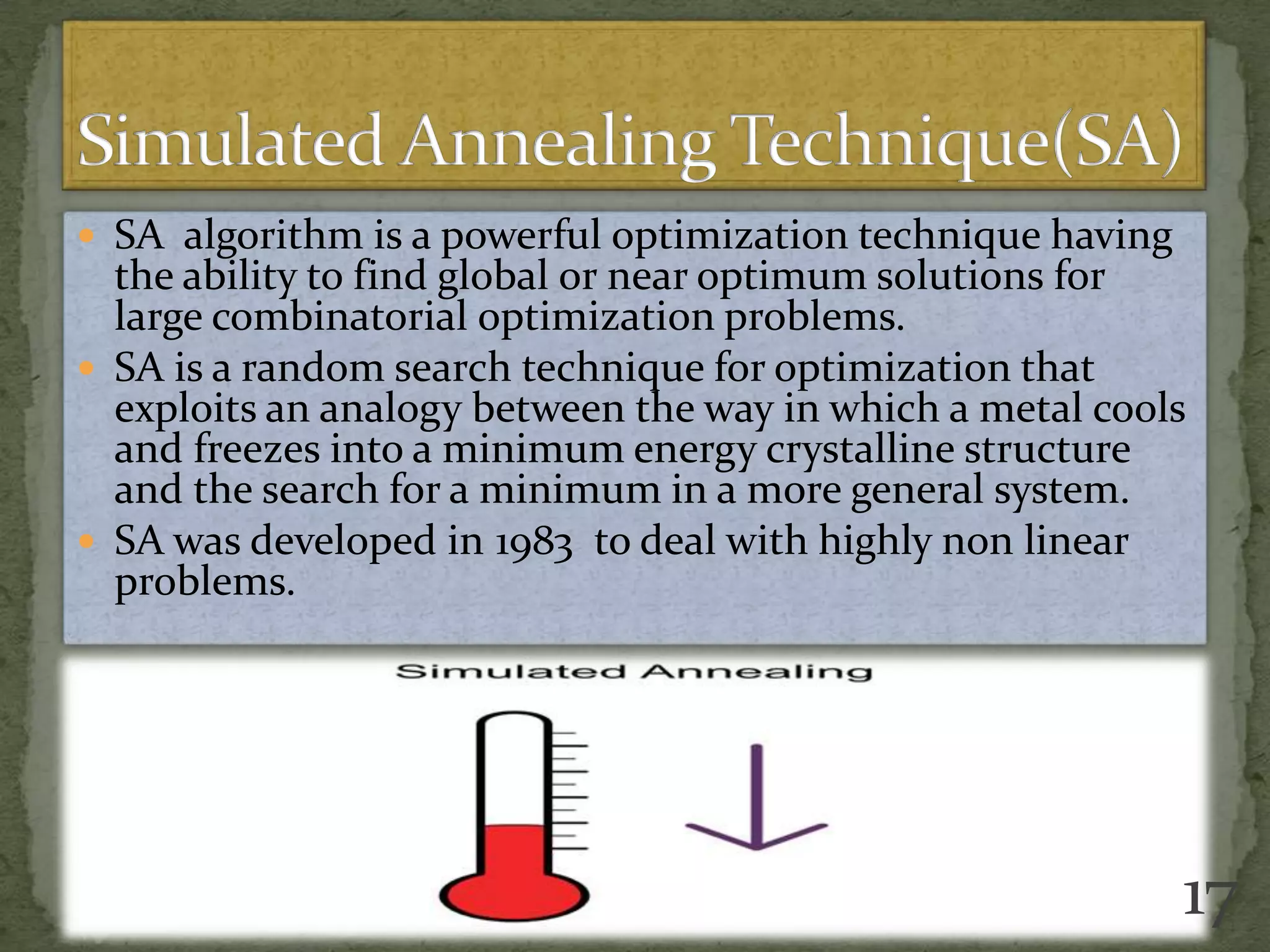
 SA algorithm is a powerful optimization technique having
the ability to find global or near optimum solutions for
large combinatorial optimization problems.
 SA is a random search technique for optimization that
exploits an analogy between the way in which a metal cools
and freezes into a minimum energy crystalline structure
and the search for a minimum in a more general system.
 SA was developed in 1983 to deal with highly non linear
problems.
17
 Linear cost curve
 Local optimum solution
 Highly sensitive to starting point
18
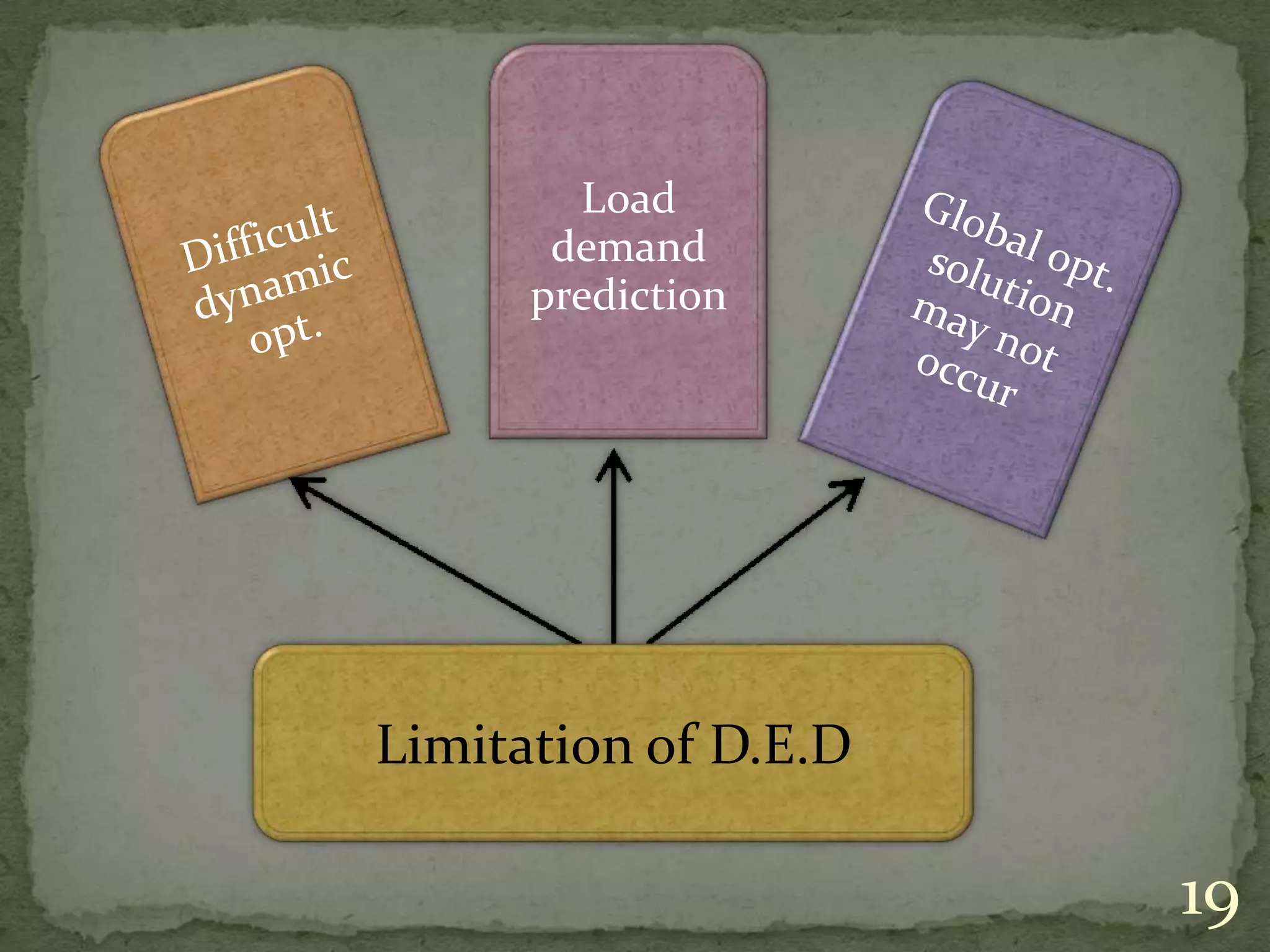
Load
demand
prediction
Limitation of D.E.D
19
 This paper presents important features of ded problem. This
problem is traditional problem and solved using several
methods based on the requirements of the problem
formulation.
 These methods are classified into mathematicalprogramming
based methods.
 It is expected that this review of the ded problem based on
the solution method to solve them will be helpful for all those
who do research related to ded problem.
20
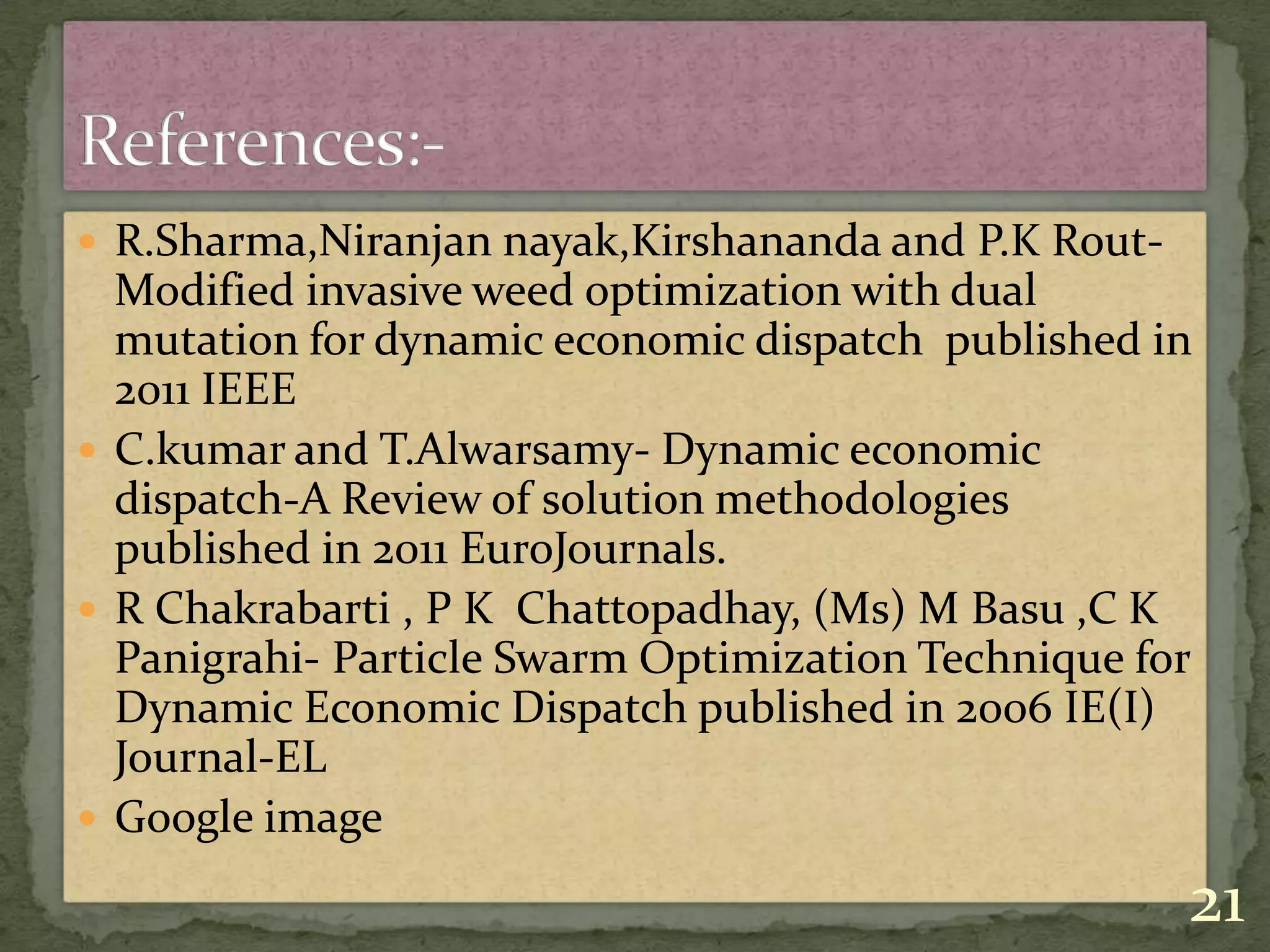
 R.Sharma,Niranjan nayak,Kirshananda and P.K Rout-
Modified invasive weed optimization with dual
mutation for dynamic economic dispatch published in
2011 IEEE
 C.kumar and T.Alwarsamy- Dynamic economic
dispatch-A Review of solution methodologies
published in 2011 EuroJournals.
 R Chakrabarti , P K Chattopadhay, (Ms) M Basu ,C K
Panigrahi- Particle Swarm Optimization Technique for
Dynamic Economic Dispatch published in 2006 IE(I)
Journal-EL
 Google image
21

Dynamic economic load dispatch a review of solution methodologies48

  • 1.
  • 2.
     Meaning ofded  Why ded is necessary ?  Process of ded  Ded formulation  Types of technique to solve ded problem  Invasive technique  Invasive flow chart  Pso technique  Pso flow chart  Genetic algorithm technique  Simulated annealing technique  Failure of classical method  Limitation of ded  Conclusion  Refrences 2
  • 3.
     Power systemeconomic load dispatch is the process of allocating generation among available generating units subject to load and other operational constraints, such that, the cost of operation is minimum. 3
  • 4.
     The rateof increase of power demand is more then the rate of increase of generation.  If the plant is located far from the load center transmission losses will be considerably higher and the plant may be uneconomical. 4
  • 5.
     Discretization ofentire dispatch period  Dispatching of the individual static interval economically, through static economic dispatch 3 HOUR 1 HOUR 2 HOUR 3 HOUR 5
  • 6.
     Total timeperiod Dispatch-able units Total operating cost Fuel cost Quadratic fuel cost function Fit(Pit)=ai + bi Pit + ci P (it) 2 +│ei sin{fi (pit-min –Pit )}│ 6
  • 7.
     Invasive weedoptimization technique(IWO)  Particle swarm optimization technique(PSO)  Genetic algorithm technique(GA)  Simulated annealing technique(SA) 7
  • 8.
     The IWOtechnique is a stochastic optimization method that is based on the simulation of production, mutation, and spatial propagation of weeds.  Adapting with their environment, invasive weed cover spaces of opportunity left behind by improper tillage; followed by enduring occupation of the field.  They reproduce rapidly by making seeds and raise their population.  Their behaviour changes with time as the colony become dense leaving lesser opportunity of life for the ones with lesser fitness. 8
  • 9.
    NO Define the solutionspace Initialize a population of weeds within the solution space c Evaluate the fitness of each of each weed and rank the population Reproduce new seeds based on the rank of the population Disperse the new seeds over the solution space Solution is the best weed Evaluate the fitness of new weeds, rank the population and retain the most pmax Finished? YES 9
  • 10.
    1. Xi G=[X1,i,G,X2,i,G,X3,i,G…………….XD,i,G] 2.SiG = [{Fmax , G-F(XiG )}{Smax - Smin }]/[{Fmax , G – Fmin ,G}] 3. =[{(Gmax -G)÷Gmin}n * ( max - min )+ min ] 4. = G(S, Xi )/ G(Si , x ) 10
  • 11.
     An individualgains knowledge from other population member. Fish 1 Food : 50 Fish 3 Food : 150 Fish 2 Food : 100 Fish 4 Food : 300 Where should I move to? 11
  • 12.
     The combinationvector created by pbest, gbest, pulls each particle to a better direction than previous published versions pbest gbest Standard PSO 12
  • 13.
    Initialize particles withrandom position and zero velocity Evaluate fitness value Compare & update fitness value with pbest and gbest Meet stopping criterion? Update velocity and position Start End YES NO pbest = the best solution (fitness) a particle has achieved so far. gbest = the global best solution of all particles. 13
  • 14.
     Genetic algorithmsare a class of heuristic search methods and computational models of adaptation and evolution based on natural selection.  GA is a search system used in finding out the exact or estimated solutions to optimization.  Genetic algorithm categorized as global search heuristics.  Inspired by Darwin’s Theory about evolution. 14
  • 15.
  • 16.
  • 17.
     SA algorithmis a powerful optimization technique having the ability to find global or near optimum solutions for large combinatorial optimization problems.  SA is a random search technique for optimization that exploits an analogy between the way in which a metal cools and freezes into a minimum energy crystalline structure and the search for a minimum in a more general system.  SA was developed in 1983 to deal with highly non linear problems. 17
  • 18.
     Linear costcurve  Local optimum solution  Highly sensitive to starting point 18
  • 19.
  • 20.
     This paperpresents important features of ded problem. This problem is traditional problem and solved using several methods based on the requirements of the problem formulation.  These methods are classified into mathematicalprogramming based methods.  It is expected that this review of the ded problem based on the solution method to solve them will be helpful for all those who do research related to ded problem. 20
  • 21.
     R.Sharma,Niranjan nayak,Kirshanandaand P.K Rout- Modified invasive weed optimization with dual mutation for dynamic economic dispatch published in 2011 IEEE  C.kumar and T.Alwarsamy- Dynamic economic dispatch-A Review of solution methodologies published in 2011 EuroJournals.  R Chakrabarti , P K Chattopadhay, (Ms) M Basu ,C K Panigrahi- Particle Swarm Optimization Technique for Dynamic Economic Dispatch published in 2006 IE(I) Journal-EL  Google image 21