20th Century Architecture
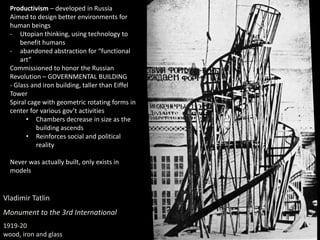
Vladimir Tatlin
Monument to the 3rd International
1919-20
wood, iron and glass
Productivism – developed in Russia
Aimed to design better environments for
human beings
- Utopian thinking, using technology to
benefit humans
- abandoned abstraction for “functional
art”
Commissioned to honor the Russian
Revolution – GOVERNMENTAL BUILDING
- Glass and iron building, taller than Eiffel
Tower
Spiral cage with geometric rotating forms in
center for various gov’t activities
• Chambers decrease in size as the
building ascends
• Reinforces social and political
reality
Never was actually built, only exists in
models
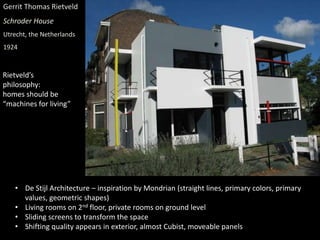
Gerrit Thomas Rietveld
Schroder House
Utrecht, the Netherlands
1924
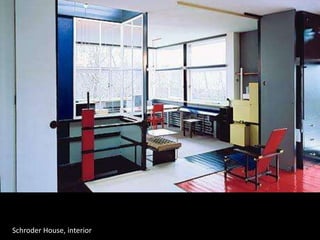
• De Stijl Architecture – inspiration by Mondrian (straight lines, primary colors, primary
values, geometric shapes)
• Living rooms on 2nd floor, private rooms on ground level
• Sliding screens to transform the space
• Shifting quality appears in exterior, almost Cubist, moveable panels
Rietveld’s
philosophy:
homes should be
“machines for living”
Schroder House, interior
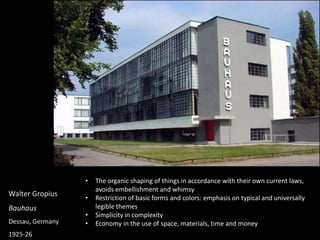
Walter Gropius
Bauhaus
Dessau, Germany
1925-26
• The organic shaping of things in accordance with their own current laws,
avoids embellishment and whimsy
• Restriction of basic forms and colors: emphasis on typical and universally
legible themes
• Simplicity in complexity
• Economy in the use of space, materials, time and money
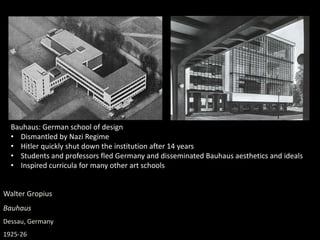
Walter Gropius
Bauhaus
Dessau, Germany
1925-26
Bauhaus: German school of design
• Dismantled by Nazi Regime
• Hitler quickly shut down the institution after 14 years
• Students and professors fled Germany and disseminated Bauhaus aesthetics and ideals
• Inspired curricula for many other art schools
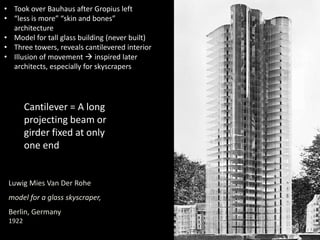
Luwig Mies Van Der Rohe
model for a glass skyscraper,
Berlin, Germany
1922
• Took over Bauhaus after Gropius left
• “less is more” “skin and bones”
architecture
• Model for tall glass building (never built)
• Three towers, reveals cantilevered interior
• Illusion of movement  inspired later
architects, especially for skyscrapers
Cantilever = A long
projecting beam or
girder fixed at only
one end
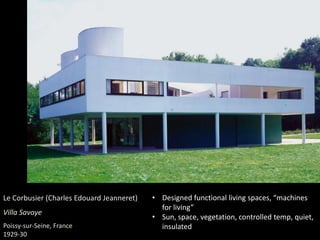
Le Corbusier (Charles Edouard Jeanneret)
Villa Savoye
Poissy-sur-Seine, France
1929-30
• Designed functional living spaces, “machines
for living”
• Sun, space, vegetation, controlled temp, quiet,
insulated
Le Corbusier
Villa Savoye
Poissy-sur-Seine, France
1929-30
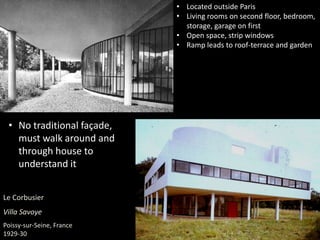
• Located outside Paris
• Living rooms on second floor, bedroom,
storage, garage on first
• Open space, strip windows
• Ramp leads to roof-terrace and garden
• No traditional façade,
must walk around and
through house to
understand it
Le Corbusier
Villa Savoye
Poissy-sur-Seine, France
1929-30
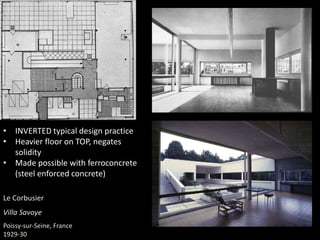
• INVERTED typical design practice
• Heavier floor on TOP, negates
solidity
• Made possible with ferroconcrete
(steel enforced concrete)
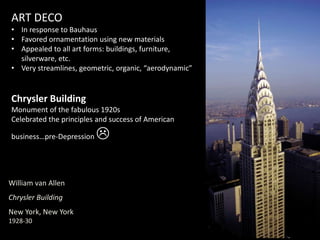
William van Allen
Chrysler Building
New York, New York
1928-30
ART DECO
• In response to Bauhaus
• Favored ornamentation using new materials
• Appealed to all art forms: buildings, furniture,
silverware, etc.
• Very streamlines, geometric, organic, “aerodynamic”
Chrysler Building
Monument of the fabulous 1920s
Celebrated the principles and success of American
business…pre-Depression 
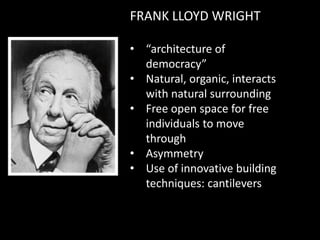
FRANK LLOYD WRIGHT
• “architecture of
democracy”
• Natural, organic, interacts
with natural surrounding
• Free open space for free
individuals to move
through
• Asymmetry
• Use of innovative building
techniques: cantilevers
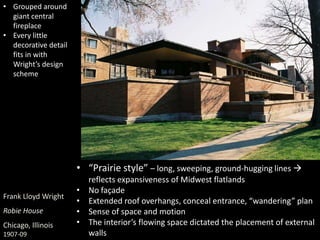
Frank Lloyd Wright
Robie House
Chicago, Illinois
1907-09
• “Prairie style” – long, sweeping, ground-hugging lines 
reflects expansiveness of Midwest flatlands
• No façade
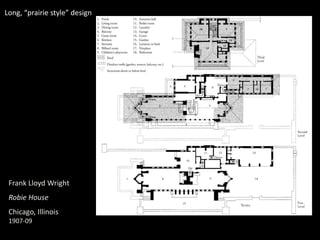
• Extended roof overhangs, conceal entrance, “wandering” plan
• Sense of space and motion
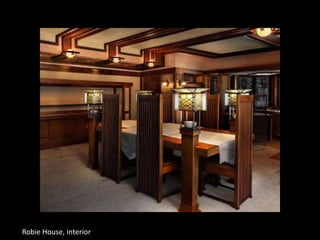
• The interior’s flowing space dictated the placement of external
walls
• Grouped around
giant central
fireplace
• Every little
decorative detail
fits in with
Wright’s design
scheme
Robie House, interior
Frank Lloyd Wright
Robie House
Chicago, Illinois
1907-09
Long, “prairie style” design
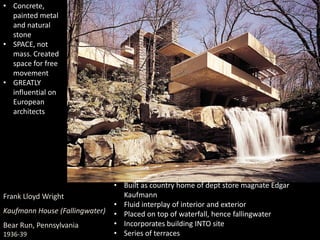
Frank Lloyd Wright
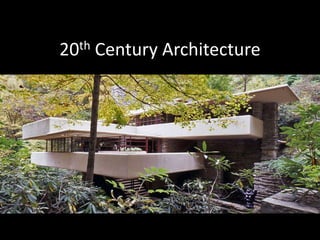
Kaufmann House (Fallingwater)
Bear Run, Pennsylvania
1936-39
• Built as country home of dept store magnate Edgar
Kaufmann
• Fluid interplay of interior and exterior
• Placed on top of waterfall, hence fallingwater
• Incorporates building INTO site
• Series of terraces
• Concrete,
painted metal
and natural
stone
• SPACE, not
mass. Created
space for free
movement
• GREATLY
influential on
European
architects
Early 20th c architecture

Early 20th c architecture

  • 1.
  • 2.
    Vladimir Tatlin Monument tothe 3rd International 1919-20 wood, iron and glass Productivism – developed in Russia Aimed to design better environments for human beings - Utopian thinking, using technology to benefit humans - abandoned abstraction for “functional art” Commissioned to honor the Russian Revolution – GOVERNMENTAL BUILDING - Glass and iron building, taller than Eiffel Tower Spiral cage with geometric rotating forms in center for various gov’t activities • Chambers decrease in size as the building ascends • Reinforces social and political reality Never was actually built, only exists in models
  • 3.
    Gerrit Thomas Rietveld SchroderHouse Utrecht, the Netherlands 1924 • De Stijl Architecture – inspiration by Mondrian (straight lines, primary colors, primary values, geometric shapes) • Living rooms on 2nd floor, private rooms on ground level • Sliding screens to transform the space • Shifting quality appears in exterior, almost Cubist, moveable panels Rietveld’s philosophy: homes should be “machines for living”
  • 4.
  • 5.
    Walter Gropius Bauhaus Dessau, Germany 1925-26 •The organic shaping of things in accordance with their own current laws, avoids embellishment and whimsy • Restriction of basic forms and colors: emphasis on typical and universally legible themes • Simplicity in complexity • Economy in the use of space, materials, time and money
  • 6.
    Walter Gropius Bauhaus Dessau, Germany 1925-26 Bauhaus:German school of design • Dismantled by Nazi Regime • Hitler quickly shut down the institution after 14 years • Students and professors fled Germany and disseminated Bauhaus aesthetics and ideals • Inspired curricula for many other art schools
  • 7.
    Luwig Mies VanDer Rohe model for a glass skyscraper, Berlin, Germany 1922 • Took over Bauhaus after Gropius left • “less is more” “skin and bones” architecture • Model for tall glass building (never built) • Three towers, reveals cantilevered interior • Illusion of movement  inspired later architects, especially for skyscrapers Cantilever = A long projecting beam or girder fixed at only one end
  • 8.
    Le Corbusier (CharlesEdouard Jeanneret) Villa Savoye Poissy-sur-Seine, France 1929-30 • Designed functional living spaces, “machines for living” • Sun, space, vegetation, controlled temp, quiet, insulated
  • 9.
    Le Corbusier Villa Savoye Poissy-sur-Seine,France 1929-30 • Located outside Paris • Living rooms on second floor, bedroom, storage, garage on first • Open space, strip windows • Ramp leads to roof-terrace and garden • No traditional façade, must walk around and through house to understand it
  • 10.
    Le Corbusier Villa Savoye Poissy-sur-Seine,France 1929-30 • INVERTED typical design practice • Heavier floor on TOP, negates solidity • Made possible with ferroconcrete (steel enforced concrete)
  • 11.
    William van Allen ChryslerBuilding New York, New York 1928-30 ART DECO • In response to Bauhaus • Favored ornamentation using new materials • Appealed to all art forms: buildings, furniture, silverware, etc. • Very streamlines, geometric, organic, “aerodynamic” Chrysler Building Monument of the fabulous 1920s Celebrated the principles and success of American business…pre-Depression 
  • 12.
    FRANK LLOYD WRIGHT •“architecture of democracy” • Natural, organic, interacts with natural surrounding • Free open space for free individuals to move through • Asymmetry • Use of innovative building techniques: cantilevers
  • 13.
    Frank Lloyd Wright RobieHouse Chicago, Illinois 1907-09 • “Prairie style” – long, sweeping, ground-hugging lines  reflects expansiveness of Midwest flatlands • No façade • Extended roof overhangs, conceal entrance, “wandering” plan • Sense of space and motion • The interior’s flowing space dictated the placement of external walls • Grouped around giant central fireplace • Every little decorative detail fits in with Wright’s design scheme
  • 14.
  • 15.
    Frank Lloyd Wright RobieHouse Chicago, Illinois 1907-09 Long, “prairie style” design
  • 16.
    Frank Lloyd Wright KaufmannHouse (Fallingwater) Bear Run, Pennsylvania 1936-39 • Built as country home of dept store magnate Edgar Kaufmann • Fluid interplay of interior and exterior • Placed on top of waterfall, hence fallingwater • Incorporates building INTO site • Series of terraces • Concrete, painted metal and natural stone • SPACE, not mass. Created space for free movement • GREATLY influential on European architects