Copyright ©2012 Pearson Inc.
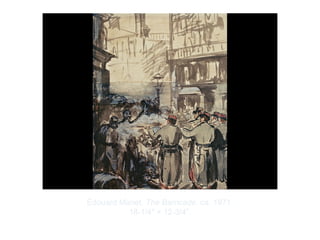
Édouard Manet. The Barricade. ca. 1871.
18-1/4" × 12-3/4”.
Copyright ©2012 Pearson Inc.
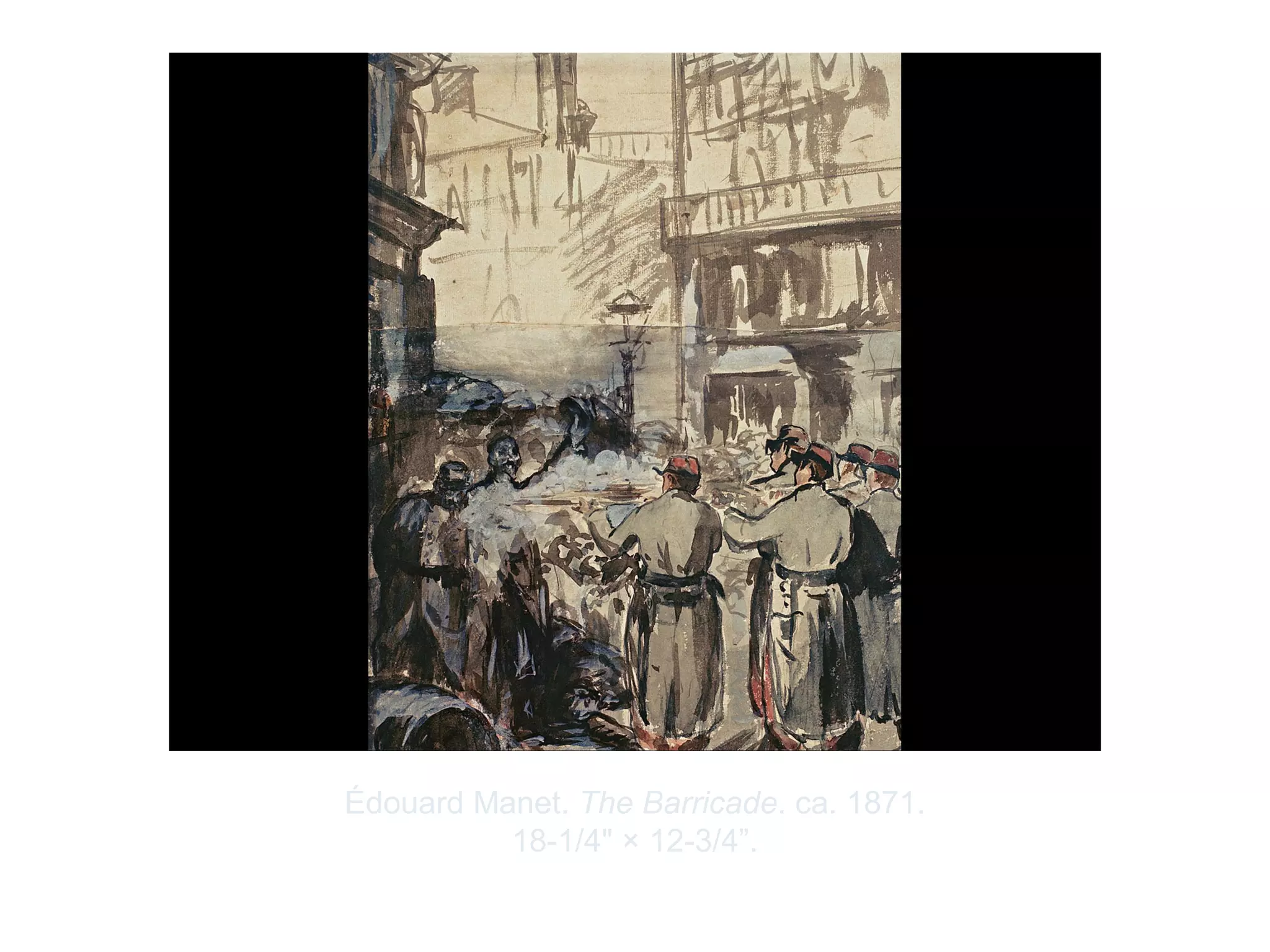
Édouard Manet. The Execution of Maximilian. 1868-69.
99-1/4" × 120”.
Copyright ©2012 Pearson Inc.
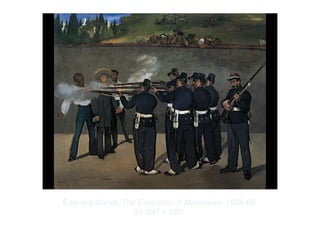
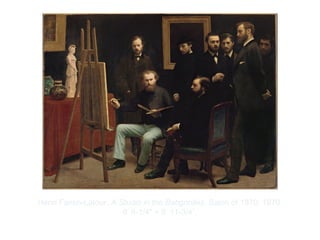
Henri Fantin-Latour. A Studio in the Batignolles. Salon of 1870. 1870.
6’ 8-1/4" × 8’ 11-3/4”.
What is Impressionism?
• Monet’s Escape to Giverny — Monet continually sought to escape
the city for the pleasures of the countryside. In 1883 he moved to
Giverny. Monet began painting the same subject at different times of
day and in different atmospheric conditions. Each painting in the series
became a fragment in the duration of the whole.
• Morisot and Pissarro: The Effects of Paint — Morisot painted
figures in clothing that is often barely distinguishable from the
background; her paintings seem to dissolve into a uniform white light.
Pisarro’s landscapes give us the impression of a view never quite fully
captured by the painter.
French Impressionism
• Leisure and Work: Renoir, Degas and Caillebotte — Renoir
and Degas preferred to paint the crowd in the cafes and restaurants, at
entertainments of all kinds, and in the countryside. Renoir’s work is
tightly composed and show a geometric symmetry. Degas also cared
carefully constructed his paintings. Work was the theme of the first
painting Caillebotte exhibited with the Impressionists. His theme in
The Floor-Scrapers is the monotony of repetition, the rhythm of parallel
lines of flooring reinforcing the theme.
• Manet’s Impressionism — Manet increasingly adopted
Impressionist techniques, particularly the loose application of paint and
the emphasis on capturing the effects of light. Manet’s Impressionism
incorporates the viewer into its “atmosphere,” which is actually
impenetrable.
• Discussion Question: What are the prominent features of
impressionism?
Copyright ©2012 Pearson Inc.
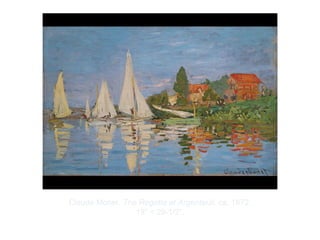
Claude Monet. The Regatta at Argenteuil. ca. 1872.
19" × 29-1/2”.
Copyright ©2012 Pearson Inc.
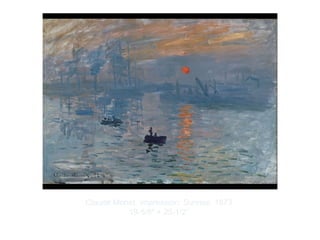
Claude Monet. Impression: Sunrise. 1873.
19-5/8" × 25-1/2”.
Copyright ©2012 Pearson Inc.
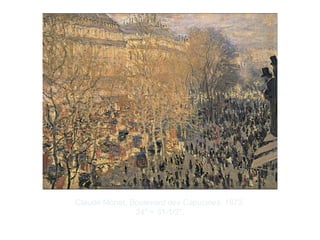
Claude Monet. Boulevard des Capucines. 1873.
24" × 31-1/2”.
Copyright ©2012 Pearson Inc.
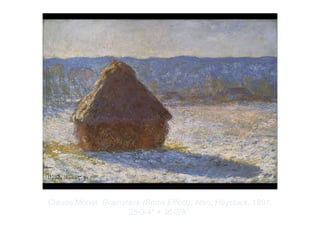
Claude Monet. Grainstack (Snow Effect). Also, Haystack. 1891.
25-3/4" × 36-3/8”.
Copyright ©2012 Pearson Inc.
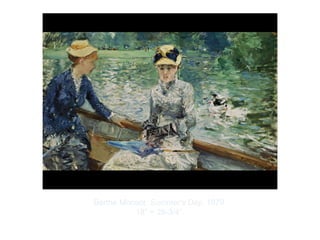
Berthe Morisot. Summer's Day. 1879.
18" × 29-3/4”.
Copyright ©2012 Pearson Inc.
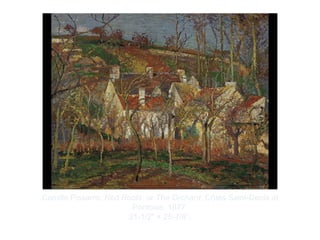
Camille Pissarro. Red Roofs, or The Orchard, Côtes Saint-Denis at
Pontoise. 1877.
21-1/2" × 25-7/8”.
Copyright ©2012 Pearson Inc.
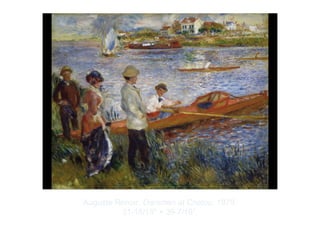
Auguste Renoir. Oarsmen at Chatou. 1879.
31-15/16" × 39-7/16”.
Copyright ©2012 Pearson Inc.
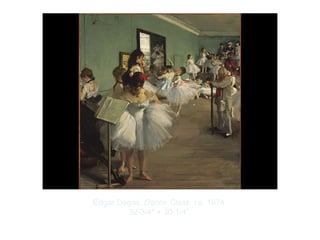
Edgar Degas. Dance Class. ca. 1874.
32-3/4" × 30-1/4”.
Copyright ©2012 Pearson Inc.
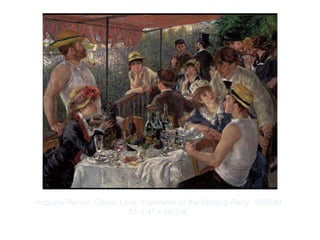
Auguste Renoir. Closer Look: Luncheon of the Boating Party. 1880-81.
51-1/4" × 69-1/8”.
Copyright ©2012 Pearson Inc.
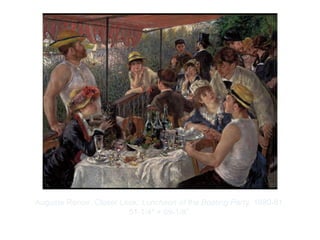
Auguste Renoir. Closer Look: Luncheon of the Boating Party. 1880-81.
51-1/4" × 69-1/8”.
Copyright ©2012 Pearson Inc.
Gustave Caillebotte. The Floor-Scrapers. 1875.
40-1/8" × 57-1/2”.
Copyright ©2012 Pearson Inc.
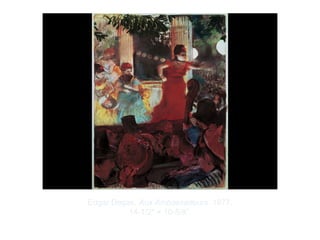
Edgar Degas. Aux Ambassadeurs. 1877.
14-1/2" × 10-5/8”.
Copyright ©2012 Pearson Inc.
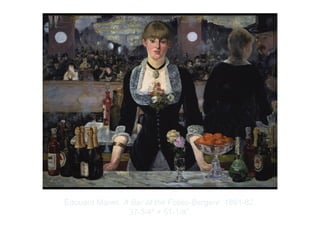
Édouard Manet. A Bar at the Folies-Bergère. 1881-82.
37-3/4" × 51-1/8”.
 Closer Look: A Bar at the Folies-Bergère
MyArtsLabChapter 31 – Hope and Possibility in Late Nineteenth-Century Europe
Copyright ©2012 Pearson Inc.
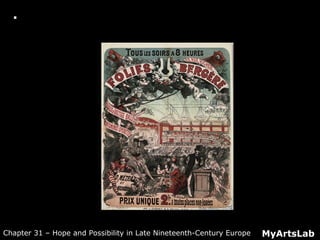
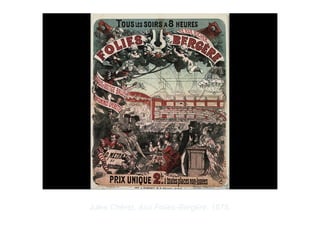
Jules Chéret. Aux Folies-Bergère. 1875.
Russian Realism and the Quest
for the Russian Soul
How was Russian nationalism reflected in literature, art, and
music?
• The Writer and Artist under the Tsars — Under the rule of
Nicholas I, literary culture was severely stifled. Dostoyevsky
considered the question, “Can we love the damned?”. The complexity
of psychological guilt is the theme of Crime and Punishment where he
asks, “Can immoral means justify worthy ends?” Tolstoy’s realism
turned outward, to the epic stage of Russian history. War and Peace
surveys Russian life in the early nineteenth century. The Travelers was
a group of 13 visual artists dedicated to presenting art exhibitions
throughout the country.
• Russian Nationalistic Music and Ballet — The quest to express
the fundamental essence of Russia was reflected in music. Slavic pride
was expressed through the incorporation of Russian folklore, folk
songs, and instruments. Tchiakovsky’s nationalism is apparent in his
1812 Overture. His real fame came from his ballet music such as Swan
Lake, Sleeping Beauty, and the Nutcracker.
• Discussion Question: What are the two factions within nineteenth-
century Russian society?
Copyright ©2012 Pearson Inc.
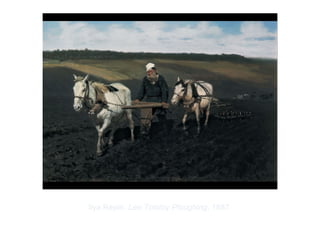
Ilya Repin. Leo Tolstoy Ploughing. 1887.
Copyright ©2012 Pearson Inc.
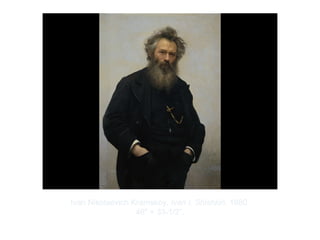
Ivan Nikolaevich Kramskoy. Ivan I. Shishkin. 1880.
46" × 33-1/2”.
 Active Listening Guide: Tchaikovsky: 1812
Overture
MyArtsLabChapter 31 – Hope and Possibility in Late Nineteenth-Century Europe
Britain and the Design of Social Reform
How did the Crystal Palace and Pre-Raphaelite artists express the
spirit of social reform?
• Morris, the Guild Movement and the Pre-Raphaelites —
Morris longed to return to a handmade craft tradition, in which workers,
as with the medieval craft guilds, would no longer be alienated from
their labor. In his designs, Morris constantly emphasized simplicity and
utility. He hired many of his artist friends such as, Rossetti, and Burne-
Jones. Rossetti was the leader of the Pre-Raphaelite Brotherhood, who
denounced contemporary art. He championed the spiritual values of
medieval and early Renaissance culture. Burne-Jones illustrated many
of the books produced by Morris’s press. The influence of Morris’s
design company fostered a guild movement throughout England intent
on producing quality handcrafted goods.
• The Fight for Women’s Rights: Mill’s Subjection of Women
— Many reformers felt that women were inherently conservative, unduly
controlled by the clergy. Mill was an advocate of utilitarian theory, and
on that basis felt that in assigning an inferior role to women, society was
wasting an enormous resource. Mill wrote The Subjection of Women in
collaboration with his wife.
• Discussion Question: What are some of the late-nineteenth-century’s
attitudes towards women as expressed through philosophy and art?
Copyright ©2012 Pearson Inc.
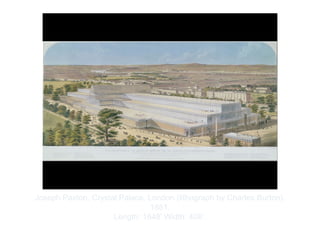
Joseph Paxton. Crystal Palace, London (lithograph by Charles Burton).
1851.
Length: 1848' Width: 408’.
Copyright ©2012 Pearson Inc.
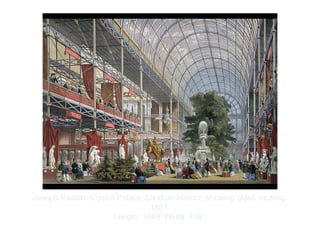
Joseph Paxton. Crystal Palace, London: Interior, showing glass vaulting.
1851.
Length: 1848' Width: 408’.
Copyright ©2012 Pearson Inc.
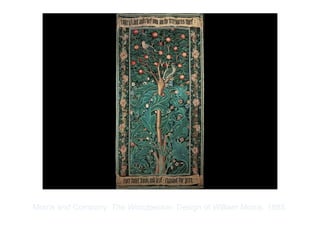
Morris and Company. The Woodpecker. Design of William Morris. 1885.
Copyright ©2012 Pearson Inc.
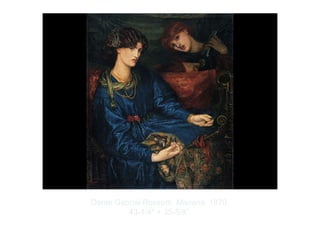
Dante Gabriel Rossetti. Mariana. 1870.
43-1/4" × 35-5/8”.
Copyright ©2012 Pearson Inc.
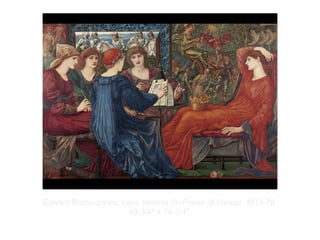
Edward Burne-Jones. Laus Veneris (In Praise of Venus). 1873-78.
48-3/4" × 74-1/4”.
Copyright ©2012 Pearson Inc.
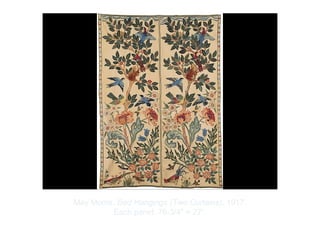
May Morris. Bed Hangings (Two Curtains). 1917.
Each panel: 76-3/4" × 27”.
Copyright ©2012 Pearson Inc.
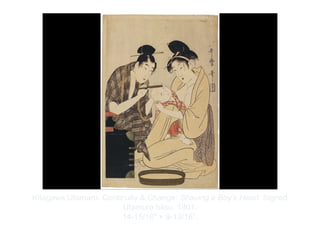
Kitagawa Utamaro. Continuity & Change: Shaving a Boy’s Head. Signed
Utamuro hitsu. 1801.
14-15/16" × 9-13/16”.
Copyright ©2012 Pearson Inc.
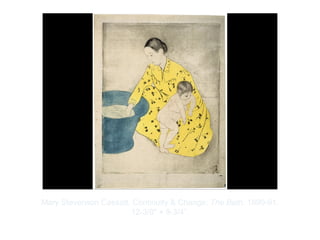
Mary Stevenson Cassatt. Continuity & Change: The Bath. 1890-91.
12-3/8" × 9-3/4”.

Sayre2e ch31 integrated_lecture_pp_ts-150672

  • 1.
    Copyright ©2012 PearsonInc. Édouard Manet. The Barricade. ca. 1871. 18-1/4" × 12-3/4”.
  • 2.
    Copyright ©2012 PearsonInc. Édouard Manet. The Execution of Maximilian. 1868-69. 99-1/4" × 120”.
  • 3.
    Copyright ©2012 PearsonInc. Henri Fantin-Latour. A Studio in the Batignolles. Salon of 1870. 1870. 6’ 8-1/4" × 8’ 11-3/4”.
  • 4.
    What is Impressionism? •Monet’s Escape to Giverny — Monet continually sought to escape the city for the pleasures of the countryside. In 1883 he moved to Giverny. Monet began painting the same subject at different times of day and in different atmospheric conditions. Each painting in the series became a fragment in the duration of the whole. • Morisot and Pissarro: The Effects of Paint — Morisot painted figures in clothing that is often barely distinguishable from the background; her paintings seem to dissolve into a uniform white light. Pisarro’s landscapes give us the impression of a view never quite fully captured by the painter. French Impressionism
  • 5.
    • Leisure andWork: Renoir, Degas and Caillebotte — Renoir and Degas preferred to paint the crowd in the cafes and restaurants, at entertainments of all kinds, and in the countryside. Renoir’s work is tightly composed and show a geometric symmetry. Degas also cared carefully constructed his paintings. Work was the theme of the first painting Caillebotte exhibited with the Impressionists. His theme in The Floor-Scrapers is the monotony of repetition, the rhythm of parallel lines of flooring reinforcing the theme. • Manet’s Impressionism — Manet increasingly adopted Impressionist techniques, particularly the loose application of paint and the emphasis on capturing the effects of light. Manet’s Impressionism incorporates the viewer into its “atmosphere,” which is actually impenetrable. • Discussion Question: What are the prominent features of impressionism?
  • 6.
    Copyright ©2012 PearsonInc. Claude Monet. The Regatta at Argenteuil. ca. 1872. 19" × 29-1/2”.
  • 7.
    Copyright ©2012 PearsonInc. Claude Monet. Impression: Sunrise. 1873. 19-5/8" × 25-1/2”.
  • 8.
    Copyright ©2012 PearsonInc. Claude Monet. Boulevard des Capucines. 1873. 24" × 31-1/2”.
  • 9.
    Copyright ©2012 PearsonInc. Claude Monet. Grainstack (Snow Effect). Also, Haystack. 1891. 25-3/4" × 36-3/8”.
  • 10.
    Copyright ©2012 PearsonInc. Berthe Morisot. Summer's Day. 1879. 18" × 29-3/4”.
  • 11.
    Copyright ©2012 PearsonInc. Camille Pissarro. Red Roofs, or The Orchard, Côtes Saint-Denis at Pontoise. 1877. 21-1/2" × 25-7/8”.
  • 12.
    Copyright ©2012 PearsonInc. Auguste Renoir. Oarsmen at Chatou. 1879. 31-15/16" × 39-7/16”.
  • 13.
    Copyright ©2012 PearsonInc. Edgar Degas. Dance Class. ca. 1874. 32-3/4" × 30-1/4”.
  • 14.
    Copyright ©2012 PearsonInc. Auguste Renoir. Closer Look: Luncheon of the Boating Party. 1880-81. 51-1/4" × 69-1/8”.
  • 15.
    Copyright ©2012 PearsonInc. Auguste Renoir. Closer Look: Luncheon of the Boating Party. 1880-81. 51-1/4" × 69-1/8”.
  • 16.
    Copyright ©2012 PearsonInc. Gustave Caillebotte. The Floor-Scrapers. 1875. 40-1/8" × 57-1/2”.
  • 17.
    Copyright ©2012 PearsonInc. Edgar Degas. Aux Ambassadeurs. 1877. 14-1/2" × 10-5/8”.
  • 18.
    Copyright ©2012 PearsonInc. Édouard Manet. A Bar at the Folies-Bergère. 1881-82. 37-3/4" × 51-1/8”.
  • 19.
     Closer Look:A Bar at the Folies-Bergère MyArtsLabChapter 31 – Hope and Possibility in Late Nineteenth-Century Europe
  • 20.
    Copyright ©2012 PearsonInc. Jules Chéret. Aux Folies-Bergère. 1875.
  • 21.
    Russian Realism andthe Quest for the Russian Soul How was Russian nationalism reflected in literature, art, and music? • The Writer and Artist under the Tsars — Under the rule of Nicholas I, literary culture was severely stifled. Dostoyevsky considered the question, “Can we love the damned?”. The complexity of psychological guilt is the theme of Crime and Punishment where he asks, “Can immoral means justify worthy ends?” Tolstoy’s realism turned outward, to the epic stage of Russian history. War and Peace surveys Russian life in the early nineteenth century. The Travelers was a group of 13 visual artists dedicated to presenting art exhibitions throughout the country.
  • 22.
    • Russian NationalisticMusic and Ballet — The quest to express the fundamental essence of Russia was reflected in music. Slavic pride was expressed through the incorporation of Russian folklore, folk songs, and instruments. Tchiakovsky’s nationalism is apparent in his 1812 Overture. His real fame came from his ballet music such as Swan Lake, Sleeping Beauty, and the Nutcracker. • Discussion Question: What are the two factions within nineteenth- century Russian society?
  • 23.
    Copyright ©2012 PearsonInc. Ilya Repin. Leo Tolstoy Ploughing. 1887.
  • 24.
    Copyright ©2012 PearsonInc. Ivan Nikolaevich Kramskoy. Ivan I. Shishkin. 1880. 46" × 33-1/2”.
  • 25.
     Active ListeningGuide: Tchaikovsky: 1812 Overture MyArtsLabChapter 31 – Hope and Possibility in Late Nineteenth-Century Europe
  • 26.
    Britain and theDesign of Social Reform How did the Crystal Palace and Pre-Raphaelite artists express the spirit of social reform? • Morris, the Guild Movement and the Pre-Raphaelites — Morris longed to return to a handmade craft tradition, in which workers, as with the medieval craft guilds, would no longer be alienated from their labor. In his designs, Morris constantly emphasized simplicity and utility. He hired many of his artist friends such as, Rossetti, and Burne- Jones. Rossetti was the leader of the Pre-Raphaelite Brotherhood, who denounced contemporary art. He championed the spiritual values of medieval and early Renaissance culture. Burne-Jones illustrated many of the books produced by Morris’s press. The influence of Morris’s design company fostered a guild movement throughout England intent on producing quality handcrafted goods.
  • 27.
    • The Fightfor Women’s Rights: Mill’s Subjection of Women — Many reformers felt that women were inherently conservative, unduly controlled by the clergy. Mill was an advocate of utilitarian theory, and on that basis felt that in assigning an inferior role to women, society was wasting an enormous resource. Mill wrote The Subjection of Women in collaboration with his wife. • Discussion Question: What are some of the late-nineteenth-century’s attitudes towards women as expressed through philosophy and art?
  • 28.
    Copyright ©2012 PearsonInc. Joseph Paxton. Crystal Palace, London (lithograph by Charles Burton). 1851. Length: 1848' Width: 408’.
  • 29.
    Copyright ©2012 PearsonInc. Joseph Paxton. Crystal Palace, London: Interior, showing glass vaulting. 1851. Length: 1848' Width: 408’.
  • 30.
    Copyright ©2012 PearsonInc. Morris and Company. The Woodpecker. Design of William Morris. 1885.
  • 31.
    Copyright ©2012 PearsonInc. Dante Gabriel Rossetti. Mariana. 1870. 43-1/4" × 35-5/8”.
  • 32.
    Copyright ©2012 PearsonInc. Edward Burne-Jones. Laus Veneris (In Praise of Venus). 1873-78. 48-3/4" × 74-1/4”.
  • 33.
    Copyright ©2012 PearsonInc. May Morris. Bed Hangings (Two Curtains). 1917. Each panel: 76-3/4" × 27”.
  • 34.
    Copyright ©2012 PearsonInc. Kitagawa Utamaro. Continuity & Change: Shaving a Boy’s Head. Signed Utamuro hitsu. 1801. 14-15/16" × 9-13/16”.
  • 35.
    Copyright ©2012 PearsonInc. Mary Stevenson Cassatt. Continuity & Change: The Bath. 1890-91. 12-3/8" × 9-3/4”.

Editor's Notes

  • #2 Édouard Manet. The Barricade . ca. 1871. 18-1/4" × 12-3/4”.
  • #3 Édouard Manet. The Execution of Maximilian . 1868-69. 99-1/4" × 120”.
  • #4 Henri Fantin-Latour. A Studio in the Batignolles . Salon of 1870. 1870. 6’ 8-1/4" × 8’ 11-3/4”.
  • #5 What is Impressionism? The renovation of Paris came to a temporary halt in 1870 during the Franco-Prussian war. Embarrassed by the failure of his imperial adventuring in Mexico, where his hand-picked leader was executed by revolutionaries, Louis-Napoleon entered into war with Prussia. He was soundly defeated by Otto von Bismarck and exiled to England. After Bismarck laid siege to Paris, which surrendered in January 1871, the newly declared Third Republic granted generous concessions to its citizens. In March, they created their own municipal government, the Commune. The National Assembly’s army attacked, and after a bloody week the Commune was crushed. In what ways was Impressionism borne out of this political climate? Many of these young artists who were identified as Impressionists preferred painting out-of-doors to capture the natural effects of light. What technological innovations made such an approach to painting possible? Monet, Pissarro, Renoir, Degas, and Morisot were the founders of the group. Although he never exhibited with them, Manet was considered by many to be their leader. In what ways did Impressionism undercut conventional assumptions about the style and content of painting?
  • #7 Claude Monet. The Regatta at Argenteuil . ca. 1872. 19" × 29-1/2”.
  • #8 Claude Monet. Impression: Sunrise . 1873. 19-5/8" × 25-1/2”.
  • #9 Claude Monet. Boulevard des Capucines . 1873. 24" × 31-1/2”.
  • #10 Claude Monet. Grainstack (Snow Effect) . Also, Haystack . 1891. 25-3/4" × 36-3/8”.
  • #11 Berthe Morisot. Summer's Day . 1879. 18" × 29-3/4”.
  • #12 Camille Pissarro. Red Roofs , or The Orchard , Côtes Saint-Denis at Pontoise. 1877. 21-1/2" × 25-7/8”.
  • #13 Auguste Renoir. Oarsmen at Chatou . 1879. 31-15/16" × 39-7/16”.
  • #14 Edgar Degas. Dance Class . ca. 1874. 32-3/4" × 30-1/4”.
  • #15 Auguste Renoir. Closer Look: Luncheon of the Boating Party . 1880-81. 51-1/4" × 69-1/8”.
  • #16 Auguste Renoir. Closer Look: Luncheon of the Boating Party . 1880-81. 51-1/4" × 69-1/8”.
  • #17 Gustave Caillebotte. The Floor-Scrapers . 1875. 40-1/8" × 57-1/2”.
  • #18 Edgar Degas. Aux Ambassadeurs . 1877. 14-1/2" × 10-5/8”.
  • #19 Édouard Manet. A Bar at the Folies-Bergère . 1881-82. 37-3/4" × 51-1/8”.
  • #21 Jules Chéret. Aux Folies-Bergère . 1875.
  • #22 How was Russian nationalism reflected in literature, art, and music? In Russia, Francophiles followed developments in Paris carefully, but Slavophiles rejected the pro-Western bias and those Westernizers who believed that Russia was hopelessly mired in the medieval past. Slavophiles tended to be nationalists and saw Russian culture and its spirituality (or “soul”) as essentially different from that of the West. How did Fyodor Dostoyevsky’s novel Crime and Punishment reflect the Russian soul? What was novelist Leo Tolstoy’s approach? In painting, a group of young Russian painters called the Travelers created highly realistic works that celebrated peasant life. In music, the nationalist spirit manifested itself in the use of folklore and folk songs, particularly in the compositions of Modest Mussorgsky. How did Tchaikovsky’s 1812 Overture reflect a nationalist spirit?
  • #24 Ilya Repin. Leo Tolstoy Ploughing . 1887.
  • #25 Ivan Nikolaevich Kramskoy. Ivan I. Shishkin . 1880. 46" × 33-1/2”.
  • #27 How did the Crystal Palace and Pre-Raphaelite artists express the spirit of social reform? The lack of standards of beauty in British industrial design was symptomatic of the country’s social inequities, according to English civil servant and designer Henry Cole. Why did Cole propose a Universal Exposition for London’s Hyde Park in 1850? The Exposition took place at Joseph Paxton’s Crystal Palace. How did the Crystal Palace revolutionize architectural construction? William Morris took a different approach to the problem. With a group of friends he founded the design firm Morris and Company in 1855. Modeled on the medieval guilds, the company made everything from tapestries and ceramic tiles to stained glass and furniture, all handcrafted. In his employ were the Pre-Raphaelite painters Daniel Gabriel Rossetti and Edward Burne- Jones, whose work was both medieval in spirit and highly charged with erotic tension. Why did these artists and designers turn to medieval models? How does Morris’s exclusion of women from higher-level production and design positions in his firm compare with John Stuart Mill’s 1869 essay The Subjection of Women , which argued against the continued subjugation of women in Western society?
  • #29 Joseph Paxton. Crystal Palace, London (lithograph by Charles Burton). 1851. Length: 1848' Width: 408’.
  • #30 Joseph Paxton. Crystal Palace, London: Interior, showing glass vaulting. 1851. Length: 1848' Width: 408’.
  • #31 Morris and Company. The Woodpecker . Design of William Morris. 1885.
  • #32 Dante Gabriel Rossetti. Mariana . 1870. 43-1/4" × 35-5/8”.
  • #33 Edward Burne-Jones. Laus Veneris (In Praise of Venus) . 1873-78. 48-3/4" × 74-1/4”.
  • #34 May Morris. Bed Hangings (Two Curtains) . 1917. Each panel: 76-3/4" × 27”.
  • #35 Kitagawa Utamaro. Continuity & Change: Shaving a Boy’s Head . Signed Utamuro hitsu. 1801. 14-15/16" × 9-13/16”.
  • #36 Mary Stevenson Cassatt. Continuity & Change: The Bath . 1890-91. 12-3/8" × 9-3/4”.