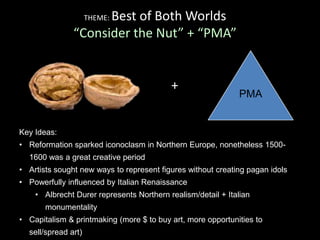
THEME: Best of Both Worlds
“Consider the Nut” + “PMA”
PMA
+
Key Ideas:
• Reformation sparked iconoclasm in Northern Europe, nonetheless 1500-
1600 was a great creative period
• Artists sought new ways to represent figures without creating pagan idols
• Powerfully influenced by Italian Renaissance
• Albrecht Durer represents Northern realism/detail + Italian
monumentality
• Capitalism & printmaking (more $ to buy art, more opportunities to
sell/spread art)
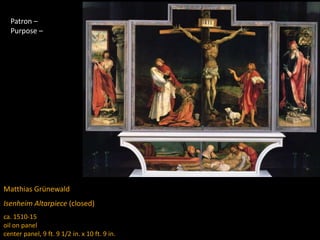
Matthias Grünewald
Isenheim Altarpiece (closed)
ca. 1510-15
oil on panel
center panel, 9 ft. 9 1/2 in. x 10 ft. 9 in.
Patron –
Purpose –
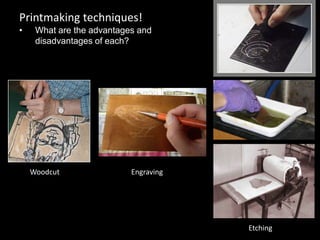
Printmaking techniques!
• What are the advantages and
disadvantages of each?
Woodcut Engraving
Etching
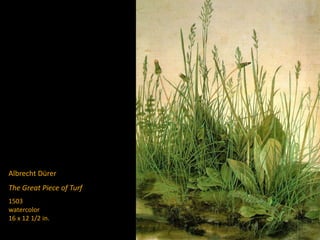
Albrecht Dürer
The Great Piece of Turf
1503
watercolor
16 x 12 1/2 in.
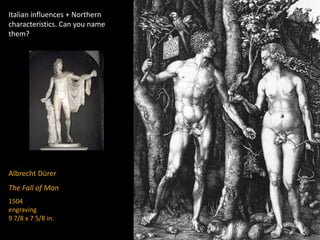
Albrecht Dürer
The Fall of Man
1504
engraving
9 7/8 x 7 5/8 in.
Italian influences + Northern
characteristics. Can you name
them?
Albrecht Dürer
Knight, Death and the Devil
1513
engraving
9 5/8 x 7 3/8 in.
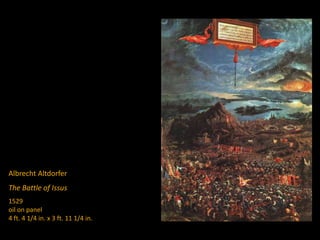
Albrecht Altdorfer
The Battle of Issus
1529
oil on panel
4 ft. 4 1/4 in. x 3 ft. 11 1/4 in.
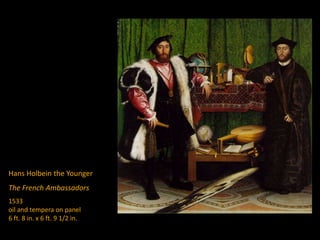
Hans Holbein the Younger
The French Ambassadors
1533
oil and tempera on panel
6 ft. 8 in. x 6 ft. 9 1/2 in.
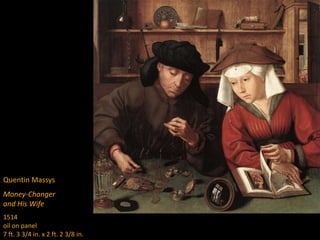
Quentin Massys
Money-Changer
and His Wife
1514
oil on panel
7 ft. 3 3/4 in. x 2 ft. 2 3/8 in.
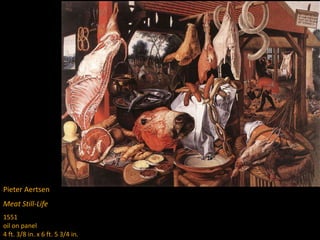
Pieter Aertsen
Meat Still-Life
1551
oil on panel
4 ft. 3/8 in. x 6 ft. 5 3/4 in.
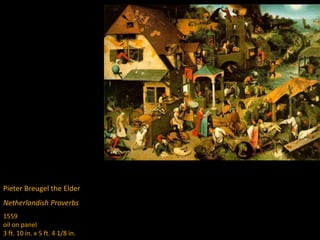
Pieter Breugel the Elder
Netherlandish Proverbs
1559
oil on panel
3 ft. 10 in. x 5 ft. 4 1/8 in.
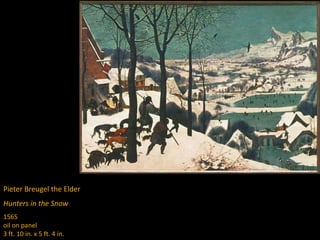
Pieter Breugel the Elder
Hunters in the Snow
1565
oil on panel
3 ft. 10 in. x 5 ft. 4 in.
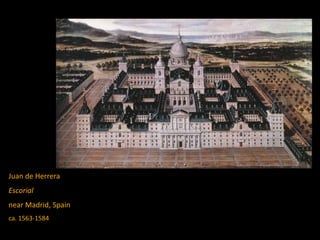
Juan de Herrera
Escorial
near Madrid, Spain
ca. 1563-1584
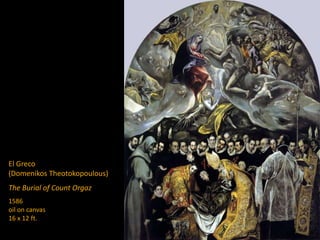
El Greco
(Domenikos Theotokopoulous)
The Burial of Count Orgaz
1586
oil on canvas
16 x 12 ft.
Mannerism - "Oh, what the hey. We could never top the
High Renaissance, so why bother?"
- Comes from Italian word Maniera
- Artifice
- Mannerist art is deliberately intellectual, asking the viewer to respond in a
sophisticated way to the spatial challenges
- Complicated compositions, distorted figures, complex allegorical
interpretations
- Calculated ambiguity gives Mannerism its enduring value
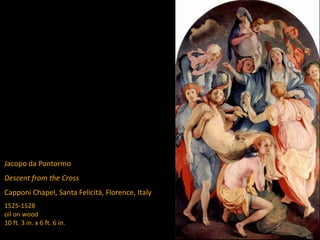
Jacopo da Pontormo
Descent from the Cross
Capponi Chapel, Santa Felicità, Florence, Italy
1525-1528
oil on wood
10 ft. 3 in. x 6 ft. 6 in.
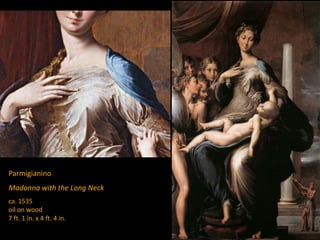
Parmigianino
Madonna with the Long Neck
ca. 1535
oil on wood
7 ft. 1 in. x 4 ft. 4 in.
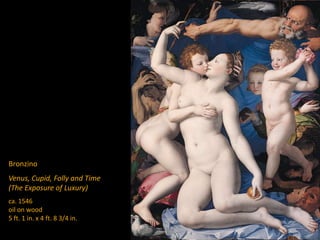
Bronzino
Venus, Cupid, Folly and Time
(The Exposure of Luxury)
ca. 1546
oil on wood
5 ft. 1 in. x 4 ft. 8 3/4 in.
Tintoretto
Last Supper
Chancel. San Giorgio Maggiore, Venice, Italy
1594
oil on canvas
12 ft. x 18 ft. 8 in.
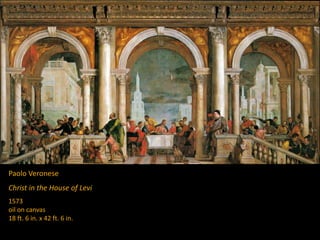
Paolo Veronese
Christ in the House of Levi
1573
oil on canvas
18 ft. 6 in. x 42 ft. 6 in.
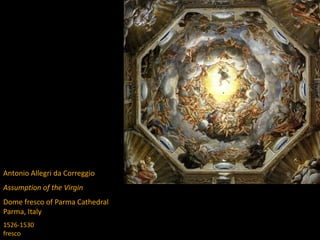
Antonio Allegri da Correggio
Assumption of the Virgin
Dome fresco of Parma Cathedral
Parma, Italy
1526-1530
fresco
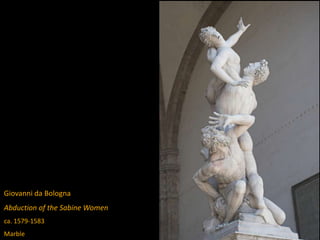
Giovanni da Bologna
Abduction of the Sabine Women
ca. 1579-1583
Marble
Baroque Art in Italy and Spain
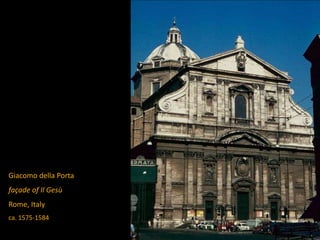
Giacomo della Porta
façade of Il Gesù
Rome, Italy
ca. 1575-1584
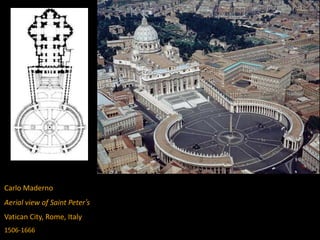
Carlo Maderno
Aerial view of Saint Peter’s
Vatican City, Rome, Italy
1506-1666
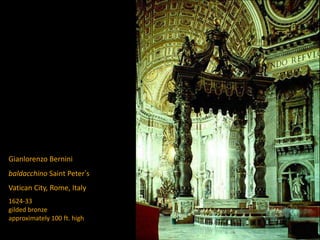
Gianlorenzo Bernini
baldacchino Saint Peter’s
Vatican City, Rome, Italy
1624-33
gilded bronze
approximately 100 ft. high
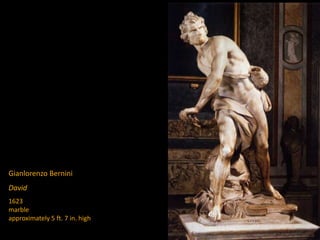
Gianlorenzo Bernini
David
1623
marble
approximately 5 ft. 7 in. high
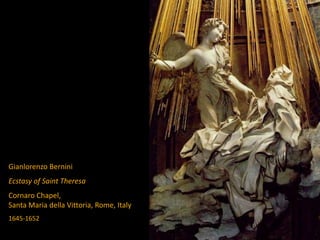
Gianlorenzo Bernini
Ecstasy of Saint Theresa
Cornaro Chapel,
Santa Maria della Vittoria, Rome, Italy
1645-1652
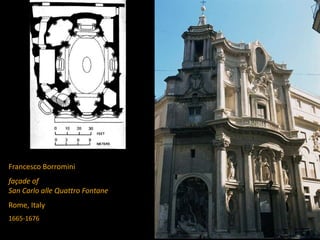
Francesco Borromini
façade of
San Carlo alle Quattro Fontane
Rome, Italy
1665-1676
Caravaggio
Calling of Saint Matthew
Contarelli Chapel, San Luigi dei Francesci
Rome, Italy
ca. 1597-1601
oil on canvas
11 ft. 1 in. x 11 ft. 5 in.
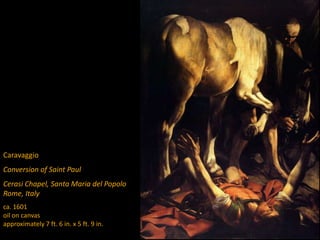
Caravaggio
Conversion of Saint Paul
Cerasi Chapel, Santa Maria del Popolo
Rome, Italy
ca. 1601
oil on canvas
approximately 7 ft. 6 in. x 5 ft. 9 in.
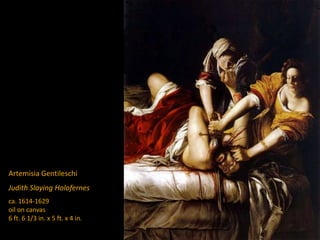
Artemisia Gentileschi
Judith Slaying Holofernes
ca. 1614-1629
oil on canvas
6 ft. 6 1/3 in. x 5 ft. x 4 in.
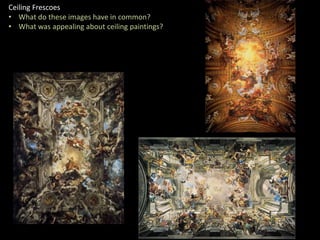
Ceiling Frescoes
• What do these images have in common?
• What was appealing about ceiling paintings?
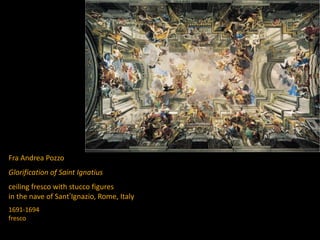
Fra Andrea Pozzo
Glorification of Saint Ignatius
ceiling fresco with stucco figures
in the nave of Sant’Ignazio, Rome, Italy
1691-1694
fresco
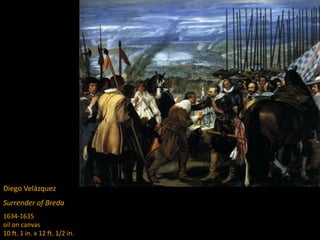
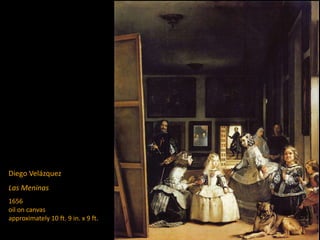
Diego Velázquez
Surrender of Breda
1634-1635
oil on canvas
10 ft. 1 in. x 12 ft. 1/2 in.
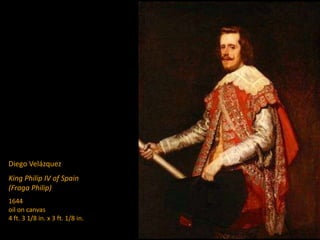
Diego Velázquez
King Philip IV of Spain
(Fraga Philip)
1644
oil on canvas
4 ft. 3 1/8 in. x 3 ft. 1/8 in.
Diego Velázquez
Las Meninas
1656
oil on canvas
approximately 10 ft. 9 in. x 9 ft.
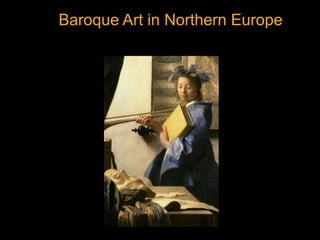
Baroque Art in Northern Europe
Peter Paul Rubens
Elevation of the Cross
Antwerp Cathedral, Antwerp, Belgium
1610
oil on panel
15 ft. 2 in. x 11 ft. 2 in.
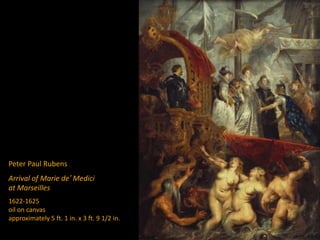
Peter Paul Rubens
Arrival of Marie de’ Medici
at Marseilles
1622-1625
oil on canvas
approximately 5 ft. 1 in. x 3 ft. 9 1/2 in.
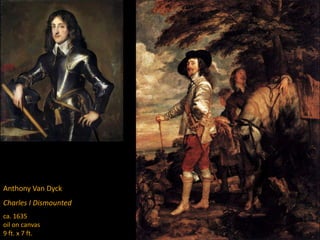
Anthony Van Dyck
Charles I Dismounted
ca. 1635
oil on canvas
9 ft. x 7 ft.
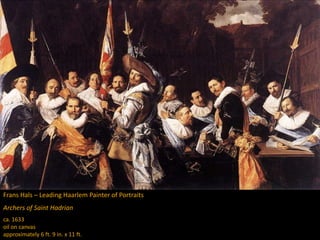
Frans Hals – Leading Haarlem Painter of Portraits
Archers of Saint Hadrian
ca. 1633
oil on canvas
approximately 6 ft. 9 in. x 11 ft.
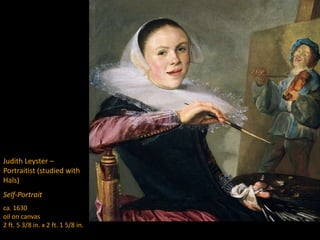
Judith Leyster –
Portraitist (studied with
Hals)
Self-Portrait
ca. 1630
oil on canvas
2 ft. 5 3/8 in. x 2 ft. 1 5/8 in.
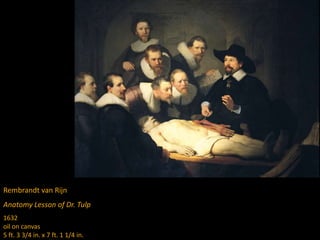
Rembrandt van Rijn
Anatomy Lesson of Dr. Tulp
1632
oil on canvas
5 ft. 3 3/4 in. x 7 ft. 1 1/4 in.
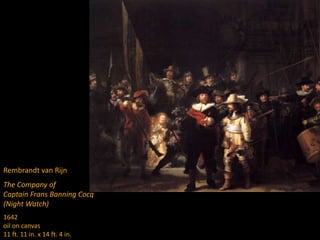
Rembrandt van Rijn
The Company of
Captain Frans Banning Cocq
(Night Watch)
1642
oil on canvas
11 ft. 11 in. x 14 ft. 4 in.
Rembrandt van Rijn
Self-Portrait
ca. 1659-1660
oil on canvas
3 ft. 8 3/4 in. x 3 ft. 1 in.
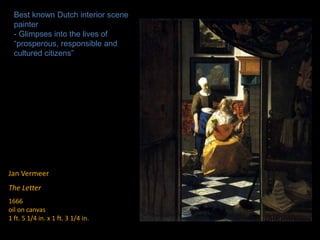
Jan Vermeer
The Letter
1666
oil on canvas
1 ft. 5 1/4 in. x 1 ft. 3 1/4 in.
Best known Dutch interior scene
painter
- Glimpses into the lives of
“prosperous, responsible and
cultured citizens”
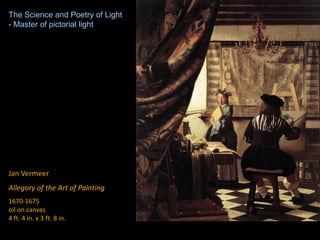
Jan Vermeer
Allegory of the Art of Painting
1670-1675
oil on canvas
4 ft. 4 in. x 3 ft. 8 in.
The Science and Poetry of Light
- Master of pictorial light
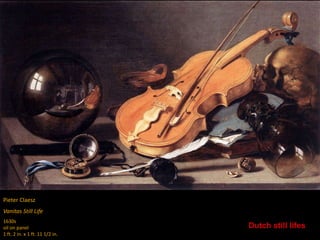
Pieter Claesz
Vanitas Still Life
1630s
oil on panel
1 ft. 2 in. x 1 ft. 11 1/2 in.
Dutch still lifes
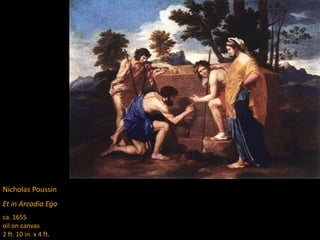
Nicholas Poussin
Et in Arcadia Ego
ca. 1655
oil on canvas
2 ft. 10 in. x 4 ft.
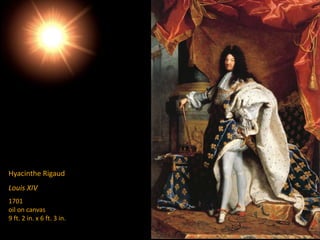
Hyacinthe Rigaud
Louis XIV
1701
oil on canvas
9 ft. 2 in. x 6 ft. 3 in.
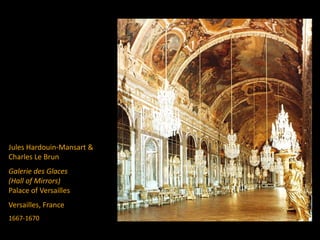
Jules Hardouin-Mansart &
Charles Le Brun
Galerie des Glaces
(Hall of Mirrors)
Palace of Versailles
Versailles, France
1667-1670
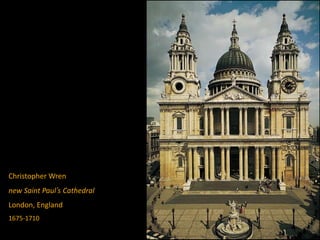
Christopher Wren
new Saint Paul’s Cathedral
London, England
1675-1710
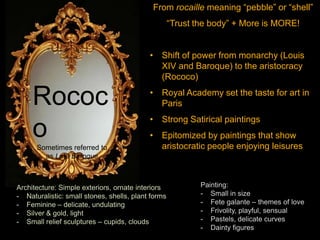
From rocaille meaning “pebble” or “shell”
“Trust the body” + More is MORE!
• Shift of power from monarchy (Louis
XIV and Baroque) to the aristocracy
(Rococo)
• Royal Academy set the taste for art in
Paris
• Strong Satirical paintings
• Epitomized by paintings that show
aristocratic people enjoying leisures
Rococ
oSometimes referred to
as Late Baroque
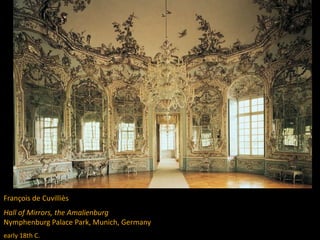
Architecture: Simple exteriors, ornate interiors
- Naturalistic: small stones, shells, plant forms
- Feminine – delicate, undulating
- Silver & gold, light
- Small relief sculptures – cupids, clouds
Painting:
- Small in size
- Fete galante – themes of love
- Frivolity, playful, sensual
- Pastels, delicate curves
- Dainty figures
François de Cuvilliès
Hall of Mirrors, the Amalienburg
Nymphenburg Palace Park, Munich, Germany
early 18th C.
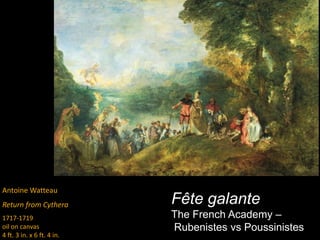
Antoine Watteau
Return from Cythera
1717-1719
oil on canvas
4 ft. 3 in. x 6 ft. 4 in.
Fête galante
The French Academy –
Rubenistes vs Poussinistes
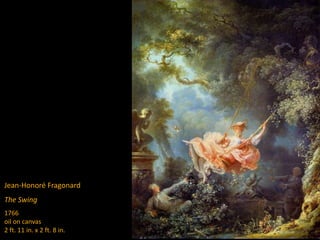
Jean-Honoré Fragonard
The Swing
1766
oil on canvas
2 ft. 11 in. x 2 ft. 8 in.
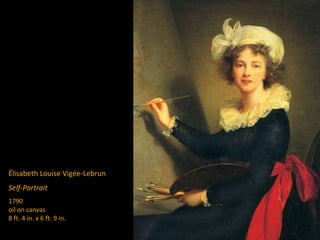
Élisabeth Louise Vigée-Lebrun
Self-Portrait
1790
oil on canvas
8 ft. 4 in. x 6 ft. 9 in.
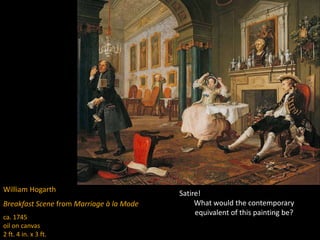
William Hogarth
Breakfast Scene from Marriage à la Mode
ca. 1745
oil on canvas
2 ft. 4 in. x 3 ft.
Satire!
What would the contemporary
equivalent of this painting be?
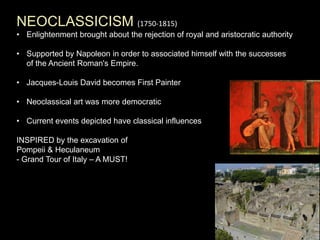
NEOCLASSICISM (1750-1815)
• Enlightenment brought about the rejection of royal and aristocratic authority
• Supported by Napoleon in order to associated himself with the successes
of the Ancient Roman's Empire.
• Jacques-Louis David becomes First Painter
• Neoclassical art was more democratic
• Current events depicted have classical influences
INSPIRED by the excavation of
Pompeii & Heculaneum
- Grand Tour of Italy – A MUST!
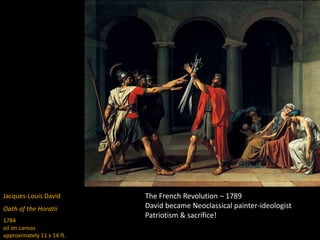
Jacques-Louis David
Oath of the Horatii
1784
oil on canvas
approximately 11 x 14 ft.
The French Revolution – 1789
David became Neoclassical painter-ideologist
Patriotism & sacrifice!
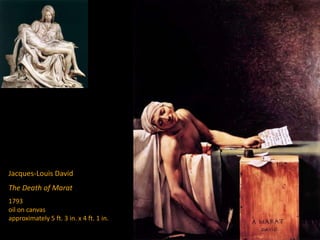
Jacques-Louis David
The Death of Marat
1793
oil on canvas
approximately 5 ft. 3 in. x 4 ft. 1 in.
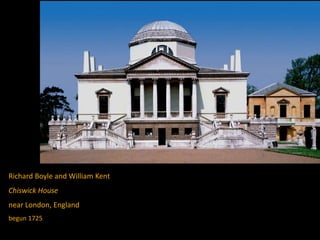
Richard Boyle and William Kent
Chiswick House
near London, England
begun 1725
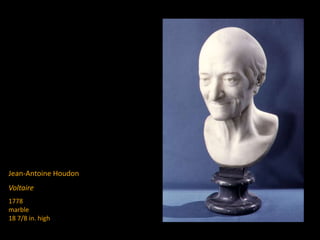
Jean-Antoine Houdon
Voltaire
1778
marble
18 7/8 in. high

Review baroque thru neoclassicism