Enlightenment Overview

       A summary of major
Enlightenment ideas and thinkers
How is the Enlightenment a change
from previous thought?
The Enlightenment brought about many ideas that were different
from previous beliefs/philosophies.  Prior to the Enlightenment it
was generally believed that women were inferior to men, children
were small adults, and that common person should be loyal to the
leader regardless of how they were treated.
Leaders were mostly absolute monarchs who believed they ruled by
divine rights and therefore felt they could rule in whatever way
they desired.
Education was something for wealthy men only, and the church
played a huge role in almost every aspect of people's lives.
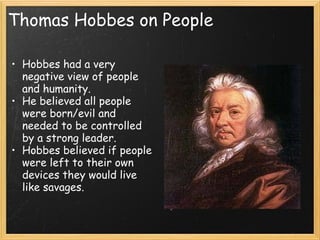
Thomas Hobbes on People

• Hobbes had a very            
  negative view of people
  and humanity.
• He believed all people
  were born/evil and
  needed to be controlled
  by a strong leader.
• Hobbes believed if people
  were left to their own
  devices they would live
  like savages.
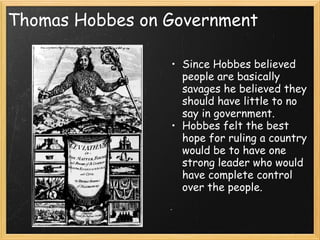
Thomas Hobbes on Government

                 • Since Hobbes believed
                   people are basically
                   savages he believed they
                   should have little to no
                   say in government.
                 • Hobbes felt the best
                   hope for ruling a country
                   would be to have one
                   strong leader who would
                   have complete control
                   over the people.
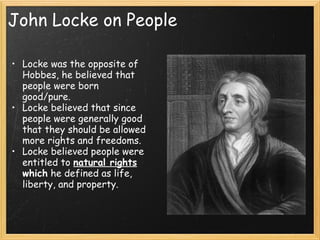
John Locke on People

• Locke was the opposite of      
  Hobbes, he believed that
  people were born
  good/pure.  
• Locke believed that since
  people were generally good
  that they should be allowed
  more rights and freedoms.
• Locke believed people were
  entitled to natural rights
  which he defined as life,
  liberty, and property.
John Locke on Government

• Locke believed that people should have a say in
  government.
• He also believed that the role of the leader is to
  protect the people's natural rights.
• Locke also believed in a form of the social
  contract - he believed if the leader was not
  protecting the people's natural rights than the
  people had the right to overthrow the leader.
Jean - Jacques Rosseau on People

• Rousseau believed that people weren't born good or
  bad, but that they were born blank slates and that
  their life experiences would determine the kind of
  person they would become. (This is known as tabula
  rasa).
• Rousseau also believed that every male deserved an
  education regardless of their social class.  
• He also valued children/childhood and felt that
  children should be treated differently than adults. He
  believed that the primary role of a woman was to be a
  mother, and that a woman should only receive enough
  education to raise a decent son.
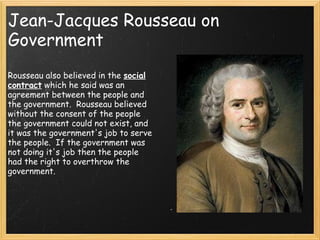
Jean-Jacques Rousseau on
Government
                                        
Rousseau also believed in the social
contract which he said was an
agreement between the people and
the government.  Rousseau believed
without the consent of the people
the government could not exist, and
it was the government's job to serve
the people.  If the government was
not doing it's job then the people
had the right to overthrow the
government.
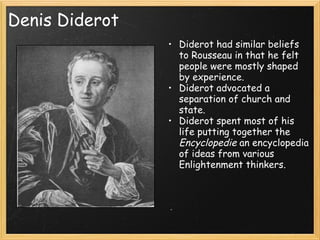
Denis Diderot
                • Diderot had similar beliefs
                  to Rousseau in that he felt
                  people were mostly shaped
                  by experience.
                • Diderot advocated a
                  separation of church and
                  state.
                • Diderot spent most of his
                  life putting together the
                  Encyclopedie an encyclopedia
                  of ideas from various
                  Enlightenment thinkers.
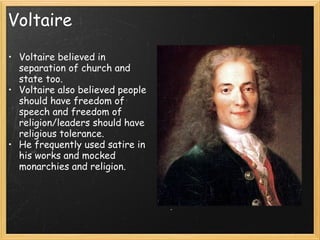
Voltaire

• Voltaire believed in
  separation of church and         
  state too.
• Voltaire also believed people
  should have freedom of
  speech and freedom of
  religion/leaders should have
  religious tolerance.
• He frequently used satire in
  his works and mocked
  monarchies and religion.
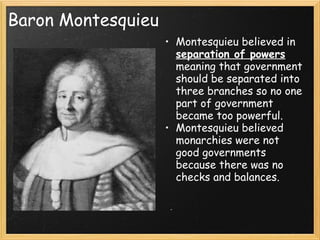
Baron Montesquieu
                    • Montesquieu believed in
                      separation of powers
                      meaning that government
                      should be separated into
                      three branches so no one
                      part of government
                      became too powerful.
                    • Montesquieu believed
                      monarchies were not
                      good governments
                      because there was no
                      checks and balances.
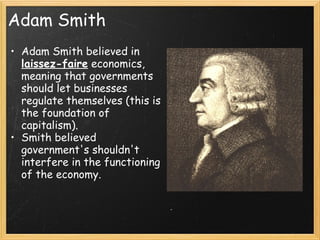
Adam Smith
• Adam Smith believed in
  laissez-faire economics,      
  meaning that governments
  should let businesses
  regulate themselves (this is
  the foundation of
  capitalism).
• Smith believed
  government's shouldn't
  interfere in the functioning
  of the economy.
Key Points
• Many new ideas about government/society/life
  emerged during the Enlightenment.
• These ideas represented a break from past thoughts
  on these subjects and were inspirational to many
  people and leaders.
•  Enlightenment ideas were spread through books,
  pamphlets, and salons gatherings typically held by
  wealthy French women in which Enlightenment
  thinkers would share ideas.
• Although these ideas were exciting to many people
  society and government did not rapidly undergo
  change.

Enlightenment overview[1]

  • 1.
    Enlightenment Overview A summary of major Enlightenment ideas and thinkers
  • 2.
    How is theEnlightenment a change from previous thought? The Enlightenment brought about many ideas that were different from previous beliefs/philosophies.  Prior to the Enlightenment it was generally believed that women were inferior to men, children were small adults, and that common person should be loyal to the leader regardless of how they were treated. Leaders were mostly absolute monarchs who believed they ruled by divine rights and therefore felt they could rule in whatever way they desired. Education was something for wealthy men only, and the church played a huge role in almost every aspect of people's lives.
  • 3.
    Thomas Hobbes onPeople • Hobbes had a very   negative view of people and humanity. • He believed all people were born/evil and needed to be controlled by a strong leader. • Hobbes believed if people were left to their own devices they would live like savages.
  • 4.
    Thomas Hobbes onGovernment   • Since Hobbes believed people are basically savages he believed they should have little to no say in government. • Hobbes felt the best hope for ruling a country would be to have one strong leader who would have complete control over the people.
  • 5.
    John Locke onPeople • Locke was the opposite of   Hobbes, he believed that people were born good/pure.   • Locke believed that since people were generally good that they should be allowed more rights and freedoms. • Locke believed people were entitled to natural rights which he defined as life, liberty, and property.
  • 6.
    John Locke onGovernment • Locke believed that people should have a say in government. • He also believed that the role of the leader is to protect the people's natural rights. • Locke also believed in a form of the social contract - he believed if the leader was not protecting the people's natural rights than the people had the right to overthrow the leader.
  • 7.
    Jean - JacquesRosseau on People • Rousseau believed that people weren't born good or bad, but that they were born blank slates and that their life experiences would determine the kind of person they would become. (This is known as tabula rasa). • Rousseau also believed that every male deserved an education regardless of their social class.   • He also valued children/childhood and felt that children should be treated differently than adults. He believed that the primary role of a woman was to be a mother, and that a woman should only receive enough education to raise a decent son.
  • 8.
    Jean-Jacques Rousseau on Government   Rousseau also believed in the social contract which he said was an agreement between the people and the government.  Rousseau believed without the consent of the people the government could not exist, and it was the government's job to serve the people.  If the government was not doing it's job then the people had the right to overthrow the government.
  • 9.
    Denis Diderot • Diderot had similar beliefs to Rousseau in that he felt   people were mostly shaped by experience. • Diderot advocated a separation of church and state. • Diderot spent most of his life putting together the Encyclopedie an encyclopedia of ideas from various Enlightenment thinkers.
  • 10.
    Voltaire • Voltaire believedin separation of church and   state too. • Voltaire also believed people should have freedom of speech and freedom of religion/leaders should have religious tolerance. • He frequently used satire in his works and mocked monarchies and religion.
  • 11.
    Baron Montesquieu • Montesquieu believed in separation of powers   meaning that government should be separated into three branches so no one part of government became too powerful. • Montesquieu believed monarchies were not good governments because there was no checks and balances.
  • 12.
    Adam Smith • AdamSmith believed in laissez-faire economics,   meaning that governments should let businesses regulate themselves (this is the foundation of capitalism). • Smith believed government's shouldn't interfere in the functioning of the economy.
  • 13.
    Key Points • Manynew ideas about government/society/life emerged during the Enlightenment. • These ideas represented a break from past thoughts on these subjects and were inspirational to many people and leaders. •  Enlightenment ideas were spread through books, pamphlets, and salons gatherings typically held by wealthy French women in which Enlightenment thinkers would share ideas. • Although these ideas were exciting to many people society and government did not rapidly undergo change.