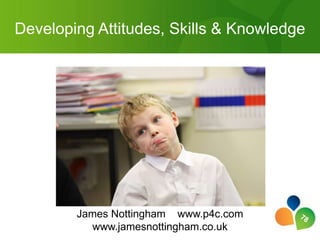
Developing Attitudes, Skills & KnowledgeJames Nottingham    www.p4c.comwww.jamesnottingham.co.uk78
Focusing on learning“Pupils show greater motivation, are better behaved and are more likely to be independent and strategic thinkers when teachers are not obsessed by grades.”“If there is one new thing we need in our school system right now, it is a well-developed focus on learning.”Chris Watkins, Institute of Education, Aug 2010From an analysis of 100 international studies on how children learn
The ASK model – Attitudes, Skills & KnowledgeSSkills Intellectual
 Social
 Communicative
 PhysicalAttitudes Curiosity
 Desire to succeed
 Open-mindedness
 Resilience
 Self-RegulationKAKnowledge Facts
 Figures
 Concepts
 IdeasDo not kill the cat!
Rules, rules, rules
A selection of attitudesExamples from 7 year oldsExamples from 11 year oldsExamples from 14 year oldsTrying my best		Always trying hard		PerseveringBeing willing to be helped	Being open to advice	Being open to support and coachingConcentrating hard		Thinking carefully		Being focused on what’s relevant Having a go		Being willing to try new things	Being open to new experiencesNot giving up		Never-say-die attitude	ResilienceNot worrying about mistakes	Learning from mistakes	Treating mistakes as useful feedbackAsking questions		Being curious		Enquiring and being curious28
Persistence
Standing up for what you believeEmmeline Pankhurst1858 - 1928Suffragette
Attention to detail
Going the extra few inches ...Before ...After ...
The impact of core valuesSöderporten school, NorrköpingThe school is extremely multi-cultural, with most children having recently arrived in the country and speaking Swedish as a second language. Our Core Values have helped to: Achieve in 2010 the best exam results since the national grading system was introduced in Sweden in 1997
 The school´s video surveillance is being switched off in autumn 2010Creating Core Values through consensusParents, governors and staff speak openly about the significant impact of the current headteacher. This is reflected in better teaching, a lively curriculum, good behaviour and rising standards. The headteacher'sapproach is collegiate. She has generated a debate within the school about the type of school that staff wished to create and how it would meet the needs of the pupils and the community. This process was a model of good practice. It was research-based, engaged all staff and generated a strong sense of commitment and belonging; staff speak about feeling valued and able to contribute. The outcomes were a five year plan which identifies clearly the key priorities to raise standards. This process has provided a clear sense of direction to the school and a shared purpose. Ofsted, 2008
Myers Briggs Type Indicator (MBTI)Developed during World War II, MBTI is a personality indicator designed to identify personal preferencesIn a similar way to left or right-handedness, the MBTI principle is that individuals also find certain ways of thinking and acting easier than othersEvidenceGut feelingSensingIntuitionThink to talkTalk to thinkIntroversionExtroversionDefinitePossibleJudgingPerceivingLogic/ReasonEmpathyThinkingFeeling
The ASK model – Attitudes, Skills & KnowledgeSSkills Intellectual
 Social
 Communicative
 PhysicalAttitudes Curiosity
 Desire to succeed
 Open-mindedness
 Resilience
 Self-RegulationKAKnowledge Facts
 Figures

Develop ASK

  • 1.
    Developing Attitudes, Skills& KnowledgeJames Nottingham www.p4c.comwww.jamesnottingham.co.uk78
  • 2.
    Focusing on learning“Pupilsshow greater motivation, are better behaved and are more likely to be independent and strategic thinkers when teachers are not obsessed by grades.”“If there is one new thing we need in our school system right now, it is a well-developed focus on learning.”Chris Watkins, Institute of Education, Aug 2010From an analysis of 100 international studies on how children learn
  • 3.
    The ASK model– Attitudes, Skills & KnowledgeSSkills Intellectual
  • 4.
  • 5.
  • 6.
  • 7.
    Desire tosucceed
  • 8.
  • 9.
  • 10.
  • 11.
  • 12.
  • 13.
    IdeasDo notkill the cat!
  • 14.
  • 15.
    A selection ofattitudesExamples from 7 year oldsExamples from 11 year oldsExamples from 14 year oldsTrying my best Always trying hard PerseveringBeing willing to be helped Being open to advice Being open to support and coachingConcentrating hard Thinking carefully Being focused on what’s relevant Having a go Being willing to try new things Being open to new experiencesNot giving up Never-say-die attitude ResilienceNot worrying about mistakes Learning from mistakes Treating mistakes as useful feedbackAsking questions Being curious Enquiring and being curious28
  • 16.
  • 18.
    Standing up forwhat you believeEmmeline Pankhurst1858 - 1928Suffragette
  • 19.
  • 20.
    Going the extrafew inches ...Before ...After ...
  • 22.
    The impact ofcore valuesSöderporten school, NorrköpingThe school is extremely multi-cultural, with most children having recently arrived in the country and speaking Swedish as a second language. Our Core Values have helped to: Achieve in 2010 the best exam results since the national grading system was introduced in Sweden in 1997
  • 23.
    The school´svideo surveillance is being switched off in autumn 2010Creating Core Values through consensusParents, governors and staff speak openly about the significant impact of the current headteacher. This is reflected in better teaching, a lively curriculum, good behaviour and rising standards. The headteacher'sapproach is collegiate. She has generated a debate within the school about the type of school that staff wished to create and how it would meet the needs of the pupils and the community. This process was a model of good practice. It was research-based, engaged all staff and generated a strong sense of commitment and belonging; staff speak about feeling valued and able to contribute. The outcomes were a five year plan which identifies clearly the key priorities to raise standards. This process has provided a clear sense of direction to the school and a shared purpose. Ofsted, 2008
  • 24.
    Myers Briggs TypeIndicator (MBTI)Developed during World War II, MBTI is a personality indicator designed to identify personal preferencesIn a similar way to left or right-handedness, the MBTI principle is that individuals also find certain ways of thinking and acting easier than othersEvidenceGut feelingSensingIntuitionThink to talkTalk to thinkIntroversionExtroversionDefinitePossibleJudgingPerceivingLogic/ReasonEmpathyThinkingFeeling
  • 25.
    The ASK model– Attitudes, Skills & KnowledgeSSkills Intellectual
  • 26.
  • 27.
  • 28.
  • 29.
    Desire tosucceed
  • 30.
  • 31.
  • 32.
  • 33.