Designing with capabilities
for fun and profit
@ScottWlaschin
fsharpforfunandprofit.com/cap
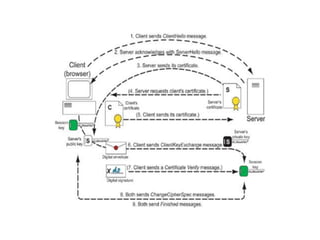
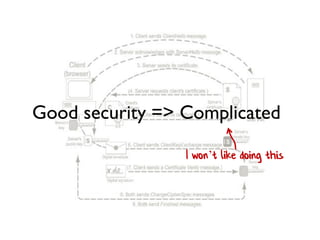
Good security => Complicated
I won’t like doing this
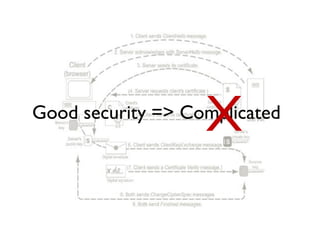
Good security => Complicated
X
Security for free!
...which is good,
because I’m lazy
Good security == Good design
I like doing this
The topic of this talk
Not about OAuth, JWT etc
Good security == Good design
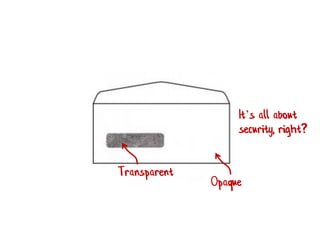
Transparent
Opaque
It’s all about
security, right?
Sed ut perspiciatis unde omnis iste natus error sit voluptatem
accusantium doloremque laudantium, totam rem aperiam,
eaque ipsa quae ab illo inventore veritatis et quasi architecto
beatae vitae dicta sunt explicabo. Nemo enim ipsam voluptatem
quia voluptas sit aspernatur aut odit aut fugit, sed quia
consequuntur magni dolores eos qui ratione voluptatem sequi
nesciunt. Neque porro quisquam est, qui dolorem ipsum quia
dolor sit amet, consectetur, adipisci velit, sed quia non
numquam eius modi tempora incidunt ut labore et dolore
magnam aliquam quaerat voluptatem. Ut enim ad minima
veniam, quis nostrum exercitationem ullam corporis suscipit
laboriosam, nisi ut aliquid ex ea commodi consequatur? Quis
autem vel eum iure reprehenderit qui in ea voluptate velit esse
quam nihil molestiae consequatur, Temporibus autem quibus
Dacei Megasystems Tech Inc necessitatibust aut officiis debitis
auteo 2799 E Dragam Suite 7 quisquam saepe Itaque
enieti Los Angeles CA 90002 ut et voluptates repudiandae sint
et molestiae non recusandae. Itaque earum rerum hic tenetur a
sapiente delectus, ut aut reiciendis voluptatibus maiores alias
consequatur aut perferendis doloribus asperiores repellat.
Neque porro quisquam est, qui dolorem ipsum quia dolor sit
amet, consectetur, adipisci velit, sed quia non numquam eius
modi tempora incidunt ut labore et dolore magnam aliquam
quaerat voluptatem. Ut enim ad minima veniam, quis nostrum
exercitationem ullam corporis suscipit laboriosam, nisi ut
aliquid ex ea commodi consequatur?
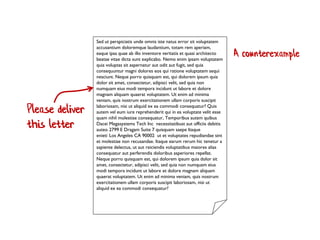
Please deliver
this letter
A counterexample
Sed ut perspiciatis unde omnis iste natus error sit voluptatem
accusantium doloremque laudantium, totam rem aperiam,
eaque ipsa quae ab illo inventore veritatis et quasi architecto
beatae vitae dicta sunt explicabo. Nemo enim ipsam voluptatem
quia voluptas sit aspernatur aut odit aut fugit, sed quia
consequuntur magni dolores eos qui ratione voluptatem sequi
nesciunt. Neque porro quisquam est, qui dolorem ipsum quia
dolor sit amet, consectetur, adipisci velit, sed quia non
numquam eius modi tempora incidunt ut labore et dolore
magnam aliquam quaerat voluptatem. Ut enim ad minima
veniam, quis nostrum exercitationem ullam corporis suscipit
laboriosam, nisi ut aliquid ex ea commodi consequatur? Quis
autem vel eum iure reprehenderit qui in ea voluptate velit esse
quam nihil molestiae consequatur, Temporibus autem quibus
Dacei Megasystems Tech Inc necessitatibust aut officiis debitis
auteo 2799 E Dragam Suite 7 quisquam saepe Itaque
enieti Los Angeles CA 90002 ut et voluptates repudiandae sint
et molestiae non recusandae. Itaque earum rerum hic tenetur a
sapiente delectus, ut aut reiciendis voluptatibus maiores alias
consequatur aut perferendis doloribus asperiores repellat.
Neque porro quisquam est, qui dolorem ipsum quia dolor sit
amet, consectetur, adipisci velit, sed quia non numquam eius
modi tempora incidunt ut labore et dolore magnam aliquam
quaerat voluptatem. Ut enim ad minima veniam, quis nostrum
exercitationem ullam corporis suscipit laboriosam, nisi ut
aliquid ex ea commodi consequatur?
Please deliver
this letter
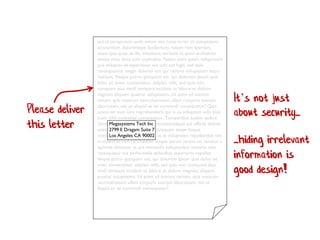
It’s not just
about security...
...hiding irrelevant
information is
good design!
EVOLUTION OF AN API
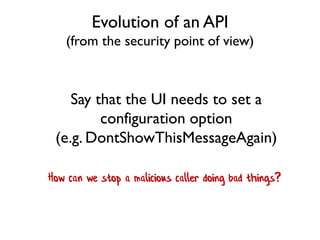
Evolution of an API
(from the security point of view)
Say that the UI needs to set a
configuration option
(e.g. DontShowThisMessageAgain)
How can we stop a malicious caller doing bad things?
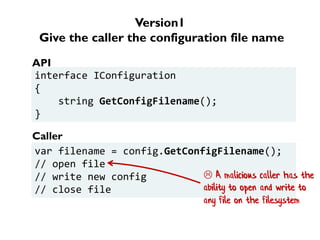
Version1
Give the caller the configuration file name
interface IConfiguration
{
string GetConfigFilename();
}
var filename = config.GetConfigFilename();
// open file
// write new config
// close file
API
Caller
 A malicious caller has the
ability to open and write to
any file on the filesystem
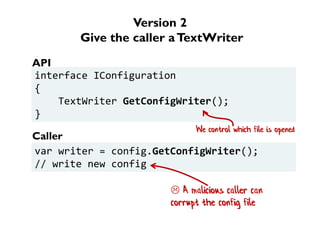
Version 2
Give the caller aTextWriter
interface IConfiguration
{
TextWriter GetConfigWriter();
}
var writer = config.GetConfigWriter();
// write new config
API
Caller
 A malicious caller can
corrupt the config file
We control which file is opened
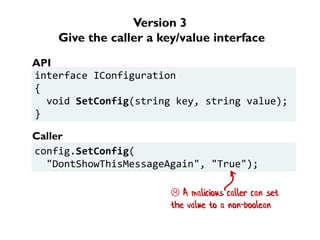
Version 3
Give the caller a key/value interface
interface IConfiguration
{
void SetConfig(string key, string value);
}
config.SetConfig(
"DontShowThisMessageAgain", "True");
API
Caller
 A malicious caller can set
the value to a non-boolean
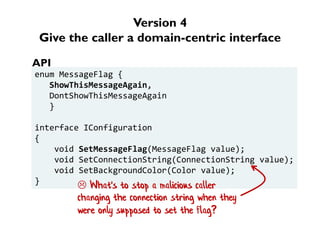
Version 4
Give the caller a domain-centric interface
enum MessageFlag {
ShowThisMessageAgain,
DontShowThisMessageAgain
}
interface IConfiguration
{
void SetMessageFlag(MessageFlag value);
void SetConnectionString(ConnectionString value);
void SetBackgroundColor(Color value);
}
API
 What's to stop a malicious caller
changing the connection string when they
were only supposed to set the flag?
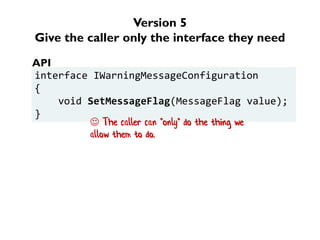
Version 5
Give the caller only the interface they need
interface IWarningMessageConfiguration
{
void SetMessageFlag(MessageFlag value);
}
API
 The caller can *only* do the thing we
allow them to do.
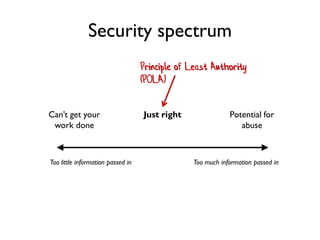
Can’t get your
work done
Too much information passed in
Just right Potential for
abuse
Principle of Least Authority
(POLA)
Too little information passed in
Security spectrum
Evolution of the same API
(from the design point of view)
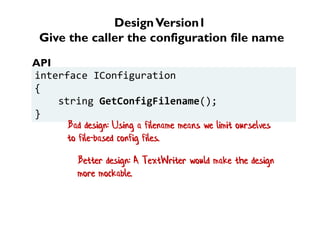
DesignVersion1
Give the caller the configuration file name
interface IConfiguration
{
string GetConfigFilename();
}
API
Bad design: Using a filename means we limit ourselves
to file-based config files.
Better design: A TextWriter would make the design
more mockable.
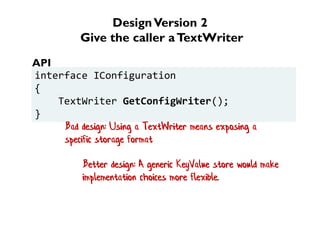
DesignVersion 2
Give the caller aTextWriter
interface IConfiguration
{
TextWriter GetConfigWriter();
}
API
Better design: A generic KeyValue store would make
implementation choices more flexible.
Bad design: Using a TextWriter means exposing a
specific storage format
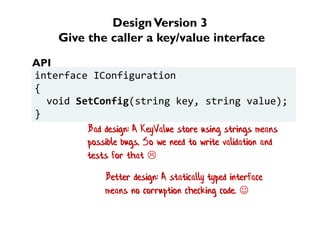
DesignVersion 3
Give the caller a key/value interface
interface IConfiguration
{
void SetConfig(string key, string value);
}
API
Bad design: A KeyValue store using strings means
possible bugs. So we need to write validation and
tests for that 
Better design: A statically typed interface
means no corruption checking code. 
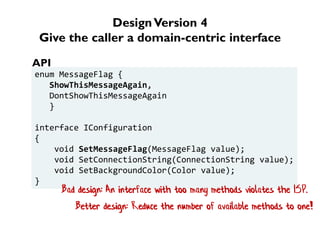
DesignVersion 4
Give the caller a domain-centric interface
enum MessageFlag {
ShowThisMessageAgain,
DontShowThisMessageAgain
}
interface IConfiguration
{
void SetMessageFlag(MessageFlag value);
void SetConnectionString(ConnectionString value);
void SetBackgroundColor(Color value);
}
API
Bad design: An interface with too many methods violates the ISP.
Better design: Reduce the number of available methods to one!
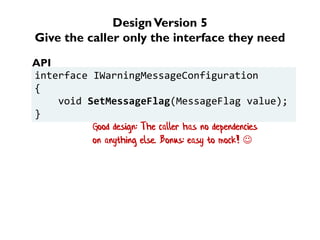
DesignVersion 5
Give the caller only the interface they need
interface IWarningMessageConfiguration
{
void SetMessageFlag(MessageFlag value);
}
API
Good design: The caller has no dependencies
on anything else. Bonus: easy to mock! 
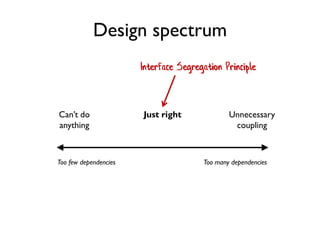
Can’t do
anything
Too many dependencies
Just right Unnecessary
coupling
Interface Segregation Principle
Too few dependencies
Design spectrum
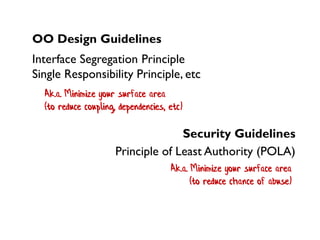
Ak.a. Minimize your surface area
(to reduce chance of abuse)
OO Design Guidelines
Interface Segregation Principle
Single Responsibility Principle, etc
Security Guidelines
Principle of Least Authority (POLA)
Ak.a. Minimize your surface area
(to reduce coupling, dependencies, etc)
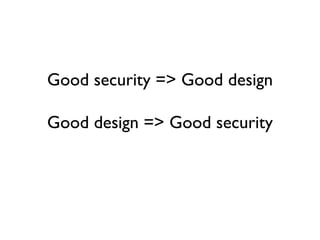
Good security => Good design
Good design => Good security
INTRODUCING
“CAPABILITIES”
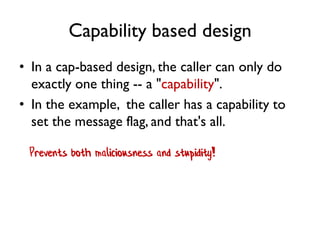
Capability based design
• In a cap-based design, the caller can only do
exactly one thing -- a "capability".
• In the example, the caller has a capability to
set the message flag, and that's all.
Prevents both maliciousness and stupidity!
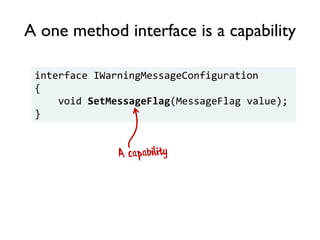
A one method interface is a capability
interface IWarningMessageConfiguration
{
void SetMessageFlag(MessageFlag value);
}
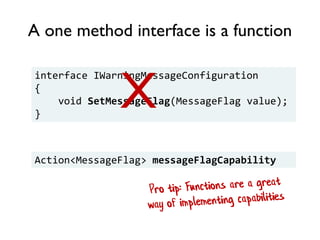
A one method interface is a function
interface IWarningMessageConfiguration
{
void SetMessageFlag(MessageFlag value);
}
Action<MessageFlag> messageFlagCapability
X
Capability-based security
in the real world
What does “access-control” mean?
• Preventing any access at all.
• Limiting access to some things only.
• Revoking access when you are no longer
allowed.
• Granting and delegating access to some
subset of things.
It’s not always
about saying no!
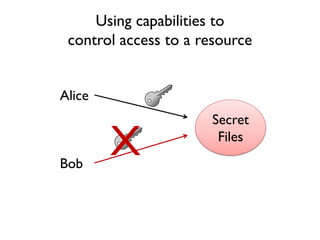
Using capabilities to
control access to a resource
Secret
Files
Alice
Bob
X
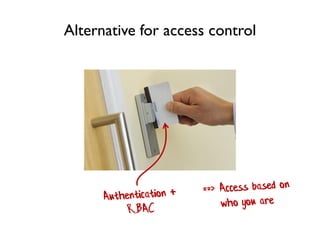
Alternative for access control
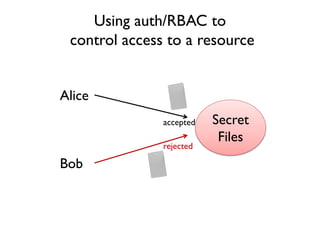
Using auth/RBAC to
control access to a resource
Secret
Files
Alice
Bob
rejected
accepted
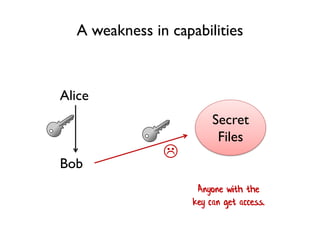
A weakness in capabilities
Secret
Files
Alice
Bob

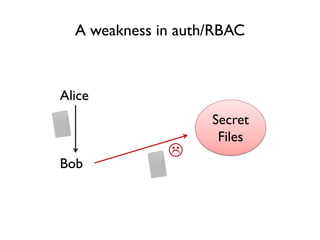
Anyone with the
key can get access.
A weakness in auth/RBAC
Secret
Files
Alice
Bob

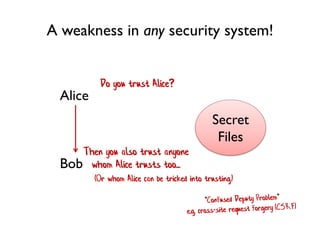
A weakness in any security system!
Secret
Files
Alice
Bob
Do you trust Alice?
Then you also trust anyone
whom Alice trusts too...
(Or whom Alice can be tricked into trusting)
“Don’t prohibit what
you can’t prevent”
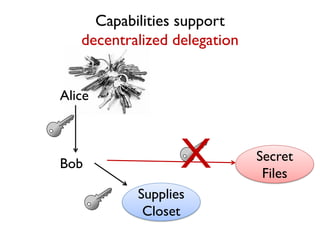
Supplies
Closet
Alice
Bob
Secret
Files
X
Capabilities support
decentralized delegation
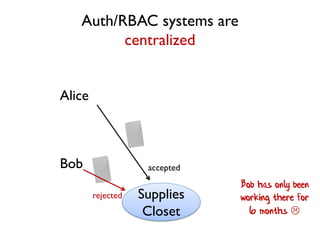
Supplies
Closet
Auth/RBAC systems are
centralized
Alice
Bob accepted
rejected
Bob has only been
working there for
6 months 
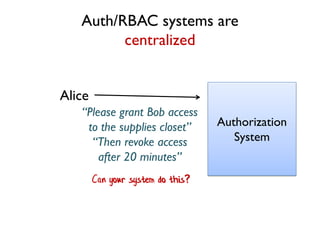
Auth/RBAC systems are
centralized
Alice
“Please grant Bob access
to the supplies closet”
“Then revoke access
after 20 minutes”
Authorization
System
Can your system do this?
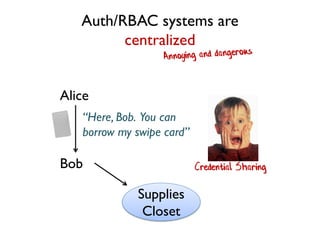
Supplies
Closet
Auth/RBAC systems are
centralized
Alice
Bob
“Here, Bob. You can
borrow my swipe card”
Credential Sharing
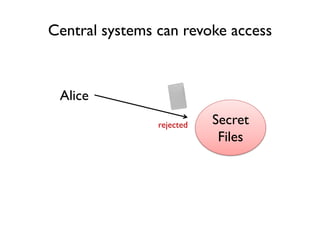
Central systems can revoke access
Secret
Files
Alice
rejected
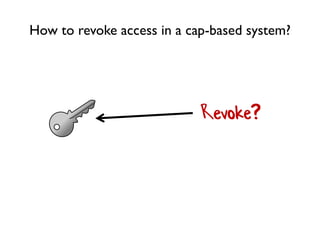
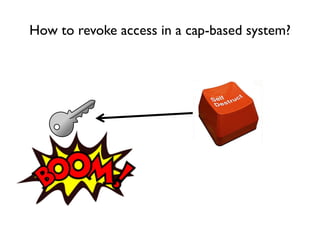
How to revoke access in a cap-based system?
Revoke?
How to revoke access in a cap-based system?
Demo: Capabilities as functions
DESIGNING AN
API USING CAPABILITIES
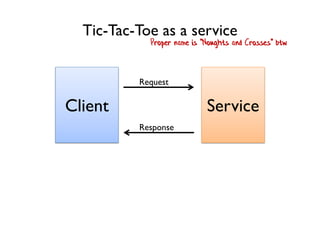
Client Service
Request
Response
Tic-Tac-Toe as a service
Proper name is "Noughts and Crosses" btw
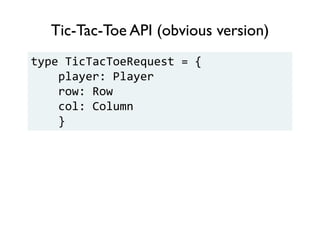
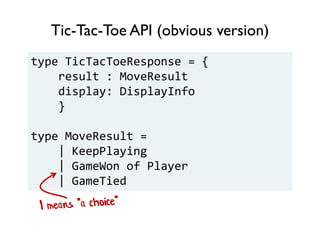
Tic-Tac-Toe API (obvious version)
type TicTacToeRequest = {
player: Player
row: Row
col: Column
}
Tic-Tac-Toe API (obvious version)
type TicTacToeResponse = {
result : MoveResult
display: DisplayInfo
}
type MoveResult =
| KeepPlaying
| GameWon of Player
| GameTied
Demo:Tic-Tac-Toe
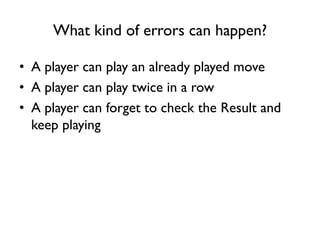
What kind of errors can happen?
• A player can play an already played move
• A player can play twice in a row
• A player can forget to check the Result and
keep playing
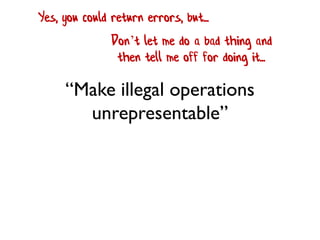
“Make illegal operations
unrepresentable”
Don’t let me do a bad thing and
then tell me off for doing it...
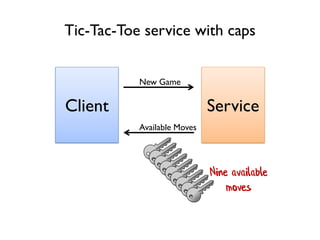
Yes, you could return errors, but...
Client Service
New Game
Available Moves
Tic-Tac-Toe service with caps
Nine available
moves
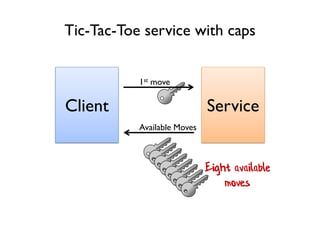
Client Service
1st move
Available Moves
Tic-Tac-Toe service with caps
Eight available
moves
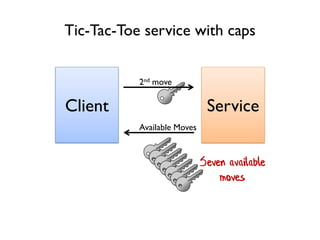
Client Service
Available Moves
Tic-Tac-Toe service with caps
2nd move
Seven available
moves
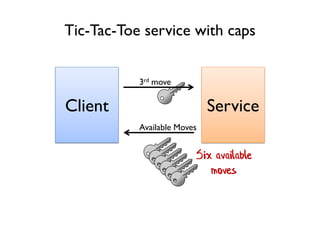
Client Service
Available Moves
Tic-Tac-Toe service with caps
3rd move
Six available
moves
Client Service
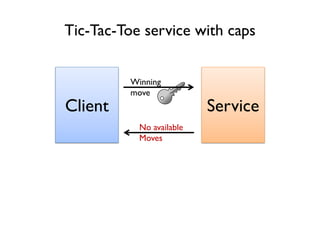
No available
Moves
Tic-Tac-Toe service with caps
Winning
move
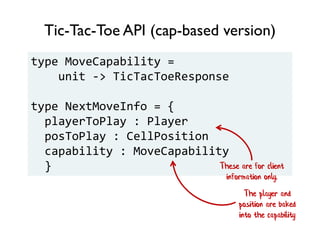
Tic-Tac-Toe API (cap-based version)
type MoveCapability =
unit -> TicTacToeResponse
type NextMoveInfo = {
playerToPlay : Player
posToPlay : CellPosition
capability : MoveCapability
} These are for client
information only.
The player and
position are baked
into the capability
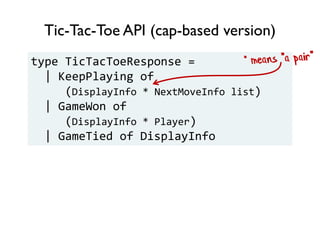
Tic-Tac-Toe API (cap-based version)
type TicTacToeResponse =
| KeepPlaying of
(DisplayInfo * NextMoveInfo list)
| GameWon of
(DisplayInfo * Player)
| GameTied of DisplayInfo
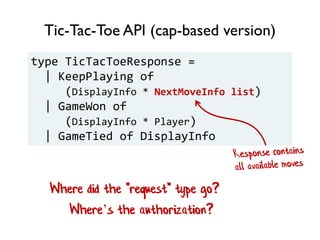
Tic-Tac-Toe API (cap-based version)
type TicTacToeResponse =
| KeepPlaying of
(DisplayInfo * NextMoveInfo list)
| GameWon of
(DisplayInfo * Player)
| GameTied of DisplayInfo
Where did the "request" type go?
Where’s the authorization?
Demo: Cap-based Api
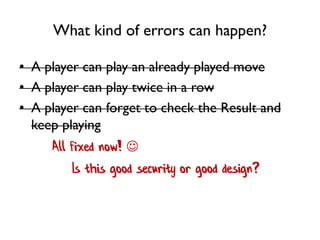
What kind of errors can happen?
• A player can play an already played move
• A player can play twice in a row
• A player can forget to check the Result and
keep playing
Is this good security or good design?
All fixed now! 
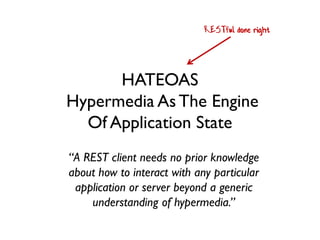
HATEOAS
Hypermedia As The Engine
Of Application State
“A REST client needs no prior knowledge
about how to interact with any particular
application or server beyond a generic
understanding of hypermedia.”
RESTful done right
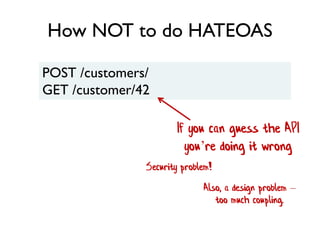
How NOT to do HATEOAS
POST /customers/
GET /customer/42
If you can guess the API
you’re doing it wrong
Security problem!
Also, a design problem –
too much coupling.
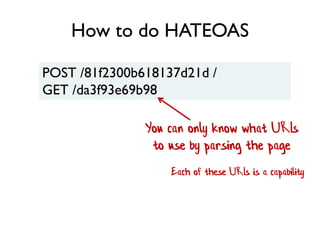
How to do HATEOAS
POST /81f2300b618137d21d /
GET /da3f93e69b98
You can only know what URIs
to use by parsing the page
Each of these URIs is a capability
Demo: HATEOAS
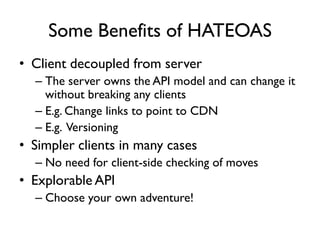
Some Benefits of HATEOAS
• Client decoupled from server
– The server owns the API model and can change it
without breaking any clients
– E.g. Change links to point to CDN
– E.g. Versioning
• Simpler clients in many cases
– No need for client-side checking of moves
• Explorable API
– Choose your own adventure!
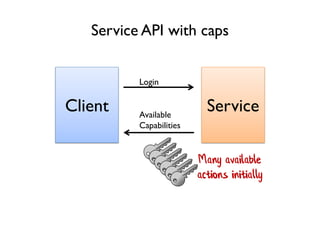
Client Service
Login
Available
Capabilities
Service API with caps
Many available
actions initially
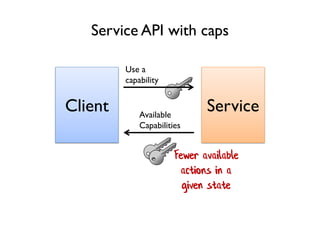
Client Service
Use a
capability
Available
Capabilities
Service API with caps
Fewer available
actions in a
given state
CAPABILITY DRIVEN DESIGN
Using these design techniques throughout your domain
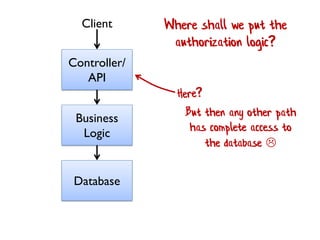
Controller/
API
Business
Logic
Database
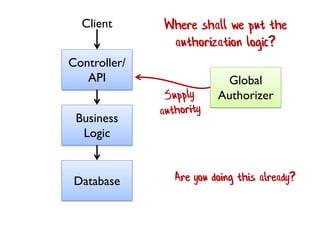
Client Where shall we put the
authorization logic?
But then any other path
has complete access to
the database 
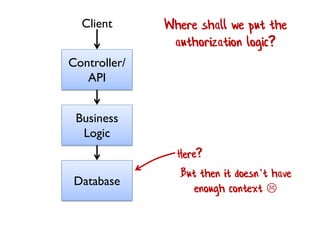
Controller/
API
Business
Logic
Database
Client Where shall we put the
authorization logic?
But then it doesn’t have
enough context 
Controller/
API
Business
Logic
Database
Client Where shall we put the
authorization logic?
Global
Authorizer
Are you doing this already?
public class CustomerController : ApiController
{
readonly ICustomerDb _db;
public CustomerController(ICustomerDb db)
{
_db = db;
}
[Route("customers/{customerId}")]
[HttpGet]
[GetCustomerProfileAuth]
public IHttpActionResult Get(int customerId)
{
var custId = new CustomerId(customerId);
var cust = _db.GetProfile(custId);
var dto = DtoConverter.CustomerToDto(cust);
return Ok(dto);
}
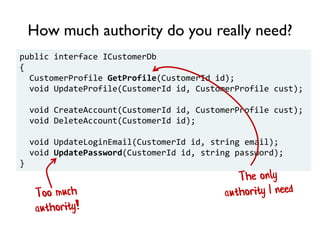
public interface ICustomerDb
{
CustomerProfile GetProfile(CustomerId id);
void UpdateProfile(CustomerId id, CustomerProfile cust);
void CreateAccount(CustomerId id, CustomerProfile cust);
void DeleteAccount(CustomerId id);
void UpdateLoginEmail(CustomerId id, string email);
void UpdatePassword(CustomerId id, string password);
}
How much authority do you really need?
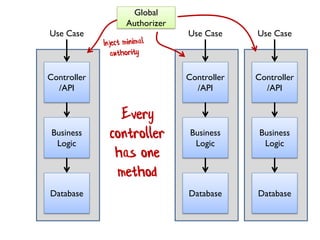
Controller
/API
Business
Logic
Database
Use Case
Controller
/API
Business
Logic
Database
Use Case
Controller
/API
Business
Logic
Database
Use Case
Global
Authorizer
Every
controller
has one
method
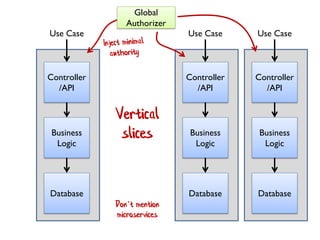
Controller
/API
Business
Logic
Database
Use Case
Controller
/API
Business
Logic
Database
Use Case
Controller
/API
Business
Logic
Database
Use Case
Global
Authorizer
Vertical
slices
Don’t mention
microservices
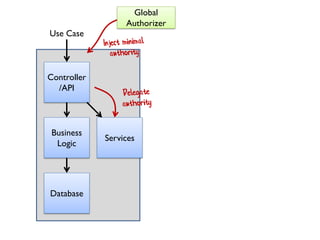
Controller
/API
Business
Logic
Database
Use Case
Global
Authorizer
Services
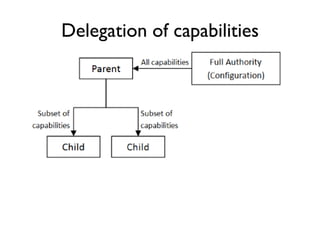
Delegation of capabilities
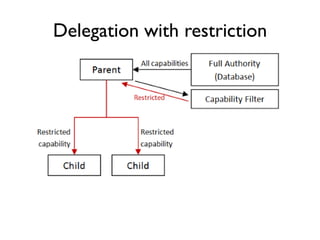
Delegation with restriction
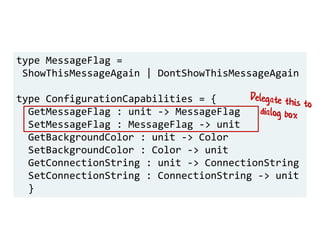
type MessageFlag =
ShowThisMessageAgain | DontShowThisMessageAgain
type ConfigurationCapabilities = {
GetMessageFlag : unit -> MessageFlag
SetMessageFlag : MessageFlag -> unit
GetBackgroundColor : unit -> Color
SetBackgroundColor : Color -> unit
GetConnectionString : unit -> ConnectionString
SetConnectionString : ConnectionString -> unit
}
◘
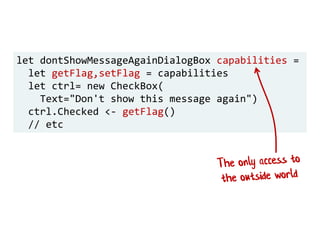
let dontShowMessageAgainDialogBox capabilities =
let getFlag,setFlag = capabilities
let ctrl= new CheckBox(
Text="Don't show this message again")
ctrl.Checked <- getFlag()
// etc
Demo:
Vertical slices and delegation
Controller
/API
Business
Logic
Database
Global
Authorizer
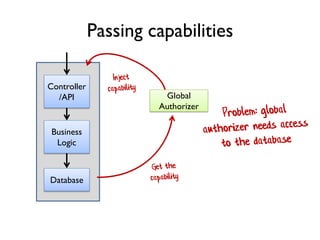
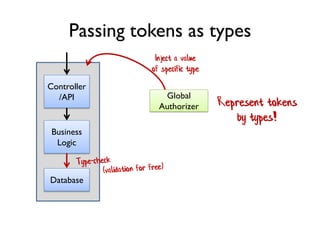
Passing capabilities
Controller
/API
Business
Logic
Database
Global
Authorizer
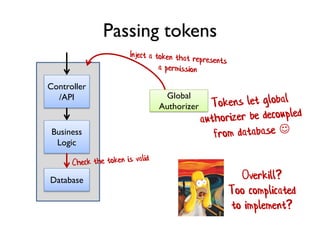
Passing tokens
Overkill?
Too complicated
to implement?
Controller
/API
Business
Logic
Database
Inject a value
of specific type
Global
Authorizer
Passing tokens as types
Represent tokens
by types!
Demo:
Using types for access tokens
What have we covered?
• Don’t use complicated security patterns
– This will ensure that they are never used, or used
wrong.
– Don’t rely on other people doing the right thing.
– Don’t rely on other people reading the
documentation!
• Do use techniques where you get security for
free.
– You can be lazy!
– You don’t have to remember to do anything.
What have we covered?
• Don’t develop first, add security later
– Right after you implement the “quality” module
• Do use security-driven design
– Bonus: get a modular architecture!
What have we covered?
• Don’t only do security at the outermost layer
• Do use POLA everywhere, which ensures that
you have minimal dependencies.
Common questions
• How do you pass these capabilities around?
– Dependency injection or equivalent
• Are you saying that all external IO should be
passed around as capabilities?
– Yes!You should never access any ambient
authority.
– You should be doing this anyway for mocking.
Common questions
• Won’t there be too many parameters?
– Less than you think!
– Encourages vertical slices (per use-case, scenario)
– “Functional core, imperative shell”
• Can’t this be bypassed by reflection or other
backdoors?
– Yes. This is really all about design not about total
security.
Resources for capability-based thinking
• LMGTFY “Capability based security”
• “Lazy developers guide to secure computing”
talk by Marc Stiegler
• erights.org
• Google's Caja built over JavaScript
• Emily, a capability based language (via Ocaml)
Thanks!
@ScottWlaschin
fsharpforfunandprofit.com/cap
Contact me
Slides and video here
Let us know if you
need help with F#

Designing with Capabilities

  • 1.
    Designing with capabilities forfun and profit @ScottWlaschin fsharpforfunandprofit.com/cap
  • 3.
    Good security =>Complicated I won’t like doing this
  • 4.
    Good security =>Complicated X
  • 5.
    Security for free! ...whichis good, because I’m lazy Good security == Good design I like doing this
  • 6.
    The topic ofthis talk Not about OAuth, JWT etc Good security == Good design
  • 7.
  • 8.
    Sed ut perspiciatisunde omnis iste natus error sit voluptatem accusantium doloremque laudantium, totam rem aperiam, eaque ipsa quae ab illo inventore veritatis et quasi architecto beatae vitae dicta sunt explicabo. Nemo enim ipsam voluptatem quia voluptas sit aspernatur aut odit aut fugit, sed quia consequuntur magni dolores eos qui ratione voluptatem sequi nesciunt. Neque porro quisquam est, qui dolorem ipsum quia dolor sit amet, consectetur, adipisci velit, sed quia non numquam eius modi tempora incidunt ut labore et dolore magnam aliquam quaerat voluptatem. Ut enim ad minima veniam, quis nostrum exercitationem ullam corporis suscipit laboriosam, nisi ut aliquid ex ea commodi consequatur? Quis autem vel eum iure reprehenderit qui in ea voluptate velit esse quam nihil molestiae consequatur, Temporibus autem quibus Dacei Megasystems Tech Inc necessitatibust aut officiis debitis auteo 2799 E Dragam Suite 7 quisquam saepe Itaque enieti Los Angeles CA 90002 ut et voluptates repudiandae sint et molestiae non recusandae. Itaque earum rerum hic tenetur a sapiente delectus, ut aut reiciendis voluptatibus maiores alias consequatur aut perferendis doloribus asperiores repellat. Neque porro quisquam est, qui dolorem ipsum quia dolor sit amet, consectetur, adipisci velit, sed quia non numquam eius modi tempora incidunt ut labore et dolore magnam aliquam quaerat voluptatem. Ut enim ad minima veniam, quis nostrum exercitationem ullam corporis suscipit laboriosam, nisi ut aliquid ex ea commodi consequatur? Please deliver this letter A counterexample
  • 9.
    Sed ut perspiciatisunde omnis iste natus error sit voluptatem accusantium doloremque laudantium, totam rem aperiam, eaque ipsa quae ab illo inventore veritatis et quasi architecto beatae vitae dicta sunt explicabo. Nemo enim ipsam voluptatem quia voluptas sit aspernatur aut odit aut fugit, sed quia consequuntur magni dolores eos qui ratione voluptatem sequi nesciunt. Neque porro quisquam est, qui dolorem ipsum quia dolor sit amet, consectetur, adipisci velit, sed quia non numquam eius modi tempora incidunt ut labore et dolore magnam aliquam quaerat voluptatem. Ut enim ad minima veniam, quis nostrum exercitationem ullam corporis suscipit laboriosam, nisi ut aliquid ex ea commodi consequatur? Quis autem vel eum iure reprehenderit qui in ea voluptate velit esse quam nihil molestiae consequatur, Temporibus autem quibus Dacei Megasystems Tech Inc necessitatibust aut officiis debitis auteo 2799 E Dragam Suite 7 quisquam saepe Itaque enieti Los Angeles CA 90002 ut et voluptates repudiandae sint et molestiae non recusandae. Itaque earum rerum hic tenetur a sapiente delectus, ut aut reiciendis voluptatibus maiores alias consequatur aut perferendis doloribus asperiores repellat. Neque porro quisquam est, qui dolorem ipsum quia dolor sit amet, consectetur, adipisci velit, sed quia non numquam eius modi tempora incidunt ut labore et dolore magnam aliquam quaerat voluptatem. Ut enim ad minima veniam, quis nostrum exercitationem ullam corporis suscipit laboriosam, nisi ut aliquid ex ea commodi consequatur? Please deliver this letter It’s not just about security... ...hiding irrelevant information is good design!
  • 10.
  • 11.
    Evolution of anAPI (from the security point of view) Say that the UI needs to set a configuration option (e.g. DontShowThisMessageAgain) How can we stop a malicious caller doing bad things?
  • 12.
    Version1 Give the callerthe configuration file name interface IConfiguration { string GetConfigFilename(); } var filename = config.GetConfigFilename(); // open file // write new config // close file API Caller  A malicious caller has the ability to open and write to any file on the filesystem
  • 13.
    Version 2 Give thecaller aTextWriter interface IConfiguration { TextWriter GetConfigWriter(); } var writer = config.GetConfigWriter(); // write new config API Caller  A malicious caller can corrupt the config file We control which file is opened
  • 14.
    Version 3 Give thecaller a key/value interface interface IConfiguration { void SetConfig(string key, string value); } config.SetConfig( "DontShowThisMessageAgain", "True"); API Caller  A malicious caller can set the value to a non-boolean
  • 15.
    Version 4 Give thecaller a domain-centric interface enum MessageFlag { ShowThisMessageAgain, DontShowThisMessageAgain } interface IConfiguration { void SetMessageFlag(MessageFlag value); void SetConnectionString(ConnectionString value); void SetBackgroundColor(Color value); } API  What's to stop a malicious caller changing the connection string when they were only supposed to set the flag?
  • 16.
    Version 5 Give thecaller only the interface they need interface IWarningMessageConfiguration { void SetMessageFlag(MessageFlag value); } API  The caller can *only* do the thing we allow them to do.
  • 17.
    Can’t get your workdone Too much information passed in Just right Potential for abuse Principle of Least Authority (POLA) Too little information passed in Security spectrum
  • 18.
    Evolution of thesame API (from the design point of view)
  • 19.
    DesignVersion1 Give the callerthe configuration file name interface IConfiguration { string GetConfigFilename(); } API Bad design: Using a filename means we limit ourselves to file-based config files. Better design: A TextWriter would make the design more mockable.
  • 20.
    DesignVersion 2 Give thecaller aTextWriter interface IConfiguration { TextWriter GetConfigWriter(); } API Better design: A generic KeyValue store would make implementation choices more flexible. Bad design: Using a TextWriter means exposing a specific storage format
  • 21.
    DesignVersion 3 Give thecaller a key/value interface interface IConfiguration { void SetConfig(string key, string value); } API Bad design: A KeyValue store using strings means possible bugs. So we need to write validation and tests for that  Better design: A statically typed interface means no corruption checking code. 
  • 22.
    DesignVersion 4 Give thecaller a domain-centric interface enum MessageFlag { ShowThisMessageAgain, DontShowThisMessageAgain } interface IConfiguration { void SetMessageFlag(MessageFlag value); void SetConnectionString(ConnectionString value); void SetBackgroundColor(Color value); } API Bad design: An interface with too many methods violates the ISP. Better design: Reduce the number of available methods to one!
  • 23.
    DesignVersion 5 Give thecaller only the interface they need interface IWarningMessageConfiguration { void SetMessageFlag(MessageFlag value); } API Good design: The caller has no dependencies on anything else. Bonus: easy to mock! 
  • 24.
    Can’t do anything Too manydependencies Just right Unnecessary coupling Interface Segregation Principle Too few dependencies Design spectrum
  • 25.
    Ak.a. Minimize yoursurface area (to reduce chance of abuse) OO Design Guidelines Interface Segregation Principle Single Responsibility Principle, etc Security Guidelines Principle of Least Authority (POLA) Ak.a. Minimize your surface area (to reduce coupling, dependencies, etc)
  • 26.
    Good security =>Good design Good design => Good security
  • 27.
  • 28.
    Capability based design •In a cap-based design, the caller can only do exactly one thing -- a "capability". • In the example, the caller has a capability to set the message flag, and that's all. Prevents both maliciousness and stupidity!
  • 29.
    A one methodinterface is a capability interface IWarningMessageConfiguration { void SetMessageFlag(MessageFlag value); }
  • 30.
    A one methodinterface is a function interface IWarningMessageConfiguration { void SetMessageFlag(MessageFlag value); } Action<MessageFlag> messageFlagCapability X
  • 31.
  • 34.
    What does “access-control”mean? • Preventing any access at all. • Limiting access to some things only. • Revoking access when you are no longer allowed. • Granting and delegating access to some subset of things. It’s not always about saying no!
  • 35.
    Using capabilities to controlaccess to a resource Secret Files Alice Bob X
  • 36.
  • 37.
    Using auth/RBAC to controlaccess to a resource Secret Files Alice Bob rejected accepted
  • 38.
    A weakness incapabilities Secret Files Alice Bob  Anyone with the key can get access.
  • 39.
    A weakness inauth/RBAC Secret Files Alice Bob 
  • 40.
    A weakness inany security system! Secret Files Alice Bob Do you trust Alice? Then you also trust anyone whom Alice trusts too... (Or whom Alice can be tricked into trusting)
  • 41.
    “Don’t prohibit what youcan’t prevent”
  • 42.
  • 43.
    Supplies Closet Auth/RBAC systems are centralized Alice Bobaccepted rejected Bob has only been working there for 6 months 
  • 44.
    Auth/RBAC systems are centralized Alice “Pleasegrant Bob access to the supplies closet” “Then revoke access after 20 minutes” Authorization System Can your system do this?
  • 45.
    Supplies Closet Auth/RBAC systems are centralized Alice Bob “Here,Bob. You can borrow my swipe card” Credential Sharing
  • 46.
    Central systems canrevoke access Secret Files Alice rejected
  • 47.
    How to revokeaccess in a cap-based system? Revoke?
  • 48.
    How to revokeaccess in a cap-based system?
  • 49.
  • 50.
  • 51.
    Client Service Request Response Tic-Tac-Toe asa service Proper name is "Noughts and Crosses" btw
  • 52.
    Tic-Tac-Toe API (obviousversion) type TicTacToeRequest = { player: Player row: Row col: Column }
  • 53.
    Tic-Tac-Toe API (obviousversion) type TicTacToeResponse = { result : MoveResult display: DisplayInfo } type MoveResult = | KeepPlaying | GameWon of Player | GameTied
  • 54.
  • 55.
    What kind oferrors can happen? • A player can play an already played move • A player can play twice in a row • A player can forget to check the Result and keep playing
  • 56.
    “Make illegal operations unrepresentable” Don’tlet me do a bad thing and then tell me off for doing it... Yes, you could return errors, but...
  • 57.
    Client Service New Game AvailableMoves Tic-Tac-Toe service with caps Nine available moves
  • 58.
    Client Service 1st move AvailableMoves Tic-Tac-Toe service with caps Eight available moves
  • 59.
    Client Service Available Moves Tic-Tac-Toeservice with caps 2nd move Seven available moves
  • 60.
    Client Service Available Moves Tic-Tac-Toeservice with caps 3rd move Six available moves
  • 61.
    Client Service No available Moves Tic-Tac-Toeservice with caps Winning move
  • 62.
    Tic-Tac-Toe API (cap-basedversion) type MoveCapability = unit -> TicTacToeResponse type NextMoveInfo = { playerToPlay : Player posToPlay : CellPosition capability : MoveCapability } These are for client information only. The player and position are baked into the capability
  • 63.
    Tic-Tac-Toe API (cap-basedversion) type TicTacToeResponse = | KeepPlaying of (DisplayInfo * NextMoveInfo list) | GameWon of (DisplayInfo * Player) | GameTied of DisplayInfo
  • 64.
    Tic-Tac-Toe API (cap-basedversion) type TicTacToeResponse = | KeepPlaying of (DisplayInfo * NextMoveInfo list) | GameWon of (DisplayInfo * Player) | GameTied of DisplayInfo Where did the "request" type go? Where’s the authorization?
  • 65.
  • 66.
    What kind oferrors can happen? • A player can play an already played move • A player can play twice in a row • A player can forget to check the Result and keep playing Is this good security or good design? All fixed now! 
  • 67.
    HATEOAS Hypermedia As TheEngine Of Application State “A REST client needs no prior knowledge about how to interact with any particular application or server beyond a generic understanding of hypermedia.” RESTful done right
  • 68.
    How NOT todo HATEOAS POST /customers/ GET /customer/42 If you can guess the API you’re doing it wrong Security problem! Also, a design problem – too much coupling.
  • 69.
    How to doHATEOAS POST /81f2300b618137d21d / GET /da3f93e69b98 You can only know what URIs to use by parsing the page Each of these URIs is a capability
  • 70.
  • 71.
    Some Benefits ofHATEOAS • Client decoupled from server – The server owns the API model and can change it without breaking any clients – E.g. Change links to point to CDN – E.g. Versioning • Simpler clients in many cases – No need for client-side checking of moves • Explorable API – Choose your own adventure!
  • 72.
    Client Service Login Available Capabilities Service APIwith caps Many available actions initially
  • 73.
    Client Service Use a capability Available Capabilities ServiceAPI with caps Fewer available actions in a given state
  • 74.
    CAPABILITY DRIVEN DESIGN Usingthese design techniques throughout your domain
  • 75.
    Controller/ API Business Logic Database Client Where shallwe put the authorization logic? But then any other path has complete access to the database 
  • 76.
    Controller/ API Business Logic Database Client Where shallwe put the authorization logic? But then it doesn’t have enough context 
  • 77.
    Controller/ API Business Logic Database Client Where shallwe put the authorization logic? Global Authorizer Are you doing this already?
  • 78.
    public class CustomerController: ApiController { readonly ICustomerDb _db; public CustomerController(ICustomerDb db) { _db = db; } [Route("customers/{customerId}")] [HttpGet] [GetCustomerProfileAuth] public IHttpActionResult Get(int customerId) { var custId = new CustomerId(customerId); var cust = _db.GetProfile(custId); var dto = DtoConverter.CustomerToDto(cust); return Ok(dto); }
  • 79.
    public interface ICustomerDb { CustomerProfileGetProfile(CustomerId id); void UpdateProfile(CustomerId id, CustomerProfile cust); void CreateAccount(CustomerId id, CustomerProfile cust); void DeleteAccount(CustomerId id); void UpdateLoginEmail(CustomerId id, string email); void UpdatePassword(CustomerId id, string password); } How much authority do you really need?
  • 80.
  • 81.
  • 82.
  • 83.
  • 84.
  • 85.
    type MessageFlag = ShowThisMessageAgain| DontShowThisMessageAgain type ConfigurationCapabilities = { GetMessageFlag : unit -> MessageFlag SetMessageFlag : MessageFlag -> unit GetBackgroundColor : unit -> Color SetBackgroundColor : Color -> unit GetConnectionString : unit -> ConnectionString SetConnectionString : ConnectionString -> unit } ◘
  • 86.
    let dontShowMessageAgainDialogBox capabilities= let getFlag,setFlag = capabilities let ctrl= new CheckBox( Text="Don't show this message again") ctrl.Checked <- getFlag() // etc
  • 87.
  • 88.
  • 89.
  • 90.
    Controller /API Business Logic Database Inject a value ofspecific type Global Authorizer Passing tokens as types Represent tokens by types!
  • 91.
    Demo: Using types foraccess tokens
  • 92.
    What have wecovered? • Don’t use complicated security patterns – This will ensure that they are never used, or used wrong. – Don’t rely on other people doing the right thing. – Don’t rely on other people reading the documentation! • Do use techniques where you get security for free. – You can be lazy! – You don’t have to remember to do anything.
  • 93.
    What have wecovered? • Don’t develop first, add security later – Right after you implement the “quality” module • Do use security-driven design – Bonus: get a modular architecture!
  • 94.
    What have wecovered? • Don’t only do security at the outermost layer • Do use POLA everywhere, which ensures that you have minimal dependencies.
  • 95.
    Common questions • Howdo you pass these capabilities around? – Dependency injection or equivalent • Are you saying that all external IO should be passed around as capabilities? – Yes!You should never access any ambient authority. – You should be doing this anyway for mocking.
  • 96.
    Common questions • Won’tthere be too many parameters? – Less than you think! – Encourages vertical slices (per use-case, scenario) – “Functional core, imperative shell” • Can’t this be bypassed by reflection or other backdoors? – Yes. This is really all about design not about total security.
  • 97.
    Resources for capability-basedthinking • LMGTFY “Capability based security” • “Lazy developers guide to secure computing” talk by Marc Stiegler • erights.org • Google's Caja built over JavaScript • Emily, a capability based language (via Ocaml)
  • 98.