ENGLISH LANGUAGE IN DOMINICAN CULTURE

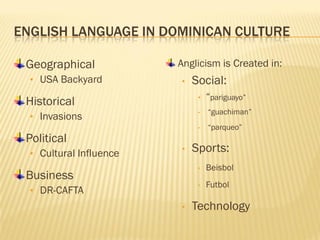
 Geographical            Anglicism is Created in:
  • USA Backyard         •   Social:
 Historical                   •   “pariguayo”
                              •   “guachiman”
  • Invasions
                              •   “parqueo”
 Political
  • Cultural Influence
                         •   Sports:
                              •   Beisbol
 Business
                              •   Futbol
  • DR-CAFTA
                         •   Technology
THE NEED TO LEARN ENGLISH: JOBS
  Administrative
     Secretaries,     Receptionists, Hostesses, Translators
  Tourism     Area
     Front   desk, activities, waiters, croupiers, bartenders
  International       Trade
     Managers,    bookkeepers, human resources
  Internet    and computer related works
     Web    designers, net engineers, developers
  Telecommunication
     Call   Centers
THE NEED TO LEARN ENGLISH: CONTEXT

 Changes In Economy
 Demands from companies

 International Ratings

 National Competitiveness Plan

 Education challenge

 Official Response

 Private Institutions
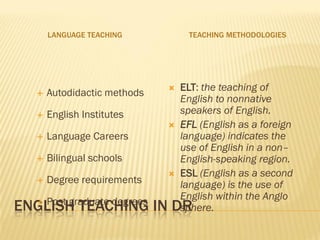
LANGUAGE TEACHING          TEACHING METHODOLOGIES


                            ELT: the teaching of
                               
       Autodidactic methods
                            English to nonnative
   English Institutes
                            speakers of English.
                           EFL (English as a foreign
   Language Careers        language) indicates the
                            use of English in a non–
   Bilingual schools       English-speaking region.
                           ESL (English as a second
   Degree requirements
                            language) is the use of
   Post graduate degrees
                            English within the Anglo
ENGLISH TEACHING IN DR      sphere.
How English is Taught for Specific Business Needs

CASE STUDY: CALL CENTERS
CALL CENTERS’ ORIGIN

 How Service has evolved
 Customer Support

 Offshore companies

 Free Zones

 Technology frame

 Qualified manwork

 Product and language training
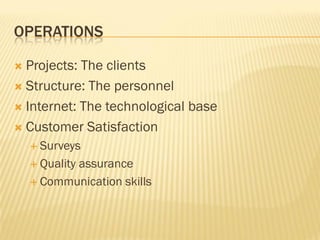
OPERATIONS

 Projects: The clients
 Structure: The personnel

 Internet: The technological base

 Customer Satisfaction
     Surveys

     Quality
           assurance
     Communication skills
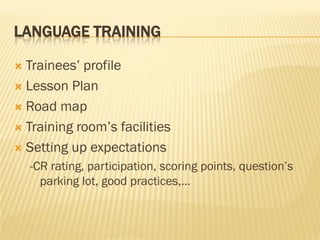
LANGUAGE TRAINING

 Trainees’ profile
 Lesson Plan

 Road map

 Training room’s facilities

 Setting up expectations
    -CR rating, participation, scoring points, question’s
      parking lot, good practices,…
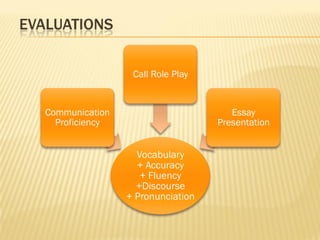
EVALUATIONS

                    Call Role Play


   Communication                        Essay
     Proficiency                     Presentation


                     Vocabulary
                     + Accuracy
                      + Fluency
                     +Discourse
                   + Pronunciation
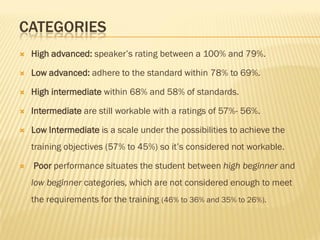
CATEGORIES
   High advanced: speaker’s rating between a 100% and 79%.

   Low advanced: adhere to the standard within 78% to 69%.

   High intermediate within 68% and 58% of standards.

   Intermediate are still workable with a ratings of 57%- 56%.

   Low Intermediate is a scale under the possibilities to achieve the
    training objectives (57% to 45%) so it’s considered not workable.

   Poor performance situates the student between high beginner and
    low beginner categories, which are not considered enough to meet
    the requirements for the training (46% to 36% and 35% to 26%).
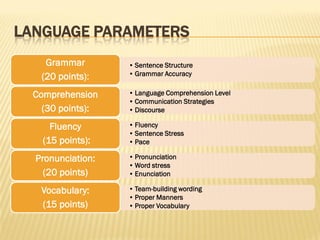
LANGUAGE PARAMETERS
    Grammar        • Sentence Structure
   (20 points):    • Grammar Accuracy


  Comprehension    • Language Comprehension Level
                   • Communication Strategies
    (30 points):   • Discourse

      Fluency      • Fluency
                   • Sentence Stress
    (15 points):   • Pace

  Pronunciation:   • Pronunciation
                   • Word stress
    (20 points)    • Enunciation

   Vocabulary:     • Team-building wording
                   • Proper Manners
   (15 points)     • Proper Vocabulary
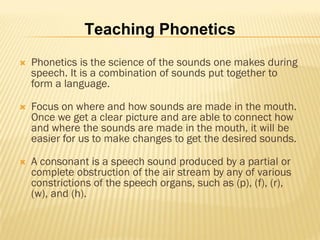
Teaching Phonetics
   Phonetics is the science of the sounds one makes during
    speech. It is a combination of sounds put together to
    form a language.

   Focus on where and how sounds are made in the mouth.
    Once we get a clear picture and are able to connect how
    and where the sounds are made in the mouth, it will be
    easier for us to make changes to get the desired sounds.

   A consonant is a speech sound produced by a partial or
    complete obstruction of the air stream by any of various
    constrictions of the speech organs, such as (p), (f), (r),
    (w), and (h).
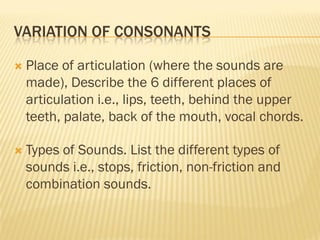
VARIATION OF CONSONANTS

   Place of articulation (where the sounds are
    made), Describe the 6 different places of
    articulation i.e., lips, teeth, behind the upper
    teeth, palate, back of the mouth, vocal chords.

   Types of Sounds. List the different types of
    sounds i.e., stops, friction, non-friction and
    combination sounds.
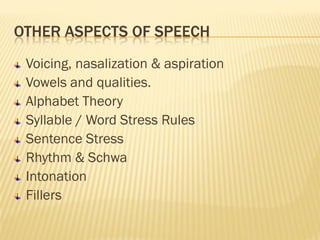
OTHER ASPECTS OF SPEECH
 Voicing, nasalization & aspiration
 Vowels and qualities.
 Alphabet Theory
 Syllable / Word Stress Rules
 Sentence Stress
 Rhythm & Schwa
 Intonation
 Fillers
VOICING, NASALIZATION, ASPIRATION
   Voicing - whether the vocal chords are vibrating or not.
    If you feel your throat vibrating when speaking, that is your vocal
    chords making sound. Some sounds are voiced and others are
    voiceless.

   Nasalization - whether air travels through the mouth and/or the
    nasal passage.
     Nasalization in English is found in sounds like [m] and [n], where
    the flow of air from the mouth is completely blocked off, but
    continues to flow from the nasal passage.

   Aspiration (breath) - Whether stops are released lightly or with a
    noticeable puff of air.
    Some sounds are not pronounced as forcefully as other sounds.
    A sound is aspirated if it has a slight [h] following the sound.
VOWELS AND QUALITIES
    A vowel sound is made by keeping the vocal tract open. Consider:

   Tongue height: Vowels are classified in terms of how much space there
    is between the tongue and the roof of the mouth. There are three
    primary height distinctions among vowels: high, low, and mid. High
    vowels have a relatively narrow space between the tongue and the roof
    of the mouth, [i], [i:], [u] and [u:].

   Tongue Backness: Vowels are classified in terms of how far the raised
    body of the tongue is from the back of the mouth, which is called the
    backness of the tongue. front, back, and central. front vowels are [i], [i:],
    [e], [ae], back vowels are [u], [u:], [o], central vowels are [uh] and
    schwa.

   Lip Rounding/Tense vs. Lax: Some vowels, such as the vowels [u] and
    [o], are formed with a high degree of lip rounding. Some vowels, such as
    [i:] and [e], are formed without such rounding, and are called non-
    rounded vowels.
AS YOU CAN SEE FROM THE DIAGRAMS, THE ARTICULATION OF THE FRONT
 VOWEL [I:] IS MUCH FARTHER FORWARD THAN THAT FOR THE BACK VOWEL [U].


TONGUE BACKNESS
THE TENSENESS
   Some vowels, such as the vowels [i:] and [ae], are
    formed with a high degree of tenseness.
   Such vowels are called tense vowels.
   In articulating a rounded vowel, the lips are rounded.
    The rounded vowels of Present-Day English are:

   /u/ (the phoneme spelled oo in food)
   /U/ (the phoneme spelled u in put)
   /o/ (the phoneme spelled oa in boat)
   /ô/ (the phoneme spelled au in caught)
LAX VOWELS
   With a lax vowel, on the other hand, the muscles
    of the vocal apparatus are relatively loose. The lax
    vowels in Present-Day English are
 /I/ (the phoneme spelled i in bit)
 /e/ (the phoneme spelled e in bet)

   Note that the degree of tenseness varies
    considerably in these different vowels. The other
    vowels of Present-Day English are relatively tense
    (also in different degrees).
THE ALPHABET THEORY
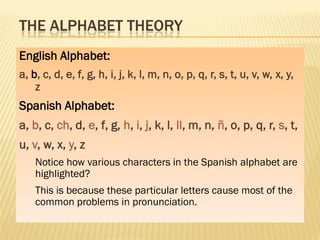
English Alphabet:
a, b, c, d, e, f, g, h, i, j, k, l, m, n, o, p, q, r, s, t, u, v, w, x, y,
    z
Spanish Alphabet:
a, b, c, ch, d, e, f, g, h, i, j, k, l, ll, m, n, ñ, o, p, q, r, s, t,
u, v, w, x, y, z
   Notice how various characters in the Spanish alphabet are
    highlighted?
   This is because these particular letters cause most of the
    common problems in pronunciation.
THE ALPHABET THEORY
   How many times have you wondered why you speak
    English with an accent?

   Many, if not most of us, who learned English as a
    second language were taught what many consider to
    be an advanced version of the topic, jumping directly
    into grammar and conversation without first studying
    the phonetic rules of the language itself, namely the
    alphabet.

   Would it be fair to say that perhaps it’s not our fault
    that we speak with an accent?
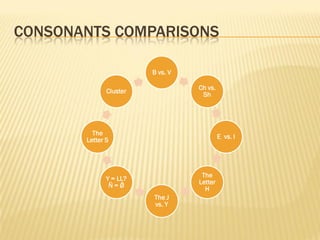
CONSONANTS COMPARISONS

                        B vs. V

                                  Ch vs.
              Cluster
                                   Sh


         The
                                           E vs. I
       Letter S


                                   The
              Y = LL?
                                  Letter
               Ñ=Ǿ
                                    H
                        The J
                        vs. Y
Syllable / Word Stress Rules

   Syllable & Word stress can be defined as the placing or
    distribution of stress within a polysyllabic word. These
    are general rules for syllable / word stress.

   Only one syllable is stressed in one word.
   The word must have two or more syllables for a syllable
    to be stressed.
    A word with a stressed syllable can have two or more
    syllables. Regardless of the amount of syllables, there is
    only one stressed syllable in each word and the stress
    always falls on a vowel.
WHY IS STRESS IMPORTANT?
   Word stress is something that native speakers don’t even realize
    they are using, however, they do recognize when it is used
    inappropriately.
   Using the correct stress can also help people understand what
    you mean, even if not every word in a sentence is audible.
   Think about photograph and photographer. If only part of the word
    is heard, one may assume what was said because of the
    difference in stress. Sometimes, if word stress is changed, the
    meaning of the word changes.
   Look at three words: photo, photographer, photograph. If all you
    heard a person say is “phoTO” then one may assume that the
    speaker meant to say “phoTOgrapher”.
   If you hear “PHOto”, then one may assume that the speaker
    meant to say “PHOtograph.”
SENTENCE STRESS
   Sentence Stress refers to the process whereby
    particular words are stressed within an overall sentence.
    It is actually the “music” of English, the thing that gives
    the language its particular “beat” or “rhythm”.
   In general, in any given English utterance there will be
    particular words that carry more “weight” or “volume”
    (stress) than others.

   From a speaking perspective, Sentence Stress will affect
    the degree to which a non-native speaker sounds
    “natural”. In terms of listening, it affects how well that
    person can understand the utterances they hear.
Rhythm & Schwa
   Speech rhythm can be defined as the arrangement of
    spoken words alternating stressed and unstressed
    elements. It is the beat that native speakers of a
    language follow when they produce their utterances.
   Even though we are changing the word order, the beat
    and rhythm stays the same provided that:
       The stressed syllable is louder and longer than the others
       The weak syllables are really weak

   The rhythm stays the same even when you change the
    words
       This is the house that Jack built.
       DUH da da DUH da DUH DUH
RHYTHM & SCHWA
   The schwa is the vowel sound in many lightly pronounced unaccented
    syllables in words of more than one syllable. It is sometimes signified by
    the pronunciation "uh" or symbolized by an upside-down rotated e.
   Allows us to stress and stretch other syllables on which we want to
    emphasize. It will never be found in a stressed syllable and because it
    is so weak, it allows us to pay attention to the contrast between
    stressed and weak syllables.
   It is also the most common sound in the English language system. The
    schwa is not clearly distinguishable like other vowel sounds.
   It is often the blank or neutral sound that occurs as our mouth moves
    from one consonant sound to the next.

   *x-PORT       *KAUNt*nt         *LAUw*ns
   VOU-ch*       DEB*t card        SLEN-d*
Intonation
    It is the music of language. The stresses of words and syllables while speaking, which are
    used to convey meaning

       WHY IS IT SO IMPORTANT?                             THREE WAYS TO MAKE :

   People from different countries,                  Say the word or syllable
    who come from different linguistic                 louder.
    backgrounds, speak differently.
                                                      Stretch out the word or
   When we start speaking English,
    the Spanish accent influences our                  syllable and make it seem
    pronunciation.                                     longer to say than the
   The words we say, how we say it,                   others.
    the words we stress and it can
    even include various aspects of                   Change pitch: even
    humor and how we interpret the                     pausing before changing
    meaning of words that are being
    said.                                              your pitch can be effective
                                                       if it isn’t overused.
FILLERS
   Fillers can be defined as words / expressions that people use,
    and actions that people do when they don't know or are not sure
    how to continue on in a sentence, how to continue within the
    same topic or how to move to a different one.
   These are expressions such as umm; hmmm... err… ooh…and
    actions such as licking their lips or snapping their fingers.
   The best way to eliminate filler words and actions is to substitute
    that behavior for another. So at points of transition, or whenever
    you feel the need to inject filler, simply PAUSE. Take a deep
    breath and gather your thoughts.
   While English Native-speakers will use "ums" and "uhs", Spanish-
    speakers tend to use "because", "you know" and "ehh".
CUSTOMER SERVICE
•   Active Listening & Comprehension:
       Active Listening is defined as the behaviors used to listen, attend to
        the person speaking, and to understand. These include, but are not
        limited to: facing the speaker, removing distractions, demonstrating
        attentiveness, asking questions, and summarizing. Active listening
        intentionally focuses on who you are listening to, whether in a group
        or one-on-one, in order to understand what is being said.
   How to improve your Listening Comprehension Skills:
       Spanish-speakers should listen to different varieties of English, and
        become familiar with the varying native and non-native accents
        from different parts of the English-speaking world. This will
        consequently train your ear on the different variations and paces in
        fast-spoken English.
       Additionally, when listening, we are reviewing a lot of English usage
        such as vocabulary, grammatical structures, intonation, accent and
        our own interpretation. As a consequence, we can imitate what we
        hear and apply it with great confidence.
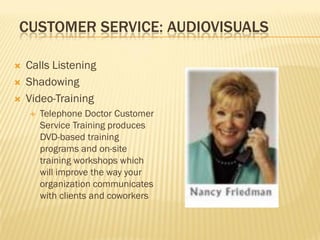
CUSTOMER SERVICE: AUDIOVISUALS

   Calls Listening
   Shadowing
   Video-Training
       Telephone Doctor Customer
        Service Training produces
        DVD-based training
        programs and on-site
        training workshops which
        will improve the way your
        organization communicates
        with clients and coworkers
ICDA’S ANNUAL CONFERENCE OF TEACHERS
June 12. 2009

English For Business Needs

  • 1.
    ENGLISH LANGUAGE INDOMINICAN CULTURE Geographical Anglicism is Created in: • USA Backyard • Social: Historical • “pariguayo” • “guachiman” • Invasions • “parqueo” Political • Cultural Influence • Sports: • Beisbol Business • Futbol • DR-CAFTA • Technology
  • 2.
    THE NEED TOLEARN ENGLISH: JOBS  Administrative  Secretaries, Receptionists, Hostesses, Translators  Tourism Area  Front desk, activities, waiters, croupiers, bartenders  International Trade  Managers, bookkeepers, human resources  Internet and computer related works  Web designers, net engineers, developers  Telecommunication  Call Centers
  • 3.
    THE NEED TOLEARN ENGLISH: CONTEXT  Changes In Economy  Demands from companies  International Ratings  National Competitiveness Plan  Education challenge  Official Response  Private Institutions
  • 4.
    LANGUAGE TEACHING TEACHING METHODOLOGIES ELT: the teaching of   Autodidactic methods English to nonnative  English Institutes speakers of English.  EFL (English as a foreign  Language Careers language) indicates the use of English in a non–  Bilingual schools English-speaking region.  ESL (English as a second  Degree requirements language) is the use of  Post graduate degrees English within the Anglo ENGLISH TEACHING IN DR sphere.
  • 5.
    How English isTaught for Specific Business Needs CASE STUDY: CALL CENTERS
  • 6.
    CALL CENTERS’ ORIGIN How Service has evolved  Customer Support  Offshore companies  Free Zones  Technology frame  Qualified manwork  Product and language training
  • 7.
    OPERATIONS  Projects: Theclients  Structure: The personnel  Internet: The technological base  Customer Satisfaction  Surveys  Quality assurance  Communication skills
  • 8.
    LANGUAGE TRAINING  Trainees’profile  Lesson Plan  Road map  Training room’s facilities  Setting up expectations -CR rating, participation, scoring points, question’s parking lot, good practices,…
  • 9.
    EVALUATIONS Call Role Play Communication Essay Proficiency Presentation Vocabulary + Accuracy + Fluency +Discourse + Pronunciation
  • 10.
    CATEGORIES  High advanced: speaker’s rating between a 100% and 79%.  Low advanced: adhere to the standard within 78% to 69%.  High intermediate within 68% and 58% of standards.  Intermediate are still workable with a ratings of 57%- 56%.  Low Intermediate is a scale under the possibilities to achieve the training objectives (57% to 45%) so it’s considered not workable.  Poor performance situates the student between high beginner and low beginner categories, which are not considered enough to meet the requirements for the training (46% to 36% and 35% to 26%).
  • 11.
    LANGUAGE PARAMETERS Grammar • Sentence Structure (20 points): • Grammar Accuracy Comprehension • Language Comprehension Level • Communication Strategies (30 points): • Discourse Fluency • Fluency • Sentence Stress (15 points): • Pace Pronunciation: • Pronunciation • Word stress (20 points) • Enunciation Vocabulary: • Team-building wording • Proper Manners (15 points) • Proper Vocabulary
  • 12.
    Teaching Phonetics  Phonetics is the science of the sounds one makes during speech. It is a combination of sounds put together to form a language.  Focus on where and how sounds are made in the mouth. Once we get a clear picture and are able to connect how and where the sounds are made in the mouth, it will be easier for us to make changes to get the desired sounds.  A consonant is a speech sound produced by a partial or complete obstruction of the air stream by any of various constrictions of the speech organs, such as (p), (f), (r), (w), and (h).
  • 13.
    VARIATION OF CONSONANTS  Place of articulation (where the sounds are made), Describe the 6 different places of articulation i.e., lips, teeth, behind the upper teeth, palate, back of the mouth, vocal chords.  Types of Sounds. List the different types of sounds i.e., stops, friction, non-friction and combination sounds.
  • 14.
    OTHER ASPECTS OFSPEECH Voicing, nasalization & aspiration Vowels and qualities. Alphabet Theory Syllable / Word Stress Rules Sentence Stress Rhythm & Schwa Intonation Fillers
  • 15.
    VOICING, NASALIZATION, ASPIRATION  Voicing - whether the vocal chords are vibrating or not. If you feel your throat vibrating when speaking, that is your vocal chords making sound. Some sounds are voiced and others are voiceless.  Nasalization - whether air travels through the mouth and/or the nasal passage. Nasalization in English is found in sounds like [m] and [n], where the flow of air from the mouth is completely blocked off, but continues to flow from the nasal passage.  Aspiration (breath) - Whether stops are released lightly or with a noticeable puff of air. Some sounds are not pronounced as forcefully as other sounds. A sound is aspirated if it has a slight [h] following the sound.
  • 16.
    VOWELS AND QUALITIES A vowel sound is made by keeping the vocal tract open. Consider:  Tongue height: Vowels are classified in terms of how much space there is between the tongue and the roof of the mouth. There are three primary height distinctions among vowels: high, low, and mid. High vowels have a relatively narrow space between the tongue and the roof of the mouth, [i], [i:], [u] and [u:].  Tongue Backness: Vowels are classified in terms of how far the raised body of the tongue is from the back of the mouth, which is called the backness of the tongue. front, back, and central. front vowels are [i], [i:], [e], [ae], back vowels are [u], [u:], [o], central vowels are [uh] and schwa.  Lip Rounding/Tense vs. Lax: Some vowels, such as the vowels [u] and [o], are formed with a high degree of lip rounding. Some vowels, such as [i:] and [e], are formed without such rounding, and are called non- rounded vowels.
  • 17.
    AS YOU CANSEE FROM THE DIAGRAMS, THE ARTICULATION OF THE FRONT VOWEL [I:] IS MUCH FARTHER FORWARD THAN THAT FOR THE BACK VOWEL [U]. TONGUE BACKNESS
  • 18.
    THE TENSENESS  Some vowels, such as the vowels [i:] and [ae], are formed with a high degree of tenseness.  Such vowels are called tense vowels.  In articulating a rounded vowel, the lips are rounded. The rounded vowels of Present-Day English are:  /u/ (the phoneme spelled oo in food)  /U/ (the phoneme spelled u in put)  /o/ (the phoneme spelled oa in boat)  /ô/ (the phoneme spelled au in caught)
  • 19.
    LAX VOWELS  With a lax vowel, on the other hand, the muscles of the vocal apparatus are relatively loose. The lax vowels in Present-Day English are  /I/ (the phoneme spelled i in bit)  /e/ (the phoneme spelled e in bet)  Note that the degree of tenseness varies considerably in these different vowels. The other vowels of Present-Day English are relatively tense (also in different degrees).
  • 20.
    THE ALPHABET THEORY EnglishAlphabet: a, b, c, d, e, f, g, h, i, j, k, l, m, n, o, p, q, r, s, t, u, v, w, x, y, z Spanish Alphabet: a, b, c, ch, d, e, f, g, h, i, j, k, l, ll, m, n, ñ, o, p, q, r, s, t, u, v, w, x, y, z  Notice how various characters in the Spanish alphabet are highlighted?  This is because these particular letters cause most of the common problems in pronunciation.
  • 21.
    THE ALPHABET THEORY  How many times have you wondered why you speak English with an accent?  Many, if not most of us, who learned English as a second language were taught what many consider to be an advanced version of the topic, jumping directly into grammar and conversation without first studying the phonetic rules of the language itself, namely the alphabet.  Would it be fair to say that perhaps it’s not our fault that we speak with an accent?
  • 22.
    CONSONANTS COMPARISONS B vs. V Ch vs. Cluster Sh The E vs. I Letter S The Y = LL? Letter Ñ=Ǿ H The J vs. Y
  • 23.
    Syllable / WordStress Rules  Syllable & Word stress can be defined as the placing or distribution of stress within a polysyllabic word. These are general rules for syllable / word stress.  Only one syllable is stressed in one word.  The word must have two or more syllables for a syllable to be stressed.  A word with a stressed syllable can have two or more syllables. Regardless of the amount of syllables, there is only one stressed syllable in each word and the stress always falls on a vowel.
  • 24.
    WHY IS STRESSIMPORTANT?  Word stress is something that native speakers don’t even realize they are using, however, they do recognize when it is used inappropriately.  Using the correct stress can also help people understand what you mean, even if not every word in a sentence is audible.  Think about photograph and photographer. If only part of the word is heard, one may assume what was said because of the difference in stress. Sometimes, if word stress is changed, the meaning of the word changes.  Look at three words: photo, photographer, photograph. If all you heard a person say is “phoTO” then one may assume that the speaker meant to say “phoTOgrapher”.  If you hear “PHOto”, then one may assume that the speaker meant to say “PHOtograph.”
  • 25.
    SENTENCE STRESS  Sentence Stress refers to the process whereby particular words are stressed within an overall sentence. It is actually the “music” of English, the thing that gives the language its particular “beat” or “rhythm”.  In general, in any given English utterance there will be particular words that carry more “weight” or “volume” (stress) than others.  From a speaking perspective, Sentence Stress will affect the degree to which a non-native speaker sounds “natural”. In terms of listening, it affects how well that person can understand the utterances they hear.
  • 26.
    Rhythm & Schwa  Speech rhythm can be defined as the arrangement of spoken words alternating stressed and unstressed elements. It is the beat that native speakers of a language follow when they produce their utterances.  Even though we are changing the word order, the beat and rhythm stays the same provided that:  The stressed syllable is louder and longer than the others  The weak syllables are really weak  The rhythm stays the same even when you change the words  This is the house that Jack built.  DUH da da DUH da DUH DUH
  • 27.
    RHYTHM & SCHWA  The schwa is the vowel sound in many lightly pronounced unaccented syllables in words of more than one syllable. It is sometimes signified by the pronunciation "uh" or symbolized by an upside-down rotated e.  Allows us to stress and stretch other syllables on which we want to emphasize. It will never be found in a stressed syllable and because it is so weak, it allows us to pay attention to the contrast between stressed and weak syllables.  It is also the most common sound in the English language system. The schwa is not clearly distinguishable like other vowel sounds.  It is often the blank or neutral sound that occurs as our mouth moves from one consonant sound to the next.  *x-PORT *KAUNt*nt *LAUw*ns  VOU-ch* DEB*t card SLEN-d*
  • 28.
    Intonation It is the music of language. The stresses of words and syllables while speaking, which are used to convey meaning WHY IS IT SO IMPORTANT? THREE WAYS TO MAKE :  People from different countries,  Say the word or syllable who come from different linguistic louder. backgrounds, speak differently.  Stretch out the word or  When we start speaking English, the Spanish accent influences our syllable and make it seem pronunciation. longer to say than the  The words we say, how we say it, others. the words we stress and it can even include various aspects of  Change pitch: even humor and how we interpret the pausing before changing meaning of words that are being said. your pitch can be effective if it isn’t overused.
  • 29.
    FILLERS  Fillers can be defined as words / expressions that people use, and actions that people do when they don't know or are not sure how to continue on in a sentence, how to continue within the same topic or how to move to a different one.  These are expressions such as umm; hmmm... err… ooh…and actions such as licking their lips or snapping their fingers.  The best way to eliminate filler words and actions is to substitute that behavior for another. So at points of transition, or whenever you feel the need to inject filler, simply PAUSE. Take a deep breath and gather your thoughts.  While English Native-speakers will use "ums" and "uhs", Spanish- speakers tend to use "because", "you know" and "ehh".
  • 30.
    CUSTOMER SERVICE • Active Listening & Comprehension:  Active Listening is defined as the behaviors used to listen, attend to the person speaking, and to understand. These include, but are not limited to: facing the speaker, removing distractions, demonstrating attentiveness, asking questions, and summarizing. Active listening intentionally focuses on who you are listening to, whether in a group or one-on-one, in order to understand what is being said.  How to improve your Listening Comprehension Skills:  Spanish-speakers should listen to different varieties of English, and become familiar with the varying native and non-native accents from different parts of the English-speaking world. This will consequently train your ear on the different variations and paces in fast-spoken English.  Additionally, when listening, we are reviewing a lot of English usage such as vocabulary, grammatical structures, intonation, accent and our own interpretation. As a consequence, we can imitate what we hear and apply it with great confidence.
  • 31.
    CUSTOMER SERVICE: AUDIOVISUALS  Calls Listening  Shadowing  Video-Training  Telephone Doctor Customer Service Training produces DVD-based training programs and on-site training workshops which will improve the way your organization communicates with clients and coworkers
  • 32.
    ICDA’S ANNUAL CONFERENCEOF TEACHERS June 12. 2009