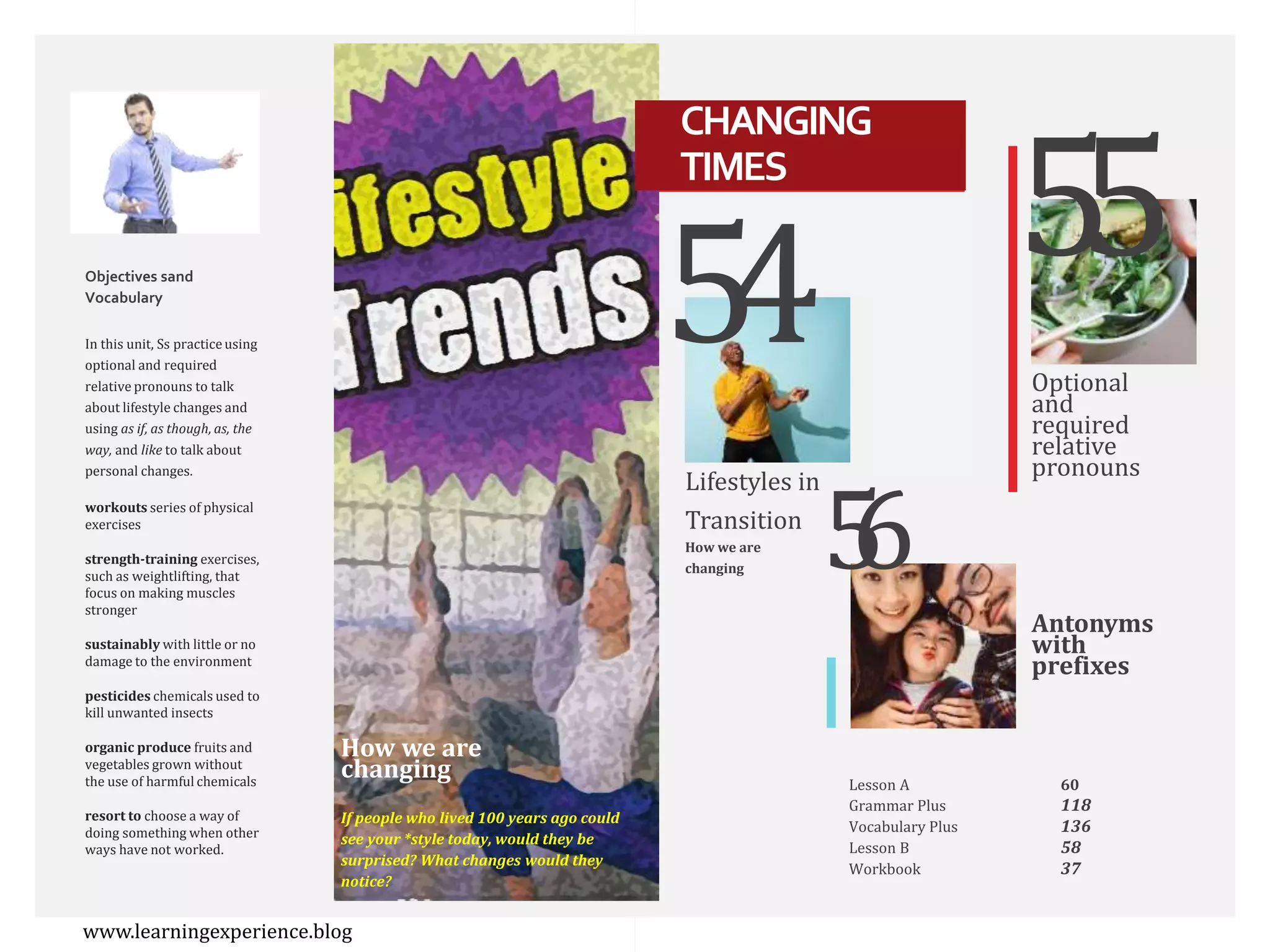
In this unit, Ss practice using
optional and required
relative pronouns to talk
about lifestyle changes and
using as if, as though, as, the
way, and like to talk about
personal changes.
workouts series of physical
exercises
strength-training exercises,
such as weightlifting, that
focus on making muscles
stronger
sustainably with little or no
damage to the environment
pesticides chemicals used to
kill unwanted insects
organic produce fruits and
vegetables grown without
the use of harmful chemicals
resort to choose a way of
doing something when other
ways have not worked.
Objectives sand
Vocabulary
CHANGING
TIMES
Optional
and
required
relative
pronouns
Antonyms
with
prefixes
54
How we are
changing
Lifestyles in
Transition
Lesson A 60
Grammar Plus 118
Vocabulary Plus 136
Lesson B 58
Workbook 37
55
56
If people who lived 100 years ago could
see your *style today, would they be
surprised? What changes would they
notice?
How we are
changing
www.learningexperience.blog
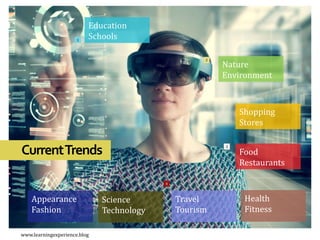
CurrentTrends
Education
Schools
3
1
2
4
Nature
Environment
Food
Restaurants
Health
Fitness
Travel
Tourism
Science
Technology
Appearance
Fashion
Shopping
Stores
www.learningexperience.blog
Lorem ipsum maecenas mattis risus
ligula, sed ullamcorper nunc efficitur
sed. Praesent venenatis quam tortor,
id viverra nunc rutrum a. Maecenas
malesuada ultricies sapien sit amet
pharetra, nunc tempus, risus sodales
sodales.
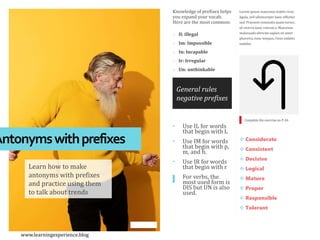
Knowledge of prefixes helps
you expand your vocab.
Here are the most common:
o Il: illegal
o Im: Impossible
o In: Incapable
o Ir: Irregular
o Un: unthinkable
Antonymswithprefixes
Learn how to make
antonyms with prefixes
and practice using them
to talk about trends
• Use IL for words
that begin with L
• Use IM for words
that begin with p,
m, and b.
• Use IR for words
that begin with r
• For verbs, the
most used form is
DIS but UN is also
used.
 Considerate
 Consistent
 Decisive
 Logical
 Mature
 Proper
 Responsible
 Tolerant
Complete the exercise on P-56
General rules
negative prefixes
www.learningexperience.blog
GenerationY
Develop skills in listening
for gist and details
Vocabulary
accommodating helping
people by providing —
something they need fall in
(that category) belong to;
are part of —transitioning
changing from one style to
another —hands-off not
interfering; allowing others
to work independently —
(community) outreach
program an organization or
group that helps people with
social, medical, or
educational problems —
instituting introducing,
starting up (a new plan or
system)
Complete
the exercise
on P-56
Listen to a
presentation by a
corporate executive
about two
generations of
employees.
LISTENING
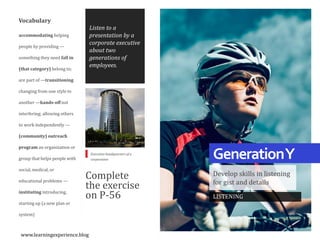
Executive headquarters of a
corporation
www.learningexperience.blog
Is the relative pronoun
needed in both
sentences?
1. Many students who have
finished high school are
choosing to take a year off
before college.
2. A personal trainer is a
professional whom people
hire to help them get in
shape.
Ilook at the starting point on
p-54 —In which sentences is
the relatve pronoun
requeired.?
DefiningRelativeClauses
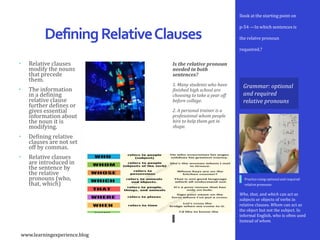
Who, that, and which can act as
subjects or objects of verbs in
relative clauses. Whom can act as
the object but not the subject. In
informal English, who is often used
Instead of whom.
Practice using optional and required
relative pronouns
Grammar: optional
and required
relative pronouns
• Relative clauses
modify the nouns
that precede
them.
• The information
in a defining
relative clause
further defines or
gives essential
information about
the noun it is
modifying.
• Defining relative
clauses are not set
off by commas.
• Relative clasues
are introduced in
the sentence by
the relative
pronouns (who,
that, which)
www.learningexperience.blog
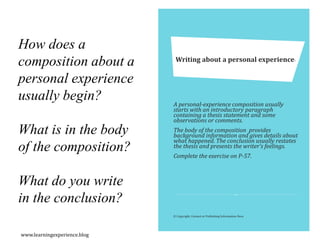
A personal-experience composition usually
starts with an introductory paragraph
containing a thesis statement and some
observations or comments.
The body of the composition provides
background information and gives details about
what happened. The conclusion usually restates
the thesis and presents the writer’s feelings.
Complete the exercise on P-57.
Writing about a personal experience-
© Copyright, Contact or Publishing Information Here
How does a
composition about a
personal experience
usually begin?
What is in the body
of the composition?
What do you write
in the conclusion?
www.learningexperience.blog
LessonB:
AchangefortheBetter
Contemplating a change:
Discuss making lifestyle changes.
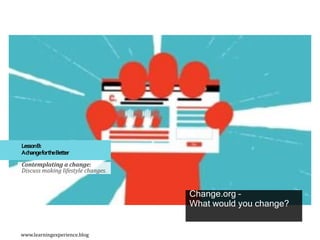
Change.org –
What would you change?
www.learningexperience.blog
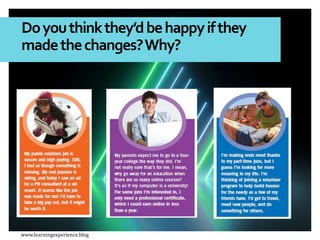
Doyouthinkthey’dbehappyifthey
madethechanges?Why?
www.learningexperience.blog
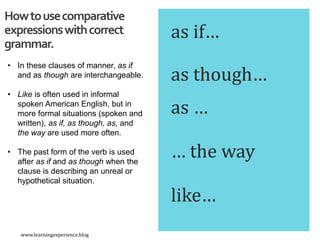
as if…
Howtousecomparative
expressionswithcorrect
grammar.
as though…
as …
… the way
like…
• In these clauses of manner, as if
and as though are interchangeable.
• Like is often used in informal
spoken American English, but in
more formal situations (spoken and
written), as if, as though, as, and
the way are used more often.
• The past form of the verb is used
after as if and as though when the
clause is describing an unreal or
hypothetical situation.
www.learningexperience.blog
Collocationsof Change
VOCABULARY & SPEAKING
Collocations are phrases that go together in a
natural way, because that is how most people
speak.
Why should we learn collocations?
Our brain tends to store language in chunks, rather than
individual words. Thus, when we speak or write, it is more
efficient for us to remember and use phrases as chunks rather
than constructing them one word at a time. This increased
efficiency promotes fluency.
• Anticipate
• Avoid
• Bring about
• Cope with
• Go through
• Resist
• Welcome
CHANGE
www.learningexperience.blog
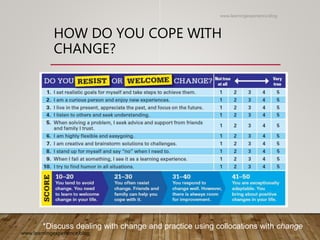
HOW DO YOU COPE WITH
CHANGE?
*Discuss dealing with change and practice using collocations with change
www.learningexperience.blog
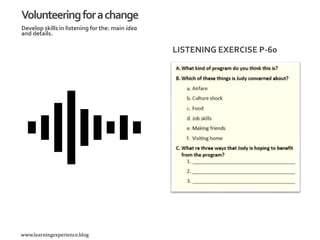
Develop skills in listening for the: main idea
and details.
LISTENING EXERCISE P-60
Volunteeringforachange
www.learningexperience.blog
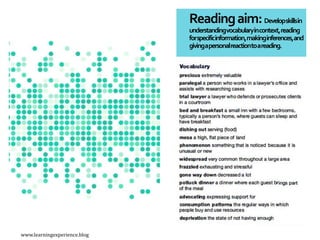
Readingaim:Developskillsin
understandingvocabularyincontext,reading
forspecificinformation,makinginferences,and
givingapersonalreactiontoareading.
www.learningexperience.blog
LEARNING REFLECTION
• What language and culture did I encounter?
• What did I do that helped my learning?
• What did I do to hinder my learning?
• What did my peers do that helped my learning?
• What did my peers do to hinder my learning?
• How can I apply the content to my life?
• What did I like the most?
• What did my teacher do that helped my learning?
• What did my teacher do to hinder my learning?

Unit 7 -changing-times

  • 1.
    In this unit,Ss practice using optional and required relative pronouns to talk about lifestyle changes and using as if, as though, as, the way, and like to talk about personal changes. workouts series of physical exercises strength-training exercises, such as weightlifting, that focus on making muscles stronger sustainably with little or no damage to the environment pesticides chemicals used to kill unwanted insects organic produce fruits and vegetables grown without the use of harmful chemicals resort to choose a way of doing something when other ways have not worked. Objectives sand Vocabulary CHANGING TIMES Optional and required relative pronouns Antonyms with prefixes 54 How we are changing Lifestyles in Transition Lesson A 60 Grammar Plus 118 Vocabulary Plus 136 Lesson B 58 Workbook 37 55 56 If people who lived 100 years ago could see your *style today, would they be surprised? What changes would they notice? How we are changing www.learningexperience.blog
  • 2.
  • 3.
  • 4.
    Lorem ipsum maecenasmattis risus ligula, sed ullamcorper nunc efficitur sed. Praesent venenatis quam tortor, id viverra nunc rutrum a. Maecenas malesuada ultricies sapien sit amet pharetra, nunc tempus, risus sodales sodales. Knowledge of prefixes helps you expand your vocab. Here are the most common: o Il: illegal o Im: Impossible o In: Incapable o Ir: Irregular o Un: unthinkable Antonymswithprefixes Learn how to make antonyms with prefixes and practice using them to talk about trends • Use IL for words that begin with L • Use IM for words that begin with p, m, and b. • Use IR for words that begin with r • For verbs, the most used form is DIS but UN is also used.  Considerate  Consistent  Decisive  Logical  Mature  Proper  Responsible  Tolerant Complete the exercise on P-56 General rules negative prefixes www.learningexperience.blog
  • 5.
    GenerationY Develop skills inlistening for gist and details Vocabulary accommodating helping people by providing — something they need fall in (that category) belong to; are part of —transitioning changing from one style to another —hands-off not interfering; allowing others to work independently — (community) outreach program an organization or group that helps people with social, medical, or educational problems — instituting introducing, starting up (a new plan or system) Complete the exercise on P-56 Listen to a presentation by a corporate executive about two generations of employees. LISTENING Executive headquarters of a corporation www.learningexperience.blog
  • 6.
    Is the relativepronoun needed in both sentences? 1. Many students who have finished high school are choosing to take a year off before college. 2. A personal trainer is a professional whom people hire to help them get in shape. Ilook at the starting point on p-54 —In which sentences is the relatve pronoun requeired.? DefiningRelativeClauses Who, that, and which can act as subjects or objects of verbs in relative clauses. Whom can act as the object but not the subject. In informal English, who is often used Instead of whom. Practice using optional and required relative pronouns Grammar: optional and required relative pronouns • Relative clauses modify the nouns that precede them. • The information in a defining relative clause further defines or gives essential information about the noun it is modifying. • Defining relative clauses are not set off by commas. • Relative clasues are introduced in the sentence by the relative pronouns (who, that, which) www.learningexperience.blog
  • 7.
    A personal-experience compositionusually starts with an introductory paragraph containing a thesis statement and some observations or comments. The body of the composition provides background information and gives details about what happened. The conclusion usually restates the thesis and presents the writer’s feelings. Complete the exercise on P-57. Writing about a personal experience- © Copyright, Contact or Publishing Information Here How does a composition about a personal experience usually begin? What is in the body of the composition? What do you write in the conclusion? www.learningexperience.blog
  • 8.
    LessonB: AchangefortheBetter Contemplating a change: Discussmaking lifestyle changes. Change.org – What would you change? www.learningexperience.blog
  • 9.
  • 10.
    as if… Howtousecomparative expressionswithcorrect grammar. as though… as… … the way like… • In these clauses of manner, as if and as though are interchangeable. • Like is often used in informal spoken American English, but in more formal situations (spoken and written), as if, as though, as, and the way are used more often. • The past form of the verb is used after as if and as though when the clause is describing an unreal or hypothetical situation. www.learningexperience.blog
  • 11.
    Collocationsof Change VOCABULARY &SPEAKING Collocations are phrases that go together in a natural way, because that is how most people speak. Why should we learn collocations? Our brain tends to store language in chunks, rather than individual words. Thus, when we speak or write, it is more efficient for us to remember and use phrases as chunks rather than constructing them one word at a time. This increased efficiency promotes fluency. • Anticipate • Avoid • Bring about • Cope with • Go through • Resist • Welcome CHANGE www.learningexperience.blog
  • 12.
    HOW DO YOUCOPE WITH CHANGE? *Discuss dealing with change and practice using collocations with change www.learningexperience.blog www.learningexperience.blog
  • 13.
    Develop skills inlistening for the: main idea and details. LISTENING EXERCISE P-60 Volunteeringforachange www.learningexperience.blog
  • 14.
  • 15.
    LEARNING REFLECTION • Whatlanguage and culture did I encounter? • What did I do that helped my learning? • What did I do to hinder my learning? • What did my peers do that helped my learning? • What did my peers do to hinder my learning? • How can I apply the content to my life? • What did I like the most? • What did my teacher do that helped my learning? • What did my teacher do to hinder my learning?