Planning
Techniques for Teaching Pronunciation
39LINC 1-5
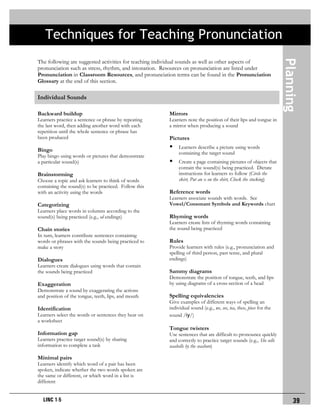
The following are suggested activities for teaching individual sounds as well as other aspects of
pronunciation such as stress, rhythm, and intonation. Resources on pronunciation are listed under
Pronunciation in Classroom Resources, and pronunciation terms can be found in the Pronunciation
Glossary at the end of this section.
Individual Sounds
Backward buildup
Learners practice a sentence or phrase by repeating
the last word, then adding another word with each
repetition until the whole sentence or phrase has
been produced
Bingo
Play bingo using words or pictures that demonstrate
a particular sound(s)
Brainstorming
Choose a topic and ask learners to think of words
containing the sound(s) to be practiced. Follow this
with an activity using the words
Categorizing
Learners place words in columns according to the
sound(s) being practiced (e.g., ed endings)
Chain stories
In turn, learners contribute sentences containing
words or phrases with the sounds being practiced to
make a story
Dialogues
Learners create dialogues using words that contain
the sounds being practiced
Exaggeration
Demonstrate a sound by exaggerating the actions
and position of the tongue, teeth, lips, and mouth
Identification
Learners select the words or sentences they hear on
a worksheet
Information gap
Learners practice target sound(s) by sharing
information to complete a task
Minimal pairs
Learners identify which word of a pair has been
spoken, indicate whether the two words spoken are
the same or different, or which word in a list is
different
Mirrors
Learners note the position of their lips and tongue in
a mirror when producing a sound
Pictures
• Learners describe a picture using words
containing the target sound
• Create a page containing pictures of objects that
contain the sound(s) being practiced. Dictate
instructions for learners to follow (Circle the
skirt, Put an x on the shirt, Check the stocking)
Reference words
Learners associate sounds with words. See
Vowel/Consonant Symbols and Keywords chart
Rhyming words
Learners create lists of rhyming words containing
the sound being practiced
Rules
Provide learners with rules (e.g., pronunciation and
spelling of third person, past tense, and plural
endings)
Sammy diagrams
Demonstrate the position of tongue, teeth, and lips
by using diagrams of a cross-section of a head
Spelling equivalencies
Give examples of different ways of spelling an
individual sound (e.g., we, see, tea, these, piece for the
sound /iy/)
Tongue twisters
Use sentences that are difficult to pronounce quickly
and correctly to practice target sounds (e.g., She sells
seashells by the seashore)
Planning
Techniques for Teaching Pronunciation
40 LINC Curriculum Guidelines
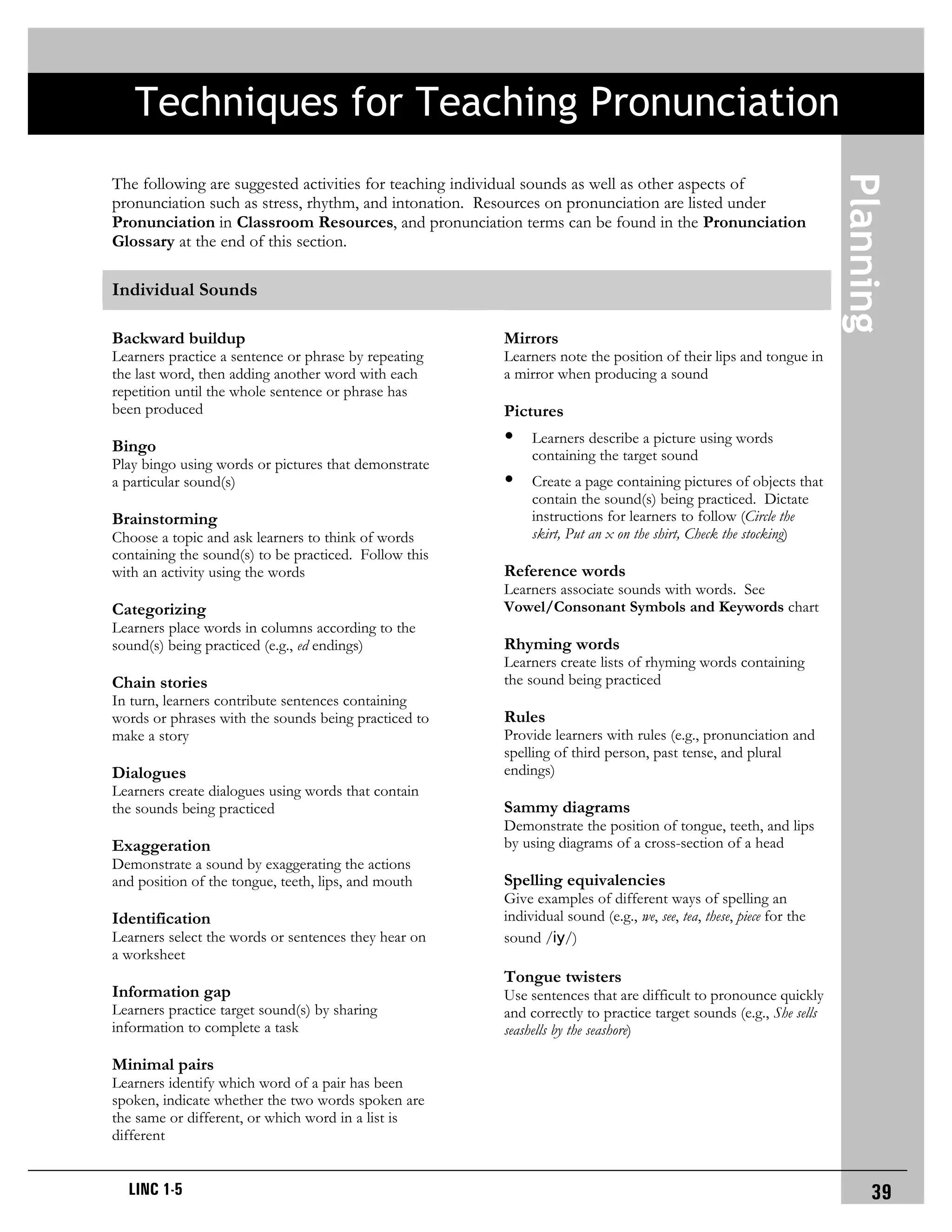
Stress and Rhythm
Changing the meaning
Read words and phrases using contrastive stress and
discuss the meanings (e.g., green house and greenhouse)
Exaggeration
Encourage learners to exaggerate their production of
stress and rhythm
Identification of content and function
words
Learners underline content words in sentences
Limericks
Use rhyming verses to teach stress and rhythm
Marking syllables
Read a list of words or sentences and have learners
count syllables and mark which syllables are stressed
Nonsense syllables
Substitute a nonsense syllable such as da for word
syllables
Rules
Provide rules for dividing words into syllables
Tapping
Tap to indicate rhythm or stress
Intonation
Changing the meaning
Read sentences using different stress and intonation
to change the meaning
Questionnaires and surveys
Prepare questions for learners to use in pairs and
instruct them to ask the questions politely, and ask
follow-up questions to keep the conversation going
Directions and instructions
Learners work in pairs or groups and ask for and
give directions and instructions
Identifying questions, statements, and lists
• Read a list of sentences that have a declarative
word order with yes/no question intonation or
as statements. Learners complete sentences on
a worksheet with a question mark or period
• Read lists, sometimes stopping before the end,
using rising intonation. Learners indicate
whether the list is complete or whether there
are more items to come
• Read aloud a list of tag questions using rising or
falling intonation. Learners indicate whether
you are asking a question or stating a fact
Contractions, Reduced Expressions, Linking, and Pausing
Dialogues and role-plays
Learners create their own dialogues or use dialogues
provided by the instructor to practice reduced
expressions and linking
Dictation
Learners dictate a list of sentences or a dialogue to a
partner
Gap fill
Prepare worksheets containing sentences with
blanks for function words or contractions. Learners
listen to a dictation of the sentences and fill in the
blanks
Identification
Dictate pairs of similar sentences and have learners
identify which sentence is being read on a worksheet
Word counting
Dictate sentences containing reductions and have
learners count the number of words
Planning
Techniques for Teaching Pronunciation
41LINC 1-5
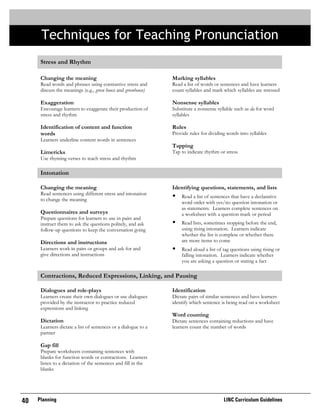
Vowel/Consonant Symbols and Keywords
1
Vowel Keyword Consonant Keyword Consonant Keyword
/iy/ green /p/ Poland /Z/ Malaysia
/I/ pink /b/ Bolivia /tS/ China
/ey/ grey /m/ Mexico /dZ/ Germany
/E/ red /f/ Finland /k/ Canada
/Q/ black /v/ Venezuela /g/ Guyana
/uw/ blue /T/ South Africa /N/ Hong Kong
/U/ wood /D/ The Philippines /w/ Wales
/ow/ yellow /t/ Thailand /y/ Yemen
/a/ olive /d/ Denmark /h/ Hungary
/Ã/ mustard /s/ Singapore
/ay/ sky blue /z/ Zambia
/aw/ brown /n/ Norway
/oy/ turquoise /l/ Libya
/«r/ purple /r/ Romania
/«/ tomato /S/ Russia
Pictorial Representations of Sounds
One way of helping learners produce speech correctly is to use a cross-sectional diagram of a head showing
the position of the tongue, teeth, and lips for different sounds. These illustrations are called Sammy
diagrams and can be found in many pronunciation reference books (e.g., Teaching American English
Pronunciation).2
Sammy diagram3
showing tongue, teeth, and roof of mouth
Another pronunciation resource is the CALL software, ELLIS – Master Pronunciation. The Pronunciation
section displays animated graphics of male and female models pronouncing sounds. Learners can choose
either vowels or consonants to practice, record, and compare to the computer-generated sound. The
Master Tutor section allows learners to choose a sound, see a Sammy diagram, and hear an explanation in
different languages of how the sounds are formed.
1
Peter Avery and Susan Ehrlich, eds., Teaching American English Pronunciation (UK: Oxford University Press, 1992), p. 183.
2
Avery and Ehrlich, 1992.
3
The diagram on this page is from Sharon Widmayer and Holly Gray, Sounds of English, http://www.soundsofenglish.org .
Planning42 LINC Curriculum Guidelines
Techniques for Teaching Pronunciation
Teaching Cultural Aspects of Communication
1
Effective communication requires not just the mastery of individual sounds and the accompanying aspects
of pronunciation such as stress, rhythm, and intonation. It also depends on speaking habits such as
gestures, posture, and eye contact. The following is a list of global aspects of speech to consider when
helping learners to understand and to be understood. Point out these features to learners and ask
questions to encourage awareness of cultural differences.
Questions for Class Discussion
Speech
• Silence
How do people respond to periods of silence in a conversation?
• Speed
What does fast speech indicate? What about steady, evenly paced speech?
• Volume
What is an acceptable level? What do people think if the volume is very soft? Is this the same
in all cultures?
Body Language
• Eye contact
What does direct eye contact signify for North Americans? Is the length of eye contact
important?
• Facial Expressions
What do facial expressions convey? Are they the same in all cultures? Do they matter?
• Gestures
What gestures are used (e.g., to beckon, greet, wave goodbye, indicate agreement, non-
comprehension, etc.)? How do gestures vary from culture to culture? Should we use gestures
to communicate? How often should we gesture in conversation? What happens if we don’t
use gestures? Do men and women gesture in the same way?
• Posture
What attitudes do different postures communicate?
• Physical Distance
What is an acceptable distance between people in conversation? What if that distance is too
far? What if it is too close?
• Touching
What forms of touching are acceptable in North America compared with other countries? Is
it acceptable to touch someone when he/she is speaking to another person?
1
Adapted from Kathryn Brillinger, Pronunciation Rules: The Accompanying Pragmatics workshop (Mississauga, ON, June 2001).

P7techniqs teach pronun

  • 1.
    Planning Techniques for TeachingPronunciation 39LINC 1-5 The following are suggested activities for teaching individual sounds as well as other aspects of pronunciation such as stress, rhythm, and intonation. Resources on pronunciation are listed under Pronunciation in Classroom Resources, and pronunciation terms can be found in the Pronunciation Glossary at the end of this section. Individual Sounds Backward buildup Learners practice a sentence or phrase by repeating the last word, then adding another word with each repetition until the whole sentence or phrase has been produced Bingo Play bingo using words or pictures that demonstrate a particular sound(s) Brainstorming Choose a topic and ask learners to think of words containing the sound(s) to be practiced. Follow this with an activity using the words Categorizing Learners place words in columns according to the sound(s) being practiced (e.g., ed endings) Chain stories In turn, learners contribute sentences containing words or phrases with the sounds being practiced to make a story Dialogues Learners create dialogues using words that contain the sounds being practiced Exaggeration Demonstrate a sound by exaggerating the actions and position of the tongue, teeth, lips, and mouth Identification Learners select the words or sentences they hear on a worksheet Information gap Learners practice target sound(s) by sharing information to complete a task Minimal pairs Learners identify which word of a pair has been spoken, indicate whether the two words spoken are the same or different, or which word in a list is different Mirrors Learners note the position of their lips and tongue in a mirror when producing a sound Pictures • Learners describe a picture using words containing the target sound • Create a page containing pictures of objects that contain the sound(s) being practiced. Dictate instructions for learners to follow (Circle the skirt, Put an x on the shirt, Check the stocking) Reference words Learners associate sounds with words. See Vowel/Consonant Symbols and Keywords chart Rhyming words Learners create lists of rhyming words containing the sound being practiced Rules Provide learners with rules (e.g., pronunciation and spelling of third person, past tense, and plural endings) Sammy diagrams Demonstrate the position of tongue, teeth, and lips by using diagrams of a cross-section of a head Spelling equivalencies Give examples of different ways of spelling an individual sound (e.g., we, see, tea, these, piece for the sound /iy/) Tongue twisters Use sentences that are difficult to pronounce quickly and correctly to practice target sounds (e.g., She sells seashells by the seashore)
  • 2.
    Planning Techniques for TeachingPronunciation 40 LINC Curriculum Guidelines Stress and Rhythm Changing the meaning Read words and phrases using contrastive stress and discuss the meanings (e.g., green house and greenhouse) Exaggeration Encourage learners to exaggerate their production of stress and rhythm Identification of content and function words Learners underline content words in sentences Limericks Use rhyming verses to teach stress and rhythm Marking syllables Read a list of words or sentences and have learners count syllables and mark which syllables are stressed Nonsense syllables Substitute a nonsense syllable such as da for word syllables Rules Provide rules for dividing words into syllables Tapping Tap to indicate rhythm or stress Intonation Changing the meaning Read sentences using different stress and intonation to change the meaning Questionnaires and surveys Prepare questions for learners to use in pairs and instruct them to ask the questions politely, and ask follow-up questions to keep the conversation going Directions and instructions Learners work in pairs or groups and ask for and give directions and instructions Identifying questions, statements, and lists • Read a list of sentences that have a declarative word order with yes/no question intonation or as statements. Learners complete sentences on a worksheet with a question mark or period • Read lists, sometimes stopping before the end, using rising intonation. Learners indicate whether the list is complete or whether there are more items to come • Read aloud a list of tag questions using rising or falling intonation. Learners indicate whether you are asking a question or stating a fact Contractions, Reduced Expressions, Linking, and Pausing Dialogues and role-plays Learners create their own dialogues or use dialogues provided by the instructor to practice reduced expressions and linking Dictation Learners dictate a list of sentences or a dialogue to a partner Gap fill Prepare worksheets containing sentences with blanks for function words or contractions. Learners listen to a dictation of the sentences and fill in the blanks Identification Dictate pairs of similar sentences and have learners identify which sentence is being read on a worksheet Word counting Dictate sentences containing reductions and have learners count the number of words
  • 3.
    Planning Techniques for TeachingPronunciation 41LINC 1-5 Vowel/Consonant Symbols and Keywords 1 Vowel Keyword Consonant Keyword Consonant Keyword /iy/ green /p/ Poland /Z/ Malaysia /I/ pink /b/ Bolivia /tS/ China /ey/ grey /m/ Mexico /dZ/ Germany /E/ red /f/ Finland /k/ Canada /Q/ black /v/ Venezuela /g/ Guyana /uw/ blue /T/ South Africa /N/ Hong Kong /U/ wood /D/ The Philippines /w/ Wales /ow/ yellow /t/ Thailand /y/ Yemen /a/ olive /d/ Denmark /h/ Hungary /Ã/ mustard /s/ Singapore /ay/ sky blue /z/ Zambia /aw/ brown /n/ Norway /oy/ turquoise /l/ Libya /«r/ purple /r/ Romania /«/ tomato /S/ Russia Pictorial Representations of Sounds One way of helping learners produce speech correctly is to use a cross-sectional diagram of a head showing the position of the tongue, teeth, and lips for different sounds. These illustrations are called Sammy diagrams and can be found in many pronunciation reference books (e.g., Teaching American English Pronunciation).2 Sammy diagram3 showing tongue, teeth, and roof of mouth Another pronunciation resource is the CALL software, ELLIS – Master Pronunciation. The Pronunciation section displays animated graphics of male and female models pronouncing sounds. Learners can choose either vowels or consonants to practice, record, and compare to the computer-generated sound. The Master Tutor section allows learners to choose a sound, see a Sammy diagram, and hear an explanation in different languages of how the sounds are formed. 1 Peter Avery and Susan Ehrlich, eds., Teaching American English Pronunciation (UK: Oxford University Press, 1992), p. 183. 2 Avery and Ehrlich, 1992. 3 The diagram on this page is from Sharon Widmayer and Holly Gray, Sounds of English, http://www.soundsofenglish.org .
  • 4.
    Planning42 LINC CurriculumGuidelines Techniques for Teaching Pronunciation Teaching Cultural Aspects of Communication 1 Effective communication requires not just the mastery of individual sounds and the accompanying aspects of pronunciation such as stress, rhythm, and intonation. It also depends on speaking habits such as gestures, posture, and eye contact. The following is a list of global aspects of speech to consider when helping learners to understand and to be understood. Point out these features to learners and ask questions to encourage awareness of cultural differences. Questions for Class Discussion Speech • Silence How do people respond to periods of silence in a conversation? • Speed What does fast speech indicate? What about steady, evenly paced speech? • Volume What is an acceptable level? What do people think if the volume is very soft? Is this the same in all cultures? Body Language • Eye contact What does direct eye contact signify for North Americans? Is the length of eye contact important? • Facial Expressions What do facial expressions convey? Are they the same in all cultures? Do they matter? • Gestures What gestures are used (e.g., to beckon, greet, wave goodbye, indicate agreement, non- comprehension, etc.)? How do gestures vary from culture to culture? Should we use gestures to communicate? How often should we gesture in conversation? What happens if we don’t use gestures? Do men and women gesture in the same way? • Posture What attitudes do different postures communicate? • Physical Distance What is an acceptable distance between people in conversation? What if that distance is too far? What if it is too close? • Touching What forms of touching are acceptable in North America compared with other countries? Is it acceptable to touch someone when he/she is speaking to another person? 1 Adapted from Kathryn Brillinger, Pronunciation Rules: The Accompanying Pragmatics workshop (Mississauga, ON, June 2001).