UNIT 10
Language
Communication Skills
What is language?
What qualities
make effective
communicators?
Fear of public
speaking
• Have you ever had to speak or perform in public?
Were you nervous?
• What are some occupations where speaking in public
is an important skill?
• Stage fright is the biggest fear for many people
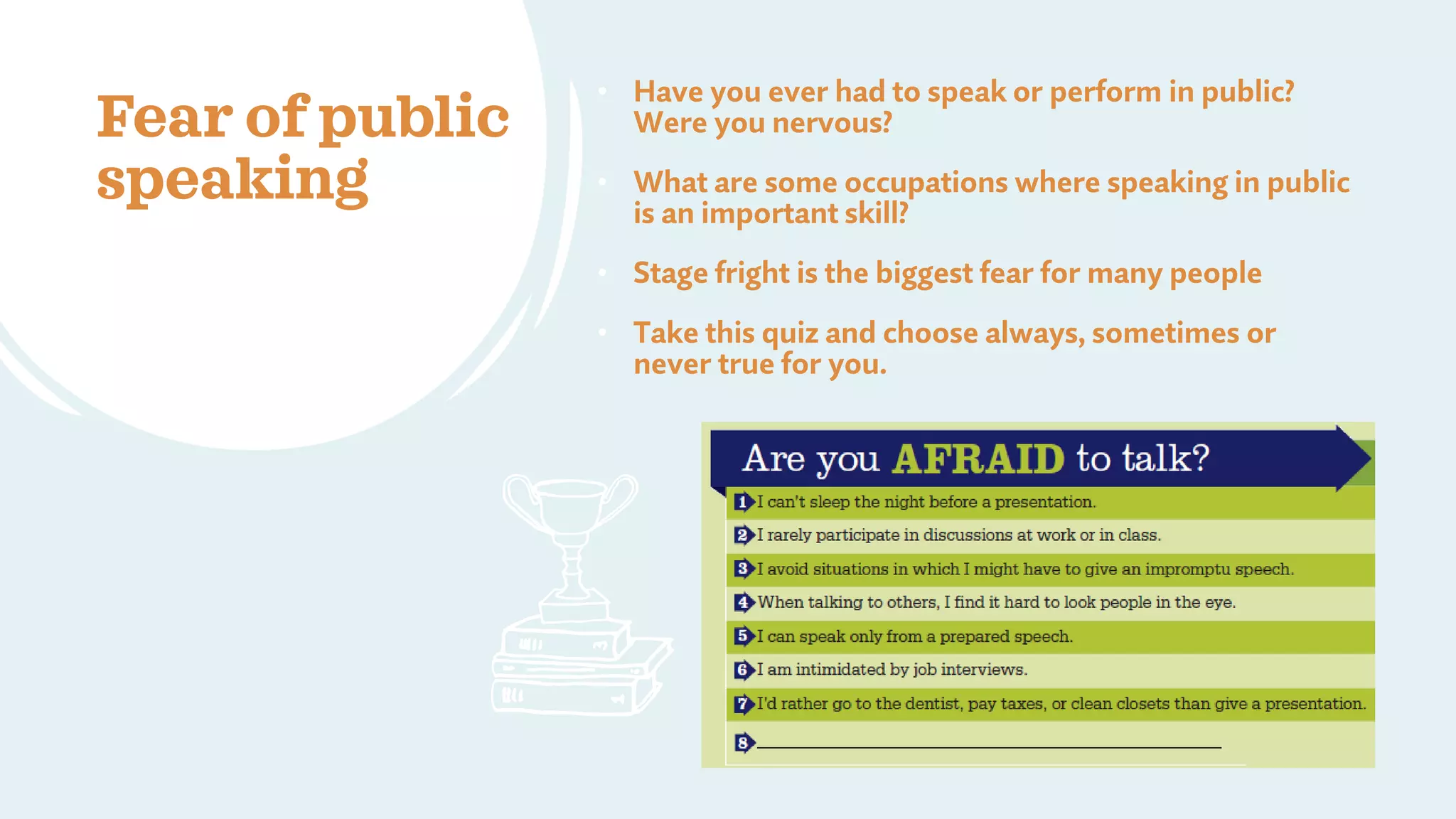
• Take this quiz and choose always, sometimes or
never true for you.
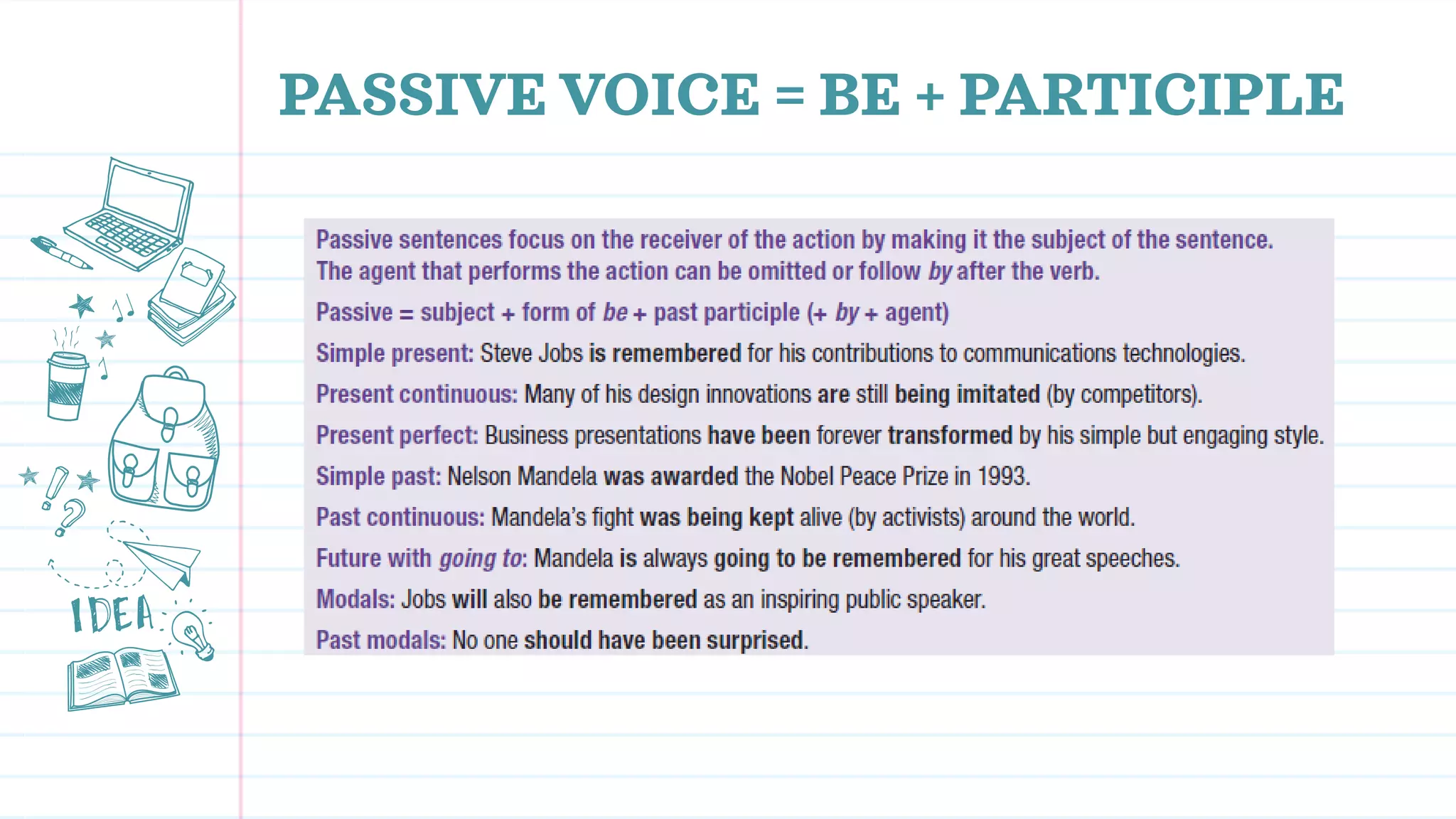
PASSIVE VOICE = BE + PARTICIPLE
Overview of passives
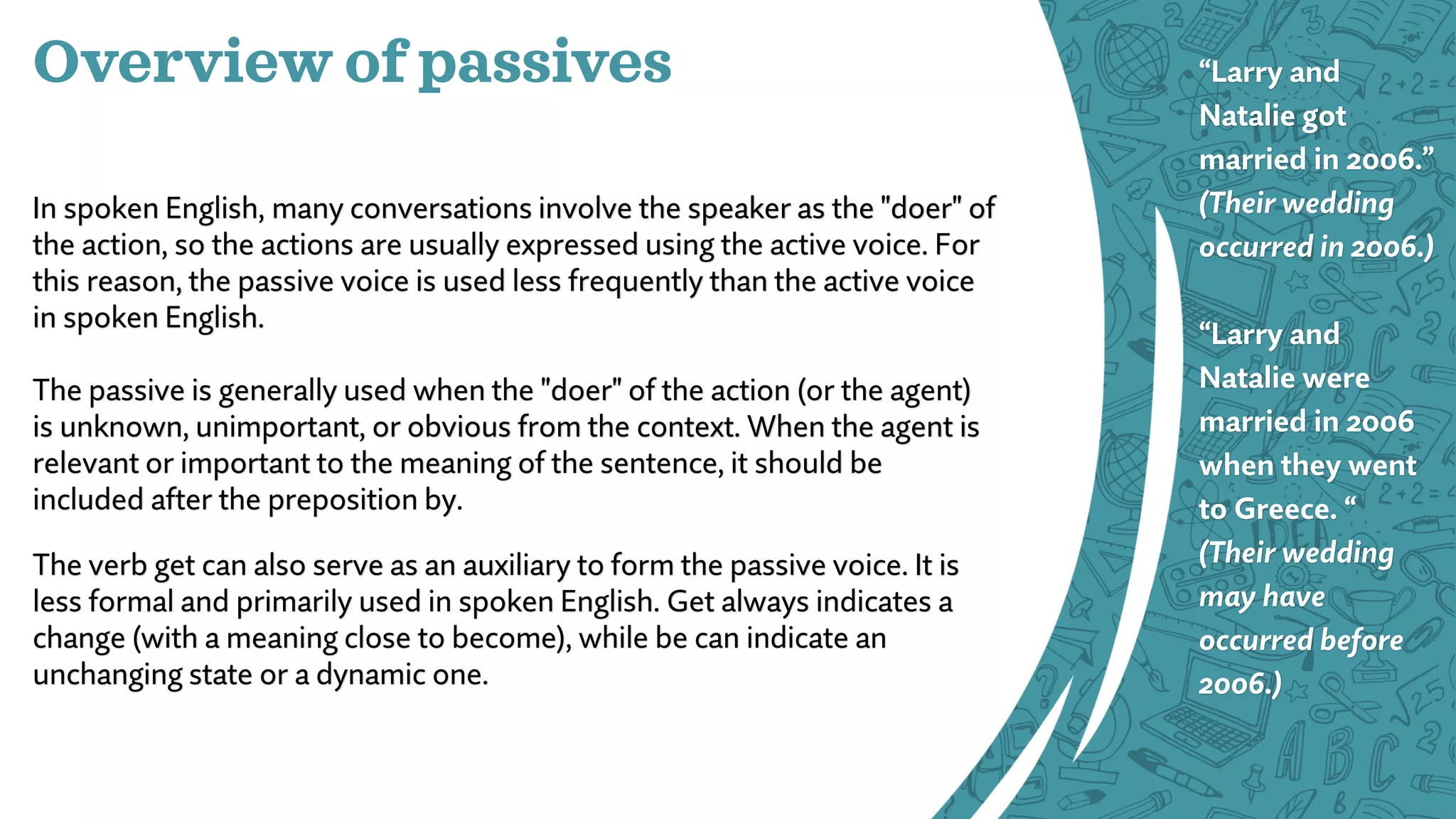
In spoken English, many conversations involve the speaker as the "doer" of
the action, so the actions are usually expressed using the active voice. For
this reason, the passive voice is used less frequently than the active voice
in spoken English.
The passive is generally used when the "doer" of the action (or the agent)
is unknown, unimportant, or obvious from the context. When the agent is
relevant or important to the meaning of the sentence, it should be
included after the preposition by.
The verb get can also serve as an auxiliary to form the passive voice. It is
less formal and primarily used in spoken English. Get always indicates a
change (with a meaning close to become), while be can indicate an
unchanging state or a dynamic one.
“Larry and
Natalie got
married in 2006.”
(Their wedding
occurred in 2006.)
“Larry and
Natalie were
married in 2006
when they went
to Greece. “
(Their wedding
may have
occurred before
2006.)
DISCOURSE MARKERS
• in conclusion
• next
• similarly
• to begin
• nevertheless
• in addition
• to sum up
• first of all
• likewise
• yet
• first / second / third
• furthermore
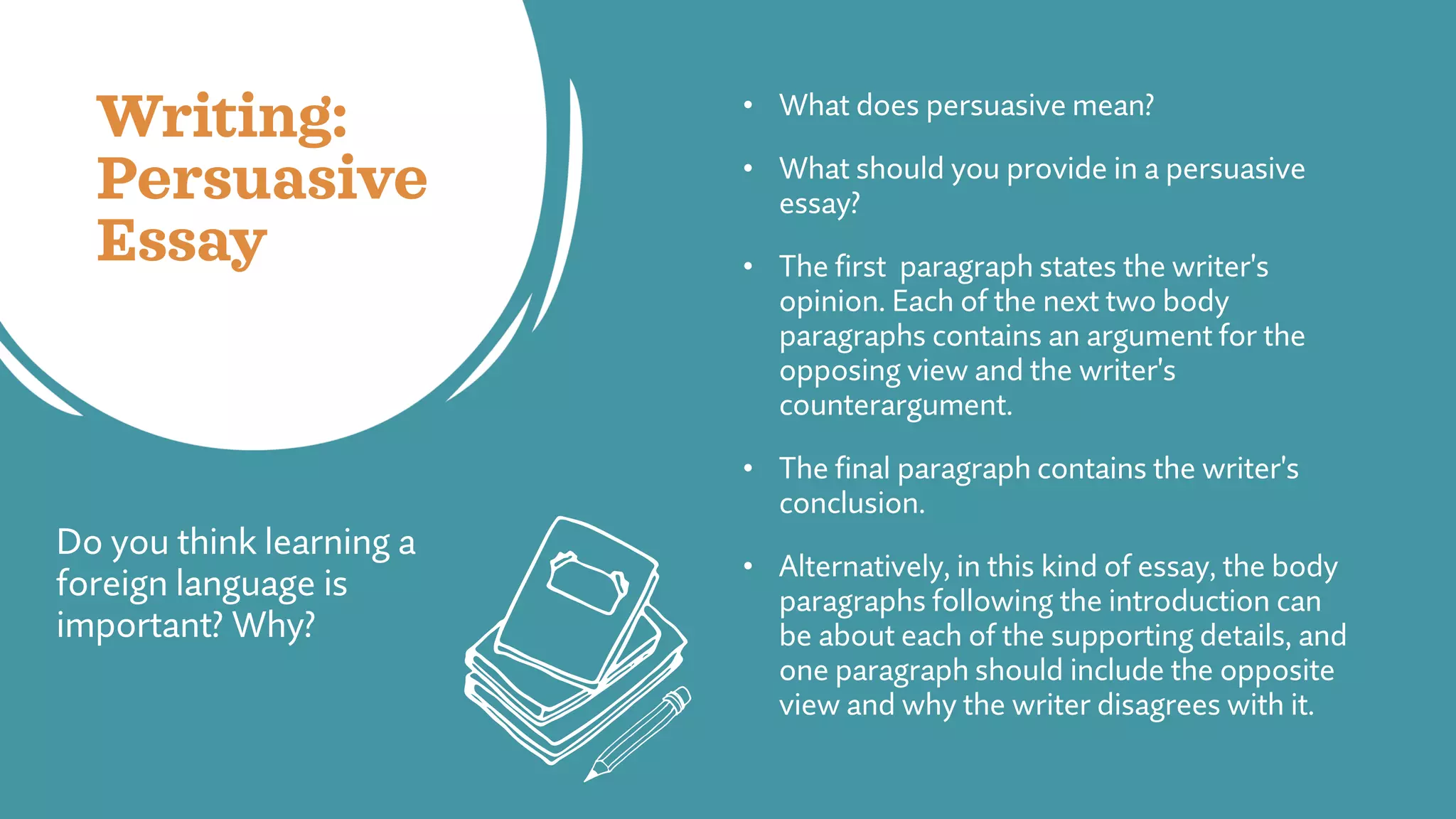
Writing:
Persuasive
Essay
• What does persuasive mean?
• What should you provide in a persuasive
essay?
• The first paragraph states the writer's
opinion. Each of the next two body
paragraphs contains an argument for the
opposing view and the writer's
counterargument.
• The final paragraph contains the writer's
conclusion.
• Alternatively, in this kind of essay, the body
paragraphs following the introduction can
be about each of the supporting details, and
one paragraph should include the opposite
view and why the writer disagrees with it.
Do you think learning a
foreign language is
important? Why?
Lesson B
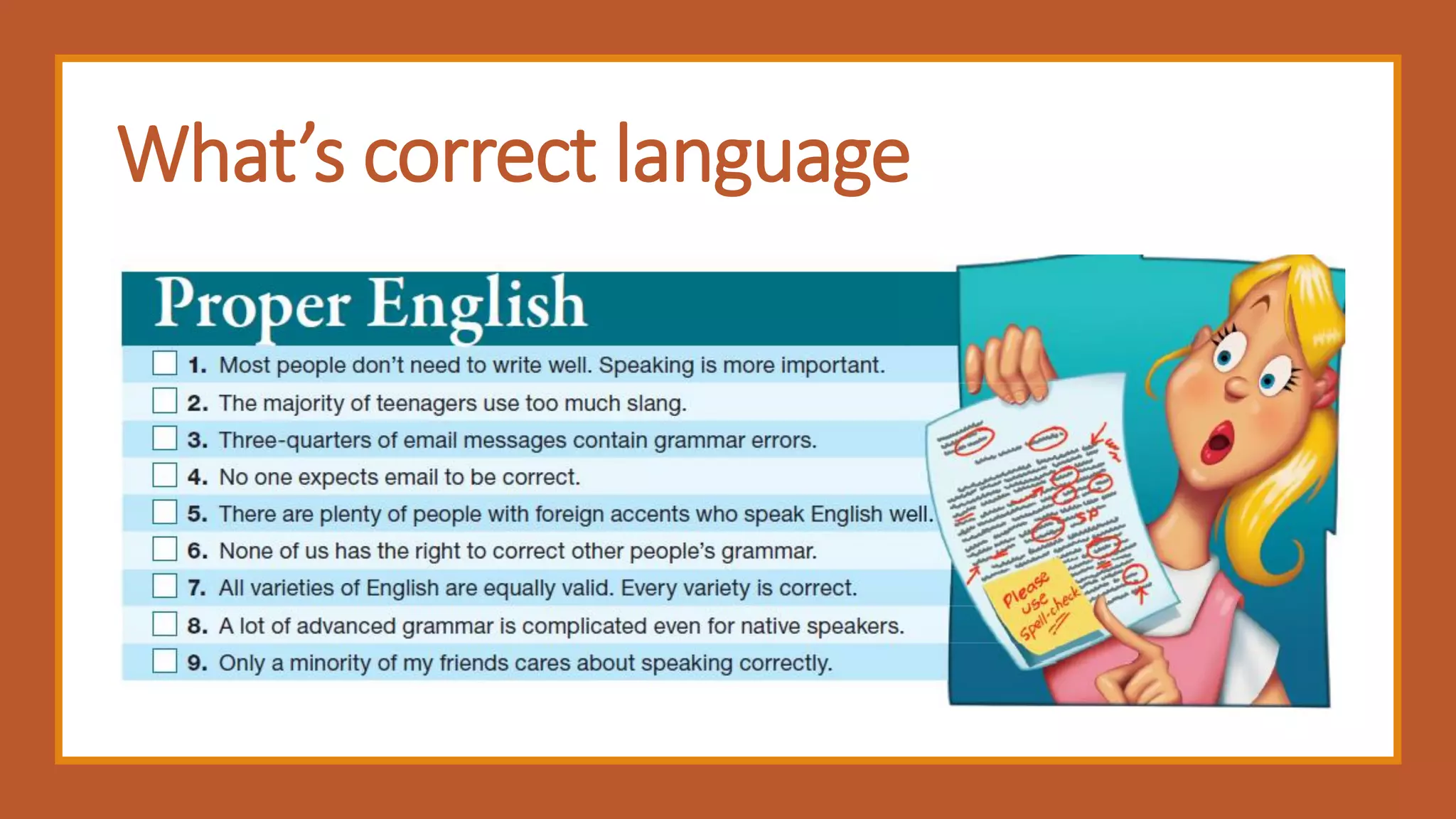
What’s correct language
What do you think of text speak?
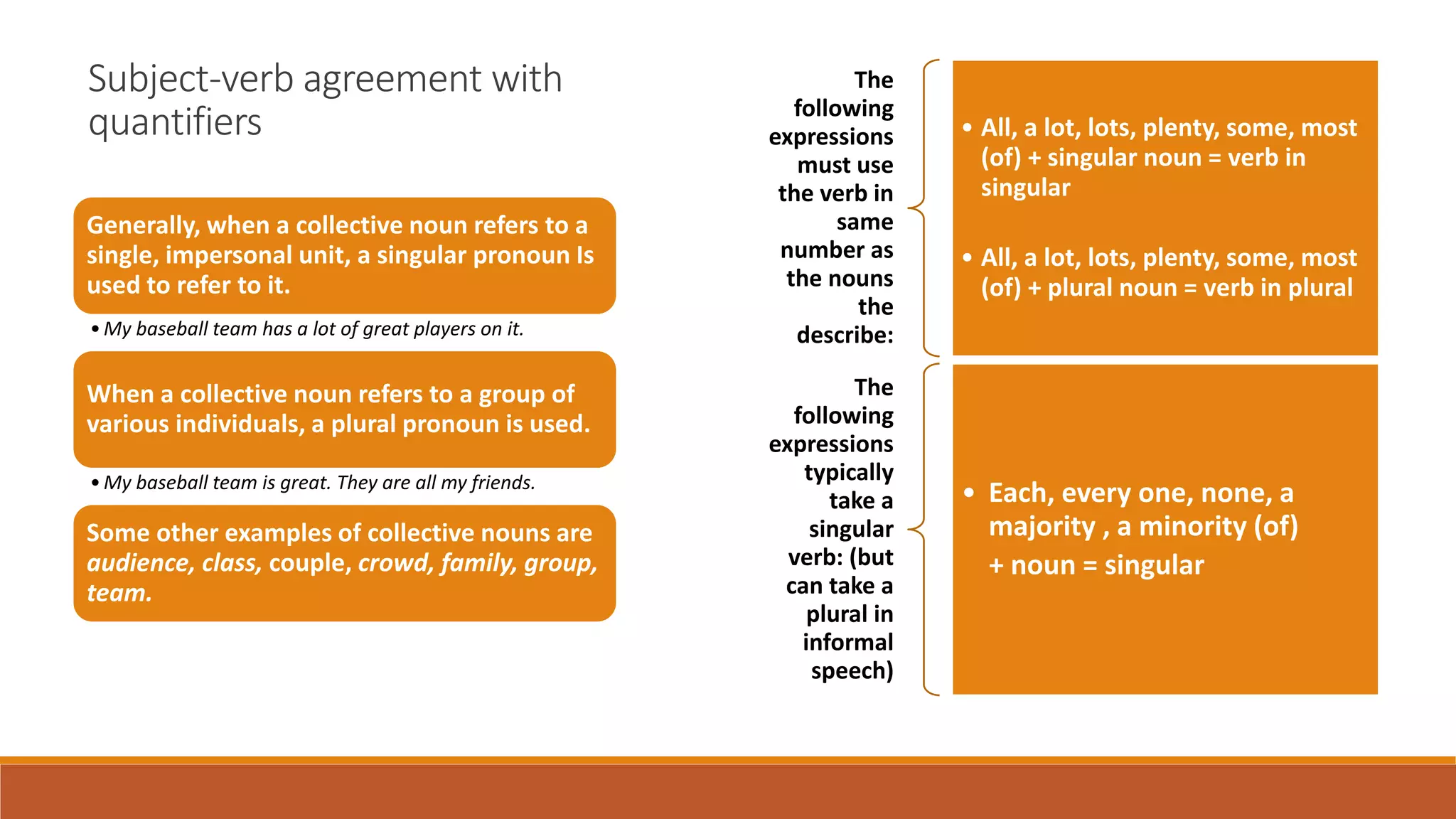
Subject-verb agreement with
quantifiers
The
following
expressions
must use
the verb in
same
number as
the nouns
the
describe:
• All, a lot, lots, plenty, some, most
(of) + singular noun = verb in
singular
• All, a lot, lots, plenty, some, most
(of) + plural noun = verb in plural
The
following
expressions
typically
take a
singular
verb: (but
can take a
plural in
informal
speech)
• Each, every one, none, a
majority , a minority (of)
+ noun = singular
Generally, when a collective noun refers to a
single, impersonal unit, a singular pronoun Is
used to refer to it.
•My baseball team has a lot of great players on it.
When a collective noun refers to a group of
various individuals, a plural pronoun is used.
•My baseball team is great. They are all my friends.
Some other examples of collective nouns are
audience, class, couple, crowd, family, group,
team.
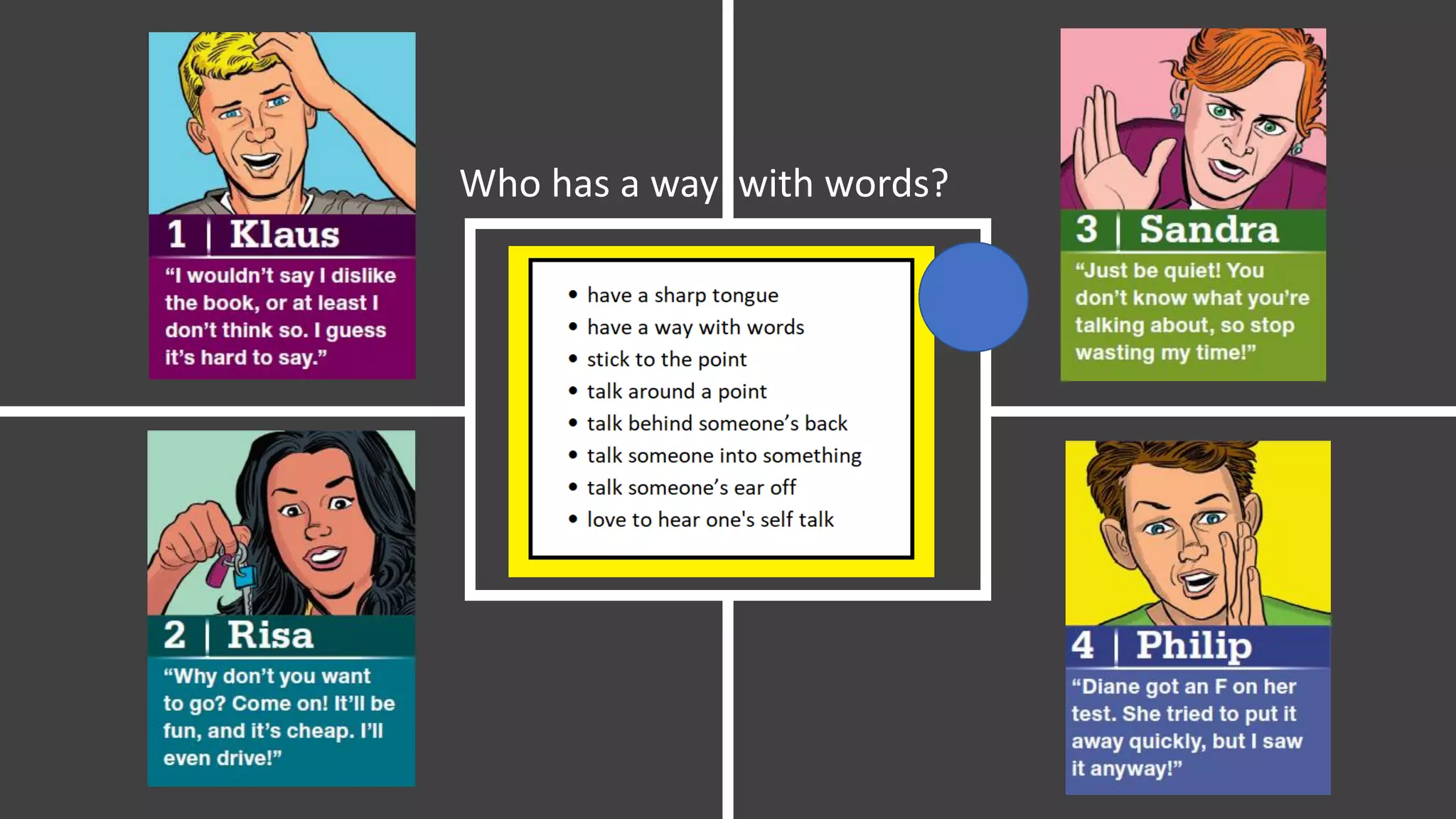
Who has a way with words?
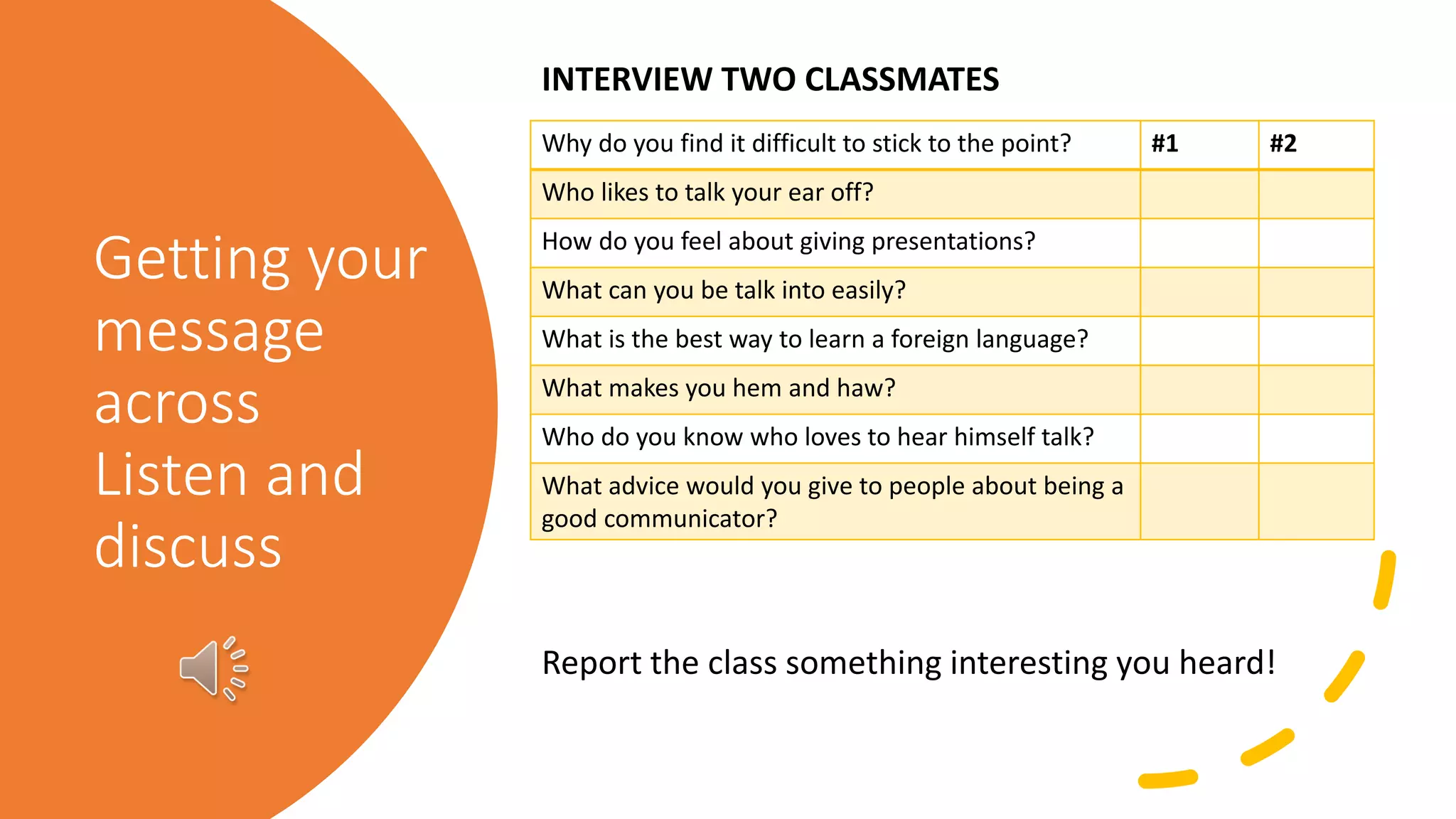
Getting your
message
across
Listen and
discuss
Why do you find it difficult to stick to the point? #1 #2
Who likes to talk your ear off?
How do you feel about giving presentations?
What can you be talk into easily?
What is the best way to learn a foreign language?
What makes you hem and haw?
Who do you know who loves to hear himself talk?
What advice would you give to people about being a
good communicator?
INTERVIEW TWO CLASSMATES
Report the class something interesting you heard!
“The limits of my
language are the
limits of my
world”

Unit 10 -Language passages 2

  • 1.
  • 2.
  • 3.
  • 4.
    Fear of public speaking •Have you ever had to speak or perform in public? Were you nervous? • What are some occupations where speaking in public is an important skill? • Stage fright is the biggest fear for many people • Take this quiz and choose always, sometimes or never true for you.
  • 5.
    PASSIVE VOICE =BE + PARTICIPLE
  • 6.
    Overview of passives Inspoken English, many conversations involve the speaker as the "doer" of the action, so the actions are usually expressed using the active voice. For this reason, the passive voice is used less frequently than the active voice in spoken English. The passive is generally used when the "doer" of the action (or the agent) is unknown, unimportant, or obvious from the context. When the agent is relevant or important to the meaning of the sentence, it should be included after the preposition by. The verb get can also serve as an auxiliary to form the passive voice. It is less formal and primarily used in spoken English. Get always indicates a change (with a meaning close to become), while be can indicate an unchanging state or a dynamic one. “Larry and Natalie got married in 2006.” (Their wedding occurred in 2006.) “Larry and Natalie were married in 2006 when they went to Greece. “ (Their wedding may have occurred before 2006.)
  • 7.
    DISCOURSE MARKERS • inconclusion • next • similarly • to begin • nevertheless • in addition • to sum up • first of all • likewise • yet • first / second / third • furthermore
  • 8.
    Writing: Persuasive Essay • What doespersuasive mean? • What should you provide in a persuasive essay? • The first paragraph states the writer's opinion. Each of the next two body paragraphs contains an argument for the opposing view and the writer's counterargument. • The final paragraph contains the writer's conclusion. • Alternatively, in this kind of essay, the body paragraphs following the introduction can be about each of the supporting details, and one paragraph should include the opposite view and why the writer disagrees with it. Do you think learning a foreign language is important? Why?
  • 9.
  • 10.
  • 11.
    What do youthink of text speak?
  • 12.
    Subject-verb agreement with quantifiers The following expressions mustuse the verb in same number as the nouns the describe: • All, a lot, lots, plenty, some, most (of) + singular noun = verb in singular • All, a lot, lots, plenty, some, most (of) + plural noun = verb in plural The following expressions typically take a singular verb: (but can take a plural in informal speech) • Each, every one, none, a majority , a minority (of) + noun = singular Generally, when a collective noun refers to a single, impersonal unit, a singular pronoun Is used to refer to it. •My baseball team has a lot of great players on it. When a collective noun refers to a group of various individuals, a plural pronoun is used. •My baseball team is great. They are all my friends. Some other examples of collective nouns are audience, class, couple, crowd, family, group, team.
  • 13.
    Who has away with words?
  • 14.
    Getting your message across Listen and discuss Whydo you find it difficult to stick to the point? #1 #2 Who likes to talk your ear off? How do you feel about giving presentations? What can you be talk into easily? What is the best way to learn a foreign language? What makes you hem and haw? Who do you know who loves to hear himself talk? What advice would you give to people about being a good communicator? INTERVIEW TWO CLASSMATES Report the class something interesting you heard!
  • 15.
    “The limits ofmy language are the limits of my world”