SUMMARY OF DATA ANALYSIS JOURNAL AND LANGUAGE COMPARISON By Jacob Shuey
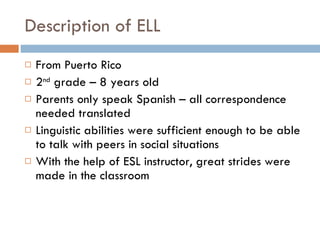
Description of ELL From Puerto Rico 2 nd  grade – 8 years old Parents only speak Spanish – all correspondence needed translated Linguistic abilities were sufficient enough to be able to talk with peers in social situations With the help of ESL instructor, great strides were made in the classroom
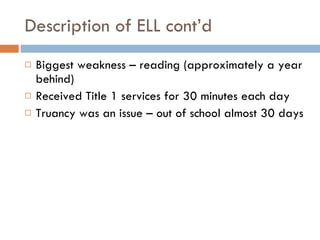
Description of ELL cont’d  Biggest weakness – reading (approximately a year behind) Received Title 1 services for 30 minutes each day Truancy was an issue – out of school almost 30 days
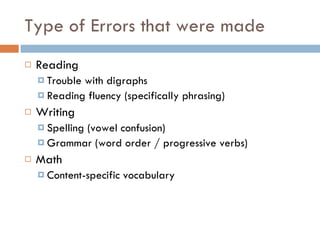
Type of Errors that were made Reading Trouble with digraphs  Reading fluency (specifically phrasing) Writing Spelling (vowel confusion) Grammar (word order / progressive verbs) Math Content-specific vocabulary
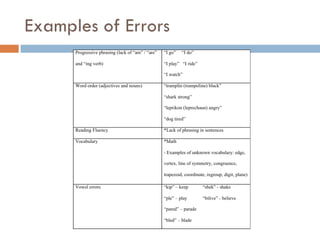
Examples of Errors
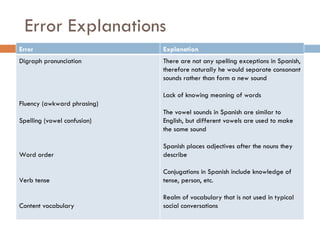
Error Explanations Error Explanation Digraph pronunciation Fluency (awkward phrasing) Spelling (vowel confusion) Word order Verb tense Content vocabulary There are not any spelling exceptions in Spanish, therefore naturally he would separate consonant sounds rather than form a new sound Lack of knowing meaning of words The vowel sounds in Spanish are similar to English, but different vowels are used to make the same sound Spanish places adjectives after the nouns they describe Conjugations in Spanish include knowledge of tense, person, etc. Realm of vocabulary that is not used in typical social conversations
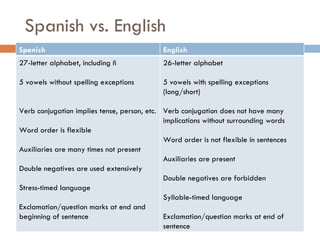
Spanish vs. English Spanish English 27-letter alphabet, including ñ 5 vowels without spelling exceptions Verb conjugation implies tense, person, etc. Word order is flexible Auxiliaries are many times not present Double negatives are used extensively Stress-timed language Exclamation/question marks at end and beginning of sentence 26-letter alphabet 5 vowels with spelling exceptions (long/short) Verb conjugation does not have many implications without surrounding words Word order is not flexible in sentences Auxiliaries are present Double negatives are forbidden Syllable-timed language Exclamation/question marks at end of sentence
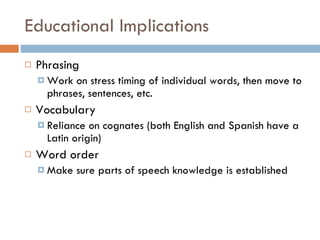
Educational Implications Phrasing Work on stress timing of individual words, then move to phrases, sentences, etc. Vocabulary Reliance on cognates (both English and Spanish have a Latin origin) Word order Make sure parts of speech knowledge is established
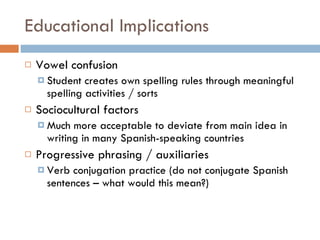
Educational Implications Vowel confusion Student creates own spelling rules through meaningful spelling activities / sorts Sociocultural factors Much more acceptable to deviate from main idea in writing in many Spanish-speaking countries Progressive phrasing / auxiliaries Verb conjugation practice (do not conjugate Spanish sentences – what would this mean?)
Final thoughts… Good news!  Many of the errors were due to a direct transfer of rules and characteristics from Spanish to English and it was clear that this student had a great knowledge of their L1 In conclusion… Encourage connections from L1 to L2, but teach new rules of L2 that are relevant Develop vocabulary across curriculum
References Dalby, J. (2006). Vowel errors and sentence intelligibility in spanish-accented english speech.  Acoustical Society of America ,  119 (5), Retrieved from  http://asadl.org/jasa/resource/1/jasman/v119/i5/p3423_s5?bypassSSO=1   Flaitz, J. (2003).  Understanding your international students: an education, cultural, and linguistic guide , (Ed.). Ann Arbor, MI: The University of Michigan Press. Freeman, D, & Freeman, Y. (2004).  Essential linguistics . Portsmouth, NH: Heinemann. Hinkel, E. (1999).  Culture in second language teaching and learning , (Ed.). New York, NY: Cambridge University Press. O'Grady, W, Archibald, J, Aronoff, M, & Rees-Miller, J. (2010).  Contemporary linguistics . Boston, MA: Bedford St. Martins. Shoebottom, P. (1996).  A guide to learning english . Retrieved from  http://esl.fis.edu/index.htm

Language Comparison Powerpoint

  • 1.
    SUMMARY OF DATAANALYSIS JOURNAL AND LANGUAGE COMPARISON By Jacob Shuey
  • 2.
    Description of ELLFrom Puerto Rico 2 nd grade – 8 years old Parents only speak Spanish – all correspondence needed translated Linguistic abilities were sufficient enough to be able to talk with peers in social situations With the help of ESL instructor, great strides were made in the classroom
  • 3.
    Description of ELLcont’d Biggest weakness – reading (approximately a year behind) Received Title 1 services for 30 minutes each day Truancy was an issue – out of school almost 30 days
  • 4.
    Type of Errorsthat were made Reading Trouble with digraphs Reading fluency (specifically phrasing) Writing Spelling (vowel confusion) Grammar (word order / progressive verbs) Math Content-specific vocabulary
  • 5.
  • 6.
    Error Explanations ErrorExplanation Digraph pronunciation Fluency (awkward phrasing) Spelling (vowel confusion) Word order Verb tense Content vocabulary There are not any spelling exceptions in Spanish, therefore naturally he would separate consonant sounds rather than form a new sound Lack of knowing meaning of words The vowel sounds in Spanish are similar to English, but different vowels are used to make the same sound Spanish places adjectives after the nouns they describe Conjugations in Spanish include knowledge of tense, person, etc. Realm of vocabulary that is not used in typical social conversations
  • 7.
    Spanish vs. EnglishSpanish English 27-letter alphabet, including ñ 5 vowels without spelling exceptions Verb conjugation implies tense, person, etc. Word order is flexible Auxiliaries are many times not present Double negatives are used extensively Stress-timed language Exclamation/question marks at end and beginning of sentence 26-letter alphabet 5 vowels with spelling exceptions (long/short) Verb conjugation does not have many implications without surrounding words Word order is not flexible in sentences Auxiliaries are present Double negatives are forbidden Syllable-timed language Exclamation/question marks at end of sentence
  • 8.
    Educational Implications PhrasingWork on stress timing of individual words, then move to phrases, sentences, etc. Vocabulary Reliance on cognates (both English and Spanish have a Latin origin) Word order Make sure parts of speech knowledge is established
  • 9.
    Educational Implications Vowelconfusion Student creates own spelling rules through meaningful spelling activities / sorts Sociocultural factors Much more acceptable to deviate from main idea in writing in many Spanish-speaking countries Progressive phrasing / auxiliaries Verb conjugation practice (do not conjugate Spanish sentences – what would this mean?)
  • 10.
    Final thoughts… Goodnews! Many of the errors were due to a direct transfer of rules and characteristics from Spanish to English and it was clear that this student had a great knowledge of their L1 In conclusion… Encourage connections from L1 to L2, but teach new rules of L2 that are relevant Develop vocabulary across curriculum
  • 11.
    References Dalby, J.(2006). Vowel errors and sentence intelligibility in spanish-accented english speech. Acoustical Society of America , 119 (5), Retrieved from http://asadl.org/jasa/resource/1/jasman/v119/i5/p3423_s5?bypassSSO=1 Flaitz, J. (2003). Understanding your international students: an education, cultural, and linguistic guide , (Ed.). Ann Arbor, MI: The University of Michigan Press. Freeman, D, & Freeman, Y. (2004). Essential linguistics . Portsmouth, NH: Heinemann. Hinkel, E. (1999). Culture in second language teaching and learning , (Ed.). New York, NY: Cambridge University Press. O'Grady, W, Archibald, J, Aronoff, M, & Rees-Miller, J. (2010). Contemporary linguistics . Boston, MA: Bedford St. Martins. Shoebottom, P. (1996). A guide to learning english . Retrieved from http://esl.fis.edu/index.htm