Passages 1
Units 1-6
Speaking Objectives
Friends and family
UNIT 1
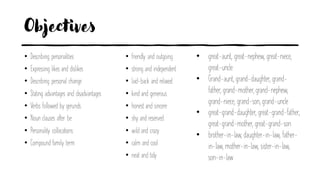
Objectives
• Describing personalities
• Expressing likes and dislikes
• Describing personal change
• Stating advantages and disadvantages
• Verbs followed by gerunds
• Noun clauses after be
• Personality collocations
• Compound family term
• friendly and outgoing
• strong and independent
• laid-back and relaxed
• kind and generous
• honest and sincere
• shy and reserved
• wild and crazy
• calm and cool
• neat and tidy
• great-aunt, great-nephew, great-niece,
great-uncle
• Grand-aunt, grand-daughter, grand-
father, grand-mother, grand-nephew,
grand-niece, grand-son, grand-uncle
• great-grand-daughter, great-grand-father,
great-grand-mother, great-grand-son
• brother-in-law, daughter-in-law, father-
in-law, mother-in-law, sister-in-law,
son-in-law
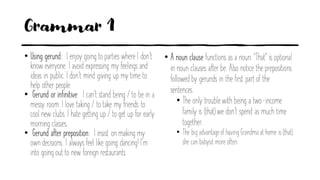
Grammar 1
• Using gerund: I enjoy going to parties where I don’t
know everyone. I avoid expressing my feelings and
ideas in public. I don’t mind giving up my time to
help other people
• Gerund or infinitive: I can’t stand being / to be in a
messy room. I love taking / to take my friends to
cool new clubs. I hate getting up / to get up for early
morning classes.
• Gerund after preposition: I insist on making my
own decisions. I always feel like going dancing! I’m
into going out to new foreign restaurants
• A noun clause functions as a noun. "That" is optional
in noun clauses after be. Also notice the prepositions
followed by gerunds in the first part of the
sentences.
• The only troublewith being a two-income
family is (that) we don’t spend as much time
together.
• The big advantageof having Grandma at home is (that)
she can babysit more often.
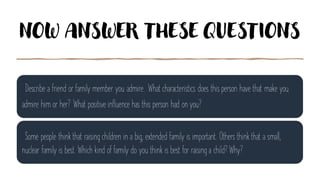
NOW ANSWER THESE QUESTIONS
Describe a friend or family member you admire. What characteristics does this person have that make you
admire him or her? What positive influence has this person had on you?
Some people think that raising children in a big, extended family is important. Others think that a small,
nuclear family is best. Which kind of family do you think is best for raising a child? Why?
Mistakes and
mysteries
UNIT 2
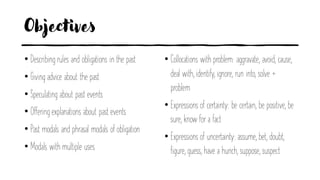
Objectives
• Describing rules and obligations in the past
• Giving advice about the past
• Speculating about past events
• Offering explanations about past events
• Past modals and phrasal modals of obligation
• Modals with multiple uses
• Collocations with problem: aggravate, avoid, cause,
deal with, identify, ignore, run into, solve +
problem
• Expressions of certainty: be certain, be positive, be
sure, know for a fact
• Expressions of uncertainty: assume, bet, doubt,
figure, guess, have a hunch, suppose, suspect
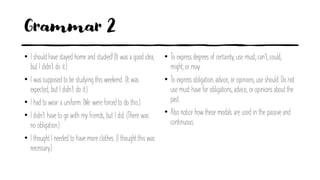
Grammar 2
• I should have stayed home and studied! (It was a good idea,
but I didn’t do it.)
• I was supposed to be studying this weekend. (It was
expected, but I didn’t do it.)
• I had to wear a uniform. (We were forced to do this.)
• I didn’t have to go with my friends, but I did. (There was
no obligation.)
• I thoughtI needed to have more clothes. (I thoughtthis was
necessary.)
• To express degrees of certainty, use must, can’t, could,
might, or may.
• To express obligation, advice, or opinions, use should. Do not
use must have for obligations, advice, or opinions about the
past.
• Also notice how these modals are used in the passive and
continuous.
Now answer these questions
Describe a decision you made in the past that had negative consequences. Explain
how you dealt with those consequences and what you think you should have
done differently. Include details and examples to support your explanation.
Some people believe that they should solve all of their problems by themselves.
Others believe that it’s better to ask others for help. How do you prefer to deal
with problems? Why?
Exploring new cities
UNIT 3
Objectives
• Describing and giving information about places
• Stating preferences
• Presenting contrasting information
• Categorizing and evaluating issues
• Deining and non-deining relative clauses
• Order of modiiers
• Connecting contrasting ideas
• Features of cities: climate, cost of living, crime
rate, cuisine, green spaces, hotels, job
market, landmarks, neighborhoods, nightlife,
shopping, transportationsystem.
• Types of town: border town, coastal town, college
town, industrial town, mountain town, port
town, resort town, rural town, suburban town, tourist
town.
Gramar 3
Defining relative clause
• Gives essential information about a noun
functioning like adjectives. They must follow
inmediately the noun they describe.
• PEOPLE LIKE TO GO TO RESTAURANTS THAT HAVE
GOOD FOOD.
Non-defining relative clause
• Gives optional information about a noun
and cannot begin with the pronoun that. They are
set off by commas.
• THAT RESTAURANT, WHICH HAS GOOD FOOD, IS THE
MOST POPULAR IN TOWN.
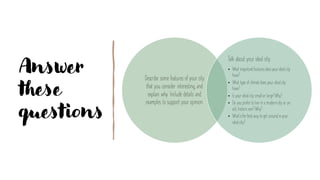
Answer
these
questions
Describe some features of your city
that you consider interesting, and
explain why. Include details and
examples to support your opinion.
Talk about your ideal city.
• What importantfeaturesdoesyouridealcity
have?
• What type of climatedoes your idealcity
have?
• Is your idealcity smallor large?Why?
• Do you preferto live in a moderncity or an
old, historicone? Why?
• What’sthe bestway to get aroundinyour
idealcity?
Early birds and
night owls
UNIT 4
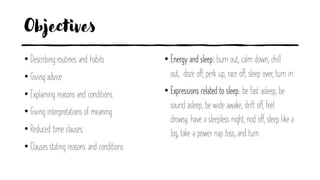
Objectives
• Describing routines and habits
• Giving advice
• Explaining reasons and conditions
• Giving interpretations of meaning
• Reduced time clauses
• Clauses stating reasons and conditions
• Energy and sleep: burn out, calm down, chill
out, doze off, perk up, race off, sleep over, turn in.
• Expressions related to sleep: be fast asleep, be
sound asleep, be wide awake, drift off, feel
drowsy, have a sleepless night, nod off, sleep like a
log, take a power nap toss, and turn.
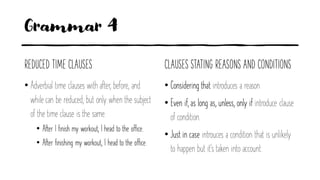
Grammar 4
REDUCED TIME CLAUSES
• Adverbial time clauses with after, before, and
while can be reduced, but only when the subject
of the time clause is the same.
• After I finish my workout, I head to the office.
• After finishing my workout, I head to the office.
CLAUSES STATING REASONS AND CONDITIONS
• Considering that introduces a reason
• Even if, as long as, unless, only if introduce clause
of condition.
• Just in case introuces a condition that is unlikely
to happen but it's taken into account.
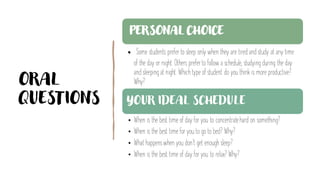
ORAL
QUESTIONS
PERSONAL CHOICE
• Some students preferto sleep only when they are tiredand study at any time
of the day or night. Others preferto follow a schedule, studying during the day
and sleeping at night. Which type of student do you think is more productive?
Why?
YOUR IDEAL SCHEDULE
• When is the best time of day for you to concentratehard on something?
• When is the best time for you to go to bed? Why?
• What happenswhen you don’t get enough sleep?
• When is the best time of day for you to relax? Why?
Communication
UNIT 5
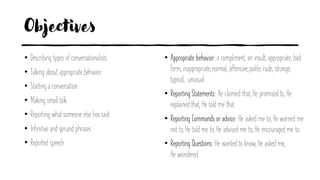
Objectives
• Describing types of conversationalists
• Talking about appropriate behavior
• Starting a conversation
• Making small talk
• Reporting what someone else has said
• Infinitive and gerund phrases
• Reported speech
• Appropriate behavior: a compliment, an insult, appropriate, bad
form, inappropriate,normal, offensive,polite, rude, strange,
typical, unusual.
• Reporting Statements: He claimed that, He promised to, He
explained that, He told me that.
• Reporting Commands or advice: He asked me to, He warned me
not to, He told me to, He advised me to, He encouraged me to.
• Reporting Questions: He wanted to know, He asked me,
He wondered
What’s the real story?
UNIT 6
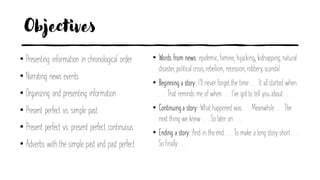
Objectives
• Presenting information in chronological order
• Narrating news events
• Organizing and presenting information
• Present perfect vs. simple past
• Present perfect vs. present perfect continuous
• Adverbs with the simple past and past perfect
• Words from news: epidemic, famine, hijacking,, kidnapping, natural
disaster, political crisis, rebellion, recession, robbery, scandal.
• Beginning a story: I’ll never forget the time . . . It all started when
. . . That reminds me of when . . . I’ve got to tell you about . . .
• Continuinga story: What happened was . . . Meanwhile . . . The
next thing we knew . . . So later on . . .
• Ending a story: And in the end . . . To make a long story short . . .
So finally . . .
Grammar 6
• Use the present perfect to report a recent event without
giving a specific time reference. Use the simple past to
report an event with a specific time reference.
• Use the present perfect continuous to describe temporary
situationsand actions that are not yet completed. The
present perfect describes permanent situationsand recently
completed actions.Use the present perfect with the passive
or with stative verbs such as be, love, and have.
•Adverbs of time help to clarify when an event or
situation in the past tool place:
• Afterwards, / Later, / The next day, to describe something
that happened at a later time.
• When / As soon as / The moment I got to describe two
things that happened at the same time.
• Up until then, / Before that, / Until that time to describe
something that was true or that happened before another
event in the past.
Questions
• Personal preference: Name the news medium that you prefer to use
to find out about current events. Explain why you prefer this news
medium over others. Include details and examples to support your
explanation.
• Personal choice: Some people prefer to read about current events
in the newspaper. Others prefer to watch the news on TV. Some
people prefer to get news about current events online. Which kind of
news medium do you think is the most trustworthy? Explain your
views.

First review 1 6 pass1

  • 1.
  • 2.
  • 3.
    Objectives • Describing personalities •Expressing likes and dislikes • Describing personal change • Stating advantages and disadvantages • Verbs followed by gerunds • Noun clauses after be • Personality collocations • Compound family term • friendly and outgoing • strong and independent • laid-back and relaxed • kind and generous • honest and sincere • shy and reserved • wild and crazy • calm and cool • neat and tidy • great-aunt, great-nephew, great-niece, great-uncle • Grand-aunt, grand-daughter, grand- father, grand-mother, grand-nephew, grand-niece, grand-son, grand-uncle • great-grand-daughter, great-grand-father, great-grand-mother, great-grand-son • brother-in-law, daughter-in-law, father- in-law, mother-in-law, sister-in-law, son-in-law
  • 4.
    Grammar 1 • Usinggerund: I enjoy going to parties where I don’t know everyone. I avoid expressing my feelings and ideas in public. I don’t mind giving up my time to help other people • Gerund or infinitive: I can’t stand being / to be in a messy room. I love taking / to take my friends to cool new clubs. I hate getting up / to get up for early morning classes. • Gerund after preposition: I insist on making my own decisions. I always feel like going dancing! I’m into going out to new foreign restaurants • A noun clause functions as a noun. "That" is optional in noun clauses after be. Also notice the prepositions followed by gerunds in the first part of the sentences. • The only troublewith being a two-income family is (that) we don’t spend as much time together. • The big advantageof having Grandma at home is (that) she can babysit more often.
  • 5.
    NOW ANSWER THESEQUESTIONS Describe a friend or family member you admire. What characteristics does this person have that make you admire him or her? What positive influence has this person had on you? Some people think that raising children in a big, extended family is important. Others think that a small, nuclear family is best. Which kind of family do you think is best for raising a child? Why?
  • 6.
  • 7.
    Objectives • Describing rulesand obligations in the past • Giving advice about the past • Speculating about past events • Offering explanations about past events • Past modals and phrasal modals of obligation • Modals with multiple uses • Collocations with problem: aggravate, avoid, cause, deal with, identify, ignore, run into, solve + problem • Expressions of certainty: be certain, be positive, be sure, know for a fact • Expressions of uncertainty: assume, bet, doubt, figure, guess, have a hunch, suppose, suspect
  • 8.
    Grammar 2 • Ishould have stayed home and studied! (It was a good idea, but I didn’t do it.) • I was supposed to be studying this weekend. (It was expected, but I didn’t do it.) • I had to wear a uniform. (We were forced to do this.) • I didn’t have to go with my friends, but I did. (There was no obligation.) • I thoughtI needed to have more clothes. (I thoughtthis was necessary.) • To express degrees of certainty, use must, can’t, could, might, or may. • To express obligation, advice, or opinions, use should. Do not use must have for obligations, advice, or opinions about the past. • Also notice how these modals are used in the passive and continuous.
  • 9.
    Now answer thesequestions Describe a decision you made in the past that had negative consequences. Explain how you dealt with those consequences and what you think you should have done differently. Include details and examples to support your explanation. Some people believe that they should solve all of their problems by themselves. Others believe that it’s better to ask others for help. How do you prefer to deal with problems? Why?
  • 10.
  • 11.
    Objectives • Describing andgiving information about places • Stating preferences • Presenting contrasting information • Categorizing and evaluating issues • Deining and non-deining relative clauses • Order of modiiers • Connecting contrasting ideas • Features of cities: climate, cost of living, crime rate, cuisine, green spaces, hotels, job market, landmarks, neighborhoods, nightlife, shopping, transportationsystem. • Types of town: border town, coastal town, college town, industrial town, mountain town, port town, resort town, rural town, suburban town, tourist town.
  • 12.
    Gramar 3 Defining relativeclause • Gives essential information about a noun functioning like adjectives. They must follow inmediately the noun they describe. • PEOPLE LIKE TO GO TO RESTAURANTS THAT HAVE GOOD FOOD. Non-defining relative clause • Gives optional information about a noun and cannot begin with the pronoun that. They are set off by commas. • THAT RESTAURANT, WHICH HAS GOOD FOOD, IS THE MOST POPULAR IN TOWN.
  • 13.
    Answer these questions Describe some featuresof your city that you consider interesting, and explain why. Include details and examples to support your opinion. Talk about your ideal city. • What importantfeaturesdoesyouridealcity have? • What type of climatedoes your idealcity have? • Is your idealcity smallor large?Why? • Do you preferto live in a moderncity or an old, historicone? Why? • What’sthe bestway to get aroundinyour idealcity?
  • 14.
  • 15.
    Objectives • Describing routinesand habits • Giving advice • Explaining reasons and conditions • Giving interpretations of meaning • Reduced time clauses • Clauses stating reasons and conditions • Energy and sleep: burn out, calm down, chill out, doze off, perk up, race off, sleep over, turn in. • Expressions related to sleep: be fast asleep, be sound asleep, be wide awake, drift off, feel drowsy, have a sleepless night, nod off, sleep like a log, take a power nap toss, and turn.
  • 16.
    Grammar 4 REDUCED TIMECLAUSES • Adverbial time clauses with after, before, and while can be reduced, but only when the subject of the time clause is the same. • After I finish my workout, I head to the office. • After finishing my workout, I head to the office. CLAUSES STATING REASONS AND CONDITIONS • Considering that introduces a reason • Even if, as long as, unless, only if introduce clause of condition. • Just in case introuces a condition that is unlikely to happen but it's taken into account.
  • 17.
    ORAL QUESTIONS PERSONAL CHOICE • Somestudents preferto sleep only when they are tiredand study at any time of the day or night. Others preferto follow a schedule, studying during the day and sleeping at night. Which type of student do you think is more productive? Why? YOUR IDEAL SCHEDULE • When is the best time of day for you to concentratehard on something? • When is the best time for you to go to bed? Why? • What happenswhen you don’t get enough sleep? • When is the best time of day for you to relax? Why?
  • 18.
  • 19.
    Objectives • Describing typesof conversationalists • Talking about appropriate behavior • Starting a conversation • Making small talk • Reporting what someone else has said • Infinitive and gerund phrases • Reported speech • Appropriate behavior: a compliment, an insult, appropriate, bad form, inappropriate,normal, offensive,polite, rude, strange, typical, unusual. • Reporting Statements: He claimed that, He promised to, He explained that, He told me that. • Reporting Commands or advice: He asked me to, He warned me not to, He told me to, He advised me to, He encouraged me to. • Reporting Questions: He wanted to know, He asked me, He wondered
  • 20.
    What’s the realstory? UNIT 6
  • 21.
    Objectives • Presenting informationin chronological order • Narrating news events • Organizing and presenting information • Present perfect vs. simple past • Present perfect vs. present perfect continuous • Adverbs with the simple past and past perfect • Words from news: epidemic, famine, hijacking,, kidnapping, natural disaster, political crisis, rebellion, recession, robbery, scandal. • Beginning a story: I’ll never forget the time . . . It all started when . . . That reminds me of when . . . I’ve got to tell you about . . . • Continuinga story: What happened was . . . Meanwhile . . . The next thing we knew . . . So later on . . . • Ending a story: And in the end . . . To make a long story short . . . So finally . . .
  • 22.
    Grammar 6 • Usethe present perfect to report a recent event without giving a specific time reference. Use the simple past to report an event with a specific time reference. • Use the present perfect continuous to describe temporary situationsand actions that are not yet completed. The present perfect describes permanent situationsand recently completed actions.Use the present perfect with the passive or with stative verbs such as be, love, and have. •Adverbs of time help to clarify when an event or situation in the past tool place: • Afterwards, / Later, / The next day, to describe something that happened at a later time. • When / As soon as / The moment I got to describe two things that happened at the same time. • Up until then, / Before that, / Until that time to describe something that was true or that happened before another event in the past.
  • 23.
    Questions • Personal preference:Name the news medium that you prefer to use to find out about current events. Explain why you prefer this news medium over others. Include details and examples to support your explanation. • Personal choice: Some people prefer to read about current events in the newspaper. Others prefer to watch the news on TV. Some people prefer to get news about current events online. Which kind of news medium do you think is the most trustworthy? Explain your views.