ELL Presentation Learning Theories 5101 Kevin Neuenswander Learning Structures
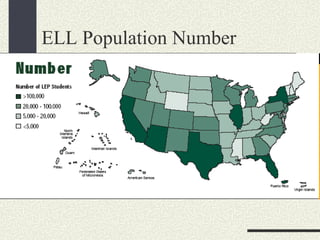
ELL Population Number
ELL Population Density
ELL Population Growth States growing the fastest are the Midwest
English Pronunciation  From  The Mother Tongue  by Bill Bryson English possesses more sounds than almost any other language.  The International Phonetic Alphabet differentiates between 52 sounds used in English, divided equally between consonants and vowels.  In contrast, Spanish uses 27, while Hawaiian gets by with just 13.  However, if you listen carefully, there are many more than this. The “ng,” combination for example, can be a discrete sound ( bring, sing ), but in fact we make two sounds with it – a soft “g” with  singer  and a hard “g” with  finger .
English Pronunciation  If there is one thing certain abut English pronunciation it is that there is almost nothing certain about it.  No other language in the world has more words spelled the same way & yet pronounced differently.  A few examples are: heard – beard road – broad five – give fillet – skillet early – dearly beau – beauty steak – streak ache – mustache doll – droll scour – four four – tour paid – said break – speak low - how
English Pronunciation  In some languages, such as Finish, there is a tidy one-to-one correspondence between the sound & spelling.  A  k  to the Finns is always  “ k ,”  and an  l   always and  “ l .”   But in English, pronunciation is so various – that not one of our 26 letters can be relied on for constancy.  Either they have a variety of pronunciations, like the  c   in  race, rack,  &  rich , or they hide in silence, like the  b  in  debt , the  a   in  bread , the second  t  in  thistle .
English Pronunciation  In combinations they can become even more unpredictable.  One of the most obvious is the letter cluster  ough , which can be pronounce in any of 8 ways –  through, though, thought, tough, plough, thorough, hic-cough,  &   lough (lock). We are also prone to slur phrases. Americans will say  jeetjet “did you eat yet”   and   lesskweet  for  “let’s go eat.”
English Pronunciation  We make another unconscious distinction between the hard “th” of  those  & the soft one of  thought .  Also, even more subtle is when we use a “k” sound at the start of a word, we put a tiny puff of breath behind it ( kitchen, conquer ) but when the “k” follows and s ( skill, skid ) we withhold the puff. There are many words that we pronounce considerably different then they are spelled: later –  lader butter –  budder/buddah wash –  worsh granted –  grannid looked –  lookt warmth –  warmpth
English Pronunciation  As native English speakers we can distinguish between the most subtle graduations of emphasis.  Most of us, if we are paying attention, can detect the difference between  that’s tough  &  that stuff , between  I love you  &  isle of view , & between  gray day   &   Grade A ,  between  African Elephant   &   a frick’n elephant  even though the phonics are incredibly similar.
BICS & CALP Classroom teachers need to understand the difference between social language & academic language acquisition.  Here is a simple description of BICS & CALP as theorized by Jim Cummins. Basic Interpersonal Communication Skills (BICS) Basic Interpersonal Communication Skills (BICS) are language skills needed in social situations.  It is the day-to-day language need to interact socially with other people.  ELL’s employ BIC skills when they are on the playground, in the lunch room, on the bus, at parties, playing sports & talking on the phone.
BICS & CALP Basic Interpersonal Communication Skills (BICS)   (cont.) Social interactions are usually context embedded.  They occur in a meaningful social context.  They are not very demanding cognitively.  The language required is not specialized.  These language skills usually develop within six months to two years after arrival in the U.S.  Problems arise when teachers & administrators think that a child is proficient in a language when they demonstrate good social English.
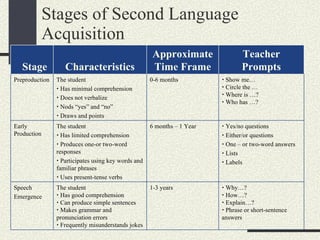
Stages of Second Language Acquisition Stage Characteristics Approximate Time Frame Teacher Prompts Preproduction The student     Has minimal comprehension    Does not verbalize    Nods “yes” and “no”    Draws and points 0-6 months    Show me…    Circle the …    Where is …?    Who has …? Early Production The student     Has limited comprehension    Produces one-or two-word responses    Participates using key words and familiar phrases    Uses present-tense verbs 6 months – 1 Year    Yes/no questions    Either/or questions    One – or two-word answers    Lists    Labels Speech Emergence The student    Has good comprehension    Can produce simple sentences    Makes grammar and pronunciation errors    Frequently misunderstands jokes 1-3 years    Why…?    How…?    Explain…?    Phrase or short-sentence answers
Stages of Second Language Acquisition Stage Characteristics Approximate Time Frame Teacher Prompts Intermediate Fluency The student    Has excellent comprehension    Makes few grammatical errors 3 – 5 years    What would happen if ..?    What do you think…? Advanced Fluency The student has a near-native level of speech. 5 – 7 years    Decide if …    Retell …
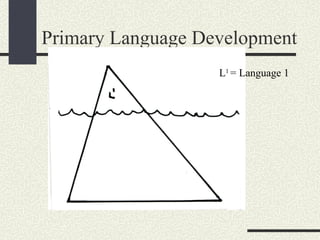
Primary Language Development L 1  = Language 1
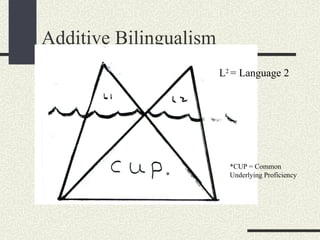
Additive Bilingualism L 2  = Language 2 *CUP = Common Underlying Proficiency *
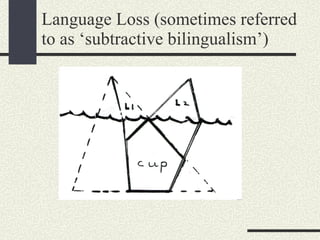
Language Loss (sometimes referred to as ‘subtractive bilingualism’)
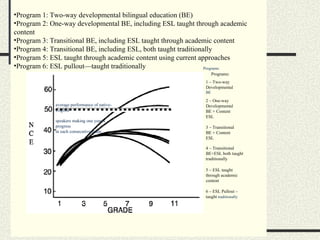
Program 1: Two-way developmental bilingual education (BE) Program 2: One-way developmental BE, including ESL taught through academic content Program 3: Transitional BE, including ESL taught through academic content Program 4: Transitional BE, including ESL, both taught traditionally Program 5: ESL taught through academic content using current approaches Program 6: ESL pullout—taught traditionally Programs: Programs: 1 – Two-way Developmental  BE 2 – One-way Developmental BE + Content ESL 3 – Transitional BE + Content ESL  4 – Transitional BE+ESL both taught traditionally 5 – ESL taught through academic content 6 – ESL Pullout –  taught  traditionally average performance of native-English  speakers making one year’s progress  in each consecutive grade
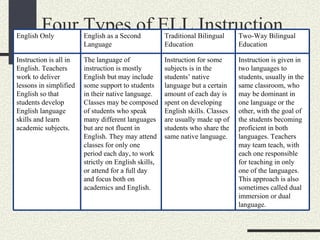
Four Types of ELL Instruction English Only English as a Second Language Traditional Bilingual Education Two-Way Bilingual Education Instruction is all in English. Teachers work to deliver lessons in simplified English so that students develop English language skills and learn academic subjects.  The language of instruction is mostly English but may include some support to students in their native language. Classes may be composed of students who speak many different languages but are not fluent in English. They may attend classes for only one period each day, to work strictly on English skills, or attend for a full day and focus both on academics and English.  Instruction for some subjects is in the students’ native language but a certain amount of each day is spent on developing English skills. Classes are usually made up of students who share the same native language.  Instruction is given in two languages to students, usually in the same classroom, who may be dominant in one language or the other, with the goal of the students becoming proficient in both languages. Teachers may team teach, with each one responsible for teaching in only one of the languages. This approach is also sometimes called dual immersion or dual language.
Directions Ask participants to generate ideas related to the topic at hand and write them on an index card/post-it note (one idea per card). Have the team collect all cards, then begin to sort the cards into categories or groups based on the relationships which they perceive exist between terms. After the cards are sorted, teams will create labels for each category. Sort Card (Affinity)
SHELTERED ENGLISH Techniques for Ensuring Comprehension   Sheltered instruction  is an approach for teaching ELLs using specific methods to ensure that students understand the content while expanding their English language development. Since all instruction is in English, teachers need to make some adjustments so that the lesson is comprehensible to ELLs. The following procedures provide guidelines to “shelter” your English: By L. David van Broekhuizen
SHELTERED ENGLISH Techniques for Ensuring Comprehension   When giving  explanations  and  directions , use simple sentences with a set of already developed standard directions students are familiar with. Students will then be able to focus on the content of the lesson rather than on the lesson procedures.  Speak at a  normal rate , but lengthen the pauses between sentence boundaries (i.e., where there would be a comma, period, or question mark if speech were written down). Check frequently for comprehension by listening to and observing verbal and nonverbal cues from students.
SHELTERED ENGLISH Techniques for Ensuring Comprehension Control your  vocabulary . Focus on the vocabulary related to the topic, but do not teach a long vocabulary list. Emphasize  reading ,  writing , and  thinking skills . Use activities such as note taking, report writing, individual projects, group problem solving, and textbook reading to develop these skills.
SHELTERED ENGLISH Techniques for Ensuring Comprehension For information on developing a lesson based on the principles of sheltered English, see “Steps for Developing a Sheltered English Lesson.” By using sheltered English, teachers can make content in any subject area understandable for ELLs, allowing them to improve their English language skills while learning the material.
Steps for Developing a Sheltered English Lesson Review the curriculum and/or textbook for the content area. Talk with subject area teachers or resource teachers to find out what they think are the most important vocabulary, skills, and concepts.
Steps for Developing a Sheltered English Lesson Identify the key concepts and vocabulary needed to teach the lesson. Introduce vocabulary you think ELLs are unfamiliar with at the beginning of the lesson. Be prepared to use gestures, objects, or other visual aids to ensure students learn important vocabulary before you start the main lesson.
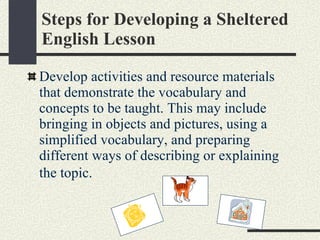
Steps for Developing a Sheltered English Lesson Develop activities and resource materials that demonstrate the vocabulary and concepts to be taught. This may include bringing in objects and pictures, using a simplified vocabulary, and preparing different ways of describing or explaining the topic.
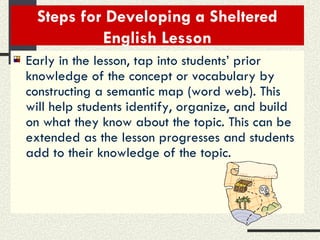
Steps for Developing a Sheltered English Lesson Early in the lesson, tap into students’ prior knowledge of the concept or vocabulary by constructing a semantic map (word web). This will help students identify, organize, and build on what they know about the topic. This can be extended as the lesson progresses and students add to their knowledge of the topic.
Referral Issues/Questions Detailed History (Language, medical, education) OTL  (Opportunity to Learn) What are the   presenting Academic or Developmental Concerns? mobility/attendance language support (loss?) consistency (model, language of instruction, etc.) How might prior experience impact social or motor skills?
Assess the Educational Setting: Philosophies Cultural Mismatch Strategies Expectations  Instructional level(s) Contextual or language supports Are referring personnel able to describe  where, when & how the student DOES learn?
Do the findings ‘make sense’? How is the ‘behavior’ or ‘delay’ exhibited in the primary language or home environment? Is English achievement in line with measures of English acquisition? Is the instructional module. (pull-out vs. bilingual) correlated with higher student success? Does language learning history appear to account for strength or weakness of primary language ability? Is L1 achievement consistent with amount and time period of L1 academic instruction? How does the student respond to scaffolded or mediated learning?
Given what we know about this child’s academic and language learning history, language learning processes, the affective filter, need for first language support and second language accommodations…is this student learning in a manner consistent with the type and quality of their instruction? If so, what general education modifications or supports can be provided to better meet his/her needs? If not, what type of further assessment data should be sought, and how will it be gathered?
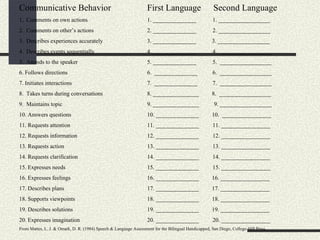
Communicative Behavior First Language  Second Language 1,  Comments on own actions 1. _______________  1. __________________ 2.  Comments on other’s actions  2. _______________  2. __________________ 3.  Describes experiences accurately 3. _______________  3. __________________ 4.  Describes events sequentially 4. _______________  4.  __________________ 5.  Attends to the speaker 5. _______________  5.  __________________ 6. Follows directions 6.  _______________  6.  __________________ 7. Initiates interactions 7.  _______________  7.  __________________ 8.  Takes turns during conversations 8. ________________  8.  __________________ 9.  Maintains topic 9. ________________   9. __________________ 10. Answers questions 10. _______________  10.  _________________ 11. Requests attention 11. _______________  11. _________________ 12. Requests information 12. _______________  12. _________________ 13. Requests action 13. _______________  13. _________________ 14. Requests clarification 14. _______________  14. _________________ 15. Expresses needs 15. _______________  15. _________________ 16. Expresses feelings 16. _______________  16. _________________ 17. Describes plans 17. _______________  17. _________________ 18. Supports viewpoints 18. _______________  18. _________________ 19. Describes solutions 19. _______________  19. _________________ 20. Expresses imagination 20. _______________  20. _________________ From Mattes, L. J. & Omark, D. R. (1984) Speech & Language Assessment for the Bilingual Handicapped, San Diego, College-Hill Press.

Ell Presentation

  • 1.
    ELL Presentation LearningTheories 5101 Kevin Neuenswander Learning Structures
  • 2.
  • 3.
  • 4.
    ELL Population GrowthStates growing the fastest are the Midwest
  • 5.
    English Pronunciation From The Mother Tongue by Bill Bryson English possesses more sounds than almost any other language. The International Phonetic Alphabet differentiates between 52 sounds used in English, divided equally between consonants and vowels. In contrast, Spanish uses 27, while Hawaiian gets by with just 13. However, if you listen carefully, there are many more than this. The “ng,” combination for example, can be a discrete sound ( bring, sing ), but in fact we make two sounds with it – a soft “g” with singer and a hard “g” with finger .
  • 6.
    English Pronunciation If there is one thing certain abut English pronunciation it is that there is almost nothing certain about it. No other language in the world has more words spelled the same way & yet pronounced differently. A few examples are: heard – beard road – broad five – give fillet – skillet early – dearly beau – beauty steak – streak ache – mustache doll – droll scour – four four – tour paid – said break – speak low - how
  • 7.
    English Pronunciation In some languages, such as Finish, there is a tidy one-to-one correspondence between the sound & spelling. A k to the Finns is always “ k ,” and an l always and “ l .” But in English, pronunciation is so various – that not one of our 26 letters can be relied on for constancy. Either they have a variety of pronunciations, like the c in race, rack, & rich , or they hide in silence, like the b in debt , the a in bread , the second t in thistle .
  • 8.
    English Pronunciation In combinations they can become even more unpredictable. One of the most obvious is the letter cluster ough , which can be pronounce in any of 8 ways – through, though, thought, tough, plough, thorough, hic-cough, & lough (lock). We are also prone to slur phrases. Americans will say jeetjet “did you eat yet” and lesskweet for “let’s go eat.”
  • 9.
    English Pronunciation We make another unconscious distinction between the hard “th” of those & the soft one of thought . Also, even more subtle is when we use a “k” sound at the start of a word, we put a tiny puff of breath behind it ( kitchen, conquer ) but when the “k” follows and s ( skill, skid ) we withhold the puff. There are many words that we pronounce considerably different then they are spelled: later – lader butter – budder/buddah wash – worsh granted – grannid looked – lookt warmth – warmpth
  • 10.
    English Pronunciation As native English speakers we can distinguish between the most subtle graduations of emphasis. Most of us, if we are paying attention, can detect the difference between that’s tough & that stuff , between I love you & isle of view , & between gray day & Grade A , between African Elephant & a frick’n elephant even though the phonics are incredibly similar.
  • 11.
    BICS & CALPClassroom teachers need to understand the difference between social language & academic language acquisition. Here is a simple description of BICS & CALP as theorized by Jim Cummins. Basic Interpersonal Communication Skills (BICS) Basic Interpersonal Communication Skills (BICS) are language skills needed in social situations. It is the day-to-day language need to interact socially with other people. ELL’s employ BIC skills when they are on the playground, in the lunch room, on the bus, at parties, playing sports & talking on the phone.
  • 12.
    BICS & CALPBasic Interpersonal Communication Skills (BICS) (cont.) Social interactions are usually context embedded. They occur in a meaningful social context. They are not very demanding cognitively. The language required is not specialized. These language skills usually develop within six months to two years after arrival in the U.S. Problems arise when teachers & administrators think that a child is proficient in a language when they demonstrate good social English.
  • 13.
    Stages of SecondLanguage Acquisition Stage Characteristics Approximate Time Frame Teacher Prompts Preproduction The student  Has minimal comprehension  Does not verbalize  Nods “yes” and “no”  Draws and points 0-6 months  Show me…  Circle the …  Where is …?  Who has …? Early Production The student  Has limited comprehension  Produces one-or two-word responses  Participates using key words and familiar phrases  Uses present-tense verbs 6 months – 1 Year  Yes/no questions  Either/or questions  One – or two-word answers  Lists  Labels Speech Emergence The student  Has good comprehension  Can produce simple sentences  Makes grammar and pronunciation errors  Frequently misunderstands jokes 1-3 years  Why…?  How…?  Explain…?  Phrase or short-sentence answers
  • 14.
    Stages of SecondLanguage Acquisition Stage Characteristics Approximate Time Frame Teacher Prompts Intermediate Fluency The student  Has excellent comprehension  Makes few grammatical errors 3 – 5 years  What would happen if ..?  What do you think…? Advanced Fluency The student has a near-native level of speech. 5 – 7 years  Decide if …  Retell …
  • 15.
  • 16.
    Additive Bilingualism L2 = Language 2 *CUP = Common Underlying Proficiency *
  • 17.
    Language Loss (sometimesreferred to as ‘subtractive bilingualism’)
  • 18.
    Program 1: Two-waydevelopmental bilingual education (BE) Program 2: One-way developmental BE, including ESL taught through academic content Program 3: Transitional BE, including ESL taught through academic content Program 4: Transitional BE, including ESL, both taught traditionally Program 5: ESL taught through academic content using current approaches Program 6: ESL pullout—taught traditionally Programs: Programs: 1 – Two-way Developmental BE 2 – One-way Developmental BE + Content ESL 3 – Transitional BE + Content ESL 4 – Transitional BE+ESL both taught traditionally 5 – ESL taught through academic content 6 – ESL Pullout – taught traditionally average performance of native-English speakers making one year’s progress in each consecutive grade
  • 19.
    Four Types ofELL Instruction English Only English as a Second Language Traditional Bilingual Education Two-Way Bilingual Education Instruction is all in English. Teachers work to deliver lessons in simplified English so that students develop English language skills and learn academic subjects. The language of instruction is mostly English but may include some support to students in their native language. Classes may be composed of students who speak many different languages but are not fluent in English. They may attend classes for only one period each day, to work strictly on English skills, or attend for a full day and focus both on academics and English. Instruction for some subjects is in the students’ native language but a certain amount of each day is spent on developing English skills. Classes are usually made up of students who share the same native language. Instruction is given in two languages to students, usually in the same classroom, who may be dominant in one language or the other, with the goal of the students becoming proficient in both languages. Teachers may team teach, with each one responsible for teaching in only one of the languages. This approach is also sometimes called dual immersion or dual language.
  • 20.
    Directions Ask participantsto generate ideas related to the topic at hand and write them on an index card/post-it note (one idea per card). Have the team collect all cards, then begin to sort the cards into categories or groups based on the relationships which they perceive exist between terms. After the cards are sorted, teams will create labels for each category. Sort Card (Affinity)
  • 21.
    SHELTERED ENGLISH Techniquesfor Ensuring Comprehension Sheltered instruction is an approach for teaching ELLs using specific methods to ensure that students understand the content while expanding their English language development. Since all instruction is in English, teachers need to make some adjustments so that the lesson is comprehensible to ELLs. The following procedures provide guidelines to “shelter” your English: By L. David van Broekhuizen
  • 22.
    SHELTERED ENGLISH Techniquesfor Ensuring Comprehension When giving explanations and directions , use simple sentences with a set of already developed standard directions students are familiar with. Students will then be able to focus on the content of the lesson rather than on the lesson procedures. Speak at a normal rate , but lengthen the pauses between sentence boundaries (i.e., where there would be a comma, period, or question mark if speech were written down). Check frequently for comprehension by listening to and observing verbal and nonverbal cues from students.
  • 23.
    SHELTERED ENGLISH Techniquesfor Ensuring Comprehension Control your vocabulary . Focus on the vocabulary related to the topic, but do not teach a long vocabulary list. Emphasize reading , writing , and thinking skills . Use activities such as note taking, report writing, individual projects, group problem solving, and textbook reading to develop these skills.
  • 24.
    SHELTERED ENGLISH Techniquesfor Ensuring Comprehension For information on developing a lesson based on the principles of sheltered English, see “Steps for Developing a Sheltered English Lesson.” By using sheltered English, teachers can make content in any subject area understandable for ELLs, allowing them to improve their English language skills while learning the material.
  • 25.
    Steps for Developinga Sheltered English Lesson Review the curriculum and/or textbook for the content area. Talk with subject area teachers or resource teachers to find out what they think are the most important vocabulary, skills, and concepts.
  • 26.
    Steps for Developinga Sheltered English Lesson Identify the key concepts and vocabulary needed to teach the lesson. Introduce vocabulary you think ELLs are unfamiliar with at the beginning of the lesson. Be prepared to use gestures, objects, or other visual aids to ensure students learn important vocabulary before you start the main lesson.
  • 27.
    Steps for Developinga Sheltered English Lesson Develop activities and resource materials that demonstrate the vocabulary and concepts to be taught. This may include bringing in objects and pictures, using a simplified vocabulary, and preparing different ways of describing or explaining the topic.
  • 28.
    Steps for Developinga Sheltered English Lesson Early in the lesson, tap into students’ prior knowledge of the concept or vocabulary by constructing a semantic map (word web). This will help students identify, organize, and build on what they know about the topic. This can be extended as the lesson progresses and students add to their knowledge of the topic.
  • 29.
    Referral Issues/Questions DetailedHistory (Language, medical, education) OTL (Opportunity to Learn) What are the presenting Academic or Developmental Concerns? mobility/attendance language support (loss?) consistency (model, language of instruction, etc.) How might prior experience impact social or motor skills?
  • 30.
    Assess the EducationalSetting: Philosophies Cultural Mismatch Strategies Expectations Instructional level(s) Contextual or language supports Are referring personnel able to describe where, when & how the student DOES learn?
  • 31.
    Do the findings‘make sense’? How is the ‘behavior’ or ‘delay’ exhibited in the primary language or home environment? Is English achievement in line with measures of English acquisition? Is the instructional module. (pull-out vs. bilingual) correlated with higher student success? Does language learning history appear to account for strength or weakness of primary language ability? Is L1 achievement consistent with amount and time period of L1 academic instruction? How does the student respond to scaffolded or mediated learning?
  • 32.
    Given what weknow about this child’s academic and language learning history, language learning processes, the affective filter, need for first language support and second language accommodations…is this student learning in a manner consistent with the type and quality of their instruction? If so, what general education modifications or supports can be provided to better meet his/her needs? If not, what type of further assessment data should be sought, and how will it be gathered?
  • 33.
    Communicative Behavior FirstLanguage Second Language 1, Comments on own actions 1. _______________ 1. __________________ 2. Comments on other’s actions 2. _______________ 2. __________________ 3. Describes experiences accurately 3. _______________ 3. __________________ 4. Describes events sequentially 4. _______________ 4. __________________ 5. Attends to the speaker 5. _______________ 5. __________________ 6. Follows directions 6. _______________ 6. __________________ 7. Initiates interactions 7. _______________ 7. __________________ 8. Takes turns during conversations 8. ________________ 8. __________________ 9. Maintains topic 9. ________________ 9. __________________ 10. Answers questions 10. _______________ 10. _________________ 11. Requests attention 11. _______________ 11. _________________ 12. Requests information 12. _______________ 12. _________________ 13. Requests action 13. _______________ 13. _________________ 14. Requests clarification 14. _______________ 14. _________________ 15. Expresses needs 15. _______________ 15. _________________ 16. Expresses feelings 16. _______________ 16. _________________ 17. Describes plans 17. _______________ 17. _________________ 18. Supports viewpoints 18. _______________ 18. _________________ 19. Describes solutions 19. _______________ 19. _________________ 20. Expresses imagination 20. _______________ 20. _________________ From Mattes, L. J. & Omark, D. R. (1984) Speech & Language Assessment for the Bilingual Handicapped, San Diego, College-Hill Press.