Conditionals
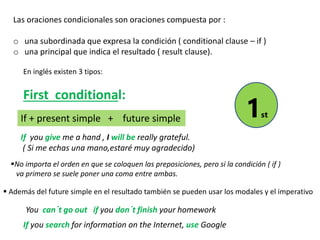
Las oraciones condicionales son oraciones compuesta por :
o una subordinada que expresa la condición ( conditional clause – if )
o una principal que indica el resultado ( result clause).
En inglés existen 3 tipos:
First conditional:
If + present simple + future simple
If you give me a hand , I will be really grateful.
( Si me echas una mano,estaré muy agradecido)
No importa el orden en que se coloquen las preposiciones, pero si la condición ( if )
va primero se suele poner una coma entre ambas.
 Además del future simple en el resultado también se pueden usar los modales y el imperativo
You can´t go out if you don´t finish your homework
If you search for information on the Internet, use Google
1st
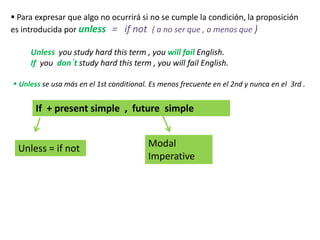
 Para expresar que algo no ocurrirá si no se cumple la condición, la proposición
es introducida por unless = if not ( a no ser que , a menos que )
Unless you study hard this term , you will fail English.
If you don´t study hard this term , you will fail English.
 Unless se usa más en el 1st conditional. Es menos frecuente en el 2nd y nunca en el 3rd .
If + present simple , future simple
Modal
Imperative
Unless = if not
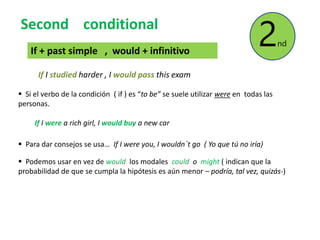
Second conditional
If + past simple , would + infinitivo
If I studied harder , I would pass this exam
 Si el verbo de la condición ( if ) es “to be” se suele utilizar were en todas las
personas.
If I were a rich girl, I would buy a new car
 Para dar consejos se usa… If I were you, I wouldn´t go ( Yo que tú no iría)
 Podemos usar en vez de would los modales could o might ( indican que la
probabilidad de que se cumpla la hipótesis es aún menor – podría, tal vez, quizás-)
2nd
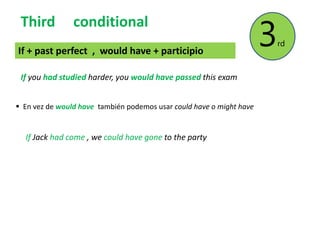
Third conditional
3rd
If + past perfect , would have + participio
If you had studied harder, you would have passed this exam
 En vez de would have también podemos usar could have o might have
If Jack had come , we could have gone to the party
1st
2nd
3rd
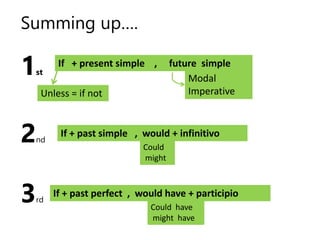
Summing up….
If + present simple , future simple
Unless = if not
Modal
Imperative
If + past simple , would + infinitivo
Could
might
If + past perfect , would have + participio
Could have
might have
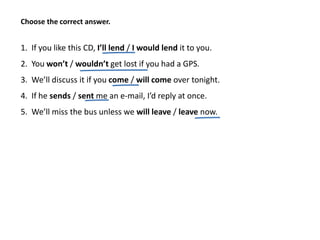
1. If you like this CD, I’ll lend / I would lend it to you.
2. You won’t / wouldn’t get lost if you had a GPS.
3. We’ll discuss it if you come / will come over tonight.
4. If he sends / sent me an e-mail, I’d reply at once.
5. We’ll miss the bus unless we will leave / leave now.
Choose the correct answer.
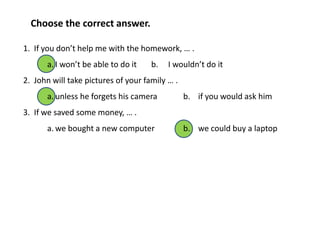
1. If you don’t help me with the homework, … .
a. I won’t be able to do it b. I wouldn’t do it
2. John will take pictures of your family … .
a. unless he forgets his camera b. if you would ask him
3. If we saved some money, … .
a. we bought a new computer b. we could buy a laptop
Choose the correct answer.
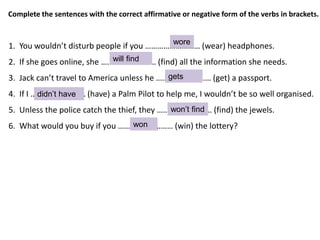
1. You wouldn’t disturb people if you ……………………… (wear) headphones.
2. If she goes online, she ……………………… (find) all the information she needs.
3. Jack can’t travel to America unless he ……………………… (get) a passport.
4. If I ……………………… (have) a Palm Pilot to help me, I wouldn’t be so well organised.
5. Unless the police catch the thief, they ……………………… (find) the jewels.
6. What would you buy if you ……………………… (win) the lottery?
Complete the sentences with the correct affirmative or negative form of the verbs in brackets.
wore
will find
gets
didn’t have
won’t find
won
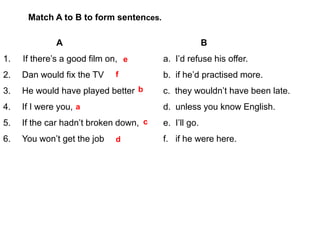
A B
1. If there’s a good film on, a. I’d refuse his offer.
2. Dan would fix the TV b. if he’d practised more.
3. He would have played better c. they wouldn’t have been late.
4. If I were you, d. unless you know English.
5. If the car hadn’t broken down, e. I’ll go.
6. You won’t get the job f. if he were here.
Match A to B to form sentences.
e
f
b
a
c
d
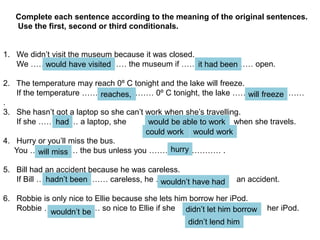
1. We didn’t visit the museum because it was closed.
We ……………………………… the museum if ……………………… open.
2. The temperature may reach 0º C tonight and the lake will freeze.
If the temperature ……………………… 0º C tonight, the lake ………………………
.
3. She hasn’t got a laptop so she can’t work when she’s travelling.
If she …………… a laptop, she ……………………… when she travels.
4. Hurry or you’ll miss the bus.
You ……………… the bus unless you ……………………… .
5. Bill had an accident because he was careless.
If Bill ……………………… careless, he ……………………… an accident.
6. Robbie is only nice to Ellie because she lets him borrow her iPod.
Robbie ………………… so nice to Ellie if she ……………………… her iPod.
Complete each sentence according to the meaning of the original sentences.
Use the first, second or third conditionals.
would have visited it had been
reaches, will freeze
had would be able to work
could work would work
will miss hurry
hadn’t been wouldn’t have had
wouldn’t be didn’t let him borrow
didn’t lend him
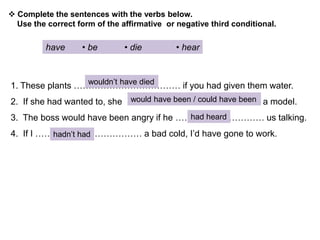
1. These plants ……………………………… if you had given them water.
2. If she had wanted to, she ……………………………… a model.
3. The boss would have been angry if he ………………………… us talking.
4. If I ……………………………… a bad cold, I’d have gone to work.
 Complete the sentences with the verbs below.
Use the correct form of the affirmative or negative third conditional.
have • be • die • hear
wouldn’t have died
would have been / could have been
had heard
hadn’t had
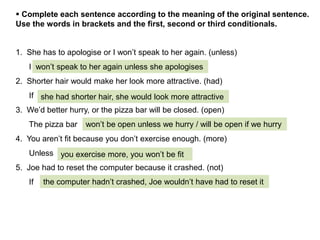
1. She has to apologise or I won’t speak to her again. (unless)
I .
2. Shorter hair would make her look more attractive. (had)
If .
3. We’d better hurry, or the pizza bar will be closed. (open)
The pizza bar .
4. You aren’t fit because you don’t exercise enough. (more)
Unless .
5. Joe had to reset the computer because it crashed. (not)
If .
 Complete each sentence according to the meaning of the original sentence.
Use the words in brackets and the first, second or third conditionals.
won’t speak to her again unless she apologises
she had shorter hair, she would look more attractive
won’t be open unless we hurry / will be open if we hurry
you exercise more, you won’t be fit
the computer hadn’t crashed, Joe wouldn’t have had to reset it
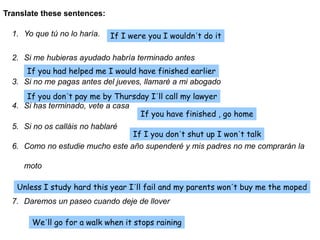
1. Yo que tú no lo haría.
2. Si me hubieras ayudado habría terminado antes
3. Si no me pagas antes del jueves, llamaré a mi abogado
4. Si has terminado, vete a casa
5. Si no os calláis no hablaré
6. Como no estudie mucho este año supenderé y mis padres no me comprarán la
moto
7. Daremos un paseo cuando deje de llover
Translate these sentences:
If I were you I wouldn´t do it
If you had helped me I would have finished earlier
If you don´t pay me by Thursday I´ll call my lawyer
If you have finished , go home
If I you don´t shut up I won´t talk
Unless I study hard this year I´ll fail and my parents won´t buy me the moped
We´ll go for a walk when it stops raining

conditionals5.ppt

  • 1.
  • 2.
    Las oraciones condicionalesson oraciones compuesta por : o una subordinada que expresa la condición ( conditional clause – if ) o una principal que indica el resultado ( result clause). En inglés existen 3 tipos: First conditional: If + present simple + future simple If you give me a hand , I will be really grateful. ( Si me echas una mano,estaré muy agradecido) No importa el orden en que se coloquen las preposiciones, pero si la condición ( if ) va primero se suele poner una coma entre ambas.  Además del future simple en el resultado también se pueden usar los modales y el imperativo You can´t go out if you don´t finish your homework If you search for information on the Internet, use Google 1st
  • 3.
     Para expresarque algo no ocurrirá si no se cumple la condición, la proposición es introducida por unless = if not ( a no ser que , a menos que ) Unless you study hard this term , you will fail English. If you don´t study hard this term , you will fail English.  Unless se usa más en el 1st conditional. Es menos frecuente en el 2nd y nunca en el 3rd . If + present simple , future simple Modal Imperative Unless = if not
  • 4.
    Second conditional If +past simple , would + infinitivo If I studied harder , I would pass this exam  Si el verbo de la condición ( if ) es “to be” se suele utilizar were en todas las personas. If I were a rich girl, I would buy a new car  Para dar consejos se usa… If I were you, I wouldn´t go ( Yo que tú no iría)  Podemos usar en vez de would los modales could o might ( indican que la probabilidad de que se cumpla la hipótesis es aún menor – podría, tal vez, quizás-) 2nd
  • 5.
    Third conditional 3rd If +past perfect , would have + participio If you had studied harder, you would have passed this exam  En vez de would have también podemos usar could have o might have If Jack had come , we could have gone to the party
  • 6.
    1st 2nd 3rd Summing up…. If +present simple , future simple Unless = if not Modal Imperative If + past simple , would + infinitivo Could might If + past perfect , would have + participio Could have might have
  • 7.
    1. If youlike this CD, I’ll lend / I would lend it to you. 2. You won’t / wouldn’t get lost if you had a GPS. 3. We’ll discuss it if you come / will come over tonight. 4. If he sends / sent me an e-mail, I’d reply at once. 5. We’ll miss the bus unless we will leave / leave now. Choose the correct answer.
  • 8.
    1. If youdon’t help me with the homework, … . a. I won’t be able to do it b. I wouldn’t do it 2. John will take pictures of your family … . a. unless he forgets his camera b. if you would ask him 3. If we saved some money, … . a. we bought a new computer b. we could buy a laptop Choose the correct answer.
  • 9.
    1. You wouldn’tdisturb people if you ……………………… (wear) headphones. 2. If she goes online, she ……………………… (find) all the information she needs. 3. Jack can’t travel to America unless he ……………………… (get) a passport. 4. If I ……………………… (have) a Palm Pilot to help me, I wouldn’t be so well organised. 5. Unless the police catch the thief, they ……………………… (find) the jewels. 6. What would you buy if you ……………………… (win) the lottery? Complete the sentences with the correct affirmative or negative form of the verbs in brackets. wore will find gets didn’t have won’t find won
  • 10.
    A B 1. Ifthere’s a good film on, a. I’d refuse his offer. 2. Dan would fix the TV b. if he’d practised more. 3. He would have played better c. they wouldn’t have been late. 4. If I were you, d. unless you know English. 5. If the car hadn’t broken down, e. I’ll go. 6. You won’t get the job f. if he were here. Match A to B to form sentences. e f b a c d
  • 11.
    1. We didn’tvisit the museum because it was closed. We ……………………………… the museum if ……………………… open. 2. The temperature may reach 0º C tonight and the lake will freeze. If the temperature ……………………… 0º C tonight, the lake ……………………… . 3. She hasn’t got a laptop so she can’t work when she’s travelling. If she …………… a laptop, she ……………………… when she travels. 4. Hurry or you’ll miss the bus. You ……………… the bus unless you ……………………… . 5. Bill had an accident because he was careless. If Bill ……………………… careless, he ……………………… an accident. 6. Robbie is only nice to Ellie because she lets him borrow her iPod. Robbie ………………… so nice to Ellie if she ……………………… her iPod. Complete each sentence according to the meaning of the original sentences. Use the first, second or third conditionals. would have visited it had been reaches, will freeze had would be able to work could work would work will miss hurry hadn’t been wouldn’t have had wouldn’t be didn’t let him borrow didn’t lend him
  • 12.
    1. These plants……………………………… if you had given them water. 2. If she had wanted to, she ……………………………… a model. 3. The boss would have been angry if he ………………………… us talking. 4. If I ……………………………… a bad cold, I’d have gone to work.  Complete the sentences with the verbs below. Use the correct form of the affirmative or negative third conditional. have • be • die • hear wouldn’t have died would have been / could have been had heard hadn’t had
  • 13.
    1. She hasto apologise or I won’t speak to her again. (unless) I . 2. Shorter hair would make her look more attractive. (had) If . 3. We’d better hurry, or the pizza bar will be closed. (open) The pizza bar . 4. You aren’t fit because you don’t exercise enough. (more) Unless . 5. Joe had to reset the computer because it crashed. (not) If .  Complete each sentence according to the meaning of the original sentence. Use the words in brackets and the first, second or third conditionals. won’t speak to her again unless she apologises she had shorter hair, she would look more attractive won’t be open unless we hurry / will be open if we hurry you exercise more, you won’t be fit the computer hadn’t crashed, Joe wouldn’t have had to reset it
  • 14.
    1. Yo quetú no lo haría. 2. Si me hubieras ayudado habría terminado antes 3. Si no me pagas antes del jueves, llamaré a mi abogado 4. Si has terminado, vete a casa 5. Si no os calláis no hablaré 6. Como no estudie mucho este año supenderé y mis padres no me comprarán la moto 7. Daremos un paseo cuando deje de llover Translate these sentences: If I were you I wouldn´t do it If you had helped me I would have finished earlier If you don´t pay me by Thursday I´ll call my lawyer If you have finished , go home If I you don´t shut up I won´t talk Unless I study hard this year I´ll fail and my parents won´t buy me the moped We´ll go for a walk when it stops raining