Advanced English
1
Chapter 1
Introduction
Background of the History of English Language
In this chapter I have tried to conclude the historical background and the importance
of English language. Here this objective for making an understanding particularly the basic
knowledge about history and the importance of English language in briefly description.
The history of the English language really started with the arrival of three Germanic
tribes who invaded Britain during the 5th
century AD. These tribes, the Angles, the Saxons
and the Jutes, crossed the North Sea from what today is Denmark and northern Germany. At
that time the inhabitants of Britain spoke a Celtic language. But most of the Celtic speakers
were pushed west and north by the invaders - mainly into what is now Wales, Scotland and
Ireland. The Angles came from "Englaland" and their language was called "Englisc" - from
which the words "England" and "English" are derived.
1
Language is a conventional, arbitrary system of sounds used for communication in a
human linguistic community. Language is a system at many levels, including the following:
2
Phonemic: Phonemes are the smallest meaningless components that
constitute the sound system of a language.
Morphemic: Morphemes are the smallest meaningful components of a
language. For example, the word cats consists of two morphemes, {cat} and {-
s}. Morphemes can be grammatical (having dictionary definitions) or lexical (affixes
and function words). They can be free (able to stand alone) or bound (complete only
when combined with other morphemes. Bound lexical morphemes (or affixes) can be
either derivational (used to create new words) or inflectional (used to signal
grammatical relationships).
1 a b
Shore, Thomas William (1906), Origin of the Anglo-Saxon Race – A of the Settlement of England and the Tribal Origin
of the English People (1nd ed.), London, pp. 3, 393.
2
All notes are loosely drawn from Pyles and Algeo's The Origins and Development of the English Language, 5th
edition,
Harcourt Brace College Publishers, New York, 2005. Please see Sources, which can be accessed from the main
lobby, for a complete list of references.
Advanced English
2
Syntactic: Syntax governs the way words come together to create
sentences. The syntax of English has become less synthetic (grammatical structures
are signaled primarily by inflectional endings) and more analytic (grammatical
structures are signaled primarily by word order and function words).
Semantic: Semantics concerns the meaning of words, including but not
limited to etymologies.
Lexical: Lexicology includes spelling, the formation and use of words.
F. Stylistic: Linguistic choice and options.
Language is a human activity. Though animals can communicate in a primal way,
they do not have innate language abilities that allow for an unlimited number of novel
utterances. Though some apes have been taught to use sign language (a paralanguage, or
parallel system of communication), the breadth of ideas that they express are limited.
Language is arbitrary. Aside from echoic words, there is no intrinsic relationship between
words and the objects or concepts that they represent. Language is conventional. Language is
passed down from one generation to the next. It is the nature of language to change. Notions
of absolute correctness are imposed by writers, linguists, scholars, etc. and may slow down
but do not prevent the natural process of language evolution. Language is sound. Linguists
are primarily concerned with speech. Writing is a secondary activity. The English language
is one that most widely spread around the world in around the world in using as a universal
language.
English is a West Germanic language that originated from the Anglo-Frisian dialects
brought to Britain by Germanic invaders and/or settlers from various parts of what is now
northwest Germany and the Netherlands. Initially, Old English was a diverse group of
dialects, reflecting the varied origins of the Anglo-Saxon kingdoms of Britain. One of these
dialects, Late West Saxon, eventually became predominant.
The English language underwent extensive change in the middle Ages. Written Old
English of AD 1000 is similar in vocabulary and grammar to other old Germanic languages
such as Old High German and Old Norse, and completely unintelligible to modern speakers,
while the modern language is already largely recognizable in written Middle English of AD
1400. The transformation was caused by two further waves of invasion: the first by speakers
Advanced English
3
of the Scandinavian branch of the Germanic language family, who conquered and colonized
parts of Britain in the 8th and 9th
centuries; the second by the Normans in the 11th
century,
who spoke Old Norman and ultimately developed an English variety of this called Anglo-
Norman. A large proportion of the modern English vocabulary comes directly from Anglo-
Norman.
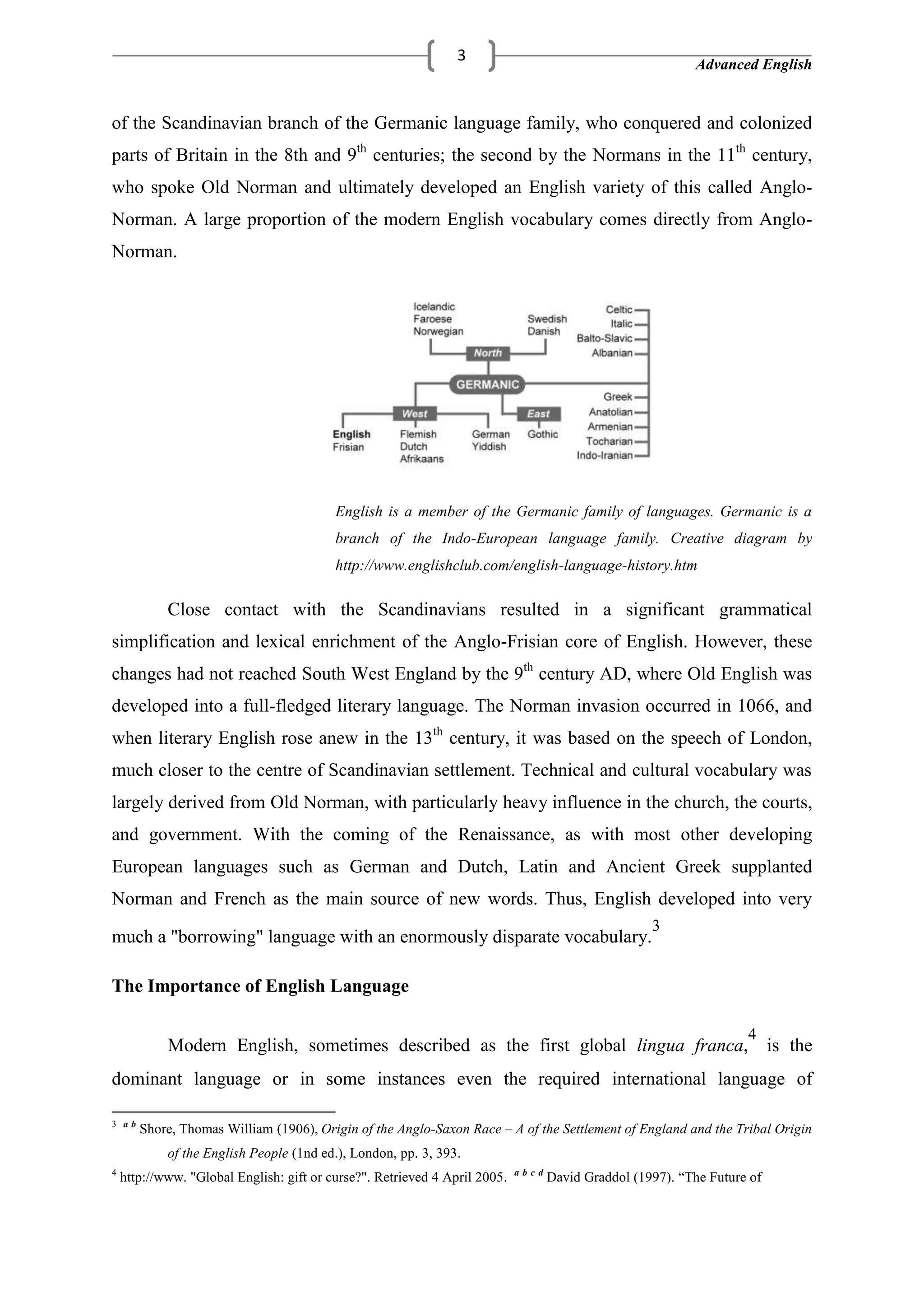
English is a member of the Germanic family of languages. Germanic is a
branch of the Indo-European language family. Creative diagram by
http://www.englishclub.com/english-language-history.htm
Close contact with the Scandinavians resulted in a significant grammatical
simplification and lexical enrichment of the Anglo-Frisian core of English. However, these
changes had not reached South West England by the 9th
century AD, where Old English was
developed into a full-fledged literary language. The Norman invasion occurred in 1066, and
when literary English rose anew in the 13th
century, it was based on the speech of London,
much closer to the centre of Scandinavian settlement. Technical and cultural vocabulary was
largely derived from Old Norman, with particularly heavy influence in the church, the courts,
and government. With the coming of the Renaissance, as with most other developing
European languages such as German and Dutch, Latin and Ancient Greek supplanted
Norman and French as the main source of new words. Thus, English developed into very
much a "borrowing" language with an enormously disparate vocabulary.
3
The Importance of English Language
Modern English, sometimes described as the first global lingua franca,
4
is the
dominant language or in some instances even the required international language of
3 a b
Shore, Thomas William (1906), Origin of the Anglo-Saxon Race – A of the Settlement of England and the Tribal Origin
of the English People (1nd ed.), London, pp. 3, 393.
4
http://www. "Global English: gift or curse?". Retrieved 4 April 2005. a b c d
David Graddol (1997). ―The Future of
Advanced English
4
communications, science, information technology, business, seafaring, aviation,
entertainment, radio and diplomacy.
5
Its spread beyond the British Isles began with the
growth of the British Empire, and by the late 19th
century its reach was truly global.
6
Following British colonization from the 16th
to 19th
centuries, it became the dominant
language in the United States, Canada, Australia and New Zealand. The growing economic
and cultural influence of the US and its status as a global superpower since World War II
have significantly accelerated the language's spread across the planet.
7
English replaced
German as the dominant language of science Nobel Prize laureates during the second half of
the 20th century. English equal and may have surpassed French as the dominant language of
diplomacy during the last half of the 19th century.
A working knowledge of English has become a requirement in a number of fields,
occupations and professions such as medicine and computing; as a consequence over a billion
people speak English to at least a basic level (see English as a foreign or second language). It
is one of six official languages of the United Nations.
8
One impact of the growth of English is the reduction of native linguistic diversity in
many parts of the world. Its influence continues to play an important role in language
attrition. Conversely, the natural internal varieties of English along with creoles and pidgins
have the potential to produce new distinct languages from English over time.
9
Because English is so widely spoken, it has often been referred to as a "world
language", the lingua franca of the modern era,
10
and while it is not an official language in
most countries, it is currently the language most often taught as a foreign language. It is, by
English” (PDF). The British Council. Retrieved 15 April 2007.
5
http://www."FAQ – Language proficiency requirements for licence holders – In which languages does a licence holder
need to demonstrate proficiency?". International Civil Aviation Organization – Air Navigation Bureau. Retrieved 2
June 2011.
6
McGrath, Charles (2007-05-17). "Magazine Suspends Its Run in History". The New York Times. Retrieved 2008-03-08.
7
http://www. a b c d
David Graddol (1997). "The Future of English?" (PDF). The British Council. Retrieved 15 April 2007.
8
"UN official languages". UN.org.
9
Cheshire, Jenny (1991). English Around The World: Sociolinguistic Perspectives. Cambridge University Press.
doi:10.2277/0521395658. ISBN 0-521-39565-8.
10
http://www.a b c d
David Graddol (1997). "The Future of English" (PDF). The British Council. Retrieved 15 April 2007.
Advanced English
5
international treaty, the official language for aeronautical
11
and maritime
12
communications.
English is an official language of the United Nations and many other international
organizations, including the International Olympic Committee.
English is the language most often studied as a foreign language in the European
Union, by 89% of schoolchildren, ahead of French at 32%, while the perception of the
usefulness of foreign languages among Europeans is 68% in favour of English ahead of 25%
for French.
13
Among some non-English-speaking EU countries, a large percentage of the
adult population claims to be able to converse in English – in particular: 85% in Sweden,
83% in Denmark, 79% in the Netherlands, 66% in Luxembourg and over 50% in Finland,
Slovenia, Austria, Belgium, and Germany.
14
Books, magazines, and newspapers written in English are available in many countries
around the world, and English is the most commonly used language in the sciences
15
with
Science Citation Index reporting as early as 1997 that 95% of its articles were written in
English, even though only half of them came from authors in English-speaking countries.
This increasing use of the English language globally has had a large impact on many
other languages, leading to language shift and even language death,
16
and to claims of
linguistic imperialism.
17
English itself has become more open to language shift as multiple
regional varieties feed back into the language as a whole.
18
11
http://www."ICAO Promotes Aviation Safety by Endorsing English Language Testing". International Civil Aviation
Organization. 13 October 2011.
12
http:www."IMO Standard Marine Communication Phrases". International Maritime Organization. Archived from the
original on 27 December 2003.
13
2006 survey by Eurobarometer, in the Official EU languages website
14
http://www."IMO Standard Marine Communication Phrases". International Maritime Organization. Archived from the
original on 27 December 2003.
15
http://www.a b c d
David Graddol (1997). "The Future of English" (PDF). The British Council. Retrieved 15 April 2007.
16
David Crystal (2000) Language Death, Preface; viii, Cambridge University Press, Cambridge
17 a b
Jambor, Paul Z. 'English Language Imperialism: Points of View', Journal of English as an International Language,
April 2007 – Volume 1, pages 103–123 (Accessed in 2007)
18
Ibid.p.115.
Advanced English
6
Chapter 2
Sentence Structure
Basic Sentence Structure
According to my own experiences in learning English grammar mostly it is not
difficult as many learners feared or worried about. Every word in a sentence serves a specific
purpose within the structure of that particular sentence. According to rules of grammar,
sentence structure can sometimes be quite complicated. For the sake of simplicity, however,
the basic parts of sentences will discussed here can be made easier to all learner English
grammar as follows:
Sentence Structure
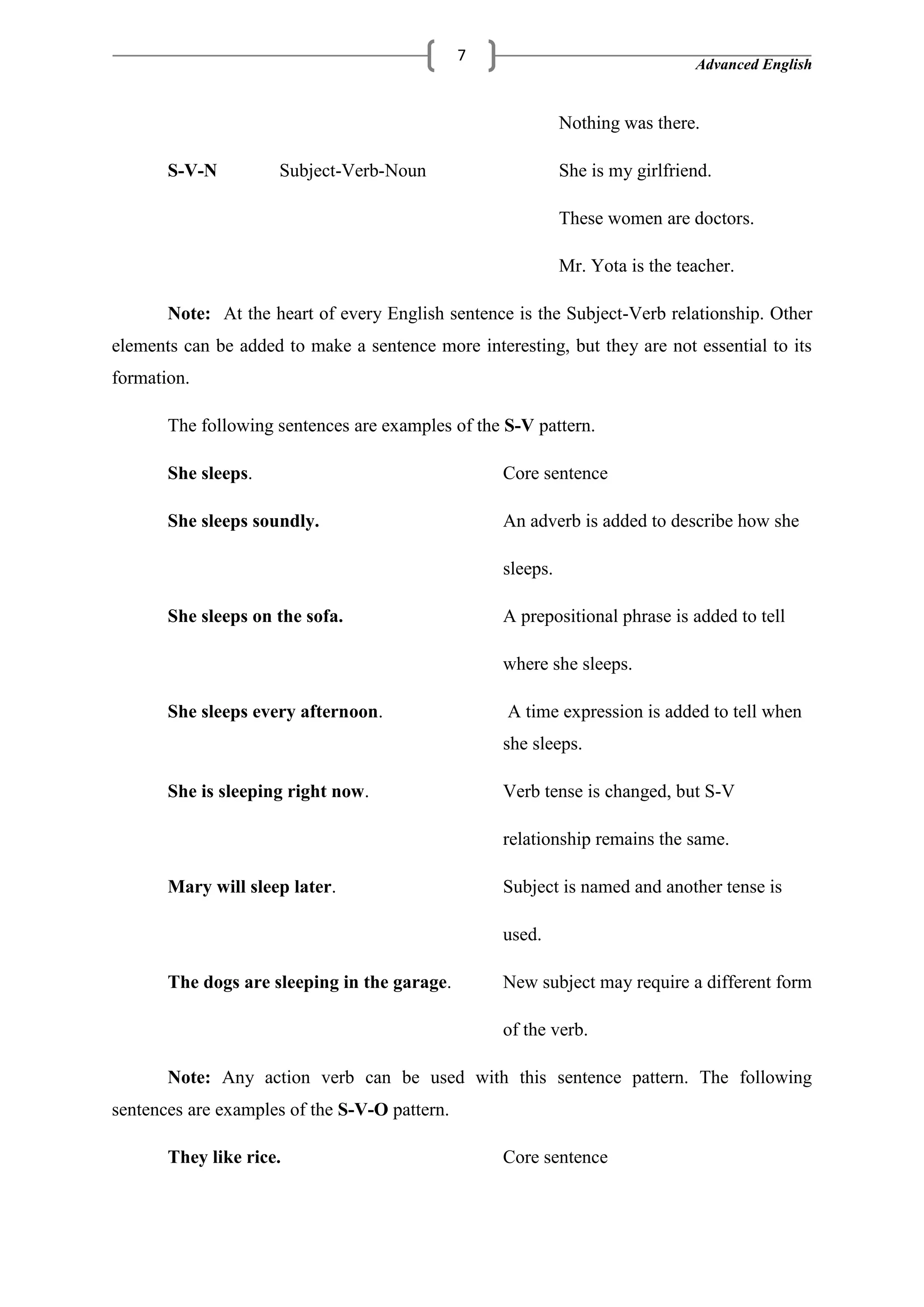
There are five basic patterns around which most English sentences are built. They are
as follows:
19
S-V Subject-Verb Yota sleeps.
Joy is eating.
Job will arrive next week.
S-V-O Subject-Verb- Object I like rice.
Joy loves her job.
Job's eating an orange.
S-V-Adj Subject-Verb-Adjective He is good.
They are lazy.
She seems angry.
S-V-Adv Subject-Verb-Adverb Jay is here.
Plants are everywhere.
19
Omaggio, Alice C. 1986. Teaching Language in Context: Proficiency-oriented instruction. Boston: Heinle and Heinle.
479pp
Advanced English
7
Nothing was there.
S-V-N Subject-Verb-Noun She is my girlfriend.
These women are doctors.
Mr. Yota is the teacher.
Note: At the heart of every English sentence is the Subject-Verb relationship. Other
elements can be added to make a sentence more interesting, but they are not essential to its
formation.
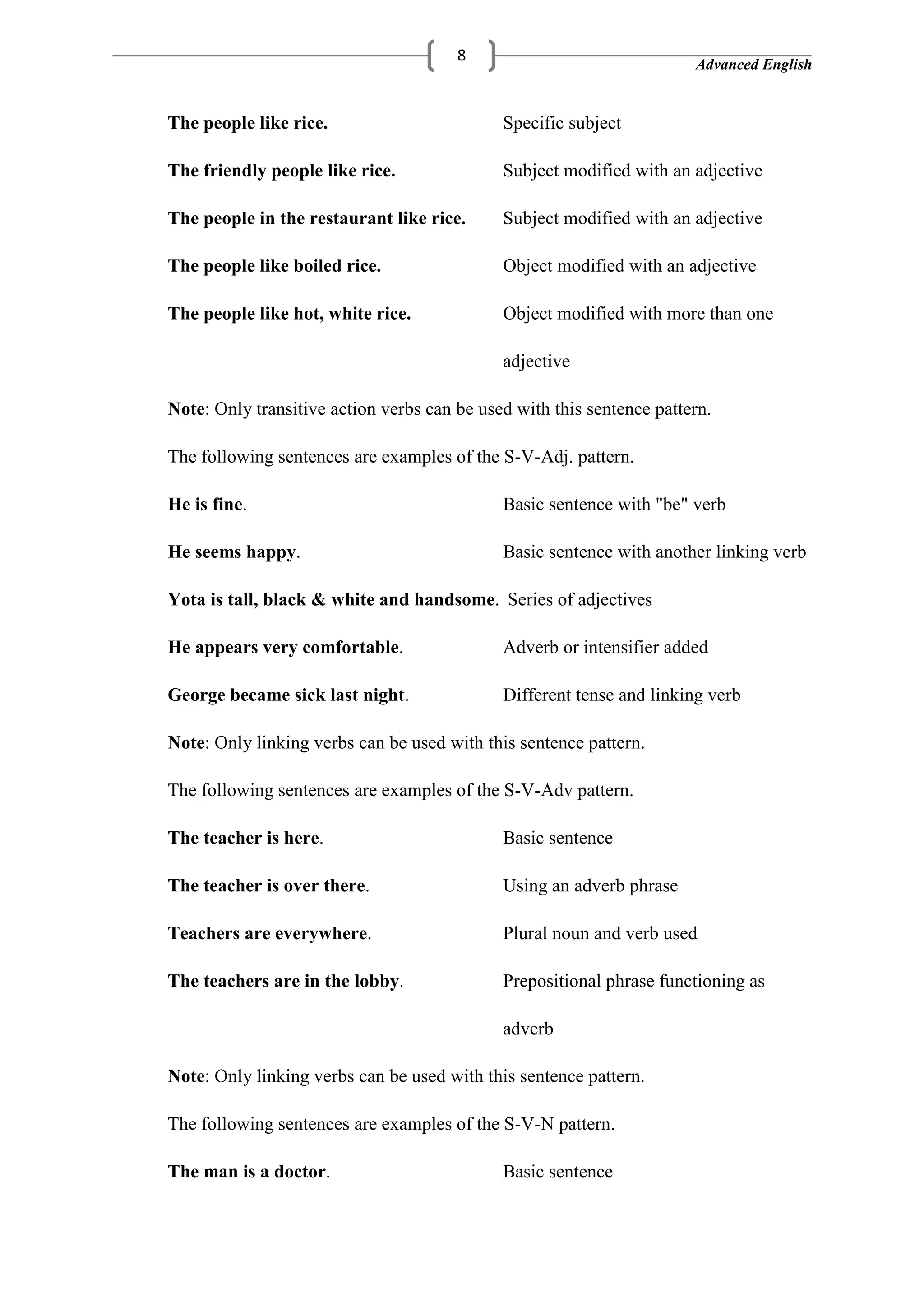
The following sentences are examples of the S-V pattern.
She sleeps. Core sentence
She sleeps soundly. An adverb is added to describe how she
sleeps.
She sleeps on the sofa. A prepositional phrase is added to tell
where she sleeps.
She sleeps every afternoon. A time expression is added to tell when
she sleeps.
She is sleeping right now. Verb tense is changed, but S-V
relationship remains the same.
Mary will sleep later. Subject is named and another tense is
used.
The dogs are sleeping in the garage. New subject may require a different form
of the verb.
Note: Any action verb can be used with this sentence pattern. The following
sentences are examples of the S-V-O pattern.
They like rice. Core sentence
Advanced English
8
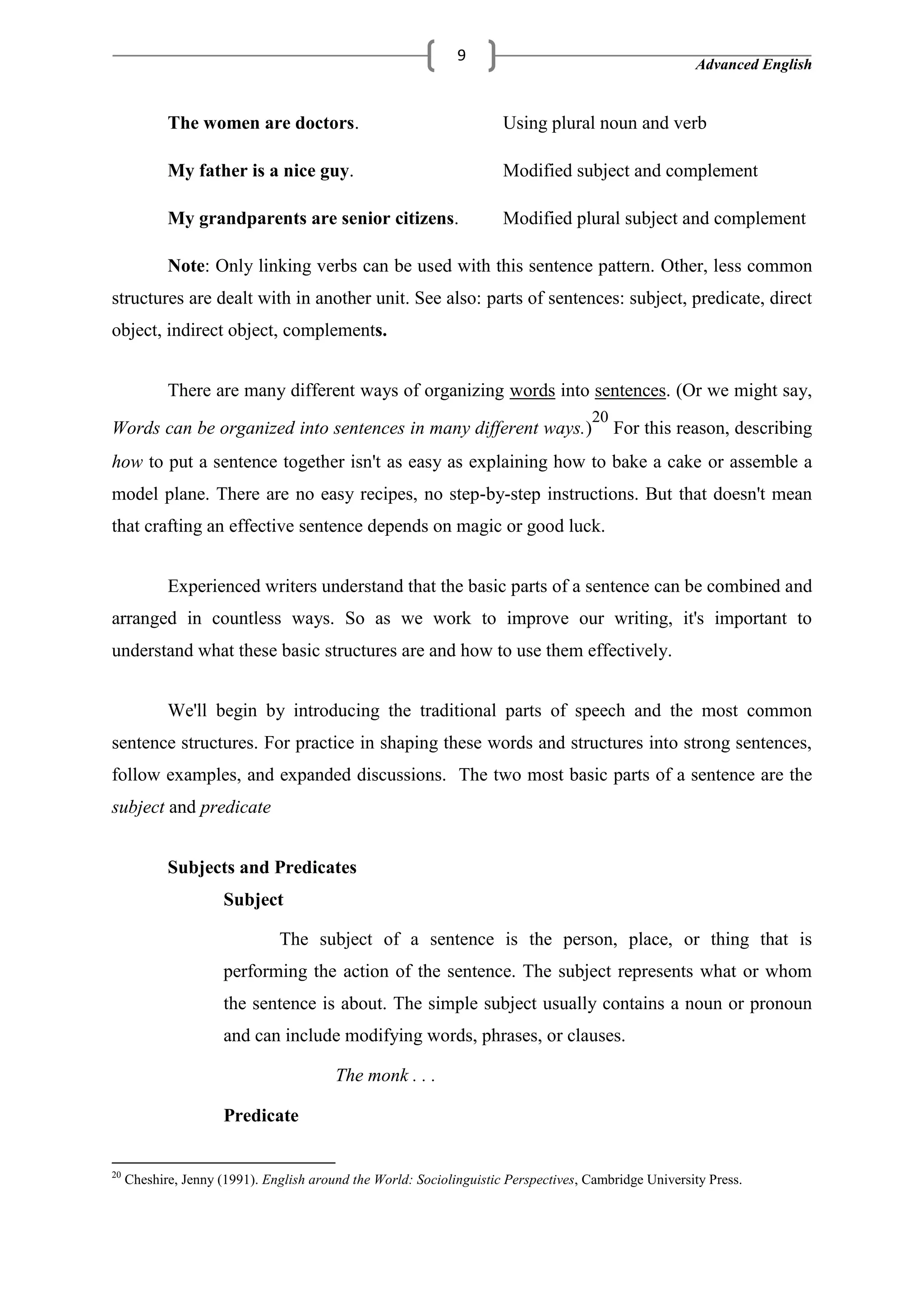
The people like rice. Specific subject
The friendly people like rice. Subject modified with an adjective
The people in the restaurant like rice. Subject modified with an adjective
The people like boiled rice. Object modified with an adjective
The people like hot, white rice. Object modified with more than one
adjective
Note: Only transitive action verbs can be used with this sentence pattern.
The following sentences are examples of the S-V-Adj. pattern.
He is fine. Basic sentence with "be" verb
He seems happy. Basic sentence with another linking verb
Yota is tall, black & white and handsome. Series of adjectives
He appears very comfortable. Adverb or intensifier added
George became sick last night. Different tense and linking verb
Note: Only linking verbs can be used with this sentence pattern.
The following sentences are examples of the S-V-Adv pattern.
The teacher is here. Basic sentence
The teacher is over there. Using an adverb phrase
Teachers are everywhere. Plural noun and verb used
The teachers are in the lobby. Prepositional phrase functioning as
adverb
Note: Only linking verbs can be used with this sentence pattern.
The following sentences are examples of the S-V-N pattern.
The man is a doctor. Basic sentence
Advanced English
9
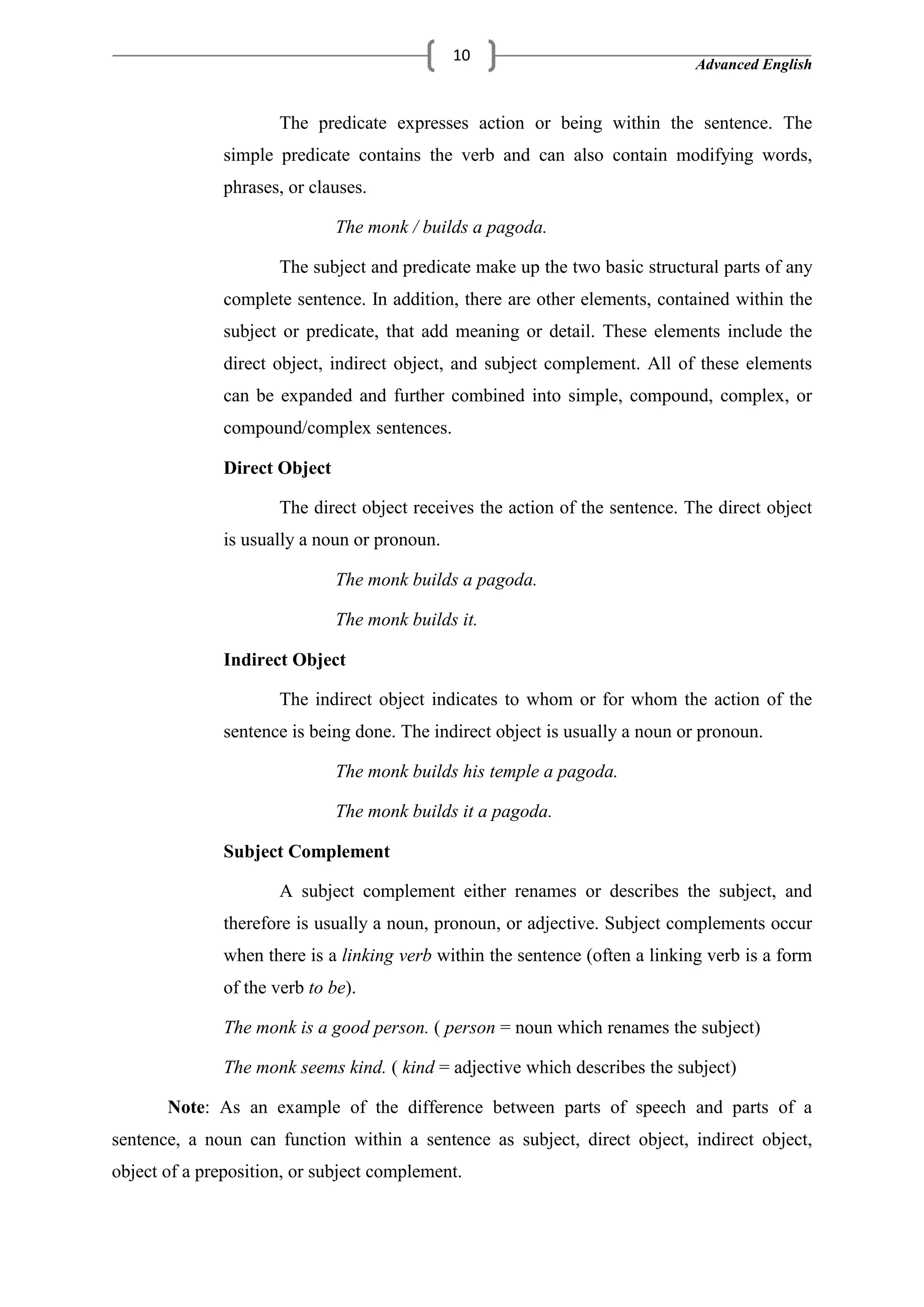
The women are doctors. Using plural noun and verb
My father is a nice guy. Modified subject and complement
My grandparents are senior citizens. Modified plural subject and complement
Note: Only linking verbs can be used with this sentence pattern. Other, less common
structures are dealt with in another unit. See also: parts of sentences: subject, predicate, direct
object, indirect object, complements.
There are many different ways of organizing words into sentences. (Or we might say,
Words can be organized into sentences in many different ways.)
20
For this reason, describing
how to put a sentence together isn't as easy as explaining how to bake a cake or assemble a
model plane. There are no easy recipes, no step-by-step instructions. But that doesn't mean
that crafting an effective sentence depends on magic or good luck.
Experienced writers understand that the basic parts of a sentence can be combined and
arranged in countless ways. So as we work to improve our writing, it's important to
understand what these basic structures are and how to use them effectively.
We'll begin by introducing the traditional parts of speech and the most common
sentence structures. For practice in shaping these words and structures into strong sentences,
follow examples, and expanded discussions. The two most basic parts of a sentence are the
subject and predicate
Subjects and Predicates
Subject
The subject of a sentence is the person, place, or thing that is
performing the action of the sentence. The subject represents what or whom
the sentence is about. The simple subject usually contains a noun or pronoun
and can include modifying words, phrases, or clauses.
The monk . . .
Predicate
20
Cheshire, Jenny (1991). English around the World: Sociolinguistic Perspectives, Cambridge University Press.
Advanced English
10
The predicate expresses action or being within the sentence. The
simple predicate contains the verb and can also contain modifying words,
phrases, or clauses.
The monk / builds a pagoda.
The subject and predicate make up the two basic structural parts of any
complete sentence. In addition, there are other elements, contained within the
subject or predicate, that add meaning or detail. These elements include the
direct object, indirect object, and subject complement. All of these elements
can be expanded and further combined into simple, compound, complex, or
compound/complex sentences.
Direct Object
The direct object receives the action of the sentence. The direct object
is usually a noun or pronoun.
The monk builds a pagoda.
The monk builds it.
Indirect Object
The indirect object indicates to whom or for whom the action of the
sentence is being done. The indirect object is usually a noun or pronoun.
The monk builds his temple a pagoda.
The monk builds it a pagoda.
Subject Complement
A subject complement either renames or describes the subject, and
therefore is usually a noun, pronoun, or adjective. Subject complements occur
when there is a linking verb within the sentence (often a linking verb is a form
of the verb to be).
The monk is a good person. ( person = noun which renames the subject)
The monk seems kind. ( kind = adjective which describes the subject)
Note: As an example of the difference between parts of speech and parts of a
sentence, a noun can function within a sentence as subject, direct object, indirect object,
object of a preposition, or subject complement.
Advanced English
11
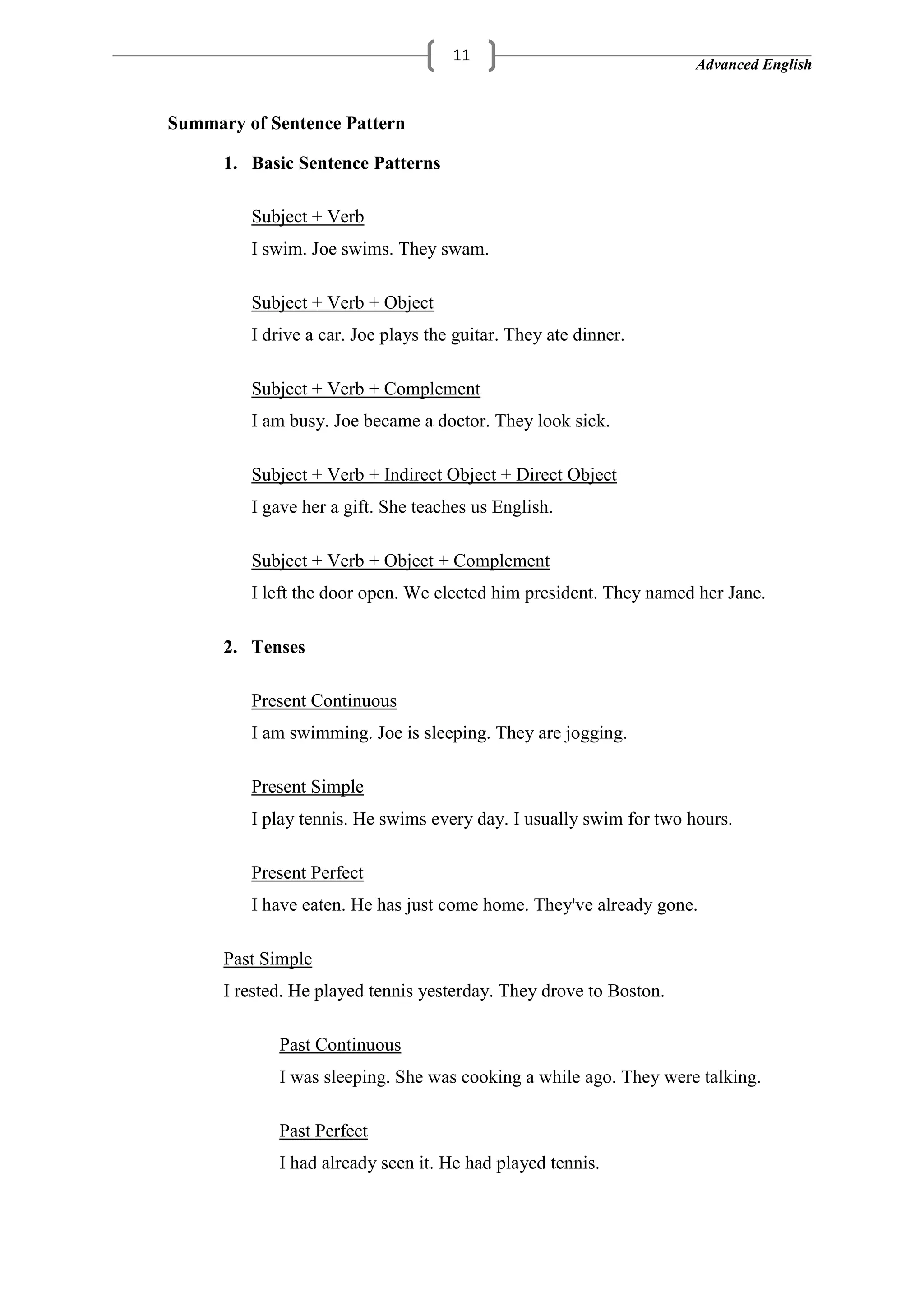
Summary of Sentence Pattern
1. Basic Sentence Patterns
Subject + Verb
I swim. Joe swims. They swam.
Subject + Verb + Object
I drive a car. Joe plays the guitar. They ate dinner.
Subject + Verb + Complement
I am busy. Joe became a doctor. They look sick.
Subject + Verb + Indirect Object + Direct Object
I gave her a gift. She teaches us English.
Subject + Verb + Object + Complement
I left the door open. We elected him president. They named her Jane.
2. Tenses
Present Continuous
I am swimming. Joe is sleeping. They are jogging.
Present Simple
I play tennis. He swims every day. I usually swim for two hours.
Present Perfect
I have eaten. He has just come home. They've already gone.
Past Simple
I rested. He played tennis yesterday. They drove to Boston.
Past Continuous
I was sleeping. She was cooking a while ago. They were talking.
Past Perfect
I had already seen it. He had played tennis.
Advanced English
12
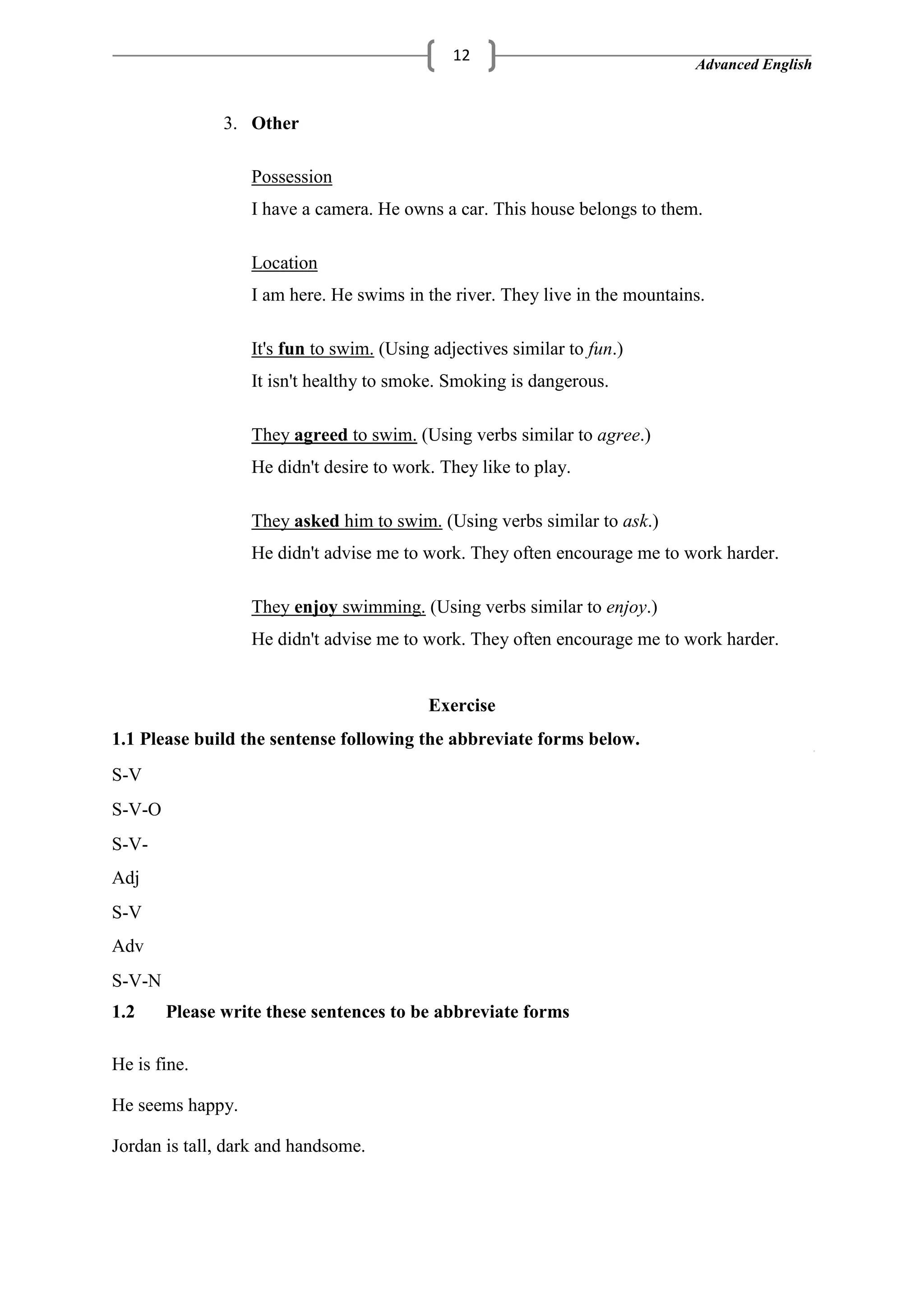
3. Other
Possession
I have a camera. He owns a car. This house belongs to them.
Location
I am here. He swims in the river. They live in the mountains.
It's fun to swim. (Using adjectives similar to fun.)
It isn't healthy to smoke. Smoking is dangerous.
They agreed to swim. (Using verbs similar to agree.)
He didn't desire to work. They like to play.
They asked him to swim. (Using verbs similar to ask.)
He didn't advise me to work. They often encourage me to work harder.
They enjoy swimming. (Using verbs similar to enjoy.)
He didn't advise me to work. They often encourage me to work harder.
Exercise
1.1 Please build the sentense following the abbreviate forms below.
S-V
S-V-O
S-V-
Adj
S-V
Adv
S-V-N
1.2 Please write these sentences to be abbreviate forms
He is fine.
He seems happy.
Jordan is tall, dark and handsome.
Advanced English
13
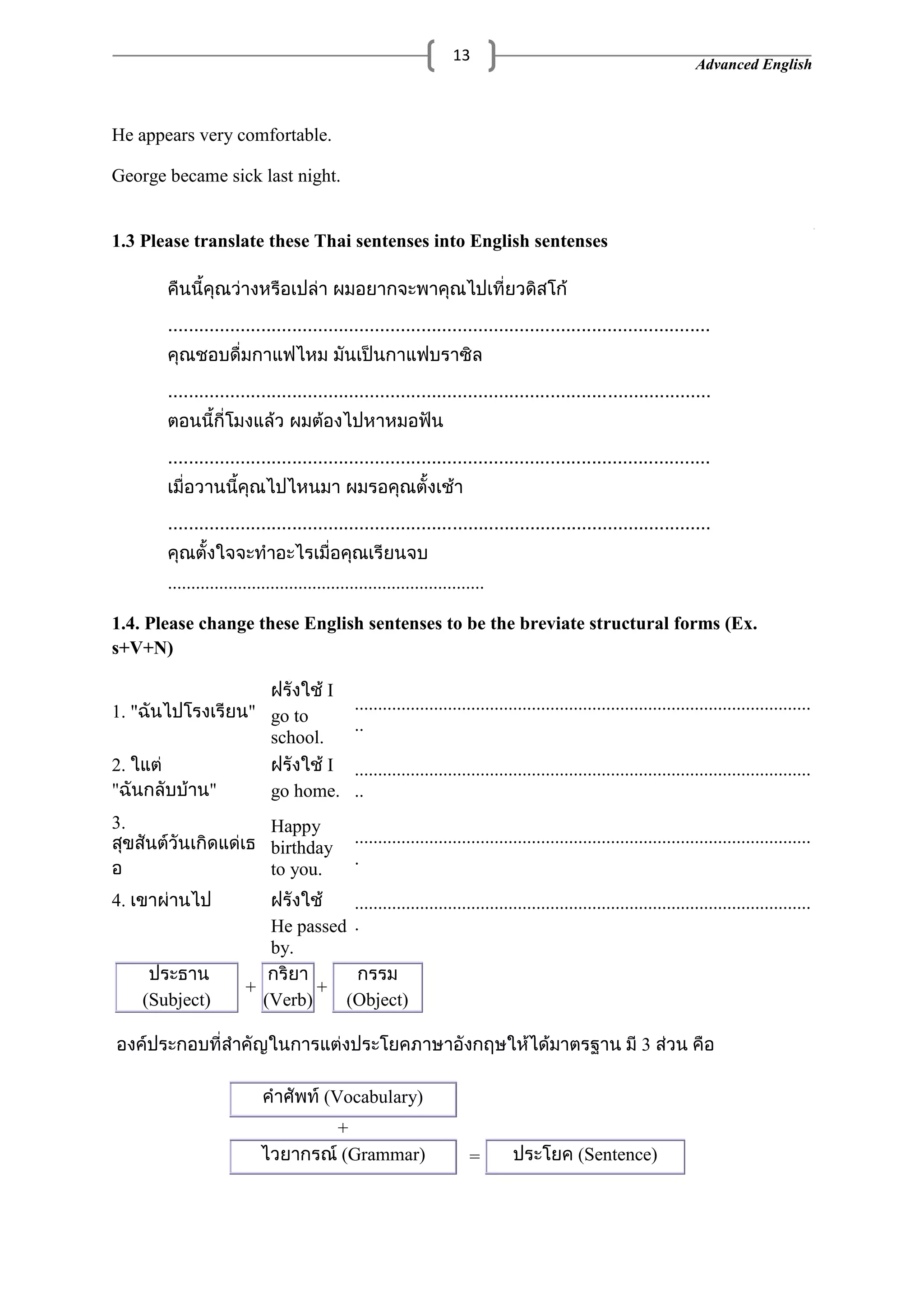
He appears very comfortable.
George became sick last night.
1.3 Please translate these Thai sentenses into English sentenses
.........................................................................................................
.........................................................................................................
.........................................................................................................
.........................................................................................................
....................................................................
1.4. Please change these English sentenses to be the breviate structural forms (Ex.
s+V+N)
1. "
I
go to
school.
..................................................................................................
..
2. I
go home.
..................................................................................................
..
3. Happy
birthday
to you.
..................................................................................................
.
4.
He passed
by.
..................................................................................................
.
(Subject)
+
(Verb)
+
Object)
3
(Vocabulary)
+
(Grammar) = Sentence)
Advanced English
14
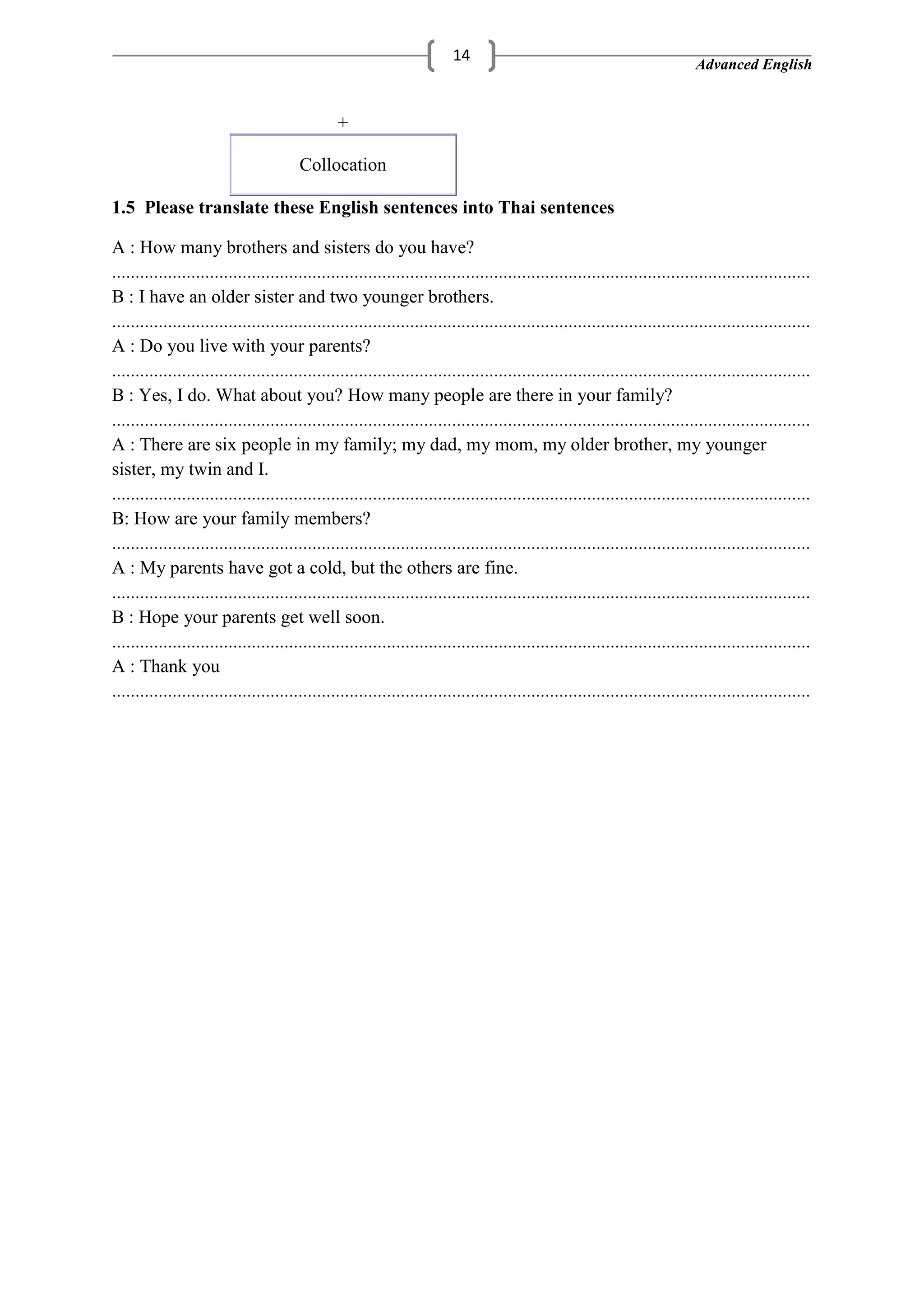
+
Collocation
1.5 Please translate these English sentences into Thai sentences
A : How many brothers and sisters do you have?
B : I have an older sister and two younger brothers.
A : Do you live with your parents?
B : Yes, I do. What about you? How many people are there in your family?
A : There are six people in my family; my dad, my mom, my older brother, my younger
sister, my twin and I.
B: How are your family members?
A : My parents have got a cold, but the others are fine.
B : Hope your parents get well soon.
A : Thank you
Advanced English
15
Chapter 3
Sentence Patterns
Basically in learning process of every language, the understanding of sentence
patterns is one of important thing that all learner need for. The knowledge of how groups of
words function to convey units of thought further enhances our ability to communicate
clearly. This is why we need to know about sentence patterns, the fundamentals of how those
units of thought that we call sentences are constructed. Just about all sentences in the English
language fall into ten patterns determined by the presence and functions of nouns, verbs,
adjectives, and adverbs.
21
Verb of Being Patterns
The patterns are most easily classified according to the type of verb used:
22
Verb of being patterns (1, 2, 3) use a form of the verb to be as the main verb in the
sentence.
is are was were
has been have been had been
Linking Verb Pattern
Linking verb patterns (4, 5) use one of the linking verbs as the main verb in the
sentence. The linking verb is followed by a noun or adjective functioning as a subjective
complement.
smell taste look feel seem become appear grow etc.
Action Verb Pattern
21
http://www.englishmistakeswelcome.com/sentence_patterns.htm retrieved on 12/2/2012
22
http://www.lovekraw.blogspot.com/2012/09/sentence-patterns-1.html retrieved on 4/9/2012
Advanced English
16
Action verb patterns (6, 7, 8, 9,10) use one of the many action verbs as the main verb
in the sentence. The action verb may be either transitive (take a direct object) or intransitive
(not take a direct object).
see jump embrace write imagine buy plummet
think etc.
Terms used to identify various parts of each sentence pattern include the following:
NP = noun phrase
This abbreviation refers to a headword noun and its modifiers ("noun phrase")
functioning as a subject, direct object, indirect object, subjective complement, or objective
complement.
NP1, NP2, NP3, etc. = designations for different noun phrase functions
Numbers in sequential order are used with each NP to designate its difference from or
similarity to other NPs before and after it.
V-be = verb of being
LV = linking verb
V-int = intransitive verb
V-tr = transitive verb
ADV/TP = adverbial of time or place
ADJ = adjective
The Ten Sentence Patterns
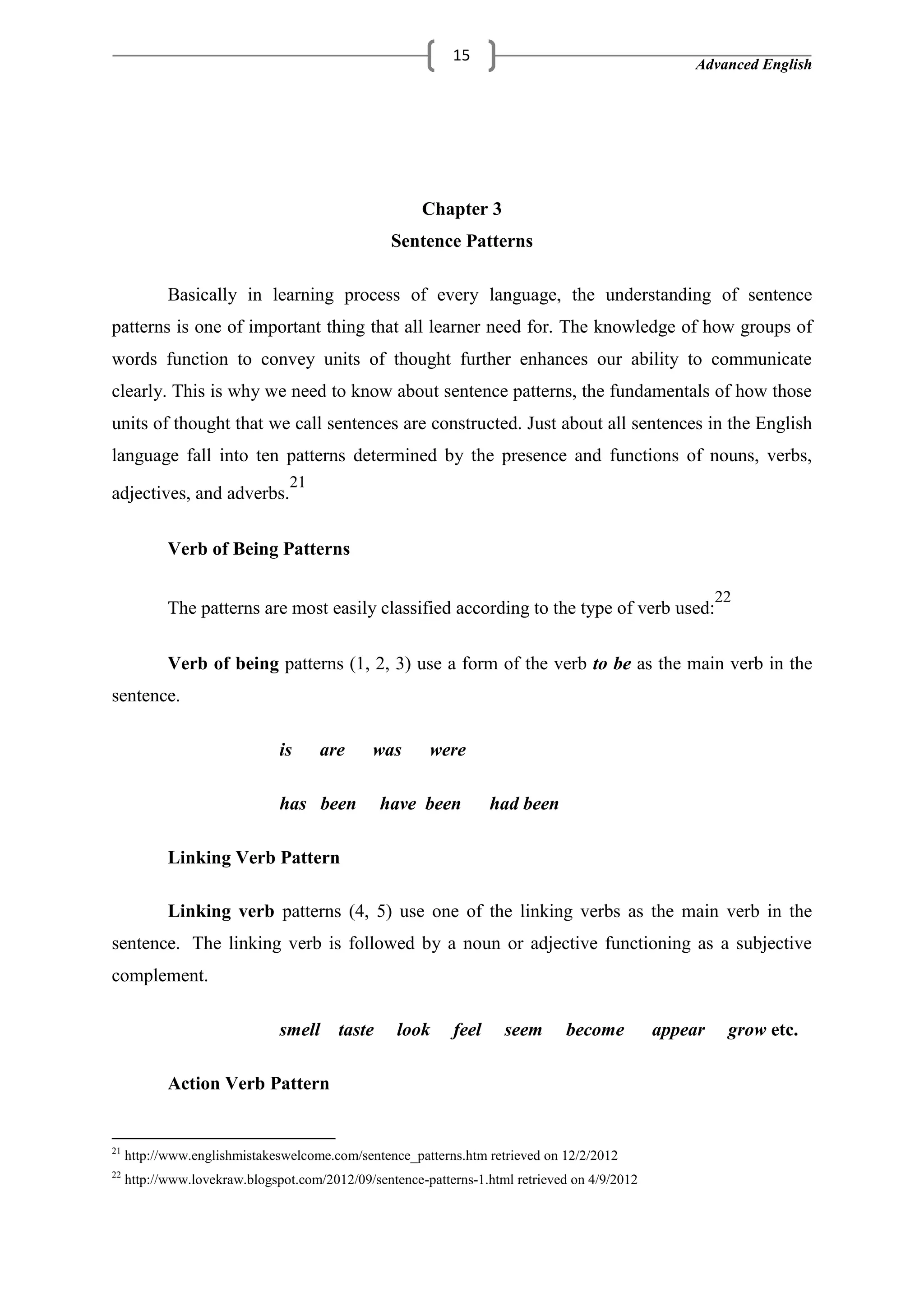
1. NP1 + V-be + ADV/TP
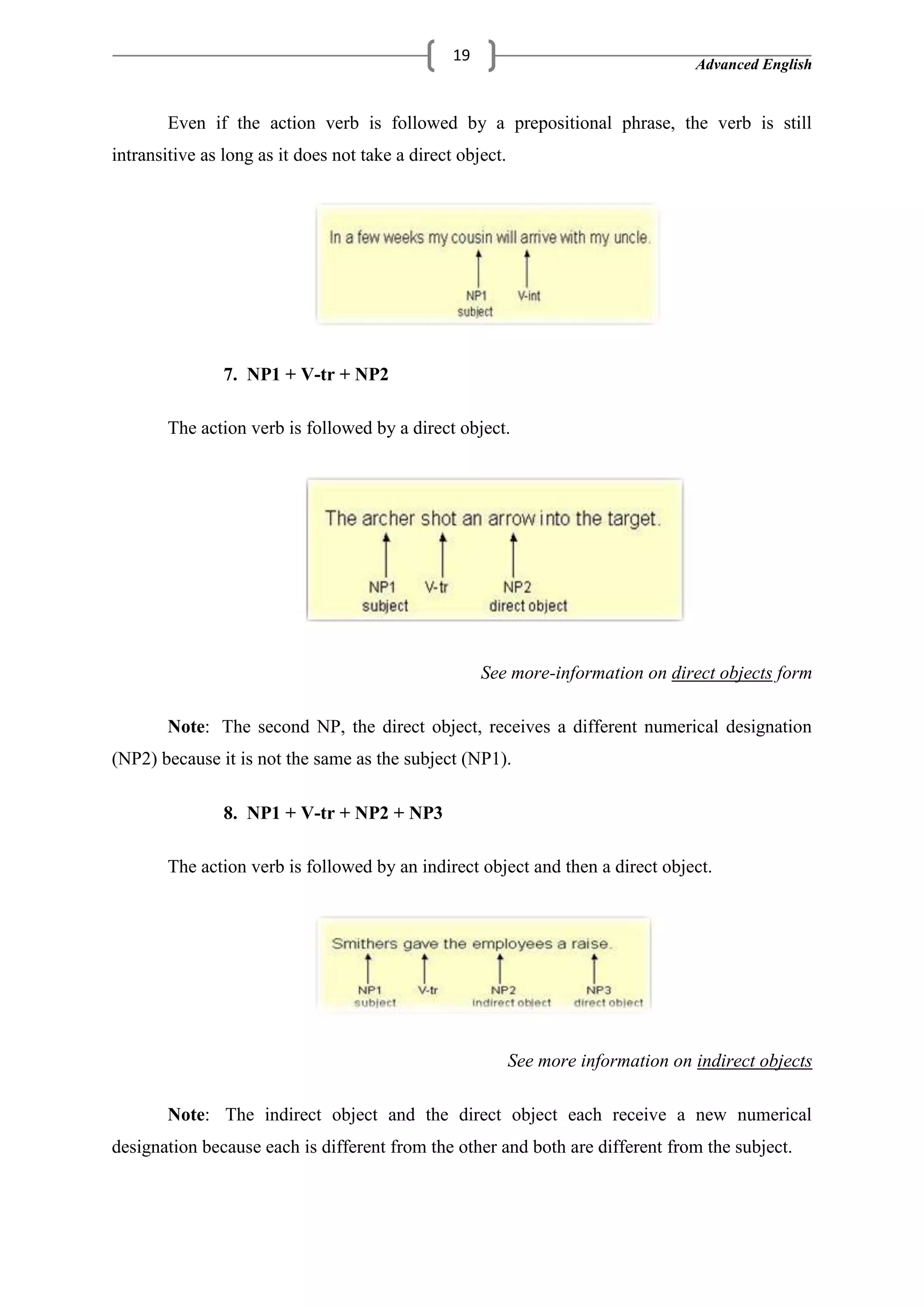
The verb of being is followed by an adverb indicating where or when.
See more information on subjects form
Advanced English
17
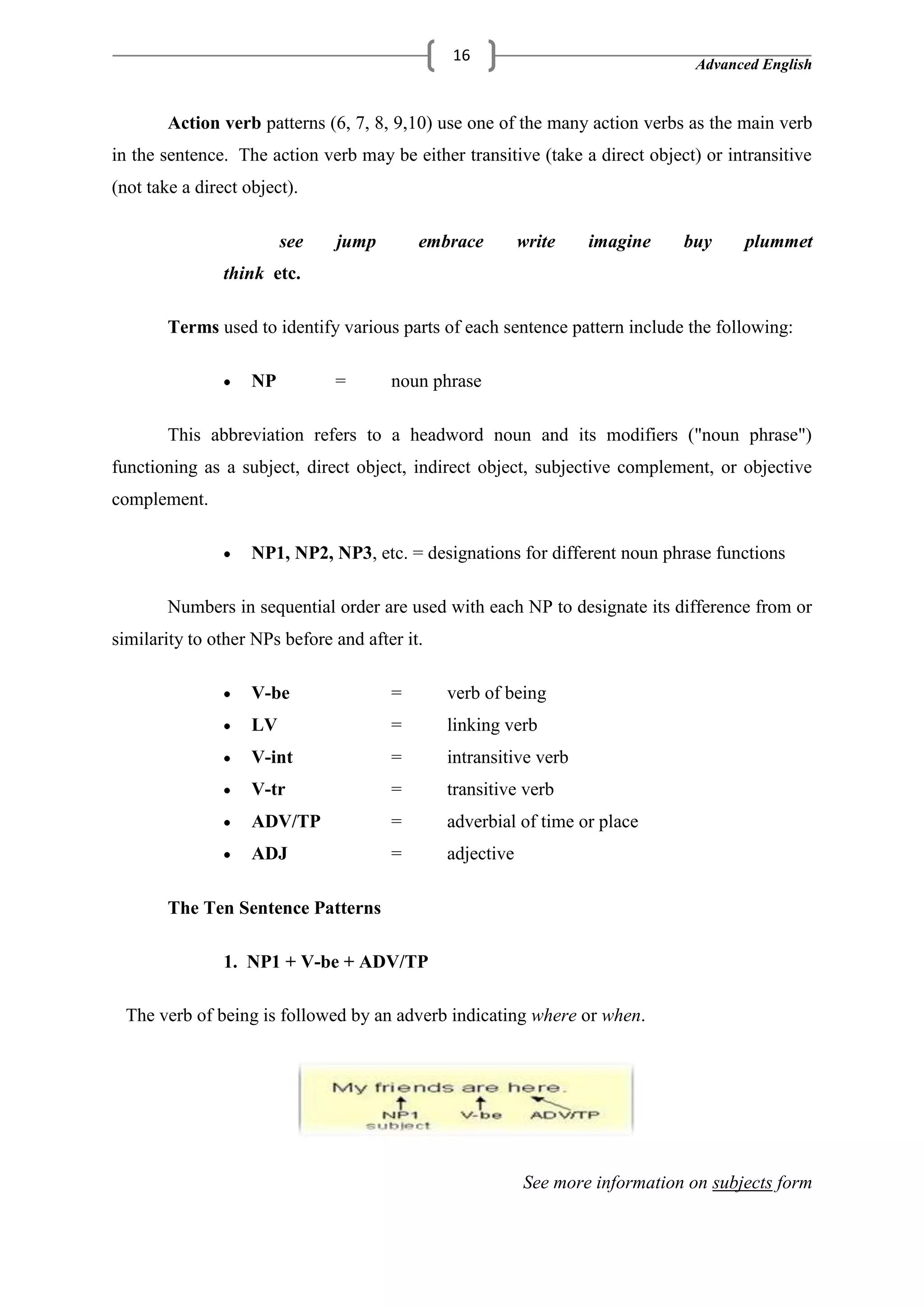
The adverbial indicating where or when may be a prepositional phrase.
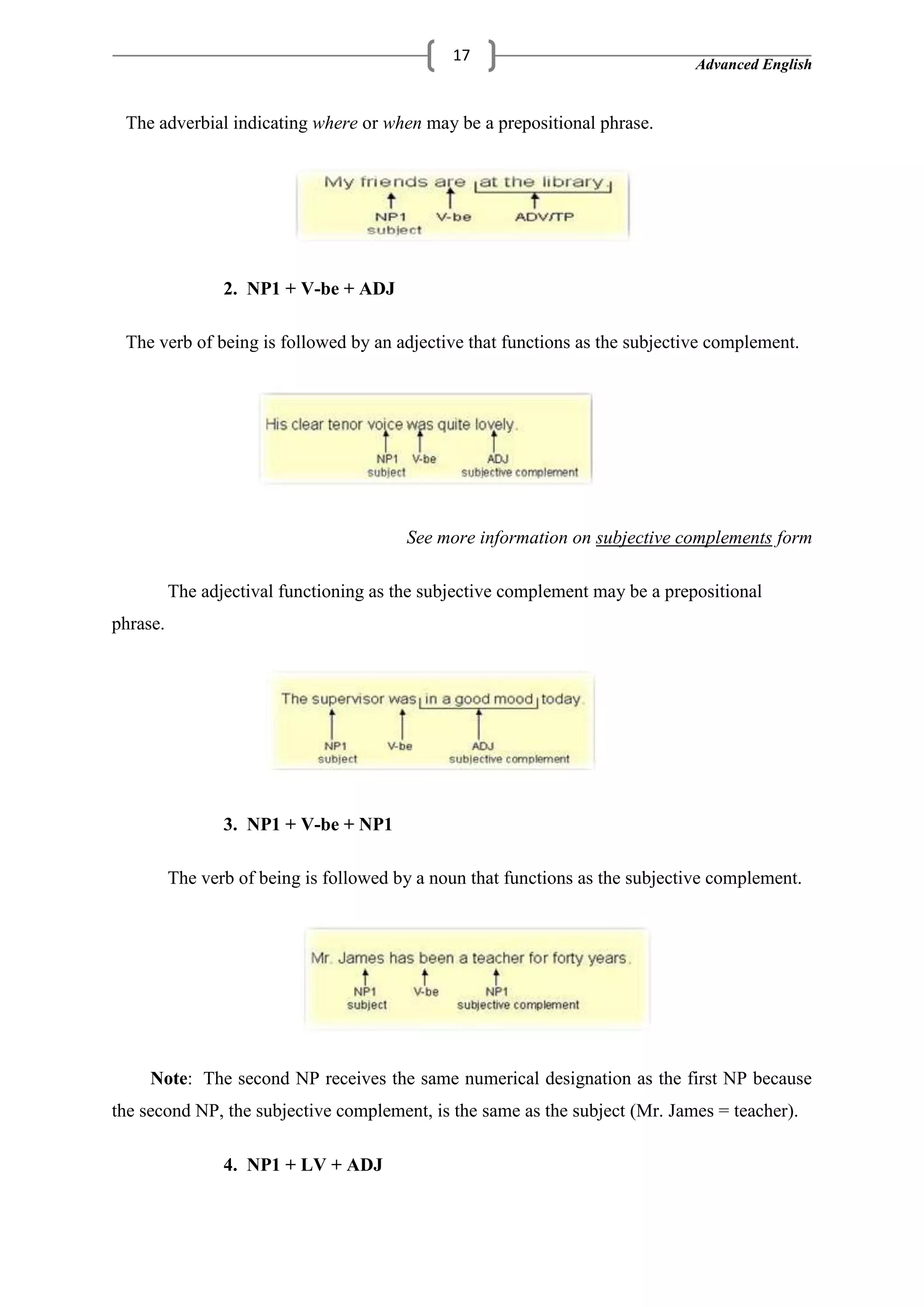
2. NP1 + V-be + ADJ
The verb of being is followed by an adjective that functions as the subjective complement.
See more information on subjective complements form
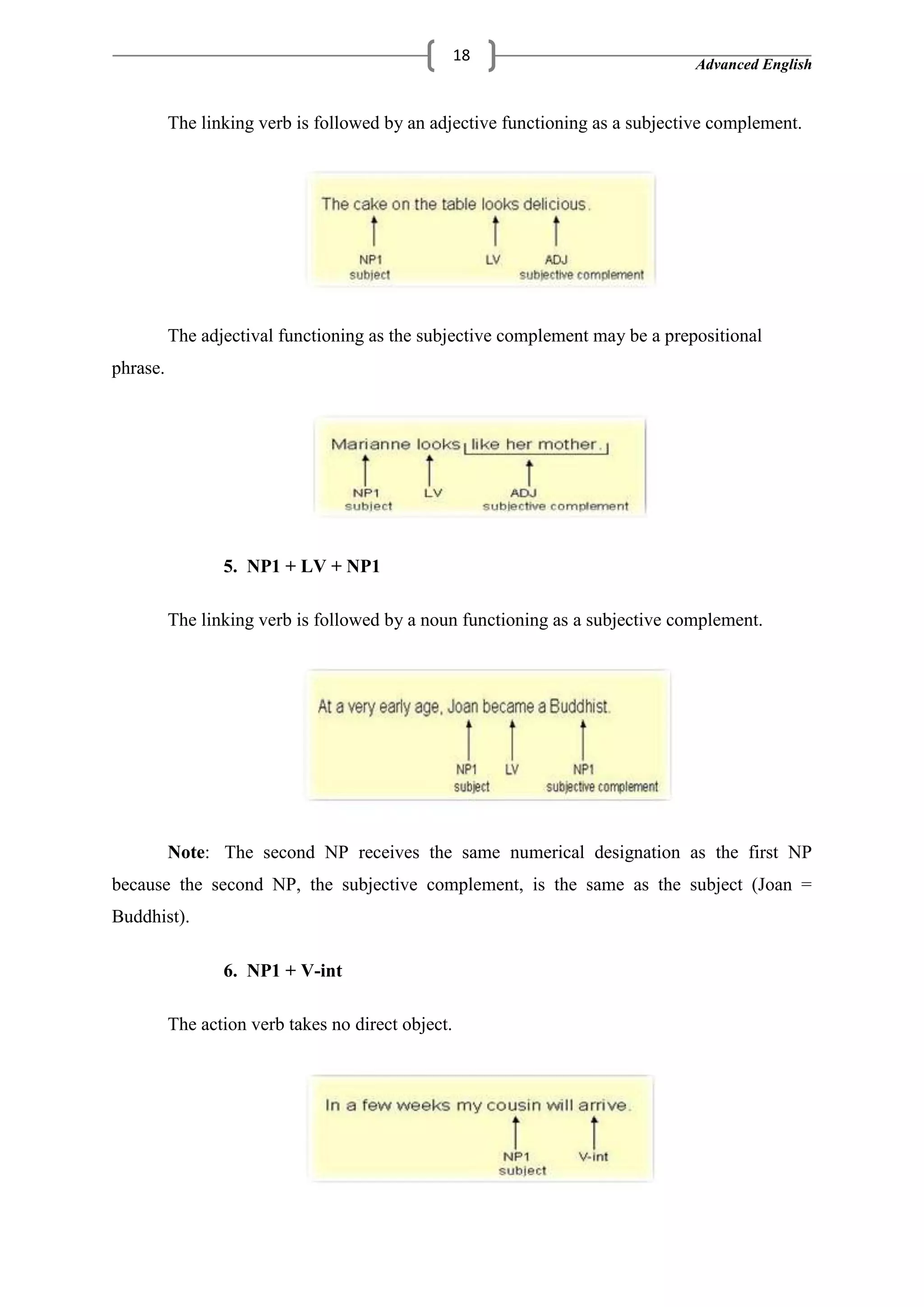
The adjectival functioning as the subjective complement may be a prepositional
phrase.
3. NP1 + V-be + NP1
The verb of being is followed by a noun that functions as the subjective complement.
Note: The second NP receives the same numerical designation as the first NP because
the second NP, the subjective complement, is the same as the subject (Mr. James = teacher).
4. NP1 + LV + ADJ
Advanced English
18
The linking verb is followed by an adjective functioning as a subjective complement.
The adjectival functioning as the subjective complement may be a prepositional
phrase.
5. NP1 + LV + NP1
The linking verb is followed by a noun functioning as a subjective complement.
Note: The second NP receives the same numerical designation as the first NP
because the second NP, the subjective complement, is the same as the subject (Joan =
Buddhist).
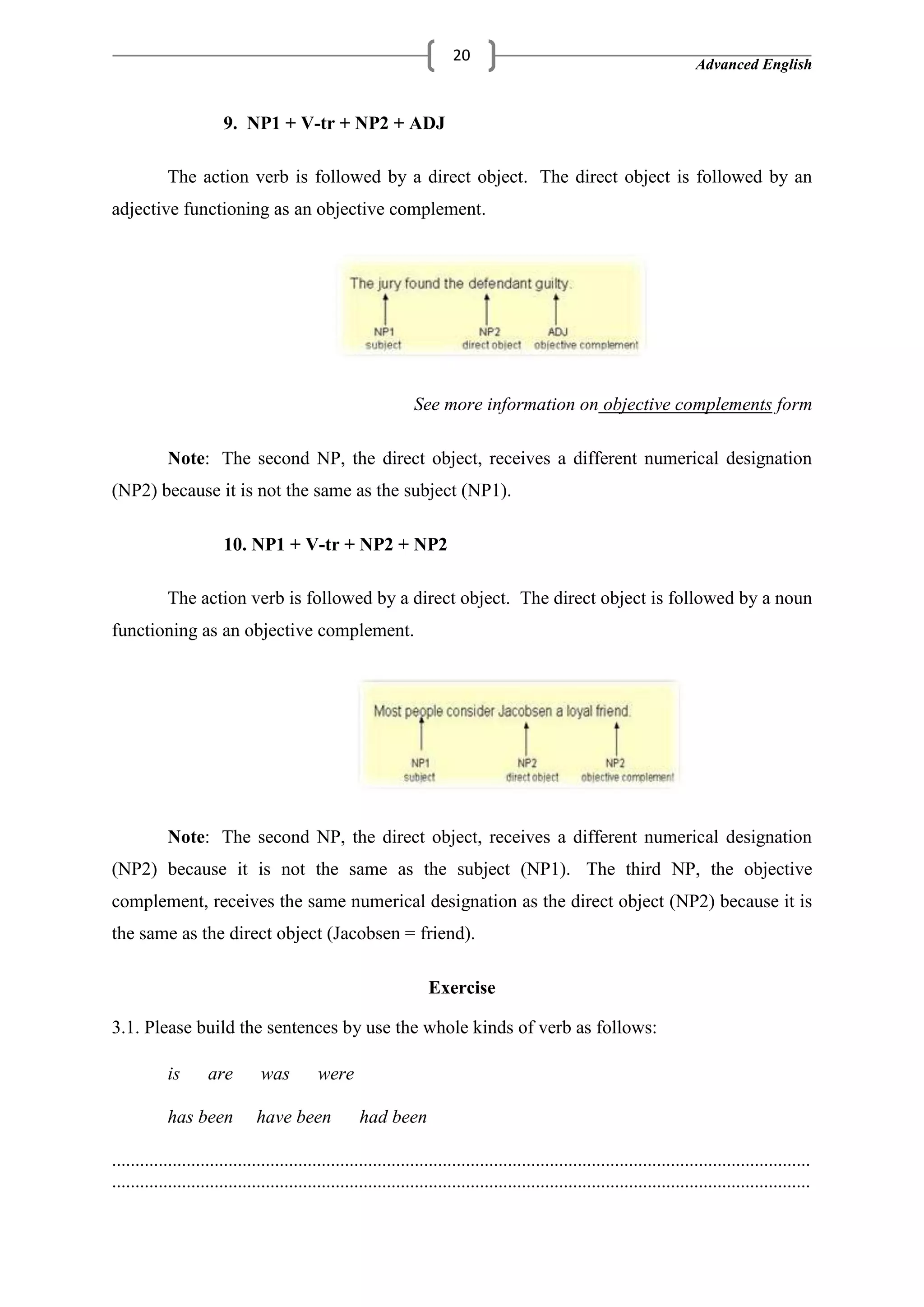
6. NP1 + V-int
The action verb takes no direct object.
Advanced English
19
Even if the action verb is followed by a prepositional phrase, the verb is still
intransitive as long as it does not take a direct object.
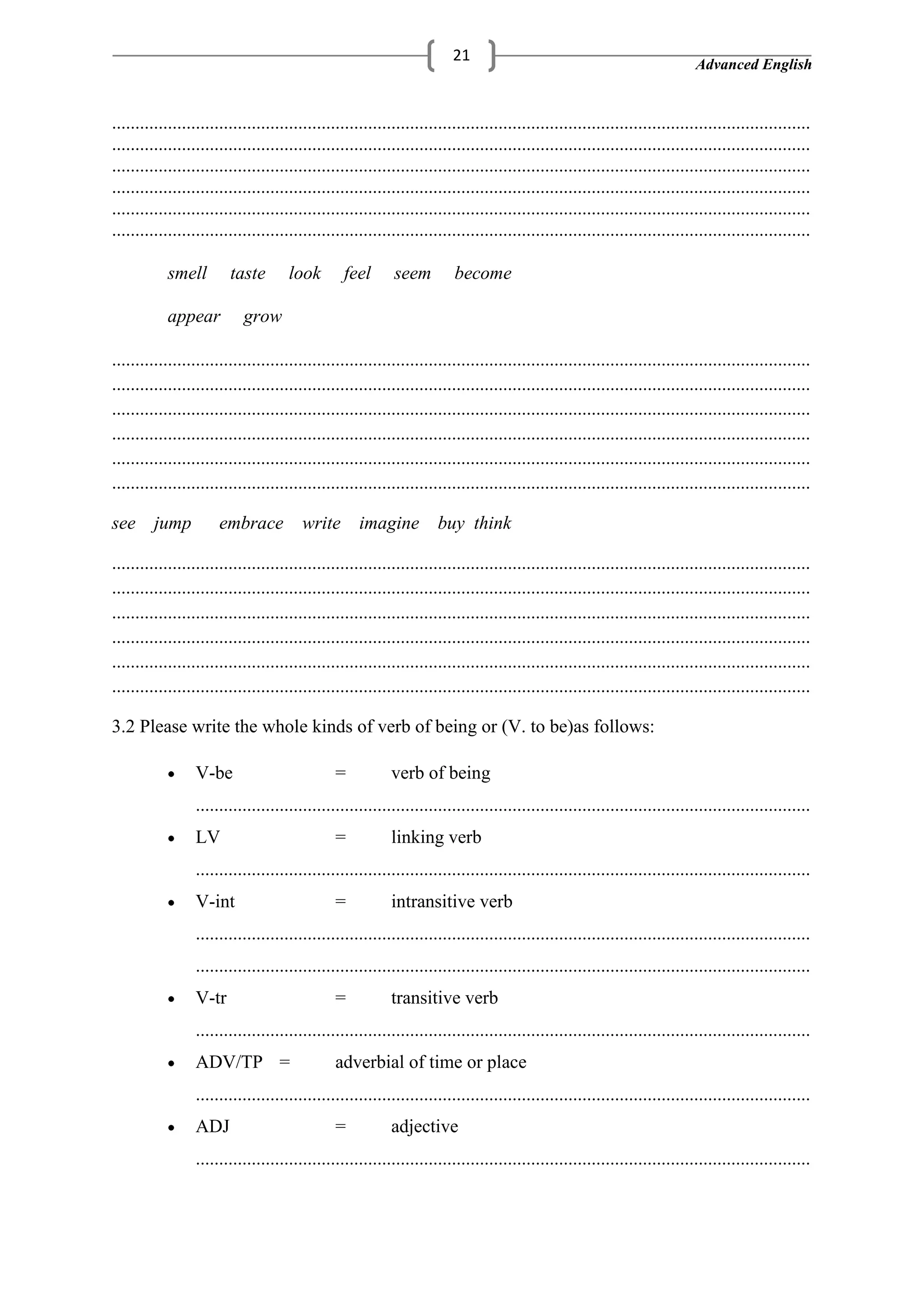
7. NP1 + V-tr + NP2
The action verb is followed by a direct object.
See more-information on direct objects form
Note: The second NP, the direct object, receives a different numerical designation
(NP2) because it is not the same as the subject (NP1).
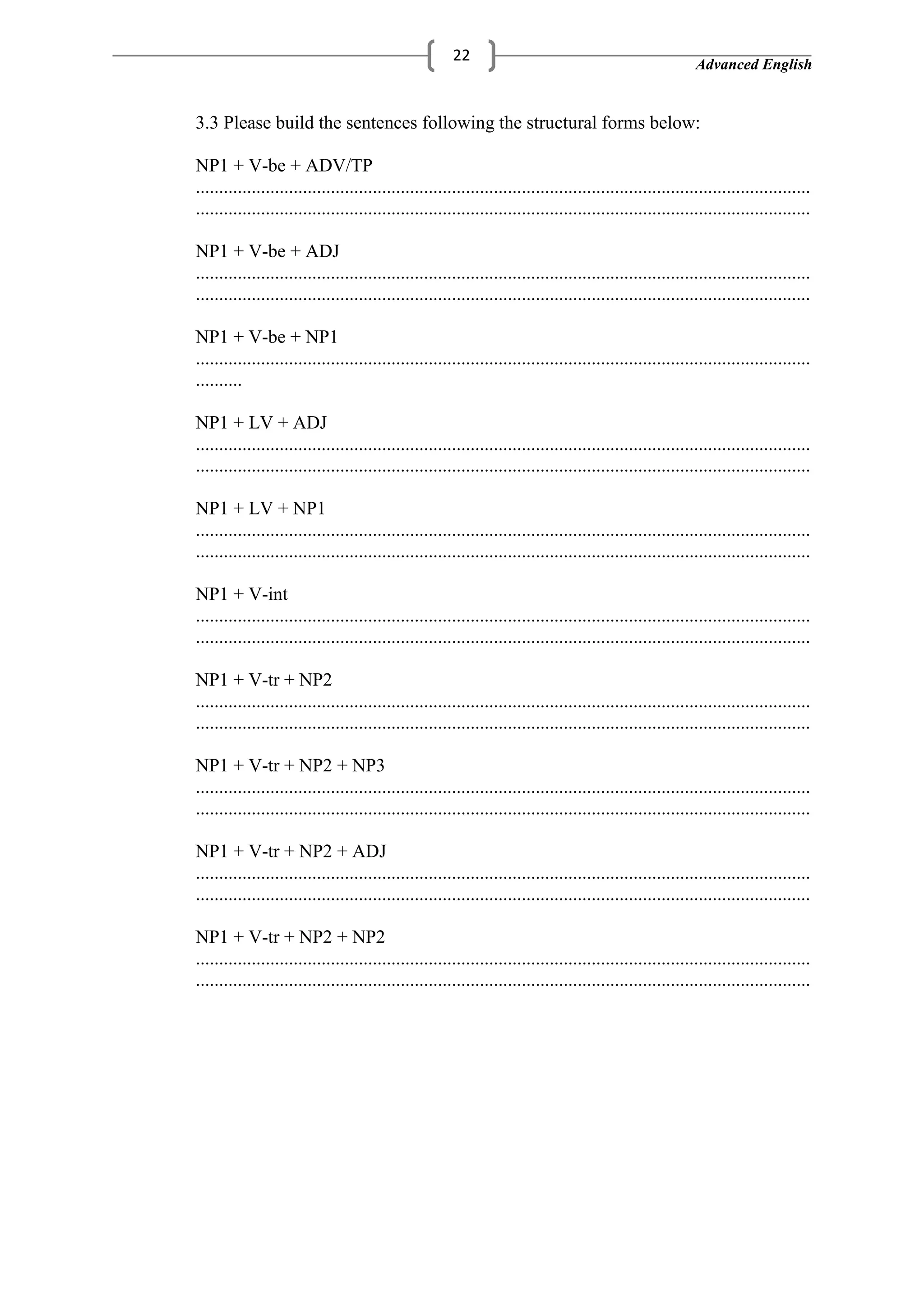
8. NP1 + V-tr + NP2 + NP3
The action verb is followed by an indirect object and then a direct object.
See more information on indirect objects
Note: The indirect object and the direct object each receive a new numerical
designation because each is different from the other and both are different from the subject.
Advanced English
20
9. NP1 + V-tr + NP2 + ADJ
The action verb is followed by a direct object. The direct object is followed by an
adjective functioning as an objective complement.
See more information on objective complements form
Note: The second NP, the direct object, receives a different numerical designation
(NP2) because it is not the same as the subject (NP1).
10. NP1 + V-tr + NP2 + NP2
The action verb is followed by a direct object. The direct object is followed by a noun
functioning as an objective complement.
Note: The second NP, the direct object, receives a different numerical designation
(NP2) because it is not the same as the subject (NP1). The third NP, the objective
complement, receives the same numerical designation as the direct object (NP2) because it is
the same as the direct object (Jacobsen = friend).
Exercise
3.1. Please build the sentences by use the whole kinds of verb as follows:
is are was were
has been have been had been
......................................................................................................................................................
......................................................................................................................................................
Advanced English
21
......................................................................................................................................................
......................................................................................................................................................
......................................................................................................................................................
......................................................................................................................................................
......................................................................................................................................................
......................................................................................................................................................
smell taste look feel seem become
appear grow
......................................................................................................................................................
......................................................................................................................................................
......................................................................................................................................................
......................................................................................................................................................
......................................................................................................................................................
......................................................................................................................................................
see jump embrace write imagine buy think
......................................................................................................................................................
......................................................................................................................................................
......................................................................................................................................................
......................................................................................................................................................
......................................................................................................................................................
......................................................................................................................................................
3.2 Please write the whole kinds of verb of being or (V. to be)as follows:
V-be = verb of being
....................................................................................................................................
LV = linking verb
....................................................................................................................................
V-int = intransitive verb
....................................................................................................................................
....................................................................................................................................
V-tr = transitive verb
....................................................................................................................................
ADV/TP = adverbial of time or place
....................................................................................................................................
ADJ = adjective
....................................................................................................................................
Advanced English
22
3.3 Please build the sentences following the structural forms below:
NP1 + V-be + ADV/TP
....................................................................................................................................
....................................................................................................................................
NP1 + V-be + ADJ
....................................................................................................................................
....................................................................................................................................
NP1 + V-be + NP1
....................................................................................................................................
..........
NP1 + LV + ADJ
....................................................................................................................................
....................................................................................................................................
NP1 + LV + NP1
....................................................................................................................................
....................................................................................................................................
NP1 + V-int
....................................................................................................................................
....................................................................................................................................
NP1 + V-tr + NP2
....................................................................................................................................
....................................................................................................................................
NP1 + V-tr + NP2 + NP3
....................................................................................................................................
....................................................................................................................................
NP1 + V-tr + NP2 + ADJ
....................................................................................................................................
....................................................................................................................................
NP1 + V-tr + NP2 + NP2
....................................................................................................................................
....................................................................................................................................
Advanced English
23
Chapter 4
Elements of Sentence Structuring
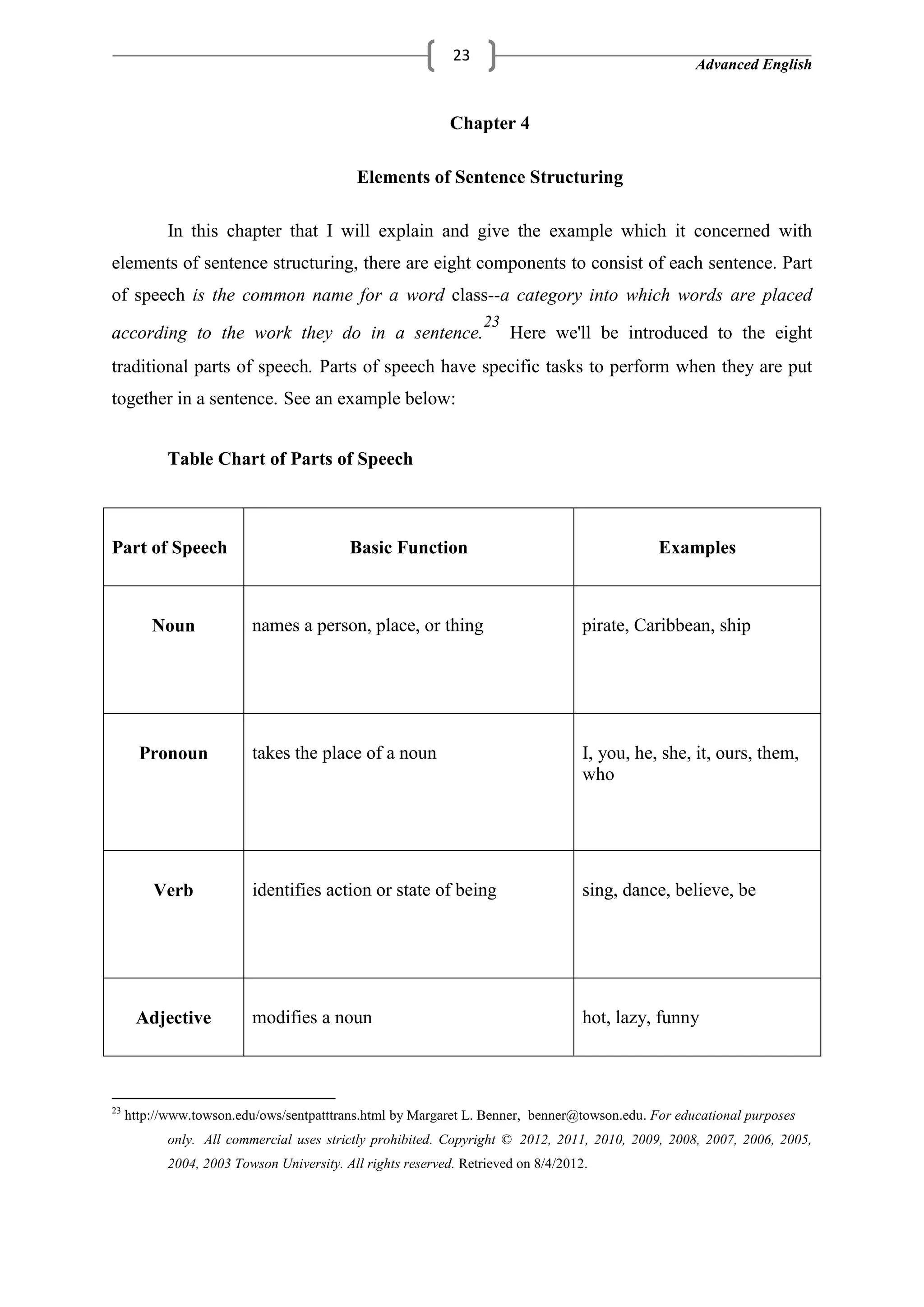
In this chapter that I will explain and give the example which it concerned with
elements of sentence structuring, there are eight components to consist of each sentence. Part
of speech is the common name for a word class--a category into which words are placed
according to the work they do in a sentence.
23
Here we'll be introduced to the eight
traditional parts of speech. Parts of speech have specific tasks to perform when they are put
together in a sentence. See an example below:
Table Chart of Parts of Speech
Part of Speech Basic Function Examples
Noun names a person, place, or thing pirate, Caribbean, ship
Pronoun takes the place of a noun I, you, he, she, it, ours, them,
who
Verb identifies action or state of being sing, dance, believe, be
Adjective modifies a noun hot, lazy, funny
23
http://www.towson.edu/ows/sentpatttrans.html by Margaret L. Benner, benner@towson.edu. For educational purposes
only. All commercial uses strictly prohibited. Copyright © 2012, 2011, 2010, 2009, 2008, 2007, 2006, 2005,
2004, 2003 Towson University. All rights reserved. Retrieved on 8/4/2012.
Advanced English
24
Adverb
modifies a verb, adjective, or other
adverb
softly, lazily, often
Preposition shows a relationship between a noun (or
pronoun) and other words in a sentence
up, over, against, by, for
Conjunction joins words, phrases, and clauses and, but, or, yet
Interjection expresses emotion ah, whoops, ouch
See more details about English grammar in part of speech
Note: Though some traditional grammars have treated articles (the, a[n]) as a distinct
part of speech, contemporary grammars more often include articles in the category of
determiners.
A noun or pronoun functions as the sentence subject when it is paired with a verb
functioning as the sentence predicate. Every sentence has a subject and predicate.
24
Subject
A subject can be a noun or pronoun that is partnered with an action verb.
Example:
24
Learn English Network. ―English Grammar – Simple Sentence Construction.‖ Learn English: LEO Network. (2007). See
more details: http://www.learnenglish.de/grammar/sentencetext.htm#Object.
Advanced English
25
Sometimes a verb will express being or existence instead of action.
Example:
Sometimes we use sentences in which a subject is not actually stated, but is,
nevertheless, understood in the meaning.
Example:
A sentence like this gives an order or a request to someone.
Because we use such statements when we are talking directly to someone, we omit the
word you. It is understood in the sentence. Therefore, in statements like this one, we say the
subject is
You (understood).
This kind of sentence is an imperative sentence.
Predicate
Advanced English
26
A predicate is a verb that expresses the subject's action or state of being.
Example:
Sometimes the predicate will be composed of two or three verbs that fit together - the main
verb preceded by one or more auxiliary (helping) verbs.
Note: To be a predicate, a verb that ends in -ing must always have a helping verb
with it. An -ing verb without a helping verb cannot be a predicate in a sentence. A subject
and predicate may not always appear together or in the normal order, as the following
examples show:
Advanced English
27
Phrases
A phrase is a group of related words that
1. does not express a complete thought
2. does not have a subject and predicate pair
One type of phrase is a prepositional phrase.
Examples:
Another kind of phrase is a verbal phrase.
Examples:
Even though these phrases contain nouns (pronouns) and/or verb forms, none of the
nouns/pronouns/verbs are subjects or predicates. None of them work as a partnership.
Also, these phrases do not express complete thoughts.
Clauses
Words and phrases can be put together to make clauses.
A clause is a group of related words that contain a subject and predicate. Note
the difference between phrases and clauses in the following examples:
Only one of the clauses is a sentence.
Clause #1 gives a thought or an idea that is complete, that can stand by itself,
independent of other words.
Advanced English
28
However, clause #2 gives an incomplete thought or idea, one that cannot stand by
itself, one that needs some more words to make it whole. The word after changes the
meaning, making the thought incomplete, after reading this clause, we are left hanging.
These two clauses illustrate the two kinds of clauses:
Independent Clauses and Dependent Clauses
An independent clause is a group of words that contains a subject, a
predicate, and a complete thought.
A dependent clause is a group of words that contains a subject and a
predicate, but does not express a complete thought.
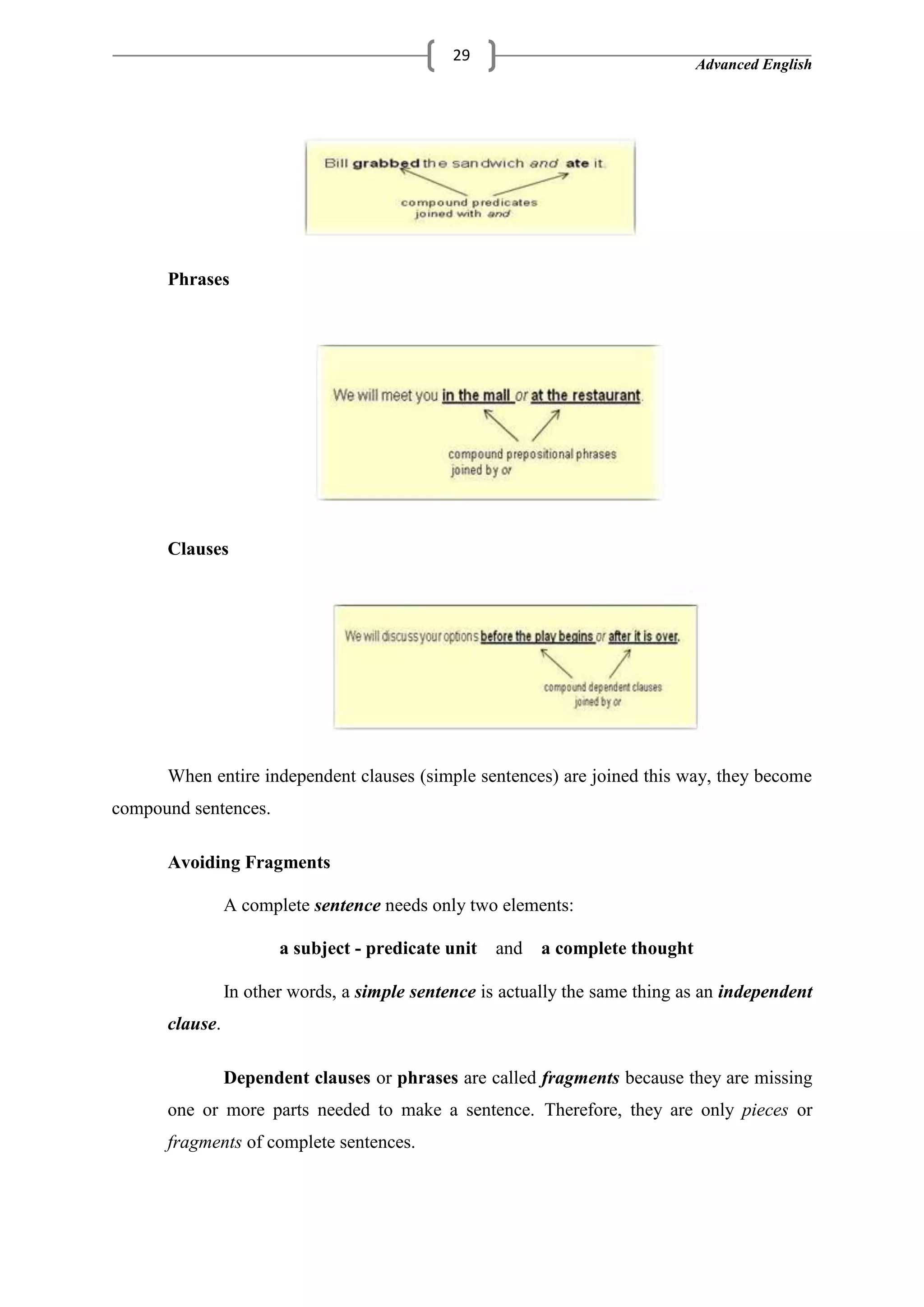
Compounding Sentence Elements
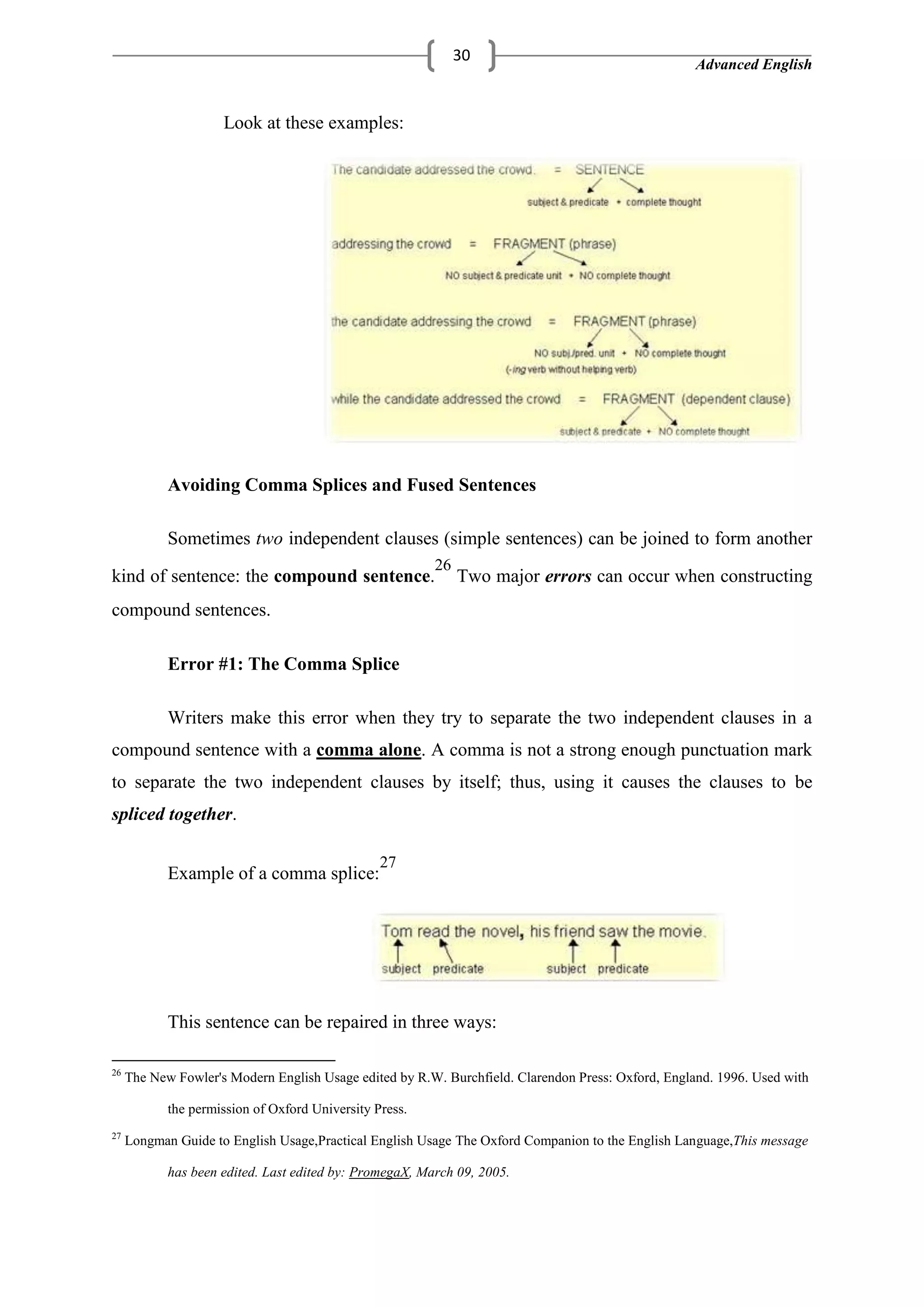
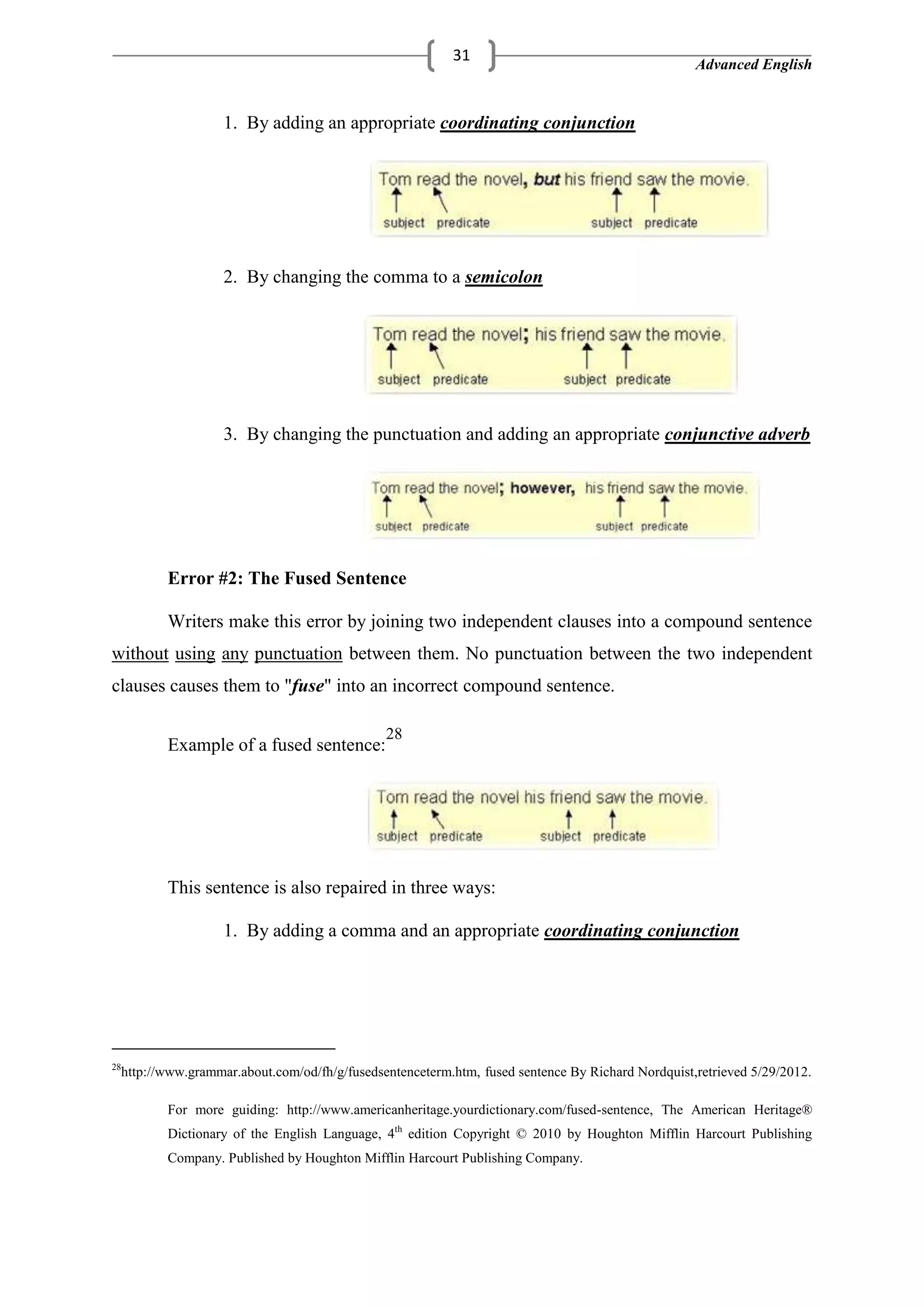
Words, phrases, and clauses may be joined to one another inside a sentence with a
conjunction. The coordinating conjunctions and, but, or, and nor may join subjects,
predicates, adjectives, adverbs, prepositional phrases or dependent clauses within a
sentence. This process is called "compounding."
25
The following examples show the process
of compounding
Words
25
http://www.towson.edu/ows/sentpatttrans.htmby Margaret L. Benner, benner@towson.edu. For educational purposes
only. All commercial uses strictly prohibited. Copyright © 2012, 2011, 2010, 2009, 2008, 2007, 2006, 2005,
2004, 2003 Towson University. All rights reserved, Retrieved on 8/4/2012.
Advanced English
29
Phrases
Clauses
When entire independent clauses (simple sentences) are joined this way, they become
compound sentences.
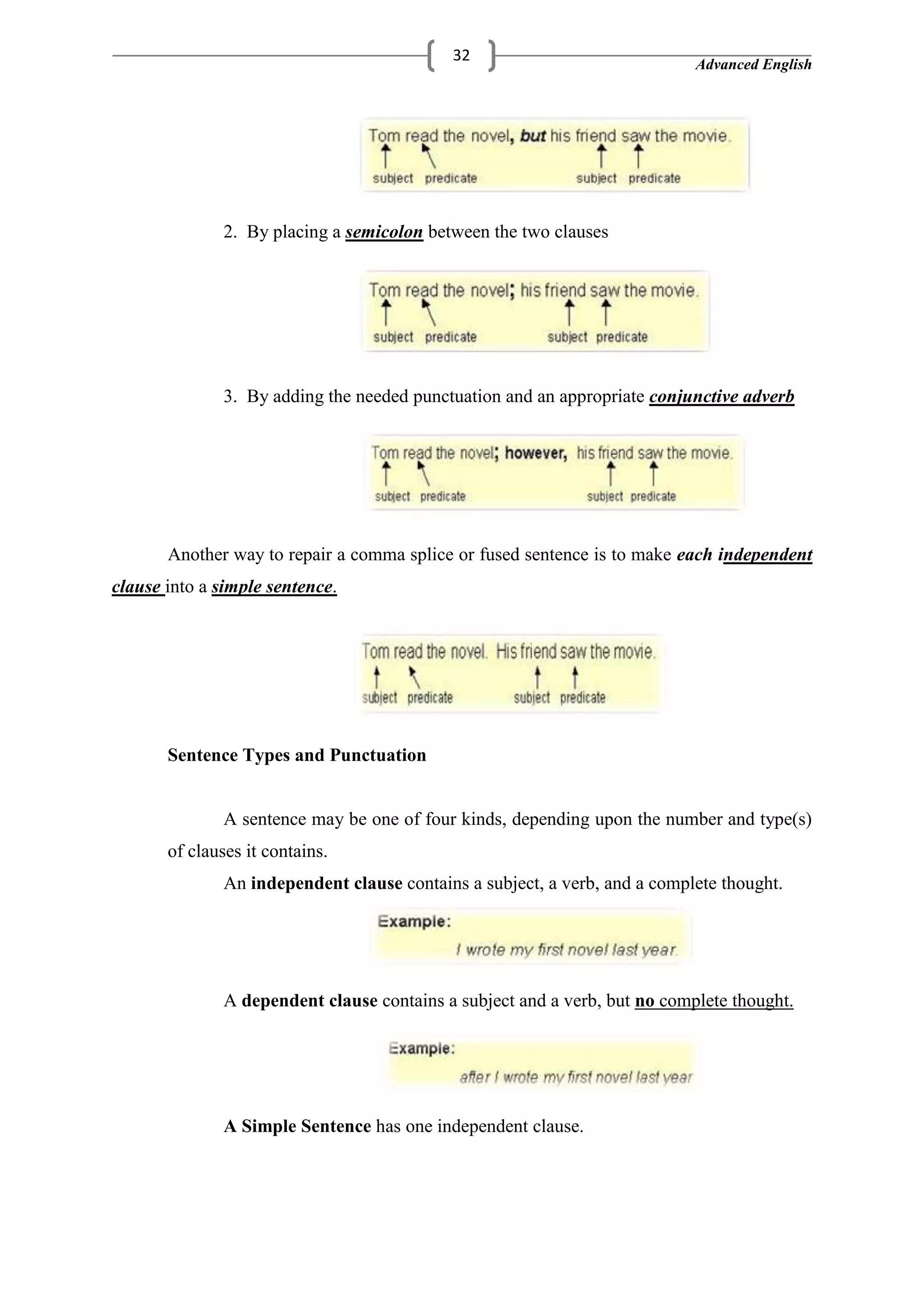
Avoiding Fragments
A complete sentence needs only two elements:
a subject - predicate unit and a complete thought
In other words, a simple sentence is actually the same thing as an independent
clause.
Dependent clauses or phrases are called fragments because they are missing
one or more parts needed to make a sentence. Therefore, they are only pieces or
fragments of complete sentences.
Advanced English
30
Look at these examples:
Avoiding Comma Splices and Fused Sentences
Sometimes two independent clauses (simple sentences) can be joined to form another
kind of sentence: the compound sentence.
26
Two major errors can occur when constructing
compound sentences.
Error #1: The Comma Splice
Writers make this error when they try to separate the two independent clauses in a
compound sentence with a comma alone. A comma is not a strong enough punctuation mark
to separate the two independent clauses by itself; thus, using it causes the clauses to be
spliced together.
Example of a comma splice:
27
This sentence can be repaired in three ways:
26
The New Fowler's Modern English Usage edited by R.W. Burchfield. Clarendon Press: Oxford, England. 1996. Used with
the permission of Oxford University Press.
27
Longman Guide to English Usage,Practical English Usage The Oxford Companion to the English Language,This message
has been edited. Last edited by: PromegaX, March 09, 2005.
Advanced English
31
1. By adding an appropriate coordinating conjunction
2. By changing the comma to a semicolon
3. By changing the punctuation and adding an appropriate conjunctive adverb
Error #2: The Fused Sentence
Writers make this error by joining two independent clauses into a compound sentence
without using any punctuation between them. No punctuation between the two independent
clauses causes them to "fuse" into an incorrect compound sentence.
Example of a fused sentence:
28
This sentence is also repaired in three ways:
1. By adding a comma and an appropriate coordinating conjunction
28
http://www.grammar.about.com/od/fh/g/fusedsentenceterm.htm, fused sentence By Richard Nordquist,retrieved 5/29/2012.
For more guiding: http://www.americanheritage.yourdictionary.com/fused-sentence, The American Heritage®
Dictionary of the English Language, 4th
edition Copyright © 2010 by Houghton Mifflin Harcourt Publishing
Company. Published by Houghton Mifflin Harcourt Publishing Company.
Advanced English
32
2. By placing a semicolon between the two clauses
3. By adding the needed punctuation and an appropriate conjunctive adverb
Another way to repair a comma splice or fused sentence is to make each independent
clause into a simple sentence.
Sentence Types and Punctuation
A sentence may be one of four kinds, depending upon the number and type(s)
of clauses it contains.
An independent clause contains a subject, a verb, and a complete thought.
A dependent clause contains a subject and a verb, but no complete thought.
A Simple Sentence has one independent clause.
Advanced English
33
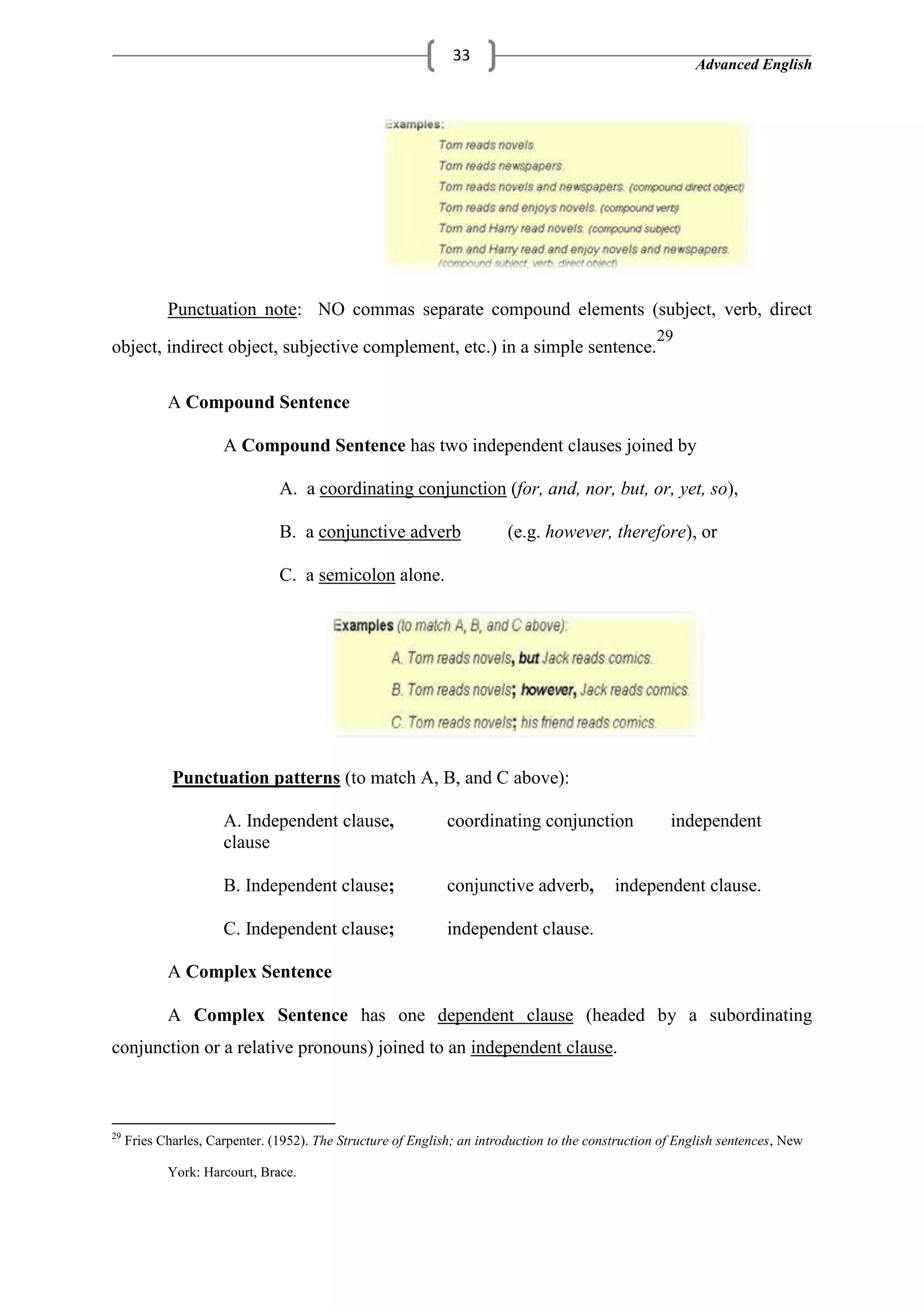
Punctuation note: NO commas separate compound elements (subject, verb, direct
object, indirect object, subjective complement, etc.) in a simple sentence.
29
A Compound Sentence
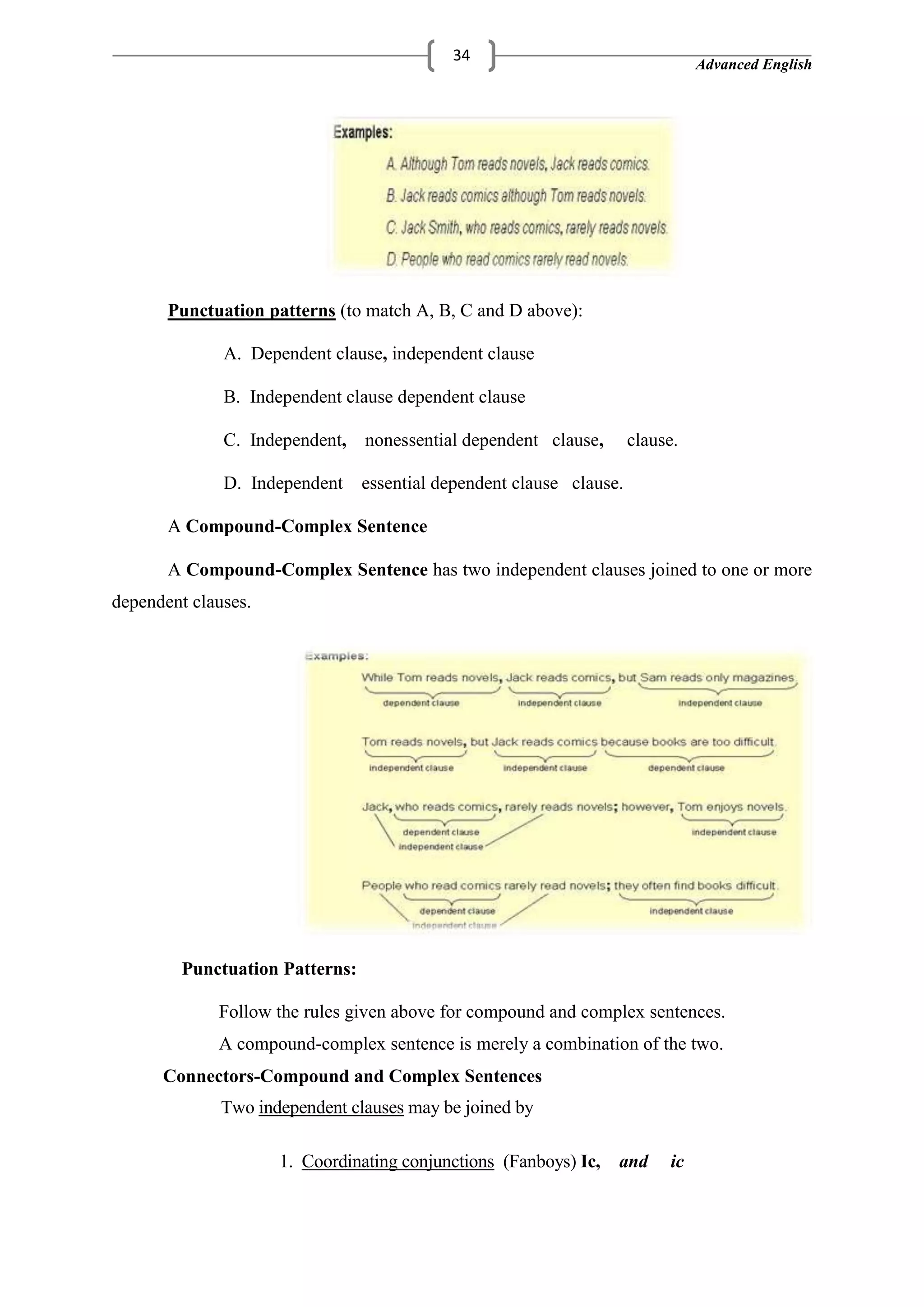
A Compound Sentence has two independent clauses joined by
A. a coordinating conjunction (for, and, nor, but, or, yet, so),
B. a conjunctive adverb (e.g. however, therefore), or
C. a semicolon alone.
Punctuation patterns (to match A, B, and C above):
A. Independent clause, coordinating conjunction independent
clause
B. Independent clause; conjunctive adverb, independent clause.
C. Independent clause; independent clause.
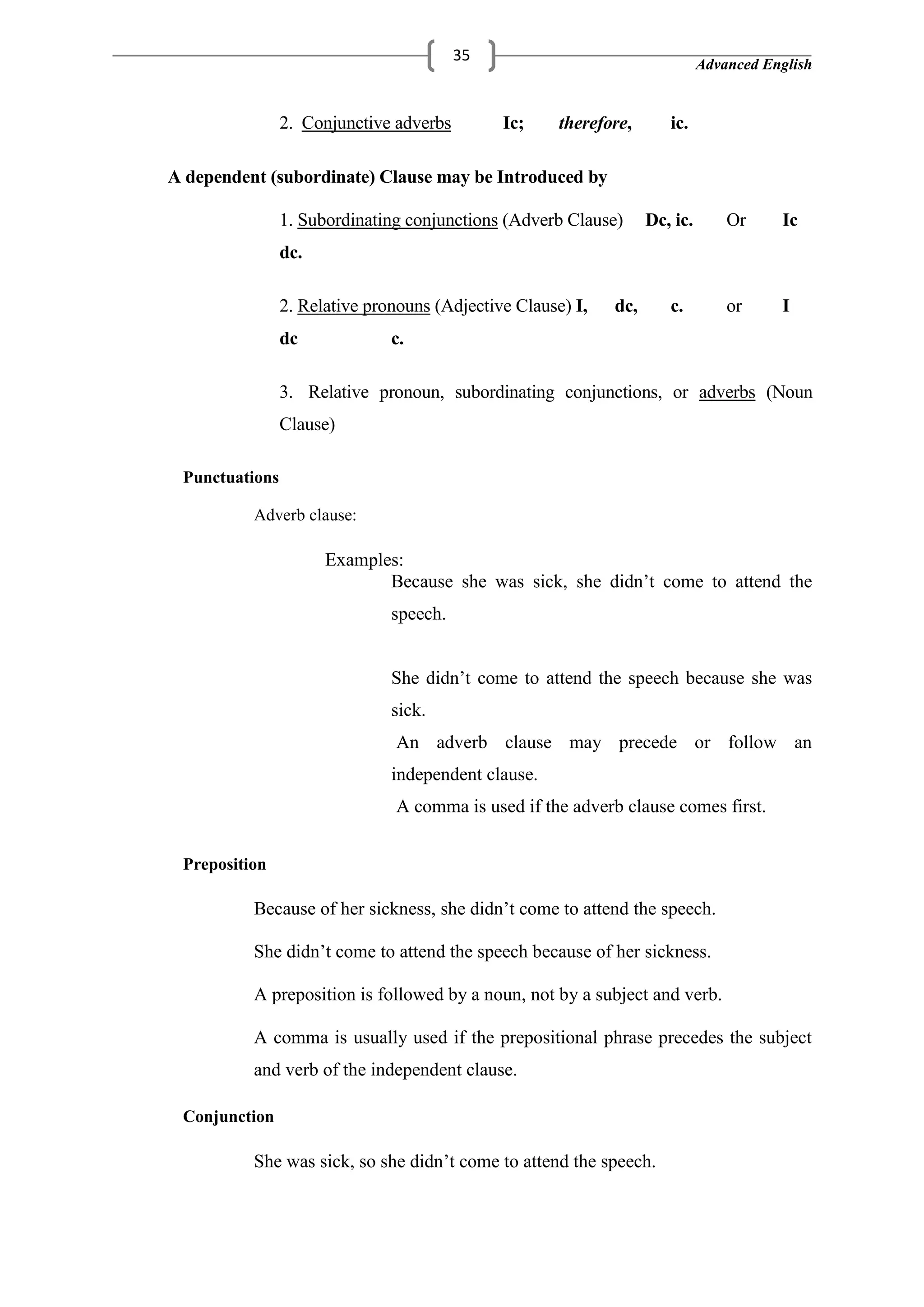
A Complex Sentence
A Complex Sentence has one dependent clause (headed by a subordinating
conjunction or a relative pronouns) joined to an independent clause.
29
Fries Charles, Carpenter. (1952). The Structure of English; an introduction to the construction of English sentences, New
York: Harcourt, Brace.
Advanced English
34
Punctuation patterns (to match A, B, C and D above):
A. Dependent clause, independent clause
B. Independent clause dependent clause
C. Independent, nonessential dependent clause, clause.
D. Independent essential dependent clause clause.
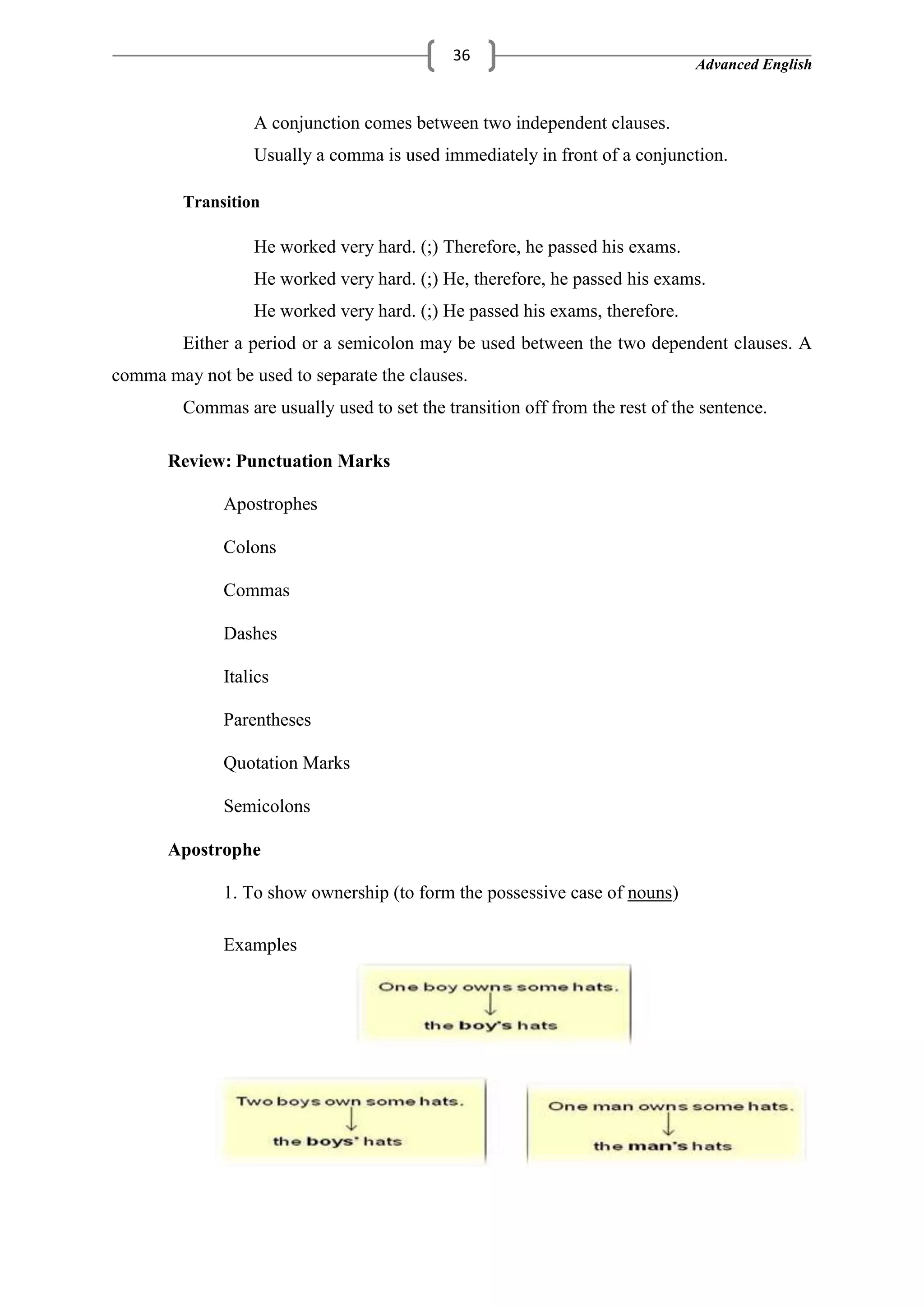
A Compound-Complex Sentence
A Compound-Complex Sentence has two independent clauses joined to one or more
dependent clauses.
Punctuation Patterns:
Follow the rules given above for compound and complex sentences.
A compound-complex sentence is merely a combination of the two.
Connectors-Compound and Complex Sentences
Two independent clauses may be joined by
1. Coordinating conjunctions (Fanboys) Ic, and ic
Advanced English
35
2. Conjunctive adverbs Ic; therefore, ic.
A dependent (subordinate) Clause may be Introduced by
1. Subordinating conjunctions (Adverb Clause) Dc, ic. Or Ic
dc.
2. Relative pronouns (Adjective Clause) I, dc, c. or I
dc c.
3. Relative pronoun, subordinating conjunctions, or adverbs (Noun
Clause)
Punctuations
Adverb clause:
Examples:
Because she was sick, she didn‘t come to attend the
speech.
She didn‘t come to attend the speech because she was
sick.
An adverb clause may precede or follow an
independent clause.
A comma is used if the adverb clause comes first.
Preposition
Because of her sickness, she didn‘t come to attend the speech.
She didn‘t come to attend the speech because of her sickness.
A preposition is followed by a noun, not by a subject and verb.
A comma is usually used if the prepositional phrase precedes the subject
and verb of the independent clause.
Conjunction
She was sick, so she didn‘t come to attend the speech.
Advanced English
36
A conjunction comes between two independent clauses.
Usually a comma is used immediately in front of a conjunction.
Transition
He worked very hard. (;) Therefore, he passed his exams.
He worked very hard. (;) He, therefore, he passed his exams.
He worked very hard. (;) He passed his exams, therefore.
Either a period or a semicolon may be used between the two dependent clauses. A
comma may not be used to separate the clauses.
Commas are usually used to set the transition off from the rest of the sentence.
Review: Punctuation Marks
Apostrophes
Colons
Commas
Dashes
Italics
Parentheses
Quotation Marks
Semicolons
Apostrophe
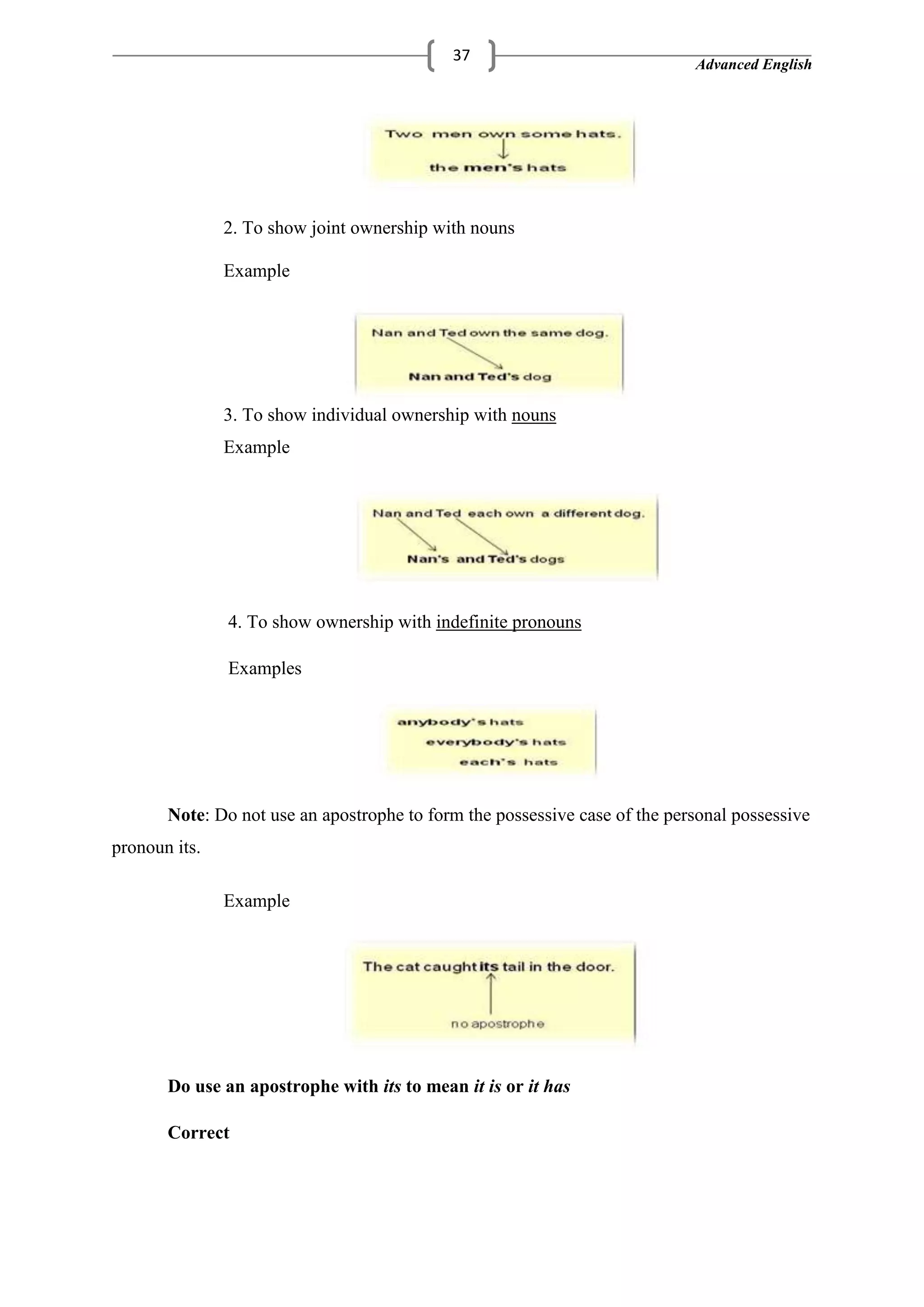
1. To show ownership (to form the possessive case of nouns)
Examples
Advanced English
37
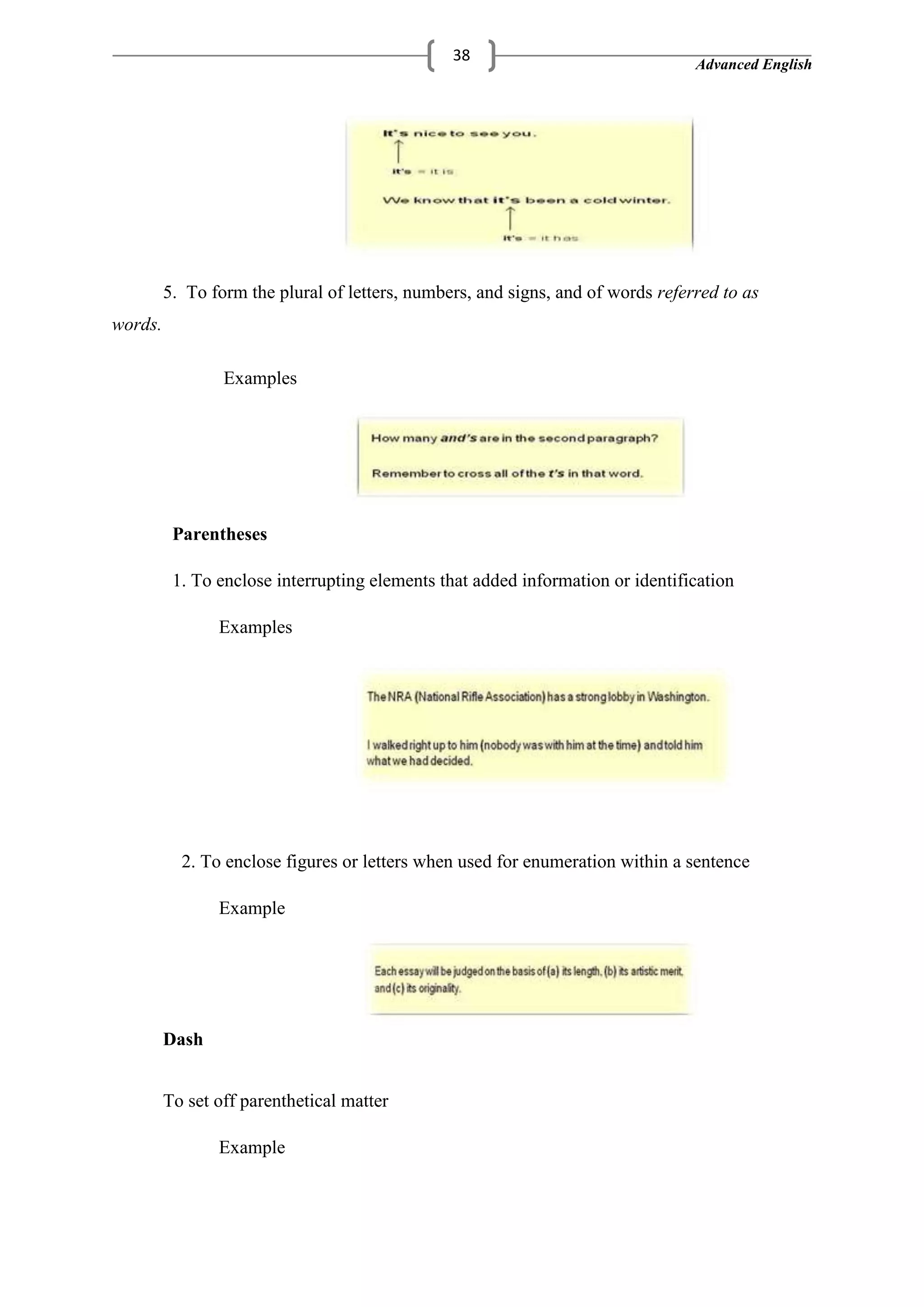
2. To show joint ownership with nouns
Example
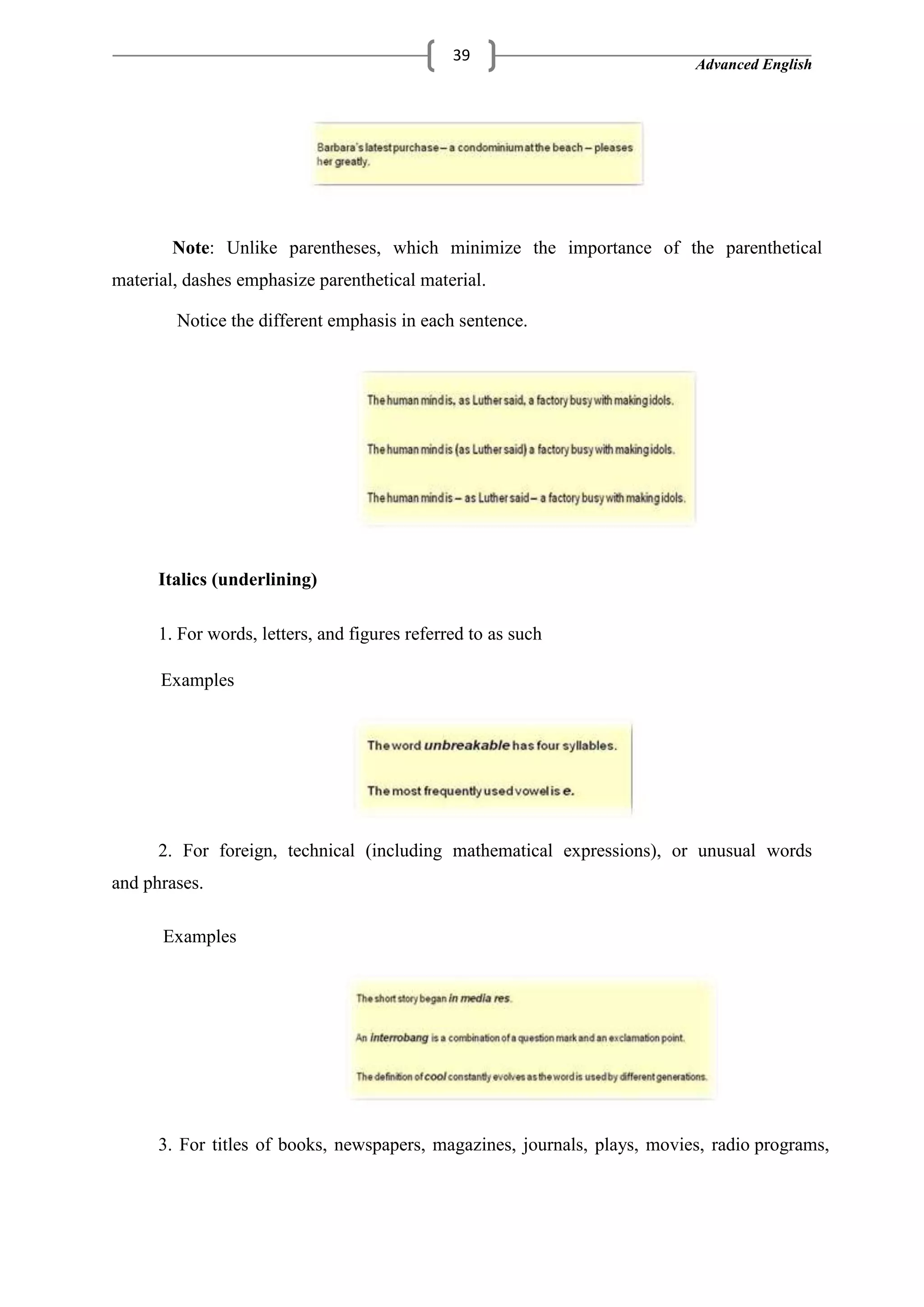
3. To show individual ownership with nouns
Example
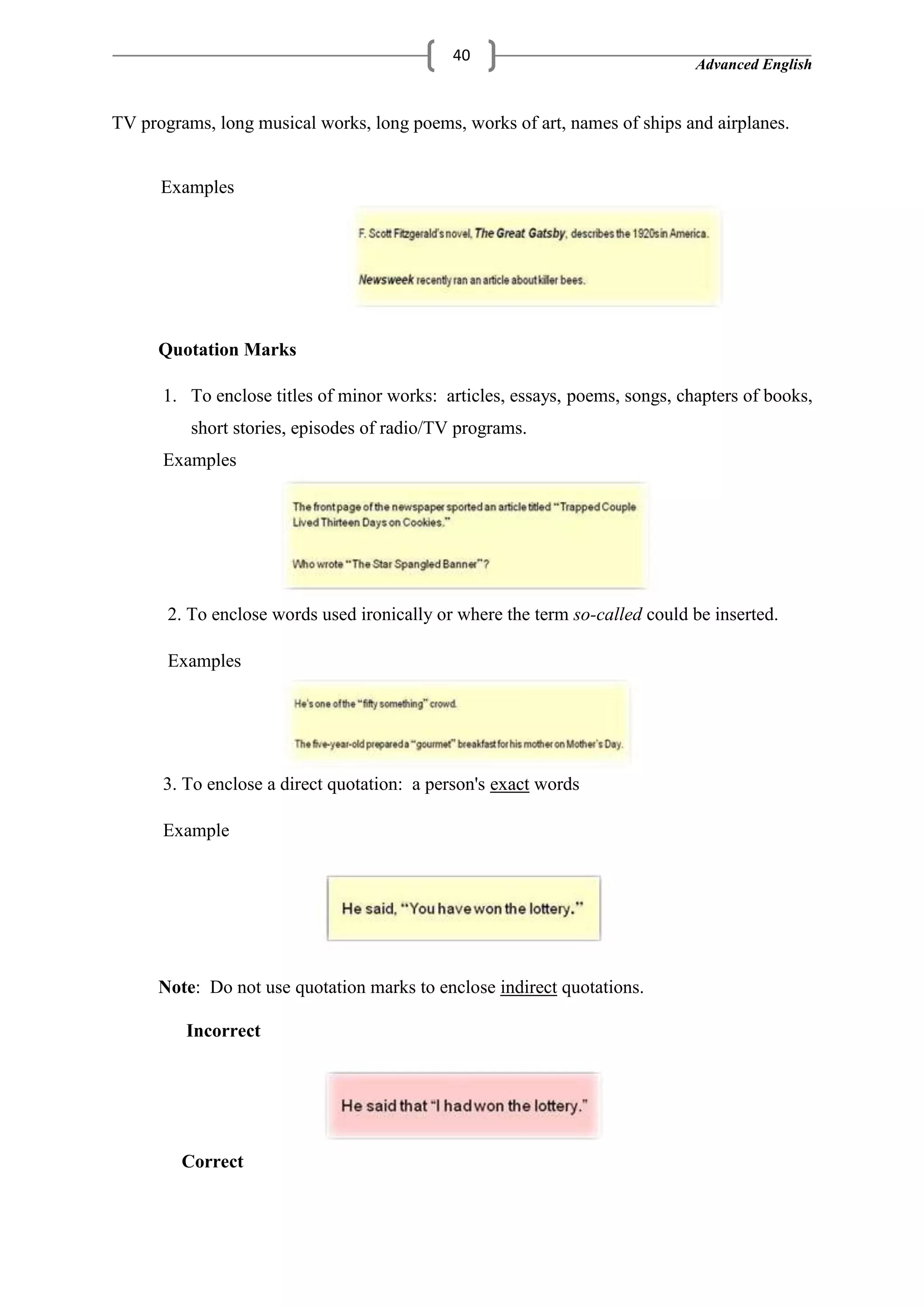
4. To show ownership with indefinite pronouns
Examples
Note: Do not use an apostrophe to form the possessive case of the personal possessive
pronoun its.
Example
Do use an apostrophe with its to mean it is or it has
Correct
Advanced English
38
5. To form the plural of letters, numbers, and signs, and of words referred to as
words.
Examples
Parentheses
1. To enclose interrupting elements that added information or identification
Examples
2. To enclose figures or letters when used for enumeration within a sentence
Example
Dash
To set off parenthetical matter
Example
Advanced English
39
Note: Unlike parentheses, which minimize the importance of the parenthetical
material, dashes emphasize parenthetical material.
Notice the different emphasis in each sentence.
Italics (underlining)
1. For words, letters, and figures referred to as such
Examples
2. For foreign, technical (including mathematical expressions), or unusual words
and phrases.
Examples
3. For titles of books, newspapers, magazines, journals, plays, movies, radio programs,
Advanced English
40
TV programs, long musical works, long poems, works of art, names of ships and airplanes.
Examples
Quotation Marks
1. To enclose titles of minor works: articles, essays, poems, songs, chapters of books,
short stories, episodes of radio/TV programs.
Examples
2. To enclose words used ironically or where the term so-called could be inserted.
Examples
3. To enclose a direct quotation: a person's exact words
Example
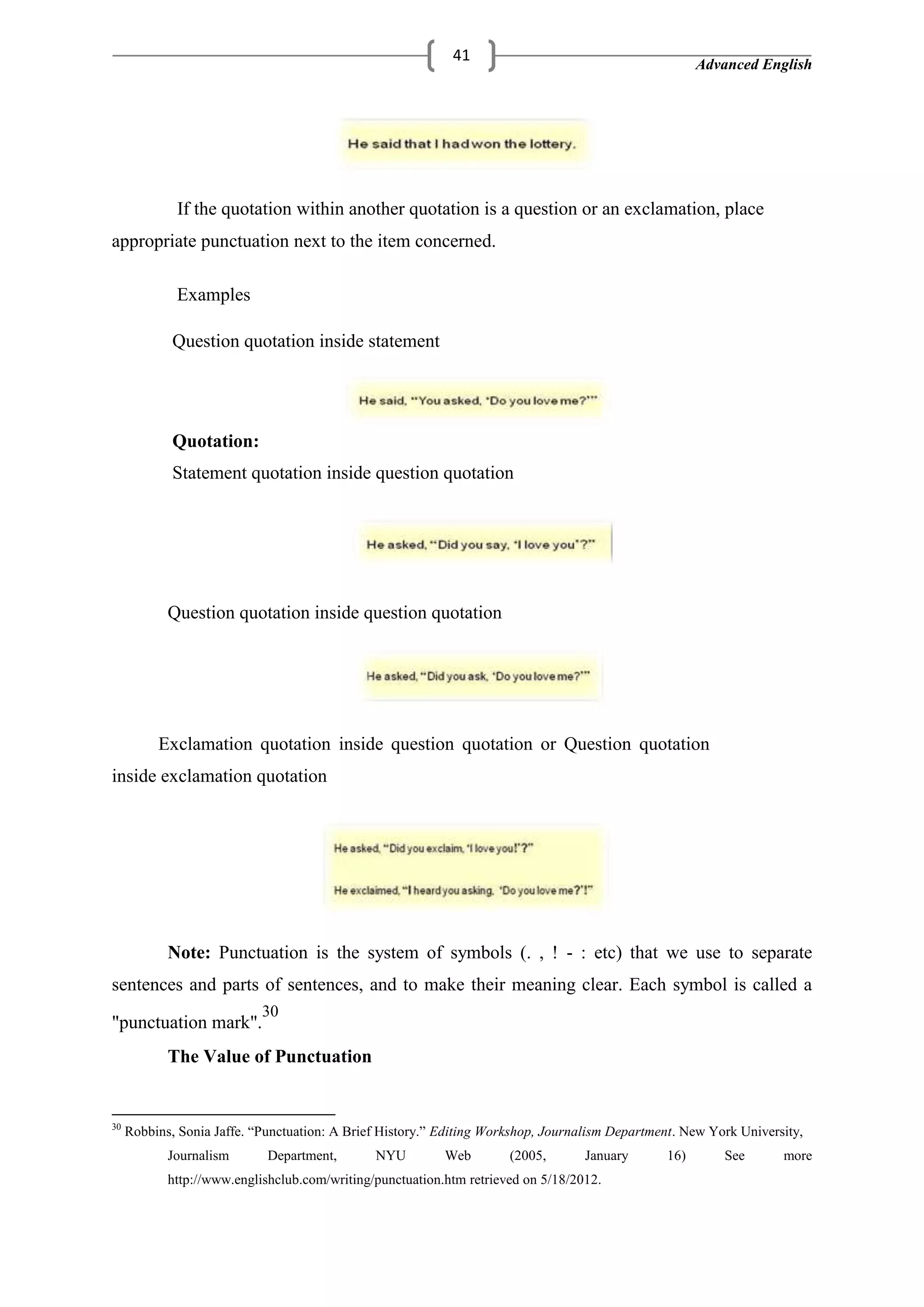
Note: Do not use quotation marks to enclose indirect quotations.
Incorrect
Correct
Advanced English
41
If the quotation within another quotation is a question or an exclamation, place
appropriate punctuation next to the item concerned.
Examples
Question quotation inside statement
Quotation:
Statement quotation inside question quotation
Question quotation inside question quotation
Exclamation quotation inside question quotation or Question quotation
inside exclamation quotation
Note: Punctuation is the system of symbols (. , ! - : etc) that we use to separate
sentences and parts of sentences, and to make their meaning clear. Each symbol is called a
"punctuation mark".
30
The Value of Punctuation
30
Robbins, Sonia Jaffe. ―Punctuation: A Brief History.‖ Editing Workshop, Journalism Department. New York University,
Journalism Department, NYU Web (2005, January 16) See more
http://www.englishclub.com/writing/punctuation.htm retrieved on 5/18/2012.
Advanced English
42
An English teacher wrote these words on the board:
31
Woman without her man is nothing.
The teacher then asked the students to punctuate the words correctly. The men
wrote the top line. The women wrote the bottom line.
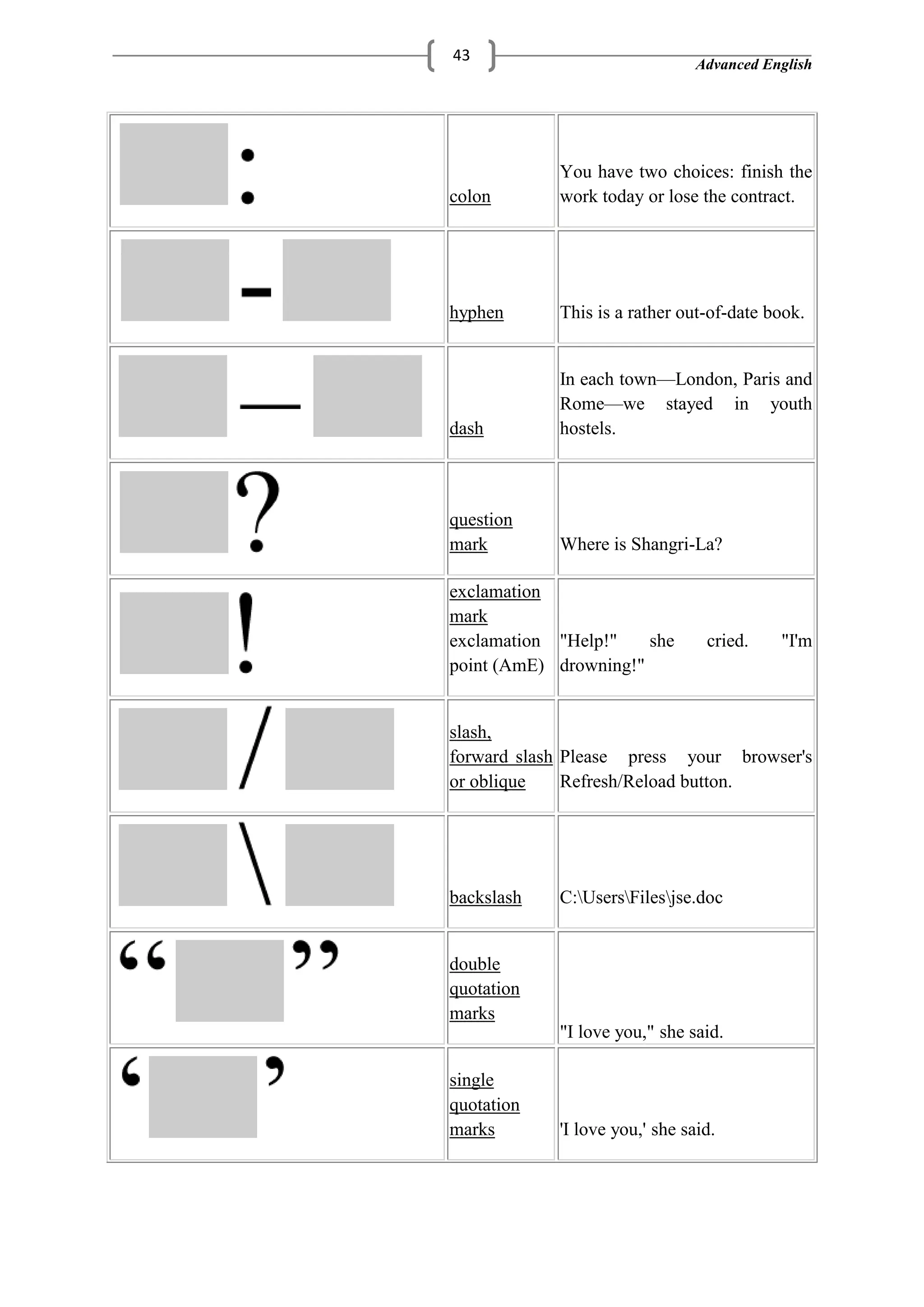
Table Chart of Punctuation Marks
Punctuation Mark Name Example
full stop or
period I like English.
comma I speak English, French and Thai.
semi-colon
I don't often go swimming; I
prefer to play tennis.
31
Robbins, Sonia Jaffe. ―Punctuation: A Brief History.‖ Editing Workshop, Journalism Department. New York University,
Journalism Department, NYU Web (2005, January 16).
http://www.nyu.edu/classes/copyXediting/Punctuation.html#history,―A Grammar Toolkit (10.).‖ The American
Heritage Book of English Usage: A Practical and Authoritative Guide to Contemporary English [Electronic
version]. (1996). http://www.bartleby.com/64/10.html
Advanced English
43
colon
You have two choices: finish the
work today or lose the contract.
hyphen This is a rather out-of-date book.
dash
In each town—London, Paris and
Rome—we stayed in youth
hostels.
question
mark Where is Shangri-La?
exclamation
mark
exclamation
point (AmE)
"Help!" she cried. "I'm
drowning!"
slash,
forward slash
or oblique
Please press your browser's
Refresh/Reload button.
backslash C:UsersFilesjse.doc
double
quotation
marks
"I love you," she said.
single
quotation
marks 'I love you,' she said.
Advanced English
44
apostrophe This is John's car.
underline Have you read War and Peace?
underscore bin_lad@cia.gov
round
brackets
I went to Bangkok (my favourite
city) and stayed there for two
weeks.
square
brackets
The newspaper reported that the
hostages [most of them French]
had been released.
ellipsis mark
One happy customer wrote: "This
is the best program...that I have
ever seen."
The Table of Summary of Punctuation Marks By http://www.englishclub.com
English Tips
Although there are general rules for English punctuation, there are differences of style
between, for example, British and American English, some publishers and some writers.
Anyone seeking guidance at an advanced level is recommended to consult a style guide
(often included in good dictionaries) for their particular variety of English or editorial style.
Exercise
Writing Skill in Grammar Structures
Advanced English
45
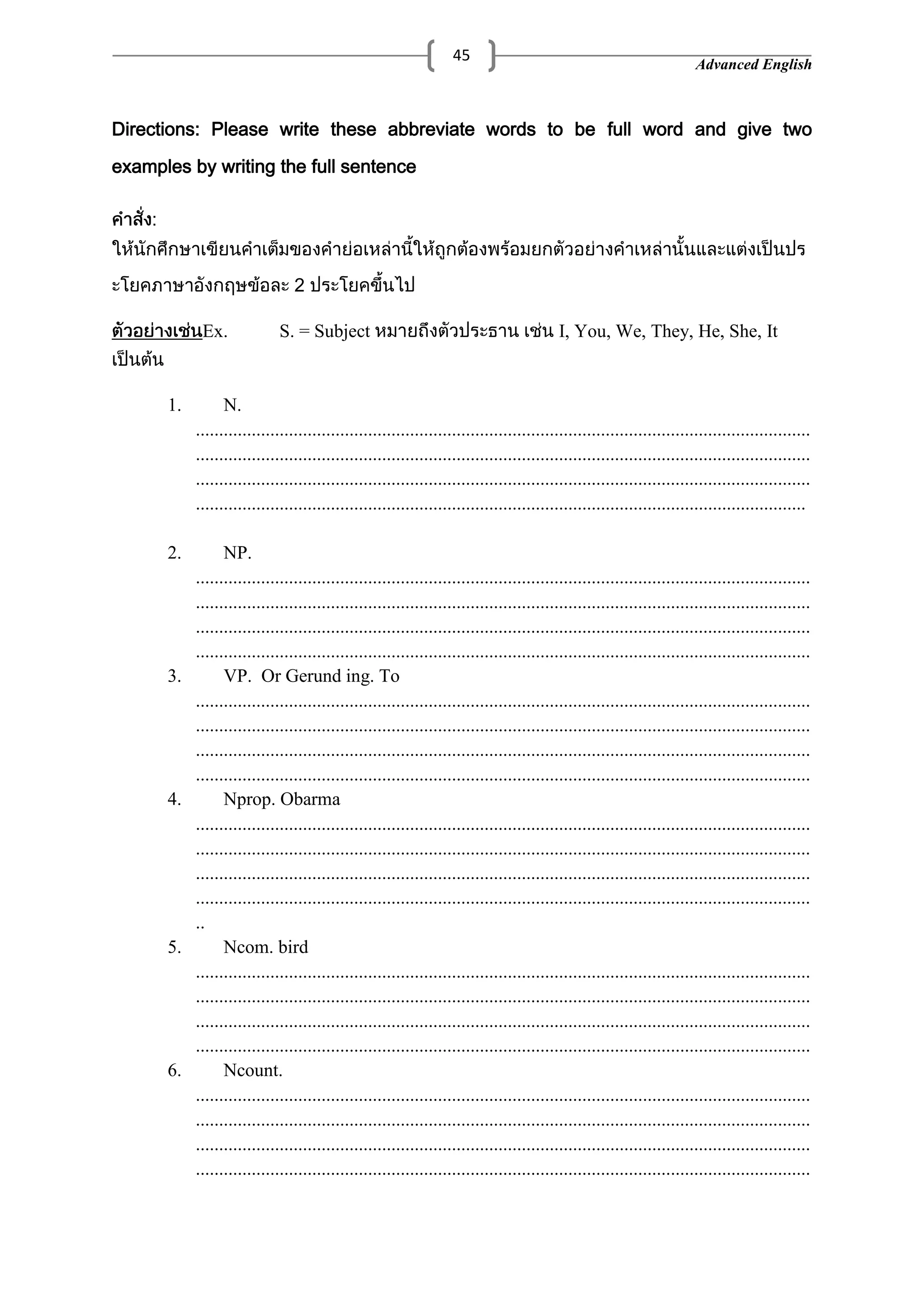
Directions: Please write these abbreviate words to be full word and give two
examples by writing the full sentence
:
2
Ex. S. = Subject I, You, We, They, He, She, It
1. N.
....................................................................................................................................
....................................................................................................................................
....................................................................................................................................
...................................................................................................................................
2. NP.
....................................................................................................................................
....................................................................................................................................
....................................................................................................................................
....................................................................................................................................
3. VP. Or Gerund ing. To
....................................................................................................................................
....................................................................................................................................
....................................................................................................................................
....................................................................................................................................
4. Nprop. Obarma
....................................................................................................................................
....................................................................................................................................
....................................................................................................................................
....................................................................................................................................
..
5. Ncom. bird
....................................................................................................................................
....................................................................................................................................
....................................................................................................................................
....................................................................................................................................
6. Ncount.
....................................................................................................................................
....................................................................................................................................
....................................................................................................................................
....................................................................................................................................
Advanced English
46
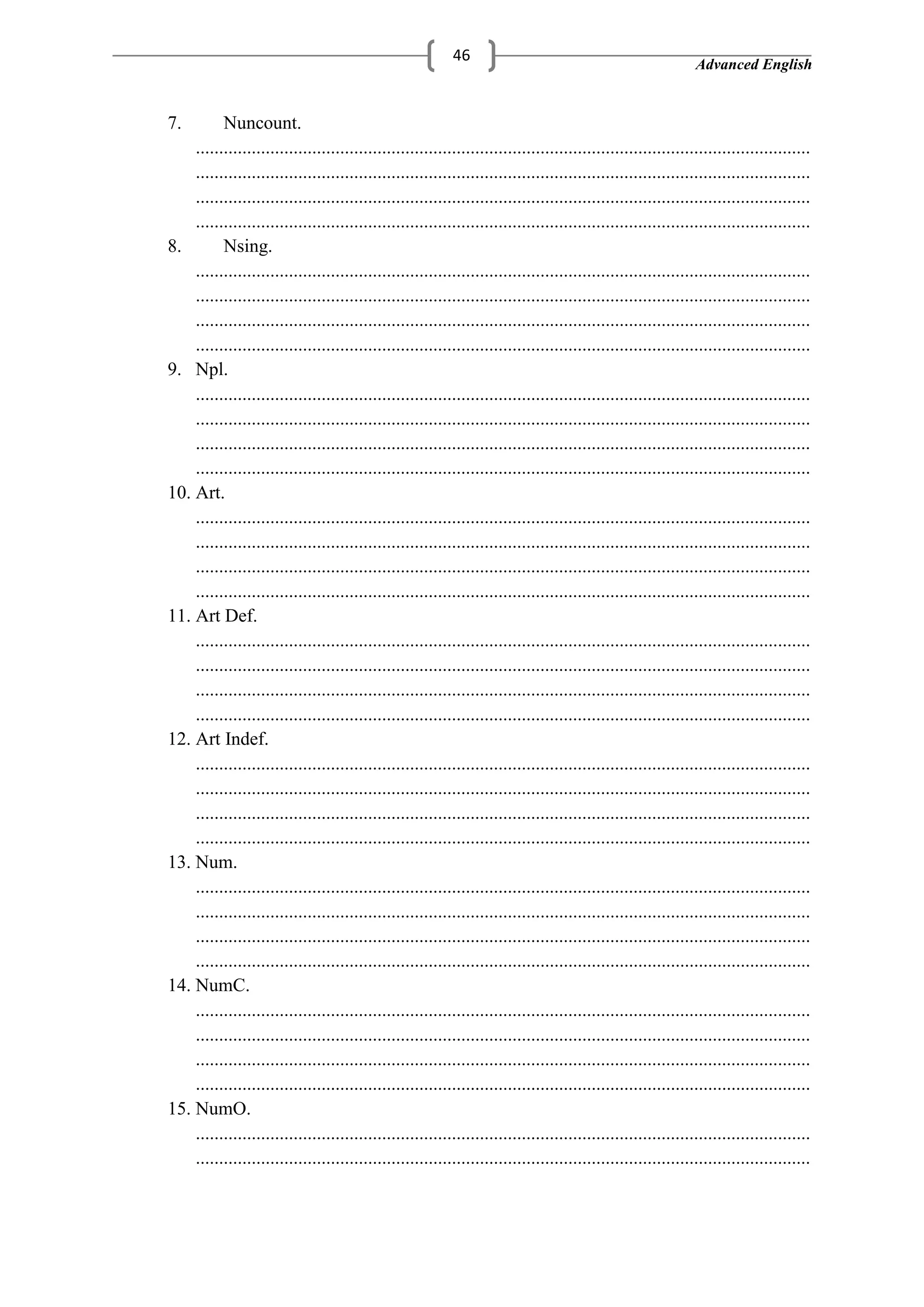
7. Nuncount.
....................................................................................................................................
....................................................................................................................................
....................................................................................................................................
....................................................................................................................................
8. Nsing.
....................................................................................................................................
....................................................................................................................................
....................................................................................................................................
....................................................................................................................................
9. Npl.
....................................................................................................................................
....................................................................................................................................
....................................................................................................................................
....................................................................................................................................
10. Art.
....................................................................................................................................
....................................................................................................................................
....................................................................................................................................
....................................................................................................................................
11. Art Def.
....................................................................................................................................
....................................................................................................................................
....................................................................................................................................
....................................................................................................................................
12. Art Indef.
....................................................................................................................................
....................................................................................................................................
....................................................................................................................................
....................................................................................................................................
13. Num.
....................................................................................................................................
....................................................................................................................................
....................................................................................................................................
....................................................................................................................................
14. NumC.
....................................................................................................................................
....................................................................................................................................
....................................................................................................................................
....................................................................................................................................
15. NumO.
....................................................................................................................................
....................................................................................................................................
Advanced English
47
....................................................................................................................................
....................................................................................................................................
16. Aux.
....................................................................................................................................
....................................................................................................................................
....................................................................................................................................
....................................................................................................................................
....................................................................................................................................
17. Adj.
....................................................................................................................................
....................................................................................................................................
....................................................................................................................................
....................................................................................................................................
....................................................................................................................................
18. Adv.
....................................................................................................................................
....................................................................................................................................
....................................................................................................................................
....................................................................................................................................
19. V.
....................................................................................................................................
....................................................................................................................................
....................................................................................................................................
....................................................................................................................................
Exercise
Directions: In the text boxes provided below each item, identify the sentence's
simple subject and simple predicate.
1. Four young soldiers led the troops into battle.
Subject =
Predicate =
2. In less than two hours, the entire cake had been eaten.
Subject =
Predicate =
3. For most of his career, Jim has ridden his bicycle to his office.
Subject =
Advanced English
48
Predicate =
4. Two beautiful goldfish in the pond were eating the insects on the top of the water.
Subject =
Predicate =
5. Until that last telephone call, I was having a wonderful day.
Subject =
Predicate =
6. Last week's fire was started by an arsonist from a nearby town.
Subject =
Predicate =
7. Her latest statement to the press was carefully worded.
Subject =
Predicate =
8. Novels by E. L. Doctorow are my favorite.
Subject =
Predicate =
9. The farmers in that part of the county are planting their fields this week.
Subject =
Predicate =
10. You eat your food slowly.
Subject =
Predicate =
Answer Key
Identifying Subjects and Predicates - Exercise 1
The correct answers are given below. For help with subjects and predicates,
Advanced English
49
1. Four young soldiers led the troops into battle.
Subject = soldiers Predicate = led
Your answers: subject= predicate=
2. In less than two hours, the entire cake had been eaten.
Subject = cake Predicate = had been eaten
Your answers: subject= predicate=
3. For most of his career, Jim has ridden his bicycle to his office.
Subject = Jim Predicate = has ridden
Your answers: subject= predicate=
4. Two beautiful goldfish in the pond were eating the insects on the top of the water.
Subject = goldfish Predicate = were eating
Your answers: subject= predicate=
5. Until that last telephone call, I was having a wonderful day.
Subject = I Predicate = was having
Your answers: subject= predicate=
6. Last week's fire was started by an arsonist from a nearby town.
Subject = fire Predicate = was started
Your answers: subject= predicate=
7. Her latest statement to the press was carefully worded.
Subject = statement Predicate = was worded
Your answers: subject= predicate=
8. Novels by E. L. Doctorow are my favorite.
Subject = novels Predicate = are
Your answers: subject= predicate=
Advanced English
50
9. The farmers in that part of the county are planting their fields this week.
Subject = farmers Predicate = are planting
Your answers: subject= predicate=
10. Eat your food slowly.
Subject = "you" understood Predicate = eat
Your answers: subject= predicate=
Chapter 5
Expansion of Phrases to Clauses
This chapter I would like to give you understanding the definition of phrases and
clauses, how can we identify phrases and clauses included with explaining and giving the
example about the structure of simple sentences throughout guiding to phrases and clauses,
here we‘ll continue what are phrases and clauses.
What are Phrases and Clauses?
Phrases and clauses are groups of related words that serve as building blocks of
sentences on a larger scale than parts of speech. A clause contains both a subject and a verb
whereas a phrase does not. Understanding phrases and clauses and knowing how to recognize
them help writers create varied sentences and avoid problems such as run-on sentences,
fragments, and punctuation errors.
32
How Can We Identify Phrases and Clauses?
A phrase, which generally consists of multiple parts of speech, behaves as a unit like a
single part of speech. In the following examples, note how phrases take on the roles of nouns,
verbs, adjectives, and adverbs. (Phrases that begin with a preposition—called ―prepositional
phrases‖—can fulfill various functions, particularly as adjective phrases, adverb phrases, or
part of noun phrases.
33
)
Noun phrases name a person, place, thing, or idea.
Buying a home can be a stressful ordeal.
My elegant Aunt Ida adores that mangy one-eyed mutt of hers.
32
http://web.cn.edu/kwheeler/gram_clauses_n_phrases.htmlCopyright Dr. L. Kip Wheeler 1998-2012. Permission is granted
for non-profit, educational, and student reproduction. Last updated 2 January, 2013
33
http://www.eslgold.com/grammar/clauses_phrases.html/Last updated: 15 February, 2010.
Advanced English
51
Verb phrases express action or state of being.
We may have been mistaken about the car’s reliability.
The Sampson twins will be traveling in Belize all next month.
Adjective phrases describe nouns.
The bird, a beautiful yellow grosbeak, is chirping gleefully.
The tree on your left is a popular haven for such species.
Adverb phrases describe verbs, adjectives, other adverbs, or even whole sentences.
Because of the recent rainfall, our vegetable garden is thriving.
I wish all people could live with music in their hearts.
Clauses fit into two main categories: independent and dependent.
An independent clause may stand alone as a complete sentence because it contains a
subject and a verb and forms a complete idea. A sentence made of one independent clause is
called a ―simple sentence.‖
34
A sentence made of two or more independent clauses is called a
―compound sentence.‖
35
Note that these distinctions rely on the particular combination of
subject (underlined) and verb (double-underlined) rather than the length of the sentence.
(Uncle Jay’s two Siamese kittens kept me awake all night long with their
constant mewing and wrestling.)
(I sing,] and [she dances.)
A dependent clause contains a subject and a verb but does not form a complete idea.
(When Laney scratched off the final number on the lottery ticket)
Do you feel the suspense?
A dependent clause needs an independent clause to finish the thought and
become a complete sentence. This type of sentence is called a ―complex sentence.‖
36
A sentence with at least one dependent clause and at least two independent clauses is
called a ―compound-complex sentence.‖
37
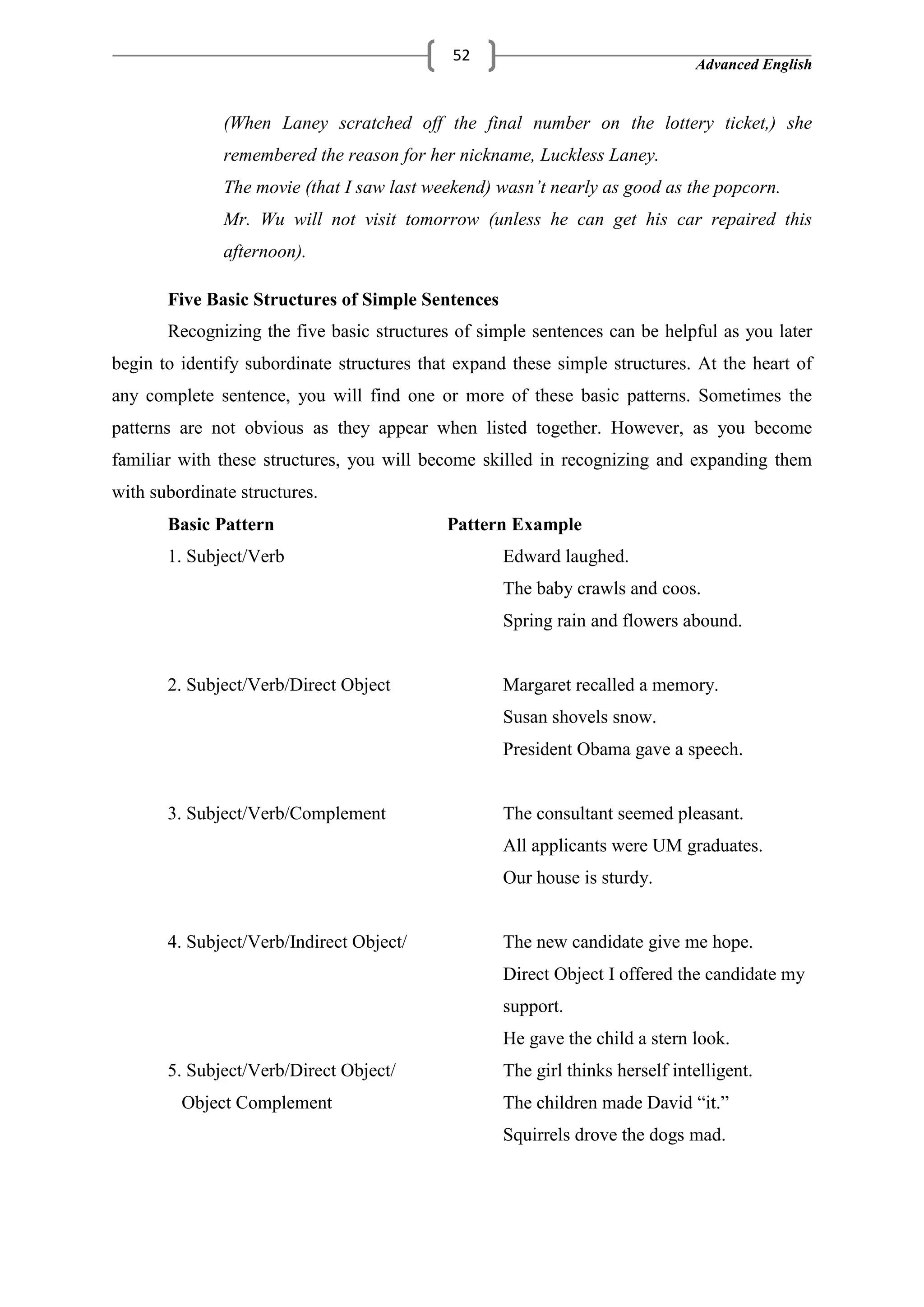
34
Omaggio, Alice C. 1986. Teaching language in context : Proficiency-oriented instruction. Boston: Heinle and Heinle.
479pp.
35
http://www.orl.devry.edu/tutoring/Phrase,%20Clause,%20Sentence.html retrieved on 3/3/2012.
36
http://www.englishpractice.com/improve/phrases-clauses/ EnglishPractice.com © 2013 - All rights Reserved. Posted on
18.3.12.24.30
37
http://www.englishpractice.com/improve/phrases-clauses/ EnglishPractice.com © 2013 - All rights Reserved. Posted on
18.3.12.24.30
Advanced English
52
(When Laney scratched off the final number on the lottery ticket,) she
remembered the reason for her nickname, Luckless Laney.
The movie (that I saw last weekend) wasn’t nearly as good as the popcorn.
Mr. Wu will not visit tomorrow (unless he can get his car repaired this
afternoon).
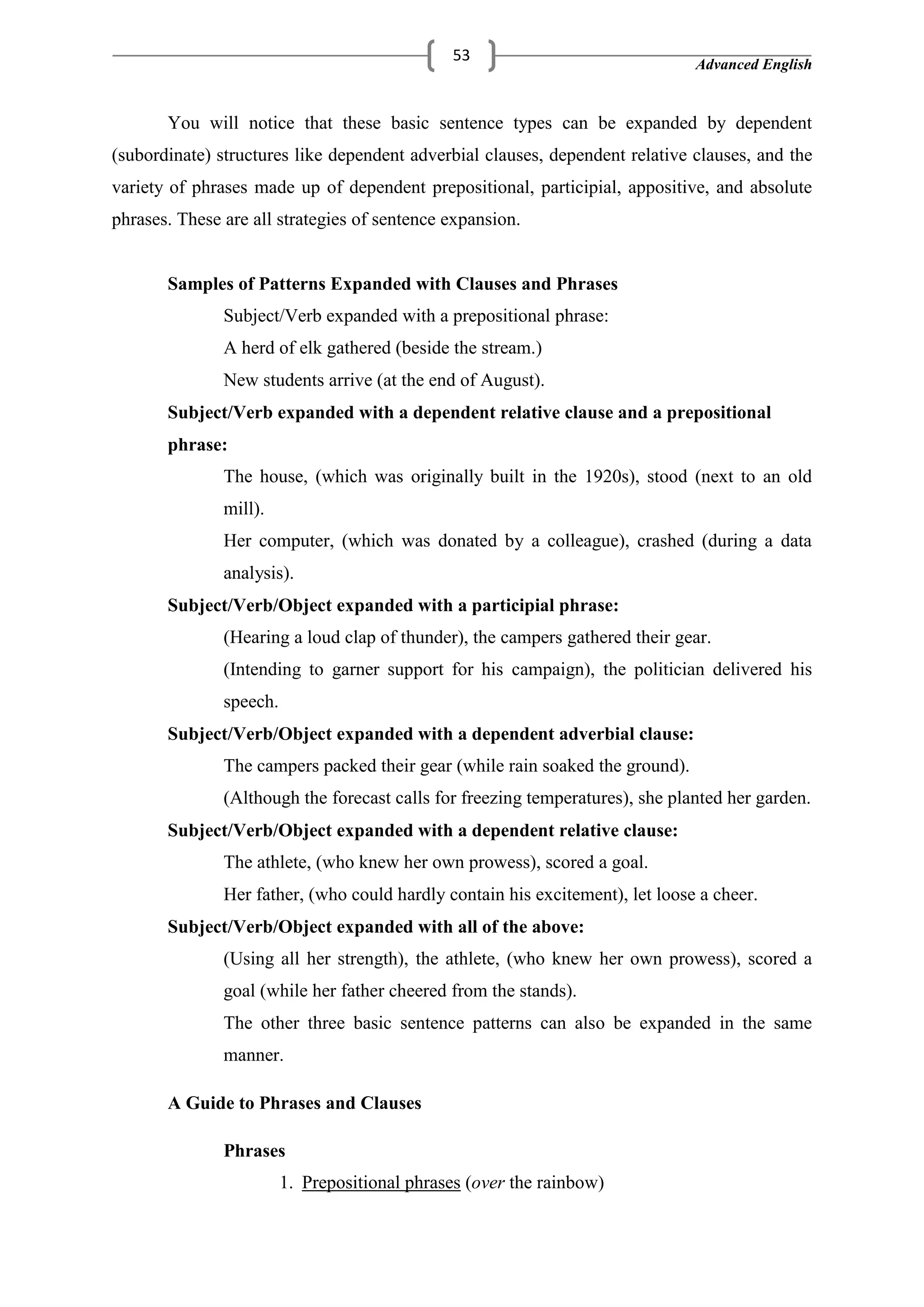
Five Basic Structures of Simple Sentences
Recognizing the five basic structures of simple sentences can be helpful as you later
begin to identify subordinate structures that expand these simple structures. At the heart of
any complete sentence, you will find one or more of these basic patterns. Sometimes the
patterns are not obvious as they appear when listed together. However, as you become
familiar with these structures, you will become skilled in recognizing and expanding them
with subordinate structures.
Basic Pattern Pattern Example
1. Subject/Verb Edward laughed.
The baby crawls and coos.
Spring rain and flowers abound.
2. Subject/Verb/Direct Object Margaret recalled a memory.
Susan shovels snow.
President Obama gave a speech.
3. Subject/Verb/Complement The consultant seemed pleasant.
All applicants were UM graduates.
Our house is sturdy.
4. Subject/Verb/Indirect Object/ The new candidate give me hope.
Direct Object I offered the candidate my
support.
He gave the child a stern look.
5. Subject/Verb/Direct Object/ The girl thinks herself intelligent.
Object Complement The children made David ―it.‖
Squirrels drove the dogs mad.
Advanced English
53
You will notice that these basic sentence types can be expanded by dependent
(subordinate) structures like dependent adverbial clauses, dependent relative clauses, and the
variety of phrases made up of dependent prepositional, participial, appositive, and absolute
phrases. These are all strategies of sentence expansion.
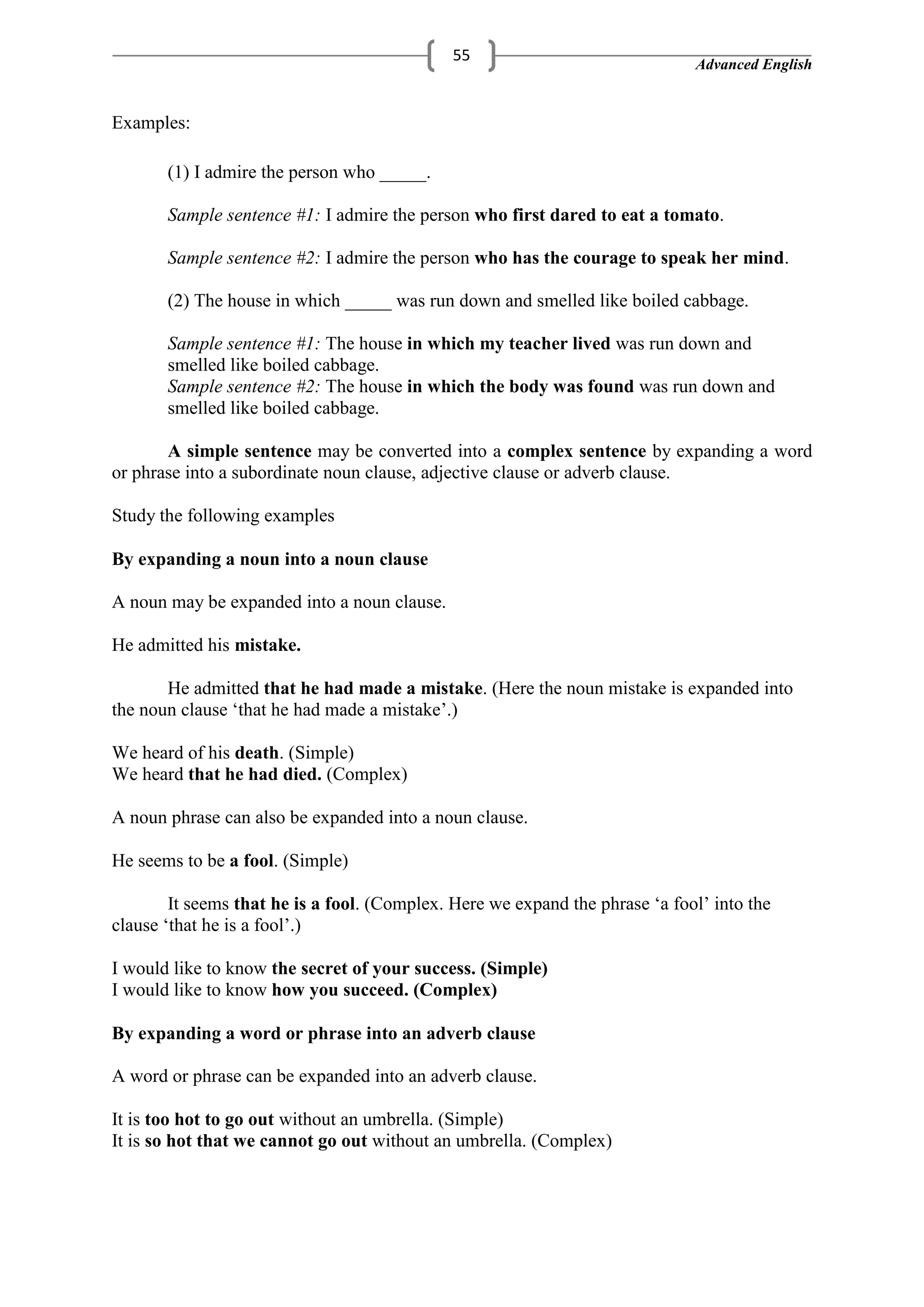
Samples of Patterns Expanded with Clauses and Phrases
Subject/Verb expanded with a prepositional phrase:
A herd of elk gathered (beside the stream.)
New students arrive (at the end of August).
Subject/Verb expanded with a dependent relative clause and a prepositional
phrase:
The house, (which was originally built in the 1920s), stood (next to an old
mill).
Her computer, (which was donated by a colleague), crashed (during a data
analysis).
Subject/Verb/Object expanded with a participial phrase:
(Hearing a loud clap of thunder), the campers gathered their gear.
(Intending to garner support for his campaign), the politician delivered his
speech.
Subject/Verb/Object expanded with a dependent adverbial clause:
The campers packed their gear (while rain soaked the ground).
(Although the forecast calls for freezing temperatures), she planted her garden.
Subject/Verb/Object expanded with a dependent relative clause:
The athlete, (who knew her own prowess), scored a goal.
Her father, (who could hardly contain his excitement), let loose a cheer.
Subject/Verb/Object expanded with all of the above:
(Using all her strength), the athlete, (who knew her own prowess), scored a
goal (while her father cheered from the stands).
The other three basic sentence patterns can also be expanded in the same
manner.
A Guide to Phrases and Clauses
Phrases
1. Prepositional phrases (over the rainbow)
Advanced English
54
a. as adjectives
b. as adverbs
2. Adjectival phrases (free from government control)
3. Verbal –ing phrase [present participle] (running five miles each
day)
a. as adjective
b. as noun
c. as adverb (sometimes)
4. Verbal –ed phrase [past participle] (written in 2001)
a. as adjective
5. Verbal to phrase [infinitive] (to win the game)
6. Truncated clause [subordinating conjunction + five structures {adj
phrase, -ing phrase, -ed phrase, prepositional phrase, noun} ] (when in Rome)
7. Noun absolute [noun or pronoun + five structures] (his knees
shaking)
8. Noun appositive (the reserve catcher)
Clauses
9. Dependent adjectival clause (she slept in the barn)
a. as a restrictive that clause
b. as a nonrestrictive which clause
c. as a restrictive and nonrestrictive who/whom/whose clause
10. Dependent adverbial clause (because he enjoyed the special
effects)
11. Dependent noun clause (that he would prevail)
See more concerned details in chapter 4 pp.19-25.
Exercise
Using the examples as a guide, expand each sentence or word group below by adding
an appropriate adjective clause.
Advanced English
55
Examples:
(1) I admire the person who _____.
Sample sentence #1: I admire the person who first dared to eat a tomato.
Sample sentence #2: I admire the person who has the courage to speak her mind.
(2) The house in which _____ was run down and smelled like boiled cabbage.
Sample sentence #1: The house in which my teacher lived was run down and
smelled like boiled cabbage.
Sample sentence #2: The house in which the body was found was run down and
smelled like boiled cabbage.
A simple sentence may be converted into a complex sentence by expanding a word
or phrase into a subordinate noun clause, adjective clause or adverb clause.
Study the following examples
By expanding a noun into a noun clause
A noun may be expanded into a noun clause.
He admitted his mistake.
He admitted that he had made a mistake. (Here the noun mistake is expanded into
the noun clause ‗that he had made a mistake‘.)
We heard of his death. (Simple)
We heard that he had died. (Complex)
A noun phrase can also be expanded into a noun clause.
He seems to be a fool. (Simple)
It seems that he is a fool. (Complex. Here we expand the phrase ‗a fool‘ into the
clause ‗that he is a fool‘.)
I would like to know the secret of your success. (Simple)
I would like to know how you succeed. (Complex)
By expanding a word or phrase into an adverb clause
A word or phrase can be expanded into an adverb clause.
It is too hot to go out without an umbrella. (Simple)
It is so hot that we cannot go out without an umbrella. (Complex)
Advanced English
56
Seeing the snake, the boy shouted.
When the boy saw the snake, he shouted.
We didn‘t go out because of the rain.
We didn‘t go out because it rained.
By expanding a word or phrase into an adjective clause
A simple sentence may be converted into a complex sentence by expanding a word or
phrase into an adjective clause.
Prudent boys work hard. (Simple)
Boys who are prudent work hard. (Complex)
Chapter 6
Sentence Pattern Transformations
In this chapter I will try to give an easily example and make a shortly explanation
about the sentence pattern transformations how to write a sentence or clause, by changing the
form of the sentence, the other forms, by trying to preserve the original meaning. Or may
change the meaning somewhat, Depending on the purpose of the author himself. Is there a
way to convert the sentence with a collection of them? The ideas presented are not well
enough. The basic sentence patterns in the English language may be transformed in the
following ways:
Transform to Passive Voice
This transformation requires using a sentence with an action verb and a direct object.
The sentence may be any of the following patterns:
38
NP1 + V-tr + NP2 The dog ate the bone.
NP1 + V-tr + NP2 + NP3 Joe gave Mary a ring.
NP1 + V-tr + NP2 + Adj We consider Joe intelligent.
NP1 + V-tr + NP2 + NP2 The people made Olaf king.
38
http://www.towson.edu/ows/sentpatttrans.htmby Margaret L. Benner, benner@towson.edu. For educational purposes
only. All commercial uses strictly prohibited. Copyright © 2012, 2011, 2010, 2009, 2008, 2007, 2006, 2005,
2004, 2003 Towson University. All rights reserved, Retrieved on 8/4/2012.
Advanced English
57
To Create the Transformation,
1. Make the direct object into the subject,
2. Add the "be" auxiliary and the -en ending to the main verb, and
3. Place the original doer of the action into a prepositional phrase beginning
with by.
Examples:
Note: Do not change verb tense when transforming sentences from active to passive.
Ate = was eaten
Gave = was given
Advanced English
58
Consider = is considered
Made = was made
Transform to the Expletive there is / there are
This transformation requires using a sentence with a verb of being as the main verb.
The sentence pattern must be
NP1 + V-be + ADV/TP. A fly is on the wall.
Two dogs were at the park.
To Create the Transformation,
1. Place there at the beginning of the sentence and
2. Reverse positions of the subject and verb.
Examples:
Note: Do not change verb tense when creating the there is / there are transformation.
is = there is
is = There was
are = there
were = there were
Advanced English
59
Transform to Cleft/Divide
This transformation allows the writer to emphasize the sentence subject or object.
This transformation may be used with any of the sentence patterns. There are two ways to
create this transformation.
Method 1
1. Begin the sentence with It and the appropriate number and tense of the verb
of being,
2. Focus on either the subject or direct object, and
3. Create a second half for the sentence that begins with who, whom, or
that.
Examples:
In the above example, the first cleft transformation emphasizes the subject, dog, using
three words to refer to the dog: it, dog, and that.
The second cleft transformation emphasizes the direct object, bone, using three words
to refer to the bone: it, bone, and that.
Advanced English
60
In the above example, the first cleft transformation emphasizes the direct object, Joe,
using three words to refer to Joe: it, Joe, and whom.
The second cleft transformation emphasizes the subject we, using three words to refer
to us it, we, and who.
Method 2
1. Begin the sentence with What,
2. Follow with the subject and verb, and
3. Insert the appropriate tense of the verb of being and follow with
the direct object.
Examples:
In the above example, the cleft transformation emphasizes the direct object, bone,
using two words to refer to bone: what and bone.
This cleft transformation emphasizes the direct object, ring, using two words to refer
to the ring: what and ring.
Note: Do not change verb tense when creating the cleft transformation.
Past Tense:
The dog ate the bone.
It was the dog who ate the bone.
Advanced English
61
It was the bone that the dog ate.
What the dog ate was the bone.
Present Tense:
We consider Joe intelligent.
It is Joe whom we consider Intelligent.
Past Tense:
Joe gave Mary a ring.
What Joe gave Mary was a ring.
Transform to Negative
This transformation may be used with any of the sentence patterns.
To Create the Negative Transformation
1. with a verb of being as the main verb: Add not to the verb.
Example
2. with an action or linking verb that has an auxiliary verb (have or be): Add not to
the verb
Example - action verb
Advanced English
62
Example - linking verb
3. With an action or linking verb that does not have an auxiliary verb: Add not and
the appropriate number and tense of do.
Example - action verb
Example - linking verb
Transform to Interrogative with yes-no answer
This transformation may be used with any of the sentence patterns. To transform
sentences into the interrogative with yes-no answer,
1. with a verb of being as the main verb: Transpose the position of the subject and
the verb
Advanced English
63
2. with an action or linking verb that has an auxiliary verb (have or be): Transpose
the position of the subject and the auxiliary verb
Example - action verb
Example - linking verb
3. With an action or linking verb that does not have an auxiliary verb: Add the
appropriate number and tense of do
Example - Action verb
Example - Linking verb
Transform to Interrogative
Advanced English
64
This transformation provides questions that will produce more than a yes/no answer.
It may be used with any of the sentence patterns.
To create the transformation,
1. Place an interrogative word at the beginning of the sentence,
2. Reverse positions of the subject and verb, and
3. Add do/does/did if needed (action or linking verb without auxiliary verb).
Interrogative Words:
how when where why what which who whom
Example - verb of being
Example - action verb with auxiliary verb
Example - linking verb with auxiliary verb
Example - action verb without auxiliary verb
Advanced English
65
Example - linking verb without auxiliary verb
Note: Sentences using which or whose to create the interrogative may not require
adding do/does/did or transposing the positions of the subject and verb.
Transform to Emphasis / Emphatic
This transformation may be used
With all sentence patterns except the verb-of-being patterns.
With action or linking verbs that do not have auxiliary verbs.
To make the emphatic transformation, place do, does, or did in front of the verb, as
tense and number dictate.
Examples
Advanced English
66
Transform to Imperative
This transformation creates a command. It may be used with all sentence patterns. To
make the imperative transformation, replace the sentence subject with you understood and
change the verb form to its infinitive form without to
Examples:
Note: There is only one tense, simple present, for the imperative transformation.
Transform to Exclamatory
This transformation creates a surprise statement. It may be used with all sentence
patterns. To make the exclamatory transformation,
place what or how at the beginning of the sentence
rearrange words in the sentence as needed
place an exclamation point at the end of the sentence
Examples:
In many cases, more than one transformation may be performed at a time on a given
sentence.
Example - passive and interrogative
Advanced English
67
Example - passive, negative, and interrogative yes-no
Example - cleft, emphasis, and interrogative yes-no
Answer the Question Active and Passive
Examples: Change the following active sentences into passive form.
She wrote a letter.
A letter was written by her.
1. Julia rescued three cats.
Three cats were rescued by Julia.
2. Steven has forgotten the books.
The books have been forgotten by Steven.
3. The teacher will not open the window.
The window will not (won’t) be opened by the teacher.
4. Susan is baking a cake.
A cake is being baked my Susan
5. Tim washed many cars.
Many cars were washed by Tim.
Examples: Change the following passive sentences into active form.
Pasta is being cooked by Jim.
Jim is cooking Pasta.
Advanced English
68
1. The words were explained by the teacher yesterday.
The teacher explained the words yesterday.
2. Many dishes were not washed by my little brother.
My little brother didn’t wash many dishes.
3. Photos are taken by me.
I take photos.
4. Housework is done by her.
She does housework.
5. Kevin asked Dennis a question.
Denis was asked a question by Kevin. here change Active to be
Passive)
Exercise
The Answer keys of Active and Passive
Exercise: Change the following active sentences into passive form.
0. She wrote a letter.
A letter was written by her.
1. Julia rescued three cats.
Three cats were rescued by Julia.
2. Steven has forgotten the books.
The books have been forgotten by Steven.
3. The teacher will not open the window.
The window will not (won’t) be opened by the teacher.
4. Susan is baking a cake.
A cake is being baked my Susan
5. Tim washed many cars.
Many cars were washed by Tim.
Exercise: Change the following passive sentences into active form.
0. Pasta is being cooked by Jim.
Jim is cooking Pasta.
Advanced English
69
1. The words were explained by the teacher yesterday.
The teacher explained the words yesterday.
2. Many dishes were not washed by my little brother.
My little brother didn’t wash many dishes.
3. Photos are taken by me.
I take photos.
4. Housework is done by her.
She does housework.
5. Kevin asked Dennis a question.
Denis was asked a question by Kevin. Active Passive)
Complete the correct verb form with the passive.
1. A song ..(sing)..........................by Ann now.
2. Rice (usually eat) .............................by Thai people nationwide.
3. English (teach).......................................by me for more than 20 years.
4. Two snakes (kill).................................by my dog yesterday.
5. My birthday party (hold) ...............................next Saturday.
Advanced English
70
Chapter 7
Clause and Sentence Structure
In this chapter I would like the learners please remind and remember that every clause
is, in a sense, a miniature sentence. A simple sentence contains only a single clause, while a
compound sentence, a complex sentence, or a compound-complex sentence contains at least
two clauses.
39
The Simple Sentence
The most basic type of sentence is the simple sentence, which contains only one
clause. A simple sentence can be as short as one word:
40
Run!
Usually, however, the sentence has a subject as well as a predicate and both the
subject and the predicate may have modifiers. All of the following are simple sentences,
because each contains only one clause:
39
The American Heritage Book of English Usage by American Heritage Dictionaries Hardcover, Houghton Mifflin,
www.bookfinder.com/author/american-heritage-publishing-staff/ retrieved on 4/8/2012.
40
http://www.ehow.com/how_4714536_identify-clauses-sentence-structure.html© 1999-2013 Demand Media, Inc. Use of
this web site constitutes acceptance of the eHow Terms of Use and Privacy Policy. Report Copyright. Ad Choices
en-US,Read more: How to Identify Clauses and Sentence Structure | eHow.com
http://www.ehow.com/how_4714536_identify-clauses-sentence-structure.html#ixzz2HAb9HiV3,retrieved
9/22/2012.
Advanced English
71
Melt!
Ice melts.
The ice melts quickly.
The ice on the river melts quickly under the warm March sun.
Lying exposed without its blanket of snow, the ice on the river melts quickly under
the warm March sun.
As you can see, a simple sentence can be quite long -- it is a mistake to think that you
can tell a simple sentence from a compound sentence or a complex sentence simply by its
length.
The most natural sentence structure is the simple sentence: it is the first kind which
children learn to speak, and it remains by far the most common sentence in the spoken
language of people of all ages. In written work, simple sentences can be very effective for
grabbing a reader's attention or for summing up an argument, but you have to use them with
care: too many simple sentences can make your writing seem childish.
When you do use simple sentences, you should add transitional phrases to connect
them to the surrounding sentences.
The Compound Sentence
A compound sentence consists of two or more independent clauses (or simple
sentences) joined by co-ordinating conjunctions like "and," "but," and "or":
Simple
Canada is a rich country.
Simple
Still, it has many poor people.
Compound
Canada is a rich country, but still it has many poor people.
Compound sentences are very natural for English speakers -- small children learn to
use them early on to connect their ideas and to avoid pausing (and allowing an adult to
interrupt):
Advanced English
72
Today at school Mr. Moore brought in his pet rabbit, and he showed it to the
class, and I got to pet it, and Kate held it, and we coloured pictures of it, and it
ate part of my carrot at lunch, and ...
41
Of course, this is an extreme example, but if you over-use compound sentences in
written work, your writing might seem immature.
A compound sentence is most effective when you use it to create a sense of balance or
contrast between two (or more) equally-important pieces of information:
Montréal has better clubs, but Toronto has better cinemas.
Special Cases of Compound Sentences
There are two special types of compound sentences which you might want to note.
First, rather than joining two simple sentences together, a co-ordinating conjunction
sometimes joins two complex sentences, or one simple sentence and one complex sentence.
In this case, the sentence is called a compound-complex sentence:
42
Compound-Complex
The package arrived in the morning, but the courier left before I
could check the contents.
The second special case involves punctuation. It is possible to join two originally
separate sentences into a compound sentence using a semicolon instead of a co-ordinating
conjunction:
41
http://www.ehow.com/how_4714536_identify-clauses-sentence-structure.html© 1999-2013 Demand Media, Inc. Use of
this web site constitutes acceptance of the How Terms of Use and Privacy Policy. Report Copyright. Ad Choices
en-US,Read more: How to Identify Clauses and Sentence Structure | eHow.com
http://www.ehow.com/how_4714536_identify-clauses-sentence-structure.html#ixzz2HAb9HiV3,retrieved
9/22/2012.
42
http://www.ehow.com/how_4714536_identify-clauses-sentence-structure.html© 1999-2013 Demand Media, Inc. Use of
this web site constitutes acceptance of the eHow Terms of Use and Privacy Policy. Report Copyright. Ad Choices
en-US, Read more: How to Identify Clauses and Sentence Structure | eHow.com
http://www.ehow.com/how_4714536_identify-clauses-sentence-structure.html#ixzz2HAb9HiV3,retrieved
9/22/2012.
Advanced English
73
Sir John A. Macdonald had a serious drinking problem; when
sober, however, he could be a formidable foe in the House of
Commons.
Usually, a conjunctive adverb like
43
"however" or "consequently" will appear near
the beginning of the second part, but it is not required:
The sun rises in the east; it sets in the west.
The Complex Sentence
A complex sentence contains one independent clause and at least one dependent
clause. Unlike a compound sentence, however, a complex sentence contains clauses which
are not equal. Consider the following examples:
Simple
My friend invited me to a party. I do not want to go.
Compound
My friend invited me to a party, but I do not want to go.
Complex
Although my friend invited me to a party, I do not want to go.
In the first example, there are two separate simple sentences: "My friend invited me to
a party" and "I do not want to go." The second example joins them together into a single
sentence with the co-ordinating conjunction "but," but both parts could still stand as
independent sentences -- they are entirely equal, and the reader cannot tell which is most
important. In the third example, however, the sentence has changed quite a bit: the first
clause, "Although my friend invited me to a party," has become incomplete, or a dependent
clause.
43
http://www.ehow.com/how_4714536_identify-clauses-sentence-structure.html© 1999-2013 Demand Media, Inc. Use of
this web site constitutes acceptance of the eHow Terms of Use and Privacy Policy. Report Copyright. Ad Choices
en-US, Read more: How to Identify Clauses and Sentence Structure | eHow.com
http://www.ehow.com/how_4714536_identify-clauses-sentence-structure.html#ixzz2HAb9HiV3,retrieved
9/22/2012.
Advanced English
74
A complex sentence is very different from a simple sentence or a compound sentence
because it makes clear which ideas are most important. When you write:
My friend invited me to a party. I do not want to go.
Or even
My friend invited me to a party, but I do not want to go.
The reader will have trouble knowing which piece of information is most important to
you. When you write the subordinating conjunction "although" at the beginning of the first
clause, however, you make it clear that the fact that your friend invited you is less important
than, or subordinate, to the fact that you do not want to go.
Terminology
Capital letter - use capital letters:
To begin sentences
With the first person subject pronoun "I"
For all proper nouns including names, days of the week, month, names of
institutions, etc.
Nationality adjectives (i.e., Italian)
For the first letter in direct speech
Determiner: type - definite article
Subordinate clause - cannot stand alone
Main clause - can stand alone
Connective adverb - other examples include: firstly, finally, etc.
Advanced English
75
Adjective - modifying following noun
Connective conjunction - other examples include: and, or, etc.
Determiner: type - possessive adjective (also known as possessive pronoun)
Determiner: type - demonstrative adjective (including this, that, these, those)
Connective: relative pronoun
Period (US English), full stop (British English)
Comma
Upgradable adjective - these adjectives are already 'very' (Example: 'wonderful'
means 'very good'. These adjectives can only be used with 'extreme' modifiers like absolutely,
extremely, etc.)
44
Exclamation mark - used for emphasis
Modifier - adverb. Other examples include: pretty, very, quite, etc.
Question mark - used when asking questions
Quotation marks - used when employing direct speech
See more information on chapter 2 p.16-25
English Learning Tip
44
http://www.ehow.com/how_4714536_identify-clauses-sentence-structure.html© 1999-2013 Demand Media, Inc. Use of
this web site constitutes acceptance of the eHow Terms of Use and Privacy Policy. Report Copyright. Ad Choices
en-US, Read more: How to Identify Clauses and Sentence Structure | eHow.com
http://www.ehow.com/how_4714536_identify-clauses-sentence-structure.html#ixzz2HAb9HiV3,retrieved
9/22/2012.
Advanced English
76
Take a daily English course by subscribing to English Tip of the Day which provides
a new English learning tip every day. Each day you will receive an important English
learning tip with example sentences. The newsletter also provides links to a quiz of the day
and a worksheet of the day to help you practice your English.
Chapter 8
Reduction of Adverb Clauses to Modifying Phrases
Here for this part of the chapter, we‘ll take a look and make it clear understanding
how to write the correctly English grammar about reduction of adverb clauses to modifying
phrases. Now I will give you explain and show you easily examples forms of reduction of
adverb clauses to modifying phrases.
These modifying phrases are often called ―participial phrases‖ because the main word
is a present participle (-ing form) or sometimes a past participle (-ed form, conveying a
passive meaning). If the phrase doesn‘t modify the subject of the main clause, the
unacceptable result is called a ―dangling participle‖—the participle has nothing to modify, so
it dangles (hangs) unattached to any other word.
45
For example:
While walking by the lake, a fish jumped out of the water.
45
http://www.docstoc.com/docs/77435586/Reduction-of-Adverb-Clauses-to-Modifying-Adverbial-Phrases © Docstoc®
2011. All rights reserved. views:1248,posted:4/20/2011language:Maltese,pages:5
Advanced English
77
Obviously, the fish wasn‘t walking! But in this sentence walking must refer to fish, so
the whole thing is ungrammatical (as well as unscientific). Here we will start reduction of
adverb clauses to modifying Phrases as follows
Time: Since, After, and Before
General Rules
Rule 1: If the main verb of the adverb clause is the be verb, omit the
subject and the be verb.
While I was walking down the street, I came across a very strange guy.
While walking down the street, I came across a very strange guy.
Rule 2: If the main verb of the adverb clause is not the be verb, omit
the subject and change the verb to ~ing.
Before I go to school in the morning, I usually take a shower.
Before going to school in the morning, I usually take a shower.
Rule 3: The reduction is possible only when the subjects of the adverb clause
and the main clause are the same. (In very formal English, is sometimes possible to
use the different subjects.)
(Different subjects)
Before he came, I had already finished my homework.
[The adverb clause in this sentence cannot be reduced to a phrase.]
Since I came to the U.S.A., I have been studying English.
Advanced English
78
Since coming to the U.S.A., I have been studying English.
After I finished my homework, I went to the party. After I had finished my
homework, I went to the party.
After finishing my homework, I went to the party.
After having finished my homework, I went to the party.
Before I came to the U.S.A., I lived in Australia. I lived in Australia before I came to
the U.S.A.
Before coming to the U.S.A., I lived in Australia. I lived in Australia before coming
to the U.S.A.
Reduction of Adverb Clauses to Modifying Phrases (continuous)
Time: While (during the same time)
While I was watching TV, I heard someone knock on the door.
While watching TV, I heard someone knock on the door.
Watching TV, I heard someone knock on the door.
[While can be omitted.]
Cause and Effect
Because he wanted more money, he accepted the offer.
Wanting more money, he accepted the offer.
[Because is omitted.]
Because I didn‘t want to hurt her, I didn‘t tell her the truth.
Not wanting to hurt her, I didn‘t tell her the truth.
Because I (have) lived in the city before, I have many friends there.
Having lived in the city before, I have many friends there.
Advanced English
79
[The time in the adverb clause is before the main clause.]
Because I had read the book before, I didn‘t read it again.
Having read the book before, I didn‘t read it gain.
Because she was anxious to see them, she couldn‘t sleep that night.
Being anxious to see them, she couldn‘t sleep that night.
Anxious to see them, she couldn‘t sleep that night.
[Being can be omitted.]
Time + Cause & Effect: Upon -ing / On –ing
When she heard the news, Jennifer burst into tears.
[Immediately after she heard the news (and because she heard it), she
burst into tears.]
Upon hearing the news, Jennifer burst into tears.
On hearing the news, Jennifer burst into tears.
Adverb clauses
Part 1: Adverb Clauses
1. Introduction:
Examples:
When she was in Miami, she visited many
friends.
She visited many friends when she was in
Miami.
When she was in Miami: is an adverb clause.
She visited many friends: Independent clause.
Advanced English
80
The words used to introduce adverb clauses are called subordinating conjunction.
Time:
After, before, when, while, as by the time (that), whenever,
since, until, as soon as, once, as so long as.
Cause and effect:
Because, since, now that, as so long as, inasmuch as, so (that), in
order that.
Opposition:
Even though, although, though, whereas, while.
Condition:
If, unless, only if, whether or not, even if, providing (that),
provided (that), in case (that), in the event (that).
2. Time relationships with adverb clauses
Examples:
After she (had) came, she turned on the radio.
After she comes, she will turn on the radio.
Before she came, she (had) turned on the
radio.
Before she comes, she will turn on the radio.
The adverb clause contains a present tense while the independent
clause contains a future time.
When he came, she was turning on the radio.
When he came, she had already turned on the radio.
When he came, she turned on the radio.
When he was out, she turned on the radio.
When he comes tomorrow, she will turn on the radio.
While she was listening to the radio, he knocked at the door.
Advanced English
81
As she was listening to the radio, he knocked at the door.
As, while = during this time.
By the time he came, she had already listened the news.
By the time he comes, she will listen the news.
By the time = one event is completed before another event.
She listens to the radio whenever he comes.
Whenever = every time when
She stayed at home until he came.
Until = till = to that time and then no longer.
She hasn‘t listened to the radio since he came.
Since = from that time to the present.
As soon as he knocks at the door, she will turn off the radio.
Once he knocks at the door, she will turn off the radio.
As soon as = once = when one event happens, another Event happens soon
afterwards.
He won‘t come as long as she smokes.
He will never come so long as she doesn‘t call him.
As long as = so long as = during all that time, from beginning to end.
3. Cause and effect relationships with adverb clauses
Because:
Examples:
Because he wanted to visit his friends, he
went to Miami.
He went to Miami because he wanted to visit
his friends.
Since:
Examples:
Since she never heard about cloning, she
decided to not speak about it.
Since = because
Now that:
Now that he has a lot of money, he can afford a new
computer.
Advanced English
82
Now that = because now. It is used for present and
future situations.
As:
As they graduated, they were looking for jobs.
As = because
As/so long as:
As long as he works for this company, he can‘t learn
anything.
As/so long as = because
Inasmuch as (very formal):
Inasmuch as anybody is responsible, the situation becomes
worse and worse. Inasmuch as = because
Part 2: Other ways of showing cause and effect relationships:
1. Such … that and so … that:
Such … that encloses a modified noun:
Such + adjective +noun + that
So … that encloses an adjective or adverb:
So + adjective + that
So + adverb + that
Examples:
Because the exam was easy, they could pass
it.
(1) It was such easy exam that they could pass it.
(2) The exam was so easy that they could pass it.
(3) (1), (2) and (3) have the same meaning.
So … that is used with many, few, much and little.
Examples:
They worked so hard that they passed the
exam.
She made so many mistakes that she failed
the exam.
Advanced English
83
He had so much time that he went to hike.
They have so little work to do that they share
it.
He has so few books that he wants to buy
some.
Sometimes in speaking, that is omitted.
The exam was so easy that I could pass it.
I had so much time that I went to hike.
Using “In order to”:
In order to = to. It is used to express purpose.
It answers the question ―Why‖?
Examples:
He went to Miami because he wanted to visit
his friends.
He went to Miami (in order) to visit his
friends.
Don‘t use for with a verb to express purpose.
Sometimes
We use for to express purpose but with a
noun.
He went to Miami for business.
Using: So …that:
So that = in order to
So that = in order that.
So that + can:
So that is often used rather in order to when the idea of ability is
being expressed.
Examples:
He is going to make a registration in order to
be able to take courses.
He is going to make a registration so (that) he
can take courses.
Advanced English
84
So that + could:
Could is used after so that in past sentences.
Examples:
He repaired his car in order to enable his
friend to use it.
He repaired his car so (that) his friend could
use it.
May and might, may also be used after that,
but are not as common as can and could.
So that + will:
The use of will after so that gives the idea that someone
does something in order to make sure that something else is the
result.
Examples:
She fill her car up in order to make sure that
she will not run out of gas during her trip across The
Nevada desert.
She fills her car up so (that) she will not run
out of gas during her trip across The Nevada desert.
So that would:
Would is used in past tense.
Examples:
Last week, he early left his car in the garage
in order to make sure that it would be ready by eleven.
Last week, he left leaves his car in the garage so (that)
it would be ready by eleven.
Using: “because of” and “due to”:
Examples:
Because she was sick, she didn‘t come to
attend the speech.
Because of her sickness, she didn‘t come to
attend the speech.
Advanced English
85
Due to her sickness, she didn‘t come to attend
the speech.
Because is an adverb. It introduces an adverb
clause. It is followed by a subject and verb.
Because of and due to are prepositions. They
are followed by a noun object.
Sometimes, usually, in more formal writing, due to is
followed by a noun clause introduced by the fact that. Due to the
fact that she was sick, she didn‘t come to attend the speech.
Using “therefore”:
Examples:
He passed his exams because he worked very
hard.
Therefore is called a transition (or
conjunctive adverb)
He worked very hard. Therefore, he passed
his exams.
He worked very hard. He, therefore, he
passed his exams.
He worked very hard. He passed his exams,
therefore.
A semicolon may be used instead a period:
He worked very hard; therefore, he passed his exams.
Consequently is also a transition and has the same
meaning as therefore:
He worked very hard. Consequently, he passed his
exams.
A transition is used with the second sentence of a pair.
It shows the relationship of the second idea to the first idea. A
transition is movable within the second sentence.
Part 3: Reduction of Adverb Clauses to Modifying Phrases
Advanced English
86
1. Changing time clauses to modifying phrases:
Some adverb clauses may be changed to modifying
phrases. The way is the same as changing adjective clauses:
Omit the subject and the ‗be‘ form of the verb of the
dependant clause:
Adverb clause:
While she was going home, she runs into a friend.
Modifying phrase:
While going home, she runs into a friend.
If there is no be form of a verb, omit the subject and
change the verb to -ing:
Adverb clause: Before he came, he called us.
Modifying phrase: Before coming, he called us.
While he was reading a book, she knocks at the door.
This adverb clause cannot be changed to a modifying
clause because the two clauses have different subjects.
While Yota was reading, he felt very upset.
While reading, Yota felt very upset.
When Sunee was arrived at home, she began to call on
her daughter.
When arrived at home, Sunee began to call on her
daughter.
Advanced English
87
When the adverb clause is changed to a modifying
phrase, the noun in the adverb clause becomes the subject of the
independent clause.
2. Expressing the idea of “During the same time” in modifying
phrases:
Examples:
While he was reading, he felt very upset.
While reading, he felt very upset.
Reading, he felt very upset.
Going home, she saw an ancient car on the sidewalk.
Sometimes while is omitted but the - ing phrase at the
beginning of the sentence gives the same meaning (= during the
same time)
3. Expressing cause and effect relationships in modifying phrases:
Because is not used in a modifying phrase. It is omitted, but the
resulting phrase expresses a cause and effect relationship.
Because he worked, he didn‘t come to attend the speech.
Working, he didn‘t come to attend the speech.
Often an-ing phrase at the beginning of a sentence gives the
meaning of ―because‖.
Because she has moved, she doesn‘t remember the way to the
market.
Having moved, she doesn‘t remember the way to the market.
Having + past participle gives the meaning not only of because,
but also of before.
Because he was unable to afford the truth, he lied a lot.
Being unable to afford the truth, he lied a lot.
Unable to afford the truth, he lied a lot.
The form of be in the adverb clause is often changed to being.
The use of being makes the cause and effect relationship clear.
Advanced English
88
Chapter 9
The Four Skills of English Language
Introduction
This chapter contains suggestions for objectives, strategies, techniques, and
activities appropriate for each stage of our language learning. The guidelines are linked to
detailed descriptions of language learning techniques and activities we can use at each
stage. These guidelines can be used in planning language learning lessons for self-directed
language learning.
Language educators have long used the concepts of four basic language skills:
1. Listening
2. Speaking
Advanced English
89
3. Reading
4. Writing
46
The four basic skills are related to each other by two parameters:
1. The mode of communication: oral or written
2. The direction of communication: receiving or producing the message
We may represent the relationships among the skills in the following chart:
Oral Written
Receptive Listening Reading
Productive Speaking Writing
Table Chart Created Idea By http://www.sil.org/lingualinks
The following modules will briefly describe some characteristics of each basic skill.
Module Group
1. Listening comprehension skill
2. Speaking skill
3. Reading skill
4. Writing skill
See also: Index to guidelines by stage and basic language skill47
When we learn a language, there are four skills that we need for complete
communication. When we learn our native language, we usually learn to listen first, then to
46
Anstrom, K., DiCerbo, P., Butler, F., Katz, A., Millet, J., & Rivera, C. (2010). A review of the literature on academic
English: Implications for K-12 English language learners. Arlington, VA: The George Washington University
Center for Equity and Excellence. Education.www.ceee.gwu.edu.
47
http://www.sil.org/links/languagelearning/otherresources/gudlnsfralnggandcprgrm/FourbasicLanguageSkills.htp, this page
is an extract from the LinguaLinks Library, Version 3.5, published on CD-ROM by SIL International, 1999.
[Ordering information.] Page content last modified: 15 September 1998
Advanced English
90
speak, then to read, and finally to write. These are called the four "language skills": there is
the connecting process of the four language skills as below:
Picture diagram by http://www.englishclub.com
The four language skills are related to each other in two ways:
1. the direction of communication (in or out)
2. the method of communication (spoken or written)
English Tip
Input is sometimes called "reception" and output is sometimes called
"production". Spoken is also known as "oral".48
*Note that these four language skills are sometimes called the "macro-skills". This is
in contrast to the "micro-skills", which are things like grammar, vocabulary, pronunciation
and spelling.
Listening Skills
Several years back there was a public service announcement that ran on television. It
talked about the importance of good listening skills and the difference between hearing and
listening. Hearing is a physical ability while listening is a skill. Listening skills allow one to
make sense of and understand what another person is saying. In other words, listening skills
allow us to understand what someone is "talking about". In 1991 the United States
Department of Labor Secretary's Commission on Achieving Necessary Skills (SCANS)
48
http://www.englishclub.com/learn-english/language-skills.htm retrieved on 6/1/2012.
Advanced English
91
identified five competencies and three foundation skills that are essential for those entering
the workforce. Listening skills were among the foundation skills SCANS identified.
49
Why We Need Good Listening Skills
Good listening skills make workers more productive. The ability to listen carefully
will allow us to:
1. Better understand assignments and what is expected of us;
2. Build rapport with co-workers, bosses, and clients;
3. Show support;
4. Work better in a team-based environment;
5. Resolve problems with customers, co-workers, and bosses;
6. Answer questions; and
7. Find underlying meanings in what others say.
How to Listen Well
The following guides will help us listen well. Doing these things will also
demonstrate to the speaker that we are paying attention, While we may in fact be able to
listen while looking down at the floor, doing so may imply that you are not.
1. Maintain eye contact;
2. Don't interrupt the speaker;
3. Sit still;
4. Nod our head;
5. Lean toward the speaker;
6. Repeat instructions and ask appropriate questions when the speaker has finished.
A good listener knows that being attentive to what the speaker doesn't say is as
49
http://careerplanning.about.com/cs/miscskills/a/listening_skill.htm, retrieved on 10/3/2012
Advanced English
92
important as being attentive to what he does say. Look for non-verbal cues such as facial
expressions and posture to get the full gist of what the speaker is telling us.
Barriers to Listening
Beware of the following things that may get in the way of listening.
1. Bias or prejudice;
2. Language differences or accents;
3. Noise;
4. Worry, fear, or anger; and
5. Lack of attention span.
Listening Starts Early
If we have children we know what it's like to feel like we're talking to a wall. Kids
have an uncanny ability to appear to be listening to us while actually paying no attention at
all. While this is something that may pass with age it is important to help children develop
good listening skills early. They will do better in school and we will keep our sanity. As the
SCANS report points out, good listening skills will prepare children to eventually succeed in
the workforce.
1. When we tell our child to do something, ask him to repeat our instructions;
2. Teach our child to maintain eye contact when talking to or listening to
someone;
3. Read out loud to our child and then engage her in a conversation about what
we have read; and
4. Engage our child in age-appropriate activities that promote good listening
skills.
What is Active Listening?
Imagine that we‘re just sitting down in class to take notes, when the teacher
announces that ―there will be a quiz on this lecture.‖ Suddenly, we‘re more alert. We watch
attentively as our teacher speaks and we underline each and every word that is emphasized
or repeated. Each time we sit down to listen to a speaker or a class lecture, we should listen
Advanced English
93
as if we‘re going to be tested on the material. After all, we might be!
Here are some tips to help us learn to improve our listening skills:
1. Listen for verbal clues. Our teacher will emphasize any important terms and
concepts.
2. Watch for nonverbal clues. Eyebrows, hands, pauses, eyes: these features all
show expression when our teacher makes an important point.
3. Be mindful of our own reactions. When our teacher says something that
sound interesting, curious, or surprising, go ahead and nod or smile. If the
teacher says something boring or unpleasant, try not to have an ugly response.
Why? To keep ourselves on track. As long as we‘re managing our reactions,
we‘re still listening.
4. Avoid making predictions. If we think we know what someone is about to
say, we stop listening and start drifting.
5. Focus on the words, not the person. Don‘t get distracted by an ugly dress,
weird hairstyle or goofy tie.
6. Don‘t get caught up on one detail. Stay on pace.
7. Don‘t let our mind wander. Put that food, person, music, or daydream out of
our head and save it for later.
Some students struggle to pay attention in class and other study areas because small
background noises interfere with their concentration. Background noise does not affect all
students in the same way. There are a few factors that may determine whether noise
distraction is a problem for us.
Noise Distraction and Learning Styles
Three of the most commonly recognized learning styles are visual learning, tactile
learning, and auditory learning. It is important to discover our own prominent learning style
to determine how to study most effectively, but it's also important to know our learning style
in order to recognize potential problems. Studies have shown that auditory learners are most
distracted by background noise. But how will we know if we are an auditory learner?
Advanced English
94
Auditory learners often:
1. Talk to themselves while reading or studying
2. Move their lips while reading
3. Are better at speaking than writing
4. Spell better out loud
5. Have difficulty visualizing things
6. Can't follow conversations when the TV is on
7. Can mimic songs and tunes well
50
If we feel that these traits describe our personality, we may need to pay special
attention to our study habits and the location of our study space.
Noise Distraction and Personality Type
Two personality types that we may recognize are introversion and extraversion. It is
important to know that these types have nothing to do with ability or intelligence; these
terms merely describe the way that different people function. Some students are deep
thinkers who tend to talk less than others. These are common traits of introverted students.
One study has shown that noise distraction can be more harmful to introverted
students than to extroverted students when it comes to study time. Introverted students can
experience more difficulty understanding what they are reading in a noisy environment.
Introverts typically:
1. Like to work independently
2. Are confident about their own opinions
3. Think deeply about things
4. Reflect and analyze more before acting on something
5. Can focus on one thing for a long time
50
Anstrom, K., DiCerbo, P., Butler, F., Katz, A., Millet, J., & Rivera, C. (2010). A review of the literature on academic
English: Implications for K-12 English language learners. Arlington, VA: The George Washington University
Center for Equity and Excellence. Education.www.ceee.gwu.edu.
Advanced English
95
6. Enjoy reading
7. Are happy in their "own little world"
8. Have a few deep friendships
If these traits sound familiar to us, we may want to read more about introversion. We
may discover that you need to adjust your study habits to cut down on the potential for noise
distraction.
Avoiding Noise Distraction
Sometimes we don't realize how much background noise can affect our performance.
If we suspect that noise interference is affecting our grades, we should consider the
following recommendations.
51
Turn off the mp3 and other music when you study. We may love our music, but it's
not good for us when we're reading.
Stay away from the TV when doing homework. Television shows contain plots and
conversations that can trick our brain into distraction when we don't even realize it! If our
family watches TV on one end of the house during homework time, try to move to the other
end.
Buy earplugs. Small, expanding foam earplugs are available at large retail stores and
auto stores. They're great for blocking out noise.
Consider investing in some noise-blocking earphones. This is a more expensive
solution, but it might make a big difference in your homework performance if we have a
serious problem with noise distraction.
Listening Comprehension Skill
Listening comprehension is the receptive skill in the oral mode. When we speak of
51
For more information you may consider:"The Effects of Noise Distraction on SAT Scores," by Janice M. Chatto and
Laura O'Donnell. Ergonomics, Volume 45, Number 3, 2002,pp. 203-217.
Advanced English
96
listening what we really mean is listening and understanding what we hear. In our first
language, we have all the skills and background knowledge we need to understand what we
hear, so we probably aren't even aware of how complex a process it is. Here we will briefly
describe some of what is involved in learning to understand what we hear in a second
language.
Listening Situations
There are two kinds of listening situations in which we find ourselves:
1. Interactive, and
2. Non-interactive
Interactive listening situations include face-to-face conversations and
telephone calls, in which we are alternately listening and speaking, and in which we
have a chance to ask for clarification, repetition, or slower speech from our
conversation partner. Some non-interactive listening situations are listening to the
radio, TV, films, lectures, or sermons. In such situations we usually don't have the
opportunity to ask for clarification, slower speech or repetition.
Micro-Skills
Richards (1983, cited in Omaggio, 1986, p. 126)
52
proposes that the
following are the micro-skills involved in understanding what someone says to us.
The listener has to:
1. Retain chunks of language in short-term memory
2. Discriminate among the distinctive sounds in the new language
3. Recognize stress and rhythm patterns, tone patterns, intonational
contours
4. Recognize reduced forms of words
5. Distinguish word boundaries
6. Recognize typical word-order patterns
52
Omaggio, Alice C. 1986. Teaching language in context : Proficiency-oriented instruction. Boston: Heinle and Heinle.
479pp.
Advanced English
97
7. Recognize vocabulary
8. Detect key words, such as those identifying topics and ideas
9. Guess meaning from context
10. Recognize grammatical word classes
11. Recognize basic syntactic patterns
12. Recognize cohesive devices
13. Detect sentence constituents, such as subject, verb, object,
prepositions, and the like
Speaking Skills
Speaking is the productive skill in the oral mode. It, like the other skills, is more
complicated than it seems at first and involves more than just pronouncing words.
Speaking Situations
There are three kinds of speaking situations in which we find ourselves:
1. Interactive,
2. Partially interactive, and
3. Non-Interactive
53
Create Idea Picture By http://www.englishclub.com
Interactive speaking situations include face-to-face conversations and telephone calls,
53
http://www.sil.org/lingualinks/languagelearning/otherresources/gudlnsfralnggandcltrlrnngprgrm/GudlnsFrALnggAndCltrL
rnngPrgrm.htm, this page is an extract from the LinguaLinks Library, Version 3.5, published on CD-ROM by SIL
International, 1999. [Ordering information.] Page content last modified: 15 September 1998.
Advanced English
98
in which we are alternately listening and speaking, and in which we have a chance to ask for
clarification, repetition, or slower speech from our conversation partner. Some speaking
situations are partially interactive, such as when giving a speech to a live audience, where
the convention is that the audience does not interrupt the speech. The speaker nevertheless
can see the audience and judge from the expressions on their faces and body language
whether or not he or she is being understood.
Some few speaking situations may be totally non-interactive, such as when recording
a speech for a radio broadcast.
Micro-Skills (Speaking)
Here are some of the micro-skills involved in speaking. The speaker has to:
1. Pronounce the distinctive sounds of a language clearly enough so
that people can distinguish them. This includes making tonal
distinctions.
2. Use stress and rhythmic patterns, and intonation patterns of the
language clearly enough so that people can understand what is
said.
3. Use the correct forms of words. This may mean, for example,
changes in the tense, case, or gender.
4. Put words together in correct word order.
5. Use vocabulary appropriately.
6. Use the register or language variety that is appropriate to the
situation and the relationship to the conversation partner.
7. Make clear to the listener the main sentence constituents, such as
subject, verb, object, by whatever means the language uses.
8. Make the main ideas stand out from supporting ideas or
information.
9. Make the discourse hang together so that people can follow what
you are saying.
54
54
http://www.sil.org/lingualinks/languagelearning/otherresources/gudlnsfralnggandcltrlrnngprgrm/GudlnsFrALnggAndCltrL
Advanced English
99
Why We Need Good Speaking Skills
The first step in good communication is to listen effectively. Today‘s trend is away
from top-down management, where decisions and policies are proclaimed from above. Good
managers now consult a lot with their teams, using them as a resource for information and
suggestions. Good communication skills thus involve good PR skills. Knowing when and
how to release information is an important way of maintaining our image with our team
members, our clients and the market in general.
Basically, our skills as a communicator are felt in nearly all of our business dealings.
If we and our team communicate well, we maximize efficiency. We find out about issues
earlier and can deal with them without adding further complications or misunderstandings.
Having good communications skills is like having a good IT system - information flows
faster and this saves our money.
How to Speak English Well
It has been said that English is an easy language to learn, but a difficult one to
master. Speaking functional English is something many people take for granted, but
speaking it well is a rare and powerful ability. Whether English is our native tongue or a
second or third language for us, we can improve our fluency and the power of our speech.
Being familiar with the works of William Shakespeare will improve our English. Read more:
How to Speak English Well/eHow.com http://www.ehow.com/how speak-english-well.
How to Improve Our English Speaking
Learn the rules of English grammar, including rules for word order, sentence
structure, parts of speech, verb conjugation and spelling. Knowing these rules will make it
easier for us to form intelligible sentences in English.
Take a course in English language through a school or community organization.
There are English as a Second Language (ESL) courses available through a variety of
groups; some communities even have literacy volunteers to help ESL strengthen their
rnngPrgrm.htm, this page is an extract from the LinguaLinks Library, Version 3.5, published on CD-ROM by SIL
International, 1999. [Ordering information.] Page content last modified: 15 September 1998.
Advanced English
100
communication skills.
Listen to native English speakers for cue about proper pronunciation, sentence
formation, slang expressions and variations in speaking etiquette. Linguists will tell us that
the rules for proper speech lie with the native speaker, so we are likely to learn more by
observing others than to follow the strict guidelines of a textbook.
Immerse ourselves in the language by surrounding yourself with native speakers
and forcing ourselves to speak English as much as possible. Don't worry about making
mistakes in front of native speakers because our mistakes will only improve our speaking
skills in the long run.
Watch television shows, listen to radio and read books in English to learn more
about how native speakers use and pronounce words. The more we hear the language, the
better we will be able to use it.
Watch ourselves in a mirror as we practice speaking English, and observe the
shape of our mouth with each sound and word we produce. We may find that your
difficulties with pronunciation are a result of the ways in which we open our mouth and
place our tongue.
Keep a translation dictionary with us so that we can translate unfamiliar words and
then practice using them in a sentence. The best way to enlarge our vocabulary is to make a
conscious effort of learning and practicing new words.
What is Active Speaking?
Sometimes the way we say something means more than the words we use. Here are
some ways we can demonstrate active speaking.
Respond
Quickly
Begin each customer interaction with an immediate
indication that we are ready to help. Use our greeting
as soon as we are connected to the listeners.
Tone of The only way a listener knows how we feel is by the
Advanced English
101
Voice way we sound. Even if we are feeling stressed and
angry, we can use our tone of voice to show the
customer that you are concerned about their needs and
eager to help. Be upbeat.
Speak
Clearly and
Concisely
The best way to represent our knowledge and
professionalism is to be articulate. Don't assume that
English is the listener's first, or best, language. Use
words that we are comfortable with, and never use
jargon.
Ask
Questions
We may need to use probing questions to get all of the
details we need to satisfy the listener's needs.
Provide
Progress
Reports
There's nothing worse than silence during a phone
conversation. Since the listener can't see we, always
let them know that we are continuing to address their
concerns.
Summarize
the
Resolution
End all calls by making sure that the listener
understands what we are doing to resolve their
problem. Summarize what we and the listener will do
next and the time frames involved. Make sure the
listener is in agreement.
End on a
Positive
Note
Remember, people are much more likely to tell others
about negative experiences. Always assure the listener
that we will satisfy their needs, and ask if there is
anything else we can help them with. Read more: How
to Improve My English Speaking | eHow.com
http://www.ehow.com/how_7372628_improve-english-speaking.
English Tips
Advanced English
102
Don't be discouraged by making mistakes in front of native speakers. Even if they
laugh at our mistakes, we can rest assured that they would sound just as funny if they were
trying to speak our language.
Reading Skills
Reading is the receptive skill in the written mode. It can develop independently of
listening and speaking skills, but often develops along with them, especially in societies with
a highly-developed literary tradition. Reading can help build vocabulary that helps listening
comprehension at the later stages, particularly.
Micro-Skills (Reading)
Here are some of the micro-skills involved in reading. The reader has to:
1. Decipher the script. In an alphabetic system or a syllabary, this means
establishing a relationship between sounds and symbols. In a
pictograph system, it means associating the meaning of the words with
written symbols.
2. Recognize vocabulary.
3. Pick out key words, such as those identifying topics and main ideas.
4. Figure out the meaning of the words, including unfamiliar vocabulary,
from the (written) context.
5. Recognize grammatical word classes: noun, adjective, etc.
6. Detect sentence constituents, such as subject, verb, object,
prepositions, etc.
7. Recognize basic syntactic patterns.
8. Reconstruct and infer situations, goals and participants.
Advanced English
103
9. Use both knowledge of the world and lexical and grammatical
cohesive devices to make the foregoing inferences, predict outcomes,
and infer links and connections among the parts of the text.
10. Get the main point or the most important information.
11. Distinguish the main idea from supporting details.
12. Adjust reading strategies to different reading purposes, such as
skimming for main ideas or studying in-depth.
55
From time to time people have wondered why reading is important. There seem so
many other things to do with one's time. Reading is important for a variety of reasons. We
will look at some of those fundamental reasons below, but it is important to realize that
struggling with vital reading skills in not a sign a low intelligence. For example, John
Corcoran, who wrote the teacher who couldn't read, is a very intelligent man.
56
He
graduated from high school and college, became a popular high school teacher and later a
successful business man all without being able to read. Many highly intelligent people have
struggled with reading although, when properly taught, most people can learn to read easily
and quickly.
Now, if a man like John Corcoran can succeed without reading, why is reading
important? A person should really read Mr. Corcoran's story to get the feeling of shame,
loneliness and fear that he experienced before he learned to read. He was able to succeed in
spite of this major handicap because he was a man of intelligence, ability and determination.
But, make no mistake it was a handicap that made life harder and less enjoyable.
Why Is Reading Important?
1. Reading is fundamental to function in today's society. There are many adults
who cannot read well enough to understand the instructions on a medicine bottle. That is a
scary thought - especially for their children. Filling out applications becomes impossible
without help. Reading road or warning signs is difficult. Even following a map becomes a
55
Noice, H., and Noice, T. 2000. Two approaches to learning a theatrical script, p. 444–455. In Memory Observed, edited by
Ulric Neisser and Ira Hyman, Jr. Worth Publishers, New York, N.Y.
56
Why is reading important, http://www.learn-to-read-prince-george.com/why-is-reading-important.html retrieved on
8/9/2012.
Advanced English
104
chore. Day-to-day activities that many people take for granted become a source of
frustration, anger and fear.
2. Reading is a vital skill in finding a good job. Many well-paying jobs require
reading as a part of job performance. There are reports and memos which must be read and
responded to. Poor reading skills increase the amount of time it takes to absorb and react in
the workplace. A person is limited in what they can accomplish without good reading and
comprehension skills.
3. Reading is important because it develops the mind. The mind is a muscle. It
needs exercise. Understanding the written word is one way the mind grows in its ability.
Teaching young children to read helps them develop their language skills. It also helps them
learn to listen. Everybody wants to talk, but few can really listen. Lack of listening skills can
result in major misunderstandings which can lead to job loss, marriage breakup, and other
disasters - small and great. Reading helps children [and adults] focus on what someone else
is communicating.
4. Why is reading important? It is how we discover new things. Books, magazines
and even the Internet are great learning tools which require the ability to read and understand
what is read. A person who knows how to read can educate themselves in any area of life
they are interested in. We live in an age where we overflow with information, but reading is
the main way to take advantage of it.
5. Reading develops the imagination. TV and computer games have their place, but
they are more like amusement. Amusement comes from two words "a" (non) and "muse"
(think). Amusement is non-thinking activities. With reading, a person can go anywhere in
the world...or even out of it! They can be a king, or an adventurer, or a princess, or... The
possibilities are endless. Non-readers never experience these joys to the same extent.
6. In line with the above, reading develops the creative side of people. When
reading to children, stop every once in awhile and ask them what they think is going to
happen next. Get them thinking about the story. When it is finished, ask if they could think
of a better ending or anything that would have improved it. If they really liked the story,
encourage them to illustrate it with their own drawings or to make up a different story with
the same characters. Get the creative juices flowing!
Advanced English
105
7. Reading is fundamental in developing a good self image. Nonreaders or poor
readers often have low opinions of themselves and their abilities. Many times they feel as if
the world is against them. They feel isolated [everybody else can read - which isn't true] and
behavior problems can surface. They can perform poorly in other subjects because they
cannot read and understand the material and so tend to "give up."
8. Why is reading important? Let's keep going... Good reading skills, especially in a
phonics reading program, improve spelling. As students learn to sound out letters and words,
spelling comes easier. Also, reading helps to expand the vocabulary. Reading new words
puts them in their mind for later use. Seeing how words are used in different contexts can
give a better understanding of the word usage and definitions than the cold facts of a
dictionary.
9. There is an old saying, "The pen is mightier than the sword." Ideas written down
have changed the destiny of men and nations for better or worse. The flow of ideas cannot be
stopped. We need to read and research to build on the good ideas and expose the bad ideas
before they bring destruction. Only by reading can we be armed in this never-ending, life-
and-death struggle.
10. The fact of the power of written ideas communicated through reading is a
foundational reason why some governments oppose free and honest communication.
Illiterate people are easier to control and manipulate. They cannot do their own research and
thinking. They must rely on what they are told and how their emotions are swayed. There is
a good possibility that this is one of the main reasons phonics was removed from the schools
about 100 years ago.
11. Finally, why is reading important? Reading is important because words - spoken
and written - are the building blocks of life. We are, right now, the result of words that we
have heard or read and believed about ourselves. What we become in the future will depend
on the words we believe about ourselves now. People, families, relationships, and even
nations are built from words. Think about it. According to Jonathan Kozol in "Illiterate
America," quoted in "the teacher who couldn't read,'" the three main reasons people give for
Advanced English
106
wanting to read are:
57
1. To read the Bible,
2. To read books and newspapers, and
3. To help their children.
I think everyone can conclude that reading is a vital skill! Reading Strategies are
also a part of learning to read.
How to Read Well?
Before we read, think about why we are reading. Are we reading for entertainment,
information or to further knowledge? If we are reading for entertainment, the last thing we
want to do is to speed read, and miss out on the wonderful imagery in that romance novel or
murder mystery. However, if we are reading for information or to further our knowledge,
speed reading is the way to go since at least fifty percent of the information is not important.
Three Habits Acquired When We Learned to Read
1. Regression: We learned to read from left to right, one word at a time.
2. Fixation: We focus on one word at a time and break down monosyllabic
words into syllables.
3. Sub-vocalization: We read phonetically, breaking down the words in our
minds first before we move on to the next.
We learn best when we are in a happy, relaxed environment. The Alpha
Brainwave State is best for optimal learning.
To Go into Alpha Brainwave State
1. Sit down in a comfortable position.
2. Close our eyes and let all thoughts drift away.
3. Take a few deep breaths, breathing deep into our lungs by flexing our
diaphragm (we know that we are breathing deeply when our stomach
57
Why is reading important, http://www.learn-to-read-prince-george.com/why-is-reading-important.html retrieved on
8/9/2012.
Advanced English
107
pushes out when we are inhaling).
4. With our eyes still closed, look upwards as if we‘re focusing on the point
between our eyebrows.
5. When we feel a slight pressure, start counting down slowly from ten to
one.
6. When we reach one, we are now in the alpha state.
7. Relax for a few more minutes.
8. We are now ready to focus on the task at hand.
Basic Rules of Reading Faster
1. Read groups of words at a time.
2. Never read over what we have already read. Trust that our subconscious
will get the gist, and later fill in the blanks.
3. Move a finger or pen beneath the line we are reading, in a left to right
manner, to force us to read faster.
Go into Alpha Brainwave State
Preview
1. For a magazine article – read the first and last paragraph.
2. For a journal article – read the abstract, in addition to the first and
last paragraph.
For a book: Read the description of the book that‘s given:
1. Flip through the book several times using your index finger to move
through the pages. If we miss a few pages, keep going until the end.
And while we are flipping through the book a few times, make sure
that we also do it with the book upside down a few times.
2. If it‘s a textbook or one filled with diagrams, look at the chapter
titles, all the headings in the book, the words in bold, all diagrams,
then flip through the entire book.
Advanced English
108
Create a mind map of what we have learned so far..
Overview
1. For an article – read the first sentence of each paragraph, remembering to
read groups of words at a time.
2. For a book – read the first sentence of each chapter then glide our finger
down the middle of the page.
3. Build on the mind map that we have created.
Read
1. Read group of words at a time and use a pencil on our finger to force us to
read faster.
2. For a book, spend roughly 30 seconds on each page.
3. For a two-page magazine article, spend approximately six and a half
minutes, reading 400 words per minute.
4. Complete the mind map, which is a good refresher for what we have read.
Summary
1. Read with a purpose.
2. Skim first.
3. Get the reading mechanics right.
4. Be judicious in highlighting and note taking.
5. Think in pictures.
6. Rehearse as we go along.
7. Stay within our attention span and work to increase that span.
8. Rehearse again soon.
Advanced English
109
Happily Reading?
Writing Skills
Writing is the productive skill in the written mode. It, too, is more complicated than
it seems at first, and often seems to be the hardest of the skills, even for native speakers of a
language, since it involves not just a graphic representation of speech, but the development
and presentation of thoughts in a structured way.
I want to be the good writer
Micro-Skills (Writing)
Here are some of the micro-skills involved in writing. The writer needs to:
1. Use the orthography correctly, including the script, and spelling and
punctuation conventions.
2. Use the correct forms of words. This may mean using forms that
express the right tense, or case or gender.
3. Put words together in correct word order.
Advanced English
110
4. Use vocabulary correctly.
5. Use the style appropriate to the genre and audience.
6. Make the main sentence constituents, such as subject, verb, and
object, clear to the reader.
7. Make the main ideas distinct from supporting ideas or information.
8. Make the text coherent, so that other people can follow the
development of the ideas.
9. Judge how much background knowledge the audience has on the
subject and make clear what it is assumed they don't know.
58
Why We Need Good Writing Skills
There are many reasons to have good writing skills. The most important one I
think is communication. If we don‘t have good writing skills we will have a hard time
communicating with our readers. Good writing skills can help us in life. If we‘re trying to
get a job, good writing skills make us more desirable to the employer. One of the first things
an employer looks at is our cover letter or resume. If we have an interesting cover letter it
could lead to an interview. I think even if we‘re just exchanging e-mails. E-mails that are
clearly written generally make we seem more intelligent and more responsible.
Good writing skills can lead to a monetary value. Lots of people make a living
writing. I‘m not just talking about people who write books. There are technical writers,
copywriters, software writers the list goes on and on. Even if we are not a professional
writer there is ways to make money with our good writing skills. We could write a blog on
the side. There are endless ways to make some extra money on the internet with endless
amounts of content. It‘s rare to find good content on the internet and when we do sometimes
it‘s worth paying for. Without good writing skills the world would be in anarchy and chaos.
Bad writing skills can lead to misinformation. Bad writing skills can lead to the wrong or
ambiguous message. Good writing skills can lead to a much needed confidence boost. One
of the most important considerations when writing in any style is the purpose of our writing.
What is the attended goal of our writing? Is it to argue a point? Is it to describe an event? If
58
Anstrom, K., DiCerbo, P., Butler, F., Katz, A., Millet, J., & Rivera, C. (2010). A review of the literature on academic
English: Implications for K-12 English language learners. Arlington, VA: The George Washington University
Center for Equity and Excellence. Education.www.ceee.gwu.edu.
Advanced English
111
we have a purpose in our writing from the start we are more likely to achieve our goal.
Another purpose of good writings skills is to know our audience. All audiences
require different styles of writing. If we do not keep this in mind we might produce
ineffective communication. Good writing skills must be engaging. If it is not interesting no
one will want to read it. Another thing to take note of is to keep our writing focused. It is
easy to get side tracked. Always try to be direct and to the point. When people are confident
in there writing skills whether it is a business proposal or just a friendly e-mail we make an
impression on people just on we‘re writing skills alone. If we want to have good writing
skills read. Read good writing, read bad writing. Learn to tell the difference. One way to
make our writing skills better is to remember simplicity of style: noun, verb, and object; It
worked for Hemingway; he said that his ultimate goal in writing was to create the perfect
sentence. Good writing skills are important in professional and personal lives. Don‘t let it be
a thorn in our side. It‘s easy to achieve good writing skills if we set our mind to it.
How to write Well?
The rules of good English are simple. Use smaller and familiar words instead of
big and unfamiliar words. Note that great writers and thinkers always use simple words. By
using simple words in our writing, we make it easier for the reader to understand what we are
trying to express. So don't be overwhelmed by all those unknown words in the dictionary.
Learn only a small fraction of them number and we will still be able to write well. Good
writing makes us sound intelligent and look professional. As we probably know these two
benefits will significantly improve our personal and professional life.
For a good writer, there is only one measure of success,
and that is found in his honoring the complexity and richness
of his subject while telling his story in a lucid way.
59
While reading we should build up a personal ‗database‘ of special words or phrases.
Get a small copy book and list down all striking and unknown words to us. Therefore, be
59
Joseph Epstein Compiled by Joshua Sowin January 8th, 2007 | Published in Education, Essays, Writing
http://www.fireandknowledge.org/archives/2007/01/08/a-guide-to-writing-well.
Advanced English
112
regular in breeding a medley of nice words in our special ‗note-book‗. Those precious words
are our key to write good English. But here, the key tricks are:
1) Each time and every single time we read, we should keep growing our ‗database‘
of words. Keep looking for new prominent words.
2) Make the English dictionary be our bosom English friend – never keep a word in
our book without finding and writing down its meaning. Else, do not bother about even
writing it down – trust me!
3) We should pinpoint good critical articles/books, think about what we are reading
and in this process be generous to ourselves by taking notes conscientiously of new golden
words. This is because you are reading rarely and hence we should make those rare readings
worth 10 times the ones that we would read every day. So we have to be very selective and
analytical in what we will read.
4) Now that we have a copy-book full of defined words, don‘t just sit around and
smile at it. Go and put them into practice. Start by writing good sentences with these words
and write some essays. Writing here is pivotal. Just like a car cannot run without a battery, we
cannot expect to have fluent English if we do not write English.
Support Our Effort to Write Good English with Observation
Going further in our approach, while reading decent articles, we should see how
Mr. Yota is using his words in his articles and how he constructs his sentences. Then, with
your analytical and critical reading, coupled with your observation and some personal
insights, you should try to emulate the fresh expressiveness of Mr. Yota. How to do this, you
say? Go and try to write a good English sentence where you can use those words better than
Mr. Yota. You will once again be amazed at yourself at how well we performed and you will
even be seeing ourselves gaining momentum and hence writing good English paragraphs. Go
reward ourselves after our hard work, you deserve it! I hope this article on ‘how to write
good English’ and my effort to explain it to you, has been fruitful for you. If you do like I
explain, there is no excuse in not being able to produce good quality English writings. And I
wish you all the best.
Advanced English
113
The most important sentence in any article is the first one. If it
doesn’t induce the reader to proceed to the second sentence,
your article is dead. And if the second sentence doesn’t induce
him to continue to the third sentence, it’s equally dead. Of such
progression of sentences, each tugging the reader forward until
he is hooked, a writer constructs that fateful unit, the “lead.”60
The King Of writer
Chapter 10
Writing Essays and Summaries
Introduction
In the past, writing an essay was a thing to be feared. A dreaded assignment usually
put off until the last possible moment. A prayer usually accompanied an essay exam…. but
why? An essay should have a simple form used for the expression of an idea or the proof of a
60
William Zinsser, On Writing Well, p. 55 http://www.fireandknowledge.org/archives/2007/01/08/a-guide-towriting-
well/retrieve on 1/8/2007
Advanced English
114
point.
61
Unfortunately, until now, all the rules were too nebulous to allow the writer the
freedom found in standardized form. For example, we were told that a paragraph changed
when the idea changed. What if the idea of my essay was my life story? Should this then
make my essay one long paragraph?
Therefore, we have developed an organized form that gives the writer the framework
within which to express his or her ideas. This method shows when to start each paragraph,
what goes into each paragraph, how to end the paragraph, and the order of the paragraphs. By
following the form, the inclusion of extraneous material is prevented and as an eventual side
benefit teaches the writer to think in a more logical manner. Yet, in spite of all the attention to
form, it allows the writer the freedom to express him or herself with all the creativity in the
world.
With the use of this writing style, the writer can spend his or her time on the
formulations of ideas, not the formation of form.
The Basic Paragraph
A paragraph is an organized expression of a complete idea. It begins with a topic
sentence.
62
The topic sentence informs the reader as to exactly what will be discussed in the
paragraph. It limits the range of the subjects. The next part or body of the paragraph proves or
clarifies the topic sentence. Only statements that directly refer to the topic sentence are used
in this section. The end of the paragraph is the clincher sentence. The clincher sentence is the
conclusion and may restate the topic sentence as proven. All paragraphs must have a
beginning, the middle and an end in the form of a topic sentence, body of proof, and a
clincher sentence.
The Short Essay
To write a short essay, one simply expands the basic paragraph. This paper begins
with a thesis statement. It is similar to the topic sentence in that it begins the first paragraph
61
http://www.1.aucegypt.edu/academic/writers/research_internet.htm, by Tom Johnson. tjohnson@aucegypt.edu Last
updated May 2004.
62
Strunk, William, Jr. ―III. Elementary Principles of Composition: 9. Make the paragraph the unit of composition: one
paragraph to each topic.‖ The Elements of Style. (1999). see http://www.bartleby.com/141/strunk5.html
Advanced English
115
and all following information must be, in some way, relate to it. A thesis statement is a
statement of fact. A fact is something that can be discussed. If it can‘t be discussed, you can‘t
write about it. The thesis statement is followed by major proofs. These are used to prove or
clarify the thesis statement. Then, as always, a clincher sentence is used as a conclusion for
the paragraph and restating the thesis.
The next section of the essay is the body. It is similar to the body of a simple
paragraph, except that it is a group of paragraphs. Combining the thesis statement with each
of the major proofs forms the topic sentence of each paragraph. (A separate topic sentence
and paragraph is needed for each major proof.) Following the topic sentence, in each case, are
minor proofs whose purpose is to directly prove the topic sentence and indirectly prove the
thesis statement. Each paragraph in the body is ended with a clincher sentence.
The paper is ended with a paragraph of conclusion. This paragraph begins with a
restatement of the thesis statement and also restates the major proofs. Any conclusions that
the writer has conceived are included in this paragraph. This paragraph, as with all others in
this style of writing, ends with a clincher statement. In this case, the clincher restates the
thesis as proven.
The Simple Essay
Yota is great.
He is funny.
He is smart. He is cute.
That is why Yota is great.
Yota is great because he is funny. He tells jokes. He does funny things. He makes
everyone laugh. Yota is great because he is funny.
Yota is great because he is smart. He says smart things. He does smart things. He has
smart friends. Yota is great because he is smart.
Yota is great because he is cute. His voice is cute. His ears are cute. He does cute
things. Yota is great because he is cute.
Advanced English
116
So, Yota is great. He is funny. He is smart. He is cute. That is why Yota is great.
When understanding this sentence, I believe that every article that you write a letter or
document to fluently English and are able to communicate and meaningful better. For
example:
According to our telephone conversation regarding your previous request of
transferring your credit to your new account, we have considered all available options along
with our department head approval per your request. your official request will now be
acceptable as an addition account, which will be effective on the first day of January. Should
there be any question regarding this matter, please do not hesitate to contact our customer
service at your earliest convenience.
This message then hang up, not sure what the author wants to convey. To be held for
the five of us really would not be writing this. But this is just an example and quoted a brief
summary that concisely that...?
1. Basically in this form:
a) You say it.
b) You prove it.
c) You say you‘ve proven it.
2. Transitions—be it a word, phrase, sentence or paragraph. The use of transitions
makes your writing more cohesive. Sample Transitions:
In addition to
In contrast with
Additionally
On the other hand
Interestingly enough
To begin with
Following this
Secondly, Thirdly etc.
In conclusion
Considering this
Advanced English
117
Taking this into account
Allowing for this, And so on…..
Introducing:
1. Organization
Paragraph Form
Prewriting:
Taking Note
Sample questions: Sample Notes:
What is your first name? Yota
What is your family name? Chaiworamankul
Where are you from? Buriram, Thailand
How long have lived... ten years
Organization of Paragraph Form
What is a paragraph?
 A paragraph is a group of related sentences about a
single topic.
 Title
The beginning form to writing a paragraph
 Examples:
My classmate
Friendship
My best friend
How to play football
Shopping for a used car
Advanced English
118
What is a sentence? S+V....
End-of-sentence punctuation
Capitalization five rules:
1. The first word in a sentence = My name is Venerable
Yota Chaiworamankul.
2. The pronoun I alone. = At first I appeared in Buddhist
3. Name of Buddhism and their titles:
King Bhumiphol
President Baruck Obarma
Professor Jumnong Thongprasert
Mr. Mrs. Theerasak, Malinee
4. Country = Thailand
Nationalities = Thai
languages = Thai
religions = Buddhism
and ethnic groups = Thai
5. Specific places you could find on map
Chaophraya River Bangkok Thailand
Central of Thailand
First Street
Siam Square Bangkok
Every time of your practicing will intellect you skillful.
Exercise
Please rewrite to be the correct forms
Advanced English
119
Songkran festival
of all the feasts and festivals in
thailand, which are many, the
songkran festival is the most striking,
for it is widely observed not only in
this country but also in burma,
cambodia and the lao state.
songkran is a sanskrit word in thai
form which means the entry of the
sun into any sign of the zodiac. but the songkran in this particular instance is when the sun
enters the sign of aries or the ram. its full name is maha songkran or major songkran to
distinguish it from the other ones. but the people call it simply the songkran for it is the only
one they know and in which they take interest. it is their traditional new year when they can
enjoy their holidays to the full with no economic hindrance. songkran is a fixable feast on the
solar calender. it begins on the 13th april and ends on the 15th
april, but occasionally in
certain years on the 16th april. the songkran is in fact the celebration of the vernal equinox
similar to those of the indian holi festival, the chinese ching ming, and the christian festival of
easter. the beginning of spring when the sun crosses the equator is now on the 21st of march
which is due to the precession of the equinox. the songkran festival is in a certain sense like
april fool's day, when the maids of the village play pranks on any gallant who happens to pass
by their way. he will be caught and bound by the united strength of the maids and they will
daub him with blacking.
information from: "essays on cultural thailand" by office of the national culture commission.
…………………………………………………………………………………………………
…………………………………………………………………………………………………
Advanced English
120
…………………………………………………………………………………………………
…………………………………………………………………………………………………
…………………………………………………………………………………………………
…………………………………………………………………………………………………
…………………………………………………………………………………………………
…………………………………………………………………………………………………
…………………………………………………………………………………………………
…………………………………………………………………………………………………
…………………………………………………………………………………………………
…………………………………………………………………………………………………
…………………………………………………………………………………………………
…………………………………………………………………………………………………
…………………………………………………………………………………………………
…………………………………………………………………………………………………
…………………………………………………………………………………………………
…………………………………………………………………………………………………
…………………………………………………………………………………………………
…………………………………………………………………………………………………
…………………………………………………………………………………………………
…………………………………………………………………………………………………
…………………………………………………………………………………………………
…………………………………………………………………………………………………
…………………………………………………………………………………………………
…………………………………………………………………………………………………
…………………………………………………………………………………………………
…………………………………………………………………………………………………
…………………………………………………………………………………………………
…………………………………………………………………………………………………
…………………………………………………………………………………………………
…………………………………………………………………………………………………
…………………………………………………………………………………………………
…………………………………………………………………………………………………
History of Loy Krathong
a crowd with flickering light of candles and color of flowers decorating floating object is
familiar scene in a celebration occurring in a twelfth month in lunar calendar. it is one of
wonderful asian cultures when rivers and canals are full of water. since we have been a kid, i
guess everyone must be impressed with this festive occasion in november - loy krathong.
most of us are convinced that floating objects or krathongs are originated in sukhothai by tao
sri chulalak or nang noppamas, who was one of phra ruang‘s wives. however, some assert
that the story was written in the reign of rama iii merely to advocate women on role model of
Advanced English
121
a good wife, as no evidence is found to prove the festival‘s existence. they believe that loy
krathong has just been celebrated since the end of ayutthaya. despite the confusing history,
this gracious culture is still alive. people still conducts this ritual not only to worship the
footprint of the buddha on a riverside in india, but also to pay respect to chulamanee chedi in
heaven. another well-known purpose is to show their gratitude to the goddess of the water on
their plentiful use of water and ask for forgiveness in the ensuing pollution. moreover, many
people believe that floating the beautiful krathong away also refers to flying away misfortune
and bad things in the past and asking for good luck in the future.
in the past, people in lanna kingdom in the north of thailand also show respect to rivers, but
they use fire instead. they float a lantern like a hot-air balloon in the sky which is called yee
peng. and now we still can find this celebration in chiang mai. interestingly, people other
than thais have the similar tradition. not far from us, laos float pratips (or our krathong) and
lai rue fai (or flowing an ablaze boat) in worship of water goddess. this rite is also used to
welcome the buddha after his return from preaching to his mother in the second heaven. in
cambodia, this period is called Ok Ambok which means worshipping the moon. they float
pratips on a full moon night as well. another neighboring country as burma has the same
culture. they float krathong to worship the buddha and nut or household spirit. looking
upward farther, some of us may be surprised that vietnam, korea and japan have the similar
rituals too. they apologize the water goddess and float away ill fortune. it is assumed that the
origin is mahayana Buddhism which was expanded from china. on the other hand, indians
claim that they are the root of this ceremony derived from Brahmin. this festival is aimed to
worship naraya god who sleeps in the milk ocean and he then will throw our sin away.
in thailand, people enjoy creating their own krathong made from natural resources, such as
leaves and trunks of banana adorned with flowers. some might use bread instead of synthetic
materials showing their concern for environment. other than flowers, a candle and incense
sticks, we often put some coins or betel pepper and nut in our krathongs. and that‘s why our
krathongs can‘t drift any further as they are raided for little money. nevertheless, loy
krathong festival remains the most romantic and favorite occasion for a number of people and
still best represents our gratitude.
Advanced English
122
loy krathong
…………………………………………………………………………………………………
…………………………………………………………………………………………………
…………………………………………………………………………………………………
…………………………………………………………………………………………………
…………………………………………………………………………………………………
…………………………………………………………………………………………………
…………………………………………………………………………………………………
…………………………………………………………………………………………………
…………………………………………………………………………………………………
…………………………………………………………………………………………………
…………………………………………………………………………………………………
…………………………………………………………………………………………………
…………………………………………………………………………………………………
…………………………………………………………………………………………………
…………………………………………………………………………………………………
…………………………………………………………………………………………………
…………………………………………………………………………………………………
…………………………………………………………………………………………………
…………………………………………………………………………………………………
…………………………………………………………………………………………………
…………………………………………………………………………………………………
…………………………………………………………………………………………………
…………………………………………………………………………………………………
…………………………………………………………………………………………………
…………………………………………………………………………………………………
…………………………………………………………………………………………………
Bibliography
English Texts
Bryant, Margaret (1945). A functional English grammar. D.C. Heath and company.
Advanced English
123
Carter Ronald, McCarthy, Michael (2006). Cambridge Grammar of English: A
Comprehensive Guide, Cambridge University Press.
Cobbett, William (2003, originally 1818). A Grammar of the English Language (Oxford
Language Classics), Oxford University Press.
Cheshire, Jenny (1991). English Around The World: Sociolinguistic Perspectives.
Cambridge University Press.
David Crystal (2000) Language Death, Preface; viii, Cambridge University Press,
Cambridge.
Fries Charles, Carpenter. (1952). The structure of English; an introduction to the construction
of English sentences. New York: Harcourt, Brace.
Greenbaum, Sidney (1996). Oxford English Grammar, Oxford and New York: Oxford
University Press.
Greenbaum, Sidney (1990). A Student's Grammar of the English Language. Addison Wesley
Publishing Company
Halliday M. A. K; Matthiessen, Christian M. I. M. (revised by) (2004). An Introduction to
Functional Grammar, 3rd. edition. London: Hodder Arnold.
Huddleston, Rodney D. (1984) Introduction to the grammar of English. Cambridge:
Cambridge University Press.
Huddleston, Rodney D. (1988) English grammar: An outline. Cambridge: Cambridge
University Press.
Huddleston, Rodney D.; Pullum, Geoffrey K., eds (2002). The Cambridge grammar of the
English language.Cambridge University Press.
Huddleston, Rodney D.; Pullum, Geoffrey K. (2005).A student's introduction to English
Advanced English
124
grammar.Cambridge University Press.
Jespersen, Otto. (1909–1949). A modern English grammar on historical principles (Vols. 1-
7). Heidelberg: C. Winter.
Omaggio, Alice C. 1986. Teaching language in context : Proficiency-oriented instruction.
Boston: Heinle and Heinle.
Schibsbye, Knud (1970). A Modern English Grammar: Second Edition. London: Oxford
University Press.
Sledd, James. (1959) A short introduction to English grammar Chicago: Scott, Foresman.
Strang, Barbara M. H. (1968) Modern English structure (2nd ed.) London: Arnold.
Thomson, A. J. (Audrey Jean); Martinet, A. V. (Agnes V.) (1986). A practical English
grammar:Fourth Edition. Oxford University Press.
The New Fowler's Modern English Usage edited by R.W. Burchfield. Clarendon Press:
Oxford, England. 1996. Used with the permission of Oxford University Press
Zandvoort, R. W. (1972) A handbook of English grammar (2nd ed.) London: Longmans.
Websites
http://www. a b Shore, Thomas William (1906), Origin of the Anglo-Saxon Race-A Study of
the Settlement of England and the Tribal Origin of the Old England People (1nd ed.),
London. Retrieved 4 April 2005
http://www.a b c d David Graddol (1997). "The Future of English?" (PDF). The British
Council. Retrieved 15 April 2007.
http:www."FAQ – Language proficiency requirements for licence holders – In which
languages does a licence holder need to demonstrate proficiency?". International Civil
Aviation Organization – Air Navigation Bureau. Retrieved 2 June 2011.
Advanced English
125
http://www."Lecture 7: World-Wide English". EHistLing. Retrieved 26 March 2007.
http://www. a b c d David Graddol (1997). "The Future of English?" (PDF). The British
Council. Retrieved 15 April 2007.
http://www. a b c d David Graddol (1997). "The Future of English?" (PDF). The British
Council. Retrieved 15 April 2007.
http://www. "ICAO Promotes Aviation Safety by Endorsing English Language Testing".
International Civil Aviation Organization. Retrieved 13 October 2011.
http://www. "IMO Standard Marine Communication Phrases". International Maritime
Organization. Archived from the original on 27 December 2003.
http://www. a b c d David Graddol (1997). "The Future of English?" (PDF). The British
Council. Retrieved 15 April 2007.
http://www. a b Jambor, Paul Z. 'English Language Imperialism: Points of View', Journal of
English as an International Language, April 2007 – Volume 1, pages 103–123
(Accessed in 2007)
http://www.sil.org/lingualinks/languagelearning/otherresources/gudlnsfralnggandcltrlrnngprg
rm/GudlnsFrALnggAndCltrLrnngPrgrm.htm, this page is an extract from the
LinguaLinks Library, Version 3.5, published on CD-ROM by SIL International, 1999.
[Ordering information.] Page content last modified: 15 September 1998.
http://www.sil.org/lingualinks/languagelearning/otherresources/gudlnsfralnggandcltrlrnngprg
rm/GudlnsFrALnggAndCltrLrnngPrgrm.htm, this page is an extract from the
LinguaLinks Library, Version 3.5, published on CD-ROM by SIL International, 1999.
[Ordering information.] Page content last modified: 15 September 1998.
http://www.towson.edu/ows/sentpatttrans.htmby Margaret L. Benner, benner@towson.edu.
For educational purposes only. All commercial uses strictly prohibited. Copyright
© 2012, 2011, 2010, 2009, 2008, 2007, 2006, 2005, 2004, 2003 Towson University.
http://www."Global English: gift or curse?". Retrieved 4 April 2005.
http://www.englishclub.com/learn-english/language-skills.htm
http://careerplanning.about.com/cs/miscskills/a/listening_skill.htm
http://www.learn-to-read-prince-george.com/why-is-reading-important.html
http://theinvisiblementor.com/2010/09/27/how-to-read-faster-while-reading-well/
Advanced English
126
http://www.writerscafe.org/courses/Why-do-we-need-good-writing-skills%3F/319/Why-do-
we-need-good-writing-skills
Appendix 1
Course Syllabus
Curriculum Bachelor of Arts Programe
Advanced English
127
In Political Science
Section of Subject General Education
Code of Subject 000117, Credit Numbers 2(2-0-4)
Subject Advanced English
Graduate School Class
Course Description
To study grammatical structure, and practicing skills in listening, speaking, reading,
writing, which emphasized on reading, writing, and comprehension sentences forms that have
vocabularies, and sentences structures related with document in using for studies.
Objectives of Study
1. Learning to know and understand the principles of language in the name of
universal language.
2. Learning to know and understand the principles of language in the name of
universal language in order to able phrases building, and sentences forms in English.
3. Learning to know and understand the principles of language in the name of
universal language in order to use listening skills, speaking, reading, and writing in English to
communication correctly.
Objectives of Virtues
1. An appreciate in English learning for communication with foreigners around the
world.
2. An appreciate and benefits of English using for propagation of the Buddhism
Course Objectives
1. Sentences Structures
2. Punctuation in English
3. Clauses and Sentences structures
4. Expansion of Phrases to Clauses
5. Reduction of Clauses to Phrases
6. Listening, Speaking, Reading and Writing Proficiency
7. Writing Essays Summaries
Course outline
Advanced English
128
1. Sentences Structures
2. Punctuation in English
3. Clauses and Sentences structures
4. Expansion of Phrases to Clauses
5. Reduction of Clauses to Phrases
6. Listening and Speaking Proficiency
7. Writing Essays Summaries
8. Reading Proficiency
9. Practicing listening and Speaking
Educational Activities
1. Explanations
2. Discussions
3. Personal/Group Research
4. Media Using in Teaching
5. Project Working
6. The Four Skills Practicing
Instruction Media
1. Document Teaching, Power point, Movies, Books,
Evaluation Qualifies
1. Attention class, cooperation, manners, relationships, honesty and responsibility.
10 Marks
2. Skills ability(readiness, skillfully in expression) 10 Marks
3. Intelligence (knowledge, comprehension, documentary
applying, report, Midterm exam. 20 Marks
4. Final exam 60 Marks
Total 100 Marks
Measure of Evaluation and Mark Levels
Advanced English
129
Excellent A
Very Good B +
Good B
Very Fair C +
Fair C
Quite Fair D +
Poor D
Failed F
Documentaries Descriptions and Suggested Readings
Documentaries Descriptions and Suggested Readings 000117 Advanced English.
Bryant, Margaret (1945). A functional English grammar. D.C. Heath and company.
Carter Ronald, McCarthy, Michael (2006). Cambridge Grammar of English: A
Comprehensive Guide, Cambridge University Press.
Cobbett, William (2003, originally 1818). A Grammar of the English Language
(Oxford Language Classics), Oxford University Press.
Fries Charles, Carpenter. (1952). The structure of English; an introduction to the
construction of English sentences. New York: Harcourt, Brace.
Greenbaum, Sidney (1996). Oxford English Grammar, Oxford and New York: Oxford
University Press.
Greenbaum, Sidney (1990). A Student's Grammar of the English Language. Addison
Wesley Publishing Company
Halliday M. A. K; Matthiessen, Christian M. I. M. (revised by) (2004).An
Introduction to Functional Grammar, 3rd. edition. London: Hodder Arnold.
Huddleston, Rodney D. (1984) Introduction to the grammar of English. Cambridge:
Cambridge University Press.
Huddleston, Rodney D. (1988) English grammar: An outline. Cambridge: Cambridge
University Press.
Huddleston, Rodney D.; Pullum, Geoffrey K., eds (2002). The Cambridge grammar
of the English language.Cambridge University Press.
Huddleston, Rodney D.; Pullum, Geoffrey K. (2005).A student's introduction to
English grammar.Cambridge University Press.
Advanced English
130
Jespersen, Otto. (1909–1949). A modern English grammar on historical principles
(Vols. 1-7). Heidelberg: C. Winter.
Schibsbye, Knud (1970). A Modern English Grammar: Second Edition. London:
Oxford University Press.
Sledd, James. (1959) A short introduction to English grammar Chicago: Scott,
Foresman.
Strang, Barbara M. H. (1968) Modern English structure (2nd ed.) London: Arnold.
Thomson, A. J. (Audrey Jean); Martinet, A. V. (Agnes V.) (1986). A practical English
grammar:Fourth Edition. Oxford University Press.
The New Fowler's Modern English Usage edited by R.W. Burchfield. Clarendon
Press: Oxford, England. 1996. Used with the permission of Oxford University Press
Zandvoort, R. W. (1972) A handbook of English grammar (2nd ed.) London:
Longmans.
Appendix 2
Biography
Biography
AUTHOR
Phramaha Yota Payutto (Chaiworamankul)
Date of Birth: February 13, 1987
Place of Birth: Buriram Province, Kra-Sang District, Sung
Nurn Subdistrict, 31160
Residence: Wat Raikhing, Raikhing Subdistrict
Samphran District, Nakhornpathom
Province 73210, Mobile: 082-052-9790,
034-326-912, Fax:034-326-912, Email
Advanced English
131
Logic will get you from A to B.
Imagination will take you everywhere.

Advanced text book advanced english 1 12 chapters

  • 1.
    Advanced English 1 Chapter 1 Introduction Backgroundof the History of English Language In this chapter I have tried to conclude the historical background and the importance of English language. Here this objective for making an understanding particularly the basic knowledge about history and the importance of English language in briefly description. The history of the English language really started with the arrival of three Germanic tribes who invaded Britain during the 5th century AD. These tribes, the Angles, the Saxons and the Jutes, crossed the North Sea from what today is Denmark and northern Germany. At that time the inhabitants of Britain spoke a Celtic language. But most of the Celtic speakers were pushed west and north by the invaders - mainly into what is now Wales, Scotland and Ireland. The Angles came from "Englaland" and their language was called "Englisc" - from which the words "England" and "English" are derived. 1 Language is a conventional, arbitrary system of sounds used for communication in a human linguistic community. Language is a system at many levels, including the following: 2 Phonemic: Phonemes are the smallest meaningless components that constitute the sound system of a language. Morphemic: Morphemes are the smallest meaningful components of a language. For example, the word cats consists of two morphemes, {cat} and {- s}. Morphemes can be grammatical (having dictionary definitions) or lexical (affixes and function words). They can be free (able to stand alone) or bound (complete only when combined with other morphemes. Bound lexical morphemes (or affixes) can be either derivational (used to create new words) or inflectional (used to signal grammatical relationships). 1 a b Shore, Thomas William (1906), Origin of the Anglo-Saxon Race – A of the Settlement of England and the Tribal Origin of the English People (1nd ed.), London, pp. 3, 393. 2 All notes are loosely drawn from Pyles and Algeo's The Origins and Development of the English Language, 5th edition, Harcourt Brace College Publishers, New York, 2005. Please see Sources, which can be accessed from the main lobby, for a complete list of references.
  • 2.
    Advanced English 2 Syntactic: Syntaxgoverns the way words come together to create sentences. The syntax of English has become less synthetic (grammatical structures are signaled primarily by inflectional endings) and more analytic (grammatical structures are signaled primarily by word order and function words). Semantic: Semantics concerns the meaning of words, including but not limited to etymologies. Lexical: Lexicology includes spelling, the formation and use of words. F. Stylistic: Linguistic choice and options. Language is a human activity. Though animals can communicate in a primal way, they do not have innate language abilities that allow for an unlimited number of novel utterances. Though some apes have been taught to use sign language (a paralanguage, or parallel system of communication), the breadth of ideas that they express are limited. Language is arbitrary. Aside from echoic words, there is no intrinsic relationship between words and the objects or concepts that they represent. Language is conventional. Language is passed down from one generation to the next. It is the nature of language to change. Notions of absolute correctness are imposed by writers, linguists, scholars, etc. and may slow down but do not prevent the natural process of language evolution. Language is sound. Linguists are primarily concerned with speech. Writing is a secondary activity. The English language is one that most widely spread around the world in around the world in using as a universal language. English is a West Germanic language that originated from the Anglo-Frisian dialects brought to Britain by Germanic invaders and/or settlers from various parts of what is now northwest Germany and the Netherlands. Initially, Old English was a diverse group of dialects, reflecting the varied origins of the Anglo-Saxon kingdoms of Britain. One of these dialects, Late West Saxon, eventually became predominant. The English language underwent extensive change in the middle Ages. Written Old English of AD 1000 is similar in vocabulary and grammar to other old Germanic languages such as Old High German and Old Norse, and completely unintelligible to modern speakers, while the modern language is already largely recognizable in written Middle English of AD 1400. The transformation was caused by two further waves of invasion: the first by speakers
  • 3.
    Advanced English 3 of theScandinavian branch of the Germanic language family, who conquered and colonized parts of Britain in the 8th and 9th centuries; the second by the Normans in the 11th century, who spoke Old Norman and ultimately developed an English variety of this called Anglo- Norman. A large proportion of the modern English vocabulary comes directly from Anglo- Norman. English is a member of the Germanic family of languages. Germanic is a branch of the Indo-European language family. Creative diagram by http://www.englishclub.com/english-language-history.htm Close contact with the Scandinavians resulted in a significant grammatical simplification and lexical enrichment of the Anglo-Frisian core of English. However, these changes had not reached South West England by the 9th century AD, where Old English was developed into a full-fledged literary language. The Norman invasion occurred in 1066, and when literary English rose anew in the 13th century, it was based on the speech of London, much closer to the centre of Scandinavian settlement. Technical and cultural vocabulary was largely derived from Old Norman, with particularly heavy influence in the church, the courts, and government. With the coming of the Renaissance, as with most other developing European languages such as German and Dutch, Latin and Ancient Greek supplanted Norman and French as the main source of new words. Thus, English developed into very much a "borrowing" language with an enormously disparate vocabulary. 3 The Importance of English Language Modern English, sometimes described as the first global lingua franca, 4 is the dominant language or in some instances even the required international language of 3 a b Shore, Thomas William (1906), Origin of the Anglo-Saxon Race – A of the Settlement of England and the Tribal Origin of the English People (1nd ed.), London, pp. 3, 393. 4 http://www. "Global English: gift or curse?". Retrieved 4 April 2005. a b c d David Graddol (1997). ―The Future of
  • 4.
    Advanced English 4 communications, science,information technology, business, seafaring, aviation, entertainment, radio and diplomacy. 5 Its spread beyond the British Isles began with the growth of the British Empire, and by the late 19th century its reach was truly global. 6 Following British colonization from the 16th to 19th centuries, it became the dominant language in the United States, Canada, Australia and New Zealand. The growing economic and cultural influence of the US and its status as a global superpower since World War II have significantly accelerated the language's spread across the planet. 7 English replaced German as the dominant language of science Nobel Prize laureates during the second half of the 20th century. English equal and may have surpassed French as the dominant language of diplomacy during the last half of the 19th century. A working knowledge of English has become a requirement in a number of fields, occupations and professions such as medicine and computing; as a consequence over a billion people speak English to at least a basic level (see English as a foreign or second language). It is one of six official languages of the United Nations. 8 One impact of the growth of English is the reduction of native linguistic diversity in many parts of the world. Its influence continues to play an important role in language attrition. Conversely, the natural internal varieties of English along with creoles and pidgins have the potential to produce new distinct languages from English over time. 9 Because English is so widely spoken, it has often been referred to as a "world language", the lingua franca of the modern era, 10 and while it is not an official language in most countries, it is currently the language most often taught as a foreign language. It is, by English” (PDF). The British Council. Retrieved 15 April 2007. 5 http://www."FAQ – Language proficiency requirements for licence holders – In which languages does a licence holder need to demonstrate proficiency?". International Civil Aviation Organization – Air Navigation Bureau. Retrieved 2 June 2011. 6 McGrath, Charles (2007-05-17). "Magazine Suspends Its Run in History". The New York Times. Retrieved 2008-03-08. 7 http://www. a b c d David Graddol (1997). "The Future of English?" (PDF). The British Council. Retrieved 15 April 2007. 8 "UN official languages". UN.org. 9 Cheshire, Jenny (1991). English Around The World: Sociolinguistic Perspectives. Cambridge University Press. doi:10.2277/0521395658. ISBN 0-521-39565-8. 10 http://www.a b c d David Graddol (1997). "The Future of English" (PDF). The British Council. Retrieved 15 April 2007.
  • 5.
    Advanced English 5 international treaty,the official language for aeronautical 11 and maritime 12 communications. English is an official language of the United Nations and many other international organizations, including the International Olympic Committee. English is the language most often studied as a foreign language in the European Union, by 89% of schoolchildren, ahead of French at 32%, while the perception of the usefulness of foreign languages among Europeans is 68% in favour of English ahead of 25% for French. 13 Among some non-English-speaking EU countries, a large percentage of the adult population claims to be able to converse in English – in particular: 85% in Sweden, 83% in Denmark, 79% in the Netherlands, 66% in Luxembourg and over 50% in Finland, Slovenia, Austria, Belgium, and Germany. 14 Books, magazines, and newspapers written in English are available in many countries around the world, and English is the most commonly used language in the sciences 15 with Science Citation Index reporting as early as 1997 that 95% of its articles were written in English, even though only half of them came from authors in English-speaking countries. This increasing use of the English language globally has had a large impact on many other languages, leading to language shift and even language death, 16 and to claims of linguistic imperialism. 17 English itself has become more open to language shift as multiple regional varieties feed back into the language as a whole. 18 11 http://www."ICAO Promotes Aviation Safety by Endorsing English Language Testing". International Civil Aviation Organization. 13 October 2011. 12 http:www."IMO Standard Marine Communication Phrases". International Maritime Organization. Archived from the original on 27 December 2003. 13 2006 survey by Eurobarometer, in the Official EU languages website 14 http://www."IMO Standard Marine Communication Phrases". International Maritime Organization. Archived from the original on 27 December 2003. 15 http://www.a b c d David Graddol (1997). "The Future of English" (PDF). The British Council. Retrieved 15 April 2007. 16 David Crystal (2000) Language Death, Preface; viii, Cambridge University Press, Cambridge 17 a b Jambor, Paul Z. 'English Language Imperialism: Points of View', Journal of English as an International Language, April 2007 – Volume 1, pages 103–123 (Accessed in 2007) 18 Ibid.p.115.
  • 6.
    Advanced English 6 Chapter 2 SentenceStructure Basic Sentence Structure According to my own experiences in learning English grammar mostly it is not difficult as many learners feared or worried about. Every word in a sentence serves a specific purpose within the structure of that particular sentence. According to rules of grammar, sentence structure can sometimes be quite complicated. For the sake of simplicity, however, the basic parts of sentences will discussed here can be made easier to all learner English grammar as follows: Sentence Structure There are five basic patterns around which most English sentences are built. They are as follows: 19 S-V Subject-Verb Yota sleeps. Joy is eating. Job will arrive next week. S-V-O Subject-Verb- Object I like rice. Joy loves her job. Job's eating an orange. S-V-Adj Subject-Verb-Adjective He is good. They are lazy. She seems angry. S-V-Adv Subject-Verb-Adverb Jay is here. Plants are everywhere. 19 Omaggio, Alice C. 1986. Teaching Language in Context: Proficiency-oriented instruction. Boston: Heinle and Heinle. 479pp
  • 7.
    Advanced English 7 Nothing wasthere. S-V-N Subject-Verb-Noun She is my girlfriend. These women are doctors. Mr. Yota is the teacher. Note: At the heart of every English sentence is the Subject-Verb relationship. Other elements can be added to make a sentence more interesting, but they are not essential to its formation. The following sentences are examples of the S-V pattern. She sleeps. Core sentence She sleeps soundly. An adverb is added to describe how she sleeps. She sleeps on the sofa. A prepositional phrase is added to tell where she sleeps. She sleeps every afternoon. A time expression is added to tell when she sleeps. She is sleeping right now. Verb tense is changed, but S-V relationship remains the same. Mary will sleep later. Subject is named and another tense is used. The dogs are sleeping in the garage. New subject may require a different form of the verb. Note: Any action verb can be used with this sentence pattern. The following sentences are examples of the S-V-O pattern. They like rice. Core sentence
  • 8.
    Advanced English 8 The peoplelike rice. Specific subject The friendly people like rice. Subject modified with an adjective The people in the restaurant like rice. Subject modified with an adjective The people like boiled rice. Object modified with an adjective The people like hot, white rice. Object modified with more than one adjective Note: Only transitive action verbs can be used with this sentence pattern. The following sentences are examples of the S-V-Adj. pattern. He is fine. Basic sentence with "be" verb He seems happy. Basic sentence with another linking verb Yota is tall, black & white and handsome. Series of adjectives He appears very comfortable. Adverb or intensifier added George became sick last night. Different tense and linking verb Note: Only linking verbs can be used with this sentence pattern. The following sentences are examples of the S-V-Adv pattern. The teacher is here. Basic sentence The teacher is over there. Using an adverb phrase Teachers are everywhere. Plural noun and verb used The teachers are in the lobby. Prepositional phrase functioning as adverb Note: Only linking verbs can be used with this sentence pattern. The following sentences are examples of the S-V-N pattern. The man is a doctor. Basic sentence
  • 9.
    Advanced English 9 The womenare doctors. Using plural noun and verb My father is a nice guy. Modified subject and complement My grandparents are senior citizens. Modified plural subject and complement Note: Only linking verbs can be used with this sentence pattern. Other, less common structures are dealt with in another unit. See also: parts of sentences: subject, predicate, direct object, indirect object, complements. There are many different ways of organizing words into sentences. (Or we might say, Words can be organized into sentences in many different ways.) 20 For this reason, describing how to put a sentence together isn't as easy as explaining how to bake a cake or assemble a model plane. There are no easy recipes, no step-by-step instructions. But that doesn't mean that crafting an effective sentence depends on magic or good luck. Experienced writers understand that the basic parts of a sentence can be combined and arranged in countless ways. So as we work to improve our writing, it's important to understand what these basic structures are and how to use them effectively. We'll begin by introducing the traditional parts of speech and the most common sentence structures. For practice in shaping these words and structures into strong sentences, follow examples, and expanded discussions. The two most basic parts of a sentence are the subject and predicate Subjects and Predicates Subject The subject of a sentence is the person, place, or thing that is performing the action of the sentence. The subject represents what or whom the sentence is about. The simple subject usually contains a noun or pronoun and can include modifying words, phrases, or clauses. The monk . . . Predicate 20 Cheshire, Jenny (1991). English around the World: Sociolinguistic Perspectives, Cambridge University Press.
  • 10.
    Advanced English 10 The predicateexpresses action or being within the sentence. The simple predicate contains the verb and can also contain modifying words, phrases, or clauses. The monk / builds a pagoda. The subject and predicate make up the two basic structural parts of any complete sentence. In addition, there are other elements, contained within the subject or predicate, that add meaning or detail. These elements include the direct object, indirect object, and subject complement. All of these elements can be expanded and further combined into simple, compound, complex, or compound/complex sentences. Direct Object The direct object receives the action of the sentence. The direct object is usually a noun or pronoun. The monk builds a pagoda. The monk builds it. Indirect Object The indirect object indicates to whom or for whom the action of the sentence is being done. The indirect object is usually a noun or pronoun. The monk builds his temple a pagoda. The monk builds it a pagoda. Subject Complement A subject complement either renames or describes the subject, and therefore is usually a noun, pronoun, or adjective. Subject complements occur when there is a linking verb within the sentence (often a linking verb is a form of the verb to be). The monk is a good person. ( person = noun which renames the subject) The monk seems kind. ( kind = adjective which describes the subject) Note: As an example of the difference between parts of speech and parts of a sentence, a noun can function within a sentence as subject, direct object, indirect object, object of a preposition, or subject complement.
  • 11.
    Advanced English 11 Summary ofSentence Pattern 1. Basic Sentence Patterns Subject + Verb I swim. Joe swims. They swam. Subject + Verb + Object I drive a car. Joe plays the guitar. They ate dinner. Subject + Verb + Complement I am busy. Joe became a doctor. They look sick. Subject + Verb + Indirect Object + Direct Object I gave her a gift. She teaches us English. Subject + Verb + Object + Complement I left the door open. We elected him president. They named her Jane. 2. Tenses Present Continuous I am swimming. Joe is sleeping. They are jogging. Present Simple I play tennis. He swims every day. I usually swim for two hours. Present Perfect I have eaten. He has just come home. They've already gone. Past Simple I rested. He played tennis yesterday. They drove to Boston. Past Continuous I was sleeping. She was cooking a while ago. They were talking. Past Perfect I had already seen it. He had played tennis.
  • 12.
    Advanced English 12 3. Other Possession Ihave a camera. He owns a car. This house belongs to them. Location I am here. He swims in the river. They live in the mountains. It's fun to swim. (Using adjectives similar to fun.) It isn't healthy to smoke. Smoking is dangerous. They agreed to swim. (Using verbs similar to agree.) He didn't desire to work. They like to play. They asked him to swim. (Using verbs similar to ask.) He didn't advise me to work. They often encourage me to work harder. They enjoy swimming. (Using verbs similar to enjoy.) He didn't advise me to work. They often encourage me to work harder. Exercise 1.1 Please build the sentense following the abbreviate forms below. S-V S-V-O S-V- Adj S-V Adv S-V-N 1.2 Please write these sentences to be abbreviate forms He is fine. He seems happy. Jordan is tall, dark and handsome.
  • 13.
    Advanced English 13 He appearsvery comfortable. George became sick last night. 1.3 Please translate these Thai sentenses into English sentenses ......................................................................................................... ......................................................................................................... ......................................................................................................... ......................................................................................................... .................................................................... 1.4. Please change these English sentenses to be the breviate structural forms (Ex. s+V+N) 1. " I go to school. .................................................................................................. .. 2. I go home. .................................................................................................. .. 3. Happy birthday to you. .................................................................................................. . 4. He passed by. .................................................................................................. . (Subject) + (Verb) + Object) 3 (Vocabulary) + (Grammar) = Sentence)
  • 14.
    Advanced English 14 + Collocation 1.5 Pleasetranslate these English sentences into Thai sentences A : How many brothers and sisters do you have? B : I have an older sister and two younger brothers. A : Do you live with your parents? B : Yes, I do. What about you? How many people are there in your family? A : There are six people in my family; my dad, my mom, my older brother, my younger sister, my twin and I. B: How are your family members? A : My parents have got a cold, but the others are fine. B : Hope your parents get well soon. A : Thank you
  • 15.
    Advanced English 15 Chapter 3 SentencePatterns Basically in learning process of every language, the understanding of sentence patterns is one of important thing that all learner need for. The knowledge of how groups of words function to convey units of thought further enhances our ability to communicate clearly. This is why we need to know about sentence patterns, the fundamentals of how those units of thought that we call sentences are constructed. Just about all sentences in the English language fall into ten patterns determined by the presence and functions of nouns, verbs, adjectives, and adverbs. 21 Verb of Being Patterns The patterns are most easily classified according to the type of verb used: 22 Verb of being patterns (1, 2, 3) use a form of the verb to be as the main verb in the sentence. is are was were has been have been had been Linking Verb Pattern Linking verb patterns (4, 5) use one of the linking verbs as the main verb in the sentence. The linking verb is followed by a noun or adjective functioning as a subjective complement. smell taste look feel seem become appear grow etc. Action Verb Pattern 21 http://www.englishmistakeswelcome.com/sentence_patterns.htm retrieved on 12/2/2012 22 http://www.lovekraw.blogspot.com/2012/09/sentence-patterns-1.html retrieved on 4/9/2012
  • 16.
    Advanced English 16 Action verbpatterns (6, 7, 8, 9,10) use one of the many action verbs as the main verb in the sentence. The action verb may be either transitive (take a direct object) or intransitive (not take a direct object). see jump embrace write imagine buy plummet think etc. Terms used to identify various parts of each sentence pattern include the following: NP = noun phrase This abbreviation refers to a headword noun and its modifiers ("noun phrase") functioning as a subject, direct object, indirect object, subjective complement, or objective complement. NP1, NP2, NP3, etc. = designations for different noun phrase functions Numbers in sequential order are used with each NP to designate its difference from or similarity to other NPs before and after it. V-be = verb of being LV = linking verb V-int = intransitive verb V-tr = transitive verb ADV/TP = adverbial of time or place ADJ = adjective The Ten Sentence Patterns 1. NP1 + V-be + ADV/TP The verb of being is followed by an adverb indicating where or when. See more information on subjects form
  • 17.
    Advanced English 17 The adverbialindicating where or when may be a prepositional phrase. 2. NP1 + V-be + ADJ The verb of being is followed by an adjective that functions as the subjective complement. See more information on subjective complements form The adjectival functioning as the subjective complement may be a prepositional phrase. 3. NP1 + V-be + NP1 The verb of being is followed by a noun that functions as the subjective complement. Note: The second NP receives the same numerical designation as the first NP because the second NP, the subjective complement, is the same as the subject (Mr. James = teacher). 4. NP1 + LV + ADJ
  • 18.
    Advanced English 18 The linkingverb is followed by an adjective functioning as a subjective complement. The adjectival functioning as the subjective complement may be a prepositional phrase. 5. NP1 + LV + NP1 The linking verb is followed by a noun functioning as a subjective complement. Note: The second NP receives the same numerical designation as the first NP because the second NP, the subjective complement, is the same as the subject (Joan = Buddhist). 6. NP1 + V-int The action verb takes no direct object.
  • 19.
    Advanced English 19 Even ifthe action verb is followed by a prepositional phrase, the verb is still intransitive as long as it does not take a direct object. 7. NP1 + V-tr + NP2 The action verb is followed by a direct object. See more-information on direct objects form Note: The second NP, the direct object, receives a different numerical designation (NP2) because it is not the same as the subject (NP1). 8. NP1 + V-tr + NP2 + NP3 The action verb is followed by an indirect object and then a direct object. See more information on indirect objects Note: The indirect object and the direct object each receive a new numerical designation because each is different from the other and both are different from the subject.
  • 20.
    Advanced English 20 9. NP1+ V-tr + NP2 + ADJ The action verb is followed by a direct object. The direct object is followed by an adjective functioning as an objective complement. See more information on objective complements form Note: The second NP, the direct object, receives a different numerical designation (NP2) because it is not the same as the subject (NP1). 10. NP1 + V-tr + NP2 + NP2 The action verb is followed by a direct object. The direct object is followed by a noun functioning as an objective complement. Note: The second NP, the direct object, receives a different numerical designation (NP2) because it is not the same as the subject (NP1). The third NP, the objective complement, receives the same numerical designation as the direct object (NP2) because it is the same as the direct object (Jacobsen = friend). Exercise 3.1. Please build the sentences by use the whole kinds of verb as follows: is are was were has been have been had been ...................................................................................................................................................... ......................................................................................................................................................
  • 21.
    Advanced English 21 ...................................................................................................................................................... ...................................................................................................................................................... ...................................................................................................................................................... ...................................................................................................................................................... ...................................................................................................................................................... ...................................................................................................................................................... smell tastelook feel seem become appear grow ...................................................................................................................................................... ...................................................................................................................................................... ...................................................................................................................................................... ...................................................................................................................................................... ...................................................................................................................................................... ...................................................................................................................................................... see jump embrace write imagine buy think ...................................................................................................................................................... ...................................................................................................................................................... ...................................................................................................................................................... ...................................................................................................................................................... ...................................................................................................................................................... ...................................................................................................................................................... 3.2 Please write the whole kinds of verb of being or (V. to be)as follows: V-be = verb of being .................................................................................................................................... LV = linking verb .................................................................................................................................... V-int = intransitive verb .................................................................................................................................... .................................................................................................................................... V-tr = transitive verb .................................................................................................................................... ADV/TP = adverbial of time or place .................................................................................................................................... ADJ = adjective ....................................................................................................................................
  • 22.
    Advanced English 22 3.3 Pleasebuild the sentences following the structural forms below: NP1 + V-be + ADV/TP .................................................................................................................................... .................................................................................................................................... NP1 + V-be + ADJ .................................................................................................................................... .................................................................................................................................... NP1 + V-be + NP1 .................................................................................................................................... .......... NP1 + LV + ADJ .................................................................................................................................... .................................................................................................................................... NP1 + LV + NP1 .................................................................................................................................... .................................................................................................................................... NP1 + V-int .................................................................................................................................... .................................................................................................................................... NP1 + V-tr + NP2 .................................................................................................................................... .................................................................................................................................... NP1 + V-tr + NP2 + NP3 .................................................................................................................................... .................................................................................................................................... NP1 + V-tr + NP2 + ADJ .................................................................................................................................... .................................................................................................................................... NP1 + V-tr + NP2 + NP2 .................................................................................................................................... ....................................................................................................................................
  • 23.
    Advanced English 23 Chapter 4 Elementsof Sentence Structuring In this chapter that I will explain and give the example which it concerned with elements of sentence structuring, there are eight components to consist of each sentence. Part of speech is the common name for a word class--a category into which words are placed according to the work they do in a sentence. 23 Here we'll be introduced to the eight traditional parts of speech. Parts of speech have specific tasks to perform when they are put together in a sentence. See an example below: Table Chart of Parts of Speech Part of Speech Basic Function Examples Noun names a person, place, or thing pirate, Caribbean, ship Pronoun takes the place of a noun I, you, he, she, it, ours, them, who Verb identifies action or state of being sing, dance, believe, be Adjective modifies a noun hot, lazy, funny 23 http://www.towson.edu/ows/sentpatttrans.html by Margaret L. Benner, benner@towson.edu. For educational purposes only. All commercial uses strictly prohibited. Copyright © 2012, 2011, 2010, 2009, 2008, 2007, 2006, 2005, 2004, 2003 Towson University. All rights reserved. Retrieved on 8/4/2012.
  • 24.
    Advanced English 24 Adverb modifies averb, adjective, or other adverb softly, lazily, often Preposition shows a relationship between a noun (or pronoun) and other words in a sentence up, over, against, by, for Conjunction joins words, phrases, and clauses and, but, or, yet Interjection expresses emotion ah, whoops, ouch See more details about English grammar in part of speech Note: Though some traditional grammars have treated articles (the, a[n]) as a distinct part of speech, contemporary grammars more often include articles in the category of determiners. A noun or pronoun functions as the sentence subject when it is paired with a verb functioning as the sentence predicate. Every sentence has a subject and predicate. 24 Subject A subject can be a noun or pronoun that is partnered with an action verb. Example: 24 Learn English Network. ―English Grammar – Simple Sentence Construction.‖ Learn English: LEO Network. (2007). See more details: http://www.learnenglish.de/grammar/sentencetext.htm#Object.
  • 25.
    Advanced English 25 Sometimes averb will express being or existence instead of action. Example: Sometimes we use sentences in which a subject is not actually stated, but is, nevertheless, understood in the meaning. Example: A sentence like this gives an order or a request to someone. Because we use such statements when we are talking directly to someone, we omit the word you. It is understood in the sentence. Therefore, in statements like this one, we say the subject is You (understood). This kind of sentence is an imperative sentence. Predicate
  • 26.
    Advanced English 26 A predicateis a verb that expresses the subject's action or state of being. Example: Sometimes the predicate will be composed of two or three verbs that fit together - the main verb preceded by one or more auxiliary (helping) verbs. Note: To be a predicate, a verb that ends in -ing must always have a helping verb with it. An -ing verb without a helping verb cannot be a predicate in a sentence. A subject and predicate may not always appear together or in the normal order, as the following examples show:
  • 27.
    Advanced English 27 Phrases A phraseis a group of related words that 1. does not express a complete thought 2. does not have a subject and predicate pair One type of phrase is a prepositional phrase. Examples: Another kind of phrase is a verbal phrase. Examples: Even though these phrases contain nouns (pronouns) and/or verb forms, none of the nouns/pronouns/verbs are subjects or predicates. None of them work as a partnership. Also, these phrases do not express complete thoughts. Clauses Words and phrases can be put together to make clauses. A clause is a group of related words that contain a subject and predicate. Note the difference between phrases and clauses in the following examples: Only one of the clauses is a sentence. Clause #1 gives a thought or an idea that is complete, that can stand by itself, independent of other words.
  • 28.
    Advanced English 28 However, clause#2 gives an incomplete thought or idea, one that cannot stand by itself, one that needs some more words to make it whole. The word after changes the meaning, making the thought incomplete, after reading this clause, we are left hanging. These two clauses illustrate the two kinds of clauses: Independent Clauses and Dependent Clauses An independent clause is a group of words that contains a subject, a predicate, and a complete thought. A dependent clause is a group of words that contains a subject and a predicate, but does not express a complete thought. Compounding Sentence Elements Words, phrases, and clauses may be joined to one another inside a sentence with a conjunction. The coordinating conjunctions and, but, or, and nor may join subjects, predicates, adjectives, adverbs, prepositional phrases or dependent clauses within a sentence. This process is called "compounding." 25 The following examples show the process of compounding Words 25 http://www.towson.edu/ows/sentpatttrans.htmby Margaret L. Benner, benner@towson.edu. For educational purposes only. All commercial uses strictly prohibited. Copyright © 2012, 2011, 2010, 2009, 2008, 2007, 2006, 2005, 2004, 2003 Towson University. All rights reserved, Retrieved on 8/4/2012.
  • 29.
    Advanced English 29 Phrases Clauses When entireindependent clauses (simple sentences) are joined this way, they become compound sentences. Avoiding Fragments A complete sentence needs only two elements: a subject - predicate unit and a complete thought In other words, a simple sentence is actually the same thing as an independent clause. Dependent clauses or phrases are called fragments because they are missing one or more parts needed to make a sentence. Therefore, they are only pieces or fragments of complete sentences.
  • 30.
    Advanced English 30 Look atthese examples: Avoiding Comma Splices and Fused Sentences Sometimes two independent clauses (simple sentences) can be joined to form another kind of sentence: the compound sentence. 26 Two major errors can occur when constructing compound sentences. Error #1: The Comma Splice Writers make this error when they try to separate the two independent clauses in a compound sentence with a comma alone. A comma is not a strong enough punctuation mark to separate the two independent clauses by itself; thus, using it causes the clauses to be spliced together. Example of a comma splice: 27 This sentence can be repaired in three ways: 26 The New Fowler's Modern English Usage edited by R.W. Burchfield. Clarendon Press: Oxford, England. 1996. Used with the permission of Oxford University Press. 27 Longman Guide to English Usage,Practical English Usage The Oxford Companion to the English Language,This message has been edited. Last edited by: PromegaX, March 09, 2005.
  • 31.
    Advanced English 31 1. Byadding an appropriate coordinating conjunction 2. By changing the comma to a semicolon 3. By changing the punctuation and adding an appropriate conjunctive adverb Error #2: The Fused Sentence Writers make this error by joining two independent clauses into a compound sentence without using any punctuation between them. No punctuation between the two independent clauses causes them to "fuse" into an incorrect compound sentence. Example of a fused sentence: 28 This sentence is also repaired in three ways: 1. By adding a comma and an appropriate coordinating conjunction 28 http://www.grammar.about.com/od/fh/g/fusedsentenceterm.htm, fused sentence By Richard Nordquist,retrieved 5/29/2012. For more guiding: http://www.americanheritage.yourdictionary.com/fused-sentence, The American Heritage® Dictionary of the English Language, 4th edition Copyright © 2010 by Houghton Mifflin Harcourt Publishing Company. Published by Houghton Mifflin Harcourt Publishing Company.
  • 32.
    Advanced English 32 2. Byplacing a semicolon between the two clauses 3. By adding the needed punctuation and an appropriate conjunctive adverb Another way to repair a comma splice or fused sentence is to make each independent clause into a simple sentence. Sentence Types and Punctuation A sentence may be one of four kinds, depending upon the number and type(s) of clauses it contains. An independent clause contains a subject, a verb, and a complete thought. A dependent clause contains a subject and a verb, but no complete thought. A Simple Sentence has one independent clause.
  • 33.
    Advanced English 33 Punctuation note:NO commas separate compound elements (subject, verb, direct object, indirect object, subjective complement, etc.) in a simple sentence. 29 A Compound Sentence A Compound Sentence has two independent clauses joined by A. a coordinating conjunction (for, and, nor, but, or, yet, so), B. a conjunctive adverb (e.g. however, therefore), or C. a semicolon alone. Punctuation patterns (to match A, B, and C above): A. Independent clause, coordinating conjunction independent clause B. Independent clause; conjunctive adverb, independent clause. C. Independent clause; independent clause. A Complex Sentence A Complex Sentence has one dependent clause (headed by a subordinating conjunction or a relative pronouns) joined to an independent clause. 29 Fries Charles, Carpenter. (1952). The Structure of English; an introduction to the construction of English sentences, New York: Harcourt, Brace.
  • 34.
    Advanced English 34 Punctuation patterns(to match A, B, C and D above): A. Dependent clause, independent clause B. Independent clause dependent clause C. Independent, nonessential dependent clause, clause. D. Independent essential dependent clause clause. A Compound-Complex Sentence A Compound-Complex Sentence has two independent clauses joined to one or more dependent clauses. Punctuation Patterns: Follow the rules given above for compound and complex sentences. A compound-complex sentence is merely a combination of the two. Connectors-Compound and Complex Sentences Two independent clauses may be joined by 1. Coordinating conjunctions (Fanboys) Ic, and ic
  • 35.
    Advanced English 35 2. Conjunctiveadverbs Ic; therefore, ic. A dependent (subordinate) Clause may be Introduced by 1. Subordinating conjunctions (Adverb Clause) Dc, ic. Or Ic dc. 2. Relative pronouns (Adjective Clause) I, dc, c. or I dc c. 3. Relative pronoun, subordinating conjunctions, or adverbs (Noun Clause) Punctuations Adverb clause: Examples: Because she was sick, she didn‘t come to attend the speech. She didn‘t come to attend the speech because she was sick. An adverb clause may precede or follow an independent clause. A comma is used if the adverb clause comes first. Preposition Because of her sickness, she didn‘t come to attend the speech. She didn‘t come to attend the speech because of her sickness. A preposition is followed by a noun, not by a subject and verb. A comma is usually used if the prepositional phrase precedes the subject and verb of the independent clause. Conjunction She was sick, so she didn‘t come to attend the speech.
  • 36.
    Advanced English 36 A conjunctioncomes between two independent clauses. Usually a comma is used immediately in front of a conjunction. Transition He worked very hard. (;) Therefore, he passed his exams. He worked very hard. (;) He, therefore, he passed his exams. He worked very hard. (;) He passed his exams, therefore. Either a period or a semicolon may be used between the two dependent clauses. A comma may not be used to separate the clauses. Commas are usually used to set the transition off from the rest of the sentence. Review: Punctuation Marks Apostrophes Colons Commas Dashes Italics Parentheses Quotation Marks Semicolons Apostrophe 1. To show ownership (to form the possessive case of nouns) Examples
  • 37.
    Advanced English 37 2. Toshow joint ownership with nouns Example 3. To show individual ownership with nouns Example 4. To show ownership with indefinite pronouns Examples Note: Do not use an apostrophe to form the possessive case of the personal possessive pronoun its. Example Do use an apostrophe with its to mean it is or it has Correct
  • 38.
    Advanced English 38 5. Toform the plural of letters, numbers, and signs, and of words referred to as words. Examples Parentheses 1. To enclose interrupting elements that added information or identification Examples 2. To enclose figures or letters when used for enumeration within a sentence Example Dash To set off parenthetical matter Example
  • 39.
    Advanced English 39 Note: Unlikeparentheses, which minimize the importance of the parenthetical material, dashes emphasize parenthetical material. Notice the different emphasis in each sentence. Italics (underlining) 1. For words, letters, and figures referred to as such Examples 2. For foreign, technical (including mathematical expressions), or unusual words and phrases. Examples 3. For titles of books, newspapers, magazines, journals, plays, movies, radio programs,
  • 40.
    Advanced English 40 TV programs,long musical works, long poems, works of art, names of ships and airplanes. Examples Quotation Marks 1. To enclose titles of minor works: articles, essays, poems, songs, chapters of books, short stories, episodes of radio/TV programs. Examples 2. To enclose words used ironically or where the term so-called could be inserted. Examples 3. To enclose a direct quotation: a person's exact words Example Note: Do not use quotation marks to enclose indirect quotations. Incorrect Correct
  • 41.
    Advanced English 41 If thequotation within another quotation is a question or an exclamation, place appropriate punctuation next to the item concerned. Examples Question quotation inside statement Quotation: Statement quotation inside question quotation Question quotation inside question quotation Exclamation quotation inside question quotation or Question quotation inside exclamation quotation Note: Punctuation is the system of symbols (. , ! - : etc) that we use to separate sentences and parts of sentences, and to make their meaning clear. Each symbol is called a "punctuation mark". 30 The Value of Punctuation 30 Robbins, Sonia Jaffe. ―Punctuation: A Brief History.‖ Editing Workshop, Journalism Department. New York University, Journalism Department, NYU Web (2005, January 16) See more http://www.englishclub.com/writing/punctuation.htm retrieved on 5/18/2012.
  • 42.
    Advanced English 42 An Englishteacher wrote these words on the board: 31 Woman without her man is nothing. The teacher then asked the students to punctuate the words correctly. The men wrote the top line. The women wrote the bottom line. Table Chart of Punctuation Marks Punctuation Mark Name Example full stop or period I like English. comma I speak English, French and Thai. semi-colon I don't often go swimming; I prefer to play tennis. 31 Robbins, Sonia Jaffe. ―Punctuation: A Brief History.‖ Editing Workshop, Journalism Department. New York University, Journalism Department, NYU Web (2005, January 16). http://www.nyu.edu/classes/copyXediting/Punctuation.html#history,―A Grammar Toolkit (10.).‖ The American Heritage Book of English Usage: A Practical and Authoritative Guide to Contemporary English [Electronic version]. (1996). http://www.bartleby.com/64/10.html
  • 43.
    Advanced English 43 colon You havetwo choices: finish the work today or lose the contract. hyphen This is a rather out-of-date book. dash In each town—London, Paris and Rome—we stayed in youth hostels. question mark Where is Shangri-La? exclamation mark exclamation point (AmE) "Help!" she cried. "I'm drowning!" slash, forward slash or oblique Please press your browser's Refresh/Reload button. backslash C:UsersFilesjse.doc double quotation marks "I love you," she said. single quotation marks 'I love you,' she said.
  • 44.
    Advanced English 44 apostrophe Thisis John's car. underline Have you read War and Peace? underscore bin_lad@cia.gov round brackets I went to Bangkok (my favourite city) and stayed there for two weeks. square brackets The newspaper reported that the hostages [most of them French] had been released. ellipsis mark One happy customer wrote: "This is the best program...that I have ever seen." The Table of Summary of Punctuation Marks By http://www.englishclub.com English Tips Although there are general rules for English punctuation, there are differences of style between, for example, British and American English, some publishers and some writers. Anyone seeking guidance at an advanced level is recommended to consult a style guide (often included in good dictionaries) for their particular variety of English or editorial style. Exercise Writing Skill in Grammar Structures
  • 45.
    Advanced English 45 Directions: Pleasewrite these abbreviate words to be full word and give two examples by writing the full sentence : 2 Ex. S. = Subject I, You, We, They, He, She, It 1. N. .................................................................................................................................... .................................................................................................................................... .................................................................................................................................... ................................................................................................................................... 2. NP. .................................................................................................................................... .................................................................................................................................... .................................................................................................................................... .................................................................................................................................... 3. VP. Or Gerund ing. To .................................................................................................................................... .................................................................................................................................... .................................................................................................................................... .................................................................................................................................... 4. Nprop. Obarma .................................................................................................................................... .................................................................................................................................... .................................................................................................................................... .................................................................................................................................... .. 5. Ncom. bird .................................................................................................................................... .................................................................................................................................... .................................................................................................................................... .................................................................................................................................... 6. Ncount. .................................................................................................................................... .................................................................................................................................... .................................................................................................................................... ....................................................................................................................................
  • 46.
    Advanced English 46 7. Nuncount. .................................................................................................................................... .................................................................................................................................... .................................................................................................................................... .................................................................................................................................... 8.Nsing. .................................................................................................................................... .................................................................................................................................... .................................................................................................................................... .................................................................................................................................... 9. Npl. .................................................................................................................................... .................................................................................................................................... .................................................................................................................................... .................................................................................................................................... 10. Art. .................................................................................................................................... .................................................................................................................................... .................................................................................................................................... .................................................................................................................................... 11. Art Def. .................................................................................................................................... .................................................................................................................................... .................................................................................................................................... .................................................................................................................................... 12. Art Indef. .................................................................................................................................... .................................................................................................................................... .................................................................................................................................... .................................................................................................................................... 13. Num. .................................................................................................................................... .................................................................................................................................... .................................................................................................................................... .................................................................................................................................... 14. NumC. .................................................................................................................................... .................................................................................................................................... .................................................................................................................................... .................................................................................................................................... 15. NumO. .................................................................................................................................... ....................................................................................................................................
  • 47.
    Advanced English 47 .................................................................................................................................... .................................................................................................................................... 16. Aux. .................................................................................................................................... .................................................................................................................................... .................................................................................................................................... .................................................................................................................................... .................................................................................................................................... 17.Adj. .................................................................................................................................... .................................................................................................................................... .................................................................................................................................... .................................................................................................................................... .................................................................................................................................... 18. Adv. .................................................................................................................................... .................................................................................................................................... .................................................................................................................................... .................................................................................................................................... 19. V. .................................................................................................................................... .................................................................................................................................... .................................................................................................................................... .................................................................................................................................... Exercise Directions: In the text boxes provided below each item, identify the sentence's simple subject and simple predicate. 1. Four young soldiers led the troops into battle. Subject = Predicate = 2. In less than two hours, the entire cake had been eaten. Subject = Predicate = 3. For most of his career, Jim has ridden his bicycle to his office. Subject =
  • 48.
    Advanced English 48 Predicate = 4.Two beautiful goldfish in the pond were eating the insects on the top of the water. Subject = Predicate = 5. Until that last telephone call, I was having a wonderful day. Subject = Predicate = 6. Last week's fire was started by an arsonist from a nearby town. Subject = Predicate = 7. Her latest statement to the press was carefully worded. Subject = Predicate = 8. Novels by E. L. Doctorow are my favorite. Subject = Predicate = 9. The farmers in that part of the county are planting their fields this week. Subject = Predicate = 10. You eat your food slowly. Subject = Predicate = Answer Key Identifying Subjects and Predicates - Exercise 1 The correct answers are given below. For help with subjects and predicates,
  • 49.
    Advanced English 49 1. Fouryoung soldiers led the troops into battle. Subject = soldiers Predicate = led Your answers: subject= predicate= 2. In less than two hours, the entire cake had been eaten. Subject = cake Predicate = had been eaten Your answers: subject= predicate= 3. For most of his career, Jim has ridden his bicycle to his office. Subject = Jim Predicate = has ridden Your answers: subject= predicate= 4. Two beautiful goldfish in the pond were eating the insects on the top of the water. Subject = goldfish Predicate = were eating Your answers: subject= predicate= 5. Until that last telephone call, I was having a wonderful day. Subject = I Predicate = was having Your answers: subject= predicate= 6. Last week's fire was started by an arsonist from a nearby town. Subject = fire Predicate = was started Your answers: subject= predicate= 7. Her latest statement to the press was carefully worded. Subject = statement Predicate = was worded Your answers: subject= predicate= 8. Novels by E. L. Doctorow are my favorite. Subject = novels Predicate = are Your answers: subject= predicate=
  • 50.
    Advanced English 50 9. Thefarmers in that part of the county are planting their fields this week. Subject = farmers Predicate = are planting Your answers: subject= predicate= 10. Eat your food slowly. Subject = "you" understood Predicate = eat Your answers: subject= predicate= Chapter 5 Expansion of Phrases to Clauses This chapter I would like to give you understanding the definition of phrases and clauses, how can we identify phrases and clauses included with explaining and giving the example about the structure of simple sentences throughout guiding to phrases and clauses, here we‘ll continue what are phrases and clauses. What are Phrases and Clauses? Phrases and clauses are groups of related words that serve as building blocks of sentences on a larger scale than parts of speech. A clause contains both a subject and a verb whereas a phrase does not. Understanding phrases and clauses and knowing how to recognize them help writers create varied sentences and avoid problems such as run-on sentences, fragments, and punctuation errors. 32 How Can We Identify Phrases and Clauses? A phrase, which generally consists of multiple parts of speech, behaves as a unit like a single part of speech. In the following examples, note how phrases take on the roles of nouns, verbs, adjectives, and adverbs. (Phrases that begin with a preposition—called ―prepositional phrases‖—can fulfill various functions, particularly as adjective phrases, adverb phrases, or part of noun phrases. 33 ) Noun phrases name a person, place, thing, or idea. Buying a home can be a stressful ordeal. My elegant Aunt Ida adores that mangy one-eyed mutt of hers. 32 http://web.cn.edu/kwheeler/gram_clauses_n_phrases.htmlCopyright Dr. L. Kip Wheeler 1998-2012. Permission is granted for non-profit, educational, and student reproduction. Last updated 2 January, 2013 33 http://www.eslgold.com/grammar/clauses_phrases.html/Last updated: 15 February, 2010.
  • 51.
    Advanced English 51 Verb phrasesexpress action or state of being. We may have been mistaken about the car’s reliability. The Sampson twins will be traveling in Belize all next month. Adjective phrases describe nouns. The bird, a beautiful yellow grosbeak, is chirping gleefully. The tree on your left is a popular haven for such species. Adverb phrases describe verbs, adjectives, other adverbs, or even whole sentences. Because of the recent rainfall, our vegetable garden is thriving. I wish all people could live with music in their hearts. Clauses fit into two main categories: independent and dependent. An independent clause may stand alone as a complete sentence because it contains a subject and a verb and forms a complete idea. A sentence made of one independent clause is called a ―simple sentence.‖ 34 A sentence made of two or more independent clauses is called a ―compound sentence.‖ 35 Note that these distinctions rely on the particular combination of subject (underlined) and verb (double-underlined) rather than the length of the sentence. (Uncle Jay’s two Siamese kittens kept me awake all night long with their constant mewing and wrestling.) (I sing,] and [she dances.) A dependent clause contains a subject and a verb but does not form a complete idea. (When Laney scratched off the final number on the lottery ticket) Do you feel the suspense? A dependent clause needs an independent clause to finish the thought and become a complete sentence. This type of sentence is called a ―complex sentence.‖ 36 A sentence with at least one dependent clause and at least two independent clauses is called a ―compound-complex sentence.‖ 37 34 Omaggio, Alice C. 1986. Teaching language in context : Proficiency-oriented instruction. Boston: Heinle and Heinle. 479pp. 35 http://www.orl.devry.edu/tutoring/Phrase,%20Clause,%20Sentence.html retrieved on 3/3/2012. 36 http://www.englishpractice.com/improve/phrases-clauses/ EnglishPractice.com © 2013 - All rights Reserved. Posted on 18.3.12.24.30 37 http://www.englishpractice.com/improve/phrases-clauses/ EnglishPractice.com © 2013 - All rights Reserved. Posted on 18.3.12.24.30
  • 52.
    Advanced English 52 (When Laneyscratched off the final number on the lottery ticket,) she remembered the reason for her nickname, Luckless Laney. The movie (that I saw last weekend) wasn’t nearly as good as the popcorn. Mr. Wu will not visit tomorrow (unless he can get his car repaired this afternoon). Five Basic Structures of Simple Sentences Recognizing the five basic structures of simple sentences can be helpful as you later begin to identify subordinate structures that expand these simple structures. At the heart of any complete sentence, you will find one or more of these basic patterns. Sometimes the patterns are not obvious as they appear when listed together. However, as you become familiar with these structures, you will become skilled in recognizing and expanding them with subordinate structures. Basic Pattern Pattern Example 1. Subject/Verb Edward laughed. The baby crawls and coos. Spring rain and flowers abound. 2. Subject/Verb/Direct Object Margaret recalled a memory. Susan shovels snow. President Obama gave a speech. 3. Subject/Verb/Complement The consultant seemed pleasant. All applicants were UM graduates. Our house is sturdy. 4. Subject/Verb/Indirect Object/ The new candidate give me hope. Direct Object I offered the candidate my support. He gave the child a stern look. 5. Subject/Verb/Direct Object/ The girl thinks herself intelligent. Object Complement The children made David ―it.‖ Squirrels drove the dogs mad.
  • 53.
    Advanced English 53 You willnotice that these basic sentence types can be expanded by dependent (subordinate) structures like dependent adverbial clauses, dependent relative clauses, and the variety of phrases made up of dependent prepositional, participial, appositive, and absolute phrases. These are all strategies of sentence expansion. Samples of Patterns Expanded with Clauses and Phrases Subject/Verb expanded with a prepositional phrase: A herd of elk gathered (beside the stream.) New students arrive (at the end of August). Subject/Verb expanded with a dependent relative clause and a prepositional phrase: The house, (which was originally built in the 1920s), stood (next to an old mill). Her computer, (which was donated by a colleague), crashed (during a data analysis). Subject/Verb/Object expanded with a participial phrase: (Hearing a loud clap of thunder), the campers gathered their gear. (Intending to garner support for his campaign), the politician delivered his speech. Subject/Verb/Object expanded with a dependent adverbial clause: The campers packed their gear (while rain soaked the ground). (Although the forecast calls for freezing temperatures), she planted her garden. Subject/Verb/Object expanded with a dependent relative clause: The athlete, (who knew her own prowess), scored a goal. Her father, (who could hardly contain his excitement), let loose a cheer. Subject/Verb/Object expanded with all of the above: (Using all her strength), the athlete, (who knew her own prowess), scored a goal (while her father cheered from the stands). The other three basic sentence patterns can also be expanded in the same manner. A Guide to Phrases and Clauses Phrases 1. Prepositional phrases (over the rainbow)
  • 54.
    Advanced English 54 a. asadjectives b. as adverbs 2. Adjectival phrases (free from government control) 3. Verbal –ing phrase [present participle] (running five miles each day) a. as adjective b. as noun c. as adverb (sometimes) 4. Verbal –ed phrase [past participle] (written in 2001) a. as adjective 5. Verbal to phrase [infinitive] (to win the game) 6. Truncated clause [subordinating conjunction + five structures {adj phrase, -ing phrase, -ed phrase, prepositional phrase, noun} ] (when in Rome) 7. Noun absolute [noun or pronoun + five structures] (his knees shaking) 8. Noun appositive (the reserve catcher) Clauses 9. Dependent adjectival clause (she slept in the barn) a. as a restrictive that clause b. as a nonrestrictive which clause c. as a restrictive and nonrestrictive who/whom/whose clause 10. Dependent adverbial clause (because he enjoyed the special effects) 11. Dependent noun clause (that he would prevail) See more concerned details in chapter 4 pp.19-25. Exercise Using the examples as a guide, expand each sentence or word group below by adding an appropriate adjective clause.
  • 55.
    Advanced English 55 Examples: (1) Iadmire the person who _____. Sample sentence #1: I admire the person who first dared to eat a tomato. Sample sentence #2: I admire the person who has the courage to speak her mind. (2) The house in which _____ was run down and smelled like boiled cabbage. Sample sentence #1: The house in which my teacher lived was run down and smelled like boiled cabbage. Sample sentence #2: The house in which the body was found was run down and smelled like boiled cabbage. A simple sentence may be converted into a complex sentence by expanding a word or phrase into a subordinate noun clause, adjective clause or adverb clause. Study the following examples By expanding a noun into a noun clause A noun may be expanded into a noun clause. He admitted his mistake. He admitted that he had made a mistake. (Here the noun mistake is expanded into the noun clause ‗that he had made a mistake‘.) We heard of his death. (Simple) We heard that he had died. (Complex) A noun phrase can also be expanded into a noun clause. He seems to be a fool. (Simple) It seems that he is a fool. (Complex. Here we expand the phrase ‗a fool‘ into the clause ‗that he is a fool‘.) I would like to know the secret of your success. (Simple) I would like to know how you succeed. (Complex) By expanding a word or phrase into an adverb clause A word or phrase can be expanded into an adverb clause. It is too hot to go out without an umbrella. (Simple) It is so hot that we cannot go out without an umbrella. (Complex)
  • 56.
    Advanced English 56 Seeing thesnake, the boy shouted. When the boy saw the snake, he shouted. We didn‘t go out because of the rain. We didn‘t go out because it rained. By expanding a word or phrase into an adjective clause A simple sentence may be converted into a complex sentence by expanding a word or phrase into an adjective clause. Prudent boys work hard. (Simple) Boys who are prudent work hard. (Complex) Chapter 6 Sentence Pattern Transformations In this chapter I will try to give an easily example and make a shortly explanation about the sentence pattern transformations how to write a sentence or clause, by changing the form of the sentence, the other forms, by trying to preserve the original meaning. Or may change the meaning somewhat, Depending on the purpose of the author himself. Is there a way to convert the sentence with a collection of them? The ideas presented are not well enough. The basic sentence patterns in the English language may be transformed in the following ways: Transform to Passive Voice This transformation requires using a sentence with an action verb and a direct object. The sentence may be any of the following patterns: 38 NP1 + V-tr + NP2 The dog ate the bone. NP1 + V-tr + NP2 + NP3 Joe gave Mary a ring. NP1 + V-tr + NP2 + Adj We consider Joe intelligent. NP1 + V-tr + NP2 + NP2 The people made Olaf king. 38 http://www.towson.edu/ows/sentpatttrans.htmby Margaret L. Benner, benner@towson.edu. For educational purposes only. All commercial uses strictly prohibited. Copyright © 2012, 2011, 2010, 2009, 2008, 2007, 2006, 2005, 2004, 2003 Towson University. All rights reserved, Retrieved on 8/4/2012.
  • 57.
    Advanced English 57 To Createthe Transformation, 1. Make the direct object into the subject, 2. Add the "be" auxiliary and the -en ending to the main verb, and 3. Place the original doer of the action into a prepositional phrase beginning with by. Examples: Note: Do not change verb tense when transforming sentences from active to passive. Ate = was eaten Gave = was given
  • 58.
    Advanced English 58 Consider =is considered Made = was made Transform to the Expletive there is / there are This transformation requires using a sentence with a verb of being as the main verb. The sentence pattern must be NP1 + V-be + ADV/TP. A fly is on the wall. Two dogs were at the park. To Create the Transformation, 1. Place there at the beginning of the sentence and 2. Reverse positions of the subject and verb. Examples: Note: Do not change verb tense when creating the there is / there are transformation. is = there is is = There was are = there were = there were
  • 59.
    Advanced English 59 Transform toCleft/Divide This transformation allows the writer to emphasize the sentence subject or object. This transformation may be used with any of the sentence patterns. There are two ways to create this transformation. Method 1 1. Begin the sentence with It and the appropriate number and tense of the verb of being, 2. Focus on either the subject or direct object, and 3. Create a second half for the sentence that begins with who, whom, or that. Examples: In the above example, the first cleft transformation emphasizes the subject, dog, using three words to refer to the dog: it, dog, and that. The second cleft transformation emphasizes the direct object, bone, using three words to refer to the bone: it, bone, and that.
  • 60.
    Advanced English 60 In theabove example, the first cleft transformation emphasizes the direct object, Joe, using three words to refer to Joe: it, Joe, and whom. The second cleft transformation emphasizes the subject we, using three words to refer to us it, we, and who. Method 2 1. Begin the sentence with What, 2. Follow with the subject and verb, and 3. Insert the appropriate tense of the verb of being and follow with the direct object. Examples: In the above example, the cleft transformation emphasizes the direct object, bone, using two words to refer to bone: what and bone. This cleft transformation emphasizes the direct object, ring, using two words to refer to the ring: what and ring. Note: Do not change verb tense when creating the cleft transformation. Past Tense: The dog ate the bone. It was the dog who ate the bone.
  • 61.
    Advanced English 61 It wasthe bone that the dog ate. What the dog ate was the bone. Present Tense: We consider Joe intelligent. It is Joe whom we consider Intelligent. Past Tense: Joe gave Mary a ring. What Joe gave Mary was a ring. Transform to Negative This transformation may be used with any of the sentence patterns. To Create the Negative Transformation 1. with a verb of being as the main verb: Add not to the verb. Example 2. with an action or linking verb that has an auxiliary verb (have or be): Add not to the verb Example - action verb
  • 62.
    Advanced English 62 Example -linking verb 3. With an action or linking verb that does not have an auxiliary verb: Add not and the appropriate number and tense of do. Example - action verb Example - linking verb Transform to Interrogative with yes-no answer This transformation may be used with any of the sentence patterns. To transform sentences into the interrogative with yes-no answer, 1. with a verb of being as the main verb: Transpose the position of the subject and the verb
  • 63.
    Advanced English 63 2. withan action or linking verb that has an auxiliary verb (have or be): Transpose the position of the subject and the auxiliary verb Example - action verb Example - linking verb 3. With an action or linking verb that does not have an auxiliary verb: Add the appropriate number and tense of do Example - Action verb Example - Linking verb Transform to Interrogative
  • 64.
    Advanced English 64 This transformationprovides questions that will produce more than a yes/no answer. It may be used with any of the sentence patterns. To create the transformation, 1. Place an interrogative word at the beginning of the sentence, 2. Reverse positions of the subject and verb, and 3. Add do/does/did if needed (action or linking verb without auxiliary verb). Interrogative Words: how when where why what which who whom Example - verb of being Example - action verb with auxiliary verb Example - linking verb with auxiliary verb Example - action verb without auxiliary verb
  • 65.
    Advanced English 65 Example -linking verb without auxiliary verb Note: Sentences using which or whose to create the interrogative may not require adding do/does/did or transposing the positions of the subject and verb. Transform to Emphasis / Emphatic This transformation may be used With all sentence patterns except the verb-of-being patterns. With action or linking verbs that do not have auxiliary verbs. To make the emphatic transformation, place do, does, or did in front of the verb, as tense and number dictate. Examples
  • 66.
    Advanced English 66 Transform toImperative This transformation creates a command. It may be used with all sentence patterns. To make the imperative transformation, replace the sentence subject with you understood and change the verb form to its infinitive form without to Examples: Note: There is only one tense, simple present, for the imperative transformation. Transform to Exclamatory This transformation creates a surprise statement. It may be used with all sentence patterns. To make the exclamatory transformation, place what or how at the beginning of the sentence rearrange words in the sentence as needed place an exclamation point at the end of the sentence Examples: In many cases, more than one transformation may be performed at a time on a given sentence. Example - passive and interrogative
  • 67.
    Advanced English 67 Example -passive, negative, and interrogative yes-no Example - cleft, emphasis, and interrogative yes-no Answer the Question Active and Passive Examples: Change the following active sentences into passive form. She wrote a letter. A letter was written by her. 1. Julia rescued three cats. Three cats were rescued by Julia. 2. Steven has forgotten the books. The books have been forgotten by Steven. 3. The teacher will not open the window. The window will not (won’t) be opened by the teacher. 4. Susan is baking a cake. A cake is being baked my Susan 5. Tim washed many cars. Many cars were washed by Tim. Examples: Change the following passive sentences into active form. Pasta is being cooked by Jim. Jim is cooking Pasta.
  • 68.
    Advanced English 68 1. Thewords were explained by the teacher yesterday. The teacher explained the words yesterday. 2. Many dishes were not washed by my little brother. My little brother didn’t wash many dishes. 3. Photos are taken by me. I take photos. 4. Housework is done by her. She does housework. 5. Kevin asked Dennis a question. Denis was asked a question by Kevin. here change Active to be Passive) Exercise The Answer keys of Active and Passive Exercise: Change the following active sentences into passive form. 0. She wrote a letter. A letter was written by her. 1. Julia rescued three cats. Three cats were rescued by Julia. 2. Steven has forgotten the books. The books have been forgotten by Steven. 3. The teacher will not open the window. The window will not (won’t) be opened by the teacher. 4. Susan is baking a cake. A cake is being baked my Susan 5. Tim washed many cars. Many cars were washed by Tim. Exercise: Change the following passive sentences into active form. 0. Pasta is being cooked by Jim. Jim is cooking Pasta.
  • 69.
    Advanced English 69 1. Thewords were explained by the teacher yesterday. The teacher explained the words yesterday. 2. Many dishes were not washed by my little brother. My little brother didn’t wash many dishes. 3. Photos are taken by me. I take photos. 4. Housework is done by her. She does housework. 5. Kevin asked Dennis a question. Denis was asked a question by Kevin. Active Passive) Complete the correct verb form with the passive. 1. A song ..(sing)..........................by Ann now. 2. Rice (usually eat) .............................by Thai people nationwide. 3. English (teach).......................................by me for more than 20 years. 4. Two snakes (kill).................................by my dog yesterday. 5. My birthday party (hold) ...............................next Saturday.
  • 70.
    Advanced English 70 Chapter 7 Clauseand Sentence Structure In this chapter I would like the learners please remind and remember that every clause is, in a sense, a miniature sentence. A simple sentence contains only a single clause, while a compound sentence, a complex sentence, or a compound-complex sentence contains at least two clauses. 39 The Simple Sentence The most basic type of sentence is the simple sentence, which contains only one clause. A simple sentence can be as short as one word: 40 Run! Usually, however, the sentence has a subject as well as a predicate and both the subject and the predicate may have modifiers. All of the following are simple sentences, because each contains only one clause: 39 The American Heritage Book of English Usage by American Heritage Dictionaries Hardcover, Houghton Mifflin, www.bookfinder.com/author/american-heritage-publishing-staff/ retrieved on 4/8/2012. 40 http://www.ehow.com/how_4714536_identify-clauses-sentence-structure.html© 1999-2013 Demand Media, Inc. Use of this web site constitutes acceptance of the eHow Terms of Use and Privacy Policy. Report Copyright. Ad Choices en-US,Read more: How to Identify Clauses and Sentence Structure | eHow.com http://www.ehow.com/how_4714536_identify-clauses-sentence-structure.html#ixzz2HAb9HiV3,retrieved 9/22/2012.
  • 71.
    Advanced English 71 Melt! Ice melts. Theice melts quickly. The ice on the river melts quickly under the warm March sun. Lying exposed without its blanket of snow, the ice on the river melts quickly under the warm March sun. As you can see, a simple sentence can be quite long -- it is a mistake to think that you can tell a simple sentence from a compound sentence or a complex sentence simply by its length. The most natural sentence structure is the simple sentence: it is the first kind which children learn to speak, and it remains by far the most common sentence in the spoken language of people of all ages. In written work, simple sentences can be very effective for grabbing a reader's attention or for summing up an argument, but you have to use them with care: too many simple sentences can make your writing seem childish. When you do use simple sentences, you should add transitional phrases to connect them to the surrounding sentences. The Compound Sentence A compound sentence consists of two or more independent clauses (or simple sentences) joined by co-ordinating conjunctions like "and," "but," and "or": Simple Canada is a rich country. Simple Still, it has many poor people. Compound Canada is a rich country, but still it has many poor people. Compound sentences are very natural for English speakers -- small children learn to use them early on to connect their ideas and to avoid pausing (and allowing an adult to interrupt):
  • 72.
    Advanced English 72 Today atschool Mr. Moore brought in his pet rabbit, and he showed it to the class, and I got to pet it, and Kate held it, and we coloured pictures of it, and it ate part of my carrot at lunch, and ... 41 Of course, this is an extreme example, but if you over-use compound sentences in written work, your writing might seem immature. A compound sentence is most effective when you use it to create a sense of balance or contrast between two (or more) equally-important pieces of information: Montréal has better clubs, but Toronto has better cinemas. Special Cases of Compound Sentences There are two special types of compound sentences which you might want to note. First, rather than joining two simple sentences together, a co-ordinating conjunction sometimes joins two complex sentences, or one simple sentence and one complex sentence. In this case, the sentence is called a compound-complex sentence: 42 Compound-Complex The package arrived in the morning, but the courier left before I could check the contents. The second special case involves punctuation. It is possible to join two originally separate sentences into a compound sentence using a semicolon instead of a co-ordinating conjunction: 41 http://www.ehow.com/how_4714536_identify-clauses-sentence-structure.html© 1999-2013 Demand Media, Inc. Use of this web site constitutes acceptance of the How Terms of Use and Privacy Policy. Report Copyright. Ad Choices en-US,Read more: How to Identify Clauses and Sentence Structure | eHow.com http://www.ehow.com/how_4714536_identify-clauses-sentence-structure.html#ixzz2HAb9HiV3,retrieved 9/22/2012. 42 http://www.ehow.com/how_4714536_identify-clauses-sentence-structure.html© 1999-2013 Demand Media, Inc. Use of this web site constitutes acceptance of the eHow Terms of Use and Privacy Policy. Report Copyright. Ad Choices en-US, Read more: How to Identify Clauses and Sentence Structure | eHow.com http://www.ehow.com/how_4714536_identify-clauses-sentence-structure.html#ixzz2HAb9HiV3,retrieved 9/22/2012.
  • 73.
    Advanced English 73 Sir JohnA. Macdonald had a serious drinking problem; when sober, however, he could be a formidable foe in the House of Commons. Usually, a conjunctive adverb like 43 "however" or "consequently" will appear near the beginning of the second part, but it is not required: The sun rises in the east; it sets in the west. The Complex Sentence A complex sentence contains one independent clause and at least one dependent clause. Unlike a compound sentence, however, a complex sentence contains clauses which are not equal. Consider the following examples: Simple My friend invited me to a party. I do not want to go. Compound My friend invited me to a party, but I do not want to go. Complex Although my friend invited me to a party, I do not want to go. In the first example, there are two separate simple sentences: "My friend invited me to a party" and "I do not want to go." The second example joins them together into a single sentence with the co-ordinating conjunction "but," but both parts could still stand as independent sentences -- they are entirely equal, and the reader cannot tell which is most important. In the third example, however, the sentence has changed quite a bit: the first clause, "Although my friend invited me to a party," has become incomplete, or a dependent clause. 43 http://www.ehow.com/how_4714536_identify-clauses-sentence-structure.html© 1999-2013 Demand Media, Inc. Use of this web site constitutes acceptance of the eHow Terms of Use and Privacy Policy. Report Copyright. Ad Choices en-US, Read more: How to Identify Clauses and Sentence Structure | eHow.com http://www.ehow.com/how_4714536_identify-clauses-sentence-structure.html#ixzz2HAb9HiV3,retrieved 9/22/2012.
  • 74.
    Advanced English 74 A complexsentence is very different from a simple sentence or a compound sentence because it makes clear which ideas are most important. When you write: My friend invited me to a party. I do not want to go. Or even My friend invited me to a party, but I do not want to go. The reader will have trouble knowing which piece of information is most important to you. When you write the subordinating conjunction "although" at the beginning of the first clause, however, you make it clear that the fact that your friend invited you is less important than, or subordinate, to the fact that you do not want to go. Terminology Capital letter - use capital letters: To begin sentences With the first person subject pronoun "I" For all proper nouns including names, days of the week, month, names of institutions, etc. Nationality adjectives (i.e., Italian) For the first letter in direct speech Determiner: type - definite article Subordinate clause - cannot stand alone Main clause - can stand alone Connective adverb - other examples include: firstly, finally, etc.
  • 75.
    Advanced English 75 Adjective -modifying following noun Connective conjunction - other examples include: and, or, etc. Determiner: type - possessive adjective (also known as possessive pronoun) Determiner: type - demonstrative adjective (including this, that, these, those) Connective: relative pronoun Period (US English), full stop (British English) Comma Upgradable adjective - these adjectives are already 'very' (Example: 'wonderful' means 'very good'. These adjectives can only be used with 'extreme' modifiers like absolutely, extremely, etc.) 44 Exclamation mark - used for emphasis Modifier - adverb. Other examples include: pretty, very, quite, etc. Question mark - used when asking questions Quotation marks - used when employing direct speech See more information on chapter 2 p.16-25 English Learning Tip 44 http://www.ehow.com/how_4714536_identify-clauses-sentence-structure.html© 1999-2013 Demand Media, Inc. Use of this web site constitutes acceptance of the eHow Terms of Use and Privacy Policy. Report Copyright. Ad Choices en-US, Read more: How to Identify Clauses and Sentence Structure | eHow.com http://www.ehow.com/how_4714536_identify-clauses-sentence-structure.html#ixzz2HAb9HiV3,retrieved 9/22/2012.
  • 76.
    Advanced English 76 Take adaily English course by subscribing to English Tip of the Day which provides a new English learning tip every day. Each day you will receive an important English learning tip with example sentences. The newsletter also provides links to a quiz of the day and a worksheet of the day to help you practice your English. Chapter 8 Reduction of Adverb Clauses to Modifying Phrases Here for this part of the chapter, we‘ll take a look and make it clear understanding how to write the correctly English grammar about reduction of adverb clauses to modifying phrases. Now I will give you explain and show you easily examples forms of reduction of adverb clauses to modifying phrases. These modifying phrases are often called ―participial phrases‖ because the main word is a present participle (-ing form) or sometimes a past participle (-ed form, conveying a passive meaning). If the phrase doesn‘t modify the subject of the main clause, the unacceptable result is called a ―dangling participle‖—the participle has nothing to modify, so it dangles (hangs) unattached to any other word. 45 For example: While walking by the lake, a fish jumped out of the water. 45 http://www.docstoc.com/docs/77435586/Reduction-of-Adverb-Clauses-to-Modifying-Adverbial-Phrases © Docstoc® 2011. All rights reserved. views:1248,posted:4/20/2011language:Maltese,pages:5
  • 77.
    Advanced English 77 Obviously, thefish wasn‘t walking! But in this sentence walking must refer to fish, so the whole thing is ungrammatical (as well as unscientific). Here we will start reduction of adverb clauses to modifying Phrases as follows Time: Since, After, and Before General Rules Rule 1: If the main verb of the adverb clause is the be verb, omit the subject and the be verb. While I was walking down the street, I came across a very strange guy. While walking down the street, I came across a very strange guy. Rule 2: If the main verb of the adverb clause is not the be verb, omit the subject and change the verb to ~ing. Before I go to school in the morning, I usually take a shower. Before going to school in the morning, I usually take a shower. Rule 3: The reduction is possible only when the subjects of the adverb clause and the main clause are the same. (In very formal English, is sometimes possible to use the different subjects.) (Different subjects) Before he came, I had already finished my homework. [The adverb clause in this sentence cannot be reduced to a phrase.] Since I came to the U.S.A., I have been studying English.
  • 78.
    Advanced English 78 Since comingto the U.S.A., I have been studying English. After I finished my homework, I went to the party. After I had finished my homework, I went to the party. After finishing my homework, I went to the party. After having finished my homework, I went to the party. Before I came to the U.S.A., I lived in Australia. I lived in Australia before I came to the U.S.A. Before coming to the U.S.A., I lived in Australia. I lived in Australia before coming to the U.S.A. Reduction of Adverb Clauses to Modifying Phrases (continuous) Time: While (during the same time) While I was watching TV, I heard someone knock on the door. While watching TV, I heard someone knock on the door. Watching TV, I heard someone knock on the door. [While can be omitted.] Cause and Effect Because he wanted more money, he accepted the offer. Wanting more money, he accepted the offer. [Because is omitted.] Because I didn‘t want to hurt her, I didn‘t tell her the truth. Not wanting to hurt her, I didn‘t tell her the truth. Because I (have) lived in the city before, I have many friends there. Having lived in the city before, I have many friends there.
  • 79.
    Advanced English 79 [The timein the adverb clause is before the main clause.] Because I had read the book before, I didn‘t read it again. Having read the book before, I didn‘t read it gain. Because she was anxious to see them, she couldn‘t sleep that night. Being anxious to see them, she couldn‘t sleep that night. Anxious to see them, she couldn‘t sleep that night. [Being can be omitted.] Time + Cause & Effect: Upon -ing / On –ing When she heard the news, Jennifer burst into tears. [Immediately after she heard the news (and because she heard it), she burst into tears.] Upon hearing the news, Jennifer burst into tears. On hearing the news, Jennifer burst into tears. Adverb clauses Part 1: Adverb Clauses 1. Introduction: Examples: When she was in Miami, she visited many friends. She visited many friends when she was in Miami. When she was in Miami: is an adverb clause. She visited many friends: Independent clause.
  • 80.
    Advanced English 80 The wordsused to introduce adverb clauses are called subordinating conjunction. Time: After, before, when, while, as by the time (that), whenever, since, until, as soon as, once, as so long as. Cause and effect: Because, since, now that, as so long as, inasmuch as, so (that), in order that. Opposition: Even though, although, though, whereas, while. Condition: If, unless, only if, whether or not, even if, providing (that), provided (that), in case (that), in the event (that). 2. Time relationships with adverb clauses Examples: After she (had) came, she turned on the radio. After she comes, she will turn on the radio. Before she came, she (had) turned on the radio. Before she comes, she will turn on the radio. The adverb clause contains a present tense while the independent clause contains a future time. When he came, she was turning on the radio. When he came, she had already turned on the radio. When he came, she turned on the radio. When he was out, she turned on the radio. When he comes tomorrow, she will turn on the radio. While she was listening to the radio, he knocked at the door.
  • 81.
    Advanced English 81 As shewas listening to the radio, he knocked at the door. As, while = during this time. By the time he came, she had already listened the news. By the time he comes, she will listen the news. By the time = one event is completed before another event. She listens to the radio whenever he comes. Whenever = every time when She stayed at home until he came. Until = till = to that time and then no longer. She hasn‘t listened to the radio since he came. Since = from that time to the present. As soon as he knocks at the door, she will turn off the radio. Once he knocks at the door, she will turn off the radio. As soon as = once = when one event happens, another Event happens soon afterwards. He won‘t come as long as she smokes. He will never come so long as she doesn‘t call him. As long as = so long as = during all that time, from beginning to end. 3. Cause and effect relationships with adverb clauses Because: Examples: Because he wanted to visit his friends, he went to Miami. He went to Miami because he wanted to visit his friends. Since: Examples: Since she never heard about cloning, she decided to not speak about it. Since = because Now that: Now that he has a lot of money, he can afford a new computer.
  • 82.
    Advanced English 82 Now that= because now. It is used for present and future situations. As: As they graduated, they were looking for jobs. As = because As/so long as: As long as he works for this company, he can‘t learn anything. As/so long as = because Inasmuch as (very formal): Inasmuch as anybody is responsible, the situation becomes worse and worse. Inasmuch as = because Part 2: Other ways of showing cause and effect relationships: 1. Such … that and so … that: Such … that encloses a modified noun: Such + adjective +noun + that So … that encloses an adjective or adverb: So + adjective + that So + adverb + that Examples: Because the exam was easy, they could pass it. (1) It was such easy exam that they could pass it. (2) The exam was so easy that they could pass it. (3) (1), (2) and (3) have the same meaning. So … that is used with many, few, much and little. Examples: They worked so hard that they passed the exam. She made so many mistakes that she failed the exam.
  • 83.
    Advanced English 83 He hadso much time that he went to hike. They have so little work to do that they share it. He has so few books that he wants to buy some. Sometimes in speaking, that is omitted. The exam was so easy that I could pass it. I had so much time that I went to hike. Using “In order to”: In order to = to. It is used to express purpose. It answers the question ―Why‖? Examples: He went to Miami because he wanted to visit his friends. He went to Miami (in order) to visit his friends. Don‘t use for with a verb to express purpose. Sometimes We use for to express purpose but with a noun. He went to Miami for business. Using: So …that: So that = in order to So that = in order that. So that + can: So that is often used rather in order to when the idea of ability is being expressed. Examples: He is going to make a registration in order to be able to take courses. He is going to make a registration so (that) he can take courses.
  • 84.
    Advanced English 84 So that+ could: Could is used after so that in past sentences. Examples: He repaired his car in order to enable his friend to use it. He repaired his car so (that) his friend could use it. May and might, may also be used after that, but are not as common as can and could. So that + will: The use of will after so that gives the idea that someone does something in order to make sure that something else is the result. Examples: She fill her car up in order to make sure that she will not run out of gas during her trip across The Nevada desert. She fills her car up so (that) she will not run out of gas during her trip across The Nevada desert. So that would: Would is used in past tense. Examples: Last week, he early left his car in the garage in order to make sure that it would be ready by eleven. Last week, he left leaves his car in the garage so (that) it would be ready by eleven. Using: “because of” and “due to”: Examples: Because she was sick, she didn‘t come to attend the speech. Because of her sickness, she didn‘t come to attend the speech.
  • 85.
    Advanced English 85 Due toher sickness, she didn‘t come to attend the speech. Because is an adverb. It introduces an adverb clause. It is followed by a subject and verb. Because of and due to are prepositions. They are followed by a noun object. Sometimes, usually, in more formal writing, due to is followed by a noun clause introduced by the fact that. Due to the fact that she was sick, she didn‘t come to attend the speech. Using “therefore”: Examples: He passed his exams because he worked very hard. Therefore is called a transition (or conjunctive adverb) He worked very hard. Therefore, he passed his exams. He worked very hard. He, therefore, he passed his exams. He worked very hard. He passed his exams, therefore. A semicolon may be used instead a period: He worked very hard; therefore, he passed his exams. Consequently is also a transition and has the same meaning as therefore: He worked very hard. Consequently, he passed his exams. A transition is used with the second sentence of a pair. It shows the relationship of the second idea to the first idea. A transition is movable within the second sentence. Part 3: Reduction of Adverb Clauses to Modifying Phrases
  • 86.
    Advanced English 86 1. Changingtime clauses to modifying phrases: Some adverb clauses may be changed to modifying phrases. The way is the same as changing adjective clauses: Omit the subject and the ‗be‘ form of the verb of the dependant clause: Adverb clause: While she was going home, she runs into a friend. Modifying phrase: While going home, she runs into a friend. If there is no be form of a verb, omit the subject and change the verb to -ing: Adverb clause: Before he came, he called us. Modifying phrase: Before coming, he called us. While he was reading a book, she knocks at the door. This adverb clause cannot be changed to a modifying clause because the two clauses have different subjects. While Yota was reading, he felt very upset. While reading, Yota felt very upset. When Sunee was arrived at home, she began to call on her daughter. When arrived at home, Sunee began to call on her daughter.
  • 87.
    Advanced English 87 When theadverb clause is changed to a modifying phrase, the noun in the adverb clause becomes the subject of the independent clause. 2. Expressing the idea of “During the same time” in modifying phrases: Examples: While he was reading, he felt very upset. While reading, he felt very upset. Reading, he felt very upset. Going home, she saw an ancient car on the sidewalk. Sometimes while is omitted but the - ing phrase at the beginning of the sentence gives the same meaning (= during the same time) 3. Expressing cause and effect relationships in modifying phrases: Because is not used in a modifying phrase. It is omitted, but the resulting phrase expresses a cause and effect relationship. Because he worked, he didn‘t come to attend the speech. Working, he didn‘t come to attend the speech. Often an-ing phrase at the beginning of a sentence gives the meaning of ―because‖. Because she has moved, she doesn‘t remember the way to the market. Having moved, she doesn‘t remember the way to the market. Having + past participle gives the meaning not only of because, but also of before. Because he was unable to afford the truth, he lied a lot. Being unable to afford the truth, he lied a lot. Unable to afford the truth, he lied a lot. The form of be in the adverb clause is often changed to being. The use of being makes the cause and effect relationship clear.
  • 88.
    Advanced English 88 Chapter 9 TheFour Skills of English Language Introduction This chapter contains suggestions for objectives, strategies, techniques, and activities appropriate for each stage of our language learning. The guidelines are linked to detailed descriptions of language learning techniques and activities we can use at each stage. These guidelines can be used in planning language learning lessons for self-directed language learning. Language educators have long used the concepts of four basic language skills: 1. Listening 2. Speaking
  • 89.
    Advanced English 89 3. Reading 4.Writing 46 The four basic skills are related to each other by two parameters: 1. The mode of communication: oral or written 2. The direction of communication: receiving or producing the message We may represent the relationships among the skills in the following chart: Oral Written Receptive Listening Reading Productive Speaking Writing Table Chart Created Idea By http://www.sil.org/lingualinks The following modules will briefly describe some characteristics of each basic skill. Module Group 1. Listening comprehension skill 2. Speaking skill 3. Reading skill 4. Writing skill See also: Index to guidelines by stage and basic language skill47 When we learn a language, there are four skills that we need for complete communication. When we learn our native language, we usually learn to listen first, then to 46 Anstrom, K., DiCerbo, P., Butler, F., Katz, A., Millet, J., & Rivera, C. (2010). A review of the literature on academic English: Implications for K-12 English language learners. Arlington, VA: The George Washington University Center for Equity and Excellence. Education.www.ceee.gwu.edu. 47 http://www.sil.org/links/languagelearning/otherresources/gudlnsfralnggandcprgrm/FourbasicLanguageSkills.htp, this page is an extract from the LinguaLinks Library, Version 3.5, published on CD-ROM by SIL International, 1999. [Ordering information.] Page content last modified: 15 September 1998
  • 90.
    Advanced English 90 speak, thento read, and finally to write. These are called the four "language skills": there is the connecting process of the four language skills as below: Picture diagram by http://www.englishclub.com The four language skills are related to each other in two ways: 1. the direction of communication (in or out) 2. the method of communication (spoken or written) English Tip Input is sometimes called "reception" and output is sometimes called "production". Spoken is also known as "oral".48 *Note that these four language skills are sometimes called the "macro-skills". This is in contrast to the "micro-skills", which are things like grammar, vocabulary, pronunciation and spelling. Listening Skills Several years back there was a public service announcement that ran on television. It talked about the importance of good listening skills and the difference between hearing and listening. Hearing is a physical ability while listening is a skill. Listening skills allow one to make sense of and understand what another person is saying. In other words, listening skills allow us to understand what someone is "talking about". In 1991 the United States Department of Labor Secretary's Commission on Achieving Necessary Skills (SCANS) 48 http://www.englishclub.com/learn-english/language-skills.htm retrieved on 6/1/2012.
  • 91.
    Advanced English 91 identified fivecompetencies and three foundation skills that are essential for those entering the workforce. Listening skills were among the foundation skills SCANS identified. 49 Why We Need Good Listening Skills Good listening skills make workers more productive. The ability to listen carefully will allow us to: 1. Better understand assignments and what is expected of us; 2. Build rapport with co-workers, bosses, and clients; 3. Show support; 4. Work better in a team-based environment; 5. Resolve problems with customers, co-workers, and bosses; 6. Answer questions; and 7. Find underlying meanings in what others say. How to Listen Well The following guides will help us listen well. Doing these things will also demonstrate to the speaker that we are paying attention, While we may in fact be able to listen while looking down at the floor, doing so may imply that you are not. 1. Maintain eye contact; 2. Don't interrupt the speaker; 3. Sit still; 4. Nod our head; 5. Lean toward the speaker; 6. Repeat instructions and ask appropriate questions when the speaker has finished. A good listener knows that being attentive to what the speaker doesn't say is as 49 http://careerplanning.about.com/cs/miscskills/a/listening_skill.htm, retrieved on 10/3/2012
  • 92.
    Advanced English 92 important asbeing attentive to what he does say. Look for non-verbal cues such as facial expressions and posture to get the full gist of what the speaker is telling us. Barriers to Listening Beware of the following things that may get in the way of listening. 1. Bias or prejudice; 2. Language differences or accents; 3. Noise; 4. Worry, fear, or anger; and 5. Lack of attention span. Listening Starts Early If we have children we know what it's like to feel like we're talking to a wall. Kids have an uncanny ability to appear to be listening to us while actually paying no attention at all. While this is something that may pass with age it is important to help children develop good listening skills early. They will do better in school and we will keep our sanity. As the SCANS report points out, good listening skills will prepare children to eventually succeed in the workforce. 1. When we tell our child to do something, ask him to repeat our instructions; 2. Teach our child to maintain eye contact when talking to or listening to someone; 3. Read out loud to our child and then engage her in a conversation about what we have read; and 4. Engage our child in age-appropriate activities that promote good listening skills. What is Active Listening? Imagine that we‘re just sitting down in class to take notes, when the teacher announces that ―there will be a quiz on this lecture.‖ Suddenly, we‘re more alert. We watch attentively as our teacher speaks and we underline each and every word that is emphasized or repeated. Each time we sit down to listen to a speaker or a class lecture, we should listen
  • 93.
    Advanced English 93 as ifwe‘re going to be tested on the material. After all, we might be! Here are some tips to help us learn to improve our listening skills: 1. Listen for verbal clues. Our teacher will emphasize any important terms and concepts. 2. Watch for nonverbal clues. Eyebrows, hands, pauses, eyes: these features all show expression when our teacher makes an important point. 3. Be mindful of our own reactions. When our teacher says something that sound interesting, curious, or surprising, go ahead and nod or smile. If the teacher says something boring or unpleasant, try not to have an ugly response. Why? To keep ourselves on track. As long as we‘re managing our reactions, we‘re still listening. 4. Avoid making predictions. If we think we know what someone is about to say, we stop listening and start drifting. 5. Focus on the words, not the person. Don‘t get distracted by an ugly dress, weird hairstyle or goofy tie. 6. Don‘t get caught up on one detail. Stay on pace. 7. Don‘t let our mind wander. Put that food, person, music, or daydream out of our head and save it for later. Some students struggle to pay attention in class and other study areas because small background noises interfere with their concentration. Background noise does not affect all students in the same way. There are a few factors that may determine whether noise distraction is a problem for us. Noise Distraction and Learning Styles Three of the most commonly recognized learning styles are visual learning, tactile learning, and auditory learning. It is important to discover our own prominent learning style to determine how to study most effectively, but it's also important to know our learning style in order to recognize potential problems. Studies have shown that auditory learners are most distracted by background noise. But how will we know if we are an auditory learner?
  • 94.
    Advanced English 94 Auditory learnersoften: 1. Talk to themselves while reading or studying 2. Move their lips while reading 3. Are better at speaking than writing 4. Spell better out loud 5. Have difficulty visualizing things 6. Can't follow conversations when the TV is on 7. Can mimic songs and tunes well 50 If we feel that these traits describe our personality, we may need to pay special attention to our study habits and the location of our study space. Noise Distraction and Personality Type Two personality types that we may recognize are introversion and extraversion. It is important to know that these types have nothing to do with ability or intelligence; these terms merely describe the way that different people function. Some students are deep thinkers who tend to talk less than others. These are common traits of introverted students. One study has shown that noise distraction can be more harmful to introverted students than to extroverted students when it comes to study time. Introverted students can experience more difficulty understanding what they are reading in a noisy environment. Introverts typically: 1. Like to work independently 2. Are confident about their own opinions 3. Think deeply about things 4. Reflect and analyze more before acting on something 5. Can focus on one thing for a long time 50 Anstrom, K., DiCerbo, P., Butler, F., Katz, A., Millet, J., & Rivera, C. (2010). A review of the literature on academic English: Implications for K-12 English language learners. Arlington, VA: The George Washington University Center for Equity and Excellence. Education.www.ceee.gwu.edu.
  • 95.
    Advanced English 95 6. Enjoyreading 7. Are happy in their "own little world" 8. Have a few deep friendships If these traits sound familiar to us, we may want to read more about introversion. We may discover that you need to adjust your study habits to cut down on the potential for noise distraction. Avoiding Noise Distraction Sometimes we don't realize how much background noise can affect our performance. If we suspect that noise interference is affecting our grades, we should consider the following recommendations. 51 Turn off the mp3 and other music when you study. We may love our music, but it's not good for us when we're reading. Stay away from the TV when doing homework. Television shows contain plots and conversations that can trick our brain into distraction when we don't even realize it! If our family watches TV on one end of the house during homework time, try to move to the other end. Buy earplugs. Small, expanding foam earplugs are available at large retail stores and auto stores. They're great for blocking out noise. Consider investing in some noise-blocking earphones. This is a more expensive solution, but it might make a big difference in your homework performance if we have a serious problem with noise distraction. Listening Comprehension Skill Listening comprehension is the receptive skill in the oral mode. When we speak of 51 For more information you may consider:"The Effects of Noise Distraction on SAT Scores," by Janice M. Chatto and Laura O'Donnell. Ergonomics, Volume 45, Number 3, 2002,pp. 203-217.
  • 96.
    Advanced English 96 listening whatwe really mean is listening and understanding what we hear. In our first language, we have all the skills and background knowledge we need to understand what we hear, so we probably aren't even aware of how complex a process it is. Here we will briefly describe some of what is involved in learning to understand what we hear in a second language. Listening Situations There are two kinds of listening situations in which we find ourselves: 1. Interactive, and 2. Non-interactive Interactive listening situations include face-to-face conversations and telephone calls, in which we are alternately listening and speaking, and in which we have a chance to ask for clarification, repetition, or slower speech from our conversation partner. Some non-interactive listening situations are listening to the radio, TV, films, lectures, or sermons. In such situations we usually don't have the opportunity to ask for clarification, slower speech or repetition. Micro-Skills Richards (1983, cited in Omaggio, 1986, p. 126) 52 proposes that the following are the micro-skills involved in understanding what someone says to us. The listener has to: 1. Retain chunks of language in short-term memory 2. Discriminate among the distinctive sounds in the new language 3. Recognize stress and rhythm patterns, tone patterns, intonational contours 4. Recognize reduced forms of words 5. Distinguish word boundaries 6. Recognize typical word-order patterns 52 Omaggio, Alice C. 1986. Teaching language in context : Proficiency-oriented instruction. Boston: Heinle and Heinle. 479pp.
  • 97.
    Advanced English 97 7. Recognizevocabulary 8. Detect key words, such as those identifying topics and ideas 9. Guess meaning from context 10. Recognize grammatical word classes 11. Recognize basic syntactic patterns 12. Recognize cohesive devices 13. Detect sentence constituents, such as subject, verb, object, prepositions, and the like Speaking Skills Speaking is the productive skill in the oral mode. It, like the other skills, is more complicated than it seems at first and involves more than just pronouncing words. Speaking Situations There are three kinds of speaking situations in which we find ourselves: 1. Interactive, 2. Partially interactive, and 3. Non-Interactive 53 Create Idea Picture By http://www.englishclub.com Interactive speaking situations include face-to-face conversations and telephone calls, 53 http://www.sil.org/lingualinks/languagelearning/otherresources/gudlnsfralnggandcltrlrnngprgrm/GudlnsFrALnggAndCltrL rnngPrgrm.htm, this page is an extract from the LinguaLinks Library, Version 3.5, published on CD-ROM by SIL International, 1999. [Ordering information.] Page content last modified: 15 September 1998.
  • 98.
    Advanced English 98 in whichwe are alternately listening and speaking, and in which we have a chance to ask for clarification, repetition, or slower speech from our conversation partner. Some speaking situations are partially interactive, such as when giving a speech to a live audience, where the convention is that the audience does not interrupt the speech. The speaker nevertheless can see the audience and judge from the expressions on their faces and body language whether or not he or she is being understood. Some few speaking situations may be totally non-interactive, such as when recording a speech for a radio broadcast. Micro-Skills (Speaking) Here are some of the micro-skills involved in speaking. The speaker has to: 1. Pronounce the distinctive sounds of a language clearly enough so that people can distinguish them. This includes making tonal distinctions. 2. Use stress and rhythmic patterns, and intonation patterns of the language clearly enough so that people can understand what is said. 3. Use the correct forms of words. This may mean, for example, changes in the tense, case, or gender. 4. Put words together in correct word order. 5. Use vocabulary appropriately. 6. Use the register or language variety that is appropriate to the situation and the relationship to the conversation partner. 7. Make clear to the listener the main sentence constituents, such as subject, verb, object, by whatever means the language uses. 8. Make the main ideas stand out from supporting ideas or information. 9. Make the discourse hang together so that people can follow what you are saying. 54 54 http://www.sil.org/lingualinks/languagelearning/otherresources/gudlnsfralnggandcltrlrnngprgrm/GudlnsFrALnggAndCltrL
  • 99.
    Advanced English 99 Why WeNeed Good Speaking Skills The first step in good communication is to listen effectively. Today‘s trend is away from top-down management, where decisions and policies are proclaimed from above. Good managers now consult a lot with their teams, using them as a resource for information and suggestions. Good communication skills thus involve good PR skills. Knowing when and how to release information is an important way of maintaining our image with our team members, our clients and the market in general. Basically, our skills as a communicator are felt in nearly all of our business dealings. If we and our team communicate well, we maximize efficiency. We find out about issues earlier and can deal with them without adding further complications or misunderstandings. Having good communications skills is like having a good IT system - information flows faster and this saves our money. How to Speak English Well It has been said that English is an easy language to learn, but a difficult one to master. Speaking functional English is something many people take for granted, but speaking it well is a rare and powerful ability. Whether English is our native tongue or a second or third language for us, we can improve our fluency and the power of our speech. Being familiar with the works of William Shakespeare will improve our English. Read more: How to Speak English Well/eHow.com http://www.ehow.com/how speak-english-well. How to Improve Our English Speaking Learn the rules of English grammar, including rules for word order, sentence structure, parts of speech, verb conjugation and spelling. Knowing these rules will make it easier for us to form intelligible sentences in English. Take a course in English language through a school or community organization. There are English as a Second Language (ESL) courses available through a variety of groups; some communities even have literacy volunteers to help ESL strengthen their rnngPrgrm.htm, this page is an extract from the LinguaLinks Library, Version 3.5, published on CD-ROM by SIL International, 1999. [Ordering information.] Page content last modified: 15 September 1998.
  • 100.
    Advanced English 100 communication skills. Listento native English speakers for cue about proper pronunciation, sentence formation, slang expressions and variations in speaking etiquette. Linguists will tell us that the rules for proper speech lie with the native speaker, so we are likely to learn more by observing others than to follow the strict guidelines of a textbook. Immerse ourselves in the language by surrounding yourself with native speakers and forcing ourselves to speak English as much as possible. Don't worry about making mistakes in front of native speakers because our mistakes will only improve our speaking skills in the long run. Watch television shows, listen to radio and read books in English to learn more about how native speakers use and pronounce words. The more we hear the language, the better we will be able to use it. Watch ourselves in a mirror as we practice speaking English, and observe the shape of our mouth with each sound and word we produce. We may find that your difficulties with pronunciation are a result of the ways in which we open our mouth and place our tongue. Keep a translation dictionary with us so that we can translate unfamiliar words and then practice using them in a sentence. The best way to enlarge our vocabulary is to make a conscious effort of learning and practicing new words. What is Active Speaking? Sometimes the way we say something means more than the words we use. Here are some ways we can demonstrate active speaking. Respond Quickly Begin each customer interaction with an immediate indication that we are ready to help. Use our greeting as soon as we are connected to the listeners. Tone of The only way a listener knows how we feel is by the
  • 101.
    Advanced English 101 Voice waywe sound. Even if we are feeling stressed and angry, we can use our tone of voice to show the customer that you are concerned about their needs and eager to help. Be upbeat. Speak Clearly and Concisely The best way to represent our knowledge and professionalism is to be articulate. Don't assume that English is the listener's first, or best, language. Use words that we are comfortable with, and never use jargon. Ask Questions We may need to use probing questions to get all of the details we need to satisfy the listener's needs. Provide Progress Reports There's nothing worse than silence during a phone conversation. Since the listener can't see we, always let them know that we are continuing to address their concerns. Summarize the Resolution End all calls by making sure that the listener understands what we are doing to resolve their problem. Summarize what we and the listener will do next and the time frames involved. Make sure the listener is in agreement. End on a Positive Note Remember, people are much more likely to tell others about negative experiences. Always assure the listener that we will satisfy their needs, and ask if there is anything else we can help them with. Read more: How to Improve My English Speaking | eHow.com http://www.ehow.com/how_7372628_improve-english-speaking. English Tips
  • 102.
    Advanced English 102 Don't bediscouraged by making mistakes in front of native speakers. Even if they laugh at our mistakes, we can rest assured that they would sound just as funny if they were trying to speak our language. Reading Skills Reading is the receptive skill in the written mode. It can develop independently of listening and speaking skills, but often develops along with them, especially in societies with a highly-developed literary tradition. Reading can help build vocabulary that helps listening comprehension at the later stages, particularly. Micro-Skills (Reading) Here are some of the micro-skills involved in reading. The reader has to: 1. Decipher the script. In an alphabetic system or a syllabary, this means establishing a relationship between sounds and symbols. In a pictograph system, it means associating the meaning of the words with written symbols. 2. Recognize vocabulary. 3. Pick out key words, such as those identifying topics and main ideas. 4. Figure out the meaning of the words, including unfamiliar vocabulary, from the (written) context. 5. Recognize grammatical word classes: noun, adjective, etc. 6. Detect sentence constituents, such as subject, verb, object, prepositions, etc. 7. Recognize basic syntactic patterns. 8. Reconstruct and infer situations, goals and participants.
  • 103.
    Advanced English 103 9. Useboth knowledge of the world and lexical and grammatical cohesive devices to make the foregoing inferences, predict outcomes, and infer links and connections among the parts of the text. 10. Get the main point or the most important information. 11. Distinguish the main idea from supporting details. 12. Adjust reading strategies to different reading purposes, such as skimming for main ideas or studying in-depth. 55 From time to time people have wondered why reading is important. There seem so many other things to do with one's time. Reading is important for a variety of reasons. We will look at some of those fundamental reasons below, but it is important to realize that struggling with vital reading skills in not a sign a low intelligence. For example, John Corcoran, who wrote the teacher who couldn't read, is a very intelligent man. 56 He graduated from high school and college, became a popular high school teacher and later a successful business man all without being able to read. Many highly intelligent people have struggled with reading although, when properly taught, most people can learn to read easily and quickly. Now, if a man like John Corcoran can succeed without reading, why is reading important? A person should really read Mr. Corcoran's story to get the feeling of shame, loneliness and fear that he experienced before he learned to read. He was able to succeed in spite of this major handicap because he was a man of intelligence, ability and determination. But, make no mistake it was a handicap that made life harder and less enjoyable. Why Is Reading Important? 1. Reading is fundamental to function in today's society. There are many adults who cannot read well enough to understand the instructions on a medicine bottle. That is a scary thought - especially for their children. Filling out applications becomes impossible without help. Reading road or warning signs is difficult. Even following a map becomes a 55 Noice, H., and Noice, T. 2000. Two approaches to learning a theatrical script, p. 444–455. In Memory Observed, edited by Ulric Neisser and Ira Hyman, Jr. Worth Publishers, New York, N.Y. 56 Why is reading important, http://www.learn-to-read-prince-george.com/why-is-reading-important.html retrieved on 8/9/2012.
  • 104.
    Advanced English 104 chore. Day-to-dayactivities that many people take for granted become a source of frustration, anger and fear. 2. Reading is a vital skill in finding a good job. Many well-paying jobs require reading as a part of job performance. There are reports and memos which must be read and responded to. Poor reading skills increase the amount of time it takes to absorb and react in the workplace. A person is limited in what they can accomplish without good reading and comprehension skills. 3. Reading is important because it develops the mind. The mind is a muscle. It needs exercise. Understanding the written word is one way the mind grows in its ability. Teaching young children to read helps them develop their language skills. It also helps them learn to listen. Everybody wants to talk, but few can really listen. Lack of listening skills can result in major misunderstandings which can lead to job loss, marriage breakup, and other disasters - small and great. Reading helps children [and adults] focus on what someone else is communicating. 4. Why is reading important? It is how we discover new things. Books, magazines and even the Internet are great learning tools which require the ability to read and understand what is read. A person who knows how to read can educate themselves in any area of life they are interested in. We live in an age where we overflow with information, but reading is the main way to take advantage of it. 5. Reading develops the imagination. TV and computer games have their place, but they are more like amusement. Amusement comes from two words "a" (non) and "muse" (think). Amusement is non-thinking activities. With reading, a person can go anywhere in the world...or even out of it! They can be a king, or an adventurer, or a princess, or... The possibilities are endless. Non-readers never experience these joys to the same extent. 6. In line with the above, reading develops the creative side of people. When reading to children, stop every once in awhile and ask them what they think is going to happen next. Get them thinking about the story. When it is finished, ask if they could think of a better ending or anything that would have improved it. If they really liked the story, encourage them to illustrate it with their own drawings or to make up a different story with the same characters. Get the creative juices flowing!
  • 105.
    Advanced English 105 7. Readingis fundamental in developing a good self image. Nonreaders or poor readers often have low opinions of themselves and their abilities. Many times they feel as if the world is against them. They feel isolated [everybody else can read - which isn't true] and behavior problems can surface. They can perform poorly in other subjects because they cannot read and understand the material and so tend to "give up." 8. Why is reading important? Let's keep going... Good reading skills, especially in a phonics reading program, improve spelling. As students learn to sound out letters and words, spelling comes easier. Also, reading helps to expand the vocabulary. Reading new words puts them in their mind for later use. Seeing how words are used in different contexts can give a better understanding of the word usage and definitions than the cold facts of a dictionary. 9. There is an old saying, "The pen is mightier than the sword." Ideas written down have changed the destiny of men and nations for better or worse. The flow of ideas cannot be stopped. We need to read and research to build on the good ideas and expose the bad ideas before they bring destruction. Only by reading can we be armed in this never-ending, life- and-death struggle. 10. The fact of the power of written ideas communicated through reading is a foundational reason why some governments oppose free and honest communication. Illiterate people are easier to control and manipulate. They cannot do their own research and thinking. They must rely on what they are told and how their emotions are swayed. There is a good possibility that this is one of the main reasons phonics was removed from the schools about 100 years ago. 11. Finally, why is reading important? Reading is important because words - spoken and written - are the building blocks of life. We are, right now, the result of words that we have heard or read and believed about ourselves. What we become in the future will depend on the words we believe about ourselves now. People, families, relationships, and even nations are built from words. Think about it. According to Jonathan Kozol in "Illiterate America," quoted in "the teacher who couldn't read,'" the three main reasons people give for
  • 106.
    Advanced English 106 wanting toread are: 57 1. To read the Bible, 2. To read books and newspapers, and 3. To help their children. I think everyone can conclude that reading is a vital skill! Reading Strategies are also a part of learning to read. How to Read Well? Before we read, think about why we are reading. Are we reading for entertainment, information or to further knowledge? If we are reading for entertainment, the last thing we want to do is to speed read, and miss out on the wonderful imagery in that romance novel or murder mystery. However, if we are reading for information or to further our knowledge, speed reading is the way to go since at least fifty percent of the information is not important. Three Habits Acquired When We Learned to Read 1. Regression: We learned to read from left to right, one word at a time. 2. Fixation: We focus on one word at a time and break down monosyllabic words into syllables. 3. Sub-vocalization: We read phonetically, breaking down the words in our minds first before we move on to the next. We learn best when we are in a happy, relaxed environment. The Alpha Brainwave State is best for optimal learning. To Go into Alpha Brainwave State 1. Sit down in a comfortable position. 2. Close our eyes and let all thoughts drift away. 3. Take a few deep breaths, breathing deep into our lungs by flexing our diaphragm (we know that we are breathing deeply when our stomach 57 Why is reading important, http://www.learn-to-read-prince-george.com/why-is-reading-important.html retrieved on 8/9/2012.
  • 107.
    Advanced English 107 pushes outwhen we are inhaling). 4. With our eyes still closed, look upwards as if we‘re focusing on the point between our eyebrows. 5. When we feel a slight pressure, start counting down slowly from ten to one. 6. When we reach one, we are now in the alpha state. 7. Relax for a few more minutes. 8. We are now ready to focus on the task at hand. Basic Rules of Reading Faster 1. Read groups of words at a time. 2. Never read over what we have already read. Trust that our subconscious will get the gist, and later fill in the blanks. 3. Move a finger or pen beneath the line we are reading, in a left to right manner, to force us to read faster. Go into Alpha Brainwave State Preview 1. For a magazine article – read the first and last paragraph. 2. For a journal article – read the abstract, in addition to the first and last paragraph. For a book: Read the description of the book that‘s given: 1. Flip through the book several times using your index finger to move through the pages. If we miss a few pages, keep going until the end. And while we are flipping through the book a few times, make sure that we also do it with the book upside down a few times. 2. If it‘s a textbook or one filled with diagrams, look at the chapter titles, all the headings in the book, the words in bold, all diagrams, then flip through the entire book.
  • 108.
    Advanced English 108 Create amind map of what we have learned so far.. Overview 1. For an article – read the first sentence of each paragraph, remembering to read groups of words at a time. 2. For a book – read the first sentence of each chapter then glide our finger down the middle of the page. 3. Build on the mind map that we have created. Read 1. Read group of words at a time and use a pencil on our finger to force us to read faster. 2. For a book, spend roughly 30 seconds on each page. 3. For a two-page magazine article, spend approximately six and a half minutes, reading 400 words per minute. 4. Complete the mind map, which is a good refresher for what we have read. Summary 1. Read with a purpose. 2. Skim first. 3. Get the reading mechanics right. 4. Be judicious in highlighting and note taking. 5. Think in pictures. 6. Rehearse as we go along. 7. Stay within our attention span and work to increase that span. 8. Rehearse again soon.
  • 109.
    Advanced English 109 Happily Reading? WritingSkills Writing is the productive skill in the written mode. It, too, is more complicated than it seems at first, and often seems to be the hardest of the skills, even for native speakers of a language, since it involves not just a graphic representation of speech, but the development and presentation of thoughts in a structured way. I want to be the good writer Micro-Skills (Writing) Here are some of the micro-skills involved in writing. The writer needs to: 1. Use the orthography correctly, including the script, and spelling and punctuation conventions. 2. Use the correct forms of words. This may mean using forms that express the right tense, or case or gender. 3. Put words together in correct word order.
  • 110.
    Advanced English 110 4. Usevocabulary correctly. 5. Use the style appropriate to the genre and audience. 6. Make the main sentence constituents, such as subject, verb, and object, clear to the reader. 7. Make the main ideas distinct from supporting ideas or information. 8. Make the text coherent, so that other people can follow the development of the ideas. 9. Judge how much background knowledge the audience has on the subject and make clear what it is assumed they don't know. 58 Why We Need Good Writing Skills There are many reasons to have good writing skills. The most important one I think is communication. If we don‘t have good writing skills we will have a hard time communicating with our readers. Good writing skills can help us in life. If we‘re trying to get a job, good writing skills make us more desirable to the employer. One of the first things an employer looks at is our cover letter or resume. If we have an interesting cover letter it could lead to an interview. I think even if we‘re just exchanging e-mails. E-mails that are clearly written generally make we seem more intelligent and more responsible. Good writing skills can lead to a monetary value. Lots of people make a living writing. I‘m not just talking about people who write books. There are technical writers, copywriters, software writers the list goes on and on. Even if we are not a professional writer there is ways to make money with our good writing skills. We could write a blog on the side. There are endless ways to make some extra money on the internet with endless amounts of content. It‘s rare to find good content on the internet and when we do sometimes it‘s worth paying for. Without good writing skills the world would be in anarchy and chaos. Bad writing skills can lead to misinformation. Bad writing skills can lead to the wrong or ambiguous message. Good writing skills can lead to a much needed confidence boost. One of the most important considerations when writing in any style is the purpose of our writing. What is the attended goal of our writing? Is it to argue a point? Is it to describe an event? If 58 Anstrom, K., DiCerbo, P., Butler, F., Katz, A., Millet, J., & Rivera, C. (2010). A review of the literature on academic English: Implications for K-12 English language learners. Arlington, VA: The George Washington University Center for Equity and Excellence. Education.www.ceee.gwu.edu.
  • 111.
    Advanced English 111 we havea purpose in our writing from the start we are more likely to achieve our goal. Another purpose of good writings skills is to know our audience. All audiences require different styles of writing. If we do not keep this in mind we might produce ineffective communication. Good writing skills must be engaging. If it is not interesting no one will want to read it. Another thing to take note of is to keep our writing focused. It is easy to get side tracked. Always try to be direct and to the point. When people are confident in there writing skills whether it is a business proposal or just a friendly e-mail we make an impression on people just on we‘re writing skills alone. If we want to have good writing skills read. Read good writing, read bad writing. Learn to tell the difference. One way to make our writing skills better is to remember simplicity of style: noun, verb, and object; It worked for Hemingway; he said that his ultimate goal in writing was to create the perfect sentence. Good writing skills are important in professional and personal lives. Don‘t let it be a thorn in our side. It‘s easy to achieve good writing skills if we set our mind to it. How to write Well? The rules of good English are simple. Use smaller and familiar words instead of big and unfamiliar words. Note that great writers and thinkers always use simple words. By using simple words in our writing, we make it easier for the reader to understand what we are trying to express. So don't be overwhelmed by all those unknown words in the dictionary. Learn only a small fraction of them number and we will still be able to write well. Good writing makes us sound intelligent and look professional. As we probably know these two benefits will significantly improve our personal and professional life. For a good writer, there is only one measure of success, and that is found in his honoring the complexity and richness of his subject while telling his story in a lucid way. 59 While reading we should build up a personal ‗database‘ of special words or phrases. Get a small copy book and list down all striking and unknown words to us. Therefore, be 59 Joseph Epstein Compiled by Joshua Sowin January 8th, 2007 | Published in Education, Essays, Writing http://www.fireandknowledge.org/archives/2007/01/08/a-guide-to-writing-well.
  • 112.
    Advanced English 112 regular inbreeding a medley of nice words in our special ‗note-book‗. Those precious words are our key to write good English. But here, the key tricks are: 1) Each time and every single time we read, we should keep growing our ‗database‘ of words. Keep looking for new prominent words. 2) Make the English dictionary be our bosom English friend – never keep a word in our book without finding and writing down its meaning. Else, do not bother about even writing it down – trust me! 3) We should pinpoint good critical articles/books, think about what we are reading and in this process be generous to ourselves by taking notes conscientiously of new golden words. This is because you are reading rarely and hence we should make those rare readings worth 10 times the ones that we would read every day. So we have to be very selective and analytical in what we will read. 4) Now that we have a copy-book full of defined words, don‘t just sit around and smile at it. Go and put them into practice. Start by writing good sentences with these words and write some essays. Writing here is pivotal. Just like a car cannot run without a battery, we cannot expect to have fluent English if we do not write English. Support Our Effort to Write Good English with Observation Going further in our approach, while reading decent articles, we should see how Mr. Yota is using his words in his articles and how he constructs his sentences. Then, with your analytical and critical reading, coupled with your observation and some personal insights, you should try to emulate the fresh expressiveness of Mr. Yota. How to do this, you say? Go and try to write a good English sentence where you can use those words better than Mr. Yota. You will once again be amazed at yourself at how well we performed and you will even be seeing ourselves gaining momentum and hence writing good English paragraphs. Go reward ourselves after our hard work, you deserve it! I hope this article on ‘how to write good English’ and my effort to explain it to you, has been fruitful for you. If you do like I explain, there is no excuse in not being able to produce good quality English writings. And I wish you all the best.
  • 113.
    Advanced English 113 The mostimportant sentence in any article is the first one. If it doesn’t induce the reader to proceed to the second sentence, your article is dead. And if the second sentence doesn’t induce him to continue to the third sentence, it’s equally dead. Of such progression of sentences, each tugging the reader forward until he is hooked, a writer constructs that fateful unit, the “lead.”60 The King Of writer Chapter 10 Writing Essays and Summaries Introduction In the past, writing an essay was a thing to be feared. A dreaded assignment usually put off until the last possible moment. A prayer usually accompanied an essay exam…. but why? An essay should have a simple form used for the expression of an idea or the proof of a 60 William Zinsser, On Writing Well, p. 55 http://www.fireandknowledge.org/archives/2007/01/08/a-guide-towriting- well/retrieve on 1/8/2007
  • 114.
    Advanced English 114 point. 61 Unfortunately, untilnow, all the rules were too nebulous to allow the writer the freedom found in standardized form. For example, we were told that a paragraph changed when the idea changed. What if the idea of my essay was my life story? Should this then make my essay one long paragraph? Therefore, we have developed an organized form that gives the writer the framework within which to express his or her ideas. This method shows when to start each paragraph, what goes into each paragraph, how to end the paragraph, and the order of the paragraphs. By following the form, the inclusion of extraneous material is prevented and as an eventual side benefit teaches the writer to think in a more logical manner. Yet, in spite of all the attention to form, it allows the writer the freedom to express him or herself with all the creativity in the world. With the use of this writing style, the writer can spend his or her time on the formulations of ideas, not the formation of form. The Basic Paragraph A paragraph is an organized expression of a complete idea. It begins with a topic sentence. 62 The topic sentence informs the reader as to exactly what will be discussed in the paragraph. It limits the range of the subjects. The next part or body of the paragraph proves or clarifies the topic sentence. Only statements that directly refer to the topic sentence are used in this section. The end of the paragraph is the clincher sentence. The clincher sentence is the conclusion and may restate the topic sentence as proven. All paragraphs must have a beginning, the middle and an end in the form of a topic sentence, body of proof, and a clincher sentence. The Short Essay To write a short essay, one simply expands the basic paragraph. This paper begins with a thesis statement. It is similar to the topic sentence in that it begins the first paragraph 61 http://www.1.aucegypt.edu/academic/writers/research_internet.htm, by Tom Johnson. tjohnson@aucegypt.edu Last updated May 2004. 62 Strunk, William, Jr. ―III. Elementary Principles of Composition: 9. Make the paragraph the unit of composition: one paragraph to each topic.‖ The Elements of Style. (1999). see http://www.bartleby.com/141/strunk5.html
  • 115.
    Advanced English 115 and allfollowing information must be, in some way, relate to it. A thesis statement is a statement of fact. A fact is something that can be discussed. If it can‘t be discussed, you can‘t write about it. The thesis statement is followed by major proofs. These are used to prove or clarify the thesis statement. Then, as always, a clincher sentence is used as a conclusion for the paragraph and restating the thesis. The next section of the essay is the body. It is similar to the body of a simple paragraph, except that it is a group of paragraphs. Combining the thesis statement with each of the major proofs forms the topic sentence of each paragraph. (A separate topic sentence and paragraph is needed for each major proof.) Following the topic sentence, in each case, are minor proofs whose purpose is to directly prove the topic sentence and indirectly prove the thesis statement. Each paragraph in the body is ended with a clincher sentence. The paper is ended with a paragraph of conclusion. This paragraph begins with a restatement of the thesis statement and also restates the major proofs. Any conclusions that the writer has conceived are included in this paragraph. This paragraph, as with all others in this style of writing, ends with a clincher statement. In this case, the clincher restates the thesis as proven. The Simple Essay Yota is great. He is funny. He is smart. He is cute. That is why Yota is great. Yota is great because he is funny. He tells jokes. He does funny things. He makes everyone laugh. Yota is great because he is funny. Yota is great because he is smart. He says smart things. He does smart things. He has smart friends. Yota is great because he is smart. Yota is great because he is cute. His voice is cute. His ears are cute. He does cute things. Yota is great because he is cute.
  • 116.
    Advanced English 116 So, Yotais great. He is funny. He is smart. He is cute. That is why Yota is great. When understanding this sentence, I believe that every article that you write a letter or document to fluently English and are able to communicate and meaningful better. For example: According to our telephone conversation regarding your previous request of transferring your credit to your new account, we have considered all available options along with our department head approval per your request. your official request will now be acceptable as an addition account, which will be effective on the first day of January. Should there be any question regarding this matter, please do not hesitate to contact our customer service at your earliest convenience. This message then hang up, not sure what the author wants to convey. To be held for the five of us really would not be writing this. But this is just an example and quoted a brief summary that concisely that...? 1. Basically in this form: a) You say it. b) You prove it. c) You say you‘ve proven it. 2. Transitions—be it a word, phrase, sentence or paragraph. The use of transitions makes your writing more cohesive. Sample Transitions: In addition to In contrast with Additionally On the other hand Interestingly enough To begin with Following this Secondly, Thirdly etc. In conclusion Considering this
  • 117.
    Advanced English 117 Taking thisinto account Allowing for this, And so on….. Introducing: 1. Organization Paragraph Form Prewriting: Taking Note Sample questions: Sample Notes: What is your first name? Yota What is your family name? Chaiworamankul Where are you from? Buriram, Thailand How long have lived... ten years Organization of Paragraph Form What is a paragraph?  A paragraph is a group of related sentences about a single topic.  Title The beginning form to writing a paragraph  Examples: My classmate Friendship My best friend How to play football Shopping for a used car
  • 118.
    Advanced English 118 What isa sentence? S+V.... End-of-sentence punctuation Capitalization five rules: 1. The first word in a sentence = My name is Venerable Yota Chaiworamankul. 2. The pronoun I alone. = At first I appeared in Buddhist 3. Name of Buddhism and their titles: King Bhumiphol President Baruck Obarma Professor Jumnong Thongprasert Mr. Mrs. Theerasak, Malinee 4. Country = Thailand Nationalities = Thai languages = Thai religions = Buddhism and ethnic groups = Thai 5. Specific places you could find on map Chaophraya River Bangkok Thailand Central of Thailand First Street Siam Square Bangkok Every time of your practicing will intellect you skillful. Exercise Please rewrite to be the correct forms
  • 119.
    Advanced English 119 Songkran festival ofall the feasts and festivals in thailand, which are many, the songkran festival is the most striking, for it is widely observed not only in this country but also in burma, cambodia and the lao state. songkran is a sanskrit word in thai form which means the entry of the sun into any sign of the zodiac. but the songkran in this particular instance is when the sun enters the sign of aries or the ram. its full name is maha songkran or major songkran to distinguish it from the other ones. but the people call it simply the songkran for it is the only one they know and in which they take interest. it is their traditional new year when they can enjoy their holidays to the full with no economic hindrance. songkran is a fixable feast on the solar calender. it begins on the 13th april and ends on the 15th april, but occasionally in certain years on the 16th april. the songkran is in fact the celebration of the vernal equinox similar to those of the indian holi festival, the chinese ching ming, and the christian festival of easter. the beginning of spring when the sun crosses the equator is now on the 21st of march which is due to the precession of the equinox. the songkran festival is in a certain sense like april fool's day, when the maids of the village play pranks on any gallant who happens to pass by their way. he will be caught and bound by the united strength of the maids and they will daub him with blacking. information from: "essays on cultural thailand" by office of the national culture commission. ………………………………………………………………………………………………… …………………………………………………………………………………………………
  • 120.
    Advanced English 120 ………………………………………………………………………………………………… ………………………………………………………………………………………………… ………………………………………………………………………………………………… ………………………………………………………………………………………………… ………………………………………………………………………………………………… ………………………………………………………………………………………………… ………………………………………………………………………………………………… ………………………………………………………………………………………………… ………………………………………………………………………………………………… ………………………………………………………………………………………………… ………………………………………………………………………………………………… ………………………………………………………………………………………………… ………………………………………………………………………………………………… ………………………………………………………………………………………………… ………………………………………………………………………………………………… ………………………………………………………………………………………………… ………………………………………………………………………………………………… ………………………………………………………………………………………………… ………………………………………………………………………………………………… ………………………………………………………………………………………………… ………………………………………………………………………………………………… ………………………………………………………………………………………………… ………………………………………………………………………………………………… ………………………………………………………………………………………………… ………………………………………………………………………………………………… ………………………………………………………………………………………………… ………………………………………………………………………………………………… ………………………………………………………………………………………………… ………………………………………………………………………………………………… ………………………………………………………………………………………………… ………………………………………………………………………………………………… ………………………………………………………………………………………………… History ofLoy Krathong a crowd with flickering light of candles and color of flowers decorating floating object is familiar scene in a celebration occurring in a twelfth month in lunar calendar. it is one of wonderful asian cultures when rivers and canals are full of water. since we have been a kid, i guess everyone must be impressed with this festive occasion in november - loy krathong. most of us are convinced that floating objects or krathongs are originated in sukhothai by tao sri chulalak or nang noppamas, who was one of phra ruang‘s wives. however, some assert that the story was written in the reign of rama iii merely to advocate women on role model of
  • 121.
    Advanced English 121 a goodwife, as no evidence is found to prove the festival‘s existence. they believe that loy krathong has just been celebrated since the end of ayutthaya. despite the confusing history, this gracious culture is still alive. people still conducts this ritual not only to worship the footprint of the buddha on a riverside in india, but also to pay respect to chulamanee chedi in heaven. another well-known purpose is to show their gratitude to the goddess of the water on their plentiful use of water and ask for forgiveness in the ensuing pollution. moreover, many people believe that floating the beautiful krathong away also refers to flying away misfortune and bad things in the past and asking for good luck in the future. in the past, people in lanna kingdom in the north of thailand also show respect to rivers, but they use fire instead. they float a lantern like a hot-air balloon in the sky which is called yee peng. and now we still can find this celebration in chiang mai. interestingly, people other than thais have the similar tradition. not far from us, laos float pratips (or our krathong) and lai rue fai (or flowing an ablaze boat) in worship of water goddess. this rite is also used to welcome the buddha after his return from preaching to his mother in the second heaven. in cambodia, this period is called Ok Ambok which means worshipping the moon. they float pratips on a full moon night as well. another neighboring country as burma has the same culture. they float krathong to worship the buddha and nut or household spirit. looking upward farther, some of us may be surprised that vietnam, korea and japan have the similar rituals too. they apologize the water goddess and float away ill fortune. it is assumed that the origin is mahayana Buddhism which was expanded from china. on the other hand, indians claim that they are the root of this ceremony derived from Brahmin. this festival is aimed to worship naraya god who sleeps in the milk ocean and he then will throw our sin away. in thailand, people enjoy creating their own krathong made from natural resources, such as leaves and trunks of banana adorned with flowers. some might use bread instead of synthetic materials showing their concern for environment. other than flowers, a candle and incense sticks, we often put some coins or betel pepper and nut in our krathongs. and that‘s why our krathongs can‘t drift any further as they are raided for little money. nevertheless, loy krathong festival remains the most romantic and favorite occasion for a number of people and still best represents our gratitude.
  • 122.
    Advanced English 122 loy krathong ………………………………………………………………………………………………… ………………………………………………………………………………………………… ………………………………………………………………………………………………… ………………………………………………………………………………………………… ………………………………………………………………………………………………… ………………………………………………………………………………………………… ………………………………………………………………………………………………… ………………………………………………………………………………………………… ………………………………………………………………………………………………… ………………………………………………………………………………………………… ………………………………………………………………………………………………… ………………………………………………………………………………………………… ………………………………………………………………………………………………… ………………………………………………………………………………………………… ………………………………………………………………………………………………… ………………………………………………………………………………………………… ………………………………………………………………………………………………… ………………………………………………………………………………………………… ………………………………………………………………………………………………… ………………………………………………………………………………………………… ………………………………………………………………………………………………… ………………………………………………………………………………………………… ………………………………………………………………………………………………… ………………………………………………………………………………………………… ………………………………………………………………………………………………… ………………………………………………………………………………………………… Bibliography EnglishTexts Bryant, Margaret (1945). A functional English grammar. D.C. Heath and company.
  • 123.
    Advanced English 123 Carter Ronald,McCarthy, Michael (2006). Cambridge Grammar of English: A Comprehensive Guide, Cambridge University Press. Cobbett, William (2003, originally 1818). A Grammar of the English Language (Oxford Language Classics), Oxford University Press. Cheshire, Jenny (1991). English Around The World: Sociolinguistic Perspectives. Cambridge University Press. David Crystal (2000) Language Death, Preface; viii, Cambridge University Press, Cambridge. Fries Charles, Carpenter. (1952). The structure of English; an introduction to the construction of English sentences. New York: Harcourt, Brace. Greenbaum, Sidney (1996). Oxford English Grammar, Oxford and New York: Oxford University Press. Greenbaum, Sidney (1990). A Student's Grammar of the English Language. Addison Wesley Publishing Company Halliday M. A. K; Matthiessen, Christian M. I. M. (revised by) (2004). An Introduction to Functional Grammar, 3rd. edition. London: Hodder Arnold. Huddleston, Rodney D. (1984) Introduction to the grammar of English. Cambridge: Cambridge University Press. Huddleston, Rodney D. (1988) English grammar: An outline. Cambridge: Cambridge University Press. Huddleston, Rodney D.; Pullum, Geoffrey K., eds (2002). The Cambridge grammar of the English language.Cambridge University Press. Huddleston, Rodney D.; Pullum, Geoffrey K. (2005).A student's introduction to English
  • 124.
    Advanced English 124 grammar.Cambridge UniversityPress. Jespersen, Otto. (1909–1949). A modern English grammar on historical principles (Vols. 1- 7). Heidelberg: C. Winter. Omaggio, Alice C. 1986. Teaching language in context : Proficiency-oriented instruction. Boston: Heinle and Heinle. Schibsbye, Knud (1970). A Modern English Grammar: Second Edition. London: Oxford University Press. Sledd, James. (1959) A short introduction to English grammar Chicago: Scott, Foresman. Strang, Barbara M. H. (1968) Modern English structure (2nd ed.) London: Arnold. Thomson, A. J. (Audrey Jean); Martinet, A. V. (Agnes V.) (1986). A practical English grammar:Fourth Edition. Oxford University Press. The New Fowler's Modern English Usage edited by R.W. Burchfield. Clarendon Press: Oxford, England. 1996. Used with the permission of Oxford University Press Zandvoort, R. W. (1972) A handbook of English grammar (2nd ed.) London: Longmans. Websites http://www. a b Shore, Thomas William (1906), Origin of the Anglo-Saxon Race-A Study of the Settlement of England and the Tribal Origin of the Old England People (1nd ed.), London. Retrieved 4 April 2005 http://www.a b c d David Graddol (1997). "The Future of English?" (PDF). The British Council. Retrieved 15 April 2007. http:www."FAQ – Language proficiency requirements for licence holders – In which languages does a licence holder need to demonstrate proficiency?". International Civil Aviation Organization – Air Navigation Bureau. Retrieved 2 June 2011.
  • 125.
    Advanced English 125 http://www."Lecture 7:World-Wide English". EHistLing. Retrieved 26 March 2007. http://www. a b c d David Graddol (1997). "The Future of English?" (PDF). The British Council. Retrieved 15 April 2007. http://www. a b c d David Graddol (1997). "The Future of English?" (PDF). The British Council. Retrieved 15 April 2007. http://www. "ICAO Promotes Aviation Safety by Endorsing English Language Testing". International Civil Aviation Organization. Retrieved 13 October 2011. http://www. "IMO Standard Marine Communication Phrases". International Maritime Organization. Archived from the original on 27 December 2003. http://www. a b c d David Graddol (1997). "The Future of English?" (PDF). The British Council. Retrieved 15 April 2007. http://www. a b Jambor, Paul Z. 'English Language Imperialism: Points of View', Journal of English as an International Language, April 2007 – Volume 1, pages 103–123 (Accessed in 2007) http://www.sil.org/lingualinks/languagelearning/otherresources/gudlnsfralnggandcltrlrnngprg rm/GudlnsFrALnggAndCltrLrnngPrgrm.htm, this page is an extract from the LinguaLinks Library, Version 3.5, published on CD-ROM by SIL International, 1999. [Ordering information.] Page content last modified: 15 September 1998. http://www.sil.org/lingualinks/languagelearning/otherresources/gudlnsfralnggandcltrlrnngprg rm/GudlnsFrALnggAndCltrLrnngPrgrm.htm, this page is an extract from the LinguaLinks Library, Version 3.5, published on CD-ROM by SIL International, 1999. [Ordering information.] Page content last modified: 15 September 1998. http://www.towson.edu/ows/sentpatttrans.htmby Margaret L. Benner, benner@towson.edu. For educational purposes only. All commercial uses strictly prohibited. Copyright © 2012, 2011, 2010, 2009, 2008, 2007, 2006, 2005, 2004, 2003 Towson University. http://www."Global English: gift or curse?". Retrieved 4 April 2005. http://www.englishclub.com/learn-english/language-skills.htm http://careerplanning.about.com/cs/miscskills/a/listening_skill.htm http://www.learn-to-read-prince-george.com/why-is-reading-important.html http://theinvisiblementor.com/2010/09/27/how-to-read-faster-while-reading-well/
  • 126.
  • 127.
    Advanced English 127 In PoliticalScience Section of Subject General Education Code of Subject 000117, Credit Numbers 2(2-0-4) Subject Advanced English Graduate School Class Course Description To study grammatical structure, and practicing skills in listening, speaking, reading, writing, which emphasized on reading, writing, and comprehension sentences forms that have vocabularies, and sentences structures related with document in using for studies. Objectives of Study 1. Learning to know and understand the principles of language in the name of universal language. 2. Learning to know and understand the principles of language in the name of universal language in order to able phrases building, and sentences forms in English. 3. Learning to know and understand the principles of language in the name of universal language in order to use listening skills, speaking, reading, and writing in English to communication correctly. Objectives of Virtues 1. An appreciate in English learning for communication with foreigners around the world. 2. An appreciate and benefits of English using for propagation of the Buddhism Course Objectives 1. Sentences Structures 2. Punctuation in English 3. Clauses and Sentences structures 4. Expansion of Phrases to Clauses 5. Reduction of Clauses to Phrases 6. Listening, Speaking, Reading and Writing Proficiency 7. Writing Essays Summaries Course outline
  • 128.
    Advanced English 128 1. SentencesStructures 2. Punctuation in English 3. Clauses and Sentences structures 4. Expansion of Phrases to Clauses 5. Reduction of Clauses to Phrases 6. Listening and Speaking Proficiency 7. Writing Essays Summaries 8. Reading Proficiency 9. Practicing listening and Speaking Educational Activities 1. Explanations 2. Discussions 3. Personal/Group Research 4. Media Using in Teaching 5. Project Working 6. The Four Skills Practicing Instruction Media 1. Document Teaching, Power point, Movies, Books, Evaluation Qualifies 1. Attention class, cooperation, manners, relationships, honesty and responsibility. 10 Marks 2. Skills ability(readiness, skillfully in expression) 10 Marks 3. Intelligence (knowledge, comprehension, documentary applying, report, Midterm exam. 20 Marks 4. Final exam 60 Marks Total 100 Marks Measure of Evaluation and Mark Levels
  • 129.
    Advanced English 129 Excellent A VeryGood B + Good B Very Fair C + Fair C Quite Fair D + Poor D Failed F Documentaries Descriptions and Suggested Readings Documentaries Descriptions and Suggested Readings 000117 Advanced English. Bryant, Margaret (1945). A functional English grammar. D.C. Heath and company. Carter Ronald, McCarthy, Michael (2006). Cambridge Grammar of English: A Comprehensive Guide, Cambridge University Press. Cobbett, William (2003, originally 1818). A Grammar of the English Language (Oxford Language Classics), Oxford University Press. Fries Charles, Carpenter. (1952). The structure of English; an introduction to the construction of English sentences. New York: Harcourt, Brace. Greenbaum, Sidney (1996). Oxford English Grammar, Oxford and New York: Oxford University Press. Greenbaum, Sidney (1990). A Student's Grammar of the English Language. Addison Wesley Publishing Company Halliday M. A. K; Matthiessen, Christian M. I. M. (revised by) (2004).An Introduction to Functional Grammar, 3rd. edition. London: Hodder Arnold. Huddleston, Rodney D. (1984) Introduction to the grammar of English. Cambridge: Cambridge University Press. Huddleston, Rodney D. (1988) English grammar: An outline. Cambridge: Cambridge University Press. Huddleston, Rodney D.; Pullum, Geoffrey K., eds (2002). The Cambridge grammar of the English language.Cambridge University Press. Huddleston, Rodney D.; Pullum, Geoffrey K. (2005).A student's introduction to English grammar.Cambridge University Press.
  • 130.
    Advanced English 130 Jespersen, Otto.(1909–1949). A modern English grammar on historical principles (Vols. 1-7). Heidelberg: C. Winter. Schibsbye, Knud (1970). A Modern English Grammar: Second Edition. London: Oxford University Press. Sledd, James. (1959) A short introduction to English grammar Chicago: Scott, Foresman. Strang, Barbara M. H. (1968) Modern English structure (2nd ed.) London: Arnold. Thomson, A. J. (Audrey Jean); Martinet, A. V. (Agnes V.) (1986). A practical English grammar:Fourth Edition. Oxford University Press. The New Fowler's Modern English Usage edited by R.W. Burchfield. Clarendon Press: Oxford, England. 1996. Used with the permission of Oxford University Press Zandvoort, R. W. (1972) A handbook of English grammar (2nd ed.) London: Longmans. Appendix 2 Biography Biography AUTHOR Phramaha Yota Payutto (Chaiworamankul) Date of Birth: February 13, 1987 Place of Birth: Buriram Province, Kra-Sang District, Sung Nurn Subdistrict, 31160 Residence: Wat Raikhing, Raikhing Subdistrict Samphran District, Nakhornpathom Province 73210, Mobile: 082-052-9790, 034-326-912, Fax:034-326-912, Email
  • 131.
    Advanced English 131 Logic willget you from A to B. Imagination will take you everywhere.