History of the English Language
Source: English - One Tongue, Many Voices
Authors: Jan Svartvik, Geoffrey Leech
Jessica Mariani
jessica.mariani@univr.it
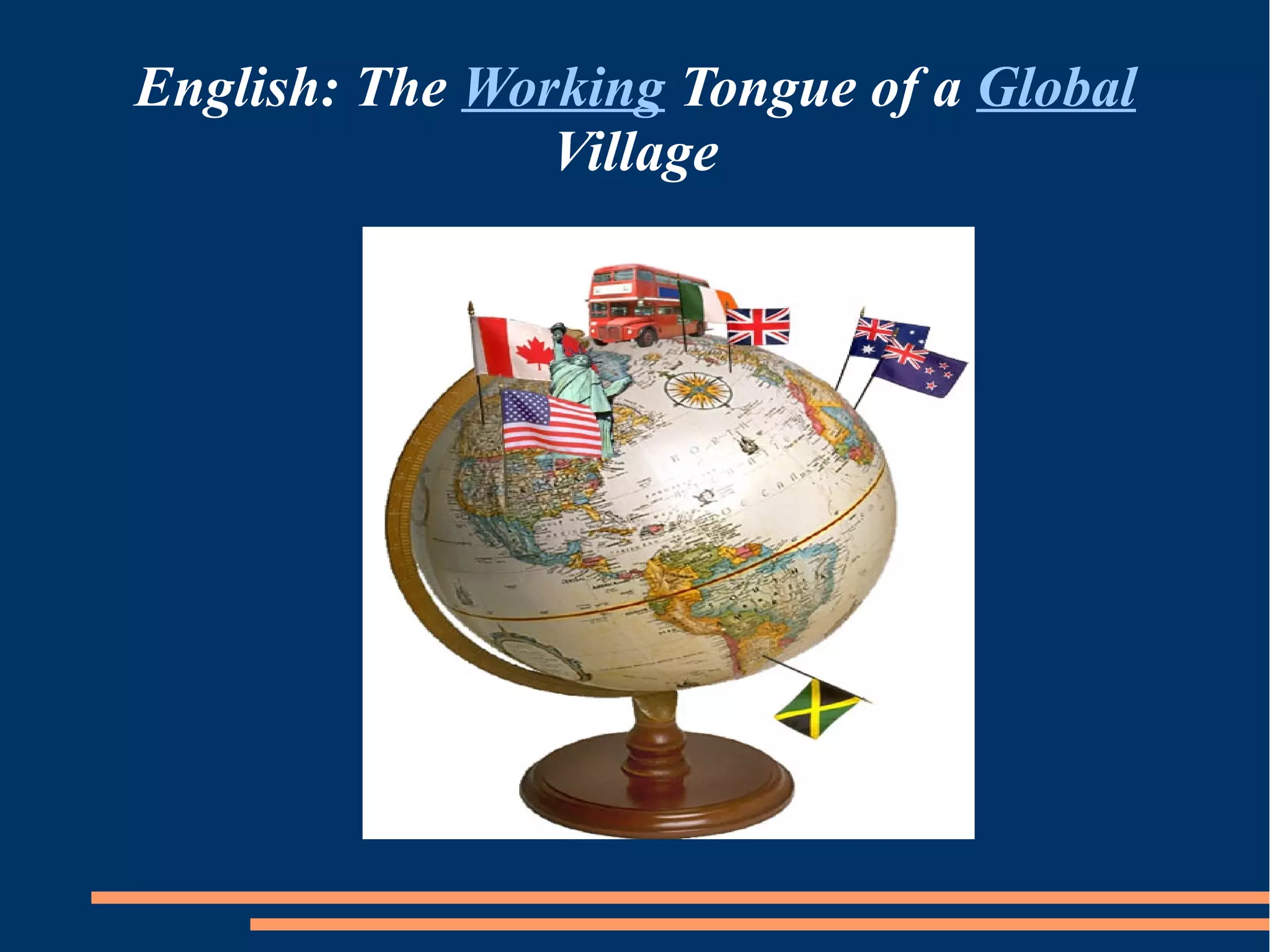
English: The Working Tongue of a Global
Village
“English, no longer an English language, now grows from many
roots”
Salman Rushdie
The Times, 3 July 1982
The Canadian writer Marshall McLuhan claimed that electronically connected
media would eventually transform the world into a huge
“Global village”
What is Globalization?
It is the process by which the world has become increasingly
interconnected as a result of massively increased trade and cultural
exchange
EFFECTS
Increase in the production of goods and services
The biggest companies are no longer national firms but multinational corporations with
subsidiaries in many countries
Increased international TRADE
Greater dependence on the global economy
Freer movement of capital, goods, and services
Language is Global for ONE REASON
ONLY......
???????????
Give it a try
English has become the working tongue of that
Global Village
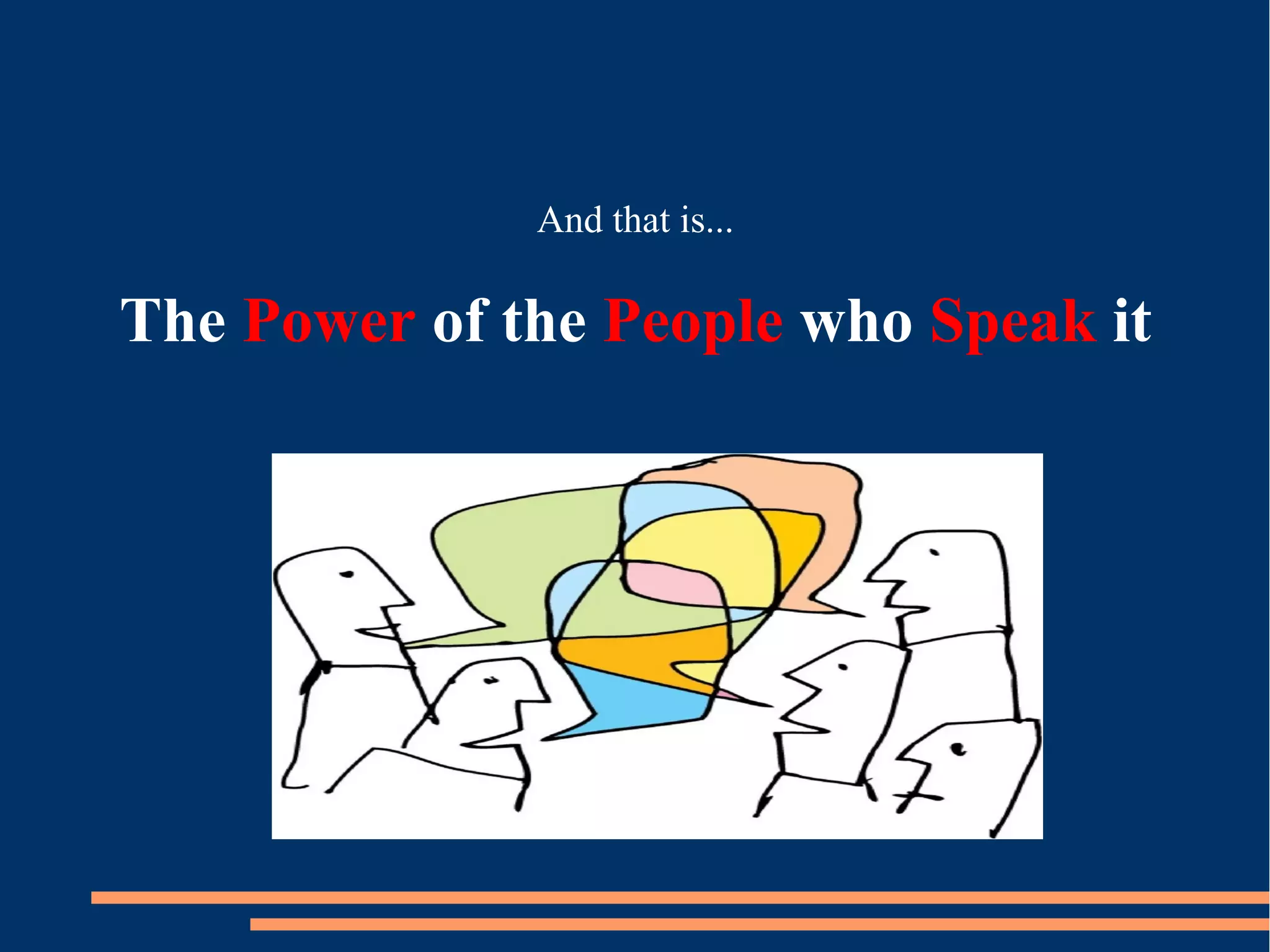
And that is...
The Power of the People who Speak it
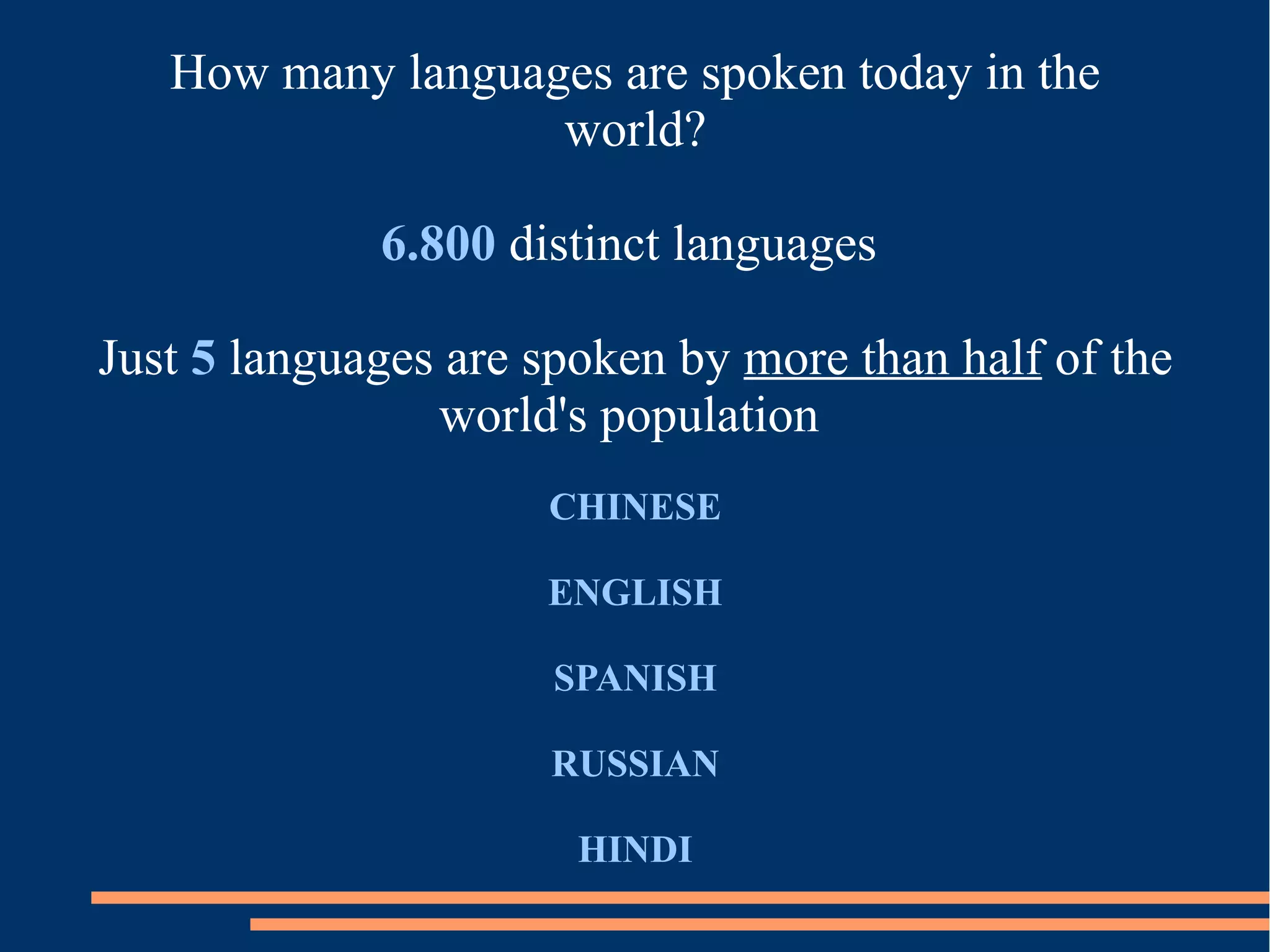
How many languages are spoken today in the
world?
6.800 distinct languages
Just 5 languages are spoken by more than half of the
world's population
CHINESE
ENGLISH
SPANISH
RUSSIAN
HINDI
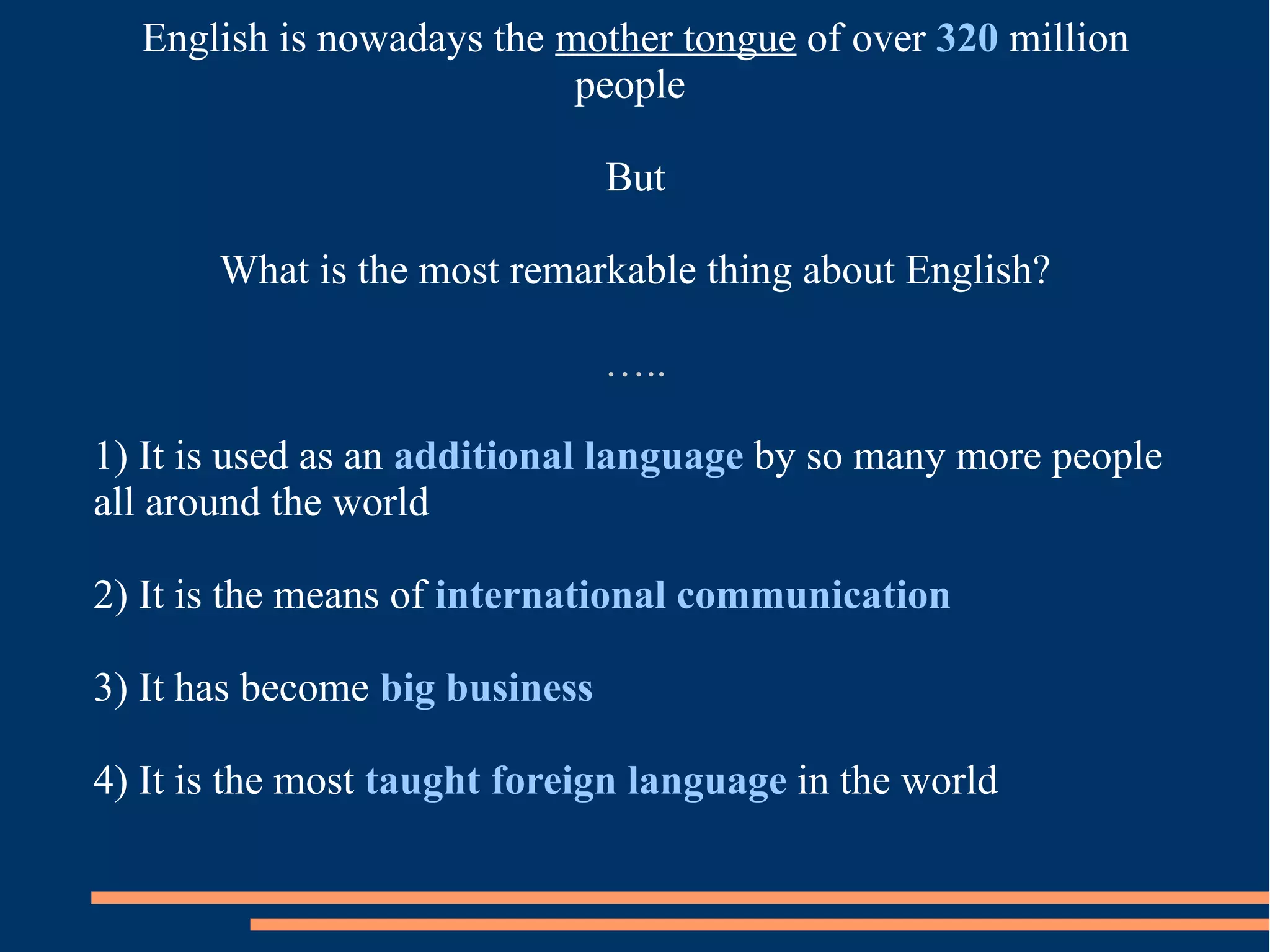
English is nowadays the mother tongue of over 320 million
people
But
What is the most remarkable thing about English?
…..
1) It is used as an additional language by so many more people
all around the world
2) It is the means of international communication
3) It has become big business
4) It is the most taught foreign language in the world
Why this huge demand for English?
Maybe...
Hypothesis 1
Is it easier, beautiful or
superior in linguistic qualities?
Here are a few reasons..
1. Young people are attracted by things they can do with English,
such as listening to music, watching films and surfing the web
2. Scientists and Academics see English as a necessity for
reaching out colleagues around the globe
3. Tourists consider the English language as the most useful tool to
travel and communicate
4. Air traffic controllers use English to communicate with pilots
5. Business (China, Russia, Saudi Arabia, India)
6. EU working language is English
7. To pursue an international career IN ANY CONTEXT
Last but not least..
8. The UNIQUE history of the English
Language
Let's revise it in this 10 minutes video:
https://www.youtube.com/watch?
v=H3r9bOkYW9s
Why is English not the easiest language?
Linguists provided scientific evidence
1. Pronunciation corresponding to Spelling
2. Vocabulary: English word stock is vast
Oxford English Dictionary: 600,000 words
3. Syntax is no less complex than that of other
languages
Grammar is less learner-friendly than is
generally assumed
Huddlestone and Pullums
Cambridge Grammar of the English
Language
1.800 pages
Remember: Italian and Spanish, despite
having pure vowel sounds, did not achieve
the status of LINGUA FRANCA
English did not become a world language
on its linguistic merits!
So,
WHY ENGLISH?
The expansion and influence of British
colonial power
The status of the United States of America
as the leading economy, military and
scientific power in the 20th
century
Increasing need of international
communication as a result of modern
technology
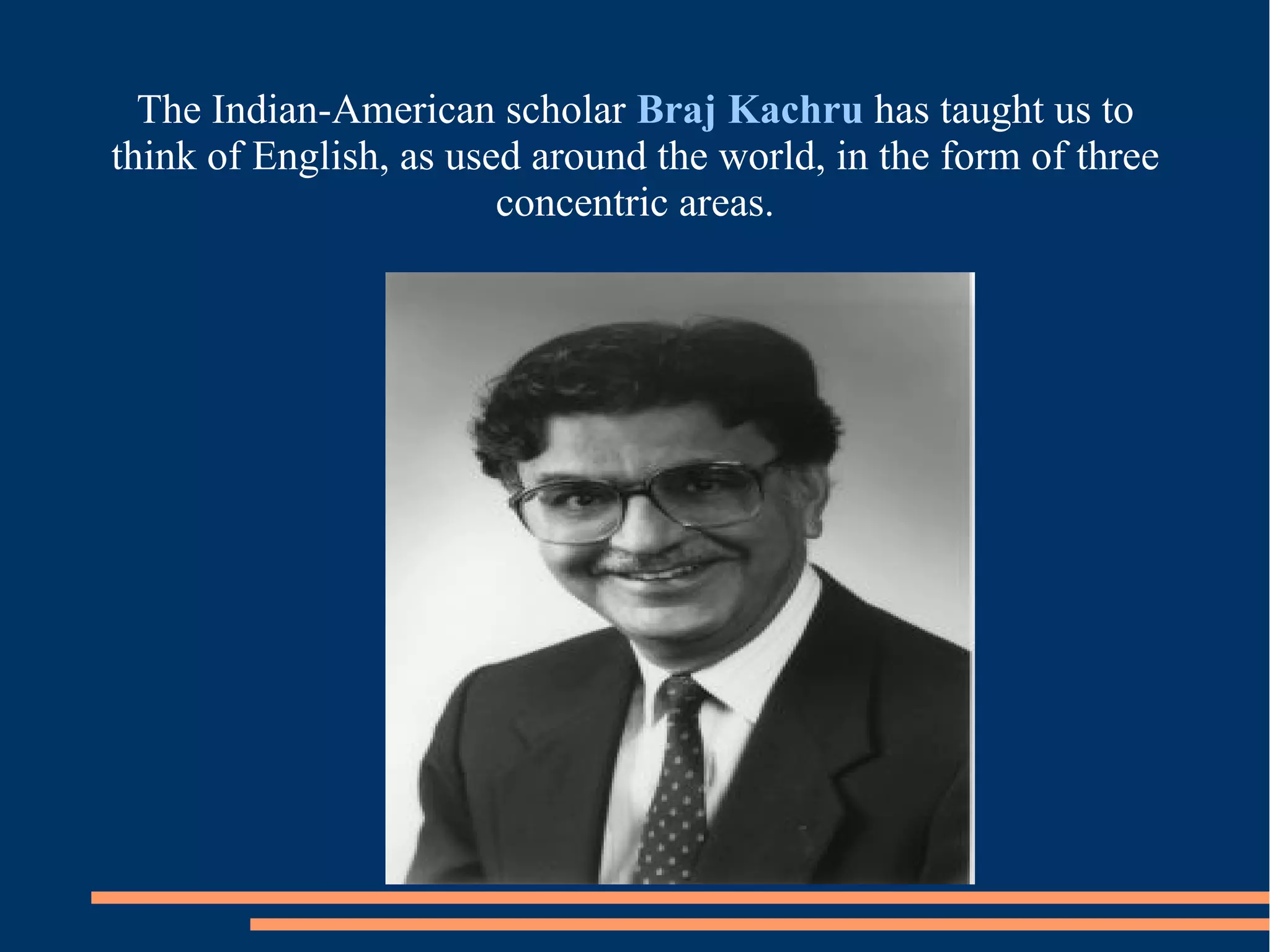
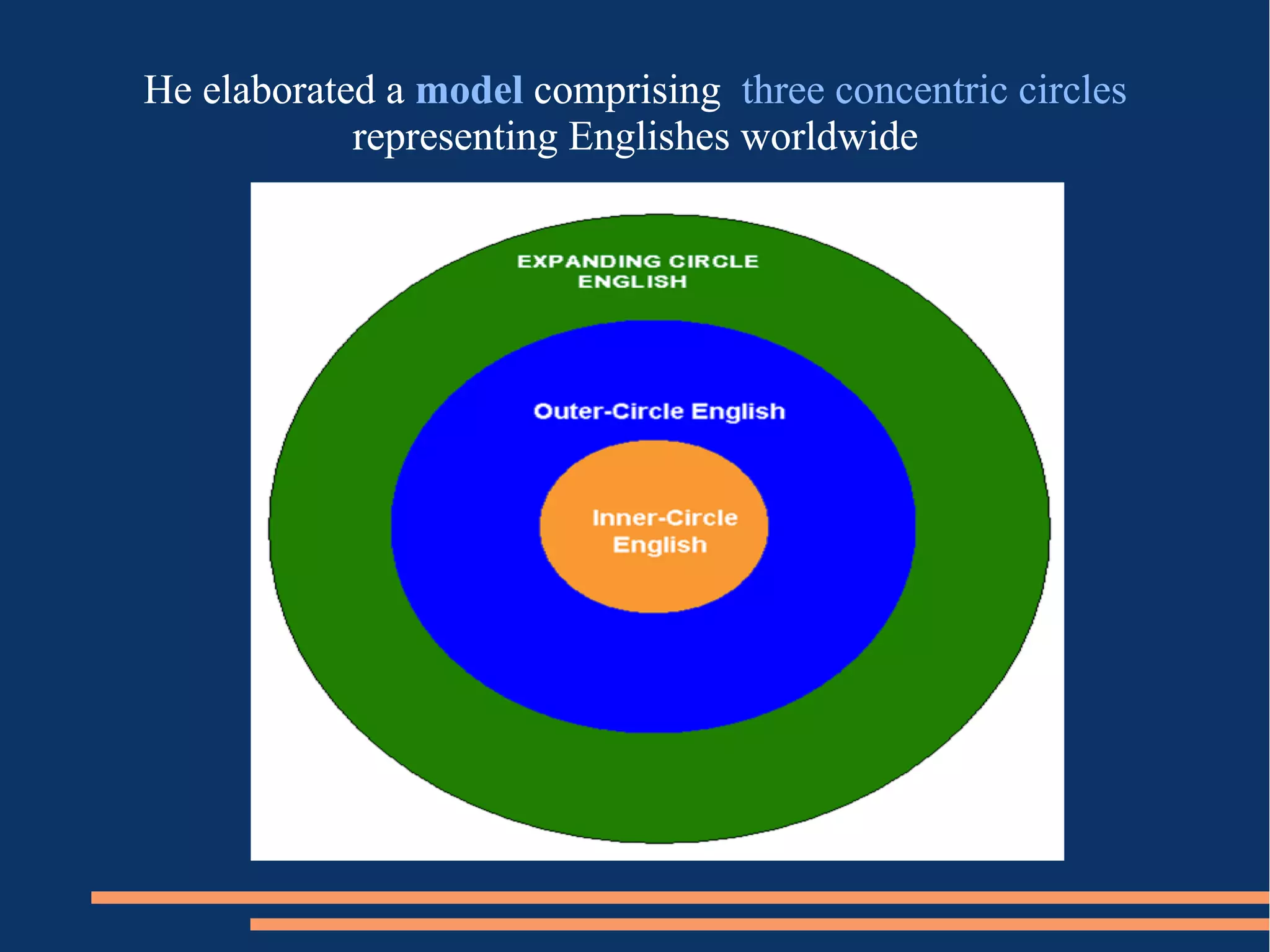
The Indian-American scholar Braj Kachru has taught us to
think of English, as used around the world, in the form of three
concentric areas.
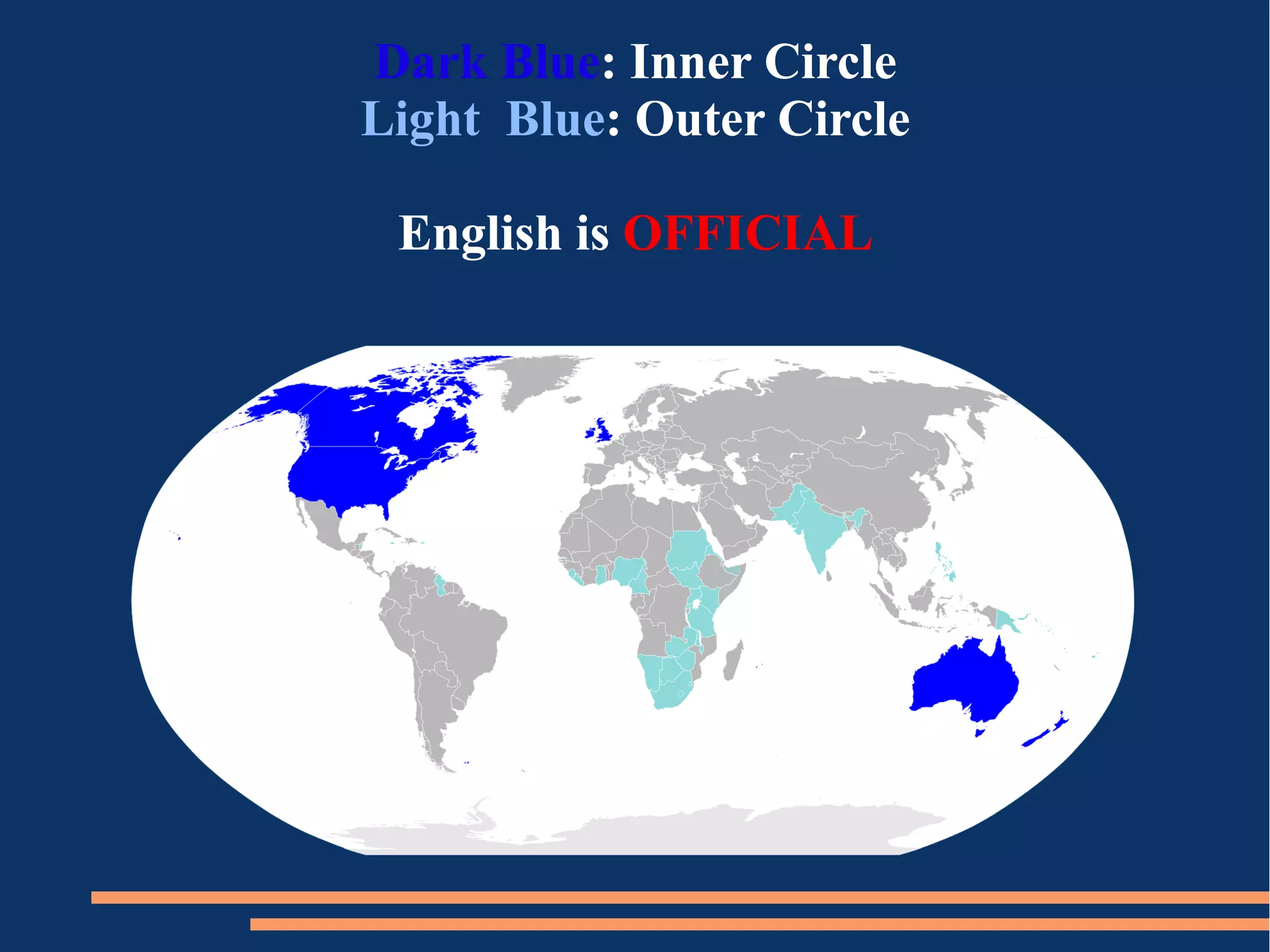
The Inner Circle
ENGLISH AS A FIRST LANGUAGE
8 countries
US
UK
CANADA
AUSTRALIA
CARIBBEAN
IRELAND
NEW ZEALAND
SOUTH AFRICA
On a population of 447 million, 326 million speak
English as their first language
Let's look at them in detail!
UNITED STATES
For 40 million Americans the FIRST language is Spanish
Hispanics have now replaced African Americans as the largest
minority group
Birth of Spanglish as an English variety
Afro-American varieties
215/278 million people speak English as their first language
CANADA
It is a BILINGUAL COUNTRY
20/32 million people speak English as their first language
Almost a quarter of the population report French to be their mother
tongue
Native Canadians speak various Indigenous languages
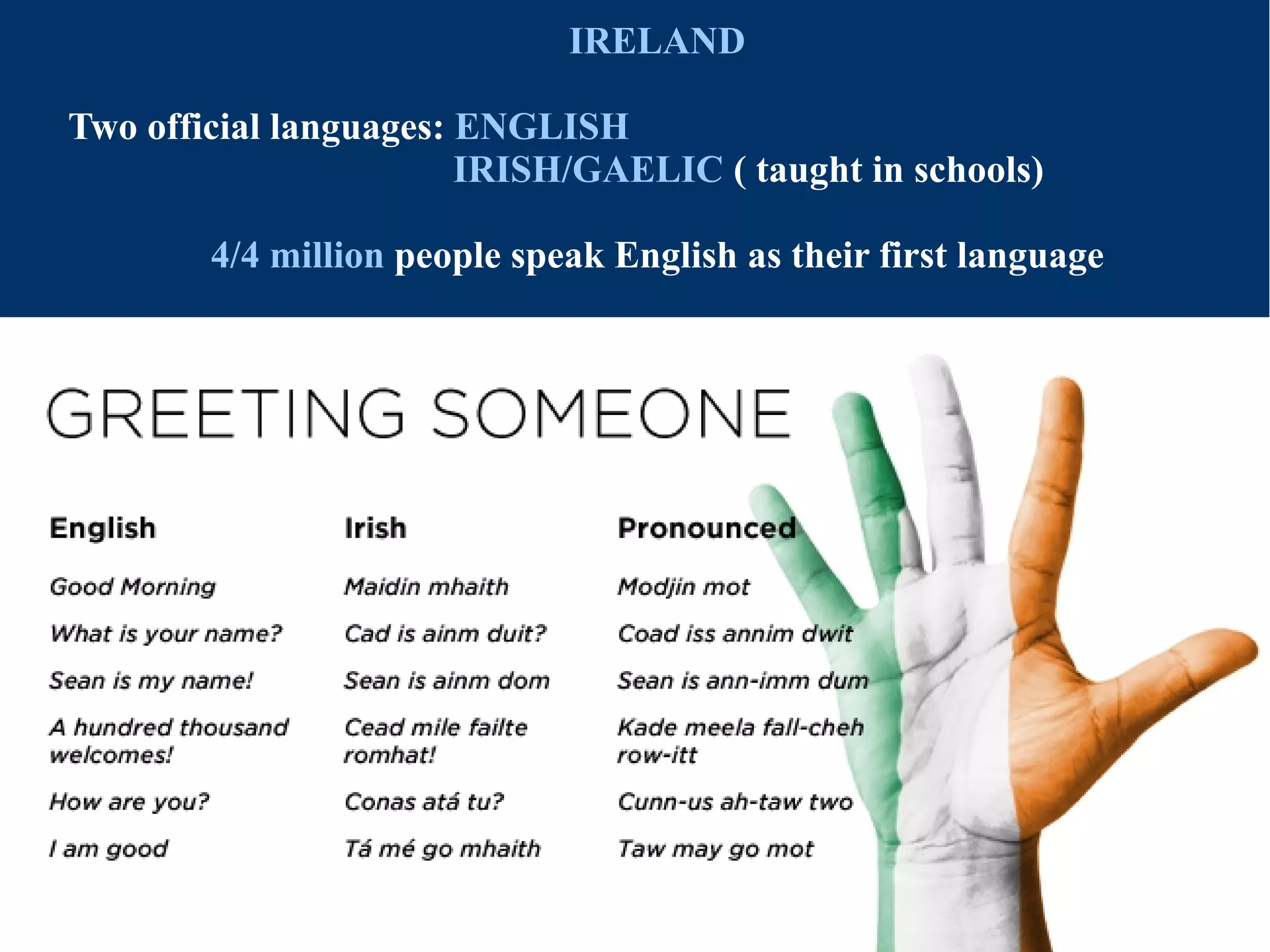
IRELAND
Two official languages: ENGLISH
IRISH/GAELIC ( taught in schools)
4/4 million people speak English as their first language
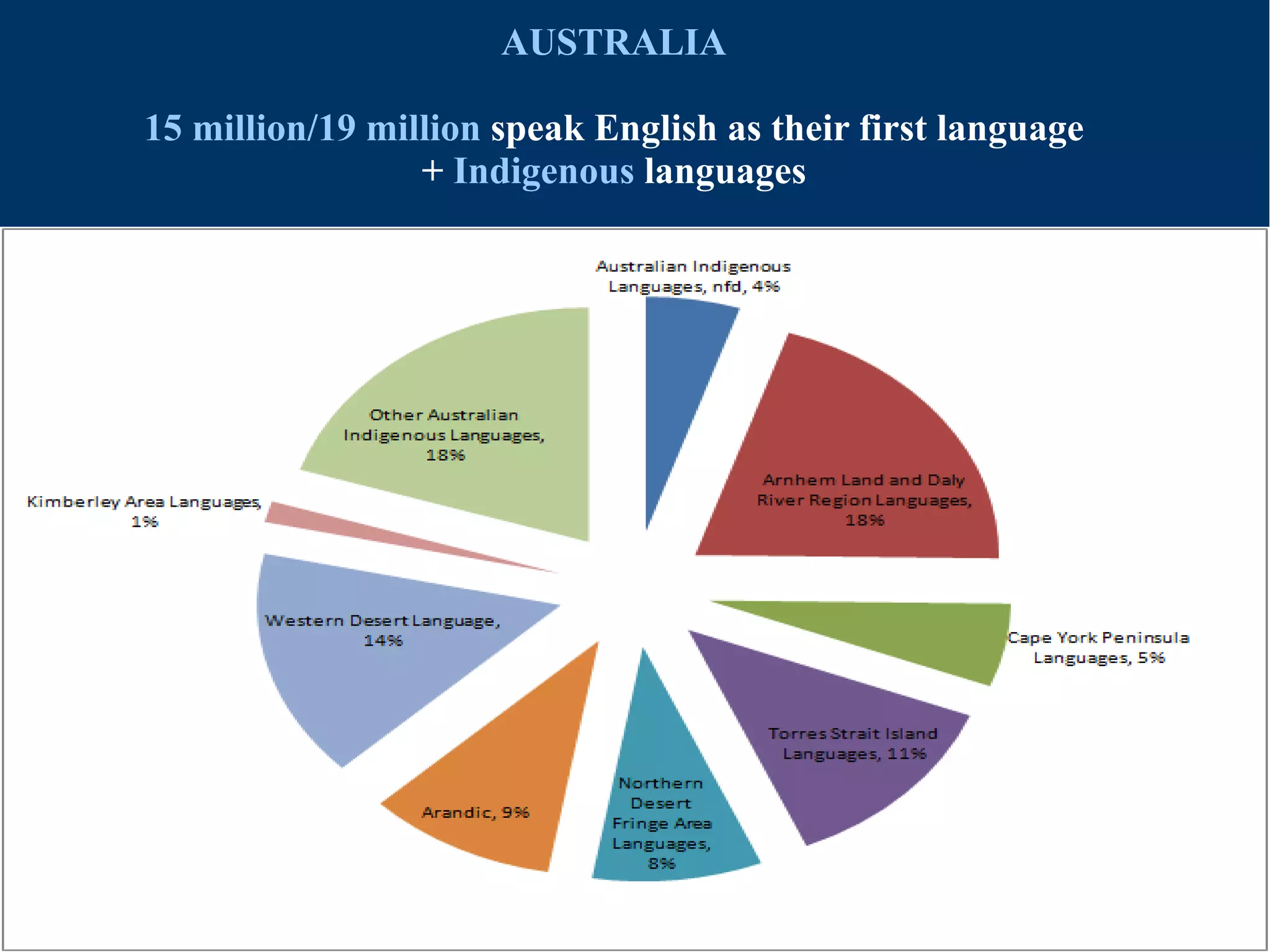
AUSTRALIA
15 million/19 million speak English as their first language
+ Indigenous languages
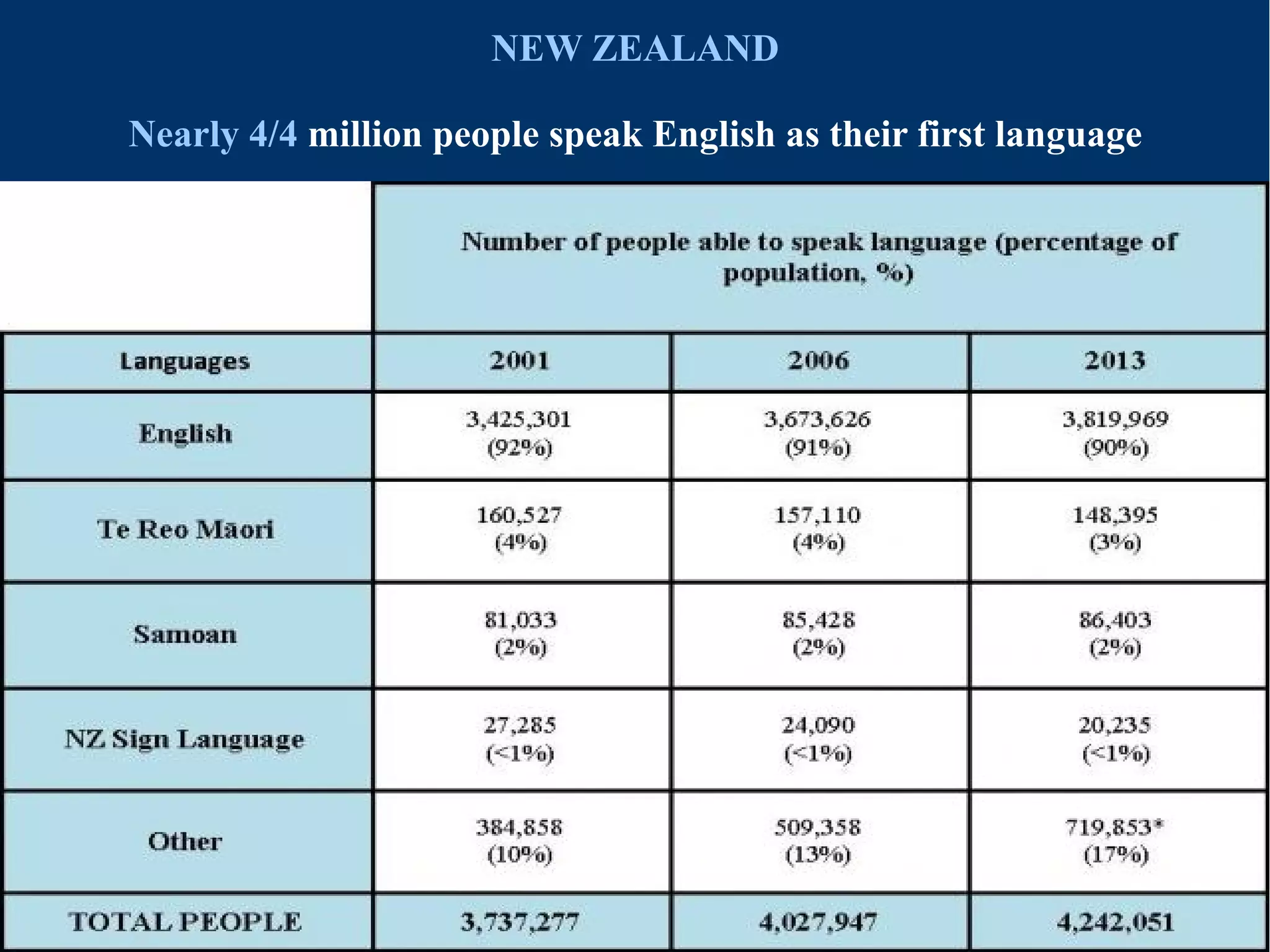
NEW ZEALAND
Nearly 4/4 million people speak English as their first language
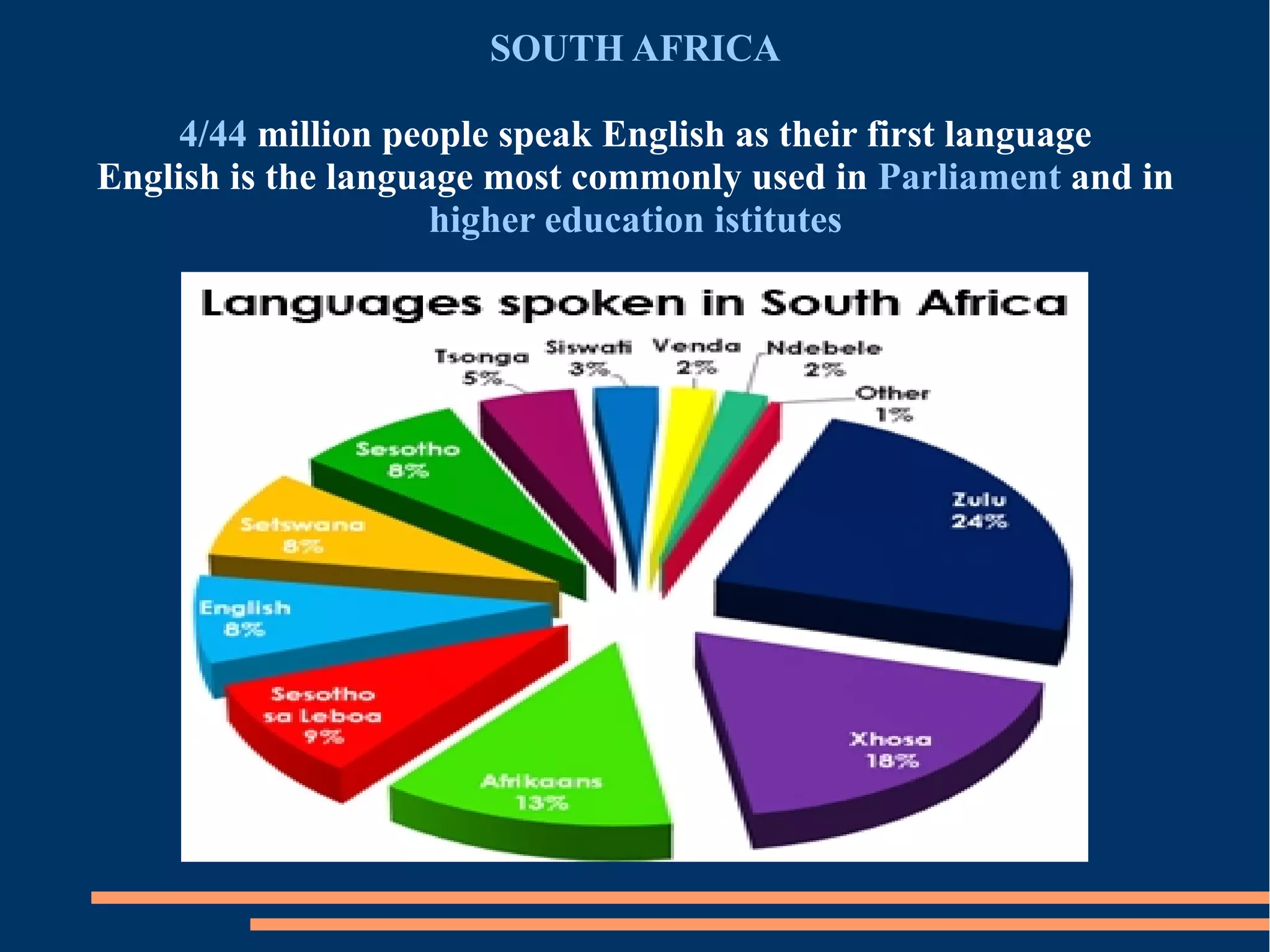
SOUTH AFRICA
4/44 million people speak English as their first language
English is the language most commonly used in Parliament and in
higher education istitutes
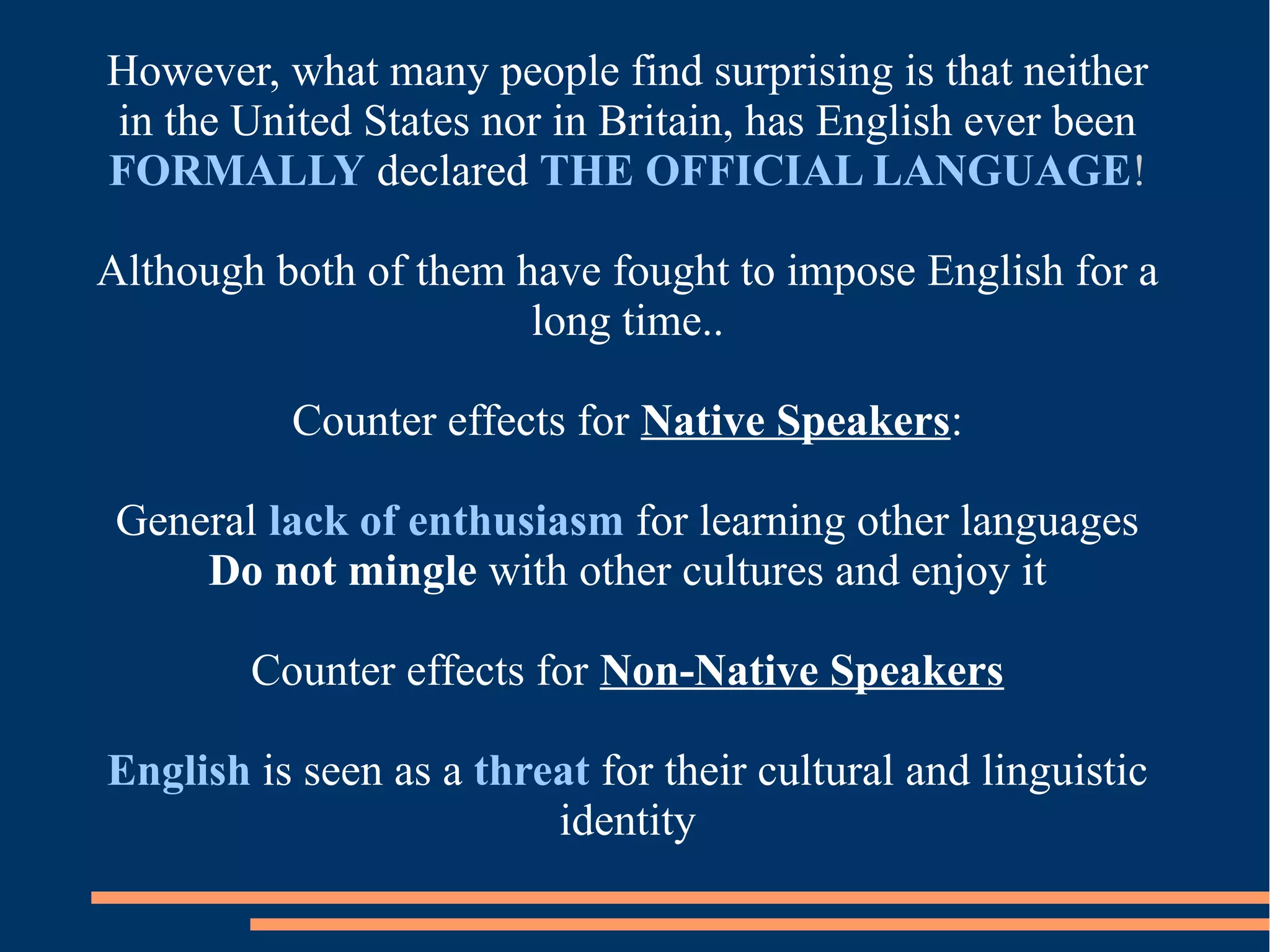
However, what many people find surprising is that neither
in the United States nor in Britain, has English ever been
FORMALLY declared THE OFFICIAL LANGUAGE!
Although both of them have fought to impose English for a
long time..
Counter effects for Native Speakers:
General lack of enthusiasm for learning other languages
Do not mingle with other cultures and enjoy it
Counter effects for Non-Native Speakers
English is seen as a threat for their cultural and linguistic
identity
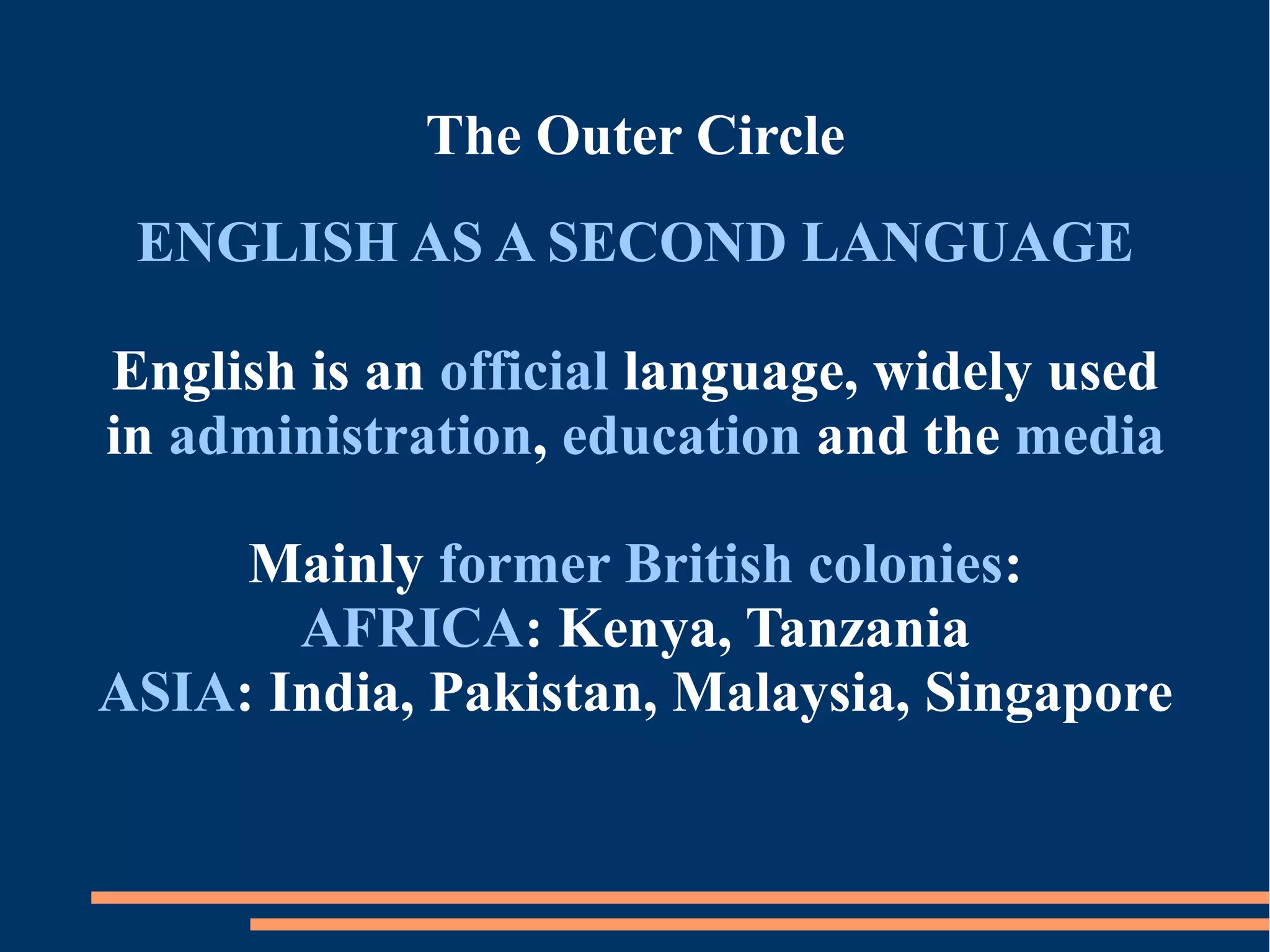
The Outer Circle
ENGLISH AS A SECOND LANGUAGE
English is an official language, widely used
in administration, education and the media
Mainly former British colonies:
AFRICA: Kenya, Tanzania
ASIA: India, Pakistan, Malaysia, Singapore
INDIA
Among the leading English-using nations in the
world
More than a BILLION inhabitants and
200 languages
200 million people use English as a second
language
The Expanding Circle
ENGLISH AS A FOREIGN LANGUAGE
Is this expansion of English going to reach a
SATURATION POINT?
Are we moving towards an “EXPANDED
CIRCLE”?
To overcome the confusion of tongues
people have tried in the past to make up
ARTIFICIAL INTERNATIONAL
LANGUAGES
Esperanto
Ido
Volapuk
Novial
Interglossa
Interlingua
Esperanto was the most successful attempt
but
Artificial languages have met with little success
Conclusive remarks
Globalization has fostered our need to have a world
language
Non-native speakers of English in the world now
outnumber native speakers
The future of English will be more determined by the
majority of its users, those in the Outer Circle and the
Expanding/-ed Circle
Further reading:
“English as Global Language” - David Crystal
David Crystal Talk at the British Council
https://www.youtube.com/watch?
v=5Kvs8SxN8mc
The End
Thank you for you
attention!

History of the English Language pdf (1)

  • 1.
    History of theEnglish Language Source: English - One Tongue, Many Voices Authors: Jan Svartvik, Geoffrey Leech Jessica Mariani jessica.mariani@univr.it
  • 2.
    English: The WorkingTongue of a Global Village
  • 3.
    “English, no longeran English language, now grows from many roots” Salman Rushdie The Times, 3 July 1982
  • 4.
    The Canadian writerMarshall McLuhan claimed that electronically connected media would eventually transform the world into a huge “Global village” What is Globalization? It is the process by which the world has become increasingly interconnected as a result of massively increased trade and cultural exchange EFFECTS Increase in the production of goods and services The biggest companies are no longer national firms but multinational corporations with subsidiaries in many countries Increased international TRADE Greater dependence on the global economy Freer movement of capital, goods, and services
  • 6.
    Language is Globalfor ONE REASON ONLY...... ??????????? Give it a try English has become the working tongue of that Global Village
  • 7.
    And that is... ThePower of the People who Speak it
  • 8.
    How many languagesare spoken today in the world? 6.800 distinct languages Just 5 languages are spoken by more than half of the world's population CHINESE ENGLISH SPANISH RUSSIAN HINDI
  • 9.
    English is nowadaysthe mother tongue of over 320 million people But What is the most remarkable thing about English? ….. 1) It is used as an additional language by so many more people all around the world 2) It is the means of international communication 3) It has become big business 4) It is the most taught foreign language in the world
  • 10.
    Why this hugedemand for English? Maybe... Hypothesis 1 Is it easier, beautiful or superior in linguistic qualities?
  • 12.
    Here are afew reasons.. 1. Young people are attracted by things they can do with English, such as listening to music, watching films and surfing the web 2. Scientists and Academics see English as a necessity for reaching out colleagues around the globe 3. Tourists consider the English language as the most useful tool to travel and communicate 4. Air traffic controllers use English to communicate with pilots 5. Business (China, Russia, Saudi Arabia, India) 6. EU working language is English 7. To pursue an international career IN ANY CONTEXT
  • 13.
    Last but notleast.. 8. The UNIQUE history of the English Language Let's revise it in this 10 minutes video: https://www.youtube.com/watch? v=H3r9bOkYW9s
  • 14.
    Why is Englishnot the easiest language? Linguists provided scientific evidence 1. Pronunciation corresponding to Spelling 2. Vocabulary: English word stock is vast Oxford English Dictionary: 600,000 words 3. Syntax is no less complex than that of other languages
  • 15.
    Grammar is lesslearner-friendly than is generally assumed Huddlestone and Pullums Cambridge Grammar of the English Language 1.800 pages Remember: Italian and Spanish, despite having pure vowel sounds, did not achieve the status of LINGUA FRANCA
  • 16.
    English did notbecome a world language on its linguistic merits! So, WHY ENGLISH?
  • 17.
    The expansion andinfluence of British colonial power The status of the United States of America as the leading economy, military and scientific power in the 20th century Increasing need of international communication as a result of modern technology
  • 18.
    The Indian-American scholarBraj Kachru has taught us to think of English, as used around the world, in the form of three concentric areas.
  • 20.
    The Inner Circle ENGLISHAS A FIRST LANGUAGE 8 countries US UK CANADA AUSTRALIA CARIBBEAN IRELAND NEW ZEALAND SOUTH AFRICA On a population of 447 million, 326 million speak English as their first language
  • 21.
    Let's look atthem in detail! UNITED STATES For 40 million Americans the FIRST language is Spanish Hispanics have now replaced African Americans as the largest minority group Birth of Spanglish as an English variety Afro-American varieties 215/278 million people speak English as their first language
  • 22.
    CANADA It is aBILINGUAL COUNTRY 20/32 million people speak English as their first language Almost a quarter of the population report French to be their mother tongue Native Canadians speak various Indigenous languages
  • 23.
    IRELAND Two official languages:ENGLISH IRISH/GAELIC ( taught in schools) 4/4 million people speak English as their first language
  • 24.
    AUSTRALIA 15 million/19 millionspeak English as their first language + Indigenous languages
  • 25.
    NEW ZEALAND Nearly 4/4million people speak English as their first language
  • 26.
    SOUTH AFRICA 4/44 millionpeople speak English as their first language English is the language most commonly used in Parliament and in higher education istitutes
  • 27.
    However, what manypeople find surprising is that neither in the United States nor in Britain, has English ever been FORMALLY declared THE OFFICIAL LANGUAGE! Although both of them have fought to impose English for a long time.. Counter effects for Native Speakers: General lack of enthusiasm for learning other languages Do not mingle with other cultures and enjoy it Counter effects for Non-Native Speakers English is seen as a threat for their cultural and linguistic identity
  • 28.
    The Outer Circle ENGLISHAS A SECOND LANGUAGE English is an official language, widely used in administration, education and the media Mainly former British colonies: AFRICA: Kenya, Tanzania ASIA: India, Pakistan, Malaysia, Singapore
  • 31.
    INDIA Among the leadingEnglish-using nations in the world More than a BILLION inhabitants and 200 languages 200 million people use English as a second language
  • 32.
    The Expanding Circle ENGLISHAS A FOREIGN LANGUAGE Is this expansion of English going to reach a SATURATION POINT? Are we moving towards an “EXPANDED CIRCLE”?
  • 34.
    To overcome theconfusion of tongues people have tried in the past to make up ARTIFICIAL INTERNATIONAL LANGUAGES Esperanto Ido Volapuk Novial Interglossa Interlingua Esperanto was the most successful attempt but Artificial languages have met with little success
  • 35.
    Conclusive remarks Globalization hasfostered our need to have a world language Non-native speakers of English in the world now outnumber native speakers The future of English will be more determined by the majority of its users, those in the Outer Circle and the Expanding/-ed Circle
  • 36.
    Further reading: “English asGlobal Language” - David Crystal David Crystal Talk at the British Council https://www.youtube.com/watch? v=5Kvs8SxN8mc
  • 37.
    The End Thank youfor you attention!