Safety, Health & Environment Management 
Engineering controls
Index 
• Controlling hazards 
• Control measure 
• Engineering controls 
• Enclosure 
• Isolation 
• Ventilation 
• Points to remember
Controlling hazards…!!! 
• All workplace hazards (chemical, physical, etc.) 
can be controlled by a variety of methods. 
• The most effective method of controlling hazards 
is to control at the source by eliminating the 
hazard or by substituting a hazardous agent or 
work process with a less dangerous one. 
• Some methods of hazard control are more 
efficient than others, but a combination of 
methods usually provides a safer workplace than 
relying on only one method.
Goal …!!! 
• The goal of controlling hazards is to prevent 
workers from being exposed to occupational 
hazards.
How can you identify health and 
safety problems ? 
• observe your workplace; 
• investigate complaints from workers; 
• examine accident and near-miss records; 
• examine sickness figures; 
• use simple surveys to ask your co-workers about 
their health and safety concerns; 
• use check-lists to help you inspect your workplace; 
• learn the results of inspections that are done by the 
employer, the union or anyone else; 
• read reports or other information about your 
workplace.
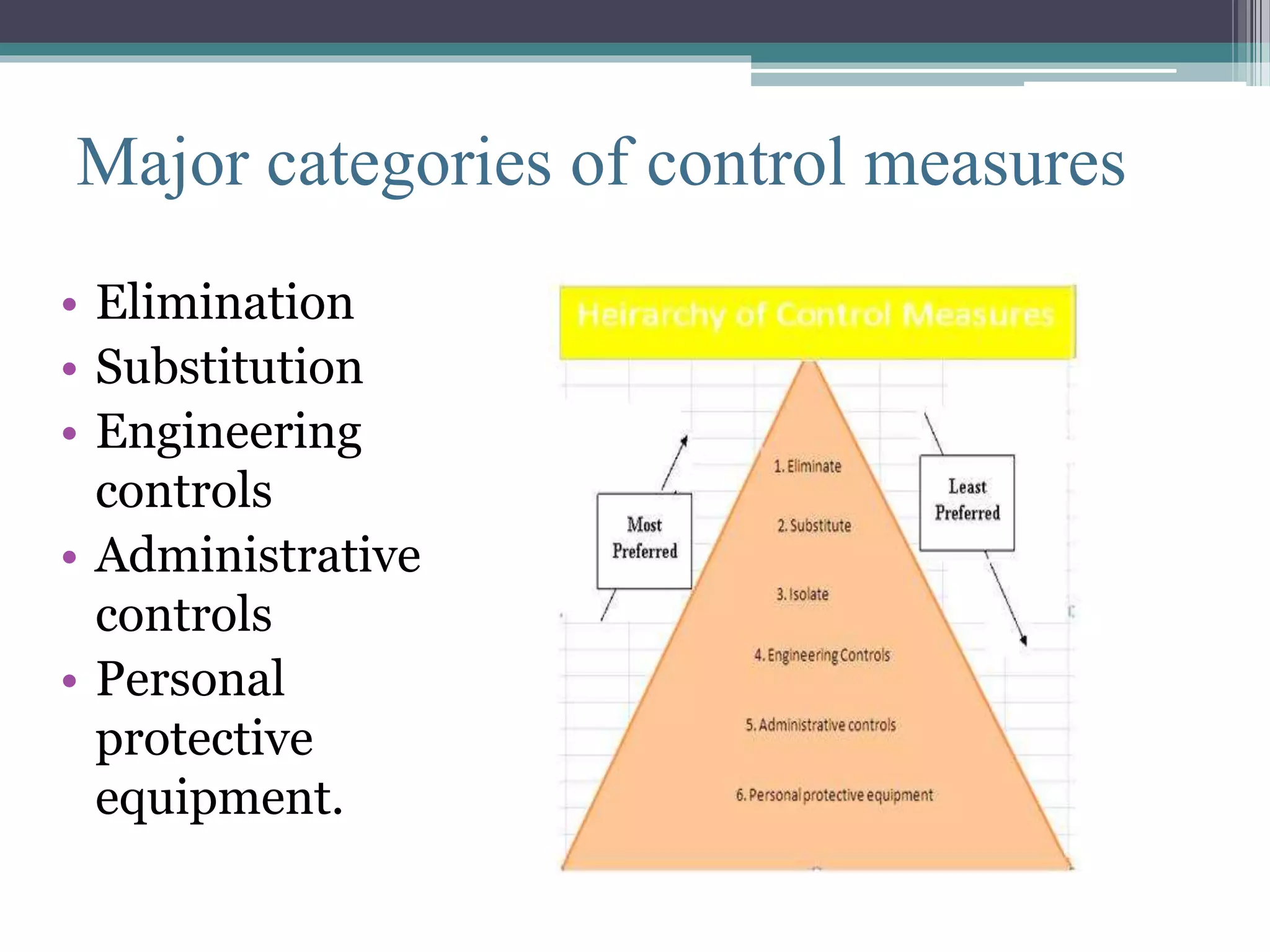
Major categories of control measures 
• Elimination 
• Substitution 
• Engineering 
controls 
• Administrative 
controls 
• Personal 
protective 
equipment.
Engineering controls…!!! 
• An engineering control may mean changing a piece 
of machinery (for example, using proper machine 
guards) or a work process to reduce exposure to a 
hazard. 
• There are a number of common control measures 
which are called “engineering controls”. These 
include 
1. Enclosure 
2. Isolation 
3. Ventilation.
is Enclosure…? 
• If a hazardous substance or work process cannot 
be eliminated or substituted, then enclosing it so 
workers are not exposed to the hazard is the next 
best method of control. 
• Enclosing hazards can minimize possible 
exposures, but does not eliminate them. 
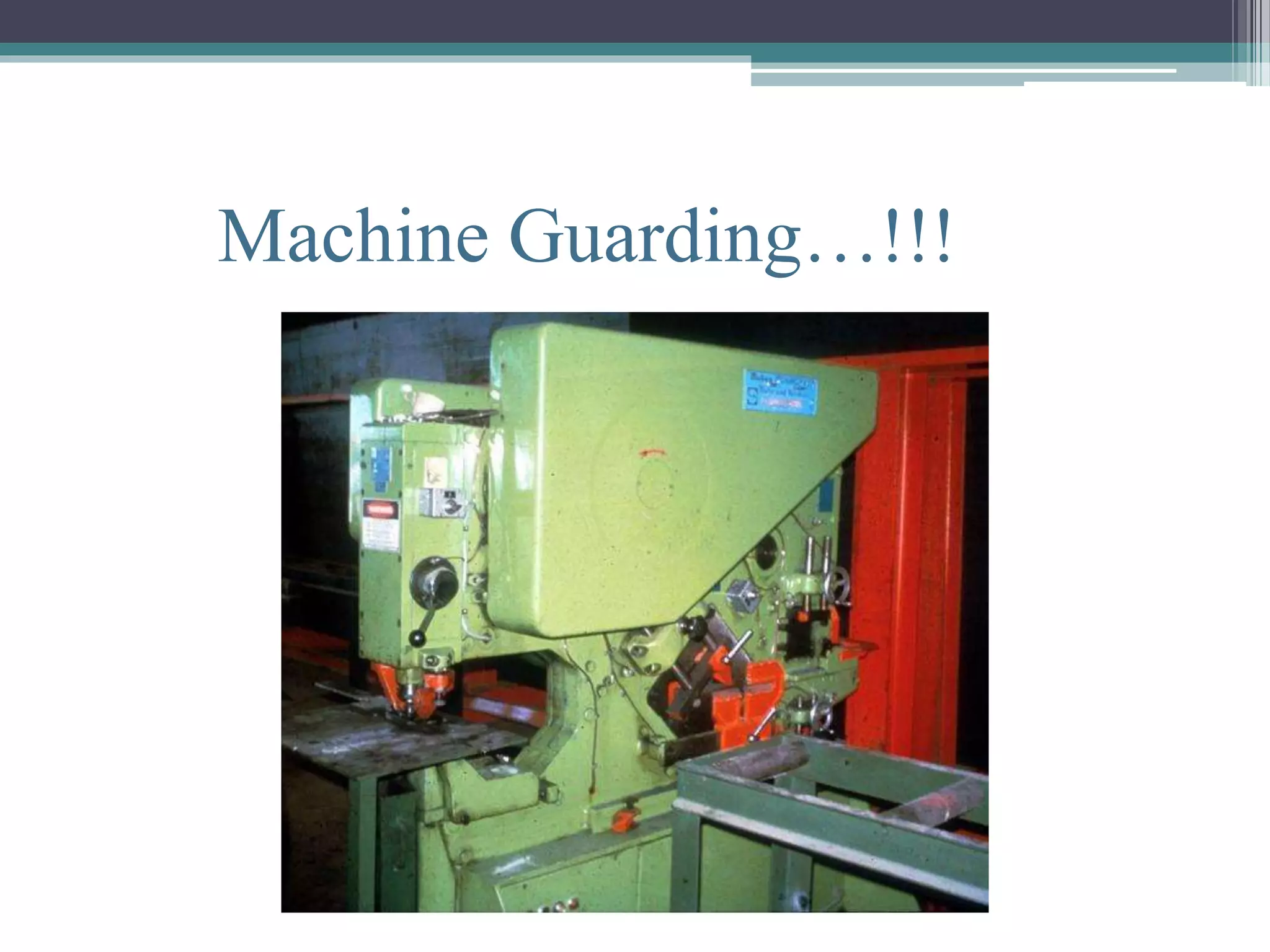
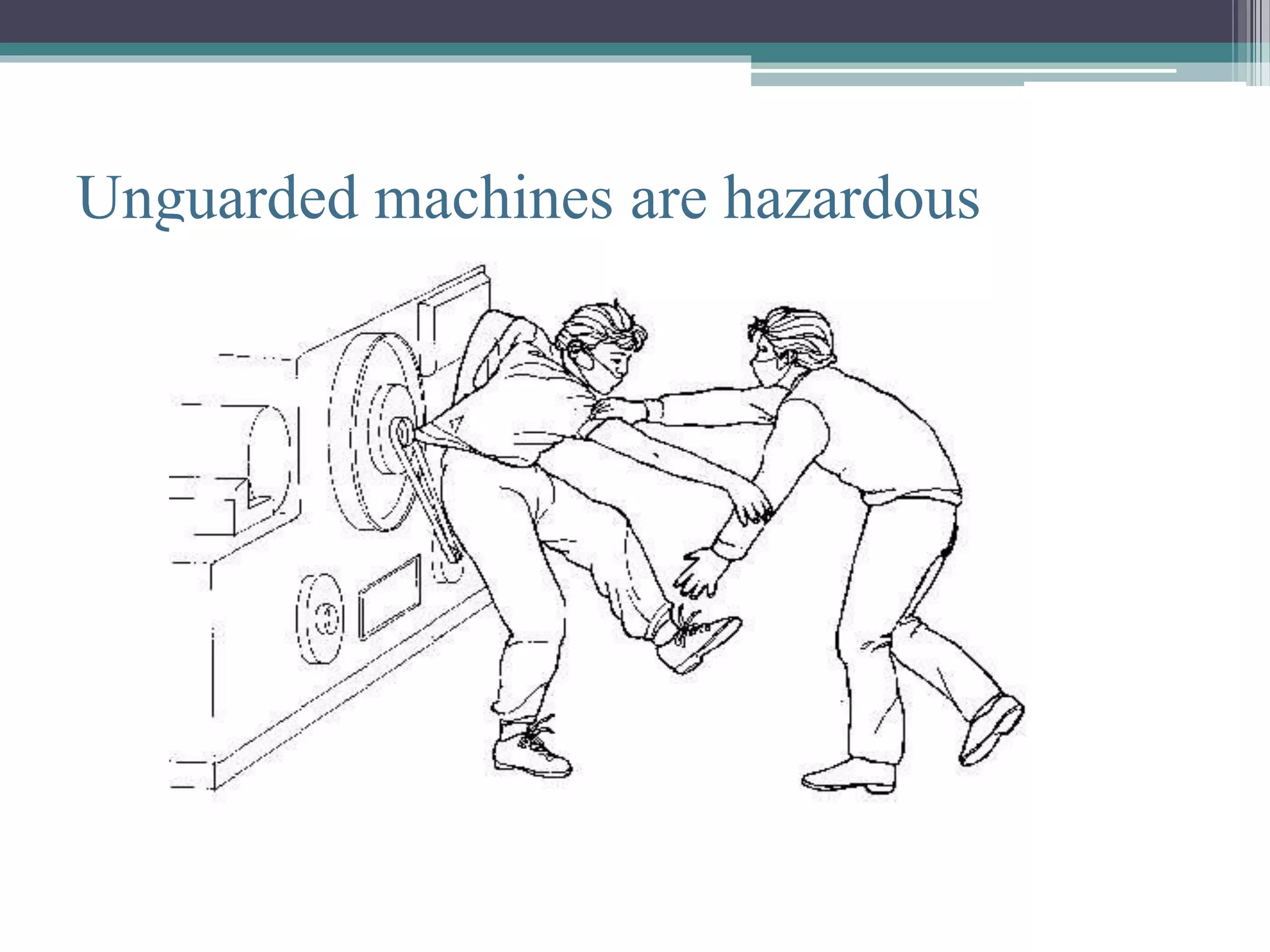
• Machine guarding is another form of enclosure 
that prevents workers from coming into contact 
with dangerous parts of machines.
Machine Guarding…!!!
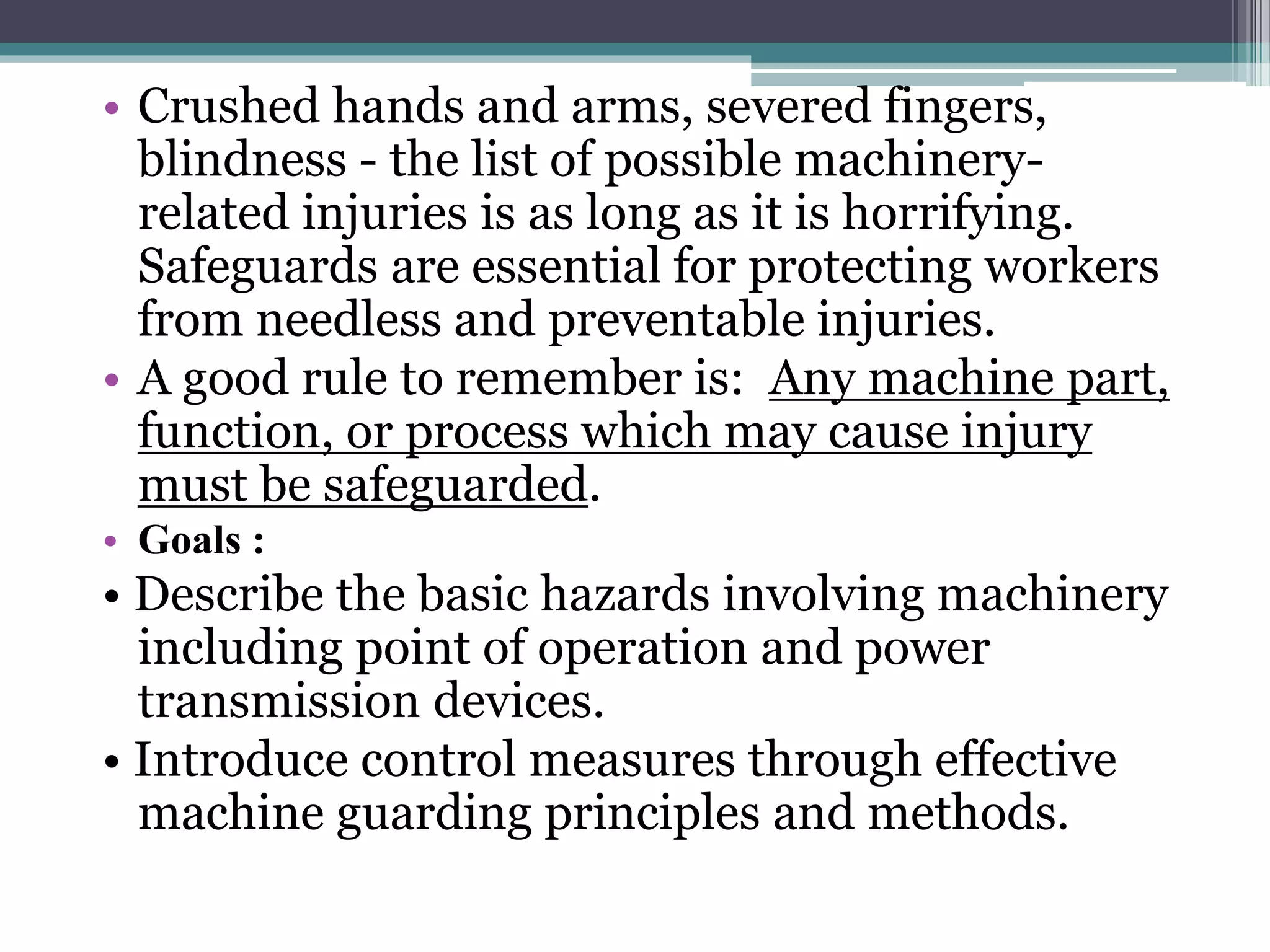
• Crushed hands and arms, severed fingers, 
blindness - the list of possible machinery-related 
injuries is as long as it is horrifying. 
Safeguards are essential for protecting workers 
from needless and preventable injuries. 
• A good rule to remember is: Any machine part, 
function, or process which may cause injury 
must be safeguarded. 
• Goals : 
• Describe the basic hazards involving machinery 
including point of operation and power 
transmission devices. 
• Introduce control measures through effective 
machine guarding principles and methods.
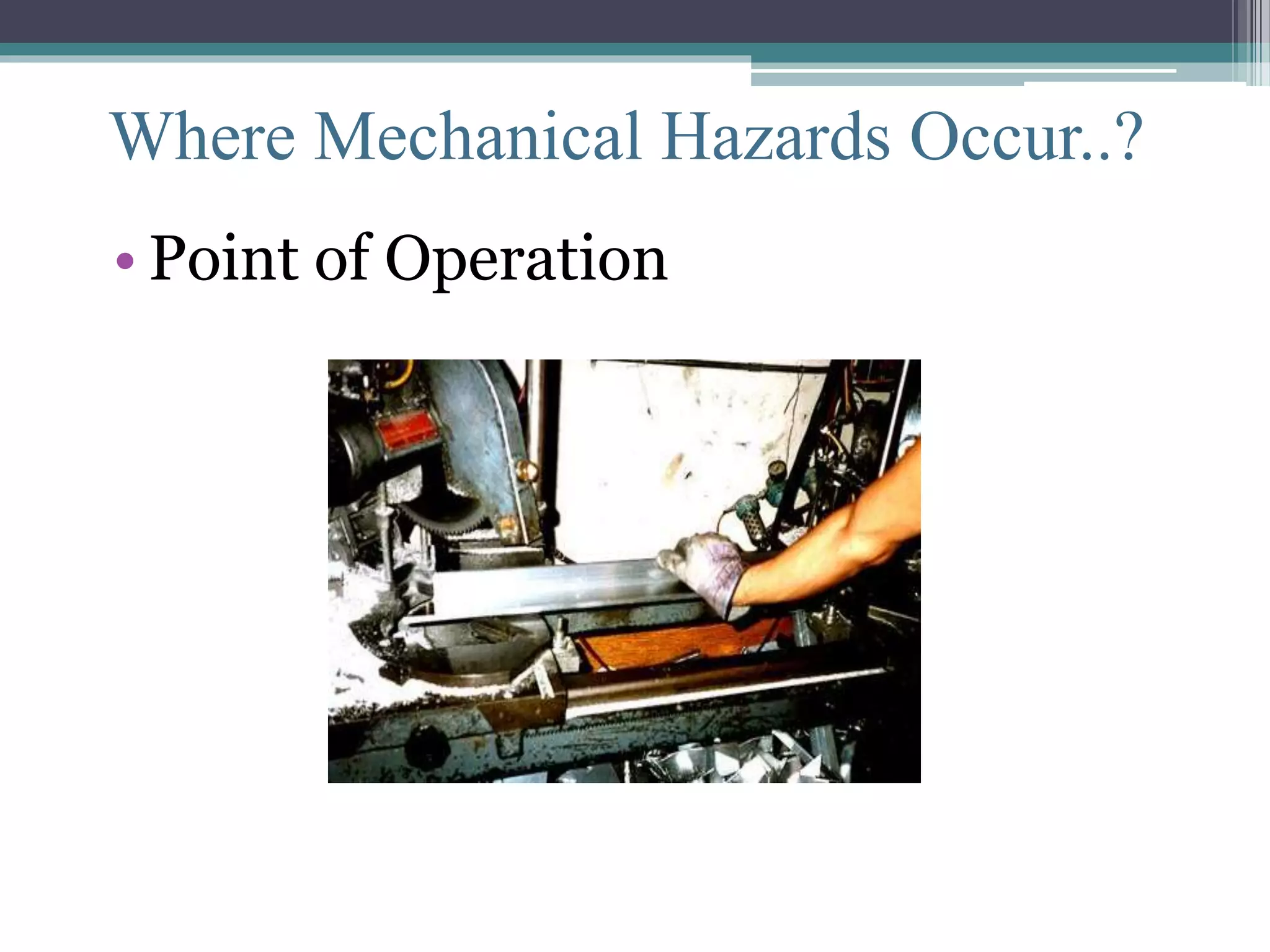
Where Mechanical Hazards Occur..? 
• Point of Operation
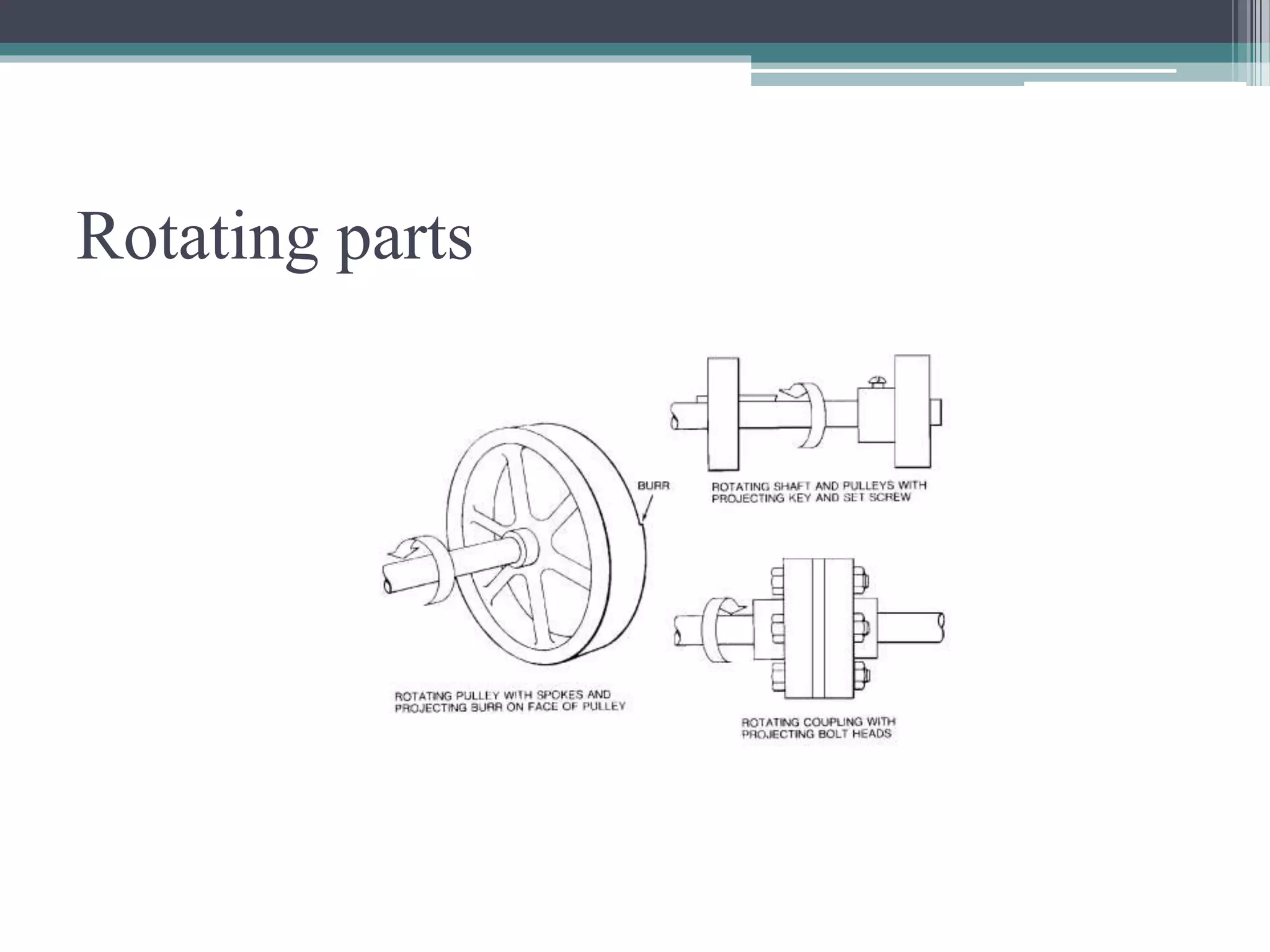
Rotating parts
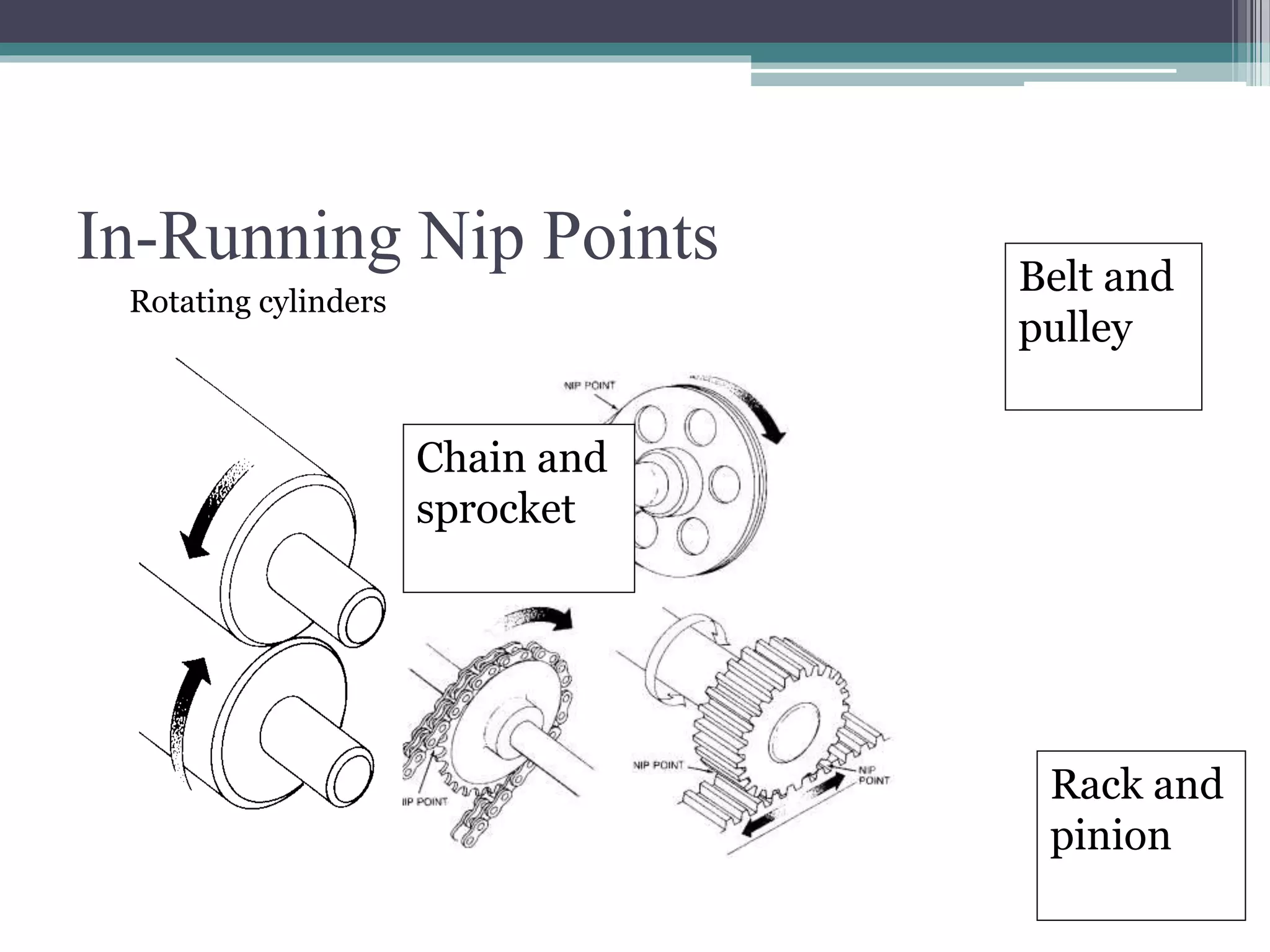
In-Running Nip Points 
Rotating cylinders 
Chain and 
sprocket 
Belt and 
pulley 
Rack and 
pinion
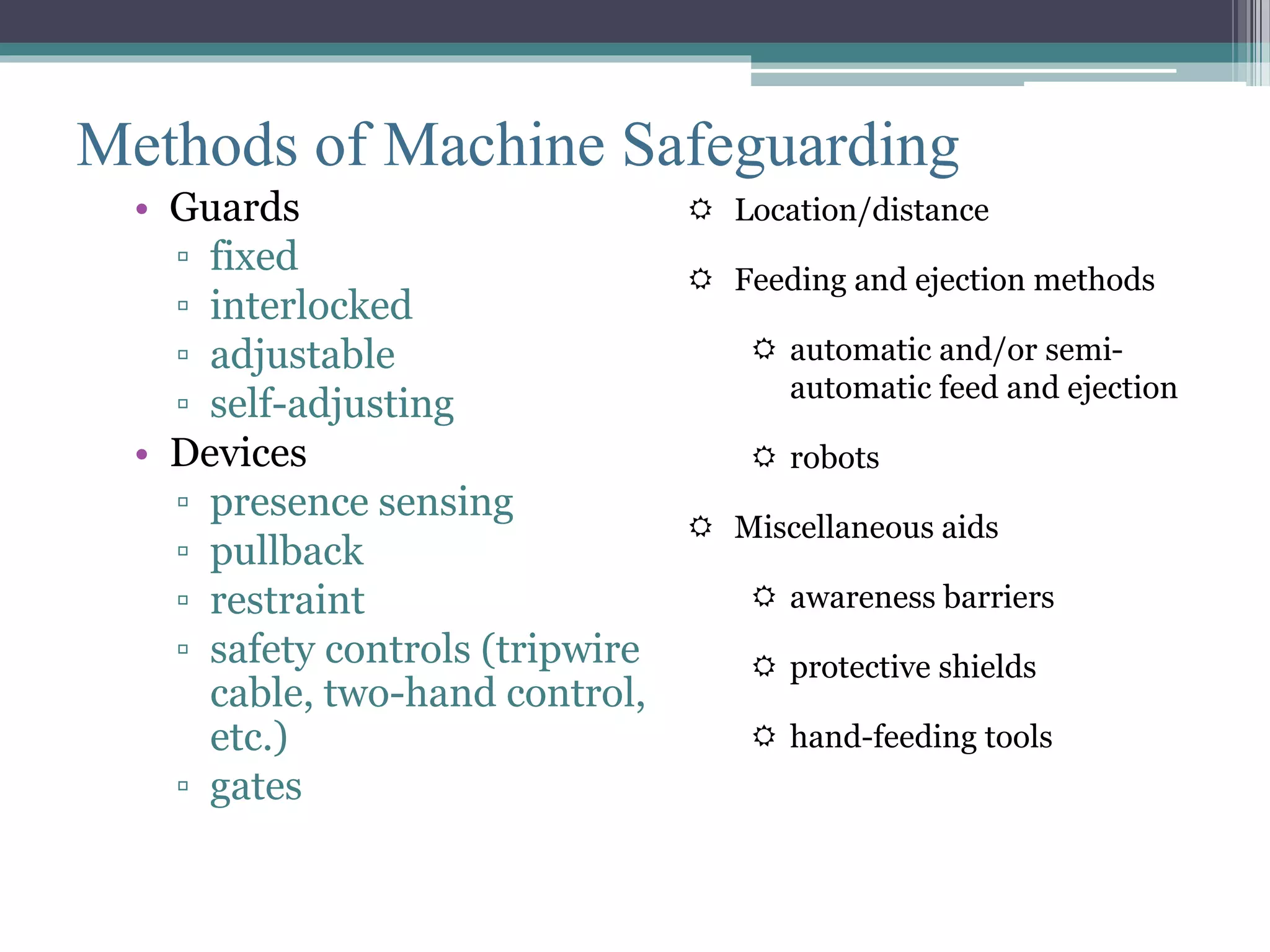
Methods of Machine Safeguarding 
• Guards 
▫ fixed 
▫ interlocked 
▫ adjustable 
▫ self-adjusting 
• Devices 
▫ presence sensing 
▫ pullback 
▫ restraint 
▫ safety controls (tripwire 
cable, two-hand control, 
etc.) 
▫ gates 
 Location/distance 
 Feeding and ejection methods 
 automatic and/or semi-automatic 
feed and ejection 
 robots 
 Miscellaneous aids 
 awareness barriers 
 protective shields 
 hand-feeding tools
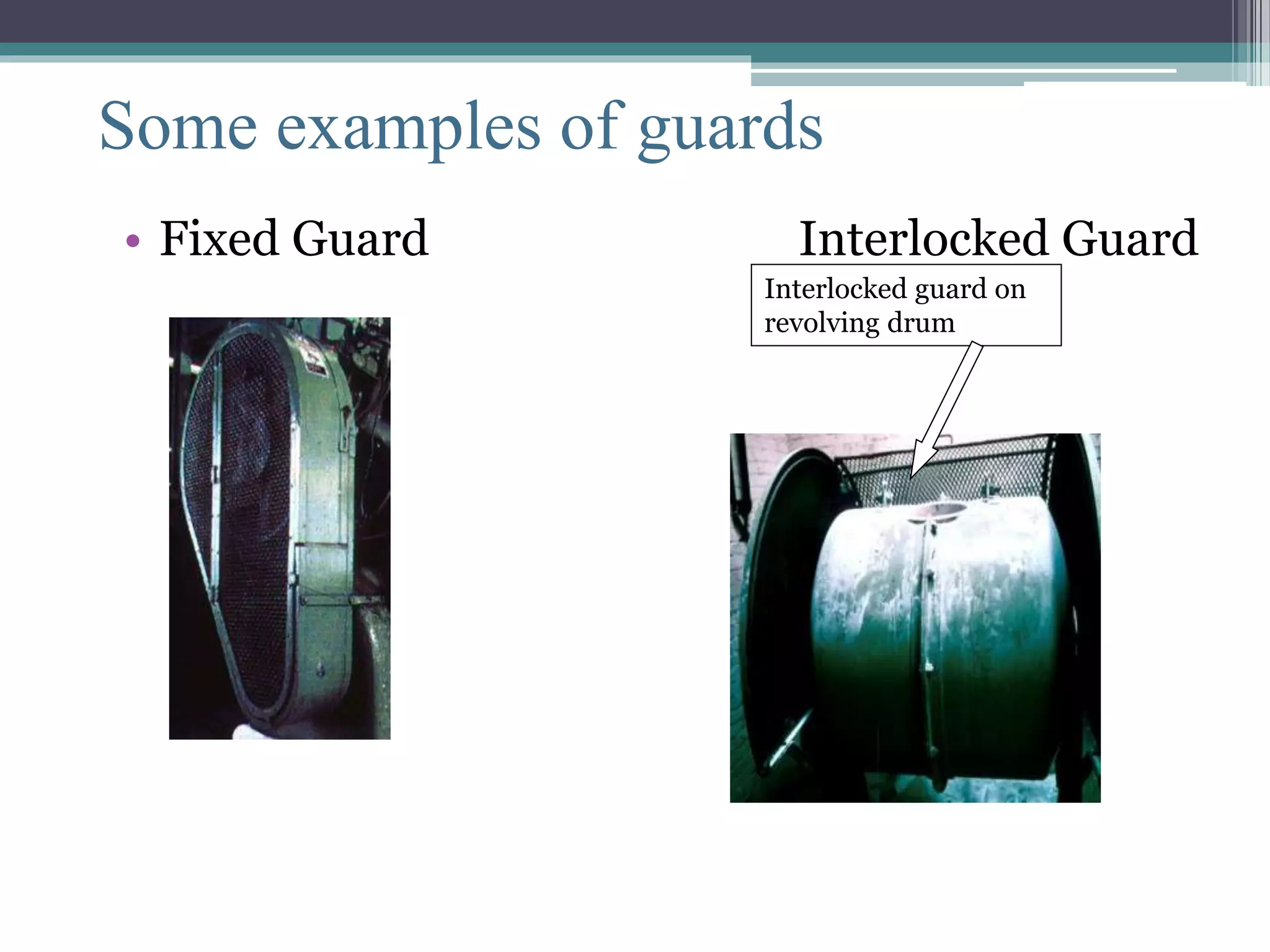
Some examples of guards 
• Fixed Guard Interlocked Guard 
Interlocked guard on 
revolving drum
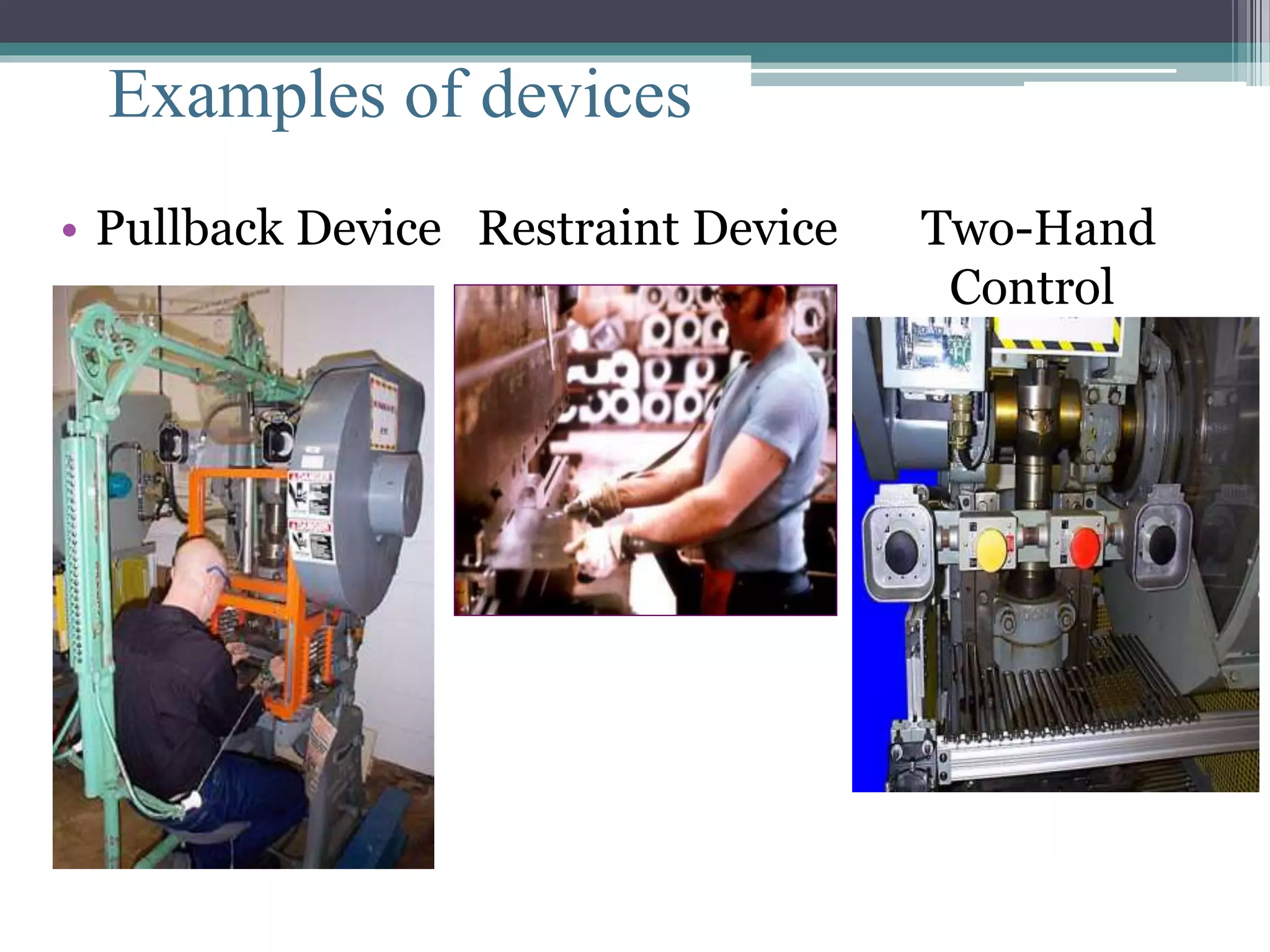
Examples of devices • Pullback Device Restraint Device Two-Hand 
Control 
Examples of devices
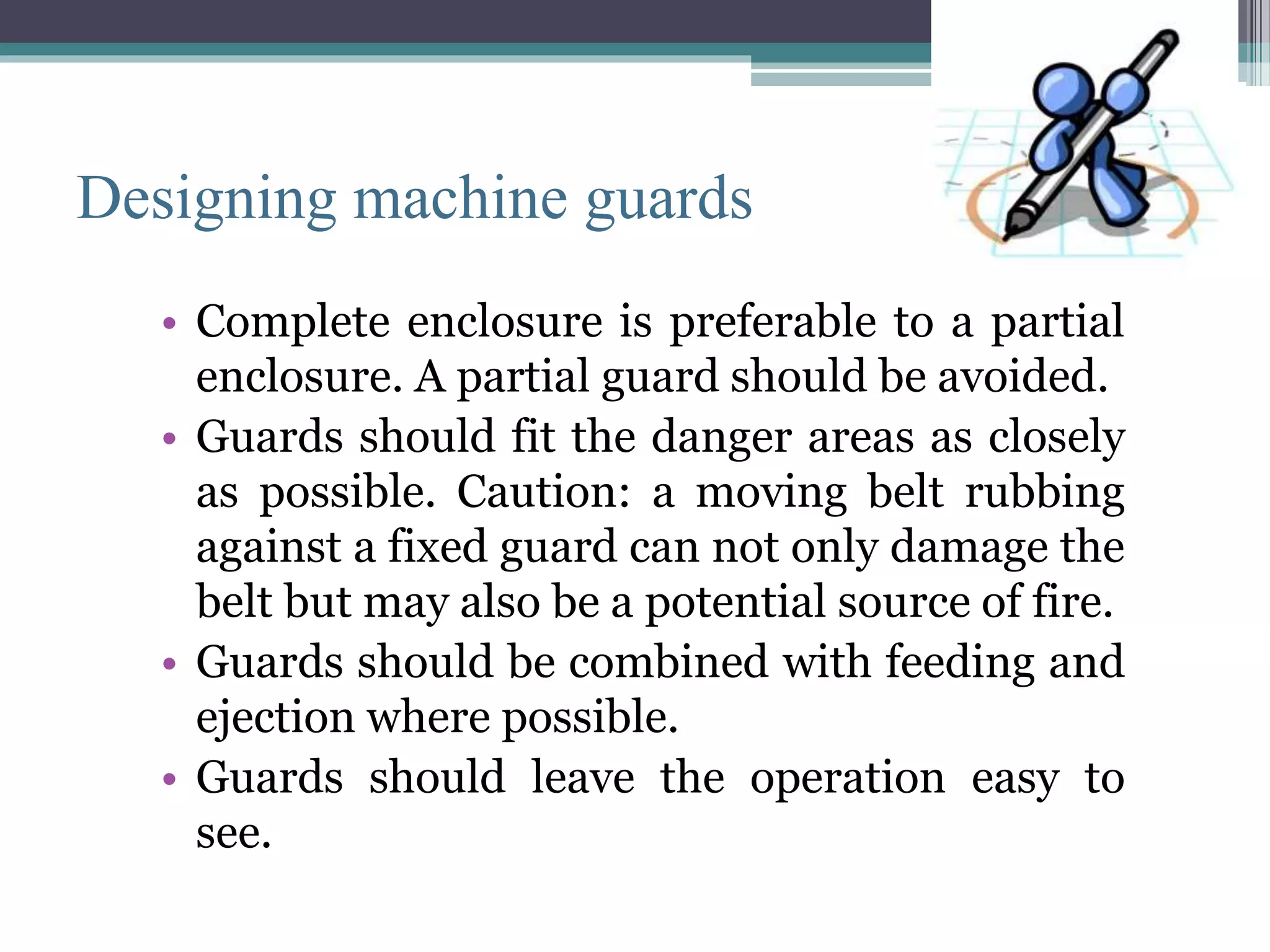
Designing machine guards 
• Complete enclosure is preferable to a partial 
enclosure. A partial guard should be avoided. 
• Guards should fit the danger areas as closely 
as possible. Caution: a moving belt rubbing 
against a fixed guard can not only damage the 
belt but may also be a potential source of fire. 
• Guards should be combined with feeding and 
ejection where possible. 
• Guards should leave the operation easy to 
see.
Unguarded machines are hazardous
Coming to isolation..!!! 
• Isolation can be an effective method of control if a 
hazardous job can be moved to a part of the 
workplace where fewer people will be exposed, or if a 
job can be changed to a shift when fewer people are 
exposed (such as a weekend or midnight shift). 
• The worker can also be isolated from a hazardous 
job, for example by working in an air-conditioned 
control booth. 
• For example, dust-producing work should be isolated 
from other work areas to prevent other workers from 
being exposed. At the same time, workers in the dusty 
areas must be protected and restricted to only a short 
time working in those areas.
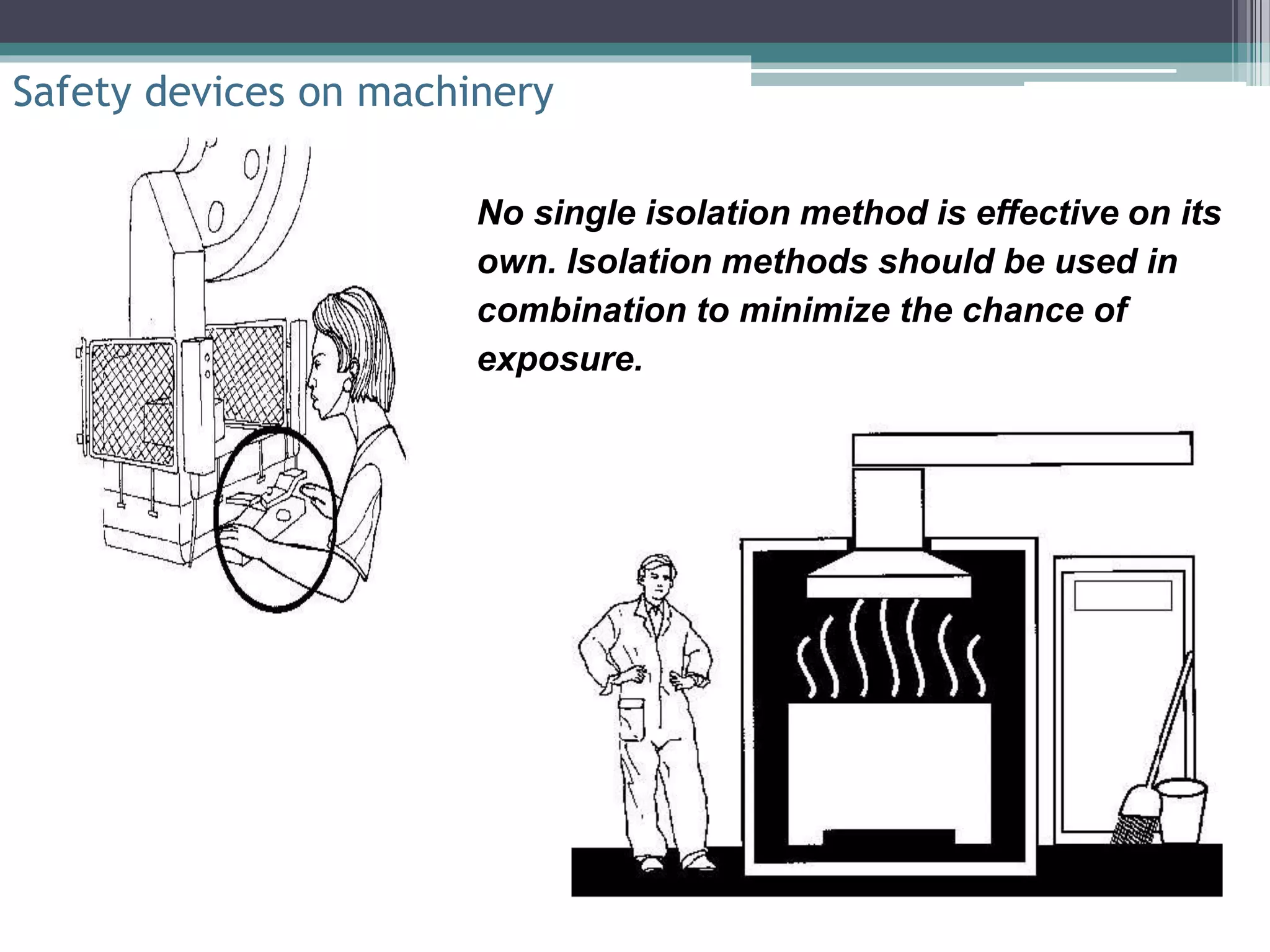
Safety devices on machinery 
No single isolation method is effective on its 
own. Isolation methods should be used in 
combination to minimize the chance of 
exposure.
Next is Ventilation…!!! 
• Ventilation in the workplace can be used for two 
reasons: 
(1) to prevent the work environment from 
being too hot, cold, dry or humid. 
(2) to prevent contaminants in the air from 
getting into the area where workers breathe. 
• Generally there are two categories of ventilation: 
local exhaust ventilation and general 
ventilation. 
• Whatever the type, ventilation should be 
used together with other methods of 
control.
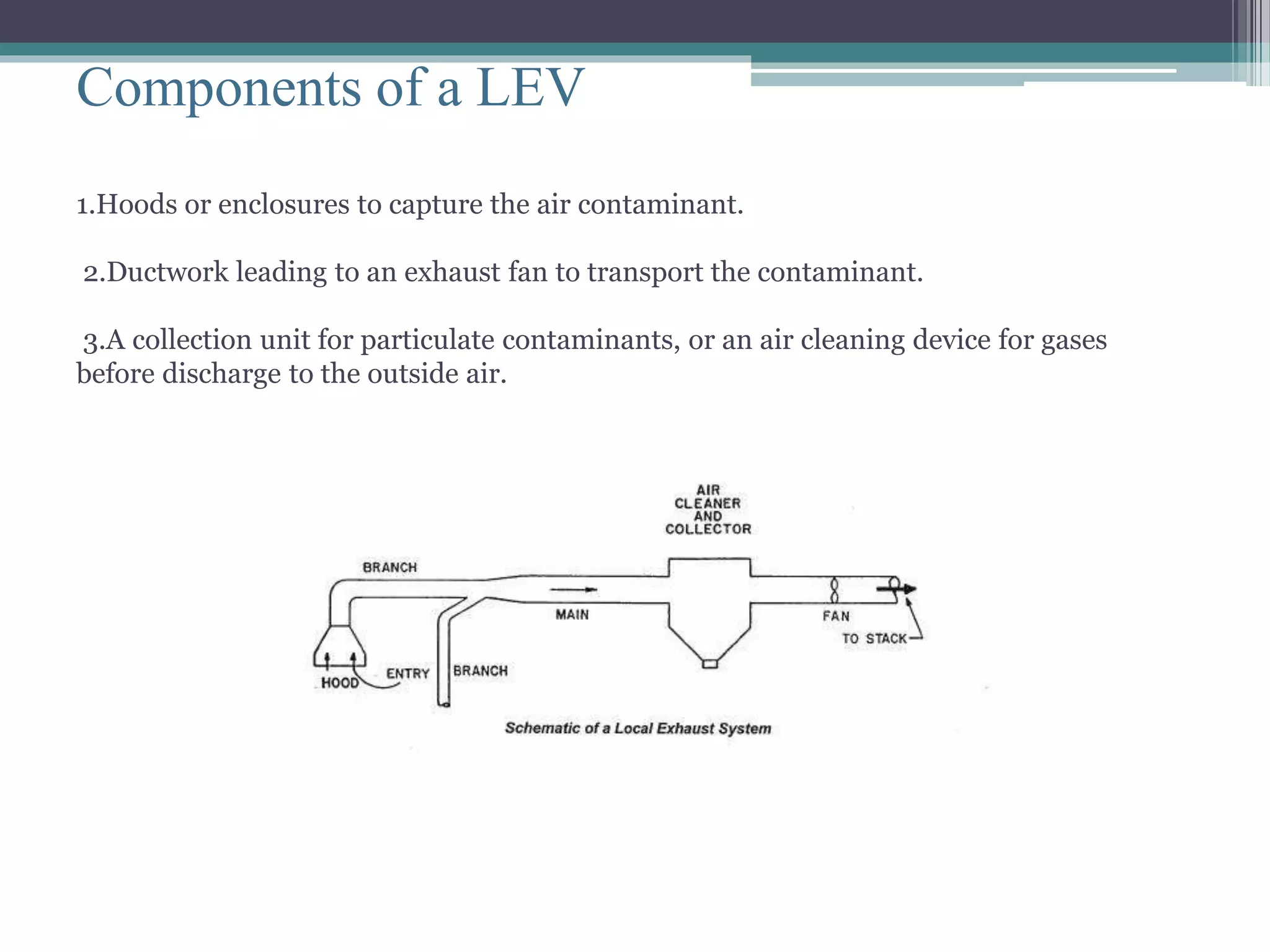
Local exhaust ventilation 
• The control of potentially hazardous airborne contaminants 
such as dusts, gases, vapours and fumes, etc. can be 
accomplished by capturing and removing the contaminant at 
or near its source or point of generation, thus preventing the 
release of the contaminant into the workroom. 
• There are two common types of local exhaust ventilation used 
in industry today: 
(1) fumes are sucked into an open tank with side slots 
and into a closed system, through which they are then 
transferred to a disposal point away from the workers (a 
degreasing tank is an example of this). 
(2) fumes are sucked into a canopy hood which hangs 
over a contaminant and forced out through a ventilation duct.
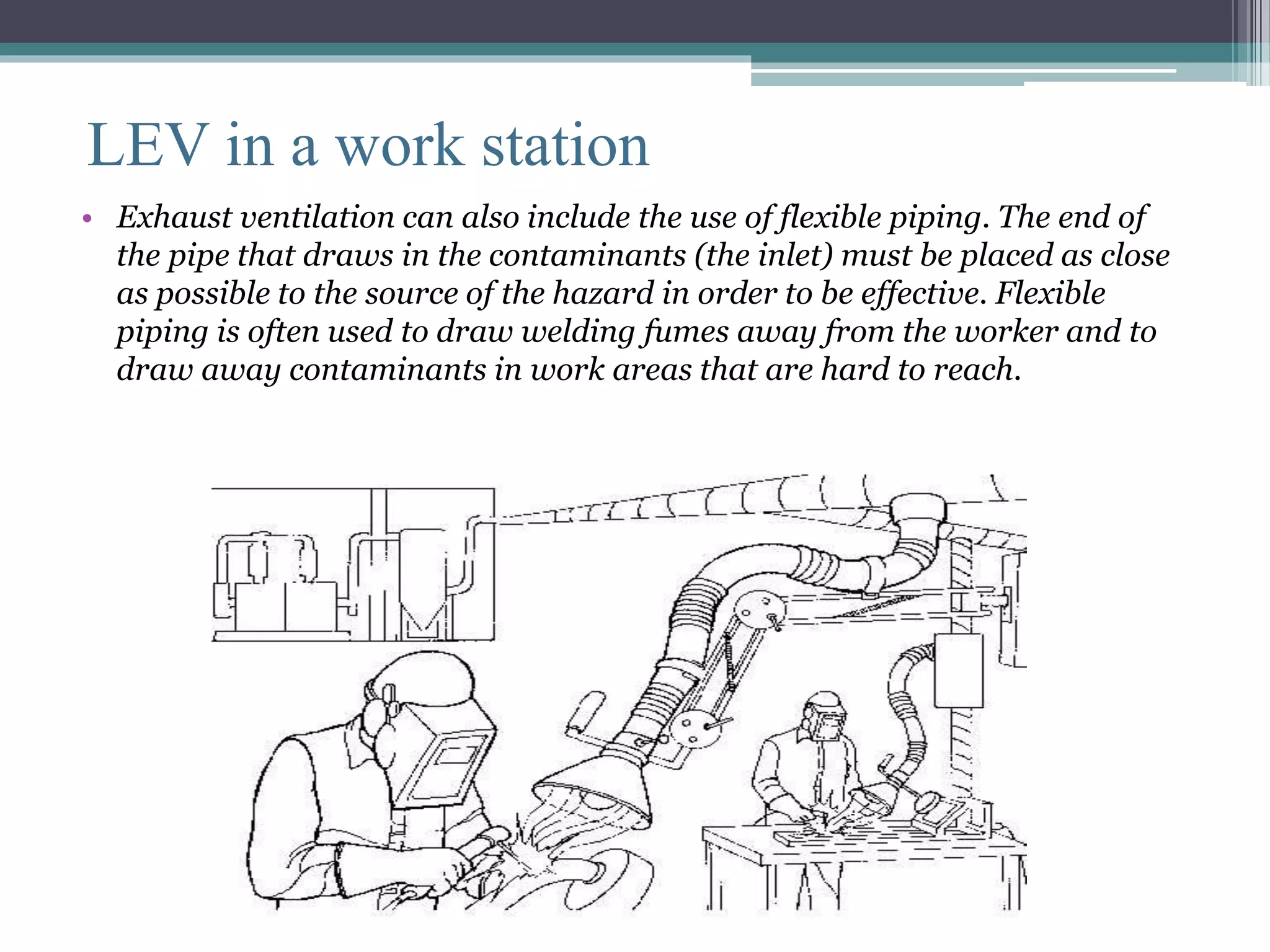
Components of a LEV 
1.Hoods or enclosures to capture the air contaminant. 
2.Ductwork leading to an exhaust fan to transport the contaminant. 
3.A collection unit for particulate contaminants, or an air cleaning device for gases 
before discharge to the outside air.
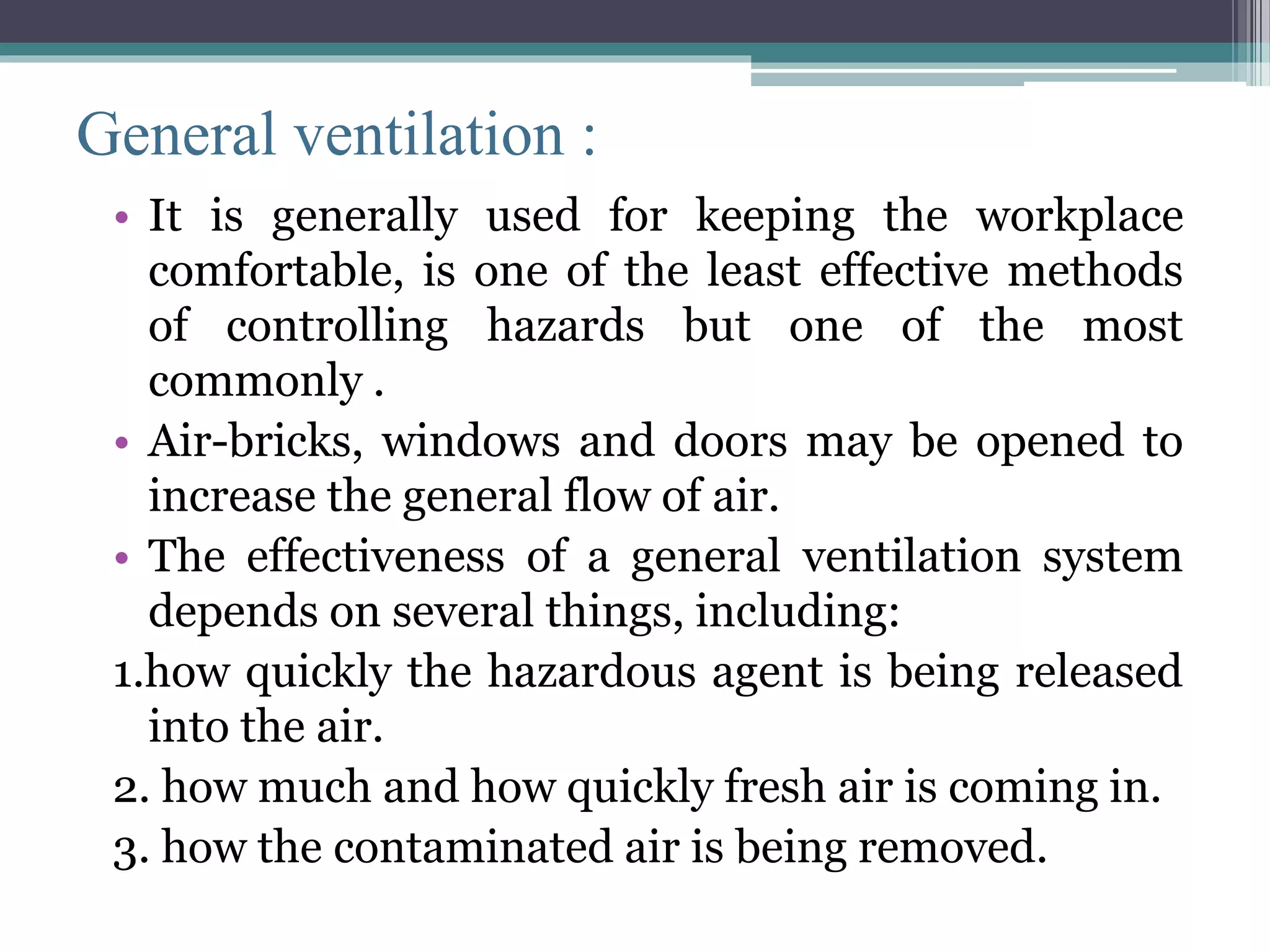
LEV in a work station 
• Exhaust ventilation can also include the use of flexible piping. The end of 
the pipe that draws in the contaminants (the inlet) must be placed as close 
as possible to the source of the hazard in order to be effective. Flexible 
piping is often used to draw welding fumes away from the worker and to 
draw away contaminants in work areas that are hard to reach.
General ventilation : 
• It is generally used for keeping the workplace 
comfortable, is one of the least effective methods 
of controlling hazards but one of the most 
commonly . 
• Air-bricks, windows and doors may be opened to 
increase the general flow of air. 
• The effectiveness of a general ventilation system 
depends on several things, including: 
1.how quickly the hazardous agent is being released 
into the air. 
2. how much and how quickly fresh air is coming in. 
3. how the contaminated air is being removed.
Points to remember 
about engineering controls 
• Engineering controls include enclosure, isolation 
and ventilation. 
• If a hazardous substance or work process cannot 
be eliminated or substituted, then fully enclosing 
it so workers do not come into contact with it is 
the next best method of control. 
• Enclosing hazards can minimize possible 
exposures, but does not eliminate them. 
• isolating the work process or the worker does not 
eliminate the hazard, which means workers can 
still be exposed. 
• it is always better to control the hazard as close to 
the source as possible. Using personal protection 
is the least acceptable and least effective of all 
control measures.
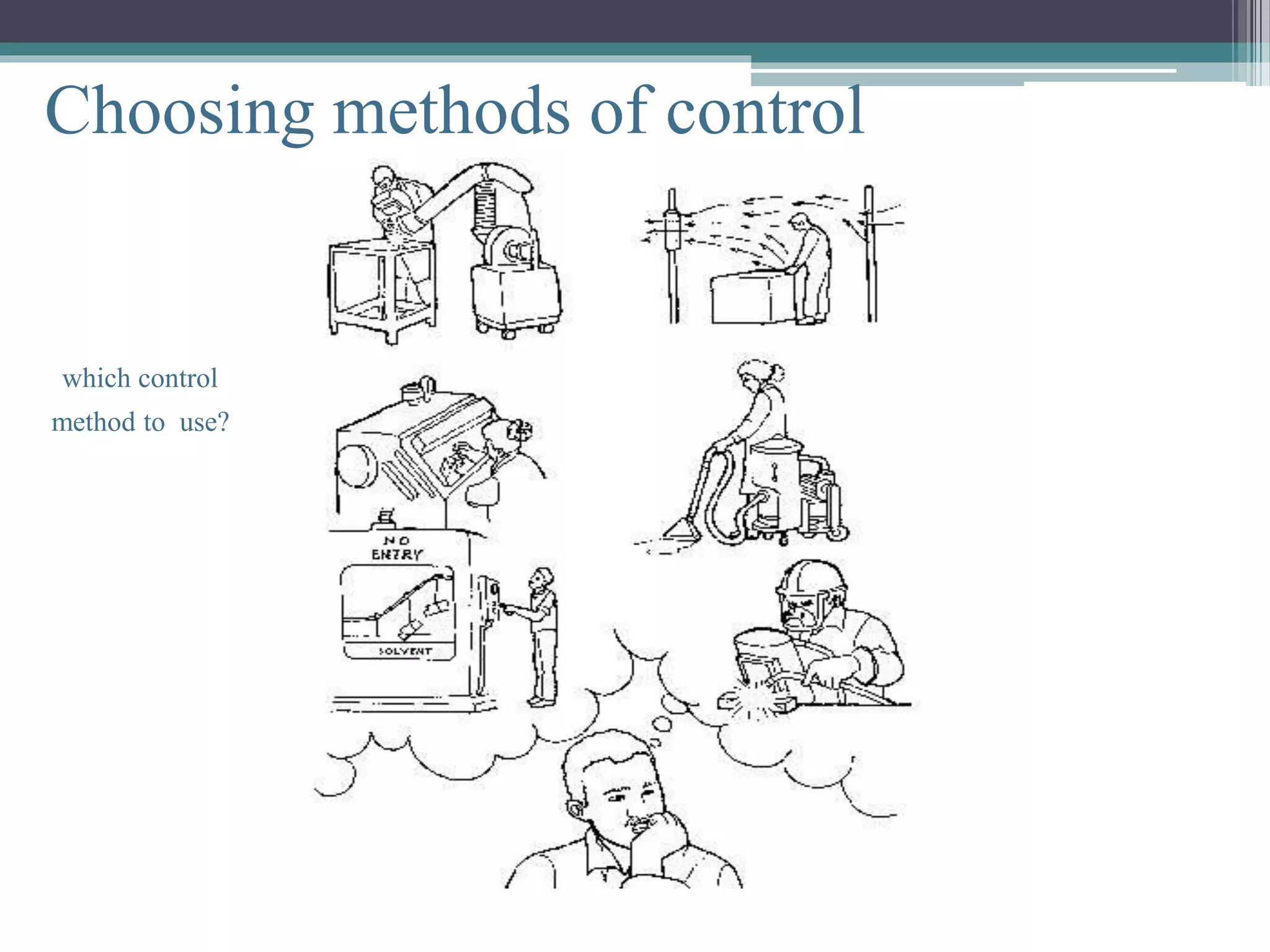
Choosing methods of control 
which control 
method to use?
Role of the health and safety 
representative 
• Your role is to work proactively (to take action 
before hazards become a problem) to prevent 
workers from occupational exposure by making 
sure hazards are controlled and kept under 
control. 
• It is best to enclose all toxic materials or work 
processes using toxic materials. However, since 
this is often not possible, try to get the employer 
to enclose at least all highly toxic materials. 
• Work with the union and employer to make sure 
the atmosphere in the workplace is monitored 
regularly for levels of hazardous materials.
Engineering controls in safety, health environment management

Engineering controls in safety, health environment management

  • 1.
    Safety, Health &Environment Management Engineering controls
  • 2.
    Index • Controllinghazards • Control measure • Engineering controls • Enclosure • Isolation • Ventilation • Points to remember
  • 3.
    Controlling hazards…!!! •All workplace hazards (chemical, physical, etc.) can be controlled by a variety of methods. • The most effective method of controlling hazards is to control at the source by eliminating the hazard or by substituting a hazardous agent or work process with a less dangerous one. • Some methods of hazard control are more efficient than others, but a combination of methods usually provides a safer workplace than relying on only one method.
  • 4.
    Goal …!!! •The goal of controlling hazards is to prevent workers from being exposed to occupational hazards.
  • 5.
    How can youidentify health and safety problems ? • observe your workplace; • investigate complaints from workers; • examine accident and near-miss records; • examine sickness figures; • use simple surveys to ask your co-workers about their health and safety concerns; • use check-lists to help you inspect your workplace; • learn the results of inspections that are done by the employer, the union or anyone else; • read reports or other information about your workplace.
  • 6.
    Major categories ofcontrol measures • Elimination • Substitution • Engineering controls • Administrative controls • Personal protective equipment.
  • 7.
    Engineering controls…!!! •An engineering control may mean changing a piece of machinery (for example, using proper machine guards) or a work process to reduce exposure to a hazard. • There are a number of common control measures which are called “engineering controls”. These include 1. Enclosure 2. Isolation 3. Ventilation.
  • 8.
    is Enclosure…? •If a hazardous substance or work process cannot be eliminated or substituted, then enclosing it so workers are not exposed to the hazard is the next best method of control. • Enclosing hazards can minimize possible exposures, but does not eliminate them. • Machine guarding is another form of enclosure that prevents workers from coming into contact with dangerous parts of machines.
  • 9.
  • 10.
    • Crushed handsand arms, severed fingers, blindness - the list of possible machinery-related injuries is as long as it is horrifying. Safeguards are essential for protecting workers from needless and preventable injuries. • A good rule to remember is: Any machine part, function, or process which may cause injury must be safeguarded. • Goals : • Describe the basic hazards involving machinery including point of operation and power transmission devices. • Introduce control measures through effective machine guarding principles and methods.
  • 11.
    Where Mechanical HazardsOccur..? • Point of Operation
  • 12.
  • 13.
    In-Running Nip Points Rotating cylinders Chain and sprocket Belt and pulley Rack and pinion
  • 14.
    Methods of MachineSafeguarding • Guards ▫ fixed ▫ interlocked ▫ adjustable ▫ self-adjusting • Devices ▫ presence sensing ▫ pullback ▫ restraint ▫ safety controls (tripwire cable, two-hand control, etc.) ▫ gates  Location/distance  Feeding and ejection methods  automatic and/or semi-automatic feed and ejection  robots  Miscellaneous aids  awareness barriers  protective shields  hand-feeding tools
  • 15.
    Some examples ofguards Some examples of guards • Fixed Guard Interlocked Guard Interlocked guard on revolving drum
  • 16.
    Examples of devices• Pullback Device Restraint Device Two-Hand Control Examples of devices
  • 17.
    Designing machine guards • Complete enclosure is preferable to a partial enclosure. A partial guard should be avoided. • Guards should fit the danger areas as closely as possible. Caution: a moving belt rubbing against a fixed guard can not only damage the belt but may also be a potential source of fire. • Guards should be combined with feeding and ejection where possible. • Guards should leave the operation easy to see.
  • 18.
  • 19.
    Coming to isolation..!!! • Isolation can be an effective method of control if a hazardous job can be moved to a part of the workplace where fewer people will be exposed, or if a job can be changed to a shift when fewer people are exposed (such as a weekend or midnight shift). • The worker can also be isolated from a hazardous job, for example by working in an air-conditioned control booth. • For example, dust-producing work should be isolated from other work areas to prevent other workers from being exposed. At the same time, workers in the dusty areas must be protected and restricted to only a short time working in those areas.
  • 20.
    Safety devices onmachinery No single isolation method is effective on its own. Isolation methods should be used in combination to minimize the chance of exposure.
  • 21.
    Next is Ventilation…!!! • Ventilation in the workplace can be used for two reasons: (1) to prevent the work environment from being too hot, cold, dry or humid. (2) to prevent contaminants in the air from getting into the area where workers breathe. • Generally there are two categories of ventilation: local exhaust ventilation and general ventilation. • Whatever the type, ventilation should be used together with other methods of control.
  • 22.
    Local exhaust ventilation • The control of potentially hazardous airborne contaminants such as dusts, gases, vapours and fumes, etc. can be accomplished by capturing and removing the contaminant at or near its source or point of generation, thus preventing the release of the contaminant into the workroom. • There are two common types of local exhaust ventilation used in industry today: (1) fumes are sucked into an open tank with side slots and into a closed system, through which they are then transferred to a disposal point away from the workers (a degreasing tank is an example of this). (2) fumes are sucked into a canopy hood which hangs over a contaminant and forced out through a ventilation duct.
  • 23.
    Components of aLEV 1.Hoods or enclosures to capture the air contaminant. 2.Ductwork leading to an exhaust fan to transport the contaminant. 3.A collection unit for particulate contaminants, or an air cleaning device for gases before discharge to the outside air.
  • 24.
    LEV in awork station • Exhaust ventilation can also include the use of flexible piping. The end of the pipe that draws in the contaminants (the inlet) must be placed as close as possible to the source of the hazard in order to be effective. Flexible piping is often used to draw welding fumes away from the worker and to draw away contaminants in work areas that are hard to reach.
  • 25.
    General ventilation : • It is generally used for keeping the workplace comfortable, is one of the least effective methods of controlling hazards but one of the most commonly . • Air-bricks, windows and doors may be opened to increase the general flow of air. • The effectiveness of a general ventilation system depends on several things, including: 1.how quickly the hazardous agent is being released into the air. 2. how much and how quickly fresh air is coming in. 3. how the contaminated air is being removed.
  • 26.
    Points to remember about engineering controls • Engineering controls include enclosure, isolation and ventilation. • If a hazardous substance or work process cannot be eliminated or substituted, then fully enclosing it so workers do not come into contact with it is the next best method of control. • Enclosing hazards can minimize possible exposures, but does not eliminate them. • isolating the work process or the worker does not eliminate the hazard, which means workers can still be exposed. • it is always better to control the hazard as close to the source as possible. Using personal protection is the least acceptable and least effective of all control measures.
  • 27.
    Choosing methods ofcontrol which control method to use?
  • 28.
    Role of thehealth and safety representative • Your role is to work proactively (to take action before hazards become a problem) to prevent workers from occupational exposure by making sure hazards are controlled and kept under control. • It is best to enclose all toxic materials or work processes using toxic materials. However, since this is often not possible, try to get the employer to enclose at least all highly toxic materials. • Work with the union and employer to make sure the atmosphere in the workplace is monitored regularly for levels of hazardous materials.