The Globally
Harmonized
System (GHS)
for Hazard
Classification
and Labeling
Development of a
Worldwide System for
Hazard Communication
Introduction
The federal Hazard Communication
Standard says that you have a
“Right-To-Know” what hazards you
face on the job and how to protect
yourself against those hazards.
That’s your Right-To-Know!
What is GHS?
 The Globally Harmonized System (GHS) is
an international approach to chemical
labels and safety data sheets (SDS).
 OSHA’s Hazard Communication standard
has adopted the GHS to improve safety
and health of workers through more
effective communications on chemical
hazards.
What is the GHS?
Target audiences include workers,
consumers, transport workers, and
emergency responders.
Provides the underlying
infrastructure for establishment of
national, comprehensive chemical
safety programs.
Purpose
The standard was developed to
make sure that everyone who works
with any hazardous chemical is
aware of the hazards and the
necessary precautions.
Why is the GHS needed?
 No country has the ability to identify
and specifically regulate every
hazardous chemical product.
 For example, in the United States,
there are an estimated 650,000 such
products.
 Adoption of requirements for
information to accompany the
product helps address protection
needs.
Why? (cont.)
 Many different countries have come
to the same conclusion about using
information dissemination as a
regulatory means to address chemical
hazards.
 While similar, they are different enough
to require multiple labels and safety
data sheets for the same product in
international trade.
Why? (cont.)
 Countries with systems have different
requirements for hazard definitions as well
as information to be included on a label
or material safety data sheet.
 For example, a product may be
considered flammable or toxic in one
country, but not in another to which it is
being shipped.
Why? (cont.)
 These differences impact both protection
and trade.
 In the area of protection, users in
countries that don’t have specific
requirements may see different label
warnings or data sheet information for the
same chemical.
Why? (cont.)
 In the area of trade, the need to comply
with multiple regulations regarding hazard
classification and labelling is costly and
time-consuming.
 Small to medium enterprises are
effectively precluded from international
trade in chemicals due to the regulatory
burden of compliance.
Benefits of Harmonization
 Countries, international organizations,
chemical producers and users of
chemicals all benefit.
 Enhance protection of humans and
environment.
 Facilitate international trade in chemicals.
 Reduce need for testing and evaluation.
 Assist countries and international
organizations to ensure the sound
management of chemicals.
OSHA Compliance Dates
 OSHA is requiring training on new label
elements (pictograms and signal words)
and safety data sheet (SDS) format by
December 2013.
 Full compliance in the workplace with the
final rule will begin in 2016.
The GHS Elements
Classification Criteria
 Health and Environmental Hazards
 Physical Hazards
 Mixtures
Hazard Communication
 Labels
 Safety Data Sheets
Health & Environmental
Hazards
Acute Toxicity
Skin Corrosion/Irritation
Serious Eye Damage/Eye Irritation
Respiratory or Skin Sensitization
Germ Cell Mutagenicity
Carcinogenicity
Reproductive Toxicity
Target Organ Systemic Toxicity – Single and
Repeated Dose
Hazardous to the Aquatic Environment
Tiered Approach to Classification
Generally use test data for the mixture, when
available

Use bridging principles, if applicable

For health and environmental hazards, estimate
hazards based on the known ingredient
information
Physical Hazards
 Definitions, test methods and
classification criteria for transport
were used as a basis for the work
since they were already
harmonized.
Physical Hazards
Explosives
Flammability – gases, aerosols, liquids, solids
Oxidizers – liquid, solid, gases
Self-Reactive
Pyrophoric – liquids, solids
Self-Heating
Organic Peroxides
Corrosive to Metals
Gases Under Pressure
Water-Activated Flammable Gases
Comprehensibility
Guiding principles:
 Information should be conveyed in more
than one way.
 The comprehensibility of the components
of the system should take account of
existing studies and evidence gained
from testing.
 The phrases used to indicate the degree
(severity) of hazard should be consistent
across different hazard types.
Hazard Statements
 A single harmonized hazard statement for
each level of hazard within each hazard
class
 Example: Flammable liquids
 Category 1: Extremely flammable liquid and
vapour
 Category 2: Highly flammable liquid and
vapour
 Category 3: Flammable liquid and vapour
 Category 4: Combustible liquid
Labels
 GHS identified about 35 different
types of information that are currently
required on labels by different
systems.
 To harmonize, key information
elements needed to be identified.
 Additional harmonization may occur
on other elements in time, in particular
for precautionary statements.
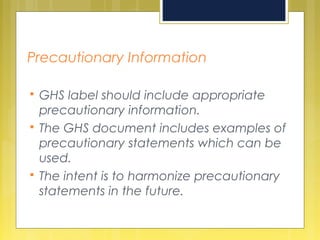
Precautionary Information
 GHS label should include appropriate
precautionary information.
 The GHS document includes examples of
precautionary statements which can be
used.
 The intent is to harmonize precautionary
statements in the future.
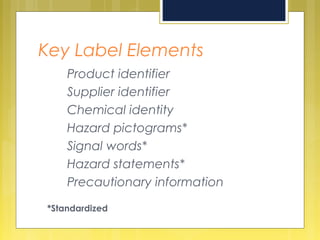
Key Label Elements
Product identifier
Supplier identifier
Chemical identity
Hazard pictograms*
Signal words*
Hazard statements*
Precautionary information
*Standardized
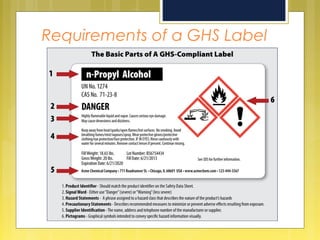
Requirements of a GHS Label
Pictograms
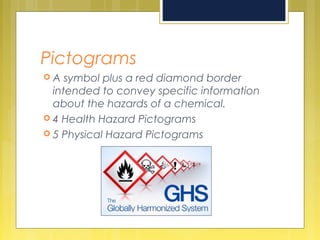
 A symbol plus a red diamond border
intended to convey specific information
about the hazards of a chemical.
 4 Health Hazard Pictograms
 5 Physical Hazard Pictograms
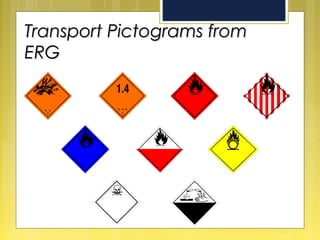
Transport Pictograms fromTransport Pictograms from
ERGERG
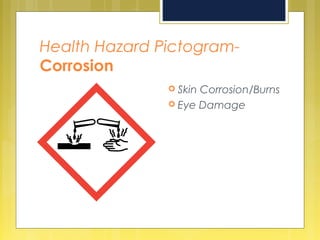
Health Hazard Pictogram-
Corrosion
 Skin Corrosion/Burns
 Eye Damage
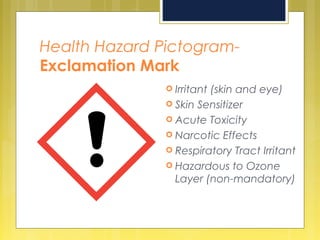
Health Hazard Pictogram-
Exclamation Mark
 Irritant (skin and eye)
 Skin Sensitizer
 Acute Toxicity
 Narcotic Effects
 Respiratory Tract Irritant
 Hazardous to Ozone
Layer (non-mandatory)
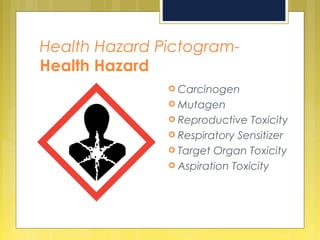
Health Hazard Pictogram-
Health Hazard
 Carcinogen
 Mutagen
 Reproductive Toxicity
 Respiratory Sensitizer
 Target Organ Toxicity
 Aspiration Toxicity
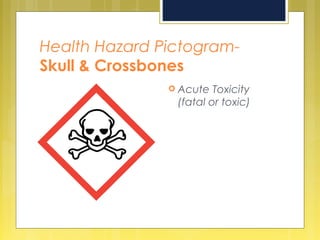
Health Hazard Pictogram-
Skull & Crossbones
 Acute Toxicity
(fatal or toxic)
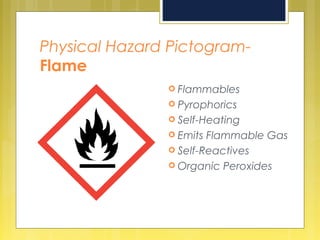
Physical Hazard Pictogram-
Flame
 Flammables
 Pyrophorics
 Self-Heating
 Emits Flammable Gas
 Self-Reactives
 Organic Peroxides
Physical Hazard Pictogram-
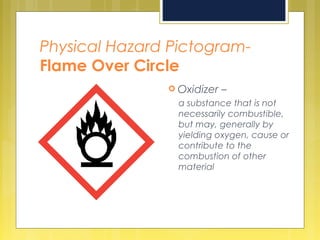
Flame Over Circle
 Oxidizer –
a substance that is not
necessarily combustible,
but may, generally by
yielding oxygen, cause or
contribute to the
combustion of other
material
Physical Hazard Pictogram-
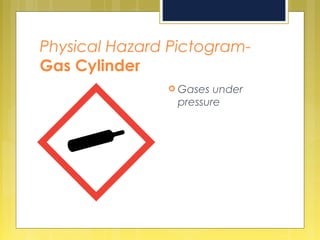
Gas Cylinder
 Gases under
pressure
Physical Hazard Pictogram-
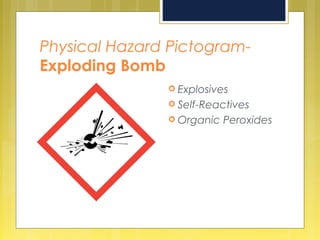
Exploding Bomb
 Explosives
 Self-Reactives
 Organic Peroxides
Physical Hazard Pictogram-
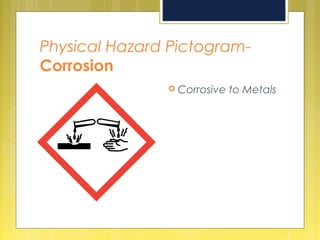
Corrosion
 Corrosive to Metals
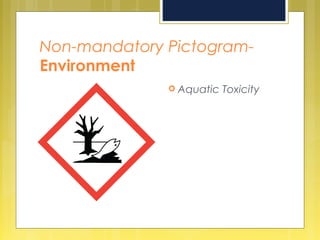
Non-mandatory Pictogram-
Environment
 Aquatic Toxicity
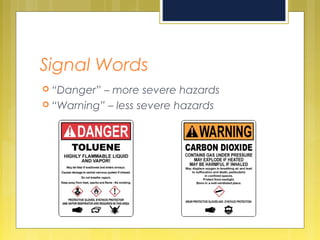
Signal Words
 “Danger” – more severe hazards
 “Warning” – less severe hazards
Safety Data Sheets (SDS)
 SDS are multi-page documents that
contain more detailed information about
a chemical than the container label.
 The revised HazCom standard requires
that the information on the SDS is
presented using consistent headings in a
specific order.
Role of the SDS in the GHS
 The SDS should provide comprehensive
information about a chemical substance or
mixture.
 Primary Use: The Workplace
 Employers and workers use the SDS as a
source of information about hazards and to
obtain advice on safety precautions.
16-Section SDS Format
1. Identification
2. Hazard(s) Identification
3. Composition/Information on Ingredients
4. First-Aid Measures
5. Fire-Fighting Measures
6. Accidental Release Measures
7. Handling and Storage
8. Exposure Controls/Personal Protection
16-Section SDS Format
9. Physical and Chemical Properties
10. Stability and Reactivity
11. Toxicological Information
12. Ecological Information
13. Disposal Considerations
14. Transport Information
15. Regulatory Information
16. Other Information
Confidential Business
Information
 National authorities should establish
appropriate mechanisms for CBI protection.
CBI will not be harmonized under the GHS.
 The provisions for CBI protection should not
compromise the health and safety of users.
 CBI claims should be limited to the names of
chemicals and their concentrations in mixtures.
 Mechanisms should be established for
disclosure in emergency and non-emergency
situations.
Information Sources
 OSHA has a web page on the GHS:
http://www.osha.gov/SLTC/
hazardcommunications/global.html
 Includes links to the completed GHS
document & international organizations.
Conclusion
 During the phase-in period, employees will
see the old and new labels on chemical
containers.
 All chemical containers in the workplace
have to be in compliance with the new
standard by June 2016.
Hazard communication update

  • 1.
    The Globally Harmonized System (GHS) forHazard Classification and Labeling Development of a Worldwide System for Hazard Communication
  • 2.
    Introduction The federal HazardCommunication Standard says that you have a “Right-To-Know” what hazards you face on the job and how to protect yourself against those hazards. That’s your Right-To-Know!
  • 3.
    What is GHS? The Globally Harmonized System (GHS) is an international approach to chemical labels and safety data sheets (SDS).  OSHA’s Hazard Communication standard has adopted the GHS to improve safety and health of workers through more effective communications on chemical hazards.
  • 4.
    What is theGHS? Target audiences include workers, consumers, transport workers, and emergency responders. Provides the underlying infrastructure for establishment of national, comprehensive chemical safety programs.
  • 5.
    Purpose The standard wasdeveloped to make sure that everyone who works with any hazardous chemical is aware of the hazards and the necessary precautions.
  • 6.
    Why is theGHS needed?  No country has the ability to identify and specifically regulate every hazardous chemical product.  For example, in the United States, there are an estimated 650,000 such products.  Adoption of requirements for information to accompany the product helps address protection needs.
  • 7.
    Why? (cont.)  Manydifferent countries have come to the same conclusion about using information dissemination as a regulatory means to address chemical hazards.  While similar, they are different enough to require multiple labels and safety data sheets for the same product in international trade.
  • 8.
    Why? (cont.)  Countrieswith systems have different requirements for hazard definitions as well as information to be included on a label or material safety data sheet.  For example, a product may be considered flammable or toxic in one country, but not in another to which it is being shipped.
  • 9.
    Why? (cont.)  Thesedifferences impact both protection and trade.  In the area of protection, users in countries that don’t have specific requirements may see different label warnings or data sheet information for the same chemical.
  • 10.
    Why? (cont.)  Inthe area of trade, the need to comply with multiple regulations regarding hazard classification and labelling is costly and time-consuming.  Small to medium enterprises are effectively precluded from international trade in chemicals due to the regulatory burden of compliance.
  • 11.
    Benefits of Harmonization Countries, international organizations, chemical producers and users of chemicals all benefit.  Enhance protection of humans and environment.  Facilitate international trade in chemicals.  Reduce need for testing and evaluation.  Assist countries and international organizations to ensure the sound management of chemicals.
  • 12.
    OSHA Compliance Dates OSHA is requiring training on new label elements (pictograms and signal words) and safety data sheet (SDS) format by December 2013.  Full compliance in the workplace with the final rule will begin in 2016.
  • 13.
    The GHS Elements ClassificationCriteria  Health and Environmental Hazards  Physical Hazards  Mixtures Hazard Communication  Labels  Safety Data Sheets
  • 14.
    Health & Environmental Hazards AcuteToxicity Skin Corrosion/Irritation Serious Eye Damage/Eye Irritation Respiratory or Skin Sensitization Germ Cell Mutagenicity Carcinogenicity Reproductive Toxicity Target Organ Systemic Toxicity – Single and Repeated Dose Hazardous to the Aquatic Environment
  • 15.
    Tiered Approach toClassification Generally use test data for the mixture, when available  Use bridging principles, if applicable  For health and environmental hazards, estimate hazards based on the known ingredient information
  • 16.
    Physical Hazards  Definitions,test methods and classification criteria for transport were used as a basis for the work since they were already harmonized.
  • 17.
    Physical Hazards Explosives Flammability –gases, aerosols, liquids, solids Oxidizers – liquid, solid, gases Self-Reactive Pyrophoric – liquids, solids Self-Heating Organic Peroxides Corrosive to Metals Gases Under Pressure Water-Activated Flammable Gases
  • 18.
    Comprehensibility Guiding principles:  Informationshould be conveyed in more than one way.  The comprehensibility of the components of the system should take account of existing studies and evidence gained from testing.  The phrases used to indicate the degree (severity) of hazard should be consistent across different hazard types.
  • 19.
    Hazard Statements  Asingle harmonized hazard statement for each level of hazard within each hazard class  Example: Flammable liquids  Category 1: Extremely flammable liquid and vapour  Category 2: Highly flammable liquid and vapour  Category 3: Flammable liquid and vapour  Category 4: Combustible liquid
  • 20.
    Labels  GHS identifiedabout 35 different types of information that are currently required on labels by different systems.  To harmonize, key information elements needed to be identified.  Additional harmonization may occur on other elements in time, in particular for precautionary statements.
  • 21.
    Precautionary Information  GHSlabel should include appropriate precautionary information.  The GHS document includes examples of precautionary statements which can be used.  The intent is to harmonize precautionary statements in the future.
  • 22.
    Key Label Elements Productidentifier Supplier identifier Chemical identity Hazard pictograms* Signal words* Hazard statements* Precautionary information *Standardized
  • 23.
  • 24.
    Pictograms  A symbolplus a red diamond border intended to convey specific information about the hazards of a chemical.  4 Health Hazard Pictograms  5 Physical Hazard Pictograms
  • 25.
    Transport Pictograms fromTransportPictograms from ERGERG
  • 26.
    Health Hazard Pictogram- Corrosion Skin Corrosion/Burns  Eye Damage
  • 27.
    Health Hazard Pictogram- ExclamationMark  Irritant (skin and eye)  Skin Sensitizer  Acute Toxicity  Narcotic Effects  Respiratory Tract Irritant  Hazardous to Ozone Layer (non-mandatory)
  • 28.
    Health Hazard Pictogram- HealthHazard  Carcinogen  Mutagen  Reproductive Toxicity  Respiratory Sensitizer  Target Organ Toxicity  Aspiration Toxicity
  • 29.
    Health Hazard Pictogram- Skull& Crossbones  Acute Toxicity (fatal or toxic)
  • 30.
    Physical Hazard Pictogram- Flame Flammables  Pyrophorics  Self-Heating  Emits Flammable Gas  Self-Reactives  Organic Peroxides
  • 31.
    Physical Hazard Pictogram- FlameOver Circle  Oxidizer – a substance that is not necessarily combustible, but may, generally by yielding oxygen, cause or contribute to the combustion of other material
  • 32.
    Physical Hazard Pictogram- GasCylinder  Gases under pressure
  • 33.
    Physical Hazard Pictogram- ExplodingBomb  Explosives  Self-Reactives  Organic Peroxides
  • 34.
  • 35.
  • 36.
    Signal Words  “Danger”– more severe hazards  “Warning” – less severe hazards
  • 37.
    Safety Data Sheets(SDS)  SDS are multi-page documents that contain more detailed information about a chemical than the container label.  The revised HazCom standard requires that the information on the SDS is presented using consistent headings in a specific order.
  • 38.
    Role of theSDS in the GHS  The SDS should provide comprehensive information about a chemical substance or mixture.  Primary Use: The Workplace  Employers and workers use the SDS as a source of information about hazards and to obtain advice on safety precautions.
  • 39.
    16-Section SDS Format 1.Identification 2. Hazard(s) Identification 3. Composition/Information on Ingredients 4. First-Aid Measures 5. Fire-Fighting Measures 6. Accidental Release Measures 7. Handling and Storage 8. Exposure Controls/Personal Protection
  • 40.
    16-Section SDS Format 9.Physical and Chemical Properties 10. Stability and Reactivity 11. Toxicological Information 12. Ecological Information 13. Disposal Considerations 14. Transport Information 15. Regulatory Information 16. Other Information
  • 41.
    Confidential Business Information  Nationalauthorities should establish appropriate mechanisms for CBI protection. CBI will not be harmonized under the GHS.  The provisions for CBI protection should not compromise the health and safety of users.  CBI claims should be limited to the names of chemicals and their concentrations in mixtures.  Mechanisms should be established for disclosure in emergency and non-emergency situations.
  • 42.
    Information Sources  OSHAhas a web page on the GHS: http://www.osha.gov/SLTC/ hazardcommunications/global.html  Includes links to the completed GHS document & international organizations.
  • 43.
    Conclusion  During thephase-in period, employees will see the old and new labels on chemical containers.  All chemical containers in the workplace have to be in compliance with the new standard by June 2016.
Editor's Notes

  • #17 Based on existing TDG requirements, changes were made to address needs of other sectors.
  • #18 Focal Point: UN Committee of Experts on Transport of Dangerous Goods, in cooperation with the ILO.