Engine block
MEL-202
MANUFACTURING WITH METALLIC MATERIALS
ROHIT ANAND
2013MEB1108
Under the guidance of -
Dr Harpreet singh
(asso.professor SMMEE)
HEART OF THE ENGINE ??
Engine block
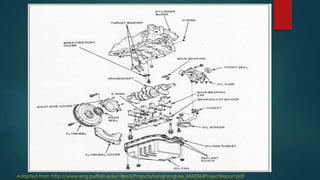
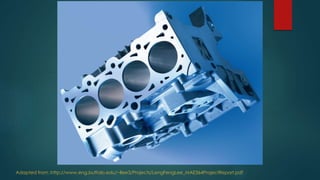
 The engine block is a single unit that contain all the pieces for the engine .
 The block serves as a structural framework of the engine and carries the
mounting pad by which the engine is supported by the chassis
 The block is made of cast iron and sometimes aluminum for higher performance
Vehicle
 The engine block is manufactured to withstand large amount of stress and high
temperature
Adapted from :http://www.eng.buffalo.edu/~llee3/Projects/LengFengLee_MAE364ProjectReport.pdf
Functional Requirements of a Cylinder Block
Engine blocks are a critical component of an engine, it must satisfy a number of
functional requirements
These requirements include :-
1. Lasting the life of the vehicle
2. Housing internal moving parts and fluids
3. Ease of service and maintenance
4. Withstand pressures created by the combustion process.
Adapted from :http://www.ewp.rpi.edu/hartford/~ernesto/F2010/EP2/Materials4Students/Lenny/Nguyen2005.pdf
Required Material Properties
The manufactured product must possess
 High strength
 High modulus of elasticity
 High abrasion resistance
 High corrosion resistance
Adapted from :http://www.ewp.rpi.edu/hartford/~ernesto/F2010/EP2/Materials4Students/Lenny/Nguyen2005.pdf
Required Material Properties (contd)
High strength is a particular concern in diesel engines, since compression ratios are
normally 17.0:1 or higher (compared to about 10.0:1 for conventional engines)
The material should also have
 Low density
 Low thermal expansion (to resist expanding under high operating temperatures)
 Low thermal conductivity (to prevent failure under high temperatures)
Based on the listed requirement industries have used cast iron and
aluminum alloys to manufacture the blocks.
Adapted from :http://www.ewp.rpi.edu/hartford/~ernesto/F2010/EP2/Materials4Students/Lenny/Nguyen2005.pdf
 Cast iron :-
Gray cast iron
Gray cast iron alloy have been the dominant metal that was used to manufacture conventional
gas-powered engine blocks
Gray cast iron alloys typically contains 2.5-4 wt.% carbon 6 and 1-3 wt.% silicon, 0.2-1.0 wt.%
manganese, 0.02-0.25 wt.% sulfur, and 0.02-1.0 wt.% phosphorus
ADVANTAGE
It has excellent damping capacity, good wear and temperature resistance, is easily machineable
and is inexpensive to produce
DISADVANTAGE
They are relatively weak and are prone to fracture and deformation
Adapted from :http://www.ewp.rpi.edu/hartford/~ernesto/F2010/EP2/Materials4Students/Lenny/Nguyen2005.pdf
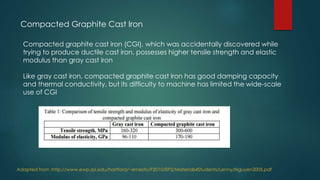
Compacted Graphite Cast Iron
Compacted graphite cast iron (CGI), which was accidentally discovered while
trying to produce ductile cast iron, possesses higher tensile strength and elastic
modulus than gray cast iron
Like gray cast iron, compacted graphite cast iron has good damping capacity
and thermal conductivity, but its difficulty to machine has limited the wide-scale
use of CGI
Adapted from :http://www.ewp.rpi.edu/hartford/~ernesto/F2010/EP2/Materials4Students/Lenny/Nguyen2005.pdf
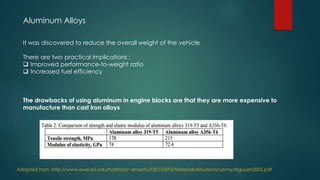
Aluminum Alloys
It was discovered to reduce the overall weight of the vehicle
There are two practical implications :
 Improved performance-to-weight ratio
 Increased fuel efficiency
The drawbacks of using aluminum in engine blocks are that they are more expensive to
manufacture than cast iron alloys
Adapted from :http://www.ewp.rpi.edu/hartford/~ernesto/F2010/EP2/Materials4Students/Lenny/Nguyen2005.pdf
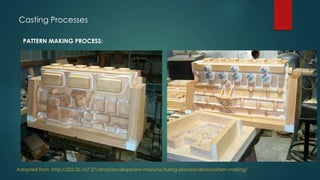
Casting Processes
PATTERN MAKING PROCESS:
Adapted from :http://203.26.107.37/dmd/development-manufacturing-process/dmd-pattern-making/
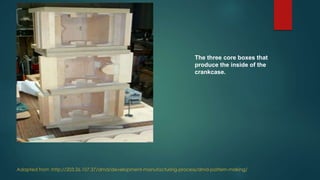
The three core boxes that
produce the inside of the
crankcase.
Adapted from :http://203.26.107.37/dmd/development-manufacturing-process/dmd-pattern-making/
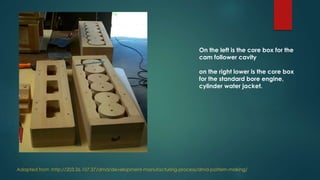
On the left is the core box for the
cam follower cavity
on the right lower is the core box
for the standard bore engine,
cylinder water jacket.
Adapted from :http://203.26.107.37/dmd/development-manufacturing-process/dmd-pattern-making/
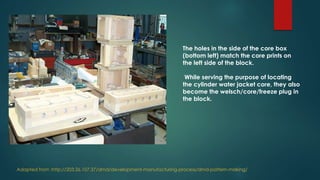
The holes in the side of the core box
(bottom left) match the core prints on
the left side of the block.
While serving the purpose of locating
the cylinder water jacket core, they also
become the welsch/core/freeze plug in
the block.
Adapted from :http://203.26.107.37/dmd/development-manufacturing-process/dmd-pattern-making/
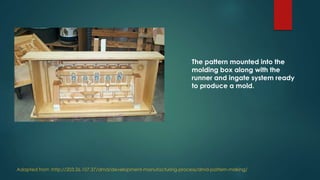
The pattern mounted into the
molding box along with the
runner and ingate system ready
to produce a mold.
Adapted from :http://203.26.107.37/dmd/development-manufacturing-process/dmd-pattern-making/
CASTING PROCESS
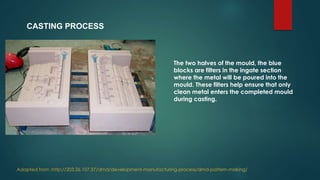
The two halves of the mould, the blue
blocks are filters in the ingate section
where the metal will be poured into the
mould. These filters help ensure that only
clean metal enters the completed mould
during casting.
Adapted from :http://203.26.107.37/dmd/development-manufacturing-process/dmd-pattern-making/
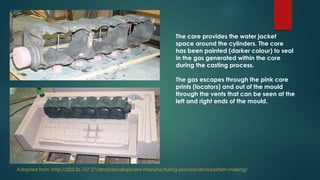
The core provides the water jacket
space around the cylinders. The core
has been painted (darker colour) to seal
in the gas generated within the core
during the casting process.
The gas escapes through the pink core
prints (locators) and out of the mould
through the vents that can be seen at the
left and right ends of the mould.
Adapted from :http://203.26.107.37/dmd/development-manufacturing-process/dmd-pattern-making/
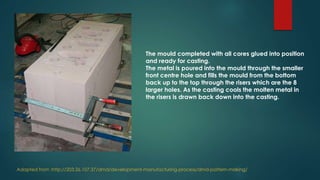
The mould completed with all cores glued into position
and ready for casting.
The metal is poured into the mould through the smaller
front centre hole and fills the mould from the bottom
back up to the top through the risers which are the 8
larger holes. As the casting cools the molten metal in
the risers is drawn back down into the casting.
Adapted from :http://203.26.107.37/dmd/development-manufacturing-process/dmd-pattern-making/
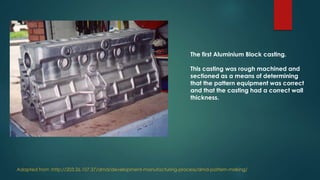
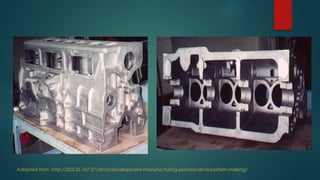
The first Aluminium Block casting.
This casting was rough machined and
sectioned as a means of determining
that the pattern equipment was correct
and that the casting had a correct wall
thickness.
Adapted from :http://203.26.107.37/dmd/development-manufacturing-process/dmd-pattern-making/
MACHINING PROCESS
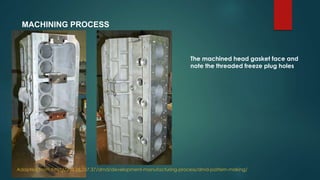
The machined head gasket face and
note the threaded freeze plug holes
Adapted from :http://203.26.107.37/dmd/development-manufacturing-process/dmd-pattern-making/
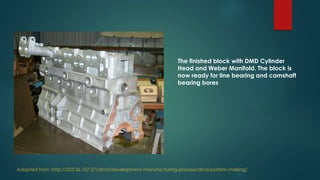
The finished block with DMD Cylinder
Head and Weber Manifold. The block is
now ready for line bearing and camshaft
bearing bores
Adapted from :http://203.26.107.37/dmd/development-manufacturing-process/dmd-pattern-making/
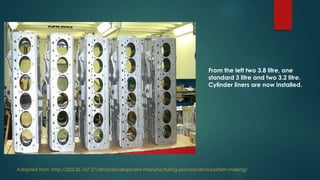
From the left two 3.8 litre, one
standard 3 litre and two 3.2 litre.
Cylinder liners are now installed.
Adapted from :http://203.26.107.37/dmd/development-manufacturing-process/dmd-pattern-making/
The block is set up for line boring
the crank and camshaft bearing
housings.
Adapted from :http://203.26.107.37/dmd/development-manufacturing-process/dmd-pattern-making/
The boring bar is carefully set in
preperation for boring. The boring bar
has multiple tools and will bore all the
housings in one operation.
Adapted from :http://203.26.107.37/dmd/development-manufacturing-process/dmd-pattern-making/
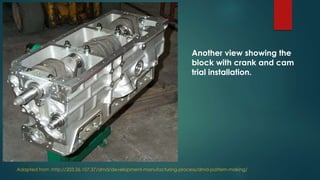
Another view showing the
block with crank and cam
trial installation.
Adapted from :http://203.26.107.37/dmd/development-manufacturing-process/dmd-pattern-making/
ASSEMBLY AND TESTING
Adapted from :http://203.26.107.37/dmd/development-manufacturing-process/dmd-pattern-making/
The 3.8 litre engine assembled
and ready for a test run. To
accommodate the large bore on
this engine, the water pump has
been moved forward on the
block casing, so a special pulley
has been machined with the
correct offset for the belt.
The engine fires for the first
time
Adapted from :http://203.26.107.37/dmd/development-manufacturing-process/dmd-pattern-making/
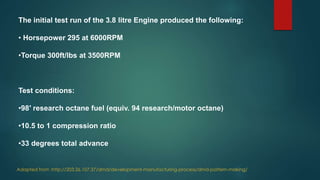
The initial test run of the 3.8 litre Engine produced the following:
• Horsepower 295 at 6000RPM
•Torque 300ft/lbs at 3500RPM
Test conditions:
•98′ research octane fuel (equiv. 94 research/motor octane)
•10.5 to 1 compression ratio
•33 degrees total advance
Adapted from :http://203.26.107.37/dmd/development-manufacturing-process/dmd-pattern-making/
Any Question ?
Thank you

Engine block manufacturing process

  • 1.
    Engine block MEL-202 MANUFACTURING WITHMETALLIC MATERIALS ROHIT ANAND 2013MEB1108 Under the guidance of - Dr Harpreet singh (asso.professor SMMEE) HEART OF THE ENGINE ??
  • 2.
    Engine block  Theengine block is a single unit that contain all the pieces for the engine .  The block serves as a structural framework of the engine and carries the mounting pad by which the engine is supported by the chassis  The block is made of cast iron and sometimes aluminum for higher performance Vehicle  The engine block is manufactured to withstand large amount of stress and high temperature Adapted from :http://www.eng.buffalo.edu/~llee3/Projects/LengFengLee_MAE364ProjectReport.pdf
  • 3.
  • 4.
  • 5.
    Functional Requirements ofa Cylinder Block Engine blocks are a critical component of an engine, it must satisfy a number of functional requirements These requirements include :- 1. Lasting the life of the vehicle 2. Housing internal moving parts and fluids 3. Ease of service and maintenance 4. Withstand pressures created by the combustion process. Adapted from :http://www.ewp.rpi.edu/hartford/~ernesto/F2010/EP2/Materials4Students/Lenny/Nguyen2005.pdf
  • 6.
    Required Material Properties Themanufactured product must possess  High strength  High modulus of elasticity  High abrasion resistance  High corrosion resistance Adapted from :http://www.ewp.rpi.edu/hartford/~ernesto/F2010/EP2/Materials4Students/Lenny/Nguyen2005.pdf
  • 7.
    Required Material Properties(contd) High strength is a particular concern in diesel engines, since compression ratios are normally 17.0:1 or higher (compared to about 10.0:1 for conventional engines) The material should also have  Low density  Low thermal expansion (to resist expanding under high operating temperatures)  Low thermal conductivity (to prevent failure under high temperatures) Based on the listed requirement industries have used cast iron and aluminum alloys to manufacture the blocks. Adapted from :http://www.ewp.rpi.edu/hartford/~ernesto/F2010/EP2/Materials4Students/Lenny/Nguyen2005.pdf
  • 8.
     Cast iron:- Gray cast iron Gray cast iron alloy have been the dominant metal that was used to manufacture conventional gas-powered engine blocks Gray cast iron alloys typically contains 2.5-4 wt.% carbon 6 and 1-3 wt.% silicon, 0.2-1.0 wt.% manganese, 0.02-0.25 wt.% sulfur, and 0.02-1.0 wt.% phosphorus ADVANTAGE It has excellent damping capacity, good wear and temperature resistance, is easily machineable and is inexpensive to produce DISADVANTAGE They are relatively weak and are prone to fracture and deformation Adapted from :http://www.ewp.rpi.edu/hartford/~ernesto/F2010/EP2/Materials4Students/Lenny/Nguyen2005.pdf
  • 9.
    Compacted Graphite CastIron Compacted graphite cast iron (CGI), which was accidentally discovered while trying to produce ductile cast iron, possesses higher tensile strength and elastic modulus than gray cast iron Like gray cast iron, compacted graphite cast iron has good damping capacity and thermal conductivity, but its difficulty to machine has limited the wide-scale use of CGI Adapted from :http://www.ewp.rpi.edu/hartford/~ernesto/F2010/EP2/Materials4Students/Lenny/Nguyen2005.pdf
  • 10.
    Aluminum Alloys It wasdiscovered to reduce the overall weight of the vehicle There are two practical implications :  Improved performance-to-weight ratio  Increased fuel efficiency The drawbacks of using aluminum in engine blocks are that they are more expensive to manufacture than cast iron alloys Adapted from :http://www.ewp.rpi.edu/hartford/~ernesto/F2010/EP2/Materials4Students/Lenny/Nguyen2005.pdf
  • 11.
    Casting Processes PATTERN MAKINGPROCESS: Adapted from :http://203.26.107.37/dmd/development-manufacturing-process/dmd-pattern-making/
  • 12.
    The three coreboxes that produce the inside of the crankcase. Adapted from :http://203.26.107.37/dmd/development-manufacturing-process/dmd-pattern-making/
  • 13.
    On the leftis the core box for the cam follower cavity on the right lower is the core box for the standard bore engine, cylinder water jacket. Adapted from :http://203.26.107.37/dmd/development-manufacturing-process/dmd-pattern-making/
  • 14.
    The holes inthe side of the core box (bottom left) match the core prints on the left side of the block. While serving the purpose of locating the cylinder water jacket core, they also become the welsch/core/freeze plug in the block. Adapted from :http://203.26.107.37/dmd/development-manufacturing-process/dmd-pattern-making/
  • 15.
    The pattern mountedinto the molding box along with the runner and ingate system ready to produce a mold. Adapted from :http://203.26.107.37/dmd/development-manufacturing-process/dmd-pattern-making/
  • 16.
    CASTING PROCESS The twohalves of the mould, the blue blocks are filters in the ingate section where the metal will be poured into the mould. These filters help ensure that only clean metal enters the completed mould during casting. Adapted from :http://203.26.107.37/dmd/development-manufacturing-process/dmd-pattern-making/
  • 17.
    The core providesthe water jacket space around the cylinders. The core has been painted (darker colour) to seal in the gas generated within the core during the casting process. The gas escapes through the pink core prints (locators) and out of the mould through the vents that can be seen at the left and right ends of the mould. Adapted from :http://203.26.107.37/dmd/development-manufacturing-process/dmd-pattern-making/
  • 18.
    The mould completedwith all cores glued into position and ready for casting. The metal is poured into the mould through the smaller front centre hole and fills the mould from the bottom back up to the top through the risers which are the 8 larger holes. As the casting cools the molten metal in the risers is drawn back down into the casting. Adapted from :http://203.26.107.37/dmd/development-manufacturing-process/dmd-pattern-making/
  • 19.
    The first AluminiumBlock casting. This casting was rough machined and sectioned as a means of determining that the pattern equipment was correct and that the casting had a correct wall thickness. Adapted from :http://203.26.107.37/dmd/development-manufacturing-process/dmd-pattern-making/
  • 20.
  • 21.
    MACHINING PROCESS The machinedhead gasket face and note the threaded freeze plug holes Adapted from :http://203.26.107.37/dmd/development-manufacturing-process/dmd-pattern-making/
  • 22.
    The finished blockwith DMD Cylinder Head and Weber Manifold. The block is now ready for line bearing and camshaft bearing bores Adapted from :http://203.26.107.37/dmd/development-manufacturing-process/dmd-pattern-making/
  • 23.
    From the lefttwo 3.8 litre, one standard 3 litre and two 3.2 litre. Cylinder liners are now installed. Adapted from :http://203.26.107.37/dmd/development-manufacturing-process/dmd-pattern-making/
  • 24.
    The block isset up for line boring the crank and camshaft bearing housings. Adapted from :http://203.26.107.37/dmd/development-manufacturing-process/dmd-pattern-making/
  • 25.
    The boring baris carefully set in preperation for boring. The boring bar has multiple tools and will bore all the housings in one operation. Adapted from :http://203.26.107.37/dmd/development-manufacturing-process/dmd-pattern-making/
  • 26.
    Another view showingthe block with crank and cam trial installation. Adapted from :http://203.26.107.37/dmd/development-manufacturing-process/dmd-pattern-making/
  • 27.
    ASSEMBLY AND TESTING Adaptedfrom :http://203.26.107.37/dmd/development-manufacturing-process/dmd-pattern-making/ The 3.8 litre engine assembled and ready for a test run. To accommodate the large bore on this engine, the water pump has been moved forward on the block casing, so a special pulley has been machined with the correct offset for the belt.
  • 29.
    The engine firesfor the first time Adapted from :http://203.26.107.37/dmd/development-manufacturing-process/dmd-pattern-making/
  • 30.
    The initial testrun of the 3.8 litre Engine produced the following: • Horsepower 295 at 6000RPM •Torque 300ft/lbs at 3500RPM Test conditions: •98′ research octane fuel (equiv. 94 research/motor octane) •10.5 to 1 compression ratio •33 degrees total advance Adapted from :http://203.26.107.37/dmd/development-manufacturing-process/dmd-pattern-making/
  • 31.