Dome Piston
Design and Manufacture of a Dome
Shaped Piston Head
April 10, 2015
List of all Slides and their Related Information Presented
Slide Information Presented
1 Group number, members, and project title
3 Overview of dome shaped piston head
4 Design focus for manufacturing process and final product
5 Detailed list of piston components
6 Detailed explanation of the expansion of the piston shape during operation
7 Piston rings and there functional purpose
8 List of all steps performed during the manufacturing process
9 Detailed description of casting and its related characteristics
10 Detailed description of forging and its related characteristics
11 Description of the heat treatment process and purpose
12 CNC Turning list of operation performed and characteristics of the CNC lathes
13 Drilling and grinding applications listed and described
14 Explanation of deburring and coating processes and their effects on the piston
15 Description of reaming and finish boring processes and matrices relating their individual pros and cons
16 Final inspection description
17 Performance and cost matrix related to the forging process
18 Performance and cost matrix related to two casting types
19 Performance and cost matrix related to coatings used on the piston head and skirt
20 -21 Manufacturing improvements and recommendations related to casting and forging
22 Cost and performance assessment matrix addressing each manufacturing process
23 Identifying the best technique and supporting information
24 Member contributions related to subject matter and percentage
25-26 List of all reference cited throughout the power point
• Increase in volume from
the dome shape
increases compression
ratio. [15] CR= (.25πb2 s+Vc )/Vc
Where: b=cylinder bore, s= piston
stroke, Vc =clearance volume
• Dome shape deflects the
inlet charge up toward
the spark plug. [15]
• Flat portion decreases
quenching effects. [15]
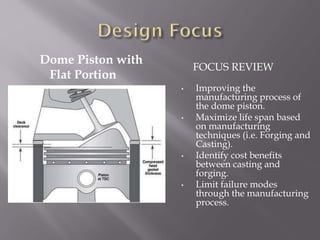
Dome Piston with
Flat Portion
FOCUS REVIEW
• Improving the
manufacturing process of
the dome piston.
• Maximize life span based
on manufacturing
techniques (i.e. Forging and
Casting).
• Identify cost benefits
between casting and
forging.
• Limit failure modes
through the manufacturing
process.
 Crown
 Top of piston
 Combustion gases exert pressure on the
piston crown
 Ring Land
 Sealing surface and support piston rings [8]
 Relief cut into side profile where the
piston rings sit [8]
 Ring Grooves
 Grooves used to retain piston rings [8]
 Recessed area located around perimeter of the piston
[8]
 Skirt
 Portion of the piston closest to the crankshaft that
helps align the piston as it moves inside cylinder bore
[8]
 Wrist Pin boss
 Connects the small end of the connecting rod to the
piston by a wrist pin [10]
 Aluminum expands so there must be an
allowance between the piston diameter and the
cylinder to account for the expansion, allowing
the piston to move freely [13]
 Top of piston (crown) experiences more heat than
the bottom (skirt) so the crown will expand
more[13]
 Top diameter needs to be smaller than diameter
of bottom of skirt, providing tapered shape[13]
 The partial skirt lightens piston, thus increases
the speed range of the engine and reduces the
contact area between the cylinder wall, which
decreases friction [14]
 The skirt is also elliptical shape at room
temperature
 As the piston heats up, the pin bore area expands
more than thinner areas of the piston making the
piston shape become circular[ 13]
 This circular shape matches the cylinder bore and
improves sealing and efficiency[13]
 Compression ring
 Piston ring located in ring groove closest to the
piston head [8]
 Prevents oil from reaching combustion chamber
[10]
 Seals the combustion chamber from any leakage
[10]
 Wiper ring
 Middle ring
 Provides a consistent film of oil to lubricate the
running of the compression ring [8]
 Wipes away excess oil from cylinder wall
 Combustion gasses which pass the compression
ring are stopped by the wiper ring [8]
 Oil ring
 Piston ring located in the ring groove closest to
the crankshaft [8]
 Thin slots cut in ring to allow flow of excess oil
back to oil basin [8]
 Casting or Forging
 Heat Treatment
 Machining process
 CNC turning
 Drilling, slotting, and grinding
 Deburring and Coating
 Reaming or Finish boring
 Cast pistons are made from an
aluminum/silicon alloy (Hypereutectic )
 Hypereutectic pistons have a lower coefficient
of thermal expansion than pure aluminum, so
tighter tolerances can be set.[2]
 Hypereutectic pistons are more brittle than
pure aluminum.
 Alloy is heated to 700°C , collected with a ladle
and poured into mold, and cooled.[5]
 Permanent molds are used and are
typically made of cast iron.
 The mold itself is expensive, but it is very
durable so it can be reused for a long
period of time.
 Once the mold is made the cost per piston
is very low.
 High production rate
 Forged pistons are mechanically shaped.[3]
 A aluminum bar stock is cut into slugs that are then heated in an
oven to about 425 °C
 A mechanical or hydraulic press and die are preheated to the
same temperature.[9]
 The press applies 2,000 lbs of force to the heated slug shaping it
to the desired shape.[9]
 The forged piston then air cools slowly for roughly an hour.[9]
 Forged pistons are more ductile and dense than cast pistons. [2]
 Forging eliminates porosity.
 Tools used are expensive, develop wear more quickly, and are
slower compared to casting tools.
 More expensive final product
 Tend to go into plastic deformation when overloaded
 Engines > 500 hp will always have forged pistons
 Diesel engines and race cars
 Piston is placed into an oven twice
 First time is at a higher temperature to
strengthen the material [10]
 Second is at a lower temperature to
stabilize the material [10]
 Controlled heating and cooling to
change physical and mechanical
properties of the piston, but
maintain the same shape.
 Increases strength and hardness
 Simplifies machining processes
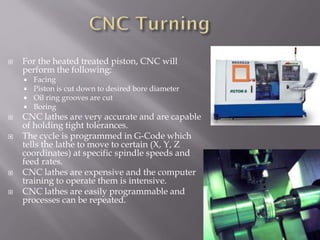
 For the heated treated piston, CNC will
perform the following:
 Facing
 Piston is cut down to desired bore diameter
 Oil ring grooves are cut
 Boring
 CNC lathes are very accurate and are capable
of holding tight tolerances.
 The cycle is programmed in G-Code which
tells the lathe to move to certain (X, Y, Z
coordinates) at specific spindle speeds and
feed rates.
 CNC lathes are expensive and the computer
training to operate them is intensive.
 CNC lathes are easily programmable and
processes can be repeated.
 Drilling
 Drill Press
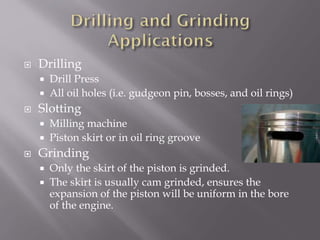
 All oil holes (i.e. gudgeon pin, bosses, and oil rings)
 Slotting
 Milling machine
 Piston skirt or in oil ring groove
 Grinding
 Only the skirt of the piston is grinded.
 The skirt is usually cam grinded, ensures the
expansion of the piston will be uniform in the bore
of the engine.
 Deburring tool is used to remove any
unwanted material on piston surface
 Piston is cleaned to remove oil, dirt,
residue, etc.
 Coating is typically sprayed on
 Dry film lubricants
 Reduce friction, reduces scuffing, extends bore
life[4]
 Good safety margin[4]
 Applied to piston skirts[4]
 Thermal barriers
 Transfer heat and prevent hot spots on piston
face[4]
 Results in less fuel needed for desired power[4]
 Applied to piston crowns[4]
 Oil shedding
 Increase cooling efficiency by not allowing oil
to coat certain surfaces[4]
 Applied to piston bottoms[4]
 Final process
 Reaming or finish boring makes existing
holes dimensionally more accurate and
improves surface finish. [5]
 Piston is placed in bath of oil and reamed
at different size to reach desired size. [5]
 A typical tolerance is about 0.4Ra. [5]
Pros Cons
Multiple cutting
edges, so tool life
is longer
Requires coolant
Can hold tighter
tolerances
Time consuming
Pros Cons
More flexible and
forgiving
Can’t hold tight
tolerances
Precise hole location
is less critical
One cutting tooth,
so tool life is lower
 Piston is cleaned of any residues left over from the manufacturing
process [5]
 Fitted with appropriate wrist pin [5]
 Stamped with the piston’s overall size and any other manufacturer’s
markings [5]
Manufacturing
Process
Pros Cons Cost
Average
Lifespan
Forging
•Stronger than
cast pistons [3]
•Less porosity
and closer alloy
grains due to not
using a cast.[3]
•Greater
dimension
stability [3]
•Dissipates heat
better and can
with stand greater
operating
temperatures [3]
•The dense, stretched,
and strained material
makeup of a forged
piston doesn't heat up
to the operating
temperature as quickly
as a cast piston. [2]
•They are more likely
to cold seize.
•The high pressures
required for the
operation increase
wear on the dies per
run, which are costly to
replace.
Higher
than
cast
pistons.
2X Lifespan of
Cast Pistons
Manufacturing
Process
Pros Cons Cost
Average
Lifespan
Casting Types
Cast Aluminum
Piston with
Steel Struts
•Help control flow of heat
from combustion process
•Lightweight reduces
force required to initiate
and maintain
acceleration. [9]
•Can be embedded into
the piston assembly to
help control piston
expansion
•Lower strength than forged
pistons
•Contains neither grain flow
or directional strength[10]
•Fractures easier under
detonation and has few
options for compression and
rod length [2]
Less costly
than forged
pistons.[3]
1/2 Lifespan of
Forged Pistons
Hypereutectic
Piston
•Stronger than 100%
aluminum piston [3]
•Hypereutectic pistons
expand less than ordinary
cast aluminum alloys, and
CNC machining of the
piston profile allows
piston-to-bore clearances
to be reduced. [3]
•Reduces heat transfer. [3]
•Require close control of
melting and cooling process
because alloy separation may
occur. [1]
•Not easily modified.
Less costly
than forged
pistons.
1/2 Lifespan of
Forged Pistons.
Greater lifespan
than cast
aluminum with
struts.
Coatings Pros Cons
Life-
span
0.002"
Ceramic
Thermal Barrier
Coating
•Holds heat inside
combustion
chamber reducing
dissipation
through the piston
that can weaken or
burn the metal.
• Thin coating
does not effect
clearance. [6]
Increases the
cost
Increases
0.008"
Tungsten-
Molybdenum
Disulfide Polymer
Matrix
•Reduces friction
between piston
skirt and cylinder
wall.[6]
Increases the
cost
Increases
Forging
■ Increase material resistance to
cracking by properly aligning the
grain flow with the crack
propagation direction during the
extrusion process. [12]
■ Heat the press and die to the same
temperature as the slug (425 C) so
the slug is not cooled when put
into the press.[9]
■ Allow roughly formed piston to
air cool after it has been heat
treated in an oven after pressed.
This will allow for the molecular
structure of the piston to reach a
lower energy state and be
therefore more uniform
molecular.[11]
Result: Increases the strength of the
forged piston
Casting
■ As the ratio of silicon to
aluminum is increased the more
brittle they become, as well as the
coefficient of thermal expansion
reduces and the piston expands
less. A ratio of 16%- 19% is
recommended.[3]
• Less than 12%  Piston will
expand too much.
• 25% and on  Piston will be
excessively brittle and loose
strength. [ 3]
Result: Reduces piston expansion
under during operation and
increased strength without
sacrificing too much ductility.
Forging
■ Apply adequate force (2000 tons)
to the heated slug of aluminum in
the press
Result: Decrease porosity, and
compact grain flows.
■ Heat treat the pressed piston
twice.
• First time at higher
temperature to ensure the
entire volume is heated to the
same temperature.
• Second time to a lower
temperature to allow for the
molecular structure to
stabilize. [11]
Casting
■ Repeatedly measure the
dimensions of the cast for
accuracy after a specific number
of casting cycles.
Results: Dimensionally consistent
casts
■ Reduce the amount of hydrogen
gas in the molten aluminum prior
to injecting the cast. Use high
quality aluminum.
■ Use a vacuum while pouring the
molten Al alloy to limit the
porosity of the cast due to gas
bubbles. [10]
Result: Decreases the porosity of the
casted piston, thus increasing
strength.
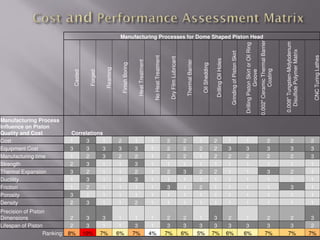
Manufacturing Processes for Dome Shaped Piston Head
Casted
Forged
Reaming
FinishBoring
HeatTreatment
NoHeatTreatment
DryFilmLubricant
ThermalBarrier
OilShedding
DrillingOilHoles
GrindingofPistonSkirt
DrillingPistonSkirtorOilRing
Groove
0.002"CeramicThermalBarrier
Coating
0.008"Tungsten-Molybdenum
DisulfidePolymerMatrix
CNCTuringLathes
Manufacturing Process
Influence on Piston
Quality and Cost Correlations
Cost 1 3 1 2 1 1 2 2 1 2 1 1 2 2 2
Equipment Cost 3 3 3 3 3 1 2 2 2 2 3 3 3 3 3
Manufacturing time 1 2 3 2 2 1 2 2 1 2 2 2 2 2 3
Strength 2 3 1 1 3 1 1 1 1 1 1 1 1 1 1
Thermal Expansion 3 2 1 1 2 1 2 3 2 2 1 1 3 2 1
Ductility 1 3 1 1 3 1 1 1 1 1 1 1 1 1 1
Friction 1 2 1 1 1 1 3 1 2 1 1 1 1 3 1
Porosity 3 1 1 1 1 1 1 1 1 1 1 1 1 1 1
Density 2 3 1 1 2 1 1 1 1 1 1 1 1 1 1
Precision of Piston
Dimensions 2 3 3 1 1 1 2 2 1 3 2 1 2 2 3
Lifespan of Piston 2 3 1 1 3 1 3 3 3 3 3 3 3 3 2
Ranking: 8% 10% 7% 6% 7% 4% 7% 6% 5% 7% 6% 6% 7% 7% 7%
 Forging is the Best Technique of the
Manufacturing Process.
• Largest influence on ductility of the piston head.
• Greater dimensional stability effectively decreasing
machining time
• Produces the greatest strength resulting from the
grain flow in the extruded material
• Eliminates porosity in the material
• Extruded product dissipates heat better than casting
and can withstand greater operating temperatures
• Forged pistons have a greater life span
[1] “Aluminum Piston Manufacturing Process.” Cast and Alloys. 05 May 2015
<http://www.cast-alloys.com/products/aluminium_piston_manu_process.htm>
[2] “Cast and Forged Pistons.” Tech Speak. 05 May 2015
http://www.hoon.tk/tech_tips/pistons.html
[3] “Cast, Hypereutectic or Forged Pistons.” Probe Industries. 05 May 2015
<http://www.probeindustries.com/Articles.asp?ID=144>
[4] “Coating Pistons.” Tech Line Coatings, Inc. 05 May 2015
<http://techlinecoatings.com/articles/Coating_Pistons_Article.htm>
[5] “How Pistons are Made” JP Pistons. 05 May 2015 http://www.jp.com.au/Made.html
[6] “Piston Selection Guidelines.” Federal Mogul Technical Education Center. 05 May 2015
<http://fme-cat.com/docs/1104.pdf>
[7] “Ultimate Ford FE Engine Piston Guide.” DIY Ford. 05 May 2015
<http://diyford.com/ultimate-ford-fe-engine-piston-guide/>
[8] “Piston and Piston Rings.” Univsersity of Windsor. 03 May 2015
<http://courses.washington.edu/engr100/Section_Wei/engine/UofWindsorManual/P
iston%20and%20Piston%20Rings.htm>
[9] “Piston Manufacturing Process.” Thomas McNish. 03 May 2015
<http://www.ehow.com/how-does_5502005_piston-manufacturing-process.html>
[10] “Casting Defects and Design Issures.” Prof. J.S. Colton. 03 May 2015 <http://www-
old.me.gatech.edu/jonathan.colton/me4210/castdefect.pdf>
[11] “Heat Treatment of Ferrous Metals.” 03 May 2015
<http://avstop.com/ac/apgeneral/heattreatmentofferrousmetals.html>
[12] “Failures Related to Metal Working.” Fudan University. 04 May 2015
<http://jpkc.fudan.edu.cn/picture/article/348/1b/ee/6dce0ae740cf8673b53e4e96abb8/
7aa78636-dda1-46b9-859b-95db3cb616f8.pdf>
[13] “Piston Design.” University of Windsor. 05 May 2015
<http://courses.washington.edu/engr100/Section_Wei/engine/UofWindsorManual/P
iston%20Design.htm>
[14] “Piston Assembly” SweetHaven Publishing Services. 05 May 2015
<http://www.waybuilder.net/sweethaven/MechTech/Automotive01/?unNum=2&les
Num=3&modNum=1>
[15] “Piston Dome.”Performance Trends Inc. 02 May 2015
<http://performancetrends.com/Definitions/Piston-Dome.htm>

Dome Shaped Piston

  • 1.
    Dome Piston Design andManufacture of a Dome Shaped Piston Head April 10, 2015
  • 2.
    List of allSlides and their Related Information Presented Slide Information Presented 1 Group number, members, and project title 3 Overview of dome shaped piston head 4 Design focus for manufacturing process and final product 5 Detailed list of piston components 6 Detailed explanation of the expansion of the piston shape during operation 7 Piston rings and there functional purpose 8 List of all steps performed during the manufacturing process 9 Detailed description of casting and its related characteristics 10 Detailed description of forging and its related characteristics 11 Description of the heat treatment process and purpose 12 CNC Turning list of operation performed and characteristics of the CNC lathes 13 Drilling and grinding applications listed and described 14 Explanation of deburring and coating processes and their effects on the piston 15 Description of reaming and finish boring processes and matrices relating their individual pros and cons 16 Final inspection description 17 Performance and cost matrix related to the forging process 18 Performance and cost matrix related to two casting types 19 Performance and cost matrix related to coatings used on the piston head and skirt 20 -21 Manufacturing improvements and recommendations related to casting and forging 22 Cost and performance assessment matrix addressing each manufacturing process 23 Identifying the best technique and supporting information 24 Member contributions related to subject matter and percentage 25-26 List of all reference cited throughout the power point
  • 3.
    • Increase involume from the dome shape increases compression ratio. [15] CR= (.25πb2 s+Vc )/Vc Where: b=cylinder bore, s= piston stroke, Vc =clearance volume • Dome shape deflects the inlet charge up toward the spark plug. [15] • Flat portion decreases quenching effects. [15]
  • 4.
    Dome Piston with FlatPortion FOCUS REVIEW • Improving the manufacturing process of the dome piston. • Maximize life span based on manufacturing techniques (i.e. Forging and Casting). • Identify cost benefits between casting and forging. • Limit failure modes through the manufacturing process.
  • 5.
     Crown  Topof piston  Combustion gases exert pressure on the piston crown  Ring Land  Sealing surface and support piston rings [8]  Relief cut into side profile where the piston rings sit [8]  Ring Grooves  Grooves used to retain piston rings [8]  Recessed area located around perimeter of the piston [8]  Skirt  Portion of the piston closest to the crankshaft that helps align the piston as it moves inside cylinder bore [8]  Wrist Pin boss  Connects the small end of the connecting rod to the piston by a wrist pin [10]
  • 6.
     Aluminum expandsso there must be an allowance between the piston diameter and the cylinder to account for the expansion, allowing the piston to move freely [13]  Top of piston (crown) experiences more heat than the bottom (skirt) so the crown will expand more[13]  Top diameter needs to be smaller than diameter of bottom of skirt, providing tapered shape[13]  The partial skirt lightens piston, thus increases the speed range of the engine and reduces the contact area between the cylinder wall, which decreases friction [14]  The skirt is also elliptical shape at room temperature  As the piston heats up, the pin bore area expands more than thinner areas of the piston making the piston shape become circular[ 13]  This circular shape matches the cylinder bore and improves sealing and efficiency[13]
  • 7.
     Compression ring Piston ring located in ring groove closest to the piston head [8]  Prevents oil from reaching combustion chamber [10]  Seals the combustion chamber from any leakage [10]  Wiper ring  Middle ring  Provides a consistent film of oil to lubricate the running of the compression ring [8]  Wipes away excess oil from cylinder wall  Combustion gasses which pass the compression ring are stopped by the wiper ring [8]  Oil ring  Piston ring located in the ring groove closest to the crankshaft [8]  Thin slots cut in ring to allow flow of excess oil back to oil basin [8]
  • 8.
     Casting orForging  Heat Treatment  Machining process  CNC turning  Drilling, slotting, and grinding  Deburring and Coating  Reaming or Finish boring
  • 9.
     Cast pistonsare made from an aluminum/silicon alloy (Hypereutectic )  Hypereutectic pistons have a lower coefficient of thermal expansion than pure aluminum, so tighter tolerances can be set.[2]  Hypereutectic pistons are more brittle than pure aluminum.  Alloy is heated to 700°C , collected with a ladle and poured into mold, and cooled.[5]  Permanent molds are used and are typically made of cast iron.  The mold itself is expensive, but it is very durable so it can be reused for a long period of time.  Once the mold is made the cost per piston is very low.  High production rate
  • 10.
     Forged pistonsare mechanically shaped.[3]  A aluminum bar stock is cut into slugs that are then heated in an oven to about 425 °C  A mechanical or hydraulic press and die are preheated to the same temperature.[9]  The press applies 2,000 lbs of force to the heated slug shaping it to the desired shape.[9]  The forged piston then air cools slowly for roughly an hour.[9]  Forged pistons are more ductile and dense than cast pistons. [2]  Forging eliminates porosity.  Tools used are expensive, develop wear more quickly, and are slower compared to casting tools.  More expensive final product  Tend to go into plastic deformation when overloaded  Engines > 500 hp will always have forged pistons  Diesel engines and race cars
  • 11.
     Piston isplaced into an oven twice  First time is at a higher temperature to strengthen the material [10]  Second is at a lower temperature to stabilize the material [10]  Controlled heating and cooling to change physical and mechanical properties of the piston, but maintain the same shape.  Increases strength and hardness  Simplifies machining processes
  • 12.
     For theheated treated piston, CNC will perform the following:  Facing  Piston is cut down to desired bore diameter  Oil ring grooves are cut  Boring  CNC lathes are very accurate and are capable of holding tight tolerances.  The cycle is programmed in G-Code which tells the lathe to move to certain (X, Y, Z coordinates) at specific spindle speeds and feed rates.  CNC lathes are expensive and the computer training to operate them is intensive.  CNC lathes are easily programmable and processes can be repeated.
  • 13.
     Drilling  DrillPress  All oil holes (i.e. gudgeon pin, bosses, and oil rings)  Slotting  Milling machine  Piston skirt or in oil ring groove  Grinding  Only the skirt of the piston is grinded.  The skirt is usually cam grinded, ensures the expansion of the piston will be uniform in the bore of the engine.
  • 14.
     Deburring toolis used to remove any unwanted material on piston surface  Piston is cleaned to remove oil, dirt, residue, etc.  Coating is typically sprayed on  Dry film lubricants  Reduce friction, reduces scuffing, extends bore life[4]  Good safety margin[4]  Applied to piston skirts[4]  Thermal barriers  Transfer heat and prevent hot spots on piston face[4]  Results in less fuel needed for desired power[4]  Applied to piston crowns[4]  Oil shedding  Increase cooling efficiency by not allowing oil to coat certain surfaces[4]  Applied to piston bottoms[4]
  • 15.
     Final process Reaming or finish boring makes existing holes dimensionally more accurate and improves surface finish. [5]  Piston is placed in bath of oil and reamed at different size to reach desired size. [5]  A typical tolerance is about 0.4Ra. [5] Pros Cons Multiple cutting edges, so tool life is longer Requires coolant Can hold tighter tolerances Time consuming Pros Cons More flexible and forgiving Can’t hold tight tolerances Precise hole location is less critical One cutting tooth, so tool life is lower
  • 16.
     Piston iscleaned of any residues left over from the manufacturing process [5]  Fitted with appropriate wrist pin [5]  Stamped with the piston’s overall size and any other manufacturer’s markings [5]
  • 17.
    Manufacturing Process Pros Cons Cost Average Lifespan Forging •Strongerthan cast pistons [3] •Less porosity and closer alloy grains due to not using a cast.[3] •Greater dimension stability [3] •Dissipates heat better and can with stand greater operating temperatures [3] •The dense, stretched, and strained material makeup of a forged piston doesn't heat up to the operating temperature as quickly as a cast piston. [2] •They are more likely to cold seize. •The high pressures required for the operation increase wear on the dies per run, which are costly to replace. Higher than cast pistons. 2X Lifespan of Cast Pistons
  • 18.
    Manufacturing Process Pros Cons Cost Average Lifespan CastingTypes Cast Aluminum Piston with Steel Struts •Help control flow of heat from combustion process •Lightweight reduces force required to initiate and maintain acceleration. [9] •Can be embedded into the piston assembly to help control piston expansion •Lower strength than forged pistons •Contains neither grain flow or directional strength[10] •Fractures easier under detonation and has few options for compression and rod length [2] Less costly than forged pistons.[3] 1/2 Lifespan of Forged Pistons Hypereutectic Piston •Stronger than 100% aluminum piston [3] •Hypereutectic pistons expand less than ordinary cast aluminum alloys, and CNC machining of the piston profile allows piston-to-bore clearances to be reduced. [3] •Reduces heat transfer. [3] •Require close control of melting and cooling process because alloy separation may occur. [1] •Not easily modified. Less costly than forged pistons. 1/2 Lifespan of Forged Pistons. Greater lifespan than cast aluminum with struts.
  • 19.
    Coatings Pros Cons Life- span 0.002" Ceramic ThermalBarrier Coating •Holds heat inside combustion chamber reducing dissipation through the piston that can weaken or burn the metal. • Thin coating does not effect clearance. [6] Increases the cost Increases 0.008" Tungsten- Molybdenum Disulfide Polymer Matrix •Reduces friction between piston skirt and cylinder wall.[6] Increases the cost Increases
  • 20.
    Forging ■ Increase materialresistance to cracking by properly aligning the grain flow with the crack propagation direction during the extrusion process. [12] ■ Heat the press and die to the same temperature as the slug (425 C) so the slug is not cooled when put into the press.[9] ■ Allow roughly formed piston to air cool after it has been heat treated in an oven after pressed. This will allow for the molecular structure of the piston to reach a lower energy state and be therefore more uniform molecular.[11] Result: Increases the strength of the forged piston Casting ■ As the ratio of silicon to aluminum is increased the more brittle they become, as well as the coefficient of thermal expansion reduces and the piston expands less. A ratio of 16%- 19% is recommended.[3] • Less than 12%  Piston will expand too much. • 25% and on  Piston will be excessively brittle and loose strength. [ 3] Result: Reduces piston expansion under during operation and increased strength without sacrificing too much ductility.
  • 21.
    Forging ■ Apply adequateforce (2000 tons) to the heated slug of aluminum in the press Result: Decrease porosity, and compact grain flows. ■ Heat treat the pressed piston twice. • First time at higher temperature to ensure the entire volume is heated to the same temperature. • Second time to a lower temperature to allow for the molecular structure to stabilize. [11] Casting ■ Repeatedly measure the dimensions of the cast for accuracy after a specific number of casting cycles. Results: Dimensionally consistent casts ■ Reduce the amount of hydrogen gas in the molten aluminum prior to injecting the cast. Use high quality aluminum. ■ Use a vacuum while pouring the molten Al alloy to limit the porosity of the cast due to gas bubbles. [10] Result: Decreases the porosity of the casted piston, thus increasing strength.
  • 22.
    Manufacturing Processes forDome Shaped Piston Head Casted Forged Reaming FinishBoring HeatTreatment NoHeatTreatment DryFilmLubricant ThermalBarrier OilShedding DrillingOilHoles GrindingofPistonSkirt DrillingPistonSkirtorOilRing Groove 0.002"CeramicThermalBarrier Coating 0.008"Tungsten-Molybdenum DisulfidePolymerMatrix CNCTuringLathes Manufacturing Process Influence on Piston Quality and Cost Correlations Cost 1 3 1 2 1 1 2 2 1 2 1 1 2 2 2 Equipment Cost 3 3 3 3 3 1 2 2 2 2 3 3 3 3 3 Manufacturing time 1 2 3 2 2 1 2 2 1 2 2 2 2 2 3 Strength 2 3 1 1 3 1 1 1 1 1 1 1 1 1 1 Thermal Expansion 3 2 1 1 2 1 2 3 2 2 1 1 3 2 1 Ductility 1 3 1 1 3 1 1 1 1 1 1 1 1 1 1 Friction 1 2 1 1 1 1 3 1 2 1 1 1 1 3 1 Porosity 3 1 1 1 1 1 1 1 1 1 1 1 1 1 1 Density 2 3 1 1 2 1 1 1 1 1 1 1 1 1 1 Precision of Piston Dimensions 2 3 3 1 1 1 2 2 1 3 2 1 2 2 3 Lifespan of Piston 2 3 1 1 3 1 3 3 3 3 3 3 3 3 2 Ranking: 8% 10% 7% 6% 7% 4% 7% 6% 5% 7% 6% 6% 7% 7% 7%
  • 23.
     Forging isthe Best Technique of the Manufacturing Process. • Largest influence on ductility of the piston head. • Greater dimensional stability effectively decreasing machining time • Produces the greatest strength resulting from the grain flow in the extruded material • Eliminates porosity in the material • Extruded product dissipates heat better than casting and can withstand greater operating temperatures • Forged pistons have a greater life span
  • 24.
    [1] “Aluminum PistonManufacturing Process.” Cast and Alloys. 05 May 2015 <http://www.cast-alloys.com/products/aluminium_piston_manu_process.htm> [2] “Cast and Forged Pistons.” Tech Speak. 05 May 2015 http://www.hoon.tk/tech_tips/pistons.html [3] “Cast, Hypereutectic or Forged Pistons.” Probe Industries. 05 May 2015 <http://www.probeindustries.com/Articles.asp?ID=144> [4] “Coating Pistons.” Tech Line Coatings, Inc. 05 May 2015 <http://techlinecoatings.com/articles/Coating_Pistons_Article.htm> [5] “How Pistons are Made” JP Pistons. 05 May 2015 http://www.jp.com.au/Made.html [6] “Piston Selection Guidelines.” Federal Mogul Technical Education Center. 05 May 2015 <http://fme-cat.com/docs/1104.pdf> [7] “Ultimate Ford FE Engine Piston Guide.” DIY Ford. 05 May 2015 <http://diyford.com/ultimate-ford-fe-engine-piston-guide/> [8] “Piston and Piston Rings.” Univsersity of Windsor. 03 May 2015 <http://courses.washington.edu/engr100/Section_Wei/engine/UofWindsorManual/P iston%20and%20Piston%20Rings.htm> [9] “Piston Manufacturing Process.” Thomas McNish. 03 May 2015 <http://www.ehow.com/how-does_5502005_piston-manufacturing-process.html> [10] “Casting Defects and Design Issures.” Prof. J.S. Colton. 03 May 2015 <http://www- old.me.gatech.edu/jonathan.colton/me4210/castdefect.pdf> [11] “Heat Treatment of Ferrous Metals.” 03 May 2015 <http://avstop.com/ac/apgeneral/heattreatmentofferrousmetals.html>
  • 25.
    [12] “Failures Relatedto Metal Working.” Fudan University. 04 May 2015 <http://jpkc.fudan.edu.cn/picture/article/348/1b/ee/6dce0ae740cf8673b53e4e96abb8/ 7aa78636-dda1-46b9-859b-95db3cb616f8.pdf> [13] “Piston Design.” University of Windsor. 05 May 2015 <http://courses.washington.edu/engr100/Section_Wei/engine/UofWindsorManual/P iston%20Design.htm> [14] “Piston Assembly” SweetHaven Publishing Services. 05 May 2015 <http://www.waybuilder.net/sweethaven/MechTech/Automotive01/?unNum=2&les Num=3&modNum=1> [15] “Piston Dome.”Performance Trends Inc. 02 May 2015 <http://performancetrends.com/Definitions/Piston-Dome.htm>