YOUR ROLE
Logan Aimone, MJE //
University High School, University of Chicago Laboratory Schools
ON STAFF
FINDING
FINDING YOUR ROLE ON STAFF
One of the biggest
challenges staff
members face is
knowing their role.
FINDING YOUR ROLE ON STAFF
In particular, student
leaders can struggle
with the transition from
member to leader.
FINDING YOUR ROLE ON STAFF
The key is
understanding that
every person has three
roles they play.
FINDING YOUR ROLE ON STAFF
They play these roles 

in varying portions
depending on the
circumstances.
FINDING YOUR ROLE ON STAFF
ROLES 

ON STAFF
3
FINDING YOUR ROLE ON STAFF
INDIVIDUAL CONTRIBUTOR
•This is the role for doing the work of the team.
For news organizations, this is the writing,
photography, editing, coaching, design, ad sales.
•Everyone is always an individual contributor
— at least a little bit and maybe a lot.
•Some staff roles are mostly individual
contributors: reporters, photographers, ad reps
•Leaders contribute as mentors/trainers.
FINDING YOUR ROLE ON STAFF
MANAGER
•This role manages the work of the team. This
generally means ensuring tasks get done, 

though it’s not just telling others what to do.
• Managing means helping contributors to get 

their work done. Anticipate, avoid, solve problems.
•People can be individual contributors and managers.
•Section editors will generally be managers, and 

top editors will also spend a lot of time managing.
FINDING YOUR ROLE ON STAFF
STRATEGIST
•In this role, a person develops a strategy or vision
for the team.
• Section editors may envision growth in the
section or new ideas for coverage.
•Top editors determine where the team is headed.
They may innovate, explore new platforms,
develop policies, and establish multi-issue or
yearlong goals.
FINDING YOUR ROLE ON STAFF
What’s the right mix 

for people 

on your staff?
FINDING YOUR ROLE ON STAFF
SMALL STAFF
•Reporters and editors may all have to be
individual contributors.
•Mostly generalists; few specialists.
•Positive: Lots of overlap in tasks, close
relationships, possible synergy, easy to enact
change
•Negative: Less chance for strategy because
leaders’ time is spent on individual contributions
FINDING YOUR ROLE ON STAFF
LARGE STAFF
•Inexperienced staffers focus on their contribution;
veteran staffers move into strategic roles
•Positive: Skills get developed, people can get in a
role that suits them (by training or talent)
•Negative: People can get stuck in a role with little
chance for movement
FINDING YOUR ROLE ON STAFF
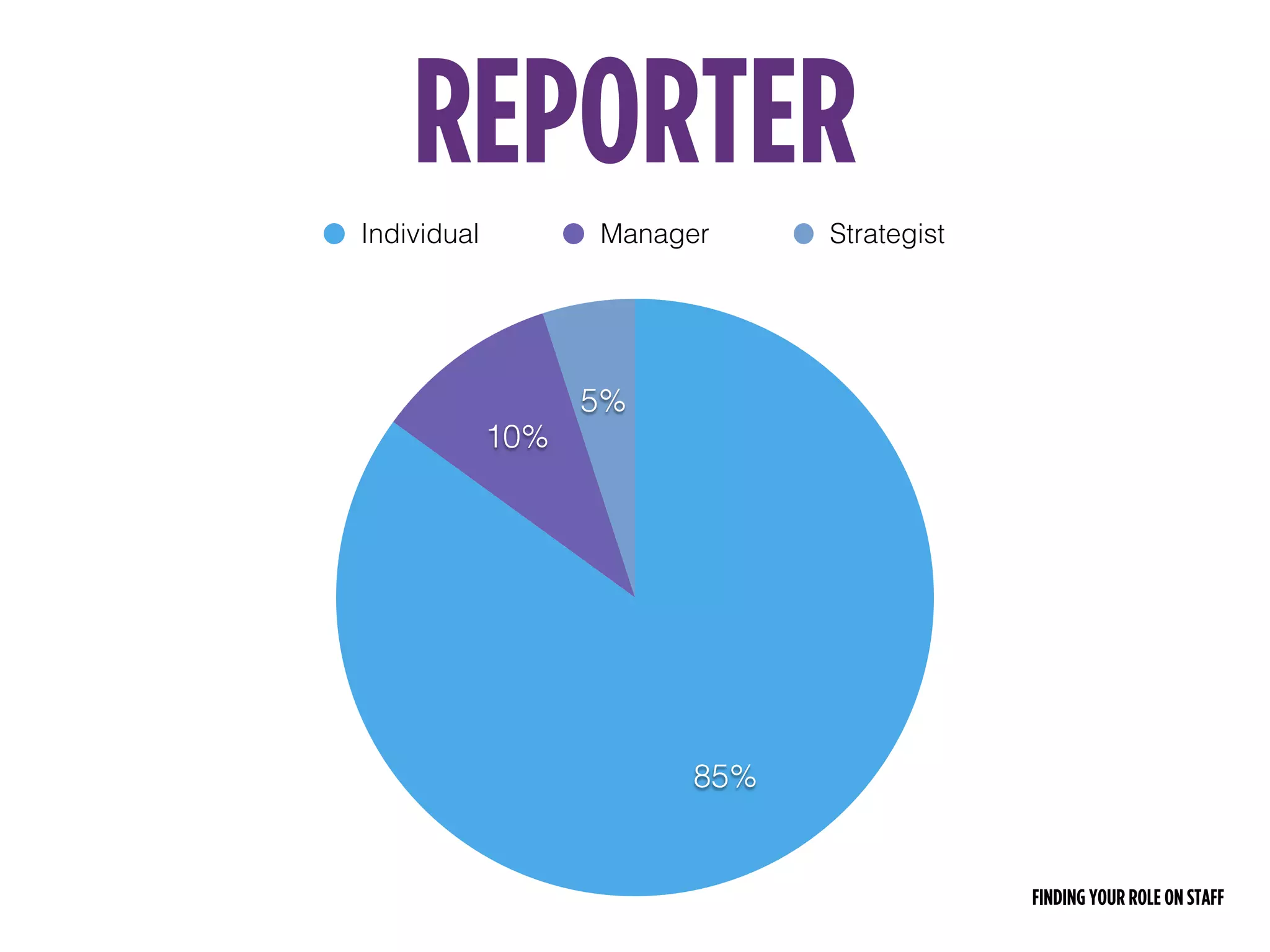
REPORTER
5%
10%
85%
Individual Manager Strategist
FINDING YOUR ROLE ON STAFF
MANAGER
15%
35%
50%
Individual Manager Strategist
FINDING YOUR ROLE ON STAFF
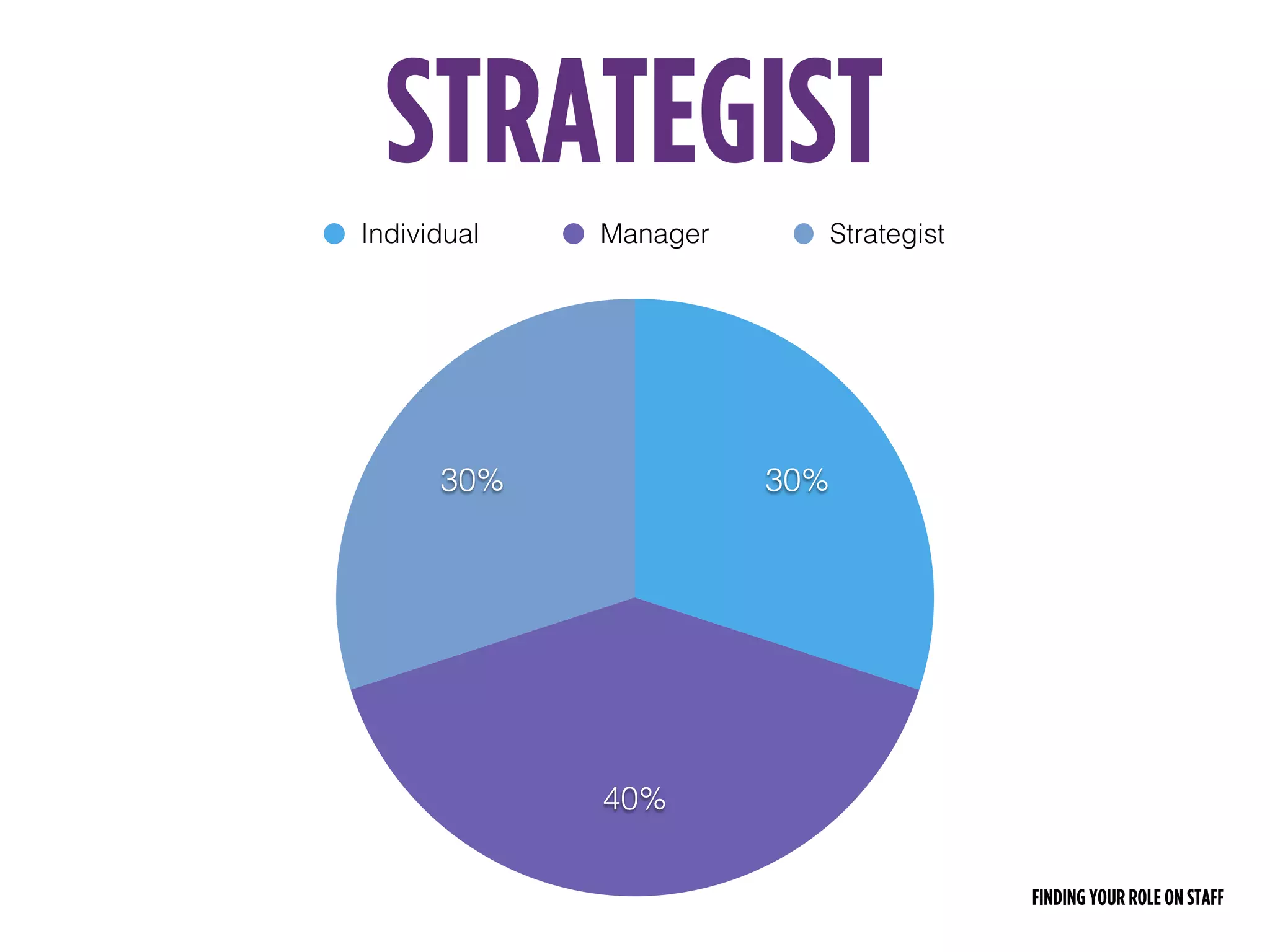
STRATEGIST
30%
40%
30%
Individual Manager Strategist
FINDING YOUR ROLE ON STAFF
THINK

ABOUT
FINDING YOUR ROLE ON STAFF
What are some ways 

to ensure each staff
position has clear
expectations?
FINDING YOUR ROLE ON STAFF
How can each position
have each of the three
roles built in?
QUESTIONS?Logan Aimone, MJE //
logan.aimone@gmail.com // @loganaimone

Finding Your Role on Staff

  • 1.
    YOUR ROLE Logan Aimone,MJE // University High School, University of Chicago Laboratory Schools ON STAFF FINDING
  • 2.
    FINDING YOUR ROLEON STAFF One of the biggest challenges staff members face is knowing their role.
  • 3.
    FINDING YOUR ROLEON STAFF In particular, student leaders can struggle with the transition from member to leader.
  • 4.
    FINDING YOUR ROLEON STAFF The key is understanding that every person has three roles they play.
  • 5.
    FINDING YOUR ROLEON STAFF They play these roles 
 in varying portions depending on the circumstances.
  • 6.
    FINDING YOUR ROLEON STAFF ROLES 
 ON STAFF 3
  • 7.
    FINDING YOUR ROLEON STAFF INDIVIDUAL CONTRIBUTOR •This is the role for doing the work of the team. For news organizations, this is the writing, photography, editing, coaching, design, ad sales. •Everyone is always an individual contributor — at least a little bit and maybe a lot. •Some staff roles are mostly individual contributors: reporters, photographers, ad reps •Leaders contribute as mentors/trainers.
  • 8.
    FINDING YOUR ROLEON STAFF MANAGER •This role manages the work of the team. This generally means ensuring tasks get done, 
 though it’s not just telling others what to do. • Managing means helping contributors to get 
 their work done. Anticipate, avoid, solve problems. •People can be individual contributors and managers. •Section editors will generally be managers, and 
 top editors will also spend a lot of time managing.
  • 9.
    FINDING YOUR ROLEON STAFF STRATEGIST •In this role, a person develops a strategy or vision for the team. • Section editors may envision growth in the section or new ideas for coverage. •Top editors determine where the team is headed. They may innovate, explore new platforms, develop policies, and establish multi-issue or yearlong goals.
  • 10.
    FINDING YOUR ROLEON STAFF What’s the right mix 
 for people 
 on your staff?
  • 11.
    FINDING YOUR ROLEON STAFF SMALL STAFF •Reporters and editors may all have to be individual contributors. •Mostly generalists; few specialists. •Positive: Lots of overlap in tasks, close relationships, possible synergy, easy to enact change •Negative: Less chance for strategy because leaders’ time is spent on individual contributions
  • 12.
    FINDING YOUR ROLEON STAFF LARGE STAFF •Inexperienced staffers focus on their contribution; veteran staffers move into strategic roles •Positive: Skills get developed, people can get in a role that suits them (by training or talent) •Negative: People can get stuck in a role with little chance for movement
  • 13.
    FINDING YOUR ROLEON STAFF REPORTER 5% 10% 85% Individual Manager Strategist
  • 14.
    FINDING YOUR ROLEON STAFF MANAGER 15% 35% 50% Individual Manager Strategist
  • 15.
    FINDING YOUR ROLEON STAFF STRATEGIST 30% 40% 30% Individual Manager Strategist
  • 16.
    FINDING YOUR ROLEON STAFF THINK
 ABOUT
  • 17.
    FINDING YOUR ROLEON STAFF What are some ways 
 to ensure each staff position has clear expectations?
  • 18.
    FINDING YOUR ROLEON STAFF How can each position have each of the three roles built in?
  • 19.
    QUESTIONS?Logan Aimone, MJE// logan.aimone@gmail.com // @loganaimone