TELL THE TRUTH
Logan Aimone, MJE //
University of Chicago Laboratory High School 2024
&MAKE A
DIFFERENCE
MAKE A DIFFERENCE:
ACCURATE, TIMELY COVERAGE
A basic tenet of journalism is to seek
comment from various sides.
But reporters are taught
you’re not supposed to take a side.
Beginning journalists learn
this fundamental lesson:
BE OBJECTIVE.
MAKE A DIFFERENCE:
ACCURATE, TIMELY COVERAGE
But why?
How did we get to the point
where good journalism
means objective journalism?
And how are we defining
“objective” anyway?
MAKE A DIFFERENCE:
ACCURATE, TIMELY COVERAGE
A BIT OF
HISTORY
MAKE A DIFFERENCE:
ACCURATE, TIMELY COVERAGE
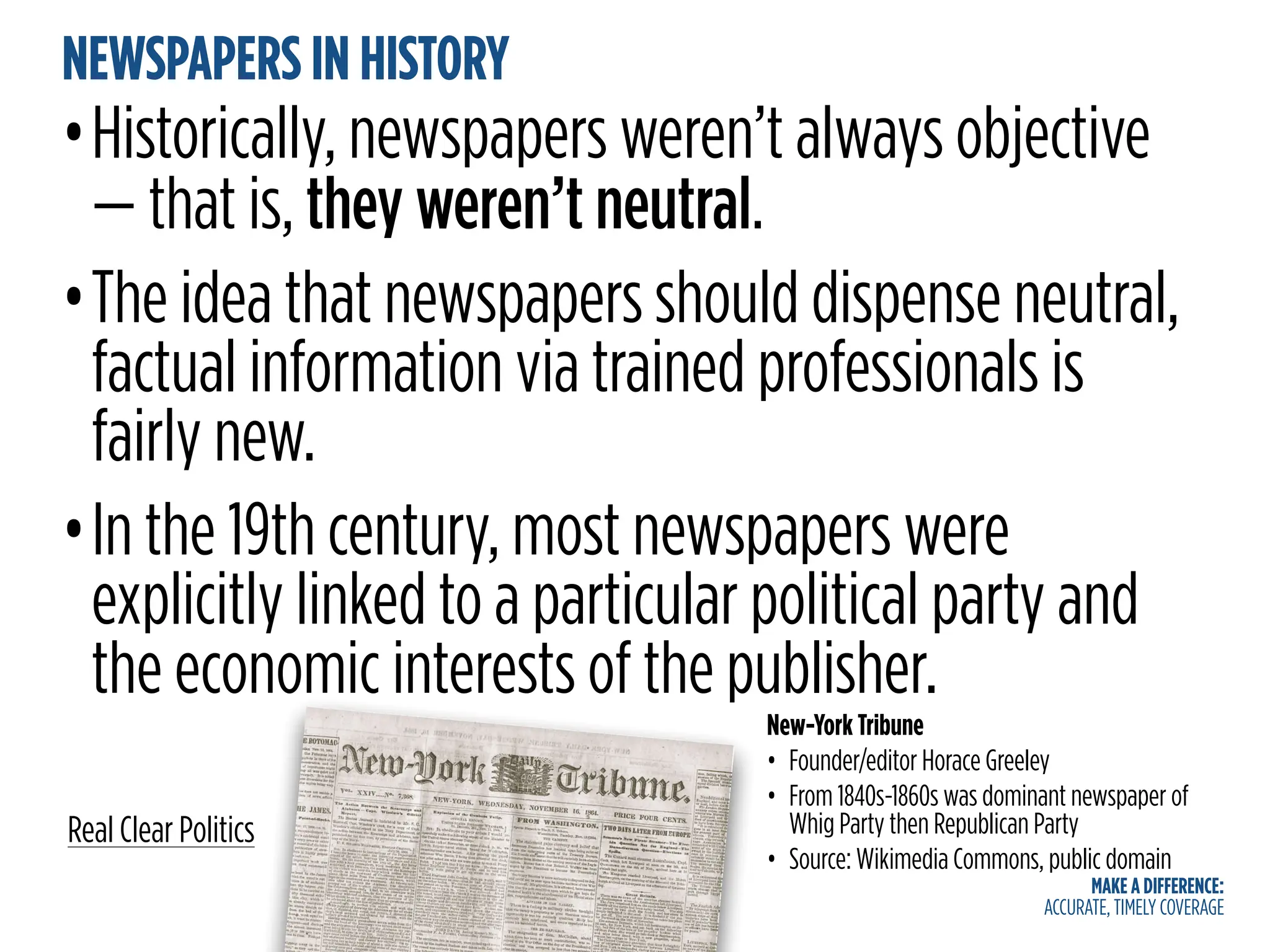
NEWSPAPERS IN HISTORY
•Historically, newspapers weren’t always objective
— that is, they weren’t neutral.
•The idea that newspapers should dispense neutral,
factual information via trained professionals is
fairly new.
•In the 19th century, most newspapers were
explicitly linked to a particular political party and
the economic interests of the publisher.
Real Clear Politics
New-York Tribune
• Founder/editor Horace Greeley
• From 1840s-1860s was dominant newspaper of
Whig Party then Republican Party
• Source: Wikimedia Commons, public domain
MAKE A DIFFERENCE:
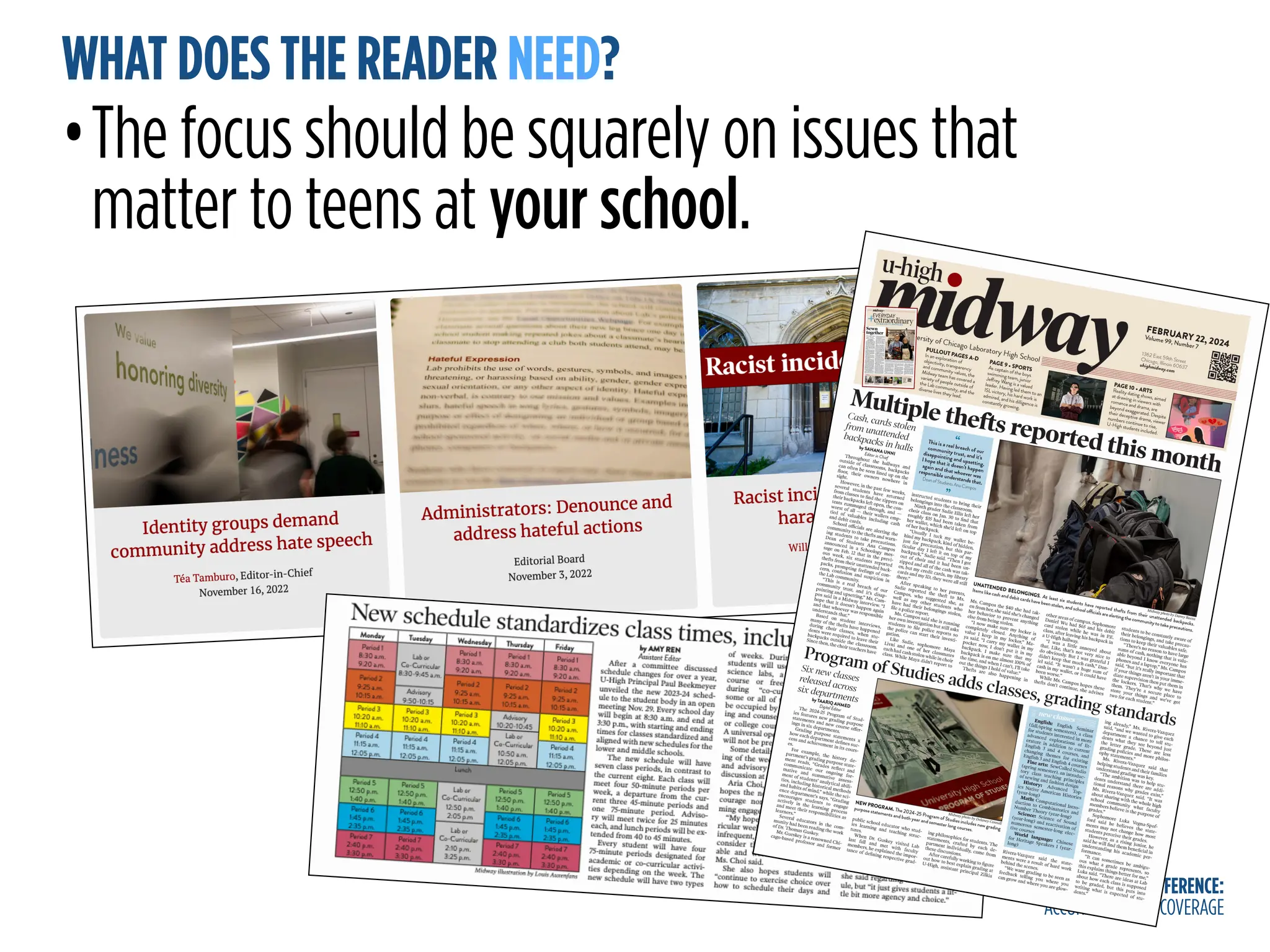
ACCURATE, TIMELY COVERAGE
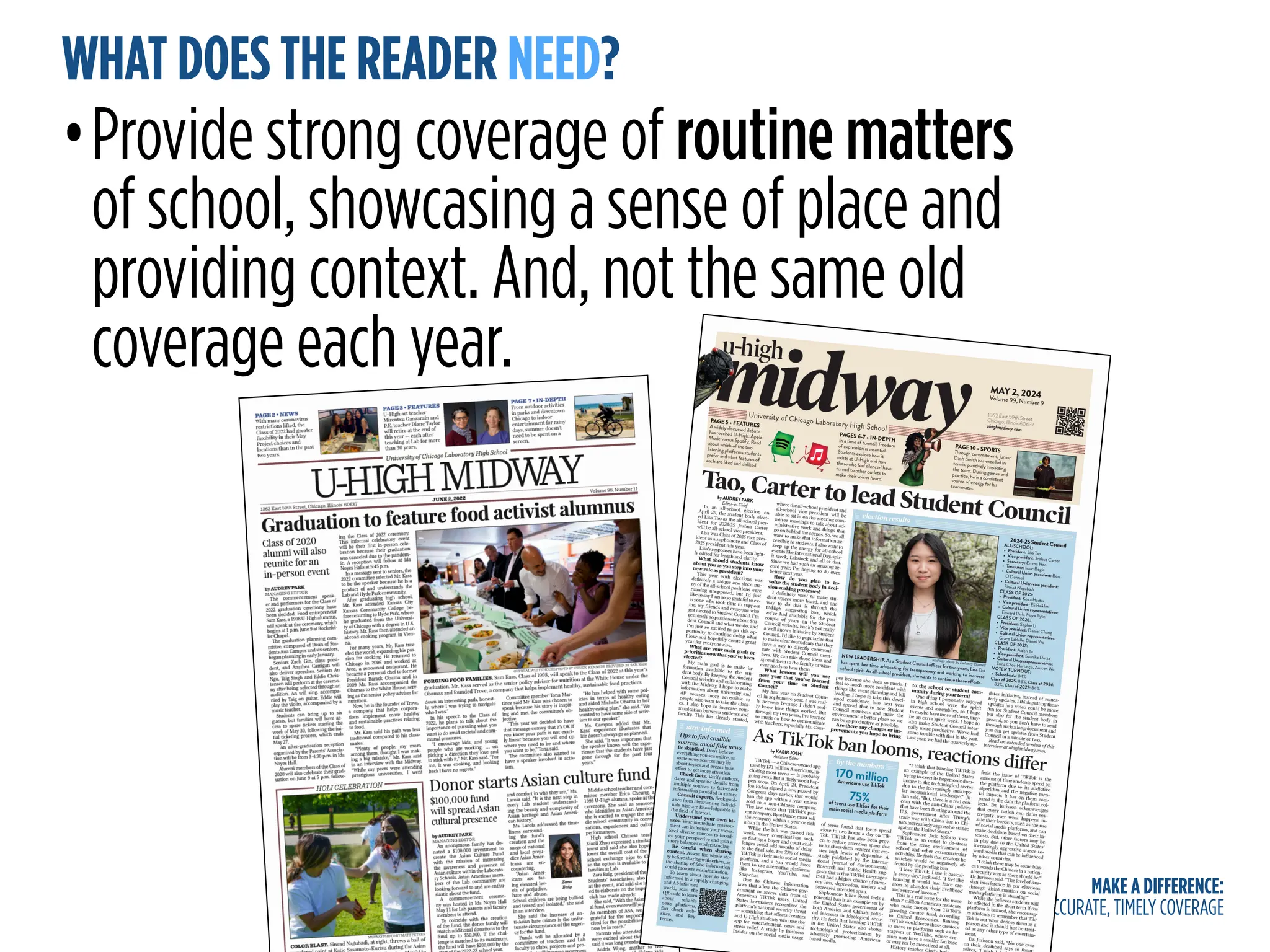
NEWSPAPERS IN HISTORY
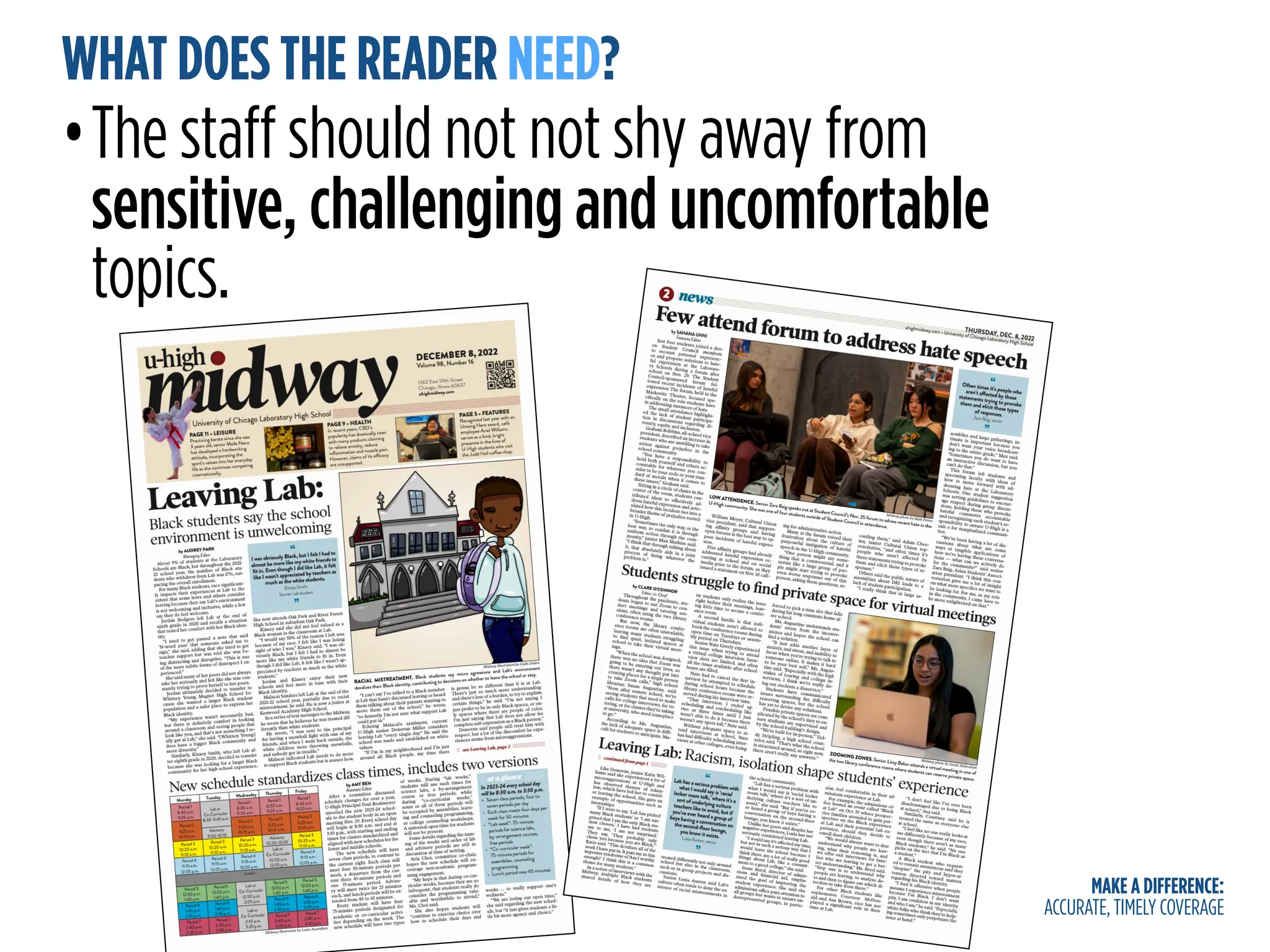
•New newspapers were developing based on
sales and advertising (not funded by parties).
•In the late 19th century, “objective” coverage
slowly began to be defined by the consensus
of the day.
•Because consensus was formed by the
dominant ideology, objectivity was also
defined from that perspective — the
dominant* group or majority.
* Mostly people who were white, male, politically centrist — not people of color,
women, LGBTQ+, religious minorities or people with far left or right political
ideologies.
MAKE A DIFFERENCE:
ACCURATE, TIMELY COVERAGE
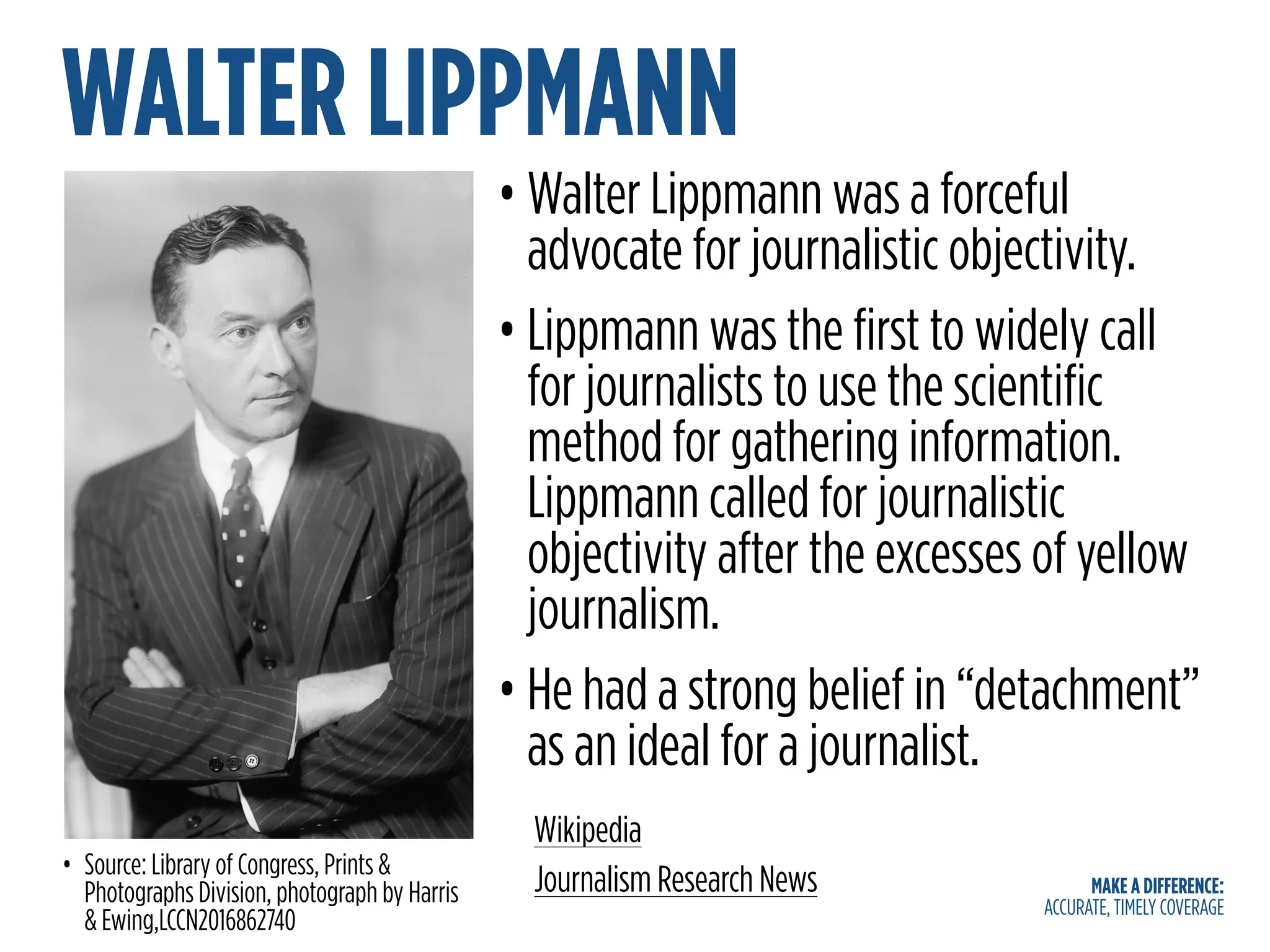
WALTER LIPPMANN
• Walter Lippmann was a forceful
advocate for journalistic objectivity.
• Lippmann was the first to widely call
for journalists to use the scientific
method for gathering information.
Lippmann called for journalistic
objectivity after the excesses of yellow
journalism.
• He had a strong belief in “detachment”
as an ideal for a journalist.
• Source: Library of Congress, Prints &
Photographs Division, photograph by Harris
& Ewing,LCCN2016862740
Wikipedia
Journalism Research News
MAKE A DIFFERENCE:
ACCURATE, TIMELY COVERAGE
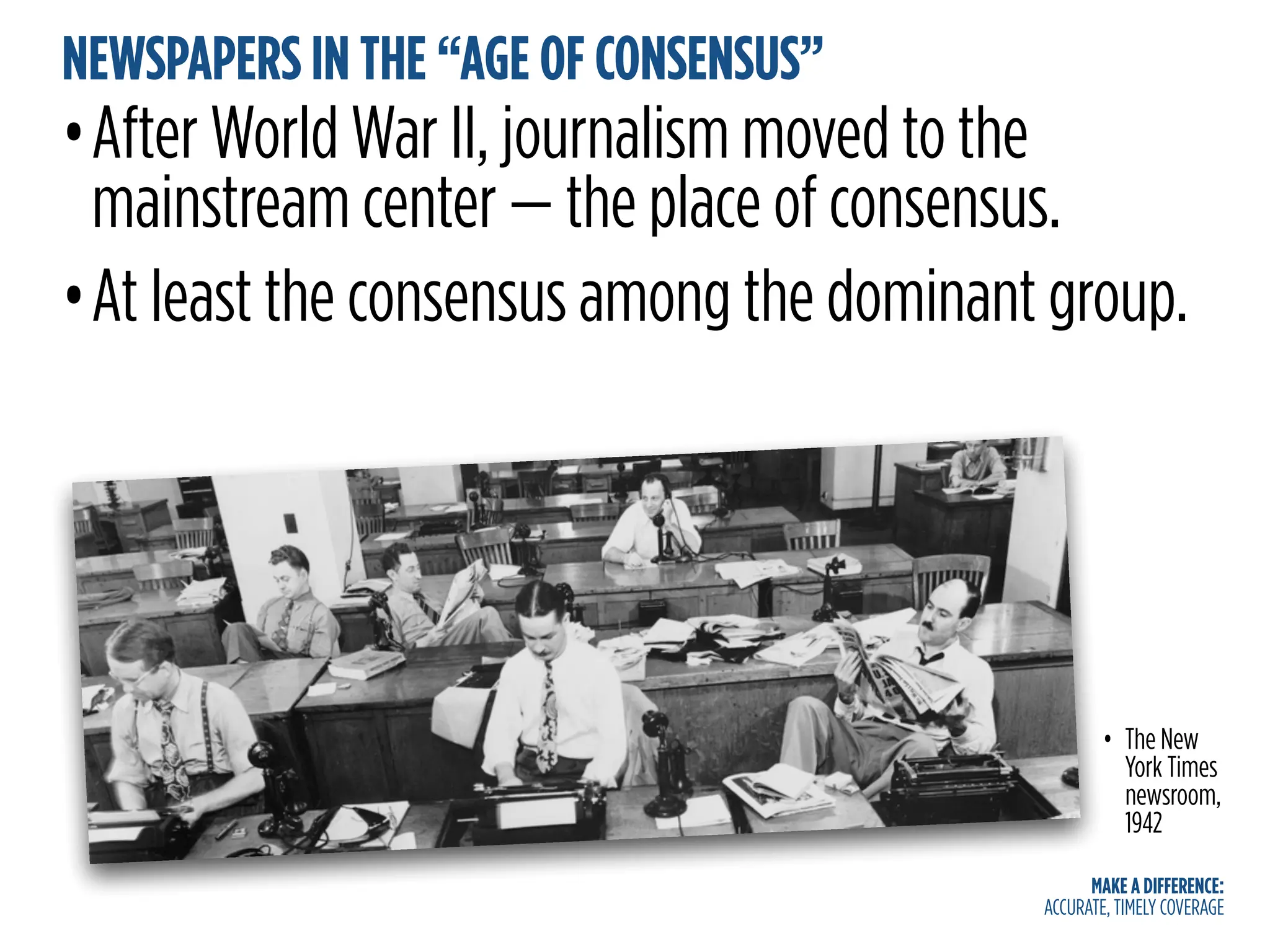
NEWSPAPERS IN THE “AGE OF CONSENSUS”
•After World War II, journalism moved to the
mainstream center — the place of consensus.
•At least the consensus among the dominant group.
• The New
York Times
newsroom,
1942
MAKE A DIFFERENCE:
ACCURATE, TIMELY COVERAGE
“LIBERAL BIAS” AND PERFORMATIVE BALANCE
•Political conservatives in particular believed the
mainstream (centrist) media was biased, so in the
1970s they began to undermine trust.
•“Liberal media bias”
•Rise of new conservative media: talk radio
in the 1980s and Fox News Channel in 1996
•Mainstream news reporters and anchors were
accused of bias, and they didn’t like challenges to
their objectivity. They reacted by offering additional
sources in their coverage — performative balance.
MAKE A DIFFERENCE:
ACCURATE, TIMELY COVERAGE
THE VIEW FROM NOWHERE
•“The view from nowhere” is reporting from
nobody’s view.
•Jay Rosen says that a journalist is placed between
extremes, calling the neither-nor position impartial.
• Rosen: “It has unearned authority in the American
press. If in doing the serious work of journalism —
digging, reporting, verification, mastering a beat —
you develop a view, expressing that view does
not diminish your authority. It may even add to it.
MAKE A DIFFERENCE:
ACCURATE, TIMELY COVERAGE
A
JOURNALIST’S
ROLE
MAKE A DIFFERENCE:
ACCURATE, TIMELY COVERAGE
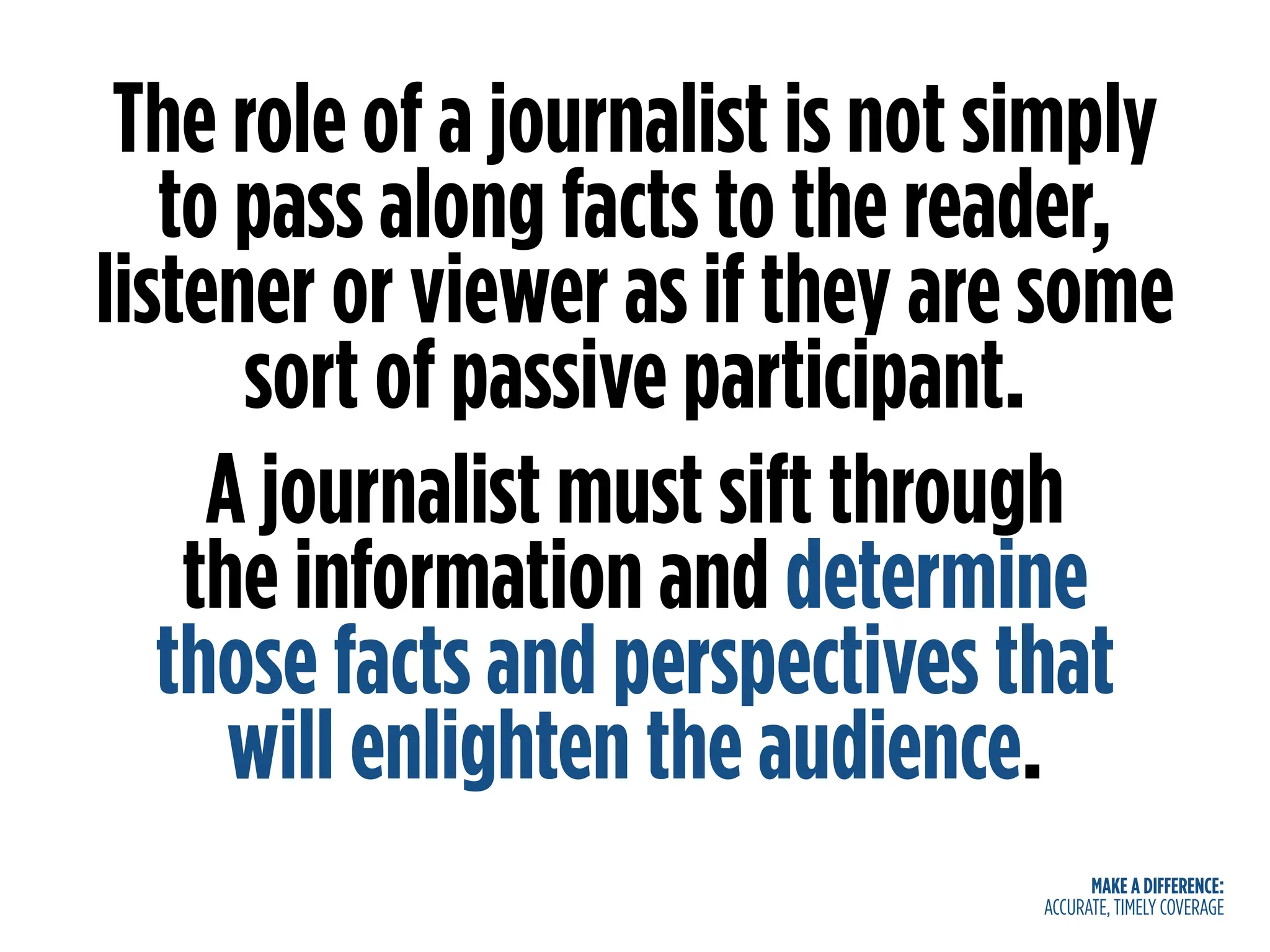
The role of a journalist is not simply
to pass along facts to the reader,
listener or viewer as if they are some
sort of passive participant.
A journalist must sift through
the information and determine
those facts and perspectives that
will enlighten the audience.
MAKE A DIFFERENCE:
ACCURATE, TIMELY COVERAGE
SPJ Code of Ethics
calls on
journalists to be
truth-tellers.
“Conduits of Misinformation” — SPJ Quill, Jan. 6, 2023
MAKE A DIFFERENCE:
ACCURATE, TIMELY COVERAGE
Journalists fail in that role when
they rely on outdated reporting
conventions, such as giving equal
weight to “both sides” of a story
when evidence strongly supports one.
“Conduits of Misinformation” — SPJ Quill, Jan. 6, 2023
MAKE A DIFFERENCE:
ACCURATE, TIMELY COVERAGE
Just because you have provided
two perspectives doesn’t mean
the audience is well served.
They need a journalist to help
them understand the truth.
They need accurate and fair reporting.
MAKE A DIFFERENCE:
ACCURATE, TIMELY COVERAGE
“If someone says it’s raining, and
another person says it’s dry, it’s not
your job to quote them both.
“Your job is to look out the … window
and find out which is true.”
— Jonathan D. Foster, Sheffield University
MAKE A DIFFERENCE:
ACCURATE, TIMELY COVERAGE
ROOTS OF
A NEW
OBJECTIVITY
MAKE A DIFFERENCE:
ACCURATE, TIMELY COVERAGE
As newsrooms
change, is it possible
to be fair and
transparent — and
still be objective?
MAKE A DIFFERENCE:
ACCURATE, TIMELY COVERAGE
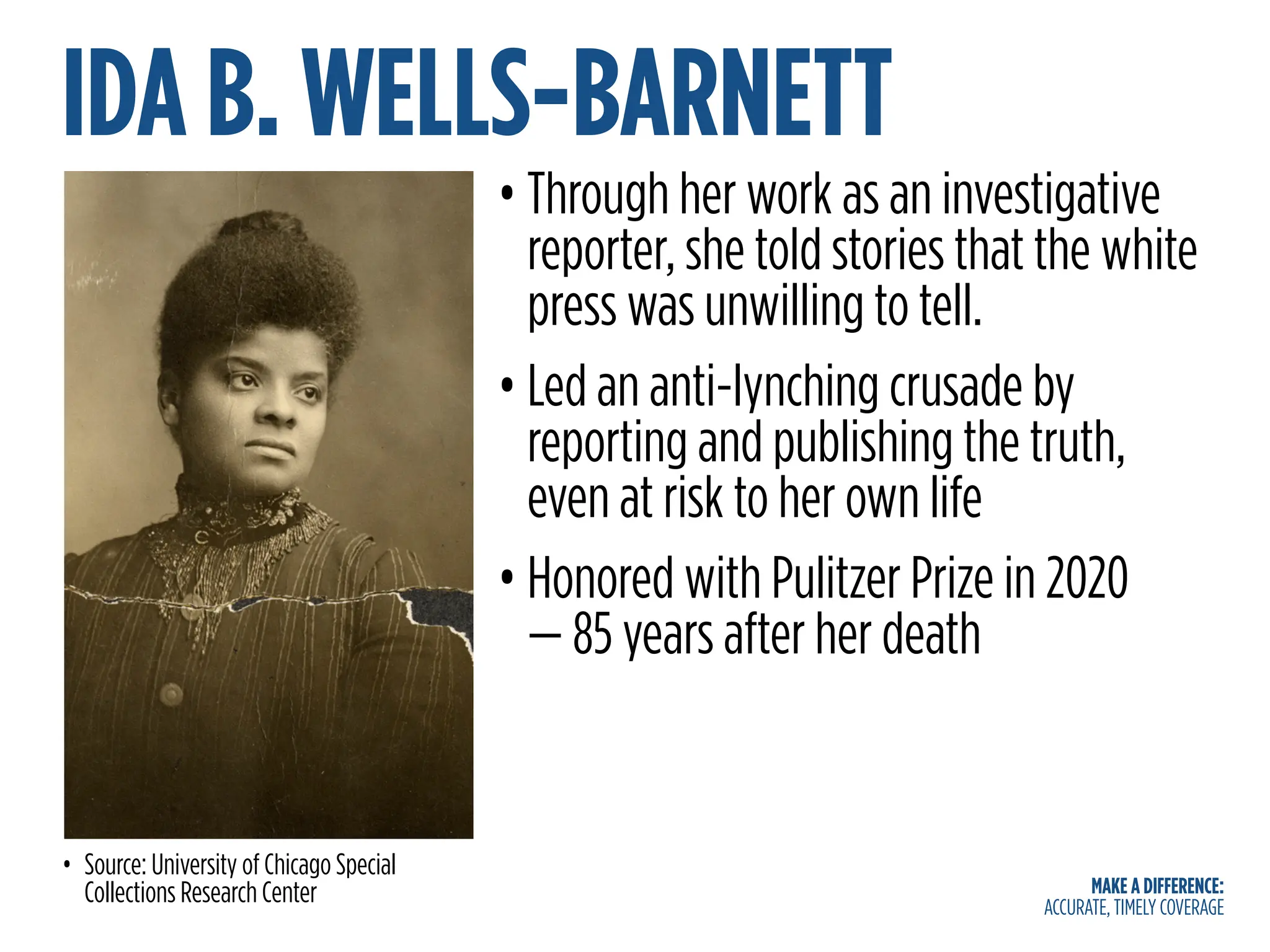
IDA B. WELLS-BARNETT
• Through her work as an investigative
reporter, she told stories that the white
press was unwilling to tell.
• Led an anti-lynching crusade by
reporting and publishing the truth,
even at risk to her own life
• Honored with Pulitzer Prize in 2020
— 85 years after her death
• Source: University of Chicago Special
Collections Research Center
MAKE A DIFFERENCE:
ACCURATE, TIMELY COVERAGE
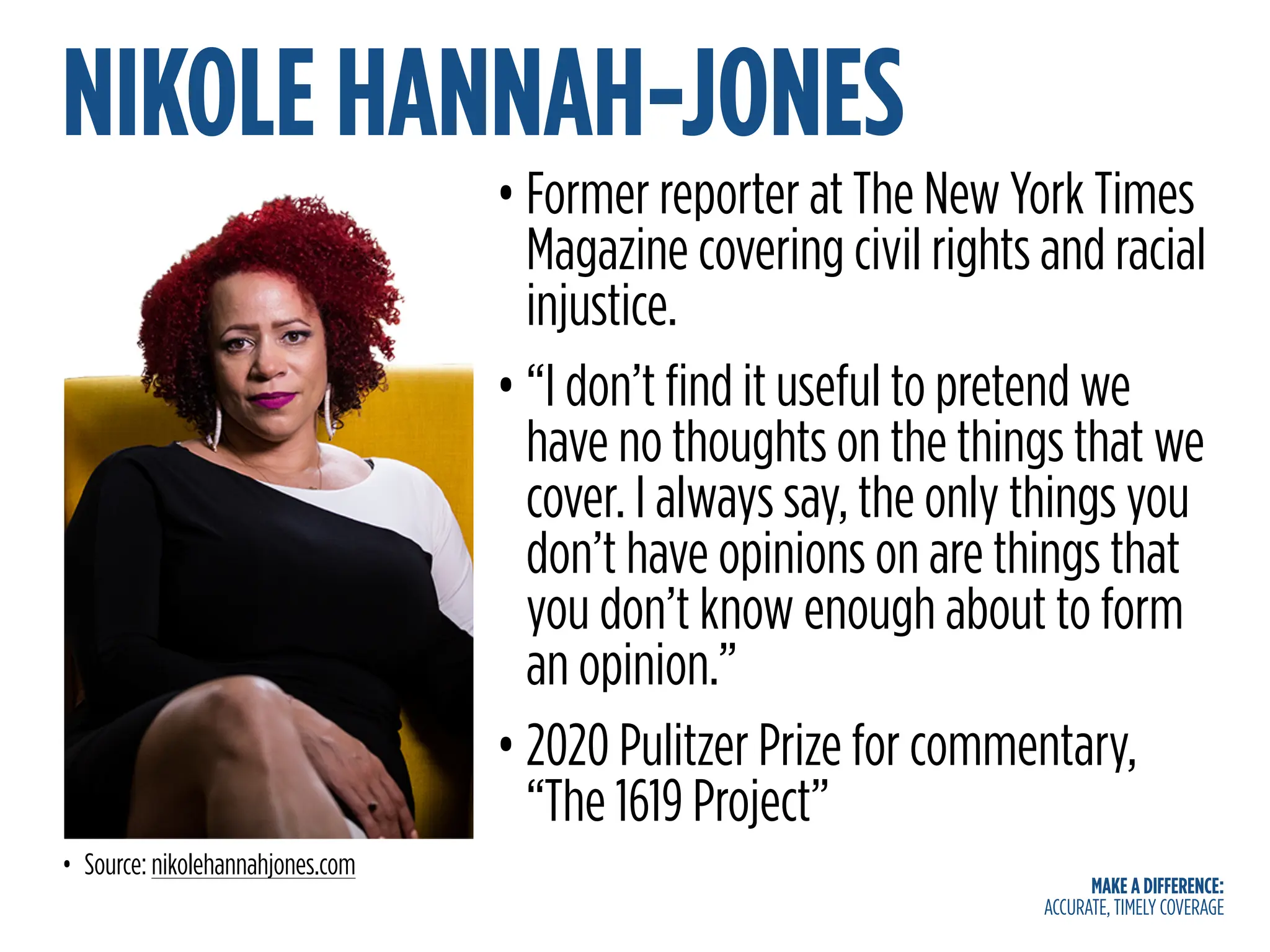
NIKOLE HANNAH-JONES
• Former reporter at The New York Times
Magazine covering civil rights and racial
injustice.
• “I don’t find it useful to pretend we
have no thoughts on the things that we
cover. I always say, the only things you
don’t have opinions on are things that
you don’t know enough about to form
an opinion.”
• 2020 Pulitzer Prize for commentary,
“The 1619 Project”
• Source: nikolehannahjones.com
MAKE A DIFFERENCE:
ACCURATE, TIMELY COVERAGE
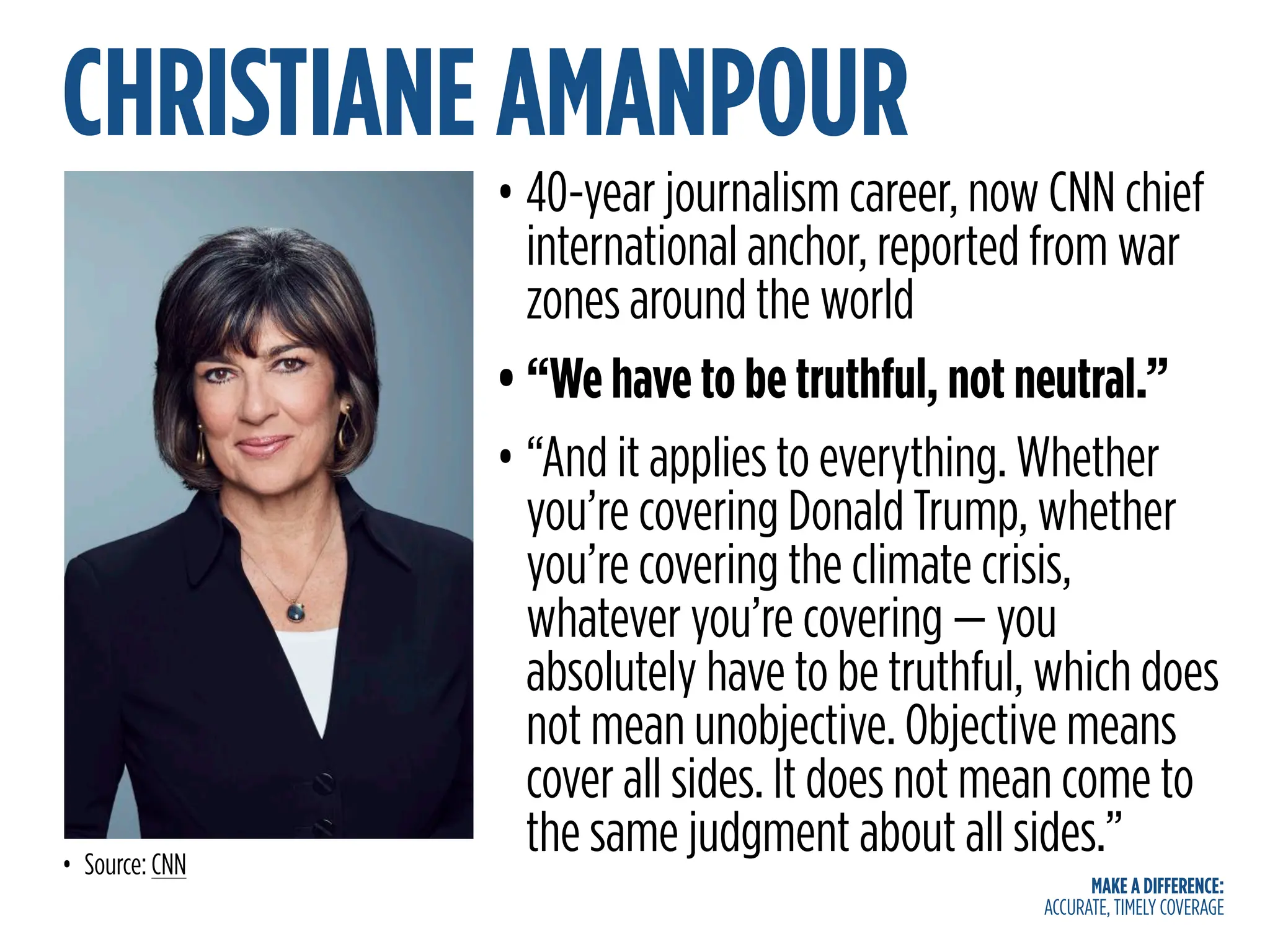
CHRISTIANE AMANPOUR
• 40-year journalism career, now CNN chief
international anchor, reported from war
zones around the world
• “We have to be truthful, not neutral.”
• “And it applies to everything. Whether
you’re covering Donald Trump, whether
you’re covering the climate crisis,
whatever you’re covering — you
absolutely have to be truthful, which does
not mean unobjective. Objective means
cover all sides. It does not mean come to
the same judgment about all sides.”
• Source: CNN
MAKE A DIFFERENCE:
ACCURATE, TIMELY COVERAGE
Stephen J.A. Ward, media ethics expert
“Objectivity is not about perfect neutrality or the
elimination of interpretation. Objectivity refers to a
person’s willingness to use objective methods to test
interpretations for bias or inaccuracies. Objectivity as a
method is compatible with journalism that interprets
and takes perspectives.
“Every day, scientists adopt the objective stance when
they use methods to test their hypotheses about
phenomena. The same stance is available for
journalists.”
MAKE A DIFFERENCE:
ACCURATE, TIMELY COVERAGE
Nikole Hannah-Jones, journalist and educator
“Journalism is not stenography. We don’t
simply say, ‘Donald Trump said this. Nancy
Pelosi said this.’ That should not be our role.
Our role should actually be at getting at the
truth and providing context and analysis so
people understand what this means.”
Appearance on NPR's “1A,” June 9, 2020
MAKE A DIFFERENCE:
ACCURATE, TIMELY COVERAGE
Can you be
objective?
Whose
objectivity?
MAKE A DIFFERENCE:
ACCURATE, TIMELY COVERAGE
COVERAGE
BEYOND
“BOTH SIDES”
MAKE A DIFFERENCE:
ACCURATE, TIMELY COVERAGE
AVOID “BOTH SIDES”
STORYTELLING
1Abandon performative balance
when covering important, timely
topics.
MAKE A DIFFERENCE:
ACCURATE, TIMELY COVERAGE
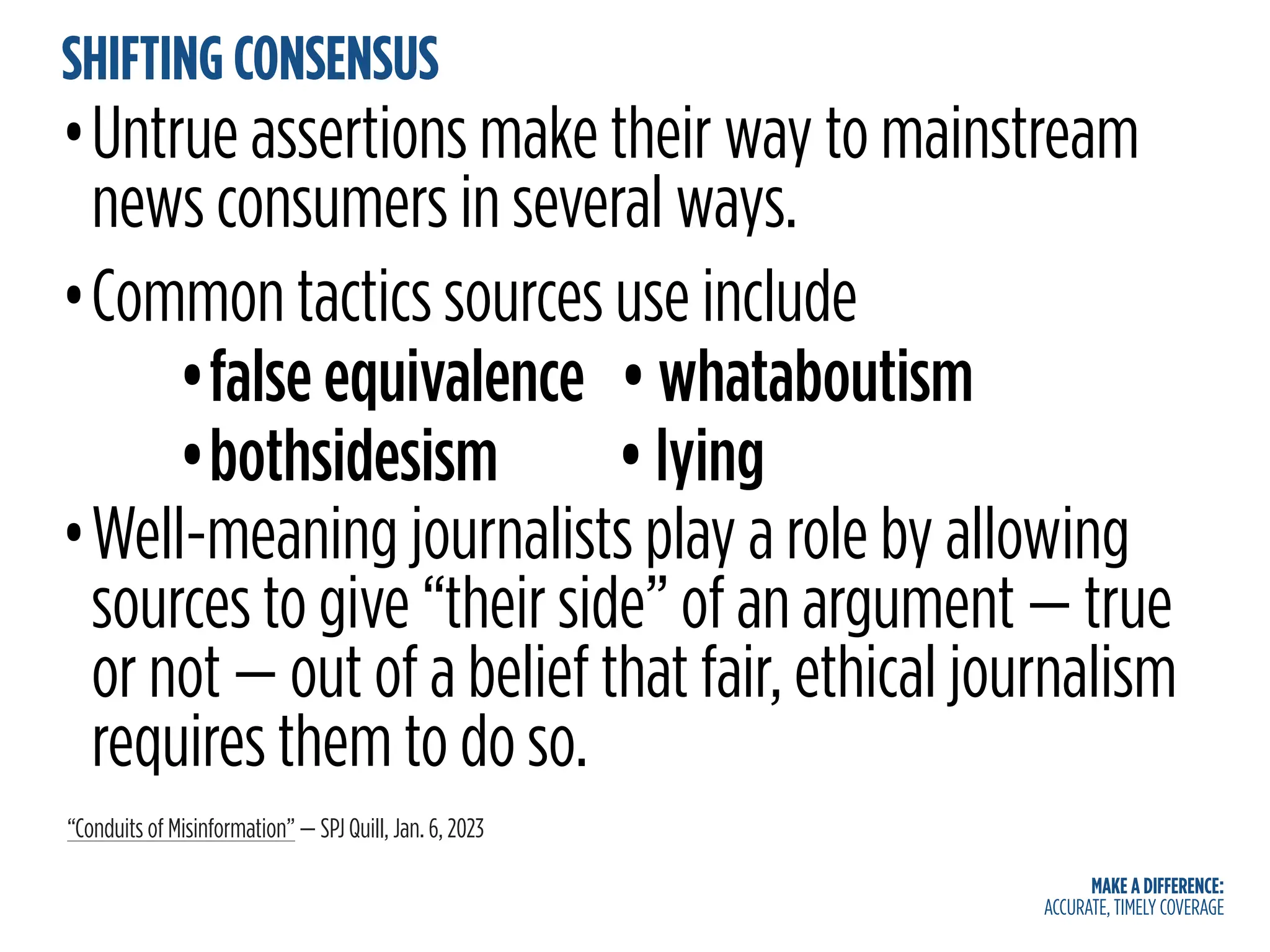
SHIFTING CONSENSUS
•Untrue assertions make their way to mainstream
news consumers in several ways.
•Common tactics sources use include
•false equivalence • whataboutism
•bothsidesism • lying
•Well-meaning journalists play a role by allowing
sources to give “their side” of an argument — true
or not — out of a belief that fair, ethical journalism
requires them to do so.
“Conduits of Misinformation” — SPJ Quill, Jan. 6, 2023
MAKE A DIFFERENCE:
ACCURATE, TIMELY COVERAGE
PRO-VERIFICATION
PRO-TRUTH
2As a gatekeeper, one role of a
journalist is to be pro-democracy.
Accuracy is the goal.
MAKE A DIFFERENCE:
ACCURATE, TIMELY COVERAGE
PRO-VERIFICATION & PRO-TRUTH
•Provide context.
•Don’t just be a stenographer.
•Ask questions to get at the truth.
•Use credibility, authority and power to move
the public.
MAKE A DIFFERENCE:
ACCURATE, TIMELY COVERAGE
NOT THE ODDS
BUT THE STAKES
3That is, focus on impact and
consequences.
Coverage of issues should be more
than binary winner-loser.
MAKE A DIFFERENCE:
ACCURATE, TIMELY COVERAGE
NOT THE ODDS BUT THE STAKES
•NYU professor Jay Rosen, a media analyst and
critic, advocates for a “citizens agenda”
approach to campaign coverage.
•It revolves around a single question:
“What do you want the candidates to be
discussing as they compete for votes?”
•The same lens can be used to cover any issue:
What is the impact of this policy/decision/vote
on our readers (or a subset of them)?
MAKE A DIFFERENCE:
ACCURATE, TIMELY COVERAGE
STRIVE FOR MORE
FAIRNESS AND
TRANSPARENCY
4Your actions should be
transparent and defensible.
Disclose conflicts of interest.
MAKE A DIFFERENCE:
ACCURATE, TIMELY COVERAGE
STRIVE FOR FAIRNESS AND TRANSPARENCY
•Maintain the watchdog function. It’s
important.
•Provide sources the opportunity to respond.
•You must be accountable to your audience.
•Credibility will be strong — readers
(and sources) know and trust the news staff.
MAKE A DIFFERENCE:
ACCURATE, TIMELY COVERAGE
BE SKEPTICAL
OF INSTITUTIONS
AND MOTIVES
5What is the claim?
By whom?
MAKE A DIFFERENCE:
ACCURATE, TIMELY COVERAGE
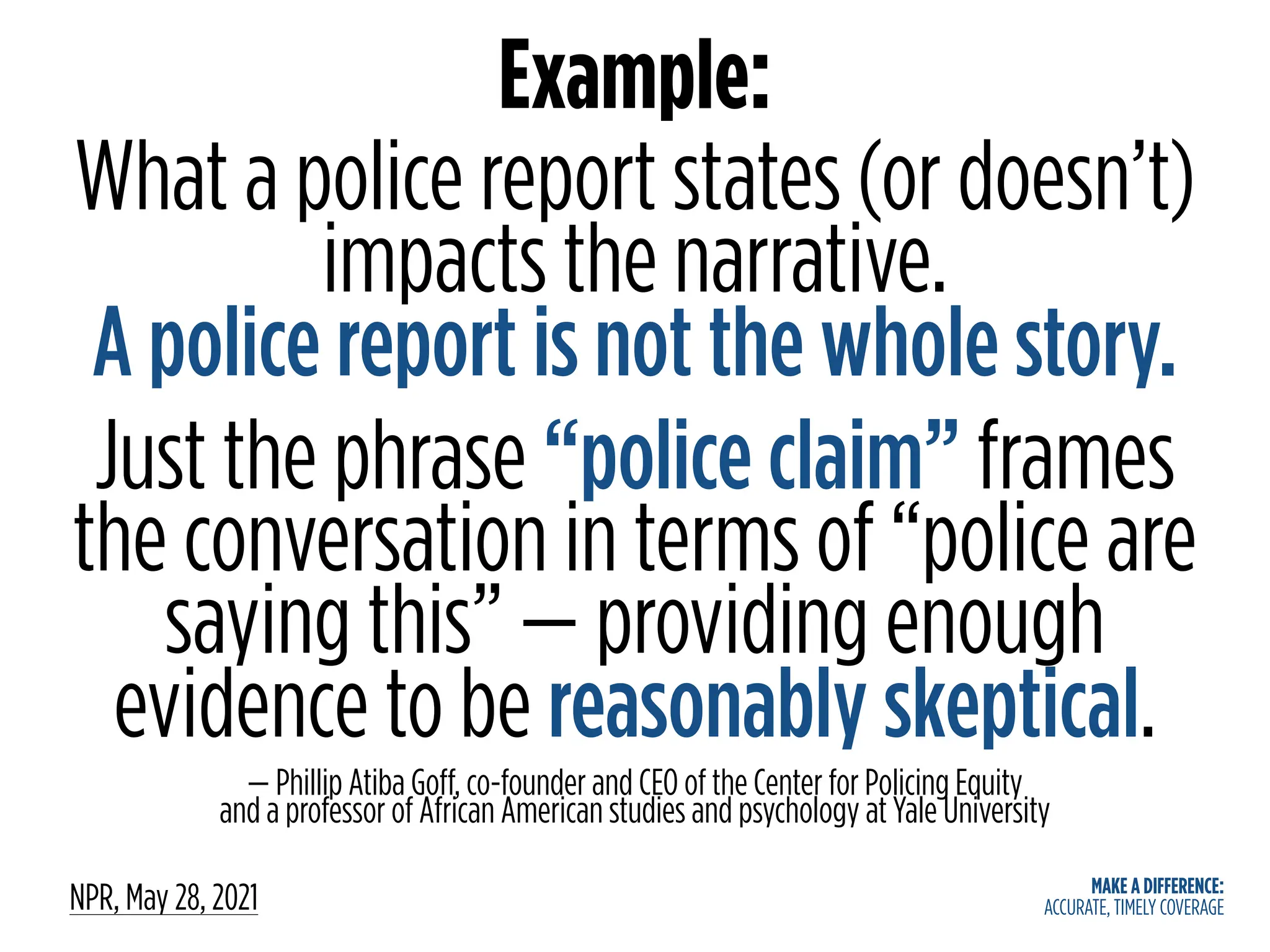
Example:
What a police report states (or doesn’t)
impacts the narrative.
A police report is not the whole story.
Just the phrase “police claim” frames
the conversation in terms of “police are
saying this” — providing enough
evidence to be reasonably skeptical.
— Phillip Atiba Goff, co-founder and CEO of the Center for Policing Equity
and a professor of African American studies and psychology at Yale University
NPR, May 28, 2021
MAKE A DIFFERENCE:
ACCURATE, TIMELY COVERAGE
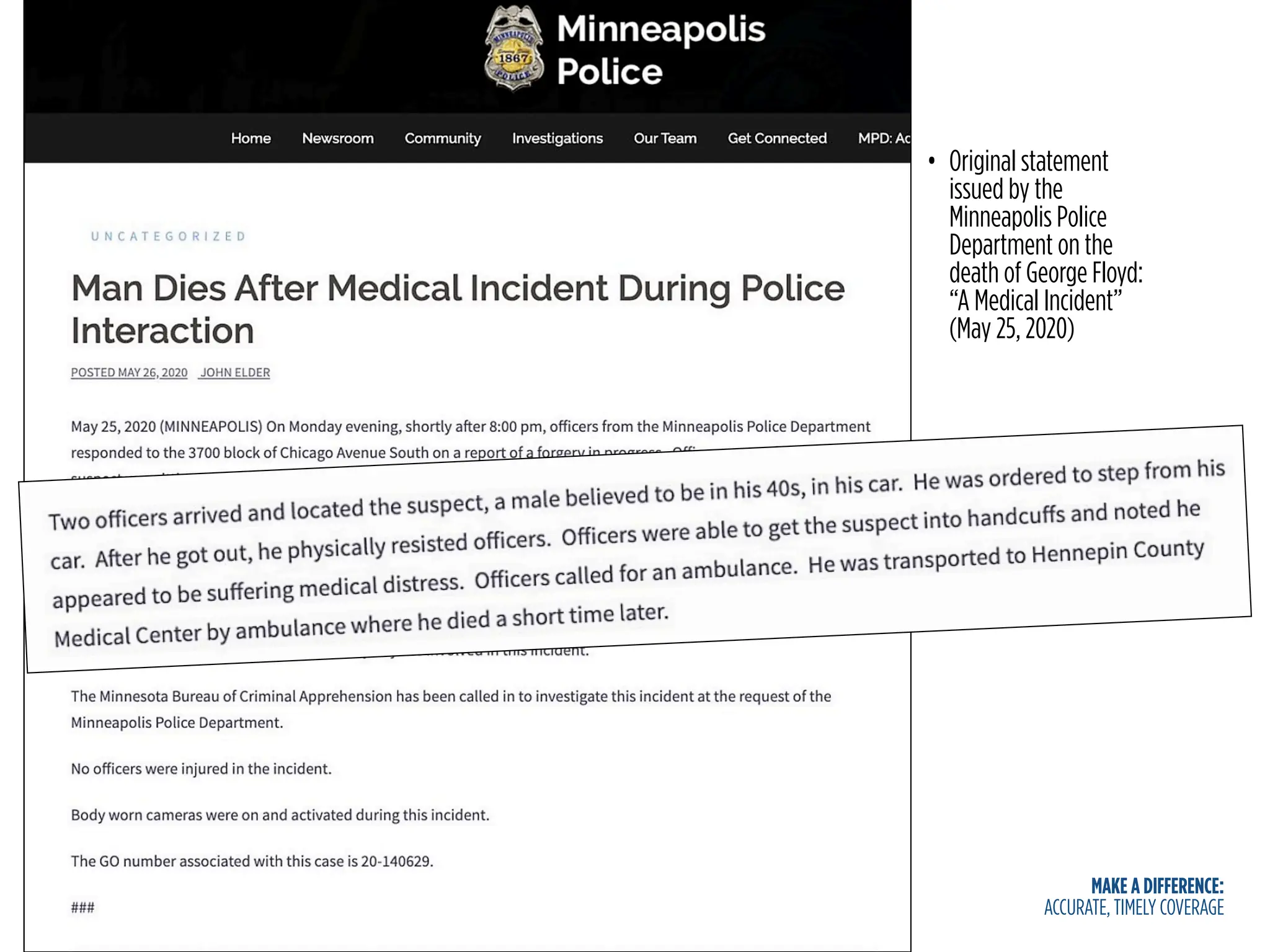
• Original statement
issued by the
Minneapolis Police
Department on the
death of George Floyd:
“A Medical Incident”
(May 25, 2020)
MAKE A DIFFERENCE:
ACCURATE, TIMELY COVERAGE
IDENTIFY AND USE
SOURCES WHO PROVIDE
COMPLETE PERSPECTIVE
6Not just sources of convenience:
reporter’s friends, institutional
leaders, well-known to give a
“good quote”
MAKE A DIFFERENCE:
ACCURATE, TIMELY COVERAGE
GIVE READERS
WHAT THEY WANT
7Readers want a diverse mix
of consequential, relevant
topics presented each edition.
MAKE A DIFFERENCE:
ACCURATE, TIMELY COVERAGE
WHAT DOES THE READER WANT?
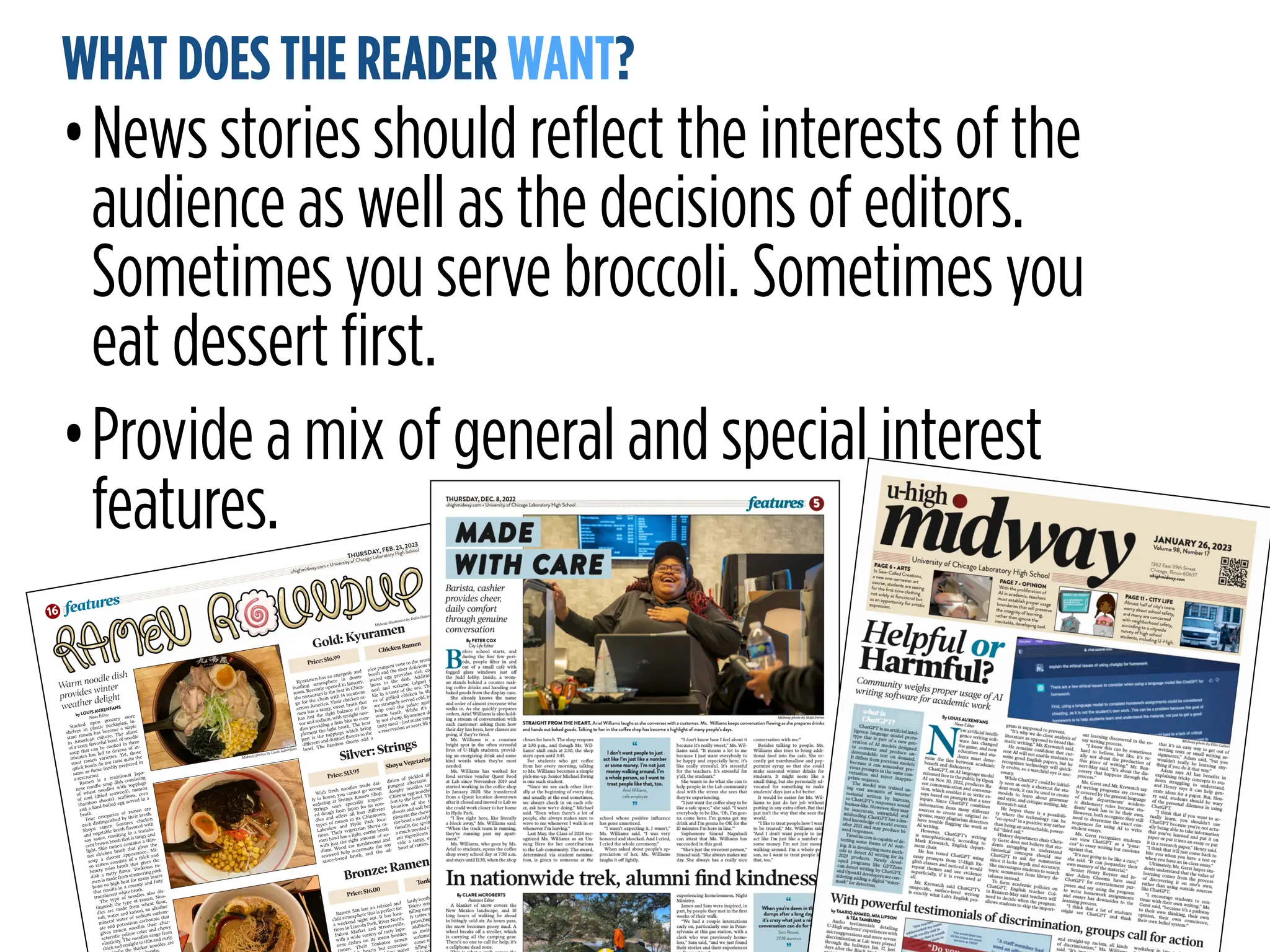
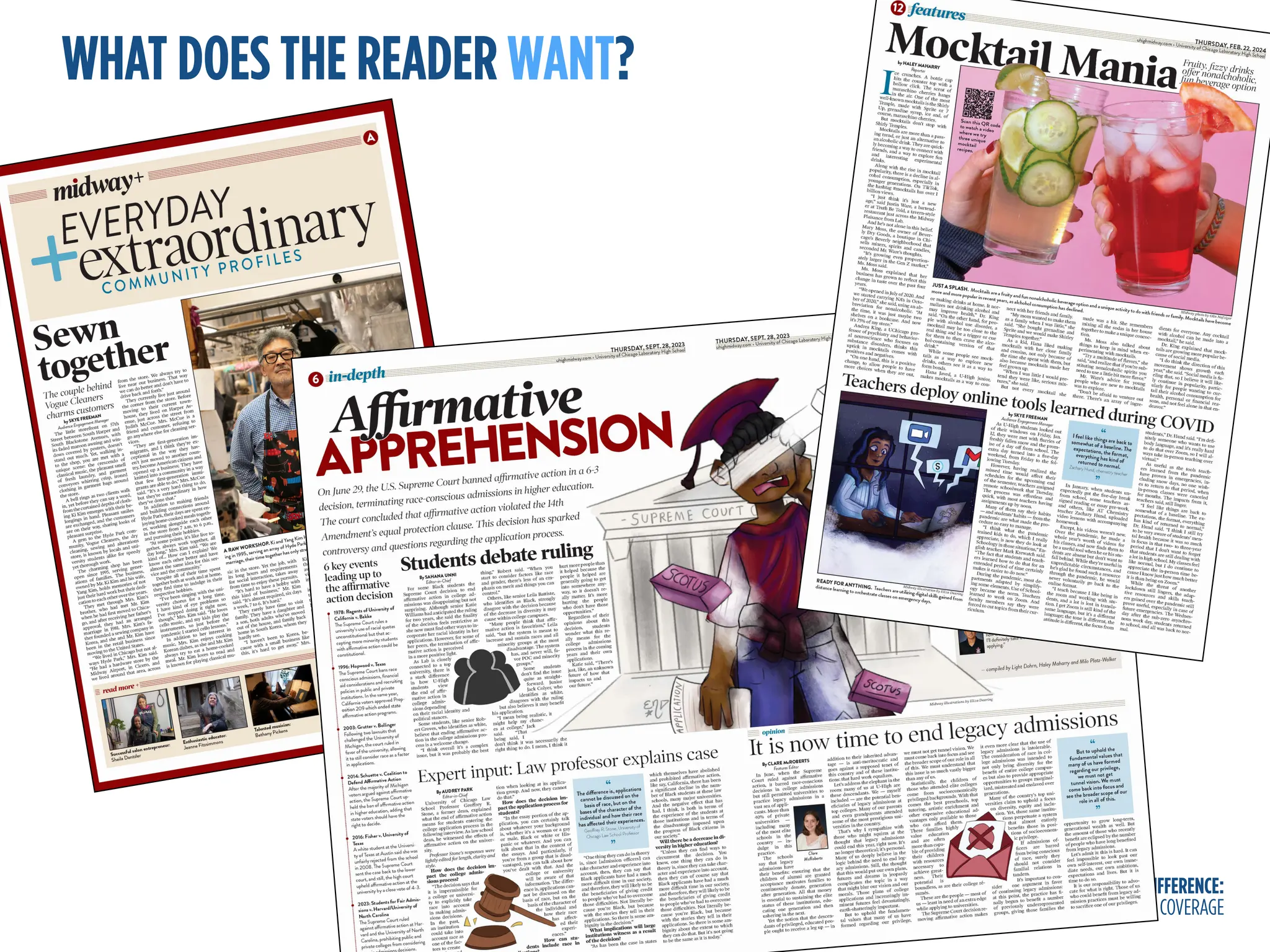
•News stories should reflect the interests of the
audience as well as the decisions of editors.
Sometimes you serve broccoli. Sometimes you
eat dessert first.
•Provide a mix of general and special interest
features. THURSDAY, FEB. 23, 2023
uhighmidway.com • University of Chicago Laboratory High School
features
16
by LOUIS AUXENFANS
News Editor
Stacked upon grocery store
shelves in plastic packaging, in-
stant ramen has become a staple
in American culture. The allure
of a tasty, flavorful bowl of noodle
soup that can be cooked in three
minutes has led to dozens of in-
stant ramen varieties. Yet, those
quick bowls do not taste quite the
same as those freshly prepared in
a restaurant.
Ramen is a traditional Japa-
nese noodle soup dish consisting
of wheat noodles with toppings
of nori (dried seaweed), menma
(bamboo shoots), scallions, corn
and a hard-boiled egg served in a
broth.
Four categories of ramen are
each distinguished by their broth.
Shoyu ramen features chicken
and vegetable broth flavored with
soy sauce, resulting in a translu-
cent brown broth that is tangy and
light. Shio ramen contains a thin-
ner chicken broth that gives the
soup a clearer appearance. Mi-
so ramen consists of a thick and
hearty miso broth that gives the
dish a nutty flavor. Tonkotsu ra-
men is made from simmering pork
bone on high heat for many hours
that results in a creamy and fatty
translucent white broth.
The type of noodles also dis-
tinguish the type of ramen. Noo-
dles are made from wheat flour,
salt, water and kansui, an alkaline
mineral water of sodium carbon-
ate and potassium carbonate that
gives ramen noodles their char-
acteristic yellow color and chewy
elasticity. The noodles range from
thick and straight to thin and curly.
the thicker noodles are
s.
Gold: Kyuramen
Warm noodle dish
provides winter
weather delight
Kyuramen has an energetic and
bustling atmosphere in down-
town. Recently opened in January,
the restaurant is the first in Chica-
go for the chain with 14 locations
across America. Their chicken ra-
men has a tangy, sweet broth that
has just the right balance of fla-
vor and sodium, with straight noo-
dles providing a firm bite to com-
plement the light broth. The best
part is the toppings which bring
different and distinct flavors to the
bowl. The bamboo shoots add a
nice pungent taste to the aromatic
broth and the uber delicious mar-
inated egg provides rich cream-
iness to the dish. Additionally,
nori and wakame (algae) sprin-
kle in a taste of the sea. The slic-
es of grilled chicken in the dish
are strangely served cold, but they
help cool the palate against the
warm broth. While it’s certain-
ly not cheap, Kyuramen delivers a
tasty meal – just make sure to book
a reservation as seats fill up fast.
Silver: Strings
Bronze: Ramen San
With fresh noodles made dai-
ly in house, you cannot go wrong
ordering at Strings Ramen Shop.
Strings uses specially import-
ed dough from Japan for its noo-
dles and offers all four different
types of ramen in its Chinatown,
Lakeview and Hyde Park loca-
tions. Their vegetarian Shoyu ra-
men bowl has a light, earthy broth
with just the right amount of so-
dium. Wood ear mushrooms and
seaweed help accentuate the soy
sauce-based broth, and the ad-
dition of pickled ginger gives a
pungent aftertaste. The straight,
doughy noodles taste similar to
Chinese egg noodles, adding com-
fort to the bowl. The texture com-
bination of the tender bamboo
shoots and soft bean sprouts com-
plement the chewy noodles to give
the bowl a satisfying feeling. Addi-
tionally, the sprinkles of corn adds
a much needed crunch. The differ-
ent ingredients work well to pro-
vide a tangy, earthy and healthy
bowl of ramen.
Ramen San has an relaxed and
chill atmosphere that is perfect for
a weekend night out. It has loca-
tions in Lincoln Park, River North,
Fulton Market and Streeterville,
with a wide variety of tasty Japa-
nese dishes on its menu besides
amen. Their Tonkotsu ramen
rty but excessive-
ater
lardy broth combined with the soft
Tokyo wavy noodles makes for a
filling meal. The thin-cut pork bel-
ly tastes succulent and butter-like,
providing an extra richness. In
addition, other elements such
as molten egg, bamboo shoots,
wakame seaweed and fresh garlic
come together well to make a ful-
filling dish. The only downside to
rty, fragrant bowl of ramen
h.
Midway illustration by Dalin Dohrn
Midway photos by Louis Auxenfans
Price: $16.99
Chicken Ramen
Price: $13.95
Shoyu Vegetarian Ramen
Price: $16.00
Tonkotsu Ramen
MAKE A DIFFERENCE:
ACCURATE, TIMELY COVERAGE
WHAT DOES THE READER WANT?
MAKE A DIFFERENCE:
ACCURATE, TIMELY COVERAGE
WHAT DOES THE READER WANT?
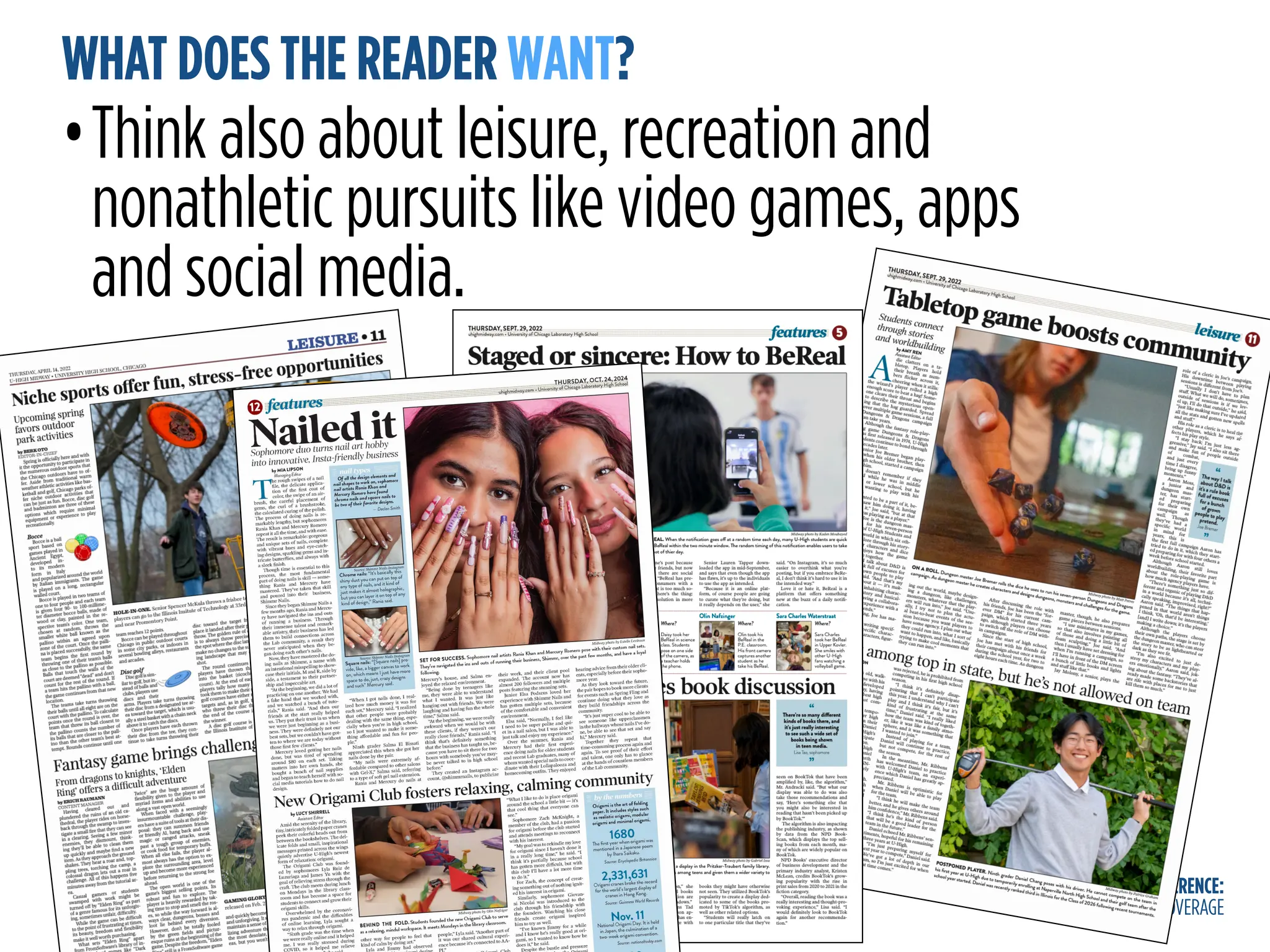
•Think also about leisure, recreation and
nonathletic pursuits like video games, apps
and social media.
MAKE A DIFFERENCE:
ACCURATE, TIMELY COVERAGE
WHAT DOES THE READER WANT?
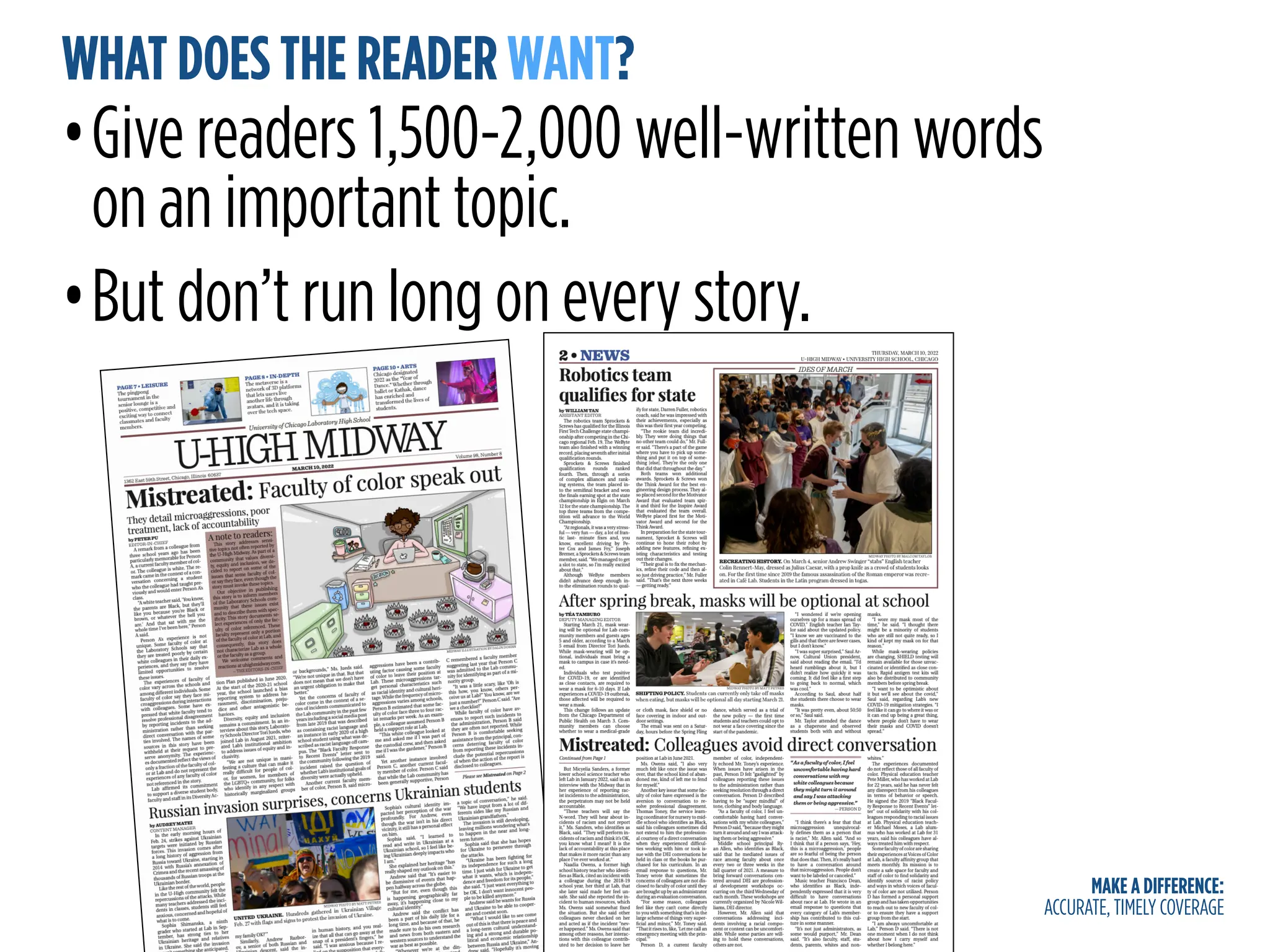
•Give readers 1,500-2,000 well-written words
on an important topic.
•But don’t run long on every story.
MAKE A DIFFERENCE:
ACCURATE, TIMELY COVERAGE
GIVE READERS
WHAT THEY NEED
8Help the reader see what matters.
MAKE A DIFFERENCE:
ACCURATE, TIMELY COVERAGE
WHAT DOES THE READER NEED?
•The focus should be squarely on issues that
matter to teens at your school.
MAKE A DIFFERENCE:
ACCURATE, TIMELY COVERAGE
WHAT DOES THE READER NEED?
•Provide strong coverage of routine matters
of school, showcasing a sense of place and
providing context. And, not the same old
coverage each year.
MAKE A DIFFERENCE:
ACCURATE, TIMELY COVERAGE
WHAT DOES THE READER NEED?
•The staff should not not shy away from
sensitive, challenging and uncomfortable
topics.
Logan Aimone, MJE //
logan.aimone@gmail.com // @loganaimone
QUESTIONS?
Do you have any

Tell the Truth and Make a Difference 24.01

  • 1.
    TELL THE TRUTH LoganAimone, MJE // University of Chicago Laboratory High School 2024 &MAKE A DIFFERENCE
  • 2.
    MAKE A DIFFERENCE: ACCURATE,TIMELY COVERAGE A basic tenet of journalism is to seek comment from various sides. But reporters are taught you’re not supposed to take a side. Beginning journalists learn this fundamental lesson: BE OBJECTIVE.
  • 3.
    MAKE A DIFFERENCE: ACCURATE,TIMELY COVERAGE But why? How did we get to the point where good journalism means objective journalism? And how are we defining “objective” anyway?
  • 4.
    MAKE A DIFFERENCE: ACCURATE,TIMELY COVERAGE A BIT OF HISTORY
  • 5.
    MAKE A DIFFERENCE: ACCURATE,TIMELY COVERAGE NEWSPAPERS IN HISTORY •Historically, newspapers weren’t always objective — that is, they weren’t neutral. •The idea that newspapers should dispense neutral, factual information via trained professionals is fairly new. •In the 19th century, most newspapers were explicitly linked to a particular political party and the economic interests of the publisher. Real Clear Politics New-York Tribune • Founder/editor Horace Greeley • From 1840s-1860s was dominant newspaper of Whig Party then Republican Party • Source: Wikimedia Commons, public domain
  • 6.
    MAKE A DIFFERENCE: ACCURATE,TIMELY COVERAGE NEWSPAPERS IN HISTORY •New newspapers were developing based on sales and advertising (not funded by parties). •In the late 19th century, “objective” coverage slowly began to be defined by the consensus of the day. •Because consensus was formed by the dominant ideology, objectivity was also defined from that perspective — the dominant* group or majority. * Mostly people who were white, male, politically centrist — not people of color, women, LGBTQ+, religious minorities or people with far left or right political ideologies.
  • 7.
    MAKE A DIFFERENCE: ACCURATE,TIMELY COVERAGE WALTER LIPPMANN • Walter Lippmann was a forceful advocate for journalistic objectivity. • Lippmann was the first to widely call for journalists to use the scientific method for gathering information. Lippmann called for journalistic objectivity after the excesses of yellow journalism. • He had a strong belief in “detachment” as an ideal for a journalist. • Source: Library of Congress, Prints & Photographs Division, photograph by Harris & Ewing,LCCN2016862740 Wikipedia Journalism Research News
  • 8.
    MAKE A DIFFERENCE: ACCURATE,TIMELY COVERAGE NEWSPAPERS IN THE “AGE OF CONSENSUS” •After World War II, journalism moved to the mainstream center — the place of consensus. •At least the consensus among the dominant group. • The New York Times newsroom, 1942
  • 9.
    MAKE A DIFFERENCE: ACCURATE,TIMELY COVERAGE “LIBERAL BIAS” AND PERFORMATIVE BALANCE •Political conservatives in particular believed the mainstream (centrist) media was biased, so in the 1970s they began to undermine trust. •“Liberal media bias” •Rise of new conservative media: talk radio in the 1980s and Fox News Channel in 1996 •Mainstream news reporters and anchors were accused of bias, and they didn’t like challenges to their objectivity. They reacted by offering additional sources in their coverage — performative balance.
  • 10.
    MAKE A DIFFERENCE: ACCURATE,TIMELY COVERAGE THE VIEW FROM NOWHERE •“The view from nowhere” is reporting from nobody’s view. •Jay Rosen says that a journalist is placed between extremes, calling the neither-nor position impartial. • Rosen: “It has unearned authority in the American press. If in doing the serious work of journalism — digging, reporting, verification, mastering a beat — you develop a view, expressing that view does not diminish your authority. It may even add to it.
  • 11.
    MAKE A DIFFERENCE: ACCURATE,TIMELY COVERAGE A JOURNALIST’S ROLE
  • 12.
    MAKE A DIFFERENCE: ACCURATE,TIMELY COVERAGE The role of a journalist is not simply to pass along facts to the reader, listener or viewer as if they are some sort of passive participant. A journalist must sift through the information and determine those facts and perspectives that will enlighten the audience.
  • 13.
    MAKE A DIFFERENCE: ACCURATE,TIMELY COVERAGE SPJ Code of Ethics calls on journalists to be truth-tellers. “Conduits of Misinformation” — SPJ Quill, Jan. 6, 2023
  • 14.
    MAKE A DIFFERENCE: ACCURATE,TIMELY COVERAGE Journalists fail in that role when they rely on outdated reporting conventions, such as giving equal weight to “both sides” of a story when evidence strongly supports one. “Conduits of Misinformation” — SPJ Quill, Jan. 6, 2023
  • 15.
    MAKE A DIFFERENCE: ACCURATE,TIMELY COVERAGE Just because you have provided two perspectives doesn’t mean the audience is well served. They need a journalist to help them understand the truth. They need accurate and fair reporting.
  • 16.
    MAKE A DIFFERENCE: ACCURATE,TIMELY COVERAGE “If someone says it’s raining, and another person says it’s dry, it’s not your job to quote them both. “Your job is to look out the … window and find out which is true.” — Jonathan D. Foster, Sheffield University
  • 17.
    MAKE A DIFFERENCE: ACCURATE,TIMELY COVERAGE ROOTS OF A NEW OBJECTIVITY
  • 18.
    MAKE A DIFFERENCE: ACCURATE,TIMELY COVERAGE As newsrooms change, is it possible to be fair and transparent — and still be objective?
  • 19.
    MAKE A DIFFERENCE: ACCURATE,TIMELY COVERAGE IDA B. WELLS-BARNETT • Through her work as an investigative reporter, she told stories that the white press was unwilling to tell. • Led an anti-lynching crusade by reporting and publishing the truth, even at risk to her own life • Honored with Pulitzer Prize in 2020 — 85 years after her death • Source: University of Chicago Special Collections Research Center
  • 20.
    MAKE A DIFFERENCE: ACCURATE,TIMELY COVERAGE NIKOLE HANNAH-JONES • Former reporter at The New York Times Magazine covering civil rights and racial injustice. • “I don’t find it useful to pretend we have no thoughts on the things that we cover. I always say, the only things you don’t have opinions on are things that you don’t know enough about to form an opinion.” • 2020 Pulitzer Prize for commentary, “The 1619 Project” • Source: nikolehannahjones.com
  • 21.
    MAKE A DIFFERENCE: ACCURATE,TIMELY COVERAGE CHRISTIANE AMANPOUR • 40-year journalism career, now CNN chief international anchor, reported from war zones around the world • “We have to be truthful, not neutral.” • “And it applies to everything. Whether you’re covering Donald Trump, whether you’re covering the climate crisis, whatever you’re covering — you absolutely have to be truthful, which does not mean unobjective. Objective means cover all sides. It does not mean come to the same judgment about all sides.” • Source: CNN
  • 22.
    MAKE A DIFFERENCE: ACCURATE,TIMELY COVERAGE Stephen J.A. Ward, media ethics expert “Objectivity is not about perfect neutrality or the elimination of interpretation. Objectivity refers to a person’s willingness to use objective methods to test interpretations for bias or inaccuracies. Objectivity as a method is compatible with journalism that interprets and takes perspectives. “Every day, scientists adopt the objective stance when they use methods to test their hypotheses about phenomena. The same stance is available for journalists.”
  • 23.
    MAKE A DIFFERENCE: ACCURATE,TIMELY COVERAGE Nikole Hannah-Jones, journalist and educator “Journalism is not stenography. We don’t simply say, ‘Donald Trump said this. Nancy Pelosi said this.’ That should not be our role. Our role should actually be at getting at the truth and providing context and analysis so people understand what this means.” Appearance on NPR's “1A,” June 9, 2020
  • 24.
    MAKE A DIFFERENCE: ACCURATE,TIMELY COVERAGE Can you be objective? Whose objectivity?
  • 25.
    MAKE A DIFFERENCE: ACCURATE,TIMELY COVERAGE COVERAGE BEYOND “BOTH SIDES”
  • 26.
    MAKE A DIFFERENCE: ACCURATE,TIMELY COVERAGE AVOID “BOTH SIDES” STORYTELLING 1Abandon performative balance when covering important, timely topics.
  • 27.
    MAKE A DIFFERENCE: ACCURATE,TIMELY COVERAGE SHIFTING CONSENSUS •Untrue assertions make their way to mainstream news consumers in several ways. •Common tactics sources use include •false equivalence • whataboutism •bothsidesism • lying •Well-meaning journalists play a role by allowing sources to give “their side” of an argument — true or not — out of a belief that fair, ethical journalism requires them to do so. “Conduits of Misinformation” — SPJ Quill, Jan. 6, 2023
  • 28.
    MAKE A DIFFERENCE: ACCURATE,TIMELY COVERAGE PRO-VERIFICATION PRO-TRUTH 2As a gatekeeper, one role of a journalist is to be pro-democracy. Accuracy is the goal.
  • 29.
    MAKE A DIFFERENCE: ACCURATE,TIMELY COVERAGE PRO-VERIFICATION & PRO-TRUTH •Provide context. •Don’t just be a stenographer. •Ask questions to get at the truth. •Use credibility, authority and power to move the public.
  • 30.
    MAKE A DIFFERENCE: ACCURATE,TIMELY COVERAGE NOT THE ODDS BUT THE STAKES 3That is, focus on impact and consequences. Coverage of issues should be more than binary winner-loser.
  • 31.
    MAKE A DIFFERENCE: ACCURATE,TIMELY COVERAGE NOT THE ODDS BUT THE STAKES •NYU professor Jay Rosen, a media analyst and critic, advocates for a “citizens agenda” approach to campaign coverage. •It revolves around a single question: “What do you want the candidates to be discussing as they compete for votes?” •The same lens can be used to cover any issue: What is the impact of this policy/decision/vote on our readers (or a subset of them)?
  • 32.
    MAKE A DIFFERENCE: ACCURATE,TIMELY COVERAGE STRIVE FOR MORE FAIRNESS AND TRANSPARENCY 4Your actions should be transparent and defensible. Disclose conflicts of interest.
  • 33.
    MAKE A DIFFERENCE: ACCURATE,TIMELY COVERAGE STRIVE FOR FAIRNESS AND TRANSPARENCY •Maintain the watchdog function. It’s important. •Provide sources the opportunity to respond. •You must be accountable to your audience. •Credibility will be strong — readers (and sources) know and trust the news staff.
  • 34.
    MAKE A DIFFERENCE: ACCURATE,TIMELY COVERAGE BE SKEPTICAL OF INSTITUTIONS AND MOTIVES 5What is the claim? By whom?
  • 35.
    MAKE A DIFFERENCE: ACCURATE,TIMELY COVERAGE Example: What a police report states (or doesn’t) impacts the narrative. A police report is not the whole story. Just the phrase “police claim” frames the conversation in terms of “police are saying this” — providing enough evidence to be reasonably skeptical. — Phillip Atiba Goff, co-founder and CEO of the Center for Policing Equity and a professor of African American studies and psychology at Yale University NPR, May 28, 2021
  • 36.
    MAKE A DIFFERENCE: ACCURATE,TIMELY COVERAGE • Original statement issued by the Minneapolis Police Department on the death of George Floyd: “A Medical Incident” (May 25, 2020)
  • 37.
    MAKE A DIFFERENCE: ACCURATE,TIMELY COVERAGE IDENTIFY AND USE SOURCES WHO PROVIDE COMPLETE PERSPECTIVE 6Not just sources of convenience: reporter’s friends, institutional leaders, well-known to give a “good quote”
  • 38.
    MAKE A DIFFERENCE: ACCURATE,TIMELY COVERAGE GIVE READERS WHAT THEY WANT 7Readers want a diverse mix of consequential, relevant topics presented each edition.
  • 39.
    MAKE A DIFFERENCE: ACCURATE,TIMELY COVERAGE WHAT DOES THE READER WANT? •News stories should reflect the interests of the audience as well as the decisions of editors. Sometimes you serve broccoli. Sometimes you eat dessert first. •Provide a mix of general and special interest features. THURSDAY, FEB. 23, 2023 uhighmidway.com • University of Chicago Laboratory High School features 16 by LOUIS AUXENFANS News Editor Stacked upon grocery store shelves in plastic packaging, in- stant ramen has become a staple in American culture. The allure of a tasty, flavorful bowl of noodle soup that can be cooked in three minutes has led to dozens of in- stant ramen varieties. Yet, those quick bowls do not taste quite the same as those freshly prepared in a restaurant. Ramen is a traditional Japa- nese noodle soup dish consisting of wheat noodles with toppings of nori (dried seaweed), menma (bamboo shoots), scallions, corn and a hard-boiled egg served in a broth. Four categories of ramen are each distinguished by their broth. Shoyu ramen features chicken and vegetable broth flavored with soy sauce, resulting in a translu- cent brown broth that is tangy and light. Shio ramen contains a thin- ner chicken broth that gives the soup a clearer appearance. Mi- so ramen consists of a thick and hearty miso broth that gives the dish a nutty flavor. Tonkotsu ra- men is made from simmering pork bone on high heat for many hours that results in a creamy and fatty translucent white broth. The type of noodles also dis- tinguish the type of ramen. Noo- dles are made from wheat flour, salt, water and kansui, an alkaline mineral water of sodium carbon- ate and potassium carbonate that gives ramen noodles their char- acteristic yellow color and chewy elasticity. The noodles range from thick and straight to thin and curly. the thicker noodles are s. Gold: Kyuramen Warm noodle dish provides winter weather delight Kyuramen has an energetic and bustling atmosphere in down- town. Recently opened in January, the restaurant is the first in Chica- go for the chain with 14 locations across America. Their chicken ra- men has a tangy, sweet broth that has just the right balance of fla- vor and sodium, with straight noo- dles providing a firm bite to com- plement the light broth. The best part is the toppings which bring different and distinct flavors to the bowl. The bamboo shoots add a nice pungent taste to the aromatic broth and the uber delicious mar- inated egg provides rich cream- iness to the dish. Additionally, nori and wakame (algae) sprin- kle in a taste of the sea. The slic- es of grilled chicken in the dish are strangely served cold, but they help cool the palate against the warm broth. While it’s certain- ly not cheap, Kyuramen delivers a tasty meal – just make sure to book a reservation as seats fill up fast. Silver: Strings Bronze: Ramen San With fresh noodles made dai- ly in house, you cannot go wrong ordering at Strings Ramen Shop. Strings uses specially import- ed dough from Japan for its noo- dles and offers all four different types of ramen in its Chinatown, Lakeview and Hyde Park loca- tions. Their vegetarian Shoyu ra- men bowl has a light, earthy broth with just the right amount of so- dium. Wood ear mushrooms and seaweed help accentuate the soy sauce-based broth, and the ad- dition of pickled ginger gives a pungent aftertaste. The straight, doughy noodles taste similar to Chinese egg noodles, adding com- fort to the bowl. The texture com- bination of the tender bamboo shoots and soft bean sprouts com- plement the chewy noodles to give the bowl a satisfying feeling. Addi- tionally, the sprinkles of corn adds a much needed crunch. The differ- ent ingredients work well to pro- vide a tangy, earthy and healthy bowl of ramen. Ramen San has an relaxed and chill atmosphere that is perfect for a weekend night out. It has loca- tions in Lincoln Park, River North, Fulton Market and Streeterville, with a wide variety of tasty Japa- nese dishes on its menu besides amen. Their Tonkotsu ramen rty but excessive- ater lardy broth combined with the soft Tokyo wavy noodles makes for a filling meal. The thin-cut pork bel- ly tastes succulent and butter-like, providing an extra richness. In addition, other elements such as molten egg, bamboo shoots, wakame seaweed and fresh garlic come together well to make a ful- filling dish. The only downside to rty, fragrant bowl of ramen h. Midway illustration by Dalin Dohrn Midway photos by Louis Auxenfans Price: $16.99 Chicken Ramen Price: $13.95 Shoyu Vegetarian Ramen Price: $16.00 Tonkotsu Ramen
  • 40.
    MAKE A DIFFERENCE: ACCURATE,TIMELY COVERAGE WHAT DOES THE READER WANT?
  • 41.
    MAKE A DIFFERENCE: ACCURATE,TIMELY COVERAGE WHAT DOES THE READER WANT? •Think also about leisure, recreation and nonathletic pursuits like video games, apps and social media.
  • 42.
    MAKE A DIFFERENCE: ACCURATE,TIMELY COVERAGE WHAT DOES THE READER WANT? •Give readers 1,500-2,000 well-written words on an important topic. •But don’t run long on every story.
  • 43.
    MAKE A DIFFERENCE: ACCURATE,TIMELY COVERAGE GIVE READERS WHAT THEY NEED 8Help the reader see what matters.
  • 44.
    MAKE A DIFFERENCE: ACCURATE,TIMELY COVERAGE WHAT DOES THE READER NEED? •The focus should be squarely on issues that matter to teens at your school.
  • 45.
    MAKE A DIFFERENCE: ACCURATE,TIMELY COVERAGE WHAT DOES THE READER NEED? •Provide strong coverage of routine matters of school, showcasing a sense of place and providing context. And, not the same old coverage each year.
  • 46.
    MAKE A DIFFERENCE: ACCURATE,TIMELY COVERAGE WHAT DOES THE READER NEED? •The staff should not not shy away from sensitive, challenging and uncomfortable topics.
  • 47.
    Logan Aimone, MJE// logan.aimone@gmail.com // @loganaimone QUESTIONS? Do you have any