EDITORIALS
Logan Aimone, MJE //
University High School, University of Chicago Laboratory Schools
Sources: Carol Lange, Ron Bennett, Karl Grubaugh
COLUMNSExpressing opinion 

in the school newspaper
&
EDITORIALS & COLUMNS
Editorials are the
voice of the paper
(or website)
EDITORIALS & COLUMNS
They can represent the views of the
whole staff or a smaller group, like an
editorial board of top leaders.
The editorial does not carry a byline
since it’s the institutional opinion.
Consider a logo or sig that indicates the
editorial is the view of the paper:

As the Midway Sees It…
EDITORIALS & COLUMNS
A column is the
view of one person
and can be one-off
or recurring
EDITORIALS & COLUMNS
EDITORIAL
STRUCTURE
EDITORIALS & COLUMNS
Both editorials and
columns can follow
a similar structure.
EDITORIALS & COLUMNS
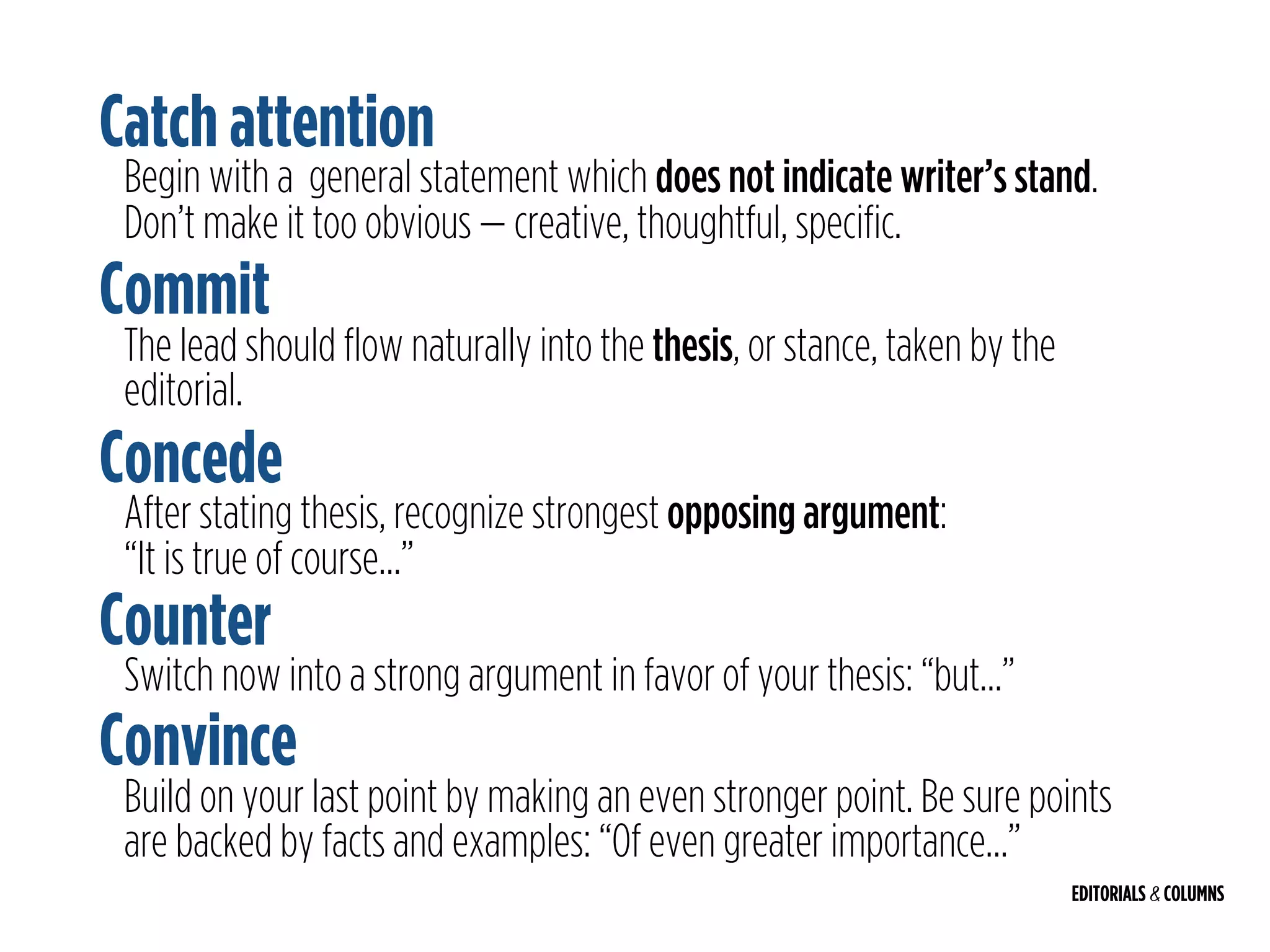
Begin with a general statement which does not indicate writer’s stand.
Don’t make it too obvious — creative, thoughtful, specific.
Catch attention
Commit
The lead should flow naturally into the thesis, or stance, taken by the
editorial.
Concede
After stating thesis, recognize strongest opposing argument: 

“It is true of course…”
Counter
Switch now into a strong argument in favor of your thesis: “but…”
Convince
Build on your last point by making an even stronger point. Be sure points
are backed by facts and examples: “Of even greater importance…”
EDITORIALS & COLUMNS
Save strongest argument for last. This discourages rebuttal and leaves the
reader with something convincing to ponder. “Finally…”
Clinch
Commit again
Using different words, restate your thesis.
Cap it off
Leave the reader with a little something extra: a vision of the future, a
revisit to the lead, a call to action, etc.
A final note…
While professional editorial writers use many different structures, this
model serves the beginning writer well. Its principles are solid. After
writers get more experience, they will discover ways to vary the structure
depending on the topic and approach.
EDITORIALS & COLUMNS
FOUR TYPES 

OF EDITORIALS
EDITORIALS & COLUMNS
Focus on significant and substantial news topics with current news hooks.
FOUR TYPES OF EDITORIALS
Explain or interpret
How the newspaper covered a sensitive topic, some newsy analysis, can
link to a main news story (probably Page 1).
Criticize
Constructively criticize actions, decisions, situations. Offer a solution.
Persuade
Focus first on the solution. Encourage specific, positive action.
Praise
Commend people and/or actions; more rare.
Style: Typically thoughtful, considered, reflective, serious. Sarcasm and humor
don’t work well here.
EDITORIALS & COLUMNS
STEPS IN
EDITORIAL
WRITING
EDITORIALS & COLUMNS
STEPS IN EDITORIAL WRITING
Find a topic.
Brainstorm. What controversial events have been in the news nationally?
Locally? In our high school? (Learn how to find relevant ideas — things
people are happy/upset/talking/curious about)
Research.
Internet research, personal interviews, news articles, archives, personal
interviews, library documents. Remember, there is no audience for an
uninformed editorial.
Don’t take the easy route.
Don’t necessarily play devil’s advocate, but don’t feel you must represent
majority opinion either.
Take a reasonable approach.
Consider the degree and circumstance of the truth. Generally avoid
inclusive words such as “always” or “never.” Be specific and accurate with
examples.
EDITORIALS & COLUMNS
Find and refine
the thesis.
EDITORIALS & COLUMNS
The basic skill needed here is the ability to
generalize. What does all the research on the
topic indicate is the center of controversy?
Can you state this main idea, or thesis
statement, in a clear, simple,
understandable way? Is the topic arguable?
For example, let’s suppose you wanted to
write an editorial on the problem of guns
being brought to school.
EDITORIALS & COLUMNS
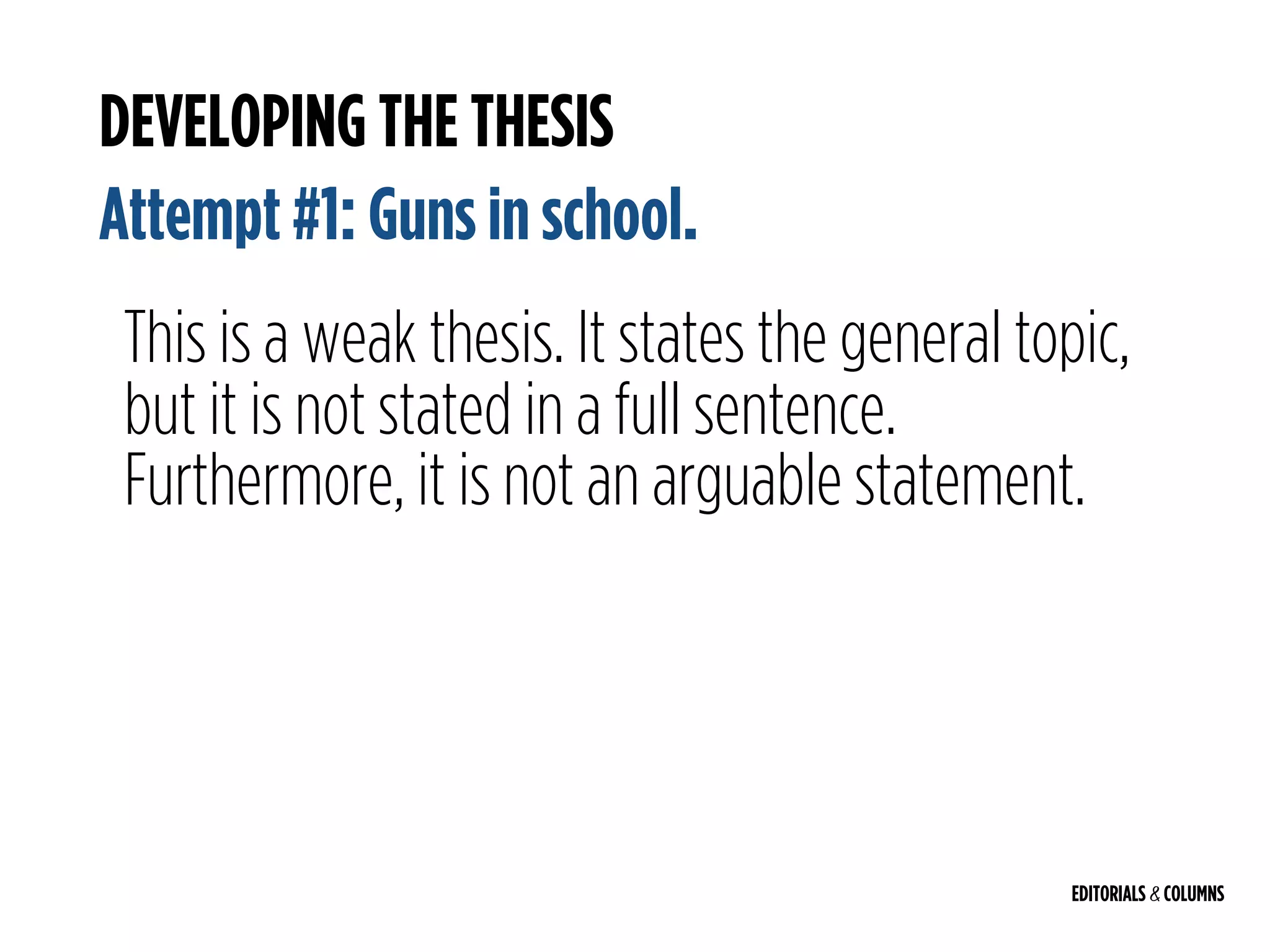
DEVELOPING THE THESIS
Attempt #1: Guns in school.
This is a weak thesis. It states the general topic,
but it is not stated in a full sentence.
Furthermore, it is not an arguable statement.
EDITORIALS & COLUMNS
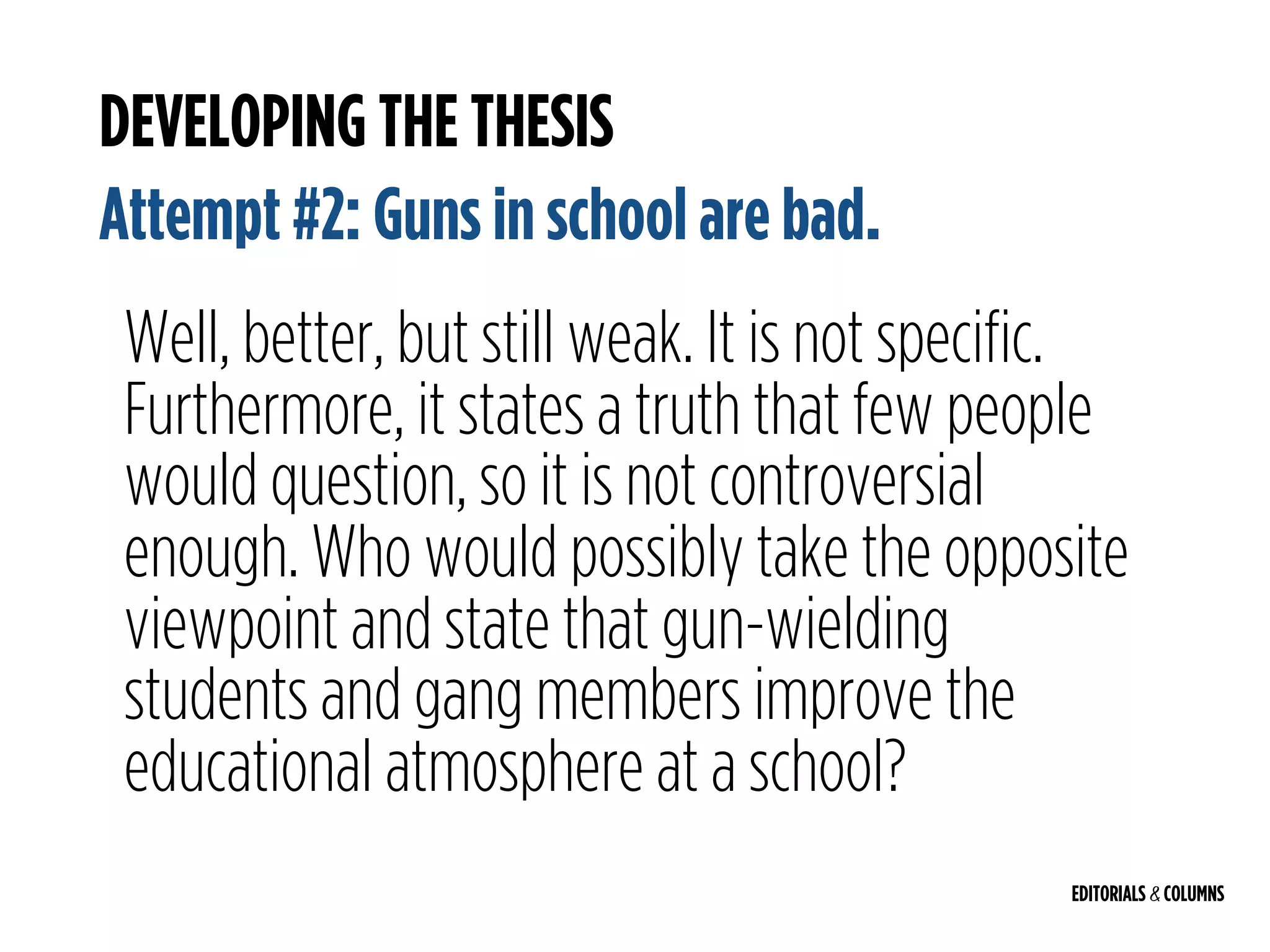
DEVELOPING THE THESIS
Attempt #2: Guns in school are bad.
Well, better, but still weak. It is not specific.
Furthermore, it states a truth that few people
would question, so it is not controversial
enough. Who would possibly take the opposite
viewpoint and state that gun-wielding
students and gang members improve the
educational atmosphere at a school?
EDITORIALS & COLUMNS
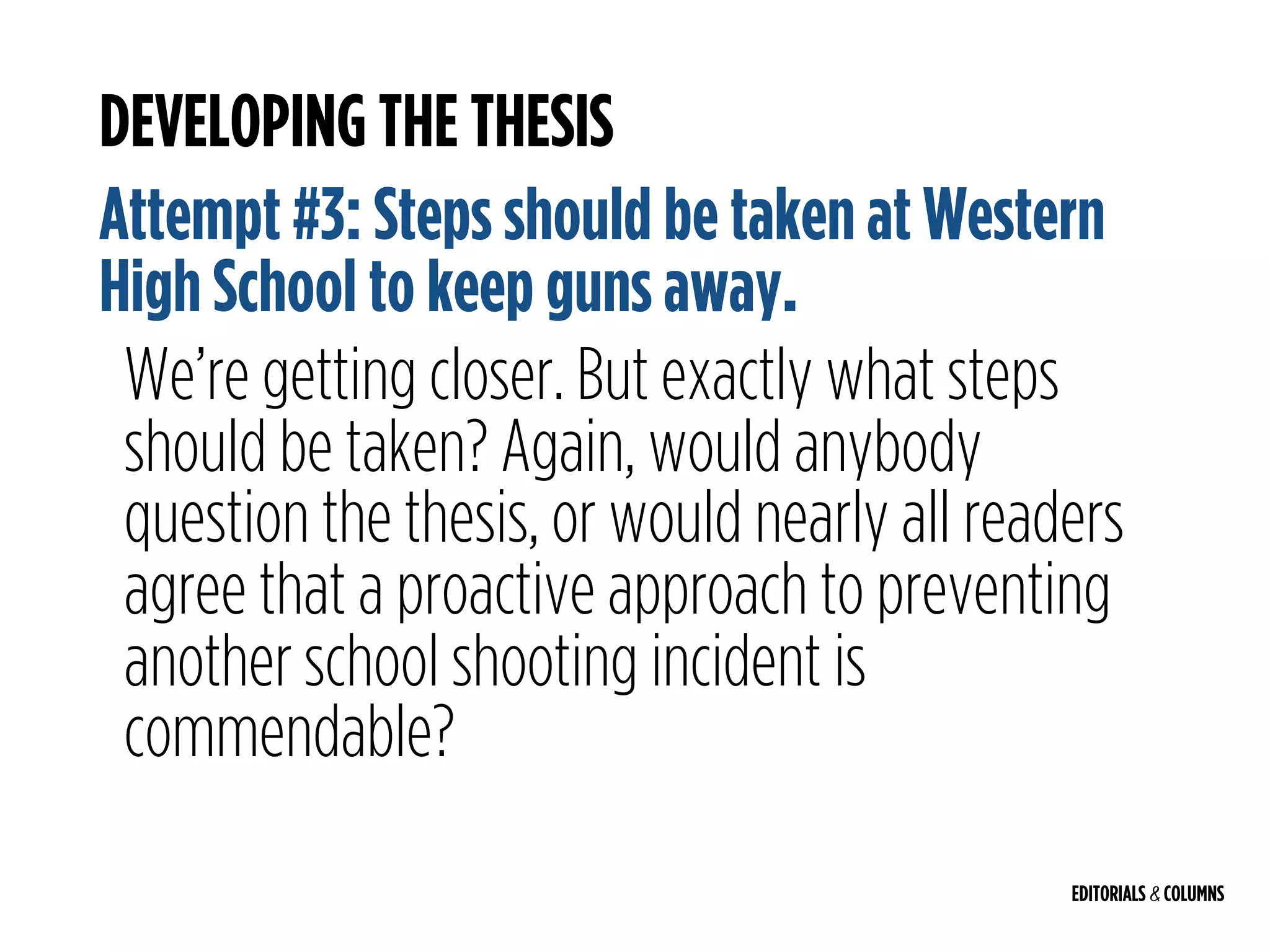
DEVELOPING THE THESIS
Attempt #3: Steps should be taken at Western
High School to keep guns away.
We’re getting closer. But exactly what steps
should be taken? Again, would anybody
question the thesis, or would nearly all readers
agree that a proactive approach to preventing
another school shooting incident is
commendable?
EDITORIALS & COLUMNS
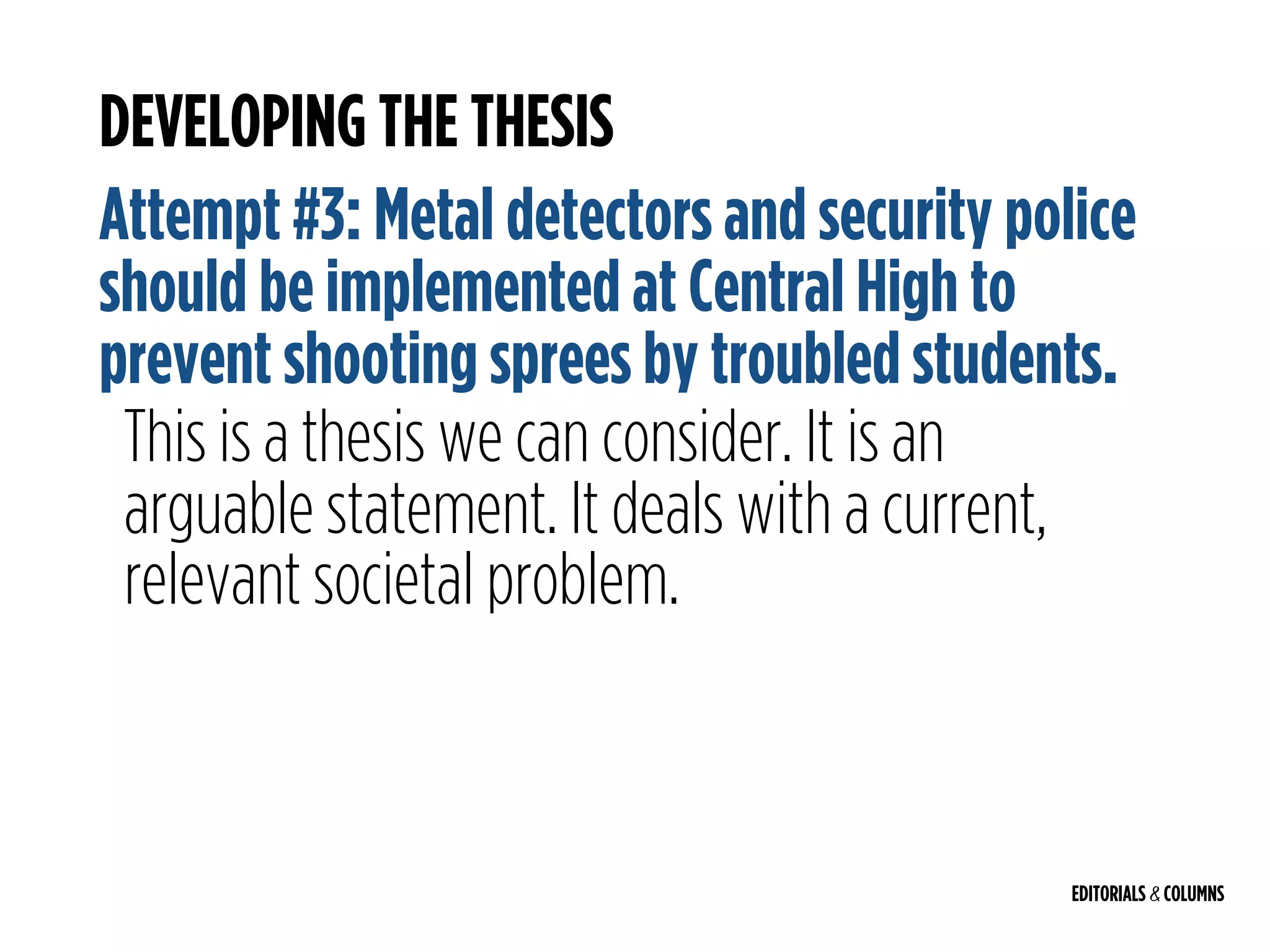
DEVELOPING THE THESIS
Attempt #3: Metal detectors and security police
should be implemented at Central High to
prevent shooting sprees by troubled students.
This is a thesis we can consider. It is an
arguable statement. It deals with a current,
relevant societal problem.
EDITORIALS & COLUMNS
Now, organize the structure. Using the
researched material, the journalist must now
begin sorting the arguments. Which facts
support the thesis? Which argue against it?
Could any be used to argue both sides?
Which facts don't directly relate to either?
(This information may be set aside. It is
normal to have much good information that
does not relate, and, therefore, must be
saved for another day.)
EDITORIALS & COLUMNS
Thesis: Metal detectors and
security police should be
implemented at Western
High to prevent shooting
sprees by troubled students.
EDITORIALS & COLUMNS
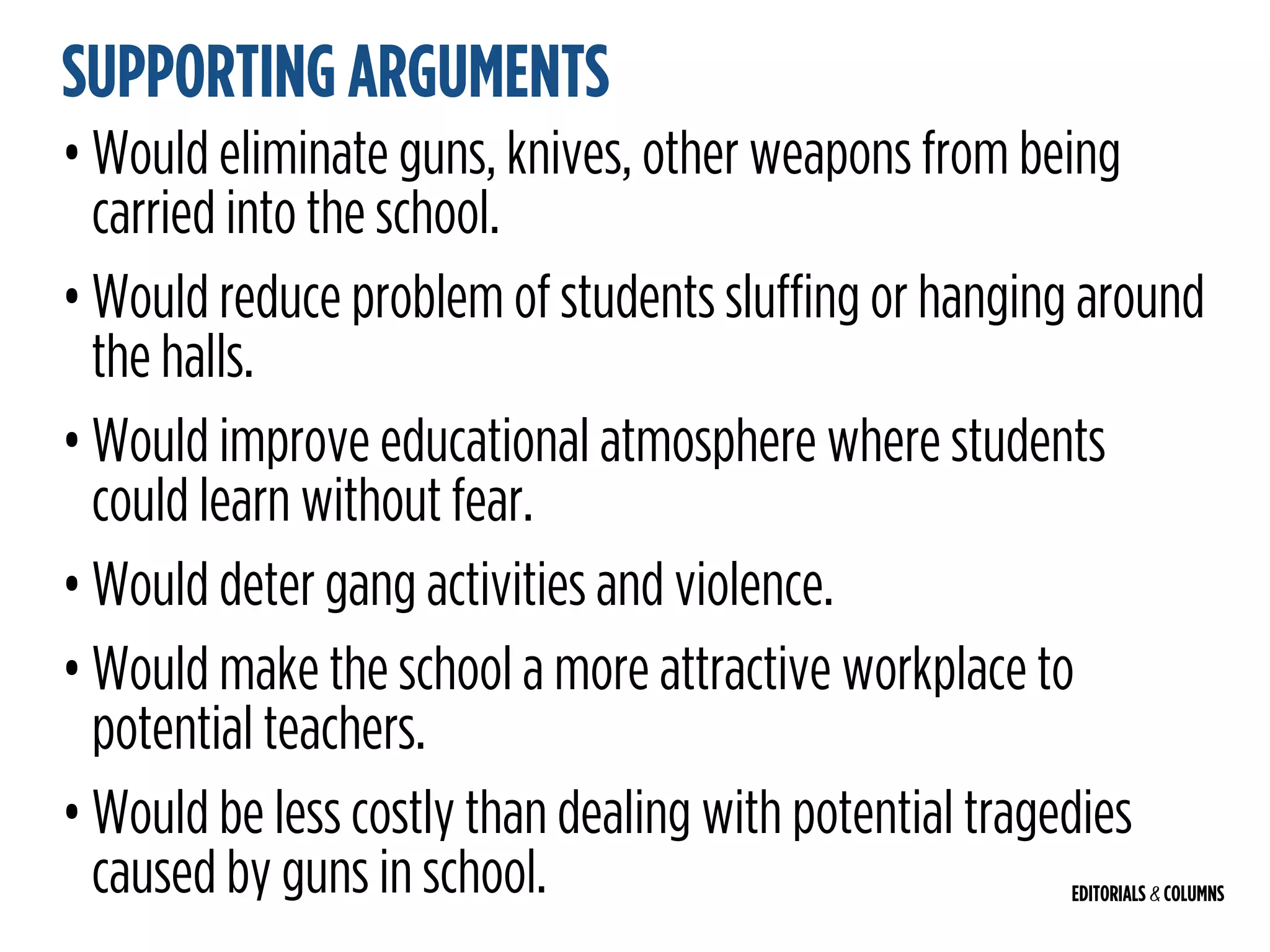
SUPPORTING ARGUMENTS
• Would eliminate guns, knives, other weapons from being
carried into the school.
• Would reduce problem of students sluffing or hanging around
the halls.
• Would improve educational atmosphere where students
could learn without fear.
• Would deter gang activities and violence.
• Would make the school a more attractive workplace to
potential teachers.
• Would be less costly than dealing with potential tragedies
caused by guns in school.
EDITORIALS & COLUMNS
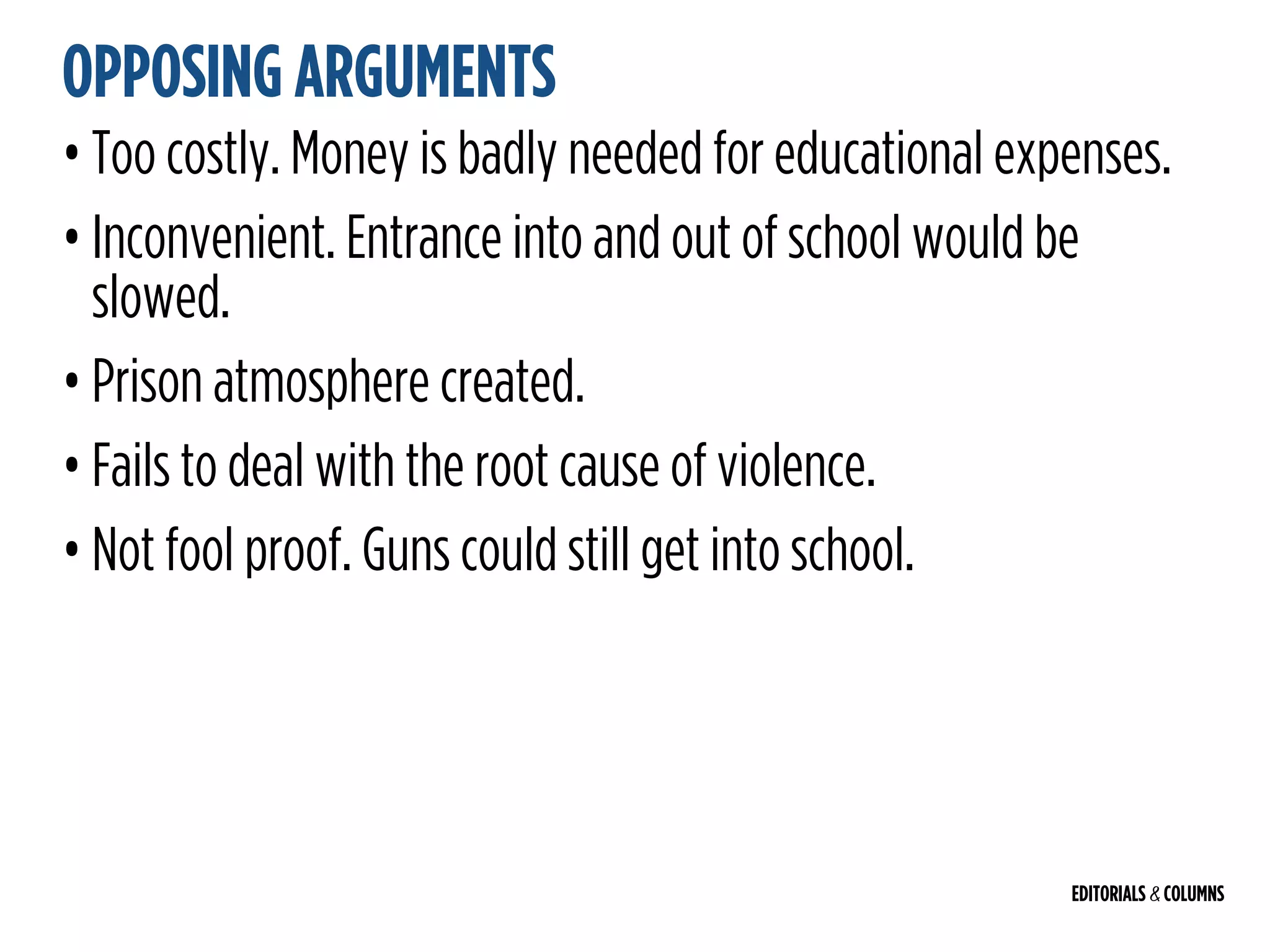
OPPOSING ARGUMENTS
• Too costly. Money is badly needed for educational expenses.
• Inconvenient. Entrance into and out of school would be
slowed.
• Prison atmosphere created.
• Fails to deal with the root cause of violence.
• Not fool proof. Guns could still get into school.
EDITORIALS & COLUMNS
THESIS VS.
ANTITHESIS
EDITORIALS & COLUMNS
The lead of an editorial should begin with a
noncommittal statement, then narrow to the
thesis. If the lead is written well, the same
beginning would serve for the antithesis.
OPPOSING ARGUMENTS
EDITORIALS & COLUMNS
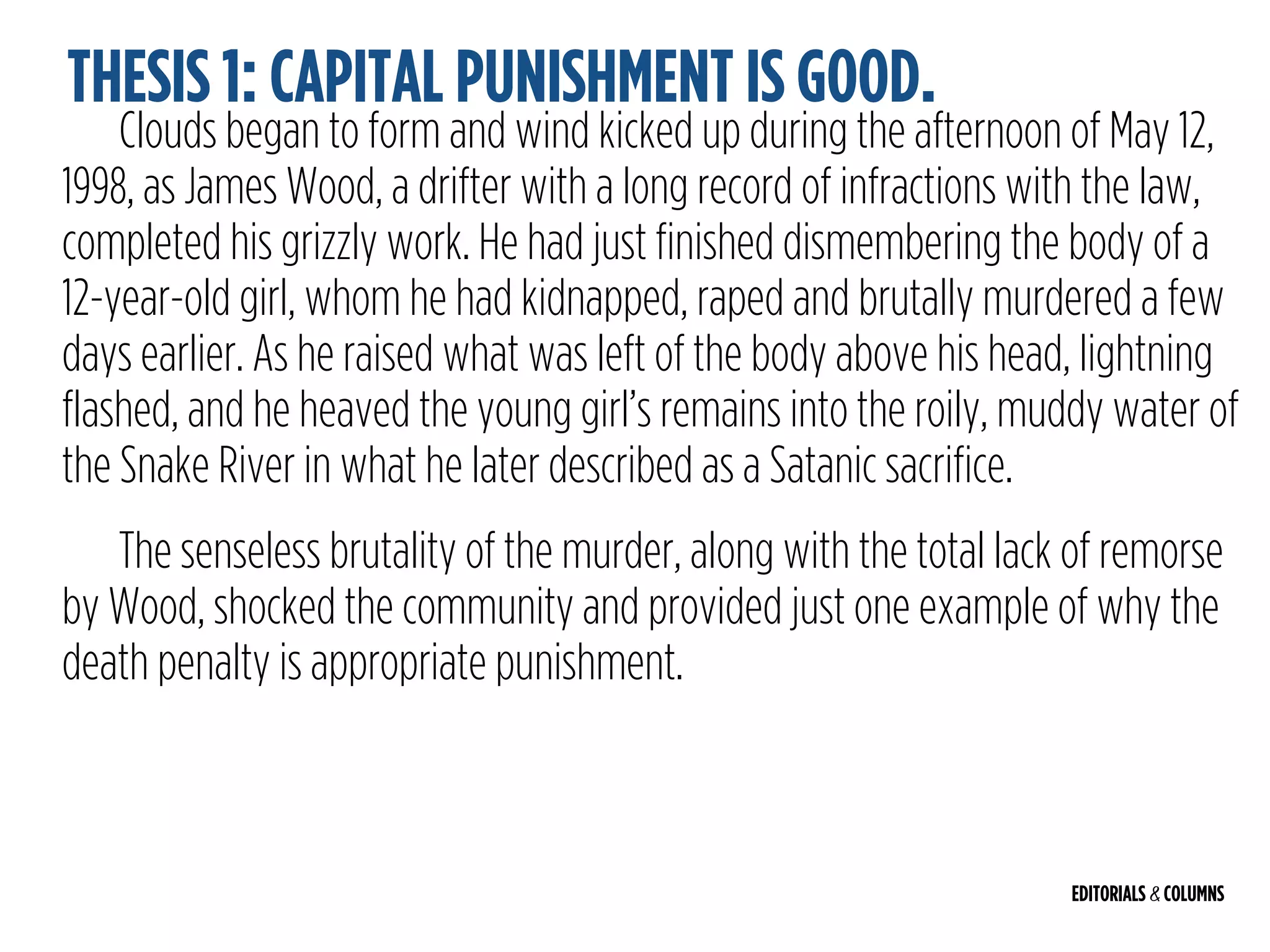
Clouds began to form and wind kicked up during the afternoon of May 12,
1998, as James Wood, a drifter with a long record of infractions with the law,
completed his grizzly work. He had just finished dismembering the body of a
12-year-old girl, whom he had kidnapped, raped and brutally murdered a few
days earlier. As he raised what was left of the body above his head, lightning
flashed, and he heaved the young girl’s remains into the roily, muddy water of
the Snake River in what he later described as a Satanic sacrifice.
The senseless brutality of the murder, along with the total lack of remorse
by Wood, shocked the community and provided just one example of why the
death penalty is appropriate punishment.
THESIS 1: CAPITAL PUNISHMENT IS GOOD.
EDITORIALS & COLUMNS
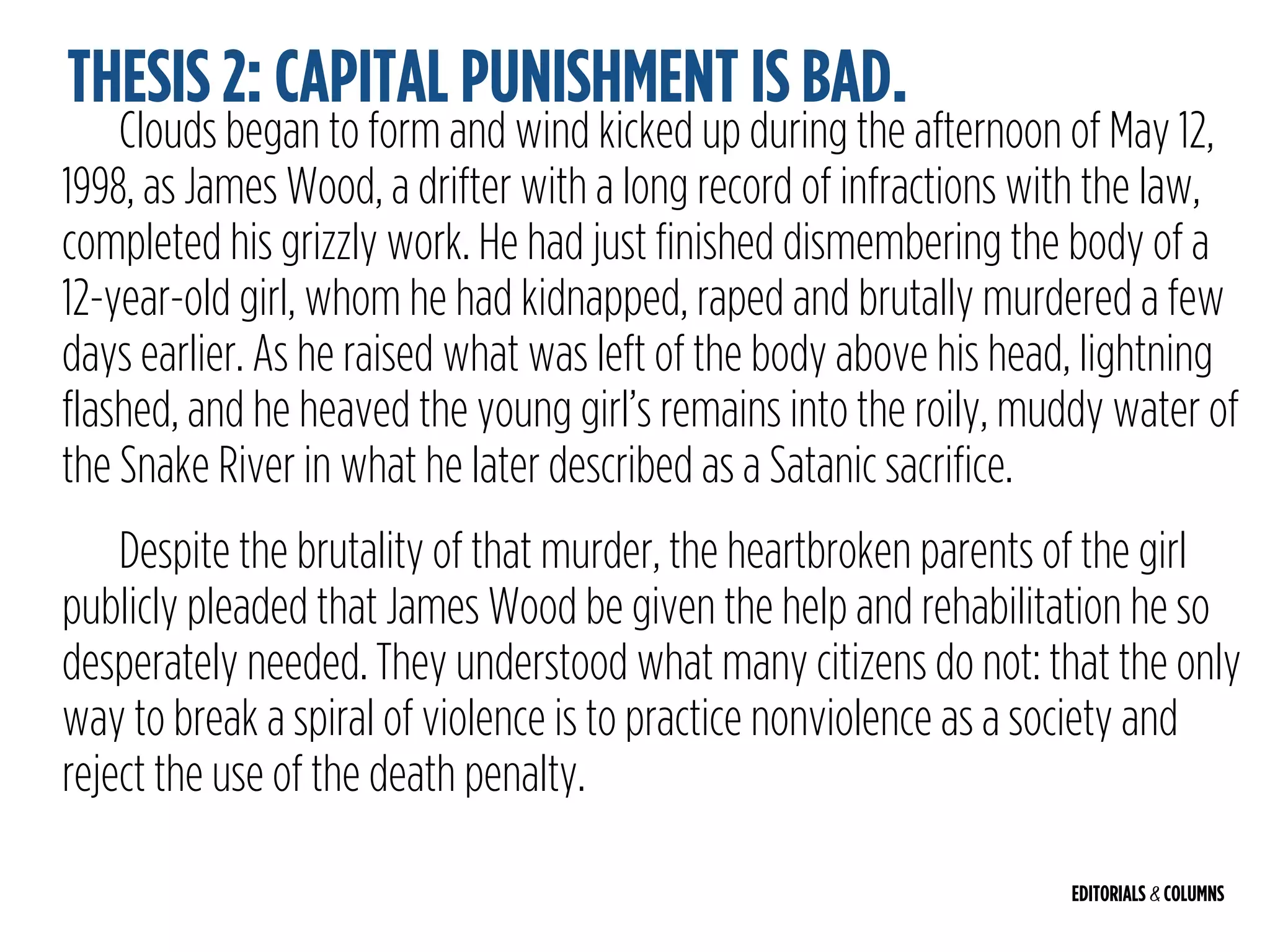
Clouds began to form and wind kicked up during the afternoon of May 12,
1998, as James Wood, a drifter with a long record of infractions with the law,
completed his grizzly work. He had just finished dismembering the body of a
12-year-old girl, whom he had kidnapped, raped and brutally murdered a few
days earlier. As he raised what was left of the body above his head, lightning
flashed, and he heaved the young girl’s remains into the roily, muddy water of
the Snake River in what he later described as a Satanic sacrifice.
Despite the brutality of that murder, the heartbroken parents of the girl
publicly pleaded that James Wood be given the help and rehabilitation he so
desperately needed. They understood what many citizens do not: that the only
way to break a spiral of violence is to practice nonviolence as a society and
reject the use of the death penalty.
THESIS 2: CAPITAL PUNISHMENT IS BAD.
EDITORIALS & COLUMNS
COLUMNS AND
OTHER STUFF
EDITORIALS & COLUMNS
COLUMNS
•Purpose: Entertainment/humor (truth/fact), information,
indignation
•Faves: Maureen Dowd, Charles M. Blow, Leonard Pitts,
Rick Reilly, Gene Weingarten
•Having a column should be a privilege. Doesn’t have to
repeat every issue.
•Avoid too many: first person, sappy, cranky or cliché
topics (senioritis, complaining, rah rah school spirit)
EDITORIALS & COLUMNS
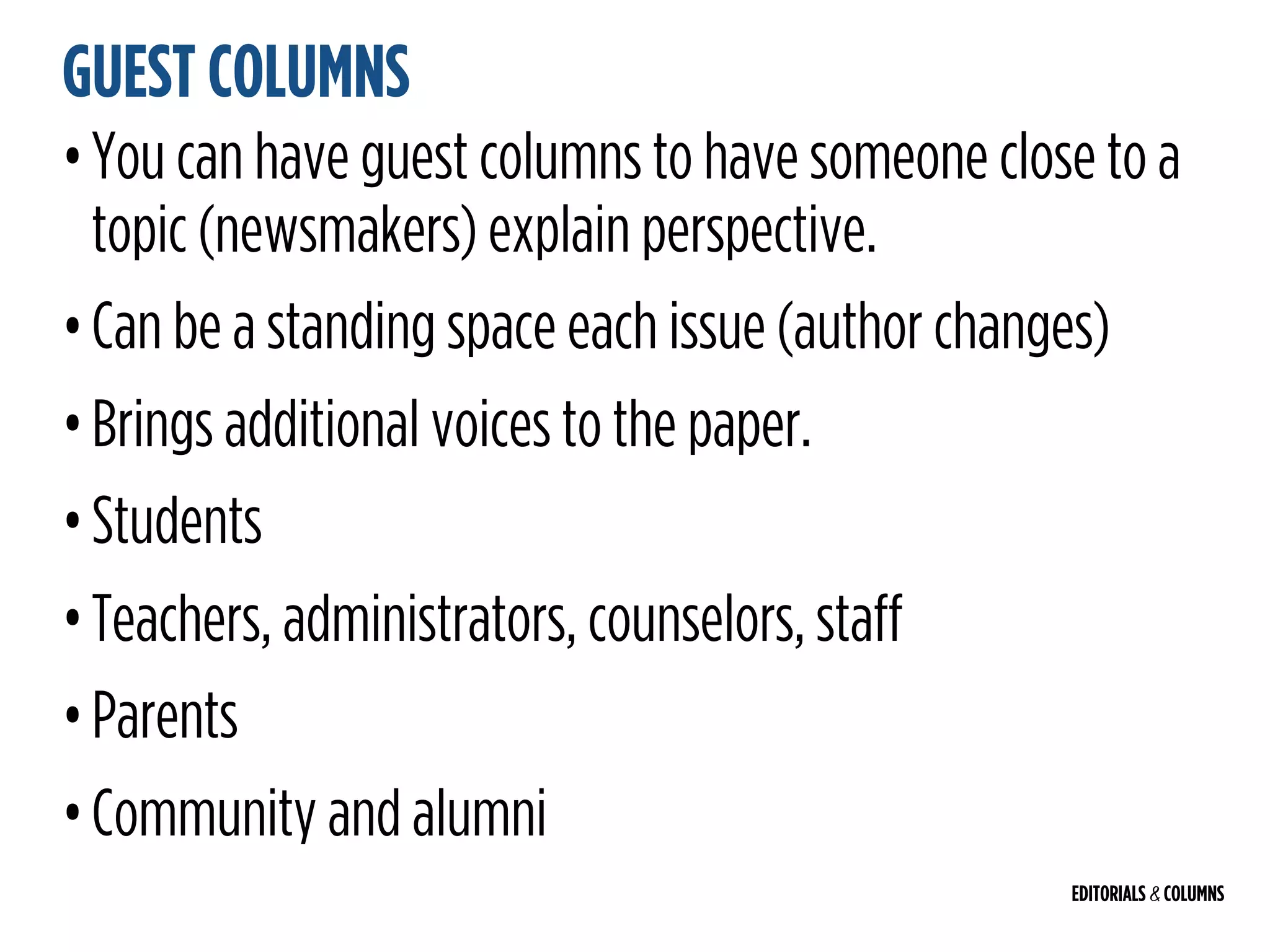
GUEST COLUMNS
•You can have guest columns to have someone close to a
topic (newsmakers) explain perspective.
•Can be a standing space each issue (author changes)
•Brings additional voices to the paper.
•Students
•Teachers, administrators, counselors, staff
•Parents
•Community and alumni
EDITORIALS & COLUMNS
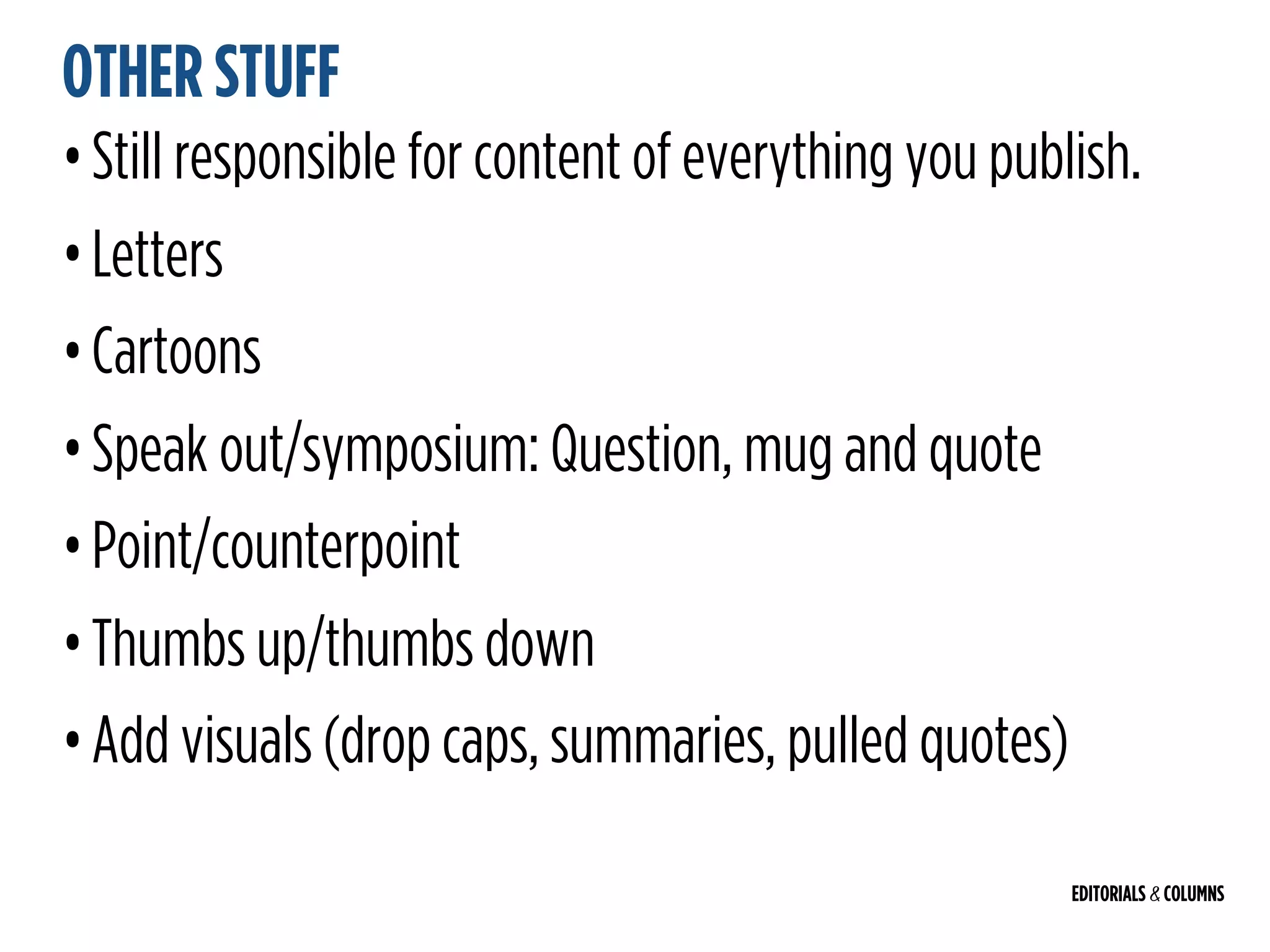
OTHER STUFF
•Still responsible for content of everything you publish.
•Letters
•Cartoons
•Speak out/symposium: Question, mug and quote
•Point/counterpoint
•Thumbs up/thumbs down
•Add visuals (drop caps, summaries, pulled quotes)
Logan Aimone, MJE //
logan.aimone@gmail.com // @loganaimone
QUESTIONS?

Editorials and Columns: Expressing opinion in the school newspaper

  • 1.
    EDITORIALS Logan Aimone, MJE// University High School, University of Chicago Laboratory Schools Sources: Carol Lange, Ron Bennett, Karl Grubaugh COLUMNSExpressing opinion 
 in the school newspaper &
  • 2.
    EDITORIALS & COLUMNS Editorialsare the voice of the paper (or website)
  • 3.
    EDITORIALS & COLUMNS Theycan represent the views of the whole staff or a smaller group, like an editorial board of top leaders. The editorial does not carry a byline since it’s the institutional opinion. Consider a logo or sig that indicates the editorial is the view of the paper:
 As the Midway Sees It…
  • 4.
    EDITORIALS & COLUMNS Acolumn is the view of one person and can be one-off or recurring
  • 5.
  • 6.
    EDITORIALS & COLUMNS Botheditorials and columns can follow a similar structure.
  • 7.
    EDITORIALS & COLUMNS Beginwith a general statement which does not indicate writer’s stand. Don’t make it too obvious — creative, thoughtful, specific. Catch attention Commit The lead should flow naturally into the thesis, or stance, taken by the editorial. Concede After stating thesis, recognize strongest opposing argument: 
 “It is true of course…” Counter Switch now into a strong argument in favor of your thesis: “but…” Convince Build on your last point by making an even stronger point. Be sure points are backed by facts and examples: “Of even greater importance…”
  • 8.
    EDITORIALS & COLUMNS Savestrongest argument for last. This discourages rebuttal and leaves the reader with something convincing to ponder. “Finally…” Clinch Commit again Using different words, restate your thesis. Cap it off Leave the reader with a little something extra: a vision of the future, a revisit to the lead, a call to action, etc. A final note… While professional editorial writers use many different structures, this model serves the beginning writer well. Its principles are solid. After writers get more experience, they will discover ways to vary the structure depending on the topic and approach.
  • 9.
    EDITORIALS & COLUMNS FOURTYPES 
 OF EDITORIALS
  • 10.
    EDITORIALS & COLUMNS Focuson significant and substantial news topics with current news hooks. FOUR TYPES OF EDITORIALS Explain or interpret How the newspaper covered a sensitive topic, some newsy analysis, can link to a main news story (probably Page 1). Criticize Constructively criticize actions, decisions, situations. Offer a solution. Persuade Focus first on the solution. Encourage specific, positive action. Praise Commend people and/or actions; more rare. Style: Typically thoughtful, considered, reflective, serious. Sarcasm and humor don’t work well here.
  • 11.
    EDITORIALS & COLUMNS STEPSIN EDITORIAL WRITING
  • 12.
    EDITORIALS & COLUMNS STEPSIN EDITORIAL WRITING Find a topic. Brainstorm. What controversial events have been in the news nationally? Locally? In our high school? (Learn how to find relevant ideas — things people are happy/upset/talking/curious about) Research. Internet research, personal interviews, news articles, archives, personal interviews, library documents. Remember, there is no audience for an uninformed editorial. Don’t take the easy route. Don’t necessarily play devil’s advocate, but don’t feel you must represent majority opinion either. Take a reasonable approach. Consider the degree and circumstance of the truth. Generally avoid inclusive words such as “always” or “never.” Be specific and accurate with examples.
  • 13.
    EDITORIALS & COLUMNS Findand refine the thesis.
  • 14.
    EDITORIALS & COLUMNS Thebasic skill needed here is the ability to generalize. What does all the research on the topic indicate is the center of controversy? Can you state this main idea, or thesis statement, in a clear, simple, understandable way? Is the topic arguable? For example, let’s suppose you wanted to write an editorial on the problem of guns being brought to school.
  • 15.
    EDITORIALS & COLUMNS DEVELOPINGTHE THESIS Attempt #1: Guns in school. This is a weak thesis. It states the general topic, but it is not stated in a full sentence. Furthermore, it is not an arguable statement.
  • 16.
    EDITORIALS & COLUMNS DEVELOPINGTHE THESIS Attempt #2: Guns in school are bad. Well, better, but still weak. It is not specific. Furthermore, it states a truth that few people would question, so it is not controversial enough. Who would possibly take the opposite viewpoint and state that gun-wielding students and gang members improve the educational atmosphere at a school?
  • 17.
    EDITORIALS & COLUMNS DEVELOPINGTHE THESIS Attempt #3: Steps should be taken at Western High School to keep guns away. We’re getting closer. But exactly what steps should be taken? Again, would anybody question the thesis, or would nearly all readers agree that a proactive approach to preventing another school shooting incident is commendable?
  • 18.
    EDITORIALS & COLUMNS DEVELOPINGTHE THESIS Attempt #3: Metal detectors and security police should be implemented at Central High to prevent shooting sprees by troubled students. This is a thesis we can consider. It is an arguable statement. It deals with a current, relevant societal problem.
  • 19.
    EDITORIALS & COLUMNS Now,organize the structure. Using the researched material, the journalist must now begin sorting the arguments. Which facts support the thesis? Which argue against it? Could any be used to argue both sides? Which facts don't directly relate to either? (This information may be set aside. It is normal to have much good information that does not relate, and, therefore, must be saved for another day.)
  • 20.
    EDITORIALS & COLUMNS Thesis:Metal detectors and security police should be implemented at Western High to prevent shooting sprees by troubled students.
  • 21.
    EDITORIALS & COLUMNS SUPPORTINGARGUMENTS • Would eliminate guns, knives, other weapons from being carried into the school. • Would reduce problem of students sluffing or hanging around the halls. • Would improve educational atmosphere where students could learn without fear. • Would deter gang activities and violence. • Would make the school a more attractive workplace to potential teachers. • Would be less costly than dealing with potential tragedies caused by guns in school.
  • 22.
    EDITORIALS & COLUMNS OPPOSINGARGUMENTS • Too costly. Money is badly needed for educational expenses. • Inconvenient. Entrance into and out of school would be slowed. • Prison atmosphere created. • Fails to deal with the root cause of violence. • Not fool proof. Guns could still get into school.
  • 23.
  • 24.
    EDITORIALS & COLUMNS Thelead of an editorial should begin with a noncommittal statement, then narrow to the thesis. If the lead is written well, the same beginning would serve for the antithesis. OPPOSING ARGUMENTS
  • 25.
    EDITORIALS & COLUMNS Cloudsbegan to form and wind kicked up during the afternoon of May 12, 1998, as James Wood, a drifter with a long record of infractions with the law, completed his grizzly work. He had just finished dismembering the body of a 12-year-old girl, whom he had kidnapped, raped and brutally murdered a few days earlier. As he raised what was left of the body above his head, lightning flashed, and he heaved the young girl’s remains into the roily, muddy water of the Snake River in what he later described as a Satanic sacrifice. The senseless brutality of the murder, along with the total lack of remorse by Wood, shocked the community and provided just one example of why the death penalty is appropriate punishment. THESIS 1: CAPITAL PUNISHMENT IS GOOD.
  • 26.
    EDITORIALS & COLUMNS Cloudsbegan to form and wind kicked up during the afternoon of May 12, 1998, as James Wood, a drifter with a long record of infractions with the law, completed his grizzly work. He had just finished dismembering the body of a 12-year-old girl, whom he had kidnapped, raped and brutally murdered a few days earlier. As he raised what was left of the body above his head, lightning flashed, and he heaved the young girl’s remains into the roily, muddy water of the Snake River in what he later described as a Satanic sacrifice. Despite the brutality of that murder, the heartbroken parents of the girl publicly pleaded that James Wood be given the help and rehabilitation he so desperately needed. They understood what many citizens do not: that the only way to break a spiral of violence is to practice nonviolence as a society and reject the use of the death penalty. THESIS 2: CAPITAL PUNISHMENT IS BAD.
  • 27.
  • 28.
    EDITORIALS & COLUMNS COLUMNS •Purpose:Entertainment/humor (truth/fact), information, indignation •Faves: Maureen Dowd, Charles M. Blow, Leonard Pitts, Rick Reilly, Gene Weingarten •Having a column should be a privilege. Doesn’t have to repeat every issue. •Avoid too many: first person, sappy, cranky or cliché topics (senioritis, complaining, rah rah school spirit)
  • 29.
    EDITORIALS & COLUMNS GUESTCOLUMNS •You can have guest columns to have someone close to a topic (newsmakers) explain perspective. •Can be a standing space each issue (author changes) •Brings additional voices to the paper. •Students •Teachers, administrators, counselors, staff •Parents •Community and alumni
  • 30.
    EDITORIALS & COLUMNS OTHERSTUFF •Still responsible for content of everything you publish. •Letters •Cartoons •Speak out/symposium: Question, mug and quote •Point/counterpoint •Thumbs up/thumbs down •Add visuals (drop caps, summaries, pulled quotes)
  • 31.
    Logan Aimone, MJE// logan.aimone@gmail.com // @loganaimone QUESTIONS?