Leveraging Open Data
& Social Media
To Measure & Impact
Citizen Well-being

Shelly D. Farnham, Ph.D.
FUSE Labs, Microsoft Research
1
BIG DREAMS

“By 2035, there will be almost no
poor countries left in the world.”
Bill Gates

3 Myths that Block Progress for the Poor
2014 Gates Annual Letter
http://annualletter.gatesfoundation.org/

https://www.flickr.com/photos/kaptainkobold/9324963783/
2
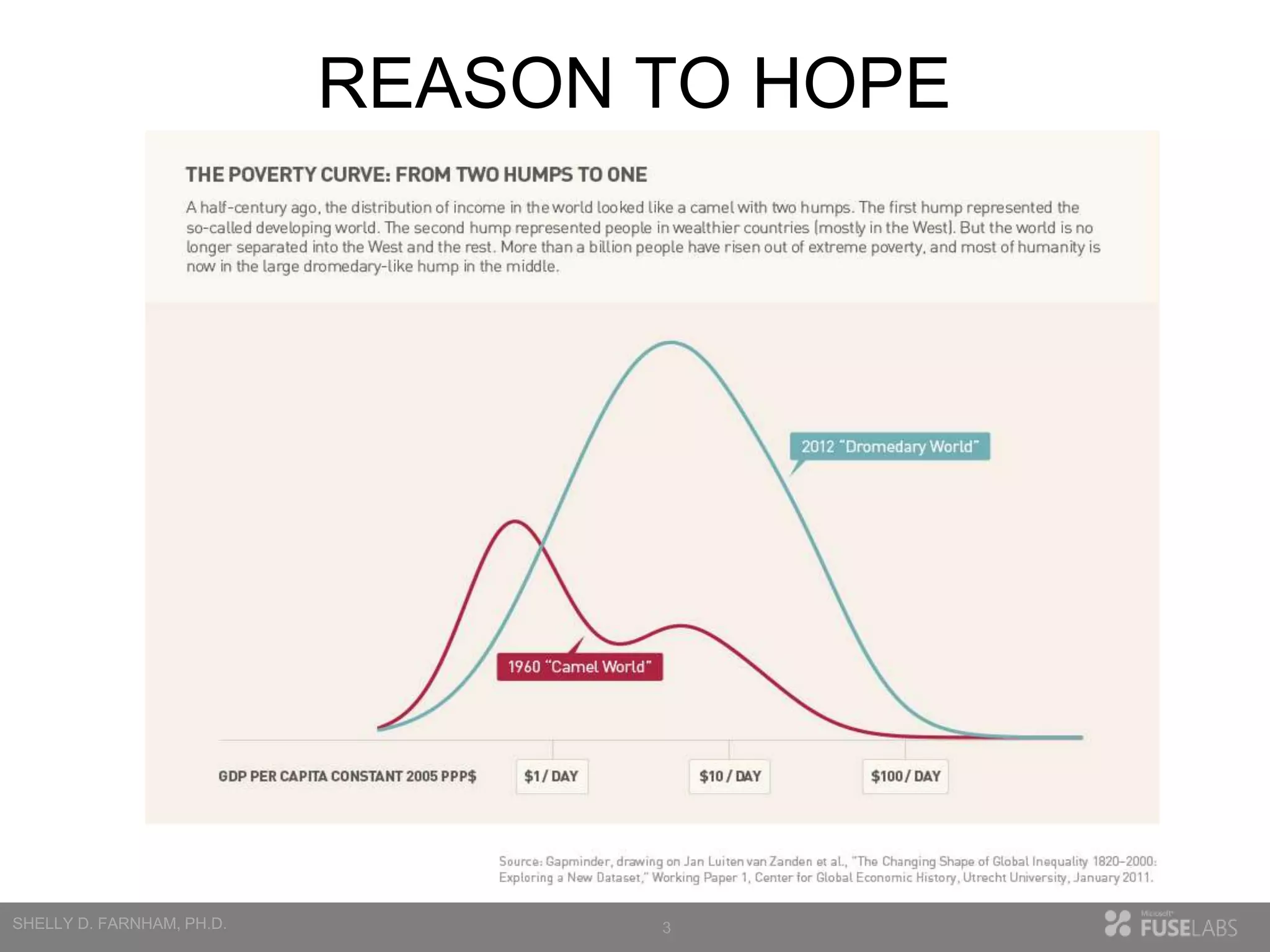
REASON TO HOPE

3
REDEFINING
PROSPERITY
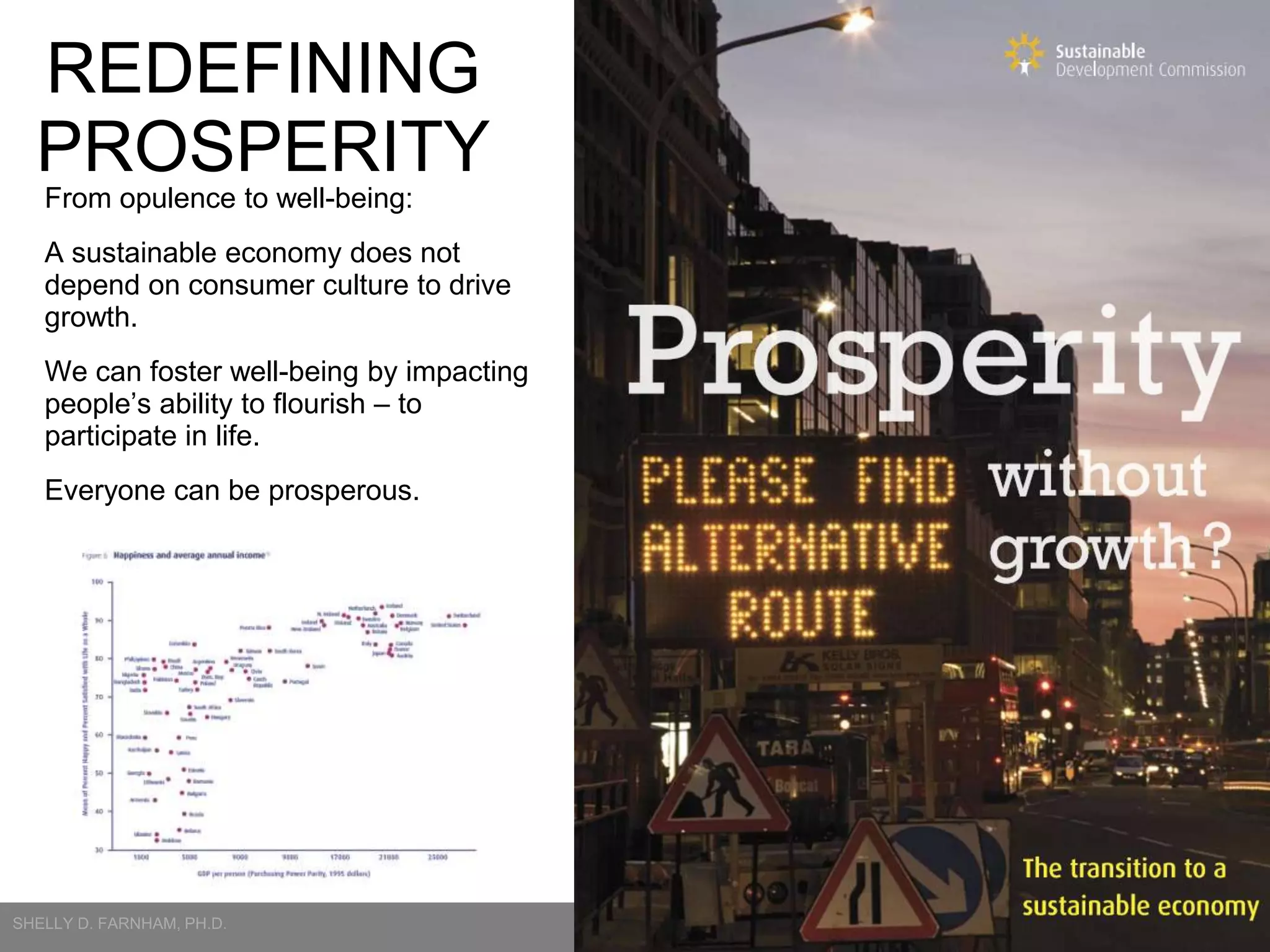
From opulence to well-being:

A sustainable economy does not
depend on consumer culture to drive
growth.
We can foster well-being by impacting
people’s ability to flourish – to
participate in life.
Everyone can be prosperous.

4
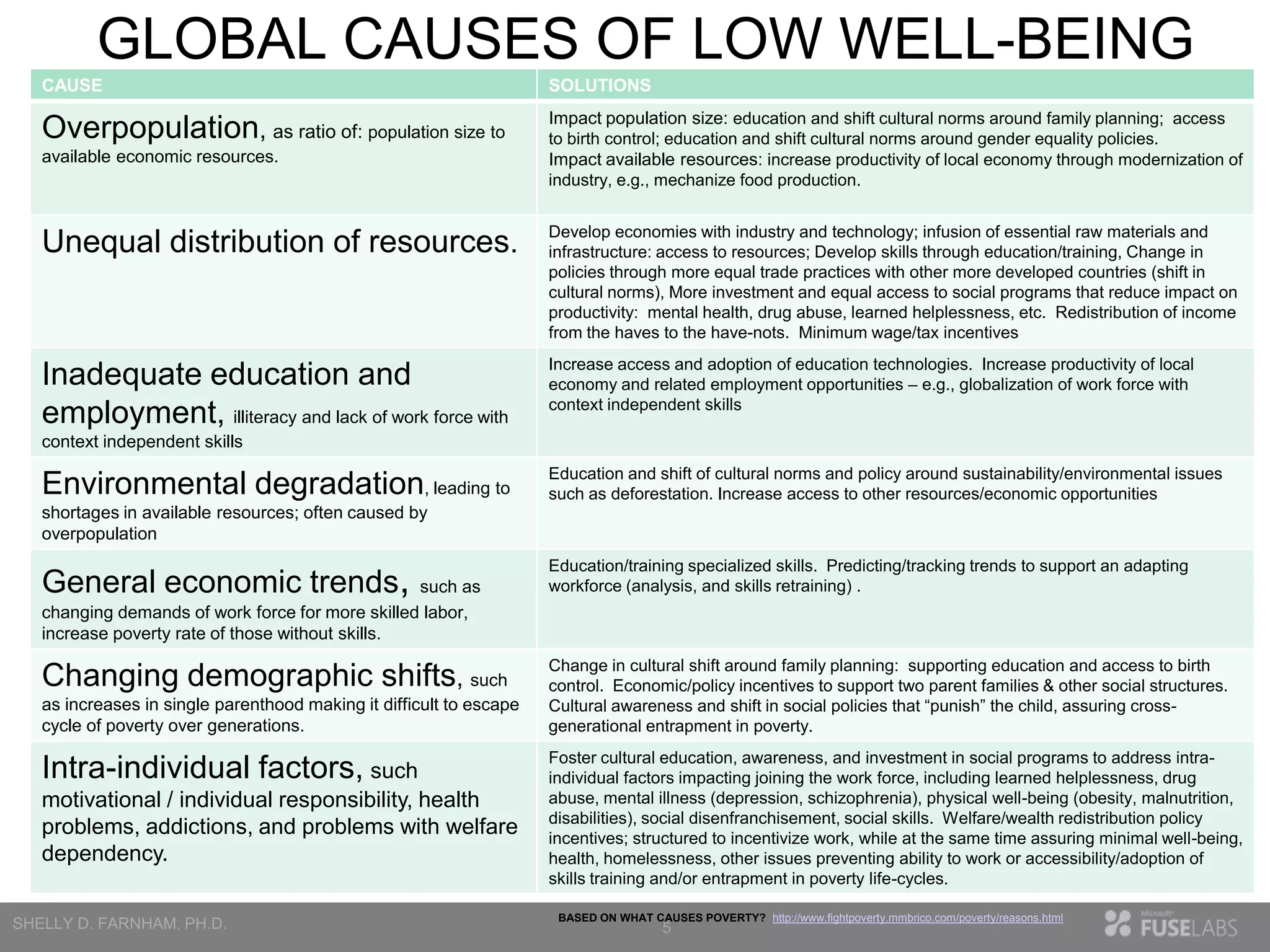
GLOBAL CAUSES OF LOW WELL-BEING
CAUSE

SOLUTIONS

Overpopulation, as ratio of: population size to

Impact population size: education and shift cultural norms around family planning; access
to birth control; education and shift cultural norms around gender equality policies.
Impact available resources: increase productivity of local economy through modernization of
industry, e.g., mechanize food production.

available economic resources.

Unequal distribution of resources.

Develop economies with industry and technology; infusion of essential raw materials and
infrastructure: access to resources; Develop skills through education/training, Change in
policies through more equal trade practices with other more developed countries (shift in
cultural norms), More investment and equal access to social programs that reduce impact on
productivity: mental health, drug abuse, learned helplessness, etc. Redistribution of income
from the haves to the have-nots. Minimum wage/tax incentives

Inadequate education and
employment, illiteracy and lack of work force with

Increase access and adoption of education technologies. Increase productivity of local
economy and related employment opportunities – e.g., globalization of work force with
context independent skills

context independent skills

Environmental degradation, leading to

Education and shift of cultural norms and policy around sustainability/environmental issues
such as deforestation. Increase access to other resources/economic opportunities

shortages in available resources; often caused by
overpopulation

General economic trends,

Education/training specialized skills. Predicting/tracking trends to support an adapting
workforce (analysis, and skills retraining) .

Changing demographic shifts, such

Change in cultural shift around family planning: supporting education and access to birth
control. Economic/policy incentives to support two parent families & other social structures.
Cultural awareness and shift in social policies that “punish” the child, assuring crossgenerational entrapment in poverty.

such as
changing demands of work force for more skilled labor,
increase poverty rate of those without skills.

as increases in single parenthood making it difficult to escape
cycle of poverty over generations.

Intra-individual factors, such
motivational / individual responsibility, health
problems, addictions, and problems with welfare
dependency.

Foster cultural education, awareness, and investment in social programs to address intraindividual factors impacting joining the work force, including learned helplessness, drug
abuse, mental illness (depression, schizophrenia), physical well-being (obesity, malnutrition,
disabilities), social disenfranchisement, social skills. Welfare/wealth redistribution policy
incentives; structured to incentivize work, while at the same time assuring minimal well-being,
health, homelessness, other issues preventing ability to work or accessibility/adoption of
skills training and/or entrapment in poverty life-cycles.
BASED ON WHAT CAUSES POVERTY? http://www.fightpoverty.mmbrico.com/poverty/reasons.html

5
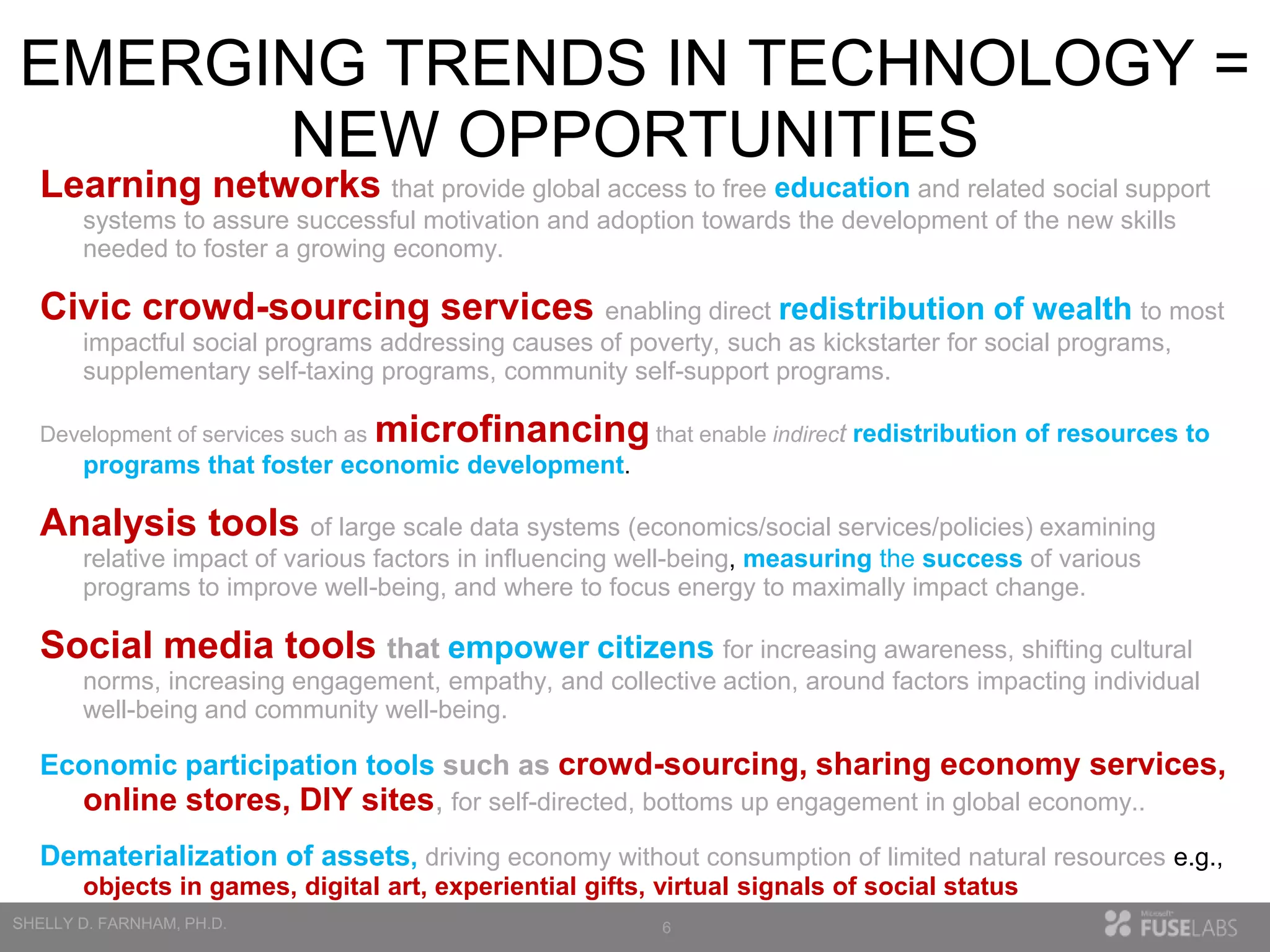
EMERGING TRENDS IN TECHNOLOGY =
NEW OPPORTUNITIES
Learning networks that provide global access to free education and related social support
systems to assure successful motivation and adoption towards the development of the new skills
needed to foster a growing economy.

Civic crowd-sourcing services enabling direct redistribution of wealth to most
impactful social programs addressing causes of poverty, such as kickstarter for social programs,
supplementary self-taxing programs, community self-support programs.
Development of services such as

microfinancing that enable indirect redistribution of resources to

programs that foster economic development.

Analysis tools of large scale data systems (economics/social services/policies) examining
relative impact of various factors in influencing well-being, measuring the success of various
programs to improve well-being, and where to focus energy to maximally impact change.

Social media tools that empower citizens for increasing awareness, shifting cultural
norms, increasing engagement, empathy, and collective action, around factors impacting individual
well-being and community well-being.

Economic participation tools such as crowd-sourcing, sharing economy services,

online stores, DIY sites, for self-directed, bottoms up engagement in global economy..
Dematerialization of assets, driving economy without consumption of limited natural resources e.g.,
objects in games, digital art, experiential gifts, virtual signals of social status
6
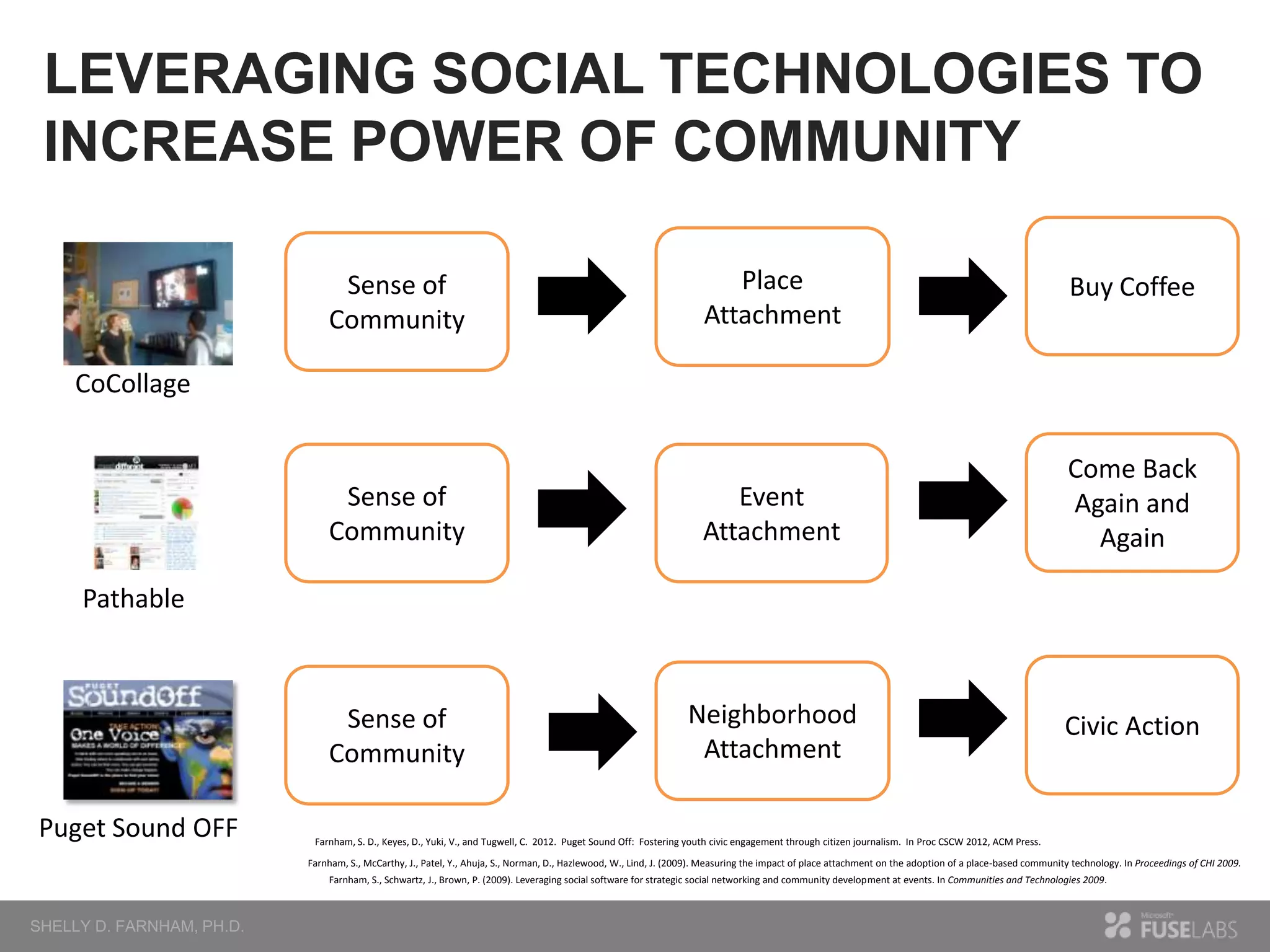
LEVERAGING SOCIAL TECHNOLOGIES TO
INCREASE POWER OF COMMUNITY
Place
Attachment

Buy Coffee

Sense of
Community

Event
Attachment

Come Back
Again and
Again

Sense of
Community

Neighborhood
Attachment

Civic Action

Sense of
Community
CoCollage

Pathable

Puget Sound OFF

Farnham, S. D., Keyes, D., Yuki, V., and Tugwell, C. 2012. Puget Sound Off: Fostering youth civic engagement through citizen journalism. In Proc CSCW 2012, ACM Press.
Farnham, S., McCarthy, J., Patel, Y., Ahuja, S., Norman, D., Hazlewood, W., Lind, J. (2009). Measuring the impact of place attachment on the adoption of a place-based community technology. In Proceedings of CHI 2009.
Farnham, S., Schwartz, J., Brown, P. (2009). Leveraging social software for strategic social networking and community development at events. In Communities and Technologies 2009.
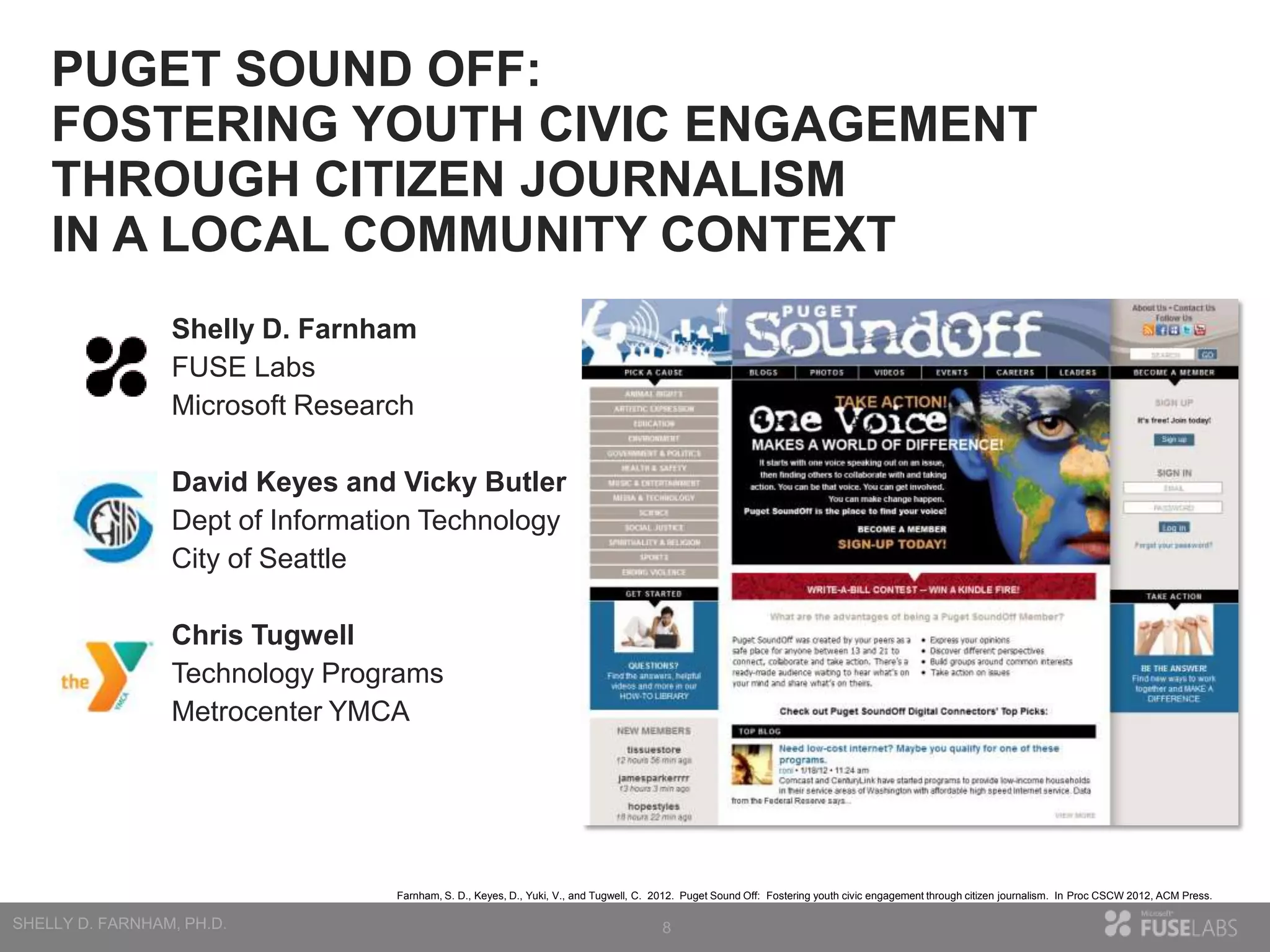
PUGET SOUND OFF:
FOSTERING YOUTH CIVIC ENGAGEMENT
THROUGH CITIZEN JOURNALISM
IN A LOCAL COMMUNITY CONTEXT
Shelly D. Farnham
FUSE Labs
Microsoft Research
David Keyes and Vicky Butler
Dept of Information Technology
City of Seattle

Chris Tugwell
Technology Programs
Metrocenter YMCA

Farnham, S. D., Keyes, D., Yuki, V., and Tugwell, C. 2012. Puget Sound Off: Fostering youth civic engagement through citizen journalism. In Proc CSCW 2012, ACM Press.

8
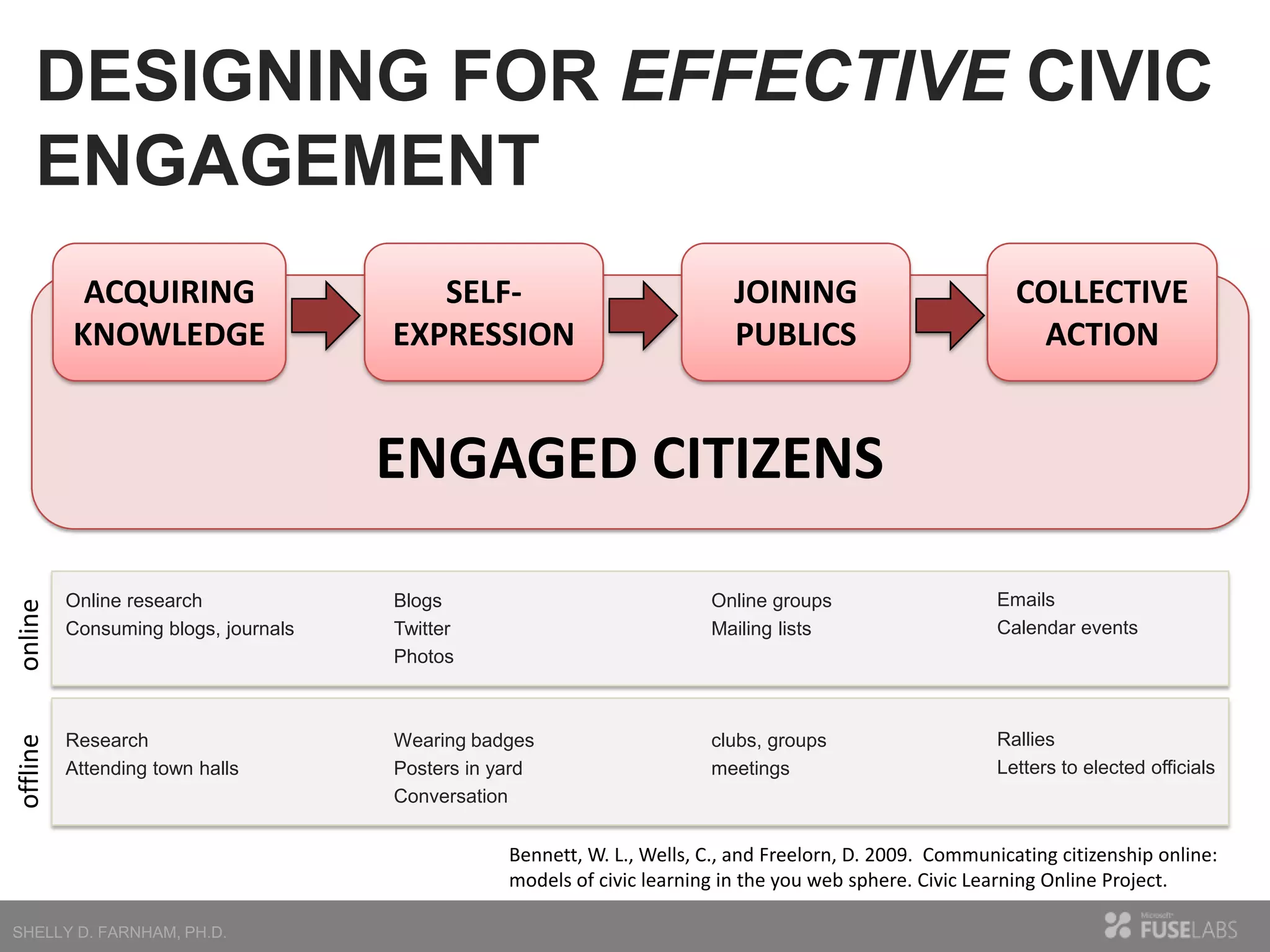
DESIGNING FOR EFFECTIVE CIVIC
ENGAGEMENT
ACQUIRING
KNOWLEDGE

SELFEXPRESSION

JOINING
PUBLICS

COLLECTIVE
ACTION

online

Online research
Consuming blogs, journals

Blogs
Twitter
Photos

Online groups
Mailing lists

Emails
Calendar events

offline

ENGAGED CITIZENS

Research
Attending town halls

Wearing badges
Posters in yard
Conversation

clubs, groups
meetings

Rallies
Letters to elected officials

Bennett, W. L., Wells, C., and Freelorn, D. 2009. Communicating citizenship online:
models of civic learning in the you web sphere. Civic Learning Online Project.
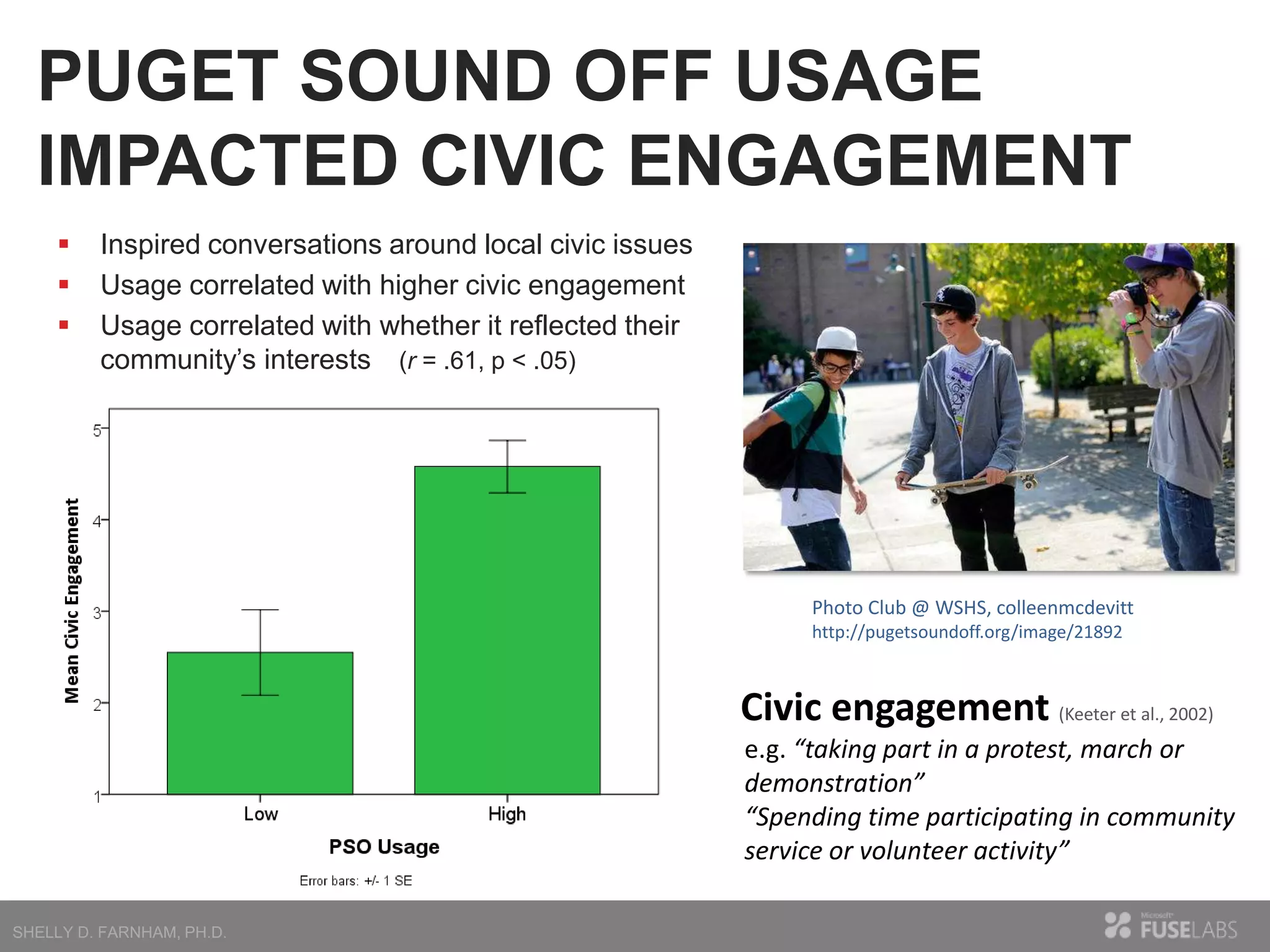
PUGET SOUND OFF USAGE
IMPACTED CIVIC ENGAGEMENT




Inspired conversations around local civic issues
Usage correlated with higher civic engagement
Usage correlated with whether it reflected their
community’s interests (r = .61, p < .05)

Photo Club @ WSHS, colleenmcdevitt
http://pugetsoundoff.org/image/21892

Civic engagement (Keeter et al., 2002)
e.g. “taking part in a protest, march or
demonstration”
“Spending time participating in community
service or volunteer activity”
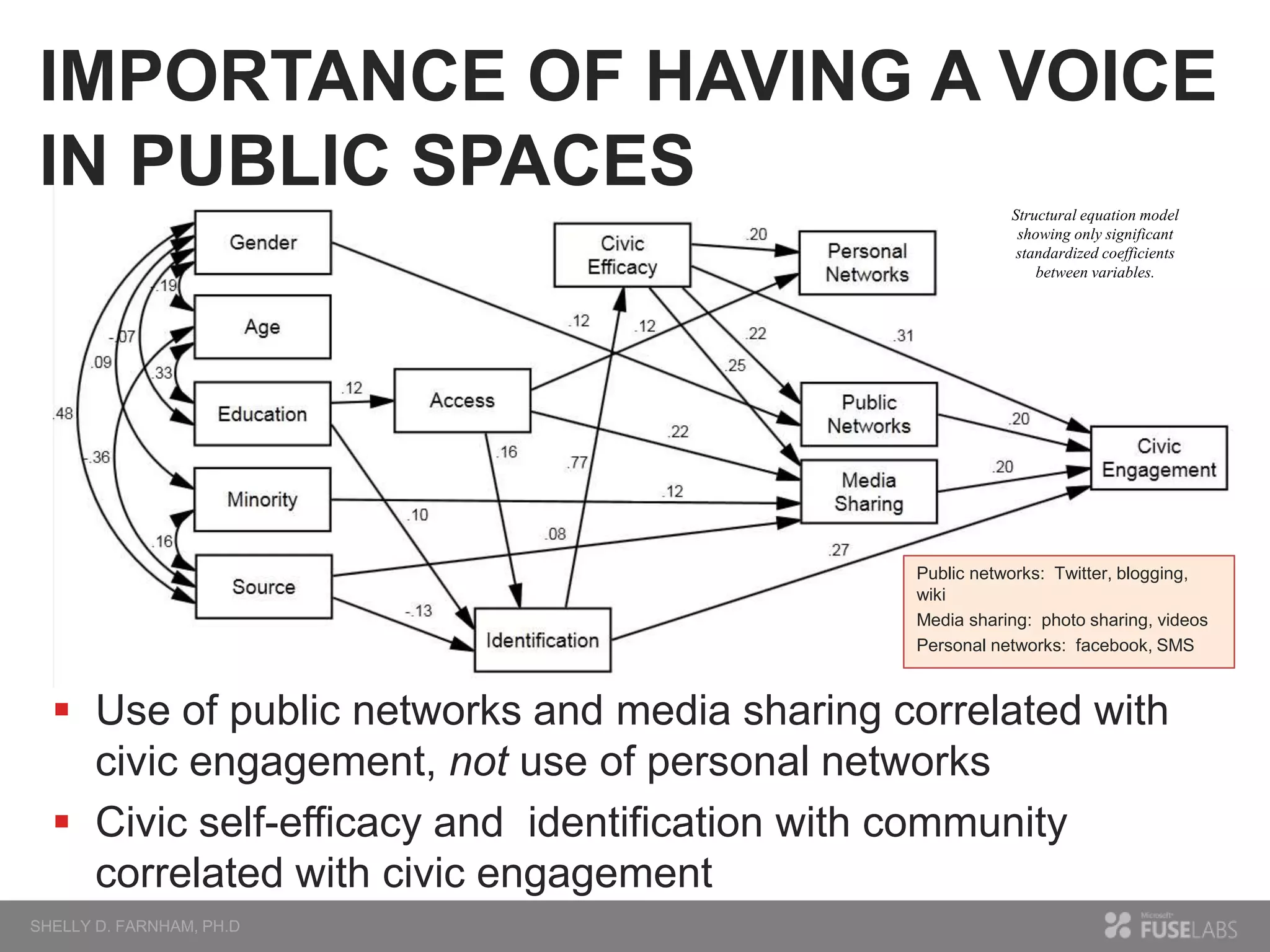
IMPORTANCE OF HAVING A VOICE
IN PUBLIC SPACES
Structural equation model
showing only significant
standardized coefficients
between variables.

Public networks: Twitter, blogging,
wiki
Media sharing: photo sharing, videos
Personal networks: facebook, SMS

 Use of public networks and media sharing correlated with
civic engagement, not use of personal networks
 Civic self-efficacy and identification with community
correlated with civic engagement
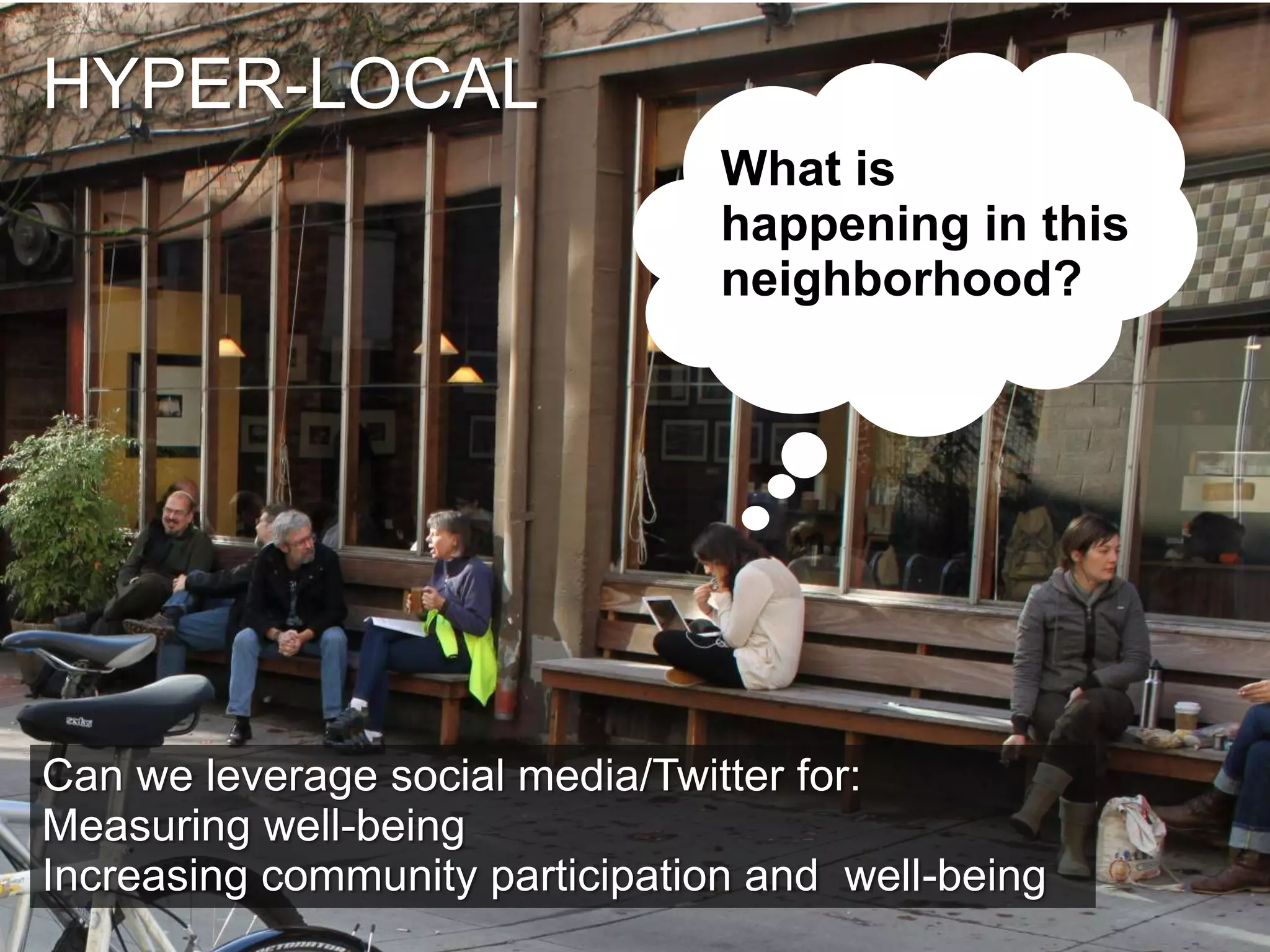
HYPER-LOCAL
What is
happening in this
neighborhood?

Can we leverage social media/Twitter for:
Measuring well-being
Increasing community participation and well-being
12
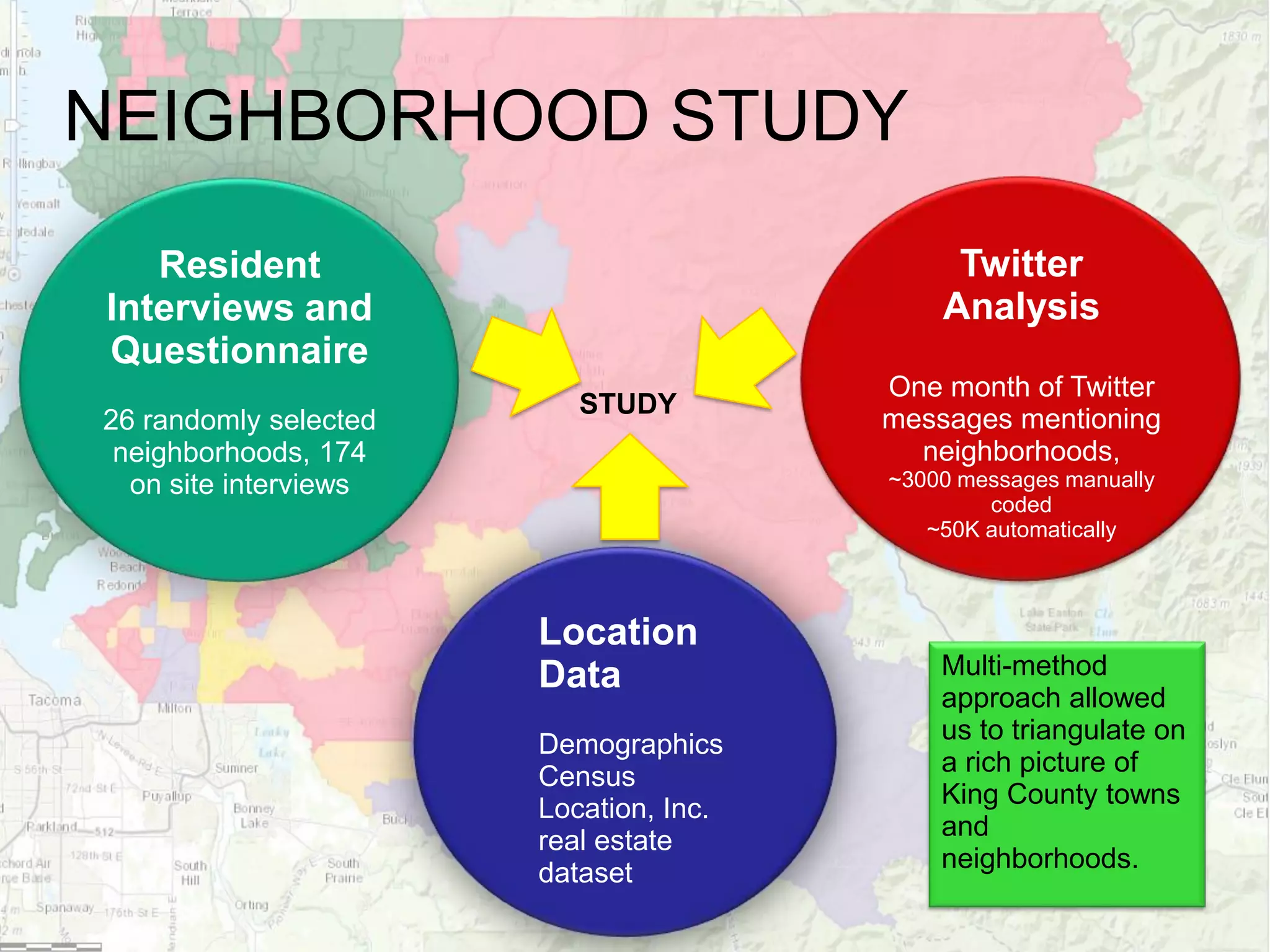
NEIGHBORHOOD STUDY
Twitter
Analysis

Resident
Interviews and
Questionnaire
26 randomly selected
neighborhoods, 174
on site interviews

STUDY

One month of Twitter
messages mentioning
neighborhoods,
~3000 messages manually
coded
~50K automatically

Location
Data
Demographics
Census
Location, Inc.
real estate
dataset
13

Multi-method
approach allowed
us to triangulate on
a rich picture of
King County towns
and
neighborhoods.
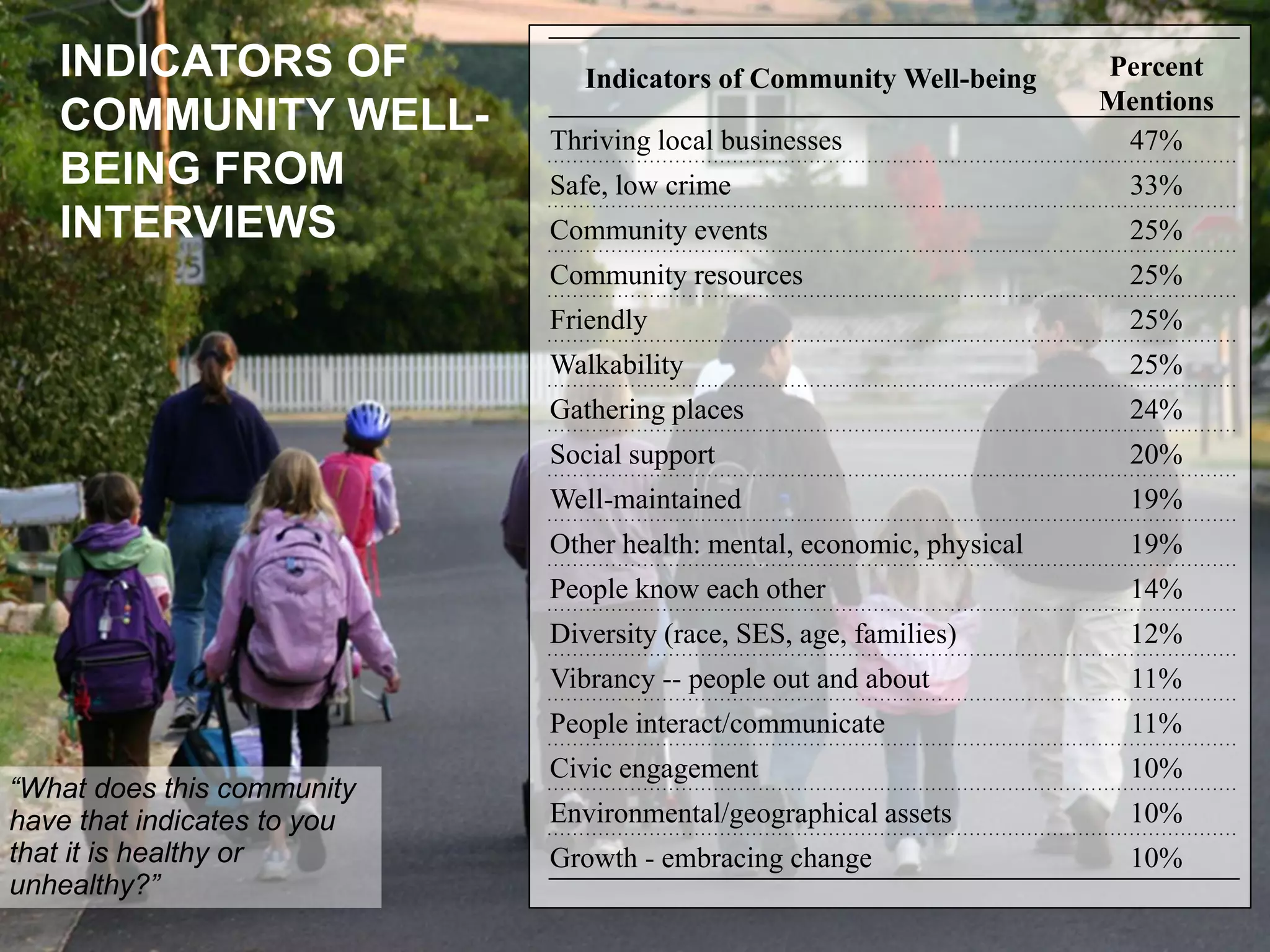
INDICATORS OF
COMMUNITY WELLBEING FROM
INTERVIEWS

Indicators of Community Well-being
Thriving local businesses

Percent
Mentions
47%
33%

Community events

25%

Community resources

25%

Friendly

25%

Walkability

25%

Gathering places

24%

Social support

20%

Well-maintained

19%

Other health: mental, economic, physical

19%

People know each other

14%

Diversity (race, SES, age, families)

12%

Vibrancy -- people out and about

11%

People interact/communicate
“What does this community
have that indicates to you
that it is healthy or
unhealthy?”

Safe, low crime

11%

Civic engagement

10%

Environmental/geographical assets

10%

Growth - embracing change

10%
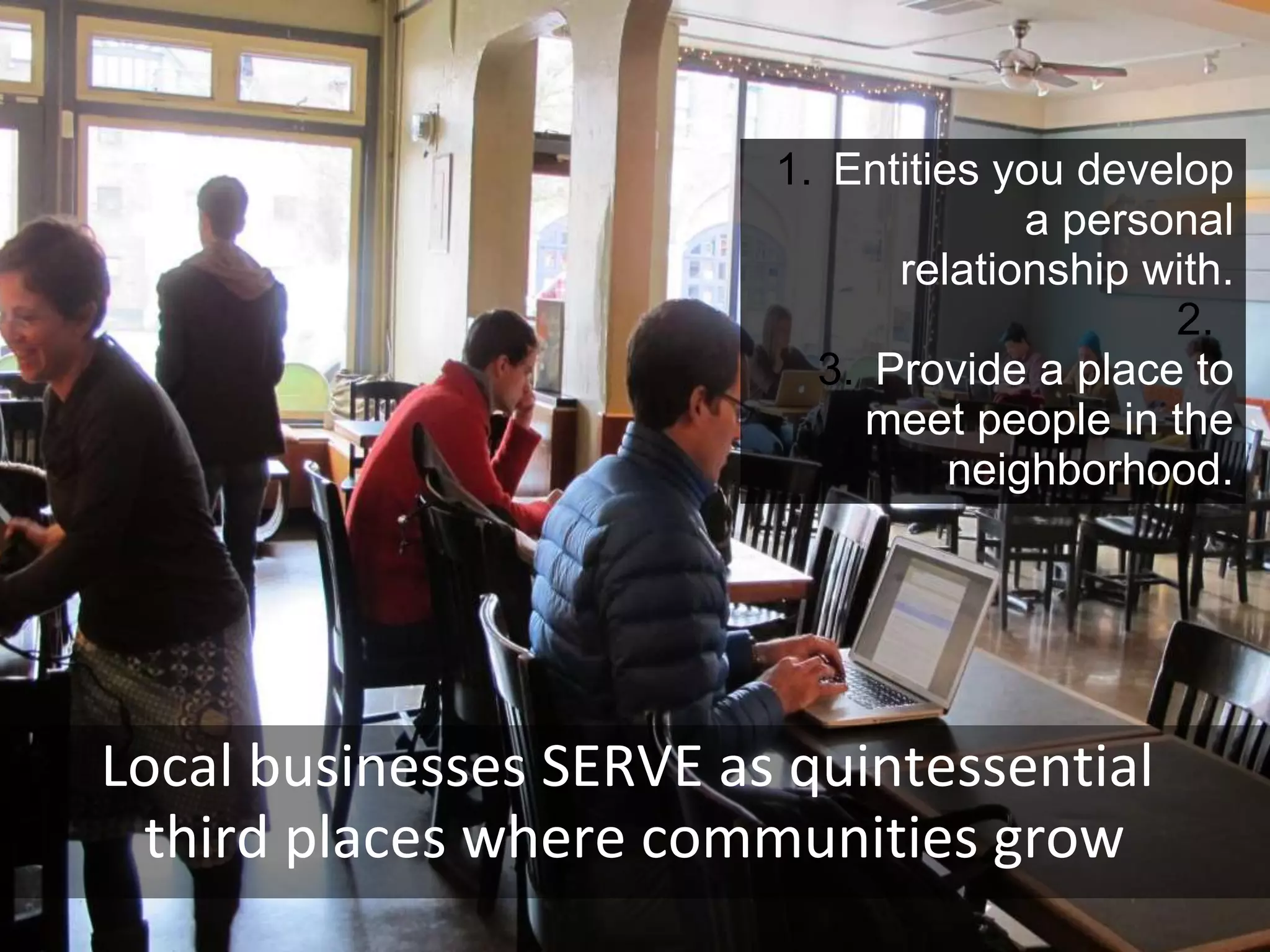
1. Entities you develop
a personal
relationship with.
2.
3. Provide a place to
meet people in the
neighborhood.

Local businesses SERVE as quintessential
third places where communities grow
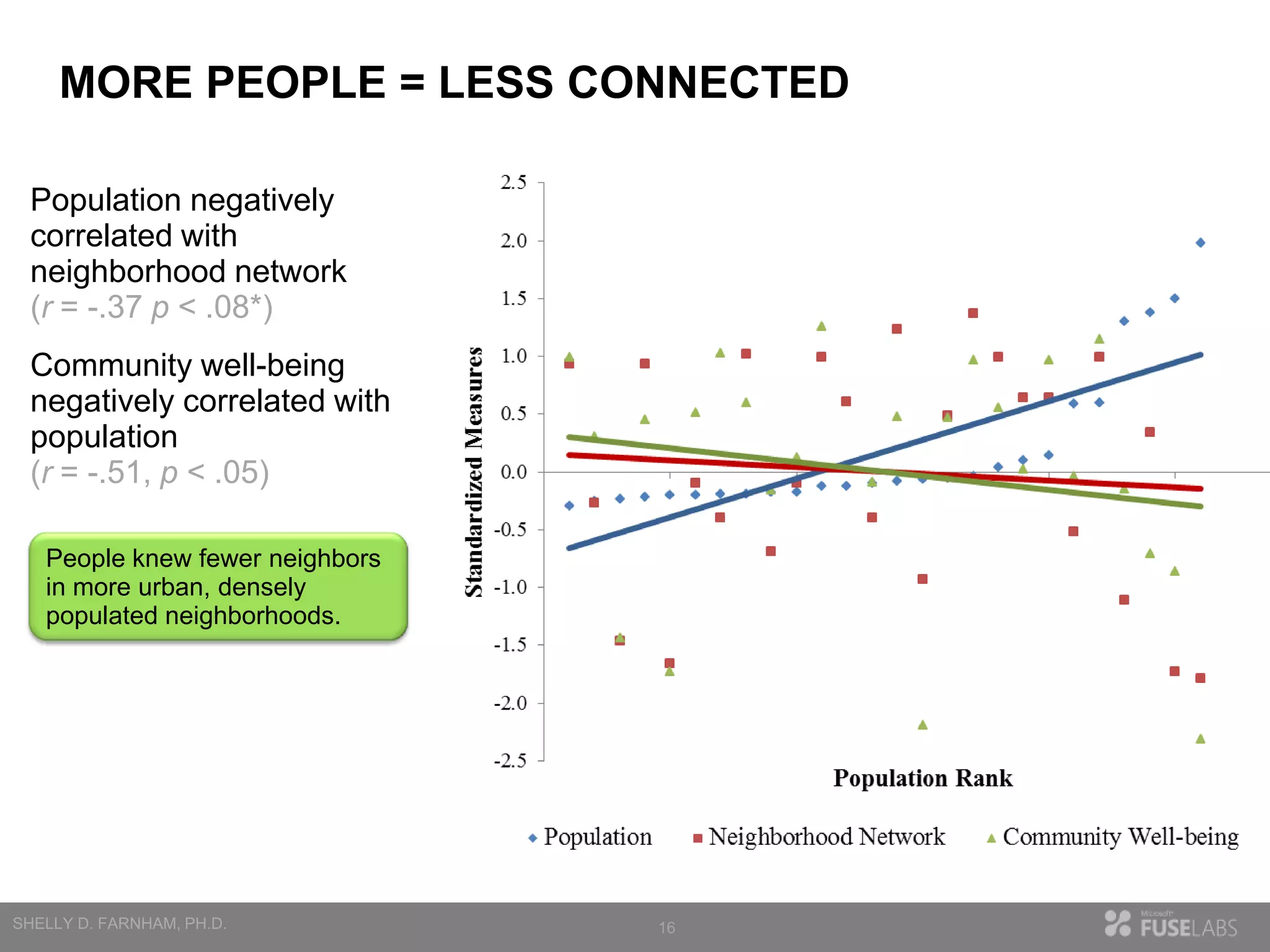
MORE PEOPLE = LESS CONNECTED
Population negatively
correlated with
neighborhood network
(r = -.37 p < .08*)
Community well-being
negatively correlated with
population
(r = -.51, p < .05)
People knew fewer neighbors
in more urban, densely
populated neighborhoods.

16
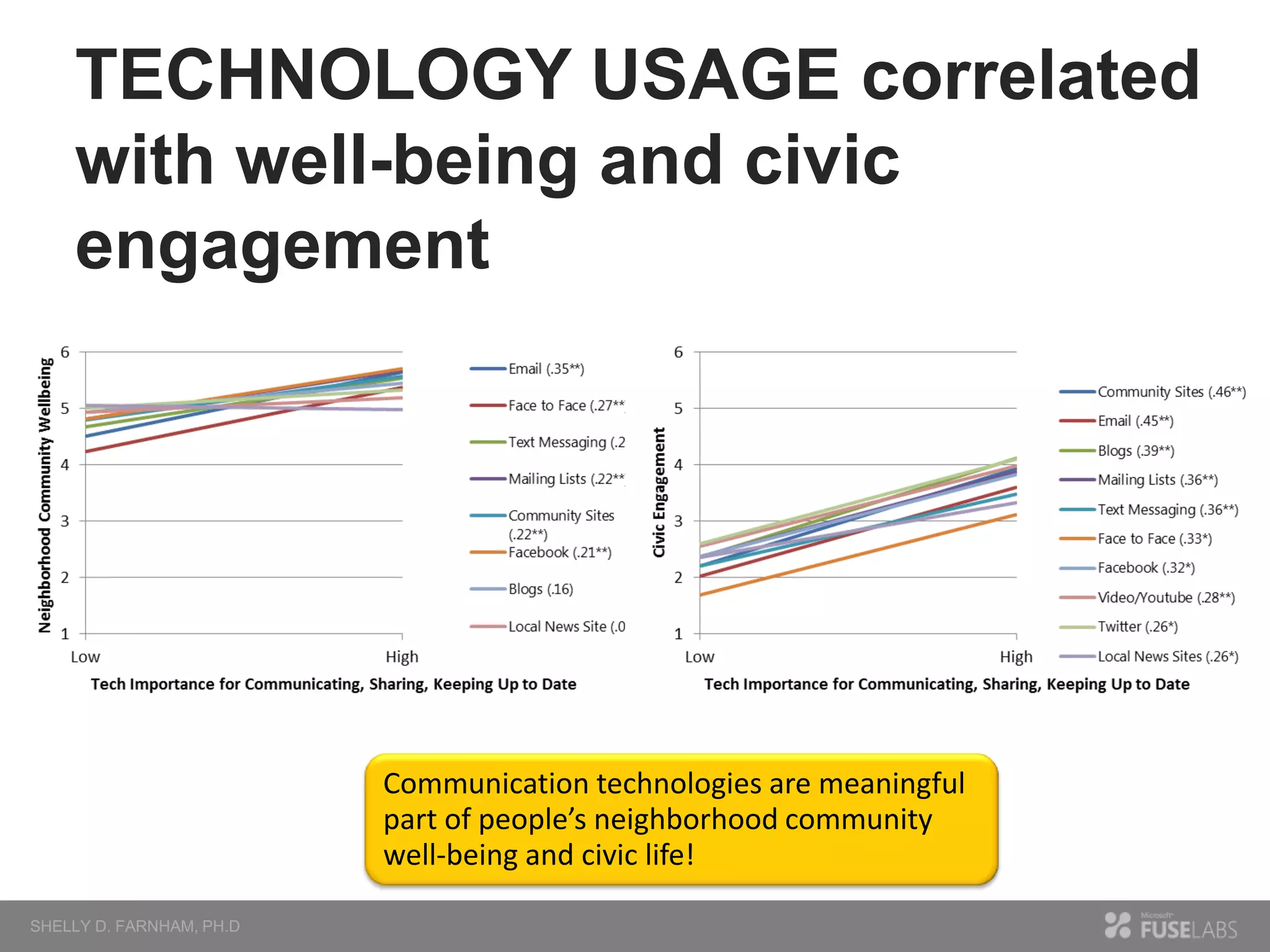
TECHNOLOGY USAGE correlated
with well-being and civic
engagement

Communication technologies are meaningful
part of people’s neighborhood community
well-being and civic life!
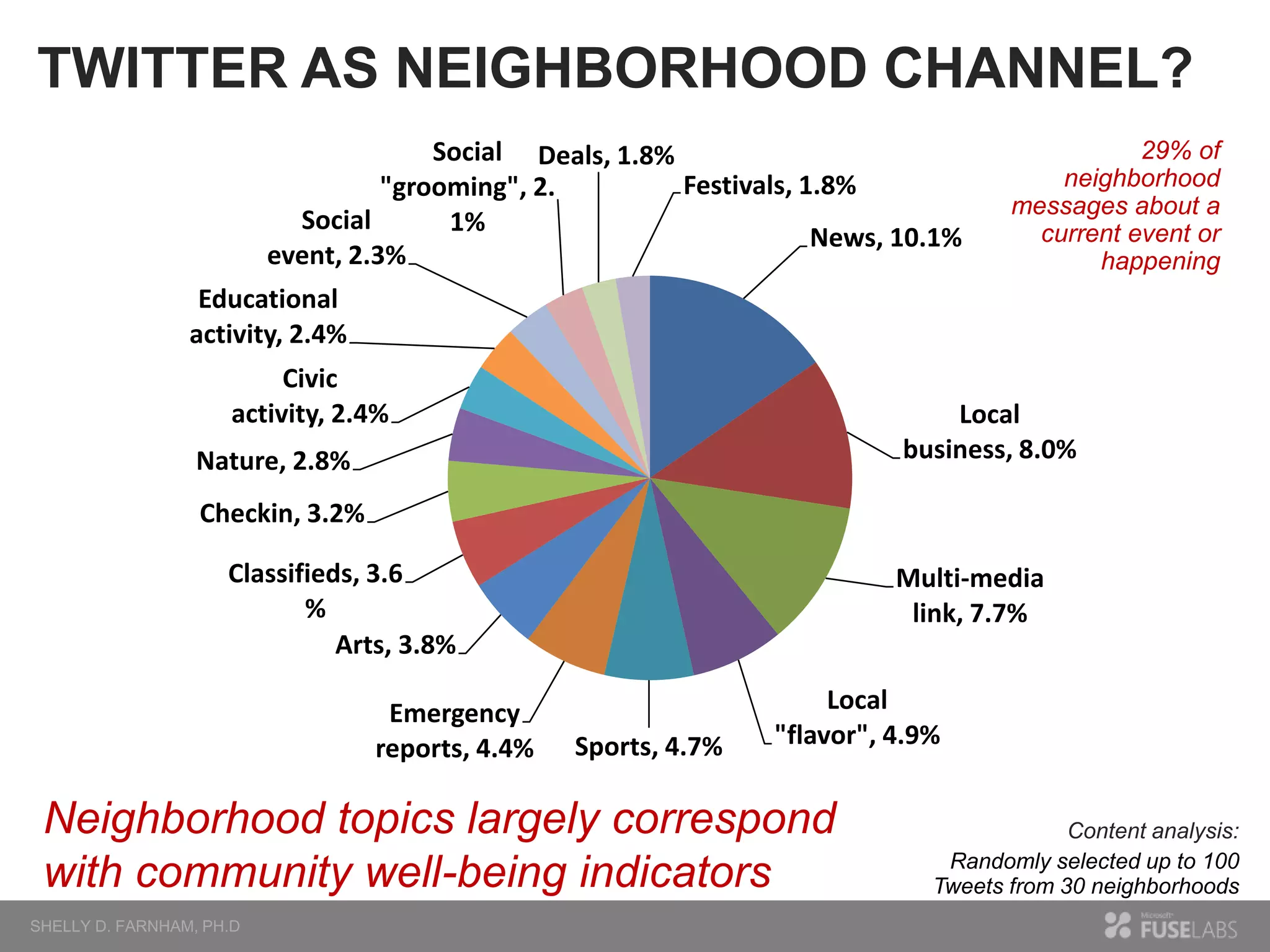
TWITTER AS NEIGHBORHOOD CHANNEL?
Social Deals, 1.8%
Festivals, 1.8%
"grooming", 2.
Social
1%
News, 10.1%
event, 2.3%

29% of
neighborhood
messages about a
current event or
happening

Educational
activity, 2.4%

Civic
activity, 2.4%

Local
business, 8.0%

Nature, 2.8%
Checkin, 3.2%
Classifieds, 3.6
%
Arts, 3.8%
Emergency
reports, 4.4%

Multi-media
link, 7.7%

Sports, 4.7%

Local
"flavor", 4.9%

Neighborhood topics largely correspond
with community well-being indicators

Content analysis:
Randomly selected up to 100
Tweets from 30 neighborhoods
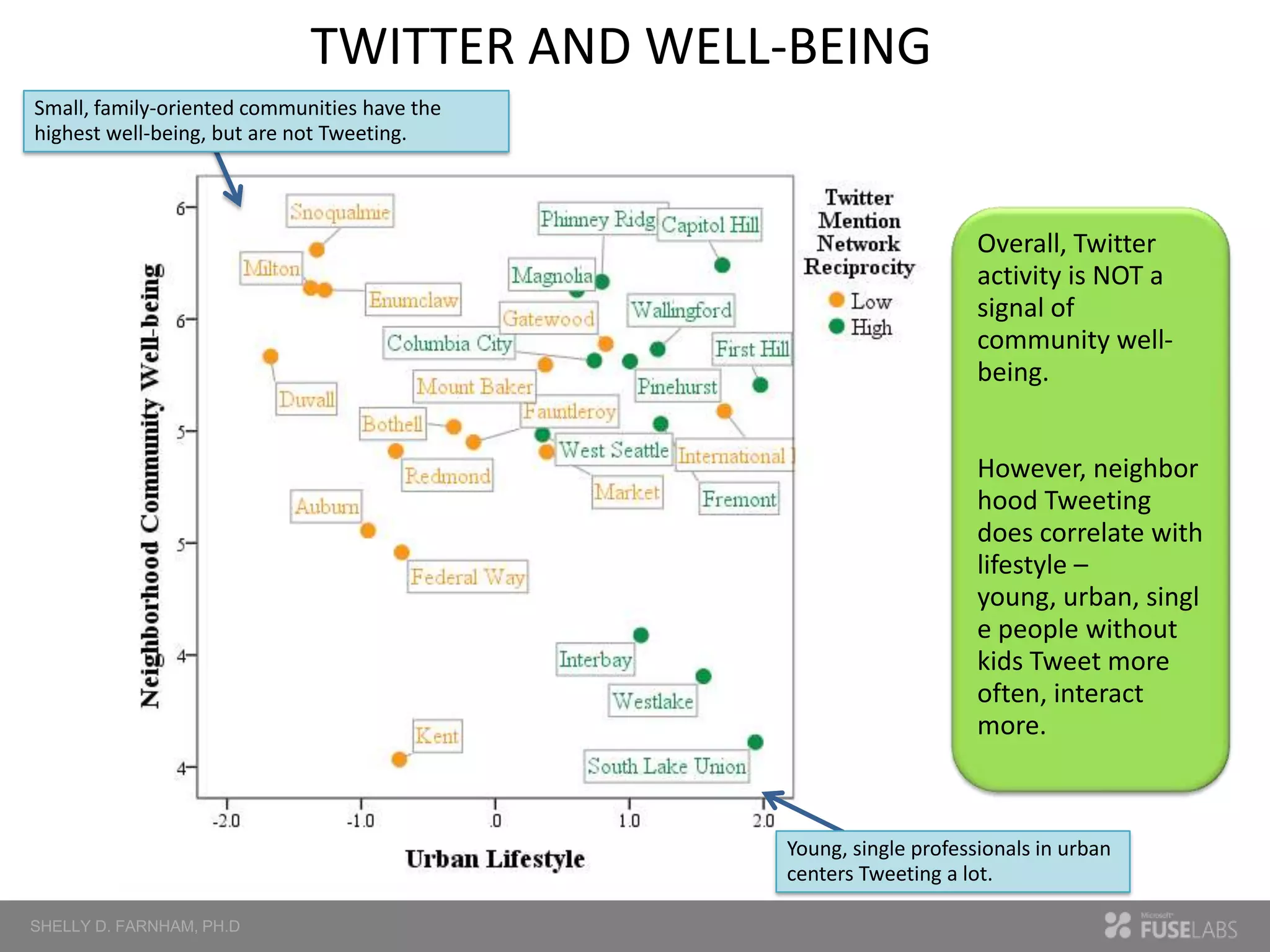
TWITTER AND WELL-BEING
Small, family-oriented communities have the
highest well-being, but are not Tweeting.

Overall, Twitter
activity is NOT a
signal of
community wellbeing.
However, neighbor
hood Tweeting
does correlate with
lifestyle –
young, urban, singl
e people without
kids Tweet more
often, interact
more.

Young, single professionals in urban
centers Tweeting a lot.
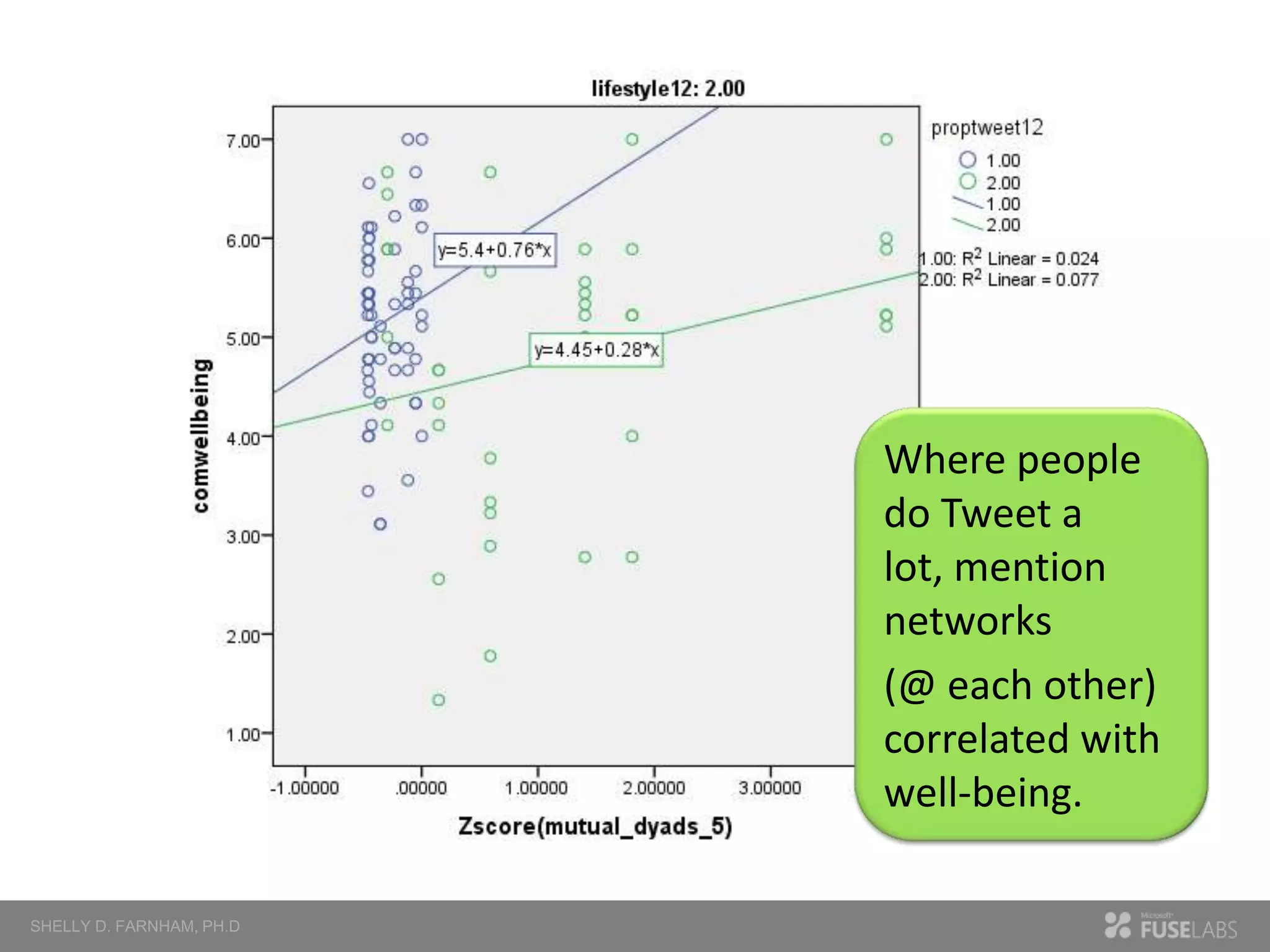
Where people
do Tweet a
lot, mention
networks
(@ each other)
correlated with
well-being.
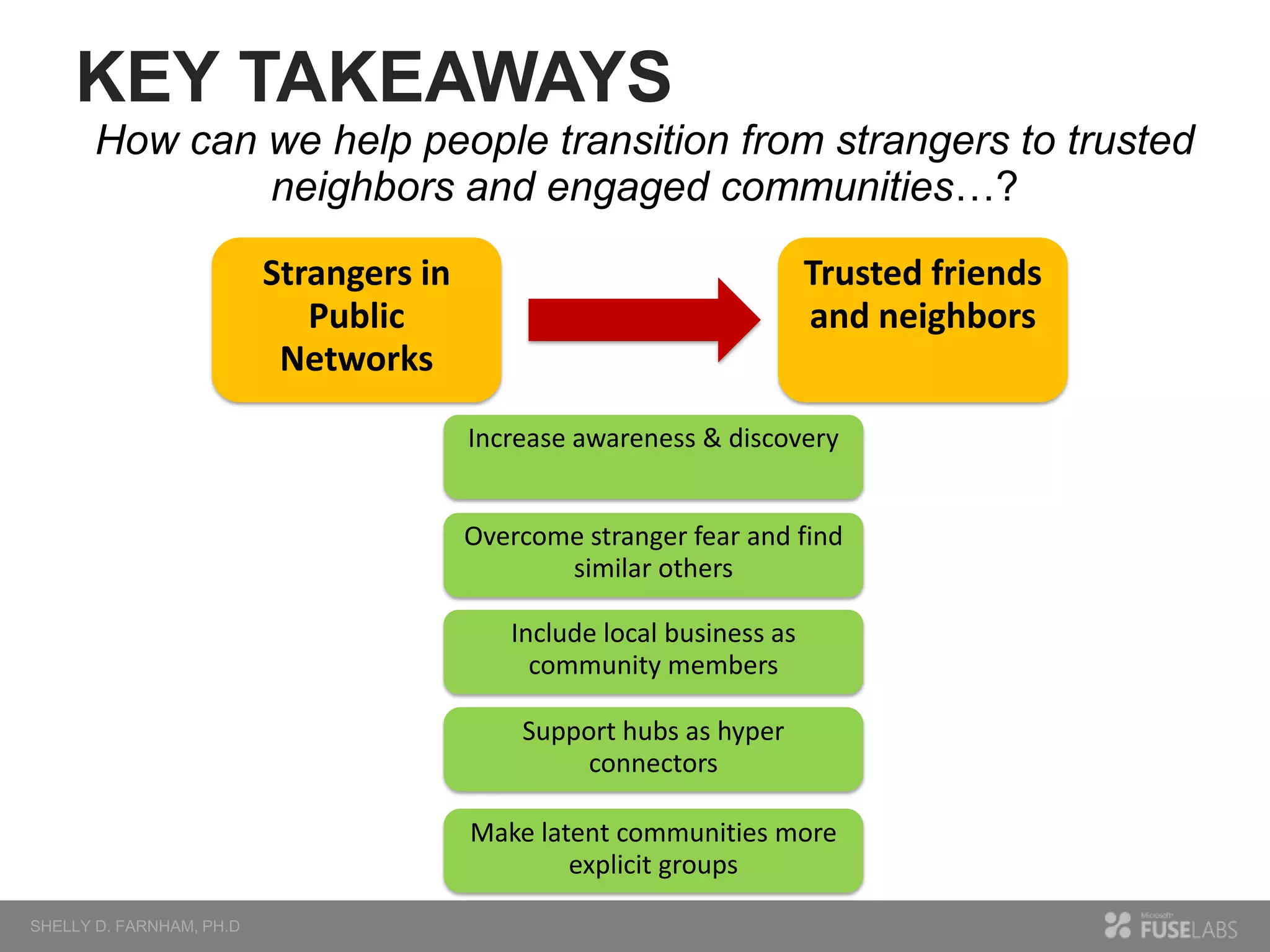
KEY TAKEAWAYS
How can we help people transition from strangers to trusted
neighbors and engaged communities…?
Strangers in
Public
Networks

Trusted friends
and neighbors
Increase awareness & discovery
Overcome stranger fear and find
similar others
Include local business as
community members

Support hubs as hyper
connectors
Make latent communities more
explicit groups
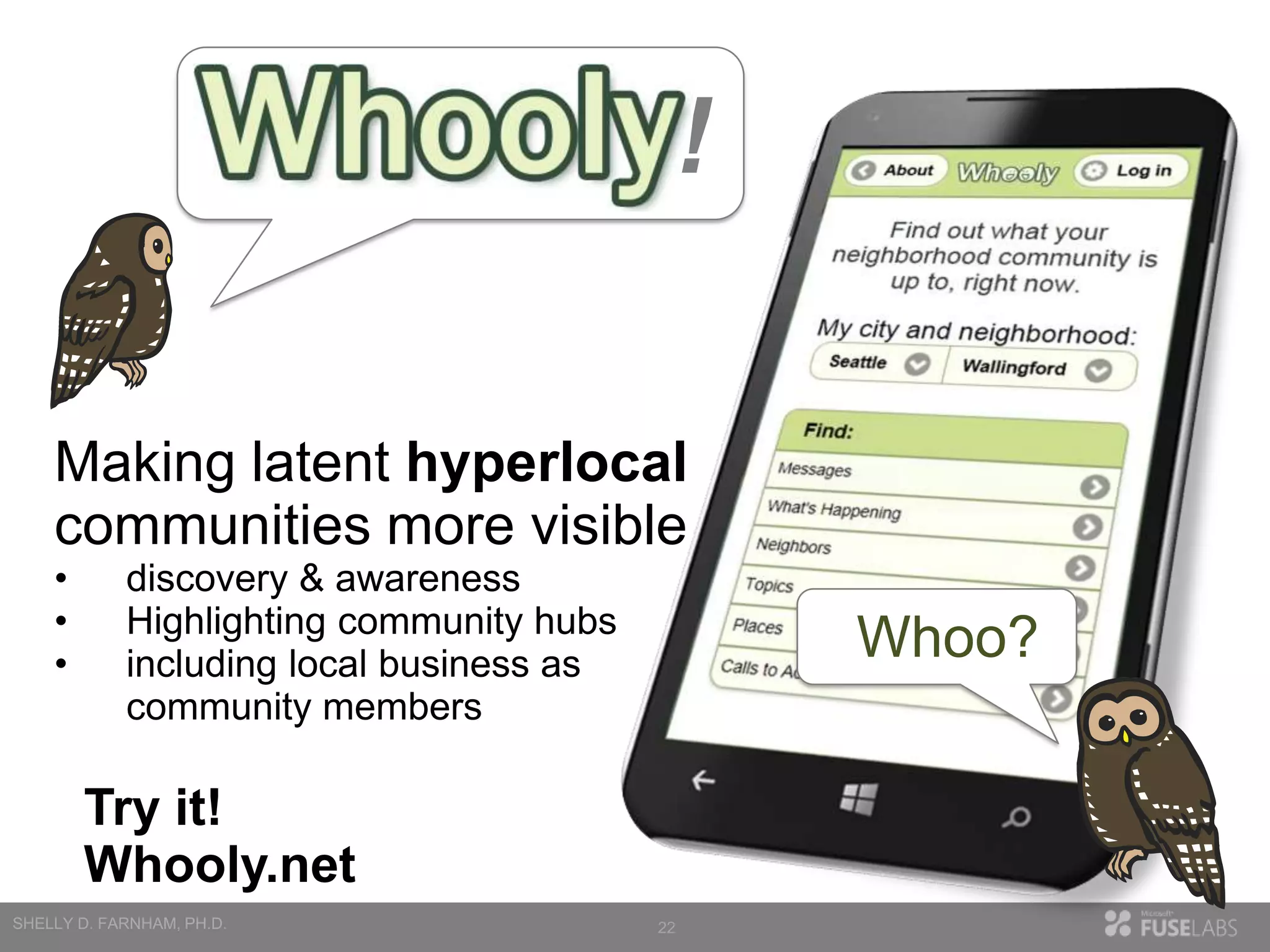
!
Making latent hyperlocal
communities more visible
•
•
•

discovery & awareness
Highlighting community hubs
including local business as
community members

Whoo?

Try it!
Whooly.net
22
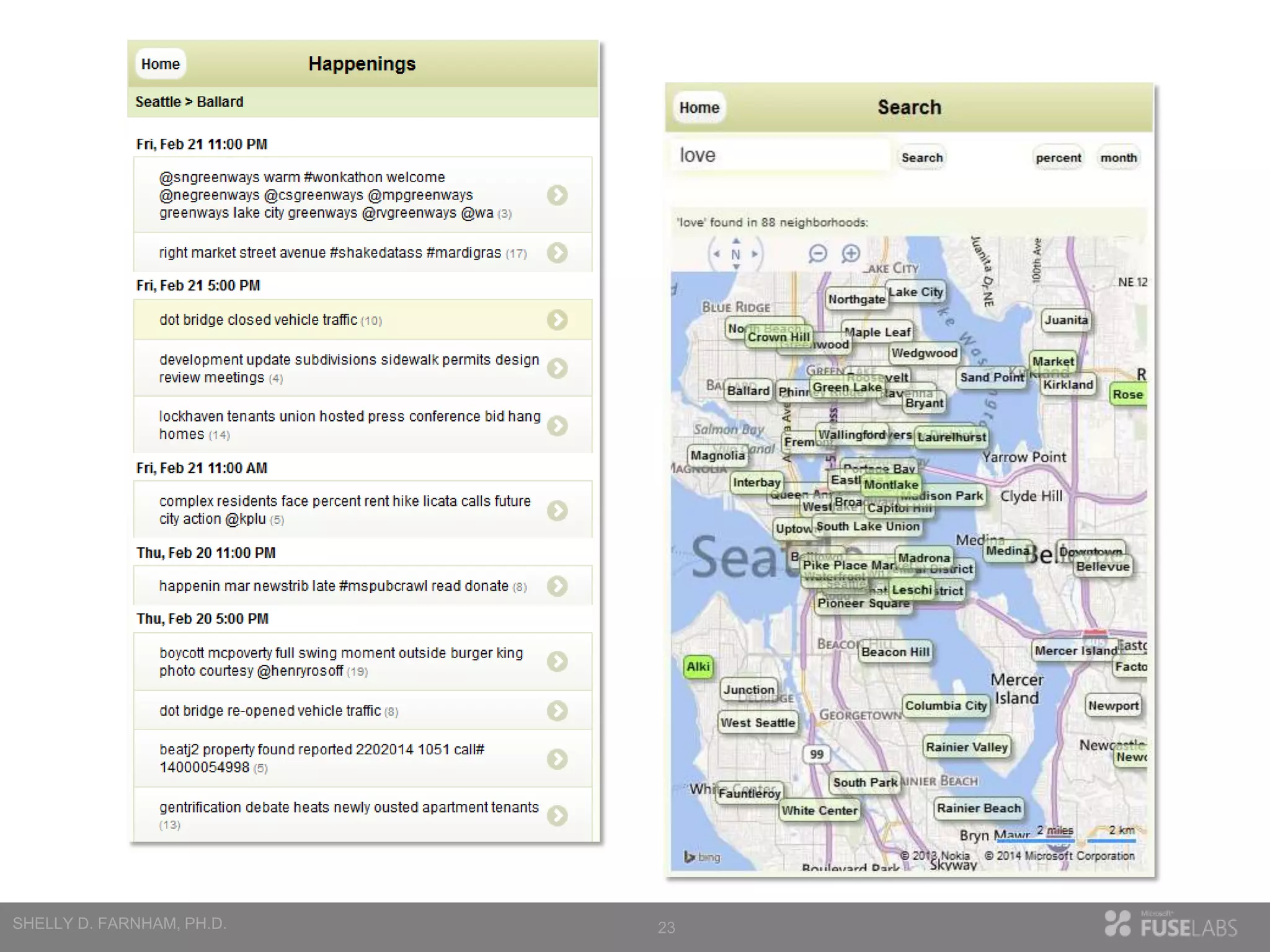
23
CONTACT

Shelly Farnham
@ShellyShelly
http://fuse.Microsoft.com
shellyfa@Microsoft.com
http://sodapoptech.com
24

Leveraging Open Data and Social Media for Improved Community Well-being

  • 1.
    Leveraging Open Data &Social Media To Measure & Impact Citizen Well-being Shelly D. Farnham, Ph.D. FUSE Labs, Microsoft Research 1
  • 2.
    BIG DREAMS “By 2035,there will be almost no poor countries left in the world.” Bill Gates 3 Myths that Block Progress for the Poor 2014 Gates Annual Letter http://annualletter.gatesfoundation.org/ https://www.flickr.com/photos/kaptainkobold/9324963783/ 2
  • 3.
  • 4.
    REDEFINING PROSPERITY From opulence towell-being: A sustainable economy does not depend on consumer culture to drive growth. We can foster well-being by impacting people’s ability to flourish – to participate in life. Everyone can be prosperous. 4
  • 5.
    GLOBAL CAUSES OFLOW WELL-BEING CAUSE SOLUTIONS Overpopulation, as ratio of: population size to Impact population size: education and shift cultural norms around family planning; access to birth control; education and shift cultural norms around gender equality policies. Impact available resources: increase productivity of local economy through modernization of industry, e.g., mechanize food production. available economic resources. Unequal distribution of resources. Develop economies with industry and technology; infusion of essential raw materials and infrastructure: access to resources; Develop skills through education/training, Change in policies through more equal trade practices with other more developed countries (shift in cultural norms), More investment and equal access to social programs that reduce impact on productivity: mental health, drug abuse, learned helplessness, etc. Redistribution of income from the haves to the have-nots. Minimum wage/tax incentives Inadequate education and employment, illiteracy and lack of work force with Increase access and adoption of education technologies. Increase productivity of local economy and related employment opportunities – e.g., globalization of work force with context independent skills context independent skills Environmental degradation, leading to Education and shift of cultural norms and policy around sustainability/environmental issues such as deforestation. Increase access to other resources/economic opportunities shortages in available resources; often caused by overpopulation General economic trends, Education/training specialized skills. Predicting/tracking trends to support an adapting workforce (analysis, and skills retraining) . Changing demographic shifts, such Change in cultural shift around family planning: supporting education and access to birth control. Economic/policy incentives to support two parent families & other social structures. Cultural awareness and shift in social policies that “punish” the child, assuring crossgenerational entrapment in poverty. such as changing demands of work force for more skilled labor, increase poverty rate of those without skills. as increases in single parenthood making it difficult to escape cycle of poverty over generations. Intra-individual factors, such motivational / individual responsibility, health problems, addictions, and problems with welfare dependency. Foster cultural education, awareness, and investment in social programs to address intraindividual factors impacting joining the work force, including learned helplessness, drug abuse, mental illness (depression, schizophrenia), physical well-being (obesity, malnutrition, disabilities), social disenfranchisement, social skills. Welfare/wealth redistribution policy incentives; structured to incentivize work, while at the same time assuring minimal well-being, health, homelessness, other issues preventing ability to work or accessibility/adoption of skills training and/or entrapment in poverty life-cycles. BASED ON WHAT CAUSES POVERTY? http://www.fightpoverty.mmbrico.com/poverty/reasons.html 5
  • 6.
    EMERGING TRENDS INTECHNOLOGY = NEW OPPORTUNITIES Learning networks that provide global access to free education and related social support systems to assure successful motivation and adoption towards the development of the new skills needed to foster a growing economy. Civic crowd-sourcing services enabling direct redistribution of wealth to most impactful social programs addressing causes of poverty, such as kickstarter for social programs, supplementary self-taxing programs, community self-support programs. Development of services such as microfinancing that enable indirect redistribution of resources to programs that foster economic development. Analysis tools of large scale data systems (economics/social services/policies) examining relative impact of various factors in influencing well-being, measuring the success of various programs to improve well-being, and where to focus energy to maximally impact change. Social media tools that empower citizens for increasing awareness, shifting cultural norms, increasing engagement, empathy, and collective action, around factors impacting individual well-being and community well-being. Economic participation tools such as crowd-sourcing, sharing economy services, online stores, DIY sites, for self-directed, bottoms up engagement in global economy.. Dematerialization of assets, driving economy without consumption of limited natural resources e.g., objects in games, digital art, experiential gifts, virtual signals of social status 6
  • 7.
    LEVERAGING SOCIAL TECHNOLOGIESTO INCREASE POWER OF COMMUNITY Place Attachment Buy Coffee Sense of Community Event Attachment Come Back Again and Again Sense of Community Neighborhood Attachment Civic Action Sense of Community CoCollage Pathable Puget Sound OFF Farnham, S. D., Keyes, D., Yuki, V., and Tugwell, C. 2012. Puget Sound Off: Fostering youth civic engagement through citizen journalism. In Proc CSCW 2012, ACM Press. Farnham, S., McCarthy, J., Patel, Y., Ahuja, S., Norman, D., Hazlewood, W., Lind, J. (2009). Measuring the impact of place attachment on the adoption of a place-based community technology. In Proceedings of CHI 2009. Farnham, S., Schwartz, J., Brown, P. (2009). Leveraging social software for strategic social networking and community development at events. In Communities and Technologies 2009.
  • 8.
    PUGET SOUND OFF: FOSTERINGYOUTH CIVIC ENGAGEMENT THROUGH CITIZEN JOURNALISM IN A LOCAL COMMUNITY CONTEXT Shelly D. Farnham FUSE Labs Microsoft Research David Keyes and Vicky Butler Dept of Information Technology City of Seattle Chris Tugwell Technology Programs Metrocenter YMCA Farnham, S. D., Keyes, D., Yuki, V., and Tugwell, C. 2012. Puget Sound Off: Fostering youth civic engagement through citizen journalism. In Proc CSCW 2012, ACM Press. 8
  • 9.
    DESIGNING FOR EFFECTIVECIVIC ENGAGEMENT ACQUIRING KNOWLEDGE SELFEXPRESSION JOINING PUBLICS COLLECTIVE ACTION online Online research Consuming blogs, journals Blogs Twitter Photos Online groups Mailing lists Emails Calendar events offline ENGAGED CITIZENS Research Attending town halls Wearing badges Posters in yard Conversation clubs, groups meetings Rallies Letters to elected officials Bennett, W. L., Wells, C., and Freelorn, D. 2009. Communicating citizenship online: models of civic learning in the you web sphere. Civic Learning Online Project.
  • 10.
    PUGET SOUND OFFUSAGE IMPACTED CIVIC ENGAGEMENT    Inspired conversations around local civic issues Usage correlated with higher civic engagement Usage correlated with whether it reflected their community’s interests (r = .61, p < .05) Photo Club @ WSHS, colleenmcdevitt http://pugetsoundoff.org/image/21892 Civic engagement (Keeter et al., 2002) e.g. “taking part in a protest, march or demonstration” “Spending time participating in community service or volunteer activity”
  • 11.
    IMPORTANCE OF HAVINGA VOICE IN PUBLIC SPACES Structural equation model showing only significant standardized coefficients between variables. Public networks: Twitter, blogging, wiki Media sharing: photo sharing, videos Personal networks: facebook, SMS  Use of public networks and media sharing correlated with civic engagement, not use of personal networks  Civic self-efficacy and identification with community correlated with civic engagement
  • 12.
    HYPER-LOCAL What is happening inthis neighborhood? Can we leverage social media/Twitter for: Measuring well-being Increasing community participation and well-being 12
  • 13.
    NEIGHBORHOOD STUDY Twitter Analysis Resident Interviews and Questionnaire 26randomly selected neighborhoods, 174 on site interviews STUDY One month of Twitter messages mentioning neighborhoods, ~3000 messages manually coded ~50K automatically Location Data Demographics Census Location, Inc. real estate dataset 13 Multi-method approach allowed us to triangulate on a rich picture of King County towns and neighborhoods.
  • 14.
    INDICATORS OF COMMUNITY WELLBEINGFROM INTERVIEWS Indicators of Community Well-being Thriving local businesses Percent Mentions 47% 33% Community events 25% Community resources 25% Friendly 25% Walkability 25% Gathering places 24% Social support 20% Well-maintained 19% Other health: mental, economic, physical 19% People know each other 14% Diversity (race, SES, age, families) 12% Vibrancy -- people out and about 11% People interact/communicate “What does this community have that indicates to you that it is healthy or unhealthy?” Safe, low crime 11% Civic engagement 10% Environmental/geographical assets 10% Growth - embracing change 10%
  • 15.
    1. Entities youdevelop a personal relationship with. 2. 3. Provide a place to meet people in the neighborhood. Local businesses SERVE as quintessential third places where communities grow
  • 16.
    MORE PEOPLE =LESS CONNECTED Population negatively correlated with neighborhood network (r = -.37 p < .08*) Community well-being negatively correlated with population (r = -.51, p < .05) People knew fewer neighbors in more urban, densely populated neighborhoods. 16
  • 17.
    TECHNOLOGY USAGE correlated withwell-being and civic engagement Communication technologies are meaningful part of people’s neighborhood community well-being and civic life!
  • 18.
    TWITTER AS NEIGHBORHOODCHANNEL? Social Deals, 1.8% Festivals, 1.8% "grooming", 2. Social 1% News, 10.1% event, 2.3% 29% of neighborhood messages about a current event or happening Educational activity, 2.4% Civic activity, 2.4% Local business, 8.0% Nature, 2.8% Checkin, 3.2% Classifieds, 3.6 % Arts, 3.8% Emergency reports, 4.4% Multi-media link, 7.7% Sports, 4.7% Local "flavor", 4.9% Neighborhood topics largely correspond with community well-being indicators Content analysis: Randomly selected up to 100 Tweets from 30 neighborhoods
  • 19.
    TWITTER AND WELL-BEING Small,family-oriented communities have the highest well-being, but are not Tweeting. Overall, Twitter activity is NOT a signal of community wellbeing. However, neighbor hood Tweeting does correlate with lifestyle – young, urban, singl e people without kids Tweet more often, interact more. Young, single professionals in urban centers Tweeting a lot.
  • 20.
    Where people do Tweeta lot, mention networks (@ each other) correlated with well-being.
  • 21.
    KEY TAKEAWAYS How canwe help people transition from strangers to trusted neighbors and engaged communities…? Strangers in Public Networks Trusted friends and neighbors Increase awareness & discovery Overcome stranger fear and find similar others Include local business as community members Support hubs as hyper connectors Make latent communities more explicit groups
  • 22.
    ! Making latent hyperlocal communitiesmore visible • • • discovery & awareness Highlighting community hubs including local business as community members Whoo? Try it! Whooly.net 22
  • 23.
  • 24.

Editor's Notes

  • #14 Twitter analysisSelection:One month data, Nov – dec 2012Person says they are from a King County city in Twitter profileMessage explicitly mentions neighborhoodTwitter content analysis, manual coding (26 randomly selected neighborhoods)~100 randomly selected messages coded per neighborhood, but read in context to retain meaningSocial network analysis; descriptives
  • #23 Term frequencyTrending EventsRank Terms2weekperiod2 hr