1
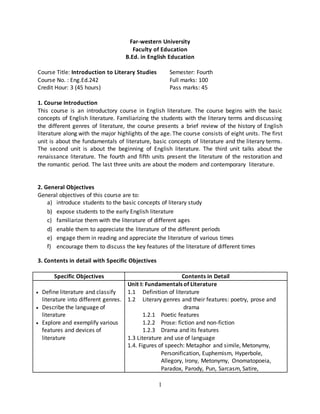
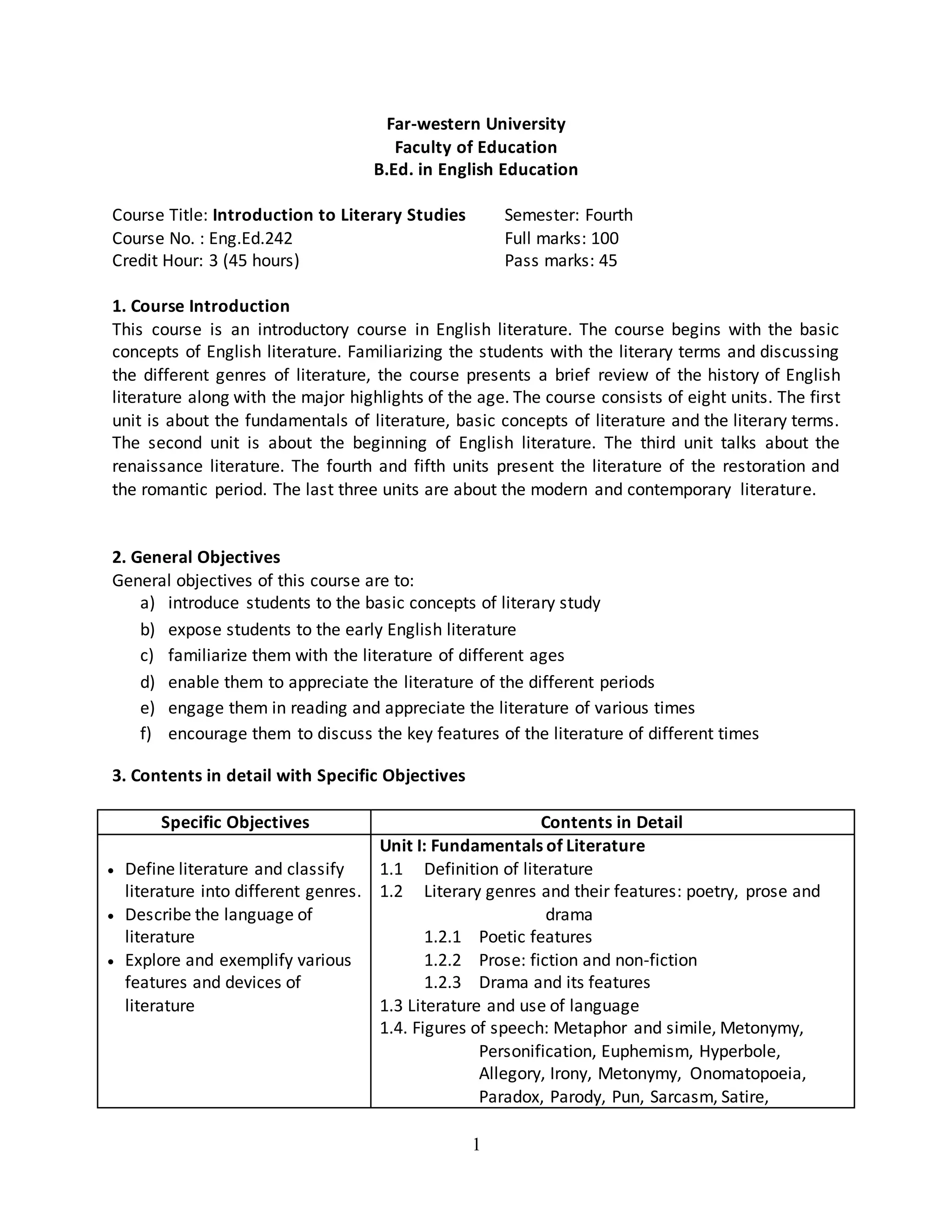
Far-western University
Faculty of Education
B.Ed. in English Education
Course Title: Introduction to Literary Studies Semester: Fourth
Course No. : Eng.Ed.242 Full marks: 100
Credit Hour: 3 (45 hours) Pass marks: 45
1. Course Introduction
This course is an introductory course in English literature. The course begins with the basic
concepts of English literature. Familiarizing the students with the literary terms and discussing
the different genres of literature, the course presents a brief review of the history of English
literature along with the major highlights of the age. The course consists of eight units. The first
unit is about the fundamentals of literature, basic concepts of literature and the literary terms.
The second unit is about the beginning of English literature. The third unit talks about the
renaissance literature. The fourth and fifth units present the literature of the restoration and
the romantic period. The last three units are about the modern and contemporary literature.
2. General Objectives
General objectives of this course are to:
a) introduce students to the basic concepts of literary study
b) expose students to the early English literature
c) familiarize them with the literature of different ages
d) enable them to appreciate the literature of the different periods
e) engage them in reading and appreciate the literature of various times
f) encourage them to discuss the key features of the literature of different times
3. Contents in detail with Specific Objectives
Specific Objectives Contents in Detail
 Define literature and classify
literature into different genres.
 Describe the language of
literature
 Explore and exemplify various
features and devices of
literature
Unit I: Fundamentals of Literature
1.1 Definition of literature
1.2 Literary genres and their features: poetry, prose and
drama
1.2.1 Poetic features
1.2.2 Prose: fiction and non-fiction
1.2.3 Drama and its features
1.3 Literature and use of language
1.4. Figures of speech: Metaphor and simile, Metonymy,
Personification, Euphemism, Hyperbole,
Allegory, Irony, Metonymy, Onomatopoeia,
Paradox, Parody, Pun, Sarcasm, Satire,
2
Alliteration, Assonance
1.5. Prosodic features; rhyme and rhythm
 Explain the contexts and
conditions of the English in the
beginning
 Discuss personal and religious
voices
 Distinguish language from
dialect in literature
 Appreciate the authors of the
early period
Unit Two: The Beginnings of English
2.1. Context and conditions
2.2. Personal and religious voices
2.3. French influence and English affirmation
2.4. Language and dialect
2.5. Individualism
2.6. Women’s voices
2.7. Key authors of the age
 Identifythe literarygenresof the
Renaissance period
 Read and appreciate the authors
of the Renaissance period
Unit Three: The Renaissance
3.1. Contexts and conditions
3.2. The Renaissance poetry and prose
3.3. Drama in the Renaissance
3.4. Key authors of the age
 Discuss the key features of the
literature of the restoration
period
 Talk about eh poetry after
Pope
 Talk about melancholy,
madness and nature
Unit Four: Restoration to Romanticism
4.1. Contexts and conditions
4.2. Restoration drama
4.3. Drama after 1737
4.4. Poetry after Pope
4.5. Melancholy, madness and nature
4.6. The Gothic and the sublime
 Mention the key features of
the literature of the romantic
period
 Argue for the rights and voices
of poetry
 Describe the romantic prose
and its features
 Read and appreciate the
novels of the romantic period
Unit Five: The Romantic Period
5.1. Contexts and conditions
5.2. Blake, Wordsworth and Coleridge
5.3. Keats, Shelly and Byron
5.4. Rights and voices of poetry
5.5. Romantic prose
5.6. Novels of the romantic period
 Discuss the literature of the
Victorian age
 Describe the features of the
Victorian literature
 Read and appreciate the
Victorian poetry and drama
Unit Six: The Nineteenth Century
6.1. Contexts and conditions
6.2. Dickens
6.3. Victorian thought and Victorian novels
6.4. Victorian fantasy
6.5. Victorian poetry and drama
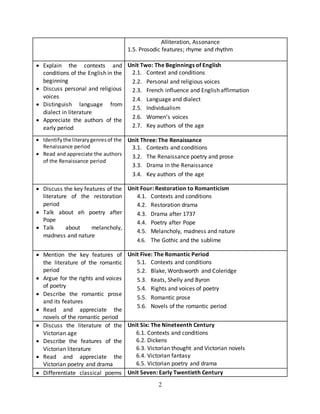
 Differentiate classical poems Unit Seven: Early Twentieth Century
3
from modern poems
 Talk about the poetsin the
thirties
 Describe the novels and their
features after 1945
 Analyze the war literature
7.1. Contexts and conditions
7.2. Modern poetry
7.3. Thirties poets
7.4. Irish drama
7.5. The novel to 1945
7.6. Novel of the First World War
 Describe the features of
modern drama after 1945
 Discuss the poems of the
Second World War
 Identify the writing for
children
 Talk about internationalism
 Discuss the new modes of
modern writing
 Mention the contemporary
Irish and Scottish novels
Unit Eight: The Twentieth Century
8.1. Contexts and conditions
8.2. Drama since 1945
8.3. Poetry of the Second World War
8.4. The novel since 1945
8.5. Children’s literature
8.6. Internationalism
8.7. New modes of modern writing
8.9. Contemporary Irish and Scottish novel
4. Methodology and Techniques
Modes of instruction:
 Lecture
 Seminar
 Exercises
 Guided study
 Tutorial
 Independent study
 Project work
Modes of learning:
 Attending lectures,
 Doing assignments,
 Writing papers,
 Independent and private study,
 Reading books, reviewing journals and papers,
 Critiquing
 Group study
 Peer discussion
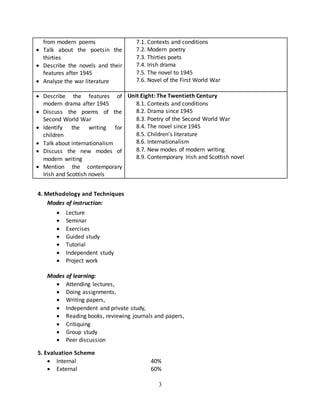
5. Evaluation Scheme
 Internal 40%
 External 60%
4
The internal examination will be conducted as follow:
a) Regularity and class participation 5%
b) Quizzes: 3 5%
c) Class presentation: 1 20%
d) Term paper/assignment: 1 20%
e) Mid-term Exam 20%
f) Investigative Project Work: 1 20%
g) Group Work and Pair Work/Group Project: 1 10%
6. Prescribed Textbook
Abrams, M.H. and Harpham, G.G. (2009). A glossary of literary terms. Ninth Edition. Boston:
Wadsworth Cengage Learning. (For unit I)
Carter, R. and McRae, J. (2013). The routledge history of literature in english. Delhi: Routledge.
6. References
Awasthi, J. R., Bhattarai, G. R. &Khaniya, T. R. (Eds.) (2010). Explorations in English. Kathmandu.
Cudden, J. A. (1992). The Penguin dictionary of literary terms and literary theories (3rd edition).
India: Penguin.
Maley, A. (2006). English through literature. Beijing: Central Radio & TV University.
Nayar, P.K. (2009). A short history of English literature. Delhi: Foundation Books.

Introduction to literary studies

  • 1.
    1 Far-western University Faculty ofEducation B.Ed. in English Education Course Title: Introduction to Literary Studies Semester: Fourth Course No. : Eng.Ed.242 Full marks: 100 Credit Hour: 3 (45 hours) Pass marks: 45 1. Course Introduction This course is an introductory course in English literature. The course begins with the basic concepts of English literature. Familiarizing the students with the literary terms and discussing the different genres of literature, the course presents a brief review of the history of English literature along with the major highlights of the age. The course consists of eight units. The first unit is about the fundamentals of literature, basic concepts of literature and the literary terms. The second unit is about the beginning of English literature. The third unit talks about the renaissance literature. The fourth and fifth units present the literature of the restoration and the romantic period. The last three units are about the modern and contemporary literature. 2. General Objectives General objectives of this course are to: a) introduce students to the basic concepts of literary study b) expose students to the early English literature c) familiarize them with the literature of different ages d) enable them to appreciate the literature of the different periods e) engage them in reading and appreciate the literature of various times f) encourage them to discuss the key features of the literature of different times 3. Contents in detail with Specific Objectives Specific Objectives Contents in Detail  Define literature and classify literature into different genres.  Describe the language of literature  Explore and exemplify various features and devices of literature Unit I: Fundamentals of Literature 1.1 Definition of literature 1.2 Literary genres and their features: poetry, prose and drama 1.2.1 Poetic features 1.2.2 Prose: fiction and non-fiction 1.2.3 Drama and its features 1.3 Literature and use of language 1.4. Figures of speech: Metaphor and simile, Metonymy, Personification, Euphemism, Hyperbole, Allegory, Irony, Metonymy, Onomatopoeia, Paradox, Parody, Pun, Sarcasm, Satire,
  • 2.
    2 Alliteration, Assonance 1.5. Prosodicfeatures; rhyme and rhythm  Explain the contexts and conditions of the English in the beginning  Discuss personal and religious voices  Distinguish language from dialect in literature  Appreciate the authors of the early period Unit Two: The Beginnings of English 2.1. Context and conditions 2.2. Personal and religious voices 2.3. French influence and English affirmation 2.4. Language and dialect 2.5. Individualism 2.6. Women’s voices 2.7. Key authors of the age  Identifythe literarygenresof the Renaissance period  Read and appreciate the authors of the Renaissance period Unit Three: The Renaissance 3.1. Contexts and conditions 3.2. The Renaissance poetry and prose 3.3. Drama in the Renaissance 3.4. Key authors of the age  Discuss the key features of the literature of the restoration period  Talk about eh poetry after Pope  Talk about melancholy, madness and nature Unit Four: Restoration to Romanticism 4.1. Contexts and conditions 4.2. Restoration drama 4.3. Drama after 1737 4.4. Poetry after Pope 4.5. Melancholy, madness and nature 4.6. The Gothic and the sublime  Mention the key features of the literature of the romantic period  Argue for the rights and voices of poetry  Describe the romantic prose and its features  Read and appreciate the novels of the romantic period Unit Five: The Romantic Period 5.1. Contexts and conditions 5.2. Blake, Wordsworth and Coleridge 5.3. Keats, Shelly and Byron 5.4. Rights and voices of poetry 5.5. Romantic prose 5.6. Novels of the romantic period  Discuss the literature of the Victorian age  Describe the features of the Victorian literature  Read and appreciate the Victorian poetry and drama Unit Six: The Nineteenth Century 6.1. Contexts and conditions 6.2. Dickens 6.3. Victorian thought and Victorian novels 6.4. Victorian fantasy 6.5. Victorian poetry and drama  Differentiate classical poems Unit Seven: Early Twentieth Century
  • 3.
    3 from modern poems Talk about the poetsin the thirties  Describe the novels and their features after 1945  Analyze the war literature 7.1. Contexts and conditions 7.2. Modern poetry 7.3. Thirties poets 7.4. Irish drama 7.5. The novel to 1945 7.6. Novel of the First World War  Describe the features of modern drama after 1945  Discuss the poems of the Second World War  Identify the writing for children  Talk about internationalism  Discuss the new modes of modern writing  Mention the contemporary Irish and Scottish novels Unit Eight: The Twentieth Century 8.1. Contexts and conditions 8.2. Drama since 1945 8.3. Poetry of the Second World War 8.4. The novel since 1945 8.5. Children’s literature 8.6. Internationalism 8.7. New modes of modern writing 8.9. Contemporary Irish and Scottish novel 4. Methodology and Techniques Modes of instruction:  Lecture  Seminar  Exercises  Guided study  Tutorial  Independent study  Project work Modes of learning:  Attending lectures,  Doing assignments,  Writing papers,  Independent and private study,  Reading books, reviewing journals and papers,  Critiquing  Group study  Peer discussion 5. Evaluation Scheme  Internal 40%  External 60%
  • 4.
    4 The internal examinationwill be conducted as follow: a) Regularity and class participation 5% b) Quizzes: 3 5% c) Class presentation: 1 20% d) Term paper/assignment: 1 20% e) Mid-term Exam 20% f) Investigative Project Work: 1 20% g) Group Work and Pair Work/Group Project: 1 10% 6. Prescribed Textbook Abrams, M.H. and Harpham, G.G. (2009). A glossary of literary terms. Ninth Edition. Boston: Wadsworth Cengage Learning. (For unit I) Carter, R. and McRae, J. (2013). The routledge history of literature in english. Delhi: Routledge. 6. References Awasthi, J. R., Bhattarai, G. R. &Khaniya, T. R. (Eds.) (2010). Explorations in English. Kathmandu. Cudden, J. A. (1992). The Penguin dictionary of literary terms and literary theories (3rd edition). India: Penguin. Maley, A. (2006). English through literature. Beijing: Central Radio & TV University. Nayar, P.K. (2009). A short history of English literature. Delhi: Foundation Books.